 Intelligence is the ability to learn about, learn from,
  understand, and interact with one’s environment.
 This general ability consists of a number of specific
  abilities, which include these specific abilities:
     Adaptability to a new environment or to changes in the current
      environment
     Capacity for knowledge and the ability to acquire it
     Capacity for reason and abstract thought
     Ability to comprehend relationships
     Ability to evaluate and judge
     Capacity for original and productive thought
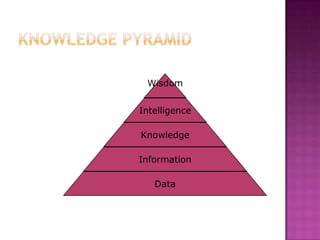
Wisdom


Intelligence

Knowledge

Information

   Data
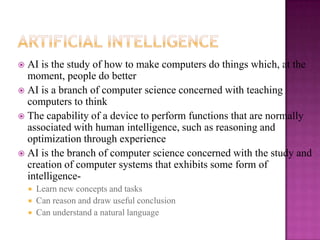
 AI is the study of how to make computers do things which, at the
  moment, people do better
 AI is a branch of computer science concerned with teaching
  computers to think
 The capability of a device to perform functions that are normally
  associated with human intelligence, such as reasoning and
  optimization through experience
 AI is the branch of computer science concerned with the study and
  creation of computer systems that exhibits some form of
  intelligence-
       Learn new concepts and tasks
       Can reason and draw useful conclusion
       Can understand a natural language
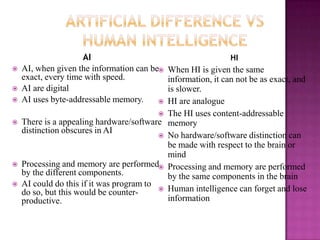
AI                                       HI
   AI, when given the information can be  When HI is given the same
    exact, every time with speed.           information, it can not be as exact, and
   AI are digital                          is slower.
   AI uses byte-addressable memory.       HI are analogue
                                           The HI uses content-addressable
   There is a appealing hardware/software memory
    distinction obscures in AI
                                           No hardware/software distinction can
                                            be made with respect to the brain or
                                            mind
   Processing and memory are performed Processing and memory are performed
    by the different components.            by the same components in the brain
   AI could do this if it was program to
                                           Human intelligence can forget and lose
    do so, but this would be counter-
    productive.                             information
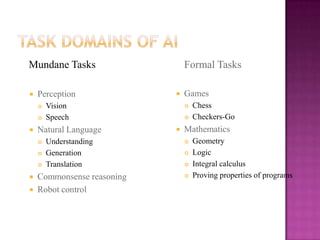
Mundane Tasks                   Formal Tasks

   Perception                 Games
       Vision                     Chess
       Speech                     Checkers-Go
   Natural Language           Mathematics
       Understanding              Geometry
       Generation                 Logic
       Translation                Integral calculus
   Commonsense reasoning          Proving properties of programs
   Robot control
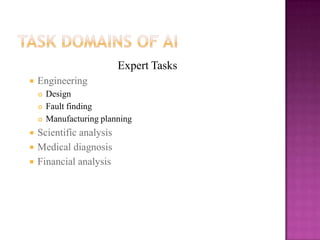
Expert Tasks
   Engineering
       Design
       Fault finding
       Manufacturing planning
   Scientific analysis
   Medical diagnosis
   Financial analysis
 This assumption was given by Newell and simon.
 They call this assumption the physical symbol system
  hypothesis.
 They define a physical symbol system as follows:-
    A physical symbol system consists of a set of entities called symbols, which
    are physical patterns that can occur as components of another type of entity
    called an expression or symbol structure. A symbol structure is composed of
    a number of instances (or tokens) of symbols related in some physical way.
    At any instance of time the system will contain a collection of these
    symbols structures. Besides these structures ,the system also contains a
    collection of processes that operate on expressions to produce other
    expressions: processes of and destruction.
 A physical symbol system is a machine that produces
  through time an evolving collection of symbol
  structures.
 This hypothesis is only a hypothesis.
 There appears to be no way to prove or disprove it on
  logical grounds.
 The only way to determine its truth is by
  experimentation.
   An AI technique is a method that exploits knowledge that should
    be represented in such a way that:
     The knowledge captures generalization.
     It can be understood by people who must provide it.
     It can easily be modified to correct errors and to reflect changes
      in the world and in our world view.
     It can be used in a great many situations even if it is not totally
      accurate or complete.
     It can be used to help overcome its own sheer bulk by helping to
      narrow the range of possibilities that must usually be considered.
   “What is our goal in trying to produce programs that do the
    intelligent things that people do?”
       Are we trying to produce programs that do the tasks the same way people
        do?
       Are we attempting to produce programs that simply do the task in
        whatever way appears easiest?
 Efforts to build programs that perform tasks the way
  people do can be divided into two classes:-
 In first class:-
   Programs that attempt to solve problems that do not
    really fit our definition of an AI task.
   They are problems that a computer could easily solve.
   Although that easy solution would exploit mechanisms
    that do not seem to be available to people.
   In second class:-
     Programs that attempt to model human performance are those
      that do things that fall more clearly within our definition of AI
      tasks.
     They do things that are not trivial for the computers.
     There are several reasons one might want to model human
      performance at these sorts of tasks:
       To test psychological theories of human performance

       To enable computers to understand human reasoning

       To enable people to understand computer reasoning

       To exploit what knowledge we can glean from people.
 In 1950,Alan Turing proposed the method for determining
  whether a machine can think.
 This method is known as Turing test.
 To conduct this test, we need
       2 people
       1 machine
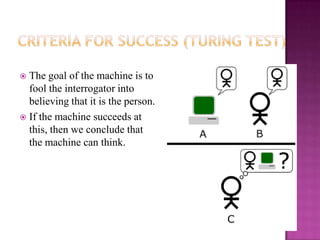
 One person plays the role of the interrogator, who is in a separate
  room from the computer and the other person.
 The interrogator can ask questions of either the person or the
  computer by typing questions and receiving typed responses.
 The interrogator knows them only as A and B
 The goal of the machine is to
  fool the interrogator into
  believing that it is the person.
 If the machine succeeds at
  this, then we conclude that
  the machine can think.

Artificial Intelligence

  • 3.
     Intelligence isthe ability to learn about, learn from, understand, and interact with one’s environment.  This general ability consists of a number of specific abilities, which include these specific abilities:  Adaptability to a new environment or to changes in the current environment  Capacity for knowledge and the ability to acquire it  Capacity for reason and abstract thought  Ability to comprehend relationships  Ability to evaluate and judge  Capacity for original and productive thought
  • 4.
  • 5.
     AI isthe study of how to make computers do things which, at the moment, people do better  AI is a branch of computer science concerned with teaching computers to think  The capability of a device to perform functions that are normally associated with human intelligence, such as reasoning and optimization through experience  AI is the branch of computer science concerned with the study and creation of computer systems that exhibits some form of intelligence-  Learn new concepts and tasks  Can reason and draw useful conclusion  Can understand a natural language
  • 6.
    AI HI  AI, when given the information can be When HI is given the same exact, every time with speed. information, it can not be as exact, and  AI are digital is slower.  AI uses byte-addressable memory.  HI are analogue  The HI uses content-addressable  There is a appealing hardware/software memory distinction obscures in AI  No hardware/software distinction can be made with respect to the brain or mind  Processing and memory are performed Processing and memory are performed by the different components. by the same components in the brain  AI could do this if it was program to  Human intelligence can forget and lose do so, but this would be counter- productive. information
  • 7.
    Mundane Tasks Formal Tasks  Perception  Games  Vision  Chess  Speech  Checkers-Go  Natural Language  Mathematics  Understanding  Geometry  Generation  Logic  Translation  Integral calculus  Commonsense reasoning  Proving properties of programs  Robot control
  • 8.
    Expert Tasks  Engineering  Design  Fault finding  Manufacturing planning  Scientific analysis  Medical diagnosis  Financial analysis
  • 9.
     This assumptionwas given by Newell and simon.  They call this assumption the physical symbol system hypothesis.  They define a physical symbol system as follows:- A physical symbol system consists of a set of entities called symbols, which are physical patterns that can occur as components of another type of entity called an expression or symbol structure. A symbol structure is composed of a number of instances (or tokens) of symbols related in some physical way. At any instance of time the system will contain a collection of these symbols structures. Besides these structures ,the system also contains a collection of processes that operate on expressions to produce other expressions: processes of and destruction.
  • 10.
     A physicalsymbol system is a machine that produces through time an evolving collection of symbol structures.  This hypothesis is only a hypothesis.  There appears to be no way to prove or disprove it on logical grounds.  The only way to determine its truth is by experimentation.
  • 11.
    An AI technique is a method that exploits knowledge that should be represented in such a way that:  The knowledge captures generalization.  It can be understood by people who must provide it.  It can easily be modified to correct errors and to reflect changes in the world and in our world view.  It can be used in a great many situations even if it is not totally accurate or complete.  It can be used to help overcome its own sheer bulk by helping to narrow the range of possibilities that must usually be considered.
  • 12.
    “What is our goal in trying to produce programs that do the intelligent things that people do?”  Are we trying to produce programs that do the tasks the same way people do?  Are we attempting to produce programs that simply do the task in whatever way appears easiest?
  • 13.
     Efforts tobuild programs that perform tasks the way people do can be divided into two classes:-  In first class:-  Programs that attempt to solve problems that do not really fit our definition of an AI task.  They are problems that a computer could easily solve.  Although that easy solution would exploit mechanisms that do not seem to be available to people.
  • 14.
    In second class:-  Programs that attempt to model human performance are those that do things that fall more clearly within our definition of AI tasks.  They do things that are not trivial for the computers.  There are several reasons one might want to model human performance at these sorts of tasks:  To test psychological theories of human performance  To enable computers to understand human reasoning  To enable people to understand computer reasoning  To exploit what knowledge we can glean from people.
  • 15.
     In 1950,AlanTuring proposed the method for determining whether a machine can think.  This method is known as Turing test.  To conduct this test, we need  2 people  1 machine  One person plays the role of the interrogator, who is in a separate room from the computer and the other person.  The interrogator can ask questions of either the person or the computer by typing questions and receiving typed responses.  The interrogator knows them only as A and B
  • 16.
     The goalof the machine is to fool the interrogator into believing that it is the person.  If the machine succeeds at this, then we conclude that the machine can think.