
CODE METRICS
Eng. Mohammad R. Katby
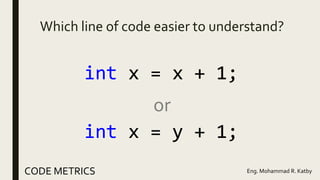
Which line of code easier to understand?
int x = x + 1;
int x = y + 1;
or
CODE METRICS Eng. Mohammad R. Katby
Agenda
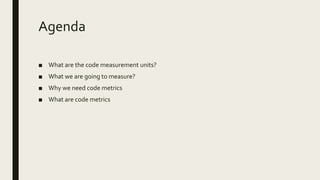
■ What are the code measurement units?
■ What we are going to measure?
■ Why we need code metrics
■ What are code metrics
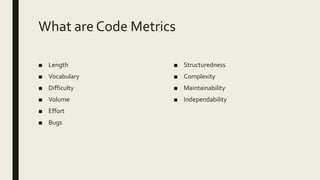
What are Code Metrics
■ Length
■ Vocabulary
■ Difficulty
■ Volume
■ Effort
■ Bugs
■ Structuredness
■ Complexity
■ Maintainability
■ Independability
Why we need measurements?
■ Without measurement you cannot understand code faults
■ See whether improvement can be made or not
■ Simply you can’t be Electrician if you can’t measure the voltage
Pioneers of Code Metrics
Thomas J. McCabe - 1976 Maurice Halstead - 1977
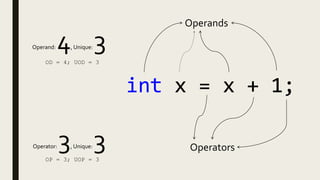
int x = x + 1;
Operators
Operands
Operand: 4, Unique: 3
Operator: 3, Unique: 3
OD = 4; UOD = 3
OP = 3; UOP = 3
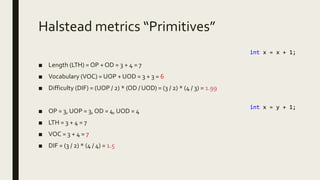
Halstead metrics “Primitives”
■ Length (LTH) = OP + OD = 3 + 4 = 7
■ Vocabulary (VOC) = UOP + UOD = 3 + 3 = 6
■ Difficulty (DIF) = (UOP / 2) * (OD / UOD) = (3 / 2) * (4 / 3) = 1.99
■ OP = 3, UOP = 3, OD = 4, UOD = 4
■ LTH = 3 + 4 = 7
■ VOC = 3 + 4 = 7
■ DIF = (3 / 2) * (4 / 4) = 1.5
int x = x + 1;
int x = y + 1;
Halstead metrics “Derived”
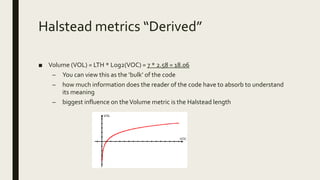
■ Volume (VOL) = LTH * Log2(VOC) = 7 * 2.58 = 18.06
– You can view this as the ‘bulk’ of the code
– how much information does the reader of the code have to absorb to understand
its meaning
– biggest influence on theVolume metric is the Halstead length
Halstead metrics “Derived”
■ Bugs (BUG) =VOL / 3000 = 18.06 / 3000
– Estimates how many bugs you are likely to find in the system.
Halstead metrics “Derived”
■ Effort (EFF) = DIF *VOL = 1.99 * 18.06 = 38.96 / 18 = 2.16 (sec)
– The amount of mental effort required to recreate the software
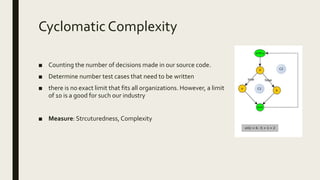
Cyclomatic Complexity
■ Counting the number of decisions made in our source code.
■ Determine number test cases that need to be written
■ there is no exact limit that fits all organizations. However, a limit
of 10 is a good for such our industry
■ Measure: Strcuturedness, Complexity
Class Coupling
■ Measure how many classes a single class uses
■ Has been shown to be an accurate predictor of software failure
■ High coupling indicates design that is difficult to reuse and maintain
■ There is no limit that fits all organizations. However, a limit of 9 is optimal
■ Measure: Reusability, Maintainability,Changeability
Depth of Inheritance
■ The maximum length from the node to the root of the tree
■ Harder to predict behavior
■ Increase complexity of design since more classes and methods are involved
■ Have a greater potential for reusing
■ Several researches suggest that a DIT around 5 or 6 should be an upper limit
Maintainability Index
■ High value means better maintainability.
– LOW - red rating is a rating between 0 and 9
– MODERIATE - yellow rating is between 10 and 19
– GOOD - green rating is between 20 and 100
■ Maintainability Index = MAX(0,(171 – 5.2 * log(HalsteadVolume) – 0.23 * (Cyclomatic
Complexity) – 16.2 * log(Lines of Code))*100 / 171)
■
Levels of Measurement
■ Method
■ Class
■ Package and system
References
■ http://moosehead.cis.umassd.edu/cis580/readings/OO_Design_Complexity_Metrics.p
df
■ http://www.mccabe.com/pdf/mccabe-nist235r.pdf
■ http://citeseerx.ist.psu.edu/viewdoc/download?doi=10.1.1.104.4041&rep=rep1&type=
pdf
■ http://www.campwoodsw.com/sourcemonitor.html
■ https://sourceforge.net/projects/metrics/

Code metrics

  • 1.
  • 2.
    Which line ofcode easier to understand? int x = x + 1; int x = y + 1; or CODE METRICS Eng. Mohammad R. Katby
  • 3.
    Agenda ■ What arethe code measurement units? ■ What we are going to measure? ■ Why we need code metrics ■ What are code metrics
  • 5.
    What are CodeMetrics ■ Length ■ Vocabulary ■ Difficulty ■ Volume ■ Effort ■ Bugs ■ Structuredness ■ Complexity ■ Maintainability ■ Independability
  • 6.
    Why we needmeasurements? ■ Without measurement you cannot understand code faults ■ See whether improvement can be made or not ■ Simply you can’t be Electrician if you can’t measure the voltage
  • 7.
    Pioneers of CodeMetrics Thomas J. McCabe - 1976 Maurice Halstead - 1977
  • 8.
    int x =x + 1; Operators Operands Operand: 4, Unique: 3 Operator: 3, Unique: 3 OD = 4; UOD = 3 OP = 3; UOP = 3
  • 9.
    Halstead metrics “Primitives” ■Length (LTH) = OP + OD = 3 + 4 = 7 ■ Vocabulary (VOC) = UOP + UOD = 3 + 3 = 6 ■ Difficulty (DIF) = (UOP / 2) * (OD / UOD) = (3 / 2) * (4 / 3) = 1.99 ■ OP = 3, UOP = 3, OD = 4, UOD = 4 ■ LTH = 3 + 4 = 7 ■ VOC = 3 + 4 = 7 ■ DIF = (3 / 2) * (4 / 4) = 1.5 int x = x + 1; int x = y + 1;
  • 10.
    Halstead metrics “Derived” ■Volume (VOL) = LTH * Log2(VOC) = 7 * 2.58 = 18.06 – You can view this as the ‘bulk’ of the code – how much information does the reader of the code have to absorb to understand its meaning – biggest influence on theVolume metric is the Halstead length
  • 11.
    Halstead metrics “Derived” ■Bugs (BUG) =VOL / 3000 = 18.06 / 3000 – Estimates how many bugs you are likely to find in the system.
  • 12.
    Halstead metrics “Derived” ■Effort (EFF) = DIF *VOL = 1.99 * 18.06 = 38.96 / 18 = 2.16 (sec) – The amount of mental effort required to recreate the software
  • 13.
    Cyclomatic Complexity ■ Countingthe number of decisions made in our source code. ■ Determine number test cases that need to be written ■ there is no exact limit that fits all organizations. However, a limit of 10 is a good for such our industry ■ Measure: Strcuturedness, Complexity
  • 14.
    Class Coupling ■ Measurehow many classes a single class uses ■ Has been shown to be an accurate predictor of software failure ■ High coupling indicates design that is difficult to reuse and maintain ■ There is no limit that fits all organizations. However, a limit of 9 is optimal ■ Measure: Reusability, Maintainability,Changeability
  • 15.
    Depth of Inheritance ■The maximum length from the node to the root of the tree ■ Harder to predict behavior ■ Increase complexity of design since more classes and methods are involved ■ Have a greater potential for reusing ■ Several researches suggest that a DIT around 5 or 6 should be an upper limit
  • 16.
    Maintainability Index ■ Highvalue means better maintainability. – LOW - red rating is a rating between 0 and 9 – MODERIATE - yellow rating is between 10 and 19 – GOOD - green rating is between 20 and 100 ■ Maintainability Index = MAX(0,(171 – 5.2 * log(HalsteadVolume) – 0.23 * (Cyclomatic Complexity) – 16.2 * log(Lines of Code))*100 / 171) ■
  • 17.
    Levels of Measurement ■Method ■ Class ■ Package and system
  • 18.
    References ■ http://moosehead.cis.umassd.edu/cis580/readings/OO_Design_Complexity_Metrics.p df ■ http://www.mccabe.com/pdf/mccabe-nist235r.pdf ■http://citeseerx.ist.psu.edu/viewdoc/download?doi=10.1.1.104.4041&rep=rep1&type= pdf ■ http://www.campwoodsw.com/sourcemonitor.html ■ https://sourceforge.net/projects/metrics/