Code Division Multiple Access
2
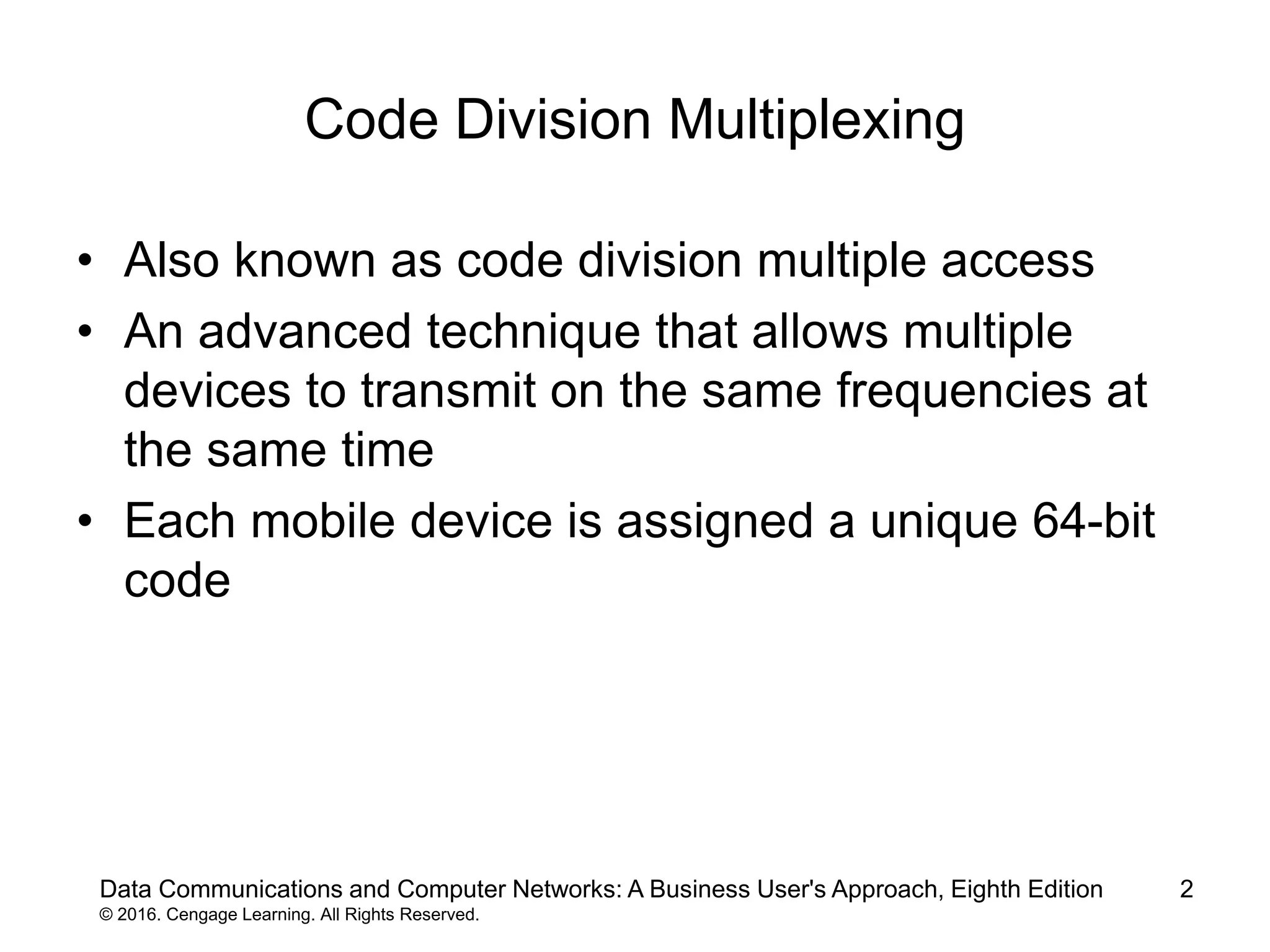
Code Division Multiplexing
• Also known as code division multiple access
• An advanced technique that allows multiple
devices to transmit on the same frequencies at
the same time
• Each mobile device is assigned a unique 64-bit
code
Data Communications and Computer Networks: A Business User's Approach, Eighth Edition
© 2016. Cengage Learning. All Rights Reserved.
3
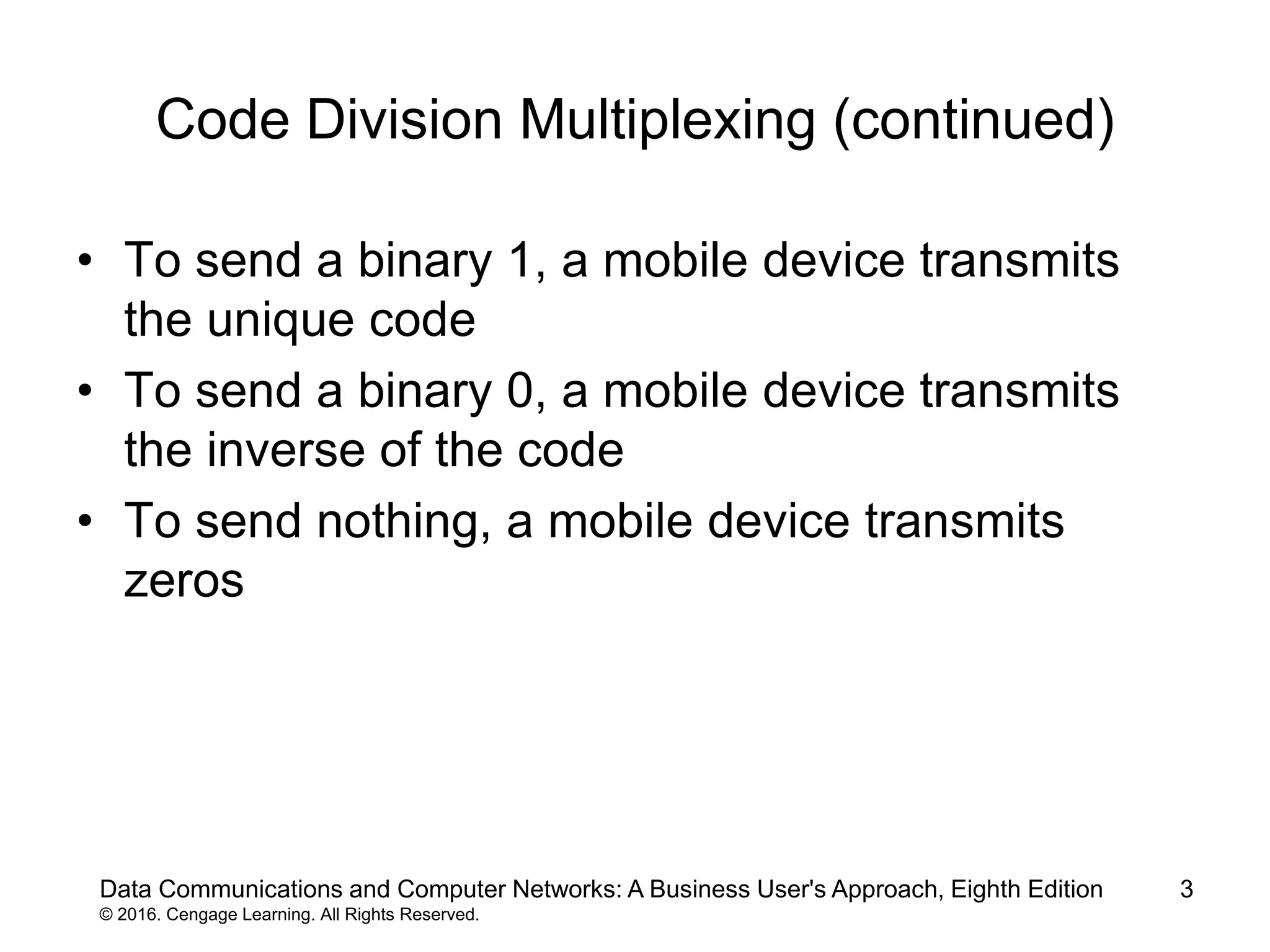
Code Division Multiplexing (continued)
• To send a binary 1, a mobile device transmits
the unique code
• To send a binary 0, a mobile device transmits
the inverse of the code
• To send nothing, a mobile device transmits
zeros
Data Communications and Computer Networks: A Business User's Approach, Eighth Edition
© 2016. Cengage Learning. All Rights Reserved.
4
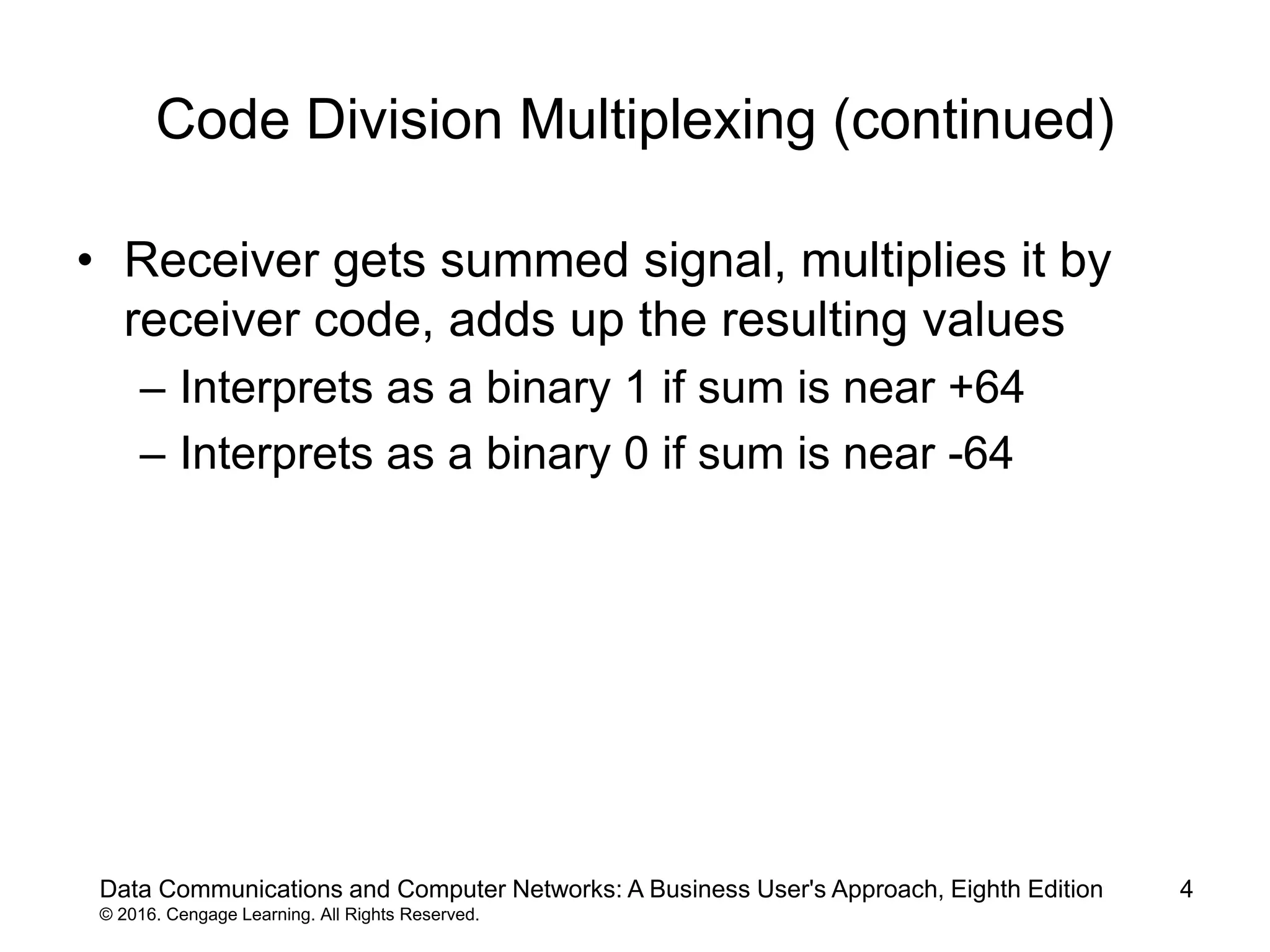
Code Division Multiplexing (continued)
• Receiver gets summed signal, multiplies it by
receiver code, adds up the resulting values
– Interprets as a binary 1 if sum is near +64
– Interprets as a binary 0 if sum is near -64
Data Communications and Computer Networks: A Business User's Approach, Eighth Edition
© 2016. Cengage Learning. All Rights Reserved.
5
Code Division Multiplexing (continued)
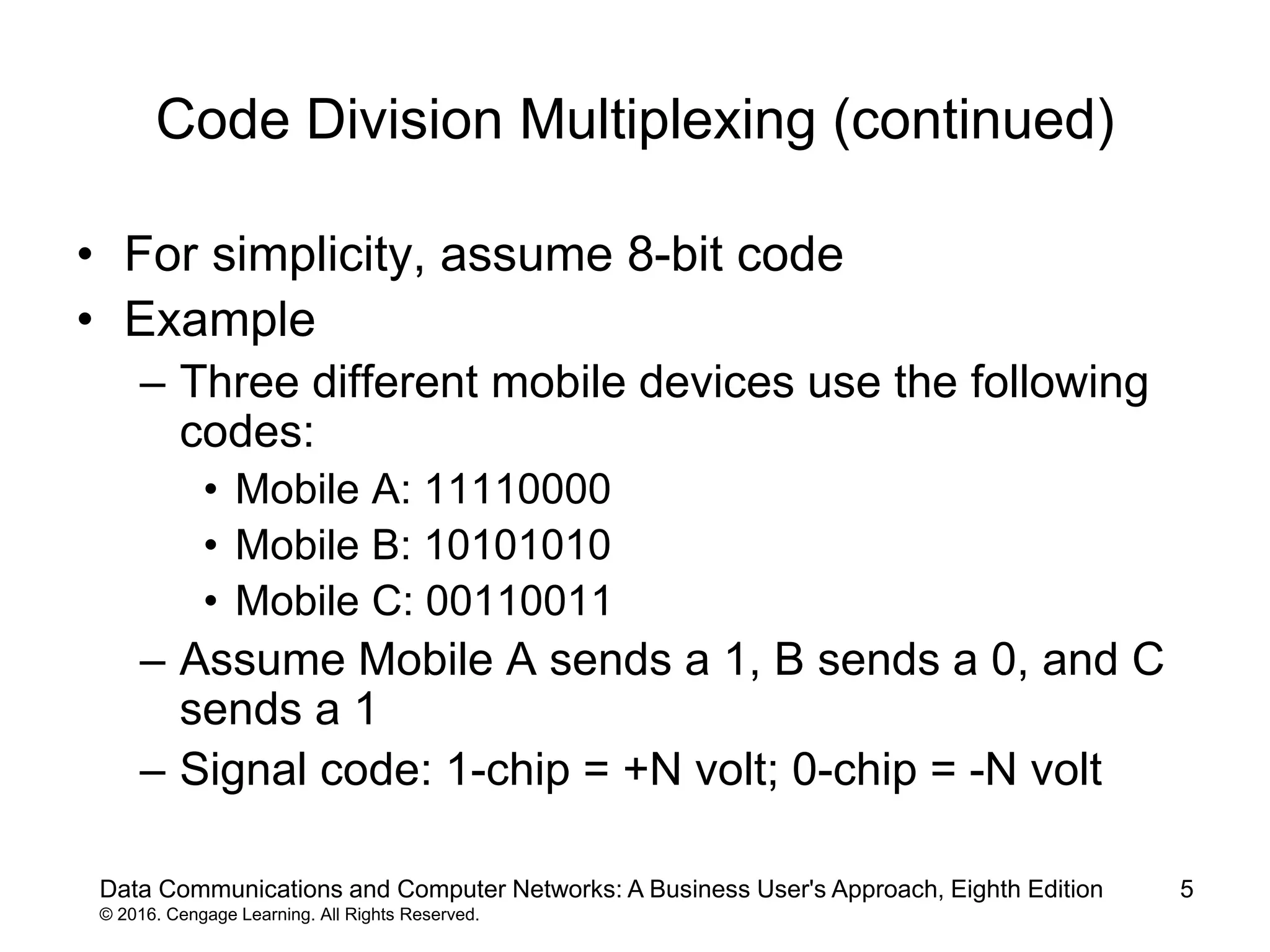
• For simplicity, assume 8-bit code
• Example
– Three different mobile devices use the following
codes:
• Mobile A: 11110000
• Mobile B: 10101010
• Mobile C: 00110011
– Assume Mobile A sends a 1, B sends a 0, and C
sends a 1
– Signal code: 1-chip = +N volt; 0-chip = -N volt
Data Communications and Computer Networks: A Business User's Approach, Eighth Edition
© 2016. Cengage Learning. All Rights Reserved.
6
Code Division Multiplexing (continued)
• Example (continued)
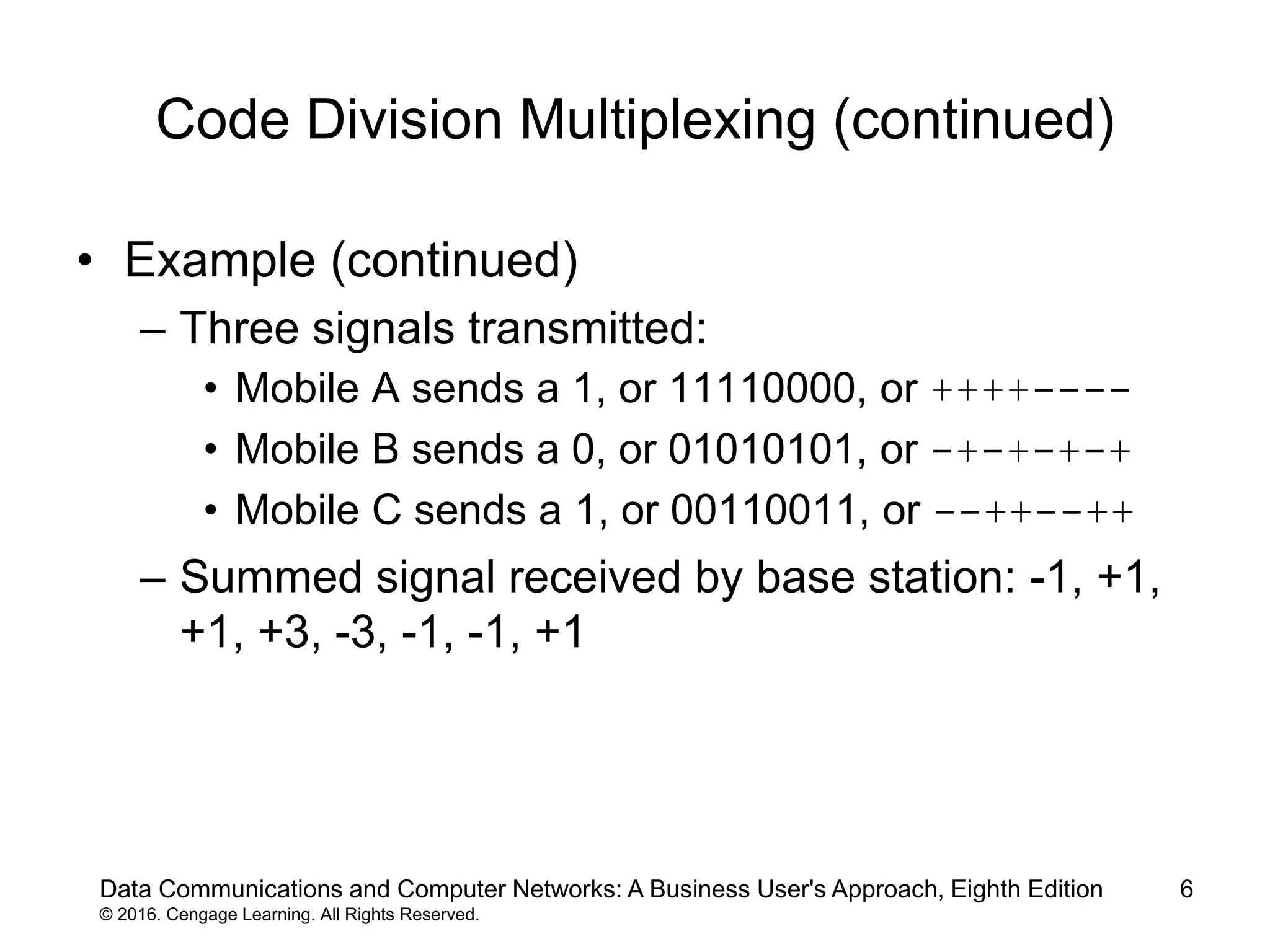
– Three signals transmitted:
• Mobile A sends a 1, or 11110000, or ++++----
• Mobile B sends a 0, or 01010101, or -+-+-+-+
• Mobile C sends a 1, or 00110011, or --++--++
– Summed signal received by base station: -1, +1,
+1, +3, -3, -1, -1, +1
Data Communications and Computer Networks: A Business User's Approach, Eighth Edition
© 2016. Cengage Learning. All Rights Reserved.
7
Code Division Multiplexing (continued)
• Example (continued)
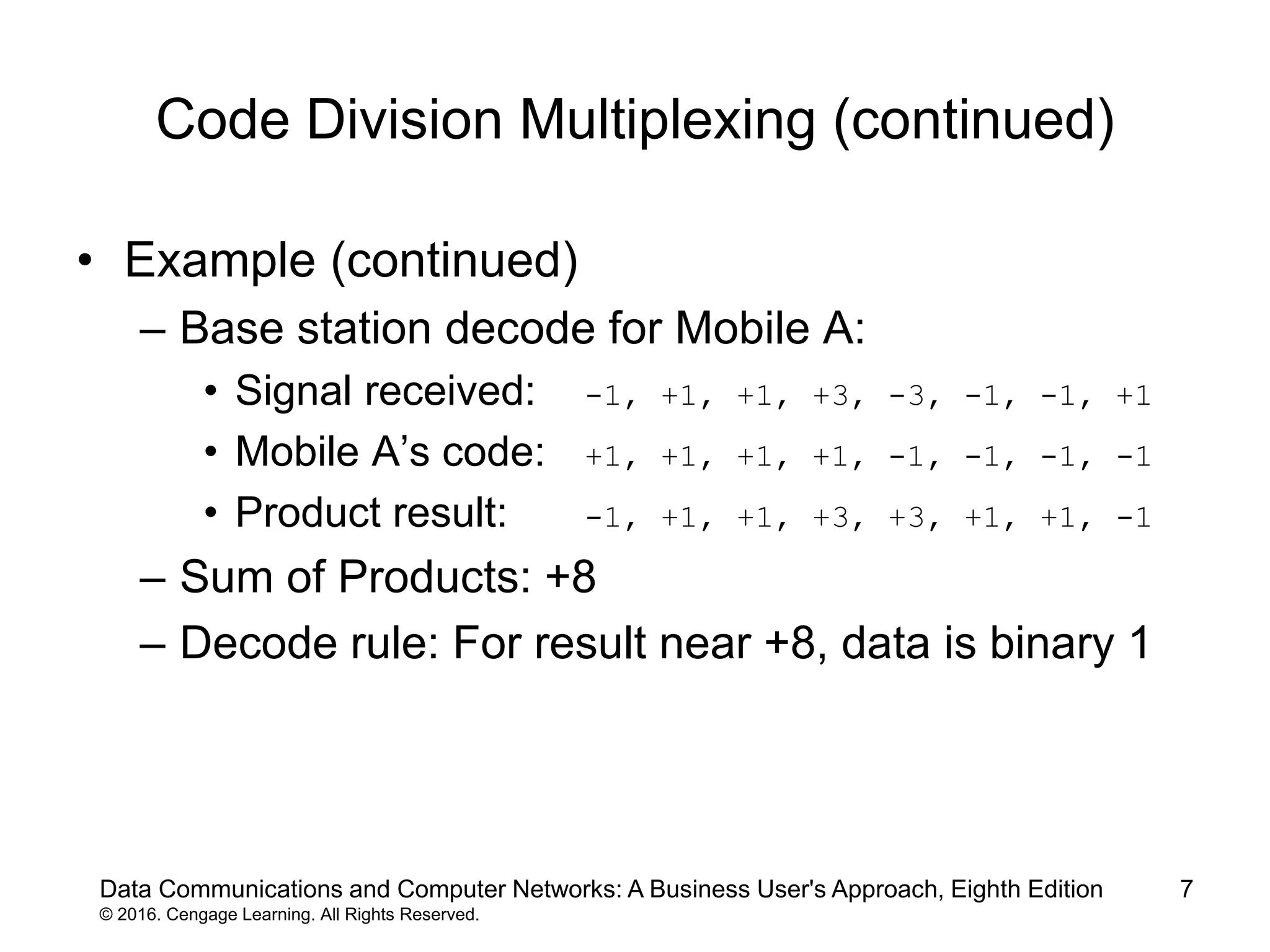
– Base station decode for Mobile A:
• Signal received: -1, +1, +1, +3, -3, -1, -1, +1
• Mobile A’s code: +1, +1, +1, +1, -1, -1, -1, -1
• Product result: -1, +1, +1, +3, +3, +1, +1, -1
– Sum of Products: +8
– Decode rule: For result near +8, data is binary 1
Data Communications and Computer Networks: A Business User's Approach, Eighth Edition
© 2016. Cengage Learning. All Rights Reserved.
8
Code Division Multiplexing (continued)
• Example (continued)
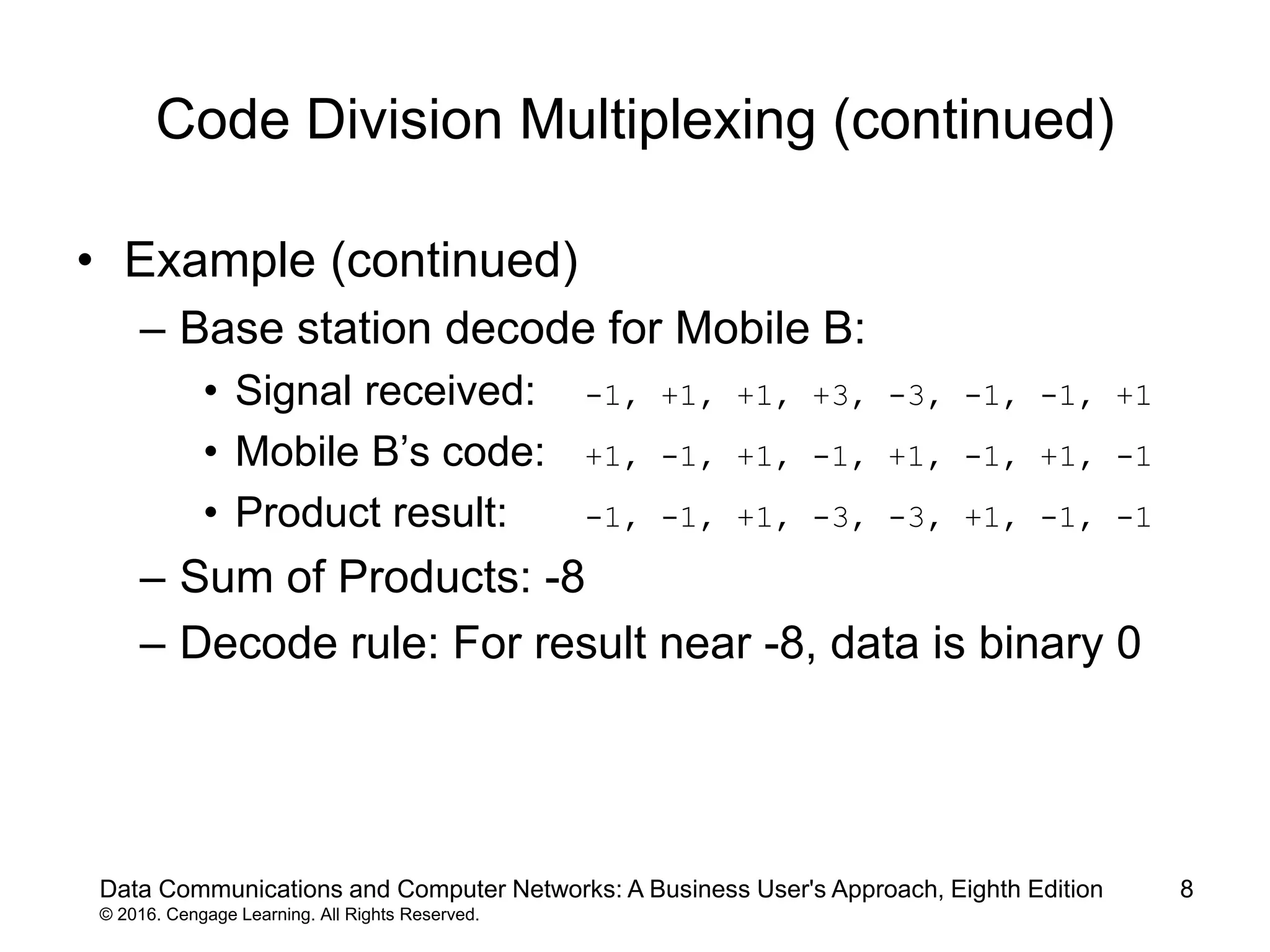
– Base station decode for Mobile B:
• Signal received: -1, +1, +1, +3, -3, -1, -1, +1
• Mobile B’s code: +1, -1, +1, -1, +1, -1, +1, -1
• Product result: -1, -1, +1, -3, -3, +1, -1, -1
– Sum of Products: -8
– Decode rule: For result near -8, data is binary 0
Data Communications and Computer Networks: A Business User's Approach, Eighth Edition
© 2016. Cengage Learning. All Rights Reserved.

Code division multiplexing techniques.ppt

  • 1.
  • 2.
    2 Code Division Multiplexing •Also known as code division multiple access • An advanced technique that allows multiple devices to transmit on the same frequencies at the same time • Each mobile device is assigned a unique 64-bit code Data Communications and Computer Networks: A Business User's Approach, Eighth Edition © 2016. Cengage Learning. All Rights Reserved.
  • 3.
    3 Code Division Multiplexing(continued) • To send a binary 1, a mobile device transmits the unique code • To send a binary 0, a mobile device transmits the inverse of the code • To send nothing, a mobile device transmits zeros Data Communications and Computer Networks: A Business User's Approach, Eighth Edition © 2016. Cengage Learning. All Rights Reserved.
  • 4.
    4 Code Division Multiplexing(continued) • Receiver gets summed signal, multiplies it by receiver code, adds up the resulting values – Interprets as a binary 1 if sum is near +64 – Interprets as a binary 0 if sum is near -64 Data Communications and Computer Networks: A Business User's Approach, Eighth Edition © 2016. Cengage Learning. All Rights Reserved.
  • 5.
    5 Code Division Multiplexing(continued) • For simplicity, assume 8-bit code • Example – Three different mobile devices use the following codes: • Mobile A: 11110000 • Mobile B: 10101010 • Mobile C: 00110011 – Assume Mobile A sends a 1, B sends a 0, and C sends a 1 – Signal code: 1-chip = +N volt; 0-chip = -N volt Data Communications and Computer Networks: A Business User's Approach, Eighth Edition © 2016. Cengage Learning. All Rights Reserved.
  • 6.
    6 Code Division Multiplexing(continued) • Example (continued) – Three signals transmitted: • Mobile A sends a 1, or 11110000, or ++++---- • Mobile B sends a 0, or 01010101, or -+-+-+-+ • Mobile C sends a 1, or 00110011, or --++--++ – Summed signal received by base station: -1, +1, +1, +3, -3, -1, -1, +1 Data Communications and Computer Networks: A Business User's Approach, Eighth Edition © 2016. Cengage Learning. All Rights Reserved.
  • 7.
    7 Code Division Multiplexing(continued) • Example (continued) – Base station decode for Mobile A: • Signal received: -1, +1, +1, +3, -3, -1, -1, +1 • Mobile A’s code: +1, +1, +1, +1, -1, -1, -1, -1 • Product result: -1, +1, +1, +3, +3, +1, +1, -1 – Sum of Products: +8 – Decode rule: For result near +8, data is binary 1 Data Communications and Computer Networks: A Business User's Approach, Eighth Edition © 2016. Cengage Learning. All Rights Reserved.
  • 8.
    8 Code Division Multiplexing(continued) • Example (continued) – Base station decode for Mobile B: • Signal received: -1, +1, +1, +3, -3, -1, -1, +1 • Mobile B’s code: +1, -1, +1, -1, +1, -1, +1, -1 • Product result: -1, -1, +1, -3, -3, +1, -1, -1 – Sum of Products: -8 – Decode rule: For result near -8, data is binary 0 Data Communications and Computer Networks: A Business User's Approach, Eighth Edition © 2016. Cengage Learning. All Rights Reserved.