The Life Cycle Of A
Coconut Tree
Topic Slide no.
Introduction 01
Origin 02
Plant 03
Natural habitat 04
Production and Cultivation 05
Coconut Management 06
Technology 07
Harvesting process 08
Uses 09
Health Benifits 10
Sustainability 11
Sociocultural 12
Diseases 13
Varieties 14
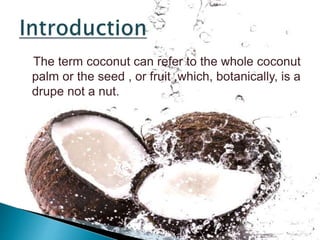
The term coconut can refer to the whole coconut
palm or the seed , or fruit ,which, botanically, is a
drupe not a nut.
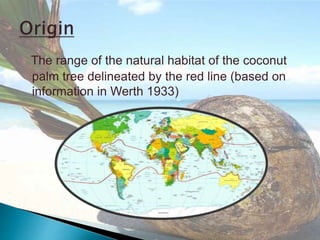
The range of the natural habitat of the coconut
palm tree delineated by the red line (based on
information in Werth 1933)
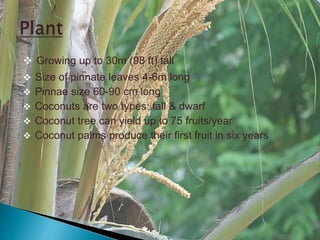
 Growing up to 30m (98 ft) tall
 Size of pinnate leaves 4-6m long
 Pinnae size 60-90 cm long
 Coconuts are two types: tall & dwarf
 Coconut tree can yield up to 75 fruits/year
 Coconut palms produce their first fruit in six years
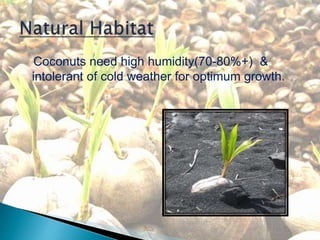
Coconuts need high humidity(70-80%+) &
intolerant of cold weather for optimum growth.
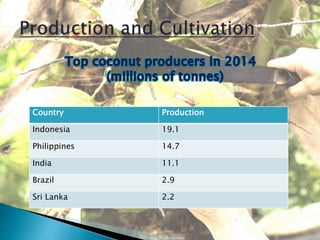
Country Production
Indonesia 19.1
Philippines 14.7
India 11.1
Brazil 2.9
Sri Lanka 2.2
 Highly sensitive to soil moisture
 Rainfall total of 1800mm evenly throughout the year
 As little as 1000mm will prove to be optimum
 Takes up to a tear for coconuts to mature
 Bloom up to thirteen times a year
 Continuous harvest year-round
 Average harvest of 60 coconuts/ tree
 Some trees yeilding at three times that amount
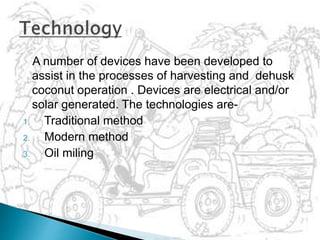
A number of devices have been developed to
assist in the processes of harvesting and dehusk
coconut operation . Devices are electrical and/or
solar generated. The technologies are-
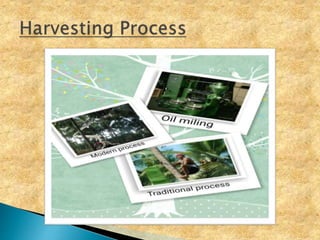
1. Traditional method
2. Modern method
3. Oil miling
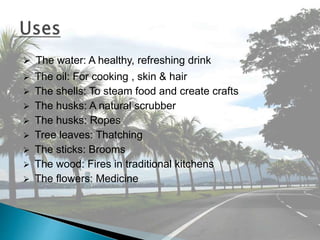
 The water: A healthy, refreshing drink
 The oil: For cooking , skin & hair
 The shells: To steam food and create crafts
 The husks: A natural scrubber
 The husks: Ropes
 Tree leaves: Thatching
 The sticks: Brooms
 The wood: Fires in traditional kitchens
 The flowers: Medicine
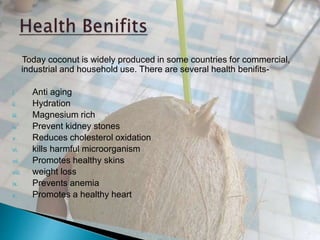
Today coconut is widely produced in some countries for commercial,
industrial and household use. There are several health benifits-
i. Anti aging
ii. Hydration
iii. Magnesium rich
iv. Prevent kidney stones
v. Reduces cholesterol oxidation
vi. kills harmful microorganism
vii. Promotes healthy skins
viii. weight loss
ix. Prevents anemia
x. Promotes a healthy heart
 Australia: coconut, cocoa, coffee along with cattle grazin
 Cylon /Sri Lanka: coconut, tea, rubber
 Coir products: husk from the coconut are bio-degradability
 India: biomass fuel supply average size family, 30-40 palm tree
 By-products: “oil-cake” is fed to cattle
“THE DAY OF COCONUT AS MAINLY OR SOLELY A
MONOCULTURE APPEARS TO BE ALMOST OVER”
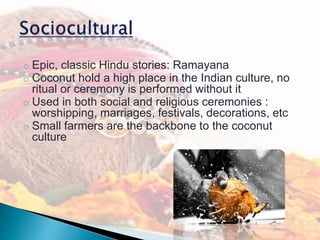
o Epic, classic Hindu stories: Ramayana
o Coconut hold a high place in the Indian culture, no
ritual or ceremony is performed without it
o Used in both social and religious ceremonies :
worshipping, marriages, festivals, decorations, etc
o Small farmers are the backbone to the coconut
culture
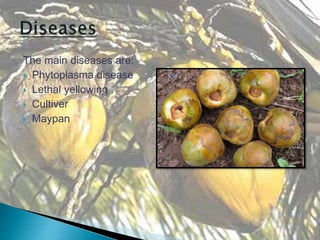
The main diseases are:
 Phytoplasma disease
 Lethal yellowing
 Cultiver
 Maypan
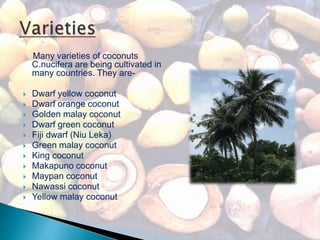
Many varieties of coconuts
C.nucifera are being cultivated in
many countries. They are-
 Dwarf yellow coconut
 Dwarf orange coconut
 Golden malay coconut
 Dwarf green coconut
 Fiji dwarf (Niu Leka)
 Green malay coconut
 King coconut
 Makapuno coconut
 Maypan coconut
 Nawassi coconut
 Yellow malay coconut
1. https://simple.m.wikipedia.org
(Date: 04-11-2017 & Time: 11:20 pm)
2. https://en.m.wikipedia.org
(Date: 04-11-2017 & Time: 11:32 pm)
3. runescape.wikia.com
(Date: 04-11-2017 & Time: 11:35 pm)
4. nekopara.wikia.com
(Date: 04-11-2017 & Time: 11:48 pm)
5. https://wiki.guildwars2.com
(Date: 04-11-2017 & Time: 12:05 pm)
?
Presented by-
Name : Subhajit Saha
Roll no. : 34201616011
Department : Electrical Engineering
Institute : Future Institute Of Technology
The End

Coconut tree

  • 1.
    The Life CycleOf A Coconut Tree
  • 2.
    Topic Slide no. Introduction01 Origin 02 Plant 03 Natural habitat 04 Production and Cultivation 05 Coconut Management 06 Technology 07 Harvesting process 08 Uses 09 Health Benifits 10 Sustainability 11 Sociocultural 12 Diseases 13 Varieties 14
  • 3.
    The term coconutcan refer to the whole coconut palm or the seed , or fruit ,which, botanically, is a drupe not a nut.
  • 4.
    The range ofthe natural habitat of the coconut palm tree delineated by the red line (based on information in Werth 1933)
  • 5.
     Growing upto 30m (98 ft) tall  Size of pinnate leaves 4-6m long  Pinnae size 60-90 cm long  Coconuts are two types: tall & dwarf  Coconut tree can yield up to 75 fruits/year  Coconut palms produce their first fruit in six years
  • 6.
    Coconuts need highhumidity(70-80%+) & intolerant of cold weather for optimum growth.
  • 7.
    Country Production Indonesia 19.1 Philippines14.7 India 11.1 Brazil 2.9 Sri Lanka 2.2
  • 8.
     Highly sensitiveto soil moisture  Rainfall total of 1800mm evenly throughout the year  As little as 1000mm will prove to be optimum  Takes up to a tear for coconuts to mature  Bloom up to thirteen times a year  Continuous harvest year-round  Average harvest of 60 coconuts/ tree  Some trees yeilding at three times that amount
  • 9.
    A number ofdevices have been developed to assist in the processes of harvesting and dehusk coconut operation . Devices are electrical and/or solar generated. The technologies are- 1. Traditional method 2. Modern method 3. Oil miling
  • 11.
     The water:A healthy, refreshing drink  The oil: For cooking , skin & hair  The shells: To steam food and create crafts  The husks: A natural scrubber  The husks: Ropes  Tree leaves: Thatching  The sticks: Brooms  The wood: Fires in traditional kitchens  The flowers: Medicine
  • 12.
    Today coconut iswidely produced in some countries for commercial, industrial and household use. There are several health benifits- i. Anti aging ii. Hydration iii. Magnesium rich iv. Prevent kidney stones v. Reduces cholesterol oxidation vi. kills harmful microorganism vii. Promotes healthy skins viii. weight loss ix. Prevents anemia x. Promotes a healthy heart
  • 13.
     Australia: coconut,cocoa, coffee along with cattle grazin  Cylon /Sri Lanka: coconut, tea, rubber  Coir products: husk from the coconut are bio-degradability  India: biomass fuel supply average size family, 30-40 palm tree  By-products: “oil-cake” is fed to cattle “THE DAY OF COCONUT AS MAINLY OR SOLELY A MONOCULTURE APPEARS TO BE ALMOST OVER”
  • 14.
    o Epic, classicHindu stories: Ramayana o Coconut hold a high place in the Indian culture, no ritual or ceremony is performed without it o Used in both social and religious ceremonies : worshipping, marriages, festivals, decorations, etc o Small farmers are the backbone to the coconut culture
  • 15.
    The main diseasesare:  Phytoplasma disease  Lethal yellowing  Cultiver  Maypan
  • 16.
    Many varieties ofcoconuts C.nucifera are being cultivated in many countries. They are-  Dwarf yellow coconut  Dwarf orange coconut  Golden malay coconut  Dwarf green coconut  Fiji dwarf (Niu Leka)  Green malay coconut  King coconut  Makapuno coconut  Maypan coconut  Nawassi coconut  Yellow malay coconut
  • 17.
    1. https://simple.m.wikipedia.org (Date: 04-11-2017& Time: 11:20 pm) 2. https://en.m.wikipedia.org (Date: 04-11-2017 & Time: 11:32 pm) 3. runescape.wikia.com (Date: 04-11-2017 & Time: 11:35 pm) 4. nekopara.wikia.com (Date: 04-11-2017 & Time: 11:48 pm) 5. https://wiki.guildwars2.com (Date: 04-11-2017 & Time: 12:05 pm)
  • 18.
  • 19.
    Presented by- Name :Subhajit Saha Roll no. : 34201616011 Department : Electrical Engineering Institute : Future Institute Of Technology
  • 20.