2019
• Enterprise strategy
• Enterprise goals
• Enterprise size
• Role of IT
• Sourcing model for IT
• Compliance requirements
• Etc.
• SME
• Security
• Risk
• DevOps
• Etc.
➢ Priority governance
and management
objectives
➢ Specific guidance
from focus areas
➢ Target capability
and performance
management
guidance
Design Factors
COBIT 5
Inputs to COBIT 2019 COBIT 2019
Community
Contribution
Standards,
Frameworks,
Regulations
COBIT Core
Publications
Focus Area
Tailored Enterprise
Governance
System for
Information and
Technology
COBIT Core
Reference Model of Governance
and Management Objectives
COBIT®
2019 Framework:
Introduction and Methodology
COBIT®
2019 Framework:
Governance and
Management Objectives
COBIT®
2019 Design Guide:
Designing an Information and Technology
Governance Solution
COBIT®
2019 Implementation Guide:
Implementing and Optimizing an
Information and Technology
Governance Solution
EDM01—Ensured
Governance
Framework Setting
and Maintenance
APO01—Managed
I&T Management
Framework
APO08—Managed
Relationships
APO02—Managed
Strategy
APO09—Managed
Service
Agreements
APO03—Managed
Enterprise
Architecture
APO10—Managed
Vendors
APO04—Managed
Innovation
APO11—Managed
Quality
APO05—Managed
Portfolio
APO12—Managed
Risk
APO06—Managed
Budget and Costs
APO07—Managed
Human Resources
APO014—Managed
Data
MEA01—Managed
Performance and
Conformance
Monitoring
MEA02—Managed
System of Internal
Control
MEA03—Managed
Compliance with
External
Requirements
MEA04—Managed
Assurance
APO13—Managed
Security
DSS01—Managed
Operations
DSS02—Managed
Service Requests
and Incidents
DSS03—Managed
Problems
DSS04—Managed
Continuity
DSS05—Managed
Security
Services
DSS06—Managed
Business
Process Controls
BAI01—Managed
Programs
BAI08—Managed
Knowledge
BAI02—Managed
Requirements
Definition
BAI09—Managed
Assets
BAI03—Manage
Solutions
Identification
and Build
BAI10—Managed
Configuration
BAI04—Managed
Availability
and Capacity
BAI11—Managed
Projects
BAI05—Managed
Organizational
Change
BAI06—Managed
IT Changes
BAI07—Managed
IT Change
Acceptance and
Transitioning
EDM02—Ensured
Benefits Delivery
EDM03—Ensured
Risk Optimization
EDM04—Ensured
Resource
Optimization
EDM05—Ensured
Stakeholder
Engagement
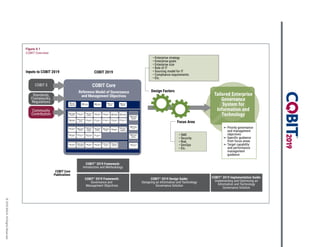
Figure 4.1
COBIT Overview
©
2018
ISACA.
All
Rights
Reserved.
1. Provide
Stakeholder
Value
2. Holistic
Approach
3. Dynamic
Governance
System
4. Governance
Distinct From
Management
5. Tailored to
Enterprise
Needs
6. End-to-End
Governance
System
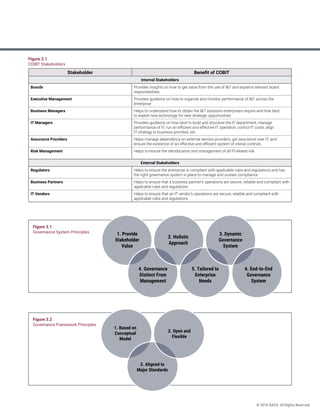
Figure 2.1
COBIT Stakeholders
Figure 3.1
Governance System Principles
Figure 3.2
Governance Framework Principles
Stakeholder Benefit of COBIT
Internal Stakeholders
Boards Provides insights on how to get value from the use of I&T and explains relevant board
responsibilities
Executive Management Provides guidance on how to organize and monitor performance of I&T across the
enterprise
Business Managers Helps to understand how to obtain the I&T solutions enterprises require and how best
to exploit new technology for new strategic opportunities
IT Managers Provides guidance on how best to build and structure the IT department, manage
performance of IT, run an efficient and effective IT operation, control IT costs, align
IT strategy to business priorities, etc.
Assurance Providers Helps manage dependency on external service providers, get assurance over IT, and
ensure the existence of an effective and efficient system of interal controls
Risk Management Helps to ensure the identitication and management of all IT-related risk
External Stakeholders
Regulators Helps to ensure the enterprise is compliant with applicable rules and regulations and has
the right governance system in place to manage and sustain compliance
Business Partners Helps to ensure that a business partner’s operations are secure, reliable and compliant with
applicable rules and regulations
IT Vendors Helps to ensure that an IT vendor’s operations are secure, relaible and compliant with
applicable rules and regulations
1. Based on
Conceptual
Model
2. Open and
Flexible
3. Aligned to
Major Standards
© 2018 ISACA. All Rights Reserved.
Processes
Services,
Infrastructure
and
Applications
Organizational
Structures
Culture, Ethics
and
Behavior
Information
People, Skills
and
Competencies
Principles,
Policies,
Procedures
Governance
System
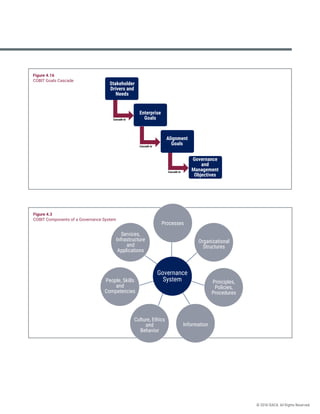
Figure 4.3
COBIT Components of a Governance System
Stakeholder
Drivers and
Needs
Enterprise
Goals
Alignment
Goals
Governance
and
Management
Objectives
Cascade to
Cascade to
Cascade to
Figure 4.16
COBIT Goals Cascade
© 2018 ISACA. All Rights Reserved.
2019
INTERNATIONAL HE ADQUARTERS
1700 E. Golf Road | Suite 400
Schaumburg, IL 60173 | USA
isaca.org
© 2018 ISACA. All Rights Reserved.
EDM01—Ensured
Governance
Framework
Setting
and
Maintenance
APO01—Managed
I&T
Management
Framework
APO08—Managed
Relationships
APO02—Managed
Strategy
APO09—Managed
Service
Agreements
APO03—Managed
Enterprise
Architecture
APO10—Managed
Vendors
APO04—Managed
Innovation
APO11—Managed
Quality
APO05—Managed
Portfolio
APO12—Managed
Risk
APO06—Managed
Budget
and
Costs
APO07—Managed
Human
Resources
APO014—Managed
Data
MEA01—Managed
Performance
and
Conformance
Monitoring
MEA02—Managed
System
of
Internal
Control
MEA03—Managed
Compliance
With
External
Requirements
MEA04—Managed
Assurance
APO13—Managed
Security
DSS01—Managed
Operations
DSS02—Managed
Service
Requests
and
Incidents
DSS03—Managed
Problems
DSS04—Managed
Continuity
DSS05—Managed
Security
Services
DSS06—Managed
Business
Process
Controls
BAI01—Managed
Programs
BAI08—Managed
Knowledge
BAI02—Managed
Requirements
Definition
BAI09—Managed
Assets
BAI03—Managed
Solutions
Identification
and
Build
BAI10—Managed
Configuration
BAI04—Managed
Availability
and
Capacity
BAI11—Managed
Projects
BAI05—Managed
Organizational
Change
BAI06—Managed
IT
Changes
BAI07—Managed
IT
Change
Acceptance
and
Transitioning
EDM02—Ensured
Benefits
Delivery
EDM03—Ensured
Risk
Optimization
EDM04—Ensured
Resource
Optimization
EDM05—Ensured
Stakeholder
Engagement
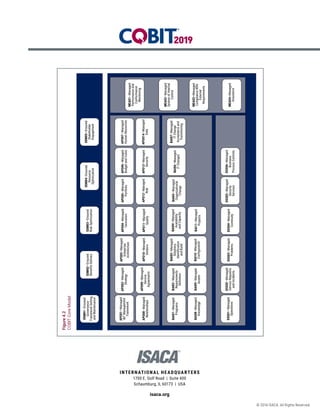
Figure
4.2
COBIT
Core
Model
1. Management
Objective
Priority and
Target
Capability
Levels
3. Specific
Focus Areas
2. Component
Variations
Design
Factors’
Impact
Future Factors
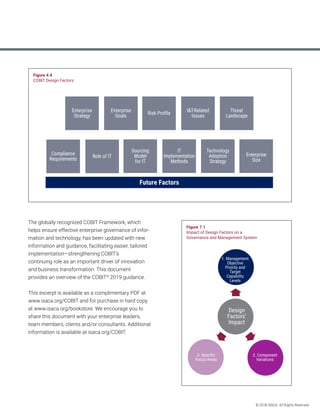
Enterprise
Strategy
Enterprise
Goals
Risk Profile
I&T-Related
Issues
Threat
Landscape
Compliance
Requirements
Role of IT
Sourcing
Model
for IT
IT
Implementation
Methods
Technology
Adoption
Strategy
Enterprise
Size
Figure 4.4
COBIT Design Factors
Figure 7.1
Impact of Design Factors on a
Governance and Management System
© 2018 ISACA. All Rights Reserved.
The globally recognized COBIT Framework, which
helps ensure effective enterprise governance of infor-
mation and technology, has been updated with new
information and guidance, facilitating easier, tailored
implementation—strengthening COBIT’s
continuing role as an important driver of innovation
and business transformation. This document
provides an overview of the COBIT®
2019 guidance.
This excerpt is available as a complimentary PDF at
www.isaca.org/COBIT and for purchase in hard copy
at www.isaca.org/bookstore. We encourage you to
share this document with your enterprise leaders,
team members, clients and/or consultants. Additional
information is available at isaca.org/COBIT.
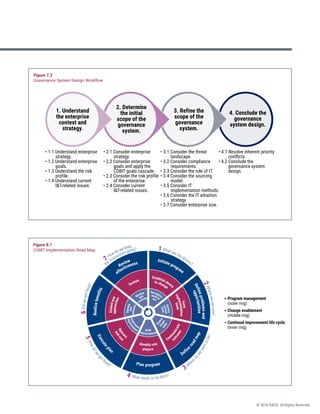
1. Understand
the enterprise
context and
strategy.
2. Determine
the initial
scope of the
governance
system.
3. Refine the
scope of the
governance
system.
4. Conclude the
governance
system design.
• 1.1 Understand enterprise
strategy.
• 1.2 Understand enterprise
goals.
• 1.3 Understand the risk
profile.
• 1.4 Understand current
I&T-related issues.
• 2.1 Consider enterprise
strategy.
• 2.2 Consider enterprise
goals and apply the
COBIT goals cascade.
• 2.3 Consider the risk profile
of the enterprise.
• 2.4 Consider current
I&T-related issues.
• 3.1 Consider the threat
landscape.
• 3.2 Consider compliance
requirements.
• 3.3 Consider the role of IT.
• 3.4 Consider the sourcing
model.
• 3.5 Consider IT
implementation methods.
• 3.6 Consider the IT adoption
strategy.
• 3.7 Consider enterprise size.
• 4.1 Resolve inherent priority
conflicts.
• 4.2 Conclude the
governance system
design.
the momentum going?
7
How do we keep
6
D
i
d
w
e
g
e
t
t
h
e
r
e
?
5
H
o
w
d
o
w
e
g
e
t
there?
4 What needs to be done?
3
Wher
e
d
o
w
e
w
a
n
t
t
o
b
e
?
2
W
h
e
r
e
a
r
e
w
e
n
o
w
?
1 What are the drivers?
• Program management
(outer ring)
• Change enablement
(middle ring)
• Continual improvement life cycle
(inner ring)
Initiate program
D
e
f
i
n
e
p
r
o
b
l
e
m
s
a
n
d
o
p
p
o
r
t
u
n
i
t
i
e
s
Defin
e
r
o
a
d
m
a
p
Plan program
E
x
e
c
u
t
e
p
lan
R
e
a
l
i
z
e
b
e
n
e
f
i
t
s
Review
effectiveness
O
p
e
r
a
t
e
Identify role
Com
m
u
n
i
c
a
t
e
t
e
a
m
to change
a
n
d
u
s
e
players
o
u
t
c
o
m
e
F
o
r
m
i
m
p
l
e
m
e
n
t
a
t
i
o
n
Establish desire
E
m
b
e
d
n
e
w
Sustain
a
p
p
r
o
a
c
h
e
s
I
m
p
l
e
m
ent
improvements
s
t
a
t
e
A
s
s
e
s
s
Recognize
Monitor
O
p
e
r
a
t
e
i
m
p
r
o
v
e
m
ents Build
ta
r
g
e
t
c
u
r
r
e
n
t
need to
and
a
n
d
De
f
i
n
e
s
t
a
t
e
act
evaluate
m
e
a
s
u
r
e
Figure 7.2
Governance System Design Workflow
Figure 8.1
COBIT Implementation Road Map
© 2018 ISACA. All Rights Reserved.

COBITlaminate_online_RD3 introduction overview

  • 1.
    2019 • Enterprise strategy •Enterprise goals • Enterprise size • Role of IT • Sourcing model for IT • Compliance requirements • Etc. • SME • Security • Risk • DevOps • Etc. ➢ Priority governance and management objectives ➢ Specific guidance from focus areas ➢ Target capability and performance management guidance Design Factors COBIT 5 Inputs to COBIT 2019 COBIT 2019 Community Contribution Standards, Frameworks, Regulations COBIT Core Publications Focus Area Tailored Enterprise Governance System for Information and Technology COBIT Core Reference Model of Governance and Management Objectives COBIT® 2019 Framework: Introduction and Methodology COBIT® 2019 Framework: Governance and Management Objectives COBIT® 2019 Design Guide: Designing an Information and Technology Governance Solution COBIT® 2019 Implementation Guide: Implementing and Optimizing an Information and Technology Governance Solution EDM01—Ensured Governance Framework Setting and Maintenance APO01—Managed I&T Management Framework APO08—Managed Relationships APO02—Managed Strategy APO09—Managed Service Agreements APO03—Managed Enterprise Architecture APO10—Managed Vendors APO04—Managed Innovation APO11—Managed Quality APO05—Managed Portfolio APO12—Managed Risk APO06—Managed Budget and Costs APO07—Managed Human Resources APO014—Managed Data MEA01—Managed Performance and Conformance Monitoring MEA02—Managed System of Internal Control MEA03—Managed Compliance with External Requirements MEA04—Managed Assurance APO13—Managed Security DSS01—Managed Operations DSS02—Managed Service Requests and Incidents DSS03—Managed Problems DSS04—Managed Continuity DSS05—Managed Security Services DSS06—Managed Business Process Controls BAI01—Managed Programs BAI08—Managed Knowledge BAI02—Managed Requirements Definition BAI09—Managed Assets BAI03—Manage Solutions Identification and Build BAI10—Managed Configuration BAI04—Managed Availability and Capacity BAI11—Managed Projects BAI05—Managed Organizational Change BAI06—Managed IT Changes BAI07—Managed IT Change Acceptance and Transitioning EDM02—Ensured Benefits Delivery EDM03—Ensured Risk Optimization EDM04—Ensured Resource Optimization EDM05—Ensured Stakeholder Engagement Figure 4.1 COBIT Overview © 2018 ISACA. All Rights Reserved.
  • 2.
    1. Provide Stakeholder Value 2. Holistic Approach 3.Dynamic Governance System 4. Governance Distinct From Management 5. Tailored to Enterprise Needs 6. End-to-End Governance System Figure 2.1 COBIT Stakeholders Figure 3.1 Governance System Principles Figure 3.2 Governance Framework Principles Stakeholder Benefit of COBIT Internal Stakeholders Boards Provides insights on how to get value from the use of I&T and explains relevant board responsibilities Executive Management Provides guidance on how to organize and monitor performance of I&T across the enterprise Business Managers Helps to understand how to obtain the I&T solutions enterprises require and how best to exploit new technology for new strategic opportunities IT Managers Provides guidance on how best to build and structure the IT department, manage performance of IT, run an efficient and effective IT operation, control IT costs, align IT strategy to business priorities, etc. Assurance Providers Helps manage dependency on external service providers, get assurance over IT, and ensure the existence of an effective and efficient system of interal controls Risk Management Helps to ensure the identitication and management of all IT-related risk External Stakeholders Regulators Helps to ensure the enterprise is compliant with applicable rules and regulations and has the right governance system in place to manage and sustain compliance Business Partners Helps to ensure that a business partner’s operations are secure, reliable and compliant with applicable rules and regulations IT Vendors Helps to ensure that an IT vendor’s operations are secure, relaible and compliant with applicable rules and regulations 1. Based on Conceptual Model 2. Open and Flexible 3. Aligned to Major Standards © 2018 ISACA. All Rights Reserved.
  • 3.
    Processes Services, Infrastructure and Applications Organizational Structures Culture, Ethics and Behavior Information People, Skills and Competencies Principles, Policies, Procedures Governance System Figure4.3 COBIT Components of a Governance System Stakeholder Drivers and Needs Enterprise Goals Alignment Goals Governance and Management Objectives Cascade to Cascade to Cascade to Figure 4.16 COBIT Goals Cascade © 2018 ISACA. All Rights Reserved.
  • 4.
    2019 INTERNATIONAL HE ADQUARTERS 1700E. Golf Road | Suite 400 Schaumburg, IL 60173 | USA isaca.org © 2018 ISACA. All Rights Reserved. EDM01—Ensured Governance Framework Setting and Maintenance APO01—Managed I&T Management Framework APO08—Managed Relationships APO02—Managed Strategy APO09—Managed Service Agreements APO03—Managed Enterprise Architecture APO10—Managed Vendors APO04—Managed Innovation APO11—Managed Quality APO05—Managed Portfolio APO12—Managed Risk APO06—Managed Budget and Costs APO07—Managed Human Resources APO014—Managed Data MEA01—Managed Performance and Conformance Monitoring MEA02—Managed System of Internal Control MEA03—Managed Compliance With External Requirements MEA04—Managed Assurance APO13—Managed Security DSS01—Managed Operations DSS02—Managed Service Requests and Incidents DSS03—Managed Problems DSS04—Managed Continuity DSS05—Managed Security Services DSS06—Managed Business Process Controls BAI01—Managed Programs BAI08—Managed Knowledge BAI02—Managed Requirements Definition BAI09—Managed Assets BAI03—Managed Solutions Identification and Build BAI10—Managed Configuration BAI04—Managed Availability and Capacity BAI11—Managed Projects BAI05—Managed Organizational Change BAI06—Managed IT Changes BAI07—Managed IT Change Acceptance and Transitioning EDM02—Ensured Benefits Delivery EDM03—Ensured Risk Optimization EDM04—Ensured Resource Optimization EDM05—Ensured Stakeholder Engagement Figure 4.2 COBIT Core Model
  • 5.
    1. Management Objective Priority and Target Capability Levels 3.Specific Focus Areas 2. Component Variations Design Factors’ Impact Future Factors Enterprise Strategy Enterprise Goals Risk Profile I&T-Related Issues Threat Landscape Compliance Requirements Role of IT Sourcing Model for IT IT Implementation Methods Technology Adoption Strategy Enterprise Size Figure 4.4 COBIT Design Factors Figure 7.1 Impact of Design Factors on a Governance and Management System © 2018 ISACA. All Rights Reserved. The globally recognized COBIT Framework, which helps ensure effective enterprise governance of infor- mation and technology, has been updated with new information and guidance, facilitating easier, tailored implementation—strengthening COBIT’s continuing role as an important driver of innovation and business transformation. This document provides an overview of the COBIT® 2019 guidance. This excerpt is available as a complimentary PDF at www.isaca.org/COBIT and for purchase in hard copy at www.isaca.org/bookstore. We encourage you to share this document with your enterprise leaders, team members, clients and/or consultants. Additional information is available at isaca.org/COBIT.
  • 6.
    1. Understand the enterprise contextand strategy. 2. Determine the initial scope of the governance system. 3. Refine the scope of the governance system. 4. Conclude the governance system design. • 1.1 Understand enterprise strategy. • 1.2 Understand enterprise goals. • 1.3 Understand the risk profile. • 1.4 Understand current I&T-related issues. • 2.1 Consider enterprise strategy. • 2.2 Consider enterprise goals and apply the COBIT goals cascade. • 2.3 Consider the risk profile of the enterprise. • 2.4 Consider current I&T-related issues. • 3.1 Consider the threat landscape. • 3.2 Consider compliance requirements. • 3.3 Consider the role of IT. • 3.4 Consider the sourcing model. • 3.5 Consider IT implementation methods. • 3.6 Consider the IT adoption strategy. • 3.7 Consider enterprise size. • 4.1 Resolve inherent priority conflicts. • 4.2 Conclude the governance system design. the momentum going? 7 How do we keep 6 D i d w e g e t t h e r e ? 5 H o w d o w e g e t there? 4 What needs to be done? 3 Wher e d o w e w a n t t o b e ? 2 W h e r e a r e w e n o w ? 1 What are the drivers? • Program management (outer ring) • Change enablement (middle ring) • Continual improvement life cycle (inner ring) Initiate program D e f i n e p r o b l e m s a n d o p p o r t u n i t i e s Defin e r o a d m a p Plan program E x e c u t e p lan R e a l i z e b e n e f i t s Review effectiveness O p e r a t e Identify role Com m u n i c a t e t e a m to change a n d u s e players o u t c o m e F o r m i m p l e m e n t a t i o n Establish desire E m b e d n e w Sustain a p p r o a c h e s I m p l e m ent improvements s t a t e A s s e s s Recognize Monitor O p e r a t e i m p r o v e m ents Build ta r g e t c u r r e n t need to and a n d De f i n e s t a t e act evaluate m e a s u r e Figure 7.2 Governance System Design Workflow Figure 8.1 COBIT Implementation Road Map © 2018 ISACA. All Rights Reserved.