UNIVERSIDAD MAGISTER
FACULTAD DE EDUCACIÓN
CARRERA DE LICENCIATURA EN ENSEÑANZA DE INGLÉS
TESIS PARA OPTAR AL GRADO DE
LICENCIATURA EN LA ENSEÑANZA DEL INGLÉS
IRMA BROWN FORBES
JANUARY, 2016
SUBJECT
Descriptive study on the
acculturation process for no
indigenous English teachers in the
indigenous communities of Bribri
inTalamanca
PROBLEM
How no indigenous English teachers
experience the acculturation process
when they have to work in the
indigenous communities?
JUSTIFICATION
Being an English teacher in an indigenous
community it´s a life changing experience.
When teachers are sent there, nobody tells
them the changes they are about to faced,
the importance of adapting to the culture
and tolerant needed when the cultural
differences arise.
Need to bond with the inhabitant
Understand and accept the difference
from their own culture
Live away from home
Facing a new language
Different food
Different customs and traditions
GENERAL OBJECTIVE
•Describe the acculturation process of the
no indigenous English teachers in the
indigenous communities of Talamanca,
based on the socio- cultural, familiar,
emotional, to facilitate the teaching –
learning process.
SPECIFIC OBJECTIVES
To identify the personal background of no
indigenous English teachers working in the
indigenous communities of Talamanca.
To describe the educational background, of the
no indigenous English teachers working in
indigenous communities of Talamanca.
SPECIFIC OBJECTIVES
Describe the cultural background of the
teachers who work in the indigenous
communities.
Identify emotional factors of teachers who
work in the indigenous communities.
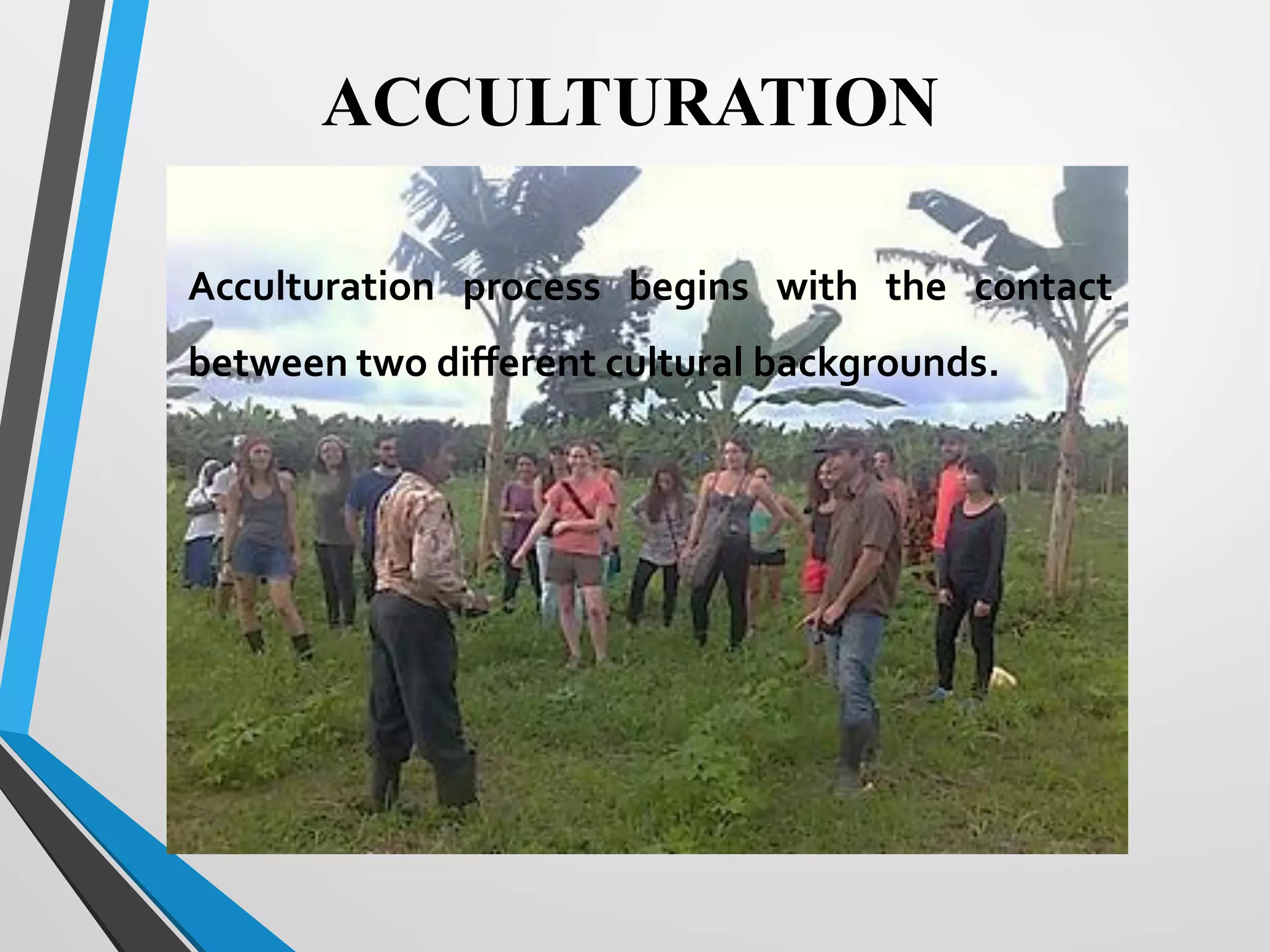
Acculturation process begins with the contact
between two different cultural backgrounds.
ACCULTURATION
Individuals are able to
adjust to new cultures
and benefit from new
intercultural
experiences
Processes of social,
cultural and
psychological
adaptation of an
individual
Includes acquiring
languages and
adopting new cultural
customs
no indigenous English teachers working in an
indigenous area face these and many changes
more, and their families also have to be part of the
adapting process because it is very difficult to take
all the members of the family to live there.
These investigation took place at Upper Talamanca Valley, Limon
Province, Costa Rica. Amubri is the heart of the indigenous reserve of
Talamanca. From Bribri town take two buses through La Pera road or to
the side of the Sixaola River, passing by the communities of Chase,
Bambú and Suretka, get to the Telire River, cross by motorboat and get
on a bus at the other side of the river. Amubri is surrounded by other
neighbor communities like Kekolde, Dique, Corbita, Kachable, Tsuiri, Los
Cocos. It limits to the north with the community of Suiri, to the south
with the community of Soki, to the east with the community of Los Cocos
and to the west, it limits with the communities of Córbita and Kachabri.
LOCATION
THE COLEGIOTÉCNICO PROFESIONAL DE
TALAMANCA
The Colegio Técnico Profesioonal de Talamanca
was founded in 1974, in the community of Hone
Creek, located in the district of Cahuita. First it was
a school part of the group of agricultural schools in
the country, later it became professional technical
schools and the educational offer was diversified.
15 administrative
• 1 Principal
• 1 Assistant
• 2 Administrative
assistants
• 1 Secretary
• 2 Counselors
• 1 Librarian
• 3 Janitors
• 4 Security guards.
850 Students
• 29 groups
• 3 special
education groups
56 teachers
• 33 tenure and
• 23 interim
Colegioi Sulayöm the first indigenous high school in Costa
Rica. It was founded in 1995 and its first name was “Colegio
Tercer Ciclo de Amubri” (Third Cycle High School of Amubri).
It was the first academic school located in the community of
Amubri, Talamanca, and Limón, Costa Rica. Because of the
very long distances many students have to walk to go to
school, there are many rivers they have to cross over, it is
difficult for them to get back home every single day after
school duties. so students from very far have to look for a
place to stay during school days because the only way to get
home is walking about 8-hours
230Students
• 11
GROUPS
Teachers
• 12
Teachers
Administratives
• 1 Principal
• 1 Asistant
• 2 Secretaries
• 2Janitors
• 2 Guards
The Research
Acculturation and Deculturation
acculturation
In order to understand what no indigenous English teachers go through when
they go to work at the indigenous communities of Talamanca, it is important to
understand the meaning of the word acculturation and deculturation.
Deculturation
Cultural modification of an
individual, group, or people by
adapting to or borrowing
traits from another culture
Process of divesting a tribe or
people of their indigenous
traits
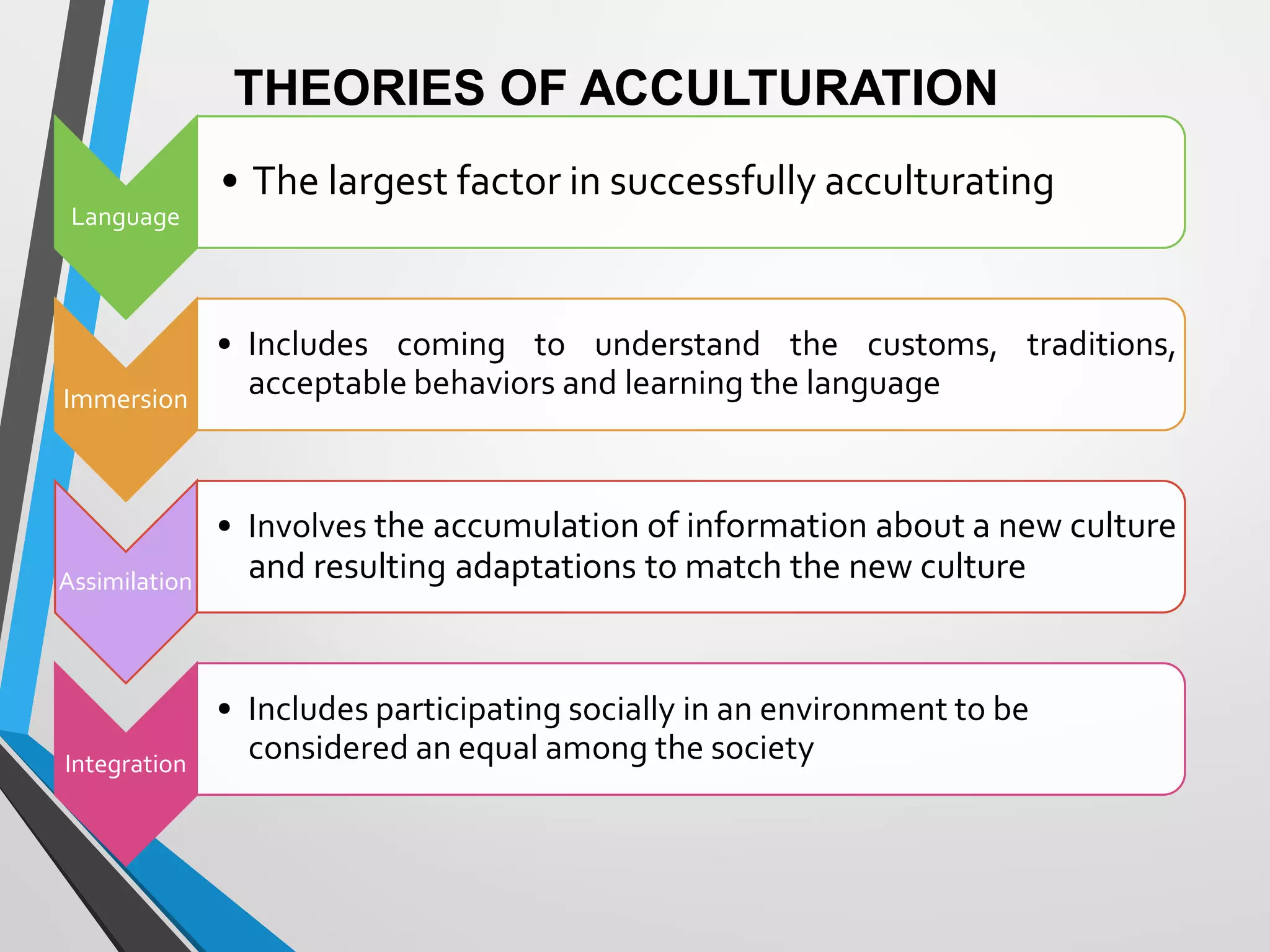
THEORIES OF ACCULTURATION
Language
• The largest factor in successfully acculturating
Immersion
• Includes coming to understand the customs, traditions,
acceptable behaviors and learning the language
Assimilation
• Involves the accumulation of information about a new culture
and resulting adaptations to match the new culture
Integration
• Includes participating socially in an environment to be
considered an equal among the society
Variable N° 1: Personal background of no indigenous English teachers
working in the indigenous communities ofTalamanca.
• It refers to the Personal background of no
indigenous English teachers working in the
indigenous communities ofTalamanca.
Conceptual
Definition
• In order to identify the Personal background
of no indigenous English teachers working in
the indigenous communities of Talamanca
they will answer a questionnaire design to
collet that information.
Operational
Definition
• A questionnaire used to collect the needed
information about the Personal background
of no indigenous English teachers working in
the indigenous communities ofTalamanca.
Instrumental
Definition
Variable N° 2: Educational background, of the no indigenous
English teachers who work in indigenous communities of
Talamanca.
• It refers to the Educational background, of
the no indigenous English teachers who
work in indigenous communities of
Talamanca.
Conceptual
Definition
• In order to describe the educational
background, of the no indigenous English
teachers who work in indigenous
communities of Talamanca. They will
answer a questionnaire designed to collet
that information.
Operational
Definition
• A questionnaire designed to collect
information about Educational background,
of the no indigenous English teachers who
work in indigenous communities of
Talamanca, they will answer a questionnaire
design to collet that information.
Instrumental
Definition
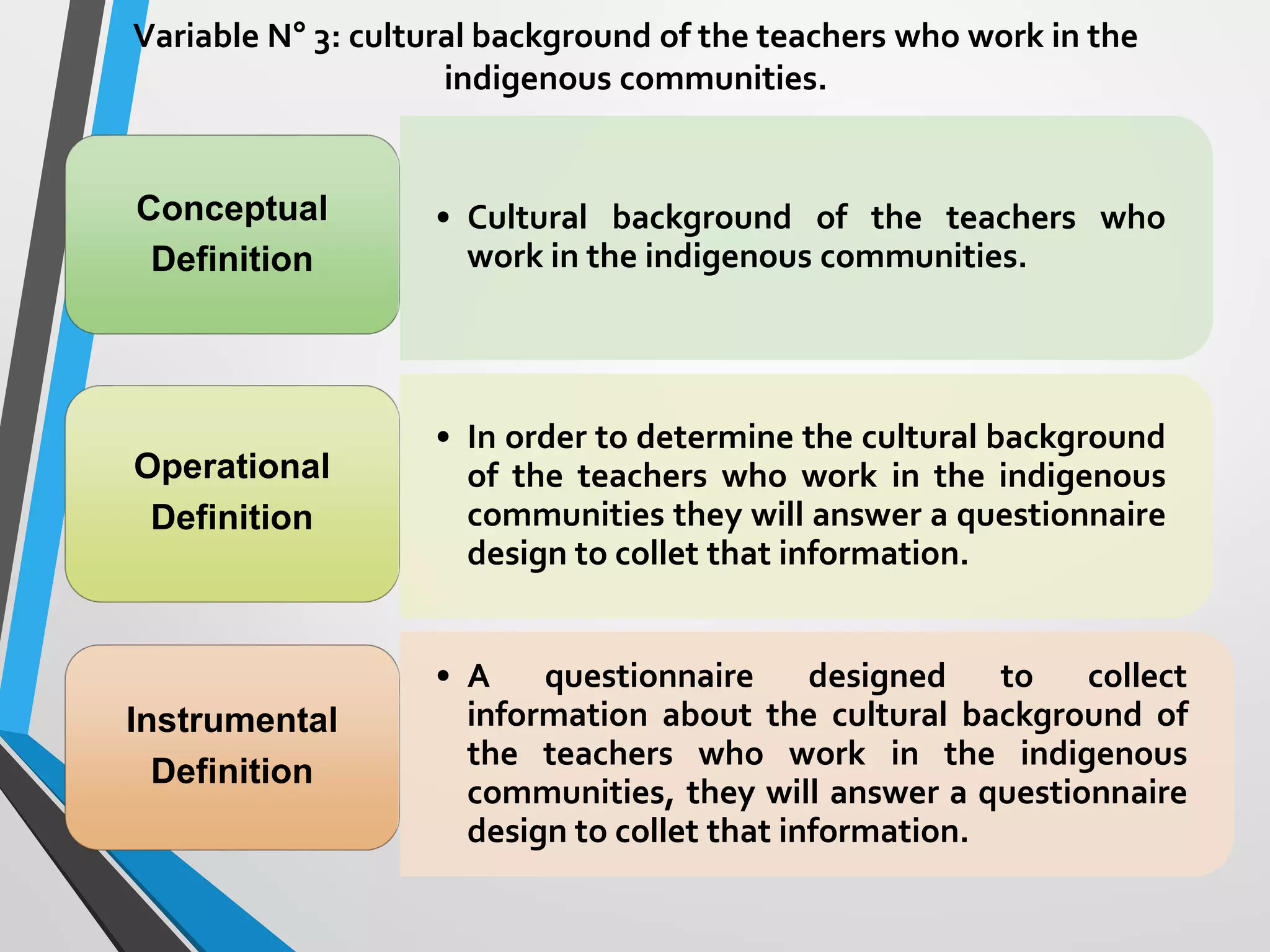
Variable N° 3: cultural background of the teachers who work in the
indigenous communities.
• Cultural background of the teachers who
work in the indigenous communities.
Conceptual
Definition
• In order to determine the cultural background
of the teachers who work in the indigenous
communities they will answer a questionnaire
design to collet that information.
Operational
Definition
• A questionnaire designed to collect
information about the cultural background of
the teachers who work in the indigenous
communities, they will answer a questionnaire
design to collet that information.
Instrumental
Definition
Variable N° 4: Emotional factors of teachers who work in the
indigenous communities.
• It refers to emotional factors of teachers
who work in the indigenous communities.
Conceptual
Definition
• In order to determine the social, emotional
factors of teachers who work in the
indigenous communities, they will answer a
questionnaire designed to collet that
information.
Operational
Definition
• A questionnaire designed to collect
information about emotional factors of
teachers who work in the indigenous
communities, they will answer a
questionnaire design to collet that
information.
Instrumental
Definition
ANALYSIS AND INTERPRETATION OF
THE RESULTS
The analysis of the collected data is presented
variable by variable, at the same time they are
going to be analyzed taking into account the
used instrument
Absolute Percentage .
Yes 3 33%
No 4 45%
No Answer 2 22%
Total 9 100%
CHART N° 1. FAMILY BACKGROUND KNOWLEDGE
Source: Irma Brown. 2015
GRAPH N° 1. PERSONAL BACKGROUND
33%
45%
22%
Yes
No
no answer
CHART N°2. ANCESTORS OF THE ENGLISH TEACHERS
Absolute Percentage ….
No 6 55%
Yes 3 45%
TOTAL 9 100%
Grandmother 3 27%
Grandfather 1 9%
Mother 0 0%
Father 1 9%
Source: Irma Brown. 2015
GRAPH N°2. ANCESTORS OF THE ENGLISH TEACHERS
55%
27%
9%
0%
9%
45%
No
grandmother
grandfather
mother
father
Source: Chart N°2
CHART N°3. PLACE OF BIRTH
Source: Irma Brown. 2015
Absolute Percentage ….
Urban 2 22%
Coast 5 56%
Rural 2 22%
Total 9 100%
GRAPH N°3. PLACE OF BIRTH
22%
56%
22%
Urban
Coast
Rural
Source: Chart N° 3
Absolute Percentage …
Concern
6 67%
Exited
0 0%
Afraid
0 0%
Happy
1 11%
Disappointed 2 22%
Total 9 100%
CHART N°4. RELATIVES OPINION ABOUT WORKING IN THE
INDIGENOUS COMMUNITIES.
Source: Irma Brown. 2015
Source: Chart N°4
GRAPH N°4, RELATIVES OPINION ABOUT WORKING IN THE
INDIGENOUS COMMUNITIES.
67%0%
0%
11%
22%
Concern
Exited
Afraid
Happy
Disappointed
CHART N°5, PRIMARY FAMILY’S REACTION ABOUT MOVING WITH
THE TEACHER TO THE INDIGENOUS COMMUNITIES.
Source: Irma Brown. 2015
Absolute Percentage
No 7 78%
May Be Later 2 22%
Yes 0 0%
TOTAL 9 100%
GRAPH N°5. PRIMARY FAMILY’S REACTION ABOUT MOVING WITH
THE TEACHER TO THE INDIGENOUS COMMUNITIES.
78%
22%
0%
No
May be later
Yes
Source: Chart N°5
Absolute Percentage
Indigenous Community 0 0%
Home town 6 67%
Away from home town 1 11%
No far from home town 2 22%
TOTAL 9 100%
CHART N°6, PRIMARY AND HIGH SCHOOL LOCATION
Source: Irma Brown. 2015
GRAPH N°6, PRIMARY AND HIGH SCHOOL
LOCATION
0%
67%
11%
22%
Indigenous Community
Home town
Away from home town
No far from home town
Source: Graph N°6
Absolute Percentage
Below Average 0 0%
Average 7 78%
Good 1 11%
Excellent 1 11%
TOTAL 9 100%
CHART N°7, STUDENT BACKGROUND
Source: Irma Brown. 2015
GRAPH N°7, STUDENT background
0%
78%
11%
11%
Bellow average
Average
Good
Excellent
Source: Chart N°7
Absolute Percentage
Play baseball 0 0%
Flip the cards 1 10%
Jump rope 3 30%
Sack race 0 0%
Play jacks 2 20%
Ride a bike 4 40%
CHART N°8, FREE TIME ACTIVITIES
Source: Irma Brown. 2015
GRAPH N°8, FREE TIME ACTIVITIES
0%
10%
30%
0%
20%
40% Play baseball
Flip the cards
Jump rope
Sack race
Play jacks
Ride a bike
Source: Chart N°8
Absolute Percentage
Very Much 0 0%
Enough 0 0%
Not Enough 2 22%
Hardly 4 45%
Not at All 3 33%
TOTAL 9 100%
CHART N°9, UNIVERSITY TRAINING
Source: Irma Brown. 2015
GRAPH N°9, UNIVERSITY TRAINING
0%0%
22%
45%
33%
Very Much
Enough
Not Enough
Hardly
Not at All
Source: Chart N°9
CHART N°10 YOUTH FRIEND SHIP
Source: Irma Brown. 2015
Absolute Percentage
No 1 11%
Yes 8 89%
TOTAL 9 100%
Preschool 1 11%
Elementary 5 22%
College 2 56%
GRAPH N°10 YOUTH FRIEND SHIP
Source: Chart N°10
0%
11% 11%
56%
22%
89%
No
Preschool
Elemenary
College
Absolute Percentage
Spanish 0 0%
Afro descendent 9 100%
Indigenous 0 0%
TOTAL 9 100%
CHART N°11, ETHNICAL BACKGROUND
Source: Irma Brown. 2015
GRAPH N°11, ETHNICAL BACKGROUND
0%0%
100%
0%0%
Spanish
Afro descendent
Indigenous
Source: Chart N°5
GRANDPARENTS PLACE OF BIRTH
Absolute Percentage
Jamaica 5 50%
Spain 0 0%
Europe 1 10%
South America 0 0%
Haiti 0 0%
Costa Rica 4 40%
CHART N°12, GRANDPARENTS PLACE OF BIRTH
Source: Irma Brown. 2015
GRAPH N°12, GRANDPARENTS PLACE OF BIRTH
0%
50%
0%10%
0%0%
40% Jamaica
Spain
Europe
South America
Haiti
Costa Rica
Source: Chart N°12
CHART N°13, OTHER MEMBERS ETHNIC
Source: Irma Brown. 2015
ABSOLUTE PERCENTAGE
Jamaica 6 30
Europe 3 15
South America 2 10
Haiti 7 35
Costa Rica, Indigenous 2 10
Costa Rica 9 31
GRAPH N°13, OTHER MEMBERS ETHNICITY
Source: Chart N°13
30%
0%
15%
10%
35%
10%
Jamaica
Europe
South America
Haiti
Costa Rica, Indigenous
CHART N°14, REMAIN ANCESTORS’ TRADITIONS
SourceChart N°14
Absolute Percentage
Jump rope 2 11%
Rice and beans 5 28%
Ron don 4 22%
Go fishing 2 11%
Cook Afro-American
dishes
5 28%
Source: Chart N°14
11%
28%
22%
11%
28%
Jump rope
Rice and beans
Ron don
Go fishing
Cook Afro-American dishes
GRAPH N°14, REMAIN ANCESTORS’ TRADITIONS
CHART N°15, INDIGENOUS LANGUAGE LEVEL
Source: Irma Brown. 2015
Absolute Percentage
Very low level 0 0%
Low level 1 11%
Medium Level 5 11%
Medium high level 2 22%
High level 1 11%
TOTAL 9 100%
0%
11%
56%
22%
11%
Very low level
Low level
Medium Level
Medium high level
High level
GRAPH N°15, INDIGENOUS LANGUAGE LEVEL
Source: Chart N°15
Absolute Percentage.
Yes 8 89%
No 1 11%
TOTAL 9 100%
CHART N°16. RECALL OF THE MEP´S CALL
Source: Irma Brown. 2015
GRAPH N°16 RECALL OF MEP´S CALL
89%
11%
Yes
No
Source: Chart N°16
Absolute Percentage
Pleased 2 22%
Unhappy 0 0%
Happy 2 22%
Concern 3 34%
Scared 2 22%
TOTAL 9 100%
CHART N°17. REACTION
Source: Irma Brown. 2015
GRAPH N°17, REACTON
22%
0%
22%
34%
22%
Pleased
Unhappy
Happy
Concern
Scared
Source: Chart N°17
Absolute Percentage
Pleasant 6 67%
Exhausting 1 11%
Unexpected 0 0%
It couldn´t be worst 0 0%
Terrifying 0 0%
It couldn´t be better 1 11%
Nice 1 11%
TOTAL 9 100%
CHART N°18, EXPERIENCE
Source: Irma Brown. 2015
GRAPH N°18, EXPERIENCE
67%11%
0%0%0%
11%
11%
Pleasant
Exhausting
Unexpected
It couldn´t be worst
Terrifying
It couldn´t be better
Nice
Source: Chart N° 18
Absolute Percentage
Yes 9 100%
No 0 0%
TOTAL 9 100%
CHART N°19, FAMILY SUPPORT
Source: Irma Brown. 2015
GRAPH N°19. FAMILY SUPPORT
Source: Chart N°19
100%
0%
Yes
No
Absolute Percentage
Yes 1 11%
No 8 89%
TOTAL 9 100%
CHART N° 20, COMPLIANCE OF EXPECTATIONS
Source: Irma Brown. 2015
GRAPH N° 20, COMPLIANCE OF EXPECTATIONS
11%
89%
Yes
No
Source: Chart N°20
CONCLUSIONS
•Analyzing the obtained
answers from the teachers who
work at the indigenous
• Most of the teachers working at the indigenous
communities of Bribri are from Limon province, even
though they live in the same province that the
indigenous communities only a few of them actually
have indigenous ancestors, the majority of the
teachers are Afro descendant, and none of them
practice any kind of cultural customs from the Bribri
culture.
PERSONAL BACKGROUND
PROFESSIONAL BACKGROUND
• Experimenting is a part of working in an indigenous
community, any university prepares a teacher to work
in the indigenous community, where the community is
completely different from where the teacher is from,
implies changing and adapting to what it’s there to
work with as well as the context where learning is
taking place.
CULTURAL BACKGROUND
• As it was mentioned before, all of the teachers are
afro-descendant, giving this situation a further
investigation about why this phenomenon occurs
can take place. Despite the fact that all of them are
Afro-descendant, not all are from the same region,
even though most of their grandparents are from
Jamaica, they are also from Europe and many of
them from Costa Rica.
EMOTIONAL FACTORS
• Working in the indigenous communities it’s not easy for the
English teachers, their expectations of workings in a indigenous
community it is not what they were expecting, and because they
didn’t receive any kind of preparation, they did not have an idea
what to expect, their relatives don’t visit them and their social
live it’s affected by the long periods of times they are away from
home, these fact affect the teachers emotionally.
RECOMMENDATIONS
Call
• To take into
consideration the
no indigenous
English teachers,
request the
principal to adapt
their schedule in
such a way that
they can at least
go home once or
twice a week.
Presentation
• To receive a basic
class of the
indigenous
language, and be
introduced to the
culture, to be
informed exactly
where they are
going, how far they
have to travel and
the means of
transportation they
have to take
• To organize workshops
to teach the teachers the
basics to the Bribri
language needed, the
minimum cultural details
to bond with the
inhabitants and have a
place for them to stay
during the school days as
well as a list of “most to
have” before they go
there to be prepare
Preparation
PROPOSAL
PREFACE
• In the fallowing proposal there is presented a project
that aims to the teachers who go to work in the
indigenous communities, facing a new culture, new
language and away from home and people they love.
GENERAL OBJECTIVE
• To create a data base with those teachers who
have already worked in the indigenous
communities, their experiences, their
thoughts and attitudes toward this new life
and how do they succeed.
SPECIFIC OBJECTIVES
To define the most important aspects teachers
must know when they are sent to work at the
indigenous communities.
To enlist the, for sure, difficulties they are going
to face.
To prepare a document with
recommendations to overcome those
difficulties successfully.
JUSTIFICATION
• Being an English teacher in an indigenous
community it´s a life changing experience,
traveling per hours, living there from Monday to
Friday, facing a new language, different food,
different customs and traditions.
• The need of bonding with the inhabitant
• The mission of convincing students, parents and
authorities the importance of learning English as
a foreign language, because Spanish is their
second language.
• This proposal has the purpose to help no
indigenous English teachers who are sent to the
indigenous communities to work, to have smoother
adaptation process, to be prepared to face
whatever they are going to face during this time as
much as possible, and to encourage new teachers
to live this amazing experience.
DEVELOPMENT
• To present the results of this project and give examples
of the different experiences is to create an eight hours
meeting with the new no indigenous English teachers
and the ones who are already working there, this
meeting is going to be prepared by the regional advisor
and it’s going to include no indigenous English
teachers from the different communities, the new
teachers and members of the different indigenous
communities.
STRATEGY
To talk to the no indigenous English teachers in order to
have the most accurate information, during the meeting
must count with the presence of no indigenous English
Teachers who already worked in an indigenous community.
It is important to present to the assistants the testimony of
former students and indigenous community’s leader, in
order to have an idea what is expected from them as
English teachers as a future members of the community
IMPORTANT ASPECTS
ENLIST DIFFICULTIES
After defining the most important aspects, theses have
to arrange based on their interest and impact in the
lives of no indigenous English Teachers who are going
to work for the first time in an indigenous community.
DOCUMENTATION
Documenting the most important information enlisted, it
has to be presented in a document to be given away to
the no indigenous English Teachers who are going to
work for the first time in an indigenous community,
doing this is very important due to the distance
between the advisors and the teachers,
Descriptive Study on the Acculturation Process for English Teachers in the Indigenous Culture of Bribri in Talamanca

Descriptive Study on the Acculturation Process for English Teachers in the Indigenous Culture of Bribri in Talamanca

  • 1.
    UNIVERSIDAD MAGISTER FACULTAD DEEDUCACIÓN CARRERA DE LICENCIATURA EN ENSEÑANZA DE INGLÉS TESIS PARA OPTAR AL GRADO DE LICENCIATURA EN LA ENSEÑANZA DEL INGLÉS IRMA BROWN FORBES JANUARY, 2016
  • 2.
    SUBJECT Descriptive study onthe acculturation process for no indigenous English teachers in the indigenous communities of Bribri inTalamanca
  • 3.
    PROBLEM How no indigenousEnglish teachers experience the acculturation process when they have to work in the indigenous communities?
  • 4.
    JUSTIFICATION Being an Englishteacher in an indigenous community it´s a life changing experience. When teachers are sent there, nobody tells them the changes they are about to faced, the importance of adapting to the culture and tolerant needed when the cultural differences arise.
  • 5.
    Need to bondwith the inhabitant Understand and accept the difference from their own culture Live away from home
  • 6.
    Facing a newlanguage Different food Different customs and traditions
  • 7.
    GENERAL OBJECTIVE •Describe theacculturation process of the no indigenous English teachers in the indigenous communities of Talamanca, based on the socio- cultural, familiar, emotional, to facilitate the teaching – learning process.
  • 8.
    SPECIFIC OBJECTIVES To identifythe personal background of no indigenous English teachers working in the indigenous communities of Talamanca. To describe the educational background, of the no indigenous English teachers working in indigenous communities of Talamanca.
  • 9.
    SPECIFIC OBJECTIVES Describe thecultural background of the teachers who work in the indigenous communities. Identify emotional factors of teachers who work in the indigenous communities.
  • 10.
    Acculturation process beginswith the contact between two different cultural backgrounds. ACCULTURATION
  • 11.
    Individuals are ableto adjust to new cultures and benefit from new intercultural experiences Processes of social, cultural and psychological adaptation of an individual Includes acquiring languages and adopting new cultural customs no indigenous English teachers working in an indigenous area face these and many changes more, and their families also have to be part of the adapting process because it is very difficult to take all the members of the family to live there.
  • 12.
    These investigation tookplace at Upper Talamanca Valley, Limon Province, Costa Rica. Amubri is the heart of the indigenous reserve of Talamanca. From Bribri town take two buses through La Pera road or to the side of the Sixaola River, passing by the communities of Chase, Bambú and Suretka, get to the Telire River, cross by motorboat and get on a bus at the other side of the river. Amubri is surrounded by other neighbor communities like Kekolde, Dique, Corbita, Kachable, Tsuiri, Los Cocos. It limits to the north with the community of Suiri, to the south with the community of Soki, to the east with the community of Los Cocos and to the west, it limits with the communities of Córbita and Kachabri. LOCATION
  • 13.
    THE COLEGIOTÉCNICO PROFESIONALDE TALAMANCA The Colegio Técnico Profesioonal de Talamanca was founded in 1974, in the community of Hone Creek, located in the district of Cahuita. First it was a school part of the group of agricultural schools in the country, later it became professional technical schools and the educational offer was diversified.
  • 14.
    15 administrative • 1Principal • 1 Assistant • 2 Administrative assistants • 1 Secretary • 2 Counselors • 1 Librarian • 3 Janitors • 4 Security guards. 850 Students • 29 groups • 3 special education groups 56 teachers • 33 tenure and • 23 interim
  • 15.
    Colegioi Sulayöm thefirst indigenous high school in Costa Rica. It was founded in 1995 and its first name was “Colegio Tercer Ciclo de Amubri” (Third Cycle High School of Amubri). It was the first academic school located in the community of Amubri, Talamanca, and Limón, Costa Rica. Because of the very long distances many students have to walk to go to school, there are many rivers they have to cross over, it is difficult for them to get back home every single day after school duties. so students from very far have to look for a place to stay during school days because the only way to get home is walking about 8-hours
  • 16.
    230Students • 11 GROUPS Teachers • 12 Teachers Administratives •1 Principal • 1 Asistant • 2 Secretaries • 2Janitors • 2 Guards
  • 17.
  • 18.
    Acculturation and Deculturation acculturation Inorder to understand what no indigenous English teachers go through when they go to work at the indigenous communities of Talamanca, it is important to understand the meaning of the word acculturation and deculturation. Deculturation Cultural modification of an individual, group, or people by adapting to or borrowing traits from another culture Process of divesting a tribe or people of their indigenous traits
  • 19.
    THEORIES OF ACCULTURATION Language •The largest factor in successfully acculturating Immersion • Includes coming to understand the customs, traditions, acceptable behaviors and learning the language Assimilation • Involves the accumulation of information about a new culture and resulting adaptations to match the new culture Integration • Includes participating socially in an environment to be considered an equal among the society
  • 20.
    Variable N° 1:Personal background of no indigenous English teachers working in the indigenous communities ofTalamanca. • It refers to the Personal background of no indigenous English teachers working in the indigenous communities ofTalamanca. Conceptual Definition • In order to identify the Personal background of no indigenous English teachers working in the indigenous communities of Talamanca they will answer a questionnaire design to collet that information. Operational Definition • A questionnaire used to collect the needed information about the Personal background of no indigenous English teachers working in the indigenous communities ofTalamanca. Instrumental Definition
  • 21.
    Variable N° 2:Educational background, of the no indigenous English teachers who work in indigenous communities of Talamanca. • It refers to the Educational background, of the no indigenous English teachers who work in indigenous communities of Talamanca. Conceptual Definition • In order to describe the educational background, of the no indigenous English teachers who work in indigenous communities of Talamanca. They will answer a questionnaire designed to collet that information. Operational Definition • A questionnaire designed to collect information about Educational background, of the no indigenous English teachers who work in indigenous communities of Talamanca, they will answer a questionnaire design to collet that information. Instrumental Definition
  • 22.
    Variable N° 3:cultural background of the teachers who work in the indigenous communities. • Cultural background of the teachers who work in the indigenous communities. Conceptual Definition • In order to determine the cultural background of the teachers who work in the indigenous communities they will answer a questionnaire design to collet that information. Operational Definition • A questionnaire designed to collect information about the cultural background of the teachers who work in the indigenous communities, they will answer a questionnaire design to collet that information. Instrumental Definition
  • 23.
    Variable N° 4:Emotional factors of teachers who work in the indigenous communities. • It refers to emotional factors of teachers who work in the indigenous communities. Conceptual Definition • In order to determine the social, emotional factors of teachers who work in the indigenous communities, they will answer a questionnaire designed to collet that information. Operational Definition • A questionnaire designed to collect information about emotional factors of teachers who work in the indigenous communities, they will answer a questionnaire design to collet that information. Instrumental Definition
  • 24.
    ANALYSIS AND INTERPRETATIONOF THE RESULTS The analysis of the collected data is presented variable by variable, at the same time they are going to be analyzed taking into account the used instrument
  • 25.
    Absolute Percentage . Yes3 33% No 4 45% No Answer 2 22% Total 9 100% CHART N° 1. FAMILY BACKGROUND KNOWLEDGE Source: Irma Brown. 2015
  • 26.
    GRAPH N° 1.PERSONAL BACKGROUND 33% 45% 22% Yes No no answer
  • 27.
    CHART N°2. ANCESTORSOF THE ENGLISH TEACHERS Absolute Percentage …. No 6 55% Yes 3 45% TOTAL 9 100% Grandmother 3 27% Grandfather 1 9% Mother 0 0% Father 1 9% Source: Irma Brown. 2015
  • 28.
    GRAPH N°2. ANCESTORSOF THE ENGLISH TEACHERS 55% 27% 9% 0% 9% 45% No grandmother grandfather mother father Source: Chart N°2
  • 29.
    CHART N°3. PLACEOF BIRTH Source: Irma Brown. 2015 Absolute Percentage …. Urban 2 22% Coast 5 56% Rural 2 22% Total 9 100%
  • 30.
    GRAPH N°3. PLACEOF BIRTH 22% 56% 22% Urban Coast Rural Source: Chart N° 3
  • 31.
    Absolute Percentage … Concern 667% Exited 0 0% Afraid 0 0% Happy 1 11% Disappointed 2 22% Total 9 100% CHART N°4. RELATIVES OPINION ABOUT WORKING IN THE INDIGENOUS COMMUNITIES. Source: Irma Brown. 2015
  • 32.
    Source: Chart N°4 GRAPHN°4, RELATIVES OPINION ABOUT WORKING IN THE INDIGENOUS COMMUNITIES. 67%0% 0% 11% 22% Concern Exited Afraid Happy Disappointed
  • 33.
    CHART N°5, PRIMARYFAMILY’S REACTION ABOUT MOVING WITH THE TEACHER TO THE INDIGENOUS COMMUNITIES. Source: Irma Brown. 2015 Absolute Percentage No 7 78% May Be Later 2 22% Yes 0 0% TOTAL 9 100%
  • 34.
    GRAPH N°5. PRIMARYFAMILY’S REACTION ABOUT MOVING WITH THE TEACHER TO THE INDIGENOUS COMMUNITIES. 78% 22% 0% No May be later Yes Source: Chart N°5
  • 35.
    Absolute Percentage Indigenous Community0 0% Home town 6 67% Away from home town 1 11% No far from home town 2 22% TOTAL 9 100% CHART N°6, PRIMARY AND HIGH SCHOOL LOCATION Source: Irma Brown. 2015
  • 36.
    GRAPH N°6, PRIMARYAND HIGH SCHOOL LOCATION 0% 67% 11% 22% Indigenous Community Home town Away from home town No far from home town Source: Graph N°6
  • 37.
    Absolute Percentage Below Average0 0% Average 7 78% Good 1 11% Excellent 1 11% TOTAL 9 100% CHART N°7, STUDENT BACKGROUND Source: Irma Brown. 2015
  • 38.
    GRAPH N°7, STUDENTbackground 0% 78% 11% 11% Bellow average Average Good Excellent Source: Chart N°7
  • 39.
    Absolute Percentage Play baseball0 0% Flip the cards 1 10% Jump rope 3 30% Sack race 0 0% Play jacks 2 20% Ride a bike 4 40% CHART N°8, FREE TIME ACTIVITIES Source: Irma Brown. 2015
  • 40.
    GRAPH N°8, FREETIME ACTIVITIES 0% 10% 30% 0% 20% 40% Play baseball Flip the cards Jump rope Sack race Play jacks Ride a bike Source: Chart N°8
  • 41.
    Absolute Percentage Very Much0 0% Enough 0 0% Not Enough 2 22% Hardly 4 45% Not at All 3 33% TOTAL 9 100% CHART N°9, UNIVERSITY TRAINING Source: Irma Brown. 2015
  • 42.
    GRAPH N°9, UNIVERSITYTRAINING 0%0% 22% 45% 33% Very Much Enough Not Enough Hardly Not at All Source: Chart N°9
  • 43.
    CHART N°10 YOUTHFRIEND SHIP Source: Irma Brown. 2015 Absolute Percentage No 1 11% Yes 8 89% TOTAL 9 100% Preschool 1 11% Elementary 5 22% College 2 56%
  • 44.
    GRAPH N°10 YOUTHFRIEND SHIP Source: Chart N°10 0% 11% 11% 56% 22% 89% No Preschool Elemenary College
  • 45.
    Absolute Percentage Spanish 00% Afro descendent 9 100% Indigenous 0 0% TOTAL 9 100% CHART N°11, ETHNICAL BACKGROUND Source: Irma Brown. 2015
  • 46.
    GRAPH N°11, ETHNICALBACKGROUND 0%0% 100% 0%0% Spanish Afro descendent Indigenous Source: Chart N°5
  • 47.
    GRANDPARENTS PLACE OFBIRTH Absolute Percentage Jamaica 5 50% Spain 0 0% Europe 1 10% South America 0 0% Haiti 0 0% Costa Rica 4 40% CHART N°12, GRANDPARENTS PLACE OF BIRTH Source: Irma Brown. 2015
  • 48.
    GRAPH N°12, GRANDPARENTSPLACE OF BIRTH 0% 50% 0%10% 0%0% 40% Jamaica Spain Europe South America Haiti Costa Rica Source: Chart N°12
  • 49.
    CHART N°13, OTHERMEMBERS ETHNIC Source: Irma Brown. 2015 ABSOLUTE PERCENTAGE Jamaica 6 30 Europe 3 15 South America 2 10 Haiti 7 35 Costa Rica, Indigenous 2 10 Costa Rica 9 31
  • 50.
    GRAPH N°13, OTHERMEMBERS ETHNICITY Source: Chart N°13 30% 0% 15% 10% 35% 10% Jamaica Europe South America Haiti Costa Rica, Indigenous
  • 51.
    CHART N°14, REMAINANCESTORS’ TRADITIONS SourceChart N°14 Absolute Percentage Jump rope 2 11% Rice and beans 5 28% Ron don 4 22% Go fishing 2 11% Cook Afro-American dishes 5 28%
  • 52.
    Source: Chart N°14 11% 28% 22% 11% 28% Jumprope Rice and beans Ron don Go fishing Cook Afro-American dishes GRAPH N°14, REMAIN ANCESTORS’ TRADITIONS
  • 53.
    CHART N°15, INDIGENOUSLANGUAGE LEVEL Source: Irma Brown. 2015 Absolute Percentage Very low level 0 0% Low level 1 11% Medium Level 5 11% Medium high level 2 22% High level 1 11% TOTAL 9 100%
  • 54.
    0% 11% 56% 22% 11% Very low level Lowlevel Medium Level Medium high level High level GRAPH N°15, INDIGENOUS LANGUAGE LEVEL Source: Chart N°15
  • 55.
    Absolute Percentage. Yes 889% No 1 11% TOTAL 9 100% CHART N°16. RECALL OF THE MEP´S CALL Source: Irma Brown. 2015
  • 56.
    GRAPH N°16 RECALLOF MEP´S CALL 89% 11% Yes No Source: Chart N°16
  • 57.
    Absolute Percentage Pleased 222% Unhappy 0 0% Happy 2 22% Concern 3 34% Scared 2 22% TOTAL 9 100% CHART N°17. REACTION Source: Irma Brown. 2015
  • 58.
  • 59.
    Absolute Percentage Pleasant 667% Exhausting 1 11% Unexpected 0 0% It couldn´t be worst 0 0% Terrifying 0 0% It couldn´t be better 1 11% Nice 1 11% TOTAL 9 100% CHART N°18, EXPERIENCE Source: Irma Brown. 2015
  • 60.
    GRAPH N°18, EXPERIENCE 67%11% 0%0%0% 11% 11% Pleasant Exhausting Unexpected Itcouldn´t be worst Terrifying It couldn´t be better Nice Source: Chart N° 18
  • 61.
    Absolute Percentage Yes 9100% No 0 0% TOTAL 9 100% CHART N°19, FAMILY SUPPORT Source: Irma Brown. 2015
  • 62.
    GRAPH N°19. FAMILYSUPPORT Source: Chart N°19 100% 0% Yes No
  • 63.
    Absolute Percentage Yes 111% No 8 89% TOTAL 9 100% CHART N° 20, COMPLIANCE OF EXPECTATIONS Source: Irma Brown. 2015
  • 64.
    GRAPH N° 20,COMPLIANCE OF EXPECTATIONS 11% 89% Yes No Source: Chart N°20
  • 65.
    CONCLUSIONS •Analyzing the obtained answersfrom the teachers who work at the indigenous
  • 66.
    • Most ofthe teachers working at the indigenous communities of Bribri are from Limon province, even though they live in the same province that the indigenous communities only a few of them actually have indigenous ancestors, the majority of the teachers are Afro descendant, and none of them practice any kind of cultural customs from the Bribri culture. PERSONAL BACKGROUND
  • 67.
    PROFESSIONAL BACKGROUND • Experimentingis a part of working in an indigenous community, any university prepares a teacher to work in the indigenous community, where the community is completely different from where the teacher is from, implies changing and adapting to what it’s there to work with as well as the context where learning is taking place.
  • 68.
    CULTURAL BACKGROUND • Asit was mentioned before, all of the teachers are afro-descendant, giving this situation a further investigation about why this phenomenon occurs can take place. Despite the fact that all of them are Afro-descendant, not all are from the same region, even though most of their grandparents are from Jamaica, they are also from Europe and many of them from Costa Rica.
  • 69.
    EMOTIONAL FACTORS • Workingin the indigenous communities it’s not easy for the English teachers, their expectations of workings in a indigenous community it is not what they were expecting, and because they didn’t receive any kind of preparation, they did not have an idea what to expect, their relatives don’t visit them and their social live it’s affected by the long periods of times they are away from home, these fact affect the teachers emotionally.
  • 70.
    RECOMMENDATIONS Call • To takeinto consideration the no indigenous English teachers, request the principal to adapt their schedule in such a way that they can at least go home once or twice a week. Presentation • To receive a basic class of the indigenous language, and be introduced to the culture, to be informed exactly where they are going, how far they have to travel and the means of transportation they have to take • To organize workshops to teach the teachers the basics to the Bribri language needed, the minimum cultural details to bond with the inhabitants and have a place for them to stay during the school days as well as a list of “most to have” before they go there to be prepare Preparation
  • 71.
  • 72.
    PREFACE • In thefallowing proposal there is presented a project that aims to the teachers who go to work in the indigenous communities, facing a new culture, new language and away from home and people they love.
  • 73.
    GENERAL OBJECTIVE • Tocreate a data base with those teachers who have already worked in the indigenous communities, their experiences, their thoughts and attitudes toward this new life and how do they succeed.
  • 74.
    SPECIFIC OBJECTIVES To definethe most important aspects teachers must know when they are sent to work at the indigenous communities. To enlist the, for sure, difficulties they are going to face. To prepare a document with recommendations to overcome those difficulties successfully.
  • 75.
    JUSTIFICATION • Being anEnglish teacher in an indigenous community it´s a life changing experience, traveling per hours, living there from Monday to Friday, facing a new language, different food, different customs and traditions. • The need of bonding with the inhabitant • The mission of convincing students, parents and authorities the importance of learning English as a foreign language, because Spanish is their second language.
  • 76.
    • This proposalhas the purpose to help no indigenous English teachers who are sent to the indigenous communities to work, to have smoother adaptation process, to be prepared to face whatever they are going to face during this time as much as possible, and to encourage new teachers to live this amazing experience.
  • 77.
    DEVELOPMENT • To presentthe results of this project and give examples of the different experiences is to create an eight hours meeting with the new no indigenous English teachers and the ones who are already working there, this meeting is going to be prepared by the regional advisor and it’s going to include no indigenous English teachers from the different communities, the new teachers and members of the different indigenous communities.
  • 78.
  • 79.
    To talk tothe no indigenous English teachers in order to have the most accurate information, during the meeting must count with the presence of no indigenous English Teachers who already worked in an indigenous community. It is important to present to the assistants the testimony of former students and indigenous community’s leader, in order to have an idea what is expected from them as English teachers as a future members of the community IMPORTANT ASPECTS
  • 80.
    ENLIST DIFFICULTIES After definingthe most important aspects, theses have to arrange based on their interest and impact in the lives of no indigenous English Teachers who are going to work for the first time in an indigenous community.
  • 81.
    DOCUMENTATION Documenting the mostimportant information enlisted, it has to be presented in a document to be given away to the no indigenous English Teachers who are going to work for the first time in an indigenous community, doing this is very important due to the distance between the advisors and the teachers,