COACHING
PRINCIPLES
NATIONAL COACHING SEMINAR FOR DEPED
BADMINTON TEACHER COACHES
LEARNING OUTCOMES
By the end of this module, coaches will be able to:
• identify the positive benefits of badminton participation;
• explain the role of the coach in creating a positive
badminton experience;
• list the roles and responsibilities of a badminton coach;
• identify their own philosophy of coaching;
• compare the characteristics of autocratic and
democratic coaching styles.
INTRODUCTION
The sport of badminton has the potential to
provide a very positive effect on participants.
Coaches play a very big role in creating an
environment where these positive effects can be
developed. However, in order to do this, coaches
need to have a clear understanding of their own
roles and responsibilities. Effective coaches are
aware of their own coaching philosophy and style,
but can also adapt this if required to meet the
needs of the participants.
What is a COACH?
• An athletic instructor or trainer.
• A private tutor.
• The one who instructs or trains.
What is COACHING?
• Is teaching.
• Mentoring.
• Training or development process in which an
individual gets support while learning to achieve
a specific personal or professional result or goal.
• A process that enables learning and
development to occur and thus performance to
improve.
To be a successful a Coach requires a knowledge and understanding
of process as well as the variety of styles, skills and techniques that are
appropriate to the context in which the coaching takes place.
What is Coaching and Mentoring?
• Facilitate the exploration of needs, motivations, desires,
skills and thought processes to assist the individual in
making real, lasting change.
• Use questioning techniques to facilitate client's own
thought processes in order to identify solutions and
actions rather than takes a wholly directive approach.
• Support the client in setting appropriate goals and
methods of assessing progress in relation to these goals.
Coaching and mentoring share many similarities so it makes sense to
outline the common things coaches and mentors do whether the services
are offered in a paid (professional) or unpaid (philanthropic) role.
• Observe, listen and ask questions to understand the client's
situation
• Creatively apply tools and techniques which may include one-
to-one training, facilitating, counselling & networking.
• Encourage a commitment to action and the development of
lasting personal growth & change.
• Maintain unconditional positive regard for the client, which
means that the coach is at all times supportive and non-
judgemental of the client, their views, lifestyle and aspirations.
• Ensure that clients develop personal competencies and do
not develop unhealthy dependencies on the coaching or
mentoring relationship.
• Evaluate the outcomes of the process, using objective
measures wherever possible to ensure the relationship is
successful and the client is achieving their personal
goals.
• Encourage clients to continually improve competencies
and to develop new developmental alliances where
necessary to achieve their goals.
• Work within their area of personal competence.
• Possess qualifications and experience in the areas that
skills-transfer coaching is offered.
• Manage the relationship to ensure the client receives the
appropriate level of service and that programmes are
neither too short, nor too long.
POSITIVE BENEFITS OF BADMINTON PARTICIPATION
Badminton offers the opportunity for lifelong participation in a sport. It
offers a large number of benefits which can be listed under the
headings of physical, social, emotional and intellectual.
BENEFITS OF BADMINTON
PHYSICAL SOCIAL SOCIAL INTELLECTUAL
• health and
fitness benefits
• friendship
• shared
experiences
• working in a group
• fun
• sense of
achievement
• confidence
• sporting behavior
• problem solving
• skill development
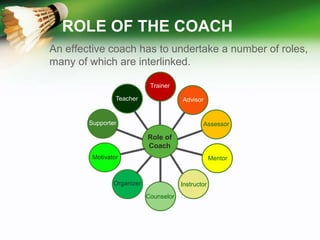
ROLE OF THE COACH
An effective coach has to undertake a number of roles,
many of which are interlinked.
Role of
Coach
Trainer
Advisor
Assessor
Mentor
Instructor
Counselor
Organizer
Motivator
Supporter
Teacher
RESPONSIBILITIES OF COACHES
Coaches are in a very powerful position and carry with them a significant
responsibility. These responsibilities are wide-ranging and can be
grouped under the following:
RESPECTING PARTICIPANTS
COACHING RESPONSIBLY
BUILDING AND MAINTAINING
RELATIONSHIPS
RESPECTING THE SPORT
RESPONSIBILITIES OF COACHES
What is Coaching PHILOSOPHY?
A coaching philosophy can be defined as:
“the set of personal principles and beliefs that
form the foundations of your coaching delivery.”
For example, honesty might be a personal principle that
underpins your coaching delivery.
PHILOSOPHY – the pursuit of wisdom helping to answer fundamental
questions about WHAT, WHY and HOW.
What is Coaching PHILOSOPHY?
All coaches have a coaching philosophy – personal principles and beliefs that
have been formed as a result of their personality, upbringing, education and
life experiences.
For many coaches, this coaching philosophy exists subconsciously. It is
there, but coaches have little appreciation of how it influences their delivery –
in effect the coach has little “self-awareness”. The issues surrounding this
are:
• Coaches who lack self-awareness are probably unaware of their
coaching strengths and weaknesses.
This means they are less likely to make maximum use of those
coaching strengths, or seek to address their coaching weaknesses.
• Coaches will lack the ability to make conscious decisions to adapt
their style. This is a weakness, since not all players, parents,
coaches are involved in badminton for the same reasons. The coach
has to be able to adapt to meet the needs of others involved in the
sport, especially the players!
What is Coaching PHILOSOPHY?
Taking time to decide on your coaching philosophy can help by:
• raising your own self-awareness;
• appreciating your strengths and developing your weaknesses;
• adapting your delivery to the differing needs of the players.
All of these can contribute to making you a better coach.
ESTABLISHING YOUR COACHING PHILOSOPHY
Completing the following questions and tasks can help you
to clearly establish your own coaching philosophy.
• Describe the personal principles and beliefs by which you live your life.
• How would you describe your coaching style and how it is influenced by
your personal principles and beliefs?
• What do others say about your personal principles/coaching style?
• How do you communicate your coaching philosophy to others within the
sport (e.g. players, parents etc.)?
• What personal strengths do you have that help your coaching?
• What are the weaknesses of your coaching and how are you seeking to
improve them?
• What are the needs of the people you coach – i.e. what do they want to get
out of badminton?
• How do you adapt your personal principles and coaching style to meet the
needs of others?
COACHING STYLES
There are many different coaching styles that can be used, but they all tend
to fall between the two extremes of autocratic and democratic coaching
styles.
Autocratic coaching involves the coach defining what needs to be done
and how to do it. The coach does a lot of telling in this style and players
have no involvement in decision-making. The advantages of this approach
for the coach are that it is easier to control and often quicker. The
disadvantage for the players is that this approach does not develop their
own problem-solving and decision-making skills.
Democratic coaching is where the coach allows the players to take more
ownership of what they need to develop and how to go about doing it. The
advantage of this approach is that it develops the self-reliance of players,
improving their problem solving and decision making. The disadvantage is
that this can be slower and harder for the coach to manage, as it involves a
more flexible approach and greater use of questioning skills.
Different styles may need to be used depending on the size of group, the
experience of players, and the situation.
SUMMARY
Badminton can offer a wide range of positive benefits to players of all ages.
Badminton coaches play an important role in helping to establish and
maintain a positive badminton environment.
To support the creation of this positive environment, badminton coaches
should adhere to the BWF Coaches Code of Conduct, the content of which
is consistent with the roles and responsibilities sections of this topic.
In order to improve, BWF coaches should:
• be aware of different coaching styles;
• develop their own self-awareness by considering their own
personal philosophy;
• adapt their coaching style to the needs of the different
participants within badminton.
SELF-ASSESSMENT QUESTIONS
1.
The possible social
benefits available in
badminton are:
Self-confidence
Friendship, shared experiences, working in a group
Health and fitness
Fun
2.
Tick 3 of the following
choices that describe
areas of responsibility
for a coach.
Respect for participants
Coaching responsibly
Respect for the sport
Promoting a win-at-all-costs attitude
3.
Tick 3 of the following
choices that describe
benefits of establishing
your coaching
philosophy.
Identifying personal coaching strengths
Letting players know what you demand
Identifying personal coaching weaknesses
Improving self-awareness
4.
Tick one benefit of a
democratic coaching
style.
The coach controls everything
Players develop their self-reliance
Players are told what to do by the coach
Coach controls how to achieve goals
THANK
YOU

COACHING-PRINCIPLES.pptx

  • 1.
    COACHING PRINCIPLES NATIONAL COACHING SEMINARFOR DEPED BADMINTON TEACHER COACHES
  • 2.
    LEARNING OUTCOMES By theend of this module, coaches will be able to: • identify the positive benefits of badminton participation; • explain the role of the coach in creating a positive badminton experience; • list the roles and responsibilities of a badminton coach; • identify their own philosophy of coaching; • compare the characteristics of autocratic and democratic coaching styles.
  • 3.
    INTRODUCTION The sport ofbadminton has the potential to provide a very positive effect on participants. Coaches play a very big role in creating an environment where these positive effects can be developed. However, in order to do this, coaches need to have a clear understanding of their own roles and responsibilities. Effective coaches are aware of their own coaching philosophy and style, but can also adapt this if required to meet the needs of the participants.
  • 4.
    What is aCOACH? • An athletic instructor or trainer. • A private tutor. • The one who instructs or trains.
  • 5.
    What is COACHING? •Is teaching. • Mentoring. • Training or development process in which an individual gets support while learning to achieve a specific personal or professional result or goal. • A process that enables learning and development to occur and thus performance to improve. To be a successful a Coach requires a knowledge and understanding of process as well as the variety of styles, skills and techniques that are appropriate to the context in which the coaching takes place.
  • 6.
    What is Coachingand Mentoring? • Facilitate the exploration of needs, motivations, desires, skills and thought processes to assist the individual in making real, lasting change. • Use questioning techniques to facilitate client's own thought processes in order to identify solutions and actions rather than takes a wholly directive approach. • Support the client in setting appropriate goals and methods of assessing progress in relation to these goals. Coaching and mentoring share many similarities so it makes sense to outline the common things coaches and mentors do whether the services are offered in a paid (professional) or unpaid (philanthropic) role.
  • 7.
    • Observe, listenand ask questions to understand the client's situation • Creatively apply tools and techniques which may include one- to-one training, facilitating, counselling & networking. • Encourage a commitment to action and the development of lasting personal growth & change. • Maintain unconditional positive regard for the client, which means that the coach is at all times supportive and non- judgemental of the client, their views, lifestyle and aspirations. • Ensure that clients develop personal competencies and do not develop unhealthy dependencies on the coaching or mentoring relationship.
  • 8.
    • Evaluate theoutcomes of the process, using objective measures wherever possible to ensure the relationship is successful and the client is achieving their personal goals. • Encourage clients to continually improve competencies and to develop new developmental alliances where necessary to achieve their goals. • Work within their area of personal competence. • Possess qualifications and experience in the areas that skills-transfer coaching is offered. • Manage the relationship to ensure the client receives the appropriate level of service and that programmes are neither too short, nor too long.
  • 9.
    POSITIVE BENEFITS OFBADMINTON PARTICIPATION Badminton offers the opportunity for lifelong participation in a sport. It offers a large number of benefits which can be listed under the headings of physical, social, emotional and intellectual. BENEFITS OF BADMINTON PHYSICAL SOCIAL SOCIAL INTELLECTUAL • health and fitness benefits • friendship • shared experiences • working in a group • fun • sense of achievement • confidence • sporting behavior • problem solving • skill development
  • 10.
    ROLE OF THECOACH An effective coach has to undertake a number of roles, many of which are interlinked. Role of Coach Trainer Advisor Assessor Mentor Instructor Counselor Organizer Motivator Supporter Teacher
  • 11.
    RESPONSIBILITIES OF COACHES Coachesare in a very powerful position and carry with them a significant responsibility. These responsibilities are wide-ranging and can be grouped under the following: RESPECTING PARTICIPANTS COACHING RESPONSIBLY BUILDING AND MAINTAINING RELATIONSHIPS RESPECTING THE SPORT
  • 12.
  • 13.
  • 14.
  • 15.
  • 16.
    What is CoachingPHILOSOPHY? A coaching philosophy can be defined as: “the set of personal principles and beliefs that form the foundations of your coaching delivery.” For example, honesty might be a personal principle that underpins your coaching delivery. PHILOSOPHY – the pursuit of wisdom helping to answer fundamental questions about WHAT, WHY and HOW.
  • 17.
    What is CoachingPHILOSOPHY? All coaches have a coaching philosophy – personal principles and beliefs that have been formed as a result of their personality, upbringing, education and life experiences. For many coaches, this coaching philosophy exists subconsciously. It is there, but coaches have little appreciation of how it influences their delivery – in effect the coach has little “self-awareness”. The issues surrounding this are: • Coaches who lack self-awareness are probably unaware of their coaching strengths and weaknesses. This means they are less likely to make maximum use of those coaching strengths, or seek to address their coaching weaknesses. • Coaches will lack the ability to make conscious decisions to adapt their style. This is a weakness, since not all players, parents, coaches are involved in badminton for the same reasons. The coach has to be able to adapt to meet the needs of others involved in the sport, especially the players!
  • 18.
    What is CoachingPHILOSOPHY? Taking time to decide on your coaching philosophy can help by: • raising your own self-awareness; • appreciating your strengths and developing your weaknesses; • adapting your delivery to the differing needs of the players. All of these can contribute to making you a better coach.
  • 19.
    ESTABLISHING YOUR COACHINGPHILOSOPHY Completing the following questions and tasks can help you to clearly establish your own coaching philosophy. • Describe the personal principles and beliefs by which you live your life. • How would you describe your coaching style and how it is influenced by your personal principles and beliefs? • What do others say about your personal principles/coaching style? • How do you communicate your coaching philosophy to others within the sport (e.g. players, parents etc.)? • What personal strengths do you have that help your coaching? • What are the weaknesses of your coaching and how are you seeking to improve them? • What are the needs of the people you coach – i.e. what do they want to get out of badminton? • How do you adapt your personal principles and coaching style to meet the needs of others?
  • 20.
    COACHING STYLES There aremany different coaching styles that can be used, but they all tend to fall between the two extremes of autocratic and democratic coaching styles. Autocratic coaching involves the coach defining what needs to be done and how to do it. The coach does a lot of telling in this style and players have no involvement in decision-making. The advantages of this approach for the coach are that it is easier to control and often quicker. The disadvantage for the players is that this approach does not develop their own problem-solving and decision-making skills. Democratic coaching is where the coach allows the players to take more ownership of what they need to develop and how to go about doing it. The advantage of this approach is that it develops the self-reliance of players, improving their problem solving and decision making. The disadvantage is that this can be slower and harder for the coach to manage, as it involves a more flexible approach and greater use of questioning skills. Different styles may need to be used depending on the size of group, the experience of players, and the situation.
  • 21.
    SUMMARY Badminton can offera wide range of positive benefits to players of all ages. Badminton coaches play an important role in helping to establish and maintain a positive badminton environment. To support the creation of this positive environment, badminton coaches should adhere to the BWF Coaches Code of Conduct, the content of which is consistent with the roles and responsibilities sections of this topic. In order to improve, BWF coaches should: • be aware of different coaching styles; • develop their own self-awareness by considering their own personal philosophy; • adapt their coaching style to the needs of the different participants within badminton.
  • 22.
    SELF-ASSESSMENT QUESTIONS 1. The possiblesocial benefits available in badminton are: Self-confidence Friendship, shared experiences, working in a group Health and fitness Fun 2. Tick 3 of the following choices that describe areas of responsibility for a coach. Respect for participants Coaching responsibly Respect for the sport Promoting a win-at-all-costs attitude 3. Tick 3 of the following choices that describe benefits of establishing your coaching philosophy. Identifying personal coaching strengths Letting players know what you demand Identifying personal coaching weaknesses Improving self-awareness 4. Tick one benefit of a democratic coaching style. The coach controls everything Players develop their self-reliance Players are told what to do by the coach Coach controls how to achieve goals
  • 23.