By: Xander Beaumont, Matt Grollman, Sarah Ikemoto, Nicole Kuester, & Brent Shigemura
Introduction
● Founded in 1941 by Miles Cahn, a NY leather artisan
● Brand loyalty and market share increased steadily until 1990
● Coach took back customers with marketing research
● First brand to compete in accessible luxury category, which quadrupled luxury market share
● Integration Strategy - high quality and style at 15-50% discount
● Products in Flagship stores, Factory Outlets, Bloomingdale's, Saks 5th Avenue and Macy’s
● Related Constrained - handbags 63%, accessories 27%, other 10%
● Expanding globally and targeting men
Key Issues
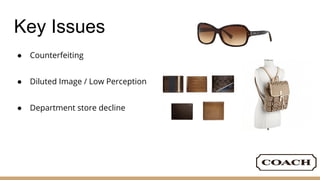
● Counterfeiting
● Diluted Image / Low Perception
● Department store decline
Business Strategy
Integration Strategy
● Cost-Leadership
○ Outsource production in China
○ Factory stores with discounted items
● Differentiation
○ Customer service
○ Heavy use of market research
Corporate Strategy
● Business Operations
○ Accessible Luxury
○ Accessories as compliments
● Vertical Integration
○ Exporting production to Asia
● Geographical Diversification
○ Selective diversification
○ Transnational Strategy
● Methods of Entry
○ Primarily licensing
PESTEL Analysis
Political - Open markets in China has lead to large annual growth
Economic- Overarching economic turmoil; US growing income disparity
Sociocultural- New generation of millennials and aging population
Technological- Popularization of ecommerce and social media
Legal- Growing problem with counterfeiting
SWOT
Strengths
● Outsourcing Price Advantage
● Industry Experience & Reputation
● Wide Customer Base
● Market Research
● New Lines Monthly
● Direct Marketing
● Enticing Stores & Customer Service
Weaknesses
● Decreasing Consumer Perception
Opportunities
● Greater International Expansion
● Broader Target Market
Threats
● Counterfeiting
● Leaks / Knowledge Sharing
● Cultural Distance in India
● Decline in Department Stores
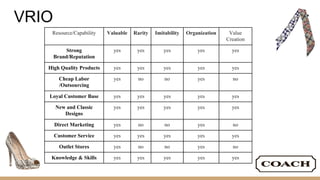
VRIO
Resource/Capability Valuable Rarity Imitability Organization Value
Creation
Strong
Brand/Reputation
yes yes yes yes yes
High Quality Products yes yes yes yes yes
Cheap Labor
/Outsourcing
yes no no yes no
Loyal Customer Base yes yes yes yes yes
New and Classic
Designs
yes yes yes yes yes
Direct Marketing yes no no yes no
Customer Service yes yes yes yes yes
Outlet Stores yes no no yes no
Knowledge & Skills yes yes yes yes yes
Recommendation #1
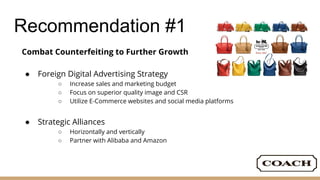
Combat Counterfeiting to Further Growth
● Foreign Digital Advertising Strategy
○ Increase sales and marketing budget
○ Focus on superior quality image and CSR
○ Utilize E-Commerce websites and social media platforms
● Strategic Alliances
○ Horizontally and vertically
○ Partner with Alibaba and Amazon
Recommendation #2
Low Consumer Perceptions with Discounted Outlets
● Implement a differentiation strategy
○ Less factory outlet discount stores and a greater emphasis on high luxury products
○ Shrink target market from top 20% to top 5-10% of Americans
○ Start a more haute-couture line of Coach vs. affordable luxury
■ Coach Premium
Discussion Question #1
How can coach penetrate India’s luxury
market with their cultural barriers?
Discussion Question #2
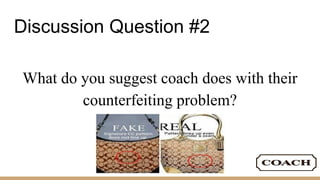
What do you suggest coach does with their
counterfeiting problem?

BA 405_ Coach

  • 1.
    By: Xander Beaumont,Matt Grollman, Sarah Ikemoto, Nicole Kuester, & Brent Shigemura
  • 2.
    Introduction ● Founded in1941 by Miles Cahn, a NY leather artisan ● Brand loyalty and market share increased steadily until 1990 ● Coach took back customers with marketing research ● First brand to compete in accessible luxury category, which quadrupled luxury market share ● Integration Strategy - high quality and style at 15-50% discount ● Products in Flagship stores, Factory Outlets, Bloomingdale's, Saks 5th Avenue and Macy’s ● Related Constrained - handbags 63%, accessories 27%, other 10% ● Expanding globally and targeting men
  • 3.
    Key Issues ● Counterfeiting ●Diluted Image / Low Perception ● Department store decline
  • 4.
    Business Strategy Integration Strategy ●Cost-Leadership ○ Outsource production in China ○ Factory stores with discounted items ● Differentiation ○ Customer service ○ Heavy use of market research
  • 5.
    Corporate Strategy ● BusinessOperations ○ Accessible Luxury ○ Accessories as compliments ● Vertical Integration ○ Exporting production to Asia ● Geographical Diversification ○ Selective diversification ○ Transnational Strategy ● Methods of Entry ○ Primarily licensing
  • 6.
    PESTEL Analysis Political -Open markets in China has lead to large annual growth Economic- Overarching economic turmoil; US growing income disparity Sociocultural- New generation of millennials and aging population Technological- Popularization of ecommerce and social media Legal- Growing problem with counterfeiting
  • 7.
    SWOT Strengths ● Outsourcing PriceAdvantage ● Industry Experience & Reputation ● Wide Customer Base ● Market Research ● New Lines Monthly ● Direct Marketing ● Enticing Stores & Customer Service Weaknesses ● Decreasing Consumer Perception Opportunities ● Greater International Expansion ● Broader Target Market Threats ● Counterfeiting ● Leaks / Knowledge Sharing ● Cultural Distance in India ● Decline in Department Stores
  • 8.
    VRIO Resource/Capability Valuable RarityImitability Organization Value Creation Strong Brand/Reputation yes yes yes yes yes High Quality Products yes yes yes yes yes Cheap Labor /Outsourcing yes no no yes no Loyal Customer Base yes yes yes yes yes New and Classic Designs yes yes yes yes yes Direct Marketing yes no no yes no Customer Service yes yes yes yes yes Outlet Stores yes no no yes no Knowledge & Skills yes yes yes yes yes
  • 9.
    Recommendation #1 Combat Counterfeitingto Further Growth ● Foreign Digital Advertising Strategy ○ Increase sales and marketing budget ○ Focus on superior quality image and CSR ○ Utilize E-Commerce websites and social media platforms ● Strategic Alliances ○ Horizontally and vertically ○ Partner with Alibaba and Amazon
  • 10.
    Recommendation #2 Low ConsumerPerceptions with Discounted Outlets ● Implement a differentiation strategy ○ Less factory outlet discount stores and a greater emphasis on high luxury products ○ Shrink target market from top 20% to top 5-10% of Americans ○ Start a more haute-couture line of Coach vs. affordable luxury ■ Coach Premium
  • 11.
    Discussion Question #1 Howcan coach penetrate India’s luxury market with their cultural barriers?
  • 12.
    Discussion Question #2 Whatdo you suggest coach does with their counterfeiting problem?