CASE Network Studies & Analyses No. 381 – Experience in implementing social benefits … 
Materials published here have a working paper character. They can be subject to further 
publication. The views and opinions expressed here reflect the author(s) point of view and 
not necessarily those of CASE Network. 
Prepared for the project: Preparation of the strategy for social benefits monetization reform in 
Ukraine. The Project was co-financed by the Polish aid programme 2008 of the Ministry of 
Foreign Affairs of the Republic of Poland. 
The publication expresses exclusively the views of the author and cannot be identified with 
the official stance of the Ministry of Foreign Affairs of the Republic of Poland. 
Keywords: in-kind benefits, monetization, housing and communal services benefits, 
targeted social assistance, social sector reform, Russia, transition 
JEL codes: H53, H77, I39 
© CASE – Center for Social and Economic Research, Warsaw, 2009 
Graphic Design: Agnieszka Natalia Bury 
EAN 9788371784835 
Publisher: 
CASE-Center for Social and Economic Research on behalf of CASE Network 
12 Sienkiewicza, 00-010 Warsaw, Poland 
tel.: (48 22) 622 66 27, 828 61 33, fax: (48 22) 828 60 69 
e-mail: case@case-research.eu 
http://www.case-research.eu
CASE Network Studies & Analyses No. 381 – Experience in implementing social benefits … 
The CASE Network is a group of economic and social research centers in Poland, Kyr-gyzstan, 
Ukraine, Georgia, Moldova, and Belarus. Organizations in the network regularly 
conduct joint research and advisory projects. The research covers a wide spectrum of eco-nomic 
and social issues, including economic effects of the European integration process, 
economic relations between the EU and CIS, monetary policy and euro-accession, innova-tion 
and competitiveness, and labour markets and social policy. The network aims to in-crease 
the range and quality of economic research and information available to policy-makers 
and civil society, and takes an active role in on-going debates on how to meet the 
economic challenges facing the EU, post-transition countries and the global economy. 
2 
The CASE network consists of: 
• CASE – Center for Social and Economic Research, Warsaw, 
est. 1991, www.case-research.eu 
• CASE – Center for Social and Economic Research – Kyrgyzstan, est. 1998, 
www.case.elcat.kg 
• Center for Social and Economic Research - CASE Ukraine, 
est. 1999, www.case-ukraine.kiev.ua 
• CASE –Transcaucasus Center for Social and Economic Research, est. 2000, 
www.case-transcaucasus.org.ge 
• Foundation for Social and Economic Research CASE Moldova, est. 2003, 
www.case.com.md 
• CASE Belarus - Center for Social and Economic Research Belarus, est. 2007.
CASE Network Studies & Analyses No. 381 – Experience in implementing social benefits … 
3 
CONTENTS 
ABSTRACT.............................................................................................................................6 
1. INTRODUCTORY REMARKS .................................................................................................7 
2. AIMS AND MOTIVES OF MONETIZATION REFORMS IN RUSSIA .................................................8 
2.1 The benefits system in Russia: Disorganized and in need of reform............8 
2.2 The scale of the problem .................................................................................10 
2.3 Financial burden: Unfunded mandates ..........................................................11 
2.4 Social rationales for reform ............................................................................12 
2.5 Economic rationales of the reform .................................................................14 
3. EXPECTED OUTCOMES OF THE REFORM...........................................................................15 
3.1 What kind of social protection reform was required?..................................15 
3.2 What were de facto main reform initiatives? ................................................16 
4. DESCRIPTION OF THE IMPLEMENTATION PROCESS ...........................................................19 
4.1 Preparation of legislation, budget estimates, organizational issues ..........19 
4.1.1 A chronicle of the legislation adoption .........................................................19 
4.1.2 Regional budget deficits.................................................................................21 
4.1.3 Insufficiency of staffing and methodical ware..............................................21 
4.1.4 Administrative difficulties...............................................................................21 
4.1.5 Lack of information for political decision-making........................................22 
4.1.6 Lack of public information and feedback from the population...................22 
4.1.7 Choice of timing for the reform......................................................................23 
4.2 Experience of the first months of reform implementation............................24 
4.2.1 Winners and losers .........................................................................................24 
4.2.2 Budget consequences ....................................................................................24 
4.2.3 Implementation at the federal level................................................................25 
4.2.4 Implementation at the regional level .............................................................25 
5. CHANGES IN THE ROLES OF VARIOUS ACTORS AND AGENCIES..........................................29 
5.1 Defining responsibilities between respective levels of authority ................29 
5.2 The changing roles of regional and local administrative bodies.................31 
5.3 New obligations of the Pension Fund.............................................................33 
5.4 The changing role of social services providers ............................................33 
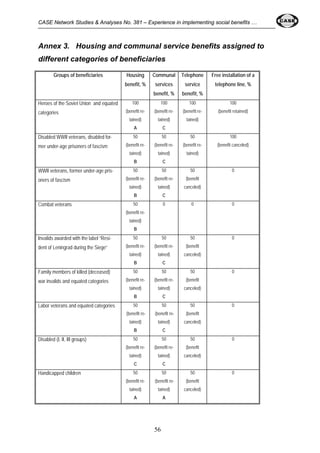
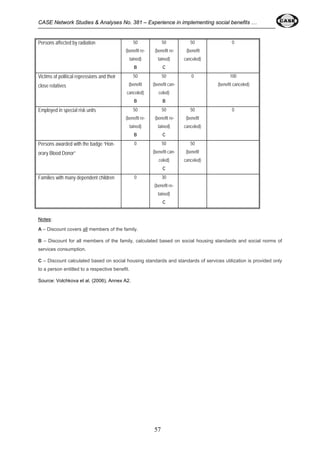
6. COMPENSATION OF HOUSING AND COMMUNAL SERVICES EXPENSES IN THE COURSE OF 
HCS AND MONETIZATION REFORMS ..............................................................................35 
6.1 Forms of HCS benefits .....................................................................................35
CASE Network Studies & Analyses No. 381 – Experience in implementing social benefits … 
6.1.1 Subsidies for HCS payments for poor households .....................................35 
6.1.2 Categorical HCS benefits................................................................................37 
6.2 Problems of categorical HCS benefits monetization ....................................38 
6.3 HCS benefits at the regional level...................................................................40 
6.4 Compensation of expenses on HCS ...............................................................42 
6.5 Simulation exercises: analysis of the consequences of social benefits 
monetization in Russia....................................................................................43 
7. MAIN GAINS AND FAILURES...............................................................................................44 
7.1 Major gains........................................................................................................44 
7.2 High costs and controversial implementation path ......................................45 
7.3 Negative impact on pension indexation schemes.........................................45 
7.4 Failure in gaining transparency ......................................................................46 
7.5 Regional budget imbalance .............................................................................46 
7.6 Invisible progress in reforming the social safety net....................................46 
7.7 Low impact on redistribution ..........................................................................47 
7.8 Unclear impact on poverty reduction .............................................................47 
7.9 Consequences at the regional level................................................................48 
8. LESSONS THAT COULD BE DERIVED FROM THE RUSSIAN MONETIZATION EXPERIENCE .......49 
ANNEXES.............................................................................................................................52 
Annex 1. Division of groups of beneficiaries according to the financial 
responsibilities of federal and regional budgets ....................................52 
Annex 2. Payments to ‘federal’ beneficiaries (without “Social federal package”) 
.......................................................................................................................................55 
Annex 3. Housing and communal service benefits assigned to different 
categories of beneficiaries........................................................................56 
REFERENCES.......................................................................................................................58 
4
CASE Network Studies & Analyses No. 381 – Experience in implementing social benefits … 
Irina Sinitsina, Ph.D., is a leading researcher at the Institute of Economics, Russian Acad-emy 
of Sciences (Moscow, Russia) and CASE's permanent representative in RussiaShe 
specializes in the analysis of social policy, including social security systems, social services, 
labour market, income and employment policies in Russia, Poland, Georgia, Ukraine and 
other FSU and CEE countries. She has also carried out extensive comparative macroeco-nomic 
studies of the economies in transition in these countries. Irina has participated in many 
international advisory projects on fiscal and social policy in Georgia and Ukraine. Since 1992, 
she has advised Russian ministries, governmental agencies, and the Central Bank of the 
Russian Federation on various social and employment policy issues. 
5
CASE Network Studies & Analyses No. 381 – Experience in implementing social benefits … 
6 
Abstract 
The present paper is an integral part of the “Preparation of the strategy for social benefits 
monetization reform in Ukraine” project, co-financed by the 2008 Polish aid programme of 
the Ministry of Foreign Affairs of the Republic of Poland and carried out by CASE in 2008. 
The paper was prepared as background material aimed at obtaining a better understanding 
of the main bottlenecks in reforming a vast in-kind benefits system typical for many countries 
of the Former Soviet Union (FSU). The paper focuses on the following issues: aims and mo-tives 
of monetization reforms in Russia; expected outcomes of the reform; description of the 
implementation process; changes of the roles of various actors and agencies; compensation 
of housing and communal services (HCS) expenses in the course of HCS and monetization 
reforms; and the major gains and failures of the reform. The paper concludes with lessons 
that can be derived from the Russian monetization experience for the planned Ukrainian 
monetization reform. The paper is based on extensive research on the monetization reform 
in Russia and literature published by leading Russian independent research centers includ-ing 
the Independent Institute for Social Policy (IISP), the Institute for Urban Economics, the 
Centre for Economic and Financial studies (CEFIR), and the Institute for the Economy in 
Transition (IET).
CASE Network Studies & Analyses No. 381 – Experience in implementing social benefits … 
7 
1. Introductory remarks 
The current review is the background paper prepared for the “Preparation of the strat-egy 
for social benefits monetization reform in Ukraine” project co-financed by the 2008 Polish 
aid programme of the Ministry of Foreign Affairs of the Republic of Poland and carried out by 
CASE in 2008. The aim of this review is to obtain a better understanding of the main prob-lems 
which Russia faced while designing and implementing a reform of the monetization of 
in-kind benefits system during the period of 2005-2008. Understanding the Russian experi-ence 
(both positive and negative) in the course of reforming its vast system of in-kind bene-fits, 
which are common in many countries in the Former Soviet Union (FSU), is regarded as 
an important prerequisite for working out a viable concept for a similar reform in Ukraine. The 
Russian experience is also valuable for the ongoing Ukrainian reform due to the similarities 
(both in terms of institutional background and popular mentality) between and the two coun-tries. 
In particular, an analysis of the Russian experience can offer valuable insight on what 
mistakes should be avoided in the course of monetization reform and what initiatives are 
unlikely to work in post-soviet countries. 
A detailed overview of the Russian experience allows us to develop recommenda-tions 
that indicate what factors should be taken into consideration and what pitfalls should be 
bypassed in order to arrange for the smooth and successful implementation of monetization 
reform in Ukraine. 
The main ideas and findings of the current review were presented to stakeholders at 
the final project conference held at Kyiv in December, 2008 and generated considerable in-terest 
among Ukrainian civil servants. The paper was later translated into Ukrainian and dis-seminated 
among the organizations involved in designing the reform strategy. 
The paper is structured as follows. In section 2 we provide a short description of the 
aims and motives of monetization reforms in Russia, including an overview of the benefits 
system that existed prior to the reform, the scale of the unfunded mandates burden, and the 
social and economic rationales for the reform. Section 3 deals with the expected outcomes of 
the monetization reform. It describes the type of social protection reform that was required in 
Russia and the main de facto reform initiatives. Section 4 contains a brief description of the 
reform implementation process, including the process of legislation preparation, budget esti-mates, 
and organizational issues. It also summarizes the experience of the first months of 
the reform’s implementation. Section 5 investigates in the changing roles of various actors 
and agencies, including defining zones of responsibilities between the respective levels of 
authority, the changing roles of regional and local administrative bodies, the new obligations 
of the Pension Fund, as well as the changing role of social services providers. Section 6 pro-
CASE Network Studies & Analyses No. 381 – Experience in implementing social benefits … 
vides a more detailed description of the compensation of housing and communal services 
(HCS) expenses in the course of HCS and monetization reforms, including the types of HCS 
benefits, problems of categorical HCS benefits monetization, HCS benefits at the regional 
level, and the compensation of expenses on HCS. In this section we also refer to an example 
of a simulation exercise conducted by the CEFIR research group which analyzed the conse-quences 
of social benefits monetization in Russia. Section 7 sums up the major accomplish-ments 
and failures of the Russian monetization reform, i.e. the high costs and the controver-sial 
implementation path, the negative impact on pension indexation schemes, the failure to 
achieve transparency, regional budget imbalances, limited progress in reforming the social 
safety net, low impact on redistribution and unclear impact on poverty reduction. 
The concluding remarks offer lessons that should be derived from the Russian mone-tization 
experience for the planned Ukrainian monetization reform. 
The review is based on the results of extensive research on the monetization reform 
in Russia .published by leading Russian independent research centers including the Inde-pendent 
Institute for Social Policy (IISP), the Institute for Urban Economics, the Centre for 
Economic and Financial studies (CEFIR), and the Institute for the Economy in Transition 
(IET). 
2. Aims and motives of monetization reforms in Russia 
2.1 The benefits system in Russia: Disorganized and in need of 
reform 
By the end of 2004, the system of in-kind benefits in Russia had developed into a vast 
and complicated scheme that encompassed the nearly unchanged legacy of the Soviet sys-tem’s 
social sector as well as numerous new benefits assigned during the course of transi-tion. 
The latter were the result of the disjointed legislative activities of different levels of public 
administration aimed at maintaining the living standards of the majority of households against 
falling real wages and pensions. Throughout the 1990s, decisions to introduce new privileges 
were often taken at the federal level while regions or municipalities were required to fund 
them out of their own budgets. Both federal and regional authorities passed a multitude of 
legislative acts that envisaged various benefits/privileges for several categories of citizens 
with regard to supply of medicines, transportation, housing, public utilities and other services. 
The system of in-kind assistance had evolved to provide benefits to three distinct 
8 
classes of beneficiaries:
CASE Network Studies & Analyses No. 381 – Experience in implementing social benefits … 
(a) the 'deserving disadvantaged', that is, those who mostly, through no fault of their own, 
would suffer impoverishment in the absence of assistance (e.g. orphans, the disabled and 
the elderly without pensions); 
(b) those who had rendered special services to their country (e.g. labor heroes, veterans of 
the Second World War and other conflicts, and those who worked in particularly hazardous 
professions or demanding locations, such as first responders at Chernobyl); and 
(c) public servants, where benefits provided a hidden salary supplement (e.g. members of 
the military, the security services and judges). 
The system offered dozens of benefits to numerous groups with an extremely large 
set of combinations of privileges and beneficiary categories (Alexandrova & Struyk, 2007). 
Federal legislation had established over 150 kinds of social privileges, allowances, 
benefits and subsidies that encompassed over 230 various categories of citizens. However, 
the majority of these privileges created claims to regional/municipal authorities which were 
not supported by adequate financing (‘unfunded federal expenditure mandates’). Local 
budgets were limited, and a substantial portion of privileges was not financed at all, with the 
resulting growth of the budget system’s creditor indebtedness to enterprises. Three federal 
laws – ‘On veterans’, ‘On the social protection of disabled in the Russian Federation’, and 
‘On social services rendered to elderly and disabled persons’ – accounted for a major part of 
regional budgets’ expenses on financing the federal social laws mandates (Golovanova & 
Kurlyandskaya, 2005). 
In the beginning of the 2000s, the federal center finally acknowledged that the budget 
simply did not have the means to finance all the benefits guaranteed by the federal legisla-tion. 
According to estimates made by the Ministry of Labor and by independent experts, in 
order to implement all the social support provisions, the consolidated budget of the Russian 
Federation in 2001 would have to have been doubled (Golovanova & Kurlyandskaya, 2005). 
Thus, there emerged the urgent issue of readjusting the system of existing privileges 
and benefits, of reducing their number, eliminating non-financed expenditure mandates, clari-fying 
the social obligations of the state (both at the federal and regional levels). The neces-sity 
of resolving these problems gave a major impetus to reform. 
9
CASE Network Studies & Analyses No. 381 – Experience in implementing social benefits … 
10 
2.2 The scale of the problem 
To assess the scale of the problem of reforming a manifold system of privileges and a 
multitude of non-financed government obligations, it was vitally important to implement a sys-tem 
to track benefits recipients. Despite the magnitude of the benefits system in Russia, 
there was no unified system for the recordkeeping of beneficiaries. The system of monitoring 
the programs of in-kind social assistance was based on departmental statistics kept by or-ganizations 
and agencies that provided services within the framework of the social benefits 
system. The authorities started to rapidly construct registers of persons eligible for privileges 
and benefits only during the course of preparing the monetization reform, but these registers 
are still lacking in many regions, which causes many problems (particularly with municipal 
and suburban transport benefits). This factor became one of the major bottlenecks in prepar-ing 
the reform and prevented a detailed analysis of its social, financial and other conse-quences. 
To cite one example, during the parliamentary hearings on the social aspects of the 
FZ-122 Federal Law held on November 11, 2004 (which was already adopted and was to be 
implemented in less than two months), much was said about the inconsistency of data con-cerning 
the number of future beneficiaries and the inadequate financing for the monetization 
of various kinds of benefits. It was demonstrated that recordkeeping activities (performed by 
the Pension Fund) were in fact only half completed. The exact figures on beneficiaries as-signed 
to direct federal responsibilities were lacking: official estimates of the number of per-sons 
entitled to privileges ranged from 12 to 19 mln people (8 to 13 percent of the total popu-lation) 
(Chernyak, 2004). The number of households with beneficiaries was estimated at 40 
percent of the total, whereas experts’ assessments far exceeded that estimation (Ovcharova, 
2007b). At the end of 2006, the Pension Fund register revealed that the number of benefici-aries 
(receiving cash benefits) amounted to 16.8 mln (‘federal’) and 11.1 mln (‘regional’), i.e. 
12 and 8 per cent of the population respectively (NISP, 2007). 
To make up for the shortage of information on the number of persons eligible for 
benefits, as well as the coverage of specific benefits, the 2003 National Survey of Household 
Welfare and Program Participation (NOBUS) could be of value.1 According to estimates 
based on NOBUS data, 27.2 percent of respondents have claimed their rights to various 
1 The 2003 National Survey of Household Welfare and Program Participation (NOBUS) [Национальное 
обследование благосостояния и участия населения в социальных программах, НОБУС] was conducted by 
Rosstat in 2003 with the financial support of the World Bank; the Survey data were subsequently actualized to the 
2007 incomes . The sample coverage included 44 529 households (117209 respondents) from 79 regions of Rus-sia 
which ensured representative assessments at national, regional and local levels. According to the estimates of 
Independent Institute of Social Policy (NISP), 43 regions had a sample size over 800 households which allowed 
to obtain representative indicators of demographic and social poverty profiles. The Russian expert community 
widely used the results of this survey for forecasting the results of the monetization reform, as well as for the as-sessment 
of the social processes in the country in general (http://go.worldbank.org/VWPUL3S9F0).
CASE Network Studies & Analyses No. 381 – Experience in implementing social benefits … 
privileges. The most numerous group of people with rights to privileges was “labor veterans”, 
who accounted for 15 percent of the population, or 34 percent of people aged 40 and over 
(Ovcharova & Pishnyak, 2005). 
The use of NOBUS data also made it possible to estimate the amount of unfunded 
mandates for specific population categories (i.e. when the right for a privilege existed, but it 
was not possible to obtain this benefit in a given locality). For example, it turned out that 
nearly a third of labor veterans in Russia had not made use of such privileges (applied to 
them in accordance with legislation) to their full extent, while in large cities this figure ex-ceeded 
40 percent. Similarly, limited access to benefits was also characteristic for such 
population categories as disabled persons (invalids of 1st and 2nd groups), persons affected 
by radiation, as well as with the right to ‘professional’ privileges (Ovcharova & Pishnyak, 
2005). 
A more complete understanding of the scale of social benefits prevalence could be 
obtained by measuring the number of households with members who have rights to privi-leges. 
According to NOBUS data, 50.7 percent of households include members who are enti-tled 
to various privileges, while almost a third of the latter group belong to two or more cate-gories 
of beneficiaries. The benefits encompassed payments for medicines and health ser-vices, 
transportation, housing, utilities and communal services, education, health resort 
vouchers, as well as food, housing purchase and repair, etc. Of these, the most prevalent 
were housing, utilities and communal services benefits (over 40 percent of households that 
included members entitled to privileges, benefits, and social services), transportation benefits 
(over 38 percent of households), and benefits for health services and medicines (about 20 
percent). 
2.3 Financial burden: Unfunded mandates 
The first necessary steps of the reform of in-kind privileges had to be focused on the 
volume and transparency of public expenditures. Given the problems with beneficiaries’ reg-istration, 
the system of in-kind privileges apportionment has not been able to give an esti-mate 
of the amount of financing required. Moreover, it was inevitable that widespread cover-age 
by various types of benefits would cause a permanent scarcity of available finance. Al-though 
the exact figures of budget appropriations for benefits financing were not available, it 
is obvious that the system of benefits at the time was seriously flawed in the sense of its 
substantial under-financing. According to information supplied by the Russian Parliamenta-rism 
Development Fund, the federal law “On Veterans” was under-financed by 88.6 percent 
in its federal part, and by 62.5 percent in its regional component. In 2003, the budget appro- 
11
CASE Network Studies & Analyses No. 381 – Experience in implementing social benefits … 
priations for financing obligations under this law amounted to RUR 55 bn, but this sum did 
not cover even half of the necessary expenses, while the required volume of financing was 
estimated at RUR 189 bn. According to other rough estimates, the total (potential) cost of 
benefits amounted in reality to over RUR 500 bn (Volchkova et al., 2006). The World Bank 
estimated the overall burden of privileges at 4.2 percent of GDP in 2002 compared to tar-geted 
social assistance programmes that accounted for 0.4 percent, and an estimated 70 
percent of the population, de jure, enjoyed one or more of these (Alexandrova & Struyk, 
2007). As a result, a large proportion of citizens were deprived of access to benefits to which 
they were entitled by law. 
2.4 Social rationales for reform 
A serious deficiency of the benefits system that prompted experts to speak of the 
need for reform was the low social effectiveness of budget expenditures on social privileges 
and benefits both at federal and regional levels. This low effectiveness was primarily the re-sult 
of very poor targeting of benefits and high levels of inter-regional disparities in budget fi-nancing. 
This, combined with relatively high poverty levels in Russia and extreme inequalities 
in incomes and consumption, has drawn widespread public attention2. The major reason for 
poor targeting was the fact that in-kind privileges were, as a rule, distributed according to 
categorical principle, without regard to the real needs of beneficiaries and their families or 
means testing. Among non-poor families, there were more persons eligible for benefits than 
among poor ones. Hence, from the point of view of participation, the poor did not constitute a 
priority group for the state social programs of subsidies and in-kind privileges (Ovcharova & 
Pishnyak, 2005). 
As highlighted in the World Bank Poverty Assessment of 2005, the current social as-sistance 
system in Russia is highly regressive compared to most other middle income coun-tries 
as the actual poor receive a small share of social benefits by international standards. 
The primary reason for this is the fact that 90% of social assistance spending in Russia is not 
targeted directly at the poor, but at various population groups regardless of income levels 
(such as pensioners, war veterans, invalids, etc.). Only 8% of this spending reaches the 
poorest 20% of the population. At the same time, Russia has been developing targeted (in- 
2 With household incomes increasing steadily, a noticeable reduction of poverty levels in Russia has been ob-served 
since 2000. The proportion of people with monetary incomes below subsistence levels decreased to 21.5 
mln in 2007 (15.2% of the total population) as compared to 25.2 mln people (17.7%) in 2005 and 42.3 mln 
(29.0%) in 2000. The poverty levels and the levels of income-measured inequality in Russia are significantly 
higher than in the developed economies and the Central European countries. Household budget surveys held by 
Rosstat showed that 2007 saw an acceleration of growth in income inequality: the income concentration index 
(measured using the Gini coefficient) soared to 0.422 vs. 0.409 reported in 2002–06 (IET, 2007). 
12
CASE Network Studies & Analyses No. 381 – Experience in implementing social benefits … 
come-tested) social assistance in three areas: child allowances, housing and utility allow-ances, 
and regional programs for the poor (World Bank, 2007). According to the Independent 
Institute for Social Policy (IISP)3 experts’ estimates based on NOBUS data, households with 
an income per family member below a subsistence minimum accounted for only 25.3 percent 
of the total amount of social benefits, subsidies and privileges; for households with an in-come 
between one and two subsistence minima per family member, the corresponding figure 
was 26.7 percent. Meanwhile more well-off households, with per capita income exceeding 
two subsistence minima, accounted for 48 percent of the total state social support expendi-tures. 
Table 1. Prevalence of benefits among poor and non-poor families, percent of poor 
and non-poor households 
Types of benefits Poor house-holds 
Non-poor house-holds 
Benefits for housing, communal services and 
utilities 
13 
28, 2 49,5 
Benefits for health services and medicines 11,7 21,3 
Benefits for transportation 24,2 47,5 
Source: Ovcharova & Pishnyak (2005) based on NOBUS data (2003) 
Inadequate targeting of the privileges system towards the poor was in fact rooted in the sys-tem’s 
poor design. For instance, under the free provision of energy benefits, the more appli-ances 
a household possesses and the more electricity it uses, the greater the benefits com-ing 
from greater electricity consumption. Similarly, better-off households have a greater 
benefit from housing privileges. Transport benefits are regressive in a different manner, since 
by default they exclude the people who are not able to use transport because they either live 
in rural areas not served by public transport, or have physical or health constraints which 
prevent them from traveling. The poor suffer disproportionately from the low quality of ser-vices, 
because, unlike wealthier groups of the population, they often cannot afford private 
services, while public services are of low quality. As for in-kind privileges, clients did not have 
a choice of either the provider or of the goods and services themselves (Alexandrova & 
Struyk, 2007). 
Thus, the two major social rationales of the pending reform of in-kind privileges were: 
to improve targeting to the poor and to achieve a wider freedom of consumer choice through 
more assistance from payments made in cash rather than in kind. 
3 Independent Institute for Social Policy - Независимый институт социальной политики (НИСП), an independ-ent 
research agency in Moscow, http://www.socpol.ru/.
CASE Network Studies & Analyses No. 381 – Experience in implementing social benefits … 
An additional serious disproportion that was socially significant and led to calls for re-form 
was the deepening of inter-regional differentials in terms of social protection and the 
amount of benefits provided. Poorer areas were, as a rule, the least able to link public liabili-ties 
14 
with their budget resources. 
2.5 Economic rationales of the reform 
A powerful impetus to the reform was provided by an extreme inefficiency of enter-prises 
and whole sectors of the economy that rendered in-kind services to the population. 
The existence of various kinds of privileges that encompassed virtually half of the country’s 
population significantly distorted the financial balances of several economic sectors including 
transportation, housing and utilities. This hindered the reforms and the development of these 
sectors and, to some extent, the development of the economy as a whole. 
Unfunded mandates were still delivered by service providers, such as housing, trans-port 
companies and clinics. Several programs were not financed at all, while for several oth-ers 
the proportion of financed services did not exceed 50 percent (transport services and 
medicines). As a result, several subsidized goods and services were in short supply (e.g. 
medicines or health resort vouchers). Meanwhile regional/local budgets’ arrears to service 
providers started to accumulate for benefits in which there was a gap between consumption 
and payment schemes (transport privileges, housing and utilities benefits). Consequently, 
many people entitled to privileges were prevented from using them, and inequality in access 
to benefits increased. In turn, the urban infrastructure sector became under-financed, and its 
crisis aggravated. Besides, under this system it was impossible to calculate the prime cost of 
subsidized services rendered by service providers. The fiscal gap translated into lost revenue 
for these providers, creating additional burdens for regional and local economies, thereby 
preventing effective enterprises from restructuring. 
Apart from money shortages in financing the excessive volume of in-kind services, 
the non-transparency of the mechanism for remuneration of providers’ expenses by the state 
became an important obstacle for service providers; quite often, the providers had to resort 
to corruption schemes. The enterprises that provided in-kind services (namely, utilities and 
transport companies) issued invoices to local/regional authorities in order to cover losses. 
These invoices, however, were frequently paid by the budgets of various levels only on the 
condition of paying off the bureaucrats who made decisions concerning payments. Quite of-ten 
these invoices were not paid at all, especially when budgets faced credit indebtedness. A 
transition to cash settlements between consumers and service providers became a vital ne-cessity.
CASE Network Studies & Analyses No. 381 – Experience in implementing social benefits … 
Thus, the driving force behind the reform of privileges was the excess burden of unaf-fordable 
social mandates which were non-transparent, and the failure to target public re-sources 
to the poor. Transformation of in-kind privileges into cash benefits ('monetization') 
was supposed to increase the transparency of the expenditures, to give beneficiaries free-dom 
of choice, and to simplify administration. To achieve affordability, monetization needs to 
be complemented by a stronger effort to target benefits to the low-income population, and a 
corresponding reduction of those in beneficiary categories. As we shall see in the following 
sections, not all of these goals were achieved. 
3. Expected outcomes of the reform 
3.1 What kind of social protection reform was required? 
In the early 2000s, the Russian expert community was well aware of the urgent need to 
reform the social protection system, particularly in terms of enhancing its effectiveness and 
improving targeting towards the poor. Generally speaking, the introduction of new social in-struments 
15 
aimed to: 
• increase the transparency of government social expenditures and eliminate quasi-governmental 
expenditures; 
• eliminate unfunded social mandates and bring the remaining state social obligations 
into accordance with actual budget capacities; 
• specify the responsibilities for budgets between various levels of government; 
• eliminate/reduce the amount of regressive (non-targeted) privileges by monetizing 
benefits (i.e. transforming in-kind privileges into cash benefits) in a way that would not 
.compensate in full the losses from the abolition of benefits for the non-poor; 
• develop a new system of benefits for the truly needy, the majority of whom were not 
covered by in-kind privileges; 
• intensify market reforms in the social infrastructure sectors – housing and utilities, 
municipal transport, health services and medicine supply, etc.; 
• link the social assistance system reform to the pension reform , so that social com-pensations 
would cease being viewed as complementary payments to low pensions; 
• eliminate economically and socially unfounded limitations on the freedom of con-sumer 
choice.
CASE Network Studies & Analyses No. 381 – Experience in implementing social benefits … 
The monetization of the benefits system was supposed to be the first stage of a comprehen-sive 
reform of the system of social support in Russia. The priority goals of the reform were: 
• elimination of unfunded social mandates; 
• transparency of relations between the federal/regional budgets and service providers; 
• restoration of fairness towards those beneficiaries that did not make use of the subsi-dized 
16 
services; 
• reduction of poverty levels in rural areas; 
• expansion of “rights and freedoms” of beneficiaries to make use of social assistance 
means. 
3.2 What were de facto main reform initiatives? 
The implementation of the reform began on 22 August, 2004, when President Putin 
signed law No. 122-FZ, referred to as 'The Law on Monetization’, (Federal law, 2004). Ac-cording 
to this law, the new system of privileges had to be defined and implemented by 1 
January 2005. In brief, the law: 
• Delineated federal and regional budgetary responsibilities for financing social protec-tion 
mandates; 
• Eliminated unfunded social protection mandates; 
• Reduced expenditure obligations laid out in federal legislation; 
• Transferred (‘cashed-out’) in-kind privileges into cash payments for federal social pro-tection 
mandates; 
• Placed the responsibility for cashing-out regional social protection mandates and for 
balancing revenue opportunities with new expenditure responsibilities on regional and 
local authorities (Kurlyandskaya, G., 2005). 
This list of issues demonstrates the limitations of the adopted law which, in fact, did not 
address monetization per se; rather it focused on dividing financial responsibilities (not only 
in the social protection area) between the federal government and the regions (see Annex 1). 
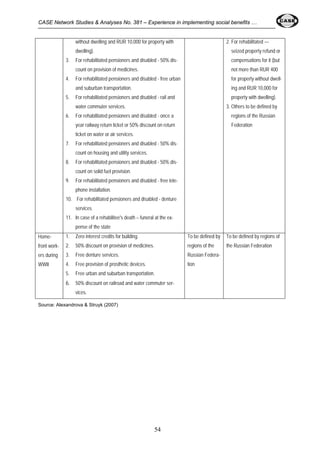
According to the new delineation, measures of social support for large groups of beneficiar-ies 
such as labor veterans or former victims of political repressions had to be re-determined 
and subsequently financed entirely by regions. Responsibilities for certain groups of benefi-ciaries 
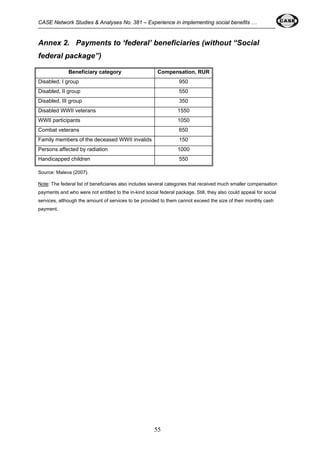
(e.g. people with disabilities or Second World War veterans) were to be federal re-sponsibilities 
(see Annex 2). The law detailed changes, such as the introduction of cash 
payments (the so-called “monthly cash payment”; MCP), the removal of certain privileges,
CASE Network Studies & Analyses No. 381 – Experience in implementing social benefits … 
and the introduction of the so-called social package, which hardly differed from in-kind privi-leges 
17 
(Alexandrova & Struyk, 2007). 
The social package complemented the MCP and included: 
• additional free health services (medicines provision, health resort vouchers); 
• free travel by suburban rail transport, as well by intercity transport to “the place of 
medical treatment”. 
The cash value of the social package was RUR 450, of which RUR 400 were earmarked 
for health services and RUR 50 were supposed to cover transportation to “the place of medi-cal 
treatment”. In 2005, this sum was subtracted from the total of MCP and privileges were 
offered to all beneficiaries in the form of in-kind payments only. From 2006 onwards, ‘federal’ 
beneficiaries were free to choose whether to receive payments in monetized form or to stay 
with in-kind services. 
Thus, the majority of the categories remained untouched. In addition, these categories 
were now split by sources of funding into 'federal' and 'regional' subgroups. The number of 
beneficiaries was not reduced significantly. Only certain narrowly defined categories were 
excluded. For instance, prior to 2005, housing privileges covered not only the categories de-fined 
by legislation, but in some cases their family members as well, although local authori-ties 
were free to define specific groups of families covered by these benefits. After 2004, 
many groups of beneficiaries were deprived of the “extension” of their in-kind benefit to family 
members and the housing privilege was now provided only to the beneficiary (within the lim-its 
of the local social standards). Students studying in the regions of the far North lost their 
annual right to one-off free transport to 'the place of medical treatment'. Free transport was 
also abolished for policemen (Alexandrova, & Struyk, 2007). 
Neither the authors of the draft law nor the Ministry of Health and Social Development 
produced reasonable arguments in support of splitting all beneficiaries into ‘federal’ and ‘re-gional’ 
categories; this led experts to view the law as non-transparent and controversial. For 
example, at the end of 2004, social protection experts across many Russian regions exten-sively 
discussed the thesis that the responsibility for the most numerous (and renewable) 
category of beneficiaries – veterans of labor – was transferred from federal to regional bodies 
because financing all the social obligations towards this category became an excessive bur-den 
for the federal budget. Regional authorities also felt uncomfortable with the new legisla-tion, 
under which World War II veterans, combat veterans and veterans of labor (all covered 
by the same federal law “On veterans”) were now in unequal positions; hence, veterans of 
labor would be put at a disadvantage and would demand from the regional authorities the
CASE Network Studies & Analyses No. 381 – Experience in implementing social benefits … 
same terms of transforming in-kind benefits into MCP as were provided to WWII veterans 
(Press-konferentsiya, 2005). 
For the majority of regions, such an approach has meant a mismatch between the obliga-tions 
and capabilities of regional budgets for several reasons. One of reasons is that regions 
differ significantly in the proportions of regional beneficiaries. According to IISP (Golovanova 
& Kurlyandskaya, 2005), in several regions, including Bashkortostan, Kaluga, Vladimir, and 
Samara, almost all pensioners acquired the status of labor veterans. On the other hand, in 
several subjects of the Federation, primarily in national republics and in less developed 
autonomous districts with a younger age structure, the proportion of ‘regional’ beneficiaries 
does not exceed 4 – 6 percent of the total population (NISP, 2007). 
At the same time, the law FZ-122 contained an important provision on non-deterioration 
of material conditions in conducting monetization (art. 153, para. 2), according to which 
“when altering, after December 31, 2004, the order of execution of benefits and payments 
provided prior to this date to specific categories of citizens in in-kind form, the aggregate vol-ume 
of financing of corresponding benefits and payments cannot be reduced, and the terms 
of their provision cannot be worsened”. In practice, this provision nullified a possible re-distributional 
effect of cashing-out in-kind benefits. 
As in practice the law contained provisions on the monetization of ‘federal’ benefits only 
(and even that in a curtailed form – with an obligatory non-monetized federal social package) 
and did not demand similar actions from the regions, its impact upon upgrading the efficiency 
of budgetary expenditures was limited. As for provisions on the monetization of ‘regional’ 
benefits, including housing and utility in-kind privileges, their implementation was carried over 
to the period after 2008 (Aleksandrova, 2005). 
The ambiguity of the federal legislation with regard to the regional authorities’ rights to 
use a targeted approach creates negative stimuli for them in the course of monetization; that, 
in turn, increases the burden on the local self-governments, which, by default are closest to 
the people. Quite often municipalities are forced to react promptly to the negative effects of 
the reform and to procure resources to mitigate these effects within their extremely limited 
budgets (Chagin, 2005). 
The economic effect from the introduction of the FZ-122 law could only have been 
achieved if the resources released as a result of the elimination of privileges would be redis-tributed 
towards the poor and used to increase the size of pensions. In that case both eco-nomic 
and social effects would have manifested themselves to a full extent. Service provid-ers 
would have started to function more efficiently, and would stimulate local economic 
growth and be able to mitigate the social consequences of cashing-out by re-distributing re- 
18
CASE Network Studies & Analyses No. 381 – Experience in implementing social benefits … 
sources to lower income households. Still, as the FZ-122 law neither improved targeting nor 
reduced benefits, its economic effects were barely visible (Aleksandrova, 2005). 
According to expert assessments, the major systemic inconsistencies of the law on bene-fits 
monetization could be described as follows: 
• a lack of a clearly formulated goals for the reform of privileges (in practice, the goal of 
reforming the system of in-kind privileges was replaced with the goal of delineating 
budget responsibilities); 
• a delimitation of responsibility in the social protection area was substituted by splitting 
19 
the beneficiaries into categories; 
• the decentralization of social protection institutes was not supported by the estab-lishment 
of a mechanism of cashing-out benefits at the regional level; 
• regions could renounce their right to implement monetization (with regard to ‘regional’ 
recipients); 
• economic and social differentiation between the regions was totally ignored; 
• a lack of consistency in implementation of social benefits reform; 
• the size of cash payment was inadequate to the tariff value of subsidized services. 
The majority of experts are unanimous in their opinion that the law on the monetization of 
benefits, strictly speaking, has nothing to do with social policy. By preserving the categorical 
principle of benefits allocation virtually untouched, the law did not establish a framework for a 
future social policy blueprint since it did not re-target social assistance or redistribute budget 
expenditures towards the poor (Aleksandrova, 2005). 
4. Description of the implementation process 
4.1 Preparation of legislation, budget estimates, organizational 
issues 
4.1.1 A chronicle of the legislation adoption 
Both the preparation for and implementation of the new regulatory framework for cash-ing- 
out benefits in Russia were carried out at an accelerated pace. The framework encom-passed 
both the FZ-122 law as well as legislation that prepared for the monetization reform 
by delimiting responsibility between various levels of government. In July 2003, amendments
CASE Network Studies & Analyses No. 381 – Experience in implementing social benefits … 
were introduced into the law “On general principles of the organization of the legislative (rep-resentative) 
and executive bodies of government in the Russian Federation”; in October 
2003, a new law “On general principles of organization of local self-government in the Rus-sian 
Federation” was adopted; finally, in August 2004 the State Duma adopted a legislative 
act (FZ-122, the “benefits monetization” law) that brought multiple federal laws into accor-dance 
with the two laws mentioned above. 
Experts observed that in the course of preparing for the law, there was no sizable pro-fessional 
discussion of methods and forms of the pending reform; there was also no socio-economic 
appraisal of the reform options and its consequences. This hasty preparation re-sulted 
in numerous inconsistencies in the text of the law. 
Box 1. A chronicle of the FZ-122 law adoption 
The law that significantly modified the Russian social protection system and di-rectly 
affected millions of people was adopted by the State Duma within less 
than three months: 
- May 13, 2004: The Government announces its intention to conduct a re-form 
of social privileges in the Federation Council; 
- May 31: The Government sends the draft law to the State Duma; 
- June 1: The State Council meets to discuss fiscal support for social obliga-tions; 
- July 2: The State Duma adopts a draft law on replacing social privileges 
with cash transfers in first reading; simultaneously, protests against the 
planned reform occur in several cities; 
- August 3: The Duma adopts the draft law in the second reading; 
- August 5: The Duma adopts the law in the third reading; 
- August 8: The law is approved by the Federation Council; 
- August 22: The law is signed by the President of the Russian Federation; 
- August 31: The text of the law is published in “Rossiskaya Gazeta”; 
- January 1, 2005: The law enters into force. 
Sources: Gerasimova et al. (2004) and Klimov (2005). 
Because of the hastiness with which the federal law was prepared, the legislative basis on a 
regional level was not developed either, at least not by the time the FZ-122 law entered into 
force. There were no regulations concerning ‘regional’ beneficiaries and no mechanisms for 
support to ‘federal’ recipients that lived in regions. Regions had virtually no time to estimate 
the costs associated with various reform implementation options and to choose the most ac-ceptable 
ones. This was the major reason for widespread inaction at the regional level. 
20
CASE Network Studies & Analyses No. 381 – Experience in implementing social benefits … 
21 
4.1.2 Regional budget deficits 
By adopting the FZ-122 law, federal authorities shunned the responsibility for both fi-nancing 
‘regional’ beneficiaries and for raising the salaries of regional employees that were 
paid from the state budget. The federal budget adopted for 2005 assumed no responsibility 
for the subjects of the Federation as a result of the reform. At the same time, as was pointed 
out at parliamentary hearings preceding the FZ-122 entry into force, 60 subjects of the Fed-eration 
out of 89 (the total at the time) ran budget deficits amounting to about RUR 70 bn 
(based on the results of the 2003 budget execution). If this figure is supplemented with sub-stantial 
accumulated budget arrears (RUR 85 bn), as well as the public debt of regional 
budgets, it became apparent that most regions had no budget resources for conducting the 
monetization of benefits (Chernyak, 2004). 
4.1.3 Insufficiency of staffing and methodical ware 
In the course of implementing FZ-122 at the regional level, one of the most severe issues 
was the insufficiency of staffing and methodical ware. While the number of professionals in 
the social protection sphere is large, innovative social techniques are available from a limited 
number of sources and are not adequately used within the system. In the course of preparing 
the monetization reform, neither regional nor local social protection bodies received any me-thodical 
assistance from the Ministry of Health and Social Development with regards to inter-preting 
the complex and ambiguous provisions of the law, the most effective ways to dis-seminate 
information among beneficiaries, the methods of dealing with marginalized catego-ries 
of recipients (e.g. disabled, handicapped or aged persons, or, conversely, the most so-cially 
active and organized groups of beneficiaries), the organization of recipients’ recurring 
registration, or the assessment of social and fiscal consequences of the legislation adopted. 
(Aleksandrova et al., 2005). 
4.1.4 Administrative difficulties 
The implementation of the new law was significantly hampered by administrative difficul-ties 
as well. These were mainly related to the transfer of functions of allocating and issuing 
MCP to ‘federal’ recipients from the social protection bodies to the Pension Fund4 which had 
more resources than the social protection authorities. Within a very limited time, between 
August 2004 and 1 January 2005, the social protection authorities had to focus their limited 
capacities on composing and verifying databases of recipients. Moreover, databases for 
'federal' categories had to be transferred to the Pension Fund and local data had to be inte-grated 
with regional data so that the administration of social assistance provision to 'regional' 
4 Russia’s Pension Fund provides pensions to 38.2 mln pensioners and operates 2192 territorial branches in 
every rayon (region) of the country.
CASE Network Studies & Analyses No. 381 – Experience in implementing social benefits … 
groups could be made uniform within each region. At the same time, no resources were 
made available for training personnel, organizing methodical support, or reorganizing social 
assistance or the Pension Fund offices to prepare them to deal with the large inflows of cli-ents 
after January 1, 2005 (Aleksandrova et al., 2005). 
4.1.5 Lack of information for political decision-making 
On the reverse side of the problem mentioned above was the lack of information for po-litical 
decision-making. Only in a few cases, such as in the Perm oblast, were surveys of 
beneficiaries conducted prior to developing social support measures for ‘regional’ recipients. 
The survey in Perm estimated actual benefit needs, predicted the total scope of needs, as-sessed 
possible social risks, identified public attitudes towards in-kind vs. cash benefits and 
evaluated the associated problems. In most cases, the decisions on cashing out benefits (or 
on the preservation of in-kind privileges) were made on the basis of very loose and inaccu-rate 
information at the disposal of the social protection bodies, without any modeling of the 
financial or social effects of monetization (Aleksandrova et al., 2005). 
4.1.6 Lack of public information and feedback from the population 
In many cases, subjects of the Federation simply had no information intended for public 
dissemination. Public opinion surveys made in late 2004 demonstrated that due to the lack of 
adopted regional legislation, ‘regional’ beneficiaries possessed completely inadequate infor-mation 
on the measures planned as compared to ‘federal’ recipients for whom social support 
measures were defined since the moment the law was signed (Aleksandrova et al., 2005). 
At the same time, public expectations were associated with the fact that, at the discus-sion 
stage of the reform in 2004, the expected changes were frequently described as “replac-ing 
in-kind benefits with cash transfers”, and the issue of limiting benefits or incomplete com-pensation 
was not specifically addressed. A similar public misperception (in terms of the 
mismatch between state obligations under the law and actual budget resources) was shaped 
by the law provision on the non-deterioration of recipients’ material status. 
Meanwhile, opinion polls conducted by the Levada Center in January 2005 witnessed a 
rather poor public awareness regarding the FZ-122 law: 44 percent of respondents had no 
idea of the compensation they were due; 58 percent thought the reform would bring about 
the deterioration of the material status of the poorest; 31 percent believed that the reform 
would worsen their family’s well-being. Responding to the question on the reform’s goals, 53 
percent said that the reform was meant to save budget funds at the expense of the least 
well-off, and only 13 percent responded that the reform was oriented at improving the status 
of the poor. 74 percent believed that the monetary compensation did not correspond to the 
amount of privileges it was meant to replace; 57 percent were against substituting existing 
22
CASE Network Studies & Analyses No. 381 – Experience in implementing social benefits … 
benefits for pensioners (on housing and utilities, telephone, medicines, municipal transport) 
with additional payments to complement pensions (Hahulina, 2005). 
An illustration of the public response to the situation of uncertainty was the phenomenon 
of mass 'invalidization,' which was observed in many regions across Russia in autumn of 
2004. It was a period when the FZ-122 law had already defined the benefits, including the 
MCP size, for people with disabilities (federal category 'invalids'), but many subjects of the 
Federation were just starting to define social protection measures for the groups assigned to 
them (‘regional’ beneficiaries). In this situation, citizens that could claim to be classified as 
‘disabled persons’, because of their age and state of health, fell under the category of ‘re-gional’ 
recipients (e.g. labor veterans) on the one hand, but received a clear-cut incentive to 
obtain the ‘federal’ status of ‘invalid’ in order to gain some sort of certainty, on the other 
hand. Few regions could offer their ‘regional’ beneficiaries MCPs comparable in size to the 
‘federal’ ones, and thus the incentive was rather strong. For regional authorities, the mass 
‘invalidization’ was also advantageous, since it meant the reduction of their own expendi-tures. 
Moreover, since at the end of 2004 the disability assessment commissions were sub-ordinate 
to regional authorities, the latter privately encouraged physicians to generously 
grant people ‘invalid’ status, thus saving on regional budget funds. As a result, elderly people 
flooded the disability assessment commissions, and at the beginning of 2005 the number of 
‘federal’ beneficiaries well exceeded budgetary projections (Alexandrova & Struyk, 2007). 
4.1.7 Choice of timing for the reform 
The social situation in Russia in the first stage of monetization was aggravated by the 
simultaneous occurrence of the two processes – cashing out benefits and an increase in tar-iffs 
for services that were inter alia provided on a privileged basis. Average tariffs for housing 
and utilities were raised by 28 percent, and transport tariffs were increased by 13 percent. 
This provoked an acute public reaction. Raising tariffs for utilities and transport was not re-lated 
to the implementation of the FZ-122 law and was carried out by totally different gov-ernmental 
bodies. However, the fact that tariffs were raised simultaneously with the introduc-tion 
of cash compensation instead of privileges bound these processes together. Though the 
two events were of a different socio-economic nature, at the micro level, the tariffs hike was 
perceived as a consequence of the monetization. 
23
CASE Network Studies & Analyses No. 381 – Experience in implementing social benefits … 
4.2 Experience of the first months of reform implementation 
4.2.1 Winners and losers 
The geographical and categorical structure of persons that responded negatively to the 
introduction of monetization was closely related to a lack of provisional evaluation of the so-cial 
effects of the reform. In fact, most of the research on the reform’s social consequences 
was performed after the reform was implemented. The main points of the reform’s social im-pact 
24 
are the following: 
(1) According to IISP estimates based on NOBUS data, the ‘regional’ category of beneficiar-ies 
(with twice the number of ‘federal’ recipients) appeared to lose the most as a result of 
monetization. Within this category, the proportion of losers was three times as high as among 
‘federal’ beneficiaries (Ovcharova & Pishnyak, 2005). 
(2) ‘Federal’ beneficiaries were also dissatisfied as the size of their benefit (MCP) was uni-form 
across the country regardless of their place of residence. Still, tariffs for services varied 
a great deal across regions; hence the MCP amount that could be adequate in the European 
part of Russia could be insufficient in the Far North or the Far East. In addition, as of January 
1, 2005 ‘federal’ beneficiaries lost their right to free transportation. 
(3) Beneficiaries living in large cities suffered most compared to people in other categories; 
this was proved by their behavior in early January 2005, when large cities became the focal 
points of social protest (Ovcharova & Pishnyak, 2005). 
(4) The monetization law contained no provisions on compensation to pensioners, since all 
privileges to this category were granted exclusively by regional authorities and were not 
regulated by federal legislation. Thus, the federal center relegated the problem of pensioners 
to the regions. As pensioners were not technically beneficiaries of any privileges, neither 
federal nor regional budgets provided any compensation for this group. Not surprisingly, the 
‘abandoned’ pensioners became the major driving force of social protests. 
4.2.2 Budget consequences 
Due to widespread public dissatisfaction with reform implementation, already in January 
2005 the Ministry of Finance was forced to acknowledge that the funds initially allocated for 
MCP financing were insufficient and had to be urgently increased. The implementation of the 
FZ-122 law provisions necessitated an increase in total expenditures on social protection 
2.77 times in 2005 as compared to 2004, while the federal budget expenditures had to in-crease 
4.6 times. In 2004, the federal budget appropriations for social protection amounted 
to RUR 45.4 bn (0.27% GDP), and those of regional budgets – to RUR 63 bn (0.37% GDP); 
in 2005, these figures increased to RUR 208.6 bn (0.96% GDP) and RUR 92.6 bn (0.43%
CASE Network Studies & Analyses No. 381 – Experience in implementing social benefits … 
GDP) accordingly, despite the modest scope of regional monetization (Duma, 2005). Even-tually, 
due largely to new financial influxes, the social tensions subsided and the public as-sumed 
a neutral stance towards the implemented social reforms. 
4.2.3 Implementation at the federal level 
As mentioned above, at the first stage of the reform (in 2005), federal beneficiaries were 
entitled, along with cash compensation, to an ‘in-kind’ federal social package that included 
additional free health services and medicines, health resort vouchers and free travel to “the 
place of medical treatment”. Since 2006, this group of recipients was entitled to receive the 
federal package in the form of cash (which remains unchanged until today). This obviously 
increases the cost of the package, as persons that do not use the privileges would choose 
cash compensation, but for those who would prefer to get the package in the ‘in-kind’ form, 
its value may substantially exceed the sum of the compensation provided. 
According to IISP experts, the majority of ‘federal’ beneficiaries benefited from the mone-tization 
process, if the additional resources allocated for these purposes after the January 
2005 wave of protests are accounted for. In particular, the right to the free use of municipal 
transport by ‘federal’ recipients (initially revoked) was restored in some cases at a later 
stage. Several well-off regions that preserved in-kind transport privileges for their ‘own’ re-cipients 
decided to extend similar privileges to ‘federal’ beneficiaries as well; that, however, 
came into conflict with the reform concept of delimiting expenditure obligations between vari-ous 
levels of authority. These decisions placed ‘federal’ recipients from such territories in a 
more advantageous position compared to similar recipients living in other regions. 
On the other hand, as subsequent analyses have demonstrated, the goals of social pro-tection 
in the case of ‘federal’ recipients were not achieved either. Since most ‘federal’ bene-ficiaries 
belong to the middle-income category, only 18 percent of the resources allocated for 
cash compensation reach poor families. 
4.2.4 Implementation at the regional level 
Notionally, the FZ-122 law gave regional authorities full freedom to define social protec-tion 
measures for labor veterans, families with children, victims of political oppression and 
home-front workers. As regions differ widely in economic and social parameters, the status of 
‘regional’ beneficiaries also varies a great deal across regions. 
Regions have acted very cautiously in cashing-out benefits. A review of regional legisla-tion, 
finally adopted in the spring of 2005, shows that: 
• an absolute majority of regions kept housing and utility privileges in the in-kind form; 
25
CASE Network Studies & Analyses No. 381 – Experience in implementing social benefits … 
• more than two-thirds kept solid fuel provision in kind (e.g. wood for wood-burning stoves 
26 
in rural areas); 
• about half the regions retained in-kind dental services for all categories and the privileges 
for medical drugs for home-front veterans and victims of political repressions; 
• a third of the regions did not transform or cancel the free provision of city and suburban 
transport for all categories of regional beneficiaries (for details, see Aleksandrova et al., 
2005). 
Three regions (Tatarstan, Tver’ and Tyumen oblasts) demonstrated a high level of monetiza-tion. 
An intermediate level of monetization was observed in 30 regions, a relatively low one in 
27 regions, and 19 regions displayed a low level of monetization. 
A rapid cashing-out of all kinds of benefits occurred in the Tyumen oblast; this was 
due to massive financial influxes in 2005 (RUR 20 bn, which was nearly equivalent to the re-gional 
budget) in the form of transfers from the two autonomous districts that were recently 
incorporated into the oblast structure. In Tatarstan, a very detailed system of compensatory 
payments was developed; Tatarstan’s budget is one of the most prosperous due to large 
federal assistance. 
The most common factors explaining the low rates of monetization were usually the 
lack of the mechanism at regional levels and the inadequate capacities of the regions to fi-nance 
monetary compensations. Another factor was the irregular ‘load’ of regional beneficiar-ies 
that varied greatly across regions. In Ingushetia, for example, victims of political repres-sions 
and their family members accounted for 45 percent of the total population; in other re-gions 
(Bashkortostan, Kaluga, Vladimir and Samara oblasts, etc.) almost all pensioners ob-tained 
the status of labor veterans in order to be entitled to benefits. 
In regions, the choice between carrying out monetization and rejecting it only partially 
depended upon resource endowment, because since the abolishment of direct governors’ 
elections the authorities’ behavior was strongly affected by the political cycle and by their 
ability to come to terms with the federal center. At the same time, the level of direct depend-ence 
on public opinion by the authorities dropped significantly (Aleksandrova et al., 2005). 
The Ministry of Finance recommended that the regions establish the compensation 
amount at a meager RUR 300 for home-front workers and at RUR 200 for veterans of labor. 
Not surprisingly, nearly a fifth of regions (including the wealthiest) refused monetization for 
their ‘own’ beneficiaries, and almost all of them preserved the free use of municipal transport 
even for ‘federal’ recipients (who received cash compensation), while some of the regions 
extended these benefits to all pensioners.
CASE Network Studies & Analyses No. 381 – Experience in implementing social benefits … 
In the regions where benefits were cashed-out, both the amounts of compensation 
and the sets of ‘monetized’ privileges differ widely. For example, compensation levels varied 
from RUR 1,500 in the Nenets autonomous district and RUR 500 in the Vologda oblast to 
RUR 100 – 120 in Bashkortostan. In the poorer regions, compensation usually did not ex-ceed 
RUR 200 which is not even enough to purchase a monthly transport pass. 
Cashing-out benefits for urban transport services became one of the most urgent is-sues. 
After mass protests by city pensioners, the federal center allocated additional funds to 
regions and worked out a mechanism of partially subsidizing the costs of the ‘privilege’ of 
monthly tickets from the federal budget. Eventually, in the regions that carried out monetiza-tion, 
it was the people in rural areas and small towns who gained the most from cashing-out 
transport benefits, while the majority of urban dwellers, where transport benefits had much 
larger importance, suffered the greatest loss. 
By now, though most regions have cashed-out the majority of “small” in-kind benefits, 
the monetization of urban transport privileges still remains a hot issue and is the cause of 
mass public tension (e.g. public protests in Chelyabinsk in April 2008). The reason is that the 
size of compensation offered is usually much smaller than the actual price of municipal 
transport. This problem is usually solved by offering monthly tickets at preferential prices to 
those categories of recipients that actively use municipal transport. The administration of this 
method, however, is cumbersome and involves additional costs. It would have been more 
logical and convenient to sell the tickets via conductors upon presentation of a respective 
certificate, but that would violate the federal law whereby only social protection bodies are 
authorized to verify personal data. At the same time, municipalities lack the capacity to calcu-late 
the costs associated with the monetization of transport privileges, as well as to select the 
most appropriate form of such a monetization. 
Monetizing transport privileges is complicated by the fact that a large number of bene-ficiaries 
make no use of their privilege to free use of municipal transport: e.g. in the Chelyab-insk 
oblast, some 70 percent of rural recipients and 60 percent of urban ones fall into this 
group. At the same time, additional funding is required to solve the problems of the remaining 
active users, who are not currently provided for in local/municipal budgets. 
In some cases, regions have called on their rights to use autonomous decision-making 
on social protection issues and have introduced their own, additional benefits. For 
example, starting May 1, 2008, the city of Zlatoust (in the Chelyabinsk oblast) abolished mu-nicipal 
transport fares for pensioners not entitled to federal or regional benefits, as well as for 
students and schoolchildren (Leonov & Zolotuhina, 2008). 
27
CASE Network Studies & Analyses No. 381 – Experience in implementing social benefits … 
On the whole, the cashing out of municipal transportation service privileges provides 
a clear example of under-financing in respect to regional beneficiaries. Providing beneficiar-ies 
with “single transportation tickets” was in fact an ad hoc way out of monetization imple-mentation 
at the regional level: sums envisaged in exchange for the right to free services 
(which differed greatly between regions and municipal entities) were not nearly enough to 
cover the real needs of those beneficiaries who regularly use transport services. On average, 
these sums ranged from 20 to 40 trips a month (which, for example, is not enough for a 
working beneficiary who must get to/from his/her workplace every working day). In addition, 
in order to reduce potential social tension, many regions were required to provide similar 
tickets to “federal” beneficiaries (who by default already got this compensation in the form of 
a “federal” MCP). 
The Chelyabinsk oblast provides a recent example of a typical monetization of trans-port 
service privileges. The example demonstrates that the real costs of such monetization 
are far beyond the capacities of poor regions. To implement monetization in 2008, the re-gional 
budget had to increase sums appropriated for the cashing out of transport privileges of 
‘regional’ beneficiaries 2.4 times (up to RUR 1,3 bn) as compared to RUR 545.7 mln in 2007 
(Povolotskaya, 2008). Each regional beneficiary was entitled to an advanced monthly pay-ment 
(RUR 200) from the regional budget as a compensation of transport expenditures. This 
sum is equivalent to 20 tram and trolleybus trips or 15 bus trips in Chelyabinsk. In other cities 
of the region, where the costs of transport are lower, this compensation can cover a larger 
number of trips, e.g. 28 trips in Zlatoust and Miass. This initiative affects almost 592 thou-sand 
regional beneficiaries who live in the Chelyabinsk region. 
At the same time, federal beneficiaries (about 140 thousand) who were previously 
provided with subsidized single tickets from May 1st 2008, lost their right to obtain compensa-tion 
financed from the regional budget and will have to pay for communal transport from their 
pockets unless regional authorities receive respective financing from the federal budget. 
In other regions, overall sums of compensations for transport privileges look compa-rable 
or even larger: in the Tyumen region regional beneficiaries in rural settlements receive 
RUR 75 a month as transport compensation, while residents of the city of Tyumen receive 
RUR 130 and the beneficiaries in Bashkortostan get RUR 200. In Perm and Saratov, the 
compensation is higher but in these regions it includes three types of in-kind benefits – costs 
of post-office services, municipal transport and dento-prosthetic rehabilitation. 
The specifics of monetization of housing and communal services (HCS) are dealt with in 
Section 5. 
28
CASE Network Studies & Analyses No. 381 – Experience in implementing social benefits … 
5. Changes in the roles of various actors and agencies 
5.1 Defining responsibilities between respective levels of 
authority 
The FZ-122 Law determined the expenditure obligations of the federal budget and 
budgets of subjects of the Russian Federation and defined responsibilities between the re-spective 
levels of government. Methodical and coordination issues were assigned to the fed-eral 
authorities. Subjects of the Russian Federation were to bear responsibility for the imple-mentation 
of federal legislation, and for working out, financing and implementing social ser-vice 
programs as well as for establishing, managing and ensuring the activities of social ser-vices, 
etc. 
Sources of financing for benefits also changed: mandates for direct financing from the 
federal budget were cut. Under the new law provisions, financing social services for the 
population became one of the expenditure obligations of the budgets of the RF subjects. 
These budgets have become the main sources of financing obligations towards ’regional’ 
beneficiaries; in addition, non-budgetary financing sources can be used as a supplementary 
channel – bank credits, income from securities, and others. 
New financial obligations came into conflict with the ongoing process of budgetary 
centralization at the federal level. In practice, by the beginning of monetization reform, the fi-nancial 
status of many regions remained unsustainable since they had a very limited capac-ity 
to supplement their budgetary revenues with increasing tax revenues, and thus their ca-pacity 
to finance the growing social obligations was quite narrow. Their situation deteriorated 
further in 2004 when, as a result of the centralization of revenue sources, sales taxes, which 
were one of the few regional taxes, were abandoned, and in 2005, corporate profit tax was 
centralized (Golovanova & Kurlyandskaya, 2005). 
To comply with the growing financial obligations, regional budgets required a substan-tial 
amount of co-financing. According to the Budgetary Code, the subjects of RF could sup-plement 
their financial resources through the Fund of Co-financing of Social Expenditures 
(FCSE) and the Fund for Compensations (FC). 
Consequently, in 2005, the size of the FCSE was sharply increased (3.6 times) as 
compared to its 2004 level and reached RUR 23 bn. In the framework of the 2005 federal 
budget, the fund has envisaged significant financial resources (55 percent of the total) for the 
support of regions in order to meet their commitments vis-à-vis recipients of social benefits. A 
sharp increase in the size of the FCSE resulted in its growth from 0.04% of GDP in 2004 to 
29
CASE Network Studies & Analyses No. 381 – Experience in implementing social benefits … 
0.12% of GDP in 2005, while in 2006-2007, the volume of transfers of this type gradually de-clined. 
In 2007, the FCSE share decreased by 0.01 p.p. (just as in 2006) and amounted to 
30 
0.1% of GDP (IET, 2007). 
The principal goal of the Fund for Compensations was to finance federal mandates. 
Since 2005, the Fund has been integrating resources allocated for financing all of the federal 
expenditure mandates stipulated by the federal law, including the financing of ‘federal’ bene-ficiaries 
under the FZ-122 law. The 2007 law on the federal budget provided for a consider-able 
increase (2.08 times) in the volume of FC up to RUR 153.1 bn. In 2007, 53 percent of 
the Fund volume (1.4 times more than in 2006) was allocated for subventions to regional 
budgets on payments for housing and public utilities services delivered to ‘federal’ recipients 
(IET, 2005, 2006). 
Support from the FCSE for financing social benefits for regional beneficiaries was en-visaged 
for those regions which were to initiate monetization. Co-financing was envisaged for 
four main categories of beneficiaries: rehabilitated individuals and those recognized as vic-tims 
of political repressions, home-front workers during WWII, labor veterans, and families 
with many children. The FCSE also included resources to provide subsidies to the regional 
budgets on the partial reimbursement of regional and municipal level expenditures on tar-geted 
HCS subsidies. 
In 2005, the Working Group for the improvement of inter-budgetary relations in the RF 
developed a methodology for the distribution of subsidies from the FCSE between the RF 
subjects. According to this methodology, the amount of subsidies to the RF subjects with re-gard 
to the first two categories of citizens rests upon two indicators – the number of citizens 
falling within the respective category and residing in the territory of a given subject of the RF, 
and the size of the cash allowance set by the federal center per recipient (for 2006, RUR 
227.9 a month for victims of political repressions and RUR 206.7 a month for laborers of the 
Home Front). As concerns the other two categories, the amount of subsidies is computed 
according to a more sophisticated formula, with account to the differentiation of the price 
scale and the level of budgetary sufficiency of the region (on which the level of co-financing 
depends) (IET, 2005). 
Subventions from the FC on payments for housing and communal services to privi-leged 
categories of citizens are allocated between the RF subjects in accordance with а 
methodology that is annually approved by the government. The calculation of these subsi-dies 
rests upon three indicators: 1) the number of citizens eligible for benefits with respect to 
payments for HCS in a given RF subject; 2) the federal social housing standard employed for 
calculation of intra-budgetary transfers of 18 square meters per person; 3) the federal stan-
CASE Network Studies & Analyses No. 381 – Experience in implementing social benefits … 
dard of the costs of HCS provision per 1 square meter of the overall living area per month set 
by the Resolution of the RF Government for every subject of RF (this indicator takes into ac-count 
the interregional price differentiation with regard to HCS costs). 
In 2005, as part of the ongoing process of defining expenditure obligations between 
different levels of government, changes in the structural composition and tasks were also in-troduced 
into other federal budgetary funds – the Federal Fund for Financial Support of the 
Subjects of RF, the Fund for Regional Development, and the Fund for Reforming Regional 
and Municipal Finances. Initially, they were designed to achieve other goals - to strengthen 
regional and local finance and to level off their budgetary potential, to assist regional and lo-cal 
budgets in debt repayment and debt servicing, as well as to develop social infrastructure 
31 
and finance other social needs. 
From the year 2004 onward, attempts have been made to increase the transparency 
of inter-budgetary relations. The resources of the Federal Fund for Financial Support of the 
Regions, the Compensation Fund, the Fund for Reforming Regional Finances, and the Fund 
for the Development of the Regions have been distributed in accordance with the methodol-ogy 
approved by the RF Government resolution. The formation and use of the FCSE has 
also been carried out on a formalized basis. Nevertheless, a substantial part of federal finan-cial 
aid to the regions is still distributed without any methodological, financial, or economic 
justification. The share of inter-budgetary transfers that were formally distributed in 2007 ac-counted 
for approximately 59 percent of the total sum of resources transferred from the fed-eral 
center to RF regions (IET, 2007: 144). 
To sum up, the changing roles of budgets of different levels in the course of moneti-zation 
resulted in the growth of shares of federal transfers aimed at financing ‘regional’ cate-gories 
of beneficiaries in the expenditures of different RF subjects. In reality, this means that 
the federal authorities have transferred the burden of unfunded (or scarcely financed) social 
commitments to the regional level and then proceeded to partially financially support new re-gional 
legislation initiatives on the basis of often non-transparent criteria. 
5.2 The changing roles of regional and local administrative bodies 
Under the new system of distribution of social support responsibilities and their radical 
shift to the regional and local (municipal) level, local administrative bodies (self-government 
authorities) gained new functions. In the context of the ongoing reform, local bodies can use 
their comparative advantage of being close to the population and their ability to be flexible 
and consider local needs. These bodies remain the only authorities of public administration
CASE Network Studies & Analyses No. 381 – Experience in implementing social benefits … 
which retain the capacity to initiate and implement targeted assistance to the poor and per-form 
some kind of adjustment of targeting in the ongoing monetization reform. By their na-ture, 
these bodies are capable of focusing the administrative and financial capacities to sup-port 
the poor, contributing at the same time to a more efficient functioning of the social sup-port 
system. These local actors are often more effective in monitoring the ongoing reform re-sults, 
in assessing their social consequences and the need to initiate local initiatives to sup-port 
the neediest categories of the population. 
Another important task of local administrative bodies and their social support units 
(which proved very important in the course of the monetization reform) is the comprehensive 
interaction they have with the local populations. This includes the provision of adequate and 
important information, communication with civil society organizations, including informal 
ones, as well as the identification of socially inactive persons and families that are in need of 
additional support. 
Should these functions be successfully executed or not depends on what scheme of 
transmission of governmental social responsibilities is used in the region. A special study 
provided by the Institute for Urban Economics (Sivaev, 2006; Institute for Urban Economics, 
2005) revealed that in most cases, regional authorities suggest that local bodies choose one 
of two possible schemes of behavior: 
(1) retain special bodies for social protection management within the structure of municipal 
administration and delegate them as public (state) authorities; 
(2) incorporate municipal bodies for social protection management into the unified public ad-ministration 
system and assign them the status of a territorial unit of the regional department. 
The first scheme provides local administration with more flexibility by allowing it to in-troduce 
new innovative social protection schemes, to optimize their management, and to or-ganize 
work with the local vulnerable population on an individual basis. The second scheme 
is considerably less flexible both for the local administrative body and the public, since it lim-its 
the municipalities’ potential to provide independent social support programs irrespective of 
the availability of resources. 
In practice, in the course of the monetization reform, when the main body of social 
mandates became focused on the regional level, local municipal bodies tended to avoid initi-ating 
their own social programs and would rather stick to purely municipal tasks and duties. 
Thus, as reported by the Institute for Urban Economics, in the course of 2005-2006, the first 
scheme was implemented in only ¼ of the regions while the majority of regions preferred 
centralization (Sivaev, 2006; Institute for Urban Economics, 2005). 
32
CASE Network Studies & Analyses No. 381 – Experience in implementing social benefits … 
5.3 New obligations of the Pension Fund 
Monetization reform added new functions to the Pension Fund and limited the func-tions 
of social protection agencies. The government decided that for ‘federal’ categories of 
beneficiaries, cash benefits (MCP) would be paid through the Pension Fund since almost all 
the beneficiaries were pensioners anyway. According to experts’ opinion, the decision to 
transfer cash payments to the Pension Fund was probably optimal in terms of administration. 
This decision can also be regarded as optimal from the point of view of economies of scale 
since the Pension Fund maintains a comparatively effective operational system on a country-wide 
scale. Transmission of the database on federal beneficiaries to the Pension Fund con-tributed 
to its unification and improvement. 
On the other hand, regional social protection bodies were thus turned into alternatives 
to the Pension Fund oriented at providing cash transfers to regional beneficiaries. Moreover, 
such a solution created a considerable systemic problem for the prospective benefits distri-bution 
reform, since the Pension Fund system is not designed to work with means testing, so 
that targeting benefits in the future can become problematic from an administrative viewpoint. 
Furthermore, this solution created disincentives for social protection agencies to es-tablish 
a comprehensive approach to assisting households and initiating a monitoring proc-ess. 
This is because they have given away a large portion of the essential data on assis-tance 
sources and because the person-based, not the household-based principle of assis-tance 
is now well fixed throughout the system. To use the Pension Fund data in the future, a 
social office will need to make it compatible with its own data, train personnel, and invest in 
data exchange systems (Aleksandrova et al., 2005). 
5.4 The changing role of social services providers 
Monetization reform was to contribute to the improvement of the financial sustainabil-ity 
of HCS, transport and other providers (local, regional or state unitary enterprises). As pre-viously 
mentioned, in-kind service provision was compensated to the respective providers in 
the form of budget subsidies which were, as a rule, inadequate to cover these enterprises’ 
losses. Thus, according to the Institute for Urban Economics, federal and regional budgets 
underpaid these enterprises for services delivered to in-kind beneficiaries by an estimated 30 
percent of the services’ cost in 2004 (Overview, 2005). Subsidies were also known to be 
non-transparent, often involving corruption schemes. Monetization was believed to initiate a 
shift from the budgetary subsidizing of these services to financing them by the population it-self 
and introducing market-based economic relations between providers and consumers. 
33
CASE Network Studies & Analyses No. 381 – Experience in implementing social benefits … 
It was also believed that monetization could bring transparency to budgetary expendi-tures 
on HCS and contribute to the marketization of communal services, since about 21.5 
mln people (15 percent of the population) were paying for HCS at a fare reduced by 50 per-cent 
(according to data from the Institute for Urban Economics). In practice only a few re-gions 
started HCS privileges monetization from the very beginning of reform, and only 14 re-gions 
initiated benefit monetization for ‘regional’ beneficiaries through personal accounts. 
In the majority of regions, the monetization of HCS benefits was intensified only in the 
middle of 2008 (see Section 5). Until recently, overall progress in this sector was very limited: 
actual costs of HCS providers were not compensated due to the intense growth of population 
indebtedness for communal services (RUR 300 bn), cross-subsidization and scarce benefit 
monetization (Kruglik, 2008). Communal infrastructure has remained predominantly under 
public (municipal) ownership; there are a number of obstacles for private capital involvement 
in the management of and investing into the HCS sphere. 
Taken together, these facts lead to the overall conclusion that the ongoing HCS re-form 
has not brought the necessary changes into the financial situation of service providers, 
and has not initiated a growth of private capital inflow into the sector. 
In public transport, the impact of monetization on service providers was also limited. 
The absolute majority of regions have monetized their transport benefits (82 out of 85 sub-jects 
of RF by mid-2007). Most of them (72 regions) used the quasi-monetization form of uni-fied 
social monthly tickets, the costs of which were subsidized on the basis of the average 
number of trips in the respective locality. According to RF government estimates (Levitin, 
2007), monetization made the transport enterprises’ finances more transparent and contrib-uted 
to an overall growth in their incomes from transporting ‘reimbursable’ passengers. 
Compensation for shortfalls in income resulting from transporting in-kind beneficiaries be-came 
more transparent and fair. Transport enterprises are now more limited in their capabili-ties 
to misrepresent their revenues from non-provided services. 
Yet total revenues of transport service providers from passenger fares taken together 
with budget subsidies still do not compensate for their total costs. Enterprises involved in 
passenger transport remain highly dependent on budgetary subsidies which are not even 
sufficient for simple cost-recovery; the sector remains unattractive for private investors. The 
situation is similar in other sectors providing services to the population, such as the health 
resort sector, etc. (Aleksandrova, 2005). 
34
CASE Network Studies & Analyses No. 381 – Experience in implementing social benefits … 
6. Compensation of housing and communal services 
expenses in the course of HCS and monetization reforms 
35 
6.1 Forms of HCS benefits 
In Russia, there are two major, though rather different, types of instruments aimed at the 
partial compensation of housing and communal services (HCS) expenses of a household 
(individual). These are: (1) subsidies for poor households for dwelling and communal ser-vices 
payments, and (2) benefits assigned to specific categories (which are an integral com-ponent 
of a monetization reform). 
6.1.1 Subsidies for HCS payments for poor households 
The system of subsidies for HCS payments for poor households (initially established in 
1993) (RF Government, 1993) was not the subject of monetization reform in Russia since the 
latter was designed to cover specific population categories regardless of their level of mate-rial 
well-being. In the course of the 1990s and in the beginning of 2000s, the schemes for the 
provision of subsidies were subject to numerous changes.5 Currently, subsidies on dwelling 
and communal services payments for poor households are provided on the basis of art. 159 
of the Housing Code of the Russian Federation and the Rules set by the Government Reso-lution 
No. 761 of December 14, 2005 (RF Government, 2005). According to these docu-ments, 
the rules and procedures on providing these subsidies are established by federal leg-islative 
bodies, while regional authorities are free to develop regional standards for HCS 
costs which are to be used by local authorities to provide subsidies to the population. 
The major difference between the previous and the current systems of subsidies provi-sion 
lies in the methods of their acquisition. While formerly subsidies were transferred directly 
to service providers, currently they are being transferred to recipients via existing or newly 
opened private bank accounts, or, in the distant regions, delivered through post-office de-partments. 
Thus, one can conclude that these subsidies have now acquired, in a sense, a 
monetized form.6 
5 RF Government Resolution No. 707 (June 18, 1996) “On improving the system of payments for dwellings and 
communal services” introduced a new mechanism of provision of HCS subsidies that in fact violated the principles 
of social justice and thus resulted in a number of critical problems within the system. It was replaced by Govern-ment 
Resolution No. 887 (August 02, 1999) “On improving the system of payments for dwellings and communal 
services and measures for social protection of population”. The system of subsidies provision was further detailed 
in the RF Government Resolution No. 444 (August 30, 2004) “On the provision of subsidies on payments for 
dwellings and communal services”. 
6 Another type of housing subsidies – a non-repayable subsidy on the construction or purchase of housing – was 
established on the basis оf the RF Government Resolution of August 03, 1996. It is provided exclusively in a non-cash 
form and in practice represents a non-repayable sum of money that supplements the savings accumulated 
by a potential housing purchaser. Such a subsidy can be provided to a person who is registered in a municipal
CASE Network Studies & Analyses No. 381 – Experience in implementing social benefits … 
According to the newly established rules, the size of subsidies is calculated on a monthly 
basis according to a uniform scheme and methodology. At present, their amount is deter-mined 
by: (1) the size of the regional HCS standard per capita of the respective household, 
(2) regional standards of dwelling space per family member for various categories of house-holds, 
and (3) a regional standard of a maximum proportion of HCS expenditures in the ag-gregate 
income of a household (its federal maximum was set at 22%). If the average house-hold 
income is equal or higher than the amount of the regional living minimum, the amount of 
subsidy is defined as the difference between (1) the regional standard of HCS costs multi-plied 
by the number of household members and (2) the regional standard of a maximum pro-portion 
of HCS expenditures in the aggregate income of a household multiplied by the aver-age 
income of the household. If the average income of a household is lower than the size of 
the regional living minimum, the amount of subsidy is defined as the difference between (1) 
the regional standard of HCS costs multiplied by the number of household members and (2) 
the regional standard of a maximum proportion of HCS expenditures in the aggregate in-come 
of a household multiplied by the average household income and by a correcting coeffi-cient. 
The latter is defined as a proportion of the average household income in the size of a 
subsistence minimum for the respective household (the subsistence minima are defined for 
different socio-demographic groups). 
Thus, these new rules ensure that the size of a subsidy does not take into account the 
volume of de facto consumed HCS, i.e. the sum of money actually paid for HCS by the 
household. Instead, this component in the formula is substituted by a fixed sum (for the spe-cific 
region) calculated for a given type of family. 
Major responsibilities for allocation of these subsidies lie with the regional (municipal) 
level of authority. Regions are free to set their own HCS standards, as well as standards for 
the maximum proportion of HCS expenditures in the aggregate income of a household: in 
fact, many regions set its value at a lower level compared to the recommended federal stan-dard 
(22%). The main reason for this reduction was a commitment to provide more substan-tial 
help for poorer families. In practice, regional/local legislative rules vary a great deal. For 
example: in Nizhni Novgorod, the 18% level is set as a maximum standard of HCS expendi-tures 
in the total household income; in Chelyabinsk this share was reduced from 22% to 11% 
for households with income exceeding the regional cost of living by not more than 20% as 
well as for pensioners living alone, families of pensioners, families with many children, single 
mothers with junior children, etc.; in Murmansk region, the regional standards for a maximum 
share of HCS expenditures in the total household income were set at the end of 2007 at the 
waiting list as a potential renter of municipal (free of charge) housing. The longer the record of the registration, the 
larger is the non-repayable sum of money that a person can get. 
36
CASE Network Studies & Analyses No. 381 – Experience in implementing social benefits … 
level of 22% and 15%. The latter referred to families of pensioners, disabled persons and 
families with many children; in Rostov region, the administration declared plans to reduce the 
maximum share from 18% (operational from 01.11.2007) to 16% from 01.01.2009, and to 
15% from 01.01.2010; in Irkutsk region, the maximum share varies widely across households 
with different incomes, and ranges from 7 to 22% for families of pensioners, and from 13 to 
22% for households of working members. For families with incomes lower than the minimal 
regional cost of living, the respective shares (7 and 13%) are additionally reduced in propor-tion 
to the ratio of the household income to a minimal regional cost of living. 
It is clear that the above mentioned regional initiatives combined with changing the for-mulae 
of the subsidy calculation tend to increase the number of newly assigned subsidies as 
well as contribute to an increase in their average size. 
On the whole, the registration of families entitled to such subsidies is quite complicated 
and bothersome both for beneficiaries as well as for administrative bodies. Not surprisingly, 
quite a few people fail or give up the registration; at the same time, social services do not 
have enough resources to check the accuracy of the income records of the applicant fami-lies. 
According to experts’ estimates, the available statistics on the number of recipients of 
these subsidies do not adequately reflect the number of households in need. 
HCS subsidies are financed from local budgets that receive subventions from the budgets of 
the subjects of the Federation. To cover these expenditures, the subjects receive financial 
resources from the Federal budget. Federal financing is provided in the amounts calculated 
according to federal standards set by the Government (22%). Although regions and local au-thorities 
are free to set their own standards (of a household dwelling space, costs of HCS 
and the maximum share of HCS expenditures in the household income), they have to find 
additional financing in their own budgets to finance these additional expense items. 
37 
6.1.2 Categorical HCS benefits 
Categorical benefits are another widely used form for the partial or full compensation of 
HCS expenses to a household (individual). These benefits, as was shown above, became 
the subject of monetization reform, although initially the time schedule for the monetization of 
these benefits was not envisaged. The eligibility of HCS benefits as well as their relative size 
are presented in Annex 3. Prior to the FZ-122 law entering into force, the average size of the 
benefit amounted to 50% of the respective service or housing payment. Prior to 2005, hous-ing 
privileges covered not only the categories currently defined by the legislation, but their 
family members as well; for many groups of beneficiaries, such as teachers, the HCS benefit 
is now provided only to the beneficiary. In the course of the reform, some of the benefits
CASE Network Studies & Analyses No. 381 – Experience in implementing social benefits … 
were abandoned, e. g. benefits for the telephone subscription fee for most beneficiary groups 
(except Heroes of the Soviet Union and equated categories for whom a 100 percent benefit 
was retained). All types of benefits for housing, communal and telephone services were can-celed 
for victims of political repressions and their close relatives and some others categories. 
As can be seen in Annex 3, the FZ-122 law authorized regional authorities to provide all 
kinds of social support in the sphere of HCS payments both for ‘federal’ and ‘regional’ bene-ficiaries. 
7 Regional authorities were free at their own expense to establish any additional so-cial 
support provisions, including HCS benefits, for ‘federal’ beneficiaries. These can include 
benefits in the form of a discount of the total payment, a formerly used in-kind privilege, as 
well as cash payments in the form of subsidies (before the due date) or compensations (after 
the payment was made by the beneficiary); HCS payments could also bе compensated irre-spective 
38 
of time limitations of payments. 
6.2 Problems of categorical HCS benefits monetization 
The FZ-122 law did not specify the timing of the monetization of HCS benefits. It only 
mentioned that the program of cashing-out benefits in this sphere had to start in 2006. At the 
same time, according to the FZ-122 law, from the very beginning of the reform (in 2005), re-gional 
authorities gained the right to cash-out HCS benefits without waiting for permission 
from the federal center. In practice, serious steps to make these norms obligatory were only 
taken in 2008. 
The primary incentive for regional authorities to cash-out HCS benefits was to inten-sify 
market reforms in this sector. Cashing out these benefits was a lot easier than, for ex-ample, 
transport benefits, because (1) the former were equal for most groups of beneficiar-ies, 
and (2) the number of beneficiaries was more or less known and they were easier to reg-ister. 
Thus three regions – Tatarstan, Tver and Tyumen oblasts – monetized these benefits 
almost at once. In other regions, the progress was not that obvious. Until recently, only 25 
regions and municipal entities implemented HCS monetization programs (including some pi-lot 
projects). Since 2008, however, regional authorities became quite limited in their choice 
on whether to cash out HCS benefits or not (President of the Russian Federation, 2007), 
since a completion of benefits’ monetization was one of the new conditions for obtaining re-sources 
from the State Corporation - Fund for Assistance to HCS Reform (Federal Law, 
7 According to FZ-122 Law, HCS benefits for persons awarded with a badge “Honorary Blood Donor of Russia “ 
were monetized and a yearly compensation in an annual sum of 6,000 RUR was envisaged for them that ab-sorbed 
HCS benefits.
CASE Network Studies & Analyses No. 381 – Experience in implementing social benefits … 
2007). The monetization of HCS benefits which is being implemented in many regions nowa-days 
is often referred to as the second stage of monetization reform.8 
The process of HCS benefits monetization was considerably hindered by significant 
regional differences in per capita costs of HCS, which were estimated at 8.7 times. This fact 
entailed grave consequences in terms of the differences in regional budgetary burdens; it 
also indicated that uniform compensation schemes for ‘federal’ beneficiaries were not appli-cable 
to all regions alike, since that could contribute to a considerable differentiation of the 
social results of the reform and would lead to a clear-cut division of recipients into winners 
and losers (Ovcharova & Pishnyak, 2005). 
Another important obstacle in the course of HCS benefit monetization was related to 
extremely high disproportions in the distribution of the overall amount of benefits between 
beneficiaries from different income groups: the total sum of HCS benefits that reach the I 
decile income group is 31 times less than that in the most wealthy families (X decile). As es-timated 
by IISP experts, only 18.7 percent of families from the I income decile are entitled to 
these benefits, while among the middle income families (IV-VI decile groups), the proportion 
of such households is considerably higher and exceeds 44 percent. The proportion of the 
most well-off households (X decile group) receiving these benefits is larger than that among 
the poorest families. Thus the use of fixed sums for compensation of in-kind transfers aimed 
at minimizing losses for individual families should only increase income inequality instead of 
alleviating it (Ovcharova & Pishnyak, 2005). 
For both ‘federal’ and ‘regional’ beneficiaries, the monetization of HCS benefits is 
provided simultaneously and on the basis of the same methodology; responsibilities of the 
respective budgets in financing Monthly Cash Compensation (MCC) for beneficiaries are re-tained. 
Although federal legislation does not necessarily require the use of regional standards 
of HCS consumption as a basic point in defining the size of MСС, many (if not most) regions 
use this already tested approach as it allows them to take into consideration many character-istics 
– e.g. types of settlement, size of household, type of dwelling, time of year (heating pe-riod), 
etc. In some regions, in cases when MCC does not cover 50% of a beneficiary’s ex-penditures 
on HCS, the possibility to use an individual multiplying ratio is envisaged. 
Beneficiaries will be receiving MCC in advance (before regular monthly payments for 
HCS should be made); they are free choose whether to transfer it to their personal bank ac-count, 
or to receive it at the post office together with their pension payment. 
8 Respective federal legislative acts that serve as a background for pushing forward this process are the above 
mentione Federal Law №185-FZ and a Protocol Order by the President of the Russian Federation (19.01.2007). 
39
CASE Network Studies & Analyses No. 381 – Experience in implementing social benefits … 
In case the regional standard is chosen as a standpoint for MCC, the whole process 
of HCS benefits monetization in most regions is reduced to a simple re-direction of cash 
flows: the responsibility for payment of the compensation shifts from the managing company 
(HCS provider) to a respective local social protection body. Then beneficiary then provides a 
100% payment for HCS in accordance with a monthly bill. 
6.3 HCS benefits at the regional level 
In addition to granting extensive decision-making rights to regional authorities in im-plementing 
monetization reform, the ambiguous federal norms established by the new legis-lation 
on HCS benefits monetization resulted in a controversial and differentiated situation 
across the regions in the 2005-2008 period. In fact, throughout 2005-2006, the majority of 
regions preserved the old in-kind mechanism for both “federal” and “regional” beneficiaries 
unchanged. Since at that time, no uniform country-wide standards or general principles were 
established; regional authorities were bound to invent their own home-made approaches and 
schemes for benefits calculation. Thus one could observe a wide variety of local legislation 
initiatives being defined at the local level (Gontmaher, 2005). The amount of money paid to 
recipients was also determined by local legislation since consumption standards, social 
norms defining the housing space per person (which serves as a basis for estimating one’s 
compensation), costs of maintenance and repair, communal service prices and other tariffs 
were defined at the local level (e.g. by municipal government bodies and the authorities of 
cities with a federal status, such as Moscow and St. Petersburg). 
The second half of 2008 was marked by intensive legislative preparation at the re-gional 
level. In some regions the legislative work mentioned above appeared to be more dif-ficult 
and thus the timetable for the implementation of new regulations was extended. For ex-ample, 
in the Chelyabinsk region, plans for the implementation of HCS benefits monetization 
were shifted to the second half of 2009, which was mostly due to the desire of regional au-thorities 
to reduce the burden of high tariffs imposed by natural monopolies, and thus to at-tempt 
to maximally reduce the regional standard of HCS costs. In the Novosibirsk region, the 
monetization mechanism is planned to be implemented starting in 2010. Meanwhile a series 
of a pilot projects are being initiated at the local level. At present, it is hard to predict what the 
final result of these actions will be both from the point of view of budgetary consequences 
and overall costs, as well as from the point of view of distributional impact. 
Besides, until the present moment, in some regions it still unclear what basic 
schemes will be implemented, so regions and municipal authorities are using their rights to 
assign additional benefits for beneficiaries in their locality. For example in Vladivostok, the 
40
CASE Network Studies & Analyses No. 381 – Experience in implementing social benefits … 
local legislative body has assigned an additional 50% discount on HCS payments for six ad-ditional 
categories of beneficiaries. 
The Samara region provides another example of this kind. Since August 10, 2008, all 
in-kind HCS benefits for “federal” and “regional” beneficiaries in the Samara region have 
been transformed into monthly cash compensation payments (MCC).9 The MCC is calcu-lated 
as a percentage of the regional standard for HCS costs. According to press reports 
(since the text of the law is not available), the new local law sets MCC at 50 percent of the 
regional standard for disabled WWII veterans and WWII participants, disabled combatants, 
former under-age prisoners of fascism, victims of the Leningrad siege, labor veterans, victims 
of political repressions and their close relatives and some others. At the same time, for per-sons 
affected by radiation, those employed in special risk units and some others, it is set at 
47 percent of the regional standard. The MCC for mothers with many children is set at 23 
percent of the standard. Family members of WWII participants and fascism prisoners, as well 
as some other categories are to receive MCC payments equivalent to 12 percent of the stan-dard. 
For those beneficiaries whose entitlement to benefits is applied to members of their 
families as well, the total sum of a monthly cash compensation is increased by a percentage 
proportional to the regional standard (Gorbunova, 2008). 
Regional authorities are well aware that HCS benefits monetization is bound to ex-pand 
the number of households that will claim an HCS subsidy, with a possible increase in 
the size of the individual subsidy as well. This is due to the fact that currently (as mentioned 
in section 5.1.1), according to the existing rules, the regional standard of HCS costs is re-duced 
in the case of there being a beneficiary in a household. The “preferential” coefficient 
applied e.g. for a single invalid is set at 0.5 and halves the size of the cost of an HCS stan-dard 
in the above mentioned formula. If the benefit is provided in a monetized form, the coef-ficient 
is not applied and the sum of the compensation is added to the total household in-come. 
The size of the subsidy is thus enlarged, and those who were not previously entitled 
41 
can now claim it. 
Still it is important to stress that, as in 2004, the implementation of new cashing-out 
instruments at the regional level is not based on the assessment of possible outcomes, and 
little is known about what income groups would finally win or lose. In some regions, the au-thorities 
claim that the cashed-out sums would be very close to the monetary equivalent of 
the previously received services, and if the MCC appears lower than the amount of in-kind 
support the beneficiary used to receive on an annual basis, he/she would be able apply for 
9 The law adopted by the regional Duma on 10.07.2008.
CASE Network Studies & Analyses No. 381 – Experience in implementing social benefits … 
an additional benefit to local social protection services. This suggests that no targeting in-struments 
are being incorporated into the new schemes introduced. 
Another characteristic feature of the ongoing process of HCS monetization in the regions that 
could be drawn from the local and regional press available online is connected with the “2005 
syndrome”: the ongoing discussions reveal the rather negative expectations of the population 
regarding the possible social consequences of the second stage of monetization. 
6.4 Compensation of expenses on HCS 
The available Rosstat data allows us to gain insight into the changes in the quantity of 
beneficiaries entitled to a reimbursement of HCS payments in the form of subsidies vis-à-vis 
the number of recipients of categorical benefits during the first half of the 2000s (see Table 
2). It is evident that while the ratio of household payments in the overall costs borne by HCS 
providers increased substantially (over 30 percentage points), the number of beneficiaries 
receiving categorical HCS benefits has decreased by 8.5 mln. people and the share of fami-lies 
receiving HCS subsidies has risen by almost 4 percentage points. 
According to expert assessments, the total burden on the budget related to these 
forms of social assistance decreased in 2000-2005. This was due to the contraction in the 
number of recipients from those categories that were not being replenished by new mem-bers, 
and to the cancellation of benefits for some occupational categories (police, military of-ficers, 
etc.), as well as straightening out the system of registration for beneficiaries. After the 
majority of regions adopted a new federal standard of a 22 percent ratio of HCS expenditures 
to overall family income, the number of people receiving HCS subsidies also decreased (Ma-leva, 
42 
2007: 319). 
Table 2. Beneficiaries entitled to reimbursement of HCS payments in the form of sub-sidies 
and categorical benefits 
2000 2001 2002 2003 2004 2005 
Families - recipients of HCS sub-sidies 
(percent of the total) 
7.7 9.1 11.4 15.2 13.7 11.6 
Number of beneficiaries receiving 
categorical HCS benefits (mln. 
people) 
46.0 48.8 49.8 44.0 43.9 37.5 
Ratio of household payments in 
the overall HCS costs, percent 
53 59 69 73 78 84 
Source: Ovcharova (2007a), p. 319.
CASE Network Studies & Analyses No. 381 – Experience in implementing social benefits … 
Nevertheless, budgetary expenditures on subsidies and benefits remain considerable, and 
the share of these expenditures in the total payments for HCS has not changed radically. 
The data available for 2003 (before the start of the monetization reform) provides insight into 
the structure and proportions of budgetary aid to households: financing the subsidies pro-gram 
through budget funds accounted for 6.2 percent of the total HCS sector financial re-ceipts 
(household payments plus budgetary financing). Category-related benefits accounted 
for a slightly higher share of this total, i.e. 10.4 percent; compensations of the difference be-tween 
the economically feasible prices and actual household tariffs (paid from the budget di-rectly 
to service providers) accounted for a much larger figure, 21.1 percent (Ovcharova, 
43 
2007a: 306). 
6.5 Simulation exercises: analysis of the consequences of social 
benefits monetization in Russia 
As mentioned above, one of the most serious drawbacks of the monetization reform 
was the lack of a preparatory assessment by a social expert; this deprived federal and re-gional 
authorities of the opportunity to evaluate the possible social consequences of the re-form 
as well as to control the process of implementation. Only after the FZ-122 law came into 
force and the government faced mass manifestations of social discontent, did experts in 
Russia initiate several independent studies of the reform’s effects, including its conse-quences 
for households. An assessment of the reform’s consequences was undertaken us-ing 
the micro-simulation modeling technique. A micro-simulation model of the Russian popu-lation 
was built based on NOBUS data. 
Regarding a simulation of the complete monetization of HCS benefits, an exercise of 
this kind was carried out by CEFIR researchers for all categories of beneficiaries (Volchkova 
et al., 2006). The authors only took into consideration limitations on the social norms of hous-ing, 
since no information on consumption norms (cold and hot water supply, electric power, 
etc.) was available. These data were used to estimate values of in-kind privileges for each 
category of beneficiaries. It was assumed that each beneficiary receives a sum of money 
equivalent to the average cost of benefit within his/her category. If a benefit is provided to the 
whole household then the family receives a sum of money equivalent to the average sum for 
the category to which the beneficiary belongs times the number of family members. It was 
also assumed that households would compensate the full costs of HCS in conformity with the 
proportion set in the respective region (in 2003-2004, this proportion actually did not differ 
much across regions, and it was assumed that an average households’ share amounted to
CASE Network Studies & Analyses No. 381 – Experience in implementing social benefits … 
77 percent). It was also assumed that the whole sum of compensation is spent exclusively on 
payments for HCS. 
The simulation by CEFIR demonstrated that some 22 percent of households, mostly 
urban and elderly, would lose out. Until НCS benefits are monetized, the overall distributional 
effect simulated appears quite positive. This is because the majority of 'losers' are the non-poor, 
while the poorest families, single pensioners apart, tend to gain from monetization. 
Simulations of housing privileges showed that the ongoing reform will affect poor 
households and pensioners severely and the government will need to allocate large subsi-dies 
to mitigate the potential negative effects. The main trend was as follows: the smaller the 
share of HCS payments by households in respective settlements before the monetization, 
the larger were the losses experienced by households. Thus the simulation revealed that in-habitants 
of large cities, where the share of household payments used to be lower (71.22 
percent), would lose most. This situation would consequently require an intensive growth of 
housing subsidies which, as the simulations have shown, are to grow considerably in most 
regions. As a result, in order to cover the additional financing of HCS subsidies and 
monetized benefits, the respective budgets will need to increase the overall financing by 
dozens of percentage points.10 
Thus, to minimize the negative effects, it would be necessary to change the proce-dures 
of allocating subsidies and to enhance their targeting. It appears that the housing sub-sidies 
program offers a ready vehicle for a targeted distribution of these benefits. Another 
important conclusion from a simulation of HCS monetization reform is that special attention 
should be paid to pensioners living alone, and that this category of the population, though not 
singled out during monetization reform, needs a special subsidy program. 
44 
7. Main gains and failures 
7.1 Major gains 
As can be seen above, the goals set by the FZ-122 law, were, for the most part, 
achieved. The major gains of the reform could be specifically described as follows: 
− several non-financed mandates were eliminated; 
− responsibilities between federal and regional zones of budgetary were delimited; 
10 Another study (Independent Institute for Social Policy, 2006), using NOBUS, also concludes that monetization 
might reduce cash poverty; but this effect will be negated by increased prices for housing utilities and medical 
services, previously provided as privileges. It was estimated that the overall growth of expenditures needed to 
monetize HCS benefits could exceed 40%. (Ovcharova & Pishnyak, 2005).
CASE Network Studies & Analyses No. 381 – Experience in implementing social benefits … 
− the zone of federal responsibility as concerns social expenditures was substantially re-duced 
and brought into balance with available financial and economic resources; 
− the main body of non-financed or inadequately financed mandates was transferred to the 
sphere of responsibility of regional and local authorities; 
− regional and local authorities were placed in charge of balancing the revenue availability 
45 
with the new expenditure mandates; 
− the financial position of service providers has improved in general; 
− compensation payments (MCP) were introduced for ‘federal’ beneficiaries, and the finan-cial 
situation for most of them improved; 
− the personal registration of ‘federal’ beneficiaries was carried out; 
− the division of privileged categories into two groups created positive incentives for the es-tablishment 
of transparent accounting and information systems. 
Thus, major gains were primarily related to the creation of budgetary and organizational pre-requisites 
for a comprehensive reform of the benefits system. 
7.2 High costs and controversial implementation path 
A serious and, to some extent, unexpected failure of the reform was its high cost, 
which resulted in a slow and controversial implementation path. That, in turn, was the result 
of numerous failures in the course of the reform preparation and the evaluation of its ex-pected 
results (e.g. at the initial implementation stage extra financing was required urgently 
to calm down mass manifestations of social discontent), on the one hand, and of the en-dogenous 
controversies of the reform concept (e. g. a categorical principal of monetization, 
or provisions of the FZ-122 law on non-deterioration of material conditions), on the other 
hand. Benefits monetization and payments of cash benefits (corresponding to an average 
market cost of services) to all the beneficiaries in a specific category required a considerable 
increase of budgetary expenditures. As a result, in the course of division of expenditure pow-ers 
between federal and regional budgets and a re-allocation of specific revenue sources be-tween 
them, the size of expenditure mandates and the needs for financial resources from re-gional 
and local budgets were underestimated. (Golovanova & Kurlyandskaya, 2005) 
7.3 Negative impact on pension indexation schemes 
Monetization produced a strong negative impact on pension indexation schemes. The 
process began with the urgent reaction of the central authorities to mass social protests 
against the monetization of benefits; these materialized in the indexation of the basic part of
CASE Network Studies & Analyses No. 381 – Experience in implementing social benefits … 
pensions far above the previously planned schedule (Maleva, 2007: 211). Apart from the fact 
that it caused a dangerous precedent of pension legislation violation, the economic conse-quences 
of these actions resulted in a growth of the pension system deficit. Furthermore, a 
rapid increase of the basic part of pensions undermined the balance between the insured 
and basic parts of pensions and thus prevented an introduction of insurance principles into 
the overall pension scheme (Maleva & Sinyavskaya, 2005). 
7.4 Failure in gaining transparency 
The priority goals of the reform (a radical decrease of the number of benefits, stream-lining 
their structure and increasing transparency) were not achieved. The main cause was 
the choice of the categorical mode of monetization. The absolute majority of benefits have 
been retained and their structure was additionally complicated by the division of beneficiaries 
by sources of funding into 'federal' and 'regional' subgroups. 
7.5 Regional budget imbalance 
Another important goal of the reform, to balance the amount of state social obligations with 
the financial and economic resources available, was only partially attained – at the federal 
level. The regional budgets still suffer from an imbalance that resulted in slow monetization 
progress at the regional level and a wide use of quasi-monetized forms of in-kind benefits. 
Regions also suffered from the lack of implementation instruments to push forward monetiza-tion. 
7.6 Invisible progress in reforming the social safety net 
The ongoing monetization reform in Russia did not (and could not, due to its concept) 
provide an impetus for a vital reform of the social protection system. Indeed, very little effort 
was made to adjust the ongoing replacement of in-kind benefits by cash payments to the 
needs of a radical reform of a very expensive and outdated system of benefits and channel-ing 
it to meet the needs of the most needy and low-income population groups. These issues 
were not on the agenda neither during the discussion period prior to the reform’s implemen-tation, 
nor were they reflected in the law provisions. The Russian reform followed the cate-gorical 
principle which was the easiest way of action for administrators at all levels, and thus 
only limited targeting via categories was possible. Thus the reform failed to produce a con-siderable 
impact and did not become a sizable event in the social and economic life of the 
46
CASE Network Studies & Analyses No. 381 – Experience in implementing social benefits … 
country. A somewhat improved system of accounting, modest results in the transition to-wards 
cash benefits and zero progress in the introduction of targeting do not appear to have 
been worth the implementation difficulties and high political price paid to calm public protests. 
7.7 Low impact on redistribution 
The controversy of the reform concept in fact prevented it from leveling out the exist-ing 
income disparities between beneficiaries from different categories. In fact, according to 
several expert’s estimates (Volchkova et al., 2006), some progress in the redistribution of 
real disposable incomes took place and inequality was slightly reduced. This was due to the 
fact that the majority of 'losers' were the non-poor, while the poorest families (with the excep-tion 
of single pensioners) tended to gain from monetization. Yet, this positive effect is likely to 
evaporate as soon as the housing privileges are monetized and it will affect poor households 
severely. The fact that some 22 percent of households, mostly urban and elderly, would lose-out 
will force the government to allocate large subsidies to mitigate the potential negative ef-fects. 
7.8 Unclear impact on poverty reduction 
The monetization reform came in conflict with the declared national priority goal of 
poverty reduction. As was estimated, the existing system of benefits excludes almost 80 per-cent 
of single-parent families and more than 60 percent of families with many children which 
have the maximum risks of poverty11. According to the specified priorities of social policy, 
these families were to become the key group for social protection programs. Today, the fact 
is that not a single regional government has introduced the targeting of categorical social as-sistance 
to low-income people or households, at least within the defined categories. The so-cial 
protection authorities acknowledge that unclear rules of the game discourage them from 
targeting, to avoid being later charged by the General Prosecutor’s office for worsening the 
conditions of the non-poor, who would lose out as a result of targeting the poor. This is a 
visible anomaly of the reform rules that reduces its potential value. 
Social protection experts’ estimates demonstrate that to implement the two social 
programs simultaneously, i.e. to aim for poverty reduction by expanding respective social 
programs, on the one hand, and to preserve the system of benefits almost unchanged on the 
other, is a nearly impossible task. It is clear that this would require supplementing monetiza- 
47 
11 IISP estimates based on NOBUS data.
CASE Network Studies & Analyses No. 381 – Experience in implementing social benefits … 
tion programs with additional complicated and expensive managerial decisions that would 
exclude the non-poor from social programs (Ovcharova & Pishnyak, 2005). 
7.9 Consequences at the regional level 
At the regional level, monetization reform has caused serious negative consequences 
(Zubarevich, 2007; Ovcharova, 2005): 
− monetization has stimulated the growth of inter-regional differences in the material status 
of ‘federal’ beneficiaries, since compensations from the federal budget (paid to 40 per-cent 
of beneficiaries do not take into account the differences in the costs of living across 
regions, whereas per capita compensations paid to ‘regional’ beneficiaries differ to a con-siderable 
48 
extent among the regions; 
− monetization has contributed to the growth of differentiation of incomes between people 
living in “rich” and “poor” regions, since in the majority of regions with higher budgetary 
sufficiency, the size of per capita compensations is larger; 
− the material standing of beneficiaries in the Northern and Eastern regions of the country, 
where costs of living are higher, have deteriorated, since the size of compensations has 
not been adequately adjusted to increased costs of living; 
− the inequality of regions in their capacities to implement social programs has increased, 
as “poor” regions were forced to bear social responsibilities that were beyond their capa-bilities; 
− instead of unifying the systems of social protection and social benefits financing, ar-rangements 
in various regions were subject to fragmentation with alternating and confus-ing 
lists of cash benefits provided; 
− the vector of the benefit monetization reform has been in the opposite direction to the one 
declared in the policy of budgetary adjustment. 
On the whole, the reform of in-kind privileges in Russia has made very limited progress 
compared to what it could have achieved and what other CIS countries have accomplished. 
Russia represents one of the most outstanding examples of social policies and practices to 
be avoided by countries seeking to build an efficient social safety net that can function sus-tainably 
in a market economy (Alexandrova & Struyk, 2007).
CASE Network Studies & Analyses No. 381 – Experience in implementing social benefits … 
8. Lessons that could be derived from the Russian 
monetization experience 
The poor results of the Russian monetization experience suggest that in order to be 
successful, a similar reform in other country should address the following essential issues at 
various stages of the process: 
(1) At the stage of developing the reform concept: 
- the monetization of in-kind benefits should be integrated, to the maximum extent pos-sible, 
into the overall concept of social safety net reform and be subordinated (at least 
partially) to its main principles, providing cohesion and preventing social exclusion. 
- the categorical principle of benefit assignment should be avoided whenever possible; 
Rather reformers should concentrate on the real needs and bottlenecks of beneficiary 
groups based on the information collected in the General register of beneficiaries. 
Benefits assigned according to professional status should be eliminated. 
- every opportunity to introduce targeting while transforming the vast nomenclature of 
in-kind benefits into the form of cash benefit(s) should be used; Available resources 
should be directed, to the maximum extent, to those beneficiaries who are associated 
with households with maximum poverty risks. Information from the General register (if 
it contains data on real needs or the income and family status of beneficiaries), as 
well as simulations of different options could be very helpful here. 
- to avoid interregional differentiation of the real value of cash benefits, it is essential to 
introduce a set of regularly updated coefficients which reflect the proportions in living 
costs between different regions of the country. The size of an individual compensation 
should be justified at the regional level. 
- the concept of HCS monetization should be closely connected with the system of tar-geted 
49 
housing subsidies. 
- transparency of budgetary financial obligations of different administrative levels is ab-solutely 
necessary, as well as clearly defining “zones” of responsibility among execu-tive 
bodies at different levels. 
- the experiences of many countries demonstrate that decentralizing social protection 
responsibilities together with allocating essential funds proved to be effective in gain-ing 
the maximum results with limited resources. Thus, a decentralization in decision-making 
rights (regarding assignment of payments, their size, etc.) is essential since 
the local self-governance level provides the best opportunities for targeting social as-
CASE Network Studies & Analyses No. 381 – Experience in implementing social benefits … 
sistance and, as a result, the most simple and effective way to eradicate poverty and 
social exclusion. 
- as concerns the structure of beneficiaries characteristic for FSU countries, it seems 
that in all these countries it is important to maintain (or maybe marginally modify) the 
privileges established earlier for categories of elderly beneficiaries (war veterans and 
homefront workers, victims of political repressions, etc.), the number of which is 
dwindling each year. It is equally important not to enlarge this category by extending 
their privileges to other population groups. 
- as regards those categories of beneficiaries that are numerous and growing in num-ber, 
a realistic solution should be based on the maximum personalization of cash 
benefits, the size of which should be determined (apart from age) by: (i) the benefici-ary’s 
real income, (ii) his/her housing conditions; (iii) his/her state of health, (iv) num-ber 
of dependents and (v) adjusted for regional cost of living. Formally assigning 
equal cash benefits solely on the basis of belonging to a certain category does not 
make much sense. The institution of “beneficiary categories” should be transformed 
into a specific (or unified) cash benefit. Thus no moratorium on assigning new bene-fits 
50 
is necessary at the local level. 
(2) At the stage of reform design and drafting the appropriate legislation: 
- the experience of monetization reform in Russia demonstrated the importance of the 
close coordination of the interests of different state ministries and agencies. This pri-marily 
relates to the ministries in the social block, that are responsible for the ideology 
of the reform, and the financial and economic block ministries. Close coordination be-tween 
the reform design and the provisional schemes of budgetary and tax adapta-tion 
reform would be of great value. Lack of such coordination in Russia has caused 
delays in reform implementation, made the reform more expensive and brought about 
controversial results. Monetization reform by itself is not exclusively a financial bal-ancing 
and budgetary delimitation exercise, but rather a structural element of a future 
social safety net adjusted to the needs of a market economy. 
- discussing the reform scheme with regional stakeholders is essential in order to ad-just 
the reform concept while accounting for regional specifics. 
- it is necessary to determine what categories of beneficiaries are really dependent on 
in-kind services and are truly in need of additional assistance, as well as what kind of 
services provided in an in-kind form are most important for households with benefici-aries.
CASE Network Studies & Analyses No. 381 – Experience in implementing social benefits … 
- a detailed expertise (both at the country-wide and regional levels) of the socio-economic 
consequences of various reform options is essential. Such expertise must 
answer the question, “what share of the total budget expenditures of the entire mone-tization 
reform would be targeted directly to poor families?” 
- various reform options should be checked based on resource availability. A deep 
analysis of budgetary obligations and possibilities should be provided. 
(3) At the stage of preparing for implementation: 
- local authorities and agencies responsible for the reform at the local levels should 
have at their disposal all necessary methodological recommendations, information 
and legislative acts provided by respective ministries and agencies; local personnel 
involved in reform implementation should be properly prepared and instructed. 
- an appropriate means testing system should be designed and established. 
- a wide-scale public discussion providing full information to the population about the 
reform and ongoing specific changes should be organized. In addition, the local social 
services can establish special consultation points informational hotlines, etc. 
- various forms of social dialogue that can offer feedback from the population, civil so-ciety 
institutes, etc should be initiated. 
- the reform implementation process should be carefully timed 
51 
(4) At the implementation stage: 
- implementation should be monitored, including feedback from households. This al-lows 
for the elimination of unexpected negative consequences and processes.
CASE Network Studies & Analyses No. 381 – Experience in implementing social benefits … 
Annexes 
Annex 1. Division of groups of beneficiaries according to the 
financial responsibilities of federal and regional budgets 
1.1 Groups of beneficiaries assigned to the federal budget 
Disabled persons (I, II, III groups) 
Disabled WWII veterans 
WWII participants, combat veterans (a total of 8 
subcategories within this group) 
Family members of the deceased WWII invalids 
Persons affected by radiation 
Handicapped children 
1.2 Groups of beneficiaries assigned to regional budgets 
Home-front workers during WWII 
Labor veterans 
Victims of political repressions 
Heroes of the Soviet Union 
Employed in special risk units 
Beneficiaries entitled to benefits according to 
professional affiliation 
Employed on hard types of work 
Other categories 
1.3 Changes resulting from the monetization reform of 2004 for selected programs by 
responsible level of government 
Bene-ficiaries 
Benefits before 'monetization' In-kind benefits 
52 
remaining in 
2005 
Cash benefits introduced 
since 2005 
RESPONSIBILITY OF THE FEDERAL BUDGET STARTING FROM 2005 
WWII par-ticipants 
and com-bat 
veter-ans 
(total 
of 8 sub-categories 
1. 50% discount on housing and utility services. 
2. 50% discount on guard services for single-living per-sons 
or couples. 
3. Free provision of medicines. 
4. Free denture services. 
5. Free provision of prosthetic devices. 
6. Free urban and suburban transportation. 
50% discount on 
housing and util-ity 
services. 
Free provision of 
prosthetic de-vices. 
RUR 2,000 (to WWII inva-lids), 
RUR 1,500 (WWII par-ticipants), 
RUR 1,100 or 600 
(others) (came into force 
from Jan. 1, 2006).
CASE Network Studies & Analyses No. 381 – Experience in implementing social benefits … 
53 
within this 
group) 
7. Railroad and water transport commuter services. 
8. Once every two years (or 50% discount once a year) 
free return ticket on rail, water, air or bus services. 
Disabled 
persons 
1. Free provision and repair of rehabilitation equipment or 
compensation for equipment purchased. 
2. Free provision of a motor car or compensation for 
transport services. 
3. Free provision of medical and domestic services (if 
needed). 
4. 50% discount on telephone and wired-radio services. 
5. For those not working – free provision of sanatorium-resort 
therapy. 
6. For those working – subsidized provision of sanatorium-resort 
therapy. 
7. For disabled and their attendants - urban, suburban 
and intercity transportation. 
8. For disabled or for a disabled person (I group) and 
his/her attendant - 50% discount on railroad, water or 
air commuter services in the period from 1 October till 
15 May or free return ticket once a year on railroad, wa-ter, 
air, or bus services at other periods. 
9. For a disabled person (I or II group) and for disabled 
child - once a year free return ticket to the place of 
treatment 
Free provision 
and repair of re-habilitation 
equipment or 
compensation 
for equipment 
purchased. 
Free parking for 
special cars. 
1. RUR 1,400, 1,000, 800 or 
500 , depending on the 
degree of disability, as 
defined by state experts 
(came into force from 1 
January 2006). 
2. Payment for transport to 
prosthetic-orthopedic or-ganization 
(depending on 
transport cost). 
3. Payment for accommoda-tion 
when traveling to 
prosthetic-orthopedic or-ganization 
(depending on 
number of days' stay). 
RESPONSIBILITY OF THE REGIONAL BUDGETS AS OF 2005 
Labor vet-erans 
1. Denture services equal to those of old-age pension-ers. 
2. Free urban and suburban transportation. 
3. 50% discount on railroad and water commuter ser-vices. 
4. 50% discount on housing and utility services. 
5. 50% discount on solid fuel provision. 
6. 50% discount on telephone, wired-radio and TV an-tenna 
services. 
To be defined by 
regions of the 
Russian Federa-tion 
To be defined by regions of 
the Russian Federation 
Victims of 
political 
repres-sions 
1. For rehabilitated - compensation = RUR 75 times # 
months of imprisonment, but not more than RUR 
10,000 . 
2. For rehabilitated - refund of seized property or com-pensation 
for it (not exceeding RUR 400 for property 
To be defined by 
regions of the 
Russian Federa-tion 
1. For rehabilitated - 
compensation = RUR 75 
times # months of impris-onment, 
but not more 
than RUR 10,000.
CASE Network Studies & Analyses No. 381 – Experience in implementing social benefits … 
without dwelling and RUR 10,000 for property with 
dwelling). 
3. For rehabilitated pensioners and disabled - 50% dis-count 
54 
on provision of medicines. 
4. For rehabilitated pensioners and disabled - free urban 
and suburban transportation. 
5. For rehabilitated pensioners and disabled - rail and 
water commuter services. 
6. For rehabilitated pensioners and disabled - once a 
year railway return ticket or 50% discount on return 
ticket on water or air services. 
7. For rehabilitated pensioners and disabled - 50% dis-count 
on housing and utility services. 
8. For rehabilitated pensioners and disabled - 50% dis-count 
on solid fuel provision. 
9. For rehabilitated pensioners and disabled - free tele-phone 
installation. 
10. For rehabilitated pensioners and disabled - denture 
services. 
11. In case of a rehabilitee's death – funeral at the ex-pense 
of the state 
2. For rehabilitated — 
seized property refund or 
compensations for it (but 
not more than RUR 400 
for property without dwell-ing 
and RUR 10,000 for 
property with dwelling). 
3. Others to be defined by 
regions of the Russian 
Federation 
Home-front 
work-ers 
during 
WWII 
1. Zero interest credits for building. 
2. 50% discount on provision of medicines. 
3. Free denture services. 
4. Free provision of prosthetic devices. 
5. Free urban and suburban transportation. 
6. 50% discount on railroad and water commuter ser-vices. 
To be defined by 
regions of the 
Russian Federa-tion 
To be defined by regions of 
the Russian Federation 
Source: Alexandrova & Struyk (2007)
CASE Network Studies & Analyses No. 381 – Experience in implementing social benefits … 
Annex 2. Payments to ‘federal’ beneficiaries (without “Social 
federal package”) 
Beneficiary category Compensation, RUR 
Disabled, I group 950 
Disabled, II group 550 
Disabled, III group 350 
Disabled WWII veterans 1550 
WWII participants 1050 
Combat veterans 650 
Family members of the deceased WWII invalids 150 
Persons affected by radiation 1000 
Handicapped children 550 
Source: Maleva (2007). 
Note: The federal list of beneficiaries also includes several categories that received much smaller compensation 
payments and who were not entitled to the in-kind social federal package. Still, they also could appeal for social 
services, although the amount of services to be provided to them cannot exceed the size of their monthly cash 
payment. 
55
CASE Network Studies & Analyses No. 381 – Experience in implementing social benefits … 
Annex 3. Housing and communal service benefits assigned to 
different categories of beneficiaries 
56 
Groups of beneficiaries Housing 
benefit, % 
Communal 
services 
benefit, % 
Telephone 
service 
benefit, % 
Free installation of a 
telephone line, % 
Heroes of the Soviet Union and equated 
categories 
100 
(benefit re-tained) 
A 
100 
(benefit re-tained) 
C 
100 
(benefit re-tained) 
100 
(benefit retained) 
Disabled WWII veterans, disabled for-mer 
under-age prisoners of fascism 
50 
(benefit re-tained) 
B 
50 
(benefit re-tained) 
C 
50 
(benefit re-tained) 
100 
(benefit canceled) 
WWII veterans, former under-age pris-oners 
of fascism 
50 
(benefit re-tained) 
B 
50 
(benefit re-tained) 
C 
50 
(benefit 
canceled) 
0 
Combat veterans 50 
(benefit re-tained) 
B 
0 0 0 
Invalids awarded with the label “Resi-dent 
of Leningrad during the Siege” 
50 
(benefit re-tained) 
B 
50 
(benefit re-tained) 
C 
50 
(benefit 
canceled) 
0 
Family members of killed (deceased) 
war invalids and equated categories 
50 
(benefit re-tained) 
B 
50 
(benefit re-tained) 
C 
50 
(benefit 
canceled) 
0 
Labor veterans and equated categories 50 
(benefit re-tained) 
B 
50 
(benefit re-tained) 
C 
50 
(benefit 
canceled) 
0 
Disabled (I, II, III groups) 50 
(benefit re-tained) 
C 
50 
(benefit re-tained) 
C 
50 
(benefit 
canceled) 
0 
Handicapped children 50 
(benefit re-tained) 
A 
50 
(benefit re-tained) 
A 
50 
(benefit 
canceled) 
0
CASE Network Studies & Analyses No. 381 – Experience in implementing social benefits … 
57 
Persons affected by radiation 50 
(benefit re-tained) 
B 
50 
(benefit re-tained) 
C 
50 
(benefit 
canceled) 
0 
Victims of political repressions and their 
close relatives 
50 
(benefit 
canceled) 
B 
50 
(benefit can-celed) 
B 
0 100 
(benefit canceled) 
Employed in special risk units 50 
(benefit re-tained) 
B 
50 
(benefit re-tained) 
C 
50 
(benefit 
canceled) 
0 
Persons awarded with the badge “Hon-orary 
Blood Donor” 
0 50 
(benefit can-celed) 
C 
50 
(benefit 
canceled) 
Families with many dependent children 0 30 
(benefit re-tained) 
C 
Notes: 
A – Discount covers all members of the family. 
B – Discount for all members of the family, calculated based on social housing standards and social norms of 
services consumption. 
C – Discount calculated based on social housing standards and standards of services utilization is provided only 
to a person entitled to a respective benefit. 
Source: Volchkova et al. (2006), Annex A2.
CASE Network Studies & Analyses No. 381 – Experience in implementing social benefits … 
58 
References 
Aleksandrova, A. (2005): Primenenie zakonodatel'stva o monetizatsii l'got [Implemen-tation 
of legislation on in-kind benefits monetization], Radio of Russia, April 7, 
http://www.urbaneconomics.ru/publications.php?folder_id=105&mat_id=582. 
Aleksandrova, A., E. Kovalenko, P. Kuznetsova (2005): Reformirovanie natural'nyh 
l'got na regional'nom urovne: Vysokaya tsena skromnyh dostizhenii [In-kind benefits reform 
at the regional level: A high price for modest achievemnts], Spero, No. 3, 
http://spero.socpol.ru. 
Alexandrova, A., R. Struyk (2007): Reform of in-kind benefits in Russia: high cost for 
small gain, Journal of European Social Policy, Vol. 17., No. 2, pp. 153-166, 
http://www.urbaneconomics.ru/publications.php?folder_id=132&mat_id=864. 
Chagin, K. (2005): Novye tehnologii upravleniya v sfere sotsial'noi pomoschi i sot-sial'nogo 
obsluzhivaniya naseleniya [New management technologies in the sphere of social 
assistance and social services provided to population], Zhurnal issledovanii sotsial'noi politiki, 
December 20, http://www.urbaneconomics.ru/publications.php?folder_id=103&mat_id=736. 
Chernyak, A. (2004): Gotova li strana k monetizatsii l'got? [Is the country prepared for 
benefits monetization?], RF Segodnya, No. 23, http://www.russia-today. 
ru/2004/no_23/23_Duma_2.htm. 
Duma (2005): Zayavlenie Gosudarstvennoi Dumy Rossiiskoi Federatsii “O merah po 
zaschite sotsial'nyh prav i zakonnyh interesov grazhdan v svyazi s realizatsiei Federal'nogo 
zakona ot 22 avgusta 2004 goda N 122-FZ” [Resolution of the State Duma of Russian Fed-eration 
“Concerning the measures on protection of social rights and legitimate interests of 
citizens related to the implementation of the Federal Law No. 122 dated 22 August 2004”], 21 
January, http://wbase.duma.gov.ru/ntc/vdoc.asp?kl=14763. 
Federal law (2004): Federal law No. 122-FZ of August 22, 2004, “On amendments to 
legislative acts of the Russian Federation and invalidation of certain legislative acts of the 
Russian Federation in relation to the adoption of federal laws ‘On amendments to the federal 
law ‘On the general principles of organization of legislative (representative) and executive au-thorities 
of RF subjects’ and ‘On the general principles of organization of local government in 
the Russian Federation”.
CASE Network Studies & Analyses No. 381 – Experience in implementing social benefits … 
Federal Law (2007): Federal Law No. 185-FZ of July 21, 2007 "On the Fund for Assistance 
to Housing and Communal Services Reform". 
Gerasimova, Ye., A. Gvozditskih, O. Krylova (2004): “Kommentarii k Federal'nomu 
Zakonu No. 122-FZ ot 22 avgusta 2004 goda” [Comments to Federal Law No. 122-FZ dated 
August 22, 2004], Byulleten' nepravitel'stvennyh organizatsii "Zakonotvorcheskii protsess v 
Gosudarstvennoi Dume: pravozaschitnyi analiz" No. 76, October 8, 
http://www.hrights.ru/laws/law76.htm. 
Golovanova, N., G. Kurlyandskaya (2005): Esche raz o l'gotah [Social benefits revis-ited], 
Spero, No. 3, http://spero.socpol.ru. 
Gontmaher, E. (2005): Analiz zakonodatel'noi bazy v oblasti sotsial'noi zashity na re-gional'nom 
urovne [Analysis of the regional social protection legislation], Spero, No. 3, 
59 
http://spero.socpol.ru. 
Gorbunova, L. (2008): Byli l'goty, stali banknoty [Once were benefits, turned into 
banknotes], Novosti Samary, July 16, http://www.samru.ru/society/samaranews/39664.html. 
Hahulina, L. (2005): Sotsial'nye reformy glazami rossiiskogo naseleniya [Social re-forms 
in the eyes of the Russian people], Levada-Tsentr, February, 
www.socpol.ru/news/conf2005/khakhulina.ppt. 
IET (2005): Russian economy in 2005: Trends and outlooks (Issue 27) / Inst. for the 
Economy in Transition [Y. Gaidar and others], M.: IET, 2006, 
http://www.iet.ru/files/text/trends/2005_en/2005.pdf. 
IET (2006): Russian economy in 2006: Trends and outlooks (Issue 28) / Inst. for the 
Economy in Transition [Y. Gaidar and others], M.: IET, 2007, 
http://www.iet.ru/files/text/trends/2006_en/2006_en.pdf. 
IET (2007): Russian economy in 2007: Trends and outlooks (Issue 29) / Inst. for the 
Economy in Transition [Y. Gaidar and others], M.: IET, 2008, 
http://www.iet.ru/files/text/trends/2007-eng/2007-eng.pdf. 
Institute for Urban Economics (2005): Rol' mestnogo samoupravleniya v obespechenii 
effektivnoi sotsial'noi podderzhki naseleniya v usloviyah transformatsii sistemy l'got [The role 
of local self-government in providing an effective social support to households under the 
transformation of the social benefits system], Analytical paper of the Institute for Urban Eco-nomics 
prepared for the Committee for Local Self-Government of the RF Federation Council, 
http://www.urbaneconomics.ru/download.php?dl_id=1425.
CASE Network Studies & Analyses No. 381 – Experience in implementing social benefits … 
Klimov, I. (2005): Reforma sistemy sotsial'nyh l'got kak sotsial'naya problema [Social 
benefits system reform as a social problem], Sotsial'naya real'nost', No. 1, 
http://bd.fom.ru/report/cat/journ_socrea/number1_05/gur050202 
Kruglik, S. (2008): RF Deputy minister for regional development, Press-conference, 
March 13, Information service DAILYSTROY, www.dailystroy.ru. 
Kurlyandskaya, G. (2005): A presentation at the Third Scientific Conference of the In-dependent 
Institute for Social Policy, February, http://www.socpol.ru/news/conf2005.shtml. 
Leonov, S., A. Zolotuhina (2008): Ostanovka po trebovaniyu [Request stop], Rossiis-kaya 
Gazeta - Yuzhnyi Ural, April 25, No. 46-48, http://www.rg.ru/2008/04/25/reg-ygural/ 
transport.html. 
Levitin, I. (2007): A teleconference by RF Minister of Transport at the RF House of 
Government, April 24, www.mintrans.ru/pressa/Novosty_070424_2.htm. 
Maleva, T., ed. (2007): Obzor sotsial'noi politiki v Rossii. Nachalo 2000-h godov 
[Overview of social policy in Russia: the beginning of 2000’s], Moscow: NISP. 
Maleva, T., O. Sinyavskaya (2005) Pensionnaya reforma v Rossii: istoriya, rezul'taty, 
perspektivy [Pension reform in Russia: historical perspective, results, prospects], Moscow. 
NISP (2007): Sotsial'nyi atlas rossiiskih regionov, 
http://www.socpol.ru/atlas/overviews/household/index.shtml. 
Ovcharova, L. (2007a): Dostupnost' zhil'ya: vozmozhnosti i ogranicheniya [Availability 
of housing: opportunities and constraints], in: Obzor sotsial'noi politiki v Rossii. Nachalo 
2000-h [An overview of social policy in Russia: the beginning of 2000’s], Moscow, NISP. 
Ovcharova, L. (2007b): Reformy v sektore sotsial'noi podderzhki naseleniya [Reforms 
in the social support sector], in: Obzor sotsial'noi poli-tiki v Rossii. Nachalo 2000-h godov [An 
overview of social policy in Russia: the beginning of 2000’s], Moscow: NISP. 
Ovcharova, L., A. Pishnyak (2005): Sotsial'nye l'goty: chto poluchilos' v rezul'tate 
monetizatsii? [Social benefits: what are the monetization results?], Spero, No 3, 
http://spero.socpol.ru. 
Ovcharova, L., ed. (2005): Dohody i sotsial'nye uslugi: neravenstvo, uyazvimost', 
bednost' [Incomes and social services: inequality, vulnerability, poverty], Moscow: GU - 
VShE, http://www.socpol.ru/publications/book1.shtml. 
Overview (2005): Obzor tsentral'noi rossiiskoi pressy po sotsial'noi te-matike.[ 
Overview of Russian press on social issues], April 11, 
http://www.fss.ru/digest/2005/obzor11042005.doc. 
60
CASE Network Studies & Analyses No. 381 – Experience in implementing social benefits … 
Povolotskaya, I. (2008): V administratsii Chelyabinska obsudyat predstoyaschuyu 
monetizatsiyu, [Chelyabinsk Administration will discuss forthcoming monetization], 
http://uralpress.ru/delivery_full_1207559016.htm. 
President of the Russian Federation (2007): Order dated February 23. 
Press-konferentsiya (2005): Press-konferentsiya gruppy sotsiologov o problemah 
monetizatsii [Press conference of a group of sociologists on the problems of monetization], 
Federal News Service - Kremlin Package, January 20, 
www.socpol.ru/publications/pdf/InterFax.doc. 
RF Government (1993) Resolution of the Government of RF No. 935, September 22, 
1993 “On transfer to a new system of payments for dwellings and communal services, and 
on the order of provision of compensations (subsidies) to citizens on payments for dwellings 
and communal services. 
RF Government (2005): Government Resolution No. 761 of December 14, 2005 “On 
the provision of subsidies on payments for dwellings and communal services”. 
Sivaev, S. (2006): Promezhutochnye itogi reformy zhilischno-kommunal'nogo kom-pleksa 
[Intermediate results of housing and communal service complex reform], ZhKH - 
zhurnal rukovoditelya i glavnogo buhgaltera, March, http://www.urbaneconomics.ru. 
Volchkova, N., E. Gorshkova, S. Lobanov, A. Makrushin, N. Turdyeva, Yu. Haleeva 
(2006): Otsenka posledst-vii reformirovaniya sistemy sotsial'nyh garantii: monetizatsiya l'got i 
reforma ZhKH [Evaluation of the consequences of social guarantees reform: monetization of 
social benefits and HCS reform], Moscow: CEFIR (Analiticheskie razrabotki i otchety; No. 
25), http://www.cefir.ru/download.php?id=469. 
World Bank, (2007): The World Bank in Russia: Economic Review. Russian Eco-nomic 
Report, No 14, June, 
http://siteresources.worldbank.org/INTRUSSIANFEDERATION/Resources/RER14_eng_full. 
pdfZubarevich, N. (2007): Transformatsiya mehanizmov sotsial'noi politiki: Kak adaptiruyut-sya 
regiony? [Transformation of social policy mechanisms: Regional adaptation], Le-ont'evskie 
chteniya, http://www.journal.leontief.net/rus/2007/papers/zubarev.rar. 
61

CASE Network Studies and Analyses 381 - Experience in Implementing Social Benefits Monetization Reform in Russia. Literature Review.

  • 2.
    CASE Network Studies& Analyses No. 381 – Experience in implementing social benefits … Materials published here have a working paper character. They can be subject to further publication. The views and opinions expressed here reflect the author(s) point of view and not necessarily those of CASE Network. Prepared for the project: Preparation of the strategy for social benefits monetization reform in Ukraine. The Project was co-financed by the Polish aid programme 2008 of the Ministry of Foreign Affairs of the Republic of Poland. The publication expresses exclusively the views of the author and cannot be identified with the official stance of the Ministry of Foreign Affairs of the Republic of Poland. Keywords: in-kind benefits, monetization, housing and communal services benefits, targeted social assistance, social sector reform, Russia, transition JEL codes: H53, H77, I39 © CASE – Center for Social and Economic Research, Warsaw, 2009 Graphic Design: Agnieszka Natalia Bury EAN 9788371784835 Publisher: CASE-Center for Social and Economic Research on behalf of CASE Network 12 Sienkiewicza, 00-010 Warsaw, Poland tel.: (48 22) 622 66 27, 828 61 33, fax: (48 22) 828 60 69 e-mail: case@case-research.eu http://www.case-research.eu
  • 3.
    CASE Network Studies& Analyses No. 381 – Experience in implementing social benefits … The CASE Network is a group of economic and social research centers in Poland, Kyr-gyzstan, Ukraine, Georgia, Moldova, and Belarus. Organizations in the network regularly conduct joint research and advisory projects. The research covers a wide spectrum of eco-nomic and social issues, including economic effects of the European integration process, economic relations between the EU and CIS, monetary policy and euro-accession, innova-tion and competitiveness, and labour markets and social policy. The network aims to in-crease the range and quality of economic research and information available to policy-makers and civil society, and takes an active role in on-going debates on how to meet the economic challenges facing the EU, post-transition countries and the global economy. 2 The CASE network consists of: • CASE – Center for Social and Economic Research, Warsaw, est. 1991, www.case-research.eu • CASE – Center for Social and Economic Research – Kyrgyzstan, est. 1998, www.case.elcat.kg • Center for Social and Economic Research - CASE Ukraine, est. 1999, www.case-ukraine.kiev.ua • CASE –Transcaucasus Center for Social and Economic Research, est. 2000, www.case-transcaucasus.org.ge • Foundation for Social and Economic Research CASE Moldova, est. 2003, www.case.com.md • CASE Belarus - Center for Social and Economic Research Belarus, est. 2007.
  • 4.
    CASE Network Studies& Analyses No. 381 – Experience in implementing social benefits … 3 CONTENTS ABSTRACT.............................................................................................................................6 1. INTRODUCTORY REMARKS .................................................................................................7 2. AIMS AND MOTIVES OF MONETIZATION REFORMS IN RUSSIA .................................................8 2.1 The benefits system in Russia: Disorganized and in need of reform............8 2.2 The scale of the problem .................................................................................10 2.3 Financial burden: Unfunded mandates ..........................................................11 2.4 Social rationales for reform ............................................................................12 2.5 Economic rationales of the reform .................................................................14 3. EXPECTED OUTCOMES OF THE REFORM...........................................................................15 3.1 What kind of social protection reform was required?..................................15 3.2 What were de facto main reform initiatives? ................................................16 4. DESCRIPTION OF THE IMPLEMENTATION PROCESS ...........................................................19 4.1 Preparation of legislation, budget estimates, organizational issues ..........19 4.1.1 A chronicle of the legislation adoption .........................................................19 4.1.2 Regional budget deficits.................................................................................21 4.1.3 Insufficiency of staffing and methodical ware..............................................21 4.1.4 Administrative difficulties...............................................................................21 4.1.5 Lack of information for political decision-making........................................22 4.1.6 Lack of public information and feedback from the population...................22 4.1.7 Choice of timing for the reform......................................................................23 4.2 Experience of the first months of reform implementation............................24 4.2.1 Winners and losers .........................................................................................24 4.2.2 Budget consequences ....................................................................................24 4.2.3 Implementation at the federal level................................................................25 4.2.4 Implementation at the regional level .............................................................25 5. CHANGES IN THE ROLES OF VARIOUS ACTORS AND AGENCIES..........................................29 5.1 Defining responsibilities between respective levels of authority ................29 5.2 The changing roles of regional and local administrative bodies.................31 5.3 New obligations of the Pension Fund.............................................................33 5.4 The changing role of social services providers ............................................33 6. COMPENSATION OF HOUSING AND COMMUNAL SERVICES EXPENSES IN THE COURSE OF HCS AND MONETIZATION REFORMS ..............................................................................35 6.1 Forms of HCS benefits .....................................................................................35
  • 5.
    CASE Network Studies& Analyses No. 381 – Experience in implementing social benefits … 6.1.1 Subsidies for HCS payments for poor households .....................................35 6.1.2 Categorical HCS benefits................................................................................37 6.2 Problems of categorical HCS benefits monetization ....................................38 6.3 HCS benefits at the regional level...................................................................40 6.4 Compensation of expenses on HCS ...............................................................42 6.5 Simulation exercises: analysis of the consequences of social benefits monetization in Russia....................................................................................43 7. MAIN GAINS AND FAILURES...............................................................................................44 7.1 Major gains........................................................................................................44 7.2 High costs and controversial implementation path ......................................45 7.3 Negative impact on pension indexation schemes.........................................45 7.4 Failure in gaining transparency ......................................................................46 7.5 Regional budget imbalance .............................................................................46 7.6 Invisible progress in reforming the social safety net....................................46 7.7 Low impact on redistribution ..........................................................................47 7.8 Unclear impact on poverty reduction .............................................................47 7.9 Consequences at the regional level................................................................48 8. LESSONS THAT COULD BE DERIVED FROM THE RUSSIAN MONETIZATION EXPERIENCE .......49 ANNEXES.............................................................................................................................52 Annex 1. Division of groups of beneficiaries according to the financial responsibilities of federal and regional budgets ....................................52 Annex 2. Payments to ‘federal’ beneficiaries (without “Social federal package”) .......................................................................................................................................55 Annex 3. Housing and communal service benefits assigned to different categories of beneficiaries........................................................................56 REFERENCES.......................................................................................................................58 4
  • 6.
    CASE Network Studies& Analyses No. 381 – Experience in implementing social benefits … Irina Sinitsina, Ph.D., is a leading researcher at the Institute of Economics, Russian Acad-emy of Sciences (Moscow, Russia) and CASE's permanent representative in RussiaShe specializes in the analysis of social policy, including social security systems, social services, labour market, income and employment policies in Russia, Poland, Georgia, Ukraine and other FSU and CEE countries. She has also carried out extensive comparative macroeco-nomic studies of the economies in transition in these countries. Irina has participated in many international advisory projects on fiscal and social policy in Georgia and Ukraine. Since 1992, she has advised Russian ministries, governmental agencies, and the Central Bank of the Russian Federation on various social and employment policy issues. 5
  • 7.
    CASE Network Studies& Analyses No. 381 – Experience in implementing social benefits … 6 Abstract The present paper is an integral part of the “Preparation of the strategy for social benefits monetization reform in Ukraine” project, co-financed by the 2008 Polish aid programme of the Ministry of Foreign Affairs of the Republic of Poland and carried out by CASE in 2008. The paper was prepared as background material aimed at obtaining a better understanding of the main bottlenecks in reforming a vast in-kind benefits system typical for many countries of the Former Soviet Union (FSU). The paper focuses on the following issues: aims and mo-tives of monetization reforms in Russia; expected outcomes of the reform; description of the implementation process; changes of the roles of various actors and agencies; compensation of housing and communal services (HCS) expenses in the course of HCS and monetization reforms; and the major gains and failures of the reform. The paper concludes with lessons that can be derived from the Russian monetization experience for the planned Ukrainian monetization reform. The paper is based on extensive research on the monetization reform in Russia and literature published by leading Russian independent research centers includ-ing the Independent Institute for Social Policy (IISP), the Institute for Urban Economics, the Centre for Economic and Financial studies (CEFIR), and the Institute for the Economy in Transition (IET).
  • 8.
    CASE Network Studies& Analyses No. 381 – Experience in implementing social benefits … 7 1. Introductory remarks The current review is the background paper prepared for the “Preparation of the strat-egy for social benefits monetization reform in Ukraine” project co-financed by the 2008 Polish aid programme of the Ministry of Foreign Affairs of the Republic of Poland and carried out by CASE in 2008. The aim of this review is to obtain a better understanding of the main prob-lems which Russia faced while designing and implementing a reform of the monetization of in-kind benefits system during the period of 2005-2008. Understanding the Russian experi-ence (both positive and negative) in the course of reforming its vast system of in-kind bene-fits, which are common in many countries in the Former Soviet Union (FSU), is regarded as an important prerequisite for working out a viable concept for a similar reform in Ukraine. The Russian experience is also valuable for the ongoing Ukrainian reform due to the similarities (both in terms of institutional background and popular mentality) between and the two coun-tries. In particular, an analysis of the Russian experience can offer valuable insight on what mistakes should be avoided in the course of monetization reform and what initiatives are unlikely to work in post-soviet countries. A detailed overview of the Russian experience allows us to develop recommenda-tions that indicate what factors should be taken into consideration and what pitfalls should be bypassed in order to arrange for the smooth and successful implementation of monetization reform in Ukraine. The main ideas and findings of the current review were presented to stakeholders at the final project conference held at Kyiv in December, 2008 and generated considerable in-terest among Ukrainian civil servants. The paper was later translated into Ukrainian and dis-seminated among the organizations involved in designing the reform strategy. The paper is structured as follows. In section 2 we provide a short description of the aims and motives of monetization reforms in Russia, including an overview of the benefits system that existed prior to the reform, the scale of the unfunded mandates burden, and the social and economic rationales for the reform. Section 3 deals with the expected outcomes of the monetization reform. It describes the type of social protection reform that was required in Russia and the main de facto reform initiatives. Section 4 contains a brief description of the reform implementation process, including the process of legislation preparation, budget esti-mates, and organizational issues. It also summarizes the experience of the first months of the reform’s implementation. Section 5 investigates in the changing roles of various actors and agencies, including defining zones of responsibilities between the respective levels of authority, the changing roles of regional and local administrative bodies, the new obligations of the Pension Fund, as well as the changing role of social services providers. Section 6 pro-
  • 9.
    CASE Network Studies& Analyses No. 381 – Experience in implementing social benefits … vides a more detailed description of the compensation of housing and communal services (HCS) expenses in the course of HCS and monetization reforms, including the types of HCS benefits, problems of categorical HCS benefits monetization, HCS benefits at the regional level, and the compensation of expenses on HCS. In this section we also refer to an example of a simulation exercise conducted by the CEFIR research group which analyzed the conse-quences of social benefits monetization in Russia. Section 7 sums up the major accomplish-ments and failures of the Russian monetization reform, i.e. the high costs and the controver-sial implementation path, the negative impact on pension indexation schemes, the failure to achieve transparency, regional budget imbalances, limited progress in reforming the social safety net, low impact on redistribution and unclear impact on poverty reduction. The concluding remarks offer lessons that should be derived from the Russian mone-tization experience for the planned Ukrainian monetization reform. The review is based on the results of extensive research on the monetization reform in Russia .published by leading Russian independent research centers including the Inde-pendent Institute for Social Policy (IISP), the Institute for Urban Economics, the Centre for Economic and Financial studies (CEFIR), and the Institute for the Economy in Transition (IET). 2. Aims and motives of monetization reforms in Russia 2.1 The benefits system in Russia: Disorganized and in need of reform By the end of 2004, the system of in-kind benefits in Russia had developed into a vast and complicated scheme that encompassed the nearly unchanged legacy of the Soviet sys-tem’s social sector as well as numerous new benefits assigned during the course of transi-tion. The latter were the result of the disjointed legislative activities of different levels of public administration aimed at maintaining the living standards of the majority of households against falling real wages and pensions. Throughout the 1990s, decisions to introduce new privileges were often taken at the federal level while regions or municipalities were required to fund them out of their own budgets. Both federal and regional authorities passed a multitude of legislative acts that envisaged various benefits/privileges for several categories of citizens with regard to supply of medicines, transportation, housing, public utilities and other services. The system of in-kind assistance had evolved to provide benefits to three distinct 8 classes of beneficiaries:
  • 10.
    CASE Network Studies& Analyses No. 381 – Experience in implementing social benefits … (a) the 'deserving disadvantaged', that is, those who mostly, through no fault of their own, would suffer impoverishment in the absence of assistance (e.g. orphans, the disabled and the elderly without pensions); (b) those who had rendered special services to their country (e.g. labor heroes, veterans of the Second World War and other conflicts, and those who worked in particularly hazardous professions or demanding locations, such as first responders at Chernobyl); and (c) public servants, where benefits provided a hidden salary supplement (e.g. members of the military, the security services and judges). The system offered dozens of benefits to numerous groups with an extremely large set of combinations of privileges and beneficiary categories (Alexandrova & Struyk, 2007). Federal legislation had established over 150 kinds of social privileges, allowances, benefits and subsidies that encompassed over 230 various categories of citizens. However, the majority of these privileges created claims to regional/municipal authorities which were not supported by adequate financing (‘unfunded federal expenditure mandates’). Local budgets were limited, and a substantial portion of privileges was not financed at all, with the resulting growth of the budget system’s creditor indebtedness to enterprises. Three federal laws – ‘On veterans’, ‘On the social protection of disabled in the Russian Federation’, and ‘On social services rendered to elderly and disabled persons’ – accounted for a major part of regional budgets’ expenses on financing the federal social laws mandates (Golovanova & Kurlyandskaya, 2005). In the beginning of the 2000s, the federal center finally acknowledged that the budget simply did not have the means to finance all the benefits guaranteed by the federal legisla-tion. According to estimates made by the Ministry of Labor and by independent experts, in order to implement all the social support provisions, the consolidated budget of the Russian Federation in 2001 would have to have been doubled (Golovanova & Kurlyandskaya, 2005). Thus, there emerged the urgent issue of readjusting the system of existing privileges and benefits, of reducing their number, eliminating non-financed expenditure mandates, clari-fying the social obligations of the state (both at the federal and regional levels). The neces-sity of resolving these problems gave a major impetus to reform. 9
  • 11.
    CASE Network Studies& Analyses No. 381 – Experience in implementing social benefits … 10 2.2 The scale of the problem To assess the scale of the problem of reforming a manifold system of privileges and a multitude of non-financed government obligations, it was vitally important to implement a sys-tem to track benefits recipients. Despite the magnitude of the benefits system in Russia, there was no unified system for the recordkeeping of beneficiaries. The system of monitoring the programs of in-kind social assistance was based on departmental statistics kept by or-ganizations and agencies that provided services within the framework of the social benefits system. The authorities started to rapidly construct registers of persons eligible for privileges and benefits only during the course of preparing the monetization reform, but these registers are still lacking in many regions, which causes many problems (particularly with municipal and suburban transport benefits). This factor became one of the major bottlenecks in prepar-ing the reform and prevented a detailed analysis of its social, financial and other conse-quences. To cite one example, during the parliamentary hearings on the social aspects of the FZ-122 Federal Law held on November 11, 2004 (which was already adopted and was to be implemented in less than two months), much was said about the inconsistency of data con-cerning the number of future beneficiaries and the inadequate financing for the monetization of various kinds of benefits. It was demonstrated that recordkeeping activities (performed by the Pension Fund) were in fact only half completed. The exact figures on beneficiaries as-signed to direct federal responsibilities were lacking: official estimates of the number of per-sons entitled to privileges ranged from 12 to 19 mln people (8 to 13 percent of the total popu-lation) (Chernyak, 2004). The number of households with beneficiaries was estimated at 40 percent of the total, whereas experts’ assessments far exceeded that estimation (Ovcharova, 2007b). At the end of 2006, the Pension Fund register revealed that the number of benefici-aries (receiving cash benefits) amounted to 16.8 mln (‘federal’) and 11.1 mln (‘regional’), i.e. 12 and 8 per cent of the population respectively (NISP, 2007). To make up for the shortage of information on the number of persons eligible for benefits, as well as the coverage of specific benefits, the 2003 National Survey of Household Welfare and Program Participation (NOBUS) could be of value.1 According to estimates based on NOBUS data, 27.2 percent of respondents have claimed their rights to various 1 The 2003 National Survey of Household Welfare and Program Participation (NOBUS) [Национальное обследование благосостояния и участия населения в социальных программах, НОБУС] was conducted by Rosstat in 2003 with the financial support of the World Bank; the Survey data were subsequently actualized to the 2007 incomes . The sample coverage included 44 529 households (117209 respondents) from 79 regions of Rus-sia which ensured representative assessments at national, regional and local levels. According to the estimates of Independent Institute of Social Policy (NISP), 43 regions had a sample size over 800 households which allowed to obtain representative indicators of demographic and social poverty profiles. The Russian expert community widely used the results of this survey for forecasting the results of the monetization reform, as well as for the as-sessment of the social processes in the country in general (http://go.worldbank.org/VWPUL3S9F0).
  • 12.
    CASE Network Studies& Analyses No. 381 – Experience in implementing social benefits … privileges. The most numerous group of people with rights to privileges was “labor veterans”, who accounted for 15 percent of the population, or 34 percent of people aged 40 and over (Ovcharova & Pishnyak, 2005). The use of NOBUS data also made it possible to estimate the amount of unfunded mandates for specific population categories (i.e. when the right for a privilege existed, but it was not possible to obtain this benefit in a given locality). For example, it turned out that nearly a third of labor veterans in Russia had not made use of such privileges (applied to them in accordance with legislation) to their full extent, while in large cities this figure ex-ceeded 40 percent. Similarly, limited access to benefits was also characteristic for such population categories as disabled persons (invalids of 1st and 2nd groups), persons affected by radiation, as well as with the right to ‘professional’ privileges (Ovcharova & Pishnyak, 2005). A more complete understanding of the scale of social benefits prevalence could be obtained by measuring the number of households with members who have rights to privi-leges. According to NOBUS data, 50.7 percent of households include members who are enti-tled to various privileges, while almost a third of the latter group belong to two or more cate-gories of beneficiaries. The benefits encompassed payments for medicines and health ser-vices, transportation, housing, utilities and communal services, education, health resort vouchers, as well as food, housing purchase and repair, etc. Of these, the most prevalent were housing, utilities and communal services benefits (over 40 percent of households that included members entitled to privileges, benefits, and social services), transportation benefits (over 38 percent of households), and benefits for health services and medicines (about 20 percent). 2.3 Financial burden: Unfunded mandates The first necessary steps of the reform of in-kind privileges had to be focused on the volume and transparency of public expenditures. Given the problems with beneficiaries’ reg-istration, the system of in-kind privileges apportionment has not been able to give an esti-mate of the amount of financing required. Moreover, it was inevitable that widespread cover-age by various types of benefits would cause a permanent scarcity of available finance. Al-though the exact figures of budget appropriations for benefits financing were not available, it is obvious that the system of benefits at the time was seriously flawed in the sense of its substantial under-financing. According to information supplied by the Russian Parliamenta-rism Development Fund, the federal law “On Veterans” was under-financed by 88.6 percent in its federal part, and by 62.5 percent in its regional component. In 2003, the budget appro- 11
  • 13.
    CASE Network Studies& Analyses No. 381 – Experience in implementing social benefits … priations for financing obligations under this law amounted to RUR 55 bn, but this sum did not cover even half of the necessary expenses, while the required volume of financing was estimated at RUR 189 bn. According to other rough estimates, the total (potential) cost of benefits amounted in reality to over RUR 500 bn (Volchkova et al., 2006). The World Bank estimated the overall burden of privileges at 4.2 percent of GDP in 2002 compared to tar-geted social assistance programmes that accounted for 0.4 percent, and an estimated 70 percent of the population, de jure, enjoyed one or more of these (Alexandrova & Struyk, 2007). As a result, a large proportion of citizens were deprived of access to benefits to which they were entitled by law. 2.4 Social rationales for reform A serious deficiency of the benefits system that prompted experts to speak of the need for reform was the low social effectiveness of budget expenditures on social privileges and benefits both at federal and regional levels. This low effectiveness was primarily the re-sult of very poor targeting of benefits and high levels of inter-regional disparities in budget fi-nancing. This, combined with relatively high poverty levels in Russia and extreme inequalities in incomes and consumption, has drawn widespread public attention2. The major reason for poor targeting was the fact that in-kind privileges were, as a rule, distributed according to categorical principle, without regard to the real needs of beneficiaries and their families or means testing. Among non-poor families, there were more persons eligible for benefits than among poor ones. Hence, from the point of view of participation, the poor did not constitute a priority group for the state social programs of subsidies and in-kind privileges (Ovcharova & Pishnyak, 2005). As highlighted in the World Bank Poverty Assessment of 2005, the current social as-sistance system in Russia is highly regressive compared to most other middle income coun-tries as the actual poor receive a small share of social benefits by international standards. The primary reason for this is the fact that 90% of social assistance spending in Russia is not targeted directly at the poor, but at various population groups regardless of income levels (such as pensioners, war veterans, invalids, etc.). Only 8% of this spending reaches the poorest 20% of the population. At the same time, Russia has been developing targeted (in- 2 With household incomes increasing steadily, a noticeable reduction of poverty levels in Russia has been ob-served since 2000. The proportion of people with monetary incomes below subsistence levels decreased to 21.5 mln in 2007 (15.2% of the total population) as compared to 25.2 mln people (17.7%) in 2005 and 42.3 mln (29.0%) in 2000. The poverty levels and the levels of income-measured inequality in Russia are significantly higher than in the developed economies and the Central European countries. Household budget surveys held by Rosstat showed that 2007 saw an acceleration of growth in income inequality: the income concentration index (measured using the Gini coefficient) soared to 0.422 vs. 0.409 reported in 2002–06 (IET, 2007). 12
  • 14.
    CASE Network Studies& Analyses No. 381 – Experience in implementing social benefits … come-tested) social assistance in three areas: child allowances, housing and utility allow-ances, and regional programs for the poor (World Bank, 2007). According to the Independent Institute for Social Policy (IISP)3 experts’ estimates based on NOBUS data, households with an income per family member below a subsistence minimum accounted for only 25.3 percent of the total amount of social benefits, subsidies and privileges; for households with an in-come between one and two subsistence minima per family member, the corresponding figure was 26.7 percent. Meanwhile more well-off households, with per capita income exceeding two subsistence minima, accounted for 48 percent of the total state social support expendi-tures. Table 1. Prevalence of benefits among poor and non-poor families, percent of poor and non-poor households Types of benefits Poor house-holds Non-poor house-holds Benefits for housing, communal services and utilities 13 28, 2 49,5 Benefits for health services and medicines 11,7 21,3 Benefits for transportation 24,2 47,5 Source: Ovcharova & Pishnyak (2005) based on NOBUS data (2003) Inadequate targeting of the privileges system towards the poor was in fact rooted in the sys-tem’s poor design. For instance, under the free provision of energy benefits, the more appli-ances a household possesses and the more electricity it uses, the greater the benefits com-ing from greater electricity consumption. Similarly, better-off households have a greater benefit from housing privileges. Transport benefits are regressive in a different manner, since by default they exclude the people who are not able to use transport because they either live in rural areas not served by public transport, or have physical or health constraints which prevent them from traveling. The poor suffer disproportionately from the low quality of ser-vices, because, unlike wealthier groups of the population, they often cannot afford private services, while public services are of low quality. As for in-kind privileges, clients did not have a choice of either the provider or of the goods and services themselves (Alexandrova & Struyk, 2007). Thus, the two major social rationales of the pending reform of in-kind privileges were: to improve targeting to the poor and to achieve a wider freedom of consumer choice through more assistance from payments made in cash rather than in kind. 3 Independent Institute for Social Policy - Независимый институт социальной политики (НИСП), an independ-ent research agency in Moscow, http://www.socpol.ru/.
  • 15.
    CASE Network Studies& Analyses No. 381 – Experience in implementing social benefits … An additional serious disproportion that was socially significant and led to calls for re-form was the deepening of inter-regional differentials in terms of social protection and the amount of benefits provided. Poorer areas were, as a rule, the least able to link public liabili-ties 14 with their budget resources. 2.5 Economic rationales of the reform A powerful impetus to the reform was provided by an extreme inefficiency of enter-prises and whole sectors of the economy that rendered in-kind services to the population. The existence of various kinds of privileges that encompassed virtually half of the country’s population significantly distorted the financial balances of several economic sectors including transportation, housing and utilities. This hindered the reforms and the development of these sectors and, to some extent, the development of the economy as a whole. Unfunded mandates were still delivered by service providers, such as housing, trans-port companies and clinics. Several programs were not financed at all, while for several oth-ers the proportion of financed services did not exceed 50 percent (transport services and medicines). As a result, several subsidized goods and services were in short supply (e.g. medicines or health resort vouchers). Meanwhile regional/local budgets’ arrears to service providers started to accumulate for benefits in which there was a gap between consumption and payment schemes (transport privileges, housing and utilities benefits). Consequently, many people entitled to privileges were prevented from using them, and inequality in access to benefits increased. In turn, the urban infrastructure sector became under-financed, and its crisis aggravated. Besides, under this system it was impossible to calculate the prime cost of subsidized services rendered by service providers. The fiscal gap translated into lost revenue for these providers, creating additional burdens for regional and local economies, thereby preventing effective enterprises from restructuring. Apart from money shortages in financing the excessive volume of in-kind services, the non-transparency of the mechanism for remuneration of providers’ expenses by the state became an important obstacle for service providers; quite often, the providers had to resort to corruption schemes. The enterprises that provided in-kind services (namely, utilities and transport companies) issued invoices to local/regional authorities in order to cover losses. These invoices, however, were frequently paid by the budgets of various levels only on the condition of paying off the bureaucrats who made decisions concerning payments. Quite of-ten these invoices were not paid at all, especially when budgets faced credit indebtedness. A transition to cash settlements between consumers and service providers became a vital ne-cessity.
  • 16.
    CASE Network Studies& Analyses No. 381 – Experience in implementing social benefits … Thus, the driving force behind the reform of privileges was the excess burden of unaf-fordable social mandates which were non-transparent, and the failure to target public re-sources to the poor. Transformation of in-kind privileges into cash benefits ('monetization') was supposed to increase the transparency of the expenditures, to give beneficiaries free-dom of choice, and to simplify administration. To achieve affordability, monetization needs to be complemented by a stronger effort to target benefits to the low-income population, and a corresponding reduction of those in beneficiary categories. As we shall see in the following sections, not all of these goals were achieved. 3. Expected outcomes of the reform 3.1 What kind of social protection reform was required? In the early 2000s, the Russian expert community was well aware of the urgent need to reform the social protection system, particularly in terms of enhancing its effectiveness and improving targeting towards the poor. Generally speaking, the introduction of new social in-struments 15 aimed to: • increase the transparency of government social expenditures and eliminate quasi-governmental expenditures; • eliminate unfunded social mandates and bring the remaining state social obligations into accordance with actual budget capacities; • specify the responsibilities for budgets between various levels of government; • eliminate/reduce the amount of regressive (non-targeted) privileges by monetizing benefits (i.e. transforming in-kind privileges into cash benefits) in a way that would not .compensate in full the losses from the abolition of benefits for the non-poor; • develop a new system of benefits for the truly needy, the majority of whom were not covered by in-kind privileges; • intensify market reforms in the social infrastructure sectors – housing and utilities, municipal transport, health services and medicine supply, etc.; • link the social assistance system reform to the pension reform , so that social com-pensations would cease being viewed as complementary payments to low pensions; • eliminate economically and socially unfounded limitations on the freedom of con-sumer choice.
  • 17.
    CASE Network Studies& Analyses No. 381 – Experience in implementing social benefits … The monetization of the benefits system was supposed to be the first stage of a comprehen-sive reform of the system of social support in Russia. The priority goals of the reform were: • elimination of unfunded social mandates; • transparency of relations between the federal/regional budgets and service providers; • restoration of fairness towards those beneficiaries that did not make use of the subsi-dized 16 services; • reduction of poverty levels in rural areas; • expansion of “rights and freedoms” of beneficiaries to make use of social assistance means. 3.2 What were de facto main reform initiatives? The implementation of the reform began on 22 August, 2004, when President Putin signed law No. 122-FZ, referred to as 'The Law on Monetization’, (Federal law, 2004). Ac-cording to this law, the new system of privileges had to be defined and implemented by 1 January 2005. In brief, the law: • Delineated federal and regional budgetary responsibilities for financing social protec-tion mandates; • Eliminated unfunded social protection mandates; • Reduced expenditure obligations laid out in federal legislation; • Transferred (‘cashed-out’) in-kind privileges into cash payments for federal social pro-tection mandates; • Placed the responsibility for cashing-out regional social protection mandates and for balancing revenue opportunities with new expenditure responsibilities on regional and local authorities (Kurlyandskaya, G., 2005). This list of issues demonstrates the limitations of the adopted law which, in fact, did not address monetization per se; rather it focused on dividing financial responsibilities (not only in the social protection area) between the federal government and the regions (see Annex 1). According to the new delineation, measures of social support for large groups of beneficiar-ies such as labor veterans or former victims of political repressions had to be re-determined and subsequently financed entirely by regions. Responsibilities for certain groups of benefi-ciaries (e.g. people with disabilities or Second World War veterans) were to be federal re-sponsibilities (see Annex 2). The law detailed changes, such as the introduction of cash payments (the so-called “monthly cash payment”; MCP), the removal of certain privileges,
  • 18.
    CASE Network Studies& Analyses No. 381 – Experience in implementing social benefits … and the introduction of the so-called social package, which hardly differed from in-kind privi-leges 17 (Alexandrova & Struyk, 2007). The social package complemented the MCP and included: • additional free health services (medicines provision, health resort vouchers); • free travel by suburban rail transport, as well by intercity transport to “the place of medical treatment”. The cash value of the social package was RUR 450, of which RUR 400 were earmarked for health services and RUR 50 were supposed to cover transportation to “the place of medi-cal treatment”. In 2005, this sum was subtracted from the total of MCP and privileges were offered to all beneficiaries in the form of in-kind payments only. From 2006 onwards, ‘federal’ beneficiaries were free to choose whether to receive payments in monetized form or to stay with in-kind services. Thus, the majority of the categories remained untouched. In addition, these categories were now split by sources of funding into 'federal' and 'regional' subgroups. The number of beneficiaries was not reduced significantly. Only certain narrowly defined categories were excluded. For instance, prior to 2005, housing privileges covered not only the categories de-fined by legislation, but in some cases their family members as well, although local authori-ties were free to define specific groups of families covered by these benefits. After 2004, many groups of beneficiaries were deprived of the “extension” of their in-kind benefit to family members and the housing privilege was now provided only to the beneficiary (within the lim-its of the local social standards). Students studying in the regions of the far North lost their annual right to one-off free transport to 'the place of medical treatment'. Free transport was also abolished for policemen (Alexandrova, & Struyk, 2007). Neither the authors of the draft law nor the Ministry of Health and Social Development produced reasonable arguments in support of splitting all beneficiaries into ‘federal’ and ‘re-gional’ categories; this led experts to view the law as non-transparent and controversial. For example, at the end of 2004, social protection experts across many Russian regions exten-sively discussed the thesis that the responsibility for the most numerous (and renewable) category of beneficiaries – veterans of labor – was transferred from federal to regional bodies because financing all the social obligations towards this category became an excessive bur-den for the federal budget. Regional authorities also felt uncomfortable with the new legisla-tion, under which World War II veterans, combat veterans and veterans of labor (all covered by the same federal law “On veterans”) were now in unequal positions; hence, veterans of labor would be put at a disadvantage and would demand from the regional authorities the
  • 19.
    CASE Network Studies& Analyses No. 381 – Experience in implementing social benefits … same terms of transforming in-kind benefits into MCP as were provided to WWII veterans (Press-konferentsiya, 2005). For the majority of regions, such an approach has meant a mismatch between the obliga-tions and capabilities of regional budgets for several reasons. One of reasons is that regions differ significantly in the proportions of regional beneficiaries. According to IISP (Golovanova & Kurlyandskaya, 2005), in several regions, including Bashkortostan, Kaluga, Vladimir, and Samara, almost all pensioners acquired the status of labor veterans. On the other hand, in several subjects of the Federation, primarily in national republics and in less developed autonomous districts with a younger age structure, the proportion of ‘regional’ beneficiaries does not exceed 4 – 6 percent of the total population (NISP, 2007). At the same time, the law FZ-122 contained an important provision on non-deterioration of material conditions in conducting monetization (art. 153, para. 2), according to which “when altering, after December 31, 2004, the order of execution of benefits and payments provided prior to this date to specific categories of citizens in in-kind form, the aggregate vol-ume of financing of corresponding benefits and payments cannot be reduced, and the terms of their provision cannot be worsened”. In practice, this provision nullified a possible re-distributional effect of cashing-out in-kind benefits. As in practice the law contained provisions on the monetization of ‘federal’ benefits only (and even that in a curtailed form – with an obligatory non-monetized federal social package) and did not demand similar actions from the regions, its impact upon upgrading the efficiency of budgetary expenditures was limited. As for provisions on the monetization of ‘regional’ benefits, including housing and utility in-kind privileges, their implementation was carried over to the period after 2008 (Aleksandrova, 2005). The ambiguity of the federal legislation with regard to the regional authorities’ rights to use a targeted approach creates negative stimuli for them in the course of monetization; that, in turn, increases the burden on the local self-governments, which, by default are closest to the people. Quite often municipalities are forced to react promptly to the negative effects of the reform and to procure resources to mitigate these effects within their extremely limited budgets (Chagin, 2005). The economic effect from the introduction of the FZ-122 law could only have been achieved if the resources released as a result of the elimination of privileges would be redis-tributed towards the poor and used to increase the size of pensions. In that case both eco-nomic and social effects would have manifested themselves to a full extent. Service provid-ers would have started to function more efficiently, and would stimulate local economic growth and be able to mitigate the social consequences of cashing-out by re-distributing re- 18
  • 20.
    CASE Network Studies& Analyses No. 381 – Experience in implementing social benefits … sources to lower income households. Still, as the FZ-122 law neither improved targeting nor reduced benefits, its economic effects were barely visible (Aleksandrova, 2005). According to expert assessments, the major systemic inconsistencies of the law on bene-fits monetization could be described as follows: • a lack of a clearly formulated goals for the reform of privileges (in practice, the goal of reforming the system of in-kind privileges was replaced with the goal of delineating budget responsibilities); • a delimitation of responsibility in the social protection area was substituted by splitting 19 the beneficiaries into categories; • the decentralization of social protection institutes was not supported by the estab-lishment of a mechanism of cashing-out benefits at the regional level; • regions could renounce their right to implement monetization (with regard to ‘regional’ recipients); • economic and social differentiation between the regions was totally ignored; • a lack of consistency in implementation of social benefits reform; • the size of cash payment was inadequate to the tariff value of subsidized services. The majority of experts are unanimous in their opinion that the law on the monetization of benefits, strictly speaking, has nothing to do with social policy. By preserving the categorical principle of benefits allocation virtually untouched, the law did not establish a framework for a future social policy blueprint since it did not re-target social assistance or redistribute budget expenditures towards the poor (Aleksandrova, 2005). 4. Description of the implementation process 4.1 Preparation of legislation, budget estimates, organizational issues 4.1.1 A chronicle of the legislation adoption Both the preparation for and implementation of the new regulatory framework for cash-ing- out benefits in Russia were carried out at an accelerated pace. The framework encom-passed both the FZ-122 law as well as legislation that prepared for the monetization reform by delimiting responsibility between various levels of government. In July 2003, amendments
  • 21.
    CASE Network Studies& Analyses No. 381 – Experience in implementing social benefits … were introduced into the law “On general principles of the organization of the legislative (rep-resentative) and executive bodies of government in the Russian Federation”; in October 2003, a new law “On general principles of organization of local self-government in the Rus-sian Federation” was adopted; finally, in August 2004 the State Duma adopted a legislative act (FZ-122, the “benefits monetization” law) that brought multiple federal laws into accor-dance with the two laws mentioned above. Experts observed that in the course of preparing for the law, there was no sizable pro-fessional discussion of methods and forms of the pending reform; there was also no socio-economic appraisal of the reform options and its consequences. This hasty preparation re-sulted in numerous inconsistencies in the text of the law. Box 1. A chronicle of the FZ-122 law adoption The law that significantly modified the Russian social protection system and di-rectly affected millions of people was adopted by the State Duma within less than three months: - May 13, 2004: The Government announces its intention to conduct a re-form of social privileges in the Federation Council; - May 31: The Government sends the draft law to the State Duma; - June 1: The State Council meets to discuss fiscal support for social obliga-tions; - July 2: The State Duma adopts a draft law on replacing social privileges with cash transfers in first reading; simultaneously, protests against the planned reform occur in several cities; - August 3: The Duma adopts the draft law in the second reading; - August 5: The Duma adopts the law in the third reading; - August 8: The law is approved by the Federation Council; - August 22: The law is signed by the President of the Russian Federation; - August 31: The text of the law is published in “Rossiskaya Gazeta”; - January 1, 2005: The law enters into force. Sources: Gerasimova et al. (2004) and Klimov (2005). Because of the hastiness with which the federal law was prepared, the legislative basis on a regional level was not developed either, at least not by the time the FZ-122 law entered into force. There were no regulations concerning ‘regional’ beneficiaries and no mechanisms for support to ‘federal’ recipients that lived in regions. Regions had virtually no time to estimate the costs associated with various reform implementation options and to choose the most ac-ceptable ones. This was the major reason for widespread inaction at the regional level. 20
  • 22.
    CASE Network Studies& Analyses No. 381 – Experience in implementing social benefits … 21 4.1.2 Regional budget deficits By adopting the FZ-122 law, federal authorities shunned the responsibility for both fi-nancing ‘regional’ beneficiaries and for raising the salaries of regional employees that were paid from the state budget. The federal budget adopted for 2005 assumed no responsibility for the subjects of the Federation as a result of the reform. At the same time, as was pointed out at parliamentary hearings preceding the FZ-122 entry into force, 60 subjects of the Fed-eration out of 89 (the total at the time) ran budget deficits amounting to about RUR 70 bn (based on the results of the 2003 budget execution). If this figure is supplemented with sub-stantial accumulated budget arrears (RUR 85 bn), as well as the public debt of regional budgets, it became apparent that most regions had no budget resources for conducting the monetization of benefits (Chernyak, 2004). 4.1.3 Insufficiency of staffing and methodical ware In the course of implementing FZ-122 at the regional level, one of the most severe issues was the insufficiency of staffing and methodical ware. While the number of professionals in the social protection sphere is large, innovative social techniques are available from a limited number of sources and are not adequately used within the system. In the course of preparing the monetization reform, neither regional nor local social protection bodies received any me-thodical assistance from the Ministry of Health and Social Development with regards to inter-preting the complex and ambiguous provisions of the law, the most effective ways to dis-seminate information among beneficiaries, the methods of dealing with marginalized catego-ries of recipients (e.g. disabled, handicapped or aged persons, or, conversely, the most so-cially active and organized groups of beneficiaries), the organization of recipients’ recurring registration, or the assessment of social and fiscal consequences of the legislation adopted. (Aleksandrova et al., 2005). 4.1.4 Administrative difficulties The implementation of the new law was significantly hampered by administrative difficul-ties as well. These were mainly related to the transfer of functions of allocating and issuing MCP to ‘federal’ recipients from the social protection bodies to the Pension Fund4 which had more resources than the social protection authorities. Within a very limited time, between August 2004 and 1 January 2005, the social protection authorities had to focus their limited capacities on composing and verifying databases of recipients. Moreover, databases for 'federal' categories had to be transferred to the Pension Fund and local data had to be inte-grated with regional data so that the administration of social assistance provision to 'regional' 4 Russia’s Pension Fund provides pensions to 38.2 mln pensioners and operates 2192 territorial branches in every rayon (region) of the country.
  • 23.
    CASE Network Studies& Analyses No. 381 – Experience in implementing social benefits … groups could be made uniform within each region. At the same time, no resources were made available for training personnel, organizing methodical support, or reorganizing social assistance or the Pension Fund offices to prepare them to deal with the large inflows of cli-ents after January 1, 2005 (Aleksandrova et al., 2005). 4.1.5 Lack of information for political decision-making On the reverse side of the problem mentioned above was the lack of information for po-litical decision-making. Only in a few cases, such as in the Perm oblast, were surveys of beneficiaries conducted prior to developing social support measures for ‘regional’ recipients. The survey in Perm estimated actual benefit needs, predicted the total scope of needs, as-sessed possible social risks, identified public attitudes towards in-kind vs. cash benefits and evaluated the associated problems. In most cases, the decisions on cashing out benefits (or on the preservation of in-kind privileges) were made on the basis of very loose and inaccu-rate information at the disposal of the social protection bodies, without any modeling of the financial or social effects of monetization (Aleksandrova et al., 2005). 4.1.6 Lack of public information and feedback from the population In many cases, subjects of the Federation simply had no information intended for public dissemination. Public opinion surveys made in late 2004 demonstrated that due to the lack of adopted regional legislation, ‘regional’ beneficiaries possessed completely inadequate infor-mation on the measures planned as compared to ‘federal’ recipients for whom social support measures were defined since the moment the law was signed (Aleksandrova et al., 2005). At the same time, public expectations were associated with the fact that, at the discus-sion stage of the reform in 2004, the expected changes were frequently described as “replac-ing in-kind benefits with cash transfers”, and the issue of limiting benefits or incomplete com-pensation was not specifically addressed. A similar public misperception (in terms of the mismatch between state obligations under the law and actual budget resources) was shaped by the law provision on the non-deterioration of recipients’ material status. Meanwhile, opinion polls conducted by the Levada Center in January 2005 witnessed a rather poor public awareness regarding the FZ-122 law: 44 percent of respondents had no idea of the compensation they were due; 58 percent thought the reform would bring about the deterioration of the material status of the poorest; 31 percent believed that the reform would worsen their family’s well-being. Responding to the question on the reform’s goals, 53 percent said that the reform was meant to save budget funds at the expense of the least well-off, and only 13 percent responded that the reform was oriented at improving the status of the poor. 74 percent believed that the monetary compensation did not correspond to the amount of privileges it was meant to replace; 57 percent were against substituting existing 22
  • 24.
    CASE Network Studies& Analyses No. 381 – Experience in implementing social benefits … benefits for pensioners (on housing and utilities, telephone, medicines, municipal transport) with additional payments to complement pensions (Hahulina, 2005). An illustration of the public response to the situation of uncertainty was the phenomenon of mass 'invalidization,' which was observed in many regions across Russia in autumn of 2004. It was a period when the FZ-122 law had already defined the benefits, including the MCP size, for people with disabilities (federal category 'invalids'), but many subjects of the Federation were just starting to define social protection measures for the groups assigned to them (‘regional’ beneficiaries). In this situation, citizens that could claim to be classified as ‘disabled persons’, because of their age and state of health, fell under the category of ‘re-gional’ recipients (e.g. labor veterans) on the one hand, but received a clear-cut incentive to obtain the ‘federal’ status of ‘invalid’ in order to gain some sort of certainty, on the other hand. Few regions could offer their ‘regional’ beneficiaries MCPs comparable in size to the ‘federal’ ones, and thus the incentive was rather strong. For regional authorities, the mass ‘invalidization’ was also advantageous, since it meant the reduction of their own expendi-tures. Moreover, since at the end of 2004 the disability assessment commissions were sub-ordinate to regional authorities, the latter privately encouraged physicians to generously grant people ‘invalid’ status, thus saving on regional budget funds. As a result, elderly people flooded the disability assessment commissions, and at the beginning of 2005 the number of ‘federal’ beneficiaries well exceeded budgetary projections (Alexandrova & Struyk, 2007). 4.1.7 Choice of timing for the reform The social situation in Russia in the first stage of monetization was aggravated by the simultaneous occurrence of the two processes – cashing out benefits and an increase in tar-iffs for services that were inter alia provided on a privileged basis. Average tariffs for housing and utilities were raised by 28 percent, and transport tariffs were increased by 13 percent. This provoked an acute public reaction. Raising tariffs for utilities and transport was not re-lated to the implementation of the FZ-122 law and was carried out by totally different gov-ernmental bodies. However, the fact that tariffs were raised simultaneously with the introduc-tion of cash compensation instead of privileges bound these processes together. Though the two events were of a different socio-economic nature, at the micro level, the tariffs hike was perceived as a consequence of the monetization. 23
  • 25.
    CASE Network Studies& Analyses No. 381 – Experience in implementing social benefits … 4.2 Experience of the first months of reform implementation 4.2.1 Winners and losers The geographical and categorical structure of persons that responded negatively to the introduction of monetization was closely related to a lack of provisional evaluation of the so-cial effects of the reform. In fact, most of the research on the reform’s social consequences was performed after the reform was implemented. The main points of the reform’s social im-pact 24 are the following: (1) According to IISP estimates based on NOBUS data, the ‘regional’ category of beneficiar-ies (with twice the number of ‘federal’ recipients) appeared to lose the most as a result of monetization. Within this category, the proportion of losers was three times as high as among ‘federal’ beneficiaries (Ovcharova & Pishnyak, 2005). (2) ‘Federal’ beneficiaries were also dissatisfied as the size of their benefit (MCP) was uni-form across the country regardless of their place of residence. Still, tariffs for services varied a great deal across regions; hence the MCP amount that could be adequate in the European part of Russia could be insufficient in the Far North or the Far East. In addition, as of January 1, 2005 ‘federal’ beneficiaries lost their right to free transportation. (3) Beneficiaries living in large cities suffered most compared to people in other categories; this was proved by their behavior in early January 2005, when large cities became the focal points of social protest (Ovcharova & Pishnyak, 2005). (4) The monetization law contained no provisions on compensation to pensioners, since all privileges to this category were granted exclusively by regional authorities and were not regulated by federal legislation. Thus, the federal center relegated the problem of pensioners to the regions. As pensioners were not technically beneficiaries of any privileges, neither federal nor regional budgets provided any compensation for this group. Not surprisingly, the ‘abandoned’ pensioners became the major driving force of social protests. 4.2.2 Budget consequences Due to widespread public dissatisfaction with reform implementation, already in January 2005 the Ministry of Finance was forced to acknowledge that the funds initially allocated for MCP financing were insufficient and had to be urgently increased. The implementation of the FZ-122 law provisions necessitated an increase in total expenditures on social protection 2.77 times in 2005 as compared to 2004, while the federal budget expenditures had to in-crease 4.6 times. In 2004, the federal budget appropriations for social protection amounted to RUR 45.4 bn (0.27% GDP), and those of regional budgets – to RUR 63 bn (0.37% GDP); in 2005, these figures increased to RUR 208.6 bn (0.96% GDP) and RUR 92.6 bn (0.43%
  • 26.
    CASE Network Studies& Analyses No. 381 – Experience in implementing social benefits … GDP) accordingly, despite the modest scope of regional monetization (Duma, 2005). Even-tually, due largely to new financial influxes, the social tensions subsided and the public as-sumed a neutral stance towards the implemented social reforms. 4.2.3 Implementation at the federal level As mentioned above, at the first stage of the reform (in 2005), federal beneficiaries were entitled, along with cash compensation, to an ‘in-kind’ federal social package that included additional free health services and medicines, health resort vouchers and free travel to “the place of medical treatment”. Since 2006, this group of recipients was entitled to receive the federal package in the form of cash (which remains unchanged until today). This obviously increases the cost of the package, as persons that do not use the privileges would choose cash compensation, but for those who would prefer to get the package in the ‘in-kind’ form, its value may substantially exceed the sum of the compensation provided. According to IISP experts, the majority of ‘federal’ beneficiaries benefited from the mone-tization process, if the additional resources allocated for these purposes after the January 2005 wave of protests are accounted for. In particular, the right to the free use of municipal transport by ‘federal’ recipients (initially revoked) was restored in some cases at a later stage. Several well-off regions that preserved in-kind transport privileges for their ‘own’ re-cipients decided to extend similar privileges to ‘federal’ beneficiaries as well; that, however, came into conflict with the reform concept of delimiting expenditure obligations between vari-ous levels of authority. These decisions placed ‘federal’ recipients from such territories in a more advantageous position compared to similar recipients living in other regions. On the other hand, as subsequent analyses have demonstrated, the goals of social pro-tection in the case of ‘federal’ recipients were not achieved either. Since most ‘federal’ bene-ficiaries belong to the middle-income category, only 18 percent of the resources allocated for cash compensation reach poor families. 4.2.4 Implementation at the regional level Notionally, the FZ-122 law gave regional authorities full freedom to define social protec-tion measures for labor veterans, families with children, victims of political oppression and home-front workers. As regions differ widely in economic and social parameters, the status of ‘regional’ beneficiaries also varies a great deal across regions. Regions have acted very cautiously in cashing-out benefits. A review of regional legisla-tion, finally adopted in the spring of 2005, shows that: • an absolute majority of regions kept housing and utility privileges in the in-kind form; 25
  • 27.
    CASE Network Studies& Analyses No. 381 – Experience in implementing social benefits … • more than two-thirds kept solid fuel provision in kind (e.g. wood for wood-burning stoves 26 in rural areas); • about half the regions retained in-kind dental services for all categories and the privileges for medical drugs for home-front veterans and victims of political repressions; • a third of the regions did not transform or cancel the free provision of city and suburban transport for all categories of regional beneficiaries (for details, see Aleksandrova et al., 2005). Three regions (Tatarstan, Tver’ and Tyumen oblasts) demonstrated a high level of monetiza-tion. An intermediate level of monetization was observed in 30 regions, a relatively low one in 27 regions, and 19 regions displayed a low level of monetization. A rapid cashing-out of all kinds of benefits occurred in the Tyumen oblast; this was due to massive financial influxes in 2005 (RUR 20 bn, which was nearly equivalent to the re-gional budget) in the form of transfers from the two autonomous districts that were recently incorporated into the oblast structure. In Tatarstan, a very detailed system of compensatory payments was developed; Tatarstan’s budget is one of the most prosperous due to large federal assistance. The most common factors explaining the low rates of monetization were usually the lack of the mechanism at regional levels and the inadequate capacities of the regions to fi-nance monetary compensations. Another factor was the irregular ‘load’ of regional beneficiar-ies that varied greatly across regions. In Ingushetia, for example, victims of political repres-sions and their family members accounted for 45 percent of the total population; in other re-gions (Bashkortostan, Kaluga, Vladimir and Samara oblasts, etc.) almost all pensioners ob-tained the status of labor veterans in order to be entitled to benefits. In regions, the choice between carrying out monetization and rejecting it only partially depended upon resource endowment, because since the abolishment of direct governors’ elections the authorities’ behavior was strongly affected by the political cycle and by their ability to come to terms with the federal center. At the same time, the level of direct depend-ence on public opinion by the authorities dropped significantly (Aleksandrova et al., 2005). The Ministry of Finance recommended that the regions establish the compensation amount at a meager RUR 300 for home-front workers and at RUR 200 for veterans of labor. Not surprisingly, nearly a fifth of regions (including the wealthiest) refused monetization for their ‘own’ beneficiaries, and almost all of them preserved the free use of municipal transport even for ‘federal’ recipients (who received cash compensation), while some of the regions extended these benefits to all pensioners.
  • 28.
    CASE Network Studies& Analyses No. 381 – Experience in implementing social benefits … In the regions where benefits were cashed-out, both the amounts of compensation and the sets of ‘monetized’ privileges differ widely. For example, compensation levels varied from RUR 1,500 in the Nenets autonomous district and RUR 500 in the Vologda oblast to RUR 100 – 120 in Bashkortostan. In the poorer regions, compensation usually did not ex-ceed RUR 200 which is not even enough to purchase a monthly transport pass. Cashing-out benefits for urban transport services became one of the most urgent is-sues. After mass protests by city pensioners, the federal center allocated additional funds to regions and worked out a mechanism of partially subsidizing the costs of the ‘privilege’ of monthly tickets from the federal budget. Eventually, in the regions that carried out monetiza-tion, it was the people in rural areas and small towns who gained the most from cashing-out transport benefits, while the majority of urban dwellers, where transport benefits had much larger importance, suffered the greatest loss. By now, though most regions have cashed-out the majority of “small” in-kind benefits, the monetization of urban transport privileges still remains a hot issue and is the cause of mass public tension (e.g. public protests in Chelyabinsk in April 2008). The reason is that the size of compensation offered is usually much smaller than the actual price of municipal transport. This problem is usually solved by offering monthly tickets at preferential prices to those categories of recipients that actively use municipal transport. The administration of this method, however, is cumbersome and involves additional costs. It would have been more logical and convenient to sell the tickets via conductors upon presentation of a respective certificate, but that would violate the federal law whereby only social protection bodies are authorized to verify personal data. At the same time, municipalities lack the capacity to calcu-late the costs associated with the monetization of transport privileges, as well as to select the most appropriate form of such a monetization. Monetizing transport privileges is complicated by the fact that a large number of bene-ficiaries make no use of their privilege to free use of municipal transport: e.g. in the Chelyab-insk oblast, some 70 percent of rural recipients and 60 percent of urban ones fall into this group. At the same time, additional funding is required to solve the problems of the remaining active users, who are not currently provided for in local/municipal budgets. In some cases, regions have called on their rights to use autonomous decision-making on social protection issues and have introduced their own, additional benefits. For example, starting May 1, 2008, the city of Zlatoust (in the Chelyabinsk oblast) abolished mu-nicipal transport fares for pensioners not entitled to federal or regional benefits, as well as for students and schoolchildren (Leonov & Zolotuhina, 2008). 27
  • 29.
    CASE Network Studies& Analyses No. 381 – Experience in implementing social benefits … On the whole, the cashing out of municipal transportation service privileges provides a clear example of under-financing in respect to regional beneficiaries. Providing beneficiar-ies with “single transportation tickets” was in fact an ad hoc way out of monetization imple-mentation at the regional level: sums envisaged in exchange for the right to free services (which differed greatly between regions and municipal entities) were not nearly enough to cover the real needs of those beneficiaries who regularly use transport services. On average, these sums ranged from 20 to 40 trips a month (which, for example, is not enough for a working beneficiary who must get to/from his/her workplace every working day). In addition, in order to reduce potential social tension, many regions were required to provide similar tickets to “federal” beneficiaries (who by default already got this compensation in the form of a “federal” MCP). The Chelyabinsk oblast provides a recent example of a typical monetization of trans-port service privileges. The example demonstrates that the real costs of such monetization are far beyond the capacities of poor regions. To implement monetization in 2008, the re-gional budget had to increase sums appropriated for the cashing out of transport privileges of ‘regional’ beneficiaries 2.4 times (up to RUR 1,3 bn) as compared to RUR 545.7 mln in 2007 (Povolotskaya, 2008). Each regional beneficiary was entitled to an advanced monthly pay-ment (RUR 200) from the regional budget as a compensation of transport expenditures. This sum is equivalent to 20 tram and trolleybus trips or 15 bus trips in Chelyabinsk. In other cities of the region, where the costs of transport are lower, this compensation can cover a larger number of trips, e.g. 28 trips in Zlatoust and Miass. This initiative affects almost 592 thou-sand regional beneficiaries who live in the Chelyabinsk region. At the same time, federal beneficiaries (about 140 thousand) who were previously provided with subsidized single tickets from May 1st 2008, lost their right to obtain compensa-tion financed from the regional budget and will have to pay for communal transport from their pockets unless regional authorities receive respective financing from the federal budget. In other regions, overall sums of compensations for transport privileges look compa-rable or even larger: in the Tyumen region regional beneficiaries in rural settlements receive RUR 75 a month as transport compensation, while residents of the city of Tyumen receive RUR 130 and the beneficiaries in Bashkortostan get RUR 200. In Perm and Saratov, the compensation is higher but in these regions it includes three types of in-kind benefits – costs of post-office services, municipal transport and dento-prosthetic rehabilitation. The specifics of monetization of housing and communal services (HCS) are dealt with in Section 5. 28
  • 30.
    CASE Network Studies& Analyses No. 381 – Experience in implementing social benefits … 5. Changes in the roles of various actors and agencies 5.1 Defining responsibilities between respective levels of authority The FZ-122 Law determined the expenditure obligations of the federal budget and budgets of subjects of the Russian Federation and defined responsibilities between the re-spective levels of government. Methodical and coordination issues were assigned to the fed-eral authorities. Subjects of the Russian Federation were to bear responsibility for the imple-mentation of federal legislation, and for working out, financing and implementing social ser-vice programs as well as for establishing, managing and ensuring the activities of social ser-vices, etc. Sources of financing for benefits also changed: mandates for direct financing from the federal budget were cut. Under the new law provisions, financing social services for the population became one of the expenditure obligations of the budgets of the RF subjects. These budgets have become the main sources of financing obligations towards ’regional’ beneficiaries; in addition, non-budgetary financing sources can be used as a supplementary channel – bank credits, income from securities, and others. New financial obligations came into conflict with the ongoing process of budgetary centralization at the federal level. In practice, by the beginning of monetization reform, the fi-nancial status of many regions remained unsustainable since they had a very limited capac-ity to supplement their budgetary revenues with increasing tax revenues, and thus their ca-pacity to finance the growing social obligations was quite narrow. Their situation deteriorated further in 2004 when, as a result of the centralization of revenue sources, sales taxes, which were one of the few regional taxes, were abandoned, and in 2005, corporate profit tax was centralized (Golovanova & Kurlyandskaya, 2005). To comply with the growing financial obligations, regional budgets required a substan-tial amount of co-financing. According to the Budgetary Code, the subjects of RF could sup-plement their financial resources through the Fund of Co-financing of Social Expenditures (FCSE) and the Fund for Compensations (FC). Consequently, in 2005, the size of the FCSE was sharply increased (3.6 times) as compared to its 2004 level and reached RUR 23 bn. In the framework of the 2005 federal budget, the fund has envisaged significant financial resources (55 percent of the total) for the support of regions in order to meet their commitments vis-à-vis recipients of social benefits. A sharp increase in the size of the FCSE resulted in its growth from 0.04% of GDP in 2004 to 29
  • 31.
    CASE Network Studies& Analyses No. 381 – Experience in implementing social benefits … 0.12% of GDP in 2005, while in 2006-2007, the volume of transfers of this type gradually de-clined. In 2007, the FCSE share decreased by 0.01 p.p. (just as in 2006) and amounted to 30 0.1% of GDP (IET, 2007). The principal goal of the Fund for Compensations was to finance federal mandates. Since 2005, the Fund has been integrating resources allocated for financing all of the federal expenditure mandates stipulated by the federal law, including the financing of ‘federal’ bene-ficiaries under the FZ-122 law. The 2007 law on the federal budget provided for a consider-able increase (2.08 times) in the volume of FC up to RUR 153.1 bn. In 2007, 53 percent of the Fund volume (1.4 times more than in 2006) was allocated for subventions to regional budgets on payments for housing and public utilities services delivered to ‘federal’ recipients (IET, 2005, 2006). Support from the FCSE for financing social benefits for regional beneficiaries was en-visaged for those regions which were to initiate monetization. Co-financing was envisaged for four main categories of beneficiaries: rehabilitated individuals and those recognized as vic-tims of political repressions, home-front workers during WWII, labor veterans, and families with many children. The FCSE also included resources to provide subsidies to the regional budgets on the partial reimbursement of regional and municipal level expenditures on tar-geted HCS subsidies. In 2005, the Working Group for the improvement of inter-budgetary relations in the RF developed a methodology for the distribution of subsidies from the FCSE between the RF subjects. According to this methodology, the amount of subsidies to the RF subjects with re-gard to the first two categories of citizens rests upon two indicators – the number of citizens falling within the respective category and residing in the territory of a given subject of the RF, and the size of the cash allowance set by the federal center per recipient (for 2006, RUR 227.9 a month for victims of political repressions and RUR 206.7 a month for laborers of the Home Front). As concerns the other two categories, the amount of subsidies is computed according to a more sophisticated formula, with account to the differentiation of the price scale and the level of budgetary sufficiency of the region (on which the level of co-financing depends) (IET, 2005). Subventions from the FC on payments for housing and communal services to privi-leged categories of citizens are allocated between the RF subjects in accordance with а methodology that is annually approved by the government. The calculation of these subsi-dies rests upon three indicators: 1) the number of citizens eligible for benefits with respect to payments for HCS in a given RF subject; 2) the federal social housing standard employed for calculation of intra-budgetary transfers of 18 square meters per person; 3) the federal stan-
  • 32.
    CASE Network Studies& Analyses No. 381 – Experience in implementing social benefits … dard of the costs of HCS provision per 1 square meter of the overall living area per month set by the Resolution of the RF Government for every subject of RF (this indicator takes into ac-count the interregional price differentiation with regard to HCS costs). In 2005, as part of the ongoing process of defining expenditure obligations between different levels of government, changes in the structural composition and tasks were also in-troduced into other federal budgetary funds – the Federal Fund for Financial Support of the Subjects of RF, the Fund for Regional Development, and the Fund for Reforming Regional and Municipal Finances. Initially, they were designed to achieve other goals - to strengthen regional and local finance and to level off their budgetary potential, to assist regional and lo-cal budgets in debt repayment and debt servicing, as well as to develop social infrastructure 31 and finance other social needs. From the year 2004 onward, attempts have been made to increase the transparency of inter-budgetary relations. The resources of the Federal Fund for Financial Support of the Regions, the Compensation Fund, the Fund for Reforming Regional Finances, and the Fund for the Development of the Regions have been distributed in accordance with the methodol-ogy approved by the RF Government resolution. The formation and use of the FCSE has also been carried out on a formalized basis. Nevertheless, a substantial part of federal finan-cial aid to the regions is still distributed without any methodological, financial, or economic justification. The share of inter-budgetary transfers that were formally distributed in 2007 ac-counted for approximately 59 percent of the total sum of resources transferred from the fed-eral center to RF regions (IET, 2007: 144). To sum up, the changing roles of budgets of different levels in the course of moneti-zation resulted in the growth of shares of federal transfers aimed at financing ‘regional’ cate-gories of beneficiaries in the expenditures of different RF subjects. In reality, this means that the federal authorities have transferred the burden of unfunded (or scarcely financed) social commitments to the regional level and then proceeded to partially financially support new re-gional legislation initiatives on the basis of often non-transparent criteria. 5.2 The changing roles of regional and local administrative bodies Under the new system of distribution of social support responsibilities and their radical shift to the regional and local (municipal) level, local administrative bodies (self-government authorities) gained new functions. In the context of the ongoing reform, local bodies can use their comparative advantage of being close to the population and their ability to be flexible and consider local needs. These bodies remain the only authorities of public administration
  • 33.
    CASE Network Studies& Analyses No. 381 – Experience in implementing social benefits … which retain the capacity to initiate and implement targeted assistance to the poor and per-form some kind of adjustment of targeting in the ongoing monetization reform. By their na-ture, these bodies are capable of focusing the administrative and financial capacities to sup-port the poor, contributing at the same time to a more efficient functioning of the social sup-port system. These local actors are often more effective in monitoring the ongoing reform re-sults, in assessing their social consequences and the need to initiate local initiatives to sup-port the neediest categories of the population. Another important task of local administrative bodies and their social support units (which proved very important in the course of the monetization reform) is the comprehensive interaction they have with the local populations. This includes the provision of adequate and important information, communication with civil society organizations, including informal ones, as well as the identification of socially inactive persons and families that are in need of additional support. Should these functions be successfully executed or not depends on what scheme of transmission of governmental social responsibilities is used in the region. A special study provided by the Institute for Urban Economics (Sivaev, 2006; Institute for Urban Economics, 2005) revealed that in most cases, regional authorities suggest that local bodies choose one of two possible schemes of behavior: (1) retain special bodies for social protection management within the structure of municipal administration and delegate them as public (state) authorities; (2) incorporate municipal bodies for social protection management into the unified public ad-ministration system and assign them the status of a territorial unit of the regional department. The first scheme provides local administration with more flexibility by allowing it to in-troduce new innovative social protection schemes, to optimize their management, and to or-ganize work with the local vulnerable population on an individual basis. The second scheme is considerably less flexible both for the local administrative body and the public, since it lim-its the municipalities’ potential to provide independent social support programs irrespective of the availability of resources. In practice, in the course of the monetization reform, when the main body of social mandates became focused on the regional level, local municipal bodies tended to avoid initi-ating their own social programs and would rather stick to purely municipal tasks and duties. Thus, as reported by the Institute for Urban Economics, in the course of 2005-2006, the first scheme was implemented in only ¼ of the regions while the majority of regions preferred centralization (Sivaev, 2006; Institute for Urban Economics, 2005). 32
  • 34.
    CASE Network Studies& Analyses No. 381 – Experience in implementing social benefits … 5.3 New obligations of the Pension Fund Monetization reform added new functions to the Pension Fund and limited the func-tions of social protection agencies. The government decided that for ‘federal’ categories of beneficiaries, cash benefits (MCP) would be paid through the Pension Fund since almost all the beneficiaries were pensioners anyway. According to experts’ opinion, the decision to transfer cash payments to the Pension Fund was probably optimal in terms of administration. This decision can also be regarded as optimal from the point of view of economies of scale since the Pension Fund maintains a comparatively effective operational system on a country-wide scale. Transmission of the database on federal beneficiaries to the Pension Fund con-tributed to its unification and improvement. On the other hand, regional social protection bodies were thus turned into alternatives to the Pension Fund oriented at providing cash transfers to regional beneficiaries. Moreover, such a solution created a considerable systemic problem for the prospective benefits distri-bution reform, since the Pension Fund system is not designed to work with means testing, so that targeting benefits in the future can become problematic from an administrative viewpoint. Furthermore, this solution created disincentives for social protection agencies to es-tablish a comprehensive approach to assisting households and initiating a monitoring proc-ess. This is because they have given away a large portion of the essential data on assis-tance sources and because the person-based, not the household-based principle of assis-tance is now well fixed throughout the system. To use the Pension Fund data in the future, a social office will need to make it compatible with its own data, train personnel, and invest in data exchange systems (Aleksandrova et al., 2005). 5.4 The changing role of social services providers Monetization reform was to contribute to the improvement of the financial sustainabil-ity of HCS, transport and other providers (local, regional or state unitary enterprises). As pre-viously mentioned, in-kind service provision was compensated to the respective providers in the form of budget subsidies which were, as a rule, inadequate to cover these enterprises’ losses. Thus, according to the Institute for Urban Economics, federal and regional budgets underpaid these enterprises for services delivered to in-kind beneficiaries by an estimated 30 percent of the services’ cost in 2004 (Overview, 2005). Subsidies were also known to be non-transparent, often involving corruption schemes. Monetization was believed to initiate a shift from the budgetary subsidizing of these services to financing them by the population it-self and introducing market-based economic relations between providers and consumers. 33
  • 35.
    CASE Network Studies& Analyses No. 381 – Experience in implementing social benefits … It was also believed that monetization could bring transparency to budgetary expendi-tures on HCS and contribute to the marketization of communal services, since about 21.5 mln people (15 percent of the population) were paying for HCS at a fare reduced by 50 per-cent (according to data from the Institute for Urban Economics). In practice only a few re-gions started HCS privileges monetization from the very beginning of reform, and only 14 re-gions initiated benefit monetization for ‘regional’ beneficiaries through personal accounts. In the majority of regions, the monetization of HCS benefits was intensified only in the middle of 2008 (see Section 5). Until recently, overall progress in this sector was very limited: actual costs of HCS providers were not compensated due to the intense growth of population indebtedness for communal services (RUR 300 bn), cross-subsidization and scarce benefit monetization (Kruglik, 2008). Communal infrastructure has remained predominantly under public (municipal) ownership; there are a number of obstacles for private capital involvement in the management of and investing into the HCS sphere. Taken together, these facts lead to the overall conclusion that the ongoing HCS re-form has not brought the necessary changes into the financial situation of service providers, and has not initiated a growth of private capital inflow into the sector. In public transport, the impact of monetization on service providers was also limited. The absolute majority of regions have monetized their transport benefits (82 out of 85 sub-jects of RF by mid-2007). Most of them (72 regions) used the quasi-monetization form of uni-fied social monthly tickets, the costs of which were subsidized on the basis of the average number of trips in the respective locality. According to RF government estimates (Levitin, 2007), monetization made the transport enterprises’ finances more transparent and contrib-uted to an overall growth in their incomes from transporting ‘reimbursable’ passengers. Compensation for shortfalls in income resulting from transporting in-kind beneficiaries be-came more transparent and fair. Transport enterprises are now more limited in their capabili-ties to misrepresent their revenues from non-provided services. Yet total revenues of transport service providers from passenger fares taken together with budget subsidies still do not compensate for their total costs. Enterprises involved in passenger transport remain highly dependent on budgetary subsidies which are not even sufficient for simple cost-recovery; the sector remains unattractive for private investors. The situation is similar in other sectors providing services to the population, such as the health resort sector, etc. (Aleksandrova, 2005). 34
  • 36.
    CASE Network Studies& Analyses No. 381 – Experience in implementing social benefits … 6. Compensation of housing and communal services expenses in the course of HCS and monetization reforms 35 6.1 Forms of HCS benefits In Russia, there are two major, though rather different, types of instruments aimed at the partial compensation of housing and communal services (HCS) expenses of a household (individual). These are: (1) subsidies for poor households for dwelling and communal ser-vices payments, and (2) benefits assigned to specific categories (which are an integral com-ponent of a monetization reform). 6.1.1 Subsidies for HCS payments for poor households The system of subsidies for HCS payments for poor households (initially established in 1993) (RF Government, 1993) was not the subject of monetization reform in Russia since the latter was designed to cover specific population categories regardless of their level of mate-rial well-being. In the course of the 1990s and in the beginning of 2000s, the schemes for the provision of subsidies were subject to numerous changes.5 Currently, subsidies on dwelling and communal services payments for poor households are provided on the basis of art. 159 of the Housing Code of the Russian Federation and the Rules set by the Government Reso-lution No. 761 of December 14, 2005 (RF Government, 2005). According to these docu-ments, the rules and procedures on providing these subsidies are established by federal leg-islative bodies, while regional authorities are free to develop regional standards for HCS costs which are to be used by local authorities to provide subsidies to the population. The major difference between the previous and the current systems of subsidies provi-sion lies in the methods of their acquisition. While formerly subsidies were transferred directly to service providers, currently they are being transferred to recipients via existing or newly opened private bank accounts, or, in the distant regions, delivered through post-office de-partments. Thus, one can conclude that these subsidies have now acquired, in a sense, a monetized form.6 5 RF Government Resolution No. 707 (June 18, 1996) “On improving the system of payments for dwellings and communal services” introduced a new mechanism of provision of HCS subsidies that in fact violated the principles of social justice and thus resulted in a number of critical problems within the system. It was replaced by Govern-ment Resolution No. 887 (August 02, 1999) “On improving the system of payments for dwellings and communal services and measures for social protection of population”. The system of subsidies provision was further detailed in the RF Government Resolution No. 444 (August 30, 2004) “On the provision of subsidies on payments for dwellings and communal services”. 6 Another type of housing subsidies – a non-repayable subsidy on the construction or purchase of housing – was established on the basis оf the RF Government Resolution of August 03, 1996. It is provided exclusively in a non-cash form and in practice represents a non-repayable sum of money that supplements the savings accumulated by a potential housing purchaser. Such a subsidy can be provided to a person who is registered in a municipal
  • 37.
    CASE Network Studies& Analyses No. 381 – Experience in implementing social benefits … According to the newly established rules, the size of subsidies is calculated on a monthly basis according to a uniform scheme and methodology. At present, their amount is deter-mined by: (1) the size of the regional HCS standard per capita of the respective household, (2) regional standards of dwelling space per family member for various categories of house-holds, and (3) a regional standard of a maximum proportion of HCS expenditures in the ag-gregate income of a household (its federal maximum was set at 22%). If the average house-hold income is equal or higher than the amount of the regional living minimum, the amount of subsidy is defined as the difference between (1) the regional standard of HCS costs multi-plied by the number of household members and (2) the regional standard of a maximum pro-portion of HCS expenditures in the aggregate income of a household multiplied by the aver-age income of the household. If the average income of a household is lower than the size of the regional living minimum, the amount of subsidy is defined as the difference between (1) the regional standard of HCS costs multiplied by the number of household members and (2) the regional standard of a maximum proportion of HCS expenditures in the aggregate in-come of a household multiplied by the average household income and by a correcting coeffi-cient. The latter is defined as a proportion of the average household income in the size of a subsistence minimum for the respective household (the subsistence minima are defined for different socio-demographic groups). Thus, these new rules ensure that the size of a subsidy does not take into account the volume of de facto consumed HCS, i.e. the sum of money actually paid for HCS by the household. Instead, this component in the formula is substituted by a fixed sum (for the spe-cific region) calculated for a given type of family. Major responsibilities for allocation of these subsidies lie with the regional (municipal) level of authority. Regions are free to set their own HCS standards, as well as standards for the maximum proportion of HCS expenditures in the aggregate income of a household: in fact, many regions set its value at a lower level compared to the recommended federal stan-dard (22%). The main reason for this reduction was a commitment to provide more substan-tial help for poorer families. In practice, regional/local legislative rules vary a great deal. For example: in Nizhni Novgorod, the 18% level is set as a maximum standard of HCS expendi-tures in the total household income; in Chelyabinsk this share was reduced from 22% to 11% for households with income exceeding the regional cost of living by not more than 20% as well as for pensioners living alone, families of pensioners, families with many children, single mothers with junior children, etc.; in Murmansk region, the regional standards for a maximum share of HCS expenditures in the total household income were set at the end of 2007 at the waiting list as a potential renter of municipal (free of charge) housing. The longer the record of the registration, the larger is the non-repayable sum of money that a person can get. 36
  • 38.
    CASE Network Studies& Analyses No. 381 – Experience in implementing social benefits … level of 22% and 15%. The latter referred to families of pensioners, disabled persons and families with many children; in Rostov region, the administration declared plans to reduce the maximum share from 18% (operational from 01.11.2007) to 16% from 01.01.2009, and to 15% from 01.01.2010; in Irkutsk region, the maximum share varies widely across households with different incomes, and ranges from 7 to 22% for families of pensioners, and from 13 to 22% for households of working members. For families with incomes lower than the minimal regional cost of living, the respective shares (7 and 13%) are additionally reduced in propor-tion to the ratio of the household income to a minimal regional cost of living. It is clear that the above mentioned regional initiatives combined with changing the for-mulae of the subsidy calculation tend to increase the number of newly assigned subsidies as well as contribute to an increase in their average size. On the whole, the registration of families entitled to such subsidies is quite complicated and bothersome both for beneficiaries as well as for administrative bodies. Not surprisingly, quite a few people fail or give up the registration; at the same time, social services do not have enough resources to check the accuracy of the income records of the applicant fami-lies. According to experts’ estimates, the available statistics on the number of recipients of these subsidies do not adequately reflect the number of households in need. HCS subsidies are financed from local budgets that receive subventions from the budgets of the subjects of the Federation. To cover these expenditures, the subjects receive financial resources from the Federal budget. Federal financing is provided in the amounts calculated according to federal standards set by the Government (22%). Although regions and local au-thorities are free to set their own standards (of a household dwelling space, costs of HCS and the maximum share of HCS expenditures in the household income), they have to find additional financing in their own budgets to finance these additional expense items. 37 6.1.2 Categorical HCS benefits Categorical benefits are another widely used form for the partial or full compensation of HCS expenses to a household (individual). These benefits, as was shown above, became the subject of monetization reform, although initially the time schedule for the monetization of these benefits was not envisaged. The eligibility of HCS benefits as well as their relative size are presented in Annex 3. Prior to the FZ-122 law entering into force, the average size of the benefit amounted to 50% of the respective service or housing payment. Prior to 2005, hous-ing privileges covered not only the categories currently defined by the legislation, but their family members as well; for many groups of beneficiaries, such as teachers, the HCS benefit is now provided only to the beneficiary. In the course of the reform, some of the benefits
  • 39.
    CASE Network Studies& Analyses No. 381 – Experience in implementing social benefits … were abandoned, e. g. benefits for the telephone subscription fee for most beneficiary groups (except Heroes of the Soviet Union and equated categories for whom a 100 percent benefit was retained). All types of benefits for housing, communal and telephone services were can-celed for victims of political repressions and their close relatives and some others categories. As can be seen in Annex 3, the FZ-122 law authorized regional authorities to provide all kinds of social support in the sphere of HCS payments both for ‘federal’ and ‘regional’ bene-ficiaries. 7 Regional authorities were free at their own expense to establish any additional so-cial support provisions, including HCS benefits, for ‘federal’ beneficiaries. These can include benefits in the form of a discount of the total payment, a formerly used in-kind privilege, as well as cash payments in the form of subsidies (before the due date) or compensations (after the payment was made by the beneficiary); HCS payments could also bе compensated irre-spective 38 of time limitations of payments. 6.2 Problems of categorical HCS benefits monetization The FZ-122 law did not specify the timing of the monetization of HCS benefits. It only mentioned that the program of cashing-out benefits in this sphere had to start in 2006. At the same time, according to the FZ-122 law, from the very beginning of the reform (in 2005), re-gional authorities gained the right to cash-out HCS benefits without waiting for permission from the federal center. In practice, serious steps to make these norms obligatory were only taken in 2008. The primary incentive for regional authorities to cash-out HCS benefits was to inten-sify market reforms in this sector. Cashing out these benefits was a lot easier than, for ex-ample, transport benefits, because (1) the former were equal for most groups of beneficiar-ies, and (2) the number of beneficiaries was more or less known and they were easier to reg-ister. Thus three regions – Tatarstan, Tver and Tyumen oblasts – monetized these benefits almost at once. In other regions, the progress was not that obvious. Until recently, only 25 regions and municipal entities implemented HCS monetization programs (including some pi-lot projects). Since 2008, however, regional authorities became quite limited in their choice on whether to cash out HCS benefits or not (President of the Russian Federation, 2007), since a completion of benefits’ monetization was one of the new conditions for obtaining re-sources from the State Corporation - Fund for Assistance to HCS Reform (Federal Law, 7 According to FZ-122 Law, HCS benefits for persons awarded with a badge “Honorary Blood Donor of Russia “ were monetized and a yearly compensation in an annual sum of 6,000 RUR was envisaged for them that ab-sorbed HCS benefits.
  • 40.
    CASE Network Studies& Analyses No. 381 – Experience in implementing social benefits … 2007). The monetization of HCS benefits which is being implemented in many regions nowa-days is often referred to as the second stage of monetization reform.8 The process of HCS benefits monetization was considerably hindered by significant regional differences in per capita costs of HCS, which were estimated at 8.7 times. This fact entailed grave consequences in terms of the differences in regional budgetary burdens; it also indicated that uniform compensation schemes for ‘federal’ beneficiaries were not appli-cable to all regions alike, since that could contribute to a considerable differentiation of the social results of the reform and would lead to a clear-cut division of recipients into winners and losers (Ovcharova & Pishnyak, 2005). Another important obstacle in the course of HCS benefit monetization was related to extremely high disproportions in the distribution of the overall amount of benefits between beneficiaries from different income groups: the total sum of HCS benefits that reach the I decile income group is 31 times less than that in the most wealthy families (X decile). As es-timated by IISP experts, only 18.7 percent of families from the I income decile are entitled to these benefits, while among the middle income families (IV-VI decile groups), the proportion of such households is considerably higher and exceeds 44 percent. The proportion of the most well-off households (X decile group) receiving these benefits is larger than that among the poorest families. Thus the use of fixed sums for compensation of in-kind transfers aimed at minimizing losses for individual families should only increase income inequality instead of alleviating it (Ovcharova & Pishnyak, 2005). For both ‘federal’ and ‘regional’ beneficiaries, the monetization of HCS benefits is provided simultaneously and on the basis of the same methodology; responsibilities of the respective budgets in financing Monthly Cash Compensation (MCC) for beneficiaries are re-tained. Although federal legislation does not necessarily require the use of regional standards of HCS consumption as a basic point in defining the size of MСС, many (if not most) regions use this already tested approach as it allows them to take into consideration many character-istics – e.g. types of settlement, size of household, type of dwelling, time of year (heating pe-riod), etc. In some regions, in cases when MCC does not cover 50% of a beneficiary’s ex-penditures on HCS, the possibility to use an individual multiplying ratio is envisaged. Beneficiaries will be receiving MCC in advance (before regular monthly payments for HCS should be made); they are free choose whether to transfer it to their personal bank ac-count, or to receive it at the post office together with their pension payment. 8 Respective federal legislative acts that serve as a background for pushing forward this process are the above mentione Federal Law №185-FZ and a Protocol Order by the President of the Russian Federation (19.01.2007). 39
  • 41.
    CASE Network Studies& Analyses No. 381 – Experience in implementing social benefits … In case the regional standard is chosen as a standpoint for MCC, the whole process of HCS benefits monetization in most regions is reduced to a simple re-direction of cash flows: the responsibility for payment of the compensation shifts from the managing company (HCS provider) to a respective local social protection body. Then beneficiary then provides a 100% payment for HCS in accordance with a monthly bill. 6.3 HCS benefits at the regional level In addition to granting extensive decision-making rights to regional authorities in im-plementing monetization reform, the ambiguous federal norms established by the new legis-lation on HCS benefits monetization resulted in a controversial and differentiated situation across the regions in the 2005-2008 period. In fact, throughout 2005-2006, the majority of regions preserved the old in-kind mechanism for both “federal” and “regional” beneficiaries unchanged. Since at that time, no uniform country-wide standards or general principles were established; regional authorities were bound to invent their own home-made approaches and schemes for benefits calculation. Thus one could observe a wide variety of local legislation initiatives being defined at the local level (Gontmaher, 2005). The amount of money paid to recipients was also determined by local legislation since consumption standards, social norms defining the housing space per person (which serves as a basis for estimating one’s compensation), costs of maintenance and repair, communal service prices and other tariffs were defined at the local level (e.g. by municipal government bodies and the authorities of cities with a federal status, such as Moscow and St. Petersburg). The second half of 2008 was marked by intensive legislative preparation at the re-gional level. In some regions the legislative work mentioned above appeared to be more dif-ficult and thus the timetable for the implementation of new regulations was extended. For ex-ample, in the Chelyabinsk region, plans for the implementation of HCS benefits monetization were shifted to the second half of 2009, which was mostly due to the desire of regional au-thorities to reduce the burden of high tariffs imposed by natural monopolies, and thus to at-tempt to maximally reduce the regional standard of HCS costs. In the Novosibirsk region, the monetization mechanism is planned to be implemented starting in 2010. Meanwhile a series of a pilot projects are being initiated at the local level. At present, it is hard to predict what the final result of these actions will be both from the point of view of budgetary consequences and overall costs, as well as from the point of view of distributional impact. Besides, until the present moment, in some regions it still unclear what basic schemes will be implemented, so regions and municipal authorities are using their rights to assign additional benefits for beneficiaries in their locality. For example in Vladivostok, the 40
  • 42.
    CASE Network Studies& Analyses No. 381 – Experience in implementing social benefits … local legislative body has assigned an additional 50% discount on HCS payments for six ad-ditional categories of beneficiaries. The Samara region provides another example of this kind. Since August 10, 2008, all in-kind HCS benefits for “federal” and “regional” beneficiaries in the Samara region have been transformed into monthly cash compensation payments (MCC).9 The MCC is calcu-lated as a percentage of the regional standard for HCS costs. According to press reports (since the text of the law is not available), the new local law sets MCC at 50 percent of the regional standard for disabled WWII veterans and WWII participants, disabled combatants, former under-age prisoners of fascism, victims of the Leningrad siege, labor veterans, victims of political repressions and their close relatives and some others. At the same time, for per-sons affected by radiation, those employed in special risk units and some others, it is set at 47 percent of the regional standard. The MCC for mothers with many children is set at 23 percent of the standard. Family members of WWII participants and fascism prisoners, as well as some other categories are to receive MCC payments equivalent to 12 percent of the stan-dard. For those beneficiaries whose entitlement to benefits is applied to members of their families as well, the total sum of a monthly cash compensation is increased by a percentage proportional to the regional standard (Gorbunova, 2008). Regional authorities are well aware that HCS benefits monetization is bound to ex-pand the number of households that will claim an HCS subsidy, with a possible increase in the size of the individual subsidy as well. This is due to the fact that currently (as mentioned in section 5.1.1), according to the existing rules, the regional standard of HCS costs is re-duced in the case of there being a beneficiary in a household. The “preferential” coefficient applied e.g. for a single invalid is set at 0.5 and halves the size of the cost of an HCS stan-dard in the above mentioned formula. If the benefit is provided in a monetized form, the coef-ficient is not applied and the sum of the compensation is added to the total household in-come. The size of the subsidy is thus enlarged, and those who were not previously entitled 41 can now claim it. Still it is important to stress that, as in 2004, the implementation of new cashing-out instruments at the regional level is not based on the assessment of possible outcomes, and little is known about what income groups would finally win or lose. In some regions, the au-thorities claim that the cashed-out sums would be very close to the monetary equivalent of the previously received services, and if the MCC appears lower than the amount of in-kind support the beneficiary used to receive on an annual basis, he/she would be able apply for 9 The law adopted by the regional Duma on 10.07.2008.
  • 43.
    CASE Network Studies& Analyses No. 381 – Experience in implementing social benefits … an additional benefit to local social protection services. This suggests that no targeting in-struments are being incorporated into the new schemes introduced. Another characteristic feature of the ongoing process of HCS monetization in the regions that could be drawn from the local and regional press available online is connected with the “2005 syndrome”: the ongoing discussions reveal the rather negative expectations of the population regarding the possible social consequences of the second stage of monetization. 6.4 Compensation of expenses on HCS The available Rosstat data allows us to gain insight into the changes in the quantity of beneficiaries entitled to a reimbursement of HCS payments in the form of subsidies vis-à-vis the number of recipients of categorical benefits during the first half of the 2000s (see Table 2). It is evident that while the ratio of household payments in the overall costs borne by HCS providers increased substantially (over 30 percentage points), the number of beneficiaries receiving categorical HCS benefits has decreased by 8.5 mln. people and the share of fami-lies receiving HCS subsidies has risen by almost 4 percentage points. According to expert assessments, the total burden on the budget related to these forms of social assistance decreased in 2000-2005. This was due to the contraction in the number of recipients from those categories that were not being replenished by new mem-bers, and to the cancellation of benefits for some occupational categories (police, military of-ficers, etc.), as well as straightening out the system of registration for beneficiaries. After the majority of regions adopted a new federal standard of a 22 percent ratio of HCS expenditures to overall family income, the number of people receiving HCS subsidies also decreased (Ma-leva, 42 2007: 319). Table 2. Beneficiaries entitled to reimbursement of HCS payments in the form of sub-sidies and categorical benefits 2000 2001 2002 2003 2004 2005 Families - recipients of HCS sub-sidies (percent of the total) 7.7 9.1 11.4 15.2 13.7 11.6 Number of beneficiaries receiving categorical HCS benefits (mln. people) 46.0 48.8 49.8 44.0 43.9 37.5 Ratio of household payments in the overall HCS costs, percent 53 59 69 73 78 84 Source: Ovcharova (2007a), p. 319.
  • 44.
    CASE Network Studies& Analyses No. 381 – Experience in implementing social benefits … Nevertheless, budgetary expenditures on subsidies and benefits remain considerable, and the share of these expenditures in the total payments for HCS has not changed radically. The data available for 2003 (before the start of the monetization reform) provides insight into the structure and proportions of budgetary aid to households: financing the subsidies pro-gram through budget funds accounted for 6.2 percent of the total HCS sector financial re-ceipts (household payments plus budgetary financing). Category-related benefits accounted for a slightly higher share of this total, i.e. 10.4 percent; compensations of the difference be-tween the economically feasible prices and actual household tariffs (paid from the budget di-rectly to service providers) accounted for a much larger figure, 21.1 percent (Ovcharova, 43 2007a: 306). 6.5 Simulation exercises: analysis of the consequences of social benefits monetization in Russia As mentioned above, one of the most serious drawbacks of the monetization reform was the lack of a preparatory assessment by a social expert; this deprived federal and re-gional authorities of the opportunity to evaluate the possible social consequences of the re-form as well as to control the process of implementation. Only after the FZ-122 law came into force and the government faced mass manifestations of social discontent, did experts in Russia initiate several independent studies of the reform’s effects, including its conse-quences for households. An assessment of the reform’s consequences was undertaken us-ing the micro-simulation modeling technique. A micro-simulation model of the Russian popu-lation was built based on NOBUS data. Regarding a simulation of the complete monetization of HCS benefits, an exercise of this kind was carried out by CEFIR researchers for all categories of beneficiaries (Volchkova et al., 2006). The authors only took into consideration limitations on the social norms of hous-ing, since no information on consumption norms (cold and hot water supply, electric power, etc.) was available. These data were used to estimate values of in-kind privileges for each category of beneficiaries. It was assumed that each beneficiary receives a sum of money equivalent to the average cost of benefit within his/her category. If a benefit is provided to the whole household then the family receives a sum of money equivalent to the average sum for the category to which the beneficiary belongs times the number of family members. It was also assumed that households would compensate the full costs of HCS in conformity with the proportion set in the respective region (in 2003-2004, this proportion actually did not differ much across regions, and it was assumed that an average households’ share amounted to
  • 45.
    CASE Network Studies& Analyses No. 381 – Experience in implementing social benefits … 77 percent). It was also assumed that the whole sum of compensation is spent exclusively on payments for HCS. The simulation by CEFIR demonstrated that some 22 percent of households, mostly urban and elderly, would lose out. Until НCS benefits are monetized, the overall distributional effect simulated appears quite positive. This is because the majority of 'losers' are the non-poor, while the poorest families, single pensioners apart, tend to gain from monetization. Simulations of housing privileges showed that the ongoing reform will affect poor households and pensioners severely and the government will need to allocate large subsi-dies to mitigate the potential negative effects. The main trend was as follows: the smaller the share of HCS payments by households in respective settlements before the monetization, the larger were the losses experienced by households. Thus the simulation revealed that in-habitants of large cities, where the share of household payments used to be lower (71.22 percent), would lose most. This situation would consequently require an intensive growth of housing subsidies which, as the simulations have shown, are to grow considerably in most regions. As a result, in order to cover the additional financing of HCS subsidies and monetized benefits, the respective budgets will need to increase the overall financing by dozens of percentage points.10 Thus, to minimize the negative effects, it would be necessary to change the proce-dures of allocating subsidies and to enhance their targeting. It appears that the housing sub-sidies program offers a ready vehicle for a targeted distribution of these benefits. Another important conclusion from a simulation of HCS monetization reform is that special attention should be paid to pensioners living alone, and that this category of the population, though not singled out during monetization reform, needs a special subsidy program. 44 7. Main gains and failures 7.1 Major gains As can be seen above, the goals set by the FZ-122 law, were, for the most part, achieved. The major gains of the reform could be specifically described as follows: − several non-financed mandates were eliminated; − responsibilities between federal and regional zones of budgetary were delimited; 10 Another study (Independent Institute for Social Policy, 2006), using NOBUS, also concludes that monetization might reduce cash poverty; but this effect will be negated by increased prices for housing utilities and medical services, previously provided as privileges. It was estimated that the overall growth of expenditures needed to monetize HCS benefits could exceed 40%. (Ovcharova & Pishnyak, 2005).
  • 46.
    CASE Network Studies& Analyses No. 381 – Experience in implementing social benefits … − the zone of federal responsibility as concerns social expenditures was substantially re-duced and brought into balance with available financial and economic resources; − the main body of non-financed or inadequately financed mandates was transferred to the sphere of responsibility of regional and local authorities; − regional and local authorities were placed in charge of balancing the revenue availability 45 with the new expenditure mandates; − the financial position of service providers has improved in general; − compensation payments (MCP) were introduced for ‘federal’ beneficiaries, and the finan-cial situation for most of them improved; − the personal registration of ‘federal’ beneficiaries was carried out; − the division of privileged categories into two groups created positive incentives for the es-tablishment of transparent accounting and information systems. Thus, major gains were primarily related to the creation of budgetary and organizational pre-requisites for a comprehensive reform of the benefits system. 7.2 High costs and controversial implementation path A serious and, to some extent, unexpected failure of the reform was its high cost, which resulted in a slow and controversial implementation path. That, in turn, was the result of numerous failures in the course of the reform preparation and the evaluation of its ex-pected results (e.g. at the initial implementation stage extra financing was required urgently to calm down mass manifestations of social discontent), on the one hand, and of the en-dogenous controversies of the reform concept (e. g. a categorical principal of monetization, or provisions of the FZ-122 law on non-deterioration of material conditions), on the other hand. Benefits monetization and payments of cash benefits (corresponding to an average market cost of services) to all the beneficiaries in a specific category required a considerable increase of budgetary expenditures. As a result, in the course of division of expenditure pow-ers between federal and regional budgets and a re-allocation of specific revenue sources be-tween them, the size of expenditure mandates and the needs for financial resources from re-gional and local budgets were underestimated. (Golovanova & Kurlyandskaya, 2005) 7.3 Negative impact on pension indexation schemes Monetization produced a strong negative impact on pension indexation schemes. The process began with the urgent reaction of the central authorities to mass social protests against the monetization of benefits; these materialized in the indexation of the basic part of
  • 47.
    CASE Network Studies& Analyses No. 381 – Experience in implementing social benefits … pensions far above the previously planned schedule (Maleva, 2007: 211). Apart from the fact that it caused a dangerous precedent of pension legislation violation, the economic conse-quences of these actions resulted in a growth of the pension system deficit. Furthermore, a rapid increase of the basic part of pensions undermined the balance between the insured and basic parts of pensions and thus prevented an introduction of insurance principles into the overall pension scheme (Maleva & Sinyavskaya, 2005). 7.4 Failure in gaining transparency The priority goals of the reform (a radical decrease of the number of benefits, stream-lining their structure and increasing transparency) were not achieved. The main cause was the choice of the categorical mode of monetization. The absolute majority of benefits have been retained and their structure was additionally complicated by the division of beneficiaries by sources of funding into 'federal' and 'regional' subgroups. 7.5 Regional budget imbalance Another important goal of the reform, to balance the amount of state social obligations with the financial and economic resources available, was only partially attained – at the federal level. The regional budgets still suffer from an imbalance that resulted in slow monetization progress at the regional level and a wide use of quasi-monetized forms of in-kind benefits. Regions also suffered from the lack of implementation instruments to push forward monetiza-tion. 7.6 Invisible progress in reforming the social safety net The ongoing monetization reform in Russia did not (and could not, due to its concept) provide an impetus for a vital reform of the social protection system. Indeed, very little effort was made to adjust the ongoing replacement of in-kind benefits by cash payments to the needs of a radical reform of a very expensive and outdated system of benefits and channel-ing it to meet the needs of the most needy and low-income population groups. These issues were not on the agenda neither during the discussion period prior to the reform’s implemen-tation, nor were they reflected in the law provisions. The Russian reform followed the cate-gorical principle which was the easiest way of action for administrators at all levels, and thus only limited targeting via categories was possible. Thus the reform failed to produce a con-siderable impact and did not become a sizable event in the social and economic life of the 46
  • 48.
    CASE Network Studies& Analyses No. 381 – Experience in implementing social benefits … country. A somewhat improved system of accounting, modest results in the transition to-wards cash benefits and zero progress in the introduction of targeting do not appear to have been worth the implementation difficulties and high political price paid to calm public protests. 7.7 Low impact on redistribution The controversy of the reform concept in fact prevented it from leveling out the exist-ing income disparities between beneficiaries from different categories. In fact, according to several expert’s estimates (Volchkova et al., 2006), some progress in the redistribution of real disposable incomes took place and inequality was slightly reduced. This was due to the fact that the majority of 'losers' were the non-poor, while the poorest families (with the excep-tion of single pensioners) tended to gain from monetization. Yet, this positive effect is likely to evaporate as soon as the housing privileges are monetized and it will affect poor households severely. The fact that some 22 percent of households, mostly urban and elderly, would lose-out will force the government to allocate large subsidies to mitigate the potential negative ef-fects. 7.8 Unclear impact on poverty reduction The monetization reform came in conflict with the declared national priority goal of poverty reduction. As was estimated, the existing system of benefits excludes almost 80 per-cent of single-parent families and more than 60 percent of families with many children which have the maximum risks of poverty11. According to the specified priorities of social policy, these families were to become the key group for social protection programs. Today, the fact is that not a single regional government has introduced the targeting of categorical social as-sistance to low-income people or households, at least within the defined categories. The so-cial protection authorities acknowledge that unclear rules of the game discourage them from targeting, to avoid being later charged by the General Prosecutor’s office for worsening the conditions of the non-poor, who would lose out as a result of targeting the poor. This is a visible anomaly of the reform rules that reduces its potential value. Social protection experts’ estimates demonstrate that to implement the two social programs simultaneously, i.e. to aim for poverty reduction by expanding respective social programs, on the one hand, and to preserve the system of benefits almost unchanged on the other, is a nearly impossible task. It is clear that this would require supplementing monetiza- 47 11 IISP estimates based on NOBUS data.
  • 49.
    CASE Network Studies& Analyses No. 381 – Experience in implementing social benefits … tion programs with additional complicated and expensive managerial decisions that would exclude the non-poor from social programs (Ovcharova & Pishnyak, 2005). 7.9 Consequences at the regional level At the regional level, monetization reform has caused serious negative consequences (Zubarevich, 2007; Ovcharova, 2005): − monetization has stimulated the growth of inter-regional differences in the material status of ‘federal’ beneficiaries, since compensations from the federal budget (paid to 40 per-cent of beneficiaries do not take into account the differences in the costs of living across regions, whereas per capita compensations paid to ‘regional’ beneficiaries differ to a con-siderable 48 extent among the regions; − monetization has contributed to the growth of differentiation of incomes between people living in “rich” and “poor” regions, since in the majority of regions with higher budgetary sufficiency, the size of per capita compensations is larger; − the material standing of beneficiaries in the Northern and Eastern regions of the country, where costs of living are higher, have deteriorated, since the size of compensations has not been adequately adjusted to increased costs of living; − the inequality of regions in their capacities to implement social programs has increased, as “poor” regions were forced to bear social responsibilities that were beyond their capa-bilities; − instead of unifying the systems of social protection and social benefits financing, ar-rangements in various regions were subject to fragmentation with alternating and confus-ing lists of cash benefits provided; − the vector of the benefit monetization reform has been in the opposite direction to the one declared in the policy of budgetary adjustment. On the whole, the reform of in-kind privileges in Russia has made very limited progress compared to what it could have achieved and what other CIS countries have accomplished. Russia represents one of the most outstanding examples of social policies and practices to be avoided by countries seeking to build an efficient social safety net that can function sus-tainably in a market economy (Alexandrova & Struyk, 2007).
  • 50.
    CASE Network Studies& Analyses No. 381 – Experience in implementing social benefits … 8. Lessons that could be derived from the Russian monetization experience The poor results of the Russian monetization experience suggest that in order to be successful, a similar reform in other country should address the following essential issues at various stages of the process: (1) At the stage of developing the reform concept: - the monetization of in-kind benefits should be integrated, to the maximum extent pos-sible, into the overall concept of social safety net reform and be subordinated (at least partially) to its main principles, providing cohesion and preventing social exclusion. - the categorical principle of benefit assignment should be avoided whenever possible; Rather reformers should concentrate on the real needs and bottlenecks of beneficiary groups based on the information collected in the General register of beneficiaries. Benefits assigned according to professional status should be eliminated. - every opportunity to introduce targeting while transforming the vast nomenclature of in-kind benefits into the form of cash benefit(s) should be used; Available resources should be directed, to the maximum extent, to those beneficiaries who are associated with households with maximum poverty risks. Information from the General register (if it contains data on real needs or the income and family status of beneficiaries), as well as simulations of different options could be very helpful here. - to avoid interregional differentiation of the real value of cash benefits, it is essential to introduce a set of regularly updated coefficients which reflect the proportions in living costs between different regions of the country. The size of an individual compensation should be justified at the regional level. - the concept of HCS monetization should be closely connected with the system of tar-geted 49 housing subsidies. - transparency of budgetary financial obligations of different administrative levels is ab-solutely necessary, as well as clearly defining “zones” of responsibility among execu-tive bodies at different levels. - the experiences of many countries demonstrate that decentralizing social protection responsibilities together with allocating essential funds proved to be effective in gain-ing the maximum results with limited resources. Thus, a decentralization in decision-making rights (regarding assignment of payments, their size, etc.) is essential since the local self-governance level provides the best opportunities for targeting social as-
  • 51.
    CASE Network Studies& Analyses No. 381 – Experience in implementing social benefits … sistance and, as a result, the most simple and effective way to eradicate poverty and social exclusion. - as concerns the structure of beneficiaries characteristic for FSU countries, it seems that in all these countries it is important to maintain (or maybe marginally modify) the privileges established earlier for categories of elderly beneficiaries (war veterans and homefront workers, victims of political repressions, etc.), the number of which is dwindling each year. It is equally important not to enlarge this category by extending their privileges to other population groups. - as regards those categories of beneficiaries that are numerous and growing in num-ber, a realistic solution should be based on the maximum personalization of cash benefits, the size of which should be determined (apart from age) by: (i) the benefici-ary’s real income, (ii) his/her housing conditions; (iii) his/her state of health, (iv) num-ber of dependents and (v) adjusted for regional cost of living. Formally assigning equal cash benefits solely on the basis of belonging to a certain category does not make much sense. The institution of “beneficiary categories” should be transformed into a specific (or unified) cash benefit. Thus no moratorium on assigning new bene-fits 50 is necessary at the local level. (2) At the stage of reform design and drafting the appropriate legislation: - the experience of monetization reform in Russia demonstrated the importance of the close coordination of the interests of different state ministries and agencies. This pri-marily relates to the ministries in the social block, that are responsible for the ideology of the reform, and the financial and economic block ministries. Close coordination be-tween the reform design and the provisional schemes of budgetary and tax adapta-tion reform would be of great value. Lack of such coordination in Russia has caused delays in reform implementation, made the reform more expensive and brought about controversial results. Monetization reform by itself is not exclusively a financial bal-ancing and budgetary delimitation exercise, but rather a structural element of a future social safety net adjusted to the needs of a market economy. - discussing the reform scheme with regional stakeholders is essential in order to ad-just the reform concept while accounting for regional specifics. - it is necessary to determine what categories of beneficiaries are really dependent on in-kind services and are truly in need of additional assistance, as well as what kind of services provided in an in-kind form are most important for households with benefici-aries.
  • 52.
    CASE Network Studies& Analyses No. 381 – Experience in implementing social benefits … - a detailed expertise (both at the country-wide and regional levels) of the socio-economic consequences of various reform options is essential. Such expertise must answer the question, “what share of the total budget expenditures of the entire mone-tization reform would be targeted directly to poor families?” - various reform options should be checked based on resource availability. A deep analysis of budgetary obligations and possibilities should be provided. (3) At the stage of preparing for implementation: - local authorities and agencies responsible for the reform at the local levels should have at their disposal all necessary methodological recommendations, information and legislative acts provided by respective ministries and agencies; local personnel involved in reform implementation should be properly prepared and instructed. - an appropriate means testing system should be designed and established. - a wide-scale public discussion providing full information to the population about the reform and ongoing specific changes should be organized. In addition, the local social services can establish special consultation points informational hotlines, etc. - various forms of social dialogue that can offer feedback from the population, civil so-ciety institutes, etc should be initiated. - the reform implementation process should be carefully timed 51 (4) At the implementation stage: - implementation should be monitored, including feedback from households. This al-lows for the elimination of unexpected negative consequences and processes.
  • 53.
    CASE Network Studies& Analyses No. 381 – Experience in implementing social benefits … Annexes Annex 1. Division of groups of beneficiaries according to the financial responsibilities of federal and regional budgets 1.1 Groups of beneficiaries assigned to the federal budget Disabled persons (I, II, III groups) Disabled WWII veterans WWII participants, combat veterans (a total of 8 subcategories within this group) Family members of the deceased WWII invalids Persons affected by radiation Handicapped children 1.2 Groups of beneficiaries assigned to regional budgets Home-front workers during WWII Labor veterans Victims of political repressions Heroes of the Soviet Union Employed in special risk units Beneficiaries entitled to benefits according to professional affiliation Employed on hard types of work Other categories 1.3 Changes resulting from the monetization reform of 2004 for selected programs by responsible level of government Bene-ficiaries Benefits before 'monetization' In-kind benefits 52 remaining in 2005 Cash benefits introduced since 2005 RESPONSIBILITY OF THE FEDERAL BUDGET STARTING FROM 2005 WWII par-ticipants and com-bat veter-ans (total of 8 sub-categories 1. 50% discount on housing and utility services. 2. 50% discount on guard services for single-living per-sons or couples. 3. Free provision of medicines. 4. Free denture services. 5. Free provision of prosthetic devices. 6. Free urban and suburban transportation. 50% discount on housing and util-ity services. Free provision of prosthetic de-vices. RUR 2,000 (to WWII inva-lids), RUR 1,500 (WWII par-ticipants), RUR 1,100 or 600 (others) (came into force from Jan. 1, 2006).
  • 54.
    CASE Network Studies& Analyses No. 381 – Experience in implementing social benefits … 53 within this group) 7. Railroad and water transport commuter services. 8. Once every two years (or 50% discount once a year) free return ticket on rail, water, air or bus services. Disabled persons 1. Free provision and repair of rehabilitation equipment or compensation for equipment purchased. 2. Free provision of a motor car or compensation for transport services. 3. Free provision of medical and domestic services (if needed). 4. 50% discount on telephone and wired-radio services. 5. For those not working – free provision of sanatorium-resort therapy. 6. For those working – subsidized provision of sanatorium-resort therapy. 7. For disabled and their attendants - urban, suburban and intercity transportation. 8. For disabled or for a disabled person (I group) and his/her attendant - 50% discount on railroad, water or air commuter services in the period from 1 October till 15 May or free return ticket once a year on railroad, wa-ter, air, or bus services at other periods. 9. For a disabled person (I or II group) and for disabled child - once a year free return ticket to the place of treatment Free provision and repair of re-habilitation equipment or compensation for equipment purchased. Free parking for special cars. 1. RUR 1,400, 1,000, 800 or 500 , depending on the degree of disability, as defined by state experts (came into force from 1 January 2006). 2. Payment for transport to prosthetic-orthopedic or-ganization (depending on transport cost). 3. Payment for accommoda-tion when traveling to prosthetic-orthopedic or-ganization (depending on number of days' stay). RESPONSIBILITY OF THE REGIONAL BUDGETS AS OF 2005 Labor vet-erans 1. Denture services equal to those of old-age pension-ers. 2. Free urban and suburban transportation. 3. 50% discount on railroad and water commuter ser-vices. 4. 50% discount on housing and utility services. 5. 50% discount on solid fuel provision. 6. 50% discount on telephone, wired-radio and TV an-tenna services. To be defined by regions of the Russian Federa-tion To be defined by regions of the Russian Federation Victims of political repres-sions 1. For rehabilitated - compensation = RUR 75 times # months of imprisonment, but not more than RUR 10,000 . 2. For rehabilitated - refund of seized property or com-pensation for it (not exceeding RUR 400 for property To be defined by regions of the Russian Federa-tion 1. For rehabilitated - compensation = RUR 75 times # months of impris-onment, but not more than RUR 10,000.
  • 55.
    CASE Network Studies& Analyses No. 381 – Experience in implementing social benefits … without dwelling and RUR 10,000 for property with dwelling). 3. For rehabilitated pensioners and disabled - 50% dis-count 54 on provision of medicines. 4. For rehabilitated pensioners and disabled - free urban and suburban transportation. 5. For rehabilitated pensioners and disabled - rail and water commuter services. 6. For rehabilitated pensioners and disabled - once a year railway return ticket or 50% discount on return ticket on water or air services. 7. For rehabilitated pensioners and disabled - 50% dis-count on housing and utility services. 8. For rehabilitated pensioners and disabled - 50% dis-count on solid fuel provision. 9. For rehabilitated pensioners and disabled - free tele-phone installation. 10. For rehabilitated pensioners and disabled - denture services. 11. In case of a rehabilitee's death – funeral at the ex-pense of the state 2. For rehabilitated — seized property refund or compensations for it (but not more than RUR 400 for property without dwell-ing and RUR 10,000 for property with dwelling). 3. Others to be defined by regions of the Russian Federation Home-front work-ers during WWII 1. Zero interest credits for building. 2. 50% discount on provision of medicines. 3. Free denture services. 4. Free provision of prosthetic devices. 5. Free urban and suburban transportation. 6. 50% discount on railroad and water commuter ser-vices. To be defined by regions of the Russian Federa-tion To be defined by regions of the Russian Federation Source: Alexandrova & Struyk (2007)
  • 56.
    CASE Network Studies& Analyses No. 381 – Experience in implementing social benefits … Annex 2. Payments to ‘federal’ beneficiaries (without “Social federal package”) Beneficiary category Compensation, RUR Disabled, I group 950 Disabled, II group 550 Disabled, III group 350 Disabled WWII veterans 1550 WWII participants 1050 Combat veterans 650 Family members of the deceased WWII invalids 150 Persons affected by radiation 1000 Handicapped children 550 Source: Maleva (2007). Note: The federal list of beneficiaries also includes several categories that received much smaller compensation payments and who were not entitled to the in-kind social federal package. Still, they also could appeal for social services, although the amount of services to be provided to them cannot exceed the size of their monthly cash payment. 55
  • 57.
    CASE Network Studies& Analyses No. 381 – Experience in implementing social benefits … Annex 3. Housing and communal service benefits assigned to different categories of beneficiaries 56 Groups of beneficiaries Housing benefit, % Communal services benefit, % Telephone service benefit, % Free installation of a telephone line, % Heroes of the Soviet Union and equated categories 100 (benefit re-tained) A 100 (benefit re-tained) C 100 (benefit re-tained) 100 (benefit retained) Disabled WWII veterans, disabled for-mer under-age prisoners of fascism 50 (benefit re-tained) B 50 (benefit re-tained) C 50 (benefit re-tained) 100 (benefit canceled) WWII veterans, former under-age pris-oners of fascism 50 (benefit re-tained) B 50 (benefit re-tained) C 50 (benefit canceled) 0 Combat veterans 50 (benefit re-tained) B 0 0 0 Invalids awarded with the label “Resi-dent of Leningrad during the Siege” 50 (benefit re-tained) B 50 (benefit re-tained) C 50 (benefit canceled) 0 Family members of killed (deceased) war invalids and equated categories 50 (benefit re-tained) B 50 (benefit re-tained) C 50 (benefit canceled) 0 Labor veterans and equated categories 50 (benefit re-tained) B 50 (benefit re-tained) C 50 (benefit canceled) 0 Disabled (I, II, III groups) 50 (benefit re-tained) C 50 (benefit re-tained) C 50 (benefit canceled) 0 Handicapped children 50 (benefit re-tained) A 50 (benefit re-tained) A 50 (benefit canceled) 0
  • 58.
    CASE Network Studies& Analyses No. 381 – Experience in implementing social benefits … 57 Persons affected by radiation 50 (benefit re-tained) B 50 (benefit re-tained) C 50 (benefit canceled) 0 Victims of political repressions and their close relatives 50 (benefit canceled) B 50 (benefit can-celed) B 0 100 (benefit canceled) Employed in special risk units 50 (benefit re-tained) B 50 (benefit re-tained) C 50 (benefit canceled) 0 Persons awarded with the badge “Hon-orary Blood Donor” 0 50 (benefit can-celed) C 50 (benefit canceled) Families with many dependent children 0 30 (benefit re-tained) C Notes: A – Discount covers all members of the family. B – Discount for all members of the family, calculated based on social housing standards and social norms of services consumption. C – Discount calculated based on social housing standards and standards of services utilization is provided only to a person entitled to a respective benefit. Source: Volchkova et al. (2006), Annex A2.
  • 59.
    CASE Network Studies& Analyses No. 381 – Experience in implementing social benefits … 58 References Aleksandrova, A. (2005): Primenenie zakonodatel'stva o monetizatsii l'got [Implemen-tation of legislation on in-kind benefits monetization], Radio of Russia, April 7, http://www.urbaneconomics.ru/publications.php?folder_id=105&mat_id=582. Aleksandrova, A., E. Kovalenko, P. Kuznetsova (2005): Reformirovanie natural'nyh l'got na regional'nom urovne: Vysokaya tsena skromnyh dostizhenii [In-kind benefits reform at the regional level: A high price for modest achievemnts], Spero, No. 3, http://spero.socpol.ru. Alexandrova, A., R. Struyk (2007): Reform of in-kind benefits in Russia: high cost for small gain, Journal of European Social Policy, Vol. 17., No. 2, pp. 153-166, http://www.urbaneconomics.ru/publications.php?folder_id=132&mat_id=864. Chagin, K. (2005): Novye tehnologii upravleniya v sfere sotsial'noi pomoschi i sot-sial'nogo obsluzhivaniya naseleniya [New management technologies in the sphere of social assistance and social services provided to population], Zhurnal issledovanii sotsial'noi politiki, December 20, http://www.urbaneconomics.ru/publications.php?folder_id=103&mat_id=736. Chernyak, A. (2004): Gotova li strana k monetizatsii l'got? [Is the country prepared for benefits monetization?], RF Segodnya, No. 23, http://www.russia-today. ru/2004/no_23/23_Duma_2.htm. Duma (2005): Zayavlenie Gosudarstvennoi Dumy Rossiiskoi Federatsii “O merah po zaschite sotsial'nyh prav i zakonnyh interesov grazhdan v svyazi s realizatsiei Federal'nogo zakona ot 22 avgusta 2004 goda N 122-FZ” [Resolution of the State Duma of Russian Fed-eration “Concerning the measures on protection of social rights and legitimate interests of citizens related to the implementation of the Federal Law No. 122 dated 22 August 2004”], 21 January, http://wbase.duma.gov.ru/ntc/vdoc.asp?kl=14763. Federal law (2004): Federal law No. 122-FZ of August 22, 2004, “On amendments to legislative acts of the Russian Federation and invalidation of certain legislative acts of the Russian Federation in relation to the adoption of federal laws ‘On amendments to the federal law ‘On the general principles of organization of legislative (representative) and executive au-thorities of RF subjects’ and ‘On the general principles of organization of local government in the Russian Federation”.
  • 60.
    CASE Network Studies& Analyses No. 381 – Experience in implementing social benefits … Federal Law (2007): Federal Law No. 185-FZ of July 21, 2007 "On the Fund for Assistance to Housing and Communal Services Reform". Gerasimova, Ye., A. Gvozditskih, O. Krylova (2004): “Kommentarii k Federal'nomu Zakonu No. 122-FZ ot 22 avgusta 2004 goda” [Comments to Federal Law No. 122-FZ dated August 22, 2004], Byulleten' nepravitel'stvennyh organizatsii "Zakonotvorcheskii protsess v Gosudarstvennoi Dume: pravozaschitnyi analiz" No. 76, October 8, http://www.hrights.ru/laws/law76.htm. Golovanova, N., G. Kurlyandskaya (2005): Esche raz o l'gotah [Social benefits revis-ited], Spero, No. 3, http://spero.socpol.ru. Gontmaher, E. (2005): Analiz zakonodatel'noi bazy v oblasti sotsial'noi zashity na re-gional'nom urovne [Analysis of the regional social protection legislation], Spero, No. 3, 59 http://spero.socpol.ru. Gorbunova, L. (2008): Byli l'goty, stali banknoty [Once were benefits, turned into banknotes], Novosti Samary, July 16, http://www.samru.ru/society/samaranews/39664.html. Hahulina, L. (2005): Sotsial'nye reformy glazami rossiiskogo naseleniya [Social re-forms in the eyes of the Russian people], Levada-Tsentr, February, www.socpol.ru/news/conf2005/khakhulina.ppt. IET (2005): Russian economy in 2005: Trends and outlooks (Issue 27) / Inst. for the Economy in Transition [Y. Gaidar and others], M.: IET, 2006, http://www.iet.ru/files/text/trends/2005_en/2005.pdf. IET (2006): Russian economy in 2006: Trends and outlooks (Issue 28) / Inst. for the Economy in Transition [Y. Gaidar and others], M.: IET, 2007, http://www.iet.ru/files/text/trends/2006_en/2006_en.pdf. IET (2007): Russian economy in 2007: Trends and outlooks (Issue 29) / Inst. for the Economy in Transition [Y. Gaidar and others], M.: IET, 2008, http://www.iet.ru/files/text/trends/2007-eng/2007-eng.pdf. Institute for Urban Economics (2005): Rol' mestnogo samoupravleniya v obespechenii effektivnoi sotsial'noi podderzhki naseleniya v usloviyah transformatsii sistemy l'got [The role of local self-government in providing an effective social support to households under the transformation of the social benefits system], Analytical paper of the Institute for Urban Eco-nomics prepared for the Committee for Local Self-Government of the RF Federation Council, http://www.urbaneconomics.ru/download.php?dl_id=1425.
  • 61.
    CASE Network Studies& Analyses No. 381 – Experience in implementing social benefits … Klimov, I. (2005): Reforma sistemy sotsial'nyh l'got kak sotsial'naya problema [Social benefits system reform as a social problem], Sotsial'naya real'nost', No. 1, http://bd.fom.ru/report/cat/journ_socrea/number1_05/gur050202 Kruglik, S. (2008): RF Deputy minister for regional development, Press-conference, March 13, Information service DAILYSTROY, www.dailystroy.ru. Kurlyandskaya, G. (2005): A presentation at the Third Scientific Conference of the In-dependent Institute for Social Policy, February, http://www.socpol.ru/news/conf2005.shtml. Leonov, S., A. Zolotuhina (2008): Ostanovka po trebovaniyu [Request stop], Rossiis-kaya Gazeta - Yuzhnyi Ural, April 25, No. 46-48, http://www.rg.ru/2008/04/25/reg-ygural/ transport.html. Levitin, I. (2007): A teleconference by RF Minister of Transport at the RF House of Government, April 24, www.mintrans.ru/pressa/Novosty_070424_2.htm. Maleva, T., ed. (2007): Obzor sotsial'noi politiki v Rossii. Nachalo 2000-h godov [Overview of social policy in Russia: the beginning of 2000’s], Moscow: NISP. Maleva, T., O. Sinyavskaya (2005) Pensionnaya reforma v Rossii: istoriya, rezul'taty, perspektivy [Pension reform in Russia: historical perspective, results, prospects], Moscow. NISP (2007): Sotsial'nyi atlas rossiiskih regionov, http://www.socpol.ru/atlas/overviews/household/index.shtml. Ovcharova, L. (2007a): Dostupnost' zhil'ya: vozmozhnosti i ogranicheniya [Availability of housing: opportunities and constraints], in: Obzor sotsial'noi politiki v Rossii. Nachalo 2000-h [An overview of social policy in Russia: the beginning of 2000’s], Moscow, NISP. Ovcharova, L. (2007b): Reformy v sektore sotsial'noi podderzhki naseleniya [Reforms in the social support sector], in: Obzor sotsial'noi poli-tiki v Rossii. Nachalo 2000-h godov [An overview of social policy in Russia: the beginning of 2000’s], Moscow: NISP. Ovcharova, L., A. Pishnyak (2005): Sotsial'nye l'goty: chto poluchilos' v rezul'tate monetizatsii? [Social benefits: what are the monetization results?], Spero, No 3, http://spero.socpol.ru. Ovcharova, L., ed. (2005): Dohody i sotsial'nye uslugi: neravenstvo, uyazvimost', bednost' [Incomes and social services: inequality, vulnerability, poverty], Moscow: GU - VShE, http://www.socpol.ru/publications/book1.shtml. Overview (2005): Obzor tsentral'noi rossiiskoi pressy po sotsial'noi te-matike.[ Overview of Russian press on social issues], April 11, http://www.fss.ru/digest/2005/obzor11042005.doc. 60
  • 62.
    CASE Network Studies& Analyses No. 381 – Experience in implementing social benefits … Povolotskaya, I. (2008): V administratsii Chelyabinska obsudyat predstoyaschuyu monetizatsiyu, [Chelyabinsk Administration will discuss forthcoming monetization], http://uralpress.ru/delivery_full_1207559016.htm. President of the Russian Federation (2007): Order dated February 23. Press-konferentsiya (2005): Press-konferentsiya gruppy sotsiologov o problemah monetizatsii [Press conference of a group of sociologists on the problems of monetization], Federal News Service - Kremlin Package, January 20, www.socpol.ru/publications/pdf/InterFax.doc. RF Government (1993) Resolution of the Government of RF No. 935, September 22, 1993 “On transfer to a new system of payments for dwellings and communal services, and on the order of provision of compensations (subsidies) to citizens on payments for dwellings and communal services. RF Government (2005): Government Resolution No. 761 of December 14, 2005 “On the provision of subsidies on payments for dwellings and communal services”. Sivaev, S. (2006): Promezhutochnye itogi reformy zhilischno-kommunal'nogo kom-pleksa [Intermediate results of housing and communal service complex reform], ZhKH - zhurnal rukovoditelya i glavnogo buhgaltera, March, http://www.urbaneconomics.ru. Volchkova, N., E. Gorshkova, S. Lobanov, A. Makrushin, N. Turdyeva, Yu. Haleeva (2006): Otsenka posledst-vii reformirovaniya sistemy sotsial'nyh garantii: monetizatsiya l'got i reforma ZhKH [Evaluation of the consequences of social guarantees reform: monetization of social benefits and HCS reform], Moscow: CEFIR (Analiticheskie razrabotki i otchety; No. 25), http://www.cefir.ru/download.php?id=469. World Bank, (2007): The World Bank in Russia: Economic Review. Russian Eco-nomic Report, No 14, June, http://siteresources.worldbank.org/INTRUSSIANFEDERATION/Resources/RER14_eng_full. pdfZubarevich, N. (2007): Transformatsiya mehanizmov sotsial'noi politiki: Kak adaptiruyut-sya regiony? [Transformation of social policy mechanisms: Regional adaptation], Le-ont'evskie chteniya, http://www.journal.leontief.net/rus/2007/papers/zubarev.rar. 61