CASE Network Studies & Analyses No. 375 - Policy challenges faced by low-income CIS… 
Materials published here have a working paper character. They can be subject to further 
publication. The views and opinions expressed here reflect the author point of view and not 
necessarily those of CASE Network. 
The publication was financed from an institutional grant extended by Rabobank Polska S.A. 
. 
Keywords: Commonwealth of Independent States, transition, low income countries, 
Southern Caucasus, Central Asia, trade, investment climate 
JEL classification: P24, P33, P36 
© CASE – Center for Social and Economic Research, Warsaw, 2008 
Graphic Design: Agnieszka Natalia Bury 
EAN 9788371784750 
Publisher: 
CASE-Center for Social and Economic Research on behalf of CASE Network 
12 Sienkiewicza, 00-010 Warsaw, Poland 
tel.: (48 22) 622 66 27, 828 61 33, fax: (48 22) 828 60 69 
e-mail: case@case-research.eu 
http://www.case-research.eu 
2
CASE Network Studies & Analyses No. 375 - Policy challenges faced by low-income CIS… 
The CASE Network is a group of economic and social research centers in Poland, 
Kyrgyzstan, Ukraine, Georgia, Moldova, and Belarus. Organizations in the network regularly 
conduct joint research and advisory projects. The research covers a wide spectrum of 
economic and social issues, including economic effects of the European integration process, 
economic relations between the EU and CIS, monetary policy and euro-accession, 
innovation and competitiveness, and labour markets and social policy. The network aims to 
increase the range and quality of economic research and information available to policy-makers 
and civil society, and takes an active role in on-going debates on how to meet the 
economic challenges facing the EU, post-transition countries and the global economy. 
The CASE network consists of: 
• CASE – Center for Social and Economic Research, Warsaw, est. 1991, 
www.case-research.eu 
• CASE – Center for Social and Economic Research – Kyrgyzstan, est. 1998, 
www.case.elcat.kg 
• Center for Social and Economic Research - CASE Ukraine, est. 1999, 
www.case-ukraine.kiev.ua 
• CASE –Transcaucasus Center for Social and Economic Research, est. 2000, 
www.case-transcaucasus.org.ge 
• Foundation for Social and Economic Research CASE Moldova, est. 2003, 
www.case.com.md 
• CASE Belarus - Center for Social and Economic Research Belarus, est. 2007. 
3
CASE Network Studies & Analyses No. 375 - Policy challenges faced by low-income CIS… 
Contents 
Abstract..................................................................................................................... 7 
1. Introduction........................................................................................................... 8 
2. Development challenges and transition progress to date .............................. 10 
3. Macroeconomic challenges and macroeconomic management .................... 18 
4. Poor business and investment climate and its institutional roots................. 21 
5. Trade, Investment and Migration ...................................................................... 27 
5.1. Sectoral structure of production and trade ............................................................27 
5.2. The Commodity structure of trade ..........................................................................28 
5.3. Geographical structure of trade...............................................................................32 
5.4. Foreign direct investments ......................................................................................33 
5.5. Migration and remittances........................................................................................34 
5.6. Trade policy and regional integration .....................................................................36 
5.7. Policies supporting economic diversification........................................................39 
6. Where to go: domestic reform agenda ............................................................. 41 
7. How can the international community help? ................................................... 45 
7.1. Trade and economic integration: WTO and intra-CIS cooperation ......................45 
7.2. Trade and economic relations with the EU.............................................................46 
7.3. Development assistance ..........................................................................................48 
8. Summary and final remarks............................................................................... 50 
References .............................................................................................................. 52 
4
CASE Network Studies & Analyses No. 375 - Policy challenges faced by low-income CIS… 
List of tables and figures: 
Table 1: Basic development characteristics......................................................................15 
Table 2: Annual growth rate of real GDP (in %).................................................................12 
Table 3: Poverty headcount ratio at USD 1 a day (PPP) (% of population).....................13 
Table 4: Income share held by lowest 20%........................................................................13 
Table 5: Distribution of income: Gini coefficient ..............................................................13 
Table 6: EBRD Transition Indicators ..................................................................................16 
Table 7: Annual inflation, end of period, 1998-2007, in % ................................................18 
Table 8: General government fiscal balance as a % of GDP............................................19 
Table 9: Public debt as a % of GDP....................................................................................20 
Table 10: Ease of Doing Business Ranking, 2008.............................................................21 
Table 11: Heritage Foundation Index of Economic Freedom, 2008.................................22 
Table 12: Transparency International Corruption Perception Index, 2007 .....................23 
Table 13: Worldwide Governance Indicators, by Dimensions of Governance: 2006.....23 
Table 14: Freedom House Index of New Democracies, 2007. ..........................................24 
Table 15: Sectoral structure of GDP, in % of GVA at prices and PPPs of current year.29 
Table 16: Commodity structure of exports, 2005, as a % of total....................................30 
Table 17: Commodity structure of imports, 2005, in % of total .......................................30 
Table 18: Diversification and concentration of exports and imports, 2006....................31 
Table 19: Geographical structure of exports, 2006, in % of total ....................................32 
Table 20: Geographical structure of imports, 2006, in % of total ....................................33 
Table 21: Foreign direct investment: inward stocks, 2006...............................................34 
Table 22: Net migration rate per 1000 inhabitants, 2000-2005 .........................................35 
Table 23: Workers remittances (receipts) as a % of GDP.................................................35 
Table 24: Import tariff rates on non-agricultural and non-fuel products 
(weighted average)...............................................................................................36 
Table 25: Partnership and Cooperation Agreements between the EU and selected CIS 
countries...............................................................................................................37 
Table 26: Selected intra-CIS trade agreements .................................................................38 
Table 27: Official development assistance, total net disbursements, as a % of GDP ...48 
Figure 1: Progress in structural reforms (EBRD indicators)............................................17 
Figure 2: Interrelation between economic and political freedoms in transition 
countries...............................................................................................................26 
5
CASE Network Studies & Analyses No. 375 - Policy challenges faced by low-income CIS… 
Marek Dąbrowski, Professor of Economics, President of CASE - Center for Social and 
Economic Research in Warsaw, Chairman of the Supervisory Board of CASE-Ukraine in 
Kiev, Member of the Board of Trustees of the Institute for the Economy in Transition in 
Moscow, Member of the Executive Committee of the Association of the Comparative 
Economic Studies (ACES), Member of the Scientific Committee of the European Journal of 
Comparative Economics, and Member of the Consulting Board of the 'Economic Systems' 
Journal. Former First Deputy Minister of Finance (1989-1990), Member of Parliament (1991- 
1993) and Member of the Monetary Policy Council of the National Bank of Poland (1998- 
2004). From the end of 1980s he has been involved in policy advising and policy research in 
Azerbaijan, Belarus, Bulgaria, Egypt, Georgia, Iraq, Kazakhstan, Kyrgyzstan, Macedonia, 
Moldova, Mongolia, Poland, Romania, Russia, Serbia, Syria, Turkmenistan, Ukraine, 
Uzbekistan and Yemen, as well as in a number of international research projects related to 
monetary and fiscal policies, currency crises, international financial architecture, EU and 
EMU enlargement, perspectives of European integration, European Neighborhood Policy 
and political economy of transition. World Bank and UNDP Consultant. Author of several 
academic and policy papers, and editor of several book publications. 
6
CASE Network Studies & Analyses No. 375 - Policy challenges faced by low-income CIS… 
Abstract 
In the 1990s, the CIS region experienced a painful transformation following the collapse of 
the USSR and the command economy. For the less developed republics of the former 
USSR, this process was even more dramatic as they lost subsidies from the Union’s budget 
and some of them suffered devastating conflicts. 
In the 2000s, after overcoming the adaptation output decline and the consequences of the 
1998-1999 financial crises, these economies started to grow rapidly, reducing poverty and 
macroeconomic imbalances. However, their future growth prospects are increasingly 
vulnerable due to their strong dependence on commodity exports, a poor business and 
investment climate, endemic corruption and weak governance. Quite recently, fighting high 
inflation has returned to the policy agenda. 
The modernization and diversification of the low-income CIS economies requires further 
market and institutional reforms aimed at overcoming the Soviet legacy of a repressive and 
inefficient state. The international community can help by resolving regional conflicts, 
assisting with trade and economic integration, and offering well-targeted development 
assistance. 
7
CASE Network Studies & Analyses No. 375 - Policy challenges faced by low-income CIS… 
1. Introduction 
The purpose of this paper is to analyze the economic policy and development challenges 
faced by a group of seven low-income CIS economies: Moldova in Eastern Europe; Armenia, 
Azerbaijan and Georgia in the Southern Caucasus; and Kyrgyzstan, Uzbekistan and 
Tajikistan in Central Asia1. All the countries, with the exception of Uzbekistan, are relatively 
small in terms of territory, population and economic potential (see Table 1). Except for 
Azerbaijan and Uzbekistan, the remaining five countries are considered resource poor. All 
the analyzed countries but Georgia2 are landlocked and all are quite far from the main 
centers of business activity in Western Europe and East and South East Asia. They all have 
weak and outdated transport and trade infrastructure. Unsolved internal and regional 
conflicts, as well as their close proximity to conflict zones (perhaps with the exception of 
Kyrgyzstan) are additional handicaps. 
The analyzed group of countries has a lot of common historical and institutional features: 
they all belonged to the Russian empire before World War I and they became part of the 
USSR a few years after the October Revolution (except for Moldova which was included in 
1940). None of them really experienced modern statehood (apart from brief episodes of 
independence in the Caucasus countries in the years of 1918-1920). All of them inherited the 
same post-communist economic and institutional legacy after the collapse of the Soviet 
Union in 1991. In December 1991, all the countries, apart from Georgia, became members of 
the Commonwealth of the Independent States (CIS),3 the regional block of the twelve former 
Soviet republics created in order to secure a “velvet divorce” from the former USSR. For this 
formal reason and for analytical convenience, these and other successor countries of the 
former USSR (except for the Baltic states) are often called “CIS countries.” This acronym 
remains in use despite the decreasing economic and political role of this regional integration 
block and the increasingly divergent development strategies and political and economic 
systems of its members. As the ambitious task of finding a more appropriate name for this 
1 
In the early 2000s, these countries were subject to the so-called CIS-7 Initiative, i.e. the International Initiative to 
Promote Poverty Reduction, Growth and Debt Sustainability in Low-Income CIS Countries, which was co – 
sponsored by several international agencies such as the IMF, WB, EBRD and ADB. 
2 
Azerbaijan has access to the Caspian Sea, which is landlocked. Moldova has very limited access to the Black 
Sea through the small port of Giurgiulesti on one of the Danube delta legs. 
3 
Georgia joined in December 1993 and decided to terminate its membership in August 2008 after the conflict in 
South Ossetia. 
8
CASE Network Studies & Analyses No. 375 - Policy challenges faced by low-income CIS… 
regional group is beyond the agenda of this paper, we shall continue to use the terms “CIS” 
and “CIS countries,” while being aware of their imperfections. 
This paper will review the major problems and challenges faced by the above mentioned 
group of countries in terms of their macroeconomic management, major structural and 
institutional reforms, trade policies and economic integration. The analysis will be conducted 
mostly in a comparative manner; it will look at similarities and differences within the analyzed 
group and try to identify common problems and challenges, rather than presenting detailed 
individual country studies. Furthermore, this analysis will have a non-technical character and 
will be based mostly on so-called analytic narratives and simple statistical presentation.4 
The paper is structured as follows. Section 2 contains basic country characteristics in terms 
of each country’s development level, recent growth record and transition progress 
accomplished to date. Section 3 is devoted to macroeconomic challenges and management, 
with the main focus being on the recently recorded inflationary pressures and fiscal stance, 
including the level of public debt and perspective of its servicing. In Section 4, we will review 
the structural and institutional reforms and, more generally, the mixed record in the area of 
business and investment climate and main obstacles which hinder improvement. In Section 
5, we will discuss the questions of production and trade structure, trade geography (including 
the export of labor force), FDI, prospects of greater economic diversification as well as the 
available options for deeper economic integration (both intra- and extra-regional). In Section 
6, we will try to summarize our earlier analysis by outlining the main directions of the required 
domestic economic and institutional reforms. In Section 7, we will try to suggest how the 
international community can help in accelerating these reforms in order to speed up the 
development process on a sustainable basis. Section 8 will offer final remarks. 
The first draft of this paper was written in March 2008 at the request of the United Nations 
Department of Economic and Social Affairs (UNDESA) and was presented at the joint 
UNDESA and UNECE (United Nations Economic Commission for Europe) international 
conference on “Strengthening Integration of the Economies in Transition into the World 
Economy through Economic Diversification” in Geneva, April 2-4, 2008. I have received 
many useful comments from Max Spoor from the Institute of Social Studies in Hague, other 
participants of the Geneva conference, the staff of the Development Policy and Analysis 
Division of UNDESA, and my CASE colleagues Roman Mogilevskiy and Jacek Cukrowski, all 
of whom helped me prepare the second version in June 2008. In addition, while working on 
4 
To secure cross-country data comparability, I use mostly international statistical databases provided by the IMF, 
World Bank, UNCTAD, UNECE, UNICEF, EBRD and other institutions. However, they are not immune from the 
numerous weaknesses of the national statistical data sources which they are based on. 
9
CASE Network Studies & Analyses No. 375 - Policy challenges faced by low-income CIS… 
this study, I drew heavily from the results of many research and development assistance 
projects conducted by CASE and its daughter organizations in the CIS region. In particular, 
this relates to the Specific Targeted Research Project (STREP) on “EU Eastern 
Neighborhood: Economic Potential and Future Development (ENEPO)” funded under the EU 
Sixth Framework Program, Priority 7, contract No 028736 (CIT5). 
The current version prepared in November 2008 for the purpose of CASE publication5 
includes further updates and takes into consideration the new dramatic developments in the 
world economy caused by the financial crisis in the US and other developed countries. 
Acknowledging the helpful role of my institution, my colleagues and commentators, I would 
like to make clear that I bear sole responsibility for the content and quality of this paper. The 
same concerns presented findings, conclusions and recommendations which can be 
attributed to me and not necessarily to the UN, CASE or any other institution with which I 
cooperate. 
2. Development challenges and transition progress to date 
A common feature of the analyzed group of countries is their relatively low-income level. 
More precisely, the three Central Asian countries (Kyrgyzstan, Tajikistan and Uzbekistan) 
belong to the group of low-income (LI) economies and the remaining four – to the group of 
lower-middle-income (LMI) economies6, according to the World Bank Atlas method based 
on 2006 GNI per capita in PPP terms7. 
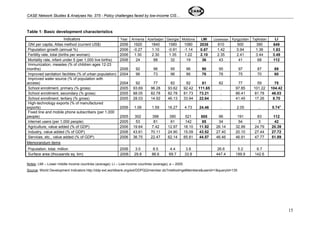
Table 1 presents a selection of indicators which illustrate the development level of each 
country and compares them to averages of respective income groups (i.e. to averages of all 
LMI and LI countries). In each income group, the analyzed CIS economies represent the GNI 
per capita level below average values. Georgia, Kyrgyzstan and Moldova are less 
industrialized in comparison to their group’s averages while the opposite is true in the case of 
Azerbaijan (due to the dominant role of the oil sector in its economy). The remaining three 
countries represent an industrialization level close to their income group’s averages. 
Furthermore, industry is rather technically obsolete, a fact that is reflected by the negligible 
number of shares of high-technology exports in total manufacturing exports. 
5 
The author would like to thank UNDESA for permission to publish this version in CASE Network Studies and 
Analyses series. 
10
CASE Network Studies & Analyses No. 375 - Policy challenges faced by low-income CIS… 
Armenia, Georgia and Moldova clearly differ from other lower-middle-income countries in 
terms of demographic trends. With fertility rates of less than 2, their populations are declining 
every year. Massive outward migration (see Section 5.5) makes this trend even more 
dramatic. The three Central Asian countries record positive rates of population growth and 
fertility rates above 2 (close to 3.5 in Tajikistan), although this growth is slower than the LI 
group average. Azerbaijan also represents the same positive trend, and is even above the 
average of the LMI group. 
On the whole, health and sanitary-related indicators appear better in the analyzed CIS 
countries when compared with respective group averages, with the exception of Azerbaijan, 
which has a very high infant mortality rate. The same can be said about secondary and 
tertiary education. The picture of primary education is somewhat less clear with group 
averages above 100% (which reflects extensive illiteracy eradication programs in many 
countries). Statistics indicate incomplete enrollment levels in Armenia, Georgia and Moldova, 
which are most likely the effect of large-scale unregistered outward migration. On the other 
hand, indicators illustrating telecommunication infrastructure seem to be close to average or 
slightly below with two exceptions in respect to Internet users: Moldova (above average trend 
for the LMI group) and Tajikistan (well below the LI average). 
Summing up, human capital seems to be the relative advantage of the analyzed countries 
(compared to the average indicators in their respective income groups)8 while 
underdeveloped infrastructure and uncompetitive manufacturing appear to be their 
handicaps. These comparative advantages and disadvantages are, to a large extent, a result 
of their Soviet history: a relatively high education and health care level on the one hand, and 
a closed and autarkic economy with heavily distorted industry and infrastructure serving 
mostly military purposes on the other. One must remember, however, that human capital 
deteriorated in some countries during the last twenty years as a result of internal and 
regional conflicts, massive outward migration and insufficient reforms in social services. 
In the second half of the 1990s, after a period of adaptation during which output declined as 
a result of the collapse of the command system, the disintegration of the USSR and, in some 
cases, regional and domestic conflicts, all of the analyzed economies began to grow. As 
Table 2 demonstrates all the countries but Kyrgyzstan have recorded impressive growth 
rates in the current decade. These rates were extraordinarily high in Armenia and Azerbaijan. 
6 
905 USD per capita is the border value between both groups. 
7 
See http://siteresources.worldbank.org/DATASTATISTICS/Resources/CLASS.XLS 
8 
In spite of the deterioration in the quality of education over the last twenty years – see Section 6 for more 
comments. 
11
CASE Network Studies & Analyses No. 375 - Policy challenges faced by low-income CIS… 
However, this positive trend cannot be analyzed without considering the external 
environment during this time. First, the period of 2001-2006 was exceptionally good for the 
entire global economy and emerging markets in particular. Second, rapid growth in the 
analyzed countries was at least partly driven by strong demand from their large neighbors 
and major trade partners such as China, Russia, Ukraine, Kazakhstan or Turkey, which were 
growing at equally rapid rates. Third, the analyzed countries enjoyed the effects of the rapidly 
growing world prices of many basic commodities, which they produced and exported. All 
these positive circumstances were unlikely to last forever and this became clear in 2008 
when the entire world economy started to slow down as result of the global financial crisis. It 
is likely that external conditions in the future will be more challenging and demanding than 
those of the early 2000s. We will come to this question in the next section. 
Table 2: Annual growth rate of real GDP (in %) 
Country 2001 2002 2003 2004 2005 2006 2007 
Armenia 9.6 13.2 14.0 10.5 14.0 13.3 13.8 
Azerbaijan 9.9 10.6 11.2 10.2 26.4 30.5 23.4 
Georgia 4.8 5.5 11.1 5.8 9.3 9.4 12.4 
Kyrgyzstan 5.3 -0.0 7.0 7.0 -0.2 3.1 8.2 
Moldova 6.1 7.8 6.6 7.4 7.5 4.8 4.0 
Tajikistan 10.2 9.1 10.2 10.6 6.7 7.0 7.8 
Uzbekistan 4.2 4.0 4.2 7.7 7.0 7.3 9.5 
Source: World Development Indicators 
http://ddp-ext.worldbank.org/ext/DDPQQ/member.do?method=getMembers&userid=1&queryId=135 
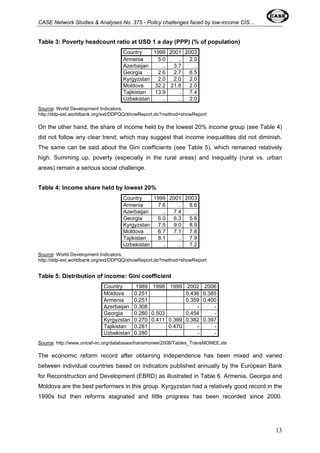
It is also unclear to what extent rapid economic growth helped to eradicate mass poverty – 
the biggest social challenge faced by these countries. The comparative cross-country data 
sets are unfortunately scarce and incomplete and only provide data up until 2003, i.e. the 
initial stage of growth. Table 3 seems to indicate that extreme poverty (the share of people 
living below the income threshold of 1 USD per day in PPP terms) decreased in the 
beginning of the 2000s (with the exception of Georgia where the opposite trend was 
observed). A continuous decrease in poverty rates was also noticed in a later period in 
individual countries, for example in Kyrgyzstan in the period of 2004-2006 (IMF, 2008, p.3). 
12
CASE Network Studies & Analyses No. 375 - Policy challenges faced by low-income CIS… 
Table 3: Poverty headcount ratio at USD 1 a day (PPP) (% of population) 
Country 1999 2001 2003 
Armenia 5.0 .. 2.0 
Azerbaijan .. 3.7 .. 
Georgia 2.6 2.7 6.5 
Kyrgyzstan 2.0 2.0 2.0 
Moldova 32.2 21.8 2.0 
Tajikistan 13.9 .. 7.4 
Uzbekistan .. .. 2.0 
Source: World Development Indicators, 
http://ddp-ext.worldbank.org/ext/DDPQQ/showReport.do?method=showReport 
On the other hand, the share of income held by the lowest 20% income group (see Table 4) 
did not follow any clear trend, which may suggest that income inequalities did not diminish. 
The same can be said about the Gini coefficients (see Table 5), which remained relatively 
high. Summing up, poverty (especially in the rural areas) and inequality (rural vs. urban 
areas) remain a serious social challenge. 
Table 4: Income share held by lowest 20% 
Country 1999 2001 2003 
Armenia 7.6 .. 8.6 
Azerbaijan .. 7.4 .. 
Georgia 6.0 6.3 5.6 
Kyrgyzstan 7.5 9.0 8.9 
Moldova 6.7 7.1 7.8 
Tajikistan 8.1 .. 7.9 
Uzbekistan .. .. 7.2 
Source: World Development Indicators, 
http://ddp-ext.worldbank.org/ext/DDPQQ/showReport.do?method=showReport 
Table 5: Distribution of income: Gini coefficient 
Country 1989 1998 1999 2002 2006 
Moldova 0.251 0.436 0.385 
Armenia 0.251 0.359 0.400 
Azerbaijan 0.308 - - 
Georgia 0.280 0.503 0.454 - 
Kyrgyzstan 0.270 0.411 0.399 0.382 0.397 
Tajikistan 0.281 0.470 - - 
Uzbekistan 0.280 - - 
Source: http://www.unicef-irc.org/databases/transmonee/2008/Tables_TransMONEE.xls 
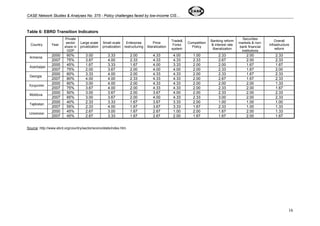
The economic reform record after obtaining independence has been mixed and varied 
between individual countries based on indicators published annually by the European Bank 
for Reconstruction and Development (EBRD) as illustrated in Table 6. Armenia, Georgia and 
Moldova are the best performers in this group. Kyrgyzstan had a relatively good record in the 
1990s but then reforms stagnated and little progress has been recorded since 2000. 
13
CASE Network Studies & Analyses No. 375 - Policy challenges faced by low-income CIS… 
Azerbaijan was delayed in the 1990s but caught up in the last few years. Tajikistan and 
Uzbekistan are the least advanced; they started reforms late and moved forward slowly. 
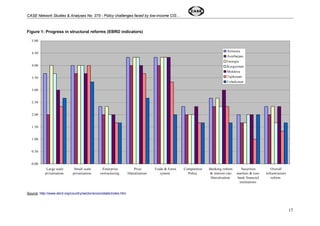
Figure 1 provides another perspective; it shows the differences between various policy 
areas. On average, price, foreign exchange and trade liberalization, and small-scale 
privatization are relatively advanced while enterprise restructuring, competition policy, non-bank 
financial institutions, the securities market, and infrastructure reforms evidently lag 
behind. This gives us a general although incomplete picture of which policy areas should be 
taken into consideration in the future reform agenda. We will come back to this question in 
Section 6. 
14
CASE Network Studies & Analyses No. 375 - Policy challenges faced by low-income CIS… 
Table 1: Basic development characteristics 
Indicators Year Armenia Azerbaijan Georgia Moldova LMI Uzbekistan Kyrgyzstan Tajikistan LI 
GNI per capita, Atlas method (current US$) 2006 1920 1840 1580 1080 2038 610 500 390 649 
Population growth (annual %) 2006 -0.27 1.10 -0.91 -1.14 0.87 1.42 0.94 1.36 1.83 
Fertility rate, total (births per woman) 2006 1.30 2.30 1.35 1.22 2.10 2.35 2.41 3.44 3.49 
Mortality rate, infant under 5 (per 1,000 live births) 2006 24 88 32 19 36 43 41 68 112 
Immunization, measles (% of children ages 12-23 
months) 2006 92 96 95 96 90 95 97 87 69 
Improved sanitation facilities (% of urban population) 2004 96 73 96 86 76 78 75 70 60 
Improved water source (% of population with 
access) 2004 92 77 82 92 81 82 77 59 75 
School enrollment, primary (% gross) 2005 93.69 96.28 93.62 92.42 111.65 .. 97.85 101.22 104.42 
School enrollment, secondary (% gross) 2005 88.05 82.78 82.78 81.73 73.21 .. 86.41 81.78 46.03 
School enrollment, tertiary (% gross) 2005 28.03 14.92 46.13 33.94 22.64 .. 41.45 17.26 8.70 
High-technology exports (% of manufactured 
exports) 2006 1.06 1.59 16.27 4.73 24.46 .. 2.05 .. 5.74a 
Fixed line and mobile phone subscribers (per 1,000 
people) 2005 302 398 390 521 505 96 191 83 112 
Internet users (per 1,000 people) 2005 53 81 61 142 85 34 54 3 42 
Agriculture, value added (% of GDP) 2006 19.64 7.42 12.97 18.10 11.92 26.14 32.99 24.79 20.39 
Industry, value added (% of GDP) 2006 43.61 70.11 24.90 15.09 43.52 27.40 20.10 27.44 27.72 
Services, etc., value added (% of GDP) 2006 36.75 22.47 62.14 65.81 44.57 46.46 46.91 47.77 51.89 
Memorandum items 
Population, total, million 2006 3.0 8.5 4.4 3.8 26.6 5.2 6.7 
Surface area (thousands sq. km) 2006 29.8 86.6 69.7 33.8 447.4 199.9 142.6 
Notes: LMI – Lower middle income countries (average); LI – Low-income countries (average); a – 2005. 
Source: World Development Indicators http://ddp-ext.worldbank.org/ext/DDPQQ/member.do?method=getMembers&userid=1&queryId=135 
15
CASE Network Studies & Analyses No. 375 - Policy challenges faced by low-income CIS… 
Table 6: EBRD Transition Indicators 
Country Year 
Private 
sector 
share in 
GDP 
Large scale 
privatization 
Small scale 
privatization 
Enterprise 
restructuring 
Price 
liberalization 
Trade& 
Forex 
system 
Competition 
Policy 
Banking reform 
& interest rate 
liberalization 
Securities 
markets & non-bank 
financial 
institutions 
Overall 
infrastructure 
reform 
Armenia 2000 60% 3.00 3.33 2.00 4.33 4.00 1.00 2.33 2.00 2.33 
2007 75% 3.67 4.00 2.33 4.33 4.33 2.33 2.67 2.00 2.33 
Azerbaijan 2000 45% 1.67 3.33 1.67 4.00 3.33 2.00 2.00 1.67 1.67 2007 75% 2.00 3.67 2.00 4.00 4.00 2.00 2.33 1.67 2.00 
Georgia 2000 60% 3.33 4.00 2.00 4.33 4.33 2.00 2.33 1.67 2.33 2007 80% 4.00 4.00 2.33 4.33 4.33 2.00 2.67 1.67 2.33 
2000 60% 3.00 4.00 2.00 4.33 4.33 2.00 2.00 2.00 1.33 Kyrgyzstan 2007 75% 3.67 4.00 2.00 4.33 4.33 2.00 2.33 2.00 1.67 
Moldova 2000 50% 3.00 3.67 2.00 3.67 4.00 2.00 2.33 2.00 2.33 2007 65% 3.00 3.67 2.00 4.00 4.33 2.33 3.00 2.00 2.33 
Tajikistan 2000 40% 2.33 3.33 1.67 3.67 3.33 2.00 1.00 1.00 1.00 2007 55% 2.33 4.00 1.67 3.67 3.33 1.67 2.33 1.00 1.33 
2000 45% 2.67 3.00 1.67 2.67 1.00 2.00 1.67 2.00 1.33 Uzbekistan 2007 45% 2.67 3.33 1.67 2.67 2.00 1.67 1.67 2.00 1.67 
Source: http://www.ebrd.org/country/sector/econo/stats/index.htm 
16
CASE Network Studies & Analyses No. 375 - Policy challenges faced by low-income CIS… 
17 
5.00 
4.50 
4.00 
3.50 
3.00 
2.50 
2.00 
1.50 
1.00 
0.50 
0.00 
Large scale 
privatisation 
Small scale 
privatisation 
Enterprise 
restructuring 
Price 
liberalisation 
Trade & Forex 
system 
Competition 
Policy 
Banking reform 
& interest rate 
liberalisation 
Securities 
markets & non-bank 
financial 
institutions 
Overall 
infrastructure 
reform 
Armenia 
Azerbaijan 
Georgia 
Kyrgyzstan 
Moldova 
Tajikistan 
Uzbekistan 
Figure 1: Progress in structural reforms (EBRD indicators) 
Source: http://www.ebrd.org/country/sector/econo/stats/index.htm
CASE Network Studies & Analyses No. 375 - Policy challenges faced by low-income CIS… 
3. Macroeconomic challenges and macroeconomic 
management 
After a series of currency crises in 1998-1999, the macroeconomic situation in the CIS region 
became more stable. It stopped being a major policy concern in the first half of the 2000s. 
Both fiscal and monetary policies have become, on the whole, more prudent and 
responsible, and inflation has started to go down to one- or low two-digit levels (see Table 7). 
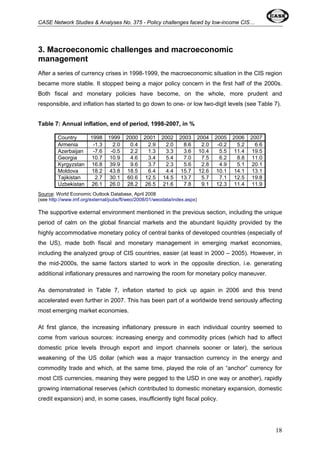
Table 7: Annual inflation, end of period, 1998-2007, in % 
Country 1998 1999 2000 2001 2002 2003 2004 2005 2006 2007 
Armenia -1.3 2.0 0.4 2.9 2.0 8.6 2.0 -0.2 5.2 6.6 
Azerbaijan -7.6 -0.5 2.2 1.3 3.3 3.6 10.4 5.5 11.4 19.5 
Georgia 10.7 10.9 4.6 3.4 5.4 7.0 7.5 6.2 8.8 11.0 
Kyrgyzstan 16.8 39.9 9.6 3.7 2.3 5.6 2.8 4.9 5.1 20.1 
Moldova 18.2 43.8 18.5 6.4 4.4 15.7 12.6 10.1 14.1 13.1 
Tajikistan 2.7 30.1 60.6 12.5 14.5 13.7 5.7 7.1 12.5 19.8 
Uzbekistan 26.1 26.0 28.2 26.5 21.6 7.8 9.1 12.3 11.4 11.9 
Source: World Economic Outlook Database, April 2008 
(see http://www.imf.org/external/pubs/ft/weo/2008/01/weodata/index.aspx) 
The supportive external environment mentioned in the previous section, including the unique 
period of calm on the global financial markets and the abundant liquidity provided by the 
highly accommodative monetary policy of central banks of developed countries (especially of 
the US), made both fiscal and monetary management in emerging market economies, 
including the analyzed group of CIS countries, easier (at least in 2000 – 2005). However, in 
the mid-2000s, the same factors started to work in the opposite direction, i.e. generating 
additional inflationary pressures and narrowing the room for monetary policy maneuver. 
As demonstrated in Table 7, inflation started to pick up again in 2006 and this trend 
accelerated even further in 2007. This has been part of a worldwide trend seriously affecting 
most emerging market economies. 
At first glance, the increasing inflationary pressure in each individual country seemed to 
come from various sources: increasing energy and commodity prices (which had to affect 
domestic price levels through export and import channels sooner or later), the serious 
weakening of the US dollar (which was a major transaction currency in the energy and 
commodity trade and which, at the same time, played the role of an “anchor” currency for 
most CIS currencies, meaning they were pegged to the USD in one way or another), rapidly 
growing international reserves (which contributed to domestic monetary expansion, domestic 
credit expansion) and, in some cases, insufficiently tight fiscal policy. 
18
CASE Network Studies & Analyses No. 375 - Policy challenges faced by low-income CIS… 
Upon closer examination, some of these factors were evidently co-integrated. For example, a 
weakened US dollar additionally stimulated an increase in export volumes and dollar-denominated 
export prices. Both of these factors contributed to increasing international 
reserves. The rapid increase in money supply fuelled by growing currency reserves created 
more room for domestic credit expansion. An increase in oil, gas and other commodity 
revenues improved the fiscal position and created the temptation to expand government 
expenditures and fuel domestic demand, etc. 
In this situation, the CIS central banks faced a serious challenge. Most central banks used a 
US dollar peg as an anti-inflationary anchor, a pragmatic solution if one takes into 
consideration the fresh memory of the high inflation or hyperinflation in the early 1990s, the 
limited credibility of domestic macroeconomic policy, the high actual dollarization and 
underdeveloped domestic money markets and monetary policy instruments. At the end of the 
1990s and early 2000s, the strong dollar worked well in this role. However, since 2002 when 
the dollar began to depreciate against the Euro and other major currencies, the dollar-pegged 
CIS countries started to import inflation. The newly observed trend of dollar-strengthening 
(as of late summer 2008) may help to ease inflationary pressure at least for a 
while. In the long term, the analyzed countries must reconsider, once again, their monetary 
policy strategies: either continue a dollar peg (on the current or corrected level) or re-peg 
their currencies to the Euro, or adopt direct inflation-targeting with a floating exchange rate, 
following Armenia’s example (see Dabla-Norris et al., 2007). 
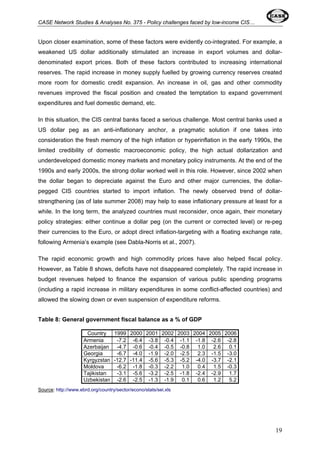
The rapid economic growth and high commodity prices have also helped fiscal policy. 
However, as Table 8 shows, deficits have not disappeared completely. The rapid increase in 
budget revenues helped to finance the expansion of various public spending programs 
(including a rapid increase in military expenditures in some conflict-affected countries) and 
allowed the slowing down or even suspension of expenditure reforms. 
Table 8: General government fiscal balance as a % of GDP 
Country 1999 2000 2001 2002 2003 2004 2005 2006 
Armenia -7.2 -6.4 -3.8 -0.4 -1.1 -1.8 -2.6 -2.8 
Azerbaijan -4.7 -0.6 -0.4 -0.5 -0.8 1.0 2.6 0.1 
Georgia -6.7 -4.0 -1.9 -2.0 -2.5 2.3 -1.5 -3.0 
Kyrgyzstan -12.7 -11.4 -5.6 -5.3 -5.2 -4.0 -3.7 -2.1 
Moldova -6.2 -1.8 -0.3 -2.2 1.0 0.4 1.5 -0.3 
Tajikistan -3.1 -5.6 -3.2 -2.5 -1.8 -2.4 -2.9 1.7 
Uzbekistan -2.6 -2.5 -1.3 -1.9 0.1 0.6 1.2 5.2 
Source: http://www.ebrd.org/country/sector/econo/stats/sei.xls 
19
CASE Network Studies & Analyses No. 375 - Policy challenges faced by low-income CIS… 
Thus if economic growth slows down and windfall gains disappear, serious fiscal tensions 
may come back again. This is a particularly serious challenge for Azerbaijan, which has 
enjoyed an extraordinary oil boom during the last few years (resulting both from higher prices 
and expanding production), but which saved a very small portion of its oil windfall, allowing 
its current budget expenditure to grow at a very rapid pace. If this policy is not corrected 
soon, the country will face a hard “landing” after 2012 when oil production is expected to start 
declining (IMF, 2007a). 
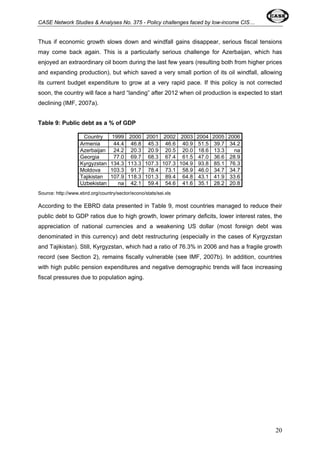
Table 9: Public debt as a % of GDP 
Country 1999 2000 2001 2002 2003 2004 2005 2006 
Armenia 44.4 46.8 45.3 46.6 40.9 51.5 39.7 34.2 
Azerbaijan 24.2 20.3 20.9 20.5 20.0 18.6 13.3 na 
Georgia 77.0 69.7 68.3 67.4 61.5 47.0 36.6 28.9 
Kyrgyzstan 134.3 113.3 107.3 107.3 104.9 93.8 85.1 76.3 
Moldova 103.3 91.7 78.4 73.1 58.9 46.0 34.7 34.7 
Tajikistan 107.9 118.3 101.3 89.4 64.8 43.1 41.9 33.6 
Uzbekistan na 42.1 59.4 54.6 41.6 35.1 28.2 20.8 
Source: http://www.ebrd.org/country/sector/econo/stats/sei.xls 
According to the EBRD data presented in Table 9, most countries managed to reduce their 
public debt to GDP ratios due to high growth, lower primary deficits, lower interest rates, the 
appreciation of national currencies and a weakening US dollar (most foreign debt was 
denominated in this currency) and debt restructuring (especially in the cases of Kyrgyzstan 
and Tajikistan). Still, Kyrgyzstan, which had a ratio of 76.3% in 2006 and has a fragile growth 
record (see Section 2), remains fiscally vulnerable (see IMF, 2007b). In addition, countries 
with high public pension expenditures and negative demographic trends will face increasing 
fiscal pressures due to population aging. 
20
CASE Network Studies & Analyses No. 375 - Policy challenges faced by low-income CIS… 
4. Poor business and investment climate and its institutional 
roots 
In Section 2, we commented on the mixed progress in various areas of microeconomic, 
structural and institutional reforms based on the EBRD transition indicators. Now we would 
like to extend this analysis, looking particularly at the issue of business and investment 
climate using the additional ratings provided by the World Bank (WB), Heritage Foundation 
(HF), Transparency International (TI) and Freedom House (FH). Similarly to the EBRD 
indicators, each of these indicators is based on either an expert or business/investor 
assessment, which is then translated into quantitative scores. This means the results may be 
influenced by various methodological shortcomings, such as bias towards the dominant 
opinion on a country rather than the country’s real record. However, this is the only available 
method to conduct a cross-country comparison related to more complex and less easily 
measurable issues such as entry and exit barriers, the administrative burden, protection of 
property rights, corruption and others. In addition, as we will see below, the various surveys 
provide quite a similar picture, without any major discrepancies. 
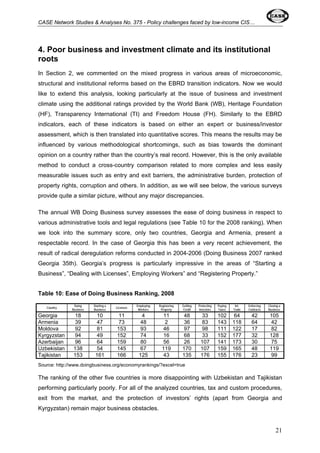
The annual WB Doing Business survey assesses the ease of doing business in respect to 
various administrative tools and legal regulations (see Table 10 for the 2008 ranking). When 
we look into the summary score, only two countries, Georgia and Armenia, present a 
respectable record. In the case of Georgia this has been a very recent achievement, the 
result of radical deregulation reforms conducted in 2004-2006 (Doing Business 2007 ranked 
Georgia 35th). Georgia’s progress is particularly impressive in the areas of “Starting a 
Business”, “Dealing with Licenses”, Employing Workers” and “Registering Property.” 
Table 10: Ease of Doing Business Ranking, 2008 
Country Doing 
Business 
Starting a 
Business Licenses Employing 
Workers 
Registering 
Property 
Getting 
Credit 
Protecting 
Investors 
Paying 
Taxes 
Int. 
Trade 
Enforcing 
Contracts 
Closing a 
Business 
Georgia 18 10 11 4 11 48 33 102 64 42 105 
Armenia 39 47 73 48 2 36 83 143 118 64 42 
Moldova 92 81 153 93 46 97 98 111 122 17 82 
Kyrgyzstan 94 49 152 74 16 68 33 152 177 32 128 
Azerbaijan 96 64 159 80 56 26 107 141 173 30 75 
Uzbekistan 138 54 145 67 119 170 107 159 165 48 119 
Tajikistan 153 161 166 125 43 135 176 155 176 23 99 
Source: http://www.doingbusiness.org/economyrankings/?excel=true 
The ranking of the other five countries is more disappointing with Uzbekistan and Tajikistan 
performing particularly poorly. For all of the analyzed countries, tax and custom procedures, 
exit from the market, and the protection of investors’ rights (apart from Georgia and 
Kyrgyzstan) remain major business obstacles. 
21
CASE Network Studies & Analyses No. 375 - Policy challenges faced by low-income CIS… 
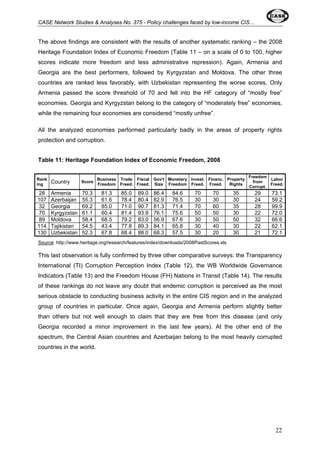
The above findings are consistent with the results of another systematic ranking – the 2008 
Heritage Foundation Index of Economic Freedom (Table 11 – on a scale of 0 to 100, higher 
scores indicate more freedom and less administrative repression). Again, Armenia and 
Georgia are the best performers, followed by Kyrgyzstan and Moldova. The other three 
countries are ranked less favorably, with Uzbekistan representing the worse scores. Only 
Armenia passed the score threshold of 70 and fell into the HF category of “mostly free” 
economies. Georgia and Kyrgyzstan belong to the category of “moderately free” economies, 
while the remaining four economies are considered “mostly unfree”. 
All the analyzed economies performed particularly badly in the areas of property rights 
protection and corruption. 
Table 11: Heritage Foundation Index of Economic Freedom, 2008 
Rank 
ing Country Score Business 
Freedom 
Trade 
Freed. 
Fiscal 
Freed. 
Gov't 
Size 
Monetary 
Freedom 
Invest. 
Freed. 
Financ. 
Freed. 
Property 
Rights 
Freedom 
from 
Corrupt. 
Labor 
Freed. 
28 Armenia 70.3 81.3 85.0 89.0 86.4 84.6 70 70 35 29 73.1 
107 Azerbaijan 55.3 61.6 78.4 80.4 82.9 76.5 30 30 30 24 59.2 
32 Georgia 69.2 85.0 71.0 90.7 81.3 71.4 70 60 35 28 99.9 
70 Kyrgyzstan 61.1 60.4 81.4 93.9 76.1 75.6 50 50 30 22 72.0 
89 Moldova 58.4 68.5 79.2 83.0 56.9 67.6 30 50 50 32 66.6 
114 Tajikistan 54.5 43.4 77.8 89.3 84.1 65.8 30 40 30 22 62.1 
130 Uzbekistan 52.3 67.8 68.4 88.0 68.3 57.5 30 20 30 21 72.1 
Source: http://www.heritage.org/research/features/index/downloads/2008PastScores.xls 
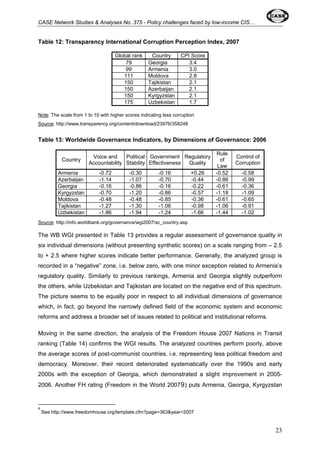
This last observation is fully confirmed by three other comparative surveys: the Transparency 
International (TI) Corruption Perception Index (Table 12), the WB Worldwide Governance 
Indicators (Table 13) and the Freedom House (FH) Nations in Transit (Table 14). The results 
of these rankings do not leave any doubt that endemic corruption is perceived as the most 
serious obstacle to conducting business activity in the entire CIS region and in the analyzed 
group of countries in particular. Once again, Georgia and Armenia perform slightly better 
than others but not well enough to claim that they are free from this disease (and only 
Georgia recorded a minor improvement in the last few years). At the other end of the 
spectrum, the Central Asian countries and Azerbaijan belong to the most heavily corrupted 
countries in the world. 
22
CASE Network Studies & Analyses No. 375 - Policy challenges faced by low-income CIS… 
Table 12: Transparency International Corruption Perception Index, 2007 
Global rank Country CPI Score 
79 Georgia 3.4 
99 Armenia 3.0 
111 Moldova 2.8 
150 Tajikistan 2.1 
150 Azerbaijan 2.1 
150 Kyrgyzstan 2.1 
175 Uzbekistan 1.7 
Note: The scale from 1 to 10 with higher scores indicating less corruption 
Source: http://www.transparency.org/content/download/23976/358248 
Table 13: Worldwide Governance Indicators, by Dimensions of Governance: 2006 
Country Voice and 
Accountability 
Political 
Stability 
Government 
Effectiveness 
Regulatory 
Quality 
Rule 
of 
Law 
Control of 
Corruption 
Armenia -0.72 -0.30 -0.16 +0.26 -0.52 -0.58 
Azerbaijan -1.14 -1.07 -0.70 -0.44 -0.86 -0.99 
Georgia -0.16 -0.86 -0.16 -0.22 -0.61 -0.36 
Kyrgyzstan -0.70 -1.20 -0.86 -0.57 -1.18 -1.09 
Moldova -0.48 -0.48 -0.85 -0.36 -0.61 -0.65 
Tajikistan -1.27 -1.30 -1.06 -0.98 -1.06 -0.91 
Uzbekistan -1.86 -1.94 -1.24 -1.66 -1.44 -1.02 
Source: http://info.worldbank.org/governance/wgi2007/sc_country.asp 
The WB WGI presented in Table 13 provides a regular assessment of governance quality in 
six individual dimensions (without presenting synthetic scores) on a scale ranging from – 2.5 
to + 2.5 where higher scores indicate better performance. Generally, the analyzed group is 
recorded in a “negative” zone, i.e. below zero, with one minor exception related to Armenia’s 
regulatory quality. Similarly to previous rankings, Armenia and Georgia slightly outperform 
the others, while Uzbekistan and Tajikistan are located on the negative end of this spectrum. 
The picture seems to be equally poor in respect to all individual dimensions of governance 
which, in fact, go beyond the narrowly defined field of the economic system and economic 
reforms and address a broader set of issues related to political and institutional reforms. 
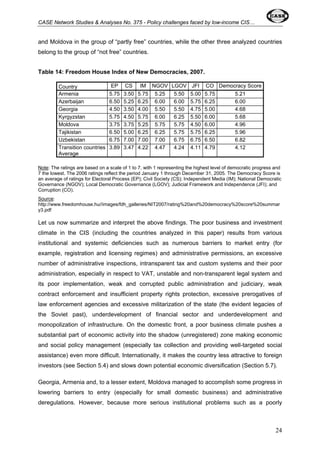
Moving in the same direction, the analysis of the Freedom House 2007 Nations in Transit 
ranking (Table 14) confirms the WGI results. The analyzed countries perform poorly, above 
the average scores of post-communist countries, i.e. representing less political freedom and 
democracy. Moreover, their record deteriorated systematically over the 1990s and early 
2000s with the exception of Georgia, which demonstrated a slight improvement in 2005- 
2006. Another FH rating (Freedom in the World 20079) puts Armenia, Georgia, Kyrgyzstan 
9 
See http://www.freedomhouse.org/template.cfm?page=363&year=2007 
23
CASE Network Studies & Analyses No. 375 - Policy challenges faced by low-income CIS… 
and Moldova in the group of “partly free” countries, while the other three analyzed countries 
belong to the group of “not free” countries. 
Table 14: Freedom House Index of New Democracies, 2007. 
Country EP CS IM NGOV LGOV JFI CO Democracy Score 
Armenia 5.75 3.50 5.75 5.25 5.50 5.00 5.75 5.21 
Azerbaijan 6.50 5.25 6.25 6.00 6.00 5.75 6.25 6.00 
Georgia 4.50 3.50 4.00 5.50 5.50 4.75 5.00 4.68 
Kyrgyzstan 5.75 4.50 5.75 6.00 6.25 5.50 6.00 5.68 
Moldova 3.75 3.75 5.25 5.75 5.75 4.50 6.00 4.96 
Tajikistan 6.50 5.00 6.25 6.25 5.75 5.75 6.25 5.96 
Uzbekistan 6.75 7.00 7.00 7.00 6.75 6.75 6.50 6.82 
Transition countries 
3.89 3.47 4.22 4.47 4.24 4.11 4.79 4.12 
Average 
Note: The ratings are based on a scale of 1 to 7, with 1 representing the highest level of democratic progress and 
7 the lowest. The 2006 ratings reflect the period January 1 through December 31, 2005. The Democracy Score is 
an average of ratings for Electoral Process (EP); Civil Society (CS); Independent Media (IM); National Democratic 
Governance (NGOV); Local Democratic Governance (LGOV); Judicial Framework and Independence (JFI); and 
Corruption (CO). 
Source: 
http://www.freedomhouse.hu//images/fdh_galleries/NIT2007/rating%20and%20democracy%20score%20summar 
y3.pdf 
Let us now summarize and interpret the above findings. The poor business and investment 
climate in the CIS (including the countries analyzed in this paper) results from various 
institutional and systemic deficiencies such as numerous barriers to market entry (for 
example, registration and licensing regimes) and administrative permissions, an excessive 
number of administrative inspections, intransparent tax and custom systems and their poor 
administration, especially in respect to VAT, unstable and non-transparent legal system and 
its poor implementation, weak and corrupted public administration and judiciary, weak 
contract enforcement and insufficient property rights protection, excessive prerogatives of 
law enforcement agencies and excessive militarization of the state (the evident legacies of 
the Soviet past), underdevelopment of financial sector and underdevelopment and 
monopolization of infrastructure. On the domestic front, a poor business climate pushes a 
substantial part of economic activity into the shadow (unregistered) zone making economic 
and social policy management (especially tax collection and providing well-targeted social 
assistance) even more difficult. Internationally, it makes the country less attractive to foreign 
investors (see Section 5.4) and slows down potential economic diversification (Section 5.7). 
Georgia, Armenia and, to a lesser extent, Moldova managed to accomplish some progress in 
lowering barriers to entry (especially for small domestic business) and administrative 
deregulations. However, because more serious institutional problems such as a poorly 
24
CASE Network Studies & Analyses No. 375 - Policy challenges faced by low-income CIS… 
performing public administration and judiciary or deficits in transparency and the rule of law 
remain unresolved, this progress may prove unsustainable. 
This brings us to a more fundamental observation: the poor business climate in the CIS has 
deep roots in the unreformed post-Soviet state, which continues to perform various functions 
typical for a command economy and non-democratic political regime. As in the Soviet or 
even pre-Soviet feudal era, the state apparatus still tries to interfere in the details of business 
activity and the day-to-day life of its citizens while it is unable to provide them with basic 
public goods such as law and order, security, a functioning judiciary, equal and fair treatment 
of all citizens and firms, basic technical and social infrastructure, etc. This kind of 
bureaucratic patrimonialism creates fertile ground for corruption (see Dubrovskiy, 2006). 
The weakness of state institutions is caused, among other things, by a democracy deficit (to 
various degrees in individual countries as authoritarian regimes continue to exist in some 
cases), a weak civil society, non-existent or insufficient media freedom, an unstable and 
immature system of political parties (penetrated by powerful business elites and representing 
their own interests), inefficient and corrupted judiciary, etc. This is the conclusion which can 
be drawn from the WB WGI and FH rankings. 
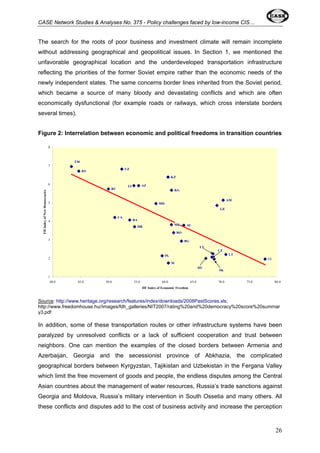
Figure 2 tries to illustrate the interrelations between economic and political freedoms or 
between economic and political reforms, using a wider sample of transition countries. One 
can observe a certain degree of correlation, though not particularly strong, in the progress in 
both spheres. It is obviously weaker than was observed at the end of the 1990s and 
beginning of 2000s – see EBRD, 1999; Dabrowski & Gortat, 2002, Dabrowski, 2004). The 
CIS countries are generally above the trend line (apart from Ukraine), indicating more 
progress in the field of economic reforms in comparison to the political ones. In the case of 
the Caucasuses and Central Asian countries, this asymmetry is even stronger. The countries 
of Central and Eastern Europe (plus Ukraine) are mostly located below the trend line, i.e. 
they tend to represent the opposite asymmetry. 
These results can be interpreted in two different ways. Those who believe in a market-friendly 
authoritarianism (see e.g. Polterovich & Popov, 2005) may find new arguments in 
favor of the East and South East Asian experience in Figure 2 (i.e. the possibility of market 
reforms without democratization – see Popov, 2000). Those who believe in a positive 
relationship and the complementarity between democracy and the market system (such as 
Aslund, 2002; Dabrowski, 2005) may warn about the potential unsustainability of economic 
reform progress and the danger of its reversal. 
25
CASE Network Studies & Analyses No. 375 - Policy challenges faced by low-income CIS… 
The search for the roots of poor business and investment climate will remain incomplete 
without addressing geographical and geopolitical issues. In Section 1, we mentioned the 
unfavorable geographical location and the underdeveloped transportation infrastructure 
reflecting the priorities of the former Soviet empire rather than the economic needs of the 
newly independent states. The same concerns border lines inherited from the Soviet period, 
which became a source of many bloody and devastating conflicts and which are often 
economically dysfunctional (for example roads or railways, which cross interstate borders 
several times). 
Figure 2: Interrelation between economic and political freedoms in transition countries 
KZ 
MK 
RO 
RU 
UZ 
PL LT 
SI 
MD 
KG 
EE 
CZ 
HR 
BG 
UA 
BA 
AZ 
LV 
SK 
HU 
GE 
AM 
AL 
BY 
TM 
TJ 
8 
7 
6 
5 
4 
3 
2 
1 
40.0 45.0 50.0 55.0 60.0 65.0 70.0 75.0 80.0 
HF Index of Economic Freedom 
FH Index of New Democracies 
Source: http://www.heritage.org/research/features/index/downloads/2008PastScores.xls; 
http://www.freedomhouse.hu//images/fdh_galleries/NIT2007/rating%20and%20democracy%20score%20summar 
y3.pdf 
In addition, some of these transportation routes or other infrastructure systems have been 
paralyzed by unresolved conflicts or a lack of sufficient cooperation and trust between 
neighbors. One can mention the examples of the closed borders between Armenia and 
Azerbaijan, Georgia and the secessionist province of Abkhazia, the complicated 
geographical borders between Kyrgyzstan, Tajikistan and Uzbekistan in the Fergana Valley 
which limit the free movement of goods and people, the endless disputes among the Central 
Asian countries about the management of water resources, Russia’s trade sanctions against 
Georgia and Moldova, Russia’s military intervention in South Ossetia and many others. All 
these conflicts and disputes add to the cost of business activity and increase the perception 
26
CASE Network Studies & Analyses No. 375 - Policy challenges faced by low-income CIS… 
of risk in these countries. The resolution of these disputes could vastly improve the business 
environment. It would increase opportunities to bring in more foreign investments, which 
could, in turn, speed up these economies’ modernization and economic diversification (see 
Section 5). The same can be said about domestic governance and regulatory reforms aimed 
at improving the business and investment climate and eradicating corruption. 
5. Trade, Investment and Migration 
This section is devoted mostly to external economic relations: trade structure and geography, 
foreign investments, labor migration and workers’ remittances, trade policy and economic 
integration, and prospects for economic diversification. 
5.1. Sectoral structure of production and trade 
After the collapse of the USSR and the system of Soviet-type central planning, individual CIS 
countries went through a process of dramatic sectoral changes. As illustrated in Table 15, in 
all six economies,10 the share of agriculture, hunting and forestry, and fishing in the global 
value added (GVA) decreased dramatically between 1995 and 2007. This was compensated 
for by the increasing share of services (apart from Azerbaijan) and the construction sector 
(apart from Kyrgyzstan). 
However, the role of the rural sector in terms of the population share living in rural areas and 
the share of agriculture employment as a percentage of total employment continue to be 
substantial, even if the low productivity in this sector lowers its importance in terms of 
generating GDP. The low productivity of agriculture can be considered the main source of 
the rural poverty briefly mentioned in Section 2. 
No single trend can be detected in respect to industry. In Azerbaijan, the share of this sector 
in GDP more than doubled on top of the rapid expansion of oil production. In Kyrgyzstan, this 
share first increased (in the second half of the 1990s) as a result of one large FDI in the gold 
industry, and then declined when this deposit had been exploited. A similar trend (but caused 
by other factors) can be observed in Tajikistan. In the case of Georgia, this share first 
increased rapidly and then stabilized. Armenia and Moldova recorded relative 
“deindustrialization”. 
10 
Table 12 does not include Uzbekistan due to lack of comparable data. 
27
CASE Network Studies & Analyses No. 375 - Policy challenges faced by low-income CIS… 
The lack of disaggregated comparable data does not allow us to analyze the structural 
changes inside the industry sector11. However, anecdotal evidence indicates that changes 
took place and went very deeply. Many traditional Soviet industries disappeared. This 
relates, first, to production in order to meet the USSR’s defense needs and various sub-sectors 
of the machine-building industry. Second, one notes the expansion of oil and gas 
production (Azerbaijan and Uzbekistan), gold production (Kyrgyzstan), diamond processing 
(Armenia) and various kinds of consumer goods based on more contemporary technologies 
and higher quality standards than those typical during the Soviet era. 
5.2. The Commodity structure of trade 
The structural analysis undertaken in the previous sub-section can be further expanded with 
the use of trade data, which gives us a picture of individual countries’ comparative 
advantages and their potential international competitiveness. 
Table 16 presents the commodity structure of exports. The bold font indicates the commodity 
groups which dominate each country’s export. 
11 
For this reason we were unable to separate energy from other industrial production. This confuses the picture 
of Azerbaijan, in which the rapid expansion of oil production overshadowed importance of manufacturing industry. 
28
CASE Network Studies & Analyses No. 375 - Policy challenges faced by low-income CIS… 
Table 15: Sectoral structure of GDP, in % of GVA at prices and PPPs of current year 
Sector Country 1995 2000 2005 2007 
Armenia 40.9 25.2 20.6 19.2 
Azerbaijan 26.9 17.0 9.8 6.2 
Georgia 44.4 21.7 16.5 10.8 
Kyrgyzstan 43.0 36.6 31.3 
Moldova 32.2 28.3 19.1 11.6 
Agriculture, hunting & forestry; 
fishing (ISIC A-B) 
Tajikistan 35.9 27.3 23.8 
Armenia 28.0 27.3 23.5 17.2 
Azerbaijan 28.9 38.1 53.1 64.7 
Georgia 10.1 18.2 17.5 16.1 
Kyrgyzstan 13.0 26.8 19.0 
Moldova 27.5 18.2 18.3 17.2 
Industry, including energy 
(ISIC C-E) 
Tajikistan 33.3 36.1 25.6 
Armenia 6.5 11.1 21.2 28.0 
Azerbaijan 3.9 6.9 10.1 7.6 
Georgia 2.3 3.9 9.0 7.7 
Kyrgyzstan 6.5 4.5 3.0 
Moldova 3.9 3.0 3.9 5.6 
Construction (ISIC F) 
Tajikistan 3.1 2.3 5.1 
Armenia 26.0 36.7 34.6 35.7 
Azerbaijan 40.2 37.9 27.0 21.5 
Georgia 43.2 56.1 57.0 65.4 
Kyrgyzstan 37.1 32.1 46.7 
Moldova 36.4 50.6 58.7 65.6 
Services (ISIC G-P), of which 
Tajikistan 27.7 34.3 45.6 
Armenia 14.8 18.9 19.2 19.0 
Azerbaijan 24.7 19.8 15.1 12.0 
Georgia 36.6 30.7 30.4 30.0 
Kyrgyzstan 16.9 17.7 28.3 
Moldova 15.3 25.3 27.6 29.4 
• Wholesale & retail 
trade, repairs; hotels & 
restaurants; transport & 
communications (ISIC 
G-I) 
Tajikistan 12.1 17.0 26.8 
Armenia 4.8 7.0 5.4 5.6 
Azerbaijan 3.8 3.9 3.0 2.9 
Georgia 2.3 8.9 8.2 8.5 
Kyrgyzstan 6.5 3.6 5.5 
Moldova 6.1 11.1 12.8 16.2 
• Financial, real estate, 
renting & business 
activities (ISIC J-K) 
Tajikistan 9 8.7 8.5 
Armenia 5.8 9.9 10.1 11.0 
Azerbaijan 11.7 14.2 8.8 6.7 
Georgia 4.3 16.4 18.5 26.9 
Kyrgyzstan 13 10.8 12.8 
Moldova 15 14.2 18.3 19.9 
• Other service activities 
(ISIC L-P) 
Tajikistan 6.6 8.6 10.2 
Source: UNECE Statistical Division Database, compiled from national and international (CIS, EUROSTAT, IMF, 
OECD) official sources, http://w3.unece.org/pxweb/dialog/Saveshow.asp 
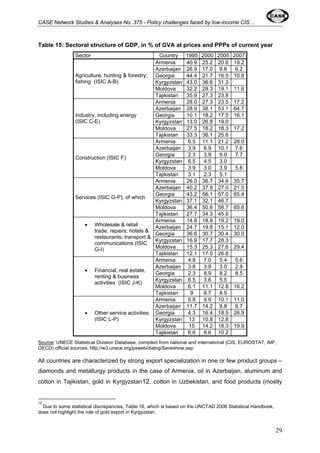
All countries are characterized by strong export specialization in one or few product groups – 
diamonds and metallurgy products in the case of Armenia, oil in Azerbaijan, aluminum and 
cotton in Tajikistan, gold in Kyrgyzstan12, cotton in Uzbekistan, and food products (mostly 
12 
Due to some statistical discrepancies, Table 16, which is based on the UNCTAD 2006 Statistical Handbook, 
does not highlight the role of gold export in Kyrgyzstan. 
29
CASE Network Studies & Analyses No. 375 - Policy challenges faced by low-income CIS… 
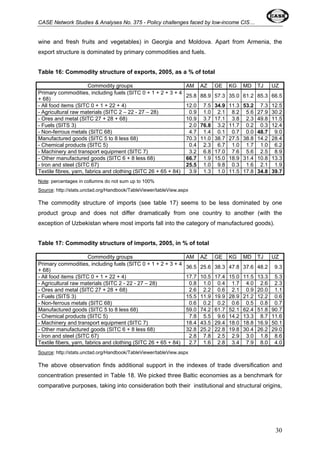
wine and fresh fruits and vegetables) in Georgia and Moldova. Apart from Armenia, the 
export structure is dominated by primary commodities and fuels. 
Table 16: Commodity structure of exports, 2005, as a % of total 
Commodity groups AM AZ GE KG MD TJ UZ 
Primary commodities, including fuels (SITC 0 + 1 + 2 + 3 + 4 
+ 68) 25.8 88.9 57.3 35.0 61.2 85.3 66.5 
- All food items (SITC 0 + 1 + 22 + 4) 12.0 7.5 34.9 11.3 53.2 7.3 12.5 
- Agricultural raw materials (SITC 2 – 22 - 27 – 28) 0.9 1.0 2.1 8.2 5.6 27.9 30.2 
- Ores and metal (SITC 27 + 28 + 68) 10.9 3.7 17.1 3.8 2.3 49.8 11.5 
- Fuels (SITS 3) 2.0 76.8 3.2 11.7 0.2 0.3 12.4 
- Non-ferrous metals (SITC 68) 4.7 1.4 0.1 0.7 0.0 48.7 9.0 
Manufactured goods (SITC 5 to 8 less 68) 70.3 11.0 38.7 27.5 38.8 14.2 28.4 
- Chemical products (SITC 5) 0.4 2.3 6.7 1.0 1.7 1.0 6.2 
- Machinery and transport equipment (SITC 7) 3.2 6.8 17.0 7.6 5.6 2.5 8.9 
- Other manufactured goods (SITC 6 + 8 less 68) 66.7 1.9 15.0 18.9 31.4 10.8 13.3 
- Iron and steel (SITC 67) 25.5 1.0 9.8 0.3 1.6 2.1 1.9 
Textile fibres, yarn, fabrics and clothing (SITC 26 + 65 + 84) 3.9 1.3 1.0 11.5 17.8 34.8 39.7 
Note: percentages in collumns do not sum up to 100% 
Source: http://stats.unctad.org/Handbook/TableViewer/tableView.aspx 
The commodity structure of imports (see table 17) seems to be less dominated by one 
product group and does not differ dramatically from one country to another (with the 
exception of Uzbekistan where most imports fall into the category of manufactured goods). 
Table 17: Commodity structure of imports, 2005, in % of total 
Commodity groups AM AZ GE KG MD TJ UZ 
Primary commodities, including fuels (SITC 0 + 1 + 2 + 3 + 4 
+ 68) 36.5 25.6 38.3 47.8 37.6 48.2 9.3 
- All food items (SITC 0 + 1 + 22 + 4) 17.7 10.5 17.4 15.0 11.5 13.3 5.3 
- Agricultural raw materials (SITC 2 - 22 - 27 – 28) 0.8 1.0 0.4 1.7 4.0 2.6 2.3 
- Ores and metal (SITC 27 + 28 + 68) 2.6 2.2 0.6 2.1 0.9 20.0 1.1 
- Fuels (SITS 3) 15.5 11.9 19.9 28.9 21.2 12.2 0.6 
- Non-ferrous metals (SITC 68) 0.6 0.2 0.2 0.6 0.5 0.8 0.7 
Manufactured goods (SITC 5 to 8 less 68) 59.0 74.2 61.7 52.1 62.4 51.8 90.7 
- Chemical products (SITC 5) 7.8 5.5 9.614.2 13.3 8.7 11.6 
- Machinery and transport equipment (SITC 7) 18.4 43.5 29.4 18.0 18.8 16.9 50.1 
- Other manufactured goods (SITC 6 + 8 less 68) 32.8 25.2 22.8 19.8 30.4 26.2 29.0 
- Iron and steel (SITC 67) 2.8 7.8 2.5 2.9 3.0 1.8 8.6 
Textile fibers, yarn, fabrics and clothing (SITC 26 + 65 + 84) 2.7 1.6 2.8 3.4 7.9 8.0 4.0 
Source: http://stats.unctad.org/Handbook/TableViewer/tableView.aspx 
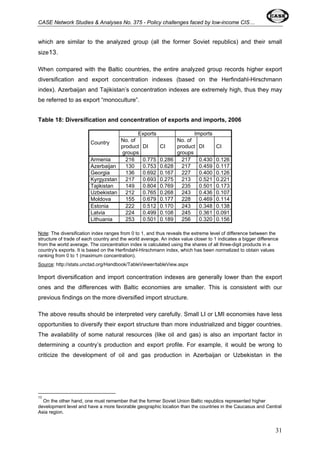
The above observation finds additional support in the indexes of trade diversification and 
concentration presented in Table 18. We picked three Baltic economies as a benchmark for 
comparative purposes, taking into consideration both their institutional and structural origins, 
30
CASE Network Studies & Analyses No. 375 - Policy challenges faced by low-income CIS… 
which are similar to the analyzed group (all the former Soviet republics) and their small 
size13. 
When compared with the Baltic countries, the entire analyzed group records higher export 
diversification and export concentration indexes (based on the Herfindahl-Hirschmann 
index). Azerbaijan and Tajikistan’s concentration indexes are extremely high, thus they may 
be referred to as export “monoculture”. 
Table 18: Diversification and concentration of exports and imports, 2006 
Exports Imports 
Country No. of 
product 
groups 
DI CI 
No. of 
product 
groups 
DI CI 
Armenia 216 0.775 0.286 217 0.430 0.126 
Azerbaijan 130 0.753 0.628 217 0.459 0.117 
Georgia 136 0.692 0.167 227 0.400 0.126 
Kyrgyzstan 217 0.693 0.275 213 0.521 0.221 
Tajikistan 149 0.804 0.769 235 0.501 0.173 
Uzbekistan 212 0.765 0.268 243 0.436 0.107 
Moldova 155 0.679 0.177 228 0.469 0.114 
Estonia 222 0.512 0.170 243 0.348 0.138 
Latvia 224 0.499 0.108 245 0.361 0.091 
Lithuania 253 0.501 0.189 256 0.320 0.156 
Note: The diversification index ranges from 0 to 1, and thus reveals the extreme level of difference between the 
structure of trade of each country and the world average. An index value closer to 1 indicates a bigger difference 
from the world average. The concentration index is calculated using the shares of all three-digit products in a 
country's exports. It is based on the Herfindahl-Hirschmann index, which has been normalized to obtain values 
ranking from 0 to 1 (maximum concentration). 
Source: http://stats.unctad.org/Handbook/TableViewer/tableView.aspx 
Import diversification and import concentration indexes are generally lower than the export 
ones and the differences with Baltic economies are smaller. This is consistent with our 
previous findings on the more diversified import structure. 
The above results should be interpreted very carefully. Small LI or LMI economies have less 
opportunities to diversify their export structure than more industrialized and bigger countries. 
The availability of some natural resources (like oil and gas) is also an important factor in 
determining a country’s production and export profile. For example, it would be wrong to 
criticize the development of oil and gas production in Azerbaijan or Uzbekistan in the 
13 
On the other hand, one must remember that the former Soviet Union Baltic republics represented higher 
development level and have a more favorable geographic location than the countries in the Caucasus and Central 
Asia region. 
31
CASE Network Studies & Analyses No. 375 - Policy challenges faced by low-income CIS… 
environment of dramatically rising global demand for energy resources14. More generally, 
each country can and should use, to a maximum extent, its comparative advantages 
whatever they may be. 
On the other hand, too strong of a specialization (not only in primary commodities) increases 
the risk of adverse terms of trade shock if demand and supply conditions change on 
international markets (as was observed in the second half of 2008). Each country case would 
require individual analysis, a task which is beyond the agenda of this paper. We can only say 
that strong specialization in energy production looks less risky in a medium to long-term 
perspective (under the condition of better macroeconomic management of windfall gains) 
than, for example, in technologically outdated metallurgical production or some agriculture 
products (like wine, fruits and vegetables, being an easy target of various protectionist 
measures in importing countries). We will come back to this topic at the end of this section. 
5.3. Geographical structure of trade 
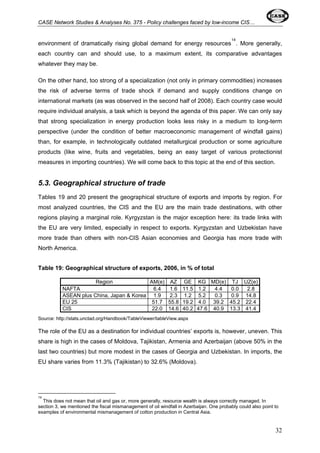
Tables 19 and 20 present the geographical structure of exports and imports by region. For 
most analyzed countries, the CIS and the EU are the main trade destinations, with other 
regions playing a marginal role. Kyrgyzstan is the major exception here: its trade links with 
the EU are very limited, especially in respect to exports. Kyrgyzstan and Uzbekistan have 
more trade than others with non-CIS Asian economies and Georgia has more trade with 
North America. 
Table 19: Geographical structure of exports, 2006, in % of total 
Region AM(e) AZ GE KG MD(e) TJ UZ(e) 
NAFTA 6.4 1.6 11.5 1.2 4.4 0.0 2.8 
ASEAN plus China, Japan & Korea 1.9 2.3 1.2 5.2 0.3 0.9 14.8 
EU 25 51.7 55.8 19.2 4.0 39.2 45.2 22.4 
CIS 22.0 14.6 40.2 47.6 40.9 13.3 41.4 
Source: http://stats.unctad.org/Handbook/TableViewer/tableView.aspx 
The role of the EU as a destination for individual countries’ exports is, however, uneven. This 
share is high in the cases of Moldova, Tajikistan, Armenia and Azerbaijan (above 50% in the 
last two countries) but more modest in the cases of Georgia and Uzbekistan. In imports, the 
EU share varies from 11.3% (Tajikistan) to 32.6% (Moldova). 
14 
This does not mean that oil and gas or, more generally, resource wealth is always correctly managed. In 
section 3, we mentioned the fiscal mismanagement of oil windfall in Azerbaijan. One probably could also point to 
examples of environmental mismanagement of cotton production in Central Asia. 
32
CASE Network Studies & Analyses No. 375 - Policy challenges faced by low-income CIS… 
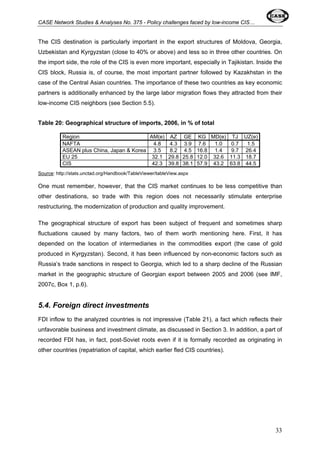
The CIS destination is particularly important in the export structures of Moldova, Georgia, 
Uzbekistan and Kyrgyzstan (close to 40% or above) and less so in three other countries. On 
the import side, the role of the CIS is even more important, especially in Tajikistan. Inside the 
CIS block, Russia is, of course, the most important partner followed by Kazakhstan in the 
case of the Central Asian countries. The importance of these two countries as key economic 
partners is additionally enhanced by the large labor migration flows they attracted from their 
low-income CIS neighbors (see Section 5.5). 
Table 20: Geographical structure of imports, 2006, in % of total 
Region AM(e) AZ GE KG MD(e) TJ UZ(e) 
NAFTA 4.8 4.3 3.9 7.6 1.0 0.7 1.5 
ASEAN plus China, Japan & Korea 3.5 8.2 4.5 16.8 1.4 9.7 26.4 
EU 25 32.1 29.8 25.8 12.0 32.6 11.3 18.7 
CIS 42.3 39.8 38.1 57.9 43.2 63.8 44.5 
Source: http://stats.unctad.org/Handbook/TableViewer/tableView.aspx 
One must remember, however, that the CIS market continues to be less competitive than 
other destinations, so trade with this region does not necessarily stimulate enterprise 
restructuring, the modernization of production and quality improvement. 
The geographical structure of export has been subject of frequent and sometimes sharp 
fluctuations caused by many factors, two of them worth mentioning here. First, it has 
depended on the location of intermediaries in the commodities export (the case of gold 
produced in Kyrgyzstan). Second, it has been influenced by non-economic factors such as 
Russia’s trade sanctions in respect to Georgia, which led to a sharp decline of the Russian 
market in the geographic structure of Georgian export between 2005 and 2006 (see IMF, 
2007c, Box 1, p.6). 
5.4. Foreign direct investments 
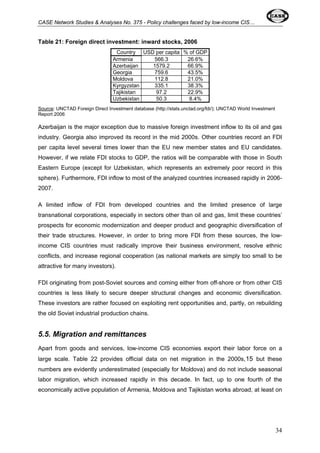
FDI inflow to the analyzed countries is not impressive (Table 21), a fact which reflects their 
unfavorable business and investment climate, as discussed in Section 3. In addition, a part of 
recorded FDI has, in fact, post-Soviet roots even if it is formally recorded as originating in 
other countries (repatriation of capital, which earlier fled CIS countries). 
33
CASE Network Studies & Analyses No. 375 - Policy challenges faced by low-income CIS… 
Table 21: Foreign direct investment: inward stocks, 2006 
Country USD per capita % of GDP 
Armenia 566.3 26.6% 
Azerbaijan 1579.2 66.9% 
Georgia 759.6 43.5% 
Moldova 112.8 21.0% 
Kyrgyzstan 335.1 38.3% 
Tajikistan 97.2 22.9% 
Uzbekistan 50.3 8.4% 
Source: UNCTAD Foreign Direct Investment database (http://stats.unctad.org/fdi/); UNCTAD World Investment 
Report 2006 
Azerbaijan is the major exception due to massive foreign investment inflow to its oil and gas 
industry. Georgia also improved its record in the mid 2000s. Other countries record an FDI 
per capita level several times lower than the EU new member states and EU candidates. 
However, if we relate FDI stocks to GDP, the ratios will be comparable with those in South 
Eastern Europe (except for Uzbekistan, which represents an extremely poor record in this 
sphere). Furthermore, FDI inflow to most of the analyzed countries increased rapidly in 2006- 
2007. 
A limited inflow of FDI from developed countries and the limited presence of large 
transnational corporations, especially in sectors other than oil and gas, limit these countries’ 
prospects for economic modernization and deeper product and geographic diversification of 
their trade structures. However, in order to bring more FDI from these sources, the low-income 
CIS countries must radically improve their business environment, resolve ethnic 
conflicts, and increase regional cooperation (as national markets are simply too small to be 
attractive for many investors). 
FDI originating from post-Soviet sources and coming either from off-shore or from other CIS 
countries is less likely to secure deeper structural changes and economic diversification. 
These investors are rather focused on exploiting rent opportunities and, partly, on rebuilding 
the old Soviet industrial production chains. 
5.5. Migration and remittances 
Apart from goods and services, low-income CIS economies export their labor force on a 
large scale. Table 22 provides official data on net migration in the 2000s,15 but these 
numbers are evidently underestimated (especially for Moldova) and do not include seasonal 
labor migration, which increased rapidly in this decade. In fact, up to one fourth of the 
economically active population of Armenia, Moldova and Tajikistan works abroad, at least on 
34
CASE Network Studies & Analyses No. 375 - Policy challenges faced by low-income CIS… 
a seasonal basis. In the other four countries, this proportion is smaller but still substantial. 
The demand for labor as well as factors of geographical, cultural and language proximity 
determine the most frequent destinations of outward migration: Russia and Kazakhstan 
inside the CIS, as well the European Union16 and Turkey. 
Table 22: Net migration rate per 1000 inhabitants, 2000-2005 
Country NMR 
Armenia -6.6 
Azerbaijan -2.4 
Georgia -10.8 
Kyrgyzstan -2.9 
Moldova -1.9 
Tajikistan -10.9 
Uzbekistan -2.3 
http://stats.unctad.org/Handbook/TableViewer/tableView.aspx 
Large-scale outward migration creates a lot of economic and social problems in sending 
countries, especially in those affected by negative natural population growth (Armenia, 
Georgia and Moldova). In a situation in which a substantial proportion of the active labor 
force works abroad and does not contribute to the domestic PAYG pension system, the fiscal 
crisis related to population aging (which is a serious challenge for almost all European and 
developed countries) will erupt even earlier and on a more dramatic scale when compared 
with a non-migration hypothetical scenario. While a detailed analysis of the impact of the 
demographic crisis on pension systems of individual countries falls outside agenda of this 
paper, the potential policy responses should be moving towards increasing the actual 
retirement age and downsizing the mandatory PAYG pillar in favor of voluntary fully-funded 
scheme(s), in which a part of remittance inflow can be securely invested. 
Table 23: Workers remittances (receipts) as a % of GDP 
Country 2000 2003 2006 
Armenia 4,6 5,8 10,2 
Azerbaijan 1,1 2,1 4,0 
Georgia 8,9 5,8 6,0 
Kyrgyzstan 0,2 3,7 25,9 
Moldova 13,8 24,4 35,0 
Tajikistan .. 9,4 36,2 
http://stats.unctad.org/Handbook/TableViewer/tableView.aspx 
On the other hand, labor migration contributes to large-scale private transfers to countries of 
origin. These are especially high in the case of Moldova, Tajikistan and Kyrgyzstan and they 
15 
In this paper we do not analyze migration flows of the early and mid-1990s which often had an ethnic and 
political character rather than an economic one. 
16 
For example, Moldovan migrants often choose countries in which a Romance language is spoken. 
35
CASE Network Studies & Analyses No. 375 - Policy challenges faced by low-income CIS… 
have been increasing rapidly since the early 2000s (see Table 23)17. They constitute a 
substantial balance-of-payment item, create a positive gap between GNI and GDP, increase 
domestic demand and help in reducing unemployment and poverty18. One may also hope 
that workers’ remittances and the experience accumulated by migrants abroad can help in 
developing domestic small and medium size business, with a certain time lag, as witnessed 
in many other low- and middle income countries. 
5.6. Trade policy and regional integration 
Generally, the CIS countries do not apply high import tariffs as demonstrated in Table 24. As 
in many other cases, non-tariff barriers seem to be more important (Taran, 2008). This is 
indirectly confirmed by the poor ratings on “Conducting International Trade” in the WB Doing 
Business 2008 survey (see Section 4 and Table 10). 
Table 24: Import tariff rates on non-agricultural and non-fuel products (weighted 
average) 
Country Rate 2001 2002 2003 2004 
Effectively applied rate 1.24 .. .. .. 
Armenia Most Favored Nation Rate (MFN) 1.24 .. .. .. 
Effectively applied rate .. 6.25 .. .. 
Azerbaijan Most Favored Nation Rate (MFN) .. 6.25 .. .. 
Effectively applied rate .. 9.74 6.58 6.48 
Georgia Most Favored Nation Rate (MFN) .. 9.74 6.58 6.48 
Effectively applied rate .. 6.13 2.01 .. 
Kyrgyzstan Most Favored Nation Rate (MFN) .. 6.13 2.01 .. 
Effectively applied rate 3.07 .. .. .. 
Moldova Most Favored Nation Rate (MFN) 3.07 .. .. .. 
Effectively applied rate .. 5.78 .. .. 
Tajikistan Most Favored Nation Rate (MFN) .. 5.78 .. .. 
Effectively applied rate 5.53 .. .. .. 
Uzbekistan Most Favored Nation Rate (MFN) 5.53 .. .. .. 
Source: http://stats.unctad.org/Handbook/TableViewer/tableView.aspx 
As concerns participation in the global and regional trade arrangements, four out of seven 
analyzed countries are already WTO members: Kyrgyzstan (as of 1998), Georgia (as of 
2000), Moldova (as of 2001) and Armenia (as of 2003). Two others, Azerbaijan and 
Tajikistan, are negotiating their accession. In the early stages of membership, the benefits of 
WTO accession seemed to be limited (Mogilevsky, 2004). However, Tables 16-21 may 
suggest that WTO members are doing slightly better in terms of the product and geographic 
diversification of their flows. Furthermore, when the biggest CIS countries finally become 
17 
According to Luecke (2007), in 2006 remittances accounted for one third of Moldova’s GNP, 14% of GNP in 
Georgia, and 17% in Kyrgyzstan. 
18 
Data for Uzbekistan are not recorded in the UNCTAD statistical database. 
36
CASE Network Studies & Analyses No. 375 - Policy challenges faced by low-income CIS… 
WTO members19, the smaller countries will benefit even further from their membership due 
to regional network externalities. 
Economic cooperation with the EU is based on the bilateral Partnership and Cooperation 
Agreements (PCA), which were negotiated during the 1990s and early 2000s (in the case of 
Tajikistan) – see Table 25. The PCAs offer CIS countries the Most Favored Nation (MFN) 
clause in their trade with the EU (very important to those countries which are not WTO 
members yet), sectoral cooperation (for example, in transportation or energy), some legal 
approximation in areas such as custom law, corporate law, banking law, intellectual property 
rights, competition policy, technical standards and certification, etc. However, the institutional 
cooperation and harmonization was lacking both sufficient incentives and enforcement 
mechanisms. 
To have a complete picture one must admit, however, that all CIS countries could benefit, to 
various degrees, from the Generalized System of Preferences (GSP) offered unilaterally by 
the EU to less developed countries20. These are primarily preferential import tariffs. 
Table 25: Partnership and Cooperation Agreements between the EU and selected CIS 
countries 
Country Entered in force 
Armenia 1.07.1999 
Azerbaijan 1.07.1999 
Georgia 1.07.1999 
Kyrgyzstan 1.07.1999 
Moldova 1.07.1998 
Tajikistan Signed Oct. 2004; ratification process not completed yet 
Uzbekistan 1.07.1999 
Source: http://ec.europa.eu/external_relations/ceeca/pca/index.htm 
The CIS countries themselves made several, mostly unsuccessful attempts to build their own 
regional trade block or other, territorially more limited, arrangements. Table 26 contains a list 
of such arrangements limited to the countries which are the subject of this analysis. 
19 
Ukraine became accepted as a WTO member in early 2008. Russia and Kazakhstan may complete their 
negotiations soon. 
20 
See http://ec.europa.eu/trade/issues/global/gsp/index_en.htm 
37
CASE Network Studies & Analyses No. 375 - Policy challenges faced by low-income CIS… 
Table 26: Selected intra-CIS trade agreements 
Name of organization/ 
agreement 
Date of 
foundation 
Member countries Declared Aims 
Agreement on Economic 
Union 
1993 11 CIS states initially, 
Georgia joined later 
Free-trade area 
Central Asian Economic 
Union / Central Asian 
Economic Cooperation / 
Central Asian Cooperation 
Organization CACO 
1994/1998/2002 Kazakhstan, Kyrgyzstan, 
Uzbekistan, Tajikistan 
(since 1998), Russia 
(since 2004) 
Free movement of 
goods, services, labor 
and capital 
Custom Union / EVRAZES – 
Eurasian Economic 
Community 
1995/2000 Russia, Kazakhstan, 
Belarus, Kyrgyzstan 
(since 1996), Tajikistan 
(since 1998), Uzbekistan 
(since 2006) 
Customs union 
GUAM, Free Trade Area 
since 2002 
1996 Georgia, Ukraine, 
Azerbaijan and Moldova 
Free-trade area 
component 
Sources: Burakovsky (2004); International Economics, Regional Trading Agreements, 
http://intl.econ.cuhk.edu.hk/rta; Regional Trade Agreements, http://ecetrade.typepad.com/rtas/ses_rta; Central 
Asian Cooperation Organization, http://ecetrade.typepad.com; Commonwealth of Independent States, Central 
Asian Gateway, http://www.cagateway.org 
The CIS itself, among other goals (like setting up a mechanism for the peaceful political 
dissolution of the former Soviet empire) aimed to be a kind of post-Soviet common market. 
However, the subsequent multilateral and bilateral free trade agreements between CIS 
countries were never fully implemented. The same concerned the more ambitious integration 
projects between a smaller number of countries such as the Custom Union between Belarus, 
Kazakhstan, Kyrgyzstan, Russia, Tajikistan and Uzbekistan, later renamed the Eurasian 
Economic Union (the Russian acronym EvrAzES). Other organizations such as CACO or 
GUAM never worked effectively as free trade blocks and concentrated instead on a political 
agenda. 
The failure of the above projects was caused by a number of political, economic and 
institutional reasons: a lack of political trust between partners, asymmetry in their economic 
and political potentials, the divergence of national economic interests, the varied pace of 
economic reforms (for example, the serious delay in implementing market reforms in 
countries such as Belarus or Uzbekistan), the lack of effective enforcement and arbitrage 
mechanisms and others. The extent to which this ‘spaghetti bowl’ type of regional trade 
liberalization has partly worked, it has helped very little in restructuring and modernizing CIS 
economies, as all partners have similar development problems (see Dabrowski and 
Radziwill, 2007). 
38
CASE Network Studies & Analyses No. 375 - Policy challenges faced by low-income CIS… 
5.7. Policies supporting economic diversification 
To diminish the impact of the export “monoculture” discussed in Section 5.2, these countries 
would have to adopt policies which would support the diversification of economic and trade 
structures, making the analyzed economies less vulnerable to potential external shocks. 
However, this is easier said than done. 
Obviously, identifying new specialization niches is not an easy task for small landlocked low-income 
economies located in potentially unstable regions. They are subject to competition 
coming not only from more developed countries (a point frequently made by policymakers) 
but, even more importantly, from low-cost rapidly developing giants such as China and India. 
There is also the risk of the task of economic diversification being misunderstood by 
policymakers and translated into misguided policy measures such as étatist and protectionist 
industrial policies, administrative selection of future winners, mushrooming tax and other 
preferential treatment, as well as uneven competition, etc. These kinds of policies could 
cause more harm than good; They could damage countries’ competitiveness, decrease 
welfare, bring more fiscal and monetary tensions, and increase structural distortions, state 
paternalism and corruption. The temptation to adopt such an approach is particularly strong 
in the CIS region, which still has a fresh memory of Soviet industrialization and state 
dirigisme, which represented an extreme case of inward-oriented import substitution strategy 
(Gaidar, 2007). Worse yet, in the last few years, government-engineered industrial policies 
have become popular again in neighboring countries such as Russia or Kazakhstan, creating 
a poor example to follow. Furthermore, the fiscal constraints which limited such experiments 
in the past have eased considerably as a result of rapid economic growth and the commodity 
boom (see Section 3). Perhaps the forthcoming period of global economic downturn and 
macroeconomic distress will reinstate the importance of fiscal discipline. 
To avoid the above-mentioned traps, diversification strategies must involve a broad set of 
market friendly policies, which will help individual countries modernize their economies, and 
compete effectively on international markets. In the case of low-income CIS economies, 
these strategies should consist of measures aiming to: 
• Improve the business and investment climate (see Section 6); 
• Implement broad-based governance reform (see Section 6); 
39
CASE Network Studies & Analyses No. 375 - Policy challenges faced by low-income CIS… 
• Further increase trade liberalization on unilateral, bilateral and multilateral bases (see 
sections 6 and 7); 
• Eliminate existing policy distortions such as the explicit or implicit subsidization of 
certain sectors (such as agriculture and domestic energy supply21), including support 
for the dominant export monoculture (such as metallurgy products which are indirectly 
being subsidized by low energy prices or cotton production); 
• Secure long-term macroeconomic stability (see Section 3); 
• Develop and modernize technical infrastructure, especially transportation and ICT, 
increasing competition in infrastructure services and closer regional/sub-regional 
cooperation in this sphere; this could facilitate not only trade in goods but also in 
services (such as transit or tourism) and a larger FDI flow; 
• Upgrade human capital through education reform; 
• Resolve regional conflicts. 
The success of such strategies requires both domestic political effort and regional/sub-regional 
cooperation. Equally important is the support of the broader international 
community. These issues will be discussed further in the next two sections. 
21 
For the role of energy-related quasi-fiscal activities, subsidization and cross-subsidization, see Paczynski et al. 
(2008), Section 4.5. 
40
CASE Network Studies & Analyses No. 375 - Policy challenges faced by low-income CIS… 
6. Where to go: domestic reform agenda 
In spite of the transition progress which has already been accomplished, the low-income CIS 
countries face a large unfinished reform agenda. While the importance of continuous 
macroeconomic stability cannot be forgotten, especially in the face of the current global 
macroeconomic and financial turbulences (see Section 3), the main policy efforts should 
concentrate on improving the business and investment climate and on reforming the 
governance system. 
Looking at potential strategies aimed at improving business and investment climate, one 
must remember that the room for maneuver for quick fixes is limited due to the fundamental 
flaws of many basic state institutions such as public administration or judiciary (see Section 
4). For example, the judicial control of administrative decisions, which constitutes the basic 
protection mechanism of business freedom in developed countries, is not available to CIS 
entrepreneurs because of the very poor performance of the court system and, more 
generally, a lack of respect for the rule of law. This bottleneck can only be partly substituted 
by the monitoring provided by civil society organizations or by special administrative 
agencies, which play the role of “entrepreneur ombudsmen”. 
The above circumstances mean that replicating the more sophisticated regulatory solutions 
from developed countries might not necessarily work well in less developed countries. 
Instead, they call for simple and radical deregulation measures such as abandoning some 
non-priority areas of regulations and the closing down, substantial downsizing or general 
overhaul of institutions in charge of these regulations (to avoid bureaucratic attempts of 
reversing deregulation). This approach was successfully adopted in Georgia after the “Rose” 
Revolution in 2003 (see Lessons, 2006). 
The regular verification of all existing regulations where ministries and agencies must justify 
prolongation of each single executive order (the so-called “Guillotine” principle attempted, 
among others, in Moldova in the early 2000s) is another good measure protecting economic 
freedom. Finally, the widespread application of online e-procedures (in business registration 
and licensing, applying for administrative permissions, tax and custom reporting and 
settlements, public procurement, etc.)22 could make compliance with them more 
transparent, less expensive and less time-consuming for both civil servants and business 
people. This requires, however, further serious investments in internet infrastructure. 
22 
Estonia offers the most advanced and impressive experience in this sphere among transition countries. 
41
CASE Network Studies & Analyses No. 375 - Policy challenges faced by low-income CIS… 
Further trade liberalization (even when conducted on a unilateral basis) and a radical 
simplification of custom and tax rules and procedures can remove one of the most serious 
obstacles to business activity and sources of corruption. Taking into consideration the weak 
administrative capacity, the large share of shadow economy, large-scale labor migration etc. 
budget revenues should rely mostly on a simple one-rate VAT, excises and lump-sum taxes 
on small business and agriculture activities. 
As mentioned above, deregulation and simplifying the business environment and investment 
rules will be impossible or at least unsustainable without far-reaching institutional reforms 
such as: 
• A complex administrative reform in order to improve the efficiency of government 
agencies and to focus them on providing basic public goods and services that cannot 
be supplied by the market mechanism. To achieve this, the government and public 
administration structure must be simplified, unnecessary functions eliminated, the 
number of personnel reduced, and the resulting budget savings used to increase the 
salaries of the remaining civil servants. A performance-oriented budgeting could help 
in the rationalization and streamlining of public administration tasks and activities by 
making it more transparent and accountable. 
• The administrative reform must be supplemented by the meticulous building up of the 
professional, stable and apolitical civil service corps on the central, regional and local 
levels. This includes, among others, drawing a clear distinction between political and 
non-political positions in the government apparatus. The selection of candidates for 
public service must be based exclusively on professional criteria and on an open, 
competitive mechanism. It is also necessary to modernize the professional training of 
civil servants, and to define clear principles for their professional careers and 
remuneration. 
• Each country must also identify the optimal level of its internal decentralization 
depending on the size of its territory and population, economic and social needs, 
historical, cultural and ethnic factors. A well-functioning system of local and regional 
self-governance can improve governance efficiency, bring democracy closer to 
citizens, and at least partly soften inter-regional conflicts. First and foremost, this 
requires overcoming the post-Soviet tradition of centralism and the unjustified fears of 
some politicians that decentralization may lead to political disintegration. Successful 
decentralization requires not only a clear delineation of prerogatives and public tasks 
between central, regional and local government but also a parallel transferring of the 
financial resources needed to carry out these prerogatives and tasks. 
42
CASE Network Studies & Analyses No. 375 - Policy challenges faced by low-income CIS… 
• The excessive militarization of many state functions, one of the legacies of the Soviet 
period, should be overcome by bringing the armed forces and various law 
enforcement agencies under effective democratic control, following dominant 
European standards. Their mandate and tasks should be clearly defined and strictly 
limited to providing public goods such as external and internal security and efficient 
law enforcement. 
• Anti-corruption policy must include a variety of measures, specifically, improved anti-corruption 
legislation and the deregulation of business activity. Individuals, 
enterprises, NGOs and the media should have free access to information. The 
increased transparency of national and local budgets, public tenders, administrative 
procedures and decisions could be achieved through the use of e-government 
instruments. 
However, special attention should be given to a comprehensive legal and judicial reform. A 
radical improvement of the judiciary is absolutely critical to ensure the effective enforcement 
of constitutional rights and freedoms, the improvement in rule of law and business climate, 
particularly, better protection of property rights and contract enforcement, curbing the 
arbitrary and predatory behavior of public administration and law enforcement agencies. This 
reform must encompass reforms of legal education, material and procedural legislation, a 
reform of law enforcement agencies such as the prosecutor’s office, various branches of 
police and security forces, better execution of court decisions, the penal system, and legal 
services (including the Bar, notary services, etc.). 
An independent judicial system must include regular courts, magistrate courts, and 
specialized judicial and quasi-judicial bodies, with clearly defined legal mandates. Both 
prosecutors and judges should enjoy independent status (lifetime nominations after 
scrupulous selection and examination of candidates), be accountable only to the law and 
code of professional ethics, and much better trained and remunerated (to resist the 
temptation of corruption). 
Many of the above-mentioned governance reforms cannot be achieved without progress in 
democratization. 
Another important direction of domestic reforms in all countries under consideration relates to 
education. After many years of neglect, the quality of education at all levels has deteriorated 
to such an extent that it has become an impediment to further economic growth. Any policy 
of economic diversification and the development of non-resource sectors will not succeed 
43
CASE Network Studies & Analyses No. 375 - Policy challenges faced by low-income CIS… 
without the improvement of primary, secondary and vocational education (tertiary education 
represents such poor quality that any quick fix is unrealistic in the short-to-medium term). 
The list of recommendations above should be amended by country-specific proposals. While 
drafting individual reform plans for each country is beyond the agenda of this paper, some 
key issues are worth mentioning. The slowest reformers, i.e. Uzbekistan and Tajikistan, must 
intensify and speed up the implementation of their domestic economic reform agendas if they 
wish to benefit from regional and global economic integration and not hinder regional 
economic integration in Central Asia. All the Central Asian countries as well as Azerbaijan 
must intensify their fight against corruption, which is the number one obstacle to improving 
the region’s business climate. Georgia, Armenia and Moldova should use their WTO 
membership, active ENP partnership status and their relative advantages in business 
deregulation and economic freedom to move ahead quickly with free trade negotiations with 
the EU, which could strengthen their economic integration with the rest of Europe and 
provide an additional external anchor for domestic reforms. Finally, Azerbaijan should correct 
its macroeconomic policy and resist the temptation to spend most of its oil windfall gains on 
various current policy needs, however socially justified they may be. It should reinforce its 
State Oil Fund and its ability to accumulate and put aside a larger share of oil revenues (via 
low-risk financial investments outside the country) instead of spending them on current 
needs. This kind of sterilization policy would be also beneficial for Uzbekistan but the scarce 
and incomplete fiscal and macroeconomic information does not allow for drafting more 
specific recommendations. 
44
CASE Network Studies & Analyses No. 375 - Policy challenges faced by low-income CIS… 
7. How can the international community help? 
In the contemporary, highly globalized world, no country can solve its problems on its own. 
This is even truer in the case of small low-income countries facing enormous development 
challenges. So the economic future of low-income CIS countries depends very much on the 
external environment and external support. The support and readiness of cooperation must 
come not only from international (global and regional) institutions and developed countries, 
i.e. traditional donors but even more importantly from large neighbors in the region such as 
Russia, Ukraine, Kazakhstan, Turkey, China, India, Pakistan and Iran. They can help in 
developing equal trade and investment relations, in implementing crucial cross-border 
infrastructure projects, making migration flows more regulated, etc. Some of them can 
contribute to solving regional conflicts. Others can refrain from using their economic and 
political power or geography factors to achieve asymmetric benefits in relations with their 
smaller neighbors. 
Apart from cooperation in the political and security spheres, two other areas require special 
attention: trade relations and development assistance. 
7.1. Trade and economic integration: WTO and intra-CIS 
cooperation 
Those countries which are not in the WTO (Azerbaijan, Tajikistan and Uzbekistan) should be 
assisted with joining this organization as soon as possible. The same concerns Russia and 
Kazakhstan, which are important trade partners of the analyzed countries. Without their WTO 
membership, the institutional network of regional trade and economic cooperation will remain 
incomplete and contradictory. 
The next step should involve creating a new generation of free trade agreements between 
CIS countries, i.e. ones which are deeper and WTO-compatible. Their aim should be to 
eliminate not only tariff but also non-tariff barriers, as well as facilitate cross-border labor 
movement and investment flows. 
Going any further, i.e. prolonging attempts to build a customs union, does not seem to be an 
economically and institutionally rational task. First, the level of economic and trade 
integration between most former Soviet republics does not justify the creation of a single 
customs area (see Tochitskaya et al, 2008). Second, a customs union would discriminate 
against trade with other partners (the trade divergence effect), many of whom (like the EU) 
can be helpful in economic modernization and diversification. Third, a customs union 
45
CASE Network Studies & Analyses No. 375 - Policy challenges faced by low-income CIS… 
requires a high level of political trust between partners, far-reaching harmonization of 
customs procedures and an effective mechanism of customs revenues sharing, factors which 
are evidently absent. In an environment of asymmetry between partners (in terms of their 
economic and trade potential, various transit roles, etc.) building mutually beneficial and 
internally balanced relations inside a customs union is extremely difficult. Fourth, customs 
unions restrict their members in terms of the possibility of building external trade relations, for 
example, in signing free trade agreements with third parties. Turkey’s experience with a 
partial customs union with the EU demonstrates that the smaller partner in such an 
arrangement does not have a choice other than following the decisions of the stronger one 
(Jakubiak, Paczynski et al., 2007). 
7.2. Trade and economic relations with the EU 
Trade and economic relations with the EU should go beyond the limited PCA agenda, and 
follow the concept of deeper free trade agreements (or FTA plus). This kind of agreement is 
being currently negotiated between the EU and Ukraine23 and will be part of the broader 
Enhanced Agreement (which will also include a political agenda), the successor of the PCA. 
The concept of a deeper FTA involves the elimination of tariff and non-tariff barriers, the 
liberalization of trade in services, and far-reaching regulatory harmonization in various areas 
related to trade and investment. 
In this initiative, it is the EU which will determine the speed and agenda of potential trade 
negotiations and whether or not agricultural trade will be involved, an aspect which is very 
important for the analyzed group of countries. So far the CIS region was rather excluded 
from the more ambitious EU trade policy projects, a situation which started to change with 
the EU Eastern Enlargement completed in 2004 and 2007. The European and Caucasus 
countries of the CIS region moved geographically from the second to the first ring of EU 
neighbors. The EU new member states (NMS) from Central and Eastern Europe have closer 
economic, social and cultural relations with the CIS region than most of old EU members. In 
addition, the rapid economic growth in the CIS after 2000 generated more demand for EU-originated 
imports and investments, and offered more benefits of enhanced economic 
cooperation for both sides. 
The new geopolitical and economic circumstances led the EU to offer in May 2004 a new 
cooperation framework called the European Neighborhood Policy24 to part of the CIS 
(Ukraine, Moldova and three Caucasus countries) along with the Southern Mediterranean 
23 
For feasibility study of such an FTA - see Emerson et al. (2006). 
46
CASE Network Studies & Analyses No. 375 - Policy challenges faced by low-income CIS… 
region (Middle East and North Africa). According to the ENP Strategy Paper, the declared 
ENP objective was to avoid the emergence of new dividing lines between an enlarged EU 
and its old and new direct neighbors as well as to strengthen the stability, security and well-being 
in the entire mega-region. The EU offered its neighbors “…a privileged relationship, 
building upon a mutual commitment to common values (democracy and human rights, rule of 
law, good governance, market economy principles and sustainable development). The ENP 
goes beyond existing relationships to offer a deeper political relationship and economic 
integration. The level of ambition of the relationship will depend on the extent to which these 
values are effectively shared” 25. 
In the economic sphere, the ENP Strategy Paper (p.14)26 offered “... neighbouring countries 
the prospect of a stake in the EU Internal Market [underlined by MD] based on legislative and 
regulatory approximation, the participation in a number of EU programmes and improved 
interconnection and physical links with the EU”. However, so far there is no clear 
interpretation of what “a stake in the EU Internal Market” means in practice. 
Recent ENP official documents27 put more emphasis on the necessity to use this 
institutional framework as a tool for modernization and support for economic and institutional 
reforms in neighborhood countries. Again, no specifics, especially in respect to incentives, 
have followed as of yet. 
Operationally, the ENP is conducted through bilateral Action Plans, which were signed in 
2005-2006 between the EU and Moldova, Armenia, Azerbaijan and Georgia. 
A general weakness of the ENP consists in the lack of balance between far-reaching 
expectations in respect to neighbors’ policies and reforms and the limited and distant 
rewards, which it can potentially offer (see Schweickert et al., 2008). This imbalance is 
especially seen in such areas as migration policy where the EU is expecting extensive 
cooperation on the part of neighboring countries in fighting illegal migration to the EU (very 
often, against the interest of their own citizens) while offering very little in facilitating the legal 
migration and freer movement of people (see Guild et al., 2007). 
24 
http://ec.europa.eu/world/enp/pdf/strategy/strategy_paper_en.pdf 
25 
http://ec.europa.eu/world/enp/policy_en.htm 
26 
http://ec.europa.eu/world/enp/pdf/strategy/strategy_paper_en.pdf 
27 
See e.g. “Strengthening the European Neighborhood Policy. Presidency Progress Report”, General Affairs and 
External Relations Council (GAERC), June 18-19, 2007, 
http://register.consilium.europa.eu/pdf/en/07/st10/st10874.en07.pdf 
47
CASE Network Studies & Analyses No. 375 - Policy challenges faced by low-income CIS… 
These weaknesses led Emerson et al. (2007) to propose the concept of the ENP Plus, which 
should add, among others, an advanced association model for the able and willing partner 
states and the strengthening of regional-multilateral schemes in the existing ENP design. 
The Central Asian countries have been excluded from the ENP. During its meeting on June 
21-22, 2007 in Brussels, the European Council approved a document entitled “The EU and 
Central Asia: Strategy for a New Partnership”28, which outlines the EU strategy towards this 
subregion. Its agenda is, however, narrower and less ambitious in comparison to the ENP. 
7.3. Development assistance 
After achieving independence, the analyzed group of countries received substantial 
development assistance as illustrated by Table 27. Kyrgyzstan is the largest relative recipient 
with annual flows systematically exceeding 10% of GDP (a figure which was even higher at 
the end of the 1990s). Tajikistan is in second place with regular annual flows of around 10% 
of GDP. Armenia and Georgia received very substantial support in the early and mid 1990s 
(in Armenia the aid flows were above 10% of GDP until 2000) but then systematically 
decreased29. Moldova’s annual aid inflows were always below 10% of GDP, while in 
Uzbekistan they never exceeded 2%. 
Table 27: Official development assistance, total net disbursements, as a % of GDP 
Country 1994 1995 1996 1997 1998 1999 2000 2001 2002 2003 2004 2005 2006 
Armenia 29.4 16.9 18.3 10.1 10.3 11.3 11.3 9.4 12.4 8.9 7.1 3.9 3.3 
Azerbaijan 6.6 4.9 3.0 4.6 2.8 3.7 2.6 4.1 5.6 4.1 2.0 1.7 1.0 
Georgia 21.5 11.0 10.2 6.8 5.8 8.7 5.6 9.4 9.2 5.7 6.1 4.8 4.6 
Kyrgyzstan 15.7 19.1 12.7 13.6 14.3 22.4 15.7 12.4 11.6 10.4 11.8 10.9 11.0 
Moldova .. .. .. 3.4 2.3 9.2 9.5 8.3 8.5 6.0 4.6 6.4 6.8 
Tajikistan 8.0 11.4 9.8 7.7 12.2 11.3 12.5 16.0 13.9 9.5 11.7 10.9 8.5 
Uzbekistan 0.4 0.8 0.6 1.0 1.1 0.9 1.4 1.3 2.0 1.9 2.0 1.2 0.9 
Source: http://stats.oecd.org/wbos/default.aspx?DatasetCode=ODA_RECIPIENT; 
http://www.imf.org/external/pubs/ft/weo/2007/02/weodata/weoselgr.aspx and Author’s calculations 
Most aid has been provided by large multilateral and bilateral donors – the EU and its 
individual member countries, US, Japan, World Bank, ADB, and EBRD. However, Turkey 
has been also an important donor to the analyzed group of countries. 
Aid efficiency raises several doubts due to its poor coordination and administration, limited 
absorption capacities, non-timely delivery, insufficient country ownership of aid programs, 
wrong prioritization, corruption, etc. (see e.g. Mogilevsky & Atamanov, 2008 in relation to 
28 
http://register.consilium.europa.eu/pdf/en/07/st10/st10113.en07.pdf 
29 
After the military conflict in South Ossetia in August 2008, Georgia received record-high aid pledges for the next 
few years. 
48
CASE Network Studies & Analyses No. 375 - Policy challenges faced by low-income CIS… 
technical assistance). The question of limited absorption capacities also relates to 
macroeconomic balances; the excessive aid flows lead to currency overvaluation and an 
unsustainable level of external debt (as in the case of Kyrgyzstan). 
In fact, these are the same problems observed in other parts of the world. Addressing them 
requires improved prioritization and coordination of aid flows and their long-term planning 
based on individual country needs assessments, careful examining each country’s 
macroeconomic constraints and vulnerabilities, better policy conditionality and policy 
implementation, linking aid programs to trade liberalization/promotion and private investment 
facilitation, increasing the share of cross-border and sub-regional projects, introducing 
elements of recipient countries co-financing, etc. 
49
CASE Network Studies & Analyses No. 375 - Policy challenges faced by low-income CIS… 
8. Summary and final remarks 
During the last two decades the entire CIS region underwent a painful process of economic 
and social transformation, following the collapse of the Soviet Union and its command 
economic system. For smaller low-income Soviet republics, this process was even more 
painful than for their larger neighbors. They represented the less developed peripheries of 
the former USSR. They lost massive (in relation to their GDP) direct and indirect subsidies 
from the Union budget after the collapse of the USSR. Many of them suffered bloody and 
devastating conflicts at the beginning of the transition period. The process of deep adaptation 
to output decline lasted between 5 and 10 years and contributed to even deeper poverty. 
Finally, most of these economies suffered from the 1998-1999 series of financial crises, 
which were triggered partly by the contagion effect of the Russian crisis in August 1998, but 
also had serious domestic roots such as chronic fiscal imbalances, loose monetary policies 
and soft budget constraints on a microeconomic level. 
The more recent period (after 1999) has been marked by a very high rate of economic 
growth, which has helped to reduce poverty and stabilize macroeconomic imbalances and 
better integrate these countries into the global economy. However, at least a part of this 
growth must be attributed to the favorable external environment in terms of high export prices 
and an extraordinary calm on the financial market (both of these factors disappeared in 
2008). In addition, in most cases, growth has been generated by just one or two industries 
being a country export “monoculture”. This makes growth prospects highly uncertain and 
vulnerable to fluctuations in world commodity prices. 
In spite of an accomplished transition progress (especially in Armenia and Georgia), the 
analyzed group of countries shares the same fundamental weaknesses: poor business and 
investment climate, endemic corruption and weak governance. In addition, the recent global 
financial and macroeconomic turbulences bring the macroeconomic issue back onto the list 
of policy priorities – fighting rising inflation, creating fiscal buffers for bad times and protecting 
the fragile financial sector against potential external shocks. 
Modernizing and diversifying the analyzed economies and making them more business-friendly 
requires the continuation of far-reaching and complex market reforms supported by 
institutional and political reforms aimed at overcoming the Soviet legacy of a repressive and 
inefficient state. This is largely domestic homework which must be completed. However, 
external support and assistance can play a crucial role. The international community can 
help these countries in their trade and economic integration, can offer well targeted and 
coordinated development aid, and can provide incentives and diplomatic services in order to 
50
CASE Network Studies & Analyses No. 375 - Policy challenges faced by low-income CIS… 
resolve regional conflicts. The EU, whose external borders came closer to the analyzed 
region after the 2004 and 2007 Eastern Enlargement, has the opportunity to play a leading 
role in facilitating this agenda. However, the potential contribution of other large developed 
countries (especially the US and Japan) and large regional neighbors, both directly and 
through the multilateral institutions, can be equally important. 
51
CASE Network Studies & Analyses No. 375 - Policy challenges faced by low-income CIS… 
References 
Aslund, A. (2002): Building Capitalism. The Transformation of the Former Soviet 
Block, Cambridge University Press 
Burakovsky, I. (2004): Regional economic integration as an element of economic 
security, http://www.unece.org/trade/workshop/OSCE_0304/presentations/Burakovski.doc 
Dabla-Norris, E., Kim, D., Zermeno, M., Billmeier, A. & Kramarenko, V. (2007): 
Modalities of Moving to Inflation Targeting in Armenia and Georgia, IMF Working Paper, No. 
07/133, June. 
Dabrowski, M. (2004): Problemy razvitiya stran SNG (Development problems of CIS 
countries), CASE Network Studies and Analyses, No. 285. 
Dabrowski, M. (2005): Is a market-friendly authoritarianism a realistic option for post-communist 
countries?, presentation at the Sixth Annual GDN Conference on “Developing 
and Developed Worlds: Mutual Impact”, Parallel Session 4.2: “Elections and Economic 
Policymaking”, Dakar, January 24-26. 
Dabrowski, M. & Gortat, R. (2002): Political Determinants of Economic Reforms in 
Former Communist Countries, CASE Network Studies and Analyses, No. 242 
Dabrowski, M & Radziwill, A (2007): Regional vs. Global Public Goods: The Case of 
Post-Communist Transition, CASE Network Studies and Analyses, No. 336 
Dubrovskiy, V. (2006): Towards Effective Anti-Corruption Strategies in Ukraine: 
Removing the Cornerstone without Toppling the Building, CASE Network Studies and 
Analyses, No. 322, March. 
EBRD (1999): Transition Report 1999, European Bank for Reconstruction and 
Development 
Emerson, M. et al. (2006): The Prospect of Deep Free Trade between the European 
Union and Ukraine, Centre for European Policy Studies, Brussels. 
Emerson, M. Noutcheva, G. and Popescu, N. (2007): European Neighbourhood 
Policy after two years: Time indeed for an ‘ENP Plus’, CEPS Policy Brief, No. 126, March. 
Gaidar, Ye. (1997): Anomalii ekonomicheskogo rosta (Anomalies of economic 
growth), Evraziya, Moscow 
52
CASE Network Studies & Analyses No. 375 - Policy challenges faced by low-income CIS… 
Guild E., Khasson, V. and Mir, M. (2007): State-of-the-Art: The Nexus Between 
European Neighbourhood Policy and Justice and Home Affairs, CASE Network Reports, No. 
73 
IMF (2007a): Republic of Azerbaijan: 2007 Article IV Consultation - Staff Report; 
Public Information Notice on the Executive Board Discussion; and Statement by the 
Executive Director for the Republic of Azerbaijan, IMF Country Report, No. 07/191. 
IMF (2007b): Kyrgyz Republic: Fifth Review Under the Three-Year Arrangement 
Under the Poverty Reduction and Growth Facility - Staff Report; Staff Supplement; Staff 
Statement; Press Release on the Executive Board Discussion; and Statement by the 
Executive Director for Kyrgyz Republic, IMF Country Report, No. 07/369. 
IMF (2007c): Georgia: Sixth Review Under the Three-Year Arrangement Under the 
Poverty Reduction and Growth Facility and Request for Waiver of Performance Criteria— 
Staff Report; Press Release on the Executive Board Discussion; and Statement by the 
Executive Director for Georgia, IMF Country Report, No. 07/299. 
IMF (2008): Kyrgyz Republic: Sixth Review Under the Three-Year Arrangement 
Under the Poverty Reduction and Growth Facility—Staff Report; Press Release on the 
Executive Board Discussion; and Statement by the Executive Director for the Kyrgyz 
Republic, IMF Country Report, No. 08/175. 
Jakubiak, M., Paczynski, W., Kolesnichenko, A., Roberts, J. and Ulgen, S. (2007): 
The New EU Frontier: Perspectives on Enhanced Economic Integration, CASE Network 
Reports, No. 74. 
Lessons (2006): Lessons Learned from Administrative Simplifications Improving 
Business Environment in Developed Countries. Possible Implications for South Caucasus 
Countries, CSERA, FAR Centre & CASE Transcaucasus, Erevan, Baku & Tbilisi, November, 
http://doingbusiness.csera.org/georgia/publications/south%20caucasus.pdf 
Luecke, M. et al. (2008): Income and Distribution Effects of Migration and 
Remittances: An Analysis Based on CGE Models for Selected CIS Countries, draft final 
report of WP #8 of ENEPO project, unpublished, Kiel Institute for the World Economy, 
http://enepo.case.com.pl/plik--21710566.pdf?nlang=710 
Milcher, S., Slay, B. and Collins, M. (2007): The Economic Rationale of the “European 
Neighborhood Policy”, in: Aslund, A. and Dabrowski, M. (eds.): Europe After Enlargement, 
Cambridge University Press. 
53
CASE Network Studies & Analyses No. 375 - Policy challenges faced by low-income CIS… 
Mogilevsky, R. (2004): CIS-7 Perspective on Trade with EU in the Context of EU 
Enlargement, CASE Network Studies and Analyses, No. 282. 
Mogilevsky, R. & Atamanov, A. (2008): Technical Assistance to CIS Countries, CASE 
Network Studies and Analyses, No. 369. 
Paczynski, W. et al. (2008): The Economic Aspects of the Energy Sector in CIS 
Countries, European Economy - Economic Papers, No. 328, CASE – Center for Social and 
Economic Research, European Commission, Directorate-general for Economic and financial 
Affairs, June. 
Polterovich, V. & Popov, V. (2005): Democracy and Growth Reconsidered: Why 
Economic Performance of New Democracies Is Not Encouraging, 
http://ctool.gdnet.org/conf_docs/PopovDemocracy2004Aug.doc and 
http://ctool.gdnet.org/conf_docs/PopovDemocracy-charts%202004.xls 
Popov, V. (2000): Shock Therapy versus Gradualism: The End of the Debate 
(Explaining the Magnitude of the Transformational Recession), Comparative Economic 
Studies, Vol. 42, No. 1, pp. 1-57 
Schweickert, R., Drautzburg, T., Gawrich, A., & Melnykovska, I. (2007): Institutional 
Convergence of CIS towards European Benchmarks, CASE Network Reports, No. 82 
Taran, S. (2008): Non-Tariff Barriers in the Selected CIS Countries, CASE Network 
Studies and Analyses, No. 371. 
Tochitskaya, I. et al. (2008): Osnovnye tendencii i prognoz razvitiya ekonomik 
gosudartv-chlenov EvrAzES na srednesrochnuyu perspektivu (2007-2010 gg.) [Main 
tendencies and forecast of economic development of EvrAzES member states in a medium-term 
perspective (2007-2010)], CASE Network Studies and Analyses, No. 364. 
54

CASE Network Studies and Analyses 375 - Policy Challenges Faced by Low-Income CIS Economies

  • 2.
    CASE Network Studies& Analyses No. 375 - Policy challenges faced by low-income CIS… Materials published here have a working paper character. They can be subject to further publication. The views and opinions expressed here reflect the author point of view and not necessarily those of CASE Network. The publication was financed from an institutional grant extended by Rabobank Polska S.A. . Keywords: Commonwealth of Independent States, transition, low income countries, Southern Caucasus, Central Asia, trade, investment climate JEL classification: P24, P33, P36 © CASE – Center for Social and Economic Research, Warsaw, 2008 Graphic Design: Agnieszka Natalia Bury EAN 9788371784750 Publisher: CASE-Center for Social and Economic Research on behalf of CASE Network 12 Sienkiewicza, 00-010 Warsaw, Poland tel.: (48 22) 622 66 27, 828 61 33, fax: (48 22) 828 60 69 e-mail: case@case-research.eu http://www.case-research.eu 2
  • 3.
    CASE Network Studies& Analyses No. 375 - Policy challenges faced by low-income CIS… The CASE Network is a group of economic and social research centers in Poland, Kyrgyzstan, Ukraine, Georgia, Moldova, and Belarus. Organizations in the network regularly conduct joint research and advisory projects. The research covers a wide spectrum of economic and social issues, including economic effects of the European integration process, economic relations between the EU and CIS, monetary policy and euro-accession, innovation and competitiveness, and labour markets and social policy. The network aims to increase the range and quality of economic research and information available to policy-makers and civil society, and takes an active role in on-going debates on how to meet the economic challenges facing the EU, post-transition countries and the global economy. The CASE network consists of: • CASE – Center for Social and Economic Research, Warsaw, est. 1991, www.case-research.eu • CASE – Center for Social and Economic Research – Kyrgyzstan, est. 1998, www.case.elcat.kg • Center for Social and Economic Research - CASE Ukraine, est. 1999, www.case-ukraine.kiev.ua • CASE –Transcaucasus Center for Social and Economic Research, est. 2000, www.case-transcaucasus.org.ge • Foundation for Social and Economic Research CASE Moldova, est. 2003, www.case.com.md • CASE Belarus - Center for Social and Economic Research Belarus, est. 2007. 3
  • 4.
    CASE Network Studies& Analyses No. 375 - Policy challenges faced by low-income CIS… Contents Abstract..................................................................................................................... 7 1. Introduction........................................................................................................... 8 2. Development challenges and transition progress to date .............................. 10 3. Macroeconomic challenges and macroeconomic management .................... 18 4. Poor business and investment climate and its institutional roots................. 21 5. Trade, Investment and Migration ...................................................................... 27 5.1. Sectoral structure of production and trade ............................................................27 5.2. The Commodity structure of trade ..........................................................................28 5.3. Geographical structure of trade...............................................................................32 5.4. Foreign direct investments ......................................................................................33 5.5. Migration and remittances........................................................................................34 5.6. Trade policy and regional integration .....................................................................36 5.7. Policies supporting economic diversification........................................................39 6. Where to go: domestic reform agenda ............................................................. 41 7. How can the international community help? ................................................... 45 7.1. Trade and economic integration: WTO and intra-CIS cooperation ......................45 7.2. Trade and economic relations with the EU.............................................................46 7.3. Development assistance ..........................................................................................48 8. Summary and final remarks............................................................................... 50 References .............................................................................................................. 52 4
  • 5.
    CASE Network Studies& Analyses No. 375 - Policy challenges faced by low-income CIS… List of tables and figures: Table 1: Basic development characteristics......................................................................15 Table 2: Annual growth rate of real GDP (in %).................................................................12 Table 3: Poverty headcount ratio at USD 1 a day (PPP) (% of population).....................13 Table 4: Income share held by lowest 20%........................................................................13 Table 5: Distribution of income: Gini coefficient ..............................................................13 Table 6: EBRD Transition Indicators ..................................................................................16 Table 7: Annual inflation, end of period, 1998-2007, in % ................................................18 Table 8: General government fiscal balance as a % of GDP............................................19 Table 9: Public debt as a % of GDP....................................................................................20 Table 10: Ease of Doing Business Ranking, 2008.............................................................21 Table 11: Heritage Foundation Index of Economic Freedom, 2008.................................22 Table 12: Transparency International Corruption Perception Index, 2007 .....................23 Table 13: Worldwide Governance Indicators, by Dimensions of Governance: 2006.....23 Table 14: Freedom House Index of New Democracies, 2007. ..........................................24 Table 15: Sectoral structure of GDP, in % of GVA at prices and PPPs of current year.29 Table 16: Commodity structure of exports, 2005, as a % of total....................................30 Table 17: Commodity structure of imports, 2005, in % of total .......................................30 Table 18: Diversification and concentration of exports and imports, 2006....................31 Table 19: Geographical structure of exports, 2006, in % of total ....................................32 Table 20: Geographical structure of imports, 2006, in % of total ....................................33 Table 21: Foreign direct investment: inward stocks, 2006...............................................34 Table 22: Net migration rate per 1000 inhabitants, 2000-2005 .........................................35 Table 23: Workers remittances (receipts) as a % of GDP.................................................35 Table 24: Import tariff rates on non-agricultural and non-fuel products (weighted average)...............................................................................................36 Table 25: Partnership and Cooperation Agreements between the EU and selected CIS countries...............................................................................................................37 Table 26: Selected intra-CIS trade agreements .................................................................38 Table 27: Official development assistance, total net disbursements, as a % of GDP ...48 Figure 1: Progress in structural reforms (EBRD indicators)............................................17 Figure 2: Interrelation between economic and political freedoms in transition countries...............................................................................................................26 5
  • 6.
    CASE Network Studies& Analyses No. 375 - Policy challenges faced by low-income CIS… Marek Dąbrowski, Professor of Economics, President of CASE - Center for Social and Economic Research in Warsaw, Chairman of the Supervisory Board of CASE-Ukraine in Kiev, Member of the Board of Trustees of the Institute for the Economy in Transition in Moscow, Member of the Executive Committee of the Association of the Comparative Economic Studies (ACES), Member of the Scientific Committee of the European Journal of Comparative Economics, and Member of the Consulting Board of the 'Economic Systems' Journal. Former First Deputy Minister of Finance (1989-1990), Member of Parliament (1991- 1993) and Member of the Monetary Policy Council of the National Bank of Poland (1998- 2004). From the end of 1980s he has been involved in policy advising and policy research in Azerbaijan, Belarus, Bulgaria, Egypt, Georgia, Iraq, Kazakhstan, Kyrgyzstan, Macedonia, Moldova, Mongolia, Poland, Romania, Russia, Serbia, Syria, Turkmenistan, Ukraine, Uzbekistan and Yemen, as well as in a number of international research projects related to monetary and fiscal policies, currency crises, international financial architecture, EU and EMU enlargement, perspectives of European integration, European Neighborhood Policy and political economy of transition. World Bank and UNDP Consultant. Author of several academic and policy papers, and editor of several book publications. 6
  • 7.
    CASE Network Studies& Analyses No. 375 - Policy challenges faced by low-income CIS… Abstract In the 1990s, the CIS region experienced a painful transformation following the collapse of the USSR and the command economy. For the less developed republics of the former USSR, this process was even more dramatic as they lost subsidies from the Union’s budget and some of them suffered devastating conflicts. In the 2000s, after overcoming the adaptation output decline and the consequences of the 1998-1999 financial crises, these economies started to grow rapidly, reducing poverty and macroeconomic imbalances. However, their future growth prospects are increasingly vulnerable due to their strong dependence on commodity exports, a poor business and investment climate, endemic corruption and weak governance. Quite recently, fighting high inflation has returned to the policy agenda. The modernization and diversification of the low-income CIS economies requires further market and institutional reforms aimed at overcoming the Soviet legacy of a repressive and inefficient state. The international community can help by resolving regional conflicts, assisting with trade and economic integration, and offering well-targeted development assistance. 7
  • 8.
    CASE Network Studies& Analyses No. 375 - Policy challenges faced by low-income CIS… 1. Introduction The purpose of this paper is to analyze the economic policy and development challenges faced by a group of seven low-income CIS economies: Moldova in Eastern Europe; Armenia, Azerbaijan and Georgia in the Southern Caucasus; and Kyrgyzstan, Uzbekistan and Tajikistan in Central Asia1. All the countries, with the exception of Uzbekistan, are relatively small in terms of territory, population and economic potential (see Table 1). Except for Azerbaijan and Uzbekistan, the remaining five countries are considered resource poor. All the analyzed countries but Georgia2 are landlocked and all are quite far from the main centers of business activity in Western Europe and East and South East Asia. They all have weak and outdated transport and trade infrastructure. Unsolved internal and regional conflicts, as well as their close proximity to conflict zones (perhaps with the exception of Kyrgyzstan) are additional handicaps. The analyzed group of countries has a lot of common historical and institutional features: they all belonged to the Russian empire before World War I and they became part of the USSR a few years after the October Revolution (except for Moldova which was included in 1940). None of them really experienced modern statehood (apart from brief episodes of independence in the Caucasus countries in the years of 1918-1920). All of them inherited the same post-communist economic and institutional legacy after the collapse of the Soviet Union in 1991. In December 1991, all the countries, apart from Georgia, became members of the Commonwealth of the Independent States (CIS),3 the regional block of the twelve former Soviet republics created in order to secure a “velvet divorce” from the former USSR. For this formal reason and for analytical convenience, these and other successor countries of the former USSR (except for the Baltic states) are often called “CIS countries.” This acronym remains in use despite the decreasing economic and political role of this regional integration block and the increasingly divergent development strategies and political and economic systems of its members. As the ambitious task of finding a more appropriate name for this 1 In the early 2000s, these countries were subject to the so-called CIS-7 Initiative, i.e. the International Initiative to Promote Poverty Reduction, Growth and Debt Sustainability in Low-Income CIS Countries, which was co – sponsored by several international agencies such as the IMF, WB, EBRD and ADB. 2 Azerbaijan has access to the Caspian Sea, which is landlocked. Moldova has very limited access to the Black Sea through the small port of Giurgiulesti on one of the Danube delta legs. 3 Georgia joined in December 1993 and decided to terminate its membership in August 2008 after the conflict in South Ossetia. 8
  • 9.
    CASE Network Studies& Analyses No. 375 - Policy challenges faced by low-income CIS… regional group is beyond the agenda of this paper, we shall continue to use the terms “CIS” and “CIS countries,” while being aware of their imperfections. This paper will review the major problems and challenges faced by the above mentioned group of countries in terms of their macroeconomic management, major structural and institutional reforms, trade policies and economic integration. The analysis will be conducted mostly in a comparative manner; it will look at similarities and differences within the analyzed group and try to identify common problems and challenges, rather than presenting detailed individual country studies. Furthermore, this analysis will have a non-technical character and will be based mostly on so-called analytic narratives and simple statistical presentation.4 The paper is structured as follows. Section 2 contains basic country characteristics in terms of each country’s development level, recent growth record and transition progress accomplished to date. Section 3 is devoted to macroeconomic challenges and management, with the main focus being on the recently recorded inflationary pressures and fiscal stance, including the level of public debt and perspective of its servicing. In Section 4, we will review the structural and institutional reforms and, more generally, the mixed record in the area of business and investment climate and main obstacles which hinder improvement. In Section 5, we will discuss the questions of production and trade structure, trade geography (including the export of labor force), FDI, prospects of greater economic diversification as well as the available options for deeper economic integration (both intra- and extra-regional). In Section 6, we will try to summarize our earlier analysis by outlining the main directions of the required domestic economic and institutional reforms. In Section 7, we will try to suggest how the international community can help in accelerating these reforms in order to speed up the development process on a sustainable basis. Section 8 will offer final remarks. The first draft of this paper was written in March 2008 at the request of the United Nations Department of Economic and Social Affairs (UNDESA) and was presented at the joint UNDESA and UNECE (United Nations Economic Commission for Europe) international conference on “Strengthening Integration of the Economies in Transition into the World Economy through Economic Diversification” in Geneva, April 2-4, 2008. I have received many useful comments from Max Spoor from the Institute of Social Studies in Hague, other participants of the Geneva conference, the staff of the Development Policy and Analysis Division of UNDESA, and my CASE colleagues Roman Mogilevskiy and Jacek Cukrowski, all of whom helped me prepare the second version in June 2008. In addition, while working on 4 To secure cross-country data comparability, I use mostly international statistical databases provided by the IMF, World Bank, UNCTAD, UNECE, UNICEF, EBRD and other institutions. However, they are not immune from the numerous weaknesses of the national statistical data sources which they are based on. 9
  • 10.
    CASE Network Studies& Analyses No. 375 - Policy challenges faced by low-income CIS… this study, I drew heavily from the results of many research and development assistance projects conducted by CASE and its daughter organizations in the CIS region. In particular, this relates to the Specific Targeted Research Project (STREP) on “EU Eastern Neighborhood: Economic Potential and Future Development (ENEPO)” funded under the EU Sixth Framework Program, Priority 7, contract No 028736 (CIT5). The current version prepared in November 2008 for the purpose of CASE publication5 includes further updates and takes into consideration the new dramatic developments in the world economy caused by the financial crisis in the US and other developed countries. Acknowledging the helpful role of my institution, my colleagues and commentators, I would like to make clear that I bear sole responsibility for the content and quality of this paper. The same concerns presented findings, conclusions and recommendations which can be attributed to me and not necessarily to the UN, CASE or any other institution with which I cooperate. 2. Development challenges and transition progress to date A common feature of the analyzed group of countries is their relatively low-income level. More precisely, the three Central Asian countries (Kyrgyzstan, Tajikistan and Uzbekistan) belong to the group of low-income (LI) economies and the remaining four – to the group of lower-middle-income (LMI) economies6, according to the World Bank Atlas method based on 2006 GNI per capita in PPP terms7. Table 1 presents a selection of indicators which illustrate the development level of each country and compares them to averages of respective income groups (i.e. to averages of all LMI and LI countries). In each income group, the analyzed CIS economies represent the GNI per capita level below average values. Georgia, Kyrgyzstan and Moldova are less industrialized in comparison to their group’s averages while the opposite is true in the case of Azerbaijan (due to the dominant role of the oil sector in its economy). The remaining three countries represent an industrialization level close to their income group’s averages. Furthermore, industry is rather technically obsolete, a fact that is reflected by the negligible number of shares of high-technology exports in total manufacturing exports. 5 The author would like to thank UNDESA for permission to publish this version in CASE Network Studies and Analyses series. 10
  • 11.
    CASE Network Studies& Analyses No. 375 - Policy challenges faced by low-income CIS… Armenia, Georgia and Moldova clearly differ from other lower-middle-income countries in terms of demographic trends. With fertility rates of less than 2, their populations are declining every year. Massive outward migration (see Section 5.5) makes this trend even more dramatic. The three Central Asian countries record positive rates of population growth and fertility rates above 2 (close to 3.5 in Tajikistan), although this growth is slower than the LI group average. Azerbaijan also represents the same positive trend, and is even above the average of the LMI group. On the whole, health and sanitary-related indicators appear better in the analyzed CIS countries when compared with respective group averages, with the exception of Azerbaijan, which has a very high infant mortality rate. The same can be said about secondary and tertiary education. The picture of primary education is somewhat less clear with group averages above 100% (which reflects extensive illiteracy eradication programs in many countries). Statistics indicate incomplete enrollment levels in Armenia, Georgia and Moldova, which are most likely the effect of large-scale unregistered outward migration. On the other hand, indicators illustrating telecommunication infrastructure seem to be close to average or slightly below with two exceptions in respect to Internet users: Moldova (above average trend for the LMI group) and Tajikistan (well below the LI average). Summing up, human capital seems to be the relative advantage of the analyzed countries (compared to the average indicators in their respective income groups)8 while underdeveloped infrastructure and uncompetitive manufacturing appear to be their handicaps. These comparative advantages and disadvantages are, to a large extent, a result of their Soviet history: a relatively high education and health care level on the one hand, and a closed and autarkic economy with heavily distorted industry and infrastructure serving mostly military purposes on the other. One must remember, however, that human capital deteriorated in some countries during the last twenty years as a result of internal and regional conflicts, massive outward migration and insufficient reforms in social services. In the second half of the 1990s, after a period of adaptation during which output declined as a result of the collapse of the command system, the disintegration of the USSR and, in some cases, regional and domestic conflicts, all of the analyzed economies began to grow. As Table 2 demonstrates all the countries but Kyrgyzstan have recorded impressive growth rates in the current decade. These rates were extraordinarily high in Armenia and Azerbaijan. 6 905 USD per capita is the border value between both groups. 7 See http://siteresources.worldbank.org/DATASTATISTICS/Resources/CLASS.XLS 8 In spite of the deterioration in the quality of education over the last twenty years – see Section 6 for more comments. 11
  • 12.
    CASE Network Studies& Analyses No. 375 - Policy challenges faced by low-income CIS… However, this positive trend cannot be analyzed without considering the external environment during this time. First, the period of 2001-2006 was exceptionally good for the entire global economy and emerging markets in particular. Second, rapid growth in the analyzed countries was at least partly driven by strong demand from their large neighbors and major trade partners such as China, Russia, Ukraine, Kazakhstan or Turkey, which were growing at equally rapid rates. Third, the analyzed countries enjoyed the effects of the rapidly growing world prices of many basic commodities, which they produced and exported. All these positive circumstances were unlikely to last forever and this became clear in 2008 when the entire world economy started to slow down as result of the global financial crisis. It is likely that external conditions in the future will be more challenging and demanding than those of the early 2000s. We will come to this question in the next section. Table 2: Annual growth rate of real GDP (in %) Country 2001 2002 2003 2004 2005 2006 2007 Armenia 9.6 13.2 14.0 10.5 14.0 13.3 13.8 Azerbaijan 9.9 10.6 11.2 10.2 26.4 30.5 23.4 Georgia 4.8 5.5 11.1 5.8 9.3 9.4 12.4 Kyrgyzstan 5.3 -0.0 7.0 7.0 -0.2 3.1 8.2 Moldova 6.1 7.8 6.6 7.4 7.5 4.8 4.0 Tajikistan 10.2 9.1 10.2 10.6 6.7 7.0 7.8 Uzbekistan 4.2 4.0 4.2 7.7 7.0 7.3 9.5 Source: World Development Indicators http://ddp-ext.worldbank.org/ext/DDPQQ/member.do?method=getMembers&userid=1&queryId=135 It is also unclear to what extent rapid economic growth helped to eradicate mass poverty – the biggest social challenge faced by these countries. The comparative cross-country data sets are unfortunately scarce and incomplete and only provide data up until 2003, i.e. the initial stage of growth. Table 3 seems to indicate that extreme poverty (the share of people living below the income threshold of 1 USD per day in PPP terms) decreased in the beginning of the 2000s (with the exception of Georgia where the opposite trend was observed). A continuous decrease in poverty rates was also noticed in a later period in individual countries, for example in Kyrgyzstan in the period of 2004-2006 (IMF, 2008, p.3). 12
  • 13.
    CASE Network Studies& Analyses No. 375 - Policy challenges faced by low-income CIS… Table 3: Poverty headcount ratio at USD 1 a day (PPP) (% of population) Country 1999 2001 2003 Armenia 5.0 .. 2.0 Azerbaijan .. 3.7 .. Georgia 2.6 2.7 6.5 Kyrgyzstan 2.0 2.0 2.0 Moldova 32.2 21.8 2.0 Tajikistan 13.9 .. 7.4 Uzbekistan .. .. 2.0 Source: World Development Indicators, http://ddp-ext.worldbank.org/ext/DDPQQ/showReport.do?method=showReport On the other hand, the share of income held by the lowest 20% income group (see Table 4) did not follow any clear trend, which may suggest that income inequalities did not diminish. The same can be said about the Gini coefficients (see Table 5), which remained relatively high. Summing up, poverty (especially in the rural areas) and inequality (rural vs. urban areas) remain a serious social challenge. Table 4: Income share held by lowest 20% Country 1999 2001 2003 Armenia 7.6 .. 8.6 Azerbaijan .. 7.4 .. Georgia 6.0 6.3 5.6 Kyrgyzstan 7.5 9.0 8.9 Moldova 6.7 7.1 7.8 Tajikistan 8.1 .. 7.9 Uzbekistan .. .. 7.2 Source: World Development Indicators, http://ddp-ext.worldbank.org/ext/DDPQQ/showReport.do?method=showReport Table 5: Distribution of income: Gini coefficient Country 1989 1998 1999 2002 2006 Moldova 0.251 0.436 0.385 Armenia 0.251 0.359 0.400 Azerbaijan 0.308 - - Georgia 0.280 0.503 0.454 - Kyrgyzstan 0.270 0.411 0.399 0.382 0.397 Tajikistan 0.281 0.470 - - Uzbekistan 0.280 - - Source: http://www.unicef-irc.org/databases/transmonee/2008/Tables_TransMONEE.xls The economic reform record after obtaining independence has been mixed and varied between individual countries based on indicators published annually by the European Bank for Reconstruction and Development (EBRD) as illustrated in Table 6. Armenia, Georgia and Moldova are the best performers in this group. Kyrgyzstan had a relatively good record in the 1990s but then reforms stagnated and little progress has been recorded since 2000. 13
  • 14.
    CASE Network Studies& Analyses No. 375 - Policy challenges faced by low-income CIS… Azerbaijan was delayed in the 1990s but caught up in the last few years. Tajikistan and Uzbekistan are the least advanced; they started reforms late and moved forward slowly. Figure 1 provides another perspective; it shows the differences between various policy areas. On average, price, foreign exchange and trade liberalization, and small-scale privatization are relatively advanced while enterprise restructuring, competition policy, non-bank financial institutions, the securities market, and infrastructure reforms evidently lag behind. This gives us a general although incomplete picture of which policy areas should be taken into consideration in the future reform agenda. We will come back to this question in Section 6. 14
  • 15.
    CASE Network Studies& Analyses No. 375 - Policy challenges faced by low-income CIS… Table 1: Basic development characteristics Indicators Year Armenia Azerbaijan Georgia Moldova LMI Uzbekistan Kyrgyzstan Tajikistan LI GNI per capita, Atlas method (current US$) 2006 1920 1840 1580 1080 2038 610 500 390 649 Population growth (annual %) 2006 -0.27 1.10 -0.91 -1.14 0.87 1.42 0.94 1.36 1.83 Fertility rate, total (births per woman) 2006 1.30 2.30 1.35 1.22 2.10 2.35 2.41 3.44 3.49 Mortality rate, infant under 5 (per 1,000 live births) 2006 24 88 32 19 36 43 41 68 112 Immunization, measles (% of children ages 12-23 months) 2006 92 96 95 96 90 95 97 87 69 Improved sanitation facilities (% of urban population) 2004 96 73 96 86 76 78 75 70 60 Improved water source (% of population with access) 2004 92 77 82 92 81 82 77 59 75 School enrollment, primary (% gross) 2005 93.69 96.28 93.62 92.42 111.65 .. 97.85 101.22 104.42 School enrollment, secondary (% gross) 2005 88.05 82.78 82.78 81.73 73.21 .. 86.41 81.78 46.03 School enrollment, tertiary (% gross) 2005 28.03 14.92 46.13 33.94 22.64 .. 41.45 17.26 8.70 High-technology exports (% of manufactured exports) 2006 1.06 1.59 16.27 4.73 24.46 .. 2.05 .. 5.74a Fixed line and mobile phone subscribers (per 1,000 people) 2005 302 398 390 521 505 96 191 83 112 Internet users (per 1,000 people) 2005 53 81 61 142 85 34 54 3 42 Agriculture, value added (% of GDP) 2006 19.64 7.42 12.97 18.10 11.92 26.14 32.99 24.79 20.39 Industry, value added (% of GDP) 2006 43.61 70.11 24.90 15.09 43.52 27.40 20.10 27.44 27.72 Services, etc., value added (% of GDP) 2006 36.75 22.47 62.14 65.81 44.57 46.46 46.91 47.77 51.89 Memorandum items Population, total, million 2006 3.0 8.5 4.4 3.8 26.6 5.2 6.7 Surface area (thousands sq. km) 2006 29.8 86.6 69.7 33.8 447.4 199.9 142.6 Notes: LMI – Lower middle income countries (average); LI – Low-income countries (average); a – 2005. Source: World Development Indicators http://ddp-ext.worldbank.org/ext/DDPQQ/member.do?method=getMembers&userid=1&queryId=135 15
  • 16.
    CASE Network Studies& Analyses No. 375 - Policy challenges faced by low-income CIS… Table 6: EBRD Transition Indicators Country Year Private sector share in GDP Large scale privatization Small scale privatization Enterprise restructuring Price liberalization Trade& Forex system Competition Policy Banking reform & interest rate liberalization Securities markets & non-bank financial institutions Overall infrastructure reform Armenia 2000 60% 3.00 3.33 2.00 4.33 4.00 1.00 2.33 2.00 2.33 2007 75% 3.67 4.00 2.33 4.33 4.33 2.33 2.67 2.00 2.33 Azerbaijan 2000 45% 1.67 3.33 1.67 4.00 3.33 2.00 2.00 1.67 1.67 2007 75% 2.00 3.67 2.00 4.00 4.00 2.00 2.33 1.67 2.00 Georgia 2000 60% 3.33 4.00 2.00 4.33 4.33 2.00 2.33 1.67 2.33 2007 80% 4.00 4.00 2.33 4.33 4.33 2.00 2.67 1.67 2.33 2000 60% 3.00 4.00 2.00 4.33 4.33 2.00 2.00 2.00 1.33 Kyrgyzstan 2007 75% 3.67 4.00 2.00 4.33 4.33 2.00 2.33 2.00 1.67 Moldova 2000 50% 3.00 3.67 2.00 3.67 4.00 2.00 2.33 2.00 2.33 2007 65% 3.00 3.67 2.00 4.00 4.33 2.33 3.00 2.00 2.33 Tajikistan 2000 40% 2.33 3.33 1.67 3.67 3.33 2.00 1.00 1.00 1.00 2007 55% 2.33 4.00 1.67 3.67 3.33 1.67 2.33 1.00 1.33 2000 45% 2.67 3.00 1.67 2.67 1.00 2.00 1.67 2.00 1.33 Uzbekistan 2007 45% 2.67 3.33 1.67 2.67 2.00 1.67 1.67 2.00 1.67 Source: http://www.ebrd.org/country/sector/econo/stats/index.htm 16
  • 17.
    CASE Network Studies& Analyses No. 375 - Policy challenges faced by low-income CIS… 17 5.00 4.50 4.00 3.50 3.00 2.50 2.00 1.50 1.00 0.50 0.00 Large scale privatisation Small scale privatisation Enterprise restructuring Price liberalisation Trade & Forex system Competition Policy Banking reform & interest rate liberalisation Securities markets & non-bank financial institutions Overall infrastructure reform Armenia Azerbaijan Georgia Kyrgyzstan Moldova Tajikistan Uzbekistan Figure 1: Progress in structural reforms (EBRD indicators) Source: http://www.ebrd.org/country/sector/econo/stats/index.htm
  • 18.
    CASE Network Studies& Analyses No. 375 - Policy challenges faced by low-income CIS… 3. Macroeconomic challenges and macroeconomic management After a series of currency crises in 1998-1999, the macroeconomic situation in the CIS region became more stable. It stopped being a major policy concern in the first half of the 2000s. Both fiscal and monetary policies have become, on the whole, more prudent and responsible, and inflation has started to go down to one- or low two-digit levels (see Table 7). Table 7: Annual inflation, end of period, 1998-2007, in % Country 1998 1999 2000 2001 2002 2003 2004 2005 2006 2007 Armenia -1.3 2.0 0.4 2.9 2.0 8.6 2.0 -0.2 5.2 6.6 Azerbaijan -7.6 -0.5 2.2 1.3 3.3 3.6 10.4 5.5 11.4 19.5 Georgia 10.7 10.9 4.6 3.4 5.4 7.0 7.5 6.2 8.8 11.0 Kyrgyzstan 16.8 39.9 9.6 3.7 2.3 5.6 2.8 4.9 5.1 20.1 Moldova 18.2 43.8 18.5 6.4 4.4 15.7 12.6 10.1 14.1 13.1 Tajikistan 2.7 30.1 60.6 12.5 14.5 13.7 5.7 7.1 12.5 19.8 Uzbekistan 26.1 26.0 28.2 26.5 21.6 7.8 9.1 12.3 11.4 11.9 Source: World Economic Outlook Database, April 2008 (see http://www.imf.org/external/pubs/ft/weo/2008/01/weodata/index.aspx) The supportive external environment mentioned in the previous section, including the unique period of calm on the global financial markets and the abundant liquidity provided by the highly accommodative monetary policy of central banks of developed countries (especially of the US), made both fiscal and monetary management in emerging market economies, including the analyzed group of CIS countries, easier (at least in 2000 – 2005). However, in the mid-2000s, the same factors started to work in the opposite direction, i.e. generating additional inflationary pressures and narrowing the room for monetary policy maneuver. As demonstrated in Table 7, inflation started to pick up again in 2006 and this trend accelerated even further in 2007. This has been part of a worldwide trend seriously affecting most emerging market economies. At first glance, the increasing inflationary pressure in each individual country seemed to come from various sources: increasing energy and commodity prices (which had to affect domestic price levels through export and import channels sooner or later), the serious weakening of the US dollar (which was a major transaction currency in the energy and commodity trade and which, at the same time, played the role of an “anchor” currency for most CIS currencies, meaning they were pegged to the USD in one way or another), rapidly growing international reserves (which contributed to domestic monetary expansion, domestic credit expansion) and, in some cases, insufficiently tight fiscal policy. 18
  • 19.
    CASE Network Studies& Analyses No. 375 - Policy challenges faced by low-income CIS… Upon closer examination, some of these factors were evidently co-integrated. For example, a weakened US dollar additionally stimulated an increase in export volumes and dollar-denominated export prices. Both of these factors contributed to increasing international reserves. The rapid increase in money supply fuelled by growing currency reserves created more room for domestic credit expansion. An increase in oil, gas and other commodity revenues improved the fiscal position and created the temptation to expand government expenditures and fuel domestic demand, etc. In this situation, the CIS central banks faced a serious challenge. Most central banks used a US dollar peg as an anti-inflationary anchor, a pragmatic solution if one takes into consideration the fresh memory of the high inflation or hyperinflation in the early 1990s, the limited credibility of domestic macroeconomic policy, the high actual dollarization and underdeveloped domestic money markets and monetary policy instruments. At the end of the 1990s and early 2000s, the strong dollar worked well in this role. However, since 2002 when the dollar began to depreciate against the Euro and other major currencies, the dollar-pegged CIS countries started to import inflation. The newly observed trend of dollar-strengthening (as of late summer 2008) may help to ease inflationary pressure at least for a while. In the long term, the analyzed countries must reconsider, once again, their monetary policy strategies: either continue a dollar peg (on the current or corrected level) or re-peg their currencies to the Euro, or adopt direct inflation-targeting with a floating exchange rate, following Armenia’s example (see Dabla-Norris et al., 2007). The rapid economic growth and high commodity prices have also helped fiscal policy. However, as Table 8 shows, deficits have not disappeared completely. The rapid increase in budget revenues helped to finance the expansion of various public spending programs (including a rapid increase in military expenditures in some conflict-affected countries) and allowed the slowing down or even suspension of expenditure reforms. Table 8: General government fiscal balance as a % of GDP Country 1999 2000 2001 2002 2003 2004 2005 2006 Armenia -7.2 -6.4 -3.8 -0.4 -1.1 -1.8 -2.6 -2.8 Azerbaijan -4.7 -0.6 -0.4 -0.5 -0.8 1.0 2.6 0.1 Georgia -6.7 -4.0 -1.9 -2.0 -2.5 2.3 -1.5 -3.0 Kyrgyzstan -12.7 -11.4 -5.6 -5.3 -5.2 -4.0 -3.7 -2.1 Moldova -6.2 -1.8 -0.3 -2.2 1.0 0.4 1.5 -0.3 Tajikistan -3.1 -5.6 -3.2 -2.5 -1.8 -2.4 -2.9 1.7 Uzbekistan -2.6 -2.5 -1.3 -1.9 0.1 0.6 1.2 5.2 Source: http://www.ebrd.org/country/sector/econo/stats/sei.xls 19
  • 20.
    CASE Network Studies& Analyses No. 375 - Policy challenges faced by low-income CIS… Thus if economic growth slows down and windfall gains disappear, serious fiscal tensions may come back again. This is a particularly serious challenge for Azerbaijan, which has enjoyed an extraordinary oil boom during the last few years (resulting both from higher prices and expanding production), but which saved a very small portion of its oil windfall, allowing its current budget expenditure to grow at a very rapid pace. If this policy is not corrected soon, the country will face a hard “landing” after 2012 when oil production is expected to start declining (IMF, 2007a). Table 9: Public debt as a % of GDP Country 1999 2000 2001 2002 2003 2004 2005 2006 Armenia 44.4 46.8 45.3 46.6 40.9 51.5 39.7 34.2 Azerbaijan 24.2 20.3 20.9 20.5 20.0 18.6 13.3 na Georgia 77.0 69.7 68.3 67.4 61.5 47.0 36.6 28.9 Kyrgyzstan 134.3 113.3 107.3 107.3 104.9 93.8 85.1 76.3 Moldova 103.3 91.7 78.4 73.1 58.9 46.0 34.7 34.7 Tajikistan 107.9 118.3 101.3 89.4 64.8 43.1 41.9 33.6 Uzbekistan na 42.1 59.4 54.6 41.6 35.1 28.2 20.8 Source: http://www.ebrd.org/country/sector/econo/stats/sei.xls According to the EBRD data presented in Table 9, most countries managed to reduce their public debt to GDP ratios due to high growth, lower primary deficits, lower interest rates, the appreciation of national currencies and a weakening US dollar (most foreign debt was denominated in this currency) and debt restructuring (especially in the cases of Kyrgyzstan and Tajikistan). Still, Kyrgyzstan, which had a ratio of 76.3% in 2006 and has a fragile growth record (see Section 2), remains fiscally vulnerable (see IMF, 2007b). In addition, countries with high public pension expenditures and negative demographic trends will face increasing fiscal pressures due to population aging. 20
  • 21.
    CASE Network Studies& Analyses No. 375 - Policy challenges faced by low-income CIS… 4. Poor business and investment climate and its institutional roots In Section 2, we commented on the mixed progress in various areas of microeconomic, structural and institutional reforms based on the EBRD transition indicators. Now we would like to extend this analysis, looking particularly at the issue of business and investment climate using the additional ratings provided by the World Bank (WB), Heritage Foundation (HF), Transparency International (TI) and Freedom House (FH). Similarly to the EBRD indicators, each of these indicators is based on either an expert or business/investor assessment, which is then translated into quantitative scores. This means the results may be influenced by various methodological shortcomings, such as bias towards the dominant opinion on a country rather than the country’s real record. However, this is the only available method to conduct a cross-country comparison related to more complex and less easily measurable issues such as entry and exit barriers, the administrative burden, protection of property rights, corruption and others. In addition, as we will see below, the various surveys provide quite a similar picture, without any major discrepancies. The annual WB Doing Business survey assesses the ease of doing business in respect to various administrative tools and legal regulations (see Table 10 for the 2008 ranking). When we look into the summary score, only two countries, Georgia and Armenia, present a respectable record. In the case of Georgia this has been a very recent achievement, the result of radical deregulation reforms conducted in 2004-2006 (Doing Business 2007 ranked Georgia 35th). Georgia’s progress is particularly impressive in the areas of “Starting a Business”, “Dealing with Licenses”, Employing Workers” and “Registering Property.” Table 10: Ease of Doing Business Ranking, 2008 Country Doing Business Starting a Business Licenses Employing Workers Registering Property Getting Credit Protecting Investors Paying Taxes Int. Trade Enforcing Contracts Closing a Business Georgia 18 10 11 4 11 48 33 102 64 42 105 Armenia 39 47 73 48 2 36 83 143 118 64 42 Moldova 92 81 153 93 46 97 98 111 122 17 82 Kyrgyzstan 94 49 152 74 16 68 33 152 177 32 128 Azerbaijan 96 64 159 80 56 26 107 141 173 30 75 Uzbekistan 138 54 145 67 119 170 107 159 165 48 119 Tajikistan 153 161 166 125 43 135 176 155 176 23 99 Source: http://www.doingbusiness.org/economyrankings/?excel=true The ranking of the other five countries is more disappointing with Uzbekistan and Tajikistan performing particularly poorly. For all of the analyzed countries, tax and custom procedures, exit from the market, and the protection of investors’ rights (apart from Georgia and Kyrgyzstan) remain major business obstacles. 21
  • 22.
    CASE Network Studies& Analyses No. 375 - Policy challenges faced by low-income CIS… The above findings are consistent with the results of another systematic ranking – the 2008 Heritage Foundation Index of Economic Freedom (Table 11 – on a scale of 0 to 100, higher scores indicate more freedom and less administrative repression). Again, Armenia and Georgia are the best performers, followed by Kyrgyzstan and Moldova. The other three countries are ranked less favorably, with Uzbekistan representing the worse scores. Only Armenia passed the score threshold of 70 and fell into the HF category of “mostly free” economies. Georgia and Kyrgyzstan belong to the category of “moderately free” economies, while the remaining four economies are considered “mostly unfree”. All the analyzed economies performed particularly badly in the areas of property rights protection and corruption. Table 11: Heritage Foundation Index of Economic Freedom, 2008 Rank ing Country Score Business Freedom Trade Freed. Fiscal Freed. Gov't Size Monetary Freedom Invest. Freed. Financ. Freed. Property Rights Freedom from Corrupt. Labor Freed. 28 Armenia 70.3 81.3 85.0 89.0 86.4 84.6 70 70 35 29 73.1 107 Azerbaijan 55.3 61.6 78.4 80.4 82.9 76.5 30 30 30 24 59.2 32 Georgia 69.2 85.0 71.0 90.7 81.3 71.4 70 60 35 28 99.9 70 Kyrgyzstan 61.1 60.4 81.4 93.9 76.1 75.6 50 50 30 22 72.0 89 Moldova 58.4 68.5 79.2 83.0 56.9 67.6 30 50 50 32 66.6 114 Tajikistan 54.5 43.4 77.8 89.3 84.1 65.8 30 40 30 22 62.1 130 Uzbekistan 52.3 67.8 68.4 88.0 68.3 57.5 30 20 30 21 72.1 Source: http://www.heritage.org/research/features/index/downloads/2008PastScores.xls This last observation is fully confirmed by three other comparative surveys: the Transparency International (TI) Corruption Perception Index (Table 12), the WB Worldwide Governance Indicators (Table 13) and the Freedom House (FH) Nations in Transit (Table 14). The results of these rankings do not leave any doubt that endemic corruption is perceived as the most serious obstacle to conducting business activity in the entire CIS region and in the analyzed group of countries in particular. Once again, Georgia and Armenia perform slightly better than others but not well enough to claim that they are free from this disease (and only Georgia recorded a minor improvement in the last few years). At the other end of the spectrum, the Central Asian countries and Azerbaijan belong to the most heavily corrupted countries in the world. 22
  • 23.
    CASE Network Studies& Analyses No. 375 - Policy challenges faced by low-income CIS… Table 12: Transparency International Corruption Perception Index, 2007 Global rank Country CPI Score 79 Georgia 3.4 99 Armenia 3.0 111 Moldova 2.8 150 Tajikistan 2.1 150 Azerbaijan 2.1 150 Kyrgyzstan 2.1 175 Uzbekistan 1.7 Note: The scale from 1 to 10 with higher scores indicating less corruption Source: http://www.transparency.org/content/download/23976/358248 Table 13: Worldwide Governance Indicators, by Dimensions of Governance: 2006 Country Voice and Accountability Political Stability Government Effectiveness Regulatory Quality Rule of Law Control of Corruption Armenia -0.72 -0.30 -0.16 +0.26 -0.52 -0.58 Azerbaijan -1.14 -1.07 -0.70 -0.44 -0.86 -0.99 Georgia -0.16 -0.86 -0.16 -0.22 -0.61 -0.36 Kyrgyzstan -0.70 -1.20 -0.86 -0.57 -1.18 -1.09 Moldova -0.48 -0.48 -0.85 -0.36 -0.61 -0.65 Tajikistan -1.27 -1.30 -1.06 -0.98 -1.06 -0.91 Uzbekistan -1.86 -1.94 -1.24 -1.66 -1.44 -1.02 Source: http://info.worldbank.org/governance/wgi2007/sc_country.asp The WB WGI presented in Table 13 provides a regular assessment of governance quality in six individual dimensions (without presenting synthetic scores) on a scale ranging from – 2.5 to + 2.5 where higher scores indicate better performance. Generally, the analyzed group is recorded in a “negative” zone, i.e. below zero, with one minor exception related to Armenia’s regulatory quality. Similarly to previous rankings, Armenia and Georgia slightly outperform the others, while Uzbekistan and Tajikistan are located on the negative end of this spectrum. The picture seems to be equally poor in respect to all individual dimensions of governance which, in fact, go beyond the narrowly defined field of the economic system and economic reforms and address a broader set of issues related to political and institutional reforms. Moving in the same direction, the analysis of the Freedom House 2007 Nations in Transit ranking (Table 14) confirms the WGI results. The analyzed countries perform poorly, above the average scores of post-communist countries, i.e. representing less political freedom and democracy. Moreover, their record deteriorated systematically over the 1990s and early 2000s with the exception of Georgia, which demonstrated a slight improvement in 2005- 2006. Another FH rating (Freedom in the World 20079) puts Armenia, Georgia, Kyrgyzstan 9 See http://www.freedomhouse.org/template.cfm?page=363&year=2007 23
  • 24.
    CASE Network Studies& Analyses No. 375 - Policy challenges faced by low-income CIS… and Moldova in the group of “partly free” countries, while the other three analyzed countries belong to the group of “not free” countries. Table 14: Freedom House Index of New Democracies, 2007. Country EP CS IM NGOV LGOV JFI CO Democracy Score Armenia 5.75 3.50 5.75 5.25 5.50 5.00 5.75 5.21 Azerbaijan 6.50 5.25 6.25 6.00 6.00 5.75 6.25 6.00 Georgia 4.50 3.50 4.00 5.50 5.50 4.75 5.00 4.68 Kyrgyzstan 5.75 4.50 5.75 6.00 6.25 5.50 6.00 5.68 Moldova 3.75 3.75 5.25 5.75 5.75 4.50 6.00 4.96 Tajikistan 6.50 5.00 6.25 6.25 5.75 5.75 6.25 5.96 Uzbekistan 6.75 7.00 7.00 7.00 6.75 6.75 6.50 6.82 Transition countries 3.89 3.47 4.22 4.47 4.24 4.11 4.79 4.12 Average Note: The ratings are based on a scale of 1 to 7, with 1 representing the highest level of democratic progress and 7 the lowest. The 2006 ratings reflect the period January 1 through December 31, 2005. The Democracy Score is an average of ratings for Electoral Process (EP); Civil Society (CS); Independent Media (IM); National Democratic Governance (NGOV); Local Democratic Governance (LGOV); Judicial Framework and Independence (JFI); and Corruption (CO). Source: http://www.freedomhouse.hu//images/fdh_galleries/NIT2007/rating%20and%20democracy%20score%20summar y3.pdf Let us now summarize and interpret the above findings. The poor business and investment climate in the CIS (including the countries analyzed in this paper) results from various institutional and systemic deficiencies such as numerous barriers to market entry (for example, registration and licensing regimes) and administrative permissions, an excessive number of administrative inspections, intransparent tax and custom systems and their poor administration, especially in respect to VAT, unstable and non-transparent legal system and its poor implementation, weak and corrupted public administration and judiciary, weak contract enforcement and insufficient property rights protection, excessive prerogatives of law enforcement agencies and excessive militarization of the state (the evident legacies of the Soviet past), underdevelopment of financial sector and underdevelopment and monopolization of infrastructure. On the domestic front, a poor business climate pushes a substantial part of economic activity into the shadow (unregistered) zone making economic and social policy management (especially tax collection and providing well-targeted social assistance) even more difficult. Internationally, it makes the country less attractive to foreign investors (see Section 5.4) and slows down potential economic diversification (Section 5.7). Georgia, Armenia and, to a lesser extent, Moldova managed to accomplish some progress in lowering barriers to entry (especially for small domestic business) and administrative deregulations. However, because more serious institutional problems such as a poorly 24
  • 25.
    CASE Network Studies& Analyses No. 375 - Policy challenges faced by low-income CIS… performing public administration and judiciary or deficits in transparency and the rule of law remain unresolved, this progress may prove unsustainable. This brings us to a more fundamental observation: the poor business climate in the CIS has deep roots in the unreformed post-Soviet state, which continues to perform various functions typical for a command economy and non-democratic political regime. As in the Soviet or even pre-Soviet feudal era, the state apparatus still tries to interfere in the details of business activity and the day-to-day life of its citizens while it is unable to provide them with basic public goods such as law and order, security, a functioning judiciary, equal and fair treatment of all citizens and firms, basic technical and social infrastructure, etc. This kind of bureaucratic patrimonialism creates fertile ground for corruption (see Dubrovskiy, 2006). The weakness of state institutions is caused, among other things, by a democracy deficit (to various degrees in individual countries as authoritarian regimes continue to exist in some cases), a weak civil society, non-existent or insufficient media freedom, an unstable and immature system of political parties (penetrated by powerful business elites and representing their own interests), inefficient and corrupted judiciary, etc. This is the conclusion which can be drawn from the WB WGI and FH rankings. Figure 2 tries to illustrate the interrelations between economic and political freedoms or between economic and political reforms, using a wider sample of transition countries. One can observe a certain degree of correlation, though not particularly strong, in the progress in both spheres. It is obviously weaker than was observed at the end of the 1990s and beginning of 2000s – see EBRD, 1999; Dabrowski & Gortat, 2002, Dabrowski, 2004). The CIS countries are generally above the trend line (apart from Ukraine), indicating more progress in the field of economic reforms in comparison to the political ones. In the case of the Caucasuses and Central Asian countries, this asymmetry is even stronger. The countries of Central and Eastern Europe (plus Ukraine) are mostly located below the trend line, i.e. they tend to represent the opposite asymmetry. These results can be interpreted in two different ways. Those who believe in a market-friendly authoritarianism (see e.g. Polterovich & Popov, 2005) may find new arguments in favor of the East and South East Asian experience in Figure 2 (i.e. the possibility of market reforms without democratization – see Popov, 2000). Those who believe in a positive relationship and the complementarity between democracy and the market system (such as Aslund, 2002; Dabrowski, 2005) may warn about the potential unsustainability of economic reform progress and the danger of its reversal. 25
  • 26.
    CASE Network Studies& Analyses No. 375 - Policy challenges faced by low-income CIS… The search for the roots of poor business and investment climate will remain incomplete without addressing geographical and geopolitical issues. In Section 1, we mentioned the unfavorable geographical location and the underdeveloped transportation infrastructure reflecting the priorities of the former Soviet empire rather than the economic needs of the newly independent states. The same concerns border lines inherited from the Soviet period, which became a source of many bloody and devastating conflicts and which are often economically dysfunctional (for example roads or railways, which cross interstate borders several times). Figure 2: Interrelation between economic and political freedoms in transition countries KZ MK RO RU UZ PL LT SI MD KG EE CZ HR BG UA BA AZ LV SK HU GE AM AL BY TM TJ 8 7 6 5 4 3 2 1 40.0 45.0 50.0 55.0 60.0 65.0 70.0 75.0 80.0 HF Index of Economic Freedom FH Index of New Democracies Source: http://www.heritage.org/research/features/index/downloads/2008PastScores.xls; http://www.freedomhouse.hu//images/fdh_galleries/NIT2007/rating%20and%20democracy%20score%20summar y3.pdf In addition, some of these transportation routes or other infrastructure systems have been paralyzed by unresolved conflicts or a lack of sufficient cooperation and trust between neighbors. One can mention the examples of the closed borders between Armenia and Azerbaijan, Georgia and the secessionist province of Abkhazia, the complicated geographical borders between Kyrgyzstan, Tajikistan and Uzbekistan in the Fergana Valley which limit the free movement of goods and people, the endless disputes among the Central Asian countries about the management of water resources, Russia’s trade sanctions against Georgia and Moldova, Russia’s military intervention in South Ossetia and many others. All these conflicts and disputes add to the cost of business activity and increase the perception 26
  • 27.
    CASE Network Studies& Analyses No. 375 - Policy challenges faced by low-income CIS… of risk in these countries. The resolution of these disputes could vastly improve the business environment. It would increase opportunities to bring in more foreign investments, which could, in turn, speed up these economies’ modernization and economic diversification (see Section 5). The same can be said about domestic governance and regulatory reforms aimed at improving the business and investment climate and eradicating corruption. 5. Trade, Investment and Migration This section is devoted mostly to external economic relations: trade structure and geography, foreign investments, labor migration and workers’ remittances, trade policy and economic integration, and prospects for economic diversification. 5.1. Sectoral structure of production and trade After the collapse of the USSR and the system of Soviet-type central planning, individual CIS countries went through a process of dramatic sectoral changes. As illustrated in Table 15, in all six economies,10 the share of agriculture, hunting and forestry, and fishing in the global value added (GVA) decreased dramatically between 1995 and 2007. This was compensated for by the increasing share of services (apart from Azerbaijan) and the construction sector (apart from Kyrgyzstan). However, the role of the rural sector in terms of the population share living in rural areas and the share of agriculture employment as a percentage of total employment continue to be substantial, even if the low productivity in this sector lowers its importance in terms of generating GDP. The low productivity of agriculture can be considered the main source of the rural poverty briefly mentioned in Section 2. No single trend can be detected in respect to industry. In Azerbaijan, the share of this sector in GDP more than doubled on top of the rapid expansion of oil production. In Kyrgyzstan, this share first increased (in the second half of the 1990s) as a result of one large FDI in the gold industry, and then declined when this deposit had been exploited. A similar trend (but caused by other factors) can be observed in Tajikistan. In the case of Georgia, this share first increased rapidly and then stabilized. Armenia and Moldova recorded relative “deindustrialization”. 10 Table 12 does not include Uzbekistan due to lack of comparable data. 27
  • 28.
    CASE Network Studies& Analyses No. 375 - Policy challenges faced by low-income CIS… The lack of disaggregated comparable data does not allow us to analyze the structural changes inside the industry sector11. However, anecdotal evidence indicates that changes took place and went very deeply. Many traditional Soviet industries disappeared. This relates, first, to production in order to meet the USSR’s defense needs and various sub-sectors of the machine-building industry. Second, one notes the expansion of oil and gas production (Azerbaijan and Uzbekistan), gold production (Kyrgyzstan), diamond processing (Armenia) and various kinds of consumer goods based on more contemporary technologies and higher quality standards than those typical during the Soviet era. 5.2. The Commodity structure of trade The structural analysis undertaken in the previous sub-section can be further expanded with the use of trade data, which gives us a picture of individual countries’ comparative advantages and their potential international competitiveness. Table 16 presents the commodity structure of exports. The bold font indicates the commodity groups which dominate each country’s export. 11 For this reason we were unable to separate energy from other industrial production. This confuses the picture of Azerbaijan, in which the rapid expansion of oil production overshadowed importance of manufacturing industry. 28
  • 29.
    CASE Network Studies& Analyses No. 375 - Policy challenges faced by low-income CIS… Table 15: Sectoral structure of GDP, in % of GVA at prices and PPPs of current year Sector Country 1995 2000 2005 2007 Armenia 40.9 25.2 20.6 19.2 Azerbaijan 26.9 17.0 9.8 6.2 Georgia 44.4 21.7 16.5 10.8 Kyrgyzstan 43.0 36.6 31.3 Moldova 32.2 28.3 19.1 11.6 Agriculture, hunting & forestry; fishing (ISIC A-B) Tajikistan 35.9 27.3 23.8 Armenia 28.0 27.3 23.5 17.2 Azerbaijan 28.9 38.1 53.1 64.7 Georgia 10.1 18.2 17.5 16.1 Kyrgyzstan 13.0 26.8 19.0 Moldova 27.5 18.2 18.3 17.2 Industry, including energy (ISIC C-E) Tajikistan 33.3 36.1 25.6 Armenia 6.5 11.1 21.2 28.0 Azerbaijan 3.9 6.9 10.1 7.6 Georgia 2.3 3.9 9.0 7.7 Kyrgyzstan 6.5 4.5 3.0 Moldova 3.9 3.0 3.9 5.6 Construction (ISIC F) Tajikistan 3.1 2.3 5.1 Armenia 26.0 36.7 34.6 35.7 Azerbaijan 40.2 37.9 27.0 21.5 Georgia 43.2 56.1 57.0 65.4 Kyrgyzstan 37.1 32.1 46.7 Moldova 36.4 50.6 58.7 65.6 Services (ISIC G-P), of which Tajikistan 27.7 34.3 45.6 Armenia 14.8 18.9 19.2 19.0 Azerbaijan 24.7 19.8 15.1 12.0 Georgia 36.6 30.7 30.4 30.0 Kyrgyzstan 16.9 17.7 28.3 Moldova 15.3 25.3 27.6 29.4 • Wholesale & retail trade, repairs; hotels & restaurants; transport & communications (ISIC G-I) Tajikistan 12.1 17.0 26.8 Armenia 4.8 7.0 5.4 5.6 Azerbaijan 3.8 3.9 3.0 2.9 Georgia 2.3 8.9 8.2 8.5 Kyrgyzstan 6.5 3.6 5.5 Moldova 6.1 11.1 12.8 16.2 • Financial, real estate, renting & business activities (ISIC J-K) Tajikistan 9 8.7 8.5 Armenia 5.8 9.9 10.1 11.0 Azerbaijan 11.7 14.2 8.8 6.7 Georgia 4.3 16.4 18.5 26.9 Kyrgyzstan 13 10.8 12.8 Moldova 15 14.2 18.3 19.9 • Other service activities (ISIC L-P) Tajikistan 6.6 8.6 10.2 Source: UNECE Statistical Division Database, compiled from national and international (CIS, EUROSTAT, IMF, OECD) official sources, http://w3.unece.org/pxweb/dialog/Saveshow.asp All countries are characterized by strong export specialization in one or few product groups – diamonds and metallurgy products in the case of Armenia, oil in Azerbaijan, aluminum and cotton in Tajikistan, gold in Kyrgyzstan12, cotton in Uzbekistan, and food products (mostly 12 Due to some statistical discrepancies, Table 16, which is based on the UNCTAD 2006 Statistical Handbook, does not highlight the role of gold export in Kyrgyzstan. 29
  • 30.
    CASE Network Studies& Analyses No. 375 - Policy challenges faced by low-income CIS… wine and fresh fruits and vegetables) in Georgia and Moldova. Apart from Armenia, the export structure is dominated by primary commodities and fuels. Table 16: Commodity structure of exports, 2005, as a % of total Commodity groups AM AZ GE KG MD TJ UZ Primary commodities, including fuels (SITC 0 + 1 + 2 + 3 + 4 + 68) 25.8 88.9 57.3 35.0 61.2 85.3 66.5 - All food items (SITC 0 + 1 + 22 + 4) 12.0 7.5 34.9 11.3 53.2 7.3 12.5 - Agricultural raw materials (SITC 2 – 22 - 27 – 28) 0.9 1.0 2.1 8.2 5.6 27.9 30.2 - Ores and metal (SITC 27 + 28 + 68) 10.9 3.7 17.1 3.8 2.3 49.8 11.5 - Fuels (SITS 3) 2.0 76.8 3.2 11.7 0.2 0.3 12.4 - Non-ferrous metals (SITC 68) 4.7 1.4 0.1 0.7 0.0 48.7 9.0 Manufactured goods (SITC 5 to 8 less 68) 70.3 11.0 38.7 27.5 38.8 14.2 28.4 - Chemical products (SITC 5) 0.4 2.3 6.7 1.0 1.7 1.0 6.2 - Machinery and transport equipment (SITC 7) 3.2 6.8 17.0 7.6 5.6 2.5 8.9 - Other manufactured goods (SITC 6 + 8 less 68) 66.7 1.9 15.0 18.9 31.4 10.8 13.3 - Iron and steel (SITC 67) 25.5 1.0 9.8 0.3 1.6 2.1 1.9 Textile fibres, yarn, fabrics and clothing (SITC 26 + 65 + 84) 3.9 1.3 1.0 11.5 17.8 34.8 39.7 Note: percentages in collumns do not sum up to 100% Source: http://stats.unctad.org/Handbook/TableViewer/tableView.aspx The commodity structure of imports (see table 17) seems to be less dominated by one product group and does not differ dramatically from one country to another (with the exception of Uzbekistan where most imports fall into the category of manufactured goods). Table 17: Commodity structure of imports, 2005, in % of total Commodity groups AM AZ GE KG MD TJ UZ Primary commodities, including fuels (SITC 0 + 1 + 2 + 3 + 4 + 68) 36.5 25.6 38.3 47.8 37.6 48.2 9.3 - All food items (SITC 0 + 1 + 22 + 4) 17.7 10.5 17.4 15.0 11.5 13.3 5.3 - Agricultural raw materials (SITC 2 - 22 - 27 – 28) 0.8 1.0 0.4 1.7 4.0 2.6 2.3 - Ores and metal (SITC 27 + 28 + 68) 2.6 2.2 0.6 2.1 0.9 20.0 1.1 - Fuels (SITS 3) 15.5 11.9 19.9 28.9 21.2 12.2 0.6 - Non-ferrous metals (SITC 68) 0.6 0.2 0.2 0.6 0.5 0.8 0.7 Manufactured goods (SITC 5 to 8 less 68) 59.0 74.2 61.7 52.1 62.4 51.8 90.7 - Chemical products (SITC 5) 7.8 5.5 9.614.2 13.3 8.7 11.6 - Machinery and transport equipment (SITC 7) 18.4 43.5 29.4 18.0 18.8 16.9 50.1 - Other manufactured goods (SITC 6 + 8 less 68) 32.8 25.2 22.8 19.8 30.4 26.2 29.0 - Iron and steel (SITC 67) 2.8 7.8 2.5 2.9 3.0 1.8 8.6 Textile fibers, yarn, fabrics and clothing (SITC 26 + 65 + 84) 2.7 1.6 2.8 3.4 7.9 8.0 4.0 Source: http://stats.unctad.org/Handbook/TableViewer/tableView.aspx The above observation finds additional support in the indexes of trade diversification and concentration presented in Table 18. We picked three Baltic economies as a benchmark for comparative purposes, taking into consideration both their institutional and structural origins, 30
  • 31.
    CASE Network Studies& Analyses No. 375 - Policy challenges faced by low-income CIS… which are similar to the analyzed group (all the former Soviet republics) and their small size13. When compared with the Baltic countries, the entire analyzed group records higher export diversification and export concentration indexes (based on the Herfindahl-Hirschmann index). Azerbaijan and Tajikistan’s concentration indexes are extremely high, thus they may be referred to as export “monoculture”. Table 18: Diversification and concentration of exports and imports, 2006 Exports Imports Country No. of product groups DI CI No. of product groups DI CI Armenia 216 0.775 0.286 217 0.430 0.126 Azerbaijan 130 0.753 0.628 217 0.459 0.117 Georgia 136 0.692 0.167 227 0.400 0.126 Kyrgyzstan 217 0.693 0.275 213 0.521 0.221 Tajikistan 149 0.804 0.769 235 0.501 0.173 Uzbekistan 212 0.765 0.268 243 0.436 0.107 Moldova 155 0.679 0.177 228 0.469 0.114 Estonia 222 0.512 0.170 243 0.348 0.138 Latvia 224 0.499 0.108 245 0.361 0.091 Lithuania 253 0.501 0.189 256 0.320 0.156 Note: The diversification index ranges from 0 to 1, and thus reveals the extreme level of difference between the structure of trade of each country and the world average. An index value closer to 1 indicates a bigger difference from the world average. The concentration index is calculated using the shares of all three-digit products in a country's exports. It is based on the Herfindahl-Hirschmann index, which has been normalized to obtain values ranking from 0 to 1 (maximum concentration). Source: http://stats.unctad.org/Handbook/TableViewer/tableView.aspx Import diversification and import concentration indexes are generally lower than the export ones and the differences with Baltic economies are smaller. This is consistent with our previous findings on the more diversified import structure. The above results should be interpreted very carefully. Small LI or LMI economies have less opportunities to diversify their export structure than more industrialized and bigger countries. The availability of some natural resources (like oil and gas) is also an important factor in determining a country’s production and export profile. For example, it would be wrong to criticize the development of oil and gas production in Azerbaijan or Uzbekistan in the 13 On the other hand, one must remember that the former Soviet Union Baltic republics represented higher development level and have a more favorable geographic location than the countries in the Caucasus and Central Asia region. 31
  • 32.
    CASE Network Studies& Analyses No. 375 - Policy challenges faced by low-income CIS… environment of dramatically rising global demand for energy resources14. More generally, each country can and should use, to a maximum extent, its comparative advantages whatever they may be. On the other hand, too strong of a specialization (not only in primary commodities) increases the risk of adverse terms of trade shock if demand and supply conditions change on international markets (as was observed in the second half of 2008). Each country case would require individual analysis, a task which is beyond the agenda of this paper. We can only say that strong specialization in energy production looks less risky in a medium to long-term perspective (under the condition of better macroeconomic management of windfall gains) than, for example, in technologically outdated metallurgical production or some agriculture products (like wine, fruits and vegetables, being an easy target of various protectionist measures in importing countries). We will come back to this topic at the end of this section. 5.3. Geographical structure of trade Tables 19 and 20 present the geographical structure of exports and imports by region. For most analyzed countries, the CIS and the EU are the main trade destinations, with other regions playing a marginal role. Kyrgyzstan is the major exception here: its trade links with the EU are very limited, especially in respect to exports. Kyrgyzstan and Uzbekistan have more trade than others with non-CIS Asian economies and Georgia has more trade with North America. Table 19: Geographical structure of exports, 2006, in % of total Region AM(e) AZ GE KG MD(e) TJ UZ(e) NAFTA 6.4 1.6 11.5 1.2 4.4 0.0 2.8 ASEAN plus China, Japan & Korea 1.9 2.3 1.2 5.2 0.3 0.9 14.8 EU 25 51.7 55.8 19.2 4.0 39.2 45.2 22.4 CIS 22.0 14.6 40.2 47.6 40.9 13.3 41.4 Source: http://stats.unctad.org/Handbook/TableViewer/tableView.aspx The role of the EU as a destination for individual countries’ exports is, however, uneven. This share is high in the cases of Moldova, Tajikistan, Armenia and Azerbaijan (above 50% in the last two countries) but more modest in the cases of Georgia and Uzbekistan. In imports, the EU share varies from 11.3% (Tajikistan) to 32.6% (Moldova). 14 This does not mean that oil and gas or, more generally, resource wealth is always correctly managed. In section 3, we mentioned the fiscal mismanagement of oil windfall in Azerbaijan. One probably could also point to examples of environmental mismanagement of cotton production in Central Asia. 32
  • 33.
    CASE Network Studies& Analyses No. 375 - Policy challenges faced by low-income CIS… The CIS destination is particularly important in the export structures of Moldova, Georgia, Uzbekistan and Kyrgyzstan (close to 40% or above) and less so in three other countries. On the import side, the role of the CIS is even more important, especially in Tajikistan. Inside the CIS block, Russia is, of course, the most important partner followed by Kazakhstan in the case of the Central Asian countries. The importance of these two countries as key economic partners is additionally enhanced by the large labor migration flows they attracted from their low-income CIS neighbors (see Section 5.5). Table 20: Geographical structure of imports, 2006, in % of total Region AM(e) AZ GE KG MD(e) TJ UZ(e) NAFTA 4.8 4.3 3.9 7.6 1.0 0.7 1.5 ASEAN plus China, Japan & Korea 3.5 8.2 4.5 16.8 1.4 9.7 26.4 EU 25 32.1 29.8 25.8 12.0 32.6 11.3 18.7 CIS 42.3 39.8 38.1 57.9 43.2 63.8 44.5 Source: http://stats.unctad.org/Handbook/TableViewer/tableView.aspx One must remember, however, that the CIS market continues to be less competitive than other destinations, so trade with this region does not necessarily stimulate enterprise restructuring, the modernization of production and quality improvement. The geographical structure of export has been subject of frequent and sometimes sharp fluctuations caused by many factors, two of them worth mentioning here. First, it has depended on the location of intermediaries in the commodities export (the case of gold produced in Kyrgyzstan). Second, it has been influenced by non-economic factors such as Russia’s trade sanctions in respect to Georgia, which led to a sharp decline of the Russian market in the geographic structure of Georgian export between 2005 and 2006 (see IMF, 2007c, Box 1, p.6). 5.4. Foreign direct investments FDI inflow to the analyzed countries is not impressive (Table 21), a fact which reflects their unfavorable business and investment climate, as discussed in Section 3. In addition, a part of recorded FDI has, in fact, post-Soviet roots even if it is formally recorded as originating in other countries (repatriation of capital, which earlier fled CIS countries). 33
  • 34.
    CASE Network Studies& Analyses No. 375 - Policy challenges faced by low-income CIS… Table 21: Foreign direct investment: inward stocks, 2006 Country USD per capita % of GDP Armenia 566.3 26.6% Azerbaijan 1579.2 66.9% Georgia 759.6 43.5% Moldova 112.8 21.0% Kyrgyzstan 335.1 38.3% Tajikistan 97.2 22.9% Uzbekistan 50.3 8.4% Source: UNCTAD Foreign Direct Investment database (http://stats.unctad.org/fdi/); UNCTAD World Investment Report 2006 Azerbaijan is the major exception due to massive foreign investment inflow to its oil and gas industry. Georgia also improved its record in the mid 2000s. Other countries record an FDI per capita level several times lower than the EU new member states and EU candidates. However, if we relate FDI stocks to GDP, the ratios will be comparable with those in South Eastern Europe (except for Uzbekistan, which represents an extremely poor record in this sphere). Furthermore, FDI inflow to most of the analyzed countries increased rapidly in 2006- 2007. A limited inflow of FDI from developed countries and the limited presence of large transnational corporations, especially in sectors other than oil and gas, limit these countries’ prospects for economic modernization and deeper product and geographic diversification of their trade structures. However, in order to bring more FDI from these sources, the low-income CIS countries must radically improve their business environment, resolve ethnic conflicts, and increase regional cooperation (as national markets are simply too small to be attractive for many investors). FDI originating from post-Soviet sources and coming either from off-shore or from other CIS countries is less likely to secure deeper structural changes and economic diversification. These investors are rather focused on exploiting rent opportunities and, partly, on rebuilding the old Soviet industrial production chains. 5.5. Migration and remittances Apart from goods and services, low-income CIS economies export their labor force on a large scale. Table 22 provides official data on net migration in the 2000s,15 but these numbers are evidently underestimated (especially for Moldova) and do not include seasonal labor migration, which increased rapidly in this decade. In fact, up to one fourth of the economically active population of Armenia, Moldova and Tajikistan works abroad, at least on 34
  • 35.
    CASE Network Studies& Analyses No. 375 - Policy challenges faced by low-income CIS… a seasonal basis. In the other four countries, this proportion is smaller but still substantial. The demand for labor as well as factors of geographical, cultural and language proximity determine the most frequent destinations of outward migration: Russia and Kazakhstan inside the CIS, as well the European Union16 and Turkey. Table 22: Net migration rate per 1000 inhabitants, 2000-2005 Country NMR Armenia -6.6 Azerbaijan -2.4 Georgia -10.8 Kyrgyzstan -2.9 Moldova -1.9 Tajikistan -10.9 Uzbekistan -2.3 http://stats.unctad.org/Handbook/TableViewer/tableView.aspx Large-scale outward migration creates a lot of economic and social problems in sending countries, especially in those affected by negative natural population growth (Armenia, Georgia and Moldova). In a situation in which a substantial proportion of the active labor force works abroad and does not contribute to the domestic PAYG pension system, the fiscal crisis related to population aging (which is a serious challenge for almost all European and developed countries) will erupt even earlier and on a more dramatic scale when compared with a non-migration hypothetical scenario. While a detailed analysis of the impact of the demographic crisis on pension systems of individual countries falls outside agenda of this paper, the potential policy responses should be moving towards increasing the actual retirement age and downsizing the mandatory PAYG pillar in favor of voluntary fully-funded scheme(s), in which a part of remittance inflow can be securely invested. Table 23: Workers remittances (receipts) as a % of GDP Country 2000 2003 2006 Armenia 4,6 5,8 10,2 Azerbaijan 1,1 2,1 4,0 Georgia 8,9 5,8 6,0 Kyrgyzstan 0,2 3,7 25,9 Moldova 13,8 24,4 35,0 Tajikistan .. 9,4 36,2 http://stats.unctad.org/Handbook/TableViewer/tableView.aspx On the other hand, labor migration contributes to large-scale private transfers to countries of origin. These are especially high in the case of Moldova, Tajikistan and Kyrgyzstan and they 15 In this paper we do not analyze migration flows of the early and mid-1990s which often had an ethnic and political character rather than an economic one. 16 For example, Moldovan migrants often choose countries in which a Romance language is spoken. 35
  • 36.
    CASE Network Studies& Analyses No. 375 - Policy challenges faced by low-income CIS… have been increasing rapidly since the early 2000s (see Table 23)17. They constitute a substantial balance-of-payment item, create a positive gap between GNI and GDP, increase domestic demand and help in reducing unemployment and poverty18. One may also hope that workers’ remittances and the experience accumulated by migrants abroad can help in developing domestic small and medium size business, with a certain time lag, as witnessed in many other low- and middle income countries. 5.6. Trade policy and regional integration Generally, the CIS countries do not apply high import tariffs as demonstrated in Table 24. As in many other cases, non-tariff barriers seem to be more important (Taran, 2008). This is indirectly confirmed by the poor ratings on “Conducting International Trade” in the WB Doing Business 2008 survey (see Section 4 and Table 10). Table 24: Import tariff rates on non-agricultural and non-fuel products (weighted average) Country Rate 2001 2002 2003 2004 Effectively applied rate 1.24 .. .. .. Armenia Most Favored Nation Rate (MFN) 1.24 .. .. .. Effectively applied rate .. 6.25 .. .. Azerbaijan Most Favored Nation Rate (MFN) .. 6.25 .. .. Effectively applied rate .. 9.74 6.58 6.48 Georgia Most Favored Nation Rate (MFN) .. 9.74 6.58 6.48 Effectively applied rate .. 6.13 2.01 .. Kyrgyzstan Most Favored Nation Rate (MFN) .. 6.13 2.01 .. Effectively applied rate 3.07 .. .. .. Moldova Most Favored Nation Rate (MFN) 3.07 .. .. .. Effectively applied rate .. 5.78 .. .. Tajikistan Most Favored Nation Rate (MFN) .. 5.78 .. .. Effectively applied rate 5.53 .. .. .. Uzbekistan Most Favored Nation Rate (MFN) 5.53 .. .. .. Source: http://stats.unctad.org/Handbook/TableViewer/tableView.aspx As concerns participation in the global and regional trade arrangements, four out of seven analyzed countries are already WTO members: Kyrgyzstan (as of 1998), Georgia (as of 2000), Moldova (as of 2001) and Armenia (as of 2003). Two others, Azerbaijan and Tajikistan, are negotiating their accession. In the early stages of membership, the benefits of WTO accession seemed to be limited (Mogilevsky, 2004). However, Tables 16-21 may suggest that WTO members are doing slightly better in terms of the product and geographic diversification of their flows. Furthermore, when the biggest CIS countries finally become 17 According to Luecke (2007), in 2006 remittances accounted for one third of Moldova’s GNP, 14% of GNP in Georgia, and 17% in Kyrgyzstan. 18 Data for Uzbekistan are not recorded in the UNCTAD statistical database. 36
  • 37.
    CASE Network Studies& Analyses No. 375 - Policy challenges faced by low-income CIS… WTO members19, the smaller countries will benefit even further from their membership due to regional network externalities. Economic cooperation with the EU is based on the bilateral Partnership and Cooperation Agreements (PCA), which were negotiated during the 1990s and early 2000s (in the case of Tajikistan) – see Table 25. The PCAs offer CIS countries the Most Favored Nation (MFN) clause in their trade with the EU (very important to those countries which are not WTO members yet), sectoral cooperation (for example, in transportation or energy), some legal approximation in areas such as custom law, corporate law, banking law, intellectual property rights, competition policy, technical standards and certification, etc. However, the institutional cooperation and harmonization was lacking both sufficient incentives and enforcement mechanisms. To have a complete picture one must admit, however, that all CIS countries could benefit, to various degrees, from the Generalized System of Preferences (GSP) offered unilaterally by the EU to less developed countries20. These are primarily preferential import tariffs. Table 25: Partnership and Cooperation Agreements between the EU and selected CIS countries Country Entered in force Armenia 1.07.1999 Azerbaijan 1.07.1999 Georgia 1.07.1999 Kyrgyzstan 1.07.1999 Moldova 1.07.1998 Tajikistan Signed Oct. 2004; ratification process not completed yet Uzbekistan 1.07.1999 Source: http://ec.europa.eu/external_relations/ceeca/pca/index.htm The CIS countries themselves made several, mostly unsuccessful attempts to build their own regional trade block or other, territorially more limited, arrangements. Table 26 contains a list of such arrangements limited to the countries which are the subject of this analysis. 19 Ukraine became accepted as a WTO member in early 2008. Russia and Kazakhstan may complete their negotiations soon. 20 See http://ec.europa.eu/trade/issues/global/gsp/index_en.htm 37
  • 38.
    CASE Network Studies& Analyses No. 375 - Policy challenges faced by low-income CIS… Table 26: Selected intra-CIS trade agreements Name of organization/ agreement Date of foundation Member countries Declared Aims Agreement on Economic Union 1993 11 CIS states initially, Georgia joined later Free-trade area Central Asian Economic Union / Central Asian Economic Cooperation / Central Asian Cooperation Organization CACO 1994/1998/2002 Kazakhstan, Kyrgyzstan, Uzbekistan, Tajikistan (since 1998), Russia (since 2004) Free movement of goods, services, labor and capital Custom Union / EVRAZES – Eurasian Economic Community 1995/2000 Russia, Kazakhstan, Belarus, Kyrgyzstan (since 1996), Tajikistan (since 1998), Uzbekistan (since 2006) Customs union GUAM, Free Trade Area since 2002 1996 Georgia, Ukraine, Azerbaijan and Moldova Free-trade area component Sources: Burakovsky (2004); International Economics, Regional Trading Agreements, http://intl.econ.cuhk.edu.hk/rta; Regional Trade Agreements, http://ecetrade.typepad.com/rtas/ses_rta; Central Asian Cooperation Organization, http://ecetrade.typepad.com; Commonwealth of Independent States, Central Asian Gateway, http://www.cagateway.org The CIS itself, among other goals (like setting up a mechanism for the peaceful political dissolution of the former Soviet empire) aimed to be a kind of post-Soviet common market. However, the subsequent multilateral and bilateral free trade agreements between CIS countries were never fully implemented. The same concerned the more ambitious integration projects between a smaller number of countries such as the Custom Union between Belarus, Kazakhstan, Kyrgyzstan, Russia, Tajikistan and Uzbekistan, later renamed the Eurasian Economic Union (the Russian acronym EvrAzES). Other organizations such as CACO or GUAM never worked effectively as free trade blocks and concentrated instead on a political agenda. The failure of the above projects was caused by a number of political, economic and institutional reasons: a lack of political trust between partners, asymmetry in their economic and political potentials, the divergence of national economic interests, the varied pace of economic reforms (for example, the serious delay in implementing market reforms in countries such as Belarus or Uzbekistan), the lack of effective enforcement and arbitrage mechanisms and others. The extent to which this ‘spaghetti bowl’ type of regional trade liberalization has partly worked, it has helped very little in restructuring and modernizing CIS economies, as all partners have similar development problems (see Dabrowski and Radziwill, 2007). 38
  • 39.
    CASE Network Studies& Analyses No. 375 - Policy challenges faced by low-income CIS… 5.7. Policies supporting economic diversification To diminish the impact of the export “monoculture” discussed in Section 5.2, these countries would have to adopt policies which would support the diversification of economic and trade structures, making the analyzed economies less vulnerable to potential external shocks. However, this is easier said than done. Obviously, identifying new specialization niches is not an easy task for small landlocked low-income economies located in potentially unstable regions. They are subject to competition coming not only from more developed countries (a point frequently made by policymakers) but, even more importantly, from low-cost rapidly developing giants such as China and India. There is also the risk of the task of economic diversification being misunderstood by policymakers and translated into misguided policy measures such as étatist and protectionist industrial policies, administrative selection of future winners, mushrooming tax and other preferential treatment, as well as uneven competition, etc. These kinds of policies could cause more harm than good; They could damage countries’ competitiveness, decrease welfare, bring more fiscal and monetary tensions, and increase structural distortions, state paternalism and corruption. The temptation to adopt such an approach is particularly strong in the CIS region, which still has a fresh memory of Soviet industrialization and state dirigisme, which represented an extreme case of inward-oriented import substitution strategy (Gaidar, 2007). Worse yet, in the last few years, government-engineered industrial policies have become popular again in neighboring countries such as Russia or Kazakhstan, creating a poor example to follow. Furthermore, the fiscal constraints which limited such experiments in the past have eased considerably as a result of rapid economic growth and the commodity boom (see Section 3). Perhaps the forthcoming period of global economic downturn and macroeconomic distress will reinstate the importance of fiscal discipline. To avoid the above-mentioned traps, diversification strategies must involve a broad set of market friendly policies, which will help individual countries modernize their economies, and compete effectively on international markets. In the case of low-income CIS economies, these strategies should consist of measures aiming to: • Improve the business and investment climate (see Section 6); • Implement broad-based governance reform (see Section 6); 39
  • 40.
    CASE Network Studies& Analyses No. 375 - Policy challenges faced by low-income CIS… • Further increase trade liberalization on unilateral, bilateral and multilateral bases (see sections 6 and 7); • Eliminate existing policy distortions such as the explicit or implicit subsidization of certain sectors (such as agriculture and domestic energy supply21), including support for the dominant export monoculture (such as metallurgy products which are indirectly being subsidized by low energy prices or cotton production); • Secure long-term macroeconomic stability (see Section 3); • Develop and modernize technical infrastructure, especially transportation and ICT, increasing competition in infrastructure services and closer regional/sub-regional cooperation in this sphere; this could facilitate not only trade in goods but also in services (such as transit or tourism) and a larger FDI flow; • Upgrade human capital through education reform; • Resolve regional conflicts. The success of such strategies requires both domestic political effort and regional/sub-regional cooperation. Equally important is the support of the broader international community. These issues will be discussed further in the next two sections. 21 For the role of energy-related quasi-fiscal activities, subsidization and cross-subsidization, see Paczynski et al. (2008), Section 4.5. 40
  • 41.
    CASE Network Studies& Analyses No. 375 - Policy challenges faced by low-income CIS… 6. Where to go: domestic reform agenda In spite of the transition progress which has already been accomplished, the low-income CIS countries face a large unfinished reform agenda. While the importance of continuous macroeconomic stability cannot be forgotten, especially in the face of the current global macroeconomic and financial turbulences (see Section 3), the main policy efforts should concentrate on improving the business and investment climate and on reforming the governance system. Looking at potential strategies aimed at improving business and investment climate, one must remember that the room for maneuver for quick fixes is limited due to the fundamental flaws of many basic state institutions such as public administration or judiciary (see Section 4). For example, the judicial control of administrative decisions, which constitutes the basic protection mechanism of business freedom in developed countries, is not available to CIS entrepreneurs because of the very poor performance of the court system and, more generally, a lack of respect for the rule of law. This bottleneck can only be partly substituted by the monitoring provided by civil society organizations or by special administrative agencies, which play the role of “entrepreneur ombudsmen”. The above circumstances mean that replicating the more sophisticated regulatory solutions from developed countries might not necessarily work well in less developed countries. Instead, they call for simple and radical deregulation measures such as abandoning some non-priority areas of regulations and the closing down, substantial downsizing or general overhaul of institutions in charge of these regulations (to avoid bureaucratic attempts of reversing deregulation). This approach was successfully adopted in Georgia after the “Rose” Revolution in 2003 (see Lessons, 2006). The regular verification of all existing regulations where ministries and agencies must justify prolongation of each single executive order (the so-called “Guillotine” principle attempted, among others, in Moldova in the early 2000s) is another good measure protecting economic freedom. Finally, the widespread application of online e-procedures (in business registration and licensing, applying for administrative permissions, tax and custom reporting and settlements, public procurement, etc.)22 could make compliance with them more transparent, less expensive and less time-consuming for both civil servants and business people. This requires, however, further serious investments in internet infrastructure. 22 Estonia offers the most advanced and impressive experience in this sphere among transition countries. 41
  • 42.
    CASE Network Studies& Analyses No. 375 - Policy challenges faced by low-income CIS… Further trade liberalization (even when conducted on a unilateral basis) and a radical simplification of custom and tax rules and procedures can remove one of the most serious obstacles to business activity and sources of corruption. Taking into consideration the weak administrative capacity, the large share of shadow economy, large-scale labor migration etc. budget revenues should rely mostly on a simple one-rate VAT, excises and lump-sum taxes on small business and agriculture activities. As mentioned above, deregulation and simplifying the business environment and investment rules will be impossible or at least unsustainable without far-reaching institutional reforms such as: • A complex administrative reform in order to improve the efficiency of government agencies and to focus them on providing basic public goods and services that cannot be supplied by the market mechanism. To achieve this, the government and public administration structure must be simplified, unnecessary functions eliminated, the number of personnel reduced, and the resulting budget savings used to increase the salaries of the remaining civil servants. A performance-oriented budgeting could help in the rationalization and streamlining of public administration tasks and activities by making it more transparent and accountable. • The administrative reform must be supplemented by the meticulous building up of the professional, stable and apolitical civil service corps on the central, regional and local levels. This includes, among others, drawing a clear distinction between political and non-political positions in the government apparatus. The selection of candidates for public service must be based exclusively on professional criteria and on an open, competitive mechanism. It is also necessary to modernize the professional training of civil servants, and to define clear principles for their professional careers and remuneration. • Each country must also identify the optimal level of its internal decentralization depending on the size of its territory and population, economic and social needs, historical, cultural and ethnic factors. A well-functioning system of local and regional self-governance can improve governance efficiency, bring democracy closer to citizens, and at least partly soften inter-regional conflicts. First and foremost, this requires overcoming the post-Soviet tradition of centralism and the unjustified fears of some politicians that decentralization may lead to political disintegration. Successful decentralization requires not only a clear delineation of prerogatives and public tasks between central, regional and local government but also a parallel transferring of the financial resources needed to carry out these prerogatives and tasks. 42
  • 43.
    CASE Network Studies& Analyses No. 375 - Policy challenges faced by low-income CIS… • The excessive militarization of many state functions, one of the legacies of the Soviet period, should be overcome by bringing the armed forces and various law enforcement agencies under effective democratic control, following dominant European standards. Their mandate and tasks should be clearly defined and strictly limited to providing public goods such as external and internal security and efficient law enforcement. • Anti-corruption policy must include a variety of measures, specifically, improved anti-corruption legislation and the deregulation of business activity. Individuals, enterprises, NGOs and the media should have free access to information. The increased transparency of national and local budgets, public tenders, administrative procedures and decisions could be achieved through the use of e-government instruments. However, special attention should be given to a comprehensive legal and judicial reform. A radical improvement of the judiciary is absolutely critical to ensure the effective enforcement of constitutional rights and freedoms, the improvement in rule of law and business climate, particularly, better protection of property rights and contract enforcement, curbing the arbitrary and predatory behavior of public administration and law enforcement agencies. This reform must encompass reforms of legal education, material and procedural legislation, a reform of law enforcement agencies such as the prosecutor’s office, various branches of police and security forces, better execution of court decisions, the penal system, and legal services (including the Bar, notary services, etc.). An independent judicial system must include regular courts, magistrate courts, and specialized judicial and quasi-judicial bodies, with clearly defined legal mandates. Both prosecutors and judges should enjoy independent status (lifetime nominations after scrupulous selection and examination of candidates), be accountable only to the law and code of professional ethics, and much better trained and remunerated (to resist the temptation of corruption). Many of the above-mentioned governance reforms cannot be achieved without progress in democratization. Another important direction of domestic reforms in all countries under consideration relates to education. After many years of neglect, the quality of education at all levels has deteriorated to such an extent that it has become an impediment to further economic growth. Any policy of economic diversification and the development of non-resource sectors will not succeed 43
  • 44.
    CASE Network Studies& Analyses No. 375 - Policy challenges faced by low-income CIS… without the improvement of primary, secondary and vocational education (tertiary education represents such poor quality that any quick fix is unrealistic in the short-to-medium term). The list of recommendations above should be amended by country-specific proposals. While drafting individual reform plans for each country is beyond the agenda of this paper, some key issues are worth mentioning. The slowest reformers, i.e. Uzbekistan and Tajikistan, must intensify and speed up the implementation of their domestic economic reform agendas if they wish to benefit from regional and global economic integration and not hinder regional economic integration in Central Asia. All the Central Asian countries as well as Azerbaijan must intensify their fight against corruption, which is the number one obstacle to improving the region’s business climate. Georgia, Armenia and Moldova should use their WTO membership, active ENP partnership status and their relative advantages in business deregulation and economic freedom to move ahead quickly with free trade negotiations with the EU, which could strengthen their economic integration with the rest of Europe and provide an additional external anchor for domestic reforms. Finally, Azerbaijan should correct its macroeconomic policy and resist the temptation to spend most of its oil windfall gains on various current policy needs, however socially justified they may be. It should reinforce its State Oil Fund and its ability to accumulate and put aside a larger share of oil revenues (via low-risk financial investments outside the country) instead of spending them on current needs. This kind of sterilization policy would be also beneficial for Uzbekistan but the scarce and incomplete fiscal and macroeconomic information does not allow for drafting more specific recommendations. 44
  • 45.
    CASE Network Studies& Analyses No. 375 - Policy challenges faced by low-income CIS… 7. How can the international community help? In the contemporary, highly globalized world, no country can solve its problems on its own. This is even truer in the case of small low-income countries facing enormous development challenges. So the economic future of low-income CIS countries depends very much on the external environment and external support. The support and readiness of cooperation must come not only from international (global and regional) institutions and developed countries, i.e. traditional donors but even more importantly from large neighbors in the region such as Russia, Ukraine, Kazakhstan, Turkey, China, India, Pakistan and Iran. They can help in developing equal trade and investment relations, in implementing crucial cross-border infrastructure projects, making migration flows more regulated, etc. Some of them can contribute to solving regional conflicts. Others can refrain from using their economic and political power or geography factors to achieve asymmetric benefits in relations with their smaller neighbors. Apart from cooperation in the political and security spheres, two other areas require special attention: trade relations and development assistance. 7.1. Trade and economic integration: WTO and intra-CIS cooperation Those countries which are not in the WTO (Azerbaijan, Tajikistan and Uzbekistan) should be assisted with joining this organization as soon as possible. The same concerns Russia and Kazakhstan, which are important trade partners of the analyzed countries. Without their WTO membership, the institutional network of regional trade and economic cooperation will remain incomplete and contradictory. The next step should involve creating a new generation of free trade agreements between CIS countries, i.e. ones which are deeper and WTO-compatible. Their aim should be to eliminate not only tariff but also non-tariff barriers, as well as facilitate cross-border labor movement and investment flows. Going any further, i.e. prolonging attempts to build a customs union, does not seem to be an economically and institutionally rational task. First, the level of economic and trade integration between most former Soviet republics does not justify the creation of a single customs area (see Tochitskaya et al, 2008). Second, a customs union would discriminate against trade with other partners (the trade divergence effect), many of whom (like the EU) can be helpful in economic modernization and diversification. Third, a customs union 45
  • 46.
    CASE Network Studies& Analyses No. 375 - Policy challenges faced by low-income CIS… requires a high level of political trust between partners, far-reaching harmonization of customs procedures and an effective mechanism of customs revenues sharing, factors which are evidently absent. In an environment of asymmetry between partners (in terms of their economic and trade potential, various transit roles, etc.) building mutually beneficial and internally balanced relations inside a customs union is extremely difficult. Fourth, customs unions restrict their members in terms of the possibility of building external trade relations, for example, in signing free trade agreements with third parties. Turkey’s experience with a partial customs union with the EU demonstrates that the smaller partner in such an arrangement does not have a choice other than following the decisions of the stronger one (Jakubiak, Paczynski et al., 2007). 7.2. Trade and economic relations with the EU Trade and economic relations with the EU should go beyond the limited PCA agenda, and follow the concept of deeper free trade agreements (or FTA plus). This kind of agreement is being currently negotiated between the EU and Ukraine23 and will be part of the broader Enhanced Agreement (which will also include a political agenda), the successor of the PCA. The concept of a deeper FTA involves the elimination of tariff and non-tariff barriers, the liberalization of trade in services, and far-reaching regulatory harmonization in various areas related to trade and investment. In this initiative, it is the EU which will determine the speed and agenda of potential trade negotiations and whether or not agricultural trade will be involved, an aspect which is very important for the analyzed group of countries. So far the CIS region was rather excluded from the more ambitious EU trade policy projects, a situation which started to change with the EU Eastern Enlargement completed in 2004 and 2007. The European and Caucasus countries of the CIS region moved geographically from the second to the first ring of EU neighbors. The EU new member states (NMS) from Central and Eastern Europe have closer economic, social and cultural relations with the CIS region than most of old EU members. In addition, the rapid economic growth in the CIS after 2000 generated more demand for EU-originated imports and investments, and offered more benefits of enhanced economic cooperation for both sides. The new geopolitical and economic circumstances led the EU to offer in May 2004 a new cooperation framework called the European Neighborhood Policy24 to part of the CIS (Ukraine, Moldova and three Caucasus countries) along with the Southern Mediterranean 23 For feasibility study of such an FTA - see Emerson et al. (2006). 46
  • 47.
    CASE Network Studies& Analyses No. 375 - Policy challenges faced by low-income CIS… region (Middle East and North Africa). According to the ENP Strategy Paper, the declared ENP objective was to avoid the emergence of new dividing lines between an enlarged EU and its old and new direct neighbors as well as to strengthen the stability, security and well-being in the entire mega-region. The EU offered its neighbors “…a privileged relationship, building upon a mutual commitment to common values (democracy and human rights, rule of law, good governance, market economy principles and sustainable development). The ENP goes beyond existing relationships to offer a deeper political relationship and economic integration. The level of ambition of the relationship will depend on the extent to which these values are effectively shared” 25. In the economic sphere, the ENP Strategy Paper (p.14)26 offered “... neighbouring countries the prospect of a stake in the EU Internal Market [underlined by MD] based on legislative and regulatory approximation, the participation in a number of EU programmes and improved interconnection and physical links with the EU”. However, so far there is no clear interpretation of what “a stake in the EU Internal Market” means in practice. Recent ENP official documents27 put more emphasis on the necessity to use this institutional framework as a tool for modernization and support for economic and institutional reforms in neighborhood countries. Again, no specifics, especially in respect to incentives, have followed as of yet. Operationally, the ENP is conducted through bilateral Action Plans, which were signed in 2005-2006 between the EU and Moldova, Armenia, Azerbaijan and Georgia. A general weakness of the ENP consists in the lack of balance between far-reaching expectations in respect to neighbors’ policies and reforms and the limited and distant rewards, which it can potentially offer (see Schweickert et al., 2008). This imbalance is especially seen in such areas as migration policy where the EU is expecting extensive cooperation on the part of neighboring countries in fighting illegal migration to the EU (very often, against the interest of their own citizens) while offering very little in facilitating the legal migration and freer movement of people (see Guild et al., 2007). 24 http://ec.europa.eu/world/enp/pdf/strategy/strategy_paper_en.pdf 25 http://ec.europa.eu/world/enp/policy_en.htm 26 http://ec.europa.eu/world/enp/pdf/strategy/strategy_paper_en.pdf 27 See e.g. “Strengthening the European Neighborhood Policy. Presidency Progress Report”, General Affairs and External Relations Council (GAERC), June 18-19, 2007, http://register.consilium.europa.eu/pdf/en/07/st10/st10874.en07.pdf 47
  • 48.
    CASE Network Studies& Analyses No. 375 - Policy challenges faced by low-income CIS… These weaknesses led Emerson et al. (2007) to propose the concept of the ENP Plus, which should add, among others, an advanced association model for the able and willing partner states and the strengthening of regional-multilateral schemes in the existing ENP design. The Central Asian countries have been excluded from the ENP. During its meeting on June 21-22, 2007 in Brussels, the European Council approved a document entitled “The EU and Central Asia: Strategy for a New Partnership”28, which outlines the EU strategy towards this subregion. Its agenda is, however, narrower and less ambitious in comparison to the ENP. 7.3. Development assistance After achieving independence, the analyzed group of countries received substantial development assistance as illustrated by Table 27. Kyrgyzstan is the largest relative recipient with annual flows systematically exceeding 10% of GDP (a figure which was even higher at the end of the 1990s). Tajikistan is in second place with regular annual flows of around 10% of GDP. Armenia and Georgia received very substantial support in the early and mid 1990s (in Armenia the aid flows were above 10% of GDP until 2000) but then systematically decreased29. Moldova’s annual aid inflows were always below 10% of GDP, while in Uzbekistan they never exceeded 2%. Table 27: Official development assistance, total net disbursements, as a % of GDP Country 1994 1995 1996 1997 1998 1999 2000 2001 2002 2003 2004 2005 2006 Armenia 29.4 16.9 18.3 10.1 10.3 11.3 11.3 9.4 12.4 8.9 7.1 3.9 3.3 Azerbaijan 6.6 4.9 3.0 4.6 2.8 3.7 2.6 4.1 5.6 4.1 2.0 1.7 1.0 Georgia 21.5 11.0 10.2 6.8 5.8 8.7 5.6 9.4 9.2 5.7 6.1 4.8 4.6 Kyrgyzstan 15.7 19.1 12.7 13.6 14.3 22.4 15.7 12.4 11.6 10.4 11.8 10.9 11.0 Moldova .. .. .. 3.4 2.3 9.2 9.5 8.3 8.5 6.0 4.6 6.4 6.8 Tajikistan 8.0 11.4 9.8 7.7 12.2 11.3 12.5 16.0 13.9 9.5 11.7 10.9 8.5 Uzbekistan 0.4 0.8 0.6 1.0 1.1 0.9 1.4 1.3 2.0 1.9 2.0 1.2 0.9 Source: http://stats.oecd.org/wbos/default.aspx?DatasetCode=ODA_RECIPIENT; http://www.imf.org/external/pubs/ft/weo/2007/02/weodata/weoselgr.aspx and Author’s calculations Most aid has been provided by large multilateral and bilateral donors – the EU and its individual member countries, US, Japan, World Bank, ADB, and EBRD. However, Turkey has been also an important donor to the analyzed group of countries. Aid efficiency raises several doubts due to its poor coordination and administration, limited absorption capacities, non-timely delivery, insufficient country ownership of aid programs, wrong prioritization, corruption, etc. (see e.g. Mogilevsky & Atamanov, 2008 in relation to 28 http://register.consilium.europa.eu/pdf/en/07/st10/st10113.en07.pdf 29 After the military conflict in South Ossetia in August 2008, Georgia received record-high aid pledges for the next few years. 48
  • 49.
    CASE Network Studies& Analyses No. 375 - Policy challenges faced by low-income CIS… technical assistance). The question of limited absorption capacities also relates to macroeconomic balances; the excessive aid flows lead to currency overvaluation and an unsustainable level of external debt (as in the case of Kyrgyzstan). In fact, these are the same problems observed in other parts of the world. Addressing them requires improved prioritization and coordination of aid flows and their long-term planning based on individual country needs assessments, careful examining each country’s macroeconomic constraints and vulnerabilities, better policy conditionality and policy implementation, linking aid programs to trade liberalization/promotion and private investment facilitation, increasing the share of cross-border and sub-regional projects, introducing elements of recipient countries co-financing, etc. 49
  • 50.
    CASE Network Studies& Analyses No. 375 - Policy challenges faced by low-income CIS… 8. Summary and final remarks During the last two decades the entire CIS region underwent a painful process of economic and social transformation, following the collapse of the Soviet Union and its command economic system. For smaller low-income Soviet republics, this process was even more painful than for their larger neighbors. They represented the less developed peripheries of the former USSR. They lost massive (in relation to their GDP) direct and indirect subsidies from the Union budget after the collapse of the USSR. Many of them suffered bloody and devastating conflicts at the beginning of the transition period. The process of deep adaptation to output decline lasted between 5 and 10 years and contributed to even deeper poverty. Finally, most of these economies suffered from the 1998-1999 series of financial crises, which were triggered partly by the contagion effect of the Russian crisis in August 1998, but also had serious domestic roots such as chronic fiscal imbalances, loose monetary policies and soft budget constraints on a microeconomic level. The more recent period (after 1999) has been marked by a very high rate of economic growth, which has helped to reduce poverty and stabilize macroeconomic imbalances and better integrate these countries into the global economy. However, at least a part of this growth must be attributed to the favorable external environment in terms of high export prices and an extraordinary calm on the financial market (both of these factors disappeared in 2008). In addition, in most cases, growth has been generated by just one or two industries being a country export “monoculture”. This makes growth prospects highly uncertain and vulnerable to fluctuations in world commodity prices. In spite of an accomplished transition progress (especially in Armenia and Georgia), the analyzed group of countries shares the same fundamental weaknesses: poor business and investment climate, endemic corruption and weak governance. In addition, the recent global financial and macroeconomic turbulences bring the macroeconomic issue back onto the list of policy priorities – fighting rising inflation, creating fiscal buffers for bad times and protecting the fragile financial sector against potential external shocks. Modernizing and diversifying the analyzed economies and making them more business-friendly requires the continuation of far-reaching and complex market reforms supported by institutional and political reforms aimed at overcoming the Soviet legacy of a repressive and inefficient state. This is largely domestic homework which must be completed. However, external support and assistance can play a crucial role. The international community can help these countries in their trade and economic integration, can offer well targeted and coordinated development aid, and can provide incentives and diplomatic services in order to 50
  • 51.
    CASE Network Studies& Analyses No. 375 - Policy challenges faced by low-income CIS… resolve regional conflicts. The EU, whose external borders came closer to the analyzed region after the 2004 and 2007 Eastern Enlargement, has the opportunity to play a leading role in facilitating this agenda. However, the potential contribution of other large developed countries (especially the US and Japan) and large regional neighbors, both directly and through the multilateral institutions, can be equally important. 51
  • 52.
    CASE Network Studies& Analyses No. 375 - Policy challenges faced by low-income CIS… References Aslund, A. (2002): Building Capitalism. The Transformation of the Former Soviet Block, Cambridge University Press Burakovsky, I. (2004): Regional economic integration as an element of economic security, http://www.unece.org/trade/workshop/OSCE_0304/presentations/Burakovski.doc Dabla-Norris, E., Kim, D., Zermeno, M., Billmeier, A. & Kramarenko, V. (2007): Modalities of Moving to Inflation Targeting in Armenia and Georgia, IMF Working Paper, No. 07/133, June. Dabrowski, M. (2004): Problemy razvitiya stran SNG (Development problems of CIS countries), CASE Network Studies and Analyses, No. 285. Dabrowski, M. (2005): Is a market-friendly authoritarianism a realistic option for post-communist countries?, presentation at the Sixth Annual GDN Conference on “Developing and Developed Worlds: Mutual Impact”, Parallel Session 4.2: “Elections and Economic Policymaking”, Dakar, January 24-26. Dabrowski, M. & Gortat, R. (2002): Political Determinants of Economic Reforms in Former Communist Countries, CASE Network Studies and Analyses, No. 242 Dabrowski, M & Radziwill, A (2007): Regional vs. Global Public Goods: The Case of Post-Communist Transition, CASE Network Studies and Analyses, No. 336 Dubrovskiy, V. (2006): Towards Effective Anti-Corruption Strategies in Ukraine: Removing the Cornerstone without Toppling the Building, CASE Network Studies and Analyses, No. 322, March. EBRD (1999): Transition Report 1999, European Bank for Reconstruction and Development Emerson, M. et al. (2006): The Prospect of Deep Free Trade between the European Union and Ukraine, Centre for European Policy Studies, Brussels. Emerson, M. Noutcheva, G. and Popescu, N. (2007): European Neighbourhood Policy after two years: Time indeed for an ‘ENP Plus’, CEPS Policy Brief, No. 126, March. Gaidar, Ye. (1997): Anomalii ekonomicheskogo rosta (Anomalies of economic growth), Evraziya, Moscow 52
  • 53.
    CASE Network Studies& Analyses No. 375 - Policy challenges faced by low-income CIS… Guild E., Khasson, V. and Mir, M. (2007): State-of-the-Art: The Nexus Between European Neighbourhood Policy and Justice and Home Affairs, CASE Network Reports, No. 73 IMF (2007a): Republic of Azerbaijan: 2007 Article IV Consultation - Staff Report; Public Information Notice on the Executive Board Discussion; and Statement by the Executive Director for the Republic of Azerbaijan, IMF Country Report, No. 07/191. IMF (2007b): Kyrgyz Republic: Fifth Review Under the Three-Year Arrangement Under the Poverty Reduction and Growth Facility - Staff Report; Staff Supplement; Staff Statement; Press Release on the Executive Board Discussion; and Statement by the Executive Director for Kyrgyz Republic, IMF Country Report, No. 07/369. IMF (2007c): Georgia: Sixth Review Under the Three-Year Arrangement Under the Poverty Reduction and Growth Facility and Request for Waiver of Performance Criteria— Staff Report; Press Release on the Executive Board Discussion; and Statement by the Executive Director for Georgia, IMF Country Report, No. 07/299. IMF (2008): Kyrgyz Republic: Sixth Review Under the Three-Year Arrangement Under the Poverty Reduction and Growth Facility—Staff Report; Press Release on the Executive Board Discussion; and Statement by the Executive Director for the Kyrgyz Republic, IMF Country Report, No. 08/175. Jakubiak, M., Paczynski, W., Kolesnichenko, A., Roberts, J. and Ulgen, S. (2007): The New EU Frontier: Perspectives on Enhanced Economic Integration, CASE Network Reports, No. 74. Lessons (2006): Lessons Learned from Administrative Simplifications Improving Business Environment in Developed Countries. Possible Implications for South Caucasus Countries, CSERA, FAR Centre & CASE Transcaucasus, Erevan, Baku & Tbilisi, November, http://doingbusiness.csera.org/georgia/publications/south%20caucasus.pdf Luecke, M. et al. (2008): Income and Distribution Effects of Migration and Remittances: An Analysis Based on CGE Models for Selected CIS Countries, draft final report of WP #8 of ENEPO project, unpublished, Kiel Institute for the World Economy, http://enepo.case.com.pl/plik--21710566.pdf?nlang=710 Milcher, S., Slay, B. and Collins, M. (2007): The Economic Rationale of the “European Neighborhood Policy”, in: Aslund, A. and Dabrowski, M. (eds.): Europe After Enlargement, Cambridge University Press. 53
  • 54.
    CASE Network Studies& Analyses No. 375 - Policy challenges faced by low-income CIS… Mogilevsky, R. (2004): CIS-7 Perspective on Trade with EU in the Context of EU Enlargement, CASE Network Studies and Analyses, No. 282. Mogilevsky, R. & Atamanov, A. (2008): Technical Assistance to CIS Countries, CASE Network Studies and Analyses, No. 369. Paczynski, W. et al. (2008): The Economic Aspects of the Energy Sector in CIS Countries, European Economy - Economic Papers, No. 328, CASE – Center for Social and Economic Research, European Commission, Directorate-general for Economic and financial Affairs, June. Polterovich, V. & Popov, V. (2005): Democracy and Growth Reconsidered: Why Economic Performance of New Democracies Is Not Encouraging, http://ctool.gdnet.org/conf_docs/PopovDemocracy2004Aug.doc and http://ctool.gdnet.org/conf_docs/PopovDemocracy-charts%202004.xls Popov, V. (2000): Shock Therapy versus Gradualism: The End of the Debate (Explaining the Magnitude of the Transformational Recession), Comparative Economic Studies, Vol. 42, No. 1, pp. 1-57 Schweickert, R., Drautzburg, T., Gawrich, A., & Melnykovska, I. (2007): Institutional Convergence of CIS towards European Benchmarks, CASE Network Reports, No. 82 Taran, S. (2008): Non-Tariff Barriers in the Selected CIS Countries, CASE Network Studies and Analyses, No. 371. Tochitskaya, I. et al. (2008): Osnovnye tendencii i prognoz razvitiya ekonomik gosudartv-chlenov EvrAzES na srednesrochnuyu perspektivu (2007-2010 gg.) [Main tendencies and forecast of economic development of EvrAzES member states in a medium-term perspective (2007-2010)], CASE Network Studies and Analyses, No. 364. 54