The views and opinions expressed here reflect the authors’ point of view and 
not necessarily those of CASE Network. 
The publication of these country reports has been funded by the Local Gov-ernment 
and Public Service Reform Initiative of the Open Society Foundations – 
Budapest. The judgments expressed herein do not necessarily reflect the views of 
LGI. 
Keywords: Fiscal policy, Belarus, Education financing, Health financing, 
Global economic crisis 
JEL codes: E62, H50, H51, H52, I18, I22 
© CASE – Center for Social and Economic Research, Warsaw, 2011 
Graphic Design: Agnieszka Natalia Bury 
EAN 9788371785450 
Publisher: 
CASE-Center for Social and Economic Research on behalf of CASE Network 
12 Sienkiewicza, 00-010 Warsaw, Poland 
tel.: (48 22) 622 66 27, fax: (48 22) 828 60 69 
e-mail: case@case-research.eu 
http://www.case-research.eu
The CASE Network is a group of economic and social research centers in Po-land, 
Kyrgyzstan, Ukraine, Georgia, Moldova, and Belarus. Organizations in the 
network regularly conduct joint research and advisory projects. The research cov-ers 
a wide spectrum of economic and social issues, including economic effects of 
the European integration process, economic relations between the EU and CIS, 
monetary policy and euro-accession, innovation and competitiveness, and labour 
markets and social policy. The network aims to increase the range and quality of 
economic research and information available to policy-makers and civil society, 
and takes an active role in on-going debates on how to meet the economic chal-lenges 
facing the EU, post-transition countries and the global economy. 
The CASE network consists of: 
• CASE – Center for Social and Economic Research, Warsaw, est. 
1991, www.case-research.eu 
• CASE – Center for Social and Economic Research – Kyrgyzstan, 
est. 1998, www.case.elcat.kg 
• Center for Social and Economic Research – CASE Ukraine, est. 
1999, www.case-ukraine.kiev.ua 
• CASE –Transcaucasus Center for Social and Economic Research, 
est. 2000, www.case-transcaucasus.org.ge 
• Foundation for Social and Economic Research CASE Moldova, est. 
2003, www.case.com.md 
• CASE Belarus – Center for Social and Economic Research Belarus, 
est. 2007.
Dzmitry Kruk, Gleb Shymanovich 
Contents 
Executive Summary............................................................................................. 10 
1. Introduction ..................................................................................................... 12 
2. Fiscal situation ................................................................................................. 14 
2.1. Pre-crisis fiscal developments .................................................................. 14 
2.1.1. General economic environment................................................... 14 
2.1.2. Public finance.............................................................................. 16 
2.2. Fiscal performance during the crisis......................................................... 26 
2.2.1. Macroeconomic developments during the crisis ......................... 26 
2.2.2. Developments in revenue and expenditure flows......................... 29 
2.2.3. Financial sustainability: mid-term forecast ................................ 38 
3. Education ......................................................................................................... 41 
3.1. Medium-term trends in the Belarusian educational system...................... 41 
3.2. Policy reforms in the sector ...................................................................... 46 
3.3. Spending trends before and during the crisis............................................ 50 
3.4. Efficiency of spending and mid-term perspective of the Belarusian 
educational system ............................................................................................ 56 
4. Healthcare ........................................................................................................ 62 
4.1. Sector indicators: current trends ............................................................... 62 
4.2. Structure of the sector and policy reforms................................................ 68 
4.3. Spending trends ........................................................................................ 70 
4.4. Efficiency of spending.............................................................................. 74 
4.5. Sector development within the crisis........................................................ 77 
4.6. Mid-term outlook...................................................................................... 80 
5. Conclusions ...................................................................................................... 82 
Sources and References....................................................................................... 90 
CASE Network Reports No. 102 4
PUBLIC EXPENDITURES ON EDUCATION AND HEALTH IN BELARUS… 
List of Figures and Tables 
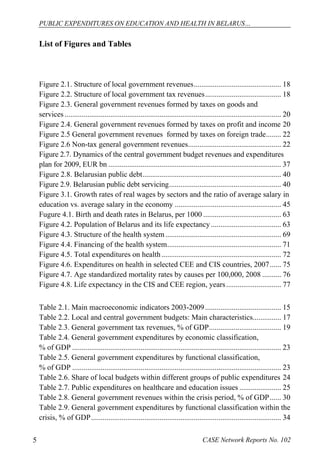
Figure 2.1. Structure of local government revenues.............................................. 18 
Figure 2.2. Structure of local government tax revenues........................................ 18 
Figure 2.3. General government revenues formed by taxes on goods and 
services .................................................................................................................. 20 
Figure 2.4. General government revenues formed by taxes on profit and income 20 
Figure 2.5 General government revenues formed by taxes on foreign trade........ 22 
Figure 2.6 Non-tax general government revenues................................................. 22 
Figure 2.7. Dynamics of the central government budget revenues and expenditures 
plan for 2009, EUR bn ........................................................................................... 37 
Figure 2.8. Belarusian public debt......................................................................... 40 
Figure 2.9. Belarusian public debt servicing........................................................... 40 
Figure 3.1. Growth rates of real wages by sectors and the ratio of average salary in 
education vs. average salary in the economy ........................................................ 45 
Fugure 4.1. Birth and death rates in Belarus, per 1000 ......................................... 63 
Figure 4.2. Population of Belarus and its life expectancy ..................................... 63 
Figure 4.3. Structure of the health system............................................................. 69 
Figure 4.4. Financing of the health system............................................................ 71 
Figure 4.5. Total expenditures on health ............................................................... 72 
Figure 4.6. Expenditures on health in selected CEE and CIS countries, 2007...... 75 
Figure 4.7. Age standardized mortality rates by causes per 100,000, 2008 .......... 76 
Figure 4.8. Life expectancy in the CIS and CEE region, years ............................. 77 
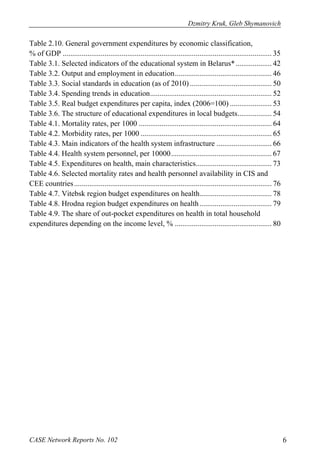
Table 2.1. Main macroeconomic indicators 2003-2009 ........................................ 15 
Table 2.2. Local and central government budgets: Main characteristics............... 17 
Table 2.3. General government tax revenues, % of GDP...................................... 19 
Table 2.4. General government expenditures by economic classification, 
% of GDP .............................................................................................................. 23 
Table 2.5. General government expenditures by functional classification, 
% of GDP .............................................................................................................. 23 
Table 2.6. Share of local budgets within different groups of public expenditures 24 
Table 2.7. Public expenditures on healthcare and education issues ...................... 25 
Table 2.8. General government revenues within the crisis period, % of GDP...... 30 
Table 2.9. General government expenditures by functional classification within the 
crisis, % of GDP .................................................................................................... 34 
5 CASE Network Reports No. 102
Dzmitry Kruk, Gleb Shymanovich 
Table 2.10. General government expenditures by economic classification, 
% of GDP .............................................................................................................. 35 
Table 3.1. Selected indicators of the educational system in Belarus* ................... 42 
Table 3.2. Output and employment in education................................................... 46 
Table 3.3. Social standards in education (as of 2010) ........................................... 50 
Table 3.4. Spending trends in education................................................................ 52 
Table 3.5. Real budget expenditures per capita, index (2006=100) ...................... 53 
Table 3.6. The structure of educational expenditures in local budgets.................. 54 
Table 4.1. Mortality rates, per 1000 ...................................................................... 64 
Table 4.2. Morbidity rates, per 1000 ..................................................................... 65 
Table 4.3. Main indicators of the health system infrastructure ............................. 66 
Table 4.4. Health system personnel, per 10000..................................................... 67 
Table 4.5. Expenditures on health, main characteristics........................................ 73 
Table 4.6. Selected mortality rates and health personnel availability in CIS and 
CEE countries ........................................................................................................ 76 
Table 4.7. Vitebsk region budget expenditures on health...................................... 78 
Table 4.8. Hrodna region budget expenditures on health ...................................... 79 
Table 4.9. The share of out-pocket expenditures on health in total household 
expenditures depending on the income level, % ................................................... 80 
CASE Network Reports No. 102 6
PUBLIC EXPENDITURES ON EDUCATION AND HEALTH IN BELARUS… 
Abbreviations 
Belstat Belarusian Statistical Committee 
bn billion 
BYR Belarusian rubles 
CEE Central and Eastern Europe 
CIS Commonwealth of Independent states 
CT Centralized testing 
EBRD European Bank for reconstruction and Development 
EUR Euro 
FDI Foreign direct investments 
GDP Gross domestic product 
GG General Government 
IMF International Monetary Fund 
IPM Institute for Privatization and Management 
ISCED International Standard Classification of Education 
m million 
NBB National Bank of Belarus 
OECD Organisation for Economic Cooperation and Development 
PAYG Pay-As-You-Go 
PIRLS Progress in International Reading Literacy Study 
PISA The Program for International Student Assessment 
PPP Purchasing power parity 
RIPO Republican Institute of Vocational Education 
SBA Stand-by arrangement 
SSF Social Security Fund 
thsd thousand 
TIMSS Trends in International Mathematics and Science Study 
TB Tuberculosis 
trln trillion 
UNESCO United Nations Educational, Scientific and Cultural Organization 
USD US dollars 
VAT Value added tax 
WHO World Health Organization 
yoy year on year 
7 CASE Network Reports No. 102
Dzmitry Kruk, Gleb Shymanovich 
The authors 
Dzmitry Kruk holds an MA degree in economics from the Belarusian State 
University (Minsk, Belarus). He has been involved in economic research since 
2003 when he began to work for the Scientific Economic Institute of the Ministry 
of Economy. Since June 2003 he has been an economist at the IPM Research Cen-ter 
and an author of many of its regular publications. Since 2004 has been teaching 
economics courses at the BSU. Since 2011 he has been a researcher in the Belaru-sian 
Economic Research and Outreach Center. His research interests include eco-nomic 
growth, monetary policy, financial systems, and the development of transi-tion 
economies. 
Gleb Shymanovich graduated from the Belarusian National Technical Univer-sity 
(Minsk, Belarus) with bachelor degree and Honours Diploma in Business 
Economics in 2006. In 2007 he received a Master’s degree in economics at BNTU. 
Since 2006 he has been an economist at the IPM Research Center and is the co-author 
of several regular publications, including the Belarusian Infrastructure 
Monitoring, the Belarusian Monthly Economic Review, the quarterly Belarusian 
Economic Outlook and several other publications of the IPM Research Center. His 
research interests include public finance, external debt, and social policy. 
CASE Network Reports No. 102 8
PUBLIC EXPENDITURES ON EDUCATION AND HEALTH IN BELARUS… 
Abstract 
The paper deals with the impact of the global financial crisis on public service 
delivery – mainly education and healthcare – in Belarus. The pre-crisis period of 
2003-2008 was the most prosperous in recent history. These trends resulted in a 
pretty good fiscal performance. Nevertheless, the share of expenditures on educa-tion 
and healthcare in GDP was decreasing during the 2000s, which was a conse-quence 
of demographic trends and a number of reforms in these sectors. The glob-al 
crisis hurt the Belarusian economy considerably. However, macro-indicators of 
the Belarusian economy looked pretty good in comparison to other countries, and 
the deterioration of public finance was limited. Thus, expenditures on both educa-tion 
and healthcare were mainly part of long-term trends and were able to avoid 
shock adjustments during the crisis. However, there are a number of medium and 
long-term threats to these public service sectors associated with the crisis agenda. 
This paper provides a number of policy recommendations to stave off these 
threats. 
9 CASE Network Reports No. 102
Dzmitry Kruk, Gleb Shymanovich 
Executive Summary 
This paper deals with the impact of the global financial crisis on public service 
delivery – mainly education and healthcare – in Belarus. The pre-crisis period of 
2003-2008 was the most prosperous in recent history, and Belarus succeeded in 
maintaining a fiscal surplus during nearly the entire period. This was also partly 
due to positive shocks in collecting budget revenues. In the mid-2000s, there was a 
positive shock in revenues from indirect taxes other than VAT. Furthermore, since 
2007, due to trade in oil products, taxes on foreign trade almost doubled. Thus, the 
government succeeded in ensuring a stable inflow of revenues, which seemed 
more than enough for financing the needed amount of expenditures. As a result, 
the prospects for public finance stability appeared safe. 
Despite a relatively good fiscal environment, the share of expenditures on edu-cation 
and healthcare in GDP was decreasing during the 2000s, which was a con-sequence 
of demographic trends and a number of reforms in these sectors. There 
were good reasons for revising the principles of financing these sectors, which 
experienced distortions inherited from the Soviet times, and the reduction of pub-lic 
expenditures on education and healthcare may be partially associated with the 
increasing efficiency of the related spending. 
In education, the government put most of its attention on general secondary ed-ucation, 
which was the main expenditure item in this sector. In the late 1990s, the 
government launched a thorough reform of secondary general education, which 
included a gradual shift to a twelve-year schooling cycle. Evidently, this reform 
meant the increase of corresponding expenditures both in absolute values and in 
per capita terms. However, the preliminary results of the reform were assessed in 
2008 by the authorities as unsatisfactory. The reform was rapidly reversed (in two 
years), which allowed the government to reduce its financing of this sub-sector. 
Moreover, in higher education and special secondary education, the government’s 
orientation towards more commercialized education was evident. 
Only pre-school and vocational education enjoyed some public expenditure 
growth. In pre-school institutions, the enrolment rate was not that high, while the 
demand for pre-school services was rather stable. Hence, the government had to 
provide additional financing for expanding pre-school facilities. Vocational educa-tion 
became one of the top priorities, as the lack of working specialties began to 
disturb the labor market in the 2000s. Per capita expenditures and expenditures in 
real terms were growing. However, it should be emphasized that the growth rates 
in financing these sub-sectors were considerably lower than real GDP growth 
rates. 
CASE Network Reports No. 102 10
PUBLIC EXPENDITURES ON EDUCATION AND HEALTH IN BELARUS… 
Despite this policy of expenditure rationing in education, there was some pro-gress 
in terms of the percentage of the population being educated and in a number 
of ‘input’ parameters. Nevertheless, some doubts remain about the increase in 
efficiency, as a number of qualitative indicators are absent or show ambiguous 
results. 
The same is true for the healthcare sector. As the starting point, the high num-ber 
of medical personnel and the excessive number of hospital beds inherited from 
the Soviet period should be emphasized. At the same time, the inherited system 
suffered from regional disparities between urban and rural areas in the quality of 
healthcare, which reduced the effectiveness of spending as well. As a result, the 
main reforms were directed at rural areas. First, the introduction of general medi-cal 
practice in rural areas should be mentioned. Second, excessive hospital beds in 
rural areas were transformed into long-term social-care facilities that were par-tially 
financed by the Social Security Fund. Another measure targeted at a more 
efficient allocation of resources between the regions was the introduction of capi-tation 
budgeting. Planning the financing of hospital services with upper expendi-ture 
limits based on the number of residents in the region and districts has been in 
place since 2001. However, the efficiency of spending in the sector as a whole and 
the adequacy of the budget financing to the sector’s needs are still questionable. 
Doubts with respect to the efficiency of healthcare expenditures arise when com-paring 
international life expectancy indicators. Despite higher expenditure in Bela-rus 
compared to Russia and Ukraine, the indicators of life expectancy are broadly 
the same. Furthermore, there is still a lack of physicians and nursing personnel in 
the primary sector, which indicates that the available human resources are used 
inefficiently. 
The global crisis hurt the Belarusian economy considerably. However, macro-indicators 
of the Belarusian economy looked pretty good in comparison to other 
countries, and the deterioration of public finance was limited. The government did 
not resort to considerable restrictions on several expenditure items on a functional 
criterion. Rather, in 2009, their strategy was to restrict capital expenditures and 
freeze wages for the majority of public services sectors, including education and 
health. Thus, expenditures on both education and healthcare were mainly part of 
long-term trends and the government was able to avoid shock adjustments during 
the crisis. However, there are a number of medium and long-term threats to these 
public service sectors associated with the crisis agenda. Namely, the problem of 
financing capital needs is becoming more vital to the branches. Taken in one row 
with the substantial gap in wages between education and healthcare on the one 
side, and average wages in the economy on the other side, this signals the neces-sity 
of additional financing for both sectors to increase their effectiveness. This 
paper provides a number of policy recommendations to stave off these threats. 
11 CASE Network Reports No. 102
Dzmitry Kruk, Gleb Shymanovich 
1. Introduction1 
The global crisis has become a serious challenge for transition economies. At 
first sight, Belarus is among the countries that overcame the crisis relatively suc-cessfully. 
For instance, there was no deep recession in Belarus, and, unlike its 
neighbors, it maintained its GDP growth, although it was very modest. Neverthe-less, 
the crisis revealed an accumulation of structural distortions in the economy, 
among which the fiscal sustainability challenge may be emphasized. Furthermore, 
in Belarus, the crisis-related shock overlapped with a number of other shocks as-sociated 
with oil-trading schemes. 
In this situation, the government had to adjust its expenditures to the changing 
environment. Education and healthcare traditionally make up a large share of total 
budget expenditures. Thus, cuts to these expenditures seem to highly probable in 
the case of a growing fiscal deficit. However, such measures may have negative 
consequences in the long-term perspective as the accumulation of human capital 
and productivity growth are closely linked with the effectiveness of education and 
healthcare. So breaking the vicious cycle of ‘poor growth – high fiscal deficit’ 
may become a problem for generations. 
The purpose of this study is to assess the link between the crisis and expendi-ture 
adjustments in education and healthcare. We are keeping in mind that cuts in 
financing in either of these sectors may cause long-term losses in productivity only 
if they cause the quality of the respective services to deteriorate. Hence, we assess 
changes in financing from the point of view of their impact on the effectiveness of 
education and healthcare. In other words, our task is not just to trace changes in 
the amount of finance provided to education and healthcare as a result of the crisis. 
We are also assessing the efficiency of financing using qualitative indicators of the 
respective sector. 
The structure of this study is as follows. In Section 2, we deal with overall 
trends in fiscal performance before and after the crisis hit Belarus. In this Section, 
we show some specific links and mechanisms in Belarusian public finance, which 
to a large extent, define the core of the adjustment mechanisms to shocks. Further, 
we focus on budget performance during the crisis and reveal the channels through 
which it affected public finance. Herewith, we also describe the government’s 
1 This paper has been prepared with the editorial assistance of Paulina Szyrmer 
CASE Network Reports No. 102 12
PUBLIC EXPENDITURES ON EDUCATION AND HEALTH IN BELARUS… 
reaction to the expenditure side of the budget during the crisis. Section 3 analyzes 
policy reforms and the revision of priorities in education sector. We search for 
indicators of the effectiveness of the Belarusian education system and through this 
outlook, we trace the changes in budget financing. In Section 4, we deal with 
healthcare, again considering the policy reforms in the sector, its spending trends, 
and outcomes on the quality of medical services provided for households. In Sec-tion 
5, the main findings and conclusions are summarized. 
Within this study we used a number of statistical data sets. For the analysis of 
budget performance we used data provided by the Belarusian Ministry of Finance 
and local governments. With regard to the educational sphere, we based our analy-sis 
on data provided by the Belarusian Statistical Committee (Belstat), the Belaru-sian 
Ministry of Education, and also by international organizations such as 
UNESCO, OECD, and the World Bank. In the analysis of healthcare, we mainly 
used data from Belstat, the Belarusian Ministry of Healthcare, and the World 
Health Organization. 
13 CASE Network Reports No. 102
Dzmitry Kruk, Gleb Shymanovich 
2. Fiscal situation 
2.1. Pre-crisis fiscal developments 
2.1.1. General economic environment 
The 2003-2008 period was the most successful period of economic develop-ment 
in Belarus. At the beginning of the period, Belarus had an important advan-tage 
due to a political deal with Russia – a low gas price and duty-free exports of 
Russian crude oil to Belarus – which gave it additional competitiveness for pro-moting 
its exports. During this period, the level of the natural gas price did not 
exceed 30% of its average level for other European countries. This, along with the 
agreements on oil supply, added an additional impulse to the economy. In the 
background of robust oil prices on world markets, the volumes of oil-refinery and, 
correspondingly, exports of oil products increased substantially. Furthermore, 
there was an indirect impact that included higher demand for the output from adja-cent 
branches of industry and subsidizing them through lower prices on inputs for 
them, providing stable foreign currency revenues and thus stabilizing the foreign-exchange 
market within the country, providing more revenue to the consolidated 
budget, which allowed for more public spending, boosting domestic demand 
through increased salaries, etc. Through this, the fuel industry became the main 
driver of growth in this period. We argue that the changes in the external environ-ment 
for the fuel industry may be interpreted as a positive productivity shock, 
which increased returns on investments and consumption and increased the growth 
of the potential GDP. 
A favorable external environment should be emphasized as the second impor-tant 
factor that determined rapid economic growth during these years. For Belarus 
it was mainly associated with demand from Russia as a vast majority of manufac-tured 
goods are exported to this country. Exploiting the positive effect from the oil 
price hikes, Russian economic agents increased their demand for foreign goods 
enormously. While Belarus had some privileges on the Russian market due to the 
Customs Union and some additional instruments (such as access to Russian public 
procurements, etc.), it benefited greatly from growing demand from Russia. This 
mostly affected Belarusian producers of capital goods, especially in machinery and 
adjacent industries. The producers of a range of foods (milk and diary products, 
CASE Network Reports No. 102 14
PUBLIC EXPENDITURES ON EDUCATION AND HEALTH IN BELARUS… 
meat and meat products) and consumer goods (refrigerators, TV-sets, etc.) also 
enjoyed growing demand from Russia. 
These factors provided for the macrostablization of the Belarusian economy, 
due to which a number of other factors also contributed to a rapid GDP growth 
rate. A stable export revenue allowed the monetary authorities to peg the exchange 
rate of the Belarusian ruble, using the US dollar as the anchor and thus providing 
stability on the money and capital markets and in the Belarusian financial system. 
Increased demand for the national currency and more trust in the national banking 
system led to decreasing financial dollarization, a deeper capital market, and lower 
inflation. In turn, stability in the monetary sphere and banking system facilitated a 
more effective allocation of resources in the economy, thus contributing to rapid 
economic growth. 
Table 2.1. Main macroeconomic indicators 2003-2009 
2003 2004 2005 2006 2007 2008 2009 
GDP growth rate, % yoy 7.0 11.4 9.4 10.0 8.6 10.2 0.2 
GDP, USD bn (current 
exchange rate) 17.8 23.1 30.2 37.0 45.3 60.8 49.2 
Fixed capital growth rate, 
% yoy 1,8 1.5 2.0 2.5 2.1 3.0 5.0 
Real money income of 
households growth rate, % 
3.9 9.8 18.4 17.8 13.2 11.8 2.7 
yoy 
Employment growth rate, 
% yoy -0.9 -0.5 0.8 1.3 1.1 2.0 0.7 
Labor productivity growth 
rate, % yoy 8.0 12.0 7.3 8.7 7.5 8.1 -0.5 
CPI inflation (annual aver-age), 
% 28.4 18.1 10.3 7.0 8.4 14.8 13.0 
Real exchange rate vs. US 
dollar growth rate, % yoy 9.3 9.5 7.1 4.1 5.2 11.1 -13.3 
Current account balance, % 
of GDP –2.4 –5.2 1.7 –4.1 -6.6 -8.6 -13.0 
Gross external debt, % of 
GDP 23.7 21.4 17.9 18.5 27.6 24.9 45.1 
Source: Belstat and own calculations based on the Belstat data. 
The first threat to the sustainability of this model of economic development ap-peared 
in 2007, when Russia began to increase prices for natural gas, thus reduc-ing 
the gap between the Belarusian price and the average European one. More-over, 
Russia insisted on sharing exports duties for oil-products exported from Bel-arus, 
arguing that a huge fraction of them should be transferred to the Russian 
15 CASE Network Reports No. 102
Dzmitry Kruk, Gleb Shymanovich 
budget, while crude oil was supplied on a duty-free basis. However, these chal-lenges 
did not lead to considerable reforms of the Belarusian economy, as further 
improvements in the external environment in 2007 and the first part of 2008 com-pensated 
for this negative effect. Before the impact of the crisis began hitting the 
Belarusian economy in the autumn of 2008, its economic indicators looked pretty 
good (see Table 2.1) and Belarus was among the leaders of growth rates in the 
CEE region. 
2.1.2. Public finance 
Volume and structure 
Belarus’s public finance sector is one of the most difficult to analyze as it is char-acterized 
by a budget structure that is constantly changing – introducing and eliminat-ing 
different funds and making changes in the tax legislation. According to the legis-lation, 
the annual general government (GG) budget, as well as the central government 
and local budgets are approved by the parliament after the President’s approval. This 
is usually done at the end of the previous year or at the beginning of the budgeted 
year. Tax legislation changes are also usually introduced within the budget approval 
procedure. However, there are regular changes in budget expenditure plans during the 
year, so they can meet actual revenues (that are difficult to plan properly due to infla-tion 
and regular external shocks), as well as changes in the tax system. 
Local budgets have three levels: primary level budgets (village, township, town 
level), basic level budgets (region and town level), and the oblast budget. The 
resource planning comes from above, thus each level of the local government has 
a portion of tax and non-tax revenues that is left at their disposal. However the 
majority of taxes are channeled to the upper levels of the budget. The exact share 
of the tax and non-tax revenue left in local budgets is set either in the budget co-dex 
or by the upper standing level of authorities. 
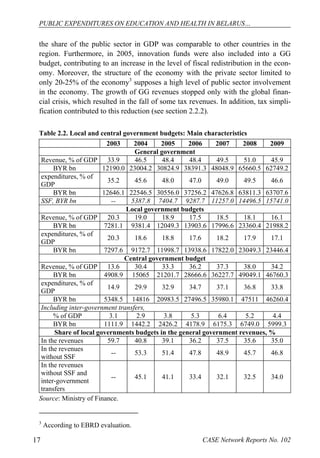
The dynamics of the local and central budgets are presented in Table 2.2. As 
one can see, GG revenues were marked by dynamic growth until the crisis hit the 
Belarusian economy. In 2008, revenues reached 51% of GDP, meaning that the 
public sector accumulated and then redistributed more then half of GDP. This is a 
very high figure but there are some explanations for it. First of all, the social secu-rity 
fund (SSF) was included in the central government budget (which is not done 
in many other countries). Until 2004 this fund was not part of the GG budget2 and 
2 SSF was once again excluded from the GG budget in 2010. 
CASE Network Reports No. 102 16
PUBLIC EXPENDITURES ON EDUCATION AND HEALTH IN BELARUS… 
the share of the public sector in GDP was comparable to other countries in the 
region. Furthermore, in 2005, innovation funds were also included into a GG 
budget, contributing to an increase in the level of fiscal redistribution in the econ-omy. 
Moreover, the structure of the economy with the private sector limited to 
only 20-25% of the economy3 supposes a high level of public sector involvement 
in the economy. The growth of GG revenues stopped only with the global finan-cial 
crisis, which resulted in the fall of some tax revenues. In addition, tax simpli-fication 
contributed to this reduction (see section 2.2.2). 
Table 2.2. Local and central government budgets: Main characteristics 
2003 2004 2005 2006 2007 2008 2009 
General government 
Revenue, % of GDP 33.9 46.5 48.4 48.4 49.5 51.0 45.9 
BYR bn 12190.0 23004.2 30824.9 38391.3 48048.9 65660.5 62749.2 
expenditures, % of 
GDP 35.2 45.6 48.0 47.0 49.0 49.5 46.6 
BYR bn 12646.1 22546.5 30556.0 37256.2 47626.8 63811.3 63707.6 
SSF, BYR bn -- 5387.8 7404.7 9287.7 11257.0 14496.5 15741.0 
Local government budgets 
Revenue, % of GDP 20.3 19.0 18.9 17.5 18.5 18.1 16.1 
BYR bn 7281.1 9381.4 12049.3 13903.6 17996.6 23360.4 21988.2 
expenditures, % of 
GDP 20.3 18.6 18.8 17.6 18.2 17.9 17.1 
BYR bn 7297.6 9172.7 11998.7 13938.6 17822.0 23049.3 23446.4 
Central government budget 
Revenue, % of GDP 13.6 30.4 33.3 36.2 37.3 38.0 34.2 
BYR bn 4908.9 15065 21201.7 28666.6 36227.7 49049.1 46760.3 
expenditures, % of 
GDP 14.9 29.9 32.9 34.7 37.1 36.8 33.8 
BYR bn 5348.5 14816 20983.5 27496.5 35980.1 47511 46260.4 
Including inter-government transfers, 
% of GDP 3.1 2.9 3.8 5.3 6.4 5.2 4.4 
BYR bn 1111.9 1442.2 2426.2 4178.9 6175.3 6749.0 5999.3 
Share of local governments budgets in the general government revenues, % 
In the revenues 59.7 40.8 39.1 36.2 37.5 35.6 35.0 
In the revenues 
without SSF -- 53.3 51.4 47.8 48.9 45.7 46.8 
In the revenues 
without SSF and 
inter-government 
-- 45.1 41.1 33.4 32.1 32.5 34.0 
transfers 
Source: Ministry of Finance. 
3 According to EBRD evaluation. 
17 CASE Network Reports No. 102
Dzmitry Kruk, Gleb Shymanovich 
At the same time the revenues of local budgets suffered a reduction instead of 
growth (see Table 2.2). This resulted in the fall of the share of local budgets in the 
GG revenues. Local budgets lost 6.5% of their contribution to public sector reve-nues 
if the SSF is deducted from GG revenues, and 11.1% if inter-government 
transfers from the central budget to local bufgets are deducted. Inter-government 
transfers constitute more than a quarter of all local government revenues, indicat-ing 
a large scale of centralization of public finance (see Figure 2.1). Among tax 
revenues, taxes on profit and income play the most important role for local budg-ets 
(see Figure 2.2). The share of this tax group that is assigned to the local budg-ets 
is rather constant and close to 70%. Within this group, revenues from personal 
income tax and some minor special levies set by local governments are left under 
the control of the latter. Taxes on profits and income are divided in favor of the 
central government. Revenues from taxes on goods and services are also vital for 
local budgets. They are also divided between central and local government budg-ets, 
but in contrast to the profit and income taxes, these come mostly under the 
control of the central government, as only 25% of these revenues are assigned to 
local budgets (mostly VAT and some special local taxes). Taxes on property fall 
fully at the disposal of local governments. 
Figure 2.1. Structure of local government 
revenues 
Figure 2.2. Structure of local government 
tax revenues 
100% 
80% 
60% 
40% 
20% 
0% 
2004 
2008 
2006 
2007 
2005 
2009 
Inter-government transfers 
Non-tax revenues 
Tax revenues 
Source: Ministry of Finance. 
100% 
80% 
60% 
40% 
20% 
0% 
2004 
2005 
2006 
2007 
2008 
2009 
Other taxes 
Taxes on goods and services 
Taxes on property 
Taxes on profit and income 
Source: Ministry of Finance. 
Public sector revenues 
General government revenues are formed by tax and non-tax revenues, as well as 
by contributions to the SSF (in 2004–2009). Tax revenues compose a large part of 
the GG revenues. They include revenues from taxes on profit and income, taxes on 
goods and services, taxes on property, taxes on foreign trade and other taxes and 
CASE Network Reports No. 102 18
PUBLIC EXPENDITURES ON EDUCATION AND HEALTH IN BELARUS… 
duties. Their performance for the pre-crisis 2002–2008 period is presented in Table 
2.3. The first part of this period (2002–2005) is characterized by the structural and 
volumetric stability of tax revenues, while the second (2006–2008) is prominent for 
regular changes in the structure and growing total tax revenues. These trends can be 
traced via a more careful analysis of the GG tax revenues structure. 
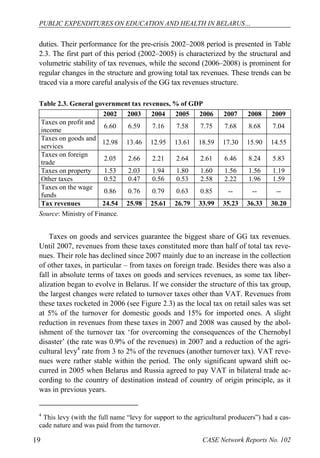
Table 2.3. General government tax revenues, % of GDP 
2002 2003 2004 2005 2006 2007 2008 2009 
Taxes on profit and 
income 6.60 6.59 7.16 7.58 7.75 7.68 8.68 7.04 
Taxes on goods and 
services 12.98 13.46 12.95 13.61 18.59 17.30 15.90 14.55 
Taxes on foreign 
trade 2.05 2.66 2.21 2.64 2.61 6.46 8.24 5.83 
Taxes on property 1.53 2.03 1.94 1.80 1.60 1.56 1.56 1.19 
Other taxes 0.52 0.47 0.56 0.53 2.58 2.22 1.96 1.59 
Taxes on the wage 
funds 0.86 0.76 0.79 0.63 0.85 -- -- -- 
Tax revenues 24.54 25.98 25.61 26.79 33.99 35.23 36.33 30.20 
Source: Ministry of Finance. 
Taxes on goods and services guarantee the biggest share of GG tax revenues. 
Until 2007, revenues from these taxes constituted more than half of total tax reve-nues. 
Their role has declined since 2007 mainly due to an increase in the collection 
of other taxes, in particular – from taxes on foreign trade. Besides there was also a 
fall in absolute terms of taxes on goods and services revenues, as some tax liber-alization 
began to evolve in Belarus. If we consider the structure of this tax group, 
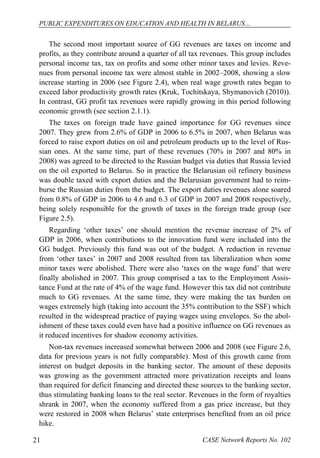
the largest changes were related to turnover taxes other than VAT. Revenues from 
these taxes rocketed in 2006 (see Figure 2.3) as the local tax on retail sales was set 
at 5% of the turnover for domestic goods and 15% for imported ones. A slight 
reduction in revenues from these taxes in 2007 and 2008 was caused by the abol-ishment 
of the turnover tax ‘for overcoming the consequences of the Chernobyl 
disaster’ (the rate was 0.9% of the revenues) in 2007 and a reduction of the agri-cultural 
levy4 rate from 3 to 2% of the revenues (another turnover tax). VAT reve-nues 
were rather stable within the period. The only significant upward shift oc-curred 
in 2005 when Belarus and Russia agreed to pay VAT in bilateral trade ac-cording 
to the country of destination instead of country of origin principle, as it 
was in previous years. 
4 This levy (with the full name “levy for support to the agricultural producers”) had a cas-cade 
nature and was paid from the turnover. 
19 CASE Network Reports No. 102
Dzmitry Kruk, Gleb Shymanovich 
Some of the increase in GG excise revenues in 2006–2008 can be explained by 
high oil prices5. They allowed Belarusian refinery plants to generate huge profits 
from exports and subsidized domestic sales, which were loss-making due to high 
excise rates and retail petroleum price regulation by the state. 
Figure 2.3. General government revenues formed by taxes on goods and services 
3.57 3.13 3.03 
2.66 
% of GDP 
4.57 2.32 2.33 2.27 4.13 3.17 2.18 
0.58 1.43 1.36 
2.15 
1.12 
8.48 8.06 7.71 9.26 9.30 8.92 8.85 8.83 
20.0 
17.5 
15.0 
12.5 
10.0 
7.5 
5.0 
2.5 
0.0 
2002 2003 2004 2005 2006 2007 2008 2009 
VAT turnover taxes (other than VAT) excise ecological tax other 
Source: Ministry of Finance. 
Figure 2.4. General government revenues formed by taxes on profit and income 
% of GDP 
2.52 2.60 3.29 3.72 3.96 3.95 4.65 
3.37 
3.03 2.85 2.84 2.96 3.13 3.17 3.25 3.15 
0 1 2 3 4 5 6 7 8 9 
2002 2003 2004 2005 2006 2007 2008 2009 
personal income tax profit tax taxes on income other levies 
Source: Ministry of Finance. 
5 Oil refinery was regulated in such a way that the export of petroleum products was profit-able 
and domestic sales were loss-making due to regulated prices and high excises. The 
growth in export revenues meant more room for cross-subsidization between exports and 
domestic sales, and the government tended to increase excise rates while prices were kept 
stable. 
CASE Network Reports No. 102 20
PUBLIC EXPENDITURES ON EDUCATION AND HEALTH IN BELARUS… 
The second most important source of GG revenues are taxes on income and 
profits, as they contribute around a quarter of all tax revenues. This group includes 
personal income tax, tax on profits and some other minor taxes and levies. Reve-nues 
from personal income tax were almost stable in 2002–2008, showing a slow 
increase starting in 2006 (see Figure 2.4), when real wage growth rates began to 
exceed labor productivity growth rates (Kruk, Tochitskaya, Shymanovich (2010)). 
In contrast, GG profit tax revenues were rapidly growing in this period following 
economic growth (see section 2.1.1). 
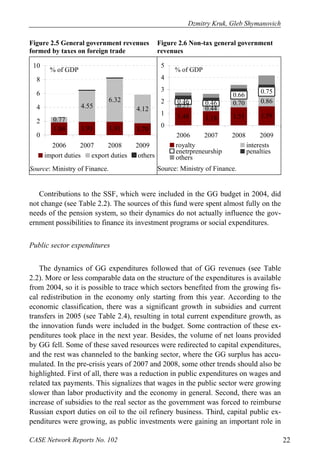
The taxes on foreign trade have gained importance for GG revenues since 
2007. They grew from 2.6% of GDP in 2006 to 6.5% in 2007, when Belarus was 
forced to raise export duties on oil and petroleum products up to the level of Rus-sian 
ones. At the same time, part of these revenues (70% in 2007 and 80% in 
2008) was agreed to be directed to the Russian budget via duties that Russia levied 
on the oil exported to Belarus. So in practice the Belarusian oil refinery business 
was double taxed with export duties and the Belarusian government had to reim-burse 
the Russian duties from the budget. The export duties revenues alone soared 
from 0.8% of GDP in 2006 to 4.6 and 6.3 of GDP in 2007 and 2008 respectively, 
being solely responsible for the growth of taxes in the foreign trade group (see 
Figure 2.5). 
Regarding ‘other taxes’ one should mention the revenue increase of 2% of 
GDP in 2006, when contributions to the innovation fund were included into the 
GG budget. Previously this fund was out of the budget. A reduction in revenue 
from ‘other taxes’ in 2007 and 2008 resulted from tax liberalization when some 
minor taxes were abolished. There were also ‘taxes on the wage fund’ that were 
finally abolished in 2007. This group comprised a tax to the Employment Assis-tance 
Fund at the rate of 4% of the wage fund. However this tax did not contribute 
much to GG revenues. At the same time, they were making the tax burden on 
wages extremely high (taking into account the 35% contribution to the SSF) which 
resulted in the widespread practice of paying wages using envelopes. So the abol-ishment 
of these taxes could even have had a positive influence on GG revenues as 
it reduced incentives for shadow economy activities. 
Non-tax revenues increased somewhat between 2006 and 2008 (see Figure 2.6, 
data for previous years is not fully comparable). Most of this growth came from 
interest on budget deposits in the banking sector. The amount of these deposits 
was growing as the government attracted more privatization receipts and loans 
than required for deficit financing and directed these sources to the banking sector, 
thus stimulating banking loans to the real sector. Revenues in the form of royalties 
shrank in 2007, when the economy suffered from a gas price increase, but they 
were restored in 2008 when Belarus’ state enterprises benefited from an oil price 
hike. 
21 CASE Network Reports No. 102
Dzmitry Kruk, Gleb Shymanovich 
Figure 2.5 General government revenues 
formed by taxes on foreign trade 
Figure 2.6 Non-tax general government 
revenues 
% of GDP 
0.77 
4.55 
6.32 
4.12 
1.84 1.91 1.91 1.70 
10 
8 
6 
4 
2 
0 
2006 2007 2008 2009 
import duties export duties others 
Source: Ministry of Finance. 
0.66 0.75 
% of GDP 
0.46 0.46 0.70 0.86 
0.27 0.44 
1.48 1.18 1.51 1.59 
5 
4 
3 
2 
1 
0 
2006 2007 2008 2009 
royalty interests 
enetrpreneurship penalties 
others 
Source: Ministry of Finance. 
Contributions to the SSF, which were included in the GG budget in 2004, did 
not change (see Table 2.2). The sources of this fund were spent almost fully on the 
needs of the pension system, so their dynamics do not actually influence the gov-ernment 
possibilities to finance its investment programs or social expenditures. 
Public sector expenditures 
The dynamics of GG expenditures followed that of GG revenues (see Table 
2.2). More or less comparable data on the structure of the expenditures is available 
from 2004, so it is possible to trace which sectors benefited from the growing fis-cal 
redistribution in the economy only starting from this year. According to the 
economic classification, there was a significant growth in subsidies and current 
transfers in 2005 (see Table 2.4), resulting in total current expenditure growth, as 
the innovation funds were included in the budget. Some contraction of these ex-penditures 
took place in the next year. Besides, the volume of net loans provided 
by GG fell. Some of these saved resources were redirected to capital expenditures, 
and the rest was channeled to the banking sector, where the GG surplus has accu-mulated. 
In the pre-crisis years of 2007 and 2008, some other trends should also be 
highlighted. First of all, there was a reduction in public expenditures on wages and 
related tax payments. This signalizes that wages in the public sector were growing 
slower than labor productivity and the economy in general. Second, there was an 
increase of subsidies to the real sector as the government was forced to reimburse 
Russian export duties on oil to the oil refinery business. Third, capital public ex-penditures 
were growing, as public investments were gaining an important role in 
CASE Network Reports No. 102 22
PUBLIC EXPENDITURES ON EDUCATION AND HEALTH IN BELARUS… 
economic growth acceleration. Fourth, high economic growth rates in 2008 were 
sustained by direct public support to the banking sector, as the government recapi-talized 
state-owned banks by BYR 3 trn (EUR 1 bn), which resulted in the related 
growth in GG expenditures. 
Table 2.4. General government expenditures by economic classification, % of GDP 
2004 2005 2006 2007 2008 2009 
Total 45.6 48.0 47.0 49.0 49.5 46.6 
Current expenditures 36.8 38.6 37.2 38.5 37.4 34.8 
Wages 7.8 8.3 8.2 7.7 6.7 6.8 
Social contributions 2.2 2.3 2.3 2.1 1.8 1.8 
Interest payments 0.5 0.4 0.4 0.4 0.6 0.8 
Subsidies and current 
transfers 18.2 19.8 19.1 20.9 21.4 19.0 
Other current expendi-tures 
8.1 7.8 7.2 7.3 6.9 6.5 
Capital expenditures 8.3 8.5 9.6 9.9 10.1 8.2 
Net loans provided 0.5 0.9 0.3 0.6 2.0 3.6 
Source: Ministry of Finance. 
Table 2.5. General government expenditures by functional classification, % of GDP 
2004 2005 2006 2007 2008 2009 
Total 45.6 48.0 47.0 49.0 49.5 46.6 
General public expenditures 5.1 6.3 6.2 6.7 8.3 5.9 
Defense issues 1.0 1.1 1.3 1.2 1.1 1.0 
Law enforcement issues 2.0 2.2 2.2 2.1 1.8 1.8 
National economy 9.1 9.4 9.6 11.5 12.8 12.0 
Environmental issues 0.6 0.6 0.6 0.6 0.4 0.3 
Household utilities 2.8 2.6 2.1 2.2 2.4 2.2 
Healthcare 4.6 4.7 4.5 4.5 3.9 3.9 
Sports, culture, mass media 1.1 1.1 1.2 1.2 1.1 1.0 
Education 6.0 6.3 6.0 5.7 5.2 4.9 
Social policy (incl. social 
security) 13.2 13.7 13.4 13.4 12.6 13.6 
Source: Ministry of Finance. 
According to the functional classification, in 2004–2008 there was an increase 
in the share of GDP of general public expenditures and expenditures on the na-tional 
economy (see Table 2.5). General public expenditures were growing due to 
the public investment program which is included in this expenditure category. The 
national economy expenditures increase was a result of the introduction of subsi-dies 
to oil refineries. At the same time, since 2006, there was a decline in the 
shares of social expenditures of education and healthcare. A particularly signifi- 
23 CASE Network Reports No. 102
Dzmitry Kruk, Gleb Shymanovich 
cant reduction of the share of social expenditures in GDP took place in 2008 when 
Belarus first faced the consequences of the global financial crisis. 
Local budget expenditures focus on the social policy sector. Most of the public 
expenditures on healthcare, education, culture, as well as housing and utilities, are 
covered by local government budgets. The shares of local budgets in financing these 
expenditures are stable across time (see Table 2.6). There were changes in the vol-ume 
of expenditures on less vital issues for the local budgets, such as ecological 
issues, national economy and general public expenditures. Expenditures on ecologi-cal 
issues started to be partly covered by local government budgets only in 2008, 
and their share is growing. However, this does not influence the general distribution 
of expenditures, as the total amount of these expenditures is rather negligible. One of 
the most important lines of expenditures within the “general public expenditures” is 
the state investment program. In 2009 the local budgets financed 63.4% of the pro-gram. 
Other general public expenditures fall largely under the responsibility of the 
central government. So increased general public expenditures by local government 
budgets in 2009 was actually a result of the changes in the volume of the investment 
program and the structure of its financing. Local government expenditures on the 
national economy fluctuated due to changes in public support for agriculture. Fi-nancing 
of agriculture increased in 2009 from 3.5% of GDP to 4.0%. A major part 
of this growth (0.3 percentage points) occurred at the expense of the local budgets6. 
Table 2.6. Share of local budgets within different groups of public expenditures 
2006 2007 2008 2009 
General public expenditures* 52.0 58.2 50.9 64.8 
Defense 1.5 1.4 1.4 1.4 
Law enforcement 14.8 15.0 15.4 14.9 
National economy 21.5 18.9 13.9 17.6 
Ecological issues 0.0 0.0 10.2 25.3 
Housing and utilities 99.5 99.6 99.3 99.2 
Healthcare 78.0 78.3 79.8 78.3 
Culture, sport, mass media 60.1 62.8 65.4 63.1 
Education 79.4 80.5 81.0 81.2 
Social policy 7.4 7.8 8.2 7.7 
Total expenditures 37.4 37.3 36.1 36.8 
Note.* Transfers from the central government budget to local budgets were excluded. 
Source: Ministry of Finance. 
6 This can partly be explained by the government’s policy in 2010. It had to run a non-deficit 
central government budget (according to the SBA program with the IMF), so a part of the 
expenditures on agriculture might have been shifted to the local government budgets. 
CASE Network Reports No. 102 24
PUBLIC EXPENDITURES ON EDUCATION AND HEALTH IN BELARUS… 
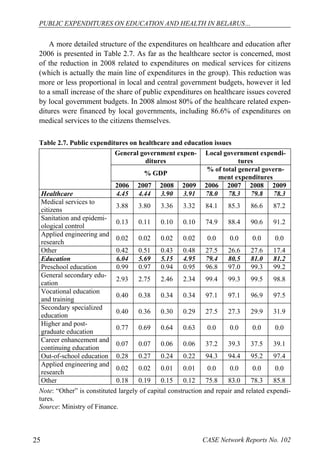
A more detailed structure of the expenditures on healthcare and education after 
2006 is presented in Table 2.7. As far as the healthcare sector is concerned, most 
of the reduction in 2008 related to expenditures on medical services for citizens 
(which is actually the main line of expenditures in the group). This reduction was 
more or less proportional in local and central government budgets, however it led 
to a small increase of the share of public expenditures on healthcare issues covered 
by local government budgets. In 2008 almost 80% of the healthcare related expen-ditures 
were financed by local governments, including 86.6% of expenditures on 
medical services to the citizens themselves. 
Table 2.7. Public expenditures on healthcare and education issues 
General government expen-ditures 
Local government expendi-tures 
% GDP % of total general govern-ment 
expenditures 
2006 2007 2008 2009 2006 2007 2008 2009 
Healthcare 4.45 4.44 3.90 3.91 78.0 78.3 79.8 78.3 
Medical services to 
citizens 3.88 3.80 3.36 3.32 84.1 85.3 86.6 87.2 
Sanitation and epidemi-ological 
control 0.13 0.11 0.10 0.10 74.9 88.4 90.6 91.2 
Applied engineering and 
research 0.02 0.02 0.02 0.02 0.0 0.0 0.0 0.0 
Other 0.42 0.51 0.43 0.48 27.5 26.6 27.6 17.4 
Education 6.04 5.69 5.15 4.95 79.4 80.5 81.0 81.2 
Preschool education 0.99 0.97 0.94 0.95 96.8 97.0 99.3 99.2 
General secondary edu-cation 
2.93 2.75 2.46 2.34 99.4 99.3 99.5 98.8 
Vocational education 
and training 0.40 0.38 0.34 0.34 97.1 97.1 96.9 97.5 
Secondary specialized 
education 0.40 0.36 0.30 0.29 27.5 27.3 29.9 31.9 
Higher and post-graduate 
education 0.77 0.69 0.64 0.63 0.0 0.0 0.0 0.0 
Career enhancement and 
continuing education 0.07 0.07 0.06 0.06 37.2 39.3 37.5 39.1 
Out-of-school education 0.28 0.27 0.24 0.22 94.3 94.4 95.2 97.4 
Applied engineering and 
research 0.02 0.02 0.01 0.01 0.0 0.0 0.0 0.0 
Other 0.18 0.19 0.15 0.12 75.8 83.0 78.3 85.8 
Note: “Other” is constituted largely of capital construction and repair and related expendi-tures. 
Source: Ministry of Finance. 
25 CASE Network Reports No. 102
Dzmitry Kruk, Gleb Shymanovich 
Expenditures on education are also largely (by more than 80%) financed from 
the local government budgets. The central government covers costs related only to 
higher education (100%), career enhancement and continuing education (62%), 
and secondary specialized education (70%). Education at schools and kindergar-tens 
is financed from local budgets. The relative fall in expenditures on education 
in 2006–2008 related to all lines of funding, so the proportion between central and 
local government budgets did not change. However, the largest relative fall oc-curred 
within general secondary education, which was caused primarily by demo-graphic 
factors (see Section 3). 
The GG budget recorded a small surplus in 2004–2008. It reached its maxi-mum 
of 1.4% of GDP in 2008, as the Belarusian government was accumulating 
sources for anti-crisis policies at the end of the year. For this, it cut expenditures 
on the national economy (a reduction of 2.2% of GDP yoy in the fourth quarter of 
2008) and in December 2008, it recalled a decision on a wage increase of 24.7%, 
restricting the growth of the wage rate by 5.5%. 
2.2. Fiscal performance during the crisis 
2.2.1. Macroeconomic developments during the crisis 
Due to the high degree of openness of the Belarusian economy, foreign trade 
became the chief channel of transmission of the global financial and economic 
crisis into the country. The most significant decrease of both export and import 
volumes was noted in trade with Russia. In the 4th quarter of 2008, exports to 
Russia dropped by 21.2% yoy, while imports decreased by 20.3% yoy. In trade 
with non-CIS countries in the 4th quarter of 2008, exports decreased by 
10.3% yoy, while imports increased by 32.4% yoy. Overall, the decrease in ex-ports 
amounted to 14.7% yoy, while that of imports was only 1.8% yoy. Since 
then, a sharp fall in external demand alongside weak adjustments of imports be-came 
a distinctive characteristic of Belarus during the crisis, which was a conse-quence 
of the measures taken by the government to prevent a fall in output. 
To mitigate the situation in foreign trade with CIS countries, particularly Rus-sia, 
the government permitted exporters, on a provisional basis, to sell their prod-ucts 
at prices lower than production costs, which was previously prohibited by 
price regulations (Kruk, Tochitskaya, Shymanovich (2010)). Furthermore, the 
authorities used a one-shot 20% devaluation of the national currency as of January 
1st, 2009, considering it an important measure directed at stimulating exporters and 
CASE Network Reports No. 102 26
PUBLIC EXPENDITURES ON EDUCATION AND HEALTH IN BELARUS… 
restricting consumer imports. However, this measure did not affect external de-mand 
very much and Belarusian exports proceeded to fall in 2009, while the con-traction 
of imports was much more modest. Hence, in the 1st half of 2009, Belarus 
faced an enormous deficit in the current account, which amounted to 18.9% of 
GDP (5.5% of GDP in the 1st half of 2008). Later on, in the 2nd half of 2009, ex-ternal 
demand began to show signs of recovery, though this recovery was very 
weak. On the other hand, the government weakened its stimulation of domestic 
demand, which restricted imports a bit. Finally, in 2009, the current account deficit 
amounted to 13.0% of GDP, which was mainly financed by increased public ex-ternal 
debt (loans from the IMF, World Bank, loans from other countries, etc). 
Despite a decrease in external demand in the 2nd half of 2008, Belarusian au-thorities 
made an attempt to maintain high growth rates. In the opinion of the gov-ernment, 
stimulating domestic demand was the most acceptable way to attain that 
objective. The government justified this policy by the alleged absence of financial 
sector distortions, which were typical for the other countries in the region. Accord-ingly, 
the government believed that there were no fundamental reasons for a reces-sion 
in the national economy, and that it was feasible and expedient to substitute 
external demand with domestic demand. 
In 2009, economic policy measures led to an increase of virtually all compo-nents 
of domestic demand. The highest growth rate and the largest contribution to 
real GDP growth were secured by capital investments. This domestic demand 
component is usually highly sensitive to external environmental factors and quite 
volatile. In Belarus, however, capital investments display antithetic properties: 
sustainability in an unfavorable external environment and inertia. This is almost 
entirely attributable to the measures implemented by the government. The eco-nomic 
authorities believed that economic activity would help them to stimulate a 
number of sectors in the domestic economy, primarily construction. So, it was 
expected that the sectors producing investment goods and services would become 
a new source of growth of the national economy and somehow galvanize the other 
sectors. 
For stimulating capital investments, a number of instruments were used, the 
majority of which were associated with credit incentives by the National Bank of 
the Republic of Belarus (NBRB). They took the form of an extensive supply of 
credit resources by the banking system, which in turn were supported by extra-refinancing 
by the NBRB. It was this source of funding that underpinned almost 
all growth of capital investments recorded in 2009. In its turn, fiscal stimuli were 
almost not used for the stimulation of investments (except those assuming partial 
compensation of the interest rates to banks that granted loans on a concessional 
basis). This kind of domestic demand stimulation may be, in a sense, interpreted as 
a quasi-fiscal activity, which pushed additional demand for imports. To neutralize 
27 CASE Network Reports No. 102
Dzmitry Kruk, Gleb Shymanovich 
the rapidly growing external imbalances, the government resorted to external bor-rowings, 
which resulted in a massive accumulation of external debt. 
It was assumed that the stimulation of capital investments during the crisis 
would facilitate the rapid technological renovation of the national economy and 
increase the level of competitiveness of Belarusian enterprises. Based on that as-sumption, 
the government believed that the deteriorating financial conditions of 
enterprises, the lack of working capital, and the emergence of additional demand 
for imported goods were only temporary problems. 
However, from the short-term view, the policy of investment demand stimula-tion 
and setting targets on output hit the firms of the real sector. Many of them had 
to maintain their volumes of production close to the previous year’s level, which 
was not supported by a corresponding demand. Hence, a large portion of the pro-duced 
goods were frozen as finished products inventories. The amount of such 
inventories fluctuated around 90% of the average monthly output through 2009. In 
other words, a huge part of their working capital was actually moved out of their 
economic activity. These adverse trends undermined the financial stability of the 
enterprises, and their profitability was lowering throughout 2009 (the average 
profitability of sold products dropped from 14.0% in 2008 down to 10.3 in 2009, 
while the profitability of sales dropped from 7.9% down to 6.1% correspondingly). 
Besides, in addition to output targets, individual enterprises received wag-es/ 
salaries directives. To comply with those directives, many enterprises had to 
reduce their own competitiveness. On the macroeconomic level this phenomenon 
manifested itself in a massive increase of unit labor costs during the crisis. Thus, 
the public finance situation was deteriorating and new challenges appeared. 
On the macro level, such a policy mix resulted in avoiding a recession in 2009 
(a growth of real GDP by 0.2% yoy was recorded), which became one of the best 
indicators on GDP growth in the CEE region in 2009. However, Belarus had to 
pay a price for these dynamics through the accumulation of longer-term distortions 
in its economy: risk exposure and non-performing loans in the banking sector re-corded 
substantial growth, external debt accumulation rapidly increased, and the 
current account deficit became more painful and persistent. Also, it should be em-phasized 
that in the second half of 2009, the stimulation of economic activity was 
weakened in order to mitigate the accumulation of structural distortions. 
A series of additional shocks hit the Belarusian economy at the beginning of 
2010. Russia’s attempt to revise the terms and conditions of an oil trade with Bela-rus 
became the most crucial one. The new conditions of the oil trade had a nega-tive 
impact on the trade balance, the profitability of the fuel and adjacent branches, 
and the consolidated budget. Trying to mitigate the impact of the shock on trade 
conditions and enterprises, the government began to conceptually revise the logis- 
CASE Network Reports No. 102 28
PUBLIC EXPENDITURES ON EDUCATION AND HEALTH IN BELARUS… 
tics scheme of oil-refinery. For instance, they decided to restrict imports of crude 
oil from Russia; in 2010 it was reduced by about 40%. The plan was to import the 
crude oil needed for ensuring the oil-refineries worked at full capacity from other 
countries, videlicet Venezuela and Azerbaijan. In 2010, the authorities succeeded 
in providing a portion of the needed amount of crude oil from Venezuela, and 
awarded Venezuela with a contract for the supply of about half of the necessary 
volume of crude oil for Belarusian oil-refineries for 2011-2013. 
The oil shock and sharp decrease in the imports of crude oil in the 1st quarter of 
2010 (while oil-refineries continued processing the accumulated stock of crude oil), 
along with a slight improvement in exports led to a considerable improvement in net 
exports. Hence, it became the main contributor to GDP growth, which amounted to 
4.0% yoy in this period. However, as of the 2nd quarter of 2010, the government 
tasked non-financial firms with providing high growth rates in 2010 (11-13% yoy) 
and a boost in average wages (the indicator of USD 500 by the end of 2010 was 
targeted while in 2009 the average wage amounted to USD 385), which continued 
‘heating’ the economy. While striving for sharp growth in real wages, the govern-ment 
actually considered household consumption the main growth factor. The 
scheme of economic functioning was similar to that of the first half of 2009. How-ever, 
unlike in 2009, there was a certain recovery in external demand in 2010, which 
widened the possibilities of expansionary economic policy. 
2.2.2. Developments in revenue and expenditure flows 
The global economic crisis significantly affected public finances in CEE and 
CIS countries. Most of the impact came through the increase in expenditures due 
to the automatic stabilizers, state interventions into the economy intended to sup-port 
the banking and real sectors, and the reduction in budget revenues as a result 
of declining economic activity. The last channel was the most influential in the 
case of Belarus. The economic stimuli packages to the real sector (agriculture and 
construction) also played some role but the scale of these subsidies was minimized 
by the IMF Stand-by agreement which included a non-deficit central budget re-quirement. 
Automatic stabilizers did not influence the public finance sector, as 
they are almost absent in Belarus. The unemployment benefits amount to only 17- 
18% of the subsistence minimum and the official unemployment rate is below 1%, 
even after the crisis. 
The global economic crisis hit the real sector in the third quarter of 2008. 
Hence, the first signs of the crisis in the public finance sector could be observed in 
the fourth quarter. Actually there was still growth in the GG revenues on a year on 
year basis, but it was slowing. The first taxes reflecting the crisis’ influence on 
29 CASE Network Reports No. 102
Dzmitry Kruk, Gleb Shymanovich 
public finances were the VAT and profit tax. VAT revenue fell by 1.2% of GDP 
yoy in the fourth quarter of 2008 (from 9.4% of GDP in the fourth quarter of 2007 
to 8.2% in 2008). A reduction of the profit tax revenues was just 0.1% of GDP 
(from 4.2% of GDP in the fourth quarter of 2007 to 4.1% in 2008), but in the third 
quarter of 2008 there was still an increase in tax revenues of 1.5% of GDP yoy 
(5.2% vs 3.7). This shows the scale of the slowdown, which began at the end of 
2008. However, it was just the first sign of the crisis, as its true scale was revealed 
only in 2009. 
In 2009, the GG revenue was reduced by 5.1% of GDP yoy down to 45.9% of 
GDP (see Table 2.8), which is actually a result of both the crisis and the tax sys-tem 
simplification. The fall occurred due to the drop in tax revenues, as non-tax 
revenues and social contributions grew in 2009 by 0.8 and 0.3% of GDP respec-tively. 
So the tax revenues shrunk by 6.1% of GDP yoy, and most of this fall took 
place in the first half of the year: The reduction was 7.7 and 7.5% of GDP yoy in 
the first and the second quarters, while in the fourth quarter it was only 3.5% yoy. 
The crisis affected all kinds of tax revenues, but taxes on foreign trade, income 
and profit, and goods and services were the most affected by the crisis. 
Table 2.8. General government revenues within the crisis period, % of GDP 
2008 2009 2008 2009 2010 1Q 2Q 3Q 4Q 1Q 2Q 3Q 4Q 1Q 2Q 
Revenues 51.0 45.9 54.2 53.4 47.3 50.4 47.7 46.2 41.6 48.8 32.3 31.0 
Tax revenues 36.3 30.2 39.4 37.3 33.8 36.0 31.7 29.8 27.3 32.5 29.9 28.1 
Taxes on profit and 
income 8.7 7.0 8.6 8.9 8.6 8.6 7.2 7.4 6.4 7.2 6.9 7.8 
Personal income 
tax 3.2 3.1 3.2 3.1 2.9 3.9 3.7 3.3 2.7 3.1 3.2 3.3 
Profit tax 4.7 3.4 4.1 5.2 5.2 4.1 3.1 3.6 3.3 3.5 3.2 3.9 
Taxes on property 1.6 1.2 1.7 1.8 1.3 1.5 1.4 1.2 1.0 1.2 1.2 1.2 
Taxes on goods 
and services 15.9 14.6 17.5 16.4 15.3 15.0 16.2 14.4 13.3 14.8 14.2 14.6 
VAT 8.8 8.8 10.1 9.3 8.2 8.2 10.0 8.7 8.0 9.0 9.7 10.4 
Excise 3.0 2.7 3.0 3.1 3.3 2.7 2.5 2.7 2.6 2.8 2.8 2.7 
Taxes on foreign 
trade 8.2 5.8 9.0 8.2 7.0 9.1 5.2 5.1 5.2 7.7 5.4 3.2 
Other taxes 2.0 1.6 2.5 1.9 1.6 1.9 1.7 1.7 1.4 1.7 2.2 1.4 
SSF contributions 11.3 11.5 11.7 12.0 9.9 11.7 12.7 12.5 10.1 11.2 -- -- 
Non-tax revenues 3.4 4.2 3.1 4.1 3.6 2.7 3.3 3.8 4.2 5.1 2.4 2.8 
Source: Ministry of Finance. 
CASE Network Reports No. 102 30
PUBLIC EXPENDITURES ON EDUCATION AND HEALTH IN BELARUS… 
The most significant fall in 2009 occurred in the revenues from taxes on foreign 
trade. They shrank from 8.2% of GDP in 2008 to 5.8% of GDP in 20097. The fall 
was very sharp in the first quarters, as export duties on oil and petroleum products 
formed the major part of this group’s revenues, and they suffered from the world oil 
price reduction. Export duties fell by 2.2% of GDP during 2009, while import duties 
contracted just by 0.2% of GDP, despite a 27.5% import reduction yoy8 (see Fig-ure 
2.5). The revenues from taxes on foreign trade were falling much slower as oil 
prices stabilized and the Belarusian government introduced a EUR 50 per ton export 
duty on potash fertilizers in the second half of 2009. 
There was also a serious decrease in the GG revenues from taxes on profit and 
income. They went from 8.7% of the GDP in 2008 down to 7.0% in 2009. A major 
part of the fall related to taxes on profit. The economic turmoil slowed the growth 
of the Belarusian economy down from 10% in 2008 to 0.2% in 2009. As a result, 
the profits of Belarusian companies dropped by 21.4% in nominal terms. This 
caused a reduction in the GG revenues from the tax on profit by 1.4% of GDP. 
The maximum reduction was observed in the third quarter of 2009, as the econ-omy 
was contracting by 1.1% yoy. Revenues from personal income tax remained 
largely at the levels of the previous year. In the first half of 2009, there was even 
an increase in public revenues from this tax, while a reduction took place in the 
second part. Such dynamics can be explained by two factors. First of all, it is inter-related 
with the dynamics of the wages and their contribution to GDP. Wages con-stituted 
52.5 and 51.7% of GDP respectively in the first two quarters, which is 
much higher than in 2008 (48.6 and 46.3% of GDP). Their contribution to GDP 
fell to 42.1% (39.3% in 2008) in the third quarter thus leading to a reduction of the 
personal income tax revenue measured in relation to GDP. Second, such dynamics 
of the personal income tax payments is related to the introduction of the flat tax 
rate at the level of 12% starting in 20099. The progressive tax scale that existed 
earlier implied that in the beginning of the year, most of the income was taxed at a 
9% rate. Closer to the end of the year, the average tax rate was much higher (12 or 
15% on average as cumulative income was growing), and additional payments 
were required to fulfill the recalculated tax obligations of previous months. The 
7 One should take into account the 30% devaluation of the BYR in 2009, which means that 
the actual fall of these taxes (collected in foreign currency) was even sharper. 
8 Most of the import reductions took place due to the fall in prices on imported energy 
goods, which are not falling under import duties. Besides, there was an increase in import 
tariffs on consumer goods in April 2009 (see section 2.2.3), which slowed down the fall of 
import duties revenues of the general government budget. 
9 The amount of non-taxable deduction was increased from BYR 31 thsd (EUR 9.9) to 
BYR 250 thsd (EUR 64.3) in order to limit the tax burden increase for the poor, who paid 
taxes at the rate of 9% before the reform. 
31 CASE Network Reports No. 102
Dzmitry Kruk, Gleb Shymanovich 
newly adopted flat tax rate made the distribution of tax payments more even with-in 
the year, explaining the growth of revenues in the first half of 2009 and the re-duction 
in the second half. 
The volume of taxes on goods and services also decreased in 2009, but this was 
caused by changes in tax rates rather than the crisis. The fall in revenue from this 
tax group by 1.3% of GDP can be explained by the further reduction of the agri-cultural 
levy rate from 2 to 1% of turnover10. Besides, the reduction of the rates of 
the local tax on retail sails for imported goods from 15 to 5% and the tax on acqui-sition 
of road vehicles from 5 to 3% contributed to the fall. Moreover, the tax rates 
within the simplified tax and accounting system for small enterprises were 
changed from 10 to 8% of the turnover if VAT is not paid, from 8% to 6% if an 
enterprise is not freed from VAT, from 20% to 15% when the tax base is a trade 
margin instead of turnover (for retail activity). GG revenues from VAT remained 
at 2008 levels, mainly due to the growth in the forth quarter of 2009 on a yoy basis 
(as the base for VAT was already low in that period). 
As mentioned above, the non-tax and social contribution revenues, if measured 
as a % of GDP, increased in 2009. The growth of the social contribution by the 
end of the year and its dynamics within the year (as it was in the case of the per-sonal 
income tax) is explained by the dynamics of wages in relation to GDP. The 
fact that wages grew faster than productivity in the first three quarters (as the share 
of wages in GDP was growing) guaranteed the growth in social contributions. 
Non-tax revenues grew in 2009 due to the contribution of ‘other non-tax reve-nues’, 
which grew by 0.5% of GDP (see Figure 2.6). Besides, revenues in the form 
of interests increased by 0.2% of the GDP as the government broadened its sup-port 
to the real sector and to banks, especially in the first half of the year, when 
most of the interests’ revenue was accumulated. Royalties remained the same as in 
2008 thanks to their rapid growth in the fourth quarter of 2009, when the Belaru-sian 
economy began to overcome the consequences of the crisis and began to 
benefit from relatively high oil prices. Another positive factor was the low base of 
the fourth quarter of 2008, as the Belarusian economy was already being hit by the 
crisis at that time. 
The negative dynamic in GG revenues continued in 2010. However, this was 
not related to the crisis anymore. It was a result of the measures taken to simplify 
the Belarusian tax system and, to an even greater extent, a consequence of the new 
oil import regime. As of 2010, Russia introduced a 100% export duty on oil that is 
exported to Belarus above the volume of its domestic demand set at the level of 
6.7 m ton for 2010. These new arrangements forced the government to review the 
10 In 2008 the agricultural levy rate was reduced from 3 to 2% (see Section 2.1.2). 
CASE Network Reports No. 102 32
PUBLIC EXPENDITURES ON EDUCATION AND HEALTH IN BELARUS… 
system of oil refinery taxation. The export duties on petroleum products produced 
from Russian oil were abolished in February, as well as subsidies to oil importers. 
As a result, revenues from taxes on foreign trade dropped from 5.1 to 3.2% of the 
GDP in the second quarter of 2010 yoy (see Table 2.8). And this fall is going to 
increase in the second part of 2010. 
There was also a reduction in taxes on goods and services in the first quarter of 
2010. This can be explained by the final abolishment of the agricultural levy and 
local tax on retail sales. The related losses in budget revenues were planned to be 
covered by the increase in the VAT tax rate from 18% to 20%. As VAT revenues 
have been growing only since the second quarter of 2010, the revenues from taxes 
on goods and services fell by 2% of GDP in the first quarter. 
The expenditures of the GG budget began to fall much later than the revenues. 
A significant reduction in public expenditures was observed only starting from the 
second half of 2009. In general, the fall in expenditures reached 2.9% of GDP by 
the end of 2009, which is much less in comparison to the revenues. The fall oc-curred 
within all groups of expenditures according to their functional classifica-tion, 
except for social policy expenditures. But the scale and dynamics of the re-duction 
differed greatly among different groups of expenditures. 
Most of all, the global economic crisis affected expenditures on the national 
economy and general public expenditures (see Table 2.9). The key lines of the 
general public expenditures are external debt servicing and state investment pro-gram. 
External debt servicing grew by only 0.1% of GDP, despite the rapid growth 
in debt stock11, due to the privileged conditions attached to the loans received from 
the IMF in 2009. Expenditures in the investment program saw a tremendous fall in 
the fourth quarter of 2009, while there was even a slight increase in the first half of 
the year. However, the fall in the fourth quarter of 9.5% of GDP is explained by 
the high base of 2008, when the government recapitalized state-owned banks by 
BYR 3 trln (EUR 1 bn). General public expenditures resumed their growth in the 
second quarter of 2010, as the government began to stimulate investments by in-creasing 
expenditures on the state investment program. 
Expenditures on the national economy were reduced by 0.8% of the GDP in 
2009. This reduction would be much higher if not the fourth quarter of 2009, when 
there was a growth of 0.9% of GDP yoy. The dynamics of these expenditures were 
closely related to the oil price fluctuations, as a significant part of them were 
caused by the subsidies to oil importers. Thus the growth in oil prices at the end of 
the year, especially in comparison to the end of 2008, meant an increase of these 
subsidies and expenditures on the national economy as a whole. New oil refinery 
11 Public external debt grew in 2009 from 5.9 to 17.1% of the GDP. 
33 CASE Network Reports No. 102
Dzmitry Kruk, Gleb Shymanovich 
conditions set in February of 2010 led to the abolishment of these kinds of expen-ditures 
and resulted in a reduction of GG expenditures on the economy of 4.8% of 
GDP in the second quarter of 2010. Contrary to the dynamics of the subsidies to 
oil importers, there was a growth in expenditures on agriculture in 2009. This was 
viewed as one of the sources of growth in the crisis period and government sup-port 
directed towards agriculture increased by 0.5% of GDP. 
Table 2.9. General government expenditures by functional classification within the 
crisis, % of GDP 
2008 2009 2008 2009 2010 Q1 Q2 Q3 Q4 Q1 Q2 Q3 Q4 Q1 Q2 
Expenditures 49.5 46.6 45.7 50.5 42.4 59.3 45.6 50.7 39.6 51.3 35.4 34.7 
General public 
expenditures 8.3 5.9 4.9 6.2 7.0 14.0 4.8 7.7 6.4 4.5 4.7 8.2 
Defense issues 1.1 1.0 1.1 1.0 0.9 1.2 0.9 0.9 0.7 1.4 0.9 0.8 
Law enforcement 
issues 1.8 1.8 1.9 1.9 1.6 1.9 1.9 1.8 1.5 2.0 1.9 1.8 
National economy 12.8 12.0 11.5 13.6 11.7 14.3 9.9 12.3 10.2 15.2 11.3 7.5 
Environmental issues 0.4 0.3 0.3 0.4 0.4 0.6 0.1 0.2 0.3 0.5 0.1 0.3 
Household utilities 2.4 2.2 2.0 2.4 2.4 2.7 2.3 2.4 2.0 2.2 2.2 2.5 
Healthcare 3.9 3.9 4.0 4.2 3.3 4.2 4.0 4.0 3.2 4.6 4.1 3.8 
Sports, culture, mass 
media 1.1 1.0 1.1 1.2 0.9 1.3 1.1 1.0 0.8 1.2 1.0 1.0 
Education 5.2 4.9 5.8 6.1 3.5 5.6 5.8 5.9 3.4 5.2 5.9 5.5 
Social policy* 12.6 13.6 13.0 13.5 10.7 13.4 14.6 14.5 11.1 14.6 15.1 15.2 
Note. * Expenditures on social policy in the first and second quarters of 2010 are presented 
with expenditures of the SSF. According to the new budget classification (which excludes 
the Social Security Fund), they were equal to 3.3 and 3.2% of GDP (3.1 and 2.8% of GDP 
in 2009 respectively, excluding SSF). 
Source: Ministry of Finance. 
Social expenditures showed some growth during the crisis, but it was not re-lated 
to the automatic stabilizers. Most of the growth came from increased public 
support to households for the purchase of apartments within the social programs. 
The government significantly widened the range of households that could apply 
for privileged loans in 2009. Hence, this measure was largely designed to support 
the construction sector, which was to be another source of growth in 2009. Be-sides, 
there was some increase in SSF expenditures in 2009 due to the pension 
increases in late 2008 and autumn of 2009. 
According to the economic classification of expenditures, the crisis affected the 
volume of subsidies and current transfers and capital expenditures (see Table 
2.10). The reduction in subsidies by 2.4% of GDP in 2009 once again highlighted 
CASE Network Reports No. 102 34
PUBLIC EXPENDITURES ON EDUCATION AND HEALTH IN BELARUS… 
the dependence of Belarusian public expenditures on world oil prices. It became 
especially obvious during the second quarter of 2010, when, after the oil importers 
subsidies were abolished, the volume of total subsidies and current transfers fell 
by 0.9% of GDP, while there was a growth of 2.6% of GDP one quarter earlier. 
Capital expenditures reduced by 1.9% of GDP, but the volume of the net loans 
provided by the GG grew simultaneously by 1.6% simultaneously. This means 
that the government preferred to support the economy by means of the loans dur-ing 
the crisis, as capital expenditures have a more long-term and rather non-immediate 
effect over the development of the economy. This trend was reversed in 
the first half of 2010, as the government minimized the volume of net credits to 
the economy and increased capital expenditures again. However their volume was 
lower compared to the pre-crisis level. 
Table 2.10. General government expenditures by economic classification, % of GDP 
2008 2009 2008 2009 2009* 2010 Q1 Q2 Q3 Q4 Q1 Q2 Q3 Q4 Q1 Q2 Q1 Q2 
Total expendi-tures 
49.5 46.6 45.7 50.5 42.4 59.3 45.6 50.7 39.6 51.5 34.1 39.1 35.4 34.7 
Current ex-penditures 
37.4 34.8 39.8 40.7 31.5 39.3 38.5 37.2 27.5 37.7 27.0 25.6 29.5 24.2 
Wages 6.7 6.8 7.4 7.9 5.1 6.9 7.5 8.2 5.4 6.5 7.5 8.2 7.5 7.5 
Social con-tributions 
1.8 1.8 2.0 2.2 1.4 1.9 2.0 2.2 1.5 1.7 2.0 2.2 2.0 2.0 
Interest 
payments 0.6 0.8 0.5 0.5 0.4 0.9 0.9 0.8 0.7 0.8 0.9 0.8 0.8 0.7 
Subsidies 
and current 
transfers 
21.4 19.0 23.1 23.2 19.1 21.3 21.3 20.3 15.1 20.2 9.9 8.8 12.5 7.9 
Other cur-rent 
expen-ditures 
6.9 6.5 6.8 7.0 5.6 8.2 6.8 5.7 4.9 8.6 6.6 5.6 6.6 6.0 
Capital ex-penditures 
10.1 8.2 5.9 10.0 9.3 14.1 5.4 7.3 7.7 11.5 5.4 7.3 6.0 8.9 
Net loans 
provided 2.0 3.6 0.0 -0.2 1.6 5.9 1.7 6.1 4.3 2.2 1.7 6.1 0.0 1.6 
Note. *according to the new budget classification that excludes SSF. 
Source: Ministry of Finance. 
Another type of expenditure that increased during the crisis were interest pay-ments, 
as the public debt grew significantly in 2009. Debt servicing decreased if 
measured as a % of GDP in the beginning of 2010, as Belarus did not attract loans 
in the first half of the year (only the last tranche of the IMF loan). Moreover, ex-penditures 
on wages also decreased in the first half of 2010. This means that pro- 
35 CASE Network Reports No. 102
Dzmitry Kruk, Gleb Shymanovich 
ductivity growth was higher than the wage increase at that time. Hence, the gov-ernment 
was accumulating its capacity for a later wage increase in 2010 in order to 
meet the promised level of USD 500 per month before the presidential elections. 
Expenditures on education and healthcare did not directly suffer during the cri-sis. 
The fall in education expenditures of 0.3% of GDP was part of the trend start-ed 
in 2005, which seemed to continue in 2010 as a result of reforms in this sector 
as well as demographic trends (most of the reduction was related to expenditures 
on general secondary education). Expenditures on healthcare remained unchanged 
in 2009 if measured as a % of GDP. 
As a result of the decline in GG revenues and reduced expenditures the budget 
moved from a surplus (1.4% of GDP) in 2008 to a deficit in 2009 (0.7% of GDP 
including 1.0% of GDP deficit of local budgets12). Moreover, according to the new 
classification (which excludes SSF), the deficit in 2009 was equal to 1.8% of 
GDP. The deficit was financed from external sources in the form of loans from the 
governments of other countries and international financial organizations at BYR 
11.5 trln (EUR 3.0 bn), or 8.4% of GDP. The rest of these sources and other finan-cial 
sources attracted by the government net of principle debt repayment of previ-ous 
years were allocated to the banking system at the volume of 7.1% of GDP. 
Thus, data on public finance sector development shows that the use of fiscal 
policy instruments was limited during the crisis. On the one hand, this was a result 
of the IMF Stand-by program, which included an arrangement that the Belarusian 
government would run a non-deficit central government budget, and the maximum 
deficit of local budgets should not exceed 1.5% of GDP. Besides, the Belarusian 
government was expected to limit the wage increase within a 10% threshold, 
which also influenced the pension expenditures. On the other hand, the possible 
growth of public expenditures was interrelated with the inflation risk, while the 
low inflation of 2004–2008 was the main precondition for the rapid economic 
growth in these years. 
Under such circumstances, the government reaction boiled down to the regular 
downward review of the central (and thus general) government budget expendi-tures 
(see Figure 2.7). The central government budget expenditures plan was re-considered 
for the first time in May 2009. Formally, they were cut by BYR 2.8 trln 
(EUR 0.7 bn) down to BYR 54.9 trln (EUR 14.1 bn) in order to fit the planned 
level of the revenues at that time. However, in reality, the reduction was much 
12 The deficit of local budgets is usually financed by privatization receipts and domestic 
borrowing in the form of bonds issued by local governments. They are usually acquired by 
the banking sector. The rates are often not market ones. For example, Baranovichi local au-thorities 
issued 19 year bonds at the rate of 1% (see http://nmnby.eu/news/express/3009.html). 
CASE Network Reports No. 102 36
PUBLIC EXPENDITURES ON EDUCATION AND HEALTH IN BELARUS… 
greater, reaching BYR 11 trln (EUR 2.8 bn) in the case of expenditures13 and BYR 
8.2 trln (EUR 2.1 bn) for revenues. It was not shown in the total balance, as these 
expenditures and revenues were reallocated to the Presidential Reserve fund 
(which is part of the GG budget). It was supposed that in case actual central gov-ernment 
revenues exceeded BYR 46.7 trln (EUR 12 bn), these additional sources 
would have been spent on the reserved expenditures. However, this did not happen 
and the Ministry of Finance was forced to review the budget once again, so it 
could match the reality. The revenues were reduced by BYR 9.6 trln (EUR 2.5 bn) 
and the expenditures by 8.7 trln (EUR 2.2 bn), which is even greater than was 
reserved in the Presidential Reserve Fund. 
Figure 2.7. Dynamics of the central government budget revenues and expenditures plan 
for 2009, EUR bn 
16 
14 
12 
10 
8 
6 
4 
2 
0 
EUR bn 
President 
Jan.09 May.09 Dec.09 actual 
revenues expenditures 
Source: Ministry of Finance. 
There was limited room to increase budget revenues during the crisis as the 
Belarusian tax system represented one of the highest burdens on the real sector in 
the world (World Bank (2009)). Only minor adjustments were made, including: 
• An increase in import duties on trucks and busses and a range of con-sumer 
goods, including food staff, electronics and clothing in April 
2009; 
• Excises on alcohol and tobacco were increased by up to 15% and an 
excise on liquefied gas was introduced in July 2009; 
• Export duties on potash fertilizers were introduced in September 2009. 
13 Expenditures such as subsidies to the oil refinery business, state investment program 
financing and expenditures of the SSF were mostly cut. 
37 CASE Network Reports No. 102
Dzmitry Kruk, Gleb Shymanovich 
2.2.3. Financial sustainability: mid-term forecast 
One of the main challenges for Belarusian economic policy is avoiding the 
problem of twin-deficits, while stimulation of domestic demand through fiscal and 
quasi-fiscal operation results not only in higher fiscal pressure, but in progressing 
foreign trade deficit as well. A current account deficit has existed in Belarus for 
the last 5 years (from 2006) and is mainly a consequence of structural factors. 
However, since 2008, exaggerated domestic demand associated with the relevant 
growth of demand for imports was the key factor of trade deficit growth. Accord-ing 
to official statistics, the budget deficit emerged only in 2009 but there is a 
threat to its longevity. It was politically inevitable in 2010 due to the presidential 
election and political-business cycle (Haiduk (2008)). However, if the fiscal ad-justment 
does not take place in 2011 alongside the maintenance of quasi-fiscal 
operations for the stimulation of domestic demand, it may result in further growth 
of the current account deficit. 
In the case of fiscal policy, measures should focus on the optimization of ex-penditures 
on the national economy, agriculture, and construction in particular. 
These sectors were viewed as those that could stimulate growth in the whole econ-omy 
during the crisis. However, the efficiency of this support is doubtful. On the 
one hand, economic analyses show that the effect of investments on economic 
growth is steadily falling in Belarus (Kruk, Tochitskaya, Shymanovich (2010)), 
and more than half of investments in Belarus are related to construction. On the 
other hand, public expenditures on agriculture are enormous (Kruk, Tochitskaya, 
Shymanovich (2010)). However, soft budget constraints make this sector function 
inefficiently. The sector needs a revision of state support policy towards more 
targeted spending and public encouragement of private farming. 
In general, privatization and a further increase of the private sector should lead 
to a reduction in public expenditures. The gradual privatization of the medium and 
large enterprises that are not viewed as strategic or monopolistic will inevitably 
result in a reduction of subsidies to the real sector. However, the prospects for 
privatization in the post-crisis period are unclear. On the one hand, investors do 
not have much interest in risky assets. On the other hand, the government is not 
eager to sell property for a low price, especially if compared to the pre-crisis years. 
Besides, privatization is not possible without labor market liberalization, which 
means a growing unemployment rate and growing public expenditures, along with 
the necessity of creating a system of social security for the unemployed. Nowa-days 
the unemployment benefit is equal to 18% of the minimum subsistence level 
and its increase is inevitable in case the practice of full employment is to be aban-doned. 
CASE Network Reports No. 102 38
PUBLIC EXPENDITURES ON EDUCATION AND HEALTH IN BELARUS… 
The pension system creates another challenge for the public finance sector in 
the long-term. Nowadays it is a PAYG system that is financed from the SSF. Its 
revenues come from the social security contributions at the rate of 36% of the 
wage fund (35% is paid by the employer and 1% is paid by the employee). The 
SSF had a surplus of 1.1% of the GDP and accumulated reserves of 4.2% of the 
GDP in 2009. However the situation is going to worsen in the upcoming years. 
Population ageing, low fertility rates, and the absence of immigration lead to the 
steady decrease of the systemic old age dependency ratio. In twenty years, the 
number of people of working age is going to be even lower than the number of 
people in the pension age according to UN projections. In such circumstances the 
current pension system can function and guarantee an adequate replacement rate 
only if there is an increase in the contribution rate which is hardly possible, as this 
burden is already high. An increase of the pension age is one of the expected 
measures that can postpone the deficit of the pension system. However, life expec-tancy 
at retirement age is very low for men, thus limiting possibilities of an in-crease 
in the pension age. Still there is room for an increase in the pension age for 
women (Chubrik, et al. (2009)). Another reform option is a shift to the two-pillar 
pension system with a defined contribution scheme (Chubrik, Shymanovich 
(2008)). 
Another long-term problem is the growing public external debt. It grew from 
5.9 to 17.1% of the GDP in 2009 (see Figure 2.8). Debt growth has continued in 
2010, as Belarus issued USD 1 bn Eurobonds with the average interest rate of 
8.7%. The main reason for the public debt increase is not the budget deficit, but 
the current account deficit, which is partly a result of quasi-fiscal activity. Banks 
and the real sector are not able to attract the necessary resources in order to finance 
the foreign trade deficit, as they are rather scarce and expensive, and investors are 
uneager to go for risky assets after the global economic crisis. Besides, prospects 
of attracting FDI without economic liberalization are rather looming. So public 
external borrowings are the most expected source of foreign trade deficit financing 
within the current economic model, and it will keep on growing. Expenditures on 
servicing borrowings are not that high yet but they are going to increase in the 
upcoming years (see Figure 2.9), causing additional pressure on the public finance 
sector. 
So there is a wide range of challenges for Belarus’s financial sustainability in 
the middle and long term, which inevitably raises doubts about the availability of 
the sources to finance healthcare and education expenditures at current levels. 
Hence, the issue of increasing the efficiency of public expenditures in these sectors 
is gaining ground, which was not the case in previous years. 
39 CASE Network Reports No. 102
Dzmitry Kruk, Gleb Shymanovich 
Figure 2.8. Belarusian public debt Figure 2.9. Belarusian public debt servicing 
25 
20 
15 
10 
5 
0 
% GDP USD bn 
2003 2005 2007 2009 
10 
8 
6 
4 
2 
0 
public domestic debt, % of GDP 
public external debt, % of GDP 
5 
4 
3 
2 
1 
0 
% GDP USD bn 
2010 2011 2012 2013 2014 2015 
3.0 
2.5 
2.0 
1.5 
1.0 
0.5 
0.0 
public external debt servicing, % of 
GDP 
public external debt servicing, USD bn 
(right axis) 
Source: Ministry of Finance. Note. Eurobonds of 2010 are not included. 
Source: Ministry of Finance. GDP Forecast – 
IMF. 
CASE Network Reports No. 102 40
PUBLIC EXPENDITURES ON EDUCATION AND HEALTH IN BELARUS… 
3. Education 
3.1. Medium-term trends in the Belarusian educational system 
The Belarusian educational system consists of the following levels: 
1. Pre-school (pre-primary) education for children up the age of 6-7 years 
(Level 0 according to ISCED standards). 
2. General secondary education 
2.1. Primary education. This level assumes 4 years of education for chil-dren 
between the ages of 6(7)-10(11) (Level 1 according to ISCED 
standards). 
2.2. Basic secondary education (lower secondary education). This level 
assumes 5 years of education for children between ages 10(11)- 
15(16) (Level 2 according to ISCED standards). 
2.3. Upper secondary education. This level assumes 2 years of education 
for children between ages 15(16)-17(18) (Level 3 according to 
ISCED standards). 
3. Vocational education and secondary specialized education. Assumes 1-2 
years of education after basic secondary education (Level 4 according to 
ISCED standards). 
4. Tertiary education. 
4.2. Master’s degree. Assumes 1-2 years of education after ‘specialist’ 
degree (Level 5B according to ISCED standards). 
4.3. Scientific degrees. (Level 6 according to ISCED standards). 
Changes in the Belarusian educational system during recent decades are associ-ated 
with the Soviet inheritance, demographic trends, changes in educational pol-icy 
and changes in the external environment. 
The Soviet educational system was financed exclusively by a government shaped 
education policy according to needs of the planned economy. Hence, there was an 
emphasis on vocational and secondary specialized education which was comparable 
in absolute numbers with the system of higher education (see Table 3.1). 
41 CASE Network Reports No. 102
Dzmitry Kruk, Gleb Shymanovich 
Table 3.1. Selected indicators of the educational system in Belarus* 
1990 1995 2000 2005 2006 2007 2008 2009 
Institutions providing 
pre-school education 5350 4576 4423 4150 4135 4109 4087 4097 
in urban areas 2551 2362 2197 2013 2010 1999 1995 2007 
in rural areas 2799 2214 2226 2137 2125 2110 2092 2090 
Children, thsd. 608.0 458.0 390.8 366.7 365.6 365.3 367.7 372.8 
The share of children, 
attending pre-school 
67.7 60.1 70.8 82.1 82.3 81.2 79.1 78.5 
institutions, % 
in urban areas 74.3 69.7 80.5 92.5 92.5 90.7 87.7 86.7 
in rural areas 50.9 34.7 46.1 52.4 53.0 53.4 53.1 53.7 
Gross enrolment ratio** n/a n/a 79 102 103 102 n/a n/a 
Net enrolment rate** n/a n/a n/a 89 90 90 n/a n/a 
Institutions providing 
general secondary edu-cation*** 
5429 5007 4772 4187 4063 3927 3821 3719 
in urban areas 1167 1275 1324 1327 1324 1315 1317 1310 
in rural areas 4158 3650 3362 2784 2665 2541 2442 2354 
Pupils, thsd. 1507.7 1582.2 1547.6 1240.9 1179.3 1134.9 1083.2 1006.7 
Gross enrolment ratio** n/a n/a 87 96 96 95 n/a n/a 
Net enrolment rate** n/a n/a n/a 89 88 87 n/a n/a 
Teachers, thsd. 123.2 138 151.5 145.6 144.3 143.9 139.1 135.3 
Pupil-to-teacher ratio 12.2 11.5 10.2 8.5 8.2 7.9 7.8 7.4 
in urban areas 15.9 14.0 12.1 10.1 9.7 9.3 9.3 8.9 
in rural areas 7.4 7.5 6.9 5.7 5.4 5.3 5.1 4.9 
Institutions providing 
vocational training 255 252 248 230 228 225 224 223 
Students, thsd. 141.1 130.1 137.7 114.6 114.4 105.1 99.0 105.7 
Institutions providing 
secondary specialized 
147 149 156 204 205 204 206 211 
education* 
Students, thsd. 143.7 122.4 150.3 154.1 152.5 155.0 157.3 166.6 
per 10,000 population 141 120 150 158 157 160 163 172 
Secondary specialized 
education entrants, thsd. 46.6 39.3 54.0 50.9 48.8 51.8 53.9 58.7 
Secondary specialized 
education graduates, 
42.2 37.0 43.8 49.3 44.3 43.1 44.0 42.5 
thsd. 
graduates per 10,000 
population 41 36 44 50 45 44 45 44 
Institutions providing 
higher education* 33 59 57 55 55 53 53 53 
Students, thsd. 188.6 197.4 281.7 383.0 396.9 413.7 420.7 430.4 
per 10,000 population 185 194 282 393 409 427 435 445 
Higher education en-trants, 
thsd. 37.5 49.1 68.4 90.5 86.6 95.4 91.5 97.8 
CASE Network Reports No. 102 42
PUBLIC EXPENDITURES ON EDUCATION AND HEALTH IN BELARUS… 
1990 1995 2000 2005 2006 2007 2008 2009 
Higher education grad-uates, 
thsd. 28.6 32.5 38.7 53.6 61.4 66.9 68.8 74.0 
per 10,000 population 28 32 39 55 63 69 71 77 
Note:* data for pre-school education is given as of the end of the period, data on general 
secondary, vocational, secondary specialized and higher education is given as of the be-ginning 
of the corresponding academic year; ** data from UNESCO Institute for Statistics 
is given for the academic year ending in the corresponding period;*** since 1995, includes 
private educational establishments. 
Source: Belstat, UNESCO Institute for Statistics. 
Such an educational structure mirrored the specifics of the labor market in the 
state-controlled economy. While vocational and secondary specialized institutions 
accumulated a large fraction of those who graduated from general secondary insti-tutions, 
the number of students getting higher education (in relative terms, i.e. per 
10 thousand people) was much smaller than in developed countries. This peculiar-ity 
determined a most prominent trend during recent decades – a sharp increase of 
students in higher education both in absolute and relative terms. From this point of 
view, the progress was rather rapid - during the last two decades the number of 
students per 10 thousand people more than doubled – and this indicator became 
much closer to the benchmark figures (those in developed countries). In a sense, 
this may be interpreted as a ‘natural’ trend, which reflects the elimination of the 
Soviet distortions and the adjustment to a new economic reality. 
However, this trend was recently reversed somewhat by educational policy. 
Claiming that working specialties are in the greatest demand at the labor market, 
the government increased the financing for vocational schools and provided incen-tives 
for additional students for this class of institutions. Hence, in 2009 the num-ber 
of new entrants to vocational schools increased by 26% up to 60 thsd people, 
which is comparable to the levels of the mid 90-s. In secondary specialized 
schools, the number of new entrants in 2009 also rose, but it was mostly connected 
with the completion of the reform in secondary general education. 
Moreover, the structure of secondary general and higher education changed, 
which may be associated with so called ‘natural’ trends as well. Among the insti-tutions 
of general education, a sharp decrease of primary and basic schools took 
place. Hence, secondary schools have become a dominant type within this group 
(although their quantity dropped a bit as well in absolute terms). At the same time, 
relatively new types of secondary institutions such as gymnasiums and lyceums 
recorded growth during the last decade. They aim to provide more focused (either 
on sciences or humanities) and advanced educational services. They were found to 
be in high demand, and hence their quantity more than doubled over the last dec-ade, 
having reached 251 or about 7% of the total number of secondary educational 
43 CASE Network Reports No. 102
Dzmitry Kruk, Gleb Shymanovich 
institutions. As for the number of pupils studying in such institutions, their share 
has reached almost 14% in 2009 (against 5.8% in 2000). 
Furthermore, a number of changes in the Belarusian educational system should 
be associated with demographic trends. Since the beginning of the 1990s, the birth 
rate has been dropping considerably. In 1990 it was 14.0‰ and its reduction con-tinued 
for more than a decade, having reached its nadir in 2002 (8.9‰). Naturally, 
this had to influence the structure of the educational system considerably. 
Pre-school education was affected by this tendency first. Between 1995 and 
2005, enrollment rates in pre-school institutions grew by 22 percentage points, 
benefiting from a wide network of kindergartens and other pre-school institutions 
established during the baby boom in the 1980s. When the government started to 
adjust budget expenditures for pre-school institutions to current demographic 
trends, the number of preschools began to fall. At the same time, in the mid 2000s, 
the birth rate started growing again. Hence, in recent years the enrollment rate 
began to fall, especially in urban areas. This mismatch in the number of children 
under 6 and the number of pre-schools can, however, be explained not only by 
fiscal policy. It also became the consequence of domestic migration trends: pre-school 
institutions have been closed mainly in rural areas where the number of 
children under age 6 has become extremely small while the number of preschools 
is insufficient in the newly constructed areas of big cities. Hence, a substitution of 
those closed in rural areas with new ones in cities requires substantial expenditures 
on capital investments, which creates additional pressure on local budgets. 
In the mid 1990s, demographic changes influenced general secondary educa-tion 
in a manner similar to pre-school education. However, there are a number of 
peculiarities. First, a decrease in the number of pupils led to a more sizeable reduc-tion 
in the number of general secondary schools. Furthermore, this trend was 
mostly observed in rural areas (due to the same causality as in pre-schools), but the 
reduction in absolute terms affected urban areas as well. Second, despite a sharp 
reduction in the number of schools, the number of teachers was relatively constant 
and a downward trend has been seen only in recent years. Such a tendency may be 
interpreted by the disparities between the number of graduated teachers and demo-graphic 
trends during the 90s and the beginning of the 2000s. On the one hand, it 
might be highlighted as a favorable tendency that is a consequence of the in-volvement 
of a wider range of narrow-specialists in secondary education and in 
the lowering workload for each teacher. The latter might be expected to lead to 
higher educational standards. On the other hand, the reluctance to fire redundant 
teachers may be the explanation, which seems to be more viable in the Belarusian 
case. However, the mismatch between the growth rate of the quantity of teachers 
and pupils resulted in a falling pupil-to-teacher ratio. 
CASE Network Reports No. 102 44
PUBLIC EXPENDITURES ON EDUCATION AND HEALTH IN BELARUS… 
The distribution of the population and demographic trends in Belarus among 
the six districts is rather uniform, which means there are no substantial regional 
disparities within the educational system. Hence, from the point of view of a re-gional 
breakdown, the Belarusian educational system looks rather homogenous, 
especially in regard to primary and secondary education. Some peculiarities are 
associated with the capital city Minsk, the only municipal unity that had steady 
population growth during recent years. Furthermore, the disparities between 
Minsk and the other six regions are extremely evident at the level of higher educa-tion, 
while the majority of corresponding institutions prefer to be located in the 
capital. 
Together with demographic challenges, the education sector faced challenges 
associated with the macro environment. The Belarusian economy as a whole en-joyed 
a favorable external environment since 2003 until the second half of 2008. 
As a result, real wages recorded rapid growth in 2004-2007. However, the growth 
rate of real wages in the education system was substantially lower rather than in 
other sectors (see Figure 3.1). 
Figure 3.1. Growth rates of real wages by sectors and the ratio of average salary in 
education vs. average salary in the economy 
30 
25 
20 
15 
10 
5 
0 
-5 
2004 2005 2006 2007 2008 2009 
% 
% 90 
85 
80 
75 
70 
65 
60 
55 
Average wages, total Industry 
Education Healthcare 
Culture Science 
Education vs. average ratio, % (right axis) 
Source: Own calculation based on Belstat data. 
The growth rate of real wages was also much lower compared to other sectors 
financed from the budget. Furthermore, the gap between the average wage in edu-cation 
and the average wage in the economy was permanently increasing in recent 
years. This trend results from the mismatch between the growth rates of value 
added in education and its employment levels. The growth rate of value added of 
the sector was much lower rather than those of the economy and correspondingly 
45 CASE Network Reports No. 102
Dzmitry Kruk, Gleb Shymanovich 
the share of education in GDP declined. However, the number of people employed 
in this sector was not affected by this tendency (see Table 3.2) and its share in total 
employment was less volatile. 
Table 3.2. Output and employment in education 
2005 2006 2007 2008 2009 
Real GDP growth rate, % yoy 9.4 10.0 8.6 10.2 0.2 
Real gross value added in education 
growth rate, % yoy 4.7 1.7 -0.6 -0.5 0.3 
The share of gross value added of educa-tion 
in GDP, % 5.0 4.7 4.3 3.8 3.8 
Employment in the economy, thsd. people 4403 4457 4505 4594 4626 
Employment in education, thsd. people 459 457 453 450 446 
The share of employed in education in 
total employment, % 10.4 10.3 10.1 9.8 9.7 
Source: Belstat. 
Hence, we can treat a desire to maintain stable employment in spite of decreas-ing 
demand for educational services as the main reason for the growing salary gap. 
This peculiarity is of crucial importance for interpreting the trends in financing the 
educational system. 
3.2. Policy reforms in the sector 
According to the law ‘On Education’ that was passed in 1991, the Belarusian 
educational system is to be based on the following principles: compulsory basic 
secondary education and a gradual shift to a compulsory general secondary educa-tion, 
which is guaranteed to be free of charge; the availability of pre-school and 
vocational education that is free of charge; the availability of secondary special-ized 
and higher education that is of free of charge (on a competitive basis). 
The most serious drawbacks of the inherited Soviet system of secondary educa-tion 
were: an excessive focus on natural sciences (which was a consequence of the 
Soviet view that education should provide strictly unified fundamental knowl-edge), 
a rigid unification of curricula (even in the grades after basic secondary 
education) and the lack of preconditions for the development of individual creative 
potential, incompleteness of knowledge within the basic secondary education, 
incompatibility of the standards in general secondary education with the require-ments 
of higher education, and an overloaded curriculum, which resulted in a poor 
CASE Network Reports No. 102 46
PUBLIC EXPENDITURES ON EDUCATION AND HEALTH IN BELARUS… 
understanding of the material and also led to the deterioration of pupils’ health. 
However, in the first part of the 1990s there were no considerable reforms in the 
main pillars of the system in comparison to the Soviet period. During this time, 
only sporadic adjustments in different dimensions took place. 
The necessity of revising the educational standards to make them closer to the 
ones in developed countries became more evident in the second part of the 1990s. 
An important reform of the secondary general education was launched in 1998. It 
was assumed to be a systematic response to the main challenges faced by Belaru-sian 
education. The ultimate goal of the reform was formulated as providing con-ceptual 
improvements in the educational level of pupils and their preparedness for 
further stages of education. Furthermore, the reform should have pursued addi-tional 
goals: satisfying the general demand for education while considering the 
individual requirements and abilities of the pupils, a greater focus on humanities, 
providing high-quality education without a negative impact on pupils’ health, sep-arating 
the functions within the secondary school system (primary school should 
prepare pupils for further studies, and basic secondary school should prepare pu-pils 
for vocational or secondary specialized education, upper secondary school 
should provide a basis for tertiary education and continuity in the education sys-tem). 
Technical steps within this reform assumed a shift from an eleven-year sec-ondary 
education (4+5+2 years of primary, basic and upper secondary correspond-ingly) 
to a twelve-year education (4+6+2 years correspondingly), alongside with 
substantial changes at the third stage of secondary education. The two last years of 
secondary education assumed a partial specialization in core disciplines, and were 
considered the connecting link between secondary school and higher education. 
The latter meant institutional changes in secondary schools. The reform provided 
incentives for the establishment of new lyceums and gymnasiums with partial 
specializations, which were to be much closer to the standards of higher education. 
This reform was planned to have been completed by 2010 when, according to the 
plan, the first generation would be graduating from a twelve-year schooling. 
Furthermore, the reform expanded on vocational, secondary specialized, and 
higher education. Vocational education was considered a blue collar sphere, while 
secondary specialized education was as being for ‘white collar’ specialties in in-dustry, 
trade and communications. These stages of education were accessible after 
basic secondary school, as well as after general secondary school on a shorter ba-sis. 
Moreover, graduation from these stages of education assumed the possibility 
of getting a higher education on adjacent specialties in a reduced period of time. 
The concept of higher education reform was adopted in 1998. The authorities 
tried to mix the Soviet inheritance in the form of a Humboldt-type system of edu-cation 
with trends from the Bologna process. This concept assumed three stages of 
higher education: a bachelor’s degree with general preparation for a specialization, 
47 CASE Network Reports No. 102
Dzmitry Kruk, Gleb Shymanovich 
a specialist degree with more advanced training and knowledge on the specialty, 
and a Master’s degree as the basis for scientific and research activity on a spe-cialty. 
The master’s degree was considered to be the basis for postgraduate educa-tion. 
Later, in the beginning of the 2000s, the discussion on joining the Bologna 
process intensified. A number of measures were undertaken. For instance, the 
biggest university – Belarusian State University –introduced an experiment on 
shifting to the Bologna-type two-staged higher education (with a bachelor’s and 
master’s degree) since 2000. It was planned that in 2003 other higher education 
institutions would adopt this practice and Belarus would join the Bologna process. 
However, at that time, the reform’s revision and the reconsideration of educa-tional 
priorities began. It affected, in the first instance, the system of higher educa-tion: 
the gradual adjustment to the Bologna type two-staged system (bachelor-master) 
was abolished. Belarusian officials claimed that the country should rely on 
its own existing experience and needs, taking only the best practices from abroad. 
However, the government’s intention to reduce educational expenses and stop the 
brain drain14 might have been a more realistic reason for scaling down the reform. 
Finally, the system of higher education was determined in the ‘law on higher ed-ucation’ 
of 2007 and now it appears to be an eclectic mix between a Humboldt-style 
system and a Bologna one. There are two stages of higher education: the first one – 
the specialist – is considered to be a complete higher education that allows working 
on specialty, while the second one – master’s – allows the student to acquire scien-tific 
knowledge and research skills on the chosen specialty and is considered to be 
preparation for postgraduate courses. As a result, despite similarities to the Bologna 
model, the nature and functions of the Belarusian system are substantially different. 
At the same time, such an approach allowed the government to reduce budget ex-penditures, 
although the share of budget financing for the Master’s stage is relatively 
low. Nevertheless, an additional step towards the reduction of budget expenditures 
was made. In 2005, the Regulation of the Council of Ministers stipulated a plan for 
differentiating the length of higher education for various specialties. This plan as-sumed 
the period of higher education of the first stage should vary between 3 and 5 
years (for the most important and difficult specialties, such as medical, it could be 
increased up to 6 years). During the last couple of years this trend affected mainly 
humanitarian, linguistic and economic specialties, where the period of education was 
reduced from five to four years. Furthermore, this practice is likely to be widened 
and for some specialties the period of study may be reduced down to three years, 
while a draft of the Educational Code secures such a norm. 
14 While a more similar structure of education with international standards led to a substan-tial 
outflow of students abroad for getting further educational degrees (MA, MBA, PhD). 
CASE Network Reports No. 102 48
PUBLIC EXPENDITURES ON EDUCATION AND HEALTH IN BELARUS… 
Nevertheless, it should be mentioned that in July 2010, the Belarusian authori-ties 
decided to join the Bologna process. They set 2012 as the starting year. How-ever, 
this process is likely to take a substantial period of time, because the Belaru-sian 
higher education system substantially differs from Bologna principles on a 
wide range of parameters. 
In 2006, Belarus launched a government program for the development of voca-tional 
education. This program envisaged more integration with secondary special-ized 
and higher education, and more flexibility in respect to labor market needs. 
Furthermore, in 2007, the ‘law on vocational education’ was passed, which deter-mined 
the goals and role of this stage of the educational system. The demand for 
labor in working specialties is assessed by a special institution – the Republican 
Institute of Vocational Education (RIPO). Moreover, in order to facilitate the devel-opment 
of this stage of education, in 2008, the government took obligations to fore-cast 
the demand for working specialties and, based on this, issue a respective order 
to vocational schools. From a financial point of view, vocational schools benefited 
greatly from the government’s Regulation, which secured the links between enter-prises 
and vocational schools, including the possibilities of channeling funds from 
enterprises’ innovation funds to support vocational schools’ basic assets. 
A reconsideration of priorities in education affected secondary education as 
well. In 2008, i.e. two years before the reform of the secondary education should 
have been accomplished, authorities claimed it failed. The main arguments for 
dropping the reform may be summarized as follows: a twelve-year general educa-tion 
is mostly oriented at higher education, while the market faces an insufficient 
supply of blue-collar labor; the increased period of general secondary school (12 
years) did not provide substantial improvements in the quality of education and 
requires additional budget expenditures, which have been estimated by the authori-ties 
at 0.2% of GDP in 2007; the increased period of education means young peo-ple 
would be entering the labor force older. Moreover, in some cases it was argued 
that specific national standards of education prevent the outflow of the workforce 
from the country. 
The majority of these arguments seemed to be at least disputable. Nevertheless, 
the decision to return to an eleven-year cycle was taken rather rapidly, as was its 
implementation. This plan supposed that a shift to an eleven-year cycle would 
happen in just two years and pupils in 8th and 10th grades would study a program 
of two grades in one year. The reconsideration of study plans included a reduction 
of teaching hours on foreign languages, humanities and sports. It resulted in a 
sharp increase of graduates in 2009, while in qualitative terms the consequences 
are hardly entirely assessable. Nevertheless, in the 2009/2010 school year the roll 
back from the reform was completed and the Belarusian secondary education is 
back on an eleven-year cycle. 
49 CASE Network Reports No. 102
Dzmitry Kruk, Gleb Shymanovich 
3.3. Spending trends before and during the crisis 
According to the ‘law on education,’ the corresponding GG expenditures 
should be planned at the level of 10% of GDP. However, (as shown in Table 2.4) 
actual expenditures were substantially lower during the last decade, while de-facto 
this 10% seems to be just an arbitrary number. Since the beginning of the 2000s, 
expenditures fluctuated around 6.5% of GDP, having reached a peak in 2002 at the 
level of 6.8% of GDP and a similar level of 6.6% of GDP in 2003. The highest 
level during these years was most likely connected with the progress in educa-tional 
reform, especially in general secondary education, which absorbed the larg-est 
share of expenditures. Furthermore, 2003 became the year in which a list of 
educational social standards was adopted for both urban and rural areas, which 
required some additional investments in order to meet them (see Table 3.3). 
Table 3.3. Social standards in education (as of 2010) 
Normative 
The number of places in pre-school institutions with respect to the number 
of children of pre-school age, % 85 
Net enrollment rate of 5-year old children in pre-school education, % 100 
Unit cost in pre-school institutions, BYR thsd. per year (US dollars )* 1710 (570) 
Unit cost in general secondary schools, BYR thsd. per year (US dollars )* 1140 (380) 
Unit cost in general secondary schools for disabled people, BYR thsd. per 
5170 
year (US dollars )* 
(1725) 
Unit cost in vocational schools, BYR thsd. per year (US dollars )* 2200 (735) 
Unit cost in extra-curricular educational institutions, BYR thsd. per year 
(US dollars )* 190 (65) 
Floor area in general secondary schools per 1 pupil, square meters 8 
Floor area of sports facilities in general secondary schools per 1 pupil, 
square meters 0.5 
The amount of pupils in general secondary schools per 1 computer 30 
Note. The exchange rate 3000 BYR/USD as of 01.01.2011 was used to estimate the value 
in US dollars. 
Source: The Regulation of the Council of Ministers No 724 on May 24, 2003 
The absolute values of standards in terms of budget funds provisioned per cap-ita 
are usually subject to revision once every couple of years. For instance, the 
current standards of budget provisioning were approved in 2006 and have nothing 
to do with the actual level of the corresponding budget expenditures. For instance, 
while the standard per unit expenditure cost for pre-school institutions is BYR 
1.7 m, the actual level of expenditures varies between BYR 3.5 and 4.3 m, depend-ing 
on the municipality. Hence, the actual role of these standards is misleading: 
CASE Network Reports No. 102 50
PUBLIC EXPENDITURES ON EDUCATION AND HEALTH IN BELARUS… 
more often than not they do not set the required level of budget provisioning for 
the corresponding level of education; rather the standards reflect the actual mini-mum 
level of budget provisioning. However, we may interpret the role of stan-dards 
as the indicative minimum norm of per capita financing in education, but 
which may diverge with actual trends. 
The structure of financing of different levels of education demonstrates that 
pre-school, general secondary education, and vocational education are almost fully 
held in the economic jurisdiction of the local governments, while higher education 
and the greater share of expenditures in secondary specialized education is fi-nanced 
through the central budget (see Table 2.5). During the last five years there 
was a clear downward trend in budget expenditures for all stages of education in 
terms of their share in GDP (see Table 2.5). In the pre-crisis years, this may have 
been partially justified by demographic trends, lower demand for educational ser-vices 
in absolute terms, and lower gross value added of the education sector (see 
Table 3.2). 
The most considerable reduction in general secondary education (by 0.59% of 
GDP) took place between 2006 and 2009 (of which 0.41% of GDP related to the 
years 2008-2009). This reflected not only demographic trends, but also the roll-back 
of educational reform (see above). The second large change – by 0.14% of 
GDP in higher education – was also closely related to the reforms in this field of 
education; specifically it was a consequence of incentives to increase private fi-nancing 
in higher education. At the same time, the impact of the crisis may hardly 
be interpreted as the reason for spending cuts, at least before 2010. In 2009, when 
the crisis hit the Belarusian public finance system, there was already a clear 
downward trend in education expenditures on almost all levels. 
However, technically expenditures on education in terms of their share in GDP 
may be misleading when trying to capture all the trends in educational finance, as 
budget expenditures are planned in the beginning of the year, while the external 
environment may contribute to a higher/lower GDP growth rate than expected. 
Such a situation took place in the pre-crises years, when favorable shocks deter-mined 
higher GDP growth rates and higher inflation than expected by the Ministry 
of Finance, while budgeting was based on more conservative projections and its 
revisions during the year were relatively modest. Hence, spending trends are clear-er 
if education expenditures are presented in terms of real growth rates. 
Table 3.4 shows that growth rates of real educational expenditures were more 
modest than those of GDP. In 2008 and 2009, a reduction of financing in real 
terms occurred. The direct impact of the crisis through budget planning, i.e. cut-ting 
expenditures in response to a deteriorated environment, was the dominant 
factor in respect to applied engineering and research, out-of-school education and 
51 CASE Network Reports No. 102
Dzmitry Kruk, Gleb Shymanovich 
‘others’ item. Corresponding expenditures were reduced due to challenges related 
to the crisis. As for other sub-branches, the crisis affected them in a slightly differ-ent 
manner, i.e. through the mechanism of wage restrictions that was agreed upon 
by the Belarusian government with the IMF. Wages are the dominant expenditure 
item in Belarusian education, so a frozen wage rate for all employees in the budget 
sector became an automatic mechanism of expenditure cuts through all the func-tional 
directions of finance. 
Table 3.4. Spending trends in education 
Real growth rate, % yoy Share in total expenditure, 
% 
2006 2007 2008 2009 2006 2007 2008 2009 
Education 5.8 2.3 -0.9 -3.0 100.0 100.0 100.0 100.0 
Preschool education 6.0 6.4 5.6 2.0 16.4 17.1 18.2 19.2 
General secondary 
education - 1.8 -2.1 -3.9 48.6 48.3 47.7 47.3 
Vocational education 
and training - 4.4 -1.2 -0.2 6.6 6.7 6.7 6.9 
Secondary specialized 
education - -1.8 -8.0 -3.7 6.6 6.3 5.8 5.8 
Higher and post-graduate 
education - -3.2 2.5 -1.4 12.7 12.0 12.5 12.7 
Career enhancement and 
continuing education - 2.2 -4.1 -3.7 1.2 1.2 1.2 1.2 
Out-of-school education - 6.3 -1.9 -7.0 4.6 4.8 4.7 4.6 
Applied engineering and 
research - 2.3 -23.0 -32.1 0.3 0.3 0.2 0.1 
Others - 10.8 -12.9 -21.4 3.0 3.3 2.9 2.3 
Note. The indicators are deflated by the GDP deflator. 
Source: Own calculations based on the data of the Ministry of Finance. 
As far as the main stages of education are concerned, the impact of the crisis 
was accompanied by other government measures. We can treat expenditures on 
pre-school education as a ‘prominent leader’ both in the pre-crisis and crisis peri-ods. 
In 2006-2008, the growth rate in expenditures on this stage of education in 
real terms was much higher than on other stages of education. This is due to the 
authorities’ intention to fulfill a social standard of the amount of places in pre-school 
institutions (85% in respect to children of the pre-school age), while its 
shortfall is peculiar to big cities, especially Minsk. Further, there is still a sizeable 
gap between enrollment in pre-primary education in Belarus and enrollment in 
developed countries, and the authorities aim to reduce this gap. 
CASE Network Reports No. 102 52
PUBLIC EXPENDITURES ON EDUCATION AND HEALTH IN BELARUS… 
General secondary education and secondary specialized education should be 
emphasized as the prominent ‘losers’. A low growth rate of these expenditures in 
‘fat years’ and the cuts in 2008 and 2009 are consequences of both policy reforms 
and demographic trends. 
The trends in educational spending controlled for the impact of demographic 
factors may be estimated using the dynamics of expenditures per capita in real 
terms (see Table 3.5). 
Table 3.5. Real budget expenditures per capita, index (2006=100) 
2006 2007 2008 2009 
Preschool education 100.0 106.5 111.7 112.4 
General secondary education 100.0 105.8 108.5 112.2 
Vocational education and training 100.0 113.7 119.3 111.5 
Secondary specialized education 100.0 96.6 87.6 79.7 
Higher and post-graduate education 100.0 92.8 93.6 90.1 
Source: Own calculations based on the data of the Ministry of Finance. 
As we can see, a large part of cuts in general secondary education may be justi-fied 
by the demographic situation, while both in the pre-crisis period and later on 
in 2009 real per capita expenditures in this sub-branch grew. A similar situation 
took place in pre-school education as well. 
As for vocational education, the pre-crisis and crisis periods assume different 
dynamics. Before the crisis, the government increased expenditures in real terms, 
which complied with its emphasis on working specialties. However, the crisis 
forced the government to reduce per capita financing of vocational schools. This 
trend is two-fold. First, from the functional view, in 2009 there was a need to in-crease 
expenditures on vocational schools against a substantial increase in the 
number of students at these schools as a consequence of withdrawal from the sec-ondary 
school reform. Unfortunately, the government did not respond to this chal-lenge 
by increasing per capita financing in this sub-sector. Second, from the point 
of view of the economic classification of expenditures, we may argue that in voca-tional 
education, a considerable part of expenditures is associated with capital 
investments for basic assets of vocational schools, while the government in 2009 
tried mainly to stimulate productive and housing investments; hence, the lack of 
funds for investments in non-market services took place. 
Furthermore, there is a clear downward trend in real per capita financing for 
secondary specialized and higher education. As a result, the higher share of stu-dents 
in these institutions study using their own funds or funds of enterprises, 
while the share of those who study using government funding is decreasing. For 
instance, in 2002 the share of students in higher education institutions, who were 
53 CASE Network Reports No. 102
Dzmitry Kruk, Gleb Shymanovich 
studying using government funds was 52.6% (43.8% among new entrants), in 
2005 it dropped down to 43.7% (37%), and in 2010 down to 34.6% (33.3%) corre-spondingly. 
Thus, we may argue that during the crisis, the government kept on its 
policy directed at more commercialization in secondary specialized and higher 
education, which reduced pressure on public expenditure. 
Within the economic classification of expenditures, the trends in educational 
spending differ between the pre-crisis period and during it. In the mid 2000-s, the 
main tendency in the structure of expenditures was the increasing share of salaries 
and payroll taxes. Before 2007, the government tried to close the gap between the 
average salary in the economy and the one in education. This was justified by the 
necessity of providing a competitive level of salaries for teaching staff. In local 
budgets that finance pre-school and general secondary education, the share of sala-ries 
exceeded 50%, while together with payroll taxes it became close to 70%. The 
other side of the coin was the lack of funds for capital investments so badly needed 
in education institutions. Thus, the deterioration of technical facilities and material 
resources in education was considered a dangerous tendency during that period 
(Sorokina et al. (2010)). 
However, in the last pre-crisis years, there were changes in the structure of ex-penditures. 
Since 2007, following the general trend of government policy which 
assumed more focus on capital investments, the biggest contribution to the in-crease 
in educational financing was associated with this kind of spending. Hence, 
its share started growing, while the share of expenditures on salaries and related 
expenses tended to fall (see Table 3.6)15. 
Table 3.6. The structure of educational expenditures in local budgets 
Vitebsk oblast Hrodno oblast 
2007 2008 2009 2007 2008 2009 
Education, total 100 100 100 100 100 100 
Wages 50.0 44.8 48.1 45.4 44.9 47.7 
Taxes on wages 16.9 15.1 16.1 15.5 15.1 16.2 
Procurement of goods 6.8 7.7 7.7 6.9 8.6 6.9 
Subsidies and current transfers 1.4 1.1 1.4 1.4 1.2 1.2 
Capital expenditures 5.9 11.5 5.7 11.7 10.0 8.9 
Other expenditures (including 
payments for utilities) 19.0 19.8 21.0 19.1 20.2 19.0 
Note: The indicators are deflated by the GDP deflator. 
Source: Own calculations based on data from the Ministry of Finance 
15 We use the Vitebsk and Hrodno oblast budgets as representative regions because a detailed 
structure of expenditures in these oblasts available. While budget policy is rather homogenous 
in Belarusian regions, the corresponding trends may be projected for other local budgets. 
CASE Network Reports No. 102 54
PUBLIC EXPENDITURES ON EDUCATION AND HEALTH IN BELARUS… 
Thus, we can summarize the main trends before the crisis as follows: 
• The government tried to limit educational expenditures, justifying this 
with demographic trends and a lower demand for educational services. 
As a result, educational expenditures dropped from 6.8% of GDP 
down to 5.2% of GDP in 2008. 
• The main contribution to this reduction was provided by restricting 
expenditures on general secondary education, which was possible due 
to a reversal of educational reform and a return to an eleven-year 
school cycle. However, in per capita terms, expenditures in general 
secondary education continued to grow. 
• Pre-school education was the sub-sector where the cuts in terms of 
GDP were minimal while expenditures grew in real terms and in per 
capita terms. 
• In vocational education the expenditures in real and per capita terms 
recorded substantial growth before the crisis, which reflected a policy 
of stimulation of working specialties. 
• Secondary specialized education was the sub-sector where a clear 
trend of expenditure cuts was observed (in terms of share in GDP, in 
real and per capita terms). This tendency was associated with the in-tention 
of the government to increase the share of private resources 
(own funds of students and of enterprises) in this education sphere. 
• In higher education, spending trends in real terms were not stable. 
However, there has been a long-term tendency of decreasing per cap-ita 
expenditures in this subsector. This may be interpreted as the inten-tion 
to develop the higher education system using more private re-sources. 
• The expenditures on education show a trade-off between salaries and 
capital expenditures. Restricting expenditures in per capita terms 
means that additional finance can hardly satisfy both the current and 
capital needs of educational institutions. Before 2007, the financing of 
wages was a priority while in 2007 and 2008, more finances were di-rected 
at capital expenditures. The latter determined the increased 
wage gap between education and the economy as a whole. 
During the crisis, the trends in financing education changed. The main adjust-ments 
may be summarized as follows: 
• The most severe cuts took place in additional spheres of education 
(like out-of-school education, research etc.). 
55 CASE Network Reports No. 102
Dzmitry Kruk, Gleb Shymanovich 
• The government cut per capita expenditures in vocational, secondary 
specialized and higher education. 
• Demographic trends and previous reforms allowed for the reduction of 
financing during the crisis in terms of its share in GDP and in absolute 
values in real terms. 
• Frozen wages in 2009 (for the whole budget sector) became the main 
instrument of cutting expenditures in real terms. 
• Cuts in capital expenditures in education (both in real and nominal 
terms) became an additional reaction of the government to the deterio-rated 
external environment. 
3.4. Efficiency of spending and mid-term perspective of the Belaru-sian 
educational system 
In respect to education, the assessment of spending efficiency is associated 
with the impact of changes in government spending on the quality of education, as 
understood in a broad context (attainment, enrolments, etc). 
In the last decade, the Ministry of Education began to pay more attention to the 
quality of education at all levels. First, it introduced tougher inspection procedures 
in the educational sphere. The inspection is provided by the Ministry of Education 
based on the National Educational Standards. All educational establishments, re-gardless 
of their ownership, every five years are required to undergo an accredita-tion 
procedure which checks whether the quality and contents of education and 
graduate training meet the requirements of established educational standards. This 
process has led to a gradual increase of state regulation and controls over the insti-tutions 
of higher education, including the ‘squeezing-out’ of private educational 
institutions (Chubrik, et al. (2009)). 
Second, since 2000, besides entry control, the Ministry of Education began to 
introduce a system of quality management in the sector. The first step here was the 
introduction of tests as the core method of knowledge assessment and controls on 
all levels of education. One of the important developments was the introduction of 
unified tests (the so called system of centralized testing, or CT) for entry to an 
institution of higher education. The official justification of this measure pointed to 
the elimination of the ‘subjectivity factor’ in the process of knowledge controls. 
However, the elaboration of the proper standards for CT is still in progress, while 
from year to year the structure and the level of complexity of the questionnaire 
CASE Network Reports No. 102 56
PUBLIC EXPENDITURES ON EDUCATION AND HEALTH IN BELARUS… 
vary substantially. As a result, a comparison of the dynamics of results from the 
CT does not obviously reflect changes in the quality of general education. 
Since 2008, the Ministry of Education paid more attention to the system of 
quality management in higher education institutions. The system assumes the 
adoption of certain standards within the education process, and applies techniques 
of teaching and assessment of students’ knowledge closer to those used interna-tionally. 
Furthermore, it assumes the implementation of the internal and external 
auditing of the education process. At the level of institutions, the implementation 
of such an approach began in 2009-2010 and is still in progress. 
However, choosing relevant indicators for assessing education quality might 
become a problem. As the benchmark we may refer those used by the European 
Commission (European Commission (2000)). In this study, 4 groups of indicators 
that include 16 indicators are presented. These groups are: attainment (7 indica-tors), 
success and transition (3 indicators), monitoring of education (2 indicators), 
resources and structures (4 indicators). 
The first group – attainment – considers the attainment of pupils and students 
of different ages in a number of disciplines. As a rule, the data to be used here is 
the output of international education comparison programs such as PIRLS, 
TIMMS, PISA, etc. Hence, by definition these indicators are comparable among 
countries and worthwhile for the inferences on the quality of education. In a sense, 
the indicators of this group may be treated as direct measures of the quality and 
effectiveness of educational process. 
The second group – success and transition – includes drop-out rates, comple-tion 
of upper secondary education, and participation in tertiary education. Differ-ent 
proxies may be used for each indicator depending on the available statistical 
joint breakdown on education and age. For instance, the European Commission 
(2000) considers the percentage of the population of 18 to 24 year olds who have 
achieved ISCED-2 level or less and not attending education or training as the 
drop-out rate. The completion of upper secondary education is considered to be an 
important indicator, as upper secondary education allows access to the opportuni-ties 
of higher education. With respect to this indicator, the European Commission 
(2000) used the percentage of 22 year-olds who have successfully completed at 
least ISCED-3. Finally, participation in tertiary education is captured through the 
percentage of students in the age groups of 18-24 and 25-29. 
The third group – monitoring of education – includes such indicators as evalua-tion, 
steering of school education, and parent participation. This group of indica-tors 
is invoked to demonstrate if the educational system is flexible, and sensitive 
enough to the challenges from the external environment. However, quantitative 
57 CASE Network Reports No. 102
Dzmitry Kruk, Gleb Shymanovich 
formalization of these indicators is hardly possible, and so is the comparability of 
the indicators among countries. 
The fourth group – resources and structures – mirrors inputs for education in a 
sense. This group includes a number of indicators – education and training by 
teachers, participation in pre-primary education, number of students per computer, 
educational expenditure per student. Again, different proxies may be used for 
measuring corresponding indicators. 
In the case of Belarus, we face with a problem with having relevant data for the 
most important group of indicators in our opinion – indicators on attainment. This 
stems from Belarus’ absence in international programs for student assessments, 
such as PISA, PIRLS, or TIMMS. 
The demand on the labor market for fresh graduates may be a potentially good 
proxy for vocational, secondary specialized, and tertiary education. Nevertheless, 
in Belarus such an approach is constantly distorted by the system of centralized 
assignment of students who studied at budget cost. This system was inherited from 
Soviet times and covers almost all the specialties. However, even disregarding this 
fact, there are some obstacles in light of the available statistics. For this purpose 
only a proxy such as unemployment by age groups and education levels may be 
used. The latter does not fully capture the targeted information, while there is no 
distinction between ‘fresh’ and ‘non-fresh’ graduates within the same age group. 
Hence, we may base our conclusions only on the available proxies for indica-tors 
in groups from 2 to 4 according to the European Commission (2000). How-ever, 
it should be emphasized that conclusions on the quality of education without 
attainment indicators do not seem to be fully reliable and meaningful. From this 
view, involvement in international testing systems for students and establishing 
sound national testing systems for different level seems to be of great importance. 
Within the group of ‘success and transition’ indicators, we may use appropriate 
proxies from population censuses in 1999 and 2009. In respect to the drop-out 
rate, we may treat a percentage of the population of 20-24 year olds who have a 
basic education (ICSED-2) or lower. This ratio fell from 8.0% in 1999 down to 
4.4% in 2009, which demonstrates rather good progress during the decade. As for 
the completion of upper secondary education, in a given breakdown of age groups 
we may use only the group of 20-24 year olds, but aim for those who have an up-per 
secondary education (ICSED-3) or higher. Due to this peculiarity of age group 
breakdown, we get the same information as from the drop-out rates16. We may 
obtain additional information from participation in tertiary, treating this as a per-centage 
of those with higher education (ISCED-5) in the age group of 25-29. This 
16 In other words this proxy is just 100 minus the drop-out rate. 
CASE Network Reports No. 102 58
PUBLIC EXPENDITURES ON EDUCATION AND HEALTH IN BELARUS… 
ratio increased from 18.3% in 1999 up to 31.1% in 2009. Thus, from the view of 
these criterions we may claim definite progress in Belarusian education during the 
last decade. Nevertheless, due to different proxies used in other countries, it is still 
difficult to interpret these results in an international context. 
As far as the indicators of ‘monitoring of education’ are concerned, we may 
state that there is at least room for progress in respect to both sound evaluation 
systems at the school level or local level, and the practice of parent participation in 
school bodies and in the preparation of school development plans. This brings to 
light another policy recommendation - to establish and widen practices that propa-gate 
greater effectiveness in education. 
A couple of indicators may be analyzed within the group of ‘resources and 
structures’. As of the 2009/2010 academic year, teachers in general secondary 
education have higher (90.7% vs. 87% and 82.5% in 2004/05 and 1999/2000 cor-respondingly) 
or secondary specialized (8.9%) education, and 97–99% of those 
who teach main specialties, i.e. Belarusian and Russian languages, physics, math-ematics, 
chemistry, biology, information technology, geography have a higher 
education. Furthermore, we must acknowledge the major progress achieved in the 
coverage of children by pre-school education during the last decade. This trend is 
captured both in national statistics and assessments of the gross enrolment ratio 
and the net enrolment rate by UNESCO (see Table 3.1). The latter means that 
children are better prepared for school education, social integration etc. Neverthe-less, 
during recent years an alarming tendency of decreasing values of correspond-ing 
indictors may be emphasized17. The latter may be interpreted as a signal of the 
decreasing efficiency of spending on pre-primary education during recent years, 
despite an increase in real per capita expenditure on pre-primary education during 
recent years (see Table 3.5). 
While there is not enough evidence on standard indicators on the quality of ed-ucation, 
we can widen our picture of education in Belarus through a number of 
supportive indicators, like average class size, pupil-to-teacher ratio, participation 
in Olympiads, etc. 
Average class sizes are 15.2 for primary school, and 16.8 and 17.7 pupils for 
basic and upper secondary, figures which are comparable to the EU average. Ur-ban 
class size is 20.9, while in rural areas it is half of this due to a decline in the 
school-age population (Chubrik, et al. (2009)). The dynamics of the last decade 
show a clear trend towards a decreasing average number of pupils in a class. Fur-thermore, 
there is a stable tendency of a decreasing pupil-to-teacher ratio (see Ta- 
17 According to UNESCO Institute for Statistics, the gross enrolment ratio in pre-primary 
education in 2010 fell to 97 (vs.102 in 2007 and 98 in 2009), and net enrolment rate fell to 
87 (vs. 90 in 2007 and 87 in 2009). 
59 CASE Network Reports No. 102
Dzmitry Kruk, Gleb Shymanovich 
ble 3.1), which follows the depopulation trend. In 2009, it dropped down to 7.4, 
which is substantially lower than even in developed countries. The interpretation 
of these dynamics may be twofold. On the one hand, it may witness about more 
preconditions for effective study. On the other hand, it may indicate the decreasing 
effectiveness of using available budget funds. However, it should be emphasized 
that the importance of this indicator for the quality of education is not so high. For 
instance, OECD findings indicate that differences in pupil-to-teacher ratios rang-ing 
from 10 to 25 are associated with relatively small effects on learning out-comes, 
and it is only when ratios rise above 25 that a decline in performance is 
detected (OECD (2001)). 
Alternatively, we can use the results of participation in international Olympiads 
as an indicator of the quality of the general secondary education. The available 
statistics from 2006–2007 year report that 28 Belarusian students won 3 gold, 11 
silver and 14 bronze medals in 6 main subjects, including Mathematics, Physics, 
Chemistry, Biology (Chubrik, et al. (2009)). This data is evidence of certain 
achievements of the Belarusian secondary education, especially in natural sci-ences. 
Nevertheless, these indicators are not perfect and do not capture all the 
trends in the quality of Belarusian educational system. 
Overall, we may argue that the trends in the quality of education are a bit am-biguous. 
On the one hand, we may state a marked progress in ‘input’ parameters, 
such as education of teachers and enrolment in pre-primary education. While this 
corresponds to increased per capita expenditures on several levels of education, we 
may state that medium-term changes in spending have been efficient. Furthermore, 
other indicators dealing with the quality of education and coverage of the popula-tion 
by education like drop-out rates, completion of upper secondary education, 
and participation in tertiary education have also exhibited a certain level of success 
in the medium-term. However, during recent years there have been signals of defi-nite 
threats, e.g. decreasing pre-primary enrolment rates in the background of in-creasing 
per capita income in real terms. Finally, there is still not enough evidence 
on attainment in Belarusian education. In our opinion these indicators are crucial 
for the overall assessment of the efficiency in spending trends. Thus, without them 
we may argue about certain signals in education, but cannot argue about the whole 
picture in spending efficiency. At the same time, the latter may be interpreted as a 
acute necessity for establishing a national evaluation system and applying to inter-national 
knowledge evaluation projects. 
Furthermore, a threat to current policies in the medium-term perspective may 
be emphasized. For instance, there is a threat that policy measures such as the 
reduction in the length of secondary education and the greater dependence of sec-ondary 
specialized and higher education institutions on private resources may 
result in the deterioration of human capital and a loss in the competitiveness of the 
CASE Network Reports No. 102 60
PUBLIC EXPENDITURES ON EDUCATION AND HEALTH IN BELARUS… 
Belarusian labor force, which may dampen the perspectives of long-term growth. 
For instance, the OECD shows that an additional year of education may increase 
GDP from 3 to 6% (OECD (2007)). 
The desire to improve the fiscal situation by cuts in education financing can also 
be responsible for possible negative outcomes. However, the government seems to 
be better able to recognize medium-term threats recently. In 2010, it called for the 
rapid adjustment to global trends in education and a readiness to join the Bologna 
process. Moreover, the government seems to be reconsidering the share of education 
in public finance. Although the fiscal deficit in 2011 is going to reach high levels, 
the budget of the central government for 2011 year includes a substantial increase of 
expenditures on education. Furthermore, local governments that finance a much 
greater share of educational expenditures have declared they will provide additional 
funds for education in 2011 in order to satisfy its major needs. 
61 CASE Network Reports No. 102
Dzmitry Kruk, Gleb Shymanovich 
4. Healthcare 
4.1. Sector indicators: current trends 
The Belarusian health system guarantees its citizens universal access to health 
care services which are free of charge according to the Constitution. Its key objec-tives 
are postulated as protecting the health of the economically active population 
and addressing demographic concerns about low birth rates, high mortality rates 
and the shrinking Belarusian population. So, demographic parameters are viewed 
as key indicators for the health system. They set main targets for its further devel-opment 
and give some understanding about the efficiency of the existing health-care 
system. Recently these parameters have often been mentioned by officials as 
evidence of improvements in the health care system. The reason for this is that 
there was a gradual slowdown in the negative rate of population growth in Belarus 
in the second half of the 2000s (see Figure 4.1). The slowdown was caused by an 
increase in births rates, which is officially attributed to the success of the demo-graphic 
and healthcare programs. However, in practice their contribution was quite 
marginal, as the main growth factor for birthrates was an increase in the number of 
women in fertile age (baby-boomers of early 1980-s): The number of women aged 
15–49 grew from 2.59 m in 1995 to 2.68 in 2005. At the same time, the death rates 
didn’t show any improvement. They stabilized at the level of 14 deaths per one 
thousand people after rapid growth in the previous decade, which can not be con-sidered 
a success of the Belarusian healthcare system. 
The consistent trend of negative population growth, which has been observed 
in Belarus since 1993, led to the fall in the population. The population of Belarus 
was 9480.2 thsd people at the end of 2009, which is more than 750 thsd less than 
in 1993, when the Belarusian population was the highest, at 10243.5 people (see 
Figure 4.2). Besides, high death rates were interrelated with the fall in life expec-tancy 
at birth, which was especially sharp in the 1990s. By 2009, total life expec-tancy 
jumped back up to the level of 1990, which can be explained by macroeco-nomic 
stability and healthcare system provisions. However, this improvement 
refers mostly to the female population, whose life expectancy exceeded 1990 lev-els. 
Male life expectancy is still considerably lower than life expectancy in the 
early 1990s, and is growing much slower than female life expectancy. Hence, the 
difference between life expectancies for men and women is very high (11.7 years). 
This is explained, among others, by the high alcoholism rate among males. One of 
CASE Network Reports No. 102 62
PUBLIC EXPENDITURES ON EDUCATION AND HEALTH IN BELARUS… 
the consequences of widespread alcohol abuse is a high mortality rate from alco-hol 
poisoning. This is one of the leading causes of death among the working age 
population after suicides, neoplasms, and cardiovascular and digestive diseases. 
Fugure 4.1. Birth and death rates in Belarus, per 1000 
16 
14 
12 
10 
8 
6 
4 
1990 
1991 
1992 
1993 
1994 
1995 
1996 
1997 
1998 
1999 
2000 
2001 
2002 
2003 
2004 
2005 
2006 
2007 
2008 
2009 
4 
2 
0 
-2 
-4 
-6 
-8 
natural increase/decrease (right axis) births rate deaths rate 
Source: Belstat. 
Figure 4.2. Population of Belarus and its life expectancy 
78 
76 
74 
72 
70 
68 
66 
64 
62 
60 
years thsd. people 
1990 
1991 
1992 
1993 
1994 
1995 
1996 
1997 
1998 
1999 
2000 
2001 
2002 
2003 
2004 
2005 
2006 
2007 
2008 
2009 
10350 
10200 
10050 
9900 
9750 
9600 
9450 
9300 
9150 
9000 
population (right axis) life expectancy, total 
life expectancy, men life expectancy, women 
Source: Belstat. 
Table 4.1 reveals that most of the fluctuations of the death rate were caused by 
changes in the mortality due to cardiovascular diseases, as these kinds of diseases 
are responsible for more than half of all deaths in Belarus. Its rate fell in 2007, but 
began to grow again in 2008. There are only two steady developments among 
other diseases: a growth in the deaths caused by digestive diseases and a fall in 
63 CASE Network Reports No. 102
Dzmitry Kruk, Gleb Shymanovich 
deaths due to diseases of the respiratory system. The first trend may reflect the 
worse state of nutrition of the Belarusian population, and the second shows the 
progress achieved in restraining the spread of tuberculosis. Besides, there was an 
increase in the number of deaths related to abnormal clinical and laboratory find-ings. 
This is partly overstated as medical institutions try to report it in order to 
lower statistics of lethal cases caused by neoplasms or cardiovascular diseases. 
Table 4.1. Mortality rates, per 1000 
2002 2005 2007 2008 2009 2002 2005 2007 2008 2009 
total population in the working age 
Certain infections 0.13 0.16 0.13 0.12 0.12 0.09 0.12 0.10 0.10 0.10 
Neoplasms 1.95 1.90 1.88 1.94 1.92 0.50 0.51 0.51 0.55 0.53 
Endocrine, nutritional, 
metabolic diseases 0.08 0.06 0.05 0.04 0.04 0.02 0.01 0.02 0.01 0.01 
Mental disorders 0.08 0.08 0.07 0.08 0.10 0.05 0.05 0.04 0.04 0.04 
Diseases of the nervous 
system 0.10 0.08 0.10 0.10 0.12 0.05 0.04 0.05 0.05 0.05 
Cardiovascular diseases 8.00 8.13 7.26 7.44 7.70 1.05 1.10 1.01 1.05 1.06 
incl. acute myocardial 
infarction 0.19 0.18 0.17 0.18 0.18 0.04 0.04 0.04 0.03 0.04 
Respiratory diseases 0.64 0.54 0.48 0.42 0.43 0.13 0.13 0.11 0.11 0.15 
Digestive diseases 0.40 0.44 0.47 0.48 0.53 0.19 0.21 0.22 0.22 0.24 
Genitourinary diseases 0.12 0.10 0.11 0.10 0.10 0.03 0.03 0.02 0.02 0.02 
Abnormal clinical and 
laboratory findings 1.49 1.23 1.61 1.77 1.62 0.10 0.11 0.10 0.10 0.08 
External causes 1.73 1.73 1.48 1.51 1.47 1.24 1.29 1.07 1.09 1.05 
traffic accidents 0.22 0.21 0.20 0.21 0.17 0.17 0.17 0.15 0.16 0.13 
accidental poisoning of 
alcohol 0.27 0.34 0.26 0.27 0.26 0.21 0.27 0.20 0.21 0.20 
Suicides 0.33 0.31 0.27 0.28 0.29 0.25 0.24 0.21 0.21 0.22 
Total 14.82 14.55 13.73 14.10 14.25 3.49 3.61 3.28 3.37 3.35 
Source: Belstat. 
In contrast to mortality rates, there was clearly a growing trend in morbidity 
rates (see Table 4.2). Several groups of diseases contributed to this growth, but 
most of the growth came from diseases of the eye and adnexa, cardiovascular, and 
respiratory diseases. As far as cardiovascular diseases are concerned, they largely 
follow the mortality trends of these kinds of diseases. In contrast, the number of 
cases of respiratory diseases is growing, while the mortality rate is falling. This 
may indicate that the treatment of these diseases is improving. However the grow-ing 
number of patients means that measures of prevention of respiratory diseases 
are not effective enough. Besides there was a slight growth of certain diseases, 
including diseases of the ear and mastoid process, diseases of the skin and subcu- 
CASE Network Reports No. 102 64
PUBLIC EXPENDITURES ON EDUCATION AND HEALTH IN BELARUS… 
taneous tissue, and diseases of the musculoskeletal system and connective tissue, 
indicating that the general state of health of the population of Belarus is deteriorat-ing. 
Moreover, there was a growth in mental disorders, which is in line with the 
high number of suicides in Belarus, and stresses the rather poor mental health of 
Belarusians. Only the spread of diseases of the digestive organs has been falling, 
which contradicts the growing mortality from these diseases. This is either due to 
the increasing complication of the cases or the lag between the registration of the 
illness and the lethal outcome caused by it. 
Table 4.2. Morbidity rates, per 1000 
2002 2003 2004 2005 2006 2007 2008 2009 
Number of cases, of which: 768.7 781.1 791.4 831.0 827.2 829.4 838.8 917.5 
Certain infectious and parasitic 
diseases 36.9 36.0 36.0 36.6 36.7 36.4 35.0 34.2 
Neoplasms 8.2 8.6 9.7 9.9 9.9 10.1 10.3 10.6 
Diseases of blood, blood form-ing 
organs and certain disorders 
involving immune mechanism 
2.3 2.5 2.7 2.5 2.6 2.6 2.5 2.5 
Endocrine, nutritional and met-abolic 
diseases 7.0 7.0 7.1 7.2 6.9 6.7 8.1 7.3 
Mental disorders 12.1 13.6 14.9 15.6 16.4 16.6 16.6 16.5 
Diseases of the nervous system 8.3 7.0 7.4 7.4 7.1 6.8 6.5 6.3 
Diseases of the eye and adnexa 25.8 27.6 28.4 29.1 28.3 28.9 30.7 30.4 
Diseases of the ear and mastoid 
process 19.9 20.5 23.0 23.1 23.4 23.6 22.6 23.5 
Cardiovascular diseases 21.4 22.8 25.3 26.2 26.2 27.7 32.3 29.1 
Respiratory diseases 391.1 390.8 385.4 419.2 414.7 418.9 421.6 509.6 
Digestive diseases 30.3 30.1 30.2 29.4 27.5 26.0 28.0 24.1 
Diseases of the skin and subcu-taneous 
tissue 41.4 42.7 42.5 45.7 45.2 45.0 43.9 44.4 
Diseases of the musculoskeletal 
system and connective tissue 39.0 40.9 44.0 43.8 45.5 45.2 46.1 43.7 
Genitourinary diseases 29.4 30.8 31.5 31.9 32.3 31.2 32.5 31.7 
Congenital anomalies, deforma-tions 
and chromosomal abnor-malities 
1.0 1.2 1.1 1.1 1.1 1.2 1.2 1.3 
Injuries, poisonings and other 
conditions resulting from exter-nal 
causes 
77.5 80.5 83.0 82.7 83.8 82.8 81.3 82.1 
Source: Belstat. 
There was a stabilization of death rates within the last decade, following their 
rapid growth in the 1990s. At the same time the number of cases of different dis-eases 
continued to grow. On the one hand, it is possible to conclude that the 
65 CASE Network Reports No. 102
Dzmitry Kruk, Gleb Shymanovich 
healthcare system managed to cope with them with increasing effectiveness, re-sulting 
in the increase in life expectancy at birth. On the other hand there is the 
problem of non-communicable diseases, which actually caused a growth in the 
total morbidity rate. Hence, the existing healthcare system does not prevent the 
development of these illnesses, concentrating rather on treatment and restraining 
the spread of communicable diseases. 
The healthcare system infrastructure has experienced some changes in recent 
years. There was a gradual decrease in the number of hospitals and hospital beds 
(see Table 4.3). Their increase in 2005–2006 can be explained by a change in the 
functioning of rural hospitals, some of which were reestablished to provide long-term 
nursing services. The change in methodology also explains the fall of 2009. 
However, the general trend of reducing the hospital beds ratio per capita is clearly 
observed and should be considered positive. The number of beds was artificially 
high, as in the Soviet times the financing of hospital organizations was determined 
by this indicator. After this practice was abolished in 2002, the number of beds has 
been significantly falling, still being over the rational level. There was also a de-crease 
in the average length of stay at the hospital, which also corresponds to in-ternational 
practices. However, it should be noted that this indicator is so high due 
to the praxis of providing long-term nursing services for elderly people within the 
hospitals in rural areas during winter time. 
Table 4.3. Main indicators of the health system infrastructure 
1990 1995 2000 2003 2004 2005 2006 2007 2008 2009 
Physicians of all 
specialties, persons 39597 42713 45817 45010 45276 45649 46359 46965 48124 49380 
Paramedical per-sonnel, 
thsd.persons 119.9 117.6 122.6 117.0 117.3 118.5 118.3 118.2 120.6 122.2 
Number of hospital 
organizations 874 865 830 729 704 711 725 792 773 661* 
Hospital beds 132.6 125.1 126.3 113.7 107.4 111.6 112.0 112.4 111.3 110.7 
Average length of 
stay at hospital, 
15.3 -- 13.9 12.7 12.2 11.8 11.7 11.7 11.6 11.4 
days 
Bed occupancy rate, 
% 81.3 -- 90.3 84.3 85.0 83.6 84.0 85.3 85.7 86.4 
Number of outpa-tient 
and polyclinic 
organizations 
1468 1622 1843 1918 1983 2005 2022 2027 2208 2205 
Outpatient and 
polyclinic organiza-tions, 
visits per shift 
185.6 212.3 231.7 238.2 242.6 247.1 250.1 252.3 -- -- 
* Since 2009 the statistical recording procedure for hospital organizations has changed. 
Source: Belstat. 
CASE Network Reports No. 102 66
PUBLIC EXPENDITURES ON EDUCATION AND HEALTH IN BELARUS… 
In contrast, the number of outpatient and polyclinic organizations was growing 
as the official policy of shifting public support from the secondary to the primary 
sector of the healthcare system was adopted. It was accompanied by a growing 
number of visits by the patients to these organizations, which actually exceeded 
the rates of infrastructure improvement. 
Physicians and paramedical personnel were growing both in numbers and per 
capita ratios. The growth occurred in almost every type of physician (see Ta-ble 
4.4), and their number should have been sufficient to satisfy the needs of the 
population. In reality, there is a big difference between these numbers and the 
physicians who are actually practicing, and there is a problem of their distribution 
between primary and secondary health care, as well as between rural and urban 
health care organizations. There is a shortage of physicians in primary care, while 
secondary care enjoys a satisfactory level of health personnel, as remuneration in 
the secondary sector tends to be higher. A lack of physicians is typical for rural 
areas, and in the Gomel and Mogilev regions in particular, as they suffered the 
most from the Chernobyl explosion. Primary care doctors (including district inter-nists, 
district pediatricians and general practitioners) form less than 15% of all 
active physicians in the country18. Therefore, although the overall number of phy-sicians 
per capita has been rising, fewer of them are working in primary care. 
Besides, Table 4.4 highlights the existing deep fragmentation of specialist care, 
leading to high numbers of narrow specialists, whose numbers are constantly in-creasing. 
The reason is that there is a dual level of narrow specialists in primary 
and secondary healthcare, who are further split into adult and pediatric narrow 
specialists. The difference between primary and secondary narrow specialists 
starts from training procedure, as those working in polyclinics require just a 4 
month training course and those in hospitals require two years of clinical training. 
It boils down to differences between them in qualifications, use of equipment, and 
remuneration. 
Table 4.4. Health system personnel, per 10000 
1990 1995 2000 2004 2005 2006 2007 2008 2009 
Total, of which: 38.9 42.0 45.9 46.2 46.8 47.7 48.5 49.8 51.1 
Therapists 10.5 11.3 12.2 11.9 12.0 12.5 12.4 12.3 12.7 
Surgeons 4.7 5.4 6.2 6.4 6.5 6.6 6.7 6.9 7.2 
Obstetricians-gynecologists* 
4.2 4.5 5.0 5.1 5.0 4.9 4.9 5.0 5.1 
Paediatricians** 21.7 20.7 23.3 24.9 25.6 26.5 27.4 -- -- 
Ophthalmologists 0.8 0.8 0.9 1.0 1.0 1.0 1.0 1.1 1.1 
18 12% in 2006 according to Ministry of Health of Belarus (see Richardson, Anker (2008)). 
67 CASE Network Reports No. 102
Dzmitry Kruk, Gleb Shymanovich 
1990 1995 2000 2004 2005 2006 2007 2008 2009 
Otorhinolaryngologists 0.7 0.8 0.8 0.8 0.8 0.8 0.8 0.8 0.9 
Neurologists 1.1 1.3 1.4 1.5 1.5 1.5 1.5 1.6 1.6 
Psychiatrists 1.2 1.2 1.3 1.4 1.5 1.5 1.5 1.5 1.6 
Physiotherapist 0.6 0.6 0.6 0.5 0.5 0.5 0.5 0.5 0.5 
Dermatovenerologists 0.6 0.6 0.7 0.7 0.7 0.7 0.7 0.6 0.7 
Roentgenologists and 
1.3 1.1 1.2 1.2 1.3 1.3 1.3 1.0 1.1 
radiologists 
Exercise therapy and 
sports 
0.3 0.2 0.3 0.3 0.3 0.3 0.3 0.1 0.3 
Sanitary and anti-epidemic 
group 
2.0 2.0 1.9 1.9 2.0 2.0 2.0 1.9 2.1 
Dentists 3.2 3.6 4.5 4.5 4.7 4.8 4.9 5.3 5.4 
Note. * per 10000 women, ** per 10000 children at the age 0-14. Later on the ratio is 
provded for children at the age 0-17: It is 22.1 for 2008 and 2009. 
Source: Belstat. 
4.2. Structure of the sector and policy reforms 
Belarus inherited the so-called Semashko healthcare system from its Soviet 
past. The system guarantees universal access to health care; it is financed by taxes 
and characterized by highly centralized resource planning. The care is focused on 
inpatient treatment while primary care is weakly developed. Such a system guar-antees 
equality of access to the healthcare system, but the quality differs signifi-cantly 
between regions, as all specialized institutions are situated in big cities and 
Minsk in particular. Moreover, there are parallel healthcare organizations for peo-ple 
from government organizations, strategic enterprises and military forces, 
which provide services of much higher quality than average (see Figure 4.3). 
Since regaining independence, Belarus did not implement radical changes in 
the inherited healthcare system. A key role in the healthcare system is played by 
the Ministry of Health. It makes all decisions on planning and financing, which are 
implemented at the local level as local governments are responsible for providing 
funds for primary and secondary care. The Ministry of Health directly funds only 
highly specialized tertiary services. There were incremental reforms targeted at the 
decentralization of the system but they did not go further than providing some 
financial independence for the regions in implementing the policy and reaching the 
targets set from above. Still, it resulted in a growing disparity between the regions, 
as rich cities enjoy a more developed healthcare system than rural areas. 
CASE Network Reports No. 102 68
PUBLIC EXPENDITURES ON EDUCATION AND HEALTH IN BELARUS… 
Figure 4.3. Structure of the health system 
REAL SECTOR 
Source: Richardson, Anker (2008). 
So changes in the healthcare system in rural areas were inevitable. Among the 
most prominent one should mention general practice, which was introduced in the 
rural areas in the late 1990s. Besides, excessive hospital beds in rural areas were 
transformed into long-term social-care facilities that are partly financed by the So-cial 
Security Fund. Another measure targeted at a more efficient allocation of 
sources among the regions was the introduction of capitation budgeting. Since 2001, 
the upper financial limits for hospital services have been based on the number of 
residents in the region and districts. This provided an incentive for the district and 
regional health care authorities to cut the excessive number of hospital beds that 
were kept earlier in order to attract additional state financing. As a drawback of this 
reform, one can mention that there is no risk adjustment (for example, based on the 
number of people in the elderly population, Chernobyl catastrophe and so on). 
69 CASE Network Reports No. 102
Dzmitry Kruk, Gleb Shymanovich 
There were also attempts to increase of the role of primary care in healthcare. 
Primary health care is provided through the polyclinic system, which also provides 
outpatient specialist care and diagnostic services. The system of polyclinics con-sists 
of two parallel subsystems for children and adults. However, a program of 
retraining physicians into general practitioners for rural areas allowed reduced the 
scale of duplication of primary care services. About 70% of rural outpatient clinics 
(out of more than 600) have general practitioners (Richardson, Anker (2008)), 
while in 1997 there were only 2 of them (World Bank (2002)). 
The incremental change approach allowed Belarus to maintain universal access 
to services,19 which are provided on a satisfactory scale. However, the problem of 
high expenses for the maintenance of the system and the low efficiency of re-source 
allocation remained largely unsolved. Moreover, although efforts to em-power 
local health care administrations have been undertaken, there is no real 
experience of privatizing health care facilities or delegating regulatory functions to 
non-state bodies. 
4.3. Spending trends 
Most of the health expenditures in Belarus come from the public sector; all diag-nostic 
and treatment services, emergency care, out-of-hours care, public health ser-vices, 
some long-term care for elderly and all long-term care for people with mental 
disorders are provided free of charge. Most of these expenditures come from the 
budget, which is under the control of the Ministry of Health. There are also parallel 
healthcare systems, provided by some other Ministries and state enterprises for their 
employees which are funded from the respective Ministry budget. 
Most public health expenditures are funded by local governments. They pro-vide 
funds for primary and secondary healthcare services for the population of the 
region. Primary services enjoy less financing compared to secondary, but their 
share has started to grow slightly. In 2008, the primary healthcare sector received 
32% of all funds, while in 2009, the share grew up to 35%. In 2010, it was planned 
to be increased up to 40%20. Specialized tertiary care and specialized vertical pro-grams 
are financed largely from the central government budget, along with scien- 
19 For instance vaccination rates for 1 year-olds are 97.8% for tuberculosis, 95.4% for 
diphtheria, 95.6% for wooping cough, 96.1% for poliomyelitis, 98.2% for measles, 98.2% 
for mumps. 
20 http://pacient.by/busines/621--2010-2008-. 
CASE Network Reports No. 102 70
PUBLIC EXPENDITURES ON EDUCATION AND HEALTH IN BELARUS… 
tific research21 (see Figure 4.4). The general volume of expenditures is determined 
by the Ministry of Health (in line with the decisions of Ministry of Finance, and 
being controlled by the Parliament and President), and budget decisions are passed 
from the central to local governments for implementation. Thus the scale of the 
implementation of the expenditure decisions made by the Ministry of Health de-pends 
on the financial stance of the local budgets. If the local government is able 
to collect enough taxes to finance additional expenditures on health they are free to 
do so. At the same time, if the available sources are insufficient, there are possi-bilities 
to lobby to rearrange downwards the plans set by Ministry of Health. 
Figure 4.4. Financing of the health system 
CENTRAL GOVERNMENT 
Source: Richardson, Anker (2008). 
21 100% of scientific research expenditures are covered from the central budget (see Table 
2.7). In 2009, they constituted 0.6% of total public expenditures on healthcare. Special 
programs are covered partly by the central government budget. For example, the program 
of preventing and treating oncological diseases (2010–2014) is financed from the central 
government budget by 85% (BYR 728.7 bn from 858.2 bn), the “Tuberculosis” program 
(2010–2014) – by 100% (BYR 43.0 bn), the program for the rehabilitation of the disabled 
(2006–2010) – by 32.7% (BYR 20.7 bn from 63.3 bn). 
71 CASE Network Reports No. 102
Dzmitry Kruk, Gleb Shymanovich 
There are also health related expenditures covered from the Social Security Fund. 
They include social care and long-term care, as much of the long-term care for eld-erly 
is provided through the hospitals, using “social beds”, starting from 200522. 
Figure 4.5 reflects the total amount of expenditures on health in Belarus as a 
share of GDP, estimated by the World Health Organization (WHO). Since 2000, 
according to this data, the public sector has been spending on average about 4.9% 
of GDP, which is 75% of total health expenditures. This level was stable in the last 
decade with two drops in 2001 and 2004. However this data contradicts the statis-tics 
of GG expenditures presented in the Table 2.5. First, it is a bit higher, starting 
from 2005 (on average by 0.2% of GDP), as the WHO also includes Social Secu-rity 
Fund expenditures in health expenditures, which are recorded in social expen-ditures 
according to Belarus’s budget classification. Second, there was a drastic 
fall of 0.6% of GDP of GG health expenditures in 2008, according to the Ministry 
of Finance, which was not registered by the WHO. Perhaps this is due to the fact 
that data for 2008 provided by the WHO are only provisional. 
Figure 4.5. Total expenditures on health 
% of GDP 
1.9 1.5 
1.2 
1.4 1.5 1.5 1.9 1.9 1.7 1.7 1.6 1.6 1.6 1.6 
4.9 4.8 5.6 4.8 4.9 4.9 5.0 4.7 4.8 4.6 5.0 4.8 4.9 4.9 
8 
7 
6 
5 
4 
3 
2 
1 
0 
1995 1996 1997 1998 1999 2000 2001 2002 2003 2004 2005 2006 2007 2008 
Private expenditure on health, % of GDP 
General government expenditure on health, % of GDP 
Source: WHO. 
However, the share of expenditures on health in total GG expenditures was fal-ling 
even according to WHO estimates (see Table 4.5). Still, it can not be considered 
troublesome. On the one hand, this fall is explained by the steady growth of GG 
revenues. On the other hand, it is interrelated with the decrease in the population. It 
also explains the growth of public expenditures on health on a per capita basis. 
22 Before SSF expenditures on healthcare were lower, as hospitals in rural areas were part-ly 
reformed into long-term care institutions only in 2005. 
CASE Network Reports No. 102 72
PUBLIC EXPENDITURES ON EDUCATION AND HEALTH IN BELARUS… 
Wages and related payments absorb up to 60% of regional expenditures on 
health (see Tables 4.7 and 4.8). At the same time, capital expenditures constitute 
less than 15% of the total. In the beginning of the 2000s, the focus within capital 
expenditures was on new facilities construction for the sector while equipment was 
modernized actively only in operating theatres and the intensive care units. Since 
2004 the policy changed and more attention was paid to refurbishing existing 
stock and investing into equipment instead of construction (Richardson, Anker 
(2008)). 
Table 4.5. Expenditures on health, main characteristics 
1995 2000 2001 2002 2003 2004 2005 2006 2007 2008 
Public expenditures on 
health, % of GG ex-penditures 
11.2 10.7 10.7 10.1 10.2 10.2 10.7 10.2 9.9 9.9 
Expenditures on health 
from SSF, % of public 
3.0 5.8 5.0 2.9 4.0 2.2 2.4 2.7 2.7 2.7 
expenditures on health 
Private insurance, % of 
private expenditures of 
health 
0.0 0.1 0.1 0.1 0.1 0.1 0.1 0.1 0.1 0.1 
Out of pocket expendi-ture, 
% of private ex-penditures 
of health 
64.5 57.1 64.3 69.4 69.7 68.3 68.9 69.4 69.4 70.6 
External resources on 
health, % of total 
health expenditures 
0.0 0.1 0.2 0.1 -- -- -- 0.2 0.2 0.2 
Public expenditures on 
health, USD PPP per 
capita 
168 251 275 278 313 343 426 465 528 602 
Source: WHO. 
The total volume of private expenditures on health has been stable since 2003 
at the level of 1.6–1.7% of GDP (see Figure 4.5). A major part is formed by out-pocket 
expenditures, the share of which has also been stable at around 70% of total 
private expenditures recently (see Table 4.5). Private health insurance is not wide-spread 
in Belarus although it can be provided by the state insurance companies. Its 
share in private expenditures is close to nil. 
Private out-pocket expenditures on health are largely related to pharmaceuti-cals, 
dentistry and optician costs23. In general, patients pay full cost for pharma- 
23 Informal payments are also wide-spread, but there is no statistical proof of this. Accord-ing 
to the data from the General Office of the Public Prosecutor there were only 166 cor- 
73 CASE Network Reports No. 102
Dzmitry Kruk, Gleb Shymanovich 
ceuticals within the outpatient care. However, there is a list of pharmaceuticals 
that are provided for people with some specific chronic diseases for free. Until 
2007 there was a wide range of privileges for different groups of people, including 
pensioners and invalids. These were abolished, as the government made the shift 
towards a more means-tested social support system. Within inpatient care, phar-maceuticals 
are largely free. Dentistry is partly subsided by the state, but people 
tend to pay for this service, as the quality of public service is very basic. Besides, 
there are different private services provided both by private medical centers and 
the state healthcare system, but they are used only by those who can afford it, and 
the number of such people is not great. 
External sources of health expenditure financing are very limited. They account 
only for 0.2% of total health expenditures. International organizations and non-governmental 
organizations are involved in the issues of HIV/AIDS, tuberculosis, 
and Chernobyl, and provide funds for some pilot projects as well, but their role is 
marginal in the sector as a whole. 
4.4. Efficiency of spending 
Belarusian public expenditures at the level of 4.9% of GDP in 2007 were close 
to the level of Central European countries such as Czech Republic, Hungary, Slo-vak 
Republic, leaving the Baltic states and Poland behind, according to WHO 
estimates. Belarusian GG health expenditures are significantly higher than those in 
the neighboring CIS countries like Russia and Ukraine (see Figure 4.6). However, 
the difference between Russia and Belarus is marginal if measured in USD PPP, 
while the level of Baltic and Central European states can be only a long-term goal 
for Belarus. It proves that Belarusian macroeconomic conditions are not that fa-vorable 
for the sustainability of the statutory health care system. 
A stable public finance situation allows Belarus to maintain a large number of 
medical personnel and a high hospital beds ratios. They are higher than those in 
the CEE region and in the CIS (see Table 4.6). At the same time, there is still a 
lack of physicians and nursing personnel in the primary sector, which signalizes 
that the available human resources are used inefficiently. The underdeveloped 
ruption-related crimes in the healthcare system (out of a total 3366 in Belarus). However, 
the sentences are very strict. For example, one physician was sentenced for 6 years in jail 
for counterfeiting a medical certificate for bribe of 45 USD (see 
http://naviny.by/rubrics/disaster/2010/3/11/ic_articles_124_167021/). 
CASE Network Reports No. 102 74
PUBLIC EXPENDITURES ON EDUCATION AND HEALTH IN BELARUS… 
general practice and low level of primary services financing, resulting in low wag-es24, 
create incentives for the health personnel to either move to the secondary 
sector or leave it all together. There is also a deficit of pharmaceutical specialists 
and health organizations must compete for them. The number of beds in hospitals 
is still excessive, despite the reform of secondary sector financing. This highlights 
the existence of room for optimizing public health expenditures, which should 
make primary health care a priority. 
Figure 4.6. Expenditures on health in selected CEE and CIS countries, 2007 
10.0 
8.0 
6.0 
4.0 
2.0 
0.0 
% of GDP USD PPP 
Czech 
Republic 
Hungary 
Slovakia 
Belarus 
Poland 
Lithuania 
Estonia 
Ukraine 
Romania 
Latvia 
Russia 
1600 
1400 
1200 
1000 
800 
600 
400 
200 
0 
Private expenditures, % of GDP 
General government expenditures, % of GDP 
General government expenditures, USD PPP per capita (right axis) 
Source: WHO. 
Despite high public expenses on health, the nominally high number of physi-cians 
and an excessive number of hospital beds, the level of mortality in Belarus is 
higher than in neighboring EU countries (see Figure 4.7). First of all, this is ex-plained 
by the frequent cases of death due to non-communicable diseases. Rates of 
such deaths in Belarus exceed rates in other analyzed countries, except Russia, and 
are largely equal to rates in Ukraine. Death rates due to communicable diseases are 
in line with the CEE average, thus providing ground for considering Belarusian 
24 In the healthcare sector, the average wage in 2009 was BYR 840.8 thsd (23% less than the 
average wage in Belarus), including BYR 1444.5 thsd for physicians and 816.0 thsd for nurs-ing 
staff. The average wage of a graduated physician in the primary healthcare sector was 
much lower, at about BYR 600-700 thsd (see http://oboz.by/articles/detail.php?article=1847). 
In Minsk, in January-May 2010, a graduated physician (both in primary and secondary sec-tors) 
was receiving BYR 914.2 thsd (for comparison, the average wage was BYR 1078.2 
thsd). Within the whole country, the wage of a graduated physician in the primary sector was 
BYR 846.2 thsd and in secondary – BYR 915.9 thsd. (see 
http://medvestnik.by/news/content/quick/5672.html). 
75 CASE Network Reports No. 102
Dzmitry Kruk, Gleb Shymanovich 
epidemiological services efficient. So the existing health system mainly does not 
cope with prevention of non-communicable diseases, as there is not enough pro-motion 
of a healthy life style. 
Table 4.6. Selected mortality rates and health personnel availability in CIS and CEE 
countries 
Maternal 
mortality 
ratio, 
2000-2009 
(per 
100,000 
births) 
TB 
mortal-ity 
rate, 
2008 
(per 
100,000) 
Inci-dence 
of 
TB, 
2008 
(per 
100,000) 
Physi-cians, 
2000- 
2009 
(per 
10,000) 
Nursing 
and mid-wifery 
person-nel, 
2000- 
2009 (per 
10,000) 
Den-tistry 
person-nel, 
2000- 
2009 
(per 
10,000) 
Phar-maceu-tical 
person-nel, 
2000- 
2009 
(per 
10,000) 
Hospital 
beds, 
2000- 
2009 
(per 
10,000) 
Belarus 7 5.2 43 49 126 5 3 112 
Czech 
Republic 6 0.6 9 36 90 7 6 81 
Estonia 0 1.9 34 33 70 9 7 56 
Hungary 8 1.0 16 28 92 4 5 71 
Latvia 26 5.5 50 30 57 7 -- 76 
Lithuania 9 9.3 71 40 76 7 8 81 
Poland 3 2.6 25 20 52 3 6 52 
Romania 14 7.7 130 19 42 2 0.5 65 
Russia 24 15.0 110 43 85 3 1 97 
Slovakia 6 0.7 12 31 66 5 5 68 
Ukraine 15 15.0 100 31 84 4 5 87 
Source: WHO. 
Figure 4.7. Age standardized mortality rates by causes per 100,000, 2008 
1200 
1000 
800 
600 
400 
200 
0 
Russia 
Ukraine 
Belarus 
Latvia 
Romania 
Estonia 
Lithuania 
Hungary 
Slovakia 
Poland 
Czech 
Republic 
non-communicable diseases communicable diseases injuries 
Source: WHO. 
CASE Network Reports No. 102 76
PUBLIC EXPENDITURES ON EDUCATION AND HEALTH IN BELARUS… 
As a result, life expectancy, and healthy life expectancy in particular, is consid-erably 
lower in Belarus than in the rest of the CEE region (see Figure 4.8). The 
existing health care system and generous public expenditures allow Belarus to 
maintain life expectancy rates at a rate just slightly exceeding rates in Ukraine and 
Russia, where the GG health expenditures measured as a % of GDP are much low-er. 
Along with the excessive hospital bed rates and the non-rational allocation of 
the health workforce, it casts doubts over the efficiency of the existing Belarusian 
health care system. 
Figure 4.8. Life expectancy in the CIS and CEE region, years 
80 
70 
60 
50 
40 
30 
20 
10 
0 
Czech 
Republic 
Poland 
Slovakia 
Estonia 
Hungary 
Romania 
Lithuania 
Latvia 
Belarus 
Russia 
Ukraine 
life expectancy 2008 healthy life expectancy 2007 
Source: WHO. 
4.5. Sector development within the crisis 
Total public expenditures on healthcare did not decrease due to the crisis. As is 
shown in Table 2.4, GG expenditures on health-related issues remained the same 
in 2009 as in 2008 if measured as a % of GDP. They have even increased if meas-ured 
as a share of total GG expenses, from 7.9% to 8.4%. However, there were 
changes within the structure of expenditures and a division between the budgets. 
The crisis, which hit public finance sector expenditures in 2009, forced local 
governments to cut expenses on healthcare. But this cut was marginal: health ex-penses 
dropped slightly from 3.11% of GDP to 3.06%. At the same time, this fall 
was accompanied by an increase of central government expenditures, from 0.79% 
of GDP to 0.85%. Hence the crisis increased the level of centralization in public 
expenditures on healthcare, while the role of local governments is still crucial. 
77 CASE Network Reports No. 102
Dzmitry Kruk, Gleb Shymanovich 
In the structure of expenditures on healthcare, according to the functional clas-sification, 
most changes occurred in the line of “other expenditures” (usually com-prised 
of capital expenditures, construction in particular), which fell by 0.04% of 
GDP in local government budgets while in the central government budget they 
grew by 0.08% of GDP. As a result, this line grew by 0.04% of GDP in total. At 
the same time, the main line of expenses “medical assistance to citizens” was re-duced 
by 0.02% of GDP in both the central and local government budgets simul-taneously. 
Developments in the structure of expenses by economic classification can be 
traced by examining the Vitebsk and Hrodna local budgets25. The total volume of 
expenditures on healthcare by these regional budgets was falling both if measured 
as a % of GDP26 and as a share of total local government expenditures (see Tables 
4.7 and 4.8). The fall occurred in both cases due to capital expenses. Their share in 
local government expenditures was reduced from 11.1 to 4.5% in the case of the 
Vitebsk region and from 14.2 to 10.2% in the case of Hrodna. The fall happened in 
all lines of capital expenditures, including equipment purchases, new facilities 
construction and capital repair of existing ones. Instead of capital expenditures, 
local governments tended to finance current expenses, such as medical staff sala-ries 
and transfers to the population. The growth in expenditures on salaries was 
explained by the increase of their share in GDP (due to slow GDP growth). In the 
health sector, wages grew slower than average: The gap between average wages 
and health care sector wages widened from 17.5% in 2008 to 18.8% in 2009 (i.e. 
average wage in health care sector is by 18.8% lower than average across Belarus 
in general). The growth of expenses on transfers to the population27 can be ex-plained 
by the worsened economic conditions of population. 
Table 4.7. Vitebsk region budget expenditures on health 
2007 2008 2009 
Heath expenditures, % of GDP 0.50 0.43 0.40 
Heath expenditures, % of local budget expenditures 22.79 19.83 19.42 
25 Belarusian regions are quiet homogenous, so these two regions out of seven (six regions 
and Minsk as a separate administrative unit) can be considered representative. Moreover 
they represent eastern and western parts of Belarus; the marginal difference between them 
is caused by cross-border effects of neighboring Russia and EU respectively. 
26 % of gross regional product would be a more relevant measure; however, this is not 
estimated in Belarus. 
27 These transfers include, for example, dental services or prosthesis that are provided free 
of charge for some groups of the population. The growth of these transfers reflects reduced 
possibilities of the population to get such healthcare services on a commercial basis (where 
quality is higher). 
CASE Network Reports No. 102 78
PUBLIC EXPENDITURES ON EDUCATION AND HEALTH IN BELARUS… 
2007 2008 2009 
current expenditures 88.4 88.9 95.5 
Purchase of goods and services 85.5 86.9 93.1 
Salary 42.7 42.5 47.4 
Taxes on salary 14.4 14.4 15.8 
Inventory and consumables 15.5 16.3 17.0 
Business trips 0.1 0.1 0.1 
Transport expenses 1.6 1.7 1.7 
Communication expenses 0.2 0.1 0.2 
Utility expenses 8.5 7.9 8.6 
Other purchases 2.6 3.8 2.3 
Subsidies and transfers 2.9 2.0 2.4 
Capital expenses 11.6 11.1 4.5 
Capital expenses on assets… 11.6 11.1 4.5 
Purchase of equipment 2.5 2.2 1.3 
Construction 5.8 5.3 1.1 
capital repair 3.3 3.6 2.1 
Expenses on non-tangible assets and territory 0.0 0.0 0.0 
Source: Financial department of the Vitebsk local executive committee. 
Table 4.8. Hrodna region budget expenditures on health 
2006 2007 2008 2009 
Heath expenditures, % of GDP 0.41 0.43 0.36 0.33 
Heath expenditures, % of local budget expendi-tures 
22.18 21.02 18.42 17.75 
current expenditures 87.7 82.5 85.8 89.8 
Purchase of goods and services 83.7 78.8 83.0 86.3 
Salary 45.5 40.6 42.3 45.8 
Taxes on salary 15.2 13.8 14.2 15.3 
Inventory and consumables 12.8 12.6 14.3 13.5 
Business trips 0.1 0.1 0.1 0.1 
Transport expenses 1.5 1.4 1.6 1.5 
Communication expenses 0.2 0.2 0.1 0.1 
Utility expenses 5.7 7.0 7.2 7.4 
Other purchases 2.9 3.2 3.2 2.5 
Subsidies and transfers 4.0 3.7 2.8 3.6 
Capital expenses 12.3 17.5 14.2 10.2 
Capital expenses on assets… 12.3 17.5 14.2 10.2 
Purchase of equipment 2.4 4.7 5.3 2.4 
Construction 6.9 9.8 5.2 4.7 
Capital repair 3.1 3.0 3.7 3.0 
Expenses on non-tangible assets and territory -- -- -- -- 
Source: Financial department of the Hrodna local executive committee. 
79 CASE Network Reports No. 102
Dzmitry Kruk, Gleb Shymanovich 
The crisis also affected private, out-pocket expenditures on health. It forced 
households reduce their expenditures on healthcare in favor of basic consumer 
goods. An especially sharp reduction was observed in middle-income households 
(see Table 4.9), which tended to have the greatest share of total expenditures on 
health, and poor households. The latter had to reduce healthcare related expendi-tures, 
even though they were not that high initially, limited to basic needs. Rich 
people almost did not reduce their expenditures on health, as they had possibilities 
to cut less expenditures in other areas, such as real estate, cars, savings and others. 
Table 4.9. The share of out-pocket expenditures on health in total household expendi-tures 
depending on the income level, % 
2007 2008 2009 
1st decile 1.70 2.13 1.51 
5th decile 2.43 2.67 2.13 
10th decile 2.10 2.15 2.04 
Average 2.16 2.32 2.05 
Source: Belstat, Household budget survey. 
4.6. Mid-term outlook 
The post-global economic crisis conditions make public expenditures rationali-zation 
even more urgent. Changes that occurred within the health care system, 
namely the transition from input-based to output-based financing via an introduc-tion 
of capitation in the expenditure planning, and rural health care system mod-ernization 
via the introduction of general practitioners and transformation of ex-cessive 
hospitals into nursing long-term care centers, were of very high impor-tance 
but they did not manage to reach the initial goals. 
Despite efforts to reorient resource allocation in the Belarusian health system 
towards primary care and efforts to reorient prevention measures away from spe-cialist 
and inpatient care, the hospital sector continues to absorb most of the finan-cial, 
physical and human resources available. The shortage of health personnel in 
primary care, both in urban and particularly in rural areas, is an especially acute 
problem considering that there is no shortage of medical students and graduates; 
the hospital sector continues to absorb trained specialists, while polyclinics strug-gle 
to fill empty posts. 
Most of the reforms that are necessary in the health care system have been offi-cially 
accepted and are clearly stated in the Concept on the Development of Health- 
CASE Network Reports No. 102 80
PUBLIC EXPENDITURES ON EDUCATION AND HEALTH IN BELARUS… 
care in the Republic of Belarus for 2003–2007. They include payment procedure 
improvements for health care personnel via the introduction of output based pay-ments 
and increasing remuneration of physicians in the primary care sector. Besides, 
there is a desire to improve the efficiency of resource allocations by giving priority 
to primary health care improving prevention services. The latter requires paying 
more attention to the diseases that have the greatest impact on the working-age 
population (namely cardiovascular diseases, diseases of the respiratory system, al-coholism) 
and improving prevention strategies and health education. 
Moreover, developing the necessary legislative base for the introduction of a 
new health care financing model is also an important goal. However, this reform, 
as many of the others, is unlikely to be achieved in the near future. Belarus tends 
to reform its healthcare system incrementally, putting aside measures that may 
cause social tensions and hamper the accessibility of health care services. Only 
fiscal pressures that may arise due to middle and long term challenges in the Bela-rusian 
public sector can accelerate reforms in the healthcare sector. 
81 CASE Network Reports No. 102
Dzmitry Kruk, Gleb Shymanovich 
5. Conclusions 
The pre-crisis period of 2003-2008 was the most prosperous in the recent his-tory 
of the Belarusian economy. The economy enjoyed a jump in foreign demand 
for a majority of goods produced in the landscape of high oil prices and strength-ened 
growth in the CIS-region. Exploiting the favorable economic environment 
allowed Belarus to achieve macro-stabilization (although the inflation rate was 
substantially higher than in other CEE countries, it was decreasing and the demand 
for national currency was growing). Furthermore, a range of factors at the cross-section 
between economics and politics – low gas prices, special duties on Russian 
crude oil, preferences in access to the Russian market – helped boost economic 
growth. In these conditions, the trends in public finance seemed positive as well: 
during several years Belarus even generated a fiscal surplus. This was mainly due 
to positive shocks in collecting budget revenues. In the mid-2000s, there was a 
positive shock in revenues from indirect taxes other than VAT. Furthermore, since 
2007, due to trade in oil products, taxes on foreign trade almost doubled. Thus, the 
government succeeded in ensuring a stable inflow of revenues, which seemed 
more than enough for financing the needed amount of expenditures. As a result, 
the perspectives of public finance stability looked safe. 
However, an increase in taxes on foreign trade did not capture their ultimate 
impact on the budget because a huge fraction of these additional revenues should 
have been redirected to oil-traders in order to make oil-refining profitable for 
them. This was a consequence of the scheme of sharing export duties on oil prod-ucts 
with Russia introduced in 2007. Hence, the net effect of oil-trading taxation 
was not so good. Herewith, through this entire period, the government looked for 
mechanisms of expenditure optimization. Evidently this process could not miss the 
main expenditure items – healthcare and education. Moreover, there were good 
reasons for revising the principles of financing these sectors, which experienced 
distortions inherited from the Soviet times. Negative demographic trends also jus-tified 
these cuts. In addition, each sector represented additional peculiarities, 
which allowed for seeking expenditure optimization. 
In education, the government put most of its attention on general secondary ed-ucation, 
which was the main expenditure item in this sector. In the late 1990s, the 
government launched a thorough reform of secondary general education, which 
included a gradual shift to a twelve-year schooling cycle. Evidently, this reform 
CASE Network Reports No. 102 82
PUBLIC EXPENDITURES ON EDUCATION AND HEALTH IN BELARUS… 
meant the increase of corresponding expenditures both in absolute values and in 
per capita terms. However, the preliminary results of the reform were assessed in 
2008 by the authorities as unsatisfactory. The reform was reversed very rapidly (in 
two years), which allowed the government to reduce its financing of this sub-sector. 
At the same time, the tendency of growing per capita expenditures in sec-ondary 
education was maintained. The total effect of changes in secondary educa-tion 
provided a reduction in expenditures in terms of share of GDP. 
In other educational sub-sectors, clear trends were visible with respect to pre-school 
and vocational education. In pre-school institutions, the enrolment rate was 
not that high, while the demand for their services was rather stable. Hence, the 
government had to provide additional financing for expanding pre-school facili-ties. 
Thus, there was a clear upward trend in spending for these purposes. As for 
vocational education, it became one of the priorities, as the lack of working spe-cialties 
began to disturb the labor market in the 2000s. Per capita expenditures and 
expenditures in real terms were growing. However, it should be emphasized that 
the growth rates in financing these sub-sectors were considerably lower than real 
GDP growth rates. This effect was strengthened by demographic trends, providing 
a reduction in the corresponding expenditures in terms of their share in GDP. 
In higher education and special secondary education, the orientation of the 
government towards more commercialized education was evident. Despite a boom 
in the number of students during the last decade, corresponding expenditures in 
real terms were almost stable. Actually they mirrored the trend of considerable 
increases in the number of students, who studied at their own expense. Thus, pub-lic 
expenditures both in per capita terms and as a share of GDP were diminishing 
during the pre-crisis period. A similar tendency of engaging more private re-sources 
may be stressed in regard to other fields of education, such as out-of-school 
education, research etc. 
In absolute values, expenditures in all sub-sectors of education were far from 
satisfactory. For instance, a considerable and increasing gap in wage rates (be-tween 
education and the average wage in the economy) indicates the decreasing 
competitiveness of education on the labor market. Capital needs were also not 
financed at the necessary level. Thus, we may argue that during the pre-crisis 
years, fiscal considerations usually took priority over the needs of the education 
sector. 
In healthcare a range of structural reforms alongside demographic changes al-lowed 
the government to cut financing in this sector as well. As the starting point, 
a high number of medical personnel and an excessive number of hospital beds 
inherited from the Soviet period should be emphasized. At the same time, the in-herited 
system suffered from regional disparities in the quality of healthcare be- 
83 CASE Network Reports No. 102
Dzmitry Kruk, Gleb Shymanovich 
tween urban and rural areas, which reduced the effectiveness of spending. As a 
result, the main reforms were directed at rural areas. First, the introduction of gen-eral 
medical practice in rural areas should be mentioned. Second, excessive hospi-tal 
beds in rural areas were transformed into long-term social-care facilities that 
were partially financed by the Social Security Fund. Another measure targeted at a 
more efficient allocation of resources between the regions was the introduction of 
capitation budgeting. Planning the financing of hospital services with upper ex-penditure 
limits based on the number of residents in the region and districts has 
been in place since 2001. This has provided an incentive to the district and re-gional 
health care authorities to cut the excessive number of hospital beds that 
were kept earlier in order to attract additional state financing. These reforms had a 
positive effect on healthcare, and due to them some cuts in expenditures at the 
beginning and mid 2000s might be justified. Furthermore, there were also attempts 
to increase the role of primary care and prevention measures but these reforms are 
far from complete. Inpatient care still absorbs most of the financial, physical and 
human resources available. 
Overall, GG expenditures for healthcare were relatively stable in the late 
2000s. The only considerable reduction that might be partially associated with 
increased spending efficiency in certain sub-sectors took place in 2008. However, 
the efficiency of spending in the sector as a whole and the adequacy of the budget 
financing to the sector’s needs are still questionable. Doubts with respect to the 
efficiency of healthcare expenditures arise when comparing international life ex-pectancy 
indicators. Despite higher expenditure in Belarus compared to Russia and 
Ukraine, the indicators of life expectancy are broadly the same. Furthermore, there 
is still a lack of physicians and nursing personnel in the primary sector, which 
signalizes that the available human resources are used inefficiently. The underde-velopment 
of general practice and the low level of primary services financing, 
resulting in low wages, creates incentives for the health workforce either to move 
to the secondary sector or leave it all together. Besides, there is a lack of pharma-ceutical 
specialists and health organizations must compete for them. The latter 
shows a problem similar to the one in education: at a given level of finance, the 
government faces a trade-off between financing increasing wages or capital in-vestments, 
which is inconsistent with the effective functioning of the healthcare 
system. 
Thus, in respect to the pre-crisis period, our main findings may be summarized 
as follows: 
1. Mainly due to demographic trends, the government succeeded in re-ducing 
the share of expenditures on education and healthcare in terms 
of share of GDP, which limited the pressure on public finance. 
CASE Network Reports No. 102 84
PUBLIC EXPENDITURES ON EDUCATION AND HEALTH IN BELARUS… 
2. At the background of a prosperous environment, the government car-ried 
out notable reforms in the education and healthcare sectors, 
aimed at increasing the efficiency of spending and limiting the pres-sure 
on public finance. 
3. Signals of increasing efficiency in spending may be admitted both in 
education and healthcare. However, the full picture in terms of effi-ciency 
is still unclear as a number of indicators needed for a credible 
judgment are either absent or demonstrate ambiguous results. 
4. A number of policy measures that may be associated with restricting 
pressure on the expenditure side and increasing efficiency in the 
short-term may become a threat in the long-term. More specifically, 
there is a threat of losses in welfare in the long-term associated with 
lost opportunities with respect to number of years of education and 
life-expectancy. 
The global crisis hurt the Belarusian economy. However, the macro indicators 
of the Belarusian economy were quite good in comparison to other countries. The 
deterioration of public finance was limited: the shortage of revenues was felt by 
the government mostly at the very end of 2008 and in the beginning of 2009. The 
shock affected mostly the revenues side as due to the peculiarities of the Belaru-sian 
economy, the increase of expenditures associated with automatic stabilizers 
was not considerable. 
A drop in GG revenues of 5.1% of GDP in 2009 in comparison to 2008 became 
the result of both the deterioration of the economic performance and changes in 
taxation. The fall occurred only due to the drop in tax revenues, as non-tax revenues 
and social contributions grew in 2009 by 0.8 and 0.3% of GDP respectively. The 
crisis affected all kinds of tax revenues but taxes on foreign trade, taxes on income 
and profit, and taxes on goods and services were most exposed to the crisis. 
In this situation, spending trends in 2009 should have been adjusted to those on 
the revenues side, while SBA agreements with the IMF set the upper level of the 
deficit for local budgets. As for the central budget, the government took the obli-gation 
to finance expenditures on a non-deficit basis in 2009. In functional 
breakup, the biggest cuts in expenditures affected the ‘expenditures on national 
economy’ item and the ‘general public expenditures’ item as they contained a 
number of items associated with specific mechanism of economic regulation. In 
economic classification, the most severe reduction touched capital expenditures 
and current subsidies and transfers (mainly due to a reduction of subsidies to oil-traders). 
The strategy of expenditures adjustment – restriction of capital expenditures and 
freezing wages – touched almost all the functional directions of the consolidated 
85 CASE Network Reports No. 102
Dzmitry Kruk, Gleb Shymanovich 
expenditures. Expenditures on education and healthcare followed this trend as well 
but with certain peculiarities. In education, expenditures on pre-school education 
were almost not affected by the crisis. This may be interpreted as the continuation of 
the long-term tendency of widening pre-school facilities, as one of the priorities in 
education policy. The most severe reduction in terms of share in GDP and in real 
terms took place in general secondary education, which mainly determined the cor-responding 
reduction of the whole sector. However, in 2009, per capita expenditures 
in general secondary education maintained growth in real terms, which reveals the 
limited influence of the crisis on these kinds of expenditures. We can argue about 
the domination of long-term trends in respect to secondary specialized and higher 
education as well. Pursuing the goal of increasing the share of private resources in 
these fields, the government simply kept this policy during the crisis as well. Thus, 
the tendency of decreasing expenditures per capita continued in both subsectors (by 
0.1% of GDP in 2009 comparing to the previous year). 
In certain sub-subsectors of education, the long-term trends were changed. For 
example, before the crisis, vocational education was considered a priority due to 
the deficit of working specialties in the labor market. Therefore, the government 
increased expenditures for this subsector, trying to eliminate this deficit. In 2009, 
these expenditures were almost constant both in real terms and as their share in 
GDP. But due to the reversal of the secondary school reform, in 2009 vocational 
schools saw a major jump in the number of new entrants. This could be an argu-ment 
for additional financing for vocational education. However, it did not happen 
in the crisis period, leading to a decrease in per capita financing within this sub-subsector. 
Severe adjustments also took place in the ‘supportive’ sub-sectors of 
education such as out-of-school education and applied engineering and research. 
Here we may argue that the government considers them of secondary importance. 
Finally, we may conclude that the adjustment in the educational sector coincided 
with the common trends for the entire budget sector and with long-term policy 
trends in education. Alongside restricting expenditures due to demographic trends, 
the government made severe restrictions in ‘supportive’ sub-branches, which re-sulted 
in a reduction of 0.2% of GDP in education expenditures. 
Expenditures on healthcare experienced fewer adjustments in light of the crisis 
and any changes were more a continuation of long-term trends. The main func-tional 
directions of healthcare were financed at the level of the previous year, thus 
exploiting the results of the in-sector reforms in the previous period. The most 
severe change took place in financing additional medical needs that are traced in 
the ‘other’ item in the consolidated budget. This item was reduced at the level of 
municipalities, which was more than compensated at the central level. Hence, this 
item had an overall small increase of 0.05% of GDP. At the same time, this mech-anism 
slightly increased the level of budget centralization within the sector. In 
CASE Network Reports No. 102 86
PUBLIC EXPENDITURES ON EDUCATION AND HEALTH IN BELARUS… 
functional classification, a certain reduction in expenditures was reported within 
the item ‘medical assistance to citizens’, which however was not significant 
(0.04% of GDP). Overall, the vulnerability of healthcare expenditures to the crisis 
was relatively small and the whole amount of expenditures was roughly at a con-stant 
level. 
Despite rather weak adjustments in the overall amount of expenditures for both 
education and healthcare during the crisis, changes in their structures should be 
admitted. These changes were a consequences of the government’s policy in re-spect 
to the entire budget sector – restricting capital expenditures and freezing the 
level of wages to a level that is slightly greater than the 2008 level. As a result, the 
problem of financing capital needs is becoming more vital to the branches. Taken 
in one row with the substantial gap in wages between education and healthcare on 
the one side, and average wages in the economy on the other side, this signals the 
necessity of additional financing for both sectors to increase their effectiveness. 
Finally, we conclude that policy reforms in the education and healthcare sectors 
and demographic trends offered the possibility of restricting financing in these 
branches. Nevertheless in healthcare, policy reforms seem to have no effect the 
quality of its services. As far as education is concerned, the absence of a negative 
impact of reforms on its quality is at least doubtful. Generally, adjustments in the 
expenditure levels in previous years allowed avoiding shock adjustments during 
the crisis. The latter resulted in the restriction of capital expenditures, along with a 
slight increase in expenditures on wages and related ones. But from the medium-term 
perspective, one may argue that the existing trade-off between capital and 
wage expenditures, unsatisfactory values of a range of quality indicators are evi-dence 
of a shortage in financing of both education and healthcare. In our opinion, 
providing financing at the level needed for enhancing the effectiveness and effi-ciency 
of education and healthcare should be a priority, taking into consideration 
their role in increasing productivity in the long-term. 
Thus, the impact of the crisis on financing public services in Belarus may be 
summarized as follows: 
1. Mainly, public services like education and healthcare did not suf-fer 
from sudden restrictions in financing due to the crisis agenda. 
The majority of adjustments in these sectors corresponded to long-term 
trends peculiar to these sectors. 
2. Some minor adjustments consequent to crisis took place only at 
the level of sub-branches, but this had a limited influence on the 
dynamics of entire sectors. Nevertheless, it determined some 
changes in the structure of the sectors. 
3. The basic strategy of the government was managing public ex-penditures 
on economic criteria during the crisis. For instance, in 
87 CASE Network Reports No. 102
Dzmitry Kruk, Gleb Shymanovich 
2009 the government restricted capital expenditures and almost 
froze wages, which affected education and healthcare as well. 
4. However, restrictions of capital expenditures along with some 
doubts in respect to the spending efficiency actualize a threat of 
long-term losses in welfare. 
The main findings of our study lead us to the following policy recommenda-tions 
aimed at facilitating spending efficiency and staving off long-term threats. 
1. National evaluation systems on school, local and national level 
should be established. Along with the increased participation of 
parents in school bodies, this will make the quality of education 
more evident and transparent. In turn, it will facilitate greater 
competition at the school level and a higher efficiency of fiscal 
spending. 
2. Involvement in international educational programs like PISA, 
PIRLS, TIMSS. Taking part in these programs will enable a com-parison 
between the Belarusian educational system and interna-tional 
standards and provides more grounds for quality manage-ment 
in the sector. 
3. Promotion of capitation approach in education and setting per cap-ita 
standards as the actual benchmark for expenditures within the 
sector. Alongside this, it is worth considering at least a partial in-troduction 
of forms of government financing of educational insti-tutions 
that promote competition (like educational vouchers, pro-ject 
financing, etc.) and thus lead to an improved quality of educa-tion. 
4. A further increase in per capita income in pre-primary education 
should be a priority in education, in order to neutralize the alarm-ing 
tendency of enrolment reduction in pre-primary education. 
5. A strategy in regard to attracting private resources to tertiary edu-cation 
should be launched and publicly discussed. Before this can 
happen, a reduction of per capita financing of tertiary education 
that is not always accompanied by an adequate inflow of private 
resources should be eliminated. 
6. Increasing the number of secondary school years to bring Belarus 
closer to benchmarks in developed countries should be considered 
in the medium-term period. 
7. A balance between different types of expenditures (i.e. current and 
capital) should be maintained depending on the needs of the sec-tor, 
not depending on macroeconomic targets. 
CASE Network Reports No. 102 88
PUBLIC EXPENDITURES ON EDUCATION AND HEALTH IN BELARUS… 
8. Efficiency of public finance allocation in healthcare should be in-creased 
by reshaping it in favor of primary care. The shortage of 
health personnel in primary care, both in urban and particularly in 
rural areas, is an especially acute problem considering that there is 
no shortage of medical students and graduates. 
9. Payments procedures to health care personnel should be improved 
via the introduction of output-based payments and increasing re-muneration 
of physicians in the primary care sector. 
10. More attention should be paid to the non-communicable diseases 
with a stress on primary prevention. Especially focused attention 
should be paid to the diseases that have the greatest impact on the 
working-age population (namely cardiovascular diseases, diseases 
of the respiratory system, alcoholism) and improving prevention 
strategies and health education. 
11. Technologies allowing the reduction of expenses on healthcare 
like outpatient care, day care and day surgery should be developed 
more widely in Belarus. 
Private health insurance schemes should be developed, which implies that pri-vate 
insurance companies are allowed to operate in this market. 
89 CASE Network Reports No. 102
Dzmitry Kruk, Gleb Shymanovich 
Sources and References 
Borisova, G., Kuusela, T. (2009). The Review of Trends in Education in Belarus 
(Obzor tendenciy v sfere obrazovaniya Respubliki Belarus), Working Paper 
of the European Education Foundation. 
Chubrik, A., Haiduk, K., Pelipas, I., Shymanovich, G., Tochitskaya, I. (2009). 
Social Protection and Social Inclusion in Belarus, European Commission, 
Directorate-General for Employment, Social Affairs and Equal Opportuni-ties, 
Unit E2. 
Chubrik, A., Shymanovich, G. (2008). Vliyanie demograficheskih tendenciy na 
ustoichivost raspredelitelnoi pensionnoy sistemy Belarusi [The Impact of 
Demographic Trends on the Belarus Pension System Sustainability], Work-ing 
Paper of the IPM Research Center WP/08/03. 
European Commission (2000). European Report on the Quality of School Educa-tion, 
Directorate General for Education and Culture. 
Haiduk, K. (2008). Redistribution policies in Belarus: Economic policy, labor 
market and the political business cycle. In: Chubrik, A., Haiduk, K., Pelipas, 
I. (Eds.) Growth for all? Economy of Belarus: Challenges ahead, Minsk, 
IPM research center. 
Kruk, Dz., Tochitskaya, I., Shymanovich, G. (2010). The Impact of Global Crisis 
on Belarusian Economy (Vliyanie global’nogo ekonomicheskogo krizisa ns 
ekonomiku Belarusi), IPM Research Center Working paper WP/09/03. 
OECD (2001). Knowledge and Skills for Life: First Results from the OECD Pro-gramme 
for International Student Assessment (PISA) 2000. Paris: Organiza-tion 
for Economic Co-operation and Development. 
OECD (2007). Lifelong Learning and Human Capital, OECD Directorate for Ed-ucation 
Policy Brief, http://www.oecd.org/dataoecd/43/50/38982210.pdf. 
Richardson, E., Anker. S. (Eds.) (2008). Belarus: Health system review. Health 
Systems in Transition, 10(6). 
Sorokina, T., Karpitskaya, M., Kuznetsova, N., Spirina, S. (2010). Finansirovanie 
obrazovaniya v Respublike Belarus [Financing Education in Belarus], 
Hrodno University. 
World Bank (2002). Improving Health and Health Care in Belarus. Belarus Health 
Policy Note. Report No. 24203-BY. May. 
World Bank (2009). Doing Business 2010. 
CASE Network Reports No. 102 90

CASE Network Report 102 - Public Expenditures on Education and Health in Belarus before and during the Global Crisis

  • 2.
    The views andopinions expressed here reflect the authors’ point of view and not necessarily those of CASE Network. The publication of these country reports has been funded by the Local Gov-ernment and Public Service Reform Initiative of the Open Society Foundations – Budapest. The judgments expressed herein do not necessarily reflect the views of LGI. Keywords: Fiscal policy, Belarus, Education financing, Health financing, Global economic crisis JEL codes: E62, H50, H51, H52, I18, I22 © CASE – Center for Social and Economic Research, Warsaw, 2011 Graphic Design: Agnieszka Natalia Bury EAN 9788371785450 Publisher: CASE-Center for Social and Economic Research on behalf of CASE Network 12 Sienkiewicza, 00-010 Warsaw, Poland tel.: (48 22) 622 66 27, fax: (48 22) 828 60 69 e-mail: case@case-research.eu http://www.case-research.eu
  • 3.
    The CASE Networkis a group of economic and social research centers in Po-land, Kyrgyzstan, Ukraine, Georgia, Moldova, and Belarus. Organizations in the network regularly conduct joint research and advisory projects. The research cov-ers a wide spectrum of economic and social issues, including economic effects of the European integration process, economic relations between the EU and CIS, monetary policy and euro-accession, innovation and competitiveness, and labour markets and social policy. The network aims to increase the range and quality of economic research and information available to policy-makers and civil society, and takes an active role in on-going debates on how to meet the economic chal-lenges facing the EU, post-transition countries and the global economy. The CASE network consists of: • CASE – Center for Social and Economic Research, Warsaw, est. 1991, www.case-research.eu • CASE – Center for Social and Economic Research – Kyrgyzstan, est. 1998, www.case.elcat.kg • Center for Social and Economic Research – CASE Ukraine, est. 1999, www.case-ukraine.kiev.ua • CASE –Transcaucasus Center for Social and Economic Research, est. 2000, www.case-transcaucasus.org.ge • Foundation for Social and Economic Research CASE Moldova, est. 2003, www.case.com.md • CASE Belarus – Center for Social and Economic Research Belarus, est. 2007.
  • 4.
    Dzmitry Kruk, GlebShymanovich Contents Executive Summary............................................................................................. 10 1. Introduction ..................................................................................................... 12 2. Fiscal situation ................................................................................................. 14 2.1. Pre-crisis fiscal developments .................................................................. 14 2.1.1. General economic environment................................................... 14 2.1.2. Public finance.............................................................................. 16 2.2. Fiscal performance during the crisis......................................................... 26 2.2.1. Macroeconomic developments during the crisis ......................... 26 2.2.2. Developments in revenue and expenditure flows......................... 29 2.2.3. Financial sustainability: mid-term forecast ................................ 38 3. Education ......................................................................................................... 41 3.1. Medium-term trends in the Belarusian educational system...................... 41 3.2. Policy reforms in the sector ...................................................................... 46 3.3. Spending trends before and during the crisis............................................ 50 3.4. Efficiency of spending and mid-term perspective of the Belarusian educational system ............................................................................................ 56 4. Healthcare ........................................................................................................ 62 4.1. Sector indicators: current trends ............................................................... 62 4.2. Structure of the sector and policy reforms................................................ 68 4.3. Spending trends ........................................................................................ 70 4.4. Efficiency of spending.............................................................................. 74 4.5. Sector development within the crisis........................................................ 77 4.6. Mid-term outlook...................................................................................... 80 5. Conclusions ...................................................................................................... 82 Sources and References....................................................................................... 90 CASE Network Reports No. 102 4
  • 5.
    PUBLIC EXPENDITURES ONEDUCATION AND HEALTH IN BELARUS… List of Figures and Tables Figure 2.1. Structure of local government revenues.............................................. 18 Figure 2.2. Structure of local government tax revenues........................................ 18 Figure 2.3. General government revenues formed by taxes on goods and services .................................................................................................................. 20 Figure 2.4. General government revenues formed by taxes on profit and income 20 Figure 2.5 General government revenues formed by taxes on foreign trade........ 22 Figure 2.6 Non-tax general government revenues................................................. 22 Figure 2.7. Dynamics of the central government budget revenues and expenditures plan for 2009, EUR bn ........................................................................................... 37 Figure 2.8. Belarusian public debt......................................................................... 40 Figure 2.9. Belarusian public debt servicing........................................................... 40 Figure 3.1. Growth rates of real wages by sectors and the ratio of average salary in education vs. average salary in the economy ........................................................ 45 Fugure 4.1. Birth and death rates in Belarus, per 1000 ......................................... 63 Figure 4.2. Population of Belarus and its life expectancy ..................................... 63 Figure 4.3. Structure of the health system............................................................. 69 Figure 4.4. Financing of the health system............................................................ 71 Figure 4.5. Total expenditures on health ............................................................... 72 Figure 4.6. Expenditures on health in selected CEE and CIS countries, 2007...... 75 Figure 4.7. Age standardized mortality rates by causes per 100,000, 2008 .......... 76 Figure 4.8. Life expectancy in the CIS and CEE region, years ............................. 77 Table 2.1. Main macroeconomic indicators 2003-2009 ........................................ 15 Table 2.2. Local and central government budgets: Main characteristics............... 17 Table 2.3. General government tax revenues, % of GDP...................................... 19 Table 2.4. General government expenditures by economic classification, % of GDP .............................................................................................................. 23 Table 2.5. General government expenditures by functional classification, % of GDP .............................................................................................................. 23 Table 2.6. Share of local budgets within different groups of public expenditures 24 Table 2.7. Public expenditures on healthcare and education issues ...................... 25 Table 2.8. General government revenues within the crisis period, % of GDP...... 30 Table 2.9. General government expenditures by functional classification within the crisis, % of GDP .................................................................................................... 34 5 CASE Network Reports No. 102
  • 6.
    Dzmitry Kruk, GlebShymanovich Table 2.10. General government expenditures by economic classification, % of GDP .............................................................................................................. 35 Table 3.1. Selected indicators of the educational system in Belarus* ................... 42 Table 3.2. Output and employment in education................................................... 46 Table 3.3. Social standards in education (as of 2010) ........................................... 50 Table 3.4. Spending trends in education................................................................ 52 Table 3.5. Real budget expenditures per capita, index (2006=100) ...................... 53 Table 3.6. The structure of educational expenditures in local budgets.................. 54 Table 4.1. Mortality rates, per 1000 ...................................................................... 64 Table 4.2. Morbidity rates, per 1000 ..................................................................... 65 Table 4.3. Main indicators of the health system infrastructure ............................. 66 Table 4.4. Health system personnel, per 10000..................................................... 67 Table 4.5. Expenditures on health, main characteristics........................................ 73 Table 4.6. Selected mortality rates and health personnel availability in CIS and CEE countries ........................................................................................................ 76 Table 4.7. Vitebsk region budget expenditures on health...................................... 78 Table 4.8. Hrodna region budget expenditures on health ...................................... 79 Table 4.9. The share of out-pocket expenditures on health in total household expenditures depending on the income level, % ................................................... 80 CASE Network Reports No. 102 6
  • 7.
    PUBLIC EXPENDITURES ONEDUCATION AND HEALTH IN BELARUS… Abbreviations Belstat Belarusian Statistical Committee bn billion BYR Belarusian rubles CEE Central and Eastern Europe CIS Commonwealth of Independent states CT Centralized testing EBRD European Bank for reconstruction and Development EUR Euro FDI Foreign direct investments GDP Gross domestic product GG General Government IMF International Monetary Fund IPM Institute for Privatization and Management ISCED International Standard Classification of Education m million NBB National Bank of Belarus OECD Organisation for Economic Cooperation and Development PAYG Pay-As-You-Go PIRLS Progress in International Reading Literacy Study PISA The Program for International Student Assessment PPP Purchasing power parity RIPO Republican Institute of Vocational Education SBA Stand-by arrangement SSF Social Security Fund thsd thousand TIMSS Trends in International Mathematics and Science Study TB Tuberculosis trln trillion UNESCO United Nations Educational, Scientific and Cultural Organization USD US dollars VAT Value added tax WHO World Health Organization yoy year on year 7 CASE Network Reports No. 102
  • 8.
    Dzmitry Kruk, GlebShymanovich The authors Dzmitry Kruk holds an MA degree in economics from the Belarusian State University (Minsk, Belarus). He has been involved in economic research since 2003 when he began to work for the Scientific Economic Institute of the Ministry of Economy. Since June 2003 he has been an economist at the IPM Research Cen-ter and an author of many of its regular publications. Since 2004 has been teaching economics courses at the BSU. Since 2011 he has been a researcher in the Belaru-sian Economic Research and Outreach Center. His research interests include eco-nomic growth, monetary policy, financial systems, and the development of transi-tion economies. Gleb Shymanovich graduated from the Belarusian National Technical Univer-sity (Minsk, Belarus) with bachelor degree and Honours Diploma in Business Economics in 2006. In 2007 he received a Master’s degree in economics at BNTU. Since 2006 he has been an economist at the IPM Research Center and is the co-author of several regular publications, including the Belarusian Infrastructure Monitoring, the Belarusian Monthly Economic Review, the quarterly Belarusian Economic Outlook and several other publications of the IPM Research Center. His research interests include public finance, external debt, and social policy. CASE Network Reports No. 102 8
  • 9.
    PUBLIC EXPENDITURES ONEDUCATION AND HEALTH IN BELARUS… Abstract The paper deals with the impact of the global financial crisis on public service delivery – mainly education and healthcare – in Belarus. The pre-crisis period of 2003-2008 was the most prosperous in recent history. These trends resulted in a pretty good fiscal performance. Nevertheless, the share of expenditures on educa-tion and healthcare in GDP was decreasing during the 2000s, which was a conse-quence of demographic trends and a number of reforms in these sectors. The glob-al crisis hurt the Belarusian economy considerably. However, macro-indicators of the Belarusian economy looked pretty good in comparison to other countries, and the deterioration of public finance was limited. Thus, expenditures on both educa-tion and healthcare were mainly part of long-term trends and were able to avoid shock adjustments during the crisis. However, there are a number of medium and long-term threats to these public service sectors associated with the crisis agenda. This paper provides a number of policy recommendations to stave off these threats. 9 CASE Network Reports No. 102
  • 10.
    Dzmitry Kruk, GlebShymanovich Executive Summary This paper deals with the impact of the global financial crisis on public service delivery – mainly education and healthcare – in Belarus. The pre-crisis period of 2003-2008 was the most prosperous in recent history, and Belarus succeeded in maintaining a fiscal surplus during nearly the entire period. This was also partly due to positive shocks in collecting budget revenues. In the mid-2000s, there was a positive shock in revenues from indirect taxes other than VAT. Furthermore, since 2007, due to trade in oil products, taxes on foreign trade almost doubled. Thus, the government succeeded in ensuring a stable inflow of revenues, which seemed more than enough for financing the needed amount of expenditures. As a result, the prospects for public finance stability appeared safe. Despite a relatively good fiscal environment, the share of expenditures on edu-cation and healthcare in GDP was decreasing during the 2000s, which was a con-sequence of demographic trends and a number of reforms in these sectors. There were good reasons for revising the principles of financing these sectors, which experienced distortions inherited from the Soviet times, and the reduction of pub-lic expenditures on education and healthcare may be partially associated with the increasing efficiency of the related spending. In education, the government put most of its attention on general secondary ed-ucation, which was the main expenditure item in this sector. In the late 1990s, the government launched a thorough reform of secondary general education, which included a gradual shift to a twelve-year schooling cycle. Evidently, this reform meant the increase of corresponding expenditures both in absolute values and in per capita terms. However, the preliminary results of the reform were assessed in 2008 by the authorities as unsatisfactory. The reform was rapidly reversed (in two years), which allowed the government to reduce its financing of this sub-sector. Moreover, in higher education and special secondary education, the government’s orientation towards more commercialized education was evident. Only pre-school and vocational education enjoyed some public expenditure growth. In pre-school institutions, the enrolment rate was not that high, while the demand for pre-school services was rather stable. Hence, the government had to provide additional financing for expanding pre-school facilities. Vocational educa-tion became one of the top priorities, as the lack of working specialties began to disturb the labor market in the 2000s. Per capita expenditures and expenditures in real terms were growing. However, it should be emphasized that the growth rates in financing these sub-sectors were considerably lower than real GDP growth rates. CASE Network Reports No. 102 10
  • 11.
    PUBLIC EXPENDITURES ONEDUCATION AND HEALTH IN BELARUS… Despite this policy of expenditure rationing in education, there was some pro-gress in terms of the percentage of the population being educated and in a number of ‘input’ parameters. Nevertheless, some doubts remain about the increase in efficiency, as a number of qualitative indicators are absent or show ambiguous results. The same is true for the healthcare sector. As the starting point, the high num-ber of medical personnel and the excessive number of hospital beds inherited from the Soviet period should be emphasized. At the same time, the inherited system suffered from regional disparities between urban and rural areas in the quality of healthcare, which reduced the effectiveness of spending as well. As a result, the main reforms were directed at rural areas. First, the introduction of general medi-cal practice in rural areas should be mentioned. Second, excessive hospital beds in rural areas were transformed into long-term social-care facilities that were par-tially financed by the Social Security Fund. Another measure targeted at a more efficient allocation of resources between the regions was the introduction of capi-tation budgeting. Planning the financing of hospital services with upper expendi-ture limits based on the number of residents in the region and districts has been in place since 2001. However, the efficiency of spending in the sector as a whole and the adequacy of the budget financing to the sector’s needs are still questionable. Doubts with respect to the efficiency of healthcare expenditures arise when com-paring international life expectancy indicators. Despite higher expenditure in Bela-rus compared to Russia and Ukraine, the indicators of life expectancy are broadly the same. Furthermore, there is still a lack of physicians and nursing personnel in the primary sector, which indicates that the available human resources are used inefficiently. The global crisis hurt the Belarusian economy considerably. However, macro-indicators of the Belarusian economy looked pretty good in comparison to other countries, and the deterioration of public finance was limited. The government did not resort to considerable restrictions on several expenditure items on a functional criterion. Rather, in 2009, their strategy was to restrict capital expenditures and freeze wages for the majority of public services sectors, including education and health. Thus, expenditures on both education and healthcare were mainly part of long-term trends and the government was able to avoid shock adjustments during the crisis. However, there are a number of medium and long-term threats to these public service sectors associated with the crisis agenda. Namely, the problem of financing capital needs is becoming more vital to the branches. Taken in one row with the substantial gap in wages between education and healthcare on the one side, and average wages in the economy on the other side, this signals the neces-sity of additional financing for both sectors to increase their effectiveness. This paper provides a number of policy recommendations to stave off these threats. 11 CASE Network Reports No. 102
  • 12.
    Dzmitry Kruk, GlebShymanovich 1. Introduction1 The global crisis has become a serious challenge for transition economies. At first sight, Belarus is among the countries that overcame the crisis relatively suc-cessfully. For instance, there was no deep recession in Belarus, and, unlike its neighbors, it maintained its GDP growth, although it was very modest. Neverthe-less, the crisis revealed an accumulation of structural distortions in the economy, among which the fiscal sustainability challenge may be emphasized. Furthermore, in Belarus, the crisis-related shock overlapped with a number of other shocks as-sociated with oil-trading schemes. In this situation, the government had to adjust its expenditures to the changing environment. Education and healthcare traditionally make up a large share of total budget expenditures. Thus, cuts to these expenditures seem to highly probable in the case of a growing fiscal deficit. However, such measures may have negative consequences in the long-term perspective as the accumulation of human capital and productivity growth are closely linked with the effectiveness of education and healthcare. So breaking the vicious cycle of ‘poor growth – high fiscal deficit’ may become a problem for generations. The purpose of this study is to assess the link between the crisis and expendi-ture adjustments in education and healthcare. We are keeping in mind that cuts in financing in either of these sectors may cause long-term losses in productivity only if they cause the quality of the respective services to deteriorate. Hence, we assess changes in financing from the point of view of their impact on the effectiveness of education and healthcare. In other words, our task is not just to trace changes in the amount of finance provided to education and healthcare as a result of the crisis. We are also assessing the efficiency of financing using qualitative indicators of the respective sector. The structure of this study is as follows. In Section 2, we deal with overall trends in fiscal performance before and after the crisis hit Belarus. In this Section, we show some specific links and mechanisms in Belarusian public finance, which to a large extent, define the core of the adjustment mechanisms to shocks. Further, we focus on budget performance during the crisis and reveal the channels through which it affected public finance. Herewith, we also describe the government’s 1 This paper has been prepared with the editorial assistance of Paulina Szyrmer CASE Network Reports No. 102 12
  • 13.
    PUBLIC EXPENDITURES ONEDUCATION AND HEALTH IN BELARUS… reaction to the expenditure side of the budget during the crisis. Section 3 analyzes policy reforms and the revision of priorities in education sector. We search for indicators of the effectiveness of the Belarusian education system and through this outlook, we trace the changes in budget financing. In Section 4, we deal with healthcare, again considering the policy reforms in the sector, its spending trends, and outcomes on the quality of medical services provided for households. In Sec-tion 5, the main findings and conclusions are summarized. Within this study we used a number of statistical data sets. For the analysis of budget performance we used data provided by the Belarusian Ministry of Finance and local governments. With regard to the educational sphere, we based our analy-sis on data provided by the Belarusian Statistical Committee (Belstat), the Belaru-sian Ministry of Education, and also by international organizations such as UNESCO, OECD, and the World Bank. In the analysis of healthcare, we mainly used data from Belstat, the Belarusian Ministry of Healthcare, and the World Health Organization. 13 CASE Network Reports No. 102
  • 14.
    Dzmitry Kruk, GlebShymanovich 2. Fiscal situation 2.1. Pre-crisis fiscal developments 2.1.1. General economic environment The 2003-2008 period was the most successful period of economic develop-ment in Belarus. At the beginning of the period, Belarus had an important advan-tage due to a political deal with Russia – a low gas price and duty-free exports of Russian crude oil to Belarus – which gave it additional competitiveness for pro-moting its exports. During this period, the level of the natural gas price did not exceed 30% of its average level for other European countries. This, along with the agreements on oil supply, added an additional impulse to the economy. In the background of robust oil prices on world markets, the volumes of oil-refinery and, correspondingly, exports of oil products increased substantially. Furthermore, there was an indirect impact that included higher demand for the output from adja-cent branches of industry and subsidizing them through lower prices on inputs for them, providing stable foreign currency revenues and thus stabilizing the foreign-exchange market within the country, providing more revenue to the consolidated budget, which allowed for more public spending, boosting domestic demand through increased salaries, etc. Through this, the fuel industry became the main driver of growth in this period. We argue that the changes in the external environ-ment for the fuel industry may be interpreted as a positive productivity shock, which increased returns on investments and consumption and increased the growth of the potential GDP. A favorable external environment should be emphasized as the second impor-tant factor that determined rapid economic growth during these years. For Belarus it was mainly associated with demand from Russia as a vast majority of manufac-tured goods are exported to this country. Exploiting the positive effect from the oil price hikes, Russian economic agents increased their demand for foreign goods enormously. While Belarus had some privileges on the Russian market due to the Customs Union and some additional instruments (such as access to Russian public procurements, etc.), it benefited greatly from growing demand from Russia. This mostly affected Belarusian producers of capital goods, especially in machinery and adjacent industries. The producers of a range of foods (milk and diary products, CASE Network Reports No. 102 14
  • 15.
    PUBLIC EXPENDITURES ONEDUCATION AND HEALTH IN BELARUS… meat and meat products) and consumer goods (refrigerators, TV-sets, etc.) also enjoyed growing demand from Russia. These factors provided for the macrostablization of the Belarusian economy, due to which a number of other factors also contributed to a rapid GDP growth rate. A stable export revenue allowed the monetary authorities to peg the exchange rate of the Belarusian ruble, using the US dollar as the anchor and thus providing stability on the money and capital markets and in the Belarusian financial system. Increased demand for the national currency and more trust in the national banking system led to decreasing financial dollarization, a deeper capital market, and lower inflation. In turn, stability in the monetary sphere and banking system facilitated a more effective allocation of resources in the economy, thus contributing to rapid economic growth. Table 2.1. Main macroeconomic indicators 2003-2009 2003 2004 2005 2006 2007 2008 2009 GDP growth rate, % yoy 7.0 11.4 9.4 10.0 8.6 10.2 0.2 GDP, USD bn (current exchange rate) 17.8 23.1 30.2 37.0 45.3 60.8 49.2 Fixed capital growth rate, % yoy 1,8 1.5 2.0 2.5 2.1 3.0 5.0 Real money income of households growth rate, % 3.9 9.8 18.4 17.8 13.2 11.8 2.7 yoy Employment growth rate, % yoy -0.9 -0.5 0.8 1.3 1.1 2.0 0.7 Labor productivity growth rate, % yoy 8.0 12.0 7.3 8.7 7.5 8.1 -0.5 CPI inflation (annual aver-age), % 28.4 18.1 10.3 7.0 8.4 14.8 13.0 Real exchange rate vs. US dollar growth rate, % yoy 9.3 9.5 7.1 4.1 5.2 11.1 -13.3 Current account balance, % of GDP –2.4 –5.2 1.7 –4.1 -6.6 -8.6 -13.0 Gross external debt, % of GDP 23.7 21.4 17.9 18.5 27.6 24.9 45.1 Source: Belstat and own calculations based on the Belstat data. The first threat to the sustainability of this model of economic development ap-peared in 2007, when Russia began to increase prices for natural gas, thus reduc-ing the gap between the Belarusian price and the average European one. More-over, Russia insisted on sharing exports duties for oil-products exported from Bel-arus, arguing that a huge fraction of them should be transferred to the Russian 15 CASE Network Reports No. 102
  • 16.
    Dzmitry Kruk, GlebShymanovich budget, while crude oil was supplied on a duty-free basis. However, these chal-lenges did not lead to considerable reforms of the Belarusian economy, as further improvements in the external environment in 2007 and the first part of 2008 com-pensated for this negative effect. Before the impact of the crisis began hitting the Belarusian economy in the autumn of 2008, its economic indicators looked pretty good (see Table 2.1) and Belarus was among the leaders of growth rates in the CEE region. 2.1.2. Public finance Volume and structure Belarus’s public finance sector is one of the most difficult to analyze as it is char-acterized by a budget structure that is constantly changing – introducing and eliminat-ing different funds and making changes in the tax legislation. According to the legis-lation, the annual general government (GG) budget, as well as the central government and local budgets are approved by the parliament after the President’s approval. This is usually done at the end of the previous year or at the beginning of the budgeted year. Tax legislation changes are also usually introduced within the budget approval procedure. However, there are regular changes in budget expenditure plans during the year, so they can meet actual revenues (that are difficult to plan properly due to infla-tion and regular external shocks), as well as changes in the tax system. Local budgets have three levels: primary level budgets (village, township, town level), basic level budgets (region and town level), and the oblast budget. The resource planning comes from above, thus each level of the local government has a portion of tax and non-tax revenues that is left at their disposal. However the majority of taxes are channeled to the upper levels of the budget. The exact share of the tax and non-tax revenue left in local budgets is set either in the budget co-dex or by the upper standing level of authorities. The dynamics of the local and central budgets are presented in Table 2.2. As one can see, GG revenues were marked by dynamic growth until the crisis hit the Belarusian economy. In 2008, revenues reached 51% of GDP, meaning that the public sector accumulated and then redistributed more then half of GDP. This is a very high figure but there are some explanations for it. First of all, the social secu-rity fund (SSF) was included in the central government budget (which is not done in many other countries). Until 2004 this fund was not part of the GG budget2 and 2 SSF was once again excluded from the GG budget in 2010. CASE Network Reports No. 102 16
  • 17.
    PUBLIC EXPENDITURES ONEDUCATION AND HEALTH IN BELARUS… the share of the public sector in GDP was comparable to other countries in the region. Furthermore, in 2005, innovation funds were also included into a GG budget, contributing to an increase in the level of fiscal redistribution in the econ-omy. Moreover, the structure of the economy with the private sector limited to only 20-25% of the economy3 supposes a high level of public sector involvement in the economy. The growth of GG revenues stopped only with the global finan-cial crisis, which resulted in the fall of some tax revenues. In addition, tax simpli-fication contributed to this reduction (see section 2.2.2). Table 2.2. Local and central government budgets: Main characteristics 2003 2004 2005 2006 2007 2008 2009 General government Revenue, % of GDP 33.9 46.5 48.4 48.4 49.5 51.0 45.9 BYR bn 12190.0 23004.2 30824.9 38391.3 48048.9 65660.5 62749.2 expenditures, % of GDP 35.2 45.6 48.0 47.0 49.0 49.5 46.6 BYR bn 12646.1 22546.5 30556.0 37256.2 47626.8 63811.3 63707.6 SSF, BYR bn -- 5387.8 7404.7 9287.7 11257.0 14496.5 15741.0 Local government budgets Revenue, % of GDP 20.3 19.0 18.9 17.5 18.5 18.1 16.1 BYR bn 7281.1 9381.4 12049.3 13903.6 17996.6 23360.4 21988.2 expenditures, % of GDP 20.3 18.6 18.8 17.6 18.2 17.9 17.1 BYR bn 7297.6 9172.7 11998.7 13938.6 17822.0 23049.3 23446.4 Central government budget Revenue, % of GDP 13.6 30.4 33.3 36.2 37.3 38.0 34.2 BYR bn 4908.9 15065 21201.7 28666.6 36227.7 49049.1 46760.3 expenditures, % of GDP 14.9 29.9 32.9 34.7 37.1 36.8 33.8 BYR bn 5348.5 14816 20983.5 27496.5 35980.1 47511 46260.4 Including inter-government transfers, % of GDP 3.1 2.9 3.8 5.3 6.4 5.2 4.4 BYR bn 1111.9 1442.2 2426.2 4178.9 6175.3 6749.0 5999.3 Share of local governments budgets in the general government revenues, % In the revenues 59.7 40.8 39.1 36.2 37.5 35.6 35.0 In the revenues without SSF -- 53.3 51.4 47.8 48.9 45.7 46.8 In the revenues without SSF and inter-government -- 45.1 41.1 33.4 32.1 32.5 34.0 transfers Source: Ministry of Finance. 3 According to EBRD evaluation. 17 CASE Network Reports No. 102
  • 18.
    Dzmitry Kruk, GlebShymanovich At the same time the revenues of local budgets suffered a reduction instead of growth (see Table 2.2). This resulted in the fall of the share of local budgets in the GG revenues. Local budgets lost 6.5% of their contribution to public sector reve-nues if the SSF is deducted from GG revenues, and 11.1% if inter-government transfers from the central budget to local bufgets are deducted. Inter-government transfers constitute more than a quarter of all local government revenues, indicat-ing a large scale of centralization of public finance (see Figure 2.1). Among tax revenues, taxes on profit and income play the most important role for local budg-ets (see Figure 2.2). The share of this tax group that is assigned to the local budg-ets is rather constant and close to 70%. Within this group, revenues from personal income tax and some minor special levies set by local governments are left under the control of the latter. Taxes on profits and income are divided in favor of the central government. Revenues from taxes on goods and services are also vital for local budgets. They are also divided between central and local government budg-ets, but in contrast to the profit and income taxes, these come mostly under the control of the central government, as only 25% of these revenues are assigned to local budgets (mostly VAT and some special local taxes). Taxes on property fall fully at the disposal of local governments. Figure 2.1. Structure of local government revenues Figure 2.2. Structure of local government tax revenues 100% 80% 60% 40% 20% 0% 2004 2008 2006 2007 2005 2009 Inter-government transfers Non-tax revenues Tax revenues Source: Ministry of Finance. 100% 80% 60% 40% 20% 0% 2004 2005 2006 2007 2008 2009 Other taxes Taxes on goods and services Taxes on property Taxes on profit and income Source: Ministry of Finance. Public sector revenues General government revenues are formed by tax and non-tax revenues, as well as by contributions to the SSF (in 2004–2009). Tax revenues compose a large part of the GG revenues. They include revenues from taxes on profit and income, taxes on goods and services, taxes on property, taxes on foreign trade and other taxes and CASE Network Reports No. 102 18
  • 19.
    PUBLIC EXPENDITURES ONEDUCATION AND HEALTH IN BELARUS… duties. Their performance for the pre-crisis 2002–2008 period is presented in Table 2.3. The first part of this period (2002–2005) is characterized by the structural and volumetric stability of tax revenues, while the second (2006–2008) is prominent for regular changes in the structure and growing total tax revenues. These trends can be traced via a more careful analysis of the GG tax revenues structure. Table 2.3. General government tax revenues, % of GDP 2002 2003 2004 2005 2006 2007 2008 2009 Taxes on profit and income 6.60 6.59 7.16 7.58 7.75 7.68 8.68 7.04 Taxes on goods and services 12.98 13.46 12.95 13.61 18.59 17.30 15.90 14.55 Taxes on foreign trade 2.05 2.66 2.21 2.64 2.61 6.46 8.24 5.83 Taxes on property 1.53 2.03 1.94 1.80 1.60 1.56 1.56 1.19 Other taxes 0.52 0.47 0.56 0.53 2.58 2.22 1.96 1.59 Taxes on the wage funds 0.86 0.76 0.79 0.63 0.85 -- -- -- Tax revenues 24.54 25.98 25.61 26.79 33.99 35.23 36.33 30.20 Source: Ministry of Finance. Taxes on goods and services guarantee the biggest share of GG tax revenues. Until 2007, revenues from these taxes constituted more than half of total tax reve-nues. Their role has declined since 2007 mainly due to an increase in the collection of other taxes, in particular – from taxes on foreign trade. Besides there was also a fall in absolute terms of taxes on goods and services revenues, as some tax liber-alization began to evolve in Belarus. If we consider the structure of this tax group, the largest changes were related to turnover taxes other than VAT. Revenues from these taxes rocketed in 2006 (see Figure 2.3) as the local tax on retail sales was set at 5% of the turnover for domestic goods and 15% for imported ones. A slight reduction in revenues from these taxes in 2007 and 2008 was caused by the abol-ishment of the turnover tax ‘for overcoming the consequences of the Chernobyl disaster’ (the rate was 0.9% of the revenues) in 2007 and a reduction of the agri-cultural levy4 rate from 3 to 2% of the revenues (another turnover tax). VAT reve-nues were rather stable within the period. The only significant upward shift oc-curred in 2005 when Belarus and Russia agreed to pay VAT in bilateral trade ac-cording to the country of destination instead of country of origin principle, as it was in previous years. 4 This levy (with the full name “levy for support to the agricultural producers”) had a cas-cade nature and was paid from the turnover. 19 CASE Network Reports No. 102
  • 20.
    Dzmitry Kruk, GlebShymanovich Some of the increase in GG excise revenues in 2006–2008 can be explained by high oil prices5. They allowed Belarusian refinery plants to generate huge profits from exports and subsidized domestic sales, which were loss-making due to high excise rates and retail petroleum price regulation by the state. Figure 2.3. General government revenues formed by taxes on goods and services 3.57 3.13 3.03 2.66 % of GDP 4.57 2.32 2.33 2.27 4.13 3.17 2.18 0.58 1.43 1.36 2.15 1.12 8.48 8.06 7.71 9.26 9.30 8.92 8.85 8.83 20.0 17.5 15.0 12.5 10.0 7.5 5.0 2.5 0.0 2002 2003 2004 2005 2006 2007 2008 2009 VAT turnover taxes (other than VAT) excise ecological tax other Source: Ministry of Finance. Figure 2.4. General government revenues formed by taxes on profit and income % of GDP 2.52 2.60 3.29 3.72 3.96 3.95 4.65 3.37 3.03 2.85 2.84 2.96 3.13 3.17 3.25 3.15 0 1 2 3 4 5 6 7 8 9 2002 2003 2004 2005 2006 2007 2008 2009 personal income tax profit tax taxes on income other levies Source: Ministry of Finance. 5 Oil refinery was regulated in such a way that the export of petroleum products was profit-able and domestic sales were loss-making due to regulated prices and high excises. The growth in export revenues meant more room for cross-subsidization between exports and domestic sales, and the government tended to increase excise rates while prices were kept stable. CASE Network Reports No. 102 20
  • 21.
    PUBLIC EXPENDITURES ONEDUCATION AND HEALTH IN BELARUS… The second most important source of GG revenues are taxes on income and profits, as they contribute around a quarter of all tax revenues. This group includes personal income tax, tax on profits and some other minor taxes and levies. Reve-nues from personal income tax were almost stable in 2002–2008, showing a slow increase starting in 2006 (see Figure 2.4), when real wage growth rates began to exceed labor productivity growth rates (Kruk, Tochitskaya, Shymanovich (2010)). In contrast, GG profit tax revenues were rapidly growing in this period following economic growth (see section 2.1.1). The taxes on foreign trade have gained importance for GG revenues since 2007. They grew from 2.6% of GDP in 2006 to 6.5% in 2007, when Belarus was forced to raise export duties on oil and petroleum products up to the level of Rus-sian ones. At the same time, part of these revenues (70% in 2007 and 80% in 2008) was agreed to be directed to the Russian budget via duties that Russia levied on the oil exported to Belarus. So in practice the Belarusian oil refinery business was double taxed with export duties and the Belarusian government had to reim-burse the Russian duties from the budget. The export duties revenues alone soared from 0.8% of GDP in 2006 to 4.6 and 6.3 of GDP in 2007 and 2008 respectively, being solely responsible for the growth of taxes in the foreign trade group (see Figure 2.5). Regarding ‘other taxes’ one should mention the revenue increase of 2% of GDP in 2006, when contributions to the innovation fund were included into the GG budget. Previously this fund was out of the budget. A reduction in revenue from ‘other taxes’ in 2007 and 2008 resulted from tax liberalization when some minor taxes were abolished. There were also ‘taxes on the wage fund’ that were finally abolished in 2007. This group comprised a tax to the Employment Assis-tance Fund at the rate of 4% of the wage fund. However this tax did not contribute much to GG revenues. At the same time, they were making the tax burden on wages extremely high (taking into account the 35% contribution to the SSF) which resulted in the widespread practice of paying wages using envelopes. So the abol-ishment of these taxes could even have had a positive influence on GG revenues as it reduced incentives for shadow economy activities. Non-tax revenues increased somewhat between 2006 and 2008 (see Figure 2.6, data for previous years is not fully comparable). Most of this growth came from interest on budget deposits in the banking sector. The amount of these deposits was growing as the government attracted more privatization receipts and loans than required for deficit financing and directed these sources to the banking sector, thus stimulating banking loans to the real sector. Revenues in the form of royalties shrank in 2007, when the economy suffered from a gas price increase, but they were restored in 2008 when Belarus’ state enterprises benefited from an oil price hike. 21 CASE Network Reports No. 102
  • 22.
    Dzmitry Kruk, GlebShymanovich Figure 2.5 General government revenues formed by taxes on foreign trade Figure 2.6 Non-tax general government revenues % of GDP 0.77 4.55 6.32 4.12 1.84 1.91 1.91 1.70 10 8 6 4 2 0 2006 2007 2008 2009 import duties export duties others Source: Ministry of Finance. 0.66 0.75 % of GDP 0.46 0.46 0.70 0.86 0.27 0.44 1.48 1.18 1.51 1.59 5 4 3 2 1 0 2006 2007 2008 2009 royalty interests enetrpreneurship penalties others Source: Ministry of Finance. Contributions to the SSF, which were included in the GG budget in 2004, did not change (see Table 2.2). The sources of this fund were spent almost fully on the needs of the pension system, so their dynamics do not actually influence the gov-ernment possibilities to finance its investment programs or social expenditures. Public sector expenditures The dynamics of GG expenditures followed that of GG revenues (see Table 2.2). More or less comparable data on the structure of the expenditures is available from 2004, so it is possible to trace which sectors benefited from the growing fis-cal redistribution in the economy only starting from this year. According to the economic classification, there was a significant growth in subsidies and current transfers in 2005 (see Table 2.4), resulting in total current expenditure growth, as the innovation funds were included in the budget. Some contraction of these ex-penditures took place in the next year. Besides, the volume of net loans provided by GG fell. Some of these saved resources were redirected to capital expenditures, and the rest was channeled to the banking sector, where the GG surplus has accu-mulated. In the pre-crisis years of 2007 and 2008, some other trends should also be highlighted. First of all, there was a reduction in public expenditures on wages and related tax payments. This signalizes that wages in the public sector were growing slower than labor productivity and the economy in general. Second, there was an increase of subsidies to the real sector as the government was forced to reimburse Russian export duties on oil to the oil refinery business. Third, capital public ex-penditures were growing, as public investments were gaining an important role in CASE Network Reports No. 102 22
  • 23.
    PUBLIC EXPENDITURES ONEDUCATION AND HEALTH IN BELARUS… economic growth acceleration. Fourth, high economic growth rates in 2008 were sustained by direct public support to the banking sector, as the government recapi-talized state-owned banks by BYR 3 trn (EUR 1 bn), which resulted in the related growth in GG expenditures. Table 2.4. General government expenditures by economic classification, % of GDP 2004 2005 2006 2007 2008 2009 Total 45.6 48.0 47.0 49.0 49.5 46.6 Current expenditures 36.8 38.6 37.2 38.5 37.4 34.8 Wages 7.8 8.3 8.2 7.7 6.7 6.8 Social contributions 2.2 2.3 2.3 2.1 1.8 1.8 Interest payments 0.5 0.4 0.4 0.4 0.6 0.8 Subsidies and current transfers 18.2 19.8 19.1 20.9 21.4 19.0 Other current expendi-tures 8.1 7.8 7.2 7.3 6.9 6.5 Capital expenditures 8.3 8.5 9.6 9.9 10.1 8.2 Net loans provided 0.5 0.9 0.3 0.6 2.0 3.6 Source: Ministry of Finance. Table 2.5. General government expenditures by functional classification, % of GDP 2004 2005 2006 2007 2008 2009 Total 45.6 48.0 47.0 49.0 49.5 46.6 General public expenditures 5.1 6.3 6.2 6.7 8.3 5.9 Defense issues 1.0 1.1 1.3 1.2 1.1 1.0 Law enforcement issues 2.0 2.2 2.2 2.1 1.8 1.8 National economy 9.1 9.4 9.6 11.5 12.8 12.0 Environmental issues 0.6 0.6 0.6 0.6 0.4 0.3 Household utilities 2.8 2.6 2.1 2.2 2.4 2.2 Healthcare 4.6 4.7 4.5 4.5 3.9 3.9 Sports, culture, mass media 1.1 1.1 1.2 1.2 1.1 1.0 Education 6.0 6.3 6.0 5.7 5.2 4.9 Social policy (incl. social security) 13.2 13.7 13.4 13.4 12.6 13.6 Source: Ministry of Finance. According to the functional classification, in 2004–2008 there was an increase in the share of GDP of general public expenditures and expenditures on the na-tional economy (see Table 2.5). General public expenditures were growing due to the public investment program which is included in this expenditure category. The national economy expenditures increase was a result of the introduction of subsi-dies to oil refineries. At the same time, since 2006, there was a decline in the shares of social expenditures of education and healthcare. A particularly signifi- 23 CASE Network Reports No. 102
  • 24.
    Dzmitry Kruk, GlebShymanovich cant reduction of the share of social expenditures in GDP took place in 2008 when Belarus first faced the consequences of the global financial crisis. Local budget expenditures focus on the social policy sector. Most of the public expenditures on healthcare, education, culture, as well as housing and utilities, are covered by local government budgets. The shares of local budgets in financing these expenditures are stable across time (see Table 2.6). There were changes in the vol-ume of expenditures on less vital issues for the local budgets, such as ecological issues, national economy and general public expenditures. Expenditures on ecologi-cal issues started to be partly covered by local government budgets only in 2008, and their share is growing. However, this does not influence the general distribution of expenditures, as the total amount of these expenditures is rather negligible. One of the most important lines of expenditures within the “general public expenditures” is the state investment program. In 2009 the local budgets financed 63.4% of the pro-gram. Other general public expenditures fall largely under the responsibility of the central government. So increased general public expenditures by local government budgets in 2009 was actually a result of the changes in the volume of the investment program and the structure of its financing. Local government expenditures on the national economy fluctuated due to changes in public support for agriculture. Fi-nancing of agriculture increased in 2009 from 3.5% of GDP to 4.0%. A major part of this growth (0.3 percentage points) occurred at the expense of the local budgets6. Table 2.6. Share of local budgets within different groups of public expenditures 2006 2007 2008 2009 General public expenditures* 52.0 58.2 50.9 64.8 Defense 1.5 1.4 1.4 1.4 Law enforcement 14.8 15.0 15.4 14.9 National economy 21.5 18.9 13.9 17.6 Ecological issues 0.0 0.0 10.2 25.3 Housing and utilities 99.5 99.6 99.3 99.2 Healthcare 78.0 78.3 79.8 78.3 Culture, sport, mass media 60.1 62.8 65.4 63.1 Education 79.4 80.5 81.0 81.2 Social policy 7.4 7.8 8.2 7.7 Total expenditures 37.4 37.3 36.1 36.8 Note.* Transfers from the central government budget to local budgets were excluded. Source: Ministry of Finance. 6 This can partly be explained by the government’s policy in 2010. It had to run a non-deficit central government budget (according to the SBA program with the IMF), so a part of the expenditures on agriculture might have been shifted to the local government budgets. CASE Network Reports No. 102 24
  • 25.
    PUBLIC EXPENDITURES ONEDUCATION AND HEALTH IN BELARUS… A more detailed structure of the expenditures on healthcare and education after 2006 is presented in Table 2.7. As far as the healthcare sector is concerned, most of the reduction in 2008 related to expenditures on medical services for citizens (which is actually the main line of expenditures in the group). This reduction was more or less proportional in local and central government budgets, however it led to a small increase of the share of public expenditures on healthcare issues covered by local government budgets. In 2008 almost 80% of the healthcare related expen-ditures were financed by local governments, including 86.6% of expenditures on medical services to the citizens themselves. Table 2.7. Public expenditures on healthcare and education issues General government expen-ditures Local government expendi-tures % GDP % of total general govern-ment expenditures 2006 2007 2008 2009 2006 2007 2008 2009 Healthcare 4.45 4.44 3.90 3.91 78.0 78.3 79.8 78.3 Medical services to citizens 3.88 3.80 3.36 3.32 84.1 85.3 86.6 87.2 Sanitation and epidemi-ological control 0.13 0.11 0.10 0.10 74.9 88.4 90.6 91.2 Applied engineering and research 0.02 0.02 0.02 0.02 0.0 0.0 0.0 0.0 Other 0.42 0.51 0.43 0.48 27.5 26.6 27.6 17.4 Education 6.04 5.69 5.15 4.95 79.4 80.5 81.0 81.2 Preschool education 0.99 0.97 0.94 0.95 96.8 97.0 99.3 99.2 General secondary edu-cation 2.93 2.75 2.46 2.34 99.4 99.3 99.5 98.8 Vocational education and training 0.40 0.38 0.34 0.34 97.1 97.1 96.9 97.5 Secondary specialized education 0.40 0.36 0.30 0.29 27.5 27.3 29.9 31.9 Higher and post-graduate education 0.77 0.69 0.64 0.63 0.0 0.0 0.0 0.0 Career enhancement and continuing education 0.07 0.07 0.06 0.06 37.2 39.3 37.5 39.1 Out-of-school education 0.28 0.27 0.24 0.22 94.3 94.4 95.2 97.4 Applied engineering and research 0.02 0.02 0.01 0.01 0.0 0.0 0.0 0.0 Other 0.18 0.19 0.15 0.12 75.8 83.0 78.3 85.8 Note: “Other” is constituted largely of capital construction and repair and related expendi-tures. Source: Ministry of Finance. 25 CASE Network Reports No. 102
  • 26.
    Dzmitry Kruk, GlebShymanovich Expenditures on education are also largely (by more than 80%) financed from the local government budgets. The central government covers costs related only to higher education (100%), career enhancement and continuing education (62%), and secondary specialized education (70%). Education at schools and kindergar-tens is financed from local budgets. The relative fall in expenditures on education in 2006–2008 related to all lines of funding, so the proportion between central and local government budgets did not change. However, the largest relative fall oc-curred within general secondary education, which was caused primarily by demo-graphic factors (see Section 3). The GG budget recorded a small surplus in 2004–2008. It reached its maxi-mum of 1.4% of GDP in 2008, as the Belarusian government was accumulating sources for anti-crisis policies at the end of the year. For this, it cut expenditures on the national economy (a reduction of 2.2% of GDP yoy in the fourth quarter of 2008) and in December 2008, it recalled a decision on a wage increase of 24.7%, restricting the growth of the wage rate by 5.5%. 2.2. Fiscal performance during the crisis 2.2.1. Macroeconomic developments during the crisis Due to the high degree of openness of the Belarusian economy, foreign trade became the chief channel of transmission of the global financial and economic crisis into the country. The most significant decrease of both export and import volumes was noted in trade with Russia. In the 4th quarter of 2008, exports to Russia dropped by 21.2% yoy, while imports decreased by 20.3% yoy. In trade with non-CIS countries in the 4th quarter of 2008, exports decreased by 10.3% yoy, while imports increased by 32.4% yoy. Overall, the decrease in ex-ports amounted to 14.7% yoy, while that of imports was only 1.8% yoy. Since then, a sharp fall in external demand alongside weak adjustments of imports be-came a distinctive characteristic of Belarus during the crisis, which was a conse-quence of the measures taken by the government to prevent a fall in output. To mitigate the situation in foreign trade with CIS countries, particularly Rus-sia, the government permitted exporters, on a provisional basis, to sell their prod-ucts at prices lower than production costs, which was previously prohibited by price regulations (Kruk, Tochitskaya, Shymanovich (2010)). Furthermore, the authorities used a one-shot 20% devaluation of the national currency as of January 1st, 2009, considering it an important measure directed at stimulating exporters and CASE Network Reports No. 102 26
  • 27.
    PUBLIC EXPENDITURES ONEDUCATION AND HEALTH IN BELARUS… restricting consumer imports. However, this measure did not affect external de-mand very much and Belarusian exports proceeded to fall in 2009, while the con-traction of imports was much more modest. Hence, in the 1st half of 2009, Belarus faced an enormous deficit in the current account, which amounted to 18.9% of GDP (5.5% of GDP in the 1st half of 2008). Later on, in the 2nd half of 2009, ex-ternal demand began to show signs of recovery, though this recovery was very weak. On the other hand, the government weakened its stimulation of domestic demand, which restricted imports a bit. Finally, in 2009, the current account deficit amounted to 13.0% of GDP, which was mainly financed by increased public ex-ternal debt (loans from the IMF, World Bank, loans from other countries, etc). Despite a decrease in external demand in the 2nd half of 2008, Belarusian au-thorities made an attempt to maintain high growth rates. In the opinion of the gov-ernment, stimulating domestic demand was the most acceptable way to attain that objective. The government justified this policy by the alleged absence of financial sector distortions, which were typical for the other countries in the region. Accord-ingly, the government believed that there were no fundamental reasons for a reces-sion in the national economy, and that it was feasible and expedient to substitute external demand with domestic demand. In 2009, economic policy measures led to an increase of virtually all compo-nents of domestic demand. The highest growth rate and the largest contribution to real GDP growth were secured by capital investments. This domestic demand component is usually highly sensitive to external environmental factors and quite volatile. In Belarus, however, capital investments display antithetic properties: sustainability in an unfavorable external environment and inertia. This is almost entirely attributable to the measures implemented by the government. The eco-nomic authorities believed that economic activity would help them to stimulate a number of sectors in the domestic economy, primarily construction. So, it was expected that the sectors producing investment goods and services would become a new source of growth of the national economy and somehow galvanize the other sectors. For stimulating capital investments, a number of instruments were used, the majority of which were associated with credit incentives by the National Bank of the Republic of Belarus (NBRB). They took the form of an extensive supply of credit resources by the banking system, which in turn were supported by extra-refinancing by the NBRB. It was this source of funding that underpinned almost all growth of capital investments recorded in 2009. In its turn, fiscal stimuli were almost not used for the stimulation of investments (except those assuming partial compensation of the interest rates to banks that granted loans on a concessional basis). This kind of domestic demand stimulation may be, in a sense, interpreted as a quasi-fiscal activity, which pushed additional demand for imports. To neutralize 27 CASE Network Reports No. 102
  • 28.
    Dzmitry Kruk, GlebShymanovich the rapidly growing external imbalances, the government resorted to external bor-rowings, which resulted in a massive accumulation of external debt. It was assumed that the stimulation of capital investments during the crisis would facilitate the rapid technological renovation of the national economy and increase the level of competitiveness of Belarusian enterprises. Based on that as-sumption, the government believed that the deteriorating financial conditions of enterprises, the lack of working capital, and the emergence of additional demand for imported goods were only temporary problems. However, from the short-term view, the policy of investment demand stimula-tion and setting targets on output hit the firms of the real sector. Many of them had to maintain their volumes of production close to the previous year’s level, which was not supported by a corresponding demand. Hence, a large portion of the pro-duced goods were frozen as finished products inventories. The amount of such inventories fluctuated around 90% of the average monthly output through 2009. In other words, a huge part of their working capital was actually moved out of their economic activity. These adverse trends undermined the financial stability of the enterprises, and their profitability was lowering throughout 2009 (the average profitability of sold products dropped from 14.0% in 2008 down to 10.3 in 2009, while the profitability of sales dropped from 7.9% down to 6.1% correspondingly). Besides, in addition to output targets, individual enterprises received wag-es/ salaries directives. To comply with those directives, many enterprises had to reduce their own competitiveness. On the macroeconomic level this phenomenon manifested itself in a massive increase of unit labor costs during the crisis. Thus, the public finance situation was deteriorating and new challenges appeared. On the macro level, such a policy mix resulted in avoiding a recession in 2009 (a growth of real GDP by 0.2% yoy was recorded), which became one of the best indicators on GDP growth in the CEE region in 2009. However, Belarus had to pay a price for these dynamics through the accumulation of longer-term distortions in its economy: risk exposure and non-performing loans in the banking sector re-corded substantial growth, external debt accumulation rapidly increased, and the current account deficit became more painful and persistent. Also, it should be em-phasized that in the second half of 2009, the stimulation of economic activity was weakened in order to mitigate the accumulation of structural distortions. A series of additional shocks hit the Belarusian economy at the beginning of 2010. Russia’s attempt to revise the terms and conditions of an oil trade with Bela-rus became the most crucial one. The new conditions of the oil trade had a nega-tive impact on the trade balance, the profitability of the fuel and adjacent branches, and the consolidated budget. Trying to mitigate the impact of the shock on trade conditions and enterprises, the government began to conceptually revise the logis- CASE Network Reports No. 102 28
  • 29.
    PUBLIC EXPENDITURES ONEDUCATION AND HEALTH IN BELARUS… tics scheme of oil-refinery. For instance, they decided to restrict imports of crude oil from Russia; in 2010 it was reduced by about 40%. The plan was to import the crude oil needed for ensuring the oil-refineries worked at full capacity from other countries, videlicet Venezuela and Azerbaijan. In 2010, the authorities succeeded in providing a portion of the needed amount of crude oil from Venezuela, and awarded Venezuela with a contract for the supply of about half of the necessary volume of crude oil for Belarusian oil-refineries for 2011-2013. The oil shock and sharp decrease in the imports of crude oil in the 1st quarter of 2010 (while oil-refineries continued processing the accumulated stock of crude oil), along with a slight improvement in exports led to a considerable improvement in net exports. Hence, it became the main contributor to GDP growth, which amounted to 4.0% yoy in this period. However, as of the 2nd quarter of 2010, the government tasked non-financial firms with providing high growth rates in 2010 (11-13% yoy) and a boost in average wages (the indicator of USD 500 by the end of 2010 was targeted while in 2009 the average wage amounted to USD 385), which continued ‘heating’ the economy. While striving for sharp growth in real wages, the govern-ment actually considered household consumption the main growth factor. The scheme of economic functioning was similar to that of the first half of 2009. How-ever, unlike in 2009, there was a certain recovery in external demand in 2010, which widened the possibilities of expansionary economic policy. 2.2.2. Developments in revenue and expenditure flows The global economic crisis significantly affected public finances in CEE and CIS countries. Most of the impact came through the increase in expenditures due to the automatic stabilizers, state interventions into the economy intended to sup-port the banking and real sectors, and the reduction in budget revenues as a result of declining economic activity. The last channel was the most influential in the case of Belarus. The economic stimuli packages to the real sector (agriculture and construction) also played some role but the scale of these subsidies was minimized by the IMF Stand-by agreement which included a non-deficit central budget re-quirement. Automatic stabilizers did not influence the public finance sector, as they are almost absent in Belarus. The unemployment benefits amount to only 17- 18% of the subsistence minimum and the official unemployment rate is below 1%, even after the crisis. The global economic crisis hit the real sector in the third quarter of 2008. Hence, the first signs of the crisis in the public finance sector could be observed in the fourth quarter. Actually there was still growth in the GG revenues on a year on year basis, but it was slowing. The first taxes reflecting the crisis’ influence on 29 CASE Network Reports No. 102
  • 30.
    Dzmitry Kruk, GlebShymanovich public finances were the VAT and profit tax. VAT revenue fell by 1.2% of GDP yoy in the fourth quarter of 2008 (from 9.4% of GDP in the fourth quarter of 2007 to 8.2% in 2008). A reduction of the profit tax revenues was just 0.1% of GDP (from 4.2% of GDP in the fourth quarter of 2007 to 4.1% in 2008), but in the third quarter of 2008 there was still an increase in tax revenues of 1.5% of GDP yoy (5.2% vs 3.7). This shows the scale of the slowdown, which began at the end of 2008. However, it was just the first sign of the crisis, as its true scale was revealed only in 2009. In 2009, the GG revenue was reduced by 5.1% of GDP yoy down to 45.9% of GDP (see Table 2.8), which is actually a result of both the crisis and the tax sys-tem simplification. The fall occurred due to the drop in tax revenues, as non-tax revenues and social contributions grew in 2009 by 0.8 and 0.3% of GDP respec-tively. So the tax revenues shrunk by 6.1% of GDP yoy, and most of this fall took place in the first half of the year: The reduction was 7.7 and 7.5% of GDP yoy in the first and the second quarters, while in the fourth quarter it was only 3.5% yoy. The crisis affected all kinds of tax revenues, but taxes on foreign trade, income and profit, and goods and services were the most affected by the crisis. Table 2.8. General government revenues within the crisis period, % of GDP 2008 2009 2008 2009 2010 1Q 2Q 3Q 4Q 1Q 2Q 3Q 4Q 1Q 2Q Revenues 51.0 45.9 54.2 53.4 47.3 50.4 47.7 46.2 41.6 48.8 32.3 31.0 Tax revenues 36.3 30.2 39.4 37.3 33.8 36.0 31.7 29.8 27.3 32.5 29.9 28.1 Taxes on profit and income 8.7 7.0 8.6 8.9 8.6 8.6 7.2 7.4 6.4 7.2 6.9 7.8 Personal income tax 3.2 3.1 3.2 3.1 2.9 3.9 3.7 3.3 2.7 3.1 3.2 3.3 Profit tax 4.7 3.4 4.1 5.2 5.2 4.1 3.1 3.6 3.3 3.5 3.2 3.9 Taxes on property 1.6 1.2 1.7 1.8 1.3 1.5 1.4 1.2 1.0 1.2 1.2 1.2 Taxes on goods and services 15.9 14.6 17.5 16.4 15.3 15.0 16.2 14.4 13.3 14.8 14.2 14.6 VAT 8.8 8.8 10.1 9.3 8.2 8.2 10.0 8.7 8.0 9.0 9.7 10.4 Excise 3.0 2.7 3.0 3.1 3.3 2.7 2.5 2.7 2.6 2.8 2.8 2.7 Taxes on foreign trade 8.2 5.8 9.0 8.2 7.0 9.1 5.2 5.1 5.2 7.7 5.4 3.2 Other taxes 2.0 1.6 2.5 1.9 1.6 1.9 1.7 1.7 1.4 1.7 2.2 1.4 SSF contributions 11.3 11.5 11.7 12.0 9.9 11.7 12.7 12.5 10.1 11.2 -- -- Non-tax revenues 3.4 4.2 3.1 4.1 3.6 2.7 3.3 3.8 4.2 5.1 2.4 2.8 Source: Ministry of Finance. CASE Network Reports No. 102 30
  • 31.
    PUBLIC EXPENDITURES ONEDUCATION AND HEALTH IN BELARUS… The most significant fall in 2009 occurred in the revenues from taxes on foreign trade. They shrank from 8.2% of GDP in 2008 to 5.8% of GDP in 20097. The fall was very sharp in the first quarters, as export duties on oil and petroleum products formed the major part of this group’s revenues, and they suffered from the world oil price reduction. Export duties fell by 2.2% of GDP during 2009, while import duties contracted just by 0.2% of GDP, despite a 27.5% import reduction yoy8 (see Fig-ure 2.5). The revenues from taxes on foreign trade were falling much slower as oil prices stabilized and the Belarusian government introduced a EUR 50 per ton export duty on potash fertilizers in the second half of 2009. There was also a serious decrease in the GG revenues from taxes on profit and income. They went from 8.7% of the GDP in 2008 down to 7.0% in 2009. A major part of the fall related to taxes on profit. The economic turmoil slowed the growth of the Belarusian economy down from 10% in 2008 to 0.2% in 2009. As a result, the profits of Belarusian companies dropped by 21.4% in nominal terms. This caused a reduction in the GG revenues from the tax on profit by 1.4% of GDP. The maximum reduction was observed in the third quarter of 2009, as the econ-omy was contracting by 1.1% yoy. Revenues from personal income tax remained largely at the levels of the previous year. In the first half of 2009, there was even an increase in public revenues from this tax, while a reduction took place in the second part. Such dynamics can be explained by two factors. First of all, it is inter-related with the dynamics of the wages and their contribution to GDP. Wages con-stituted 52.5 and 51.7% of GDP respectively in the first two quarters, which is much higher than in 2008 (48.6 and 46.3% of GDP). Their contribution to GDP fell to 42.1% (39.3% in 2008) in the third quarter thus leading to a reduction of the personal income tax revenue measured in relation to GDP. Second, such dynamics of the personal income tax payments is related to the introduction of the flat tax rate at the level of 12% starting in 20099. The progressive tax scale that existed earlier implied that in the beginning of the year, most of the income was taxed at a 9% rate. Closer to the end of the year, the average tax rate was much higher (12 or 15% on average as cumulative income was growing), and additional payments were required to fulfill the recalculated tax obligations of previous months. The 7 One should take into account the 30% devaluation of the BYR in 2009, which means that the actual fall of these taxes (collected in foreign currency) was even sharper. 8 Most of the import reductions took place due to the fall in prices on imported energy goods, which are not falling under import duties. Besides, there was an increase in import tariffs on consumer goods in April 2009 (see section 2.2.3), which slowed down the fall of import duties revenues of the general government budget. 9 The amount of non-taxable deduction was increased from BYR 31 thsd (EUR 9.9) to BYR 250 thsd (EUR 64.3) in order to limit the tax burden increase for the poor, who paid taxes at the rate of 9% before the reform. 31 CASE Network Reports No. 102
  • 32.
    Dzmitry Kruk, GlebShymanovich newly adopted flat tax rate made the distribution of tax payments more even with-in the year, explaining the growth of revenues in the first half of 2009 and the re-duction in the second half. The volume of taxes on goods and services also decreased in 2009, but this was caused by changes in tax rates rather than the crisis. The fall in revenue from this tax group by 1.3% of GDP can be explained by the further reduction of the agri-cultural levy rate from 2 to 1% of turnover10. Besides, the reduction of the rates of the local tax on retail sails for imported goods from 15 to 5% and the tax on acqui-sition of road vehicles from 5 to 3% contributed to the fall. Moreover, the tax rates within the simplified tax and accounting system for small enterprises were changed from 10 to 8% of the turnover if VAT is not paid, from 8% to 6% if an enterprise is not freed from VAT, from 20% to 15% when the tax base is a trade margin instead of turnover (for retail activity). GG revenues from VAT remained at 2008 levels, mainly due to the growth in the forth quarter of 2009 on a yoy basis (as the base for VAT was already low in that period). As mentioned above, the non-tax and social contribution revenues, if measured as a % of GDP, increased in 2009. The growth of the social contribution by the end of the year and its dynamics within the year (as it was in the case of the per-sonal income tax) is explained by the dynamics of wages in relation to GDP. The fact that wages grew faster than productivity in the first three quarters (as the share of wages in GDP was growing) guaranteed the growth in social contributions. Non-tax revenues grew in 2009 due to the contribution of ‘other non-tax reve-nues’, which grew by 0.5% of GDP (see Figure 2.6). Besides, revenues in the form of interests increased by 0.2% of the GDP as the government broadened its sup-port to the real sector and to banks, especially in the first half of the year, when most of the interests’ revenue was accumulated. Royalties remained the same as in 2008 thanks to their rapid growth in the fourth quarter of 2009, when the Belaru-sian economy began to overcome the consequences of the crisis and began to benefit from relatively high oil prices. Another positive factor was the low base of the fourth quarter of 2008, as the Belarusian economy was already being hit by the crisis at that time. The negative dynamic in GG revenues continued in 2010. However, this was not related to the crisis anymore. It was a result of the measures taken to simplify the Belarusian tax system and, to an even greater extent, a consequence of the new oil import regime. As of 2010, Russia introduced a 100% export duty on oil that is exported to Belarus above the volume of its domestic demand set at the level of 6.7 m ton for 2010. These new arrangements forced the government to review the 10 In 2008 the agricultural levy rate was reduced from 3 to 2% (see Section 2.1.2). CASE Network Reports No. 102 32
  • 33.
    PUBLIC EXPENDITURES ONEDUCATION AND HEALTH IN BELARUS… system of oil refinery taxation. The export duties on petroleum products produced from Russian oil were abolished in February, as well as subsidies to oil importers. As a result, revenues from taxes on foreign trade dropped from 5.1 to 3.2% of the GDP in the second quarter of 2010 yoy (see Table 2.8). And this fall is going to increase in the second part of 2010. There was also a reduction in taxes on goods and services in the first quarter of 2010. This can be explained by the final abolishment of the agricultural levy and local tax on retail sales. The related losses in budget revenues were planned to be covered by the increase in the VAT tax rate from 18% to 20%. As VAT revenues have been growing only since the second quarter of 2010, the revenues from taxes on goods and services fell by 2% of GDP in the first quarter. The expenditures of the GG budget began to fall much later than the revenues. A significant reduction in public expenditures was observed only starting from the second half of 2009. In general, the fall in expenditures reached 2.9% of GDP by the end of 2009, which is much less in comparison to the revenues. The fall oc-curred within all groups of expenditures according to their functional classifica-tion, except for social policy expenditures. But the scale and dynamics of the re-duction differed greatly among different groups of expenditures. Most of all, the global economic crisis affected expenditures on the national economy and general public expenditures (see Table 2.9). The key lines of the general public expenditures are external debt servicing and state investment pro-gram. External debt servicing grew by only 0.1% of GDP, despite the rapid growth in debt stock11, due to the privileged conditions attached to the loans received from the IMF in 2009. Expenditures in the investment program saw a tremendous fall in the fourth quarter of 2009, while there was even a slight increase in the first half of the year. However, the fall in the fourth quarter of 9.5% of GDP is explained by the high base of 2008, when the government recapitalized state-owned banks by BYR 3 trln (EUR 1 bn). General public expenditures resumed their growth in the second quarter of 2010, as the government began to stimulate investments by in-creasing expenditures on the state investment program. Expenditures on the national economy were reduced by 0.8% of the GDP in 2009. This reduction would be much higher if not the fourth quarter of 2009, when there was a growth of 0.9% of GDP yoy. The dynamics of these expenditures were closely related to the oil price fluctuations, as a significant part of them were caused by the subsidies to oil importers. Thus the growth in oil prices at the end of the year, especially in comparison to the end of 2008, meant an increase of these subsidies and expenditures on the national economy as a whole. New oil refinery 11 Public external debt grew in 2009 from 5.9 to 17.1% of the GDP. 33 CASE Network Reports No. 102
  • 34.
    Dzmitry Kruk, GlebShymanovich conditions set in February of 2010 led to the abolishment of these kinds of expen-ditures and resulted in a reduction of GG expenditures on the economy of 4.8% of GDP in the second quarter of 2010. Contrary to the dynamics of the subsidies to oil importers, there was a growth in expenditures on agriculture in 2009. This was viewed as one of the sources of growth in the crisis period and government sup-port directed towards agriculture increased by 0.5% of GDP. Table 2.9. General government expenditures by functional classification within the crisis, % of GDP 2008 2009 2008 2009 2010 Q1 Q2 Q3 Q4 Q1 Q2 Q3 Q4 Q1 Q2 Expenditures 49.5 46.6 45.7 50.5 42.4 59.3 45.6 50.7 39.6 51.3 35.4 34.7 General public expenditures 8.3 5.9 4.9 6.2 7.0 14.0 4.8 7.7 6.4 4.5 4.7 8.2 Defense issues 1.1 1.0 1.1 1.0 0.9 1.2 0.9 0.9 0.7 1.4 0.9 0.8 Law enforcement issues 1.8 1.8 1.9 1.9 1.6 1.9 1.9 1.8 1.5 2.0 1.9 1.8 National economy 12.8 12.0 11.5 13.6 11.7 14.3 9.9 12.3 10.2 15.2 11.3 7.5 Environmental issues 0.4 0.3 0.3 0.4 0.4 0.6 0.1 0.2 0.3 0.5 0.1 0.3 Household utilities 2.4 2.2 2.0 2.4 2.4 2.7 2.3 2.4 2.0 2.2 2.2 2.5 Healthcare 3.9 3.9 4.0 4.2 3.3 4.2 4.0 4.0 3.2 4.6 4.1 3.8 Sports, culture, mass media 1.1 1.0 1.1 1.2 0.9 1.3 1.1 1.0 0.8 1.2 1.0 1.0 Education 5.2 4.9 5.8 6.1 3.5 5.6 5.8 5.9 3.4 5.2 5.9 5.5 Social policy* 12.6 13.6 13.0 13.5 10.7 13.4 14.6 14.5 11.1 14.6 15.1 15.2 Note. * Expenditures on social policy in the first and second quarters of 2010 are presented with expenditures of the SSF. According to the new budget classification (which excludes the Social Security Fund), they were equal to 3.3 and 3.2% of GDP (3.1 and 2.8% of GDP in 2009 respectively, excluding SSF). Source: Ministry of Finance. Social expenditures showed some growth during the crisis, but it was not re-lated to the automatic stabilizers. Most of the growth came from increased public support to households for the purchase of apartments within the social programs. The government significantly widened the range of households that could apply for privileged loans in 2009. Hence, this measure was largely designed to support the construction sector, which was to be another source of growth in 2009. Be-sides, there was some increase in SSF expenditures in 2009 due to the pension increases in late 2008 and autumn of 2009. According to the economic classification of expenditures, the crisis affected the volume of subsidies and current transfers and capital expenditures (see Table 2.10). The reduction in subsidies by 2.4% of GDP in 2009 once again highlighted CASE Network Reports No. 102 34
  • 35.
    PUBLIC EXPENDITURES ONEDUCATION AND HEALTH IN BELARUS… the dependence of Belarusian public expenditures on world oil prices. It became especially obvious during the second quarter of 2010, when, after the oil importers subsidies were abolished, the volume of total subsidies and current transfers fell by 0.9% of GDP, while there was a growth of 2.6% of GDP one quarter earlier. Capital expenditures reduced by 1.9% of GDP, but the volume of the net loans provided by the GG grew simultaneously by 1.6% simultaneously. This means that the government preferred to support the economy by means of the loans dur-ing the crisis, as capital expenditures have a more long-term and rather non-immediate effect over the development of the economy. This trend was reversed in the first half of 2010, as the government minimized the volume of net credits to the economy and increased capital expenditures again. However their volume was lower compared to the pre-crisis level. Table 2.10. General government expenditures by economic classification, % of GDP 2008 2009 2008 2009 2009* 2010 Q1 Q2 Q3 Q4 Q1 Q2 Q3 Q4 Q1 Q2 Q1 Q2 Total expendi-tures 49.5 46.6 45.7 50.5 42.4 59.3 45.6 50.7 39.6 51.5 34.1 39.1 35.4 34.7 Current ex-penditures 37.4 34.8 39.8 40.7 31.5 39.3 38.5 37.2 27.5 37.7 27.0 25.6 29.5 24.2 Wages 6.7 6.8 7.4 7.9 5.1 6.9 7.5 8.2 5.4 6.5 7.5 8.2 7.5 7.5 Social con-tributions 1.8 1.8 2.0 2.2 1.4 1.9 2.0 2.2 1.5 1.7 2.0 2.2 2.0 2.0 Interest payments 0.6 0.8 0.5 0.5 0.4 0.9 0.9 0.8 0.7 0.8 0.9 0.8 0.8 0.7 Subsidies and current transfers 21.4 19.0 23.1 23.2 19.1 21.3 21.3 20.3 15.1 20.2 9.9 8.8 12.5 7.9 Other cur-rent expen-ditures 6.9 6.5 6.8 7.0 5.6 8.2 6.8 5.7 4.9 8.6 6.6 5.6 6.6 6.0 Capital ex-penditures 10.1 8.2 5.9 10.0 9.3 14.1 5.4 7.3 7.7 11.5 5.4 7.3 6.0 8.9 Net loans provided 2.0 3.6 0.0 -0.2 1.6 5.9 1.7 6.1 4.3 2.2 1.7 6.1 0.0 1.6 Note. *according to the new budget classification that excludes SSF. Source: Ministry of Finance. Another type of expenditure that increased during the crisis were interest pay-ments, as the public debt grew significantly in 2009. Debt servicing decreased if measured as a % of GDP in the beginning of 2010, as Belarus did not attract loans in the first half of the year (only the last tranche of the IMF loan). Moreover, ex-penditures on wages also decreased in the first half of 2010. This means that pro- 35 CASE Network Reports No. 102
  • 36.
    Dzmitry Kruk, GlebShymanovich ductivity growth was higher than the wage increase at that time. Hence, the gov-ernment was accumulating its capacity for a later wage increase in 2010 in order to meet the promised level of USD 500 per month before the presidential elections. Expenditures on education and healthcare did not directly suffer during the cri-sis. The fall in education expenditures of 0.3% of GDP was part of the trend start-ed in 2005, which seemed to continue in 2010 as a result of reforms in this sector as well as demographic trends (most of the reduction was related to expenditures on general secondary education). Expenditures on healthcare remained unchanged in 2009 if measured as a % of GDP. As a result of the decline in GG revenues and reduced expenditures the budget moved from a surplus (1.4% of GDP) in 2008 to a deficit in 2009 (0.7% of GDP including 1.0% of GDP deficit of local budgets12). Moreover, according to the new classification (which excludes SSF), the deficit in 2009 was equal to 1.8% of GDP. The deficit was financed from external sources in the form of loans from the governments of other countries and international financial organizations at BYR 11.5 trln (EUR 3.0 bn), or 8.4% of GDP. The rest of these sources and other finan-cial sources attracted by the government net of principle debt repayment of previ-ous years were allocated to the banking system at the volume of 7.1% of GDP. Thus, data on public finance sector development shows that the use of fiscal policy instruments was limited during the crisis. On the one hand, this was a result of the IMF Stand-by program, which included an arrangement that the Belarusian government would run a non-deficit central government budget, and the maximum deficit of local budgets should not exceed 1.5% of GDP. Besides, the Belarusian government was expected to limit the wage increase within a 10% threshold, which also influenced the pension expenditures. On the other hand, the possible growth of public expenditures was interrelated with the inflation risk, while the low inflation of 2004–2008 was the main precondition for the rapid economic growth in these years. Under such circumstances, the government reaction boiled down to the regular downward review of the central (and thus general) government budget expendi-tures (see Figure 2.7). The central government budget expenditures plan was re-considered for the first time in May 2009. Formally, they were cut by BYR 2.8 trln (EUR 0.7 bn) down to BYR 54.9 trln (EUR 14.1 bn) in order to fit the planned level of the revenues at that time. However, in reality, the reduction was much 12 The deficit of local budgets is usually financed by privatization receipts and domestic borrowing in the form of bonds issued by local governments. They are usually acquired by the banking sector. The rates are often not market ones. For example, Baranovichi local au-thorities issued 19 year bonds at the rate of 1% (see http://nmnby.eu/news/express/3009.html). CASE Network Reports No. 102 36
  • 37.
    PUBLIC EXPENDITURES ONEDUCATION AND HEALTH IN BELARUS… greater, reaching BYR 11 trln (EUR 2.8 bn) in the case of expenditures13 and BYR 8.2 trln (EUR 2.1 bn) for revenues. It was not shown in the total balance, as these expenditures and revenues were reallocated to the Presidential Reserve fund (which is part of the GG budget). It was supposed that in case actual central gov-ernment revenues exceeded BYR 46.7 trln (EUR 12 bn), these additional sources would have been spent on the reserved expenditures. However, this did not happen and the Ministry of Finance was forced to review the budget once again, so it could match the reality. The revenues were reduced by BYR 9.6 trln (EUR 2.5 bn) and the expenditures by 8.7 trln (EUR 2.2 bn), which is even greater than was reserved in the Presidential Reserve Fund. Figure 2.7. Dynamics of the central government budget revenues and expenditures plan for 2009, EUR bn 16 14 12 10 8 6 4 2 0 EUR bn President Jan.09 May.09 Dec.09 actual revenues expenditures Source: Ministry of Finance. There was limited room to increase budget revenues during the crisis as the Belarusian tax system represented one of the highest burdens on the real sector in the world (World Bank (2009)). Only minor adjustments were made, including: • An increase in import duties on trucks and busses and a range of con-sumer goods, including food staff, electronics and clothing in April 2009; • Excises on alcohol and tobacco were increased by up to 15% and an excise on liquefied gas was introduced in July 2009; • Export duties on potash fertilizers were introduced in September 2009. 13 Expenditures such as subsidies to the oil refinery business, state investment program financing and expenditures of the SSF were mostly cut. 37 CASE Network Reports No. 102
  • 38.
    Dzmitry Kruk, GlebShymanovich 2.2.3. Financial sustainability: mid-term forecast One of the main challenges for Belarusian economic policy is avoiding the problem of twin-deficits, while stimulation of domestic demand through fiscal and quasi-fiscal operation results not only in higher fiscal pressure, but in progressing foreign trade deficit as well. A current account deficit has existed in Belarus for the last 5 years (from 2006) and is mainly a consequence of structural factors. However, since 2008, exaggerated domestic demand associated with the relevant growth of demand for imports was the key factor of trade deficit growth. Accord-ing to official statistics, the budget deficit emerged only in 2009 but there is a threat to its longevity. It was politically inevitable in 2010 due to the presidential election and political-business cycle (Haiduk (2008)). However, if the fiscal ad-justment does not take place in 2011 alongside the maintenance of quasi-fiscal operations for the stimulation of domestic demand, it may result in further growth of the current account deficit. In the case of fiscal policy, measures should focus on the optimization of ex-penditures on the national economy, agriculture, and construction in particular. These sectors were viewed as those that could stimulate growth in the whole econ-omy during the crisis. However, the efficiency of this support is doubtful. On the one hand, economic analyses show that the effect of investments on economic growth is steadily falling in Belarus (Kruk, Tochitskaya, Shymanovich (2010)), and more than half of investments in Belarus are related to construction. On the other hand, public expenditures on agriculture are enormous (Kruk, Tochitskaya, Shymanovich (2010)). However, soft budget constraints make this sector function inefficiently. The sector needs a revision of state support policy towards more targeted spending and public encouragement of private farming. In general, privatization and a further increase of the private sector should lead to a reduction in public expenditures. The gradual privatization of the medium and large enterprises that are not viewed as strategic or monopolistic will inevitably result in a reduction of subsidies to the real sector. However, the prospects for privatization in the post-crisis period are unclear. On the one hand, investors do not have much interest in risky assets. On the other hand, the government is not eager to sell property for a low price, especially if compared to the pre-crisis years. Besides, privatization is not possible without labor market liberalization, which means a growing unemployment rate and growing public expenditures, along with the necessity of creating a system of social security for the unemployed. Nowa-days the unemployment benefit is equal to 18% of the minimum subsistence level and its increase is inevitable in case the practice of full employment is to be aban-doned. CASE Network Reports No. 102 38
  • 39.
    PUBLIC EXPENDITURES ONEDUCATION AND HEALTH IN BELARUS… The pension system creates another challenge for the public finance sector in the long-term. Nowadays it is a PAYG system that is financed from the SSF. Its revenues come from the social security contributions at the rate of 36% of the wage fund (35% is paid by the employer and 1% is paid by the employee). The SSF had a surplus of 1.1% of the GDP and accumulated reserves of 4.2% of the GDP in 2009. However the situation is going to worsen in the upcoming years. Population ageing, low fertility rates, and the absence of immigration lead to the steady decrease of the systemic old age dependency ratio. In twenty years, the number of people of working age is going to be even lower than the number of people in the pension age according to UN projections. In such circumstances the current pension system can function and guarantee an adequate replacement rate only if there is an increase in the contribution rate which is hardly possible, as this burden is already high. An increase of the pension age is one of the expected measures that can postpone the deficit of the pension system. However, life expec-tancy at retirement age is very low for men, thus limiting possibilities of an in-crease in the pension age. Still there is room for an increase in the pension age for women (Chubrik, et al. (2009)). Another reform option is a shift to the two-pillar pension system with a defined contribution scheme (Chubrik, Shymanovich (2008)). Another long-term problem is the growing public external debt. It grew from 5.9 to 17.1% of the GDP in 2009 (see Figure 2.8). Debt growth has continued in 2010, as Belarus issued USD 1 bn Eurobonds with the average interest rate of 8.7%. The main reason for the public debt increase is not the budget deficit, but the current account deficit, which is partly a result of quasi-fiscal activity. Banks and the real sector are not able to attract the necessary resources in order to finance the foreign trade deficit, as they are rather scarce and expensive, and investors are uneager to go for risky assets after the global economic crisis. Besides, prospects of attracting FDI without economic liberalization are rather looming. So public external borrowings are the most expected source of foreign trade deficit financing within the current economic model, and it will keep on growing. Expenditures on servicing borrowings are not that high yet but they are going to increase in the upcoming years (see Figure 2.9), causing additional pressure on the public finance sector. So there is a wide range of challenges for Belarus’s financial sustainability in the middle and long term, which inevitably raises doubts about the availability of the sources to finance healthcare and education expenditures at current levels. Hence, the issue of increasing the efficiency of public expenditures in these sectors is gaining ground, which was not the case in previous years. 39 CASE Network Reports No. 102
  • 40.
    Dzmitry Kruk, GlebShymanovich Figure 2.8. Belarusian public debt Figure 2.9. Belarusian public debt servicing 25 20 15 10 5 0 % GDP USD bn 2003 2005 2007 2009 10 8 6 4 2 0 public domestic debt, % of GDP public external debt, % of GDP 5 4 3 2 1 0 % GDP USD bn 2010 2011 2012 2013 2014 2015 3.0 2.5 2.0 1.5 1.0 0.5 0.0 public external debt servicing, % of GDP public external debt servicing, USD bn (right axis) Source: Ministry of Finance. Note. Eurobonds of 2010 are not included. Source: Ministry of Finance. GDP Forecast – IMF. CASE Network Reports No. 102 40
  • 41.
    PUBLIC EXPENDITURES ONEDUCATION AND HEALTH IN BELARUS… 3. Education 3.1. Medium-term trends in the Belarusian educational system The Belarusian educational system consists of the following levels: 1. Pre-school (pre-primary) education for children up the age of 6-7 years (Level 0 according to ISCED standards). 2. General secondary education 2.1. Primary education. This level assumes 4 years of education for chil-dren between the ages of 6(7)-10(11) (Level 1 according to ISCED standards). 2.2. Basic secondary education (lower secondary education). This level assumes 5 years of education for children between ages 10(11)- 15(16) (Level 2 according to ISCED standards). 2.3. Upper secondary education. This level assumes 2 years of education for children between ages 15(16)-17(18) (Level 3 according to ISCED standards). 3. Vocational education and secondary specialized education. Assumes 1-2 years of education after basic secondary education (Level 4 according to ISCED standards). 4. Tertiary education. 4.2. Master’s degree. Assumes 1-2 years of education after ‘specialist’ degree (Level 5B according to ISCED standards). 4.3. Scientific degrees. (Level 6 according to ISCED standards). Changes in the Belarusian educational system during recent decades are associ-ated with the Soviet inheritance, demographic trends, changes in educational pol-icy and changes in the external environment. The Soviet educational system was financed exclusively by a government shaped education policy according to needs of the planned economy. Hence, there was an emphasis on vocational and secondary specialized education which was comparable in absolute numbers with the system of higher education (see Table 3.1). 41 CASE Network Reports No. 102
  • 42.
    Dzmitry Kruk, GlebShymanovich Table 3.1. Selected indicators of the educational system in Belarus* 1990 1995 2000 2005 2006 2007 2008 2009 Institutions providing pre-school education 5350 4576 4423 4150 4135 4109 4087 4097 in urban areas 2551 2362 2197 2013 2010 1999 1995 2007 in rural areas 2799 2214 2226 2137 2125 2110 2092 2090 Children, thsd. 608.0 458.0 390.8 366.7 365.6 365.3 367.7 372.8 The share of children, attending pre-school 67.7 60.1 70.8 82.1 82.3 81.2 79.1 78.5 institutions, % in urban areas 74.3 69.7 80.5 92.5 92.5 90.7 87.7 86.7 in rural areas 50.9 34.7 46.1 52.4 53.0 53.4 53.1 53.7 Gross enrolment ratio** n/a n/a 79 102 103 102 n/a n/a Net enrolment rate** n/a n/a n/a 89 90 90 n/a n/a Institutions providing general secondary edu-cation*** 5429 5007 4772 4187 4063 3927 3821 3719 in urban areas 1167 1275 1324 1327 1324 1315 1317 1310 in rural areas 4158 3650 3362 2784 2665 2541 2442 2354 Pupils, thsd. 1507.7 1582.2 1547.6 1240.9 1179.3 1134.9 1083.2 1006.7 Gross enrolment ratio** n/a n/a 87 96 96 95 n/a n/a Net enrolment rate** n/a n/a n/a 89 88 87 n/a n/a Teachers, thsd. 123.2 138 151.5 145.6 144.3 143.9 139.1 135.3 Pupil-to-teacher ratio 12.2 11.5 10.2 8.5 8.2 7.9 7.8 7.4 in urban areas 15.9 14.0 12.1 10.1 9.7 9.3 9.3 8.9 in rural areas 7.4 7.5 6.9 5.7 5.4 5.3 5.1 4.9 Institutions providing vocational training 255 252 248 230 228 225 224 223 Students, thsd. 141.1 130.1 137.7 114.6 114.4 105.1 99.0 105.7 Institutions providing secondary specialized 147 149 156 204 205 204 206 211 education* Students, thsd. 143.7 122.4 150.3 154.1 152.5 155.0 157.3 166.6 per 10,000 population 141 120 150 158 157 160 163 172 Secondary specialized education entrants, thsd. 46.6 39.3 54.0 50.9 48.8 51.8 53.9 58.7 Secondary specialized education graduates, 42.2 37.0 43.8 49.3 44.3 43.1 44.0 42.5 thsd. graduates per 10,000 population 41 36 44 50 45 44 45 44 Institutions providing higher education* 33 59 57 55 55 53 53 53 Students, thsd. 188.6 197.4 281.7 383.0 396.9 413.7 420.7 430.4 per 10,000 population 185 194 282 393 409 427 435 445 Higher education en-trants, thsd. 37.5 49.1 68.4 90.5 86.6 95.4 91.5 97.8 CASE Network Reports No. 102 42
  • 43.
    PUBLIC EXPENDITURES ONEDUCATION AND HEALTH IN BELARUS… 1990 1995 2000 2005 2006 2007 2008 2009 Higher education grad-uates, thsd. 28.6 32.5 38.7 53.6 61.4 66.9 68.8 74.0 per 10,000 population 28 32 39 55 63 69 71 77 Note:* data for pre-school education is given as of the end of the period, data on general secondary, vocational, secondary specialized and higher education is given as of the be-ginning of the corresponding academic year; ** data from UNESCO Institute for Statistics is given for the academic year ending in the corresponding period;*** since 1995, includes private educational establishments. Source: Belstat, UNESCO Institute for Statistics. Such an educational structure mirrored the specifics of the labor market in the state-controlled economy. While vocational and secondary specialized institutions accumulated a large fraction of those who graduated from general secondary insti-tutions, the number of students getting higher education (in relative terms, i.e. per 10 thousand people) was much smaller than in developed countries. This peculiar-ity determined a most prominent trend during recent decades – a sharp increase of students in higher education both in absolute and relative terms. From this point of view, the progress was rather rapid - during the last two decades the number of students per 10 thousand people more than doubled – and this indicator became much closer to the benchmark figures (those in developed countries). In a sense, this may be interpreted as a ‘natural’ trend, which reflects the elimination of the Soviet distortions and the adjustment to a new economic reality. However, this trend was recently reversed somewhat by educational policy. Claiming that working specialties are in the greatest demand at the labor market, the government increased the financing for vocational schools and provided incen-tives for additional students for this class of institutions. Hence, in 2009 the num-ber of new entrants to vocational schools increased by 26% up to 60 thsd people, which is comparable to the levels of the mid 90-s. In secondary specialized schools, the number of new entrants in 2009 also rose, but it was mostly connected with the completion of the reform in secondary general education. Moreover, the structure of secondary general and higher education changed, which may be associated with so called ‘natural’ trends as well. Among the insti-tutions of general education, a sharp decrease of primary and basic schools took place. Hence, secondary schools have become a dominant type within this group (although their quantity dropped a bit as well in absolute terms). At the same time, relatively new types of secondary institutions such as gymnasiums and lyceums recorded growth during the last decade. They aim to provide more focused (either on sciences or humanities) and advanced educational services. They were found to be in high demand, and hence their quantity more than doubled over the last dec-ade, having reached 251 or about 7% of the total number of secondary educational 43 CASE Network Reports No. 102
  • 44.
    Dzmitry Kruk, GlebShymanovich institutions. As for the number of pupils studying in such institutions, their share has reached almost 14% in 2009 (against 5.8% in 2000). Furthermore, a number of changes in the Belarusian educational system should be associated with demographic trends. Since the beginning of the 1990s, the birth rate has been dropping considerably. In 1990 it was 14.0‰ and its reduction con-tinued for more than a decade, having reached its nadir in 2002 (8.9‰). Naturally, this had to influence the structure of the educational system considerably. Pre-school education was affected by this tendency first. Between 1995 and 2005, enrollment rates in pre-school institutions grew by 22 percentage points, benefiting from a wide network of kindergartens and other pre-school institutions established during the baby boom in the 1980s. When the government started to adjust budget expenditures for pre-school institutions to current demographic trends, the number of preschools began to fall. At the same time, in the mid 2000s, the birth rate started growing again. Hence, in recent years the enrollment rate began to fall, especially in urban areas. This mismatch in the number of children under 6 and the number of pre-schools can, however, be explained not only by fiscal policy. It also became the consequence of domestic migration trends: pre-school institutions have been closed mainly in rural areas where the number of children under age 6 has become extremely small while the number of preschools is insufficient in the newly constructed areas of big cities. Hence, a substitution of those closed in rural areas with new ones in cities requires substantial expenditures on capital investments, which creates additional pressure on local budgets. In the mid 1990s, demographic changes influenced general secondary educa-tion in a manner similar to pre-school education. However, there are a number of peculiarities. First, a decrease in the number of pupils led to a more sizeable reduc-tion in the number of general secondary schools. Furthermore, this trend was mostly observed in rural areas (due to the same causality as in pre-schools), but the reduction in absolute terms affected urban areas as well. Second, despite a sharp reduction in the number of schools, the number of teachers was relatively constant and a downward trend has been seen only in recent years. Such a tendency may be interpreted by the disparities between the number of graduated teachers and demo-graphic trends during the 90s and the beginning of the 2000s. On the one hand, it might be highlighted as a favorable tendency that is a consequence of the in-volvement of a wider range of narrow-specialists in secondary education and in the lowering workload for each teacher. The latter might be expected to lead to higher educational standards. On the other hand, the reluctance to fire redundant teachers may be the explanation, which seems to be more viable in the Belarusian case. However, the mismatch between the growth rate of the quantity of teachers and pupils resulted in a falling pupil-to-teacher ratio. CASE Network Reports No. 102 44
  • 45.
    PUBLIC EXPENDITURES ONEDUCATION AND HEALTH IN BELARUS… The distribution of the population and demographic trends in Belarus among the six districts is rather uniform, which means there are no substantial regional disparities within the educational system. Hence, from the point of view of a re-gional breakdown, the Belarusian educational system looks rather homogenous, especially in regard to primary and secondary education. Some peculiarities are associated with the capital city Minsk, the only municipal unity that had steady population growth during recent years. Furthermore, the disparities between Minsk and the other six regions are extremely evident at the level of higher educa-tion, while the majority of corresponding institutions prefer to be located in the capital. Together with demographic challenges, the education sector faced challenges associated with the macro environment. The Belarusian economy as a whole en-joyed a favorable external environment since 2003 until the second half of 2008. As a result, real wages recorded rapid growth in 2004-2007. However, the growth rate of real wages in the education system was substantially lower rather than in other sectors (see Figure 3.1). Figure 3.1. Growth rates of real wages by sectors and the ratio of average salary in education vs. average salary in the economy 30 25 20 15 10 5 0 -5 2004 2005 2006 2007 2008 2009 % % 90 85 80 75 70 65 60 55 Average wages, total Industry Education Healthcare Culture Science Education vs. average ratio, % (right axis) Source: Own calculation based on Belstat data. The growth rate of real wages was also much lower compared to other sectors financed from the budget. Furthermore, the gap between the average wage in edu-cation and the average wage in the economy was permanently increasing in recent years. This trend results from the mismatch between the growth rates of value added in education and its employment levels. The growth rate of value added of the sector was much lower rather than those of the economy and correspondingly 45 CASE Network Reports No. 102
  • 46.
    Dzmitry Kruk, GlebShymanovich the share of education in GDP declined. However, the number of people employed in this sector was not affected by this tendency (see Table 3.2) and its share in total employment was less volatile. Table 3.2. Output and employment in education 2005 2006 2007 2008 2009 Real GDP growth rate, % yoy 9.4 10.0 8.6 10.2 0.2 Real gross value added in education growth rate, % yoy 4.7 1.7 -0.6 -0.5 0.3 The share of gross value added of educa-tion in GDP, % 5.0 4.7 4.3 3.8 3.8 Employment in the economy, thsd. people 4403 4457 4505 4594 4626 Employment in education, thsd. people 459 457 453 450 446 The share of employed in education in total employment, % 10.4 10.3 10.1 9.8 9.7 Source: Belstat. Hence, we can treat a desire to maintain stable employment in spite of decreas-ing demand for educational services as the main reason for the growing salary gap. This peculiarity is of crucial importance for interpreting the trends in financing the educational system. 3.2. Policy reforms in the sector According to the law ‘On Education’ that was passed in 1991, the Belarusian educational system is to be based on the following principles: compulsory basic secondary education and a gradual shift to a compulsory general secondary educa-tion, which is guaranteed to be free of charge; the availability of pre-school and vocational education that is free of charge; the availability of secondary special-ized and higher education that is of free of charge (on a competitive basis). The most serious drawbacks of the inherited Soviet system of secondary educa-tion were: an excessive focus on natural sciences (which was a consequence of the Soviet view that education should provide strictly unified fundamental knowl-edge), a rigid unification of curricula (even in the grades after basic secondary education) and the lack of preconditions for the development of individual creative potential, incompleteness of knowledge within the basic secondary education, incompatibility of the standards in general secondary education with the require-ments of higher education, and an overloaded curriculum, which resulted in a poor CASE Network Reports No. 102 46
  • 47.
    PUBLIC EXPENDITURES ONEDUCATION AND HEALTH IN BELARUS… understanding of the material and also led to the deterioration of pupils’ health. However, in the first part of the 1990s there were no considerable reforms in the main pillars of the system in comparison to the Soviet period. During this time, only sporadic adjustments in different dimensions took place. The necessity of revising the educational standards to make them closer to the ones in developed countries became more evident in the second part of the 1990s. An important reform of the secondary general education was launched in 1998. It was assumed to be a systematic response to the main challenges faced by Belaru-sian education. The ultimate goal of the reform was formulated as providing con-ceptual improvements in the educational level of pupils and their preparedness for further stages of education. Furthermore, the reform should have pursued addi-tional goals: satisfying the general demand for education while considering the individual requirements and abilities of the pupils, a greater focus on humanities, providing high-quality education without a negative impact on pupils’ health, sep-arating the functions within the secondary school system (primary school should prepare pupils for further studies, and basic secondary school should prepare pu-pils for vocational or secondary specialized education, upper secondary school should provide a basis for tertiary education and continuity in the education sys-tem). Technical steps within this reform assumed a shift from an eleven-year sec-ondary education (4+5+2 years of primary, basic and upper secondary correspond-ingly) to a twelve-year education (4+6+2 years correspondingly), alongside with substantial changes at the third stage of secondary education. The two last years of secondary education assumed a partial specialization in core disciplines, and were considered the connecting link between secondary school and higher education. The latter meant institutional changes in secondary schools. The reform provided incentives for the establishment of new lyceums and gymnasiums with partial specializations, which were to be much closer to the standards of higher education. This reform was planned to have been completed by 2010 when, according to the plan, the first generation would be graduating from a twelve-year schooling. Furthermore, the reform expanded on vocational, secondary specialized, and higher education. Vocational education was considered a blue collar sphere, while secondary specialized education was as being for ‘white collar’ specialties in in-dustry, trade and communications. These stages of education were accessible after basic secondary school, as well as after general secondary school on a shorter ba-sis. Moreover, graduation from these stages of education assumed the possibility of getting a higher education on adjacent specialties in a reduced period of time. The concept of higher education reform was adopted in 1998. The authorities tried to mix the Soviet inheritance in the form of a Humboldt-type system of edu-cation with trends from the Bologna process. This concept assumed three stages of higher education: a bachelor’s degree with general preparation for a specialization, 47 CASE Network Reports No. 102
  • 48.
    Dzmitry Kruk, GlebShymanovich a specialist degree with more advanced training and knowledge on the specialty, and a Master’s degree as the basis for scientific and research activity on a spe-cialty. The master’s degree was considered to be the basis for postgraduate educa-tion. Later, in the beginning of the 2000s, the discussion on joining the Bologna process intensified. A number of measures were undertaken. For instance, the biggest university – Belarusian State University –introduced an experiment on shifting to the Bologna-type two-staged higher education (with a bachelor’s and master’s degree) since 2000. It was planned that in 2003 other higher education institutions would adopt this practice and Belarus would join the Bologna process. However, at that time, the reform’s revision and the reconsideration of educa-tional priorities began. It affected, in the first instance, the system of higher educa-tion: the gradual adjustment to the Bologna type two-staged system (bachelor-master) was abolished. Belarusian officials claimed that the country should rely on its own existing experience and needs, taking only the best practices from abroad. However, the government’s intention to reduce educational expenses and stop the brain drain14 might have been a more realistic reason for scaling down the reform. Finally, the system of higher education was determined in the ‘law on higher ed-ucation’ of 2007 and now it appears to be an eclectic mix between a Humboldt-style system and a Bologna one. There are two stages of higher education: the first one – the specialist – is considered to be a complete higher education that allows working on specialty, while the second one – master’s – allows the student to acquire scien-tific knowledge and research skills on the chosen specialty and is considered to be preparation for postgraduate courses. As a result, despite similarities to the Bologna model, the nature and functions of the Belarusian system are substantially different. At the same time, such an approach allowed the government to reduce budget ex-penditures, although the share of budget financing for the Master’s stage is relatively low. Nevertheless, an additional step towards the reduction of budget expenditures was made. In 2005, the Regulation of the Council of Ministers stipulated a plan for differentiating the length of higher education for various specialties. This plan as-sumed the period of higher education of the first stage should vary between 3 and 5 years (for the most important and difficult specialties, such as medical, it could be increased up to 6 years). During the last couple of years this trend affected mainly humanitarian, linguistic and economic specialties, where the period of education was reduced from five to four years. Furthermore, this practice is likely to be widened and for some specialties the period of study may be reduced down to three years, while a draft of the Educational Code secures such a norm. 14 While a more similar structure of education with international standards led to a substan-tial outflow of students abroad for getting further educational degrees (MA, MBA, PhD). CASE Network Reports No. 102 48
  • 49.
    PUBLIC EXPENDITURES ONEDUCATION AND HEALTH IN BELARUS… Nevertheless, it should be mentioned that in July 2010, the Belarusian authori-ties decided to join the Bologna process. They set 2012 as the starting year. How-ever, this process is likely to take a substantial period of time, because the Belaru-sian higher education system substantially differs from Bologna principles on a wide range of parameters. In 2006, Belarus launched a government program for the development of voca-tional education. This program envisaged more integration with secondary special-ized and higher education, and more flexibility in respect to labor market needs. Furthermore, in 2007, the ‘law on vocational education’ was passed, which deter-mined the goals and role of this stage of the educational system. The demand for labor in working specialties is assessed by a special institution – the Republican Institute of Vocational Education (RIPO). Moreover, in order to facilitate the devel-opment of this stage of education, in 2008, the government took obligations to fore-cast the demand for working specialties and, based on this, issue a respective order to vocational schools. From a financial point of view, vocational schools benefited greatly from the government’s Regulation, which secured the links between enter-prises and vocational schools, including the possibilities of channeling funds from enterprises’ innovation funds to support vocational schools’ basic assets. A reconsideration of priorities in education affected secondary education as well. In 2008, i.e. two years before the reform of the secondary education should have been accomplished, authorities claimed it failed. The main arguments for dropping the reform may be summarized as follows: a twelve-year general educa-tion is mostly oriented at higher education, while the market faces an insufficient supply of blue-collar labor; the increased period of general secondary school (12 years) did not provide substantial improvements in the quality of education and requires additional budget expenditures, which have been estimated by the authori-ties at 0.2% of GDP in 2007; the increased period of education means young peo-ple would be entering the labor force older. Moreover, in some cases it was argued that specific national standards of education prevent the outflow of the workforce from the country. The majority of these arguments seemed to be at least disputable. Nevertheless, the decision to return to an eleven-year cycle was taken rather rapidly, as was its implementation. This plan supposed that a shift to an eleven-year cycle would happen in just two years and pupils in 8th and 10th grades would study a program of two grades in one year. The reconsideration of study plans included a reduction of teaching hours on foreign languages, humanities and sports. It resulted in a sharp increase of graduates in 2009, while in qualitative terms the consequences are hardly entirely assessable. Nevertheless, in the 2009/2010 school year the roll back from the reform was completed and the Belarusian secondary education is back on an eleven-year cycle. 49 CASE Network Reports No. 102
  • 50.
    Dzmitry Kruk, GlebShymanovich 3.3. Spending trends before and during the crisis According to the ‘law on education,’ the corresponding GG expenditures should be planned at the level of 10% of GDP. However, (as shown in Table 2.4) actual expenditures were substantially lower during the last decade, while de-facto this 10% seems to be just an arbitrary number. Since the beginning of the 2000s, expenditures fluctuated around 6.5% of GDP, having reached a peak in 2002 at the level of 6.8% of GDP and a similar level of 6.6% of GDP in 2003. The highest level during these years was most likely connected with the progress in educa-tional reform, especially in general secondary education, which absorbed the larg-est share of expenditures. Furthermore, 2003 became the year in which a list of educational social standards was adopted for both urban and rural areas, which required some additional investments in order to meet them (see Table 3.3). Table 3.3. Social standards in education (as of 2010) Normative The number of places in pre-school institutions with respect to the number of children of pre-school age, % 85 Net enrollment rate of 5-year old children in pre-school education, % 100 Unit cost in pre-school institutions, BYR thsd. per year (US dollars )* 1710 (570) Unit cost in general secondary schools, BYR thsd. per year (US dollars )* 1140 (380) Unit cost in general secondary schools for disabled people, BYR thsd. per 5170 year (US dollars )* (1725) Unit cost in vocational schools, BYR thsd. per year (US dollars )* 2200 (735) Unit cost in extra-curricular educational institutions, BYR thsd. per year (US dollars )* 190 (65) Floor area in general secondary schools per 1 pupil, square meters 8 Floor area of sports facilities in general secondary schools per 1 pupil, square meters 0.5 The amount of pupils in general secondary schools per 1 computer 30 Note. The exchange rate 3000 BYR/USD as of 01.01.2011 was used to estimate the value in US dollars. Source: The Regulation of the Council of Ministers No 724 on May 24, 2003 The absolute values of standards in terms of budget funds provisioned per cap-ita are usually subject to revision once every couple of years. For instance, the current standards of budget provisioning were approved in 2006 and have nothing to do with the actual level of the corresponding budget expenditures. For instance, while the standard per unit expenditure cost for pre-school institutions is BYR 1.7 m, the actual level of expenditures varies between BYR 3.5 and 4.3 m, depend-ing on the municipality. Hence, the actual role of these standards is misleading: CASE Network Reports No. 102 50
  • 51.
    PUBLIC EXPENDITURES ONEDUCATION AND HEALTH IN BELARUS… more often than not they do not set the required level of budget provisioning for the corresponding level of education; rather the standards reflect the actual mini-mum level of budget provisioning. However, we may interpret the role of stan-dards as the indicative minimum norm of per capita financing in education, but which may diverge with actual trends. The structure of financing of different levels of education demonstrates that pre-school, general secondary education, and vocational education are almost fully held in the economic jurisdiction of the local governments, while higher education and the greater share of expenditures in secondary specialized education is fi-nanced through the central budget (see Table 2.5). During the last five years there was a clear downward trend in budget expenditures for all stages of education in terms of their share in GDP (see Table 2.5). In the pre-crisis years, this may have been partially justified by demographic trends, lower demand for educational ser-vices in absolute terms, and lower gross value added of the education sector (see Table 3.2). The most considerable reduction in general secondary education (by 0.59% of GDP) took place between 2006 and 2009 (of which 0.41% of GDP related to the years 2008-2009). This reflected not only demographic trends, but also the roll-back of educational reform (see above). The second large change – by 0.14% of GDP in higher education – was also closely related to the reforms in this field of education; specifically it was a consequence of incentives to increase private fi-nancing in higher education. At the same time, the impact of the crisis may hardly be interpreted as the reason for spending cuts, at least before 2010. In 2009, when the crisis hit the Belarusian public finance system, there was already a clear downward trend in education expenditures on almost all levels. However, technically expenditures on education in terms of their share in GDP may be misleading when trying to capture all the trends in educational finance, as budget expenditures are planned in the beginning of the year, while the external environment may contribute to a higher/lower GDP growth rate than expected. Such a situation took place in the pre-crises years, when favorable shocks deter-mined higher GDP growth rates and higher inflation than expected by the Ministry of Finance, while budgeting was based on more conservative projections and its revisions during the year were relatively modest. Hence, spending trends are clear-er if education expenditures are presented in terms of real growth rates. Table 3.4 shows that growth rates of real educational expenditures were more modest than those of GDP. In 2008 and 2009, a reduction of financing in real terms occurred. The direct impact of the crisis through budget planning, i.e. cut-ting expenditures in response to a deteriorated environment, was the dominant factor in respect to applied engineering and research, out-of-school education and 51 CASE Network Reports No. 102
  • 52.
    Dzmitry Kruk, GlebShymanovich ‘others’ item. Corresponding expenditures were reduced due to challenges related to the crisis. As for other sub-branches, the crisis affected them in a slightly differ-ent manner, i.e. through the mechanism of wage restrictions that was agreed upon by the Belarusian government with the IMF. Wages are the dominant expenditure item in Belarusian education, so a frozen wage rate for all employees in the budget sector became an automatic mechanism of expenditure cuts through all the func-tional directions of finance. Table 3.4. Spending trends in education Real growth rate, % yoy Share in total expenditure, % 2006 2007 2008 2009 2006 2007 2008 2009 Education 5.8 2.3 -0.9 -3.0 100.0 100.0 100.0 100.0 Preschool education 6.0 6.4 5.6 2.0 16.4 17.1 18.2 19.2 General secondary education - 1.8 -2.1 -3.9 48.6 48.3 47.7 47.3 Vocational education and training - 4.4 -1.2 -0.2 6.6 6.7 6.7 6.9 Secondary specialized education - -1.8 -8.0 -3.7 6.6 6.3 5.8 5.8 Higher and post-graduate education - -3.2 2.5 -1.4 12.7 12.0 12.5 12.7 Career enhancement and continuing education - 2.2 -4.1 -3.7 1.2 1.2 1.2 1.2 Out-of-school education - 6.3 -1.9 -7.0 4.6 4.8 4.7 4.6 Applied engineering and research - 2.3 -23.0 -32.1 0.3 0.3 0.2 0.1 Others - 10.8 -12.9 -21.4 3.0 3.3 2.9 2.3 Note. The indicators are deflated by the GDP deflator. Source: Own calculations based on the data of the Ministry of Finance. As far as the main stages of education are concerned, the impact of the crisis was accompanied by other government measures. We can treat expenditures on pre-school education as a ‘prominent leader’ both in the pre-crisis and crisis peri-ods. In 2006-2008, the growth rate in expenditures on this stage of education in real terms was much higher than on other stages of education. This is due to the authorities’ intention to fulfill a social standard of the amount of places in pre-school institutions (85% in respect to children of the pre-school age), while its shortfall is peculiar to big cities, especially Minsk. Further, there is still a sizeable gap between enrollment in pre-primary education in Belarus and enrollment in developed countries, and the authorities aim to reduce this gap. CASE Network Reports No. 102 52
  • 53.
    PUBLIC EXPENDITURES ONEDUCATION AND HEALTH IN BELARUS… General secondary education and secondary specialized education should be emphasized as the prominent ‘losers’. A low growth rate of these expenditures in ‘fat years’ and the cuts in 2008 and 2009 are consequences of both policy reforms and demographic trends. The trends in educational spending controlled for the impact of demographic factors may be estimated using the dynamics of expenditures per capita in real terms (see Table 3.5). Table 3.5. Real budget expenditures per capita, index (2006=100) 2006 2007 2008 2009 Preschool education 100.0 106.5 111.7 112.4 General secondary education 100.0 105.8 108.5 112.2 Vocational education and training 100.0 113.7 119.3 111.5 Secondary specialized education 100.0 96.6 87.6 79.7 Higher and post-graduate education 100.0 92.8 93.6 90.1 Source: Own calculations based on the data of the Ministry of Finance. As we can see, a large part of cuts in general secondary education may be justi-fied by the demographic situation, while both in the pre-crisis period and later on in 2009 real per capita expenditures in this sub-branch grew. A similar situation took place in pre-school education as well. As for vocational education, the pre-crisis and crisis periods assume different dynamics. Before the crisis, the government increased expenditures in real terms, which complied with its emphasis on working specialties. However, the crisis forced the government to reduce per capita financing of vocational schools. This trend is two-fold. First, from the functional view, in 2009 there was a need to in-crease expenditures on vocational schools against a substantial increase in the number of students at these schools as a consequence of withdrawal from the sec-ondary school reform. Unfortunately, the government did not respond to this chal-lenge by increasing per capita financing in this sub-sector. Second, from the point of view of the economic classification of expenditures, we may argue that in voca-tional education, a considerable part of expenditures is associated with capital investments for basic assets of vocational schools, while the government in 2009 tried mainly to stimulate productive and housing investments; hence, the lack of funds for investments in non-market services took place. Furthermore, there is a clear downward trend in real per capita financing for secondary specialized and higher education. As a result, the higher share of stu-dents in these institutions study using their own funds or funds of enterprises, while the share of those who study using government funding is decreasing. For instance, in 2002 the share of students in higher education institutions, who were 53 CASE Network Reports No. 102
  • 54.
    Dzmitry Kruk, GlebShymanovich studying using government funds was 52.6% (43.8% among new entrants), in 2005 it dropped down to 43.7% (37%), and in 2010 down to 34.6% (33.3%) corre-spondingly. Thus, we may argue that during the crisis, the government kept on its policy directed at more commercialization in secondary specialized and higher education, which reduced pressure on public expenditure. Within the economic classification of expenditures, the trends in educational spending differ between the pre-crisis period and during it. In the mid 2000-s, the main tendency in the structure of expenditures was the increasing share of salaries and payroll taxes. Before 2007, the government tried to close the gap between the average salary in the economy and the one in education. This was justified by the necessity of providing a competitive level of salaries for teaching staff. In local budgets that finance pre-school and general secondary education, the share of sala-ries exceeded 50%, while together with payroll taxes it became close to 70%. The other side of the coin was the lack of funds for capital investments so badly needed in education institutions. Thus, the deterioration of technical facilities and material resources in education was considered a dangerous tendency during that period (Sorokina et al. (2010)). However, in the last pre-crisis years, there were changes in the structure of ex-penditures. Since 2007, following the general trend of government policy which assumed more focus on capital investments, the biggest contribution to the in-crease in educational financing was associated with this kind of spending. Hence, its share started growing, while the share of expenditures on salaries and related expenses tended to fall (see Table 3.6)15. Table 3.6. The structure of educational expenditures in local budgets Vitebsk oblast Hrodno oblast 2007 2008 2009 2007 2008 2009 Education, total 100 100 100 100 100 100 Wages 50.0 44.8 48.1 45.4 44.9 47.7 Taxes on wages 16.9 15.1 16.1 15.5 15.1 16.2 Procurement of goods 6.8 7.7 7.7 6.9 8.6 6.9 Subsidies and current transfers 1.4 1.1 1.4 1.4 1.2 1.2 Capital expenditures 5.9 11.5 5.7 11.7 10.0 8.9 Other expenditures (including payments for utilities) 19.0 19.8 21.0 19.1 20.2 19.0 Note: The indicators are deflated by the GDP deflator. Source: Own calculations based on data from the Ministry of Finance 15 We use the Vitebsk and Hrodno oblast budgets as representative regions because a detailed structure of expenditures in these oblasts available. While budget policy is rather homogenous in Belarusian regions, the corresponding trends may be projected for other local budgets. CASE Network Reports No. 102 54
  • 55.
    PUBLIC EXPENDITURES ONEDUCATION AND HEALTH IN BELARUS… Thus, we can summarize the main trends before the crisis as follows: • The government tried to limit educational expenditures, justifying this with demographic trends and a lower demand for educational services. As a result, educational expenditures dropped from 6.8% of GDP down to 5.2% of GDP in 2008. • The main contribution to this reduction was provided by restricting expenditures on general secondary education, which was possible due to a reversal of educational reform and a return to an eleven-year school cycle. However, in per capita terms, expenditures in general secondary education continued to grow. • Pre-school education was the sub-sector where the cuts in terms of GDP were minimal while expenditures grew in real terms and in per capita terms. • In vocational education the expenditures in real and per capita terms recorded substantial growth before the crisis, which reflected a policy of stimulation of working specialties. • Secondary specialized education was the sub-sector where a clear trend of expenditure cuts was observed (in terms of share in GDP, in real and per capita terms). This tendency was associated with the in-tention of the government to increase the share of private resources (own funds of students and of enterprises) in this education sphere. • In higher education, spending trends in real terms were not stable. However, there has been a long-term tendency of decreasing per cap-ita expenditures in this subsector. This may be interpreted as the inten-tion to develop the higher education system using more private re-sources. • The expenditures on education show a trade-off between salaries and capital expenditures. Restricting expenditures in per capita terms means that additional finance can hardly satisfy both the current and capital needs of educational institutions. Before 2007, the financing of wages was a priority while in 2007 and 2008, more finances were di-rected at capital expenditures. The latter determined the increased wage gap between education and the economy as a whole. During the crisis, the trends in financing education changed. The main adjust-ments may be summarized as follows: • The most severe cuts took place in additional spheres of education (like out-of-school education, research etc.). 55 CASE Network Reports No. 102
  • 56.
    Dzmitry Kruk, GlebShymanovich • The government cut per capita expenditures in vocational, secondary specialized and higher education. • Demographic trends and previous reforms allowed for the reduction of financing during the crisis in terms of its share in GDP and in absolute values in real terms. • Frozen wages in 2009 (for the whole budget sector) became the main instrument of cutting expenditures in real terms. • Cuts in capital expenditures in education (both in real and nominal terms) became an additional reaction of the government to the deterio-rated external environment. 3.4. Efficiency of spending and mid-term perspective of the Belaru-sian educational system In respect to education, the assessment of spending efficiency is associated with the impact of changes in government spending on the quality of education, as understood in a broad context (attainment, enrolments, etc). In the last decade, the Ministry of Education began to pay more attention to the quality of education at all levels. First, it introduced tougher inspection procedures in the educational sphere. The inspection is provided by the Ministry of Education based on the National Educational Standards. All educational establishments, re-gardless of their ownership, every five years are required to undergo an accredita-tion procedure which checks whether the quality and contents of education and graduate training meet the requirements of established educational standards. This process has led to a gradual increase of state regulation and controls over the insti-tutions of higher education, including the ‘squeezing-out’ of private educational institutions (Chubrik, et al. (2009)). Second, since 2000, besides entry control, the Ministry of Education began to introduce a system of quality management in the sector. The first step here was the introduction of tests as the core method of knowledge assessment and controls on all levels of education. One of the important developments was the introduction of unified tests (the so called system of centralized testing, or CT) for entry to an institution of higher education. The official justification of this measure pointed to the elimination of the ‘subjectivity factor’ in the process of knowledge controls. However, the elaboration of the proper standards for CT is still in progress, while from year to year the structure and the level of complexity of the questionnaire CASE Network Reports No. 102 56
  • 57.
    PUBLIC EXPENDITURES ONEDUCATION AND HEALTH IN BELARUS… vary substantially. As a result, a comparison of the dynamics of results from the CT does not obviously reflect changes in the quality of general education. Since 2008, the Ministry of Education paid more attention to the system of quality management in higher education institutions. The system assumes the adoption of certain standards within the education process, and applies techniques of teaching and assessment of students’ knowledge closer to those used interna-tionally. Furthermore, it assumes the implementation of the internal and external auditing of the education process. At the level of institutions, the implementation of such an approach began in 2009-2010 and is still in progress. However, choosing relevant indicators for assessing education quality might become a problem. As the benchmark we may refer those used by the European Commission (European Commission (2000)). In this study, 4 groups of indicators that include 16 indicators are presented. These groups are: attainment (7 indica-tors), success and transition (3 indicators), monitoring of education (2 indicators), resources and structures (4 indicators). The first group – attainment – considers the attainment of pupils and students of different ages in a number of disciplines. As a rule, the data to be used here is the output of international education comparison programs such as PIRLS, TIMMS, PISA, etc. Hence, by definition these indicators are comparable among countries and worthwhile for the inferences on the quality of education. In a sense, the indicators of this group may be treated as direct measures of the quality and effectiveness of educational process. The second group – success and transition – includes drop-out rates, comple-tion of upper secondary education, and participation in tertiary education. Differ-ent proxies may be used for each indicator depending on the available statistical joint breakdown on education and age. For instance, the European Commission (2000) considers the percentage of the population of 18 to 24 year olds who have achieved ISCED-2 level or less and not attending education or training as the drop-out rate. The completion of upper secondary education is considered to be an important indicator, as upper secondary education allows access to the opportuni-ties of higher education. With respect to this indicator, the European Commission (2000) used the percentage of 22 year-olds who have successfully completed at least ISCED-3. Finally, participation in tertiary education is captured through the percentage of students in the age groups of 18-24 and 25-29. The third group – monitoring of education – includes such indicators as evalua-tion, steering of school education, and parent participation. This group of indica-tors is invoked to demonstrate if the educational system is flexible, and sensitive enough to the challenges from the external environment. However, quantitative 57 CASE Network Reports No. 102
  • 58.
    Dzmitry Kruk, GlebShymanovich formalization of these indicators is hardly possible, and so is the comparability of the indicators among countries. The fourth group – resources and structures – mirrors inputs for education in a sense. This group includes a number of indicators – education and training by teachers, participation in pre-primary education, number of students per computer, educational expenditure per student. Again, different proxies may be used for measuring corresponding indicators. In the case of Belarus, we face with a problem with having relevant data for the most important group of indicators in our opinion – indicators on attainment. This stems from Belarus’ absence in international programs for student assessments, such as PISA, PIRLS, or TIMMS. The demand on the labor market for fresh graduates may be a potentially good proxy for vocational, secondary specialized, and tertiary education. Nevertheless, in Belarus such an approach is constantly distorted by the system of centralized assignment of students who studied at budget cost. This system was inherited from Soviet times and covers almost all the specialties. However, even disregarding this fact, there are some obstacles in light of the available statistics. For this purpose only a proxy such as unemployment by age groups and education levels may be used. The latter does not fully capture the targeted information, while there is no distinction between ‘fresh’ and ‘non-fresh’ graduates within the same age group. Hence, we may base our conclusions only on the available proxies for indica-tors in groups from 2 to 4 according to the European Commission (2000). How-ever, it should be emphasized that conclusions on the quality of education without attainment indicators do not seem to be fully reliable and meaningful. From this view, involvement in international testing systems for students and establishing sound national testing systems for different level seems to be of great importance. Within the group of ‘success and transition’ indicators, we may use appropriate proxies from population censuses in 1999 and 2009. In respect to the drop-out rate, we may treat a percentage of the population of 20-24 year olds who have a basic education (ICSED-2) or lower. This ratio fell from 8.0% in 1999 down to 4.4% in 2009, which demonstrates rather good progress during the decade. As for the completion of upper secondary education, in a given breakdown of age groups we may use only the group of 20-24 year olds, but aim for those who have an up-per secondary education (ICSED-3) or higher. Due to this peculiarity of age group breakdown, we get the same information as from the drop-out rates16. We may obtain additional information from participation in tertiary, treating this as a per-centage of those with higher education (ISCED-5) in the age group of 25-29. This 16 In other words this proxy is just 100 minus the drop-out rate. CASE Network Reports No. 102 58
  • 59.
    PUBLIC EXPENDITURES ONEDUCATION AND HEALTH IN BELARUS… ratio increased from 18.3% in 1999 up to 31.1% in 2009. Thus, from the view of these criterions we may claim definite progress in Belarusian education during the last decade. Nevertheless, due to different proxies used in other countries, it is still difficult to interpret these results in an international context. As far as the indicators of ‘monitoring of education’ are concerned, we may state that there is at least room for progress in respect to both sound evaluation systems at the school level or local level, and the practice of parent participation in school bodies and in the preparation of school development plans. This brings to light another policy recommendation - to establish and widen practices that propa-gate greater effectiveness in education. A couple of indicators may be analyzed within the group of ‘resources and structures’. As of the 2009/2010 academic year, teachers in general secondary education have higher (90.7% vs. 87% and 82.5% in 2004/05 and 1999/2000 cor-respondingly) or secondary specialized (8.9%) education, and 97–99% of those who teach main specialties, i.e. Belarusian and Russian languages, physics, math-ematics, chemistry, biology, information technology, geography have a higher education. Furthermore, we must acknowledge the major progress achieved in the coverage of children by pre-school education during the last decade. This trend is captured both in national statistics and assessments of the gross enrolment ratio and the net enrolment rate by UNESCO (see Table 3.1). The latter means that children are better prepared for school education, social integration etc. Neverthe-less, during recent years an alarming tendency of decreasing values of correspond-ing indictors may be emphasized17. The latter may be interpreted as a signal of the decreasing efficiency of spending on pre-primary education during recent years, despite an increase in real per capita expenditure on pre-primary education during recent years (see Table 3.5). While there is not enough evidence on standard indicators on the quality of ed-ucation, we can widen our picture of education in Belarus through a number of supportive indicators, like average class size, pupil-to-teacher ratio, participation in Olympiads, etc. Average class sizes are 15.2 for primary school, and 16.8 and 17.7 pupils for basic and upper secondary, figures which are comparable to the EU average. Ur-ban class size is 20.9, while in rural areas it is half of this due to a decline in the school-age population (Chubrik, et al. (2009)). The dynamics of the last decade show a clear trend towards a decreasing average number of pupils in a class. Fur-thermore, there is a stable tendency of a decreasing pupil-to-teacher ratio (see Ta- 17 According to UNESCO Institute for Statistics, the gross enrolment ratio in pre-primary education in 2010 fell to 97 (vs.102 in 2007 and 98 in 2009), and net enrolment rate fell to 87 (vs. 90 in 2007 and 87 in 2009). 59 CASE Network Reports No. 102
  • 60.
    Dzmitry Kruk, GlebShymanovich ble 3.1), which follows the depopulation trend. In 2009, it dropped down to 7.4, which is substantially lower than even in developed countries. The interpretation of these dynamics may be twofold. On the one hand, it may witness about more preconditions for effective study. On the other hand, it may indicate the decreasing effectiveness of using available budget funds. However, it should be emphasized that the importance of this indicator for the quality of education is not so high. For instance, OECD findings indicate that differences in pupil-to-teacher ratios rang-ing from 10 to 25 are associated with relatively small effects on learning out-comes, and it is only when ratios rise above 25 that a decline in performance is detected (OECD (2001)). Alternatively, we can use the results of participation in international Olympiads as an indicator of the quality of the general secondary education. The available statistics from 2006–2007 year report that 28 Belarusian students won 3 gold, 11 silver and 14 bronze medals in 6 main subjects, including Mathematics, Physics, Chemistry, Biology (Chubrik, et al. (2009)). This data is evidence of certain achievements of the Belarusian secondary education, especially in natural sci-ences. Nevertheless, these indicators are not perfect and do not capture all the trends in the quality of Belarusian educational system. Overall, we may argue that the trends in the quality of education are a bit am-biguous. On the one hand, we may state a marked progress in ‘input’ parameters, such as education of teachers and enrolment in pre-primary education. While this corresponds to increased per capita expenditures on several levels of education, we may state that medium-term changes in spending have been efficient. Furthermore, other indicators dealing with the quality of education and coverage of the popula-tion by education like drop-out rates, completion of upper secondary education, and participation in tertiary education have also exhibited a certain level of success in the medium-term. However, during recent years there have been signals of defi-nite threats, e.g. decreasing pre-primary enrolment rates in the background of in-creasing per capita income in real terms. Finally, there is still not enough evidence on attainment in Belarusian education. In our opinion these indicators are crucial for the overall assessment of the efficiency in spending trends. Thus, without them we may argue about certain signals in education, but cannot argue about the whole picture in spending efficiency. At the same time, the latter may be interpreted as a acute necessity for establishing a national evaluation system and applying to inter-national knowledge evaluation projects. Furthermore, a threat to current policies in the medium-term perspective may be emphasized. For instance, there is a threat that policy measures such as the reduction in the length of secondary education and the greater dependence of sec-ondary specialized and higher education institutions on private resources may result in the deterioration of human capital and a loss in the competitiveness of the CASE Network Reports No. 102 60
  • 61.
    PUBLIC EXPENDITURES ONEDUCATION AND HEALTH IN BELARUS… Belarusian labor force, which may dampen the perspectives of long-term growth. For instance, the OECD shows that an additional year of education may increase GDP from 3 to 6% (OECD (2007)). The desire to improve the fiscal situation by cuts in education financing can also be responsible for possible negative outcomes. However, the government seems to be better able to recognize medium-term threats recently. In 2010, it called for the rapid adjustment to global trends in education and a readiness to join the Bologna process. Moreover, the government seems to be reconsidering the share of education in public finance. Although the fiscal deficit in 2011 is going to reach high levels, the budget of the central government for 2011 year includes a substantial increase of expenditures on education. Furthermore, local governments that finance a much greater share of educational expenditures have declared they will provide additional funds for education in 2011 in order to satisfy its major needs. 61 CASE Network Reports No. 102
  • 62.
    Dzmitry Kruk, GlebShymanovich 4. Healthcare 4.1. Sector indicators: current trends The Belarusian health system guarantees its citizens universal access to health care services which are free of charge according to the Constitution. Its key objec-tives are postulated as protecting the health of the economically active population and addressing demographic concerns about low birth rates, high mortality rates and the shrinking Belarusian population. So, demographic parameters are viewed as key indicators for the health system. They set main targets for its further devel-opment and give some understanding about the efficiency of the existing health-care system. Recently these parameters have often been mentioned by officials as evidence of improvements in the health care system. The reason for this is that there was a gradual slowdown in the negative rate of population growth in Belarus in the second half of the 2000s (see Figure 4.1). The slowdown was caused by an increase in births rates, which is officially attributed to the success of the demo-graphic and healthcare programs. However, in practice their contribution was quite marginal, as the main growth factor for birthrates was an increase in the number of women in fertile age (baby-boomers of early 1980-s): The number of women aged 15–49 grew from 2.59 m in 1995 to 2.68 in 2005. At the same time, the death rates didn’t show any improvement. They stabilized at the level of 14 deaths per one thousand people after rapid growth in the previous decade, which can not be con-sidered a success of the Belarusian healthcare system. The consistent trend of negative population growth, which has been observed in Belarus since 1993, led to the fall in the population. The population of Belarus was 9480.2 thsd people at the end of 2009, which is more than 750 thsd less than in 1993, when the Belarusian population was the highest, at 10243.5 people (see Figure 4.2). Besides, high death rates were interrelated with the fall in life expec-tancy at birth, which was especially sharp in the 1990s. By 2009, total life expec-tancy jumped back up to the level of 1990, which can be explained by macroeco-nomic stability and healthcare system provisions. However, this improvement refers mostly to the female population, whose life expectancy exceeded 1990 lev-els. Male life expectancy is still considerably lower than life expectancy in the early 1990s, and is growing much slower than female life expectancy. Hence, the difference between life expectancies for men and women is very high (11.7 years). This is explained, among others, by the high alcoholism rate among males. One of CASE Network Reports No. 102 62
  • 63.
    PUBLIC EXPENDITURES ONEDUCATION AND HEALTH IN BELARUS… the consequences of widespread alcohol abuse is a high mortality rate from alco-hol poisoning. This is one of the leading causes of death among the working age population after suicides, neoplasms, and cardiovascular and digestive diseases. Fugure 4.1. Birth and death rates in Belarus, per 1000 16 14 12 10 8 6 4 1990 1991 1992 1993 1994 1995 1996 1997 1998 1999 2000 2001 2002 2003 2004 2005 2006 2007 2008 2009 4 2 0 -2 -4 -6 -8 natural increase/decrease (right axis) births rate deaths rate Source: Belstat. Figure 4.2. Population of Belarus and its life expectancy 78 76 74 72 70 68 66 64 62 60 years thsd. people 1990 1991 1992 1993 1994 1995 1996 1997 1998 1999 2000 2001 2002 2003 2004 2005 2006 2007 2008 2009 10350 10200 10050 9900 9750 9600 9450 9300 9150 9000 population (right axis) life expectancy, total life expectancy, men life expectancy, women Source: Belstat. Table 4.1 reveals that most of the fluctuations of the death rate were caused by changes in the mortality due to cardiovascular diseases, as these kinds of diseases are responsible for more than half of all deaths in Belarus. Its rate fell in 2007, but began to grow again in 2008. There are only two steady developments among other diseases: a growth in the deaths caused by digestive diseases and a fall in 63 CASE Network Reports No. 102
  • 64.
    Dzmitry Kruk, GlebShymanovich deaths due to diseases of the respiratory system. The first trend may reflect the worse state of nutrition of the Belarusian population, and the second shows the progress achieved in restraining the spread of tuberculosis. Besides, there was an increase in the number of deaths related to abnormal clinical and laboratory find-ings. This is partly overstated as medical institutions try to report it in order to lower statistics of lethal cases caused by neoplasms or cardiovascular diseases. Table 4.1. Mortality rates, per 1000 2002 2005 2007 2008 2009 2002 2005 2007 2008 2009 total population in the working age Certain infections 0.13 0.16 0.13 0.12 0.12 0.09 0.12 0.10 0.10 0.10 Neoplasms 1.95 1.90 1.88 1.94 1.92 0.50 0.51 0.51 0.55 0.53 Endocrine, nutritional, metabolic diseases 0.08 0.06 0.05 0.04 0.04 0.02 0.01 0.02 0.01 0.01 Mental disorders 0.08 0.08 0.07 0.08 0.10 0.05 0.05 0.04 0.04 0.04 Diseases of the nervous system 0.10 0.08 0.10 0.10 0.12 0.05 0.04 0.05 0.05 0.05 Cardiovascular diseases 8.00 8.13 7.26 7.44 7.70 1.05 1.10 1.01 1.05 1.06 incl. acute myocardial infarction 0.19 0.18 0.17 0.18 0.18 0.04 0.04 0.04 0.03 0.04 Respiratory diseases 0.64 0.54 0.48 0.42 0.43 0.13 0.13 0.11 0.11 0.15 Digestive diseases 0.40 0.44 0.47 0.48 0.53 0.19 0.21 0.22 0.22 0.24 Genitourinary diseases 0.12 0.10 0.11 0.10 0.10 0.03 0.03 0.02 0.02 0.02 Abnormal clinical and laboratory findings 1.49 1.23 1.61 1.77 1.62 0.10 0.11 0.10 0.10 0.08 External causes 1.73 1.73 1.48 1.51 1.47 1.24 1.29 1.07 1.09 1.05 traffic accidents 0.22 0.21 0.20 0.21 0.17 0.17 0.17 0.15 0.16 0.13 accidental poisoning of alcohol 0.27 0.34 0.26 0.27 0.26 0.21 0.27 0.20 0.21 0.20 Suicides 0.33 0.31 0.27 0.28 0.29 0.25 0.24 0.21 0.21 0.22 Total 14.82 14.55 13.73 14.10 14.25 3.49 3.61 3.28 3.37 3.35 Source: Belstat. In contrast to mortality rates, there was clearly a growing trend in morbidity rates (see Table 4.2). Several groups of diseases contributed to this growth, but most of the growth came from diseases of the eye and adnexa, cardiovascular, and respiratory diseases. As far as cardiovascular diseases are concerned, they largely follow the mortality trends of these kinds of diseases. In contrast, the number of cases of respiratory diseases is growing, while the mortality rate is falling. This may indicate that the treatment of these diseases is improving. However the grow-ing number of patients means that measures of prevention of respiratory diseases are not effective enough. Besides there was a slight growth of certain diseases, including diseases of the ear and mastoid process, diseases of the skin and subcu- CASE Network Reports No. 102 64
  • 65.
    PUBLIC EXPENDITURES ONEDUCATION AND HEALTH IN BELARUS… taneous tissue, and diseases of the musculoskeletal system and connective tissue, indicating that the general state of health of the population of Belarus is deteriorat-ing. Moreover, there was a growth in mental disorders, which is in line with the high number of suicides in Belarus, and stresses the rather poor mental health of Belarusians. Only the spread of diseases of the digestive organs has been falling, which contradicts the growing mortality from these diseases. This is either due to the increasing complication of the cases or the lag between the registration of the illness and the lethal outcome caused by it. Table 4.2. Morbidity rates, per 1000 2002 2003 2004 2005 2006 2007 2008 2009 Number of cases, of which: 768.7 781.1 791.4 831.0 827.2 829.4 838.8 917.5 Certain infectious and parasitic diseases 36.9 36.0 36.0 36.6 36.7 36.4 35.0 34.2 Neoplasms 8.2 8.6 9.7 9.9 9.9 10.1 10.3 10.6 Diseases of blood, blood form-ing organs and certain disorders involving immune mechanism 2.3 2.5 2.7 2.5 2.6 2.6 2.5 2.5 Endocrine, nutritional and met-abolic diseases 7.0 7.0 7.1 7.2 6.9 6.7 8.1 7.3 Mental disorders 12.1 13.6 14.9 15.6 16.4 16.6 16.6 16.5 Diseases of the nervous system 8.3 7.0 7.4 7.4 7.1 6.8 6.5 6.3 Diseases of the eye and adnexa 25.8 27.6 28.4 29.1 28.3 28.9 30.7 30.4 Diseases of the ear and mastoid process 19.9 20.5 23.0 23.1 23.4 23.6 22.6 23.5 Cardiovascular diseases 21.4 22.8 25.3 26.2 26.2 27.7 32.3 29.1 Respiratory diseases 391.1 390.8 385.4 419.2 414.7 418.9 421.6 509.6 Digestive diseases 30.3 30.1 30.2 29.4 27.5 26.0 28.0 24.1 Diseases of the skin and subcu-taneous tissue 41.4 42.7 42.5 45.7 45.2 45.0 43.9 44.4 Diseases of the musculoskeletal system and connective tissue 39.0 40.9 44.0 43.8 45.5 45.2 46.1 43.7 Genitourinary diseases 29.4 30.8 31.5 31.9 32.3 31.2 32.5 31.7 Congenital anomalies, deforma-tions and chromosomal abnor-malities 1.0 1.2 1.1 1.1 1.1 1.2 1.2 1.3 Injuries, poisonings and other conditions resulting from exter-nal causes 77.5 80.5 83.0 82.7 83.8 82.8 81.3 82.1 Source: Belstat. There was a stabilization of death rates within the last decade, following their rapid growth in the 1990s. At the same time the number of cases of different dis-eases continued to grow. On the one hand, it is possible to conclude that the 65 CASE Network Reports No. 102
  • 66.
    Dzmitry Kruk, GlebShymanovich healthcare system managed to cope with them with increasing effectiveness, re-sulting in the increase in life expectancy at birth. On the other hand there is the problem of non-communicable diseases, which actually caused a growth in the total morbidity rate. Hence, the existing healthcare system does not prevent the development of these illnesses, concentrating rather on treatment and restraining the spread of communicable diseases. The healthcare system infrastructure has experienced some changes in recent years. There was a gradual decrease in the number of hospitals and hospital beds (see Table 4.3). Their increase in 2005–2006 can be explained by a change in the functioning of rural hospitals, some of which were reestablished to provide long-term nursing services. The change in methodology also explains the fall of 2009. However, the general trend of reducing the hospital beds ratio per capita is clearly observed and should be considered positive. The number of beds was artificially high, as in the Soviet times the financing of hospital organizations was determined by this indicator. After this practice was abolished in 2002, the number of beds has been significantly falling, still being over the rational level. There was also a de-crease in the average length of stay at the hospital, which also corresponds to in-ternational practices. However, it should be noted that this indicator is so high due to the praxis of providing long-term nursing services for elderly people within the hospitals in rural areas during winter time. Table 4.3. Main indicators of the health system infrastructure 1990 1995 2000 2003 2004 2005 2006 2007 2008 2009 Physicians of all specialties, persons 39597 42713 45817 45010 45276 45649 46359 46965 48124 49380 Paramedical per-sonnel, thsd.persons 119.9 117.6 122.6 117.0 117.3 118.5 118.3 118.2 120.6 122.2 Number of hospital organizations 874 865 830 729 704 711 725 792 773 661* Hospital beds 132.6 125.1 126.3 113.7 107.4 111.6 112.0 112.4 111.3 110.7 Average length of stay at hospital, 15.3 -- 13.9 12.7 12.2 11.8 11.7 11.7 11.6 11.4 days Bed occupancy rate, % 81.3 -- 90.3 84.3 85.0 83.6 84.0 85.3 85.7 86.4 Number of outpa-tient and polyclinic organizations 1468 1622 1843 1918 1983 2005 2022 2027 2208 2205 Outpatient and polyclinic organiza-tions, visits per shift 185.6 212.3 231.7 238.2 242.6 247.1 250.1 252.3 -- -- * Since 2009 the statistical recording procedure for hospital organizations has changed. Source: Belstat. CASE Network Reports No. 102 66
  • 67.
    PUBLIC EXPENDITURES ONEDUCATION AND HEALTH IN BELARUS… In contrast, the number of outpatient and polyclinic organizations was growing as the official policy of shifting public support from the secondary to the primary sector of the healthcare system was adopted. It was accompanied by a growing number of visits by the patients to these organizations, which actually exceeded the rates of infrastructure improvement. Physicians and paramedical personnel were growing both in numbers and per capita ratios. The growth occurred in almost every type of physician (see Ta-ble 4.4), and their number should have been sufficient to satisfy the needs of the population. In reality, there is a big difference between these numbers and the physicians who are actually practicing, and there is a problem of their distribution between primary and secondary health care, as well as between rural and urban health care organizations. There is a shortage of physicians in primary care, while secondary care enjoys a satisfactory level of health personnel, as remuneration in the secondary sector tends to be higher. A lack of physicians is typical for rural areas, and in the Gomel and Mogilev regions in particular, as they suffered the most from the Chernobyl explosion. Primary care doctors (including district inter-nists, district pediatricians and general practitioners) form less than 15% of all active physicians in the country18. Therefore, although the overall number of phy-sicians per capita has been rising, fewer of them are working in primary care. Besides, Table 4.4 highlights the existing deep fragmentation of specialist care, leading to high numbers of narrow specialists, whose numbers are constantly in-creasing. The reason is that there is a dual level of narrow specialists in primary and secondary healthcare, who are further split into adult and pediatric narrow specialists. The difference between primary and secondary narrow specialists starts from training procedure, as those working in polyclinics require just a 4 month training course and those in hospitals require two years of clinical training. It boils down to differences between them in qualifications, use of equipment, and remuneration. Table 4.4. Health system personnel, per 10000 1990 1995 2000 2004 2005 2006 2007 2008 2009 Total, of which: 38.9 42.0 45.9 46.2 46.8 47.7 48.5 49.8 51.1 Therapists 10.5 11.3 12.2 11.9 12.0 12.5 12.4 12.3 12.7 Surgeons 4.7 5.4 6.2 6.4 6.5 6.6 6.7 6.9 7.2 Obstetricians-gynecologists* 4.2 4.5 5.0 5.1 5.0 4.9 4.9 5.0 5.1 Paediatricians** 21.7 20.7 23.3 24.9 25.6 26.5 27.4 -- -- Ophthalmologists 0.8 0.8 0.9 1.0 1.0 1.0 1.0 1.1 1.1 18 12% in 2006 according to Ministry of Health of Belarus (see Richardson, Anker (2008)). 67 CASE Network Reports No. 102
  • 68.
    Dzmitry Kruk, GlebShymanovich 1990 1995 2000 2004 2005 2006 2007 2008 2009 Otorhinolaryngologists 0.7 0.8 0.8 0.8 0.8 0.8 0.8 0.8 0.9 Neurologists 1.1 1.3 1.4 1.5 1.5 1.5 1.5 1.6 1.6 Psychiatrists 1.2 1.2 1.3 1.4 1.5 1.5 1.5 1.5 1.6 Physiotherapist 0.6 0.6 0.6 0.5 0.5 0.5 0.5 0.5 0.5 Dermatovenerologists 0.6 0.6 0.7 0.7 0.7 0.7 0.7 0.6 0.7 Roentgenologists and 1.3 1.1 1.2 1.2 1.3 1.3 1.3 1.0 1.1 radiologists Exercise therapy and sports 0.3 0.2 0.3 0.3 0.3 0.3 0.3 0.1 0.3 Sanitary and anti-epidemic group 2.0 2.0 1.9 1.9 2.0 2.0 2.0 1.9 2.1 Dentists 3.2 3.6 4.5 4.5 4.7 4.8 4.9 5.3 5.4 Note. * per 10000 women, ** per 10000 children at the age 0-14. Later on the ratio is provded for children at the age 0-17: It is 22.1 for 2008 and 2009. Source: Belstat. 4.2. Structure of the sector and policy reforms Belarus inherited the so-called Semashko healthcare system from its Soviet past. The system guarantees universal access to health care; it is financed by taxes and characterized by highly centralized resource planning. The care is focused on inpatient treatment while primary care is weakly developed. Such a system guar-antees equality of access to the healthcare system, but the quality differs signifi-cantly between regions, as all specialized institutions are situated in big cities and Minsk in particular. Moreover, there are parallel healthcare organizations for peo-ple from government organizations, strategic enterprises and military forces, which provide services of much higher quality than average (see Figure 4.3). Since regaining independence, Belarus did not implement radical changes in the inherited healthcare system. A key role in the healthcare system is played by the Ministry of Health. It makes all decisions on planning and financing, which are implemented at the local level as local governments are responsible for providing funds for primary and secondary care. The Ministry of Health directly funds only highly specialized tertiary services. There were incremental reforms targeted at the decentralization of the system but they did not go further than providing some financial independence for the regions in implementing the policy and reaching the targets set from above. Still, it resulted in a growing disparity between the regions, as rich cities enjoy a more developed healthcare system than rural areas. CASE Network Reports No. 102 68
  • 69.
    PUBLIC EXPENDITURES ONEDUCATION AND HEALTH IN BELARUS… Figure 4.3. Structure of the health system REAL SECTOR Source: Richardson, Anker (2008). So changes in the healthcare system in rural areas were inevitable. Among the most prominent one should mention general practice, which was introduced in the rural areas in the late 1990s. Besides, excessive hospital beds in rural areas were transformed into long-term social-care facilities that are partly financed by the So-cial Security Fund. Another measure targeted at a more efficient allocation of sources among the regions was the introduction of capitation budgeting. Since 2001, the upper financial limits for hospital services have been based on the number of residents in the region and districts. This provided an incentive for the district and regional health care authorities to cut the excessive number of hospital beds that were kept earlier in order to attract additional state financing. As a drawback of this reform, one can mention that there is no risk adjustment (for example, based on the number of people in the elderly population, Chernobyl catastrophe and so on). 69 CASE Network Reports No. 102
  • 70.
    Dzmitry Kruk, GlebShymanovich There were also attempts to increase of the role of primary care in healthcare. Primary health care is provided through the polyclinic system, which also provides outpatient specialist care and diagnostic services. The system of polyclinics con-sists of two parallel subsystems for children and adults. However, a program of retraining physicians into general practitioners for rural areas allowed reduced the scale of duplication of primary care services. About 70% of rural outpatient clinics (out of more than 600) have general practitioners (Richardson, Anker (2008)), while in 1997 there were only 2 of them (World Bank (2002)). The incremental change approach allowed Belarus to maintain universal access to services,19 which are provided on a satisfactory scale. However, the problem of high expenses for the maintenance of the system and the low efficiency of re-source allocation remained largely unsolved. Moreover, although efforts to em-power local health care administrations have been undertaken, there is no real experience of privatizing health care facilities or delegating regulatory functions to non-state bodies. 4.3. Spending trends Most of the health expenditures in Belarus come from the public sector; all diag-nostic and treatment services, emergency care, out-of-hours care, public health ser-vices, some long-term care for elderly and all long-term care for people with mental disorders are provided free of charge. Most of these expenditures come from the budget, which is under the control of the Ministry of Health. There are also parallel healthcare systems, provided by some other Ministries and state enterprises for their employees which are funded from the respective Ministry budget. Most public health expenditures are funded by local governments. They pro-vide funds for primary and secondary healthcare services for the population of the region. Primary services enjoy less financing compared to secondary, but their share has started to grow slightly. In 2008, the primary healthcare sector received 32% of all funds, while in 2009, the share grew up to 35%. In 2010, it was planned to be increased up to 40%20. Specialized tertiary care and specialized vertical pro-grams are financed largely from the central government budget, along with scien- 19 For instance vaccination rates for 1 year-olds are 97.8% for tuberculosis, 95.4% for diphtheria, 95.6% for wooping cough, 96.1% for poliomyelitis, 98.2% for measles, 98.2% for mumps. 20 http://pacient.by/busines/621--2010-2008-. CASE Network Reports No. 102 70
  • 71.
    PUBLIC EXPENDITURES ONEDUCATION AND HEALTH IN BELARUS… tific research21 (see Figure 4.4). The general volume of expenditures is determined by the Ministry of Health (in line with the decisions of Ministry of Finance, and being controlled by the Parliament and President), and budget decisions are passed from the central to local governments for implementation. Thus the scale of the implementation of the expenditure decisions made by the Ministry of Health de-pends on the financial stance of the local budgets. If the local government is able to collect enough taxes to finance additional expenditures on health they are free to do so. At the same time, if the available sources are insufficient, there are possi-bilities to lobby to rearrange downwards the plans set by Ministry of Health. Figure 4.4. Financing of the health system CENTRAL GOVERNMENT Source: Richardson, Anker (2008). 21 100% of scientific research expenditures are covered from the central budget (see Table 2.7). In 2009, they constituted 0.6% of total public expenditures on healthcare. Special programs are covered partly by the central government budget. For example, the program of preventing and treating oncological diseases (2010–2014) is financed from the central government budget by 85% (BYR 728.7 bn from 858.2 bn), the “Tuberculosis” program (2010–2014) – by 100% (BYR 43.0 bn), the program for the rehabilitation of the disabled (2006–2010) – by 32.7% (BYR 20.7 bn from 63.3 bn). 71 CASE Network Reports No. 102
  • 72.
    Dzmitry Kruk, GlebShymanovich There are also health related expenditures covered from the Social Security Fund. They include social care and long-term care, as much of the long-term care for eld-erly is provided through the hospitals, using “social beds”, starting from 200522. Figure 4.5 reflects the total amount of expenditures on health in Belarus as a share of GDP, estimated by the World Health Organization (WHO). Since 2000, according to this data, the public sector has been spending on average about 4.9% of GDP, which is 75% of total health expenditures. This level was stable in the last decade with two drops in 2001 and 2004. However this data contradicts the statis-tics of GG expenditures presented in the Table 2.5. First, it is a bit higher, starting from 2005 (on average by 0.2% of GDP), as the WHO also includes Social Secu-rity Fund expenditures in health expenditures, which are recorded in social expen-ditures according to Belarus’s budget classification. Second, there was a drastic fall of 0.6% of GDP of GG health expenditures in 2008, according to the Ministry of Finance, which was not registered by the WHO. Perhaps this is due to the fact that data for 2008 provided by the WHO are only provisional. Figure 4.5. Total expenditures on health % of GDP 1.9 1.5 1.2 1.4 1.5 1.5 1.9 1.9 1.7 1.7 1.6 1.6 1.6 1.6 4.9 4.8 5.6 4.8 4.9 4.9 5.0 4.7 4.8 4.6 5.0 4.8 4.9 4.9 8 7 6 5 4 3 2 1 0 1995 1996 1997 1998 1999 2000 2001 2002 2003 2004 2005 2006 2007 2008 Private expenditure on health, % of GDP General government expenditure on health, % of GDP Source: WHO. However, the share of expenditures on health in total GG expenditures was fal-ling even according to WHO estimates (see Table 4.5). Still, it can not be considered troublesome. On the one hand, this fall is explained by the steady growth of GG revenues. On the other hand, it is interrelated with the decrease in the population. It also explains the growth of public expenditures on health on a per capita basis. 22 Before SSF expenditures on healthcare were lower, as hospitals in rural areas were part-ly reformed into long-term care institutions only in 2005. CASE Network Reports No. 102 72
  • 73.
    PUBLIC EXPENDITURES ONEDUCATION AND HEALTH IN BELARUS… Wages and related payments absorb up to 60% of regional expenditures on health (see Tables 4.7 and 4.8). At the same time, capital expenditures constitute less than 15% of the total. In the beginning of the 2000s, the focus within capital expenditures was on new facilities construction for the sector while equipment was modernized actively only in operating theatres and the intensive care units. Since 2004 the policy changed and more attention was paid to refurbishing existing stock and investing into equipment instead of construction (Richardson, Anker (2008)). Table 4.5. Expenditures on health, main characteristics 1995 2000 2001 2002 2003 2004 2005 2006 2007 2008 Public expenditures on health, % of GG ex-penditures 11.2 10.7 10.7 10.1 10.2 10.2 10.7 10.2 9.9 9.9 Expenditures on health from SSF, % of public 3.0 5.8 5.0 2.9 4.0 2.2 2.4 2.7 2.7 2.7 expenditures on health Private insurance, % of private expenditures of health 0.0 0.1 0.1 0.1 0.1 0.1 0.1 0.1 0.1 0.1 Out of pocket expendi-ture, % of private ex-penditures of health 64.5 57.1 64.3 69.4 69.7 68.3 68.9 69.4 69.4 70.6 External resources on health, % of total health expenditures 0.0 0.1 0.2 0.1 -- -- -- 0.2 0.2 0.2 Public expenditures on health, USD PPP per capita 168 251 275 278 313 343 426 465 528 602 Source: WHO. The total volume of private expenditures on health has been stable since 2003 at the level of 1.6–1.7% of GDP (see Figure 4.5). A major part is formed by out-pocket expenditures, the share of which has also been stable at around 70% of total private expenditures recently (see Table 4.5). Private health insurance is not wide-spread in Belarus although it can be provided by the state insurance companies. Its share in private expenditures is close to nil. Private out-pocket expenditures on health are largely related to pharmaceuti-cals, dentistry and optician costs23. In general, patients pay full cost for pharma- 23 Informal payments are also wide-spread, but there is no statistical proof of this. Accord-ing to the data from the General Office of the Public Prosecutor there were only 166 cor- 73 CASE Network Reports No. 102
  • 74.
    Dzmitry Kruk, GlebShymanovich ceuticals within the outpatient care. However, there is a list of pharmaceuticals that are provided for people with some specific chronic diseases for free. Until 2007 there was a wide range of privileges for different groups of people, including pensioners and invalids. These were abolished, as the government made the shift towards a more means-tested social support system. Within inpatient care, phar-maceuticals are largely free. Dentistry is partly subsided by the state, but people tend to pay for this service, as the quality of public service is very basic. Besides, there are different private services provided both by private medical centers and the state healthcare system, but they are used only by those who can afford it, and the number of such people is not great. External sources of health expenditure financing are very limited. They account only for 0.2% of total health expenditures. International organizations and non-governmental organizations are involved in the issues of HIV/AIDS, tuberculosis, and Chernobyl, and provide funds for some pilot projects as well, but their role is marginal in the sector as a whole. 4.4. Efficiency of spending Belarusian public expenditures at the level of 4.9% of GDP in 2007 were close to the level of Central European countries such as Czech Republic, Hungary, Slo-vak Republic, leaving the Baltic states and Poland behind, according to WHO estimates. Belarusian GG health expenditures are significantly higher than those in the neighboring CIS countries like Russia and Ukraine (see Figure 4.6). However, the difference between Russia and Belarus is marginal if measured in USD PPP, while the level of Baltic and Central European states can be only a long-term goal for Belarus. It proves that Belarusian macroeconomic conditions are not that fa-vorable for the sustainability of the statutory health care system. A stable public finance situation allows Belarus to maintain a large number of medical personnel and a high hospital beds ratios. They are higher than those in the CEE region and in the CIS (see Table 4.6). At the same time, there is still a lack of physicians and nursing personnel in the primary sector, which signalizes that the available human resources are used inefficiently. The underdeveloped ruption-related crimes in the healthcare system (out of a total 3366 in Belarus). However, the sentences are very strict. For example, one physician was sentenced for 6 years in jail for counterfeiting a medical certificate for bribe of 45 USD (see http://naviny.by/rubrics/disaster/2010/3/11/ic_articles_124_167021/). CASE Network Reports No. 102 74
  • 75.
    PUBLIC EXPENDITURES ONEDUCATION AND HEALTH IN BELARUS… general practice and low level of primary services financing, resulting in low wag-es24, create incentives for the health personnel to either move to the secondary sector or leave it all together. There is also a deficit of pharmaceutical specialists and health organizations must compete for them. The number of beds in hospitals is still excessive, despite the reform of secondary sector financing. This highlights the existence of room for optimizing public health expenditures, which should make primary health care a priority. Figure 4.6. Expenditures on health in selected CEE and CIS countries, 2007 10.0 8.0 6.0 4.0 2.0 0.0 % of GDP USD PPP Czech Republic Hungary Slovakia Belarus Poland Lithuania Estonia Ukraine Romania Latvia Russia 1600 1400 1200 1000 800 600 400 200 0 Private expenditures, % of GDP General government expenditures, % of GDP General government expenditures, USD PPP per capita (right axis) Source: WHO. Despite high public expenses on health, the nominally high number of physi-cians and an excessive number of hospital beds, the level of mortality in Belarus is higher than in neighboring EU countries (see Figure 4.7). First of all, this is ex-plained by the frequent cases of death due to non-communicable diseases. Rates of such deaths in Belarus exceed rates in other analyzed countries, except Russia, and are largely equal to rates in Ukraine. Death rates due to communicable diseases are in line with the CEE average, thus providing ground for considering Belarusian 24 In the healthcare sector, the average wage in 2009 was BYR 840.8 thsd (23% less than the average wage in Belarus), including BYR 1444.5 thsd for physicians and 816.0 thsd for nurs-ing staff. The average wage of a graduated physician in the primary healthcare sector was much lower, at about BYR 600-700 thsd (see http://oboz.by/articles/detail.php?article=1847). In Minsk, in January-May 2010, a graduated physician (both in primary and secondary sec-tors) was receiving BYR 914.2 thsd (for comparison, the average wage was BYR 1078.2 thsd). Within the whole country, the wage of a graduated physician in the primary sector was BYR 846.2 thsd and in secondary – BYR 915.9 thsd. (see http://medvestnik.by/news/content/quick/5672.html). 75 CASE Network Reports No. 102
  • 76.
    Dzmitry Kruk, GlebShymanovich epidemiological services efficient. So the existing health system mainly does not cope with prevention of non-communicable diseases, as there is not enough pro-motion of a healthy life style. Table 4.6. Selected mortality rates and health personnel availability in CIS and CEE countries Maternal mortality ratio, 2000-2009 (per 100,000 births) TB mortal-ity rate, 2008 (per 100,000) Inci-dence of TB, 2008 (per 100,000) Physi-cians, 2000- 2009 (per 10,000) Nursing and mid-wifery person-nel, 2000- 2009 (per 10,000) Den-tistry person-nel, 2000- 2009 (per 10,000) Phar-maceu-tical person-nel, 2000- 2009 (per 10,000) Hospital beds, 2000- 2009 (per 10,000) Belarus 7 5.2 43 49 126 5 3 112 Czech Republic 6 0.6 9 36 90 7 6 81 Estonia 0 1.9 34 33 70 9 7 56 Hungary 8 1.0 16 28 92 4 5 71 Latvia 26 5.5 50 30 57 7 -- 76 Lithuania 9 9.3 71 40 76 7 8 81 Poland 3 2.6 25 20 52 3 6 52 Romania 14 7.7 130 19 42 2 0.5 65 Russia 24 15.0 110 43 85 3 1 97 Slovakia 6 0.7 12 31 66 5 5 68 Ukraine 15 15.0 100 31 84 4 5 87 Source: WHO. Figure 4.7. Age standardized mortality rates by causes per 100,000, 2008 1200 1000 800 600 400 200 0 Russia Ukraine Belarus Latvia Romania Estonia Lithuania Hungary Slovakia Poland Czech Republic non-communicable diseases communicable diseases injuries Source: WHO. CASE Network Reports No. 102 76
  • 77.
    PUBLIC EXPENDITURES ONEDUCATION AND HEALTH IN BELARUS… As a result, life expectancy, and healthy life expectancy in particular, is consid-erably lower in Belarus than in the rest of the CEE region (see Figure 4.8). The existing health care system and generous public expenditures allow Belarus to maintain life expectancy rates at a rate just slightly exceeding rates in Ukraine and Russia, where the GG health expenditures measured as a % of GDP are much low-er. Along with the excessive hospital bed rates and the non-rational allocation of the health workforce, it casts doubts over the efficiency of the existing Belarusian health care system. Figure 4.8. Life expectancy in the CIS and CEE region, years 80 70 60 50 40 30 20 10 0 Czech Republic Poland Slovakia Estonia Hungary Romania Lithuania Latvia Belarus Russia Ukraine life expectancy 2008 healthy life expectancy 2007 Source: WHO. 4.5. Sector development within the crisis Total public expenditures on healthcare did not decrease due to the crisis. As is shown in Table 2.4, GG expenditures on health-related issues remained the same in 2009 as in 2008 if measured as a % of GDP. They have even increased if meas-ured as a share of total GG expenses, from 7.9% to 8.4%. However, there were changes within the structure of expenditures and a division between the budgets. The crisis, which hit public finance sector expenditures in 2009, forced local governments to cut expenses on healthcare. But this cut was marginal: health ex-penses dropped slightly from 3.11% of GDP to 3.06%. At the same time, this fall was accompanied by an increase of central government expenditures, from 0.79% of GDP to 0.85%. Hence the crisis increased the level of centralization in public expenditures on healthcare, while the role of local governments is still crucial. 77 CASE Network Reports No. 102
  • 78.
    Dzmitry Kruk, GlebShymanovich In the structure of expenditures on healthcare, according to the functional clas-sification, most changes occurred in the line of “other expenditures” (usually com-prised of capital expenditures, construction in particular), which fell by 0.04% of GDP in local government budgets while in the central government budget they grew by 0.08% of GDP. As a result, this line grew by 0.04% of GDP in total. At the same time, the main line of expenses “medical assistance to citizens” was re-duced by 0.02% of GDP in both the central and local government budgets simul-taneously. Developments in the structure of expenses by economic classification can be traced by examining the Vitebsk and Hrodna local budgets25. The total volume of expenditures on healthcare by these regional budgets was falling both if measured as a % of GDP26 and as a share of total local government expenditures (see Tables 4.7 and 4.8). The fall occurred in both cases due to capital expenses. Their share in local government expenditures was reduced from 11.1 to 4.5% in the case of the Vitebsk region and from 14.2 to 10.2% in the case of Hrodna. The fall happened in all lines of capital expenditures, including equipment purchases, new facilities construction and capital repair of existing ones. Instead of capital expenditures, local governments tended to finance current expenses, such as medical staff sala-ries and transfers to the population. The growth in expenditures on salaries was explained by the increase of their share in GDP (due to slow GDP growth). In the health sector, wages grew slower than average: The gap between average wages and health care sector wages widened from 17.5% in 2008 to 18.8% in 2009 (i.e. average wage in health care sector is by 18.8% lower than average across Belarus in general). The growth of expenses on transfers to the population27 can be ex-plained by the worsened economic conditions of population. Table 4.7. Vitebsk region budget expenditures on health 2007 2008 2009 Heath expenditures, % of GDP 0.50 0.43 0.40 Heath expenditures, % of local budget expenditures 22.79 19.83 19.42 25 Belarusian regions are quiet homogenous, so these two regions out of seven (six regions and Minsk as a separate administrative unit) can be considered representative. Moreover they represent eastern and western parts of Belarus; the marginal difference between them is caused by cross-border effects of neighboring Russia and EU respectively. 26 % of gross regional product would be a more relevant measure; however, this is not estimated in Belarus. 27 These transfers include, for example, dental services or prosthesis that are provided free of charge for some groups of the population. The growth of these transfers reflects reduced possibilities of the population to get such healthcare services on a commercial basis (where quality is higher). CASE Network Reports No. 102 78
  • 79.
    PUBLIC EXPENDITURES ONEDUCATION AND HEALTH IN BELARUS… 2007 2008 2009 current expenditures 88.4 88.9 95.5 Purchase of goods and services 85.5 86.9 93.1 Salary 42.7 42.5 47.4 Taxes on salary 14.4 14.4 15.8 Inventory and consumables 15.5 16.3 17.0 Business trips 0.1 0.1 0.1 Transport expenses 1.6 1.7 1.7 Communication expenses 0.2 0.1 0.2 Utility expenses 8.5 7.9 8.6 Other purchases 2.6 3.8 2.3 Subsidies and transfers 2.9 2.0 2.4 Capital expenses 11.6 11.1 4.5 Capital expenses on assets… 11.6 11.1 4.5 Purchase of equipment 2.5 2.2 1.3 Construction 5.8 5.3 1.1 capital repair 3.3 3.6 2.1 Expenses on non-tangible assets and territory 0.0 0.0 0.0 Source: Financial department of the Vitebsk local executive committee. Table 4.8. Hrodna region budget expenditures on health 2006 2007 2008 2009 Heath expenditures, % of GDP 0.41 0.43 0.36 0.33 Heath expenditures, % of local budget expendi-tures 22.18 21.02 18.42 17.75 current expenditures 87.7 82.5 85.8 89.8 Purchase of goods and services 83.7 78.8 83.0 86.3 Salary 45.5 40.6 42.3 45.8 Taxes on salary 15.2 13.8 14.2 15.3 Inventory and consumables 12.8 12.6 14.3 13.5 Business trips 0.1 0.1 0.1 0.1 Transport expenses 1.5 1.4 1.6 1.5 Communication expenses 0.2 0.2 0.1 0.1 Utility expenses 5.7 7.0 7.2 7.4 Other purchases 2.9 3.2 3.2 2.5 Subsidies and transfers 4.0 3.7 2.8 3.6 Capital expenses 12.3 17.5 14.2 10.2 Capital expenses on assets… 12.3 17.5 14.2 10.2 Purchase of equipment 2.4 4.7 5.3 2.4 Construction 6.9 9.8 5.2 4.7 Capital repair 3.1 3.0 3.7 3.0 Expenses on non-tangible assets and territory -- -- -- -- Source: Financial department of the Hrodna local executive committee. 79 CASE Network Reports No. 102
  • 80.
    Dzmitry Kruk, GlebShymanovich The crisis also affected private, out-pocket expenditures on health. It forced households reduce their expenditures on healthcare in favor of basic consumer goods. An especially sharp reduction was observed in middle-income households (see Table 4.9), which tended to have the greatest share of total expenditures on health, and poor households. The latter had to reduce healthcare related expendi-tures, even though they were not that high initially, limited to basic needs. Rich people almost did not reduce their expenditures on health, as they had possibilities to cut less expenditures in other areas, such as real estate, cars, savings and others. Table 4.9. The share of out-pocket expenditures on health in total household expendi-tures depending on the income level, % 2007 2008 2009 1st decile 1.70 2.13 1.51 5th decile 2.43 2.67 2.13 10th decile 2.10 2.15 2.04 Average 2.16 2.32 2.05 Source: Belstat, Household budget survey. 4.6. Mid-term outlook The post-global economic crisis conditions make public expenditures rationali-zation even more urgent. Changes that occurred within the health care system, namely the transition from input-based to output-based financing via an introduc-tion of capitation in the expenditure planning, and rural health care system mod-ernization via the introduction of general practitioners and transformation of ex-cessive hospitals into nursing long-term care centers, were of very high impor-tance but they did not manage to reach the initial goals. Despite efforts to reorient resource allocation in the Belarusian health system towards primary care and efforts to reorient prevention measures away from spe-cialist and inpatient care, the hospital sector continues to absorb most of the finan-cial, physical and human resources available. The shortage of health personnel in primary care, both in urban and particularly in rural areas, is an especially acute problem considering that there is no shortage of medical students and graduates; the hospital sector continues to absorb trained specialists, while polyclinics strug-gle to fill empty posts. Most of the reforms that are necessary in the health care system have been offi-cially accepted and are clearly stated in the Concept on the Development of Health- CASE Network Reports No. 102 80
  • 81.
    PUBLIC EXPENDITURES ONEDUCATION AND HEALTH IN BELARUS… care in the Republic of Belarus for 2003–2007. They include payment procedure improvements for health care personnel via the introduction of output based pay-ments and increasing remuneration of physicians in the primary care sector. Besides, there is a desire to improve the efficiency of resource allocations by giving priority to primary health care improving prevention services. The latter requires paying more attention to the diseases that have the greatest impact on the working-age population (namely cardiovascular diseases, diseases of the respiratory system, al-coholism) and improving prevention strategies and health education. Moreover, developing the necessary legislative base for the introduction of a new health care financing model is also an important goal. However, this reform, as many of the others, is unlikely to be achieved in the near future. Belarus tends to reform its healthcare system incrementally, putting aside measures that may cause social tensions and hamper the accessibility of health care services. Only fiscal pressures that may arise due to middle and long term challenges in the Bela-rusian public sector can accelerate reforms in the healthcare sector. 81 CASE Network Reports No. 102
  • 82.
    Dzmitry Kruk, GlebShymanovich 5. Conclusions The pre-crisis period of 2003-2008 was the most prosperous in the recent his-tory of the Belarusian economy. The economy enjoyed a jump in foreign demand for a majority of goods produced in the landscape of high oil prices and strength-ened growth in the CIS-region. Exploiting the favorable economic environment allowed Belarus to achieve macro-stabilization (although the inflation rate was substantially higher than in other CEE countries, it was decreasing and the demand for national currency was growing). Furthermore, a range of factors at the cross-section between economics and politics – low gas prices, special duties on Russian crude oil, preferences in access to the Russian market – helped boost economic growth. In these conditions, the trends in public finance seemed positive as well: during several years Belarus even generated a fiscal surplus. This was mainly due to positive shocks in collecting budget revenues. In the mid-2000s, there was a positive shock in revenues from indirect taxes other than VAT. Furthermore, since 2007, due to trade in oil products, taxes on foreign trade almost doubled. Thus, the government succeeded in ensuring a stable inflow of revenues, which seemed more than enough for financing the needed amount of expenditures. As a result, the perspectives of public finance stability looked safe. However, an increase in taxes on foreign trade did not capture their ultimate impact on the budget because a huge fraction of these additional revenues should have been redirected to oil-traders in order to make oil-refining profitable for them. This was a consequence of the scheme of sharing export duties on oil prod-ucts with Russia introduced in 2007. Hence, the net effect of oil-trading taxation was not so good. Herewith, through this entire period, the government looked for mechanisms of expenditure optimization. Evidently this process could not miss the main expenditure items – healthcare and education. Moreover, there were good reasons for revising the principles of financing these sectors, which experienced distortions inherited from the Soviet times. Negative demographic trends also jus-tified these cuts. In addition, each sector represented additional peculiarities, which allowed for seeking expenditure optimization. In education, the government put most of its attention on general secondary ed-ucation, which was the main expenditure item in this sector. In the late 1990s, the government launched a thorough reform of secondary general education, which included a gradual shift to a twelve-year schooling cycle. Evidently, this reform CASE Network Reports No. 102 82
  • 83.
    PUBLIC EXPENDITURES ONEDUCATION AND HEALTH IN BELARUS… meant the increase of corresponding expenditures both in absolute values and in per capita terms. However, the preliminary results of the reform were assessed in 2008 by the authorities as unsatisfactory. The reform was reversed very rapidly (in two years), which allowed the government to reduce its financing of this sub-sector. At the same time, the tendency of growing per capita expenditures in sec-ondary education was maintained. The total effect of changes in secondary educa-tion provided a reduction in expenditures in terms of share of GDP. In other educational sub-sectors, clear trends were visible with respect to pre-school and vocational education. In pre-school institutions, the enrolment rate was not that high, while the demand for their services was rather stable. Hence, the government had to provide additional financing for expanding pre-school facili-ties. Thus, there was a clear upward trend in spending for these purposes. As for vocational education, it became one of the priorities, as the lack of working spe-cialties began to disturb the labor market in the 2000s. Per capita expenditures and expenditures in real terms were growing. However, it should be emphasized that the growth rates in financing these sub-sectors were considerably lower than real GDP growth rates. This effect was strengthened by demographic trends, providing a reduction in the corresponding expenditures in terms of their share in GDP. In higher education and special secondary education, the orientation of the government towards more commercialized education was evident. Despite a boom in the number of students during the last decade, corresponding expenditures in real terms were almost stable. Actually they mirrored the trend of considerable increases in the number of students, who studied at their own expense. Thus, pub-lic expenditures both in per capita terms and as a share of GDP were diminishing during the pre-crisis period. A similar tendency of engaging more private re-sources may be stressed in regard to other fields of education, such as out-of-school education, research etc. In absolute values, expenditures in all sub-sectors of education were far from satisfactory. For instance, a considerable and increasing gap in wage rates (be-tween education and the average wage in the economy) indicates the decreasing competitiveness of education on the labor market. Capital needs were also not financed at the necessary level. Thus, we may argue that during the pre-crisis years, fiscal considerations usually took priority over the needs of the education sector. In healthcare a range of structural reforms alongside demographic changes al-lowed the government to cut financing in this sector as well. As the starting point, a high number of medical personnel and an excessive number of hospital beds inherited from the Soviet period should be emphasized. At the same time, the in-herited system suffered from regional disparities in the quality of healthcare be- 83 CASE Network Reports No. 102
  • 84.
    Dzmitry Kruk, GlebShymanovich tween urban and rural areas, which reduced the effectiveness of spending. As a result, the main reforms were directed at rural areas. First, the introduction of gen-eral medical practice in rural areas should be mentioned. Second, excessive hospi-tal beds in rural areas were transformed into long-term social-care facilities that were partially financed by the Social Security Fund. Another measure targeted at a more efficient allocation of resources between the regions was the introduction of capitation budgeting. Planning the financing of hospital services with upper ex-penditure limits based on the number of residents in the region and districts has been in place since 2001. This has provided an incentive to the district and re-gional health care authorities to cut the excessive number of hospital beds that were kept earlier in order to attract additional state financing. These reforms had a positive effect on healthcare, and due to them some cuts in expenditures at the beginning and mid 2000s might be justified. Furthermore, there were also attempts to increase the role of primary care and prevention measures but these reforms are far from complete. Inpatient care still absorbs most of the financial, physical and human resources available. Overall, GG expenditures for healthcare were relatively stable in the late 2000s. The only considerable reduction that might be partially associated with increased spending efficiency in certain sub-sectors took place in 2008. However, the efficiency of spending in the sector as a whole and the adequacy of the budget financing to the sector’s needs are still questionable. Doubts with respect to the efficiency of healthcare expenditures arise when comparing international life ex-pectancy indicators. Despite higher expenditure in Belarus compared to Russia and Ukraine, the indicators of life expectancy are broadly the same. Furthermore, there is still a lack of physicians and nursing personnel in the primary sector, which signalizes that the available human resources are used inefficiently. The underde-velopment of general practice and the low level of primary services financing, resulting in low wages, creates incentives for the health workforce either to move to the secondary sector or leave it all together. Besides, there is a lack of pharma-ceutical specialists and health organizations must compete for them. The latter shows a problem similar to the one in education: at a given level of finance, the government faces a trade-off between financing increasing wages or capital in-vestments, which is inconsistent with the effective functioning of the healthcare system. Thus, in respect to the pre-crisis period, our main findings may be summarized as follows: 1. Mainly due to demographic trends, the government succeeded in re-ducing the share of expenditures on education and healthcare in terms of share of GDP, which limited the pressure on public finance. CASE Network Reports No. 102 84
  • 85.
    PUBLIC EXPENDITURES ONEDUCATION AND HEALTH IN BELARUS… 2. At the background of a prosperous environment, the government car-ried out notable reforms in the education and healthcare sectors, aimed at increasing the efficiency of spending and limiting the pres-sure on public finance. 3. Signals of increasing efficiency in spending may be admitted both in education and healthcare. However, the full picture in terms of effi-ciency is still unclear as a number of indicators needed for a credible judgment are either absent or demonstrate ambiguous results. 4. A number of policy measures that may be associated with restricting pressure on the expenditure side and increasing efficiency in the short-term may become a threat in the long-term. More specifically, there is a threat of losses in welfare in the long-term associated with lost opportunities with respect to number of years of education and life-expectancy. The global crisis hurt the Belarusian economy. However, the macro indicators of the Belarusian economy were quite good in comparison to other countries. The deterioration of public finance was limited: the shortage of revenues was felt by the government mostly at the very end of 2008 and in the beginning of 2009. The shock affected mostly the revenues side as due to the peculiarities of the Belaru-sian economy, the increase of expenditures associated with automatic stabilizers was not considerable. A drop in GG revenues of 5.1% of GDP in 2009 in comparison to 2008 became the result of both the deterioration of the economic performance and changes in taxation. The fall occurred only due to the drop in tax revenues, as non-tax revenues and social contributions grew in 2009 by 0.8 and 0.3% of GDP respectively. The crisis affected all kinds of tax revenues but taxes on foreign trade, taxes on income and profit, and taxes on goods and services were most exposed to the crisis. In this situation, spending trends in 2009 should have been adjusted to those on the revenues side, while SBA agreements with the IMF set the upper level of the deficit for local budgets. As for the central budget, the government took the obli-gation to finance expenditures on a non-deficit basis in 2009. In functional breakup, the biggest cuts in expenditures affected the ‘expenditures on national economy’ item and the ‘general public expenditures’ item as they contained a number of items associated with specific mechanism of economic regulation. In economic classification, the most severe reduction touched capital expenditures and current subsidies and transfers (mainly due to a reduction of subsidies to oil-traders). The strategy of expenditures adjustment – restriction of capital expenditures and freezing wages – touched almost all the functional directions of the consolidated 85 CASE Network Reports No. 102
  • 86.
    Dzmitry Kruk, GlebShymanovich expenditures. Expenditures on education and healthcare followed this trend as well but with certain peculiarities. In education, expenditures on pre-school education were almost not affected by the crisis. This may be interpreted as the continuation of the long-term tendency of widening pre-school facilities, as one of the priorities in education policy. The most severe reduction in terms of share in GDP and in real terms took place in general secondary education, which mainly determined the cor-responding reduction of the whole sector. However, in 2009, per capita expenditures in general secondary education maintained growth in real terms, which reveals the limited influence of the crisis on these kinds of expenditures. We can argue about the domination of long-term trends in respect to secondary specialized and higher education as well. Pursuing the goal of increasing the share of private resources in these fields, the government simply kept this policy during the crisis as well. Thus, the tendency of decreasing expenditures per capita continued in both subsectors (by 0.1% of GDP in 2009 comparing to the previous year). In certain sub-subsectors of education, the long-term trends were changed. For example, before the crisis, vocational education was considered a priority due to the deficit of working specialties in the labor market. Therefore, the government increased expenditures for this subsector, trying to eliminate this deficit. In 2009, these expenditures were almost constant both in real terms and as their share in GDP. But due to the reversal of the secondary school reform, in 2009 vocational schools saw a major jump in the number of new entrants. This could be an argu-ment for additional financing for vocational education. However, it did not happen in the crisis period, leading to a decrease in per capita financing within this sub-subsector. Severe adjustments also took place in the ‘supportive’ sub-sectors of education such as out-of-school education and applied engineering and research. Here we may argue that the government considers them of secondary importance. Finally, we may conclude that the adjustment in the educational sector coincided with the common trends for the entire budget sector and with long-term policy trends in education. Alongside restricting expenditures due to demographic trends, the government made severe restrictions in ‘supportive’ sub-branches, which re-sulted in a reduction of 0.2% of GDP in education expenditures. Expenditures on healthcare experienced fewer adjustments in light of the crisis and any changes were more a continuation of long-term trends. The main func-tional directions of healthcare were financed at the level of the previous year, thus exploiting the results of the in-sector reforms in the previous period. The most severe change took place in financing additional medical needs that are traced in the ‘other’ item in the consolidated budget. This item was reduced at the level of municipalities, which was more than compensated at the central level. Hence, this item had an overall small increase of 0.05% of GDP. At the same time, this mech-anism slightly increased the level of budget centralization within the sector. In CASE Network Reports No. 102 86
  • 87.
    PUBLIC EXPENDITURES ONEDUCATION AND HEALTH IN BELARUS… functional classification, a certain reduction in expenditures was reported within the item ‘medical assistance to citizens’, which however was not significant (0.04% of GDP). Overall, the vulnerability of healthcare expenditures to the crisis was relatively small and the whole amount of expenditures was roughly at a con-stant level. Despite rather weak adjustments in the overall amount of expenditures for both education and healthcare during the crisis, changes in their structures should be admitted. These changes were a consequences of the government’s policy in re-spect to the entire budget sector – restricting capital expenditures and freezing the level of wages to a level that is slightly greater than the 2008 level. As a result, the problem of financing capital needs is becoming more vital to the branches. Taken in one row with the substantial gap in wages between education and healthcare on the one side, and average wages in the economy on the other side, this signals the necessity of additional financing for both sectors to increase their effectiveness. Finally, we conclude that policy reforms in the education and healthcare sectors and demographic trends offered the possibility of restricting financing in these branches. Nevertheless in healthcare, policy reforms seem to have no effect the quality of its services. As far as education is concerned, the absence of a negative impact of reforms on its quality is at least doubtful. Generally, adjustments in the expenditure levels in previous years allowed avoiding shock adjustments during the crisis. The latter resulted in the restriction of capital expenditures, along with a slight increase in expenditures on wages and related ones. But from the medium-term perspective, one may argue that the existing trade-off between capital and wage expenditures, unsatisfactory values of a range of quality indicators are evi-dence of a shortage in financing of both education and healthcare. In our opinion, providing financing at the level needed for enhancing the effectiveness and effi-ciency of education and healthcare should be a priority, taking into consideration their role in increasing productivity in the long-term. Thus, the impact of the crisis on financing public services in Belarus may be summarized as follows: 1. Mainly, public services like education and healthcare did not suf-fer from sudden restrictions in financing due to the crisis agenda. The majority of adjustments in these sectors corresponded to long-term trends peculiar to these sectors. 2. Some minor adjustments consequent to crisis took place only at the level of sub-branches, but this had a limited influence on the dynamics of entire sectors. Nevertheless, it determined some changes in the structure of the sectors. 3. The basic strategy of the government was managing public ex-penditures on economic criteria during the crisis. For instance, in 87 CASE Network Reports No. 102
  • 88.
    Dzmitry Kruk, GlebShymanovich 2009 the government restricted capital expenditures and almost froze wages, which affected education and healthcare as well. 4. However, restrictions of capital expenditures along with some doubts in respect to the spending efficiency actualize a threat of long-term losses in welfare. The main findings of our study lead us to the following policy recommenda-tions aimed at facilitating spending efficiency and staving off long-term threats. 1. National evaluation systems on school, local and national level should be established. Along with the increased participation of parents in school bodies, this will make the quality of education more evident and transparent. In turn, it will facilitate greater competition at the school level and a higher efficiency of fiscal spending. 2. Involvement in international educational programs like PISA, PIRLS, TIMSS. Taking part in these programs will enable a com-parison between the Belarusian educational system and interna-tional standards and provides more grounds for quality manage-ment in the sector. 3. Promotion of capitation approach in education and setting per cap-ita standards as the actual benchmark for expenditures within the sector. Alongside this, it is worth considering at least a partial in-troduction of forms of government financing of educational insti-tutions that promote competition (like educational vouchers, pro-ject financing, etc.) and thus lead to an improved quality of educa-tion. 4. A further increase in per capita income in pre-primary education should be a priority in education, in order to neutralize the alarm-ing tendency of enrolment reduction in pre-primary education. 5. A strategy in regard to attracting private resources to tertiary edu-cation should be launched and publicly discussed. Before this can happen, a reduction of per capita financing of tertiary education that is not always accompanied by an adequate inflow of private resources should be eliminated. 6. Increasing the number of secondary school years to bring Belarus closer to benchmarks in developed countries should be considered in the medium-term period. 7. A balance between different types of expenditures (i.e. current and capital) should be maintained depending on the needs of the sec-tor, not depending on macroeconomic targets. CASE Network Reports No. 102 88
  • 89.
    PUBLIC EXPENDITURES ONEDUCATION AND HEALTH IN BELARUS… 8. Efficiency of public finance allocation in healthcare should be in-creased by reshaping it in favor of primary care. The shortage of health personnel in primary care, both in urban and particularly in rural areas, is an especially acute problem considering that there is no shortage of medical students and graduates. 9. Payments procedures to health care personnel should be improved via the introduction of output-based payments and increasing re-muneration of physicians in the primary care sector. 10. More attention should be paid to the non-communicable diseases with a stress on primary prevention. Especially focused attention should be paid to the diseases that have the greatest impact on the working-age population (namely cardiovascular diseases, diseases of the respiratory system, alcoholism) and improving prevention strategies and health education. 11. Technologies allowing the reduction of expenses on healthcare like outpatient care, day care and day surgery should be developed more widely in Belarus. Private health insurance schemes should be developed, which implies that pri-vate insurance companies are allowed to operate in this market. 89 CASE Network Reports No. 102
  • 90.
    Dzmitry Kruk, GlebShymanovich Sources and References Borisova, G., Kuusela, T. (2009). The Review of Trends in Education in Belarus (Obzor tendenciy v sfere obrazovaniya Respubliki Belarus), Working Paper of the European Education Foundation. Chubrik, A., Haiduk, K., Pelipas, I., Shymanovich, G., Tochitskaya, I. (2009). Social Protection and Social Inclusion in Belarus, European Commission, Directorate-General for Employment, Social Affairs and Equal Opportuni-ties, Unit E2. Chubrik, A., Shymanovich, G. (2008). Vliyanie demograficheskih tendenciy na ustoichivost raspredelitelnoi pensionnoy sistemy Belarusi [The Impact of Demographic Trends on the Belarus Pension System Sustainability], Work-ing Paper of the IPM Research Center WP/08/03. European Commission (2000). European Report on the Quality of School Educa-tion, Directorate General for Education and Culture. Haiduk, K. (2008). Redistribution policies in Belarus: Economic policy, labor market and the political business cycle. In: Chubrik, A., Haiduk, K., Pelipas, I. (Eds.) Growth for all? Economy of Belarus: Challenges ahead, Minsk, IPM research center. Kruk, Dz., Tochitskaya, I., Shymanovich, G. (2010). The Impact of Global Crisis on Belarusian Economy (Vliyanie global’nogo ekonomicheskogo krizisa ns ekonomiku Belarusi), IPM Research Center Working paper WP/09/03. OECD (2001). Knowledge and Skills for Life: First Results from the OECD Pro-gramme for International Student Assessment (PISA) 2000. Paris: Organiza-tion for Economic Co-operation and Development. OECD (2007). Lifelong Learning and Human Capital, OECD Directorate for Ed-ucation Policy Brief, http://www.oecd.org/dataoecd/43/50/38982210.pdf. Richardson, E., Anker. S. (Eds.) (2008). Belarus: Health system review. Health Systems in Transition, 10(6). Sorokina, T., Karpitskaya, M., Kuznetsova, N., Spirina, S. (2010). Finansirovanie obrazovaniya v Respublike Belarus [Financing Education in Belarus], Hrodno University. World Bank (2002). Improving Health and Health Care in Belarus. Belarus Health Policy Note. Report No. 24203-BY. May. World Bank (2009). Doing Business 2010. CASE Network Reports No. 102 90