LABOUR MIGRATION FROM THE EASTERN PARTNERSHIP COUNTRIES… 
CASE 1 Network Reports No. 113
Luca Barbone, Mikhail Bonch-Osmolovskiy, Matthias Luecke 
CASE Network Reports No. 113 2 
Materials published here have a working paper character. They can be subject to further publication. The views and opinions expressed here reflect the author(s) point of view and not necessarily those of CASE Network. 
This country study is part of the project entitled “Costs and Benefits of Labour Mobility between the EU and the Eastern Partner Partnership Countries” for the European Commission (Contract No. 2011/270-312, tender procedure Eu- ropeAid/130215/C/SER/Multi). The study was conducted under the direction of Luca Barbone, CASE project director. The views expressed in this paper are those of the authors, and should not be interpreted as representing the official position of the European Commission and its institutions. All intellectual and industrial prop- erty rights in and relating to this report or any copies thereof including but not lim- ited to copyright, design, text, images, concepts and themes are owned by the Euro- pean Commission. Any reproduction, transmission, publication, performance, alter- ation, license, hyperlink, creation of derivative works or other use in whole or in part in any manner without the prior written consent of the European Commission is strictly prohibited. 
Keywords: Labour economics, Labour markets, Labour mobility, ENPI, EU, Eastern Partnership, Armenia, Azerbaijan, Belarus, Georgia, Moldova, Ukraine 
JEL codes: F22, F24, D78, I25, J15, J83, J01, J40, J61 
© CASE – Center for Social and Economic Research, Warsaw, 2012 
Graphic Design: Agnieszka Natalia Bury 
EAN 9788371785962 
Publisher: 
CASE-Center for Social and Economic Research on behalf of CASE Network 
al. Jana Pawla II 61, office 212, 01-031 Warsaw, Poland 
tel.: (48 22) 206 29 00, 828 61 33, fax: (48 22) 206 29 01 
e-mail: case@case-research.eu 
http://www.case-research.eu
LABOUR MIGRATION FROM THE EASTERN PARTNERSHIP COUNTRIES… 
CASE 3 Network Reports No. 113 
The CASE Network is a group of economic and social research centers in Po- land, Kyrgyzstan, Ukraine, Georgia, Moldova, and Belarus. Organizations in the network regularly conduct joint research and advisory projects. The research covers a wide spectrum of economic and social issues, including economic effects of the European integration process, economic relations between the EU and CIS, mone- tary policy and euro-accession, innovation and competitiveness, and labour markets and social policy. The network aims to increase the range and quality of economic research and information available to policy-makers and civil society, and takes an active role in on-going debates on how to meet the economic challenges facing the EU, post-transition countries and the global economy. 
The CASE network consists of: 
 CASE – Center for Social and Economic Research, Warsaw, est. 1991, www.case-research.eu 
 CASE – Center for Social and Economic Research – Kyrgyzstan, est. 1998, www.case.elcat.kg 
 Center for Social and Economic Research – CASE Ukraine, est. 1999, www.case-ukraine.kiev.ua 
 CASE –Transcaucasus Center for Social and Economic Research, est. 2000, www.case-transcaucasus.org.ge 
 Foundation for Social and Economic Research CASE Moldova, est. 2003, www.case.com.md 
 CASE Belarus – Center for Social and Economic Research Belarus, est. 2007, www.case-belarus.eu 
 Center for Social and Economic Research CASE Georgia, est. 2011
Luca Barbone, Mikhail Bonch-Osmolovskiy, Matthias Luecke 
CASE Network Reports No. 113 4 
Contents 
Executive Summary ............................................................................................. 10 
1. Introduction ..................................................................................................... 18 
2. Macroeconomic and Labour Market Developments in the EaP Region: Common Origins, Diverging Paths .................................................................... 20 
2.1. The Macroeconomy: Collapse and Recovery ........................................... 20 
2.2. Labour Migration – In Search of Opportunities ....................................... 24 
2.3. Remittances: the Emergence of a Powerful Economic Force................... 28 
3. Benefits and Costs of Migration and Remittances ....................................... 33 
3.1. Aggregate and macroeconomic effects ..................................................... 34 
3.2. Individual and Household-Level Effects .................................................. 41 
3.3. Overall Assessment: A Migration Scorecard? .......................................... 48 
4. Labour Migration and Demographic Trends in Eastern Partnership Countries .............................................................................................................. 50 
4.1. Introduction: Forecasting Migration Flows .............................................. 50 
4.2. Basic Scenario 1 ....................................................................................... 51 
4.3. Scenario 2: A More “Attractive” EU for EaP Migrants ........................... 55 
Appendix 1: Tables and Figures ........................................................................ 58 
Appendix 2. Methods and formulas. ................................................................. 60 
5. Policies Affecting Labour Migration in EaP Countries ............................... 61 
5.1. Policies Affecting Labour Migration Outcomes – Non-Migration- Specific .............................................................................................................. 63 
5.2. EaP Approaches to Migration Management ............................................. 68 
5.3. EU Approaches to Migration from EaP Countries ................................... 73 
5.4. Russia’s Approach to Migration Management from the EaP Countries .. 79 
6. Conclusions: Policy Recommendations to Improve the Outcomes of Migration for the EaP countries ......................................................................... 82 
6.1. Lessons and Policy Recommendations for EaP Countries ....................... 82 
6.2. Recommendations for the European Union and its Member States ......... 83 
References ............................................................................................................ 85
LABOUR MIGRATION FROM THE EASTERN PARTNERSHIP COUNTRIES… 
CASE 5 Network Reports No. 113 
List of Figures and Tables 
Figure 1. Eastern Partnership countries: GDP in constant prices, 1990 to 2011 ... 21 
Figure 2. Eastern Partnership countries: GDP in constant prices, 1990 to 2011 ... 22 
Figure 3. Eastern Partnership countries: Real household consumption ................ 23 
Figure 4. Eastern Partnership countries: Net exports,1990 to 2011 (in constant local currency units, percent of GDP) ................................................................... 23 
Figure 5. Eastern Partnership countries: Migrant stocks relative to labour force, app. 2010 (percent) ................................................................................................ 25 
Figure 6. Eastern Partnership countries: Average monthly wage, 2000 to 2010 (constant 2000 US dollar) ...................................................................................... 27 
Figure 7. Population and Labour Force ................................................................. 28 
Figure 8. Eastern Partnership countries: Migrant remittances, 2005 to 2011 (million US dollar) ................................................................................................ 29 
Figure 9. Eastern Partnership countries: Migrant remittances, 2005 to 2011 (percent of GDP) ................................................................................................... 30 
Figure 10. Real Effective Exchange Rates for EaP Countries............................... 31 
Figure 11. The Possible Curse of Unmanaged Remittance Flows ........................ 38 
Figure 12. Eastern Partnership countries: Service sector share in GDP, 1990 to 2011 (percent) ........................................................................................................ 39 
Figure 13. UN projection for 15-64 population 2010-2050, EaP total and by country ................................................................................................................... 52 
Figure 14. Results for Scenario 1. Number of Migrants to EU, thsd. ................... 54 
Figure 15. Necessary "EU propensity" to keep constant 2010 levels, share of EaP migrants going to EU............................................................................................. 56 
Figure 16. Age and Sex Specific Propensities to Migrate ..................................... 59 
Graph 1. Potential costs and benefits of migration and remittances: overview ..... 33 
Table 1. Structural features of labour migration in Eastern Partnership countries 32 
Table 2. Migration Costs and Benefits Scorecard ................................................. 48 
Table 3. Destination of EaP Migrants, latest data ................................................. 53 
Table 4. Results for scenario 1 .............................................................................. 54 
Table 5. Numbers of EaP migrants and share in the EU population ..................... 55 
Table 6. Necessary "EU propensity" to keep constant 2010 levels ....................... 56 
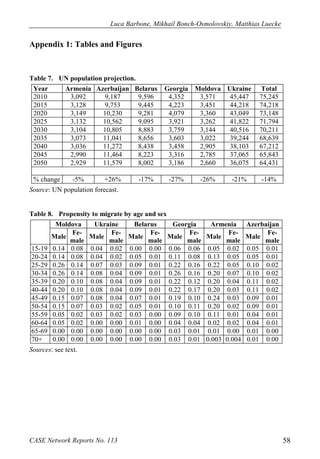
Table 7. UN population projection. ....................................................................... 58
Luca Barbone, Mikhail Bonch-Osmolovskiy, Matthias Luecke 
CASE Network Reports No. 113 6 
Table 8. Propensity to migrate by age and sex ...................................................... 58 
Table 9. Policy Channels for Migration and Socio-Economic Outcomes ............. 61 
Table 10. Legal and institutional Arrangements for Migration in EaP Countries . 69 
Table 11. EaP Migration Cooperation Framework ................................................ 74
LABOUR MIGRATION FROM THE EASTERN PARTNERSHIP COUNTRIES… 
CASE 7 Network Reports No. 113 
Abbreviations and Acronyms 
APVL Action Plan on Visa Liberalization 
BG Bulgaria 
CEE Central Eastern Europe 
CIS Commonwealth of Independent States 
CZ Czech Republic 
DCFTA Deep and Comprehensive Free Trade Agreements 
EaP Eastern Partnership 
ENPI Eastern Neighbourhood Policy Instrument 
EU European Union 
GDP Gross Domestic Product 
IMF International Monetary Fund 
IOM International Organisation for Migration 
LT Lithuania 
LV Latvia 
LX Luxemburg 
MLSP Ministry of Labour and Social Protection 
NCPD National Commission for Population and Development 
NGO Non-Governmental Organisation 
PL Poland 
RA Republic of Armenia 
SK Slovakia 
SS Social Security 
USD United States Dollar 
UN United Nations 
WP Working paper 
WTO World Trade Organisation
Luca Barbone, Mikhail Bonch-Osmolovskiy, Matthias Luecke 
CASE Network Reports No. 113 8 
The author 
Luca Barbone has been President of the CASE Management Board since Sep- tember 2011. He joined CASE in January 2011 upon his retirement from the World Bank, where he had worked since 1988, holding various leadership posts, among others Director in the Poverty Reduction and Economic Policy Unit in the Europe and Central Asia Regional Office (2007-2011), World Bank Director for Poverty Reduction (2004-2007), and Regional Director for Ukraine, Moldova and Belarus (2000-2004). Prior to the World Bank, Mr. Barbone worked for the Organisation for Cooperation and Development (Paris), the International Monetary Fund, The Planning Institute of Jamaica, and the Bank of Italy. He holds a Ph.D. in Economics from the Massachusetts Institute of Technology. He has published a number of ar- ticles in professional journal and books. Main areas of personal interest now include: (i) economic crisis and growth prospects; (ii) economic consequence of long-term demographic trends; (iii) migration and development; (iv) fiscal institutions, fiscal consolidation (v) social cohesion and political economy of reforms in Europe and Central Asia. 
Dr. Mikhail Bonch-Osmolovskiy is a senior statistician expert with an in-depth knowledge of labour market and migration economics and statistics. He holds a PhD from the University of North Carolina at Chapel Hill for his dissertation “Work- related Migration and its Effect on Poverty Reduction and Educational Attainment in Nepal” (2009). He obtained both Master degree in Mathematics from the Moscow State University and Master degree in Economics from the New Economic School in Moscow. 
Dr. Matthias Luecke is a CASE Fellow and a senior research economist at the Kiel Institute for the World Economy and an adjunct lecturer in economics at Kiel University. He studied economics at the London School of Economics and the uni- versities of Cologne (Diplom-Volkswirt, 1985; M.Sc. equivalent) and Gießen (Dr. rer. pol., 1992; Ph.D. equivalent). He has undertaken both academic and policy- oriented research on international trade policy and, more recently, on international labour migration. He has extensive regional expertise in Eastern and Southeastern Europe and Central Asia, with a particular focus since 2004 on labour migration out of Moldova.
LABOUR MIGRATION FROM THE EASTERN PARTNERSHIP COUNTRIES… 
CASE 9 Network Reports No. 113 
Foreword 
This study is part of the project entitled “Costs and Benefits of Labour Mobility between the EU and the Eastern Partnership Countries” for the European Commis- sion1. The study was written by Luca Barbone (CASE) Mikhail Bonch-Osmolovskiy (CASE) and Matthias Luecke (Kiel). It is based on the six country studies for the Eastern Partnership countries commissioned under this project and prepared by Mihran Galstyan and Gagik Makaryan (Armenia), Azer Allahveranov and Emin Huseynov (Azerbaijan), Aleksander Chubrik and Aliaksei Kazlou (Belarus), Lasha Labadze and Mirjan Tukhashvili (Georgia), Vasile Cantarji and Georgeta Mincu (Moldova), Tom Coupé and Hanna Vakhitova (Ukraine). The authors would like to thank for their comments and suggestions Kathryn Anderson, Martin Kahanec, Cos- tanza Biavaschi, Lucia Kurekova, Monica Bucurenciu, Borbala Szegeli, Giovanni Cremonini and Ummuhan Bardak, as well as the detailed review provided by IOM. The views in this study are those of the authors’ only, and should not be interpreted as representing the official position of the European Commission and its institutions. 
1 Contract No. 2011/270-312, tender procedure EuropeAid/130215/C/SER/Multi
Luca Barbone, Mikhail Bonch-Osmolovskiy, Matthias Luecke 
CASE Network Reports No. 113 10 
Executive Summary 
This Synthesis paper provides a structured overview of the main results of the six Country Papers produced under the study “Costs and Benefits of Labour Mobil- ity between the EU and the Eastern Partner Partnership Countries” for the Euro- pean Commission (Contract No. 2011/270-312, tender procedure Eu- ropeAid/130215/C/SER/Multi). The objective of the study, reflected in this paper, it to provide a thorough assessment of the costs and benefits of labour migration for the Eastern Partnership countries (EaP, comprised of Armenia, Azerbaijan, Belarus, Georgia, Moldova, Ukraine), to explore the potential for future new rules on mobil- ity with EU countries, and to provide policy recommendations to enhance the ben- efits stemming from such flows. 
EaP Migration: The “Three Stages” 
Labour migration has had, and continues to have, important effects on the econ- omies and societies of the EaP countries, albeit with different features that reflect the economic trajectories of each country. Labour mobility was high within the So- viet Union, to which all countries belonged, and contributed to the formation of large Diasporas, particularly in the Russian Federation, that have in many ways shaped post-independence developments. The dissolution of the Soviet Union led to a period of chaotic economic dislocation and resettlement of people to reflect their national origins. This period lasted roughly through the mid-1990s, and coin- cided with the deep economic depression that all EaP countries experienced (with output losses as high of 40 percent in the case of Armenia, or possibly even more as in the case of Moldova). 
Following this first wave of ethnically- and nationality-based migration, a sec- ond stage involved trade-based movements of people from the EaP, both towards the Russian Federation and increasingly towards the European Union. This gradu- ally grew into large-scale labour migration, starting in the late 1990s and growing rapidly during the 2000s, the third stage of migration for the EaP countries. The scale of the phenomenon today is large, but difficult to measure with precision, par- ticularly in view of the fact that many labour migrants do not have a legal status in the countries of destination. 
Most migrants from the Eastern Partnership countries are temporary mi- grants in the sense that they continue to belong to a household in their home country even if they work abroad for a long time. Therefore, the number of these temporary migrants may be estimated through household surveys in the countries of origin. Based on these pieces of evidence, labour migration is far more wide-
LABOUR MIGRATION FROM THE EASTERN PARTNERSHIP COUNTRIES… 
CASE 11 Network Reports No. 113 
spread in the three smaller Eastern Partnership economies (Moldova, Georgia, Ar- menia) than in oil-rich Azerbaijan (which has in fact become a net importer of la- bour), Belarus, or Ukraine. In Moldova (and probably in Georgia, too), migration was largely driven by deteriorating employment and income-earning opportunities in rural areas. By contrast, the rapidly growing oil sector in Azerbaijan and urban centres in Belarus and Ukraine have attracted large number of internal migrants. 
Who are the Migrants? In terms of migrant gender and destination countries, there is a marked contrast between Georgia, Moldova, and Ukraine, on the one hand, and Armenia, Azerbaijan and Belarus, on the other. Men account for the majority of migrants everywhere; however, their share ranges from 57 to 66 percent in Geor- gia, Moldova, and Ukraine, versus from 78 to 88 percent in the remaining countries. Similarly, Russia was home to 40 percent of Georgian migrants, 64 percent of Mol- dovans, and 47 percent of Ukrainians, versus 74 percent of Armenian migrants, 77 percent of Azerbaijanis, and fully 90 percent of Belarusians. Detailed analysis at the country level suggests that the differences in gender shares and destination countries reflect in part a substantial number of female migrants from Georgia, Moldova, and Ukraine in the European Union. Patterns of employment vary widely, from low- skilled manual work, especially in the construction industry and agriculture, to the provision of long-term care, often in households. 
In addition to temporary labour migration, some countries are beginning to see permanent emigration of whole families, particularly to the EU. While temporary migration has peaked in the Eastern Partnership countries although it remains high, the available, scattered data from destination countries suggest that permanent mi- gration may gradually be taking hold. For example, through several ways of regu- larization, Italy had regularized 143,000 Moldovans and 218,000 Ukrainians by 2011 (Marchetti et. At., 2012 (Country report Italy)). 
Remittances: A Powerful Social and Economic Agent of Change 
During the 2000s, migrant remittances in the EaP countries grew rapidly along with the number of migrants, mirroring a world-wide trend stimulated by increased migratory flows and better technologies for transfers of small sums of money. For the whole EaP region, remittances rose from practically negli- gible amounts in 1995 to US$12.9 billion in 2008. After a sharp decline in 2009 because of the economic slump in Russia and other destination countries, they have recovered consistently, reaching a projected US$14.2 billion for 2012. 
Together with the rapid growth in nominal US$ terms, the macroeconomic im- portance of remittances has increased, albeit less impressively because GDP in many Eastern Partnership countries also increased during the 2000s. Unsurprisingly, the smaller countries with higher levels of labour migration – Moldova, Armenia, and Georgia – are the most “dependent” on remittances (with the ratio of remittances
Luca Barbone, Mikhail Bonch-Osmolovskiy, Matthias Luecke 
CASE Network Reports No. 113 12 
to GDP, respectively, at 23, 13 and 11 percent in 2011), whereas for Azerbaijan, Belarus and Ukraine remittances are below 5 percent of GDP. 
The growing importance of remittances has shaped several economic and social developments in all the EaP countries, which are discussed in more detail below. Remittances have had macroeconomic consequences (sustaining growth and consumption, but also possibly inducing Dutch Disease symptoms through higher relative prices for non-tradable goods and services. They have affected the lives of ordinary citizens—while typically migrants tend not to come from the ranks of the poorest individuals, ample evidence indicates that remittances have had an im- portant role in reducing poverty and vulnerability in the EaP countries (as elsewhere in the world). Migration to Russia has played a key role in reducing poverty because the monetary cost of migrating there is little more than the price of a minibus or train ticket to Moscow; hence, migration to Russia is a viable option even for poor workers. By contrast, migration to the EU (which is frequently irregular) is typically much more costly and therefore available only to the relatively well-off. 
Costs and Benefits of Migration for EaP Countries 
Assessing costs and benefits of migration is not an easy task, if only because of the lack of a generally accepted metric. Migration is a complex phenomenon, in- volving clear economic dimensions (e.g., through the effects of remittances on con- sumption and investment patterns, the changes in the labour markets that are the result of the outflow of workers, the changes in relative prices of tradables and non- tradables) as well as non-economic ones (such as the resulting consequences on the social fabric of sending countries, the deadweight losses possibly caused by under- employment of skills). In this paper, we review several “building blocks” of the cost-benefit equation for the EaP countries, ranging from those that can be measured with some degree of precision, to those which are more qualitative in nature. 
More specifically, this study examines the evidence concerning individ- ual/household and macroeconomic effects. Among the first are the effects of the extra income on household behaviour; relatedly, the effects on professional skills, on the welfare of children and families left behind, on the relationships between genders and more generally on societal values. With respect to the second set of economy-wide consequences, we review the effects on labour markets and more generally on the possibility of Dutch disease outcomes; the repercussions on labour markets, on the formation of human capital, and then on the functioning of financial markets and the impact on fiscal aggregates and public finance management. 
We conclude from our country studies that labour migration in the EaP countries generates large benefits for the migrants and their families as well as for economic and social development in migrants’ home countries. Many mi- grants from the EaP region look upon their work abroad as an employment option
LABOUR MIGRATION FROM THE EASTERN PARTNERSHIP COUNTRIES… 
CASE 13 Network Reports No. 113 
that implies additional hardship but allows them to save for future consumption (du- rables, housing) or investment (children’s education, small enterprise) in their home country. Along the way, they may improve their professional skills, support com- munity investment projects, or help develop financial intermediaries by placing some of their savings in financial institutions at home. The sooner these migrants attain their savings objective, the sooner they will return home for good. 
After discussing the available evidence, we can conclude with one important (and intuitive) finding, namely that the balance of the benefits and the costs is proportional to the importance of migration with respect to the size of the econ- omy. Thus, for instance, in the case of Moldova it is quite apparent that there have been large benefits accruing to the macro-economy as well as to individual house- holds. On the other hand, given the scale of the phenomenon, the costs (and associ- ated risks) have also been large. 
At the opposite of the spectrum are instead countries such as Azerbaijan and Belarus, where the scale of migration and its economic effects are relatively minor, and hence the overall macroeconomic benefits are likely to be limited. However, costs and benefits of migration are not necessarily equally low for the households experiencing them – if not well addressed through public policies, they might in fact tip the balance of benefits and costs in a negative way. 
Review of evidence shows that costs and benefits can be altered by the adoption of specific policies and the strengthening of institutions dealing with migration. This issue is addressed in the rest of this summary, after a brief review of the findings on the potential for future labour migration. 
The Potential for Future Labour Migration to the EU 
An issue of concern in the debate on possible changes to the migration arrange- ments between the EU and the EaP countries is whether more liberal policies might induce uncontrolled or excessive flows, potentially disruptive of (segments of) re- ceiving countries’ labour markets. Though recognizing all the difficulties involved in forecasting migration flows, this study attempts to obtain a baseline series of es- timates of potential flows using a demographic approach. While the propensity to emigrate increased sharply in some EaP countries during the first half of the 2000s, it has been relatively constant throughout the region since then. In our simulations, we therefore assume initially that the propensity to emigrate for each age cohort of workers remains constant. Further taking into account the likely demographic trend in each EaP country, we use a simple model to project the number of migrants from the EaP countries. On this basis, we then calculate the magnitude by which the pro- pensity to migrate to the EU (as opposed to the Russian Federation) would have to change – for example, due to improved employment opportunities in the EU - in order to keep current migrant flows to the EU constant.
Luca Barbone, Mikhail Bonch-Osmolovskiy, Matthias Luecke 
CASE Network Reports No. 113 14 
These simulations show that the possibility of a major “flood” of migrants from EaP countries following the adoption of more liberal policies by the EU is rather remote. Even to maintain the current numbers unchanged would require substantial behavioural changes on the part of migrants from the largest migration- sending countries. While this is not altogether impossible, one should also keep in mind that the Russian Federation is likely to continue to increase its own demand for migrants, and has good chances to become an even more attractive destination on its own. Thus, it cannot be taken for granted that the EU will be able to shift migrants’ preferences in large proportions; by the same token, the notion of large migratory flows towards the EU from the EaP countries can be discounted as highly unlikely (barring of course the occurrence of severe negative socio-economic de- velopments in the EaP countries). 
Improving Migration Outcomes: Win-Win Policies for Sending and Receiv- ing Countries 
Migration involves significant risks. Migrants may fail to attain their savings objective or it may take longer than planned, straining family bonds. Migrants may also find living conditions in their host countries preferable to their home countries and move permanently with their families. With a view to enhancing the develop- ment impact of migration, migration-related policy interventions in host as well as home countries should therefore be designed, above all else, to empower migrants to achieve their objectives as quickly and smoothly as possible. With this as a gen- eral guideline, it is possible to identify a variety of distortions in the migration pro- cess where cost-effective interventions can be designed. 
The labour migration flows discussed in this study have taken place in an evolv- ing institutional and legislative environment, both on the sending and the receiving country side. Policies and institutions have a potentially important role in determin- ing the developmental outcomes of migration, or in affecting the balance of costs and benefits. The country studies for the Eastern Partnership countries demon- strate conclusively that some of the relevant policies are not migration-specific: overall economic stability and growth, financial sector development, education, so- cial protection, all affect the decisions of people to migrate and the way in which their efforts are translated into economic success or failure. Migration-specific pol- icies and institutions, on the other hand, may have a powerful effect on incen- tives for forms of migration that are in the best interest of migrants, sending nations and receiving ones. A subset of these policies involves relations with Di- asporas, and their contribution to the societies of origin. We summarize these les- sons into the ones mostly relevant for sending countries, and those which could be taken up by the European Union and its member states.
LABOUR MIGRATION FROM THE EASTERN PARTNERSHIP COUNTRIES… 
CASE 15 Network Reports No. 113 
Furthermore, mainstreaming migration into all development-related policies will maximize the benefits from migration and remittances to sending country societies and economies, beyond migrants and their families. Higher living standards at home will also make it more likely that those migrants who originally intended to work abroad only temporarily will in fact return. 
Lessons and Policy Recommendations for EaP Countries. General, macroe- conomic and sectoral, policies affect the individual decisions to migrate and the po- tential for positive or negative outcomes. It is not feasible to list all possible ways in which these policies interact with migration, but it is possible to provide a general, methodological recommendation for the EaP countries going forward: 
A Migration Lens should be part of macroeconomic and sectoral policy formulation 
This “lens”, i.e. framing policies with a view to direct and indirect consequences on migration should also become more important as the importance of migration rises. The need for an institutionalized “lens” is important, as experience shows that sectoral policy discussions very often are dominated by domestic concerns and lob- bying effort by different stakeholders, who may not be particularly interested in the nexuses with migration and its socio-economic effects. 
A complementary lesson is that: 
The Migration Lens needs to be implemented/facilitated by an agency empowered with sufficient clout among government organizations 
These two recommendations imply that migration should be recognized as part of the national strategy in the EaP countries, and that this recognition should be backed by an institutional setting that would favour its effectiveness. National de- velopment strategies for migration-sending countries would be well-advised to take a holistic approach to maximizing the benefits from labour migration flows, but this requires the existence of a powerful advocate that can help mediate among sectoral interests and maintain the focus on the migration strategy and on the implications of individual policy decisions on migration outcomes. 
EaP countries are also at very different stages in the provision of migration-tar- geted assistance, both pre- and post-departure. In this respect, the EaP governments could learn a lot from international best-practice in areas such as regulation of em- ployment intermediaries, pre-departure education courses in languages, survival skills, financial literacy, as well as consular assistance in countries of destination. Action in this respect would offer opportunities for joint work and collaboration with the EU and its member states. 
Maximizing the benefits of the relations with the Diaspora. Diasporas form the EaP countries are very active in a number of EU member states, and have served both as informal social safety and informational networks for migrants, as well as
Luca Barbone, Mikhail Bonch-Osmolovskiy, Matthias Luecke 
CASE Network Reports No. 113 16 
purveyors of investment and knowledge towards the countries of origin. EaP coun- tries have adopted very different models in dealing with the diaspora. We recom- mend that EaP governments, with possible assistance from the EU, evaluate the ef- fectiveness of their present arrangements and, as part of the overall Migration Strat- egy, proceed to upgrade where necessary the institutional commitments to Diaspora collaboration. 
Recommendations for the European Union and its Member States. This study documents the ongoing array of instruments and avenues that are being pur- sued by the institutions of the European Union to deal with migration issues con- cerning the EaP countries. The study also notes the experience of the relationships between the EaP and the Russian Federation with regard to mobility of people and labour migration. In particular, it appears that visa liberalization would not lead to massive emigration. This is an important point to bear in mind in the present context, when much energy is spent negotiating the fine details of visa facilitation and liber- alization between the EaP countries and the EU. The second, however, is that even Russia has not managed to find, despite its many attempts and the clear focus on management of labour migration as a strategic objective for medium-term growth, a clear mechanism to reconcile the demand for labour (and of different types of skills) and the supply of migrants from the CIS countries. 
Many migrants from EaP countries live and work in EU member states irregu- larly, frequently in problematic circumstances. National regularization programmes in several EU countries have already improved the living conditions of many of these migrants. However, as long as access to the EU labour market remains highly restricted for individuals from the EaP region, incentives for irregular migration re- main. The EU could consider, in the context of the EaP initiative, encouraging mem- ber countries to start pilot programs specifically targeted for EaP nationals for ac- cess to the labour force in EU countries. Greatly expanded legal employment op- portunities in the EU would not only improve the living conditions of the migrants themselves. They would also generate a positive development impact in the EaP countries, particularly when combined with policy interventions that provide for pre-departure migrant orientation, language training, and job placement. By provid- ing a structured environment for labour migration, it would also be possible to avoid labour market disruption in EU member states. 
In the course of its present negotiations with some EaP countries, the EU has been conditioning progress in mobility arrangements to improvements in the legal and institutional framework in sending countries, dealing with migration issues. This approach is highly appropriate, and should be extended and provided with ad- equate means—as long as clear institutional benchmarks are clearly set and not seen as ways of postponing policy decisions on the part of the EU.
LABOUR MIGRATION FROM THE EASTERN PARTNERSHIP COUNTRIES… 
CASE 17 Network Reports No. 113 
A further lesson that emerges from this review is that the progress in bilateral negotiations on important aspects of labour migration frameworks (e.g., ranging from definition of workers’ rights, to arrangements for social security and health benefits, to education) is very slow, and limited to few of the EaP countries. As noted earlier, the implementation of the Single Permit Directive could simplify ne- gotiations and provide a common platform for discussions regarding social security and other working conditions for migrants, which will likely require to be supple- mented by other agreements (either to cover categories such as seasonal or tempo- rary migrants, or to clarify the rules for recognition of contributions to different pension schemes, for instance). 
There is also still scope for the European Institutions to take leadership in areas in which the adoption of standards could allow for progress at the country level as well (most notably in the fields of higher and vocational education).
Luca Barbone, Mikhail Bonch-Osmolovskiy, Matthias Luecke 
CASE Network Reports No. 113 18 
1. Introduction 
This paper is part of the project entitled “Costs and Benefits of Labour Mobility between the EU and the Eastern Partner Partnership Countries” for the European Commission (Contract No.2011/270-312, tender procedure EuropeAid/130215/ C/SER/Multi). It is based on the six Country Studies on Armenia, Azerbaijan, Bel- arus, Georgia, Moldova and Ukraine, as well as on existing literature on migration, both regional and general. It assesses the benefits and costs of labour migration to the EU from the point of view of Eastern Partnership countries, develops scenarios for future migrant flows, reviews the institutional and legal framework in place for labour migration, and discusses policy implications for both Eastern Partnership and EU countries. 
Since the EU is only one of several important destination regions for migrants from Eastern Partnership countries (the Russian Federation still being the most prominent), we consider migration to the EU within the broader context of total migrant flows from the Eastern Partnership Region. 
Chapter 2 provides a review of macroeconomic developments in the EaP region in the years following the dissolution of the Soviet Union, leading to the great fi- nancial crisis of 2008-9 and to current developments. In this context, it reviews la- bour market developments, and links them to the emergence of substantial labour migration 
Chapter 3 provides a discussion of costs and benefits of labour migration for the EaP countries. Starting by laying out the conceptual framework for evaluating the many dimension of the socio-economic effects of migration on sending countries, the chapter reviews the available evidence for the EaP countries, distinguishing be- tween household-level and economy-wide effects. The chapter ends with a qualita- tive “scorecard” that tries to sum up the balance of benefits and costs, and argues that such balance is quite uneven across the EaP countries. 
Chapter 4 develops and discusses a methodology to assess the potential for future labour migratory flows. The model uses existing demographic projections for the EaP countries and, on the basis of hypotheses about the propensity to engage in labour migration for given age cohorts, calculates the likely future flows, both for total migration as well as migration to the EU, in the absence of major economic shifts. 
Chapter 5 reviews the institutional and legislative framework in EaP countries with regard to migration in general and labour migration more specifically. The
LABOUR MIGRATION FROM THE EASTERN PARTNERSHIP COUNTRIES… 
CASE 19 Network Reports No. 113 
chapter also discussed the approaches to migration from the EaP countries now adopted by the Russian Federation, which is the largest recipient of labour migrants from the region. 
Finally, Chapter 6 provides a series of forward looking policy recommendations for both EaP countries and the EU and its member states, aimed at maximizing the benefits from ongoing and future labour migration flows.
Luca Barbone, Mikhail Bonch-Osmolovskiy, Matthias Luecke 
CASE Network Reports No. 113 20 
2. Macroeconomic and Labour Market Developments in the EaP Region: Common Origins, Diverging Paths 
This Chapter provides a bird’s eye view of socio-economic developments in the Eastern Partnership countries with a special focus on labour markets and the role of labour migration and remittances. While we cover the last two decades, we concen- trate on the period since 2000 because it was then that (i) economic recovery took hold throughout the region and (ii) labour migration became a mass phenomenon. 
In terms of aggregate output and population, the Eastern Partnership countries are dominated by Ukraine. However, we review and compare individual country experiences, rather than focussing on regional aggregates, because greater coopera- tion and economic integration with the EU will affect individual Eastern Partnership countries in different ways. 
Throughout, this broad review of macroeconomic and labour market develop- ments draws on the more detailed analyses in our Country Studies. We complement this broad review with a comparative, country-by-country discussion of the costs and benefits of labour migration and remittances in Section 3 below. 
2.1. The Macroeconomy: Collapse and Recovery 
Throughout the Eastern Partnership countries, output declined sharply when the Soviet Union disintegrated in 1991 (Figure 1). Probable causes include the rapid breakdown of the central planning mechanism while market economy institutions took time to build; a demand shock as government procurement for many goods, including military hardware, were curtailed; and the disruption of trading rela- tioships among the former Soviet republics. Further disruptions resulted from wars and an economic blockade that affected Armenia, Azerbaijan, and Moldova. 
Recovery started during the mid-1990s in Armenia, Azerbaijan, Belarus, and Georgia and continued through 2011, with a limited setback in 2009 due to the
LABOUR MIGRATION FROM THE EASTERN PARTNERSHIP COUNTRIES… 
CASE 21 Network Reports No. 113 
global financial crisis. By contrast, Moldova and Ukraine suffered prolonged stag- nation during the mid-1990s and a further dip in output because of the Russian fi- nancial crisis in 1998. Here, recovery began around 2000 but has continued since then, with only a temporary setback in 2009. The drivers of the economic recovery differed across countries in terms of their relative importance; successful systemic transformation, higher commodity prices (especially in Ukraine and Azerbaijan), higher import demand from Russia, and growing inflows of migrant remittances have all contributed to varying degrees (Havrylyshyn, 2008). 
Figure 1. Eastern Partnership countries: GDP in constant prices, 1990 to 2011 
Source: World Bank World Development Indicators database; own calculation. 
Although the recovery was impressive in terms of its length and the rate of output growth, total GDP in Ukraine, Moldova, and Georgia remains below its pre-inde- pendence level. By contrast, GDP in Belarus has nearly doubled since 1990, alt- hough some doubts remain regarding the sustainability of the Belarusian growth model that is characterized by very extensive government intervention in the econ- omy, continuing subsidies from Russia through low energy prices, and macroeco- nomic distortions. Armenia’s GDP in 1990 was already much reduced by the dev- astating earthquake in 1988; this may explain the large increase in GDP during the 2000s. The economic boom in Azerbaijan is fuelled by a large increase in oil and gas extraction. Overall, countries in the Region remain economically fragile, not 
5010015020025030035040019901992199419961998200020022004200620082010AzerbaijanArmeniaBelarusGeorgiaMoldovaUkraine
Luca Barbone, Mikhail Bonch-Osmolovskiy, Matthias Luecke 
CASE Network Reports No. 113 22 
least because of the uneven implementation of macroeconomic, structural, and sys- temic reforms (Havrylyshyn, 2006). 
Macroeconomic stability, measured in terms of consumer price inflation, was established in the region during the first half of the 1990s and has been maintained since then, except in Belarus. After independence, each country needed to set up its own currency and banking system, starting essentially from scratch. Annual infla- tion rates were in the hundreds and even thousands of percentage points in the early 1990s. However, inflation was brought down decisively through tight macroeco- nomic policies and has been low ever since (Figure 2). While Belarus experienced low inflation during most of the 2000s, sharply higher rates in 1999 and again in 2011 suggest that macroeconomic stability is less firmly established in Belarus than in the rest of the region. 
Figure 2. Eastern Partnership countries: GDP in constant prices, 1990 to 2011 
Source: IMF, International Financial Statistics database; own calculations. 
Private consumption declined less sharply than total GDP and recovered quickly, beginning in the mid-1990s (Figure 3). This trend in consumption was accompanied by a declining investment ratio due to the transition shock as well as large trade deficits in most countries during the 1990s and 2000 (Figure 4). Trade deficits were financed through a combination of international aid, foreign investment, and mi- grant remittances. 
-500050100150200250300ArmeniaGeorgiaMoldovaUkraineAzerbaijanBelarus
LABOUR MIGRATION FROM THE EASTERN PARTNERSHIP COUNTRIES… 
23 CASE Network Reports No. 113 
Figure 3. Eastern Partnership countries: Real household consumption 
Source: World Bank, World Development Indicators database; own calculations. 
Figure 4. Eastern Partnership countries: Net exports,1990 to 2011 (in constant local 
currency units, percent of GDP) 
Source: World Bank, World Development Indicators database; own calculations. 
0 
50 
100 
150 
200 
250 
300 
350 
1990 1992 1994 1996 1998 2000 2002 2004 2006 2008 2010 
Azerbaijan 
Armenia 
Belarus 
Georgia 
Moldova 
Ukraine 
-70 
-60 
-50 
-40 
-30 
-20 
-10 
0 
10 
20 
30 
1990 1992 1994 1996 1998 2000 2002 2004 2006 2008 2010 
Azerbaijan 
Armenia 
Belarus 
Moldova 
Ukraine
Luca Barbone, Mikhail Bonch-Osmolovskiy, Matthias Luecke 
CASE Network Reports No. 113 24 
The sharp decline in GDP in the early 1990s led to wide-spread, mostly hidden unemployment in all Eastern Partnership countries. Around this time, a first wave of migrants left the region, involving mostly ethnic Russians who returned to Russia permanently and maintained few links with their former homes. 
Later during the 1990s, “shuttle” traders began to take advantage of new oppor- tunities to travel and the slow development of wholesale and retail trade networks. Travelling back and forth throughout Eastern Europe to buy goods that were cheap in one place and in short supply in another, carrying as much merchandise on them as they could physically handle, they effectively became a second wave of interna- tional migration in the region. Their international movements were atypical in the sense that their main purpose was to physically move goods across borders, rather than to live or work in the host country. Nevertheless, in exposing a large number of people to a transnational way of life, shuttle trade was probably one important stepping stone to the subsequent emergence of networks of labour migrants. 
2.2. Labour Migration – In Search of Opportunities 
Labour migration from most Eastern Partnership countries started in the late 1990s and grew rapidly during the 2000s. Many of these migrants reside and work in their host countries irregularly; therefore, there are no comprehensive data on the number of migrants or how it evolved over time (our Country Studies discuss data availability in detail). However, most migrants from the Eastern Partnership coun- tries are temporary migrants in the sense that they continue to belong to a household in their home country even if they work abroad for a long time. Therefore, the num- ber of these temporary migrants may be estimated through household surveys in the countries of origin. Since the quality of available household surveys varied widely across countries and over time, the information in Figure 5 should be viewed as the best available estimate of the current number of temporary migrants (i.e. those who still belong to a household in the country of origin), subject to considerable uncer- tainty. Since by all accounts the number of migrants abroad was very small in all Eastern Partnership countries as late as the year 2000, the information in Figure 5 also represents the accumulated net outflow of migrants over little more than one decade. 
Not surprisingly, labour migration is far more widespread in the three smaller Eastern Partnership economies (Moldova, Georgia, Armenia) than in oil-rich Azer- baijan, Belarus, or Ukraine (Figure 5). In Moldova (and probably in Georgia, too),
LABOUR MIGRATION FROM THE EASTERN PARTNERSHIP COUNTRIES… 
CASE 25 Network Reports No. 113 
migration was largely driven by deteriorating employment and income-earning op- portunities in rural areas. Under the central planning system, the agricultural sector had received huge subsidies directly and indirectly. After independence, the sector shrank and rural-to-urban migration followed. With few large urban areas to move to within the country (the Chisinau region is now performing well economically, but is relatively small relative to the rest of the country), rural-to-urban migration naturally flowed to Russia (mostly Moscow) and increasingly to Italy and Spain (Luecke, Omar Mahmoud, Steinmayr, 2009). By contrast, the rapidly growing oil sector in Azerbaijan and urban centres in Belarus and Ukraine have attracted large number of internal migrants. 
Figure 5. Eastern Partnership countries: Migrant stocks relative to labour force, app. 2010 (percent) 
Source: ENPI country reports. 
In terms of migrant gender and destination countries, there is a marked contrast between Georgia, Moldova, and Ukraine, on the one hand, and Armenia, Azerbaijan and Belarus, on the other (Synoptic Table 1). Men account for the majority of mi- grants everywhere; however, their share ranges from 57 to 66 percent in Georgia, Moldova, and Ukraine, versus from 78 to 88 percent in the remaining countries. Similarly, Russia was home to 40 percent of Georgian migrants, 64 percent of Mol- dovans, and 47 percent of Ukrainians, versus 74 percent of Armenian migrants, 77 percent of Azerbaijanis, and fully 90 percent of Belarusians. Detailed analysis at the country level suggests that the differences in gender shares and destination countries reflect in part a substantial number of female migrants from Georgia, Moldova, and Ukraine in the European Union. Patterns of employment vary widely, from low- 
0 
5 
10 
15 
20 
25 
30 
Armenia 
Azerbaijan 
Belarus 
Georgia 
Moldova 
Ukraine
Luca Barbone, Mikhail Bonch-Osmolovskiy, Matthias Luecke 
CASE Network Reports No. 113 26 
skilled manual work, especially in the construction industry and agriculture, to the provision of long-term care, often in households. 
In addition to temporary labour migration, some countries are beginning to see permanent emigration of whole families, particularly to the EU. While temporary migration has peaked in the Eastern Partnership countries although it remains high, the available, scattered data from destination countries suggest that permanent mi- gration may gradually be taking hold. For example, through several ways of regu- larization, Italy had regularized 143,000 Moldovans and 218,000 Ukrainians by 2011 (Country Report Italy). 
The rapid growth in the number of migrants coincided with rapid wage growth in the Eastern Partnership countries (Figure 6). Average wages were extremely low in the year 2000 at US$33 to US$67; open and hidden unemployment were wide- spread (see Country Studies). These “push” factors – dire poverty at home - were clearly a key motive to migrate early in the process. Although average wages have since grown several times and now range from around US$ 250 to US$ 400, there is still a large enough difference to wages in Russia (especially Moscow) or the European Union to make migration an attractive employment option for many. This is especially true for low-skilled manual workers who may earn substantially less than the average wage at home but may find skills-appropriate employment in Rus- sia or the European Union relatively easily. Also, for many temporary migrants, the dollar wage at home compared with the dollar wage abroad is probably the main decision criterion for whether to migrate. Relative price levels in the home and host country matter less because many migrants limit their expenditures in the host coun- try to the bare minimum needed for survival, while most of their households’ ex- penditures occur at home. 
Rapid wage growth was linked to the general economic recovery of the Eastern Partnership countries during the 2000s (see Figure 1 above). Thus it must have re- flected several causes, including migration. The transition shock to output left much productive capacity underutilized and workers underemployed (Havrylyshyn, 2008). In this situation, migration reduced the domestic labour supply and, hence, downward pressure on wages, without affecting output. Furthermore, simulations based on computable general equilibrium models suggest that when migrant remit- tances began to flow in, they increased demand for domestic goods and services, including food and other labour-intensive items, and allowed output to recover (Luecke, 2011). 
In most countries, labour migration and wage growth took place against the back- ground of a declining population and labour force (Figure 7). In Moldova and Bel- arus, the labour force declined rather faster than the population, reflecting the large
LABOUR MIGRATION FROM THE EASTERN PARTNERSHIP COUNTRIES… 
CASE 27 Network Reports No. 113 
number of labour migrants in Moldova and probably an aging population and man- datory retirement in Belarus. Azerbaijan differs from this pattern as it is the only country where the population grew strongly after 1990, along with an even more rapidly growing labour force. Thus it appears that the expansion of the oil and gas sector and the resulting growth in demand for non-tradable goods and services have not only fuelled wage growth (Figure 6), but have also led to higher employment. 
Figure 6. Eastern Partnership countries: Average monthly wage, 2000 to 2010 (con- stant 2000 US dollar) 
Source: Country reports; IMF International Financial Statistics database; own calculations. 
05010015020025030035020002001200220032004200520062007200820092010ArmeniaAzerbaijanBelarusGeorgiaMoldovaUkraine
Luca Barbone, Mikhail Bonch-Osmolovskiy, Matthias Luecke 
CASE Network Reports No. 113 28 
Figure 7. Population and Labour Force 
2.3. Remittances: the Emergence of a Powerful Economic Force 
Apart from directly reducing the labour supply and exerting upward pressure on wages, labour migration affects the countries of origin through the remittances sent by migrants to their domestic household members. For migrant households, remit- tances are typically a major source of income (unsurprisingly, since one adult is employed abroad rather than at home). If migrant households are poor, the extra income due to migration will help to reduce poverty (see Section 3.2.1 below for a detailed discussion of these effects)2. 
In several Eastern Partnership countries, remittances are large enough to affect not only migrant households, but macroeconomic developments as well. During the 2000s, migrant remittances grew rapidly along with the number of migrants. Bal- ance of payments statistics provide the best available data source on remittances since 2005, broken down by recipient countries (Figure 8). While strictly compara- ble data are not available before 2005, it is clear that migrant remittances were very small in all Eastern Partnership countries before 2000. Remittances to the Eastern Partnership region rose rapidly to nearly US$ 13 billion in 2008, with Ukraine ac- counting for the lion’s share at almost US$ 7 billion. In 2009, remittances declined 
2 There is an abundant literature on the relationship between remittances and economic growth or poverty reduction. See for instance Adams (2010); Adams, Richard H Jr. and John Page (2005); Brown, S.S. (2006); Barajas, A., R. Chami, C. Fullenkamp, M. Gapen& P. Montiel (2009); Lopez-Cordova, E. and A. Olmedo (2006). 
-40 
-20 
0 
20 
40 
60 
Armenia 
Azerbaijan 
Belarus 
Georgia 
Moldova 
Ukraine 
popultion 
labour force
LABOUR MIGRATION FROM THE EASTERN PARTNERSHIP COUNTRIES… 
CASE 29 Network Reports No. 113 
sharply because of the economic slump in Russia and other destination countries. Since then, they have rebounded to nearly US$ 15 billion in 2011. 
Remittances are sent through formal (banks, Money Transfer Operators) as well as informal channels (minibus drivers, friends). Remittances through formal chan- nels generate additional demand for banking services and thus promote financial sector development (see Section 3.1.5 for a more detailed analysis). 
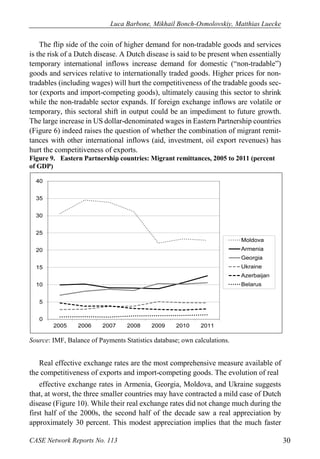
While remittances grew rapidly in nominal US$ terms, their ratio to broad mac- roeconomic aggregates has also increased considerably (Fig. 9), particularly in the smaller countries with larger labour migration – Moldova, Armenia, and Georgia – where the ratios of remittances to GDP rose to 23 percent, 13 percent, and 11 per- cent, respectively. For the three larger countries, with lower incidence of migration, this ratio is below 5 percent. 
Figure 8. Eastern Partnership countries: Migrant remittances, 2005 to 2011 (million US dollar) 
Source: IMF, Balance of Payments Statistics database; own calculations. 
With remittance inflows as high as in the smaller countries, rapidly growing re- mittances during the 2000s must have helped to sustain the growth of household consumption (Figure 3) as well as output growth in non-tradable goods and services and ultimately GDP growth (Figure 1). Due to the output collapse in the early 1990s, capacity utilization was low in many industries around 2000. When household de- mand increased due to remittances, output was able to recover quickly even though investment picked up only during the late 2000s. 
01000200030004000500060007000800090002005200620072008200920102011UkraineAzerbaijanMoldovaGeorgiaArmeniaBelarus
Luca Barbone, Mikhail Bonch-Osmolovskiy, Matthias Luecke 
CASE Network Reports No. 113 30 
The flip side of the coin of higher demand for non-tradable goods and services is the risk of a Dutch disease. A Dutch disease is said to be present when essentially temporary international inflows increase demand for domestic (“non-tradable”) goods and services relative to internationally traded goods. Higher prices for non- tradables (including wages) will hurt the competitiveness of the tradable goods sec- tor (exports and import-competing goods), ultimately causing this sector to shrink while the non-tradable sector expands. If foreign exchange inflows are volatile or temporary, this sectoral shift in output could be an impediment to future growth. The large increase in US dollar-denominated wages in Eastern Partnership countries (Figure 6) indeed raises the question of whether the combination of migrant remit- tances with other international inflows (aid, investment, oil export revenues) has hurt the competitiveness of exports. 
Figure 9. Eastern Partnership countries: Migrant remittances, 2005 to 2011 (percent of GDP) 
Source: IMF, Balance of Payments Statistics database; own calculations. 
Real effective exchange rates are the most comprehensive measure available of the competitiveness of exports and import-competing goods. The evolution of real 
effective exchange rates in Armenia, Georgia, Moldova, and Ukraine suggests that, at worst, the three smaller countries may have contracted a mild case of Dutch disease (Figure 10). While their real exchange rates did not change much during the first half of the 2000s, the second half of the decade saw a real appreciation by approximately 30 percent. This modest appreciation implies that the much faster 
05101520253035402005200620072008200920102011MoldovaArmeniaGeorgiaUkraineAzerbaijanBelarus
LABOUR MIGRATION FROM THE EASTERN PARTNERSHIP COUNTRIES… 
CASE 31 Network Reports No. 113 
growth in US dollar-denominated wages was largely due to productivity increases (which, in turn, may have been the result of better capacity utilization as well as technological change). At US$ 250 to US$ 350 in 2010, the average monthly wage in Moldova, Armenia, and Georgia was still modest compared to the rest of Eastern Europe. It would seem far-fetched to argue at this point that the competitiveness of the tradable goods sector is threatened by high wages. Furthermore, the recovery of remittances since 2009 demonstrates that even in a global crisis, remittances are neither temporary nor particularly volatile. 
Figure 10. Real Effective Exchange Rates for EaP Countries 
Source: IMF, Balance of Payments Statistics Database; own calculations. 
Overall, this broad review of labour market and macroeconomic developments suggests that labour migration and migrant remittances were crucial to the economic well-being of many households in the Eastern Partnership countries. At the aggre- gate level, migrant remittances were particularly important in the smaller, high-mi- gration countries where they amounted to 11 percent of GDP in Georgia, 13 percent in Armenia, and 23 percent in Moldova. Remittances contributed to rising demand for non-tradable goods and services and, hence, to the recovery of GDP since 2000. Emigration reduced downward pressure on wages when unemployment was high and sustained the subsequent rapid growth in wages. While most migrants still work in Russia, EU member states, especially in Southern Europe are increasingly im- portant destinations.
Luca Barbone, Mikhail Bonch-Osmolovskiy, Matthias Luecke 
CASE Network Reports No. 113 32 
Table 1. Structural features of labour migration in Eastern Partnership countries 
Armenia 
Azerbai- jan 
Belarus 
Georgia 
Moldova 
Ukraine 
Migrants: total number (ths) 
211 
307 
201 
425 
317 
1309 
Share in popula- tion 15/64 (per- cent) 
10 
5 
3 
14 
12 
4 
Share in labour force (percent) 
15 
7 
4 
18 
26 
6 
Recent migra- tion trend 
Country now a net immigra- tion desti- nation. 
EU replac- ing Russia as the most important migration destina- tion. 
Total num- ber of tem- porary mi- grants broadly constant since 2007 
Net migra- tion to the EU ap- proxi- mately 30 thousand peo- ple/year 
Remittances: share in GDP (percent) 
12 
3 
1 
7 
22 
4 
Destination countries (per- cent of migrants) 
Russia: 74 
EU: 4 
Russia: 77 
EU: 1 
Russia: 90 
EU: 4 
Russia: 40 
EU: 35 
Russia: 64 
EU: 21 
Russia: 47 
EU: 44 
Migrants: % male 
78 
85 
88 
57 
64 
66 
Migrants: educa- tion level, % with tertiary ed- ucation 
10-15% (in total employ- ment: 21%) 
26% 
(in total employ- ment 24%) 
15% among mi- grants to Russia, 42% among mi- grants to EU, 18% overall (in total em- ployment: 25.4%) 
33% 
(in total employ- ment 29%) 
7% among migrants to Russia, 16% among mi- grants to EU, 10% migrants overall. (in total employ- ment: 23.7%) 
13% over- all 
(in total employ- ment 34%)
LABOUR MIGRATION FROM THE EASTERN PARTNERSHIP COUNTRIES… 
CASE 33 Network Reports No. 113 
3. Benefits and Costs of Migration and Remittances 
This section uses the migration profiles in our Country Studies to compare coun- try experiences with labour migration and remittances and to assess the benefits and costs of migration. We focus on the impact of large-scale labour migration since the late 1990s which still affects the economies of the Eastern Partnership countries and is itself affected by immigration policies in destination countries including the Eu- ropean Union. Throughout this section, information is drawn from our Country Studies unless otherwise indicated3. 
Graph 1. Potential costs and benefits of migration and remittances: overview 
Note. Numbers refer to corresponding sections in the text. 
3 For a framework to assess costs and benefits of migration, see Barbone and Debalen (2009); Katseli, Louka, Robert E.B. Lucas and Theodora Xenogiani (2006); Ratha, Mohapatra and Scheja (2011).
Luca Barbone, Mikhail Bonch-Osmolovskiy, Matthias Luecke 
CASE Network Reports No. 113 34 
Although the number of labour migrants grew rapidly in all Eastern Partnership countries from the late 1990s until the late 2000s, the individual countries differ in terms of the size of the migrant outflow relative to the economically active popula- tion, the relative weight of different destination countries, and the socioeconomic characteristics of migration. Accordingly, the economic and social impact of migra- tion and remittances on these economies differs, too. At the same time, not all pos- sible effects in all Eastern Partnership countries have been explored through sys- tematic studies. Therefore, we review the available evidence and discuss how find- ings for a particular effect in a particular country may be applicable to other coun- tries. 
This chapter is organized along the possible benefits and costs of migration and remittances (Graph 1). The literature generally shows that the balance of costs and benefits is not easily calculated, in view of the complexity and ramification of the phenomenon. In this paper, we distinguish broadly between welfare effects at two levels: first, at the aggregate level where macroeconomic effects may arise, for in- stance, through the effect of remittances on growth of GDP, consumption, and on the relative demand for non-tradables; and also through decline in total labour sup- ply, and lower contributions to social security systems (Section 3.1); and second, at the individual or household level where remittances are received while migrants are separated from the remaining household members for prolonged periods (Section 3.2). For every possible effect, we first explain its economic implications, then con- sider the available empirical evidence on its relevance, and finally discuss the ap- plicability of available empirical findings to other Eastern Partnership countries. 
3.1. Aggregate and macroeconomic effects 
3.1.1. Labour market effects 
The current wave of labour migration from the Eastern Partnership countries started during the late 1990s when labour markets were characterized by very low wages (Figure 6) and high unemployment (both hidden and open). “Old” jobs were disappearing faster than “new” service sector jobs could be created. In this situation, labour migrants were able to quickly move into gainful employment by working abroad. Thereby, they helped to eliminate excess labour supply at home, reducing downward pressure on wages. The productivity of workers who remained at home increased sharply as output grew and hidden unemployment was gradually elimi- nated: In all Eastern Partnership countries except Azerbaijan, GDP grew rapidly
LABOUR MIGRATION FROM THE EASTERN PARTNERSHIP COUNTRIES… 
CASE 35 Network Reports No. 113 
during the 2000s (Figure 1) even while the labour force declined (Figure 7). The implied growth in labour productivity supported the observed growth in real wages. 
As discussed in Chapter 2, labour migration and the resulting reduction in excess labour supply and hidden unemployment were only one reason for the general eco- nomic recovery in the Eastern Partnership countries. It is difficult to assess the role of labour migration in this process relative to other determinants. In Moldova, la- bour migration played a large role because it was the only way in which many for- mer agricultural workers could find gainful employment at all. Although the service sector around the capital (Chisinau) expanded and industrial employment held up well, the large number of underemployed agricultural workers made it impossible to generate enough “new” jobs within the country (Luecke, Omar Mahmoud, Stein- mayr, 2009). By contrast, in a large economy like Ukraine, more of the rural-to- urban shift in employment could take place within the country. 
In sum, by reducing the excess labour supply, labour migration contributed to the observed wage growth in the Eastern Partnership countries and thus benefited not only migrants and their families, but all workers in the countries of origin. 
3.1.2. Brain drain or brain gain 
The labour market effects of migration depend not only on the total number of migrants, but also on the skill composition of migrants relative to workers staying behind. The debate about a migration-induced “brain drain” goes back originally to immigration policies in some rich countries that gave privileged access to certain skilled professions such as medical personnel. There was concern that such privi- leged access would lead to critical shortages of physicians and nurses in the coun- tries of origin. This was considered especially problematic if the professional train- ing of migrant medical personnel had been paid for by the residents of the country of origin. Given these possible risks, it is reassuring that a comprehensive study by the European Training Foundation (Bardak et al., 2011) finds no strong evidence so far that economic development in the Eastern Partnership countries has been con- strained by a lack of human capital. 
Labour migration from the Eastern Partnership countries is not focussed on a small number of highly skilled professional groups (cf. Section 3.1.2). However, a brain drain in a broader sense may still occur if migrants are more highly educated on average than the economically active population. In this case, the ratio of high- skilled to low-skilled workers in the country of origin declines, putting downward pressure on the relative wage of low-skilled workers. On the other hand, if most migrants are low-skilled, the ratio of high-skilled to low-skilled workers increases, along with the relative wage of low-skilled workers.
Luca Barbone, Mikhail Bonch-Osmolovskiy, Matthias Luecke 
CASE Network Reports No. 113 36 
In most Eastern Partnership countries, migrants are on average less educated (measured by years of education) than the labour force overall. Therefore, a brain gain (defined as an increase in the average level of formal education in the country of origin) is a more likely outcome than a brain drain (Synoptic Table 1). 
However, migrants in the EU tend to be better educated than those in other des- tination countries, especially Russia. This observation probably reflects higher ac- cess barriers to the EU labour markets: Networks of migrants from Eastern Partner- ship countries in the EU are still thinner than in Russia. In the past, many migrants entered EU labour markets in an irregular manner, which imposed large costs on migrants and their families; these costs naturally could be borne more easily by those migrants who were better educated and, therefore, relatively richer, to start with. Finding and maintaining employment in the EU and obtaining regular status when possible also require migrants to integrate into an environment that they are likely to find more challenging in terms of language and culture than Russia, again giving an advantage to better-educated migrants. 
If the formal education level of migrants to the EU is also higher than in the labour force overall (this may be the case in Belarus, but not in Moldova: Table 1), migration to the EU may reduce the average education level in the domestic labour force, implying a brain drain. Future regularization programs in EU member states for currently irregular migrants, more extensive migrant networks in the EU over time, and more legal migration opportunities for all skill groups will all serve to reduce access barriers to the EU labour market. To the extent to which additional migration opportunities are taken up by less-skilled workers, the risk of brain drain will decline. At the same time, enhanced legal employment opportunities may make it easier for skilled workers to find work that is commensurate with their skills, ren- dering migration more attractive to them overall. 
3.1.3. The Dutch Disease: Higher Demand for Domestic (“non-tradable”) Goods and Services 
Like other foreign exchange inflows such as resource export revenues or external aid, higher remittances may lead to a real appreciation of the domestic currency, reduced competitiveness of manufactured exports and import-competing goods, and an expansion of the non-tradables sector. The underlying mechanism has been called the “Dutch disease” to indicate that (i) an over-extended non-tradables sector may render an economy vulnerable to external shocks if foreign exchange inflows are volatile; (ii) the shrinkage of manufacturing industry (the core of the tradables sector) may decrease economic growth in the long run if incentives for human cap- ital formation deteriorate permanently.
LABOUR MIGRATION FROM THE EASTERN PARTNERSHIP COUNTRIES… 
CASE 37 Network Reports No. 113 
In order to assess the relevance of this possible effect in the Eastern Partnership countries, it is useful to recall the underlying mechanism: 
Higher remittances increase household incomes. 
Households typically spend extra income on both tradable and non-tradable goods. 
Extra demand for tradable goods can be met through imports, whereas extra demand for non-tradables must be met through additional domestic production. 
If full employment prevails, the output of non-tradables can only grow if factors of production are shifted from the tradables to the non-tradables sector. If un- employment and capacity underutilization prevail initially (like in the East- ern Partnership countries after the transition shock of the early 1990s and the 1998 Russian financial crisis), the output of non-tradables may grow without a shift of factors of production or a decline in tradables output. 
If factors of production have to shift, the prices of non-tradable goods and services (including wages) must increase relative to tradables to generate an incen- tive for the reallocation of inputs. This is equivalent to a real appreciation of the domestic currency. 
Thus we end up with a larger non-tradables sector and a smaller and less competitive tradables sector. In addition, if the tradables sector (for instance, agriculture) is more labour-intensive than the non-tradables, and releases manpower at a higher rate than the absorption elsewhere, unemployment may increase, or incentives to migrate may increase. 
The latter point may lead to the “Curse of Unmanaged Remittance Flows” (Figure 11), whereas incentives to increase migration may feed over the apprecia- tion of the exchange rate. 
Is there evidence of Dutch Disease for the EaP countries? As discussed in Section 2, time series for the real effective exchange rate are only available for four Eastern Partnership countries. The small, high-emigration countries (Armenia, Georgia, Moldova) saw their currencies appreciate in real terms by approximately 30 percent during the second half of the 2000s; however, there was no clear trend during the first half of the 2000s. This observation is consistent with the notion that when re- mittances began to grow during the early 2000s, the additional demand for non- tradables was initially met by utilizing existing productive capacity (including un- deremployed workers) more fully. The resulting gains in labour productivity con- tributed to the rapid recovery of wages (Figure 6). Only when further expansion of the non-tradables sectors required significant investment did the prices of non-trad- ables increase (i.e. did the currencies appreciate in real terms) to generate the re- quired incentives for reallocating inputs.
Luca Barbone, Mikhail Bonch-Osmolovskiy, Matthias Luecke 
CASE Network Reports No. 113 38 
Figure 11. The Possible Curse of Unmanaged Remittance Flows 
By contrast, Ukraine’s real effective exchange rate did not change much through- out the 2000s, probably reflecting the relatively smaller role of remittances in the economy (Figure 9). 
Overall, the real appreciation of the currencies of the smaller, high-emigration countries since 2005 suggests that further growth of remittances in these countries could create Dutch-disease-style tensions in the future. This concern is supported by the extent of structural change towards non-tradables in Georgia and Moldova (though not Armenia), represented here by the share of services in GDP (Figure 12). 
In all Eastern Partnership countries except Azerbaijan (where the increase in oil output dwarfed all other trends), the service share has increased substantially, as one would expect given the underdeveloped state of many services under the central planning system. However, a service share of around 75 percent as in Georgia and Moldova makes these economies very dependent indeed on continuing inflows of remittances at an elevated level to sustain demand for services.
LABOUR MIGRATION FROM THE EASTERN PARTNERSHIP COUNTRIES… 
CASE 39 Network Reports No. 113 
Figure 12. Eastern Partnership countries: Service sector share in GDP, 1990 to 2011 (percent) 
Source: World Bank, World Development Indicators database; own calculations. 
Against this background, it is reassuring that remittances to the Eastern Partner- ship countries have proven to be quite robust during the recent global financial cri- sis. Although they took a hit in 2009, by 2011 they had regained their previous level in all countries except Moldova (where they also recovered markedly; Figure 8). Since large swings in foreign exchange inflows, including remittances, may desta- bilize small economies in particular, we discuss possible strategies for sterilized for- eign exchange interventions to limit such effects in Chapter 5. 
3.1.4. Fiscal Effects 
Some observers have expressed concern about the fact that temporary migrants or their household members use certain public services and receive transfers in their countries of origin, but usually do not pay income or payroll taxes on their remit- tances. Potentially, this could amount to free-riding by relatively well-off migrant households on their less-well-to-do neighbours. As a result, some Eastern Partner- ship countries such as Ukraine have attempted ineffectively to tax remittances, mostly driving them underground, while others such as Moldova have renounced 
010203040506070809019901992199419961998200020022004200620082010ArmeniaAzerbaijanBelarusGeorgiaMoldovaUkraine
Luca Barbone, Mikhail Bonch-Osmolovskiy, Matthias Luecke 
CASE Network Reports No. 113 40 
any attempt to tax remittances and have worked (with some success) to channel remittances through official rather than informal channels (Luecke, Omar Mahmoud, Pinger, 2007, p.49). 
While the argument about potential free-riding deserves to be taken seriously, it also needs to be put into perspective. First, income taxes make up only a small pro- portion of tax revenues in the Eastern Partnership countries. Taxes on consumption and on imports – value added tax, excises, duties – are typically more important sources of government revenue. The surge in remittances has resulted in a similar surge in consumption and in imports, along with associated taxes (Singer, 2012). 
Second, when assessing the overall fiscal effects of migration in the country of origin, it is worth noting that the loss of tax revenue is not the amount of income and payroll tax that would be due on the remittances paid. Rather, it is the amount of tax that the migrant would pay had she remained at home. This revenue loss needs to be weighed against higher revenues from taxes on imports which are fuelled by remittances. Available studies find that the balance is usually positive for the coun- try of origin (Singer, 2012). 
Third, regular migrants pay income and payroll taxes in their host countries. It would be neither fair nor feasible to tax migrants’ incomes twice by attempting to tax remittances. At the same time, bilateral agreements between origin and destina- tion countries might give migrants the option of contributing to the pension system in the country where they expect to spend their old age. 
Finally, although some migrants do not pay income or payroll taxes on their for- eign income, many migrants nevertheless make donations for community projects at home (Luecke, Omar Mahmoud, 2012). Encouraging more migrants to support community projects through appropriate diaspora policies seems a promising ap- proach to increasing their contribution to the provision of public goods at home. 
3.1.5. Financial Sector Development 
Remittances may be transferred from host to origin countries through a wide variety of channels, including formal ones like bank transfers and money transfer operators, informal service providers (e.g. minibus drivers), and personal transfers by migrants themselves, relatives, or friends. In many Eastern Partnership countries, formal channels, especially money transfer operators, now predominate. While globally active operators still charge relatively high fees, specialized operators in some migration corridors (especially those to Russia) offer much lower rates, allow- ing migrants to capture the advantages of formal channels in terms of security and speed (Cantarji, Vasile and Georgeta Mincu (2013, Moldova Country Study), p.49).
LABOUR MIGRATION FROM THE EASTERN PARTNERSHIP COUNTRIES… 
CASE 41 Network Reports No. 113 
By contrast, informal transfers remain attractive especially for irregular migrants who do not wish to submit identification when making a transfer. Personal transfers are convenient enough but assume that somebody trusted is visiting the country of origin at the right time (Siegel, Luecke, 2013). 
While formal financial institutions now play a large role in the international transfer of remittances, our Country Studies for Armenia and Moldova show that they are only beginning to take advantage of their position to offer targeted financial services to recipients. Receiving remittances potentially creates a strong incentive for households to set up a bank account and use other financial services. For banks in Moldova, access to potential customers is facilitated by the fact that money trans- fer operators cannot set up their own offices to interact with retail customers di- rectly, but have to work through commercial bank. 
Moldovan households with migrants are indeed more likely to own a bank ac- count than households without migrants; however, at 12 percent vs. 8 percent in 2008, the difference is not large, leaving many households with or without migrants unbanked (Luecke, Omar Mahmoud, Steinmayr, 2009). This is remarkable because 29 percent of households with migrants vs. only 8 percent of households without migrants owned monetary savings of more than USD 500 in any form, including cash (Cantarji, Vasile and Georgeta Mincu (2013, Moldova Country Study), p.50. Coupé, Tom and Hanna Vakhitova (2013, Ukraine Country Study) p.17, explain how the wide-spread scepticism towards financial institutions dates back to the early 1990s when individual savings accounts accumulated during the Soviet period were practically wiped out by hyperinflation. 
3.2. Individual and Household-Level Effects 
3.2.1. Use of Extra Income 
Labour migration from the Eastern Partnership countries is mostly temporary in the sense that individual household members work abroad, possibly for many years, while other household members remain in the country of origin. Relatively few complete households move abroad permanently (Chapter 2). Our Country Studies show that migrants remit mostly to members of their own households and to a lesser degree to other close relatives. There is also evidence that in Georgia remittances have resulted in more gifts by migrant households, suggesting a desire to strengthen
Luca Barbone, Mikhail Bonch-Osmolovskiy, Matthias Luecke 
CASE Network Reports No. 113 42 
social capital (Labadze and Tukhashvili (2013, Georgia Country Study), p.41). Sim- ilarly, in Moldova, collective remittances – i.e. contributions to community projects, the Church, etc. – have played a significant role (Luecke, Omar Mahmoud, 2012). 
Theories of migration have identified many possible motives why the members of a household may decide that one of them will seek work abroad (for a survey see De Haas, 2008). For our present purposes, we may view the decision to migrate as an investment decision where higher annual net income (after subtracting any extra expenditures related to living abroad) is balanced against the initial monetary cost of migration and against the loss in the quality of life due to the migrant being sep- arated from her family. In this framework, worsening conditions at home (“push factors”) as well as improving access to higher-income employment opportunities abroad (“pull factors”) may cause labour migration. In addition to increasing the expected level of income over time, migration may allow a household to diversify its sources of income, effectively providing insurance against the volatility of other income sources, for example, farm income (Stark, Bloom, 1985). 
The available information for all Eastern Partnership countries suggests that pov- erty at home is the most important motive for labour migration. Accordingly, mi- grant households spend the extra income due to migration primarily on consumption (especially food), housing (repair, construction, purchase), and human capital for- mation (education and health care expenses). Hence, labour migration in the Eastern Partnership countries reduces poverty among those households that receive remit- tances. 
Since many migrant households in the Eastern Partnership countries are poor, it is not surprising that only a small share of the extra income is apparently saved or invested in farms or other small businesses. Some studies find that more migrant households than non-migrant households surpass some threshold level of monetary savings (Cantarji and Mincu (2013, Moldova Country Study), p.50). However, the number of migrant households investing remittances in business is quite small. To explain low business investment, our Country Studies point to the high cost of doing business in the Eastern Partnership countries. Start-up firms are subject to extensive rent-seeking behaviour by various bureaucracies whose cost easily becomes prohib- itive, especially for those would-be migrant entrepreneurs who are not well-con- nected to influential individuals (Luecke, Omar Mahmoud, Steinmayr, 2009). 
How should the lack of savings and business investment out of remittances affect our assessment of the overall benefits and costs of labour migration and remittances? It is worth bearing in mind that this is no welfare loss due to migration, relative to a default scenario of no migration. Rather, limited investment may be regarded as a potential benefit foregone. Overall, then, we may conclude that the extra income
LABOUR MIGRATION FROM THE EASTERN PARTNERSHIP COUNTRIES… 
CASE 43 Network Reports No. 113 
due to migration and remittances reduces poverty in remittance-receiving house- holds throughout the Eastern Partnership countries, leading to better nutrition, hous- ing, and access to education and health care. So far, however, there is little evidence of additional benefits such as higher monetary savings or additional business invest- ment. 
3.2.2. Professional Skills 
A prolonged stay abroad may impact upon migrants’ professional skills in sev- eral ways. On the one hand, migration may offer employment opportunities to those with specialized skills that may not be available in the country of origin. Working abroad may also expose migrants to advanced technologies, unfamiliar management methods, and a foreign language, allowing migrants to acquire new skills. 
On the other hand, migrants with medium or high professional skills may not find employment abroad that is commensurate with their skills. They may not possess nec- essary professional licences; they may lack complementary (such as language) skills; or their formal skills are simply not in demand in the host country labour market (nor, possibly, in the country of origin). By working outside their professional field, they may miss out on relevant work experience to the point where they may find it difficult to return to higher-skilled jobs in their home country. 
In assessing how skill gains and losses at the individual level affect the overall benefits and costs of migration, it is helpful to note that the migrants themselves have already decided to migrate. Unless they have miscalculated (in which case they will probably return home sooner or later), they have shown their preference for a lower-skilled but better-paid job over whatever job they could hold at home. Hence from an individual point of view, any possible loss of skills must be more than com- pensated for by income gains or other benefits of migration. We discuss the econ- omy-wide implications of a possible brain-drain or brain-gain in Section 3.2.2 be- low. 
Our Country Studies find that migrants from Eastern Partnership countries are on average lower-skilled than the labour force at home. Specifically, in all countries where data are available, the share of workers with higher education is lower among migrants than in total employment (Synoptic Table 1). Evidence from Ukraine and Moldova suggests that this may reflect in part the lack of suitable employment op- portunities abroad for high-skilled workers (Coupé and Vakhitova (2013, Ukraine Country Study)), table 10/ p.41; Cantarji and Mincu (2013, Moldova Country Study), Table 10/ p.52. In Ukraine, characteristically, the highest-skilled category of workers (“professionals, engineers, and technical staff”) accounted for only 6 percent of migrants in 2008, compared with 35 percent of total employment. Of
Luca Barbone, Mikhail Bonch-Osmolovskiy, Matthias Luecke 
CASE Network Reports No. 113 44 
those migrants who were in the “professionals, etc.” category in Ukraine, only 23 percent were in the same high-skilled occupational category abroad. Everyone else shifted down to varying degrees; 32 percent even ended up in the lowest category (“simplest professions”). By contrast, workers in “simplest professions” in Ukraine accounted for 33 percent of migrants vs. only 25 percent of total employment; “qual- ified workers with instruments” in Ukraine supplied 38 percent of migrants, but made up only 13 percent of total employment. In both groups, about two thirds of migrants were in the same occupation category at home and abroad. 
These observations demonstrate that high-skilled migrants from Eastern Partner- ship countries may indeed face skill downgrading. However, the overall impact of such downgrading is limited by the fact that relatively few high-skilled workers choose to migrate. One exception is Georgia where highly educated workers make up an unusually high 33percent of migrants (Synoptic Table 1) while also facing high unemployment at home (Labadze and Tukhashvili (2013, Georgia Country Study), p.20). Therefore, it is very likely that any skills that these Georgian migrants cannot put to use abroad would not be gainfully employed at home, either. Further- more, our Georgia and Armenia (p.17) Country Studies point to misguided educa- tion policies that generate an over-supply of graduates with administrative skills while neglecting technical vocational training. Overall, therefore, it seems unlikely that Georgian migrants are losing economically valuable skills by working abroad below their formal qualifications. 
3.2.3. Impact on Children Left Behind 
Temporary migration often implies the long-term absence of a child’s mother or father, with contact mostly through telephone or Skype calls and once-annual visits. Observers have suspected that the absence of a parent deprives the left-behind child of crucial aspects of family life and parental guidance and thus puts the child’s de- velopment at risk (Salah, 2008). Anecdotal evidence (especially at the level of re- ports in mass media: New York Times, 2012) suggests that some children are indeed facing special challenges due to the absence of their mother or both parents (Coupé and Vakhitova (2013, Ukraine Country Study): p.60; Cantarji and Mincu (2013, Moldova Country Study): p.53; Bélorgey, 2012, p.113 4, summarizing evidence from several Eastern Partnership countries). However, few studies systematically diagnose developmental issues and compare children with migrant parents to those without, thus accounting also for the poverty-reducing effects of remittances. 
Preliminary findings from one recent, large representative survey in Moldova provide only limited evidence of negative effects of migration on children left be-
LABOUR MIGRATION FROM THE EASTERN PARTNERSHIP COUNTRIES… 
CASE 45 Network Reports No. 113 
hind (Luecke, Stoehr, 2012). This study analyses the determinants of child wellbe- ing through various outcomes linked to education (grades and enrolment ratios), physical health, and social integration. One important finding is that education out- comes tend to be worse for those children whose mother is not their primary care- giver, unless the mother is a migrant (in which case there is a small positive net effect). This finding suggests that if the mother is absent from the child’s life due to reasons beyond her choosing (death, illness, etc.), then the child is likely to experi- ence distress that will affect her educational performance. However, typically, par- ents will only decide to migrate if there is a well-functioning caregiving arrange- ment in place (grandmother, father, etc.). In addition, many migrant mothers main- tain regular (often daily) contact with their children even when they are no longer the primary caregiver. 
Another important finding from the Moldovan is that boys from households with migrants in Eastern Europe are significantly less likely to be enrolled in education beyond the age of 15 than boys from non-migrant households. There is no similar effect for girls in households with a migrant in Eastern Europe; both boys and girls in households with migrants in Western Europe are more likely to be enrolled in education than their peers from households without migrants. This finding demon- strates that relatively easy access to low-skilled jobs abroad through family mem- bers’ networks may be a disincentive for some young people to pursuing further education. On the one hand, if labour demand shifts towards higher-skilled workers in the future, these young people may be ill-equipped to meet that challenge. On the other hand, entering the labour market may be a rational response if the quality of the vocational training available is low. 
To what extent are these findings applicable to the remaining Eastern Partnership countries? If migration patterns and cultural norms in Moldova are similar to the other Eastern Partnership countries, it is plausible to assume that most parents eve- rywhere take the welfare of their children into account when they decide whether to migrate. It is therefore unlikely that the overall impact from migration and remit- tances on the wellbeing of children is negative on average. There is also evidence from other Eastern Partnership countries that many households spend extra income due to remittances on the education of their children (Coupé and Vakhitova (2013, Ukraine Country Study): p.58); Georgia: p.41; Moldova: p.43). At the same time, there is a real risk that easy access to low-skilled jobs abroad may discourage some adolescents from pursuing vocational training. 
3.2.4. Impact on Elderly Left Behind 
Most Eastern Partnership countries are experiencing aging populations; this trend will continue during the coming decades. At the same, support systems and
Luca Barbone, Mikhail Bonch-Osmolovskiy, Matthias Luecke 
CASE Network Reports No. 113 46 
long-term care for infirm elderly individuals are not well developed; so far, most of the care burden falls on adult children (Bélorgey, 2012, p.114 5, summarizing evi- dence from several Eastern Partnership countries). Quite plausibly, migrants will be less able to support their elderly parents than those adult children who live in the country of origin or even in the same region as their elderly parent. At the same time, adult children who are migrants may be better off financially and may there- fore be able to make higher transfers to their elderly parents. 
Little information is presently available on how migration affects the wellbeing of elderly individuals in the Eastern Partnership countries. Preliminary findings from Luecke and Stoehr (2012) for Moldova suggest that emotional well-being (measured by the frequency and intensity of depressed feelings) is best for elderly who live in the same household with an adult child. The farther away the adult child lives (same region within Moldova, elsewhere in Moldova, abroad), the lower the positive effect on wellbeing relative to elderly individuals without children. The likelihood that an infirm elderly person who requires support actually receives such support is also highest for those who live with an adult child. 
On the other hand, the life satisfaction of elderly individuals is strongly affected by how well their adult children are doing. Adult children abroad are apparently considered to be doing well in life as they increase the life satisfaction of their el- derly parents. 
In sum, elderly individuals tend to be less depressed and have access to necessary mobility support if they live with an adult child. Unfortunately, the survey in Mol- dova (Luecke, Stoehr, 2012) did not ask how the welfare of the adult children is affected by living with an elderly parent. In any case, aging societies that are under- going rapid structural change cannot realistically expect that adult children are able and willing to live near their infirm elderly parents to provide mobility support and care as needed. 
3.2.5. Gender Issues 
The share of women in the migrant population ranges from 12 percent in Belarus and 15 percent in Azerbaijan to 43 percent in Georgia (Table 1). Women migrants are frequently employed by households in the EU for domestic work and to care for children and elderly (Coupé and Vakhitova (2013, Ukraine Country Study): p.43); Labadze and Tukhashvili (2013, Georgia Country Study): p.28). Studies from out- side the Eastern Partnership region have found that becoming a breadwinner for their families may empower women migrants and strengthen their position within
LABOUR MIGRATION FROM THE EASTERN PARTNERSHIP COUNTRIES… 
CASE 47 Network Reports No. 113 
the intra-family decision-making process. On the other hand, women may be dis- proportionately affected by the risks involved in the migration process, including the risk of being trafficked (Omelianuk, 2005). 
Women who remain at home while their husbands work abroad may also be em- powered by running their households on their own. On the other hand, in the context of traditional gender relations, anecdotal evidence suggests that in the absence of their husbands, women in Azerbaijan are frequently placed under the supervision of a male relative of their husband. They may lose personal autonomy, including in financial decisions for their household, and may be prevented from working outside the home or continuing their education. There is also anecdotal evidence that girls with migrant parents may be “married off” at a young age (Allahveranov and Huseynov (2013, Azerbaijan Country Report), p.44). 
Unfortunately, little comprehensive evidence exists on how the social status of women in the Eastern Partnership countries is affected by migration, either by fam- ily members or by themselves. The existing anecdotal evidence serves as a useful reminder of the opportunities as well as risks that may be involved. 
3.2.6. Change in Societal Values 
Evidence from other high-emigration countries demonstrates that as migrants are exposed to the culture of the host country for a long time, they may adopt some of the values related to that culture. Examples include households in Middle Eastern countries with migrants in Western Europe whose fertility declined relative to households without migrants or with migrants in the Gulf countries (Fargues, 2006). 
There is evidence from Moldova that individuals with migration experience in Western Europe as well as their families and friends are more likely to favour polit- ical parties that actively promote political integration with Western Europe (Omar Mahmoud et al., 2012). Statistical tests confirm that it is really the experience of living in Western Europe and sharing this experience with friends and relatives that accounts for the difference in voting behaviour, rather than pre-existing political preferences that might have driven the decision to migrate to Western Europe rather than to Russia. 
Given the substantial number of migrants from Georgia, Moldova, and Ukraine in the EU, it seems likely that the process of intensifying economic and political integration with the EU will benefit from political support by individuals who have been exposed, directly through their own migration experience or indirectly through migrant relatives or friends, to the political culture of EU countries. This linkage
Luca Barbone, Mikhail Bonch-Osmolovskiy, Matthias Luecke 
CASE Network Reports No. 113 48 
adds a political dimension to increased mobility between the EU and the Eastern Partnership countries. 
3.3. Overall Assessment: A Migration Scorecard? 
The discussion in this chapter makes it clear that costs and benefits of migration cover a wide range of dimensions, ranging from the “economic” ones, some of which are at least potentially quantifiable, to the more nuanced and qualitative, in- volving concepts such as social capital and cohesion, which may escape easy meas- urement. It is thus very difficult to provide a single answer to the very valid question of whether the balance of costs and benefits for a migration-sending country is pos- itive or negative at any point in time. 
These difficulties notwithstanding, in order to summarize the discussion in the past few sections, we propose in this section to develop a simple, qualitative and expert-opinion-based “Migration Scorecard”. 
Table 2. Migration Costs and Benefits Scorecard 
Benefits 
Costs 
Overall Benefits/ Costs 
Increa- sed GDP Growth 
Contri- bution to Poverty Reduc- tion 
Contri- bution to Fi- nancial Markets Develop- ment 
Evi- dence of Dutch Disease 
Social Costs at house- hold le- vel 
Brain Drain 
Armenia 
H 
H 
L 
H 
M 
M 
H/M 
Azerbaijan 
L 
L 
L 
L 
L 
L 
L/L 
Belarus 
L 
L 
L 
L 
M 
L 
L/L 
Georgia 
H 
H 
M 
H 
H 
M 
H/H 
Moldova 
H 
H 
H 
H 
M 
M 
H/M 
Ukraine 
L 
L 
L 
L 
M 
M 
L/M 
Table 2 describes the proposed approach, for six dimensions of the costs and benefits of migration: (i) the extent of the contribution to migration (chiefly through remittances) to GDP growth; (ii) the extent of the contribution of migration to pov- erty reduction; (iii) the extent of the contribution of migration to the development of financial markets; (iv) the evidence of Dutch Disease; (v) the extent of social costs borne at the household level; (vi) the evidence of brain drain/brain waste as a
LABOUR MIGRATION FROM THE EASTERN PARTNERSHIP COUNTRIES… 
CASE 49 Network Reports No. 113 
result of migration. There are three possible marks, L, M, H, and the overall marks for benefits and costs reflect the individual components. 
Table 2 carries an interesting message. It is quite clear that the size of the benefits and the costs is proportional to the importance of migration with respect to the size of the economy. Thus, for instance, in the case of Moldova it is quite apparent that there have been large benefits accruing to the macro-economy as well as to individ- ual households. On the other hand, given the scale of the phenomenon, the costs (and associated risks) have also been large. 
At the opposite of the spectrum are instead countries such as Azerbaijan and Belarus, where the scale of migration and its economic effects are relatively minor, and hence the overall macroeconomic benefits are likely to be limited. Costs of mi- gration are not necessarily equally low for the households experiencing them—if not well addressed through public policies, they might in fact tip the balance of benefits and costs in a negative way. 
The more general observation is that, from the discussion in this chapter, costs and benefits can be altered by the adoption of specific policies and the strengthening of institutions dealing with migration. We will examine in Chapter 5 how the East- ern Partnership countries fare in this respect, and what changes can be recommended to improve the balance.
Luca Barbone, Mikhail Bonch-Osmolovskiy, Matthias Luecke 
CASE Network Reports No. 113 50 
4. Labour Migration and Demographic Trends in Eastern Partnership Countries 
A relevant question for both EaP and EU policymaker is the potential for contin- ued (and perhaps increased) labour migration in the future. Fears of uncontrolled migration flows have often been a strong element in the debate on migration poli- cies, even though experience in this respect has often been anti-climactic. In this chapter we attempt to provide an informed framework for assessing the potential for increased migration flows, were the EU policies to become more liberal towards the EaP countries. We thus discuss projections of possible future labour migration flows from Eastern Partnership countries to the European Union under different scenarios until the year 2050. The approach adopted for these scenarios is demographic (as explained later), coupled with assumptions on the propensity to migrate to the EU vs. the Russian Federation. 
4.1. Introduction: Forecasting Migration Flows 
Migration flows are difficult to forecast. As argued by Bijak and Wisniowski (2009), “Forecasting migration is a very difficult research task, for the reasons in- cluding, though not limited to the following: (1) inherent randomness of the pro- cesses under study and their susceptibility to hardly predictable factors; (2) lack of coherent definitions of immigration across countries and time; (3) lack of compre- hensive migration theories; and (4) lack of data or incomplete data, including short time series”.4 These problems are particularly severe for EaP countries, as was dis- cussed in Chapters 2 and 3. In addition to the lack of reliable data, particularly for the earlier years under study in this paper, we also argued that migration from EaP countries followed a three-stage pattern, with quite different underlying motivation for migration. This makes the use of time series-based estimation virtually useless 
4 Bijak, Jakub and Arkadiusz Wiśniowski (2009): Forecasting of immigration flows until 2025 for selected European countries using expert information, IDEA Working Papers n. 7, May.
LABOUR MIGRATION FROM THE EASTERN PARTNERSHIP COUNTRIES… 
CASE 51 Network Reports No. 113 
and impossible. Other approaches have included the use of various opinion surveys, some of which have been reported in the Country Studies. Results obtained through these surveys tend to find large numbers of potential migrants. However, these find- ings are highly questionable, as they are at best “unconstrained desires”, and often affected by social and political considerations that may play fleeting roles in such responses. 
For these considerations, in this chapter we have followed a different approach, marked by two main assumptions. First, we posit, based on the evidence presented in the Country Studies, that EaP countries at present have reached a “steady state” as far as labour migration flows overall are concerned. The second assumption is that the propensity to migrate changes according to the age of the potential migrant, and tends to be higher for younger migrants and to decline with age, as the oppor- tunity cost of migration increases. 
Armed with these two assumptions, we are then able to utilize population pro- jections by age cohort to calculate the amount of potential migrants over the years, taking into account the progressive aging of the population for (almost all) EaP countries. The numbers thus obtained can then be interpreted as the potential supply of labour migrants over time, other economic and non-economic factors being con- stant. 
We also provide simulations revolving around a very important parameter, namely the propensity to migrate towards the Russian Federation or towards the EU. We have argued in previous chapters that the visa-free policy of the Russian Feder- ation has created a virtually unconstrained situation for potential migrants, and hence can be considered a relatively stable equilibrium. Changes to the “propensity parameter” can then importantly affect the total amount of potential migrants going towards either of the two main destinations. 
4.2. Basic Scenario 1 
The basic scenario for migration projection takes into account forecasted changes in EaP country population numbers according to the 2010 UN population
Luca Barbone, Mikhail Bonch-Osmolovskiy, Matthias Luecke 
CASE Network Reports No. 113 52 
forecast.5 It is assumed that all other factors affecting migration remain constant.6 Details on the formulas used for the calculations are provided in the Appendix 2. 
4.2.1. Data and sources 
UN 2010 population forecast. We use a basic forecast for medium-fertility, normal mortality, zero-migration variant.7 The forecast provides population figures for each sex and 5-year age cohorts until 2050. Overall, the population of EaP countries is forecasted to decline by about 11 million or 14%. An even larger decline of 14 million is expected to occur in the EaP working-age population (Figure 13 below). Ukraine makes up the largest share of this decline (about 10 mln persons). Azerbaijan stands out as the only country in which the population is expected to increase. Detailed UN population projections are shown in Appendix table 7. 
Figure 13. UN projection for 15-64 population 2010-2050, EaP total and by country 
5 World Population Prospects, the 2010 Revision. http://esa.un.org/unpd/wpp/index.htm. We are using medium-fertility, normal mortality, zero-migration variant. "Zero-migration" var- iant estimates population numbers assuming no permanent migration. However, UN esti- mates of permanent migration rates for the EaP countries are so low that results remain prac- tically the same when "normal" migration variant is used. 
6 In particular, we assume that the distributions of all other variables that determine individ- ual migration decision conditional on individual age and sex remain constant. 
7 "Zero-migration" variant estimates population numbers assuming that there are no perma- nent migration. However, results are UN estimates of permanent migration rates for the EaP countries are so low that results remain practically the same when "normal" migration vari- ant is used. 
0 
10 
20 
30 
40 
50 
60 
70 
0 
5 
10 
15 
20 
25 
30 
35 
2010 
2015 
2020 
2025 
2030 
2035 
2040 
2045 
2050 
EaP total(right axis) 
Armenia 
Azerbaijan 
Belarus 
Georgia 
Moldova 
Ukraine
LABOUR MIGRATION FROM THE EASTERN PARTNERSHIP COUNTRIES… 
CASE 53 Network Reports No. 113 
Source: UN, Population Division. 
The age and sex structure of the population is also expected to change along with the total population. In addition to the UN population forecast, we have used a com- bination of household surveys in each country and, in case of Belarus, a micro-cen- sus.8 
From each of these surveys we obtained 
1. estimates for probability of a household member to reside abroad, depending on age and sex of a household member. In other words, these estimates refer to migrants, whose household remained in the country of origin i.e. temporary mi- grants. Whenever possible, we used estimates for labour migrants, but in some cases, students were also counted in. 
Table 7 and Figure 15 in the appendix show estimated migration probabilities for each age group and sex in the EaP countries. 
2. estimates of shares of migrants that choose to go to EU, Russia or other country. These shares are presented in Table 3. 
Table 3. Destination of EaP Migrants, latest data 
Country of origin 
% to the EU 
% to Russia 
% to other 
Armenia 
4 
74 
22 
Azerbaijan 
1 
77 
22 
Belarus 
4 
90 
6 
Georgia 
35 
40 
25 
Moldova 
21 
64 
14 
Ukraine 
44 
47 
8 
Total EaP 
29 
56 
14 
4.2.2. Results for Scenario 1 
By applying projected population numbers for each age and sex cohort, constant estimated age and sex migration propensities, and constant shares for migrants des- tinations (assumed equal across all ages and sex groups) we obtain a forecast for total number of migrants to the EU. The results are shown in Figure 14 and table 4. 
8 Armenia: ADB Household Survey On Remittances And Poverty 2007; Azerbaijan: Adb Household Survey On Remittances And Poverty 2007.; Belarus: Census 2009 micro-sample; Moldova: LFS 2010; Georgia: Geostat 2008 and Georgia on the Move 2008 survey; Ukra- ine: SSS-2008 survey.
Luca Barbone, Mikhail Bonch-Osmolovskiy, Matthias Luecke 
CASE Network Reports No. 113 54 
In the year 2010, the total number of labour migrants from the EaPcountries that were residing in the EU is estimated to be at 817 thousands. Based on the simula- tions in this Scenario, by 2020we expect this number to drop by 60 thousands and by 2030 by a further 80 thousands. The overall decline in number of migrants by 2050 is estimated to be about 300 thousands or a drop of 40%. The largest contri- bution to this decline comes from Ukraine, which would send almost 200 thousands less migrants to the EU. Number of migrants from Georgia would decline by 50 thousands and from Moldova by 30 thousands. To repeat, all these projections are based on demographic changes alone. 
Figure 14. Results for Scenario 1. Number of Migrants to EU, thsd. 
Table 4. Results for scenario 1 
year 
Arme- nia 
Azerbai- jan 
Belarus 
Georgia 
Moldova 
Ukra- ine 
Total 
Actual 
2010 
8 
3 
8 
149 
68 
581 
817 
Projected 
2015 
9 
3 
8 
145 
66 
559 
789 
Projected 
2020 
8 
3 
8 
138 
62 
534 
753 
Projected 
2025 
8 
3 
7 
128 
59 
506 
710 
Projected 
2030 
8 
3 
7 
119 
55 
477 
670 
Projected 
2035 
8 
4 
6 
113 
52 
446 
629 
Projected 
2040 
8 
4 
6 
105 
49 
415 
587 
Projected 
2045 
8 
4 
6 
99 
44 
390 
550 
Projected 
2050 
7 
4 
5 
94 
40 
374 
524 
The share of migrants in the labour force of each EaP country changes only slightly between 2010 and 2050: from 1.8% to 1.7% in Ukraine, from 2.6% to 2.4% 
0 
100 
200 
300 
400 
500 
600 
700 
800 
0 
20 
40 
60 
80 
100 
120 
140 
160 
2010 
2020 
2030 
2040 
2050 
Moldova 
Belarus 
Georgia 
Armenia 
Azerbaijan 
Ukraine(right axis)
LABOUR MIGRATION FROM THE EASTERN PARTNERSHIP COUNTRIES… 
CASE 55 Network Reports No. 113 
in Moldova and less in other EaP countries. (We assume constant age and sex pro- pensities for migration, therefore the only changes in the share of labour force would be due to relative changes in the population pyramid and those are too small to make a large difference). 
Despite the absolute drop in the number of EaP migrants, their share in the EU population might increase if the EU population were to decline at a higher rate. How- ever, as shown in Table 4.3, EU population is actually projected to increase by 11 million and so the share of EaP migrants in the total EU population would drop from 0.16% to 0.1%. Unlike the total EU population, the EU working-age population is projected to decline from 330 to 287 mln. Nevertheless, share of EU migrants in work- ing-age population is still projected to decline from 0.25% to 0.18%. 
Table 5. Numbers of EaP migrants and share in the EU population 
Year 
EAP mig- rants, ths 
EU popula- tion, ths 
% EaP mig- rants in total pop. 
EU pop 15- 64, ths 
% EaP mig- rants 
2010 
817 
500,441 
0.16 
330,291 
0.25 
2015 
789 
506,315 
0.16 
332,245 
0.24 
2020 
753 
510,950 
0.15 
327,440 
0.23 
2025 
710 
514,150 
0.14 
322,055 
0.22 
2030 
670 
515,849 
0.13 
315,093 
0.21 
2035 
629 
516,099 
0.12 
307,005 
0.20 
2040 
587 
515,376 
0.11 
300,131 
0.20 
2045 
550 
513,898 
0.11 
293,321 
0.19 
2050 
524 
511,661 
0.10 
287,613 
0.18 
4.3. Scenario 2: A More “Attractive” EU for EaP Migrants 
One of the factors, assumed to remain constant in the above calculations, is the share of migrants from an EaP country that choose EU countries as their destination ("EU-migration propensity factor"). The actual 2010 shares for different EaP coun- tries are shown in Table 4 above. 
As of 2010, Russia remains as one of the most important destinations for the EaP migrants, attracting more than a half of all the migrants, while EU attracted less than one third. However, changes in economic and political conditions in EU and Russia, changes in visa regulations and cost of travel may result in different allocation of migrants. For example, after the reintroduction of visa regime between Georgia and
Luca Barbone, Mikhail Bonch-Osmolovskiy, Matthias Luecke 
CASE Network Reports No. 113 56 
Russia and the closure of direct air travel between the two countries, share of Geor- gian migrants going to Russia dropped from 64% to 40%, and share going to EU increased from 23 to 35%. 
Given the indications provided by the first scenario discussed in the previous sec- tion, we now ask a different question, namely by how much should "EU-migration propensity" increase to compensate for the demographic decline and keep the overall number of EaP migrants to the EU constant (817 thousands at the level of 2010). While there are many possible combinations of migrants from each of the six EaP countries that could result in an overall unchanged number of labour migrants, we have simulated a scenario in which all countries maintain the initial level of migration to the EU. The results are displayed in Table 6 and Figure 15 below. 
Table 6. Necessary "EU propensity" to keep constant 2010 levels 
Year 
Armenia 
Azerbai- jan 
Belarus 
Georgia 
Moldova 
Ukraine 
Actual 
2010 
4 
1 
4 
35 
21 
44 
Estimated 
2015 
4 
1 
4 
36 
22 
46 
Estimated 
2020 
4 
1 
4 
38 
23 
48 
Estimated 
2025 
4 
1 
5 
41 
25 
51 
Estimated 
2030 
4 
1 
5 
44 
26 
54 
Estimated 
2035 
4 
1 
5 
46 
28 
58 
Estimated 
2040 
4 
1 
5 
49 
30 
62 
Estimated 
2045 
4 
1 
6 
53 
33 
66 
Estimated 
2050 
5 
1 
6 
56 
36 
69 
Figure 15. Necessary "EU propensity" to keep constant 2010 levels, share of EaP mi- grants going to EU 
0 
10 
20 
30 
40 
50 
60 
70 
2010 
2020 
2030 
2040 
2050 
Ukraine 
Georgia 
Moldova 
Armenia 
Azerbaijan 
Belarus
LABOUR MIGRATION FROM THE EASTERN PARTNERSHIP COUNTRIES… 
CASE 57 Network Reports No. 113 
These calculations are revealing. In order to maintain a constant flow of migrants from each EaP as of 2010, major changes in the propensity to migrate to the Russian Federation would be required. In particular, through the period 2010-2050, the share of migrants going to EU would have to increase from 44% to almost 70% in Ukraine, from 35% to 65% in Georgia and from 21% to 36% in Moldova. Changes for the remaining three countries are more trivial. 
What conclusions can we draw from the results of this simple simulation? In our opinion, they show that the possibility of a major flood of migrants from EaP coun- tries following the adoption of more liberal policies by the EU is rather remote. Just to maintain the current numbers unchanged would require substantial behavioural changes on the part of migrants from the largest migration-sending countries. While this is not altogether impossible, one should also keep in mind that the Russian Fed- eration is likely to continue to increase its own demand for migrants, and has good chances to become an even more attractive destination on its own. Thus, the ability by the EU to shift migrants’ preferences in large proportions cannot be taken for granted; by the same token, the likelihood of large migratory flows towards the EU from the EaP countries can be discounted as highly unlikely (barring of course the occurrence of severely negative socio-economic developments in the EaP coun- tries).
Luca Barbone, Mikhail Bonch-Osmolovskiy, Matthias Luecke 
CASE Network Reports No. 113 58 
Appendix 1: Tables and Figures 
Table 7. UN population projection. 
Year 
Armenia 
Azerbaijan 
Belarus 
Georgia 
Moldova 
Ukraine 
Total 
2010 
3,092 
9,187 
9,596 
4,352 
3,571 
45,447 
75,245 
2015 
3,128 
9,753 
9,445 
4,223 
3,451 
44,218 
74,218 
2020 
3,149 
10,230 
9,281 
4,079 
3,360 
43,049 
73,148 
2025 
3,132 
10,562 
9,095 
3,921 
3,262 
41,822 
71,794 
2030 
3,104 
10,805 
8,883 
3,759 
3,144 
40,516 
70,211 
2035 
3,073 
11,041 
8,656 
3,603 
3,022 
39,244 
68,639 
2040 
3,036 
11,272 
8,438 
3,458 
2,905 
38,103 
67,212 
2045 
2,990 
11,464 
8,223 
3,316 
2,785 
37,065 
65,843 
2050 
2,929 
11,579 
8,002 
3,186 
2,660 
36,075 
64,431 
% change 
-5% 
+26% 
-17% 
-27% 
-26% 
-21% 
-14% 
Source: UN population forecast. 
Table 8. Propensity to migrate by age and sex 
Moldova 
Ukraine 
Belarus 
Georgia 
Armenia 
Azerbaijan 
Male 
Fe- male 
Male 
Fe- male 
Male 
Fe- male 
Male 
Fe- male 
Male 
Fe- male 
Male 
Fe- male 
15-19 
0.14 
0.08 
0.04 
0.02 
0.00 
0.00 
0.06 
0.06 
0.05 
0.02 
0.05 
0.01 
20-24 
0.14 
0.08 
0.04 
0.02 
0.05 
0.01 
0.11 
0.08 
0.13 
0.05 
0.05 
0.01 
25-29 
0.26 
0.14 
0.07 
0.03 
0.09 
0.01 
0.22 
0.16 
0.22 
0.05 
0.10 
0.02 
30-34 
0.26 
0.14 
0.08 
0.04 
0.09 
0.01 
0.26 
0.16 
0.20 
0.07 
0.10 
0.02 
35-39 
0.20 
0.10 
0.08 
0.04 
0.09 
0.01 
0.22 
0.12 
0.20 
0.04 
0.11 
0.02 
40-44 
0.20 
0.10 
0.08 
0.04 
0.09 
0.01 
0.22 
0.17 
0.20 
0.03 
0.11 
0.02 
45-49 
0.15 
0.07 
0.08 
0.04 
0.07 
0.01 
0.19 
0.10 
0.24 
0.03 
0.09 
0.01 
50-54 
0.15 
0.07 
0.03 
0.02 
0.05 
0.01 
0.10 
0.11 
0.20 
0.02 
0.09 
0.01 
55-59 
0.05 
0.02 
0.03 
0.02 
0.03 
0.00 
0.09 
0.10 
0.11 
0.01 
0.04 
0.01 
60-64 
0.05 
0.02 
0.00 
0.00 
0.01 
0.00 
0.04 
0.04 
0.02 
0.02 
0.04 
0.01 
65-69 
0.00 
0.00 
0.00 
0.00 
0.00 
0.00 
0.03 
0.01 
0.01 
0.00 
0.01 
0.00 
70+ 
0.00 
0.00 
0.00 
0.00 
0.00 
0.00 
0.03 
0.01 
0.003 
0.004 
0.01 
0.00 
Sources: see text.
LABOUR MIGRATION FROM THE EASTERN PARTNERSHIP COUNTRIES… 
CASE 59 Network Reports No. 113 
Figure 16. Age and Sex Specific Propensities to Migrate 
0,00 
0,05 
0,10 
0,15 
0,20 
0,25 
0,30 
15-19 
20-24 
25-29 
30-34 
35-39 
40-44 
45-49 
50-54 
55-59 
60-64 
65-69 
70+ 
Moldova Male 
Moldova Female 
Ukraine Male 
Ukraine Female 
Belarus Male 
Belarus Female 
Georgia Male 
Georgia Female 
Armenia Male 
Armenia Female
Luca Barbone, Mikhail Bonch-Osmolovskiy, Matthias Luecke 
CASE Network Reports No. 113 60 
Appendix 2. Methods and formulas. 
1. The projected number of future migrants originating from each country is cal- culated as a summation: 
NT = ASNASTpAS 
where, 
T - year, T = 2015, 2020,... 2050 
A - 5-year age group, 0-4, 5-9, etc. 
S - sex group, male or female. 
NAST- UN projection for the country's population of the demographic group A and S. 
pAS- Average propensity to migrate in the given age and sex demographic group. pAS were estimated from the household surveys conducted in each country in the period of 2007 to 2010. We assume that pAS remain constant for all the future time periods T. Thus, our forecast for the total number of migrants does not take into account potential economic, cultural, political or other changes that may alter estimated migration propensities in the demographic group, that were observed in 2007-2010. 
2. The projected number of migrants from a country that will choose EU as their destination is calculated as: 
NTEU=STEU*NT- where STEU - is a share of the total number of migrants from the country that choose EU as their destination. In the scenario 1 we assume that STEUre- mains constant for all the future years 2015...2050. In the scenario 2 we estimate STEU, that results in the constant number of migrants to the EU from the country. 
STEU is such that: NTEU = N2010EU , for T = 2015...2050.
LABOUR MIGRATION FROM THE EASTERN PARTNERSHIP COUNTRIES… 
CASE 61 Network Reports No. 113 
5. Policies Affecting Labour Migration in EaP Countries 
The labour migration flows discussed in the earlier sections have taken place in an evolving institutional and legislative environment, both on the sending and the receiving country side. Policies and institutions have a potentially important role in determining the developmental outcomes of migration, or in affecting the balance of costs and benefits. The country studies for the Eastern Partnership countries demonstrate conclusively that some of the relevant policies are not migration-spe- cific: overall economic stability and growth, financial sector development, educa- tion, social protection all affect the decisions of people to migrate and the way in which their efforts are translated into economic success. Migration-specific policies and institutions, on the other hand, may have a powerful effect on incentives for forms of migration that are in the best interest of migrants, sending nations and re- ceiving ones. A subset of these policies involves relations with diasporas, and their contribution to the societies of origin. 
In this section we will briefly review some of the salient aspects of non-migration policies that have affected labour migration flows, with particular attention to over- all macroeconomic policies, financial sector policies, business environment, educa- tion policies and policies with regards to old-age protection. We then follow with a review of policies and institutions explicitly directed towards the management of migratory flows, first examining the current situation with regard to EaP countries themselves, and then discussing the approaches taken by the European Union and its member states. A brief review of the current policies of the Russian Federation is also offered, given the importance of that destination for migrants from EaP coun- tries. 
The policy framework is illustrated in schematic form in Table 9. 
Table 9. Policy Channels for Migration and Socio-Economic Outcomes 
Policy Area 
Issues 
Agenda 
Economic Rationales 
Non-Migration-Specific 
Macro- eco- nomic 
Economic Stability + growth 
Policies that favour creation of jobs in sending countries 
Job Growth – Per-capita income growth - Incentives to Migrate
Luca Barbone, Mikhail Bonch-Osmolovskiy, Matthias Luecke 
CASE Network Reports No. 113 62 
Policy Area 
Issues 
Agenda 
Economic Rationales 
Mana- gement 
Manage- ment of Re- mittances Inflows 
Policies to prevent Dutch Dis- ease effects on sending countries from large inflows of remit- tances. 
Avoidance of Dutch disease, with possibility of vicious circle of de- pendence on remittances. 
Sectoral 
Business Environ- ment 
Improve the business environ- ment to favour growth of em- ployment opportunities and en- courage migrants to increase their use of remittances toward investment. 
Reform of business environment is good for the economy at large, and especially good for migrants’ deci- sions. 
Financial Sector Re- forms 
Growth and stabilization of fi- nancial institutions; 
Reduction of costs of remit- tances; 
Financial deepening through use of remittances. 
Possibility to support financial market deepening, greater availa- bility of resources or investment and growth; 
Greater impact on poverty reduc- tion through reduced intermedia- tion costs for remittances 
Education Reforms 
Reform of vocational education to match skills to market de- mands, and reduce incentives to migrate; 
Reform of higher-education (in- cluding certification of degrees). 
Disconnect between education and local labour market needs may in- crease incentives to migration; 
Demand for certain types of skills may increase as a result of migra- tion opportunities; 
Availability of remittances may in- crease demand for education by poorest families. 
Social Pro- tection 
Better targeting of social protec- tion tools to needs of migrants left behind. 
Mitigation of negative conse- quences on families and more gen- erally on social capital in sending communities. 
Migration-Specific 
Migra- tion Strat- egy 
Strategic and legisla- tive frame- work 
A clear understanding of the multi-dimensional challenges of migration, and the supportive role of government. 
General-equilibrium nature of mi- gration outcomes. 
Govern- ment coor- dination 
Assignment of coordinating function and sufficient authority to government body. 
Economies of scope in government policy-making. 
Interna- tional Cooper- ation 
Agreements on key as- pects of mi- gration framework with receiv- ing coun- tries 
Frameworks for workers’ rights, protection and obligations; 
Addressing portability of Social Security Benefits; 
Addressing issues of health in- surance. 
Overcome negative incentives to bi-directional flows of labour mi- grants.
LABOUR MIGRATION FROM THE EASTERN PARTNERSHIP COUNTRIES… 
CASE 63 Network Reports No. 113 
Policy Area 
Issues 
Agenda 
Economic Rationales 
Dias- pora Strat- egy 
Inst. frame- work for diaspora activities 
Provision of “open arms” policy, without excessive government interference 
Exploitation of informational asymmetries; wedge between risk premium for insiders/connected and outsiders. 
5.1. Policies Affecting Labour Migration Outcomes – Non-Migration- Specific 
5.1.1. Macroeconomic Management 
The six country studies portray a complex picture of the effects of economic and sectoral policies on migration in the EaP countries in the period following the break- up of the Soviet Union. The deep recession of the early nineties and the emergence of new countries with national agendas, and in some case conflicts, were a major motor for the “phase one” migration flows up until the mid-1990s or so. There are a few lessons that can be usefully gleaned from this early period and that could be applicable to future relations, keeping in mind the extraordinary nature of the events that occurred then. Perhaps the most pertinent (and less controversial) is that within a context of overall declining economic conditions, and in most cases collapsing public sector revenues, the absence of safeguards for the safety nets may exacerbate the social costs and push large section of society to seek alternatives, among which migration may be one option. This lesson was partly heeded during the 2008-2009 crisis, which hit Armenia, Ukraine and Moldova particularly hard, but during which greater attention was paid to protection of social spending in a generally recession- ary environment. 
Whereas growth was restored, to a certain extent, to EaP countries in the late 1990s and during the first part of the 2000s, macroeconomic management has pro- gressively become more complicated even as the fruits of migration were increasing in the form of sharply growing remittances. As discussed in Chapter 2, particularly for countries such as Armenia and Moldova, with their very high proportion of re- mittances in national income, there is a marked risk of “Dutch disease”, namely an increase in relative prices of non-tradables due to the inflow of foreign exchange, which in turn results in lower employment opportunities, thus fuelling the incentives for migration by domestic residents. Counteracting this possibility is particularly difficult, as on the one hand the ability of the Central Bank to sterilize the foreign
Luca Barbone, Mikhail Bonch-Osmolovskiy, Matthias Luecke 
CASE Network Reports No. 113 64 
exchange inflows is very limited in those countries due to the shallow nature of financial markets and the sheer size of remittances, and on the other hand the scope for fiscal policies aiming at a surplus to help absorb resources is quite limited. 
As noted before, for countries where remittances, though important, may not be of a magnitude comparable to that of Moldova or Armenia, management of their effects is naturally one component of overall management of external inflows. This was explicitly noted in the case of Azerbaijan, for instance, where the resources from the oil and gas boom vastly overshadow the (not insignificant) remittances. Also in the case of Ukraine, the Country Study notes that remittances do not appear to have caused any serious macro-management problem per se, while the Belarus study, which raises questions about the actual magnitude of remittances, cannot ex- clude the possibility that remittances might complicate the life of policymakers, also in view of the attempts at control over the nominal exchange rate often practiced there. 
5.1.2. Financial Sector Policies 
Financial sector policies—meant both as policies to ensure stability of financial institutions, as well as to encourage them to take advantage of and promote innova- tions specifically in the areas of remittances management—have exercised a deep impact on the effects of migration on economic development, in EaP countries as elsewhere in the world. It has been noted in the literature that remittances indeed contribute to financial sector deepening and development particularly when accom- panied by policies that encourage stability and do not inhibit innovation by banking and non-banking institutions.9 
The case study of Moldova, for instance, argues that the banking system substan- tially benefitted from the increasing inflow of remittances. While initially the share of funds transferred through banks was quite small, the insecurity of the informal channels and the liberalization of the rapid money transfer market oriented the trans- fer practice towards the banking system. Currently, in Moldova there are over 20 rapid money transfer systems in operation, and the cost of remitting has been sub- stantially lowered. The impact of remittances on the banking system is not restricted only to monetary transfers. The increase in the financial capacity of households is also reflected in other aspects. In 2004, the share of households with savings was 
9 See Reena Aggarwal, Asli Demirgüç-Kunt, Maria Soledad Martínez Pería (2011) Do Re- mittances Promote Financial Development? Journal of Development Economics, vol. 96, Issue 2, November; also Paola Giuliano and Marta Ruiz-Arranz (2005), Remittances, Finan- cial Development and Growth, IMF Working Paper WP/05/234
LABOUR MIGRATION FROM THE EASTERN PARTNERSHIP COUNTRIES… 
CASE 65 Network Reports No. 113 
relatively small (those with savings “at home” were 8.5% and in a bank account they were 1.6%). However, in 2008, it was estimated that the number of households with savings of more than USD 500 was four times higher among families receiving remittances than households without migrants (29% vs. 8%). It was noted that the volume of remittances directly correlates with net deposits of physical persons, which grew by 5.5 times in 2010 compared to 2003, as well as with the number of net credits in the economy, which in the same period increased 4.4 times and follow the trends of remittances. In sum, the banking system deepened and became more efficient, as a result of the increased availability of resources, and the prudent poli- cies of the National Bank of Moldova. 
On the other hand, in the case of Armenia, the country study notes that “financial markets in Armenia do not seem to have capitalized on the opportunities provided by large remittance flows. While a large portion of remittances is channelled through formal financial intermediaries, the lack of financial products targeted on migrants has resulted in reluctance by the population to use Armenian banks. In this sense, opportunities are lost for channelling resources to investments through in- termediation.” While it is not entirely clear why Armenia appears not to have ben- efitted from remittances-induced financial deepening, this is an area that should be of concern of policymakers, as it may signal lack of confidence of the population in the institutions that oversee financial sector stability and safety. 
Within the realm of financial sector policies lies also the issue of costs of remit- tances. This has been on the policy agenda on both sending and receiving countries for quite some time, but nevertheless remains a key issue in the transmission chain between migrant activity and economic benefits in sending countries. Reducing the costs of remittances requires coordination between sending and receiving countries, in competition and prudential standards, and is of primary importance for the EU- EaP policy agenda. 
5.1.3. The Business Environment 
For all six EaP Countries the quality of the business environment is an important determinant of the outcomes of the migration process. A poor business environment is conducive to poor growth of economic opportunities, and hence to increased in- centives for labour migration. The ease of doing business, in addition, will affect the disposition of migrants and their families to use remittances for investment ra- ther than consumption purposes. From this point of view, EaP countries have tack- led the Business Environment agenda in very different ways, with markedly differ- ent outcomes with respect to migration. The studies for Armenia and Georgia, for instance, note that a substantial drive to decrease the regulatory and discretionary
Luca Barbone, Mikhail Bonch-Osmolovskiy, Matthias Luecke 
CASE Network Reports No. 113 66 
burden on businesses small and large has led to noticeable increases in return of entrepreneurial migrants, as well as increased investments by the diaspora (a point discussed later in this chapter). At the other hand of the spectrum, Belarus has con- tinued to maintain burdensome controls on the entrepreneurial and private sector activities in general, and has such has seen very low levels of small and medium business formation, including from migrants. 
5.1.4. Education Policies 
A stylized fact of labour migration flows in EaP countries is that migrants tend to be more educated than the general population – but often are placed in jobs that do not fully exploit their qualifications. Hence, all six country studies stress the im- portance of reform in the education sector to provide the right skills and incentives for young generations in their choice between staying and migrating. 
There are two main issues that are highlighted by the Country Studies. First, the quality of vocational education is thought to be wanting (“teaching jobs that no longer exist”) in Georgia, Armenia, Azerbaijan, Ukraine. This results in large num- bers of entrants into the labour force that are faced with a high probability of unem- ployment at home and for whom the alternative of temporary or permanent migra- tion is rather appealing. 
Secondly, at the other hand of the spectrum, college graduates also appear to face difficulties in the domestic labour market in finding suitable job opportunities. The country papers provide a striking illustration of the challenges in this area: 
The Armenia report states that “Many young people see labour migration as an alternative to unemployment in their home country, and the lack of oppor- tunities for the skills they have developed. In this respect, the Armenian ed- ucational system still has to adjust to the challenges of the evolving eco- nomic structure – too many young Armenians acquire skills that cannot be properly used at home or abroad”. 
The Ukraine report notes that “many new university graduates and older workers with higher education migrate in order to find jobs corresponding if not to their professional ambitions then at least to their salary expectations”. 
The Georgia report summarizes the twin challenges of inadequate tertiary and vo- cational education as follows: “The high unemployment figures are the re- sult of a considerable skills mismatch: the country produces far too many university graduates and too few technically skilled workers. Thus, to rem- edy this situation, the country needs to invest considerably in high-quality vocational training while at the same time upgrading its technological base
LABOUR MIGRATION FROM THE EASTERN PARTNERSHIP COUNTRIES… 
CASE 67 Network Reports No. 113 
(leading to the creation of more high-skilled jobs). Until this happens, the labour market will continue to push young Georgians into migration”. 
Education reform has been on the agenda in all EaP countries over the past two decades; the lesson we can draw from the Country Studies is that there is consider- able scope for improvement left. 
Another, related, aspect highlighted in the Country Studies, which may become even more important as initiatives such as the “Blue Card” take hold, is that of recognition of standards in higher education. The underemployment of skills of mi- grants in EU countries that was discussed in Chapter 3 is often attributed (fairly or unfairly) to the less-than-marketable quality of the higher education skills acquired in sending countries. The lack of a generally-accepted system of evaluation and cer- tification (even within the EU) is certainly a major barrier that should be on the forefront of the policy agenda for better migration outcomes. 
5.1.5. Social Protection Policies 
Chapter 3 noted that migration can affect important aspects of a country’s social capital, often (but not always) in negative ways, and that the most vulnerable groups include the families left behind, particularly children and the old-aged. Social pro- tection policies, ranging from old-age and disability schemes to targeted (and often non-targeted) social assistance programs bear a crucial importance in migration out- comes on two important fronts. First, social policies, if well targeted and provided with sufficient means, can help mitigate the most negative effects on those left be- hind. Secondly, when formal old-age schemes are present and workers build a stake in them, the need for coordination with receiving countries on how benefits are to be accrued becomes important. This latter point is discussed in section C, where we review bilateral agreements in place in these areas. 
The evidence presented in the Country Studies shows that formal social protec- tion policies are seldom targeted to the needs of the “families left behind”, although the awareness of the need for targeted interventions might be increasing. Cantarji, Vasile and Georgeta Mincu (2013, Moldova Country Study), for instance, note that the Ministry of Social Protection and Family recently conducted a census of children with parent(s) working abroad, with an aim to establish child protection policies in these areas. 
More often than not, protection to families is left to informal family networks, and also to the activities of several NGOs, which are present in all EaP countries. Chubrik, Alexander and Aliaksei Kazlou (2013, Belarus Country study) note the
Luca Barbone, Mikhail Bonch-Osmolovskiy, Matthias Luecke 
CASE Network Reports No. 113 68 
presence of international NGOs whose mission is specifically to help families re- main connected to relatives abroad, in the absence of official programs to that effect. 
It should be noted, however, that families of migrants do constitute a subset of vulnerable groups that might require the use of public resources to alleviate extreme forms of distress. Deciding on rational allocation of resources among different groups is a matter of national consensus, but in those countries where migration is of high importance, those specific need should adequately represented. 
5.2. EaP Approaches to Migration Management 
5.2.1. Institutional and Strategic Arrangements 
While the importance of migration for economic and social development is in- creasingly recognized both in official circles and within civil society at large, it would be difficult to argue that EaP countries share a commonality of approach to migration management, both on the legal and the institutional sides. This is due to a variety of factors, including differences in institutional development, differences in perception of the importance of the phenomenon, and objective differences in paths of economic development over the past twenty years or so. 
Table 10 displays in synthetic form the current institutional arrangements in the EaP region. All EaP countries have adopted laws covering various aspects of mi- gration, although implementation may be uneven. Not all countries, in addition, ap- pear to have fully internalized the need for an integrated approach to labour migra- tion. As was discussed earlier, for instance, in some countries the attention of poli- cymakers to migration has concerned in particular immigration and refugees (Ukraine, Azerbaijan). Of the six EaP countries only Moldova and Armenia (with varying degrees of institutional strength and country-related stresses) have had the best success in adopting a holistic approach to labour emigration management aimed at maximizing the benefits for the migrants and for the country at large. 
In Moldova, while ten Ministries or Departments deal with different aspects of migration issues, a policy-oriented consultative committee that is closely tied to the Prime Minister of Moldova, the National Commission for Population and Develop- ment (NCPD), provides policy coordination and has a mandate which includes iden- tifying mechanisms of collection and exchange of disaggregated data on the main demographic indicators, including migration. The basic NCPD tasks are to coordi- nate the process of elaborating population policies including the ones having direct
LABOUR MIGRATION FROM THE EASTERN PARTNERSHIP COUNTRIES… 
CASE 69 Network Reports No. 113 
relations with international migration. The Action Plan (2011-2015) for the Imple- mentation of the National Strategy on Migration and Asylum (2011-2020) provides the legal and operational framework for the NCPD. 
Armenia (which, as noted in earlier sections, has the highest percentage of la- bour migrants to the Russian Federation) stands out for its attempts to facilitate the use of the Diaspora as a powerful tool for development (see Box 1). It has had a Ministry for Diaspora Affairs since 2008, and several other public and private or- ganizations have been active in the area of Diaspora development. However, the Country Study notes that in other areas of migration management and strategy, Ar- menia has yet to develop a clear institutional framework with assignment of respon- sibilities for the many issues concerned. This is in effect the reflection of the con- tinuing lack of an overall Migration Strategy as a national priority document with capacity to affect decisions in all important areas. 
Ukraine contributes the largest amount of labour migrants for the EaP countries, given its sheer size. However, the Country Paper notes that “The Concept of State Migration Policy was adopted only in the middle of 2011, after over fifteen years of discussion in parliament and other state bodies. Hence, Ukraine never really con- sidered migration policy to be a priority. Instead, it tried to control immigration while doing little for Ukrainians working abroad. For example, the State Migration Service has a “Plan of Integration of [Im]migrants into Ukrainian Society for 2011- 2015” but nothing for emigrants”. 
Table 10. Legal and institutional Arrangements for Migration in EaP Countries 
Country 
Official Strategy for Labour Migration 
Intra-Government Co- ordinating Mechanism 
Diaspora Policies and Institutions 
Armenia 
Law on the Organiza- tion of Overseas Em- ployment (2010); "2012-2016 Action Plan for Implementation of the State Policy on Mi- gration Regulation in the RA" (2011) 
No Policy body in place; State Migration Agency (a department of the Min- istry of Territorial Ad- ministration) is tasked with implementation of migration-related pro- jects. 
Ministry for Diaspora Affairs 
Azerbaijan 
State Migration Pro- gramme (expired 2008) 
State Migration Service within the Ministry of In- ternal Affairs (not a pol- icy-making or coordinat- ing agency) 
State Committee on Work with the Dias- pora 
Belarus 
Strategy mostly con- cerned with internal mi- gration and immigra- tion. National Migration 
No single body embraces all the activities and is- sues associated with mi- gration within a unified conceptual framework 
Diaspora organisation of Belarusians of the world "Batskaush- chyna" (NGO)
Luca Barbone, Mikhail Bonch-Osmolovskiy, Matthias Luecke 
CASE Network Reports No. 113 70 
Country 
Official Strategy for Labour Migration 
Intra-Government Co- ordinating Mechanism 
Diaspora Policies and Institutions 
Programme expired in 2010 and not renewed 
Georgia 
Migration Strategy be- ing drafted under the leadership of the State Commission on Migra- tion 
State Commission on Mi- gration Issues set up in 2011. Main goal: strengthen the coordina- tion among agencies working on migration is- sues. 
State Ministry on Di- aspora Issues (est. 2008) 
Moldova 
National Strategy on Migration and Asylum (2011-2020) 
National Commission for Population and Develop- ment 
No dedicated govern- ment institution 
Ukraine 
Concept of State Migra- tion Policy (2011) 
State Migration Service (created Dec. 2010) 
Very active Diasporas, no dedicated govern- ment institution 
Source: Country Studies. 
To date, the only Ukrainian state body actively dealing with potential and return labour migrants in Ukraine is the State Employment Service of the MLSP, which provides some training courses for the unemployed including return migrants. The MLSP position has always been the same: focus on the situation in the country to reduce migration flows and stimulate current migrants to return and help return migrants to reintegrate into society.” 
In the case of Belarus, the country study notes that “No single body embraces all the activities and issues associated with migration within a unified conceptual framework. There is also a lack of migration methodology, relevant data collection and monitoring of migratory movements”. In fact, as is the case for Ukraine, exist- ing legislation and mandates appear to be concerned chiefly with regulation of im- migration, rather than facilitation of emigration. 
In Georgia, immigration policies have been rather liberal. However, with regard to emigration policies, priorities and objectives, progress is only relatively recent. The Country Study notes that until 2011, the coordination mechanism among gov- ernment entities and ministries with regard to migration issues was very weak, or even non-existent. In 2011, a State Commission on Migration Issues was set up, with the main goal to strengthen coordination among agencies working on migration issues.10 
10 A number of ministries and other government entities are represented in the Migration Commission: the Ministry of Foreign Affairs, the Ministry of Internally Displaced Persons from the Occupied Territories, Accommodation and Refugees of Georgia, the Ministry of
LABOUR MIGRATION FROM THE EASTERN PARTNERSHIP COUNTRIES… 
CASE 71 Network Reports No. 113 
The Commission is working on a migration strategy, and an action plan should be ready by end 2012. The Commission also intends to improve the legal framework for migration issues. The main points discussed in the draft migration strategy doc- ument are the promotion of legal emigration, the fight against and prevention of illegal migration, asylum system development and the promotion of dignified return and reintegration. The draft migration strategy document also defines the responsi- bilities of the different entities involved. 
Finally, in the case of Azerbaijan, as noted above, institutional and legal arrange- ments increasingly reflect the status of the country as a net importer of labour, and the growing preoccupation to regulate inflows of foreign workers. A State Migration Ser- vice within the Ministry of Internal Affairs was set up in March 2007 to implement the state migration policy, develop a migration management system and co-ordinate the activities of the relevant governmental bodies in the migration field. Allahveranov and Huseynov (2013, Azerbaijan Country Study) note that the Republic of Azerbaijan is a participant of the International Convention on the Protection of the Rights of All Migrant Workers and Members of their Families, and has joined the Palermo Proto- cols related to the trafficking and smuggling of migrants. Azerbaijan has also signed bilateral agreements on the social security of migrants with Kyrgyzstan, Kazakhstan, Georgia, Ukraine, Italy, Russia, Moldova and Belarus, covering social protection of circular migration between countries, and a number of bilateral agreements on coop- eration in migration issues with the Russian Federation and Moldova. However “there is no established state policy targeted at promoting circular migration, including the mobility of skilled workers. State policies are mainly directed at regulating immigra- tion and combating illegal migration”. 
Box 1. The Armenian Diaspora 
The Armenian Diaspora is often looked at as one of the most active and effective among migrant-sending countries. Indeed, the Diaspora strongly influences economic and human development in the Republic of Armenia. Numerous Diaspora Armenians take an 
active part in the economic, political and social life of Armenia. Diaspora is one of the main generators of foreign investment: according to some estimates, fourteen major organizations provided some US$630 million in assistance to Armenia in the decade following the disas- trous earthquake of 1988 and Armenia’s independence in 1991. 
Finance, the Civil Registry and Migration Department under the Ministry of Justice, the Ministry of Education and Science (it is actively involved, takes care of returning migrants' professional development and facilitates their integration), the Ministry of Economy and Sustainable Development, the National Statistics Office of Georgia, the Georgian Parlia- ment, the European Integration Ministry and the Ministry of Diaspora (all actively in- volved as well). Meetings are held at least once a month.
Luca Barbone, Mikhail Bonch-Osmolovskiy, Matthias Luecke 
CASE Network Reports No. 113 72 
Diaspora activities encompass a broad range of initiatives of targeted economic and emergency assistance, building of education, health, and large communication infrastruc- ture, capacity-building and cultural development projects, establishing joint ventures and restarting industrial enterprises. They facilitated the arrival of many international brands (Marriott, HSBC, KPMG, Coca-Cola, Synopsis) to Armenia and created branches of multi- national corporations in the country. The Diaspora also works with the public sector and civil society, contributing to their capacity building. 
As Armenian migrants have accumulated rather significant savings abroad and have great potential in terms of knowledge and contacts, there is a rather high propensity to invest in non-productive assets such as real estate and efforts should be made to channel their re- sources as efficiently as possible to support Armenia’s development. 
The motivation and efforts of the Diaspora itself, coupled with the general public per- ceptions in Armenia of the Diaspora as the primary push factor for country’s development, as well Armenia’s diaspora policy, delegated to a recently-established Ministry for Diaspora Affairs, whose mission is to better coordinate and mobilise Diaspora potential and activities. 
Source: Galstyan and Makaryan (2013, Armenia Country Study) 
5.2.2. The Role of Diasporas 
The role of diasporas in favouring better developmental outcomes of migration has been amply documented in the literature. EaP countries, with varying degrees, have sought to maximize the benefits of the relationship with citizens established abroad.11 From a purely narrow perspective of labour migration flows, diasporas provide invaluable social capital and information for potential migrants. Diasporas can also be active vehicles for investment as well as knowledge transfers. Diasporas can also become an actor in the political life of the mother country – witness for instance the recent controversies regarding the role of the US-Based and the Russia- based Ukrainian diasporas, which have taken opposites sides in a number of national debates, or the important role played by the Armenian diaspora in presidential elec- tions in the past few years. 
The approach to diaspora development in Armenia is described in greater detail in Box 1. As noted earlier, two of the EaP countries (Georgia and Armenia) have established ministerial agencies with a mandate to develop and encourage diaspora relations.12 The experience with these institutional arrangements is relatively new 
11 Cf. Migration Policy Institute and IOM (2012): Developing a Road Map for Engaging Diasporas in Development – A Handbook For Practitioners in Home and Host Countries, and the ample references therein. 
12 The State Ministry on Diaspora Issues in Georgia (დიასპორის საკითხებში საქართველოს სახელმწიფო მინისტრის აპარატი), and the Ministry of Diaspora of the Republic of Armenia, respectively.
LABOUR MIGRATION FROM THE EASTERN PARTNERSHIP COUNTRIES… 
CASE 73 Network Reports No. 113 
and thus difficult to evaluate, but presumably, if well aimed, these dedicated insti- tutions may facilitate economic, technological and cultural exchanges. 
5.3. EU Approaches to Migration from EaP Countries 
As well known, the European Union and its member stated share responsibilities with regard to migration policies, pursuant to the general principle of subsidiarity that guides the division of competences between members and European Institu- tions. Thus, the relationships between EaP countries and the EU are governed both by EU-wide initiatives, as well as individual country agreements, covering several aspects of the migration process. 
5.3.1. EU-Wide Approaches for EaP countries 
Table 11 displays in summary form the current situation with respect to EU-wide and bilateral agreements in force for the EaP countries. As can be seen, at present the European Union has adopted different approaches with respect to migration management. The EaP countries are, like all others, subject to the existing directives on mobility and migration issues (Schengen, Blue Card, Single Document), and will be presumably included into the ones currently not yet approved but already in ad- vanced state of discussion (Seasonal Employment, Intra-Company transfers). A fur- ther EU directive (Single Permit Directive), which was approved by the European Parliament at end-2011, and should be introduced into national legislation by all Member States by 2013, should provide a common platform to address issues of portability for pensions, and access to public services for certain categories of legal migrants. 
In addition, the EU has launched a series of broad initiatives aimed at increasing the economic and political ties between the EU and EaP countries, which have im- pacts also on mobility, under the various initiatives under the Neighbourhood Policy and Eastern Partnership Initiative. At one end of the spectrum, Belarus stands out as having no special provisions in force or ongoing negotiations on migration ar- rangements, although the EU has declared its willingness to revisit the issue as po- litical developments may warrant. For the five other countries of the EaP region, several negotiations are underway in the context of the Eastern Partnership Initia- tive, a component of the European Neighbourhood Policy. These are likely to affect mobility and incentives to migrate along two main directives. The first concerns the simplification of visa rules, going hand-in-glove with strengthened rules for return
Luca Barbone, Mikhail Bonch-Osmolovskiy, Matthias Luecke 
CASE Network Reports No. 113 74 
of illegal migrants and institutional strengthening of border protection and migration management. The second, through the possible route of the Deep and Comprehen- sive Free Trade Agreements (DCFTA) might lead to increased economic integra- tion, presumably better growth and employment opportunities in EaP countries, and also clarification of rules with respect to mobility of persons. The situation country- by-country is as follows. 
Table 11. EaP Migration Cooperation Framework 
Armenia 
Azerbaijan 
Belarus 
Georgia 
Moldova 
Ukraine 
General EU Directives on conditions of admission, rights of mi- grant workers and rules on short-stay visa 1/ 
X 
X 
X 
X 
X 
X 
Association Agreement 
Ongoing 
Ongoing 
Ongoing 
X (2010, on- going nego- tiations) 
X (2011, un- der ratifica- tion) 
Mobility Part- nership 
X (2011) 
X (2009) 
X (2008) 
Visa Facilita- tion 
Ongoing 
X (2011) 
X (2008) 
X (2008) 
Visa Liberali- zation Action Plan 
X (2013, ongoing) 
X (2011, Ongoing discussions) 
X (2010, on- going dis- cussions) 
Bilateral Agreements 2/ 
Social Security: LV, LT 
Social Secu- rity: BG, PO, RM, LX 
Employment Agreements: PL, CZ, SK, LT, LV, PO; Pension/SS: BG,ET,ES, LV, LT, SK, CZ, PO 
Notes: 
1/ Schengen Visa (Visa Code) , Blue Card Directive (Directive 2009/50), Proposal for a Directive on Seasonal Employment (under negotiation), Proposal for a Directive on Intra- Corporate Transferees (under negotiation), Single Permit Directive (Directive 2011/98), Family reunification Directive (Directive 2003/86). 
2/ Other than Readmission Agreements.
LABOUR MIGRATION FROM THE EASTERN PARTNERSHIP COUNTRIES… 
CASE 75 Network Reports No. 113 
In the case of Moldova, a Mobility Partnership agreement was launched in June 2008, and in 2010 the European Union began negotiations on an Association Agree- ment. By end-2012, twelve rounds of negotiations were held, and twenty-three out of twenty-five chapters of the AA have been provisionally closed. 
Within this framework, in December 2010 the EU-Moldova Visa Dialogue Ac- tion Plan on visa liberalisation was adopted. The EU’s Evaluation Report on the implementation of the first phase of the Action Plan on Visa Liberalization (APVL) notes good progress (especially in terms of document security, border management and migration), but also the need for additional efforts towards progress in public policy (cooperation between relevant authorities) and the implementation of anti- discrimination standards areas. 
On the migration management issue, the APVL includes two phases. In the first, which was completed at end-2012, priority was given to consolidation of the legal framework for migration policy; adoption of a National Migration Management Strategy for the effective implementation of the legal framework for migration pol- icy and an Action Plan, containing a timeframe, specific objectives, activities, re- sults, performance indicators and sufficient human and financial resources; estab- lishment of a mechanism for the monitoring of migration stocks and flows, defining a regularly updated migration profile for the Republic of Moldova, and establishing bodies responsible for the collection and analysis of data on migration stocks and flows. 
The second phase now under way foresees actions with regard to the continued effective implementation of the EU-Republic of Moldova readmission agreement and measures for the reintegration of Moldovan citizens; effective implementation of the legal framework for migration management; maintenance of the migration profile and analysis of data on migration stocks and flows; implementation of an effective methodology on inland detection of irregular migration; provision of ade- quate infrastructure (including detention centres) and strengthening responsible bodies to ensure effective expulsion of illegally residing and/or transiting third country nationals from the territory of the Republic of Moldova. 
On the economic side, the EU has offered Moldova a new Deep and Compre- hensive Free Trade Area agreement (DCFTA), and four rounds of negotiations al- ready took place, the last one in November 2012. The agreement will aim at liber- alising Trade in Goods and Services beyond Moldova's WTO commitments. Migra- tion policies will be affected by the DCFTA chapter on Trade in Services that in fact address barriers to market access and limitations on national treatment across all sectors The trade in services negotiations also will address the movement of natural persons, and the negotiations might cover the temporary movement of natural per-
Luca Barbone, Mikhail Bonch-Osmolovskiy, Matthias Luecke 
CASE Network Reports No. 113 76 
sons for business purposes, as well as aspects related to the application of EU na- tional legislation and requirements regarding entry, stay, work, labour conditions and supply of services. The DCFTA might also address and define the framework or the general conditions for the mutual recognition agreements of professional qualifications between the EU and Moldova. 
In the case of Georgia, in 2011, within the framework of the Mobility Partner- ship Agreement, two agreements were finalized with the Council of the EU: one on visa facilitation and one on readmission. Both agreements entered into force on March 1, 2011. The visa facilitation agreement makes it easier and cheaper for Geor- gian citizens, in particular frequent travellers, to acquire short-stay visas for travels to and throughout the EU. A short-stay visa is a visa for an intended stay of no more than 90 days per period of 180 days. EU citizens have been exempt from the visa obligation when travelling to or transiting through Georgia since June 1, 2006. In parallel, as customary with the adoption of visa facilitation agreements, a readmis- sion agreement was also signed between the EU and Georgia, and administrative arrangements were put in place for its implementation. Negotiations on a DCFTA are also underway, and might affect migration-related issues in ways similar to those discussed in the case of Moldova. 
With regard to Ukraine, negotiations on a new Association Agreement and a DCFTA were completed, but are now in suspended status pending ratification by EU member states. As in the case of Georgia and Armenia, a Visa Facilitation agreement has been in force since 2008, and negotiations on a Visa Liberalization Action Plan are ongoing. The recent heightening of political tensions between Ukraine and the EU has contributed to a slowdown in the pace of such negotiations. 
Finally, with regard to Azerbaijan, little progress has been registered of late on the negotiations for a possible Association Agreement, whose conclusion was post- poned (Azerbaijan is not a member of WTO, which precludes negotiations on a DCFTA).13 
5.3.2. Bilateral Agreements 
13 The ENP Country Progress Report of March 20, 2013, noted that “Overall, despite pro- gress compared to the past, Azerbaijan needs to continue its efforts in order to meet its commitments on democracy, including electoral processes, the protection of human rights and fundamental freedoms, and the independence of the judicial system. Negotiations on an Association Agreement gained momentum in September, following several months of little progress. The macro-economic fundamentals of the Azerbaijani economy remained largely positive but corruption continued to be an obstacle to economic diversification.” http://eu- ropa.eu/rapid/press-release_MEMO-13-243_en.htm.
LABOUR MIGRATION FROM THE EASTERN PARTNERSHIP COUNTRIES… 
CASE 77 Network Reports No. 113 
Complementing the EU-wide policies discussed above, some EaP countries have been successful in concluding bilateral agreements with individual EU countries, while others are lagging behind. Of the six EaP countries, Azerbaijan and Georgia do not have any outstanding bilateral agreements; Armenia has only concluded a series of bilateral agreements on repatriation of undocumented migrants; Belarus has concluded agreements on the social security of migrants with Latvia and Lithu- ania; while Ukraine and Moldova have developed a sizeable number of bilateral treaties with individual EU countries on matters such as labour conditions, social security payments and benefits, migrants’ welfare, and other matters. 
In the case of Ukraine, employment agreements have been signed with Azerbai- jan, Armenia, Belarus, Moldova, Russia, Poland, the Czech Republic, Slovakia, Lithuania, Latvia, Libya, Switzerland, and Vietnam. These agreements set the framework for cooperation, allowing people from one country to work in another country and putting the responsibility on the host country for accidents at a work- place. Agreements with Portugal and Libya (2003) stipulated the mechanisms for employment, labour agreement clauses, main requirements from candidates, and so forth. The effectiveness of these agreements is widely questioned, however. As the Country Report noted, many Ukrainian labour migrants prefer or are forced to work under undocumented conditions, and hence the applicability of such bilateral agree- ments is de facto moot. 
Still in the case of Ukraine, agreements on pensions and social security with CIS countries and also with Mongolia, Hungary and Romania were based on the territo- rial principle (i.e. pensions are paid by the state of residence of a person irrespective of the place of his/her employment). Agreements with Western countries have been based on the proportional principle (i.e. each country pays some part of their pen- sion, depending on their tenure in that country). The total tenure of a person is found by adding the tenure in each country which signed such an agreement. Such agree- ments have been signed with Bulgaria, Estonia, Spain, Latvia, Lithuania, Slovakia, the Czech Republic and Portugal. 
In Moldova, in 2007 the government approved a template of an intergovernmen- tal Agreement on Social Insurance, developed based on the European Convention of Social Insurance and according to general laws set by Regulation nr. 1408/71/CEE on the coordination of the social insurance system for employed per- sons, independent workers, and their family members which have moved to the Eu- ropean Union. 
The intergovernmental agreement contains non-discriminatory provisions for citizenship or residence principle. The entitled person would benefit from payments regardless of citizenship and even if he or she resides in another contracting state. The draft of this agreement applies to national legislations of contracting states in
Luca Barbone, Mikhail Bonch-Osmolovskiy, Matthias Luecke 
CASE Network Reports No. 113 78 
regards to the following social insurance payments: payments in the case of mater- nity and sickness, accidents at work and professional diseases, disability payments (pensions and allowances), old age pensions, survivor pensions, aids in case of death, unemployment aids. 
As a basic principle, the agreement requires the payment of social insurance con- tributions in one contracting state – namely, in the state where the migrant worker undertakes his activity. Other agreement principles are: (i) equal treatment of citi- zens of each party; (ii) determination of applicable legislation; (iii) sum of social insurance periods; and (iv) the export of payments entitles a migrant worker to ben- efit from payments gained in the states where he or she worked, on the territory of his or her own country (maintenance of gained rights). 
The Government of Moldova has negotiated and signed bilateral agreements in the field of social insurance with Bulgaria (2008), Portugal (2008), Romania (April 2010), and Luxembourg (June 2010). At the moment of the study, two negotiation rounds on similar agreements were organized with the Czech Republic. Many states, among which are Greece, Italy, Latvia, Austria, Poland, Turkey, Estonia, and Lith- uania, have expressed their will to regulate their relations in the field of social in- surance and to sign bilateral agreements with Moldova. This includes Italy as a main destination country for Moldovan migrants with which negotiations are ongoing and have not been finalised. Due to the absence of a bilateral social security agreement between Moldova and Italy up until now, Moldovan migrants in Italy have to rely on the provisions of the Italian legislation with regards to the possibility for the portability and exportability of social security benefits. In the future, the Republic of Moldova plans to extend the list of countries to sign bilateral agreements in this field, in particular with the main destination countries of Moldovan migrants. 
As noted earlier, the implementation of the Single Permit Directive could sim- plify negotiations and provide a common platform for discussions regarding social security and other working conditions for migrants. However, given the partial cov- erage provided by the Directive (Pascouau and McLoughlin, 2012) it seems likely that supplemental bilateral agreements (either to cover categories such as seasonal or temporary migrants, or to clarify the rules for recognition of contributions to dif- ferent pension schemes, for instance) will continue to be required in the future. 
5.3.3. Assessment of Progress 
We can attempt to summarize the complex pictures described in the two previous sections in the following three observations:
LABOUR MIGRATION FROM THE EASTERN PARTNERSHIP COUNTRIES… 
CASE 79 Network Reports No. 113 
1. Abstaining from issues concerning EU-wide directives, one should note that the EU has (appropriately) adopted a differentiated approach to EaP coun- tries, depending on country circumstances, the capacity to manage migra- tion flows and other important considerations. But this customization makes it difficult to see what indeed is the “EaP” approach: for some countries it might be difficult to perceive what advantages can be obtained by intensifi- cation of negotiation and institutional change. 
2. The country studies do find that even for the EaP countries with the most advanced discussions with the EU, officials and migrant stakeholders opine that the pace and breadth of “concessions” is inadequate, and cannot appro- priately address the many issues regarding labour migration that have been highlighted in this study. 
3. The progress in bilateral negotiations on important aspects of labour migra- tion frameworks (e.g., ranging from definition of workers’ rights, to ar- rangements for social security and health benefits, to education) is very slow, and limited to a few of the EaP countries. While this issue is compli- cated by the divided responsibilities within the European Union for such treaties (which must generally be bilateral), the recent adoption of the Single Permit Directive offers an opportunity for substantial advances once the leg- islation in Member countries is conformed to it. There is still scope for the European Institutions to take leadership in areas in which the adoption of standards could allow for progress at the country level as well (most notably in the fields of higher and vocational education). 
5.4. Russia’s Approach to Migration Management from the EaP Countries 
The current preponderance of Russia as a destination country for EaP migrants is the result of several factors, ranging from long-established ties dating back to the former Soviet Union, the presence of large diasporas, the knowledge of Russian language (now a waning factor among the younger generations in some EaP coun- tries), cultural affinities. These explanations, however, are complemented by a ra- ther liberal legal framework for immigration that the Russian Federation has put in place over the years, and that can be distinguished according to two separate provi- sions: (i) rules for entry into the Russian Federation; and (ii) rules for lawful em- ployment of migrants.
Luca Barbone, Mikhail Bonch-Osmolovskiy, Matthias Luecke 
CASE Network Reports No. 113 80 
With regard to the rules for entry, the Russian Federation has adopted and con- firmed a very liberal approach with respect to members of the Commonwealth of the Independent States, of which all EaP countries bar Georgia are members. These rules very simply result in the possibility of entry into the territory of the Russian Federation by citizens of CIS countries without the need for a specific visa, but rather upon production of a national identity card. 
Entry into the Russian Federation, however, does not imply right to work in the Russian Federation, and in this respect Russia has struggled with several approaches in the course of the last two decades, reflecting a debate that very often has con- trasted the labour needs of the country with the negative perceptions of parts of the population particularly with regard to immigrants from Central Asia and the Cau- cuses.14 
The Federal Migration Service (FMS) published in June 2012 a new “Concept of the State Migration Policy of the Russian Federation through 2025”,15 which pro- vides a set of goals, principles, objectives and activities in the area of migration policies, including internal migration. The “Concept” requires the adoption and im- plementation of several laws and even new institutions.16 It combines a set of objec- tives with regard to migration deemed desirable and to be encouraged (particularly, 
14 For a discussion of the migration policies of the Soviet Union and of the Russian Federa- tion, see Irina Ivakhnyuk (2009): The Russian Migration Policy and its Impact on Human Development: The Historical Perspective, Human Development Research Paper, 2009/14, UNDP 
15 Концепция миграционной политики Российской Федерации до 2025 года и информация о ходе ее исполнения, http://www.fms.gov.ru/about/koncep_mig_pol/ 
16 “The Federal Migration Service, or FMS, has already published an action plan for the implementation of the first stage of the Concept. Furthermore, a number of draft laws have been actively developed as part of the Migration Policy Concept. In particular, these include certain legislative initiatives that require labour migrants to pass an examination in the Rus- sian language and fundamentals of Russian law. Moreover, a draft law imposing criminal and administrative liability for organizing illegal migration is expected to emerge in Q2 2013. A draft law that simplifies the procedure for issuing residence permits to foreigners working in Russia over a lengthy period of time and introduces a scoring system for migrants will see the light of day early in 2014. This draft law will also introduce a simplified entry procedure and lift restrictions on work and study for families of those foreigners who have long-term employment contracts. Furthermore, by the end of Q1 2014 the State Duma will consider a draft law simplifying the procedure for granting Russian citizenship to entrepre- neurs, investors and qualified specialists holding residence permits, and to their family mem- bers, as well as to graduates of Russian educational institutions. Further developments an- ticipated in the middle of 2014 include an improved procedure for evaluating the need for foreign workers and designated measures for attracting foreigners to fill vacant jobs not pop- ular among Russian citizens. Thus, these measures are expected to achieve the annual mi- gration gain to a level of 200,000 people (fellow nationals living abroad) by the end of 2015 and 250,000 migrants by 2020.” Agrba (2013).
LABOUR MIGRATION FROM THE EASTERN PARTNERSHIP COUNTRIES… 
CASE 81 Network Reports No. 113 
a program for repatriation of Russians living abroad, and a program, not-yet entirely defined, to encourage migration of skilled workers), with the revamping of the sys- tem of labour quotas for unskilled and other workers, that has been often modified in the past. The latter system, affecting the large majority of legal migrants, is in- tended to respond to labour needs in different sectors and different regions of the country, and as many other administrative-intense processes in Russia, has been the object of criticism for alleged abuses and inefficiencies. Provisions to fight illegal employment practices are also envisaged. 
As is the case with respect to many EU countries, in practice many of the labour migrants from EaP countries are in a state of semi-legality, with varying degrees according to the occupations in which they operate. Migrants in seasonal activities (agriculture, construction) tend to engage in circular patterns, as documented for instance in the case of Ukrainian and Moldovan workers. Others, often engaged in trade and hospitality services, may have settled for a long period of time. 
It is thus difficult to consider the Russian approach “ideal” or one that could be easily copied by the EU, and as noted the approach to migration policy is in evolu- tion at present. However, the separation of the visa regime issue from that of the modalities for legal labour migration bears keeping in mind, as does the empirical observation that, at least as far as EaP countries are concerned, a liberal visa regime has not resulted in uncontrolled and unstoppable flows of migrants—rather, the sit- uation, as argued in the previous chapters, has reached an apparent “steady state”.
Luca Barbone, Mikhail Bonch-Osmolovskiy, Matthias Luecke 
CASE Network Reports No. 113 82 
6. Conclusions: Policy Recommendations to Improve the Outcomes of Migration for the EaP countries 
There are several important lessons that emerge from the review of the state of play of the policies that can affect migration outcomes in the EaP region. These lessons apply, with different emphasis, to both sending (EaP) and receiving (EU) countries. 
6.1. Lessons and Policy Recommendations for EaP Countries 
General, macroeconomic and sectoral, policies affect the individual decisions to migrate and the potential for positive or negative outcomes. It is not feasible to list all possible ways in which these policies interact with migration, but it is possible to provide a general, methodological recommendation for the EaP countries going forward: 
A Migration Lens should be part of macroeconomic and sectoral policy formulation 
This “lens”, i.e. framing policies with a view to direct and indirect consequences on migration should also become more important as the importance of migration rises. The need for an institutionalized “lens” is important, as experience shows that sectoral policy discussions very often are dominated by domestic concerns and lob- bying effort by different stakeholders, who may not be particularly interested in the nexuses with migration and its socio-economic effects. 
A complementary lesson is that: 
The Migration Lens needs to be implemented/facilitated by an agency empowered with sufficient clout among government organizations 
These two recommendations imply that migration should be recognized as part of the national strategy in the EaP countries, and that this recognition should be
LABOUR MIGRATION FROM THE EASTERN PARTNERSHIP COUNTRIES… 
CASE 83 Network Reports No. 113 
backed by an institutional setting that would favour its effectiveness. National de- velopment strategies for migration-sending countries would be well-advised to take a holistic approach to maximizing the benefits from labour migration flows, but this requires the existence of a powerful advocate that can help mediate among sectoral interests and maintain the focus on the migration strategy and on the implications of individual policy decisions on migration outcomes. 
EaP countries are also at very different stages in the provision of migration-tar- geted assistance, both pre- and post-departure. In this respect, the EaP governments could learn a lot from international best-practice in areas such as regulation of em- ployment intermediaries, pre-departure education courses in languages, survival skills, financial literacy, as well as consular assistance in countries of destination. Action in this respect would offer opportunities for joint work and collaboration with the EU and its member states. 
Maximizing the benefits of the relations with the Diaspora. Diasporas form the EaP countries are very active in a number of EU member states, and have served both as informal social safety and informational networks for migrants, as well as purveyors of investment and knowledge towards the countries of origin. EaP coun- tries have adopted very different models in dealing with the diaspora. We recom- mend that EaP governments, with possible assistance from the EU, evaluate the ef- fectiveness of their present arrangements and, as part of the overall Migration Strat- egy, proceed to upgrade where necessary the institutional commitments to Diaspora collaboration. 
6.2. Recommendations for the European Union and its Member States 
This study documents the ongoing array of instruments and avenues that are be- ing pursued by the institutions of the European Union to deal with migration issues concerning the EaP countries. The study also notes the experience of the relation- ships between the EaP and the Russian Federation with regard to mobility of people and labour migration. In particular, it appears that visa liberalization would not lead to massive emigration. This is an important point to bear in mind in the present context, when much energy is spent negotiating the fine details of visa facilitation and liberalization between the EaP countries and the EU. The second, however, is that even Russia has not managed to find, despite its many attempts and the clear focus on management of labour migration as a strategic objective for medium-term
Luca Barbone, Mikhail Bonch-Osmolovskiy, Matthias Luecke 
CASE Network Reports No. 113 84 
growth, a clear mechanism to reconcile the demand for labour (and of different types of skills) and the supply of migrants from the CIS countries. 
Many migrants from EaP countries live and work in EU member states irregu- larly, frequently in problematic circumstances. National regularization programmes in several EU countries have already improved the living conditions of many of these migrants. However, as long as access to the EU labour market remains highly restricted for individuals from the EaP region, incentives for irregular migration re- main. The EU could consider, in the context of the Mobility Partnerships, encour- aging member countries to start pilot programs specifically targeted for EaP nation- als for access to the labour force in EU countries. Greatly expanded legal employ- ment opportunities in the EU would not only improve the living conditions of the migrants themselves. As we have explained above, they would also generate a pos- itive development impact in the EaP countries, particularly when combined with policy interventions that provide for pre-departure migrant orientation, language training, and job placement. By providing a structured environment for labour mi- gration, it would also be possible to avoid labour market disruption in EU member states. 
In the course of its present negotiations with some EaP countries, the EU has been conditioning progress in mobility arrangements to improvements in the legal and institutional framework in sending countries, dealing with migration issues. This approach is highly appropriate, and should be extended and provided with ad- equate means—as long as clear institutional benchmarks are clearly set and not seen as ways of postponing policy decisions on the part of the EU. 
A further lesson that emerges from this review is that the progress in bilateral negotiations on important aspects of labour migration frameworks (e.g., ranging from definition of workers’ rights, to arrangements for social security and health benefits, to education) is very slow, and limited to few of the EaP countries. As noted earlier, the implementation of the Single Permit Directive could simplify ne- gotiations and provide a common platform for discussions regarding social security and other working conditions for migrants, which will likely require to be supple- mented by other agreements (either to cover categories such as seasonal or tempo- rary migrants, or to clarify the rules for recognition of contributions to different pension schemes, for instance). 
There is still scope for the European Institutions to take leadership in areas in which the adoption of standards could allow for progress at the country level as well (most notably in the fields of higher and vocational education).
LABOUR MIGRATION FROM THE EASTERN PARTNERSHIP COUNTRIES… 
CASE 85 Network Reports No. 113 
References 
Adams, Richard H Jr. (2010): Evaluating the Economic Impact of International Remittances On Developing Countries Using Household Surveys: A Literature Re- view, Journal of Development Studies 
Adams, Richard H Jr. and John Page (2005): Do International Migration and Remittances Reduce Poverty in Developing Countries? World Development Vol. 33, No. 10, pp. 1645–1669, 2005 
Aggarwal, Reena, Asli Demirgüç-Kunt, Maria Soledad Martínez Pería (2011): Do Remittances Promote Financial Development? Journal of Development Eco- nomics, vol. 96, Issue 2, November 
Agrba, Asida (2013): Latest Development in Russian Migration Policies, Mos- cow Times, February, Issue 5066, available at http://www.themo- scowtimes.com/business_for_business/article/latest-developments-in-russian-mi- gration-policy/475339.html#ixzz2PraA7UEX 
Barajas, A., R. Chami, C. Fullenkamp, M. Gapen& P. Montiel. 2009. Do Work- ers’ Remittances Promote Economic Growth? IMF Working Paper WP/09/153, In- ternational Monetary Fund, Washington DC. 
Barbone, Luca and Andrew Dabalen (2009): Enhancing the Development Impact of Migration, Bank iKredit 40 (6), Warsaw 
Bardak, Ummuhan (ed.), with Jesús Alquézar Sabadie, Anastasia Fetsi, Constan- tin Zaman (2011). Labour markets and employability trends and challenges in Ar- menia, Azerbaijan, Belarus, Georgia, Republic of Moldova and Ukraine. European Training Foundation. 
Bélorgey, Nathalie, Birgit Garbe-Emden, Sabine Horstmann, Andrea Kuhn, Dita Vogel, Paul Stubbs (2012). Social Impact of Emigration and Rural-Urban Migration in Central and Eastern Europe (VT/2010/001). Synthesis report. Cologne: Gesell- schaftfürVersicherungswissenschaft und -gestaltunge.V (www.gvg.org). http://li- brary.symbiosis.org.gr/doc_download/225-social-impact-of-emigration-and-rural- urban-migration-in-central-and-eastern-europe 
Bijak, Jakub and ArkadiuszWiśniowski (2009): Forecasting of immigration flows until 2025 for selected European countries using expert information, IDEA Working Papers n. 7, May 
Brown, S.S. 2006. Can Remittances Spur Development? A Critical Survey. In- ternational Studies Review. Vol. 8 (1), pp. 55-76
Luca Barbone, Mikhail Bonch-Osmolovskiy, Matthias Luecke 
CASE Network Reports No. 113 86 
Cantarji, Vasile and Georgeta Mincu (2013). Costs and Benefits of Labour Mo- bility between the EU and the Eastern Partnership Partner Countries: Moldova Country Study. CASE, Warsaw 
Chubrik, Alexander and Aliaksei Kazlou (2013). Costs and Benefits of Labour Mobility between the EU and the Eastern Partnership Partner Countries: Belarus Country Study. CASE , Warsaw 
Coupé, Tom and Hanna Vakhitova (2013). Costs and Benefits of Labour Mobil- ity between the EU and the Eastern Partnership Partner Countries: Ukraine Country Study. CASE, Warsaw 
De Haas, Hein (2008). Migration and development - A theoretical perspective. Working papers 2008/9, International Migration Institute, Oxford University. 
Fargues, Philippe (2006). The demographic benefit of international migration: Hypothesis and Application to Middle Eastern and North African Contexts. Policy Research Working Paper 4050. World Bank. 
Federal Migration Service of the Russian Federation (2012): Концепция миграционной политики Российской Федерации до 2025 года и информация о ходе ее исполнения, (Concept of Migration Policy of the Russian Federation to the year 2025) http://www.fms.gov.ru/about/koncep_mig_pol/ 
Galstyan, Mihran and Gagik Makaryan (2013). Costs and Benefits of Labour Mobility between the EU and the Eastern Partnership Partner Countries: Armenia Country Study. CASE, Warsaw 
Giuliano, Paolo and Marta Ruiz-Arranz (2005): Remittances, Financial Devel- opment and Growth, IMF Working Paper WP/05/234 
Havrylyshyn. Oleh (2006). Divergent Paths in Post-Communist Transformation: Capitalism for All or Capitalism for the Few? Studies in Economic Transition. Pal- grave Macmillan. 
Havrylyshyn, Oleh (2008). Growth Recovery in CIS Countries: The Sufficient Minimum Threshold of Reforms. Comparative Economic Studies, Vol. 50, pp. 53– 78. 
Ivakhnyuk, Irina (2009): The Russian Migration Policy and its Impact on Human Development: The Historical Perspective, Human Development Research Paper, 2009/14, UNDP 
Katseli, Louka, Robert E.B. Lucas and Theodora Xenogiani (2006): Policies for Migration and Development – A European Perspective, OECD Development Cen- ter, Policy Brief n. 30, at http://www.oecd-ilibrary.org/development/policies-for- migration-and-development_201404814435
LABOUR MIGRATION FROM THE EASTERN PARTNERSHIP COUNTRIES… 
CASE 87 Network Reports No. 113 
Labadze, Lasha and Mirjan Tukhashvili (2013). Costs and Benefits of Labour Mobility between the EU and the Eastern Partnership Partner Countries: Georgia Country Study. CASE, Warsaw 
Lopez-Cordova, E. and A. Olmedo. 2006. International Remittances and Devel- opment: Existing Evidence, Policies and Recommendations. Inter-American Devel- opment Bank 
Lücke, Matthias (2011). Income and Distribution Effects of Migration and Re- mittances. MarekDabrowski, MarylaMaliszewska (eds), EU Eastern Neighborhood: Economic Potential and Future Development. Springer, pp. 101-122. 
Luecke, Matthias, Toman Omar Mahmoud, PiaPinger (2007). Patterns and Trends of Migration and Remittances in Moldova. IOM Chisinau office. 
Luecke, Matthias, Toman Omar Mahmoud, Andreas Steinmayr (2009). Labour Migration and Remittances in Moldova: Is the Boom Over? Trends and Findings from the IOM-CBSAXA Panel Household Survey 2006-2008. Chisinau, Moldova (International Organization for Migration). 
Luecke, Matthias, Toman Omar Mahmoud, Christian Peuker (2012). Identifying the Motives of Migrant Philanthropy. Kiel Working Paper No. 1790. The Kiel In- stitute for the World Economy. 
Luecke, Matthias, Tobias Stoehr (2012). Household survey on social effects of migration in Moldova: Preliminary findings. EuropeAid Project: DCI -MIGR/210/- 604604 The Effects of Migration in Moldova and Georgia on Children and Elderly Left. The Kiel Institute for the World Economy (mimeo). 
Marchetti, Sabrina, Daniela Piazzalunga, Alessandra Venturini (2013): Costs and Benefits of Labour Mobility between the EU and the Eastern Partnership Coun- tries, Country Study: ITALY 
Migration Policy Institute and IOM (2012): Developing a Road Map for Engag- ing Diasporas in Development – A Handbook For Practitioners in Home and Host Countries 
New York Times, 2012, “lens” blog: 
http://lens.blogs.nytimes.com/2010/11/29/children-heading-households-in-mol- dova/ 
Omar Mahmoud, Toman, Hillel Rapoport, Andreas Steinmayr and Christoph Trebesch (2012). Emigration and Political Change. Mimeo. 
Omelaniuk, Irena (2005). Gender, Poverty Reduction and Migration. World Bank (mimeo).
Luca Barbone, Mikhail Bonch-Osmolovskiy, Matthias Luecke 
CASE Network Reports No. 113 88 
Pascouau, Yves and Sheena McLoughlin (2012): EU Singe Permit Directive: a small step forward in EU migration policy, European Policy Centre Policy Brief, Brussels 
Ratha, Dilip, SanketMohapatra and ElinaScheja (2011): Impact of Migration on EconomicandSocial Development- A Review of Evidence and Emerging Issues, Policy Research Working Paper5558, World Bank. 
Salah, Mohamed Azzedine (2008).The impacts of migration on children in Mol- dova. UNICEF Division of Policy and Practice, Working Paper. 
Siegel, Melissa, Matthias Luecke (2013). Migrant Transnationalism and the Choice of Transfer Channels for Remittances: The Case of Moldova. Global Net- works. Forthcoming. 
Singer, David Andrew (2012). The Family Channel: Migrant Remittances and Government Finance. MIT Political Science Department Research Paper No. 2012- 23. 
Stark, Oded, David E. Bloom (1985). The New Economics of Labor Migration. American Economic Review, Vol. 75, No. 2 (May), pp. 173-178.

CASE Network Report 113 - Labour Migration from the Eastern Partnership Countries - Evolution and Policy Options for Better Outcmoes

  • 1.
    LABOUR MIGRATION FROMTHE EASTERN PARTNERSHIP COUNTRIES… CASE 1 Network Reports No. 113
  • 2.
    Luca Barbone, MikhailBonch-Osmolovskiy, Matthias Luecke CASE Network Reports No. 113 2 Materials published here have a working paper character. They can be subject to further publication. The views and opinions expressed here reflect the author(s) point of view and not necessarily those of CASE Network. This country study is part of the project entitled “Costs and Benefits of Labour Mobility between the EU and the Eastern Partner Partnership Countries” for the European Commission (Contract No. 2011/270-312, tender procedure Eu- ropeAid/130215/C/SER/Multi). The study was conducted under the direction of Luca Barbone, CASE project director. The views expressed in this paper are those of the authors, and should not be interpreted as representing the official position of the European Commission and its institutions. All intellectual and industrial prop- erty rights in and relating to this report or any copies thereof including but not lim- ited to copyright, design, text, images, concepts and themes are owned by the Euro- pean Commission. Any reproduction, transmission, publication, performance, alter- ation, license, hyperlink, creation of derivative works or other use in whole or in part in any manner without the prior written consent of the European Commission is strictly prohibited. Keywords: Labour economics, Labour markets, Labour mobility, ENPI, EU, Eastern Partnership, Armenia, Azerbaijan, Belarus, Georgia, Moldova, Ukraine JEL codes: F22, F24, D78, I25, J15, J83, J01, J40, J61 © CASE – Center for Social and Economic Research, Warsaw, 2012 Graphic Design: Agnieszka Natalia Bury EAN 9788371785962 Publisher: CASE-Center for Social and Economic Research on behalf of CASE Network al. Jana Pawla II 61, office 212, 01-031 Warsaw, Poland tel.: (48 22) 206 29 00, 828 61 33, fax: (48 22) 206 29 01 e-mail: case@case-research.eu http://www.case-research.eu
  • 3.
    LABOUR MIGRATION FROMTHE EASTERN PARTNERSHIP COUNTRIES… CASE 3 Network Reports No. 113 The CASE Network is a group of economic and social research centers in Po- land, Kyrgyzstan, Ukraine, Georgia, Moldova, and Belarus. Organizations in the network regularly conduct joint research and advisory projects. The research covers a wide spectrum of economic and social issues, including economic effects of the European integration process, economic relations between the EU and CIS, mone- tary policy and euro-accession, innovation and competitiveness, and labour markets and social policy. The network aims to increase the range and quality of economic research and information available to policy-makers and civil society, and takes an active role in on-going debates on how to meet the economic challenges facing the EU, post-transition countries and the global economy. The CASE network consists of:  CASE – Center for Social and Economic Research, Warsaw, est. 1991, www.case-research.eu  CASE – Center for Social and Economic Research – Kyrgyzstan, est. 1998, www.case.elcat.kg  Center for Social and Economic Research – CASE Ukraine, est. 1999, www.case-ukraine.kiev.ua  CASE –Transcaucasus Center for Social and Economic Research, est. 2000, www.case-transcaucasus.org.ge  Foundation for Social and Economic Research CASE Moldova, est. 2003, www.case.com.md  CASE Belarus – Center for Social and Economic Research Belarus, est. 2007, www.case-belarus.eu  Center for Social and Economic Research CASE Georgia, est. 2011
  • 4.
    Luca Barbone, MikhailBonch-Osmolovskiy, Matthias Luecke CASE Network Reports No. 113 4 Contents Executive Summary ............................................................................................. 10 1. Introduction ..................................................................................................... 18 2. Macroeconomic and Labour Market Developments in the EaP Region: Common Origins, Diverging Paths .................................................................... 20 2.1. The Macroeconomy: Collapse and Recovery ........................................... 20 2.2. Labour Migration – In Search of Opportunities ....................................... 24 2.3. Remittances: the Emergence of a Powerful Economic Force................... 28 3. Benefits and Costs of Migration and Remittances ....................................... 33 3.1. Aggregate and macroeconomic effects ..................................................... 34 3.2. Individual and Household-Level Effects .................................................. 41 3.3. Overall Assessment: A Migration Scorecard? .......................................... 48 4. Labour Migration and Demographic Trends in Eastern Partnership Countries .............................................................................................................. 50 4.1. Introduction: Forecasting Migration Flows .............................................. 50 4.2. Basic Scenario 1 ....................................................................................... 51 4.3. Scenario 2: A More “Attractive” EU for EaP Migrants ........................... 55 Appendix 1: Tables and Figures ........................................................................ 58 Appendix 2. Methods and formulas. ................................................................. 60 5. Policies Affecting Labour Migration in EaP Countries ............................... 61 5.1. Policies Affecting Labour Migration Outcomes – Non-Migration- Specific .............................................................................................................. 63 5.2. EaP Approaches to Migration Management ............................................. 68 5.3. EU Approaches to Migration from EaP Countries ................................... 73 5.4. Russia’s Approach to Migration Management from the EaP Countries .. 79 6. Conclusions: Policy Recommendations to Improve the Outcomes of Migration for the EaP countries ......................................................................... 82 6.1. Lessons and Policy Recommendations for EaP Countries ....................... 82 6.2. Recommendations for the European Union and its Member States ......... 83 References ............................................................................................................ 85
  • 5.
    LABOUR MIGRATION FROMTHE EASTERN PARTNERSHIP COUNTRIES… CASE 5 Network Reports No. 113 List of Figures and Tables Figure 1. Eastern Partnership countries: GDP in constant prices, 1990 to 2011 ... 21 Figure 2. Eastern Partnership countries: GDP in constant prices, 1990 to 2011 ... 22 Figure 3. Eastern Partnership countries: Real household consumption ................ 23 Figure 4. Eastern Partnership countries: Net exports,1990 to 2011 (in constant local currency units, percent of GDP) ................................................................... 23 Figure 5. Eastern Partnership countries: Migrant stocks relative to labour force, app. 2010 (percent) ................................................................................................ 25 Figure 6. Eastern Partnership countries: Average monthly wage, 2000 to 2010 (constant 2000 US dollar) ...................................................................................... 27 Figure 7. Population and Labour Force ................................................................. 28 Figure 8. Eastern Partnership countries: Migrant remittances, 2005 to 2011 (million US dollar) ................................................................................................ 29 Figure 9. Eastern Partnership countries: Migrant remittances, 2005 to 2011 (percent of GDP) ................................................................................................... 30 Figure 10. Real Effective Exchange Rates for EaP Countries............................... 31 Figure 11. The Possible Curse of Unmanaged Remittance Flows ........................ 38 Figure 12. Eastern Partnership countries: Service sector share in GDP, 1990 to 2011 (percent) ........................................................................................................ 39 Figure 13. UN projection for 15-64 population 2010-2050, EaP total and by country ................................................................................................................... 52 Figure 14. Results for Scenario 1. Number of Migrants to EU, thsd. ................... 54 Figure 15. Necessary "EU propensity" to keep constant 2010 levels, share of EaP migrants going to EU............................................................................................. 56 Figure 16. Age and Sex Specific Propensities to Migrate ..................................... 59 Graph 1. Potential costs and benefits of migration and remittances: overview ..... 33 Table 1. Structural features of labour migration in Eastern Partnership countries 32 Table 2. Migration Costs and Benefits Scorecard ................................................. 48 Table 3. Destination of EaP Migrants, latest data ................................................. 53 Table 4. Results for scenario 1 .............................................................................. 54 Table 5. Numbers of EaP migrants and share in the EU population ..................... 55 Table 6. Necessary "EU propensity" to keep constant 2010 levels ....................... 56 Table 7. UN population projection. ....................................................................... 58
  • 6.
    Luca Barbone, MikhailBonch-Osmolovskiy, Matthias Luecke CASE Network Reports No. 113 6 Table 8. Propensity to migrate by age and sex ...................................................... 58 Table 9. Policy Channels for Migration and Socio-Economic Outcomes ............. 61 Table 10. Legal and institutional Arrangements for Migration in EaP Countries . 69 Table 11. EaP Migration Cooperation Framework ................................................ 74
  • 7.
    LABOUR MIGRATION FROMTHE EASTERN PARTNERSHIP COUNTRIES… CASE 7 Network Reports No. 113 Abbreviations and Acronyms APVL Action Plan on Visa Liberalization BG Bulgaria CEE Central Eastern Europe CIS Commonwealth of Independent States CZ Czech Republic DCFTA Deep and Comprehensive Free Trade Agreements EaP Eastern Partnership ENPI Eastern Neighbourhood Policy Instrument EU European Union GDP Gross Domestic Product IMF International Monetary Fund IOM International Organisation for Migration LT Lithuania LV Latvia LX Luxemburg MLSP Ministry of Labour and Social Protection NCPD National Commission for Population and Development NGO Non-Governmental Organisation PL Poland RA Republic of Armenia SK Slovakia SS Social Security USD United States Dollar UN United Nations WP Working paper WTO World Trade Organisation
  • 8.
    Luca Barbone, MikhailBonch-Osmolovskiy, Matthias Luecke CASE Network Reports No. 113 8 The author Luca Barbone has been President of the CASE Management Board since Sep- tember 2011. He joined CASE in January 2011 upon his retirement from the World Bank, where he had worked since 1988, holding various leadership posts, among others Director in the Poverty Reduction and Economic Policy Unit in the Europe and Central Asia Regional Office (2007-2011), World Bank Director for Poverty Reduction (2004-2007), and Regional Director for Ukraine, Moldova and Belarus (2000-2004). Prior to the World Bank, Mr. Barbone worked for the Organisation for Cooperation and Development (Paris), the International Monetary Fund, The Planning Institute of Jamaica, and the Bank of Italy. He holds a Ph.D. in Economics from the Massachusetts Institute of Technology. He has published a number of ar- ticles in professional journal and books. Main areas of personal interest now include: (i) economic crisis and growth prospects; (ii) economic consequence of long-term demographic trends; (iii) migration and development; (iv) fiscal institutions, fiscal consolidation (v) social cohesion and political economy of reforms in Europe and Central Asia. Dr. Mikhail Bonch-Osmolovskiy is a senior statistician expert with an in-depth knowledge of labour market and migration economics and statistics. He holds a PhD from the University of North Carolina at Chapel Hill for his dissertation “Work- related Migration and its Effect on Poverty Reduction and Educational Attainment in Nepal” (2009). He obtained both Master degree in Mathematics from the Moscow State University and Master degree in Economics from the New Economic School in Moscow. Dr. Matthias Luecke is a CASE Fellow and a senior research economist at the Kiel Institute for the World Economy and an adjunct lecturer in economics at Kiel University. He studied economics at the London School of Economics and the uni- versities of Cologne (Diplom-Volkswirt, 1985; M.Sc. equivalent) and Gießen (Dr. rer. pol., 1992; Ph.D. equivalent). He has undertaken both academic and policy- oriented research on international trade policy and, more recently, on international labour migration. He has extensive regional expertise in Eastern and Southeastern Europe and Central Asia, with a particular focus since 2004 on labour migration out of Moldova.
  • 9.
    LABOUR MIGRATION FROMTHE EASTERN PARTNERSHIP COUNTRIES… CASE 9 Network Reports No. 113 Foreword This study is part of the project entitled “Costs and Benefits of Labour Mobility between the EU and the Eastern Partnership Countries” for the European Commis- sion1. The study was written by Luca Barbone (CASE) Mikhail Bonch-Osmolovskiy (CASE) and Matthias Luecke (Kiel). It is based on the six country studies for the Eastern Partnership countries commissioned under this project and prepared by Mihran Galstyan and Gagik Makaryan (Armenia), Azer Allahveranov and Emin Huseynov (Azerbaijan), Aleksander Chubrik and Aliaksei Kazlou (Belarus), Lasha Labadze and Mirjan Tukhashvili (Georgia), Vasile Cantarji and Georgeta Mincu (Moldova), Tom Coupé and Hanna Vakhitova (Ukraine). The authors would like to thank for their comments and suggestions Kathryn Anderson, Martin Kahanec, Cos- tanza Biavaschi, Lucia Kurekova, Monica Bucurenciu, Borbala Szegeli, Giovanni Cremonini and Ummuhan Bardak, as well as the detailed review provided by IOM. The views in this study are those of the authors’ only, and should not be interpreted as representing the official position of the European Commission and its institutions. 1 Contract No. 2011/270-312, tender procedure EuropeAid/130215/C/SER/Multi
  • 10.
    Luca Barbone, MikhailBonch-Osmolovskiy, Matthias Luecke CASE Network Reports No. 113 10 Executive Summary This Synthesis paper provides a structured overview of the main results of the six Country Papers produced under the study “Costs and Benefits of Labour Mobil- ity between the EU and the Eastern Partner Partnership Countries” for the Euro- pean Commission (Contract No. 2011/270-312, tender procedure Eu- ropeAid/130215/C/SER/Multi). The objective of the study, reflected in this paper, it to provide a thorough assessment of the costs and benefits of labour migration for the Eastern Partnership countries (EaP, comprised of Armenia, Azerbaijan, Belarus, Georgia, Moldova, Ukraine), to explore the potential for future new rules on mobil- ity with EU countries, and to provide policy recommendations to enhance the ben- efits stemming from such flows. EaP Migration: The “Three Stages” Labour migration has had, and continues to have, important effects on the econ- omies and societies of the EaP countries, albeit with different features that reflect the economic trajectories of each country. Labour mobility was high within the So- viet Union, to which all countries belonged, and contributed to the formation of large Diasporas, particularly in the Russian Federation, that have in many ways shaped post-independence developments. The dissolution of the Soviet Union led to a period of chaotic economic dislocation and resettlement of people to reflect their national origins. This period lasted roughly through the mid-1990s, and coin- cided with the deep economic depression that all EaP countries experienced (with output losses as high of 40 percent in the case of Armenia, or possibly even more as in the case of Moldova). Following this first wave of ethnically- and nationality-based migration, a sec- ond stage involved trade-based movements of people from the EaP, both towards the Russian Federation and increasingly towards the European Union. This gradu- ally grew into large-scale labour migration, starting in the late 1990s and growing rapidly during the 2000s, the third stage of migration for the EaP countries. The scale of the phenomenon today is large, but difficult to measure with precision, par- ticularly in view of the fact that many labour migrants do not have a legal status in the countries of destination. Most migrants from the Eastern Partnership countries are temporary mi- grants in the sense that they continue to belong to a household in their home country even if they work abroad for a long time. Therefore, the number of these temporary migrants may be estimated through household surveys in the countries of origin. Based on these pieces of evidence, labour migration is far more wide-
  • 11.
    LABOUR MIGRATION FROMTHE EASTERN PARTNERSHIP COUNTRIES… CASE 11 Network Reports No. 113 spread in the three smaller Eastern Partnership economies (Moldova, Georgia, Ar- menia) than in oil-rich Azerbaijan (which has in fact become a net importer of la- bour), Belarus, or Ukraine. In Moldova (and probably in Georgia, too), migration was largely driven by deteriorating employment and income-earning opportunities in rural areas. By contrast, the rapidly growing oil sector in Azerbaijan and urban centres in Belarus and Ukraine have attracted large number of internal migrants. Who are the Migrants? In terms of migrant gender and destination countries, there is a marked contrast between Georgia, Moldova, and Ukraine, on the one hand, and Armenia, Azerbaijan and Belarus, on the other. Men account for the majority of migrants everywhere; however, their share ranges from 57 to 66 percent in Geor- gia, Moldova, and Ukraine, versus from 78 to 88 percent in the remaining countries. Similarly, Russia was home to 40 percent of Georgian migrants, 64 percent of Mol- dovans, and 47 percent of Ukrainians, versus 74 percent of Armenian migrants, 77 percent of Azerbaijanis, and fully 90 percent of Belarusians. Detailed analysis at the country level suggests that the differences in gender shares and destination countries reflect in part a substantial number of female migrants from Georgia, Moldova, and Ukraine in the European Union. Patterns of employment vary widely, from low- skilled manual work, especially in the construction industry and agriculture, to the provision of long-term care, often in households. In addition to temporary labour migration, some countries are beginning to see permanent emigration of whole families, particularly to the EU. While temporary migration has peaked in the Eastern Partnership countries although it remains high, the available, scattered data from destination countries suggest that permanent mi- gration may gradually be taking hold. For example, through several ways of regu- larization, Italy had regularized 143,000 Moldovans and 218,000 Ukrainians by 2011 (Marchetti et. At., 2012 (Country report Italy)). Remittances: A Powerful Social and Economic Agent of Change During the 2000s, migrant remittances in the EaP countries grew rapidly along with the number of migrants, mirroring a world-wide trend stimulated by increased migratory flows and better technologies for transfers of small sums of money. For the whole EaP region, remittances rose from practically negli- gible amounts in 1995 to US$12.9 billion in 2008. After a sharp decline in 2009 because of the economic slump in Russia and other destination countries, they have recovered consistently, reaching a projected US$14.2 billion for 2012. Together with the rapid growth in nominal US$ terms, the macroeconomic im- portance of remittances has increased, albeit less impressively because GDP in many Eastern Partnership countries also increased during the 2000s. Unsurprisingly, the smaller countries with higher levels of labour migration – Moldova, Armenia, and Georgia – are the most “dependent” on remittances (with the ratio of remittances
  • 12.
    Luca Barbone, MikhailBonch-Osmolovskiy, Matthias Luecke CASE Network Reports No. 113 12 to GDP, respectively, at 23, 13 and 11 percent in 2011), whereas for Azerbaijan, Belarus and Ukraine remittances are below 5 percent of GDP. The growing importance of remittances has shaped several economic and social developments in all the EaP countries, which are discussed in more detail below. Remittances have had macroeconomic consequences (sustaining growth and consumption, but also possibly inducing Dutch Disease symptoms through higher relative prices for non-tradable goods and services. They have affected the lives of ordinary citizens—while typically migrants tend not to come from the ranks of the poorest individuals, ample evidence indicates that remittances have had an im- portant role in reducing poverty and vulnerability in the EaP countries (as elsewhere in the world). Migration to Russia has played a key role in reducing poverty because the monetary cost of migrating there is little more than the price of a minibus or train ticket to Moscow; hence, migration to Russia is a viable option even for poor workers. By contrast, migration to the EU (which is frequently irregular) is typically much more costly and therefore available only to the relatively well-off. Costs and Benefits of Migration for EaP Countries Assessing costs and benefits of migration is not an easy task, if only because of the lack of a generally accepted metric. Migration is a complex phenomenon, in- volving clear economic dimensions (e.g., through the effects of remittances on con- sumption and investment patterns, the changes in the labour markets that are the result of the outflow of workers, the changes in relative prices of tradables and non- tradables) as well as non-economic ones (such as the resulting consequences on the social fabric of sending countries, the deadweight losses possibly caused by under- employment of skills). In this paper, we review several “building blocks” of the cost-benefit equation for the EaP countries, ranging from those that can be measured with some degree of precision, to those which are more qualitative in nature. More specifically, this study examines the evidence concerning individ- ual/household and macroeconomic effects. Among the first are the effects of the extra income on household behaviour; relatedly, the effects on professional skills, on the welfare of children and families left behind, on the relationships between genders and more generally on societal values. With respect to the second set of economy-wide consequences, we review the effects on labour markets and more generally on the possibility of Dutch disease outcomes; the repercussions on labour markets, on the formation of human capital, and then on the functioning of financial markets and the impact on fiscal aggregates and public finance management. We conclude from our country studies that labour migration in the EaP countries generates large benefits for the migrants and their families as well as for economic and social development in migrants’ home countries. Many mi- grants from the EaP region look upon their work abroad as an employment option
  • 13.
    LABOUR MIGRATION FROMTHE EASTERN PARTNERSHIP COUNTRIES… CASE 13 Network Reports No. 113 that implies additional hardship but allows them to save for future consumption (du- rables, housing) or investment (children’s education, small enterprise) in their home country. Along the way, they may improve their professional skills, support com- munity investment projects, or help develop financial intermediaries by placing some of their savings in financial institutions at home. The sooner these migrants attain their savings objective, the sooner they will return home for good. After discussing the available evidence, we can conclude with one important (and intuitive) finding, namely that the balance of the benefits and the costs is proportional to the importance of migration with respect to the size of the econ- omy. Thus, for instance, in the case of Moldova it is quite apparent that there have been large benefits accruing to the macro-economy as well as to individual house- holds. On the other hand, given the scale of the phenomenon, the costs (and associ- ated risks) have also been large. At the opposite of the spectrum are instead countries such as Azerbaijan and Belarus, where the scale of migration and its economic effects are relatively minor, and hence the overall macroeconomic benefits are likely to be limited. However, costs and benefits of migration are not necessarily equally low for the households experiencing them – if not well addressed through public policies, they might in fact tip the balance of benefits and costs in a negative way. Review of evidence shows that costs and benefits can be altered by the adoption of specific policies and the strengthening of institutions dealing with migration. This issue is addressed in the rest of this summary, after a brief review of the findings on the potential for future labour migration. The Potential for Future Labour Migration to the EU An issue of concern in the debate on possible changes to the migration arrange- ments between the EU and the EaP countries is whether more liberal policies might induce uncontrolled or excessive flows, potentially disruptive of (segments of) re- ceiving countries’ labour markets. Though recognizing all the difficulties involved in forecasting migration flows, this study attempts to obtain a baseline series of es- timates of potential flows using a demographic approach. While the propensity to emigrate increased sharply in some EaP countries during the first half of the 2000s, it has been relatively constant throughout the region since then. In our simulations, we therefore assume initially that the propensity to emigrate for each age cohort of workers remains constant. Further taking into account the likely demographic trend in each EaP country, we use a simple model to project the number of migrants from the EaP countries. On this basis, we then calculate the magnitude by which the pro- pensity to migrate to the EU (as opposed to the Russian Federation) would have to change – for example, due to improved employment opportunities in the EU - in order to keep current migrant flows to the EU constant.
  • 14.
    Luca Barbone, MikhailBonch-Osmolovskiy, Matthias Luecke CASE Network Reports No. 113 14 These simulations show that the possibility of a major “flood” of migrants from EaP countries following the adoption of more liberal policies by the EU is rather remote. Even to maintain the current numbers unchanged would require substantial behavioural changes on the part of migrants from the largest migration- sending countries. While this is not altogether impossible, one should also keep in mind that the Russian Federation is likely to continue to increase its own demand for migrants, and has good chances to become an even more attractive destination on its own. Thus, it cannot be taken for granted that the EU will be able to shift migrants’ preferences in large proportions; by the same token, the notion of large migratory flows towards the EU from the EaP countries can be discounted as highly unlikely (barring of course the occurrence of severe negative socio-economic de- velopments in the EaP countries). Improving Migration Outcomes: Win-Win Policies for Sending and Receiv- ing Countries Migration involves significant risks. Migrants may fail to attain their savings objective or it may take longer than planned, straining family bonds. Migrants may also find living conditions in their host countries preferable to their home countries and move permanently with their families. With a view to enhancing the develop- ment impact of migration, migration-related policy interventions in host as well as home countries should therefore be designed, above all else, to empower migrants to achieve their objectives as quickly and smoothly as possible. With this as a gen- eral guideline, it is possible to identify a variety of distortions in the migration pro- cess where cost-effective interventions can be designed. The labour migration flows discussed in this study have taken place in an evolv- ing institutional and legislative environment, both on the sending and the receiving country side. Policies and institutions have a potentially important role in determin- ing the developmental outcomes of migration, or in affecting the balance of costs and benefits. The country studies for the Eastern Partnership countries demon- strate conclusively that some of the relevant policies are not migration-specific: overall economic stability and growth, financial sector development, education, so- cial protection, all affect the decisions of people to migrate and the way in which their efforts are translated into economic success or failure. Migration-specific pol- icies and institutions, on the other hand, may have a powerful effect on incen- tives for forms of migration that are in the best interest of migrants, sending nations and receiving ones. A subset of these policies involves relations with Di- asporas, and their contribution to the societies of origin. We summarize these les- sons into the ones mostly relevant for sending countries, and those which could be taken up by the European Union and its member states.
  • 15.
    LABOUR MIGRATION FROMTHE EASTERN PARTNERSHIP COUNTRIES… CASE 15 Network Reports No. 113 Furthermore, mainstreaming migration into all development-related policies will maximize the benefits from migration and remittances to sending country societies and economies, beyond migrants and their families. Higher living standards at home will also make it more likely that those migrants who originally intended to work abroad only temporarily will in fact return. Lessons and Policy Recommendations for EaP Countries. General, macroe- conomic and sectoral, policies affect the individual decisions to migrate and the po- tential for positive or negative outcomes. It is not feasible to list all possible ways in which these policies interact with migration, but it is possible to provide a general, methodological recommendation for the EaP countries going forward: A Migration Lens should be part of macroeconomic and sectoral policy formulation This “lens”, i.e. framing policies with a view to direct and indirect consequences on migration should also become more important as the importance of migration rises. The need for an institutionalized “lens” is important, as experience shows that sectoral policy discussions very often are dominated by domestic concerns and lob- bying effort by different stakeholders, who may not be particularly interested in the nexuses with migration and its socio-economic effects. A complementary lesson is that: The Migration Lens needs to be implemented/facilitated by an agency empowered with sufficient clout among government organizations These two recommendations imply that migration should be recognized as part of the national strategy in the EaP countries, and that this recognition should be backed by an institutional setting that would favour its effectiveness. National de- velopment strategies for migration-sending countries would be well-advised to take a holistic approach to maximizing the benefits from labour migration flows, but this requires the existence of a powerful advocate that can help mediate among sectoral interests and maintain the focus on the migration strategy and on the implications of individual policy decisions on migration outcomes. EaP countries are also at very different stages in the provision of migration-tar- geted assistance, both pre- and post-departure. In this respect, the EaP governments could learn a lot from international best-practice in areas such as regulation of em- ployment intermediaries, pre-departure education courses in languages, survival skills, financial literacy, as well as consular assistance in countries of destination. Action in this respect would offer opportunities for joint work and collaboration with the EU and its member states. Maximizing the benefits of the relations with the Diaspora. Diasporas form the EaP countries are very active in a number of EU member states, and have served both as informal social safety and informational networks for migrants, as well as
  • 16.
    Luca Barbone, MikhailBonch-Osmolovskiy, Matthias Luecke CASE Network Reports No. 113 16 purveyors of investment and knowledge towards the countries of origin. EaP coun- tries have adopted very different models in dealing with the diaspora. We recom- mend that EaP governments, with possible assistance from the EU, evaluate the ef- fectiveness of their present arrangements and, as part of the overall Migration Strat- egy, proceed to upgrade where necessary the institutional commitments to Diaspora collaboration. Recommendations for the European Union and its Member States. This study documents the ongoing array of instruments and avenues that are being pur- sued by the institutions of the European Union to deal with migration issues con- cerning the EaP countries. The study also notes the experience of the relationships between the EaP and the Russian Federation with regard to mobility of people and labour migration. In particular, it appears that visa liberalization would not lead to massive emigration. This is an important point to bear in mind in the present context, when much energy is spent negotiating the fine details of visa facilitation and liber- alization between the EaP countries and the EU. The second, however, is that even Russia has not managed to find, despite its many attempts and the clear focus on management of labour migration as a strategic objective for medium-term growth, a clear mechanism to reconcile the demand for labour (and of different types of skills) and the supply of migrants from the CIS countries. Many migrants from EaP countries live and work in EU member states irregu- larly, frequently in problematic circumstances. National regularization programmes in several EU countries have already improved the living conditions of many of these migrants. However, as long as access to the EU labour market remains highly restricted for individuals from the EaP region, incentives for irregular migration re- main. The EU could consider, in the context of the EaP initiative, encouraging mem- ber countries to start pilot programs specifically targeted for EaP nationals for ac- cess to the labour force in EU countries. Greatly expanded legal employment op- portunities in the EU would not only improve the living conditions of the migrants themselves. They would also generate a positive development impact in the EaP countries, particularly when combined with policy interventions that provide for pre-departure migrant orientation, language training, and job placement. By provid- ing a structured environment for labour migration, it would also be possible to avoid labour market disruption in EU member states. In the course of its present negotiations with some EaP countries, the EU has been conditioning progress in mobility arrangements to improvements in the legal and institutional framework in sending countries, dealing with migration issues. This approach is highly appropriate, and should be extended and provided with ad- equate means—as long as clear institutional benchmarks are clearly set and not seen as ways of postponing policy decisions on the part of the EU.
  • 17.
    LABOUR MIGRATION FROMTHE EASTERN PARTNERSHIP COUNTRIES… CASE 17 Network Reports No. 113 A further lesson that emerges from this review is that the progress in bilateral negotiations on important aspects of labour migration frameworks (e.g., ranging from definition of workers’ rights, to arrangements for social security and health benefits, to education) is very slow, and limited to few of the EaP countries. As noted earlier, the implementation of the Single Permit Directive could simplify ne- gotiations and provide a common platform for discussions regarding social security and other working conditions for migrants, which will likely require to be supple- mented by other agreements (either to cover categories such as seasonal or tempo- rary migrants, or to clarify the rules for recognition of contributions to different pension schemes, for instance). There is also still scope for the European Institutions to take leadership in areas in which the adoption of standards could allow for progress at the country level as well (most notably in the fields of higher and vocational education).
  • 18.
    Luca Barbone, MikhailBonch-Osmolovskiy, Matthias Luecke CASE Network Reports No. 113 18 1. Introduction This paper is part of the project entitled “Costs and Benefits of Labour Mobility between the EU and the Eastern Partner Partnership Countries” for the European Commission (Contract No.2011/270-312, tender procedure EuropeAid/130215/ C/SER/Multi). It is based on the six Country Studies on Armenia, Azerbaijan, Bel- arus, Georgia, Moldova and Ukraine, as well as on existing literature on migration, both regional and general. It assesses the benefits and costs of labour migration to the EU from the point of view of Eastern Partnership countries, develops scenarios for future migrant flows, reviews the institutional and legal framework in place for labour migration, and discusses policy implications for both Eastern Partnership and EU countries. Since the EU is only one of several important destination regions for migrants from Eastern Partnership countries (the Russian Federation still being the most prominent), we consider migration to the EU within the broader context of total migrant flows from the Eastern Partnership Region. Chapter 2 provides a review of macroeconomic developments in the EaP region in the years following the dissolution of the Soviet Union, leading to the great fi- nancial crisis of 2008-9 and to current developments. In this context, it reviews la- bour market developments, and links them to the emergence of substantial labour migration Chapter 3 provides a discussion of costs and benefits of labour migration for the EaP countries. Starting by laying out the conceptual framework for evaluating the many dimension of the socio-economic effects of migration on sending countries, the chapter reviews the available evidence for the EaP countries, distinguishing be- tween household-level and economy-wide effects. The chapter ends with a qualita- tive “scorecard” that tries to sum up the balance of benefits and costs, and argues that such balance is quite uneven across the EaP countries. Chapter 4 develops and discusses a methodology to assess the potential for future labour migratory flows. The model uses existing demographic projections for the EaP countries and, on the basis of hypotheses about the propensity to engage in labour migration for given age cohorts, calculates the likely future flows, both for total migration as well as migration to the EU, in the absence of major economic shifts. Chapter 5 reviews the institutional and legislative framework in EaP countries with regard to migration in general and labour migration more specifically. The
  • 19.
    LABOUR MIGRATION FROMTHE EASTERN PARTNERSHIP COUNTRIES… CASE 19 Network Reports No. 113 chapter also discussed the approaches to migration from the EaP countries now adopted by the Russian Federation, which is the largest recipient of labour migrants from the region. Finally, Chapter 6 provides a series of forward looking policy recommendations for both EaP countries and the EU and its member states, aimed at maximizing the benefits from ongoing and future labour migration flows.
  • 20.
    Luca Barbone, MikhailBonch-Osmolovskiy, Matthias Luecke CASE Network Reports No. 113 20 2. Macroeconomic and Labour Market Developments in the EaP Region: Common Origins, Diverging Paths This Chapter provides a bird’s eye view of socio-economic developments in the Eastern Partnership countries with a special focus on labour markets and the role of labour migration and remittances. While we cover the last two decades, we concen- trate on the period since 2000 because it was then that (i) economic recovery took hold throughout the region and (ii) labour migration became a mass phenomenon. In terms of aggregate output and population, the Eastern Partnership countries are dominated by Ukraine. However, we review and compare individual country experiences, rather than focussing on regional aggregates, because greater coopera- tion and economic integration with the EU will affect individual Eastern Partnership countries in different ways. Throughout, this broad review of macroeconomic and labour market develop- ments draws on the more detailed analyses in our Country Studies. We complement this broad review with a comparative, country-by-country discussion of the costs and benefits of labour migration and remittances in Section 3 below. 2.1. The Macroeconomy: Collapse and Recovery Throughout the Eastern Partnership countries, output declined sharply when the Soviet Union disintegrated in 1991 (Figure 1). Probable causes include the rapid breakdown of the central planning mechanism while market economy institutions took time to build; a demand shock as government procurement for many goods, including military hardware, were curtailed; and the disruption of trading rela- tioships among the former Soviet republics. Further disruptions resulted from wars and an economic blockade that affected Armenia, Azerbaijan, and Moldova. Recovery started during the mid-1990s in Armenia, Azerbaijan, Belarus, and Georgia and continued through 2011, with a limited setback in 2009 due to the
  • 21.
    LABOUR MIGRATION FROMTHE EASTERN PARTNERSHIP COUNTRIES… CASE 21 Network Reports No. 113 global financial crisis. By contrast, Moldova and Ukraine suffered prolonged stag- nation during the mid-1990s and a further dip in output because of the Russian fi- nancial crisis in 1998. Here, recovery began around 2000 but has continued since then, with only a temporary setback in 2009. The drivers of the economic recovery differed across countries in terms of their relative importance; successful systemic transformation, higher commodity prices (especially in Ukraine and Azerbaijan), higher import demand from Russia, and growing inflows of migrant remittances have all contributed to varying degrees (Havrylyshyn, 2008). Figure 1. Eastern Partnership countries: GDP in constant prices, 1990 to 2011 Source: World Bank World Development Indicators database; own calculation. Although the recovery was impressive in terms of its length and the rate of output growth, total GDP in Ukraine, Moldova, and Georgia remains below its pre-inde- pendence level. By contrast, GDP in Belarus has nearly doubled since 1990, alt- hough some doubts remain regarding the sustainability of the Belarusian growth model that is characterized by very extensive government intervention in the econ- omy, continuing subsidies from Russia through low energy prices, and macroeco- nomic distortions. Armenia’s GDP in 1990 was already much reduced by the dev- astating earthquake in 1988; this may explain the large increase in GDP during the 2000s. The economic boom in Azerbaijan is fuelled by a large increase in oil and gas extraction. Overall, countries in the Region remain economically fragile, not 5010015020025030035040019901992199419961998200020022004200620082010AzerbaijanArmeniaBelarusGeorgiaMoldovaUkraine
  • 22.
    Luca Barbone, MikhailBonch-Osmolovskiy, Matthias Luecke CASE Network Reports No. 113 22 least because of the uneven implementation of macroeconomic, structural, and sys- temic reforms (Havrylyshyn, 2006). Macroeconomic stability, measured in terms of consumer price inflation, was established in the region during the first half of the 1990s and has been maintained since then, except in Belarus. After independence, each country needed to set up its own currency and banking system, starting essentially from scratch. Annual infla- tion rates were in the hundreds and even thousands of percentage points in the early 1990s. However, inflation was brought down decisively through tight macroeco- nomic policies and has been low ever since (Figure 2). While Belarus experienced low inflation during most of the 2000s, sharply higher rates in 1999 and again in 2011 suggest that macroeconomic stability is less firmly established in Belarus than in the rest of the region. Figure 2. Eastern Partnership countries: GDP in constant prices, 1990 to 2011 Source: IMF, International Financial Statistics database; own calculations. Private consumption declined less sharply than total GDP and recovered quickly, beginning in the mid-1990s (Figure 3). This trend in consumption was accompanied by a declining investment ratio due to the transition shock as well as large trade deficits in most countries during the 1990s and 2000 (Figure 4). Trade deficits were financed through a combination of international aid, foreign investment, and mi- grant remittances. -500050100150200250300ArmeniaGeorgiaMoldovaUkraineAzerbaijanBelarus
  • 23.
    LABOUR MIGRATION FROMTHE EASTERN PARTNERSHIP COUNTRIES… 23 CASE Network Reports No. 113 Figure 3. Eastern Partnership countries: Real household consumption Source: World Bank, World Development Indicators database; own calculations. Figure 4. Eastern Partnership countries: Net exports,1990 to 2011 (in constant local currency units, percent of GDP) Source: World Bank, World Development Indicators database; own calculations. 0 50 100 150 200 250 300 350 1990 1992 1994 1996 1998 2000 2002 2004 2006 2008 2010 Azerbaijan Armenia Belarus Georgia Moldova Ukraine -70 -60 -50 -40 -30 -20 -10 0 10 20 30 1990 1992 1994 1996 1998 2000 2002 2004 2006 2008 2010 Azerbaijan Armenia Belarus Moldova Ukraine
  • 24.
    Luca Barbone, MikhailBonch-Osmolovskiy, Matthias Luecke CASE Network Reports No. 113 24 The sharp decline in GDP in the early 1990s led to wide-spread, mostly hidden unemployment in all Eastern Partnership countries. Around this time, a first wave of migrants left the region, involving mostly ethnic Russians who returned to Russia permanently and maintained few links with their former homes. Later during the 1990s, “shuttle” traders began to take advantage of new oppor- tunities to travel and the slow development of wholesale and retail trade networks. Travelling back and forth throughout Eastern Europe to buy goods that were cheap in one place and in short supply in another, carrying as much merchandise on them as they could physically handle, they effectively became a second wave of interna- tional migration in the region. Their international movements were atypical in the sense that their main purpose was to physically move goods across borders, rather than to live or work in the host country. Nevertheless, in exposing a large number of people to a transnational way of life, shuttle trade was probably one important stepping stone to the subsequent emergence of networks of labour migrants. 2.2. Labour Migration – In Search of Opportunities Labour migration from most Eastern Partnership countries started in the late 1990s and grew rapidly during the 2000s. Many of these migrants reside and work in their host countries irregularly; therefore, there are no comprehensive data on the number of migrants or how it evolved over time (our Country Studies discuss data availability in detail). However, most migrants from the Eastern Partnership coun- tries are temporary migrants in the sense that they continue to belong to a household in their home country even if they work abroad for a long time. Therefore, the num- ber of these temporary migrants may be estimated through household surveys in the countries of origin. Since the quality of available household surveys varied widely across countries and over time, the information in Figure 5 should be viewed as the best available estimate of the current number of temporary migrants (i.e. those who still belong to a household in the country of origin), subject to considerable uncer- tainty. Since by all accounts the number of migrants abroad was very small in all Eastern Partnership countries as late as the year 2000, the information in Figure 5 also represents the accumulated net outflow of migrants over little more than one decade. Not surprisingly, labour migration is far more widespread in the three smaller Eastern Partnership economies (Moldova, Georgia, Armenia) than in oil-rich Azer- baijan, Belarus, or Ukraine (Figure 5). In Moldova (and probably in Georgia, too),
  • 25.
    LABOUR MIGRATION FROMTHE EASTERN PARTNERSHIP COUNTRIES… CASE 25 Network Reports No. 113 migration was largely driven by deteriorating employment and income-earning op- portunities in rural areas. Under the central planning system, the agricultural sector had received huge subsidies directly and indirectly. After independence, the sector shrank and rural-to-urban migration followed. With few large urban areas to move to within the country (the Chisinau region is now performing well economically, but is relatively small relative to the rest of the country), rural-to-urban migration naturally flowed to Russia (mostly Moscow) and increasingly to Italy and Spain (Luecke, Omar Mahmoud, Steinmayr, 2009). By contrast, the rapidly growing oil sector in Azerbaijan and urban centres in Belarus and Ukraine have attracted large number of internal migrants. Figure 5. Eastern Partnership countries: Migrant stocks relative to labour force, app. 2010 (percent) Source: ENPI country reports. In terms of migrant gender and destination countries, there is a marked contrast between Georgia, Moldova, and Ukraine, on the one hand, and Armenia, Azerbaijan and Belarus, on the other (Synoptic Table 1). Men account for the majority of mi- grants everywhere; however, their share ranges from 57 to 66 percent in Georgia, Moldova, and Ukraine, versus from 78 to 88 percent in the remaining countries. Similarly, Russia was home to 40 percent of Georgian migrants, 64 percent of Mol- dovans, and 47 percent of Ukrainians, versus 74 percent of Armenian migrants, 77 percent of Azerbaijanis, and fully 90 percent of Belarusians. Detailed analysis at the country level suggests that the differences in gender shares and destination countries reflect in part a substantial number of female migrants from Georgia, Moldova, and Ukraine in the European Union. Patterns of employment vary widely, from low- 0 5 10 15 20 25 30 Armenia Azerbaijan Belarus Georgia Moldova Ukraine
  • 26.
    Luca Barbone, MikhailBonch-Osmolovskiy, Matthias Luecke CASE Network Reports No. 113 26 skilled manual work, especially in the construction industry and agriculture, to the provision of long-term care, often in households. In addition to temporary labour migration, some countries are beginning to see permanent emigration of whole families, particularly to the EU. While temporary migration has peaked in the Eastern Partnership countries although it remains high, the available, scattered data from destination countries suggest that permanent mi- gration may gradually be taking hold. For example, through several ways of regu- larization, Italy had regularized 143,000 Moldovans and 218,000 Ukrainians by 2011 (Country Report Italy). The rapid growth in the number of migrants coincided with rapid wage growth in the Eastern Partnership countries (Figure 6). Average wages were extremely low in the year 2000 at US$33 to US$67; open and hidden unemployment were wide- spread (see Country Studies). These “push” factors – dire poverty at home - were clearly a key motive to migrate early in the process. Although average wages have since grown several times and now range from around US$ 250 to US$ 400, there is still a large enough difference to wages in Russia (especially Moscow) or the European Union to make migration an attractive employment option for many. This is especially true for low-skilled manual workers who may earn substantially less than the average wage at home but may find skills-appropriate employment in Rus- sia or the European Union relatively easily. Also, for many temporary migrants, the dollar wage at home compared with the dollar wage abroad is probably the main decision criterion for whether to migrate. Relative price levels in the home and host country matter less because many migrants limit their expenditures in the host coun- try to the bare minimum needed for survival, while most of their households’ ex- penditures occur at home. Rapid wage growth was linked to the general economic recovery of the Eastern Partnership countries during the 2000s (see Figure 1 above). Thus it must have re- flected several causes, including migration. The transition shock to output left much productive capacity underutilized and workers underemployed (Havrylyshyn, 2008). In this situation, migration reduced the domestic labour supply and, hence, downward pressure on wages, without affecting output. Furthermore, simulations based on computable general equilibrium models suggest that when migrant remit- tances began to flow in, they increased demand for domestic goods and services, including food and other labour-intensive items, and allowed output to recover (Luecke, 2011). In most countries, labour migration and wage growth took place against the back- ground of a declining population and labour force (Figure 7). In Moldova and Bel- arus, the labour force declined rather faster than the population, reflecting the large
  • 27.
    LABOUR MIGRATION FROMTHE EASTERN PARTNERSHIP COUNTRIES… CASE 27 Network Reports No. 113 number of labour migrants in Moldova and probably an aging population and man- datory retirement in Belarus. Azerbaijan differs from this pattern as it is the only country where the population grew strongly after 1990, along with an even more rapidly growing labour force. Thus it appears that the expansion of the oil and gas sector and the resulting growth in demand for non-tradable goods and services have not only fuelled wage growth (Figure 6), but have also led to higher employment. Figure 6. Eastern Partnership countries: Average monthly wage, 2000 to 2010 (con- stant 2000 US dollar) Source: Country reports; IMF International Financial Statistics database; own calculations. 05010015020025030035020002001200220032004200520062007200820092010ArmeniaAzerbaijanBelarusGeorgiaMoldovaUkraine
  • 28.
    Luca Barbone, MikhailBonch-Osmolovskiy, Matthias Luecke CASE Network Reports No. 113 28 Figure 7. Population and Labour Force 2.3. Remittances: the Emergence of a Powerful Economic Force Apart from directly reducing the labour supply and exerting upward pressure on wages, labour migration affects the countries of origin through the remittances sent by migrants to their domestic household members. For migrant households, remit- tances are typically a major source of income (unsurprisingly, since one adult is employed abroad rather than at home). If migrant households are poor, the extra income due to migration will help to reduce poverty (see Section 3.2.1 below for a detailed discussion of these effects)2. In several Eastern Partnership countries, remittances are large enough to affect not only migrant households, but macroeconomic developments as well. During the 2000s, migrant remittances grew rapidly along with the number of migrants. Bal- ance of payments statistics provide the best available data source on remittances since 2005, broken down by recipient countries (Figure 8). While strictly compara- ble data are not available before 2005, it is clear that migrant remittances were very small in all Eastern Partnership countries before 2000. Remittances to the Eastern Partnership region rose rapidly to nearly US$ 13 billion in 2008, with Ukraine ac- counting for the lion’s share at almost US$ 7 billion. In 2009, remittances declined 2 There is an abundant literature on the relationship between remittances and economic growth or poverty reduction. See for instance Adams (2010); Adams, Richard H Jr. and John Page (2005); Brown, S.S. (2006); Barajas, A., R. Chami, C. Fullenkamp, M. Gapen& P. Montiel (2009); Lopez-Cordova, E. and A. Olmedo (2006). -40 -20 0 20 40 60 Armenia Azerbaijan Belarus Georgia Moldova Ukraine popultion labour force
  • 29.
    LABOUR MIGRATION FROMTHE EASTERN PARTNERSHIP COUNTRIES… CASE 29 Network Reports No. 113 sharply because of the economic slump in Russia and other destination countries. Since then, they have rebounded to nearly US$ 15 billion in 2011. Remittances are sent through formal (banks, Money Transfer Operators) as well as informal channels (minibus drivers, friends). Remittances through formal chan- nels generate additional demand for banking services and thus promote financial sector development (see Section 3.1.5 for a more detailed analysis). While remittances grew rapidly in nominal US$ terms, their ratio to broad mac- roeconomic aggregates has also increased considerably (Fig. 9), particularly in the smaller countries with larger labour migration – Moldova, Armenia, and Georgia – where the ratios of remittances to GDP rose to 23 percent, 13 percent, and 11 per- cent, respectively. For the three larger countries, with lower incidence of migration, this ratio is below 5 percent. Figure 8. Eastern Partnership countries: Migrant remittances, 2005 to 2011 (million US dollar) Source: IMF, Balance of Payments Statistics database; own calculations. With remittance inflows as high as in the smaller countries, rapidly growing re- mittances during the 2000s must have helped to sustain the growth of household consumption (Figure 3) as well as output growth in non-tradable goods and services and ultimately GDP growth (Figure 1). Due to the output collapse in the early 1990s, capacity utilization was low in many industries around 2000. When household de- mand increased due to remittances, output was able to recover quickly even though investment picked up only during the late 2000s. 01000200030004000500060007000800090002005200620072008200920102011UkraineAzerbaijanMoldovaGeorgiaArmeniaBelarus
  • 30.
    Luca Barbone, MikhailBonch-Osmolovskiy, Matthias Luecke CASE Network Reports No. 113 30 The flip side of the coin of higher demand for non-tradable goods and services is the risk of a Dutch disease. A Dutch disease is said to be present when essentially temporary international inflows increase demand for domestic (“non-tradable”) goods and services relative to internationally traded goods. Higher prices for non- tradables (including wages) will hurt the competitiveness of the tradable goods sec- tor (exports and import-competing goods), ultimately causing this sector to shrink while the non-tradable sector expands. If foreign exchange inflows are volatile or temporary, this sectoral shift in output could be an impediment to future growth. The large increase in US dollar-denominated wages in Eastern Partnership countries (Figure 6) indeed raises the question of whether the combination of migrant remit- tances with other international inflows (aid, investment, oil export revenues) has hurt the competitiveness of exports. Figure 9. Eastern Partnership countries: Migrant remittances, 2005 to 2011 (percent of GDP) Source: IMF, Balance of Payments Statistics database; own calculations. Real effective exchange rates are the most comprehensive measure available of the competitiveness of exports and import-competing goods. The evolution of real effective exchange rates in Armenia, Georgia, Moldova, and Ukraine suggests that, at worst, the three smaller countries may have contracted a mild case of Dutch disease (Figure 10). While their real exchange rates did not change much during the first half of the 2000s, the second half of the decade saw a real appreciation by approximately 30 percent. This modest appreciation implies that the much faster 05101520253035402005200620072008200920102011MoldovaArmeniaGeorgiaUkraineAzerbaijanBelarus
  • 31.
    LABOUR MIGRATION FROMTHE EASTERN PARTNERSHIP COUNTRIES… CASE 31 Network Reports No. 113 growth in US dollar-denominated wages was largely due to productivity increases (which, in turn, may have been the result of better capacity utilization as well as technological change). At US$ 250 to US$ 350 in 2010, the average monthly wage in Moldova, Armenia, and Georgia was still modest compared to the rest of Eastern Europe. It would seem far-fetched to argue at this point that the competitiveness of the tradable goods sector is threatened by high wages. Furthermore, the recovery of remittances since 2009 demonstrates that even in a global crisis, remittances are neither temporary nor particularly volatile. Figure 10. Real Effective Exchange Rates for EaP Countries Source: IMF, Balance of Payments Statistics Database; own calculations. Overall, this broad review of labour market and macroeconomic developments suggests that labour migration and migrant remittances were crucial to the economic well-being of many households in the Eastern Partnership countries. At the aggre- gate level, migrant remittances were particularly important in the smaller, high-mi- gration countries where they amounted to 11 percent of GDP in Georgia, 13 percent in Armenia, and 23 percent in Moldova. Remittances contributed to rising demand for non-tradable goods and services and, hence, to the recovery of GDP since 2000. Emigration reduced downward pressure on wages when unemployment was high and sustained the subsequent rapid growth in wages. While most migrants still work in Russia, EU member states, especially in Southern Europe are increasingly im- portant destinations.
  • 32.
    Luca Barbone, MikhailBonch-Osmolovskiy, Matthias Luecke CASE Network Reports No. 113 32 Table 1. Structural features of labour migration in Eastern Partnership countries Armenia Azerbai- jan Belarus Georgia Moldova Ukraine Migrants: total number (ths) 211 307 201 425 317 1309 Share in popula- tion 15/64 (per- cent) 10 5 3 14 12 4 Share in labour force (percent) 15 7 4 18 26 6 Recent migra- tion trend Country now a net immigra- tion desti- nation. EU replac- ing Russia as the most important migration destina- tion. Total num- ber of tem- porary mi- grants broadly constant since 2007 Net migra- tion to the EU ap- proxi- mately 30 thousand peo- ple/year Remittances: share in GDP (percent) 12 3 1 7 22 4 Destination countries (per- cent of migrants) Russia: 74 EU: 4 Russia: 77 EU: 1 Russia: 90 EU: 4 Russia: 40 EU: 35 Russia: 64 EU: 21 Russia: 47 EU: 44 Migrants: % male 78 85 88 57 64 66 Migrants: educa- tion level, % with tertiary ed- ucation 10-15% (in total employ- ment: 21%) 26% (in total employ- ment 24%) 15% among mi- grants to Russia, 42% among mi- grants to EU, 18% overall (in total em- ployment: 25.4%) 33% (in total employ- ment 29%) 7% among migrants to Russia, 16% among mi- grants to EU, 10% migrants overall. (in total employ- ment: 23.7%) 13% over- all (in total employ- ment 34%)
  • 33.
    LABOUR MIGRATION FROMTHE EASTERN PARTNERSHIP COUNTRIES… CASE 33 Network Reports No. 113 3. Benefits and Costs of Migration and Remittances This section uses the migration profiles in our Country Studies to compare coun- try experiences with labour migration and remittances and to assess the benefits and costs of migration. We focus on the impact of large-scale labour migration since the late 1990s which still affects the economies of the Eastern Partnership countries and is itself affected by immigration policies in destination countries including the Eu- ropean Union. Throughout this section, information is drawn from our Country Studies unless otherwise indicated3. Graph 1. Potential costs and benefits of migration and remittances: overview Note. Numbers refer to corresponding sections in the text. 3 For a framework to assess costs and benefits of migration, see Barbone and Debalen (2009); Katseli, Louka, Robert E.B. Lucas and Theodora Xenogiani (2006); Ratha, Mohapatra and Scheja (2011).
  • 34.
    Luca Barbone, MikhailBonch-Osmolovskiy, Matthias Luecke CASE Network Reports No. 113 34 Although the number of labour migrants grew rapidly in all Eastern Partnership countries from the late 1990s until the late 2000s, the individual countries differ in terms of the size of the migrant outflow relative to the economically active popula- tion, the relative weight of different destination countries, and the socioeconomic characteristics of migration. Accordingly, the economic and social impact of migra- tion and remittances on these economies differs, too. At the same time, not all pos- sible effects in all Eastern Partnership countries have been explored through sys- tematic studies. Therefore, we review the available evidence and discuss how find- ings for a particular effect in a particular country may be applicable to other coun- tries. This chapter is organized along the possible benefits and costs of migration and remittances (Graph 1). The literature generally shows that the balance of costs and benefits is not easily calculated, in view of the complexity and ramification of the phenomenon. In this paper, we distinguish broadly between welfare effects at two levels: first, at the aggregate level where macroeconomic effects may arise, for in- stance, through the effect of remittances on growth of GDP, consumption, and on the relative demand for non-tradables; and also through decline in total labour sup- ply, and lower contributions to social security systems (Section 3.1); and second, at the individual or household level where remittances are received while migrants are separated from the remaining household members for prolonged periods (Section 3.2). For every possible effect, we first explain its economic implications, then con- sider the available empirical evidence on its relevance, and finally discuss the ap- plicability of available empirical findings to other Eastern Partnership countries. 3.1. Aggregate and macroeconomic effects 3.1.1. Labour market effects The current wave of labour migration from the Eastern Partnership countries started during the late 1990s when labour markets were characterized by very low wages (Figure 6) and high unemployment (both hidden and open). “Old” jobs were disappearing faster than “new” service sector jobs could be created. In this situation, labour migrants were able to quickly move into gainful employment by working abroad. Thereby, they helped to eliminate excess labour supply at home, reducing downward pressure on wages. The productivity of workers who remained at home increased sharply as output grew and hidden unemployment was gradually elimi- nated: In all Eastern Partnership countries except Azerbaijan, GDP grew rapidly
  • 35.
    LABOUR MIGRATION FROMTHE EASTERN PARTNERSHIP COUNTRIES… CASE 35 Network Reports No. 113 during the 2000s (Figure 1) even while the labour force declined (Figure 7). The implied growth in labour productivity supported the observed growth in real wages. As discussed in Chapter 2, labour migration and the resulting reduction in excess labour supply and hidden unemployment were only one reason for the general eco- nomic recovery in the Eastern Partnership countries. It is difficult to assess the role of labour migration in this process relative to other determinants. In Moldova, la- bour migration played a large role because it was the only way in which many for- mer agricultural workers could find gainful employment at all. Although the service sector around the capital (Chisinau) expanded and industrial employment held up well, the large number of underemployed agricultural workers made it impossible to generate enough “new” jobs within the country (Luecke, Omar Mahmoud, Stein- mayr, 2009). By contrast, in a large economy like Ukraine, more of the rural-to- urban shift in employment could take place within the country. In sum, by reducing the excess labour supply, labour migration contributed to the observed wage growth in the Eastern Partnership countries and thus benefited not only migrants and their families, but all workers in the countries of origin. 3.1.2. Brain drain or brain gain The labour market effects of migration depend not only on the total number of migrants, but also on the skill composition of migrants relative to workers staying behind. The debate about a migration-induced “brain drain” goes back originally to immigration policies in some rich countries that gave privileged access to certain skilled professions such as medical personnel. There was concern that such privi- leged access would lead to critical shortages of physicians and nurses in the coun- tries of origin. This was considered especially problematic if the professional train- ing of migrant medical personnel had been paid for by the residents of the country of origin. Given these possible risks, it is reassuring that a comprehensive study by the European Training Foundation (Bardak et al., 2011) finds no strong evidence so far that economic development in the Eastern Partnership countries has been con- strained by a lack of human capital. Labour migration from the Eastern Partnership countries is not focussed on a small number of highly skilled professional groups (cf. Section 3.1.2). However, a brain drain in a broader sense may still occur if migrants are more highly educated on average than the economically active population. In this case, the ratio of high- skilled to low-skilled workers in the country of origin declines, putting downward pressure on the relative wage of low-skilled workers. On the other hand, if most migrants are low-skilled, the ratio of high-skilled to low-skilled workers increases, along with the relative wage of low-skilled workers.
  • 36.
    Luca Barbone, MikhailBonch-Osmolovskiy, Matthias Luecke CASE Network Reports No. 113 36 In most Eastern Partnership countries, migrants are on average less educated (measured by years of education) than the labour force overall. Therefore, a brain gain (defined as an increase in the average level of formal education in the country of origin) is a more likely outcome than a brain drain (Synoptic Table 1). However, migrants in the EU tend to be better educated than those in other des- tination countries, especially Russia. This observation probably reflects higher ac- cess barriers to the EU labour markets: Networks of migrants from Eastern Partner- ship countries in the EU are still thinner than in Russia. In the past, many migrants entered EU labour markets in an irregular manner, which imposed large costs on migrants and their families; these costs naturally could be borne more easily by those migrants who were better educated and, therefore, relatively richer, to start with. Finding and maintaining employment in the EU and obtaining regular status when possible also require migrants to integrate into an environment that they are likely to find more challenging in terms of language and culture than Russia, again giving an advantage to better-educated migrants. If the formal education level of migrants to the EU is also higher than in the labour force overall (this may be the case in Belarus, but not in Moldova: Table 1), migration to the EU may reduce the average education level in the domestic labour force, implying a brain drain. Future regularization programs in EU member states for currently irregular migrants, more extensive migrant networks in the EU over time, and more legal migration opportunities for all skill groups will all serve to reduce access barriers to the EU labour market. To the extent to which additional migration opportunities are taken up by less-skilled workers, the risk of brain drain will decline. At the same time, enhanced legal employment opportunities may make it easier for skilled workers to find work that is commensurate with their skills, ren- dering migration more attractive to them overall. 3.1.3. The Dutch Disease: Higher Demand for Domestic (“non-tradable”) Goods and Services Like other foreign exchange inflows such as resource export revenues or external aid, higher remittances may lead to a real appreciation of the domestic currency, reduced competitiveness of manufactured exports and import-competing goods, and an expansion of the non-tradables sector. The underlying mechanism has been called the “Dutch disease” to indicate that (i) an over-extended non-tradables sector may render an economy vulnerable to external shocks if foreign exchange inflows are volatile; (ii) the shrinkage of manufacturing industry (the core of the tradables sector) may decrease economic growth in the long run if incentives for human cap- ital formation deteriorate permanently.
  • 37.
    LABOUR MIGRATION FROMTHE EASTERN PARTNERSHIP COUNTRIES… CASE 37 Network Reports No. 113 In order to assess the relevance of this possible effect in the Eastern Partnership countries, it is useful to recall the underlying mechanism: Higher remittances increase household incomes. Households typically spend extra income on both tradable and non-tradable goods. Extra demand for tradable goods can be met through imports, whereas extra demand for non-tradables must be met through additional domestic production. If full employment prevails, the output of non-tradables can only grow if factors of production are shifted from the tradables to the non-tradables sector. If un- employment and capacity underutilization prevail initially (like in the East- ern Partnership countries after the transition shock of the early 1990s and the 1998 Russian financial crisis), the output of non-tradables may grow without a shift of factors of production or a decline in tradables output. If factors of production have to shift, the prices of non-tradable goods and services (including wages) must increase relative to tradables to generate an incen- tive for the reallocation of inputs. This is equivalent to a real appreciation of the domestic currency. Thus we end up with a larger non-tradables sector and a smaller and less competitive tradables sector. In addition, if the tradables sector (for instance, agriculture) is more labour-intensive than the non-tradables, and releases manpower at a higher rate than the absorption elsewhere, unemployment may increase, or incentives to migrate may increase. The latter point may lead to the “Curse of Unmanaged Remittance Flows” (Figure 11), whereas incentives to increase migration may feed over the apprecia- tion of the exchange rate. Is there evidence of Dutch Disease for the EaP countries? As discussed in Section 2, time series for the real effective exchange rate are only available for four Eastern Partnership countries. The small, high-emigration countries (Armenia, Georgia, Moldova) saw their currencies appreciate in real terms by approximately 30 percent during the second half of the 2000s; however, there was no clear trend during the first half of the 2000s. This observation is consistent with the notion that when re- mittances began to grow during the early 2000s, the additional demand for non- tradables was initially met by utilizing existing productive capacity (including un- deremployed workers) more fully. The resulting gains in labour productivity con- tributed to the rapid recovery of wages (Figure 6). Only when further expansion of the non-tradables sectors required significant investment did the prices of non-trad- ables increase (i.e. did the currencies appreciate in real terms) to generate the re- quired incentives for reallocating inputs.
  • 38.
    Luca Barbone, MikhailBonch-Osmolovskiy, Matthias Luecke CASE Network Reports No. 113 38 Figure 11. The Possible Curse of Unmanaged Remittance Flows By contrast, Ukraine’s real effective exchange rate did not change much through- out the 2000s, probably reflecting the relatively smaller role of remittances in the economy (Figure 9). Overall, the real appreciation of the currencies of the smaller, high-emigration countries since 2005 suggests that further growth of remittances in these countries could create Dutch-disease-style tensions in the future. This concern is supported by the extent of structural change towards non-tradables in Georgia and Moldova (though not Armenia), represented here by the share of services in GDP (Figure 12). In all Eastern Partnership countries except Azerbaijan (where the increase in oil output dwarfed all other trends), the service share has increased substantially, as one would expect given the underdeveloped state of many services under the central planning system. However, a service share of around 75 percent as in Georgia and Moldova makes these economies very dependent indeed on continuing inflows of remittances at an elevated level to sustain demand for services.
  • 39.
    LABOUR MIGRATION FROMTHE EASTERN PARTNERSHIP COUNTRIES… CASE 39 Network Reports No. 113 Figure 12. Eastern Partnership countries: Service sector share in GDP, 1990 to 2011 (percent) Source: World Bank, World Development Indicators database; own calculations. Against this background, it is reassuring that remittances to the Eastern Partner- ship countries have proven to be quite robust during the recent global financial cri- sis. Although they took a hit in 2009, by 2011 they had regained their previous level in all countries except Moldova (where they also recovered markedly; Figure 8). Since large swings in foreign exchange inflows, including remittances, may desta- bilize small economies in particular, we discuss possible strategies for sterilized for- eign exchange interventions to limit such effects in Chapter 5. 3.1.4. Fiscal Effects Some observers have expressed concern about the fact that temporary migrants or their household members use certain public services and receive transfers in their countries of origin, but usually do not pay income or payroll taxes on their remit- tances. Potentially, this could amount to free-riding by relatively well-off migrant households on their less-well-to-do neighbours. As a result, some Eastern Partner- ship countries such as Ukraine have attempted ineffectively to tax remittances, mostly driving them underground, while others such as Moldova have renounced 010203040506070809019901992199419961998200020022004200620082010ArmeniaAzerbaijanBelarusGeorgiaMoldovaUkraine
  • 40.
    Luca Barbone, MikhailBonch-Osmolovskiy, Matthias Luecke CASE Network Reports No. 113 40 any attempt to tax remittances and have worked (with some success) to channel remittances through official rather than informal channels (Luecke, Omar Mahmoud, Pinger, 2007, p.49). While the argument about potential free-riding deserves to be taken seriously, it also needs to be put into perspective. First, income taxes make up only a small pro- portion of tax revenues in the Eastern Partnership countries. Taxes on consumption and on imports – value added tax, excises, duties – are typically more important sources of government revenue. The surge in remittances has resulted in a similar surge in consumption and in imports, along with associated taxes (Singer, 2012). Second, when assessing the overall fiscal effects of migration in the country of origin, it is worth noting that the loss of tax revenue is not the amount of income and payroll tax that would be due on the remittances paid. Rather, it is the amount of tax that the migrant would pay had she remained at home. This revenue loss needs to be weighed against higher revenues from taxes on imports which are fuelled by remittances. Available studies find that the balance is usually positive for the coun- try of origin (Singer, 2012). Third, regular migrants pay income and payroll taxes in their host countries. It would be neither fair nor feasible to tax migrants’ incomes twice by attempting to tax remittances. At the same time, bilateral agreements between origin and destina- tion countries might give migrants the option of contributing to the pension system in the country where they expect to spend their old age. Finally, although some migrants do not pay income or payroll taxes on their for- eign income, many migrants nevertheless make donations for community projects at home (Luecke, Omar Mahmoud, 2012). Encouraging more migrants to support community projects through appropriate diaspora policies seems a promising ap- proach to increasing their contribution to the provision of public goods at home. 3.1.5. Financial Sector Development Remittances may be transferred from host to origin countries through a wide variety of channels, including formal ones like bank transfers and money transfer operators, informal service providers (e.g. minibus drivers), and personal transfers by migrants themselves, relatives, or friends. In many Eastern Partnership countries, formal channels, especially money transfer operators, now predominate. While globally active operators still charge relatively high fees, specialized operators in some migration corridors (especially those to Russia) offer much lower rates, allow- ing migrants to capture the advantages of formal channels in terms of security and speed (Cantarji, Vasile and Georgeta Mincu (2013, Moldova Country Study), p.49).
  • 41.
    LABOUR MIGRATION FROMTHE EASTERN PARTNERSHIP COUNTRIES… CASE 41 Network Reports No. 113 By contrast, informal transfers remain attractive especially for irregular migrants who do not wish to submit identification when making a transfer. Personal transfers are convenient enough but assume that somebody trusted is visiting the country of origin at the right time (Siegel, Luecke, 2013). While formal financial institutions now play a large role in the international transfer of remittances, our Country Studies for Armenia and Moldova show that they are only beginning to take advantage of their position to offer targeted financial services to recipients. Receiving remittances potentially creates a strong incentive for households to set up a bank account and use other financial services. For banks in Moldova, access to potential customers is facilitated by the fact that money trans- fer operators cannot set up their own offices to interact with retail customers di- rectly, but have to work through commercial bank. Moldovan households with migrants are indeed more likely to own a bank ac- count than households without migrants; however, at 12 percent vs. 8 percent in 2008, the difference is not large, leaving many households with or without migrants unbanked (Luecke, Omar Mahmoud, Steinmayr, 2009). This is remarkable because 29 percent of households with migrants vs. only 8 percent of households without migrants owned monetary savings of more than USD 500 in any form, including cash (Cantarji, Vasile and Georgeta Mincu (2013, Moldova Country Study), p.50. Coupé, Tom and Hanna Vakhitova (2013, Ukraine Country Study) p.17, explain how the wide-spread scepticism towards financial institutions dates back to the early 1990s when individual savings accounts accumulated during the Soviet period were practically wiped out by hyperinflation. 3.2. Individual and Household-Level Effects 3.2.1. Use of Extra Income Labour migration from the Eastern Partnership countries is mostly temporary in the sense that individual household members work abroad, possibly for many years, while other household members remain in the country of origin. Relatively few complete households move abroad permanently (Chapter 2). Our Country Studies show that migrants remit mostly to members of their own households and to a lesser degree to other close relatives. There is also evidence that in Georgia remittances have resulted in more gifts by migrant households, suggesting a desire to strengthen
  • 42.
    Luca Barbone, MikhailBonch-Osmolovskiy, Matthias Luecke CASE Network Reports No. 113 42 social capital (Labadze and Tukhashvili (2013, Georgia Country Study), p.41). Sim- ilarly, in Moldova, collective remittances – i.e. contributions to community projects, the Church, etc. – have played a significant role (Luecke, Omar Mahmoud, 2012). Theories of migration have identified many possible motives why the members of a household may decide that one of them will seek work abroad (for a survey see De Haas, 2008). For our present purposes, we may view the decision to migrate as an investment decision where higher annual net income (after subtracting any extra expenditures related to living abroad) is balanced against the initial monetary cost of migration and against the loss in the quality of life due to the migrant being sep- arated from her family. In this framework, worsening conditions at home (“push factors”) as well as improving access to higher-income employment opportunities abroad (“pull factors”) may cause labour migration. In addition to increasing the expected level of income over time, migration may allow a household to diversify its sources of income, effectively providing insurance against the volatility of other income sources, for example, farm income (Stark, Bloom, 1985). The available information for all Eastern Partnership countries suggests that pov- erty at home is the most important motive for labour migration. Accordingly, mi- grant households spend the extra income due to migration primarily on consumption (especially food), housing (repair, construction, purchase), and human capital for- mation (education and health care expenses). Hence, labour migration in the Eastern Partnership countries reduces poverty among those households that receive remit- tances. Since many migrant households in the Eastern Partnership countries are poor, it is not surprising that only a small share of the extra income is apparently saved or invested in farms or other small businesses. Some studies find that more migrant households than non-migrant households surpass some threshold level of monetary savings (Cantarji and Mincu (2013, Moldova Country Study), p.50). However, the number of migrant households investing remittances in business is quite small. To explain low business investment, our Country Studies point to the high cost of doing business in the Eastern Partnership countries. Start-up firms are subject to extensive rent-seeking behaviour by various bureaucracies whose cost easily becomes prohib- itive, especially for those would-be migrant entrepreneurs who are not well-con- nected to influential individuals (Luecke, Omar Mahmoud, Steinmayr, 2009). How should the lack of savings and business investment out of remittances affect our assessment of the overall benefits and costs of labour migration and remittances? It is worth bearing in mind that this is no welfare loss due to migration, relative to a default scenario of no migration. Rather, limited investment may be regarded as a potential benefit foregone. Overall, then, we may conclude that the extra income
  • 43.
    LABOUR MIGRATION FROMTHE EASTERN PARTNERSHIP COUNTRIES… CASE 43 Network Reports No. 113 due to migration and remittances reduces poverty in remittance-receiving house- holds throughout the Eastern Partnership countries, leading to better nutrition, hous- ing, and access to education and health care. So far, however, there is little evidence of additional benefits such as higher monetary savings or additional business invest- ment. 3.2.2. Professional Skills A prolonged stay abroad may impact upon migrants’ professional skills in sev- eral ways. On the one hand, migration may offer employment opportunities to those with specialized skills that may not be available in the country of origin. Working abroad may also expose migrants to advanced technologies, unfamiliar management methods, and a foreign language, allowing migrants to acquire new skills. On the other hand, migrants with medium or high professional skills may not find employment abroad that is commensurate with their skills. They may not possess nec- essary professional licences; they may lack complementary (such as language) skills; or their formal skills are simply not in demand in the host country labour market (nor, possibly, in the country of origin). By working outside their professional field, they may miss out on relevant work experience to the point where they may find it difficult to return to higher-skilled jobs in their home country. In assessing how skill gains and losses at the individual level affect the overall benefits and costs of migration, it is helpful to note that the migrants themselves have already decided to migrate. Unless they have miscalculated (in which case they will probably return home sooner or later), they have shown their preference for a lower-skilled but better-paid job over whatever job they could hold at home. Hence from an individual point of view, any possible loss of skills must be more than com- pensated for by income gains or other benefits of migration. We discuss the econ- omy-wide implications of a possible brain-drain or brain-gain in Section 3.2.2 be- low. Our Country Studies find that migrants from Eastern Partnership countries are on average lower-skilled than the labour force at home. Specifically, in all countries where data are available, the share of workers with higher education is lower among migrants than in total employment (Synoptic Table 1). Evidence from Ukraine and Moldova suggests that this may reflect in part the lack of suitable employment op- portunities abroad for high-skilled workers (Coupé and Vakhitova (2013, Ukraine Country Study)), table 10/ p.41; Cantarji and Mincu (2013, Moldova Country Study), Table 10/ p.52. In Ukraine, characteristically, the highest-skilled category of workers (“professionals, engineers, and technical staff”) accounted for only 6 percent of migrants in 2008, compared with 35 percent of total employment. Of
  • 44.
    Luca Barbone, MikhailBonch-Osmolovskiy, Matthias Luecke CASE Network Reports No. 113 44 those migrants who were in the “professionals, etc.” category in Ukraine, only 23 percent were in the same high-skilled occupational category abroad. Everyone else shifted down to varying degrees; 32 percent even ended up in the lowest category (“simplest professions”). By contrast, workers in “simplest professions” in Ukraine accounted for 33 percent of migrants vs. only 25 percent of total employment; “qual- ified workers with instruments” in Ukraine supplied 38 percent of migrants, but made up only 13 percent of total employment. In both groups, about two thirds of migrants were in the same occupation category at home and abroad. These observations demonstrate that high-skilled migrants from Eastern Partner- ship countries may indeed face skill downgrading. However, the overall impact of such downgrading is limited by the fact that relatively few high-skilled workers choose to migrate. One exception is Georgia where highly educated workers make up an unusually high 33percent of migrants (Synoptic Table 1) while also facing high unemployment at home (Labadze and Tukhashvili (2013, Georgia Country Study), p.20). Therefore, it is very likely that any skills that these Georgian migrants cannot put to use abroad would not be gainfully employed at home, either. Further- more, our Georgia and Armenia (p.17) Country Studies point to misguided educa- tion policies that generate an over-supply of graduates with administrative skills while neglecting technical vocational training. Overall, therefore, it seems unlikely that Georgian migrants are losing economically valuable skills by working abroad below their formal qualifications. 3.2.3. Impact on Children Left Behind Temporary migration often implies the long-term absence of a child’s mother or father, with contact mostly through telephone or Skype calls and once-annual visits. Observers have suspected that the absence of a parent deprives the left-behind child of crucial aspects of family life and parental guidance and thus puts the child’s de- velopment at risk (Salah, 2008). Anecdotal evidence (especially at the level of re- ports in mass media: New York Times, 2012) suggests that some children are indeed facing special challenges due to the absence of their mother or both parents (Coupé and Vakhitova (2013, Ukraine Country Study): p.60; Cantarji and Mincu (2013, Moldova Country Study): p.53; Bélorgey, 2012, p.113 4, summarizing evidence from several Eastern Partnership countries). However, few studies systematically diagnose developmental issues and compare children with migrant parents to those without, thus accounting also for the poverty-reducing effects of remittances. Preliminary findings from one recent, large representative survey in Moldova provide only limited evidence of negative effects of migration on children left be-
  • 45.
    LABOUR MIGRATION FROMTHE EASTERN PARTNERSHIP COUNTRIES… CASE 45 Network Reports No. 113 hind (Luecke, Stoehr, 2012). This study analyses the determinants of child wellbe- ing through various outcomes linked to education (grades and enrolment ratios), physical health, and social integration. One important finding is that education out- comes tend to be worse for those children whose mother is not their primary care- giver, unless the mother is a migrant (in which case there is a small positive net effect). This finding suggests that if the mother is absent from the child’s life due to reasons beyond her choosing (death, illness, etc.), then the child is likely to experi- ence distress that will affect her educational performance. However, typically, par- ents will only decide to migrate if there is a well-functioning caregiving arrange- ment in place (grandmother, father, etc.). In addition, many migrant mothers main- tain regular (often daily) contact with their children even when they are no longer the primary caregiver. Another important finding from the Moldovan is that boys from households with migrants in Eastern Europe are significantly less likely to be enrolled in education beyond the age of 15 than boys from non-migrant households. There is no similar effect for girls in households with a migrant in Eastern Europe; both boys and girls in households with migrants in Western Europe are more likely to be enrolled in education than their peers from households without migrants. This finding demon- strates that relatively easy access to low-skilled jobs abroad through family mem- bers’ networks may be a disincentive for some young people to pursuing further education. On the one hand, if labour demand shifts towards higher-skilled workers in the future, these young people may be ill-equipped to meet that challenge. On the other hand, entering the labour market may be a rational response if the quality of the vocational training available is low. To what extent are these findings applicable to the remaining Eastern Partnership countries? If migration patterns and cultural norms in Moldova are similar to the other Eastern Partnership countries, it is plausible to assume that most parents eve- rywhere take the welfare of their children into account when they decide whether to migrate. It is therefore unlikely that the overall impact from migration and remit- tances on the wellbeing of children is negative on average. There is also evidence from other Eastern Partnership countries that many households spend extra income due to remittances on the education of their children (Coupé and Vakhitova (2013, Ukraine Country Study): p.58); Georgia: p.41; Moldova: p.43). At the same time, there is a real risk that easy access to low-skilled jobs abroad may discourage some adolescents from pursuing vocational training. 3.2.4. Impact on Elderly Left Behind Most Eastern Partnership countries are experiencing aging populations; this trend will continue during the coming decades. At the same, support systems and
  • 46.
    Luca Barbone, MikhailBonch-Osmolovskiy, Matthias Luecke CASE Network Reports No. 113 46 long-term care for infirm elderly individuals are not well developed; so far, most of the care burden falls on adult children (Bélorgey, 2012, p.114 5, summarizing evi- dence from several Eastern Partnership countries). Quite plausibly, migrants will be less able to support their elderly parents than those adult children who live in the country of origin or even in the same region as their elderly parent. At the same time, adult children who are migrants may be better off financially and may there- fore be able to make higher transfers to their elderly parents. Little information is presently available on how migration affects the wellbeing of elderly individuals in the Eastern Partnership countries. Preliminary findings from Luecke and Stoehr (2012) for Moldova suggest that emotional well-being (measured by the frequency and intensity of depressed feelings) is best for elderly who live in the same household with an adult child. The farther away the adult child lives (same region within Moldova, elsewhere in Moldova, abroad), the lower the positive effect on wellbeing relative to elderly individuals without children. The likelihood that an infirm elderly person who requires support actually receives such support is also highest for those who live with an adult child. On the other hand, the life satisfaction of elderly individuals is strongly affected by how well their adult children are doing. Adult children abroad are apparently considered to be doing well in life as they increase the life satisfaction of their el- derly parents. In sum, elderly individuals tend to be less depressed and have access to necessary mobility support if they live with an adult child. Unfortunately, the survey in Mol- dova (Luecke, Stoehr, 2012) did not ask how the welfare of the adult children is affected by living with an elderly parent. In any case, aging societies that are under- going rapid structural change cannot realistically expect that adult children are able and willing to live near their infirm elderly parents to provide mobility support and care as needed. 3.2.5. Gender Issues The share of women in the migrant population ranges from 12 percent in Belarus and 15 percent in Azerbaijan to 43 percent in Georgia (Table 1). Women migrants are frequently employed by households in the EU for domestic work and to care for children and elderly (Coupé and Vakhitova (2013, Ukraine Country Study): p.43); Labadze and Tukhashvili (2013, Georgia Country Study): p.28). Studies from out- side the Eastern Partnership region have found that becoming a breadwinner for their families may empower women migrants and strengthen their position within
  • 47.
    LABOUR MIGRATION FROMTHE EASTERN PARTNERSHIP COUNTRIES… CASE 47 Network Reports No. 113 the intra-family decision-making process. On the other hand, women may be dis- proportionately affected by the risks involved in the migration process, including the risk of being trafficked (Omelianuk, 2005). Women who remain at home while their husbands work abroad may also be em- powered by running their households on their own. On the other hand, in the context of traditional gender relations, anecdotal evidence suggests that in the absence of their husbands, women in Azerbaijan are frequently placed under the supervision of a male relative of their husband. They may lose personal autonomy, including in financial decisions for their household, and may be prevented from working outside the home or continuing their education. There is also anecdotal evidence that girls with migrant parents may be “married off” at a young age (Allahveranov and Huseynov (2013, Azerbaijan Country Report), p.44). Unfortunately, little comprehensive evidence exists on how the social status of women in the Eastern Partnership countries is affected by migration, either by fam- ily members or by themselves. The existing anecdotal evidence serves as a useful reminder of the opportunities as well as risks that may be involved. 3.2.6. Change in Societal Values Evidence from other high-emigration countries demonstrates that as migrants are exposed to the culture of the host country for a long time, they may adopt some of the values related to that culture. Examples include households in Middle Eastern countries with migrants in Western Europe whose fertility declined relative to households without migrants or with migrants in the Gulf countries (Fargues, 2006). There is evidence from Moldova that individuals with migration experience in Western Europe as well as their families and friends are more likely to favour polit- ical parties that actively promote political integration with Western Europe (Omar Mahmoud et al., 2012). Statistical tests confirm that it is really the experience of living in Western Europe and sharing this experience with friends and relatives that accounts for the difference in voting behaviour, rather than pre-existing political preferences that might have driven the decision to migrate to Western Europe rather than to Russia. Given the substantial number of migrants from Georgia, Moldova, and Ukraine in the EU, it seems likely that the process of intensifying economic and political integration with the EU will benefit from political support by individuals who have been exposed, directly through their own migration experience or indirectly through migrant relatives or friends, to the political culture of EU countries. This linkage
  • 48.
    Luca Barbone, MikhailBonch-Osmolovskiy, Matthias Luecke CASE Network Reports No. 113 48 adds a political dimension to increased mobility between the EU and the Eastern Partnership countries. 3.3. Overall Assessment: A Migration Scorecard? The discussion in this chapter makes it clear that costs and benefits of migration cover a wide range of dimensions, ranging from the “economic” ones, some of which are at least potentially quantifiable, to the more nuanced and qualitative, in- volving concepts such as social capital and cohesion, which may escape easy meas- urement. It is thus very difficult to provide a single answer to the very valid question of whether the balance of costs and benefits for a migration-sending country is pos- itive or negative at any point in time. These difficulties notwithstanding, in order to summarize the discussion in the past few sections, we propose in this section to develop a simple, qualitative and expert-opinion-based “Migration Scorecard”. Table 2. Migration Costs and Benefits Scorecard Benefits Costs Overall Benefits/ Costs Increa- sed GDP Growth Contri- bution to Poverty Reduc- tion Contri- bution to Fi- nancial Markets Develop- ment Evi- dence of Dutch Disease Social Costs at house- hold le- vel Brain Drain Armenia H H L H M M H/M Azerbaijan L L L L L L L/L Belarus L L L L M L L/L Georgia H H M H H M H/H Moldova H H H H M M H/M Ukraine L L L L M M L/M Table 2 describes the proposed approach, for six dimensions of the costs and benefits of migration: (i) the extent of the contribution to migration (chiefly through remittances) to GDP growth; (ii) the extent of the contribution of migration to pov- erty reduction; (iii) the extent of the contribution of migration to the development of financial markets; (iv) the evidence of Dutch Disease; (v) the extent of social costs borne at the household level; (vi) the evidence of brain drain/brain waste as a
  • 49.
    LABOUR MIGRATION FROMTHE EASTERN PARTNERSHIP COUNTRIES… CASE 49 Network Reports No. 113 result of migration. There are three possible marks, L, M, H, and the overall marks for benefits and costs reflect the individual components. Table 2 carries an interesting message. It is quite clear that the size of the benefits and the costs is proportional to the importance of migration with respect to the size of the economy. Thus, for instance, in the case of Moldova it is quite apparent that there have been large benefits accruing to the macro-economy as well as to individ- ual households. On the other hand, given the scale of the phenomenon, the costs (and associated risks) have also been large. At the opposite of the spectrum are instead countries such as Azerbaijan and Belarus, where the scale of migration and its economic effects are relatively minor, and hence the overall macroeconomic benefits are likely to be limited. Costs of mi- gration are not necessarily equally low for the households experiencing them—if not well addressed through public policies, they might in fact tip the balance of benefits and costs in a negative way. The more general observation is that, from the discussion in this chapter, costs and benefits can be altered by the adoption of specific policies and the strengthening of institutions dealing with migration. We will examine in Chapter 5 how the East- ern Partnership countries fare in this respect, and what changes can be recommended to improve the balance.
  • 50.
    Luca Barbone, MikhailBonch-Osmolovskiy, Matthias Luecke CASE Network Reports No. 113 50 4. Labour Migration and Demographic Trends in Eastern Partnership Countries A relevant question for both EaP and EU policymaker is the potential for contin- ued (and perhaps increased) labour migration in the future. Fears of uncontrolled migration flows have often been a strong element in the debate on migration poli- cies, even though experience in this respect has often been anti-climactic. In this chapter we attempt to provide an informed framework for assessing the potential for increased migration flows, were the EU policies to become more liberal towards the EaP countries. We thus discuss projections of possible future labour migration flows from Eastern Partnership countries to the European Union under different scenarios until the year 2050. The approach adopted for these scenarios is demographic (as explained later), coupled with assumptions on the propensity to migrate to the EU vs. the Russian Federation. 4.1. Introduction: Forecasting Migration Flows Migration flows are difficult to forecast. As argued by Bijak and Wisniowski (2009), “Forecasting migration is a very difficult research task, for the reasons in- cluding, though not limited to the following: (1) inherent randomness of the pro- cesses under study and their susceptibility to hardly predictable factors; (2) lack of coherent definitions of immigration across countries and time; (3) lack of compre- hensive migration theories; and (4) lack of data or incomplete data, including short time series”.4 These problems are particularly severe for EaP countries, as was dis- cussed in Chapters 2 and 3. In addition to the lack of reliable data, particularly for the earlier years under study in this paper, we also argued that migration from EaP countries followed a three-stage pattern, with quite different underlying motivation for migration. This makes the use of time series-based estimation virtually useless 4 Bijak, Jakub and Arkadiusz Wiśniowski (2009): Forecasting of immigration flows until 2025 for selected European countries using expert information, IDEA Working Papers n. 7, May.
  • 51.
    LABOUR MIGRATION FROMTHE EASTERN PARTNERSHIP COUNTRIES… CASE 51 Network Reports No. 113 and impossible. Other approaches have included the use of various opinion surveys, some of which have been reported in the Country Studies. Results obtained through these surveys tend to find large numbers of potential migrants. However, these find- ings are highly questionable, as they are at best “unconstrained desires”, and often affected by social and political considerations that may play fleeting roles in such responses. For these considerations, in this chapter we have followed a different approach, marked by two main assumptions. First, we posit, based on the evidence presented in the Country Studies, that EaP countries at present have reached a “steady state” as far as labour migration flows overall are concerned. The second assumption is that the propensity to migrate changes according to the age of the potential migrant, and tends to be higher for younger migrants and to decline with age, as the oppor- tunity cost of migration increases. Armed with these two assumptions, we are then able to utilize population pro- jections by age cohort to calculate the amount of potential migrants over the years, taking into account the progressive aging of the population for (almost all) EaP countries. The numbers thus obtained can then be interpreted as the potential supply of labour migrants over time, other economic and non-economic factors being con- stant. We also provide simulations revolving around a very important parameter, namely the propensity to migrate towards the Russian Federation or towards the EU. We have argued in previous chapters that the visa-free policy of the Russian Feder- ation has created a virtually unconstrained situation for potential migrants, and hence can be considered a relatively stable equilibrium. Changes to the “propensity parameter” can then importantly affect the total amount of potential migrants going towards either of the two main destinations. 4.2. Basic Scenario 1 The basic scenario for migration projection takes into account forecasted changes in EaP country population numbers according to the 2010 UN population
  • 52.
    Luca Barbone, MikhailBonch-Osmolovskiy, Matthias Luecke CASE Network Reports No. 113 52 forecast.5 It is assumed that all other factors affecting migration remain constant.6 Details on the formulas used for the calculations are provided in the Appendix 2. 4.2.1. Data and sources UN 2010 population forecast. We use a basic forecast for medium-fertility, normal mortality, zero-migration variant.7 The forecast provides population figures for each sex and 5-year age cohorts until 2050. Overall, the population of EaP countries is forecasted to decline by about 11 million or 14%. An even larger decline of 14 million is expected to occur in the EaP working-age population (Figure 13 below). Ukraine makes up the largest share of this decline (about 10 mln persons). Azerbaijan stands out as the only country in which the population is expected to increase. Detailed UN population projections are shown in Appendix table 7. Figure 13. UN projection for 15-64 population 2010-2050, EaP total and by country 5 World Population Prospects, the 2010 Revision. http://esa.un.org/unpd/wpp/index.htm. We are using medium-fertility, normal mortality, zero-migration variant. "Zero-migration" var- iant estimates population numbers assuming no permanent migration. However, UN esti- mates of permanent migration rates for the EaP countries are so low that results remain prac- tically the same when "normal" migration variant is used. 6 In particular, we assume that the distributions of all other variables that determine individ- ual migration decision conditional on individual age and sex remain constant. 7 "Zero-migration" variant estimates population numbers assuming that there are no perma- nent migration. However, results are UN estimates of permanent migration rates for the EaP countries are so low that results remain practically the same when "normal" migration vari- ant is used. 0 10 20 30 40 50 60 70 0 5 10 15 20 25 30 35 2010 2015 2020 2025 2030 2035 2040 2045 2050 EaP total(right axis) Armenia Azerbaijan Belarus Georgia Moldova Ukraine
  • 53.
    LABOUR MIGRATION FROMTHE EASTERN PARTNERSHIP COUNTRIES… CASE 53 Network Reports No. 113 Source: UN, Population Division. The age and sex structure of the population is also expected to change along with the total population. In addition to the UN population forecast, we have used a com- bination of household surveys in each country and, in case of Belarus, a micro-cen- sus.8 From each of these surveys we obtained 1. estimates for probability of a household member to reside abroad, depending on age and sex of a household member. In other words, these estimates refer to migrants, whose household remained in the country of origin i.e. temporary mi- grants. Whenever possible, we used estimates for labour migrants, but in some cases, students were also counted in. Table 7 and Figure 15 in the appendix show estimated migration probabilities for each age group and sex in the EaP countries. 2. estimates of shares of migrants that choose to go to EU, Russia or other country. These shares are presented in Table 3. Table 3. Destination of EaP Migrants, latest data Country of origin % to the EU % to Russia % to other Armenia 4 74 22 Azerbaijan 1 77 22 Belarus 4 90 6 Georgia 35 40 25 Moldova 21 64 14 Ukraine 44 47 8 Total EaP 29 56 14 4.2.2. Results for Scenario 1 By applying projected population numbers for each age and sex cohort, constant estimated age and sex migration propensities, and constant shares for migrants des- tinations (assumed equal across all ages and sex groups) we obtain a forecast for total number of migrants to the EU. The results are shown in Figure 14 and table 4. 8 Armenia: ADB Household Survey On Remittances And Poverty 2007; Azerbaijan: Adb Household Survey On Remittances And Poverty 2007.; Belarus: Census 2009 micro-sample; Moldova: LFS 2010; Georgia: Geostat 2008 and Georgia on the Move 2008 survey; Ukra- ine: SSS-2008 survey.
  • 54.
    Luca Barbone, MikhailBonch-Osmolovskiy, Matthias Luecke CASE Network Reports No. 113 54 In the year 2010, the total number of labour migrants from the EaPcountries that were residing in the EU is estimated to be at 817 thousands. Based on the simula- tions in this Scenario, by 2020we expect this number to drop by 60 thousands and by 2030 by a further 80 thousands. The overall decline in number of migrants by 2050 is estimated to be about 300 thousands or a drop of 40%. The largest contri- bution to this decline comes from Ukraine, which would send almost 200 thousands less migrants to the EU. Number of migrants from Georgia would decline by 50 thousands and from Moldova by 30 thousands. To repeat, all these projections are based on demographic changes alone. Figure 14. Results for Scenario 1. Number of Migrants to EU, thsd. Table 4. Results for scenario 1 year Arme- nia Azerbai- jan Belarus Georgia Moldova Ukra- ine Total Actual 2010 8 3 8 149 68 581 817 Projected 2015 9 3 8 145 66 559 789 Projected 2020 8 3 8 138 62 534 753 Projected 2025 8 3 7 128 59 506 710 Projected 2030 8 3 7 119 55 477 670 Projected 2035 8 4 6 113 52 446 629 Projected 2040 8 4 6 105 49 415 587 Projected 2045 8 4 6 99 44 390 550 Projected 2050 7 4 5 94 40 374 524 The share of migrants in the labour force of each EaP country changes only slightly between 2010 and 2050: from 1.8% to 1.7% in Ukraine, from 2.6% to 2.4% 0 100 200 300 400 500 600 700 800 0 20 40 60 80 100 120 140 160 2010 2020 2030 2040 2050 Moldova Belarus Georgia Armenia Azerbaijan Ukraine(right axis)
  • 55.
    LABOUR MIGRATION FROMTHE EASTERN PARTNERSHIP COUNTRIES… CASE 55 Network Reports No. 113 in Moldova and less in other EaP countries. (We assume constant age and sex pro- pensities for migration, therefore the only changes in the share of labour force would be due to relative changes in the population pyramid and those are too small to make a large difference). Despite the absolute drop in the number of EaP migrants, their share in the EU population might increase if the EU population were to decline at a higher rate. How- ever, as shown in Table 4.3, EU population is actually projected to increase by 11 million and so the share of EaP migrants in the total EU population would drop from 0.16% to 0.1%. Unlike the total EU population, the EU working-age population is projected to decline from 330 to 287 mln. Nevertheless, share of EU migrants in work- ing-age population is still projected to decline from 0.25% to 0.18%. Table 5. Numbers of EaP migrants and share in the EU population Year EAP mig- rants, ths EU popula- tion, ths % EaP mig- rants in total pop. EU pop 15- 64, ths % EaP mig- rants 2010 817 500,441 0.16 330,291 0.25 2015 789 506,315 0.16 332,245 0.24 2020 753 510,950 0.15 327,440 0.23 2025 710 514,150 0.14 322,055 0.22 2030 670 515,849 0.13 315,093 0.21 2035 629 516,099 0.12 307,005 0.20 2040 587 515,376 0.11 300,131 0.20 2045 550 513,898 0.11 293,321 0.19 2050 524 511,661 0.10 287,613 0.18 4.3. Scenario 2: A More “Attractive” EU for EaP Migrants One of the factors, assumed to remain constant in the above calculations, is the share of migrants from an EaP country that choose EU countries as their destination ("EU-migration propensity factor"). The actual 2010 shares for different EaP coun- tries are shown in Table 4 above. As of 2010, Russia remains as one of the most important destinations for the EaP migrants, attracting more than a half of all the migrants, while EU attracted less than one third. However, changes in economic and political conditions in EU and Russia, changes in visa regulations and cost of travel may result in different allocation of migrants. For example, after the reintroduction of visa regime between Georgia and
  • 56.
    Luca Barbone, MikhailBonch-Osmolovskiy, Matthias Luecke CASE Network Reports No. 113 56 Russia and the closure of direct air travel between the two countries, share of Geor- gian migrants going to Russia dropped from 64% to 40%, and share going to EU increased from 23 to 35%. Given the indications provided by the first scenario discussed in the previous sec- tion, we now ask a different question, namely by how much should "EU-migration propensity" increase to compensate for the demographic decline and keep the overall number of EaP migrants to the EU constant (817 thousands at the level of 2010). While there are many possible combinations of migrants from each of the six EaP countries that could result in an overall unchanged number of labour migrants, we have simulated a scenario in which all countries maintain the initial level of migration to the EU. The results are displayed in Table 6 and Figure 15 below. Table 6. Necessary "EU propensity" to keep constant 2010 levels Year Armenia Azerbai- jan Belarus Georgia Moldova Ukraine Actual 2010 4 1 4 35 21 44 Estimated 2015 4 1 4 36 22 46 Estimated 2020 4 1 4 38 23 48 Estimated 2025 4 1 5 41 25 51 Estimated 2030 4 1 5 44 26 54 Estimated 2035 4 1 5 46 28 58 Estimated 2040 4 1 5 49 30 62 Estimated 2045 4 1 6 53 33 66 Estimated 2050 5 1 6 56 36 69 Figure 15. Necessary "EU propensity" to keep constant 2010 levels, share of EaP mi- grants going to EU 0 10 20 30 40 50 60 70 2010 2020 2030 2040 2050 Ukraine Georgia Moldova Armenia Azerbaijan Belarus
  • 57.
    LABOUR MIGRATION FROMTHE EASTERN PARTNERSHIP COUNTRIES… CASE 57 Network Reports No. 113 These calculations are revealing. In order to maintain a constant flow of migrants from each EaP as of 2010, major changes in the propensity to migrate to the Russian Federation would be required. In particular, through the period 2010-2050, the share of migrants going to EU would have to increase from 44% to almost 70% in Ukraine, from 35% to 65% in Georgia and from 21% to 36% in Moldova. Changes for the remaining three countries are more trivial. What conclusions can we draw from the results of this simple simulation? In our opinion, they show that the possibility of a major flood of migrants from EaP coun- tries following the adoption of more liberal policies by the EU is rather remote. Just to maintain the current numbers unchanged would require substantial behavioural changes on the part of migrants from the largest migration-sending countries. While this is not altogether impossible, one should also keep in mind that the Russian Fed- eration is likely to continue to increase its own demand for migrants, and has good chances to become an even more attractive destination on its own. Thus, the ability by the EU to shift migrants’ preferences in large proportions cannot be taken for granted; by the same token, the likelihood of large migratory flows towards the EU from the EaP countries can be discounted as highly unlikely (barring of course the occurrence of severely negative socio-economic developments in the EaP coun- tries).
  • 58.
    Luca Barbone, MikhailBonch-Osmolovskiy, Matthias Luecke CASE Network Reports No. 113 58 Appendix 1: Tables and Figures Table 7. UN population projection. Year Armenia Azerbaijan Belarus Georgia Moldova Ukraine Total 2010 3,092 9,187 9,596 4,352 3,571 45,447 75,245 2015 3,128 9,753 9,445 4,223 3,451 44,218 74,218 2020 3,149 10,230 9,281 4,079 3,360 43,049 73,148 2025 3,132 10,562 9,095 3,921 3,262 41,822 71,794 2030 3,104 10,805 8,883 3,759 3,144 40,516 70,211 2035 3,073 11,041 8,656 3,603 3,022 39,244 68,639 2040 3,036 11,272 8,438 3,458 2,905 38,103 67,212 2045 2,990 11,464 8,223 3,316 2,785 37,065 65,843 2050 2,929 11,579 8,002 3,186 2,660 36,075 64,431 % change -5% +26% -17% -27% -26% -21% -14% Source: UN population forecast. Table 8. Propensity to migrate by age and sex Moldova Ukraine Belarus Georgia Armenia Azerbaijan Male Fe- male Male Fe- male Male Fe- male Male Fe- male Male Fe- male Male Fe- male 15-19 0.14 0.08 0.04 0.02 0.00 0.00 0.06 0.06 0.05 0.02 0.05 0.01 20-24 0.14 0.08 0.04 0.02 0.05 0.01 0.11 0.08 0.13 0.05 0.05 0.01 25-29 0.26 0.14 0.07 0.03 0.09 0.01 0.22 0.16 0.22 0.05 0.10 0.02 30-34 0.26 0.14 0.08 0.04 0.09 0.01 0.26 0.16 0.20 0.07 0.10 0.02 35-39 0.20 0.10 0.08 0.04 0.09 0.01 0.22 0.12 0.20 0.04 0.11 0.02 40-44 0.20 0.10 0.08 0.04 0.09 0.01 0.22 0.17 0.20 0.03 0.11 0.02 45-49 0.15 0.07 0.08 0.04 0.07 0.01 0.19 0.10 0.24 0.03 0.09 0.01 50-54 0.15 0.07 0.03 0.02 0.05 0.01 0.10 0.11 0.20 0.02 0.09 0.01 55-59 0.05 0.02 0.03 0.02 0.03 0.00 0.09 0.10 0.11 0.01 0.04 0.01 60-64 0.05 0.02 0.00 0.00 0.01 0.00 0.04 0.04 0.02 0.02 0.04 0.01 65-69 0.00 0.00 0.00 0.00 0.00 0.00 0.03 0.01 0.01 0.00 0.01 0.00 70+ 0.00 0.00 0.00 0.00 0.00 0.00 0.03 0.01 0.003 0.004 0.01 0.00 Sources: see text.
  • 59.
    LABOUR MIGRATION FROMTHE EASTERN PARTNERSHIP COUNTRIES… CASE 59 Network Reports No. 113 Figure 16. Age and Sex Specific Propensities to Migrate 0,00 0,05 0,10 0,15 0,20 0,25 0,30 15-19 20-24 25-29 30-34 35-39 40-44 45-49 50-54 55-59 60-64 65-69 70+ Moldova Male Moldova Female Ukraine Male Ukraine Female Belarus Male Belarus Female Georgia Male Georgia Female Armenia Male Armenia Female
  • 60.
    Luca Barbone, MikhailBonch-Osmolovskiy, Matthias Luecke CASE Network Reports No. 113 60 Appendix 2. Methods and formulas. 1. The projected number of future migrants originating from each country is cal- culated as a summation: NT = ASNASTpAS where, T - year, T = 2015, 2020,... 2050 A - 5-year age group, 0-4, 5-9, etc. S - sex group, male or female. NAST- UN projection for the country's population of the demographic group A and S. pAS- Average propensity to migrate in the given age and sex demographic group. pAS were estimated from the household surveys conducted in each country in the period of 2007 to 2010. We assume that pAS remain constant for all the future time periods T. Thus, our forecast for the total number of migrants does not take into account potential economic, cultural, political or other changes that may alter estimated migration propensities in the demographic group, that were observed in 2007-2010. 2. The projected number of migrants from a country that will choose EU as their destination is calculated as: NTEU=STEU*NT- where STEU - is a share of the total number of migrants from the country that choose EU as their destination. In the scenario 1 we assume that STEUre- mains constant for all the future years 2015...2050. In the scenario 2 we estimate STEU, that results in the constant number of migrants to the EU from the country. STEU is such that: NTEU = N2010EU , for T = 2015...2050.
  • 61.
    LABOUR MIGRATION FROMTHE EASTERN PARTNERSHIP COUNTRIES… CASE 61 Network Reports No. 113 5. Policies Affecting Labour Migration in EaP Countries The labour migration flows discussed in the earlier sections have taken place in an evolving institutional and legislative environment, both on the sending and the receiving country side. Policies and institutions have a potentially important role in determining the developmental outcomes of migration, or in affecting the balance of costs and benefits. The country studies for the Eastern Partnership countries demonstrate conclusively that some of the relevant policies are not migration-spe- cific: overall economic stability and growth, financial sector development, educa- tion, social protection all affect the decisions of people to migrate and the way in which their efforts are translated into economic success. Migration-specific policies and institutions, on the other hand, may have a powerful effect on incentives for forms of migration that are in the best interest of migrants, sending nations and re- ceiving ones. A subset of these policies involves relations with diasporas, and their contribution to the societies of origin. In this section we will briefly review some of the salient aspects of non-migration policies that have affected labour migration flows, with particular attention to over- all macroeconomic policies, financial sector policies, business environment, educa- tion policies and policies with regards to old-age protection. We then follow with a review of policies and institutions explicitly directed towards the management of migratory flows, first examining the current situation with regard to EaP countries themselves, and then discussing the approaches taken by the European Union and its member states. A brief review of the current policies of the Russian Federation is also offered, given the importance of that destination for migrants from EaP coun- tries. The policy framework is illustrated in schematic form in Table 9. Table 9. Policy Channels for Migration and Socio-Economic Outcomes Policy Area Issues Agenda Economic Rationales Non-Migration-Specific Macro- eco- nomic Economic Stability + growth Policies that favour creation of jobs in sending countries Job Growth – Per-capita income growth - Incentives to Migrate
  • 62.
    Luca Barbone, MikhailBonch-Osmolovskiy, Matthias Luecke CASE Network Reports No. 113 62 Policy Area Issues Agenda Economic Rationales Mana- gement Manage- ment of Re- mittances Inflows Policies to prevent Dutch Dis- ease effects on sending countries from large inflows of remit- tances. Avoidance of Dutch disease, with possibility of vicious circle of de- pendence on remittances. Sectoral Business Environ- ment Improve the business environ- ment to favour growth of em- ployment opportunities and en- courage migrants to increase their use of remittances toward investment. Reform of business environment is good for the economy at large, and especially good for migrants’ deci- sions. Financial Sector Re- forms Growth and stabilization of fi- nancial institutions; Reduction of costs of remit- tances; Financial deepening through use of remittances. Possibility to support financial market deepening, greater availa- bility of resources or investment and growth; Greater impact on poverty reduc- tion through reduced intermedia- tion costs for remittances Education Reforms Reform of vocational education to match skills to market de- mands, and reduce incentives to migrate; Reform of higher-education (in- cluding certification of degrees). Disconnect between education and local labour market needs may in- crease incentives to migration; Demand for certain types of skills may increase as a result of migra- tion opportunities; Availability of remittances may in- crease demand for education by poorest families. Social Pro- tection Better targeting of social protec- tion tools to needs of migrants left behind. Mitigation of negative conse- quences on families and more gen- erally on social capital in sending communities. Migration-Specific Migra- tion Strat- egy Strategic and legisla- tive frame- work A clear understanding of the multi-dimensional challenges of migration, and the supportive role of government. General-equilibrium nature of mi- gration outcomes. Govern- ment coor- dination Assignment of coordinating function and sufficient authority to government body. Economies of scope in government policy-making. Interna- tional Cooper- ation Agreements on key as- pects of mi- gration framework with receiv- ing coun- tries Frameworks for workers’ rights, protection and obligations; Addressing portability of Social Security Benefits; Addressing issues of health in- surance. Overcome negative incentives to bi-directional flows of labour mi- grants.
  • 63.
    LABOUR MIGRATION FROMTHE EASTERN PARTNERSHIP COUNTRIES… CASE 63 Network Reports No. 113 Policy Area Issues Agenda Economic Rationales Dias- pora Strat- egy Inst. frame- work for diaspora activities Provision of “open arms” policy, without excessive government interference Exploitation of informational asymmetries; wedge between risk premium for insiders/connected and outsiders. 5.1. Policies Affecting Labour Migration Outcomes – Non-Migration- Specific 5.1.1. Macroeconomic Management The six country studies portray a complex picture of the effects of economic and sectoral policies on migration in the EaP countries in the period following the break- up of the Soviet Union. The deep recession of the early nineties and the emergence of new countries with national agendas, and in some case conflicts, were a major motor for the “phase one” migration flows up until the mid-1990s or so. There are a few lessons that can be usefully gleaned from this early period and that could be applicable to future relations, keeping in mind the extraordinary nature of the events that occurred then. Perhaps the most pertinent (and less controversial) is that within a context of overall declining economic conditions, and in most cases collapsing public sector revenues, the absence of safeguards for the safety nets may exacerbate the social costs and push large section of society to seek alternatives, among which migration may be one option. This lesson was partly heeded during the 2008-2009 crisis, which hit Armenia, Ukraine and Moldova particularly hard, but during which greater attention was paid to protection of social spending in a generally recession- ary environment. Whereas growth was restored, to a certain extent, to EaP countries in the late 1990s and during the first part of the 2000s, macroeconomic management has pro- gressively become more complicated even as the fruits of migration were increasing in the form of sharply growing remittances. As discussed in Chapter 2, particularly for countries such as Armenia and Moldova, with their very high proportion of re- mittances in national income, there is a marked risk of “Dutch disease”, namely an increase in relative prices of non-tradables due to the inflow of foreign exchange, which in turn results in lower employment opportunities, thus fuelling the incentives for migration by domestic residents. Counteracting this possibility is particularly difficult, as on the one hand the ability of the Central Bank to sterilize the foreign
  • 64.
    Luca Barbone, MikhailBonch-Osmolovskiy, Matthias Luecke CASE Network Reports No. 113 64 exchange inflows is very limited in those countries due to the shallow nature of financial markets and the sheer size of remittances, and on the other hand the scope for fiscal policies aiming at a surplus to help absorb resources is quite limited. As noted before, for countries where remittances, though important, may not be of a magnitude comparable to that of Moldova or Armenia, management of their effects is naturally one component of overall management of external inflows. This was explicitly noted in the case of Azerbaijan, for instance, where the resources from the oil and gas boom vastly overshadow the (not insignificant) remittances. Also in the case of Ukraine, the Country Study notes that remittances do not appear to have caused any serious macro-management problem per se, while the Belarus study, which raises questions about the actual magnitude of remittances, cannot ex- clude the possibility that remittances might complicate the life of policymakers, also in view of the attempts at control over the nominal exchange rate often practiced there. 5.1.2. Financial Sector Policies Financial sector policies—meant both as policies to ensure stability of financial institutions, as well as to encourage them to take advantage of and promote innova- tions specifically in the areas of remittances management—have exercised a deep impact on the effects of migration on economic development, in EaP countries as elsewhere in the world. It has been noted in the literature that remittances indeed contribute to financial sector deepening and development particularly when accom- panied by policies that encourage stability and do not inhibit innovation by banking and non-banking institutions.9 The case study of Moldova, for instance, argues that the banking system substan- tially benefitted from the increasing inflow of remittances. While initially the share of funds transferred through banks was quite small, the insecurity of the informal channels and the liberalization of the rapid money transfer market oriented the trans- fer practice towards the banking system. Currently, in Moldova there are over 20 rapid money transfer systems in operation, and the cost of remitting has been sub- stantially lowered. The impact of remittances on the banking system is not restricted only to monetary transfers. The increase in the financial capacity of households is also reflected in other aspects. In 2004, the share of households with savings was 9 See Reena Aggarwal, Asli Demirgüç-Kunt, Maria Soledad Martínez Pería (2011) Do Re- mittances Promote Financial Development? Journal of Development Economics, vol. 96, Issue 2, November; also Paola Giuliano and Marta Ruiz-Arranz (2005), Remittances, Finan- cial Development and Growth, IMF Working Paper WP/05/234
  • 65.
    LABOUR MIGRATION FROMTHE EASTERN PARTNERSHIP COUNTRIES… CASE 65 Network Reports No. 113 relatively small (those with savings “at home” were 8.5% and in a bank account they were 1.6%). However, in 2008, it was estimated that the number of households with savings of more than USD 500 was four times higher among families receiving remittances than households without migrants (29% vs. 8%). It was noted that the volume of remittances directly correlates with net deposits of physical persons, which grew by 5.5 times in 2010 compared to 2003, as well as with the number of net credits in the economy, which in the same period increased 4.4 times and follow the trends of remittances. In sum, the banking system deepened and became more efficient, as a result of the increased availability of resources, and the prudent poli- cies of the National Bank of Moldova. On the other hand, in the case of Armenia, the country study notes that “financial markets in Armenia do not seem to have capitalized on the opportunities provided by large remittance flows. While a large portion of remittances is channelled through formal financial intermediaries, the lack of financial products targeted on migrants has resulted in reluctance by the population to use Armenian banks. In this sense, opportunities are lost for channelling resources to investments through in- termediation.” While it is not entirely clear why Armenia appears not to have ben- efitted from remittances-induced financial deepening, this is an area that should be of concern of policymakers, as it may signal lack of confidence of the population in the institutions that oversee financial sector stability and safety. Within the realm of financial sector policies lies also the issue of costs of remit- tances. This has been on the policy agenda on both sending and receiving countries for quite some time, but nevertheless remains a key issue in the transmission chain between migrant activity and economic benefits in sending countries. Reducing the costs of remittances requires coordination between sending and receiving countries, in competition and prudential standards, and is of primary importance for the EU- EaP policy agenda. 5.1.3. The Business Environment For all six EaP Countries the quality of the business environment is an important determinant of the outcomes of the migration process. A poor business environment is conducive to poor growth of economic opportunities, and hence to increased in- centives for labour migration. The ease of doing business, in addition, will affect the disposition of migrants and their families to use remittances for investment ra- ther than consumption purposes. From this point of view, EaP countries have tack- led the Business Environment agenda in very different ways, with markedly differ- ent outcomes with respect to migration. The studies for Armenia and Georgia, for instance, note that a substantial drive to decrease the regulatory and discretionary
  • 66.
    Luca Barbone, MikhailBonch-Osmolovskiy, Matthias Luecke CASE Network Reports No. 113 66 burden on businesses small and large has led to noticeable increases in return of entrepreneurial migrants, as well as increased investments by the diaspora (a point discussed later in this chapter). At the other hand of the spectrum, Belarus has con- tinued to maintain burdensome controls on the entrepreneurial and private sector activities in general, and has such has seen very low levels of small and medium business formation, including from migrants. 5.1.4. Education Policies A stylized fact of labour migration flows in EaP countries is that migrants tend to be more educated than the general population – but often are placed in jobs that do not fully exploit their qualifications. Hence, all six country studies stress the im- portance of reform in the education sector to provide the right skills and incentives for young generations in their choice between staying and migrating. There are two main issues that are highlighted by the Country Studies. First, the quality of vocational education is thought to be wanting (“teaching jobs that no longer exist”) in Georgia, Armenia, Azerbaijan, Ukraine. This results in large num- bers of entrants into the labour force that are faced with a high probability of unem- ployment at home and for whom the alternative of temporary or permanent migra- tion is rather appealing. Secondly, at the other hand of the spectrum, college graduates also appear to face difficulties in the domestic labour market in finding suitable job opportunities. The country papers provide a striking illustration of the challenges in this area: The Armenia report states that “Many young people see labour migration as an alternative to unemployment in their home country, and the lack of oppor- tunities for the skills they have developed. In this respect, the Armenian ed- ucational system still has to adjust to the challenges of the evolving eco- nomic structure – too many young Armenians acquire skills that cannot be properly used at home or abroad”. The Ukraine report notes that “many new university graduates and older workers with higher education migrate in order to find jobs corresponding if not to their professional ambitions then at least to their salary expectations”. The Georgia report summarizes the twin challenges of inadequate tertiary and vo- cational education as follows: “The high unemployment figures are the re- sult of a considerable skills mismatch: the country produces far too many university graduates and too few technically skilled workers. Thus, to rem- edy this situation, the country needs to invest considerably in high-quality vocational training while at the same time upgrading its technological base
  • 67.
    LABOUR MIGRATION FROMTHE EASTERN PARTNERSHIP COUNTRIES… CASE 67 Network Reports No. 113 (leading to the creation of more high-skilled jobs). Until this happens, the labour market will continue to push young Georgians into migration”. Education reform has been on the agenda in all EaP countries over the past two decades; the lesson we can draw from the Country Studies is that there is consider- able scope for improvement left. Another, related, aspect highlighted in the Country Studies, which may become even more important as initiatives such as the “Blue Card” take hold, is that of recognition of standards in higher education. The underemployment of skills of mi- grants in EU countries that was discussed in Chapter 3 is often attributed (fairly or unfairly) to the less-than-marketable quality of the higher education skills acquired in sending countries. The lack of a generally-accepted system of evaluation and cer- tification (even within the EU) is certainly a major barrier that should be on the forefront of the policy agenda for better migration outcomes. 5.1.5. Social Protection Policies Chapter 3 noted that migration can affect important aspects of a country’s social capital, often (but not always) in negative ways, and that the most vulnerable groups include the families left behind, particularly children and the old-aged. Social pro- tection policies, ranging from old-age and disability schemes to targeted (and often non-targeted) social assistance programs bear a crucial importance in migration out- comes on two important fronts. First, social policies, if well targeted and provided with sufficient means, can help mitigate the most negative effects on those left be- hind. Secondly, when formal old-age schemes are present and workers build a stake in them, the need for coordination with receiving countries on how benefits are to be accrued becomes important. This latter point is discussed in section C, where we review bilateral agreements in place in these areas. The evidence presented in the Country Studies shows that formal social protec- tion policies are seldom targeted to the needs of the “families left behind”, although the awareness of the need for targeted interventions might be increasing. Cantarji, Vasile and Georgeta Mincu (2013, Moldova Country Study), for instance, note that the Ministry of Social Protection and Family recently conducted a census of children with parent(s) working abroad, with an aim to establish child protection policies in these areas. More often than not, protection to families is left to informal family networks, and also to the activities of several NGOs, which are present in all EaP countries. Chubrik, Alexander and Aliaksei Kazlou (2013, Belarus Country study) note the
  • 68.
    Luca Barbone, MikhailBonch-Osmolovskiy, Matthias Luecke CASE Network Reports No. 113 68 presence of international NGOs whose mission is specifically to help families re- main connected to relatives abroad, in the absence of official programs to that effect. It should be noted, however, that families of migrants do constitute a subset of vulnerable groups that might require the use of public resources to alleviate extreme forms of distress. Deciding on rational allocation of resources among different groups is a matter of national consensus, but in those countries where migration is of high importance, those specific need should adequately represented. 5.2. EaP Approaches to Migration Management 5.2.1. Institutional and Strategic Arrangements While the importance of migration for economic and social development is in- creasingly recognized both in official circles and within civil society at large, it would be difficult to argue that EaP countries share a commonality of approach to migration management, both on the legal and the institutional sides. This is due to a variety of factors, including differences in institutional development, differences in perception of the importance of the phenomenon, and objective differences in paths of economic development over the past twenty years or so. Table 10 displays in synthetic form the current institutional arrangements in the EaP region. All EaP countries have adopted laws covering various aspects of mi- gration, although implementation may be uneven. Not all countries, in addition, ap- pear to have fully internalized the need for an integrated approach to labour migra- tion. As was discussed earlier, for instance, in some countries the attention of poli- cymakers to migration has concerned in particular immigration and refugees (Ukraine, Azerbaijan). Of the six EaP countries only Moldova and Armenia (with varying degrees of institutional strength and country-related stresses) have had the best success in adopting a holistic approach to labour emigration management aimed at maximizing the benefits for the migrants and for the country at large. In Moldova, while ten Ministries or Departments deal with different aspects of migration issues, a policy-oriented consultative committee that is closely tied to the Prime Minister of Moldova, the National Commission for Population and Develop- ment (NCPD), provides policy coordination and has a mandate which includes iden- tifying mechanisms of collection and exchange of disaggregated data on the main demographic indicators, including migration. The basic NCPD tasks are to coordi- nate the process of elaborating population policies including the ones having direct
  • 69.
    LABOUR MIGRATION FROMTHE EASTERN PARTNERSHIP COUNTRIES… CASE 69 Network Reports No. 113 relations with international migration. The Action Plan (2011-2015) for the Imple- mentation of the National Strategy on Migration and Asylum (2011-2020) provides the legal and operational framework for the NCPD. Armenia (which, as noted in earlier sections, has the highest percentage of la- bour migrants to the Russian Federation) stands out for its attempts to facilitate the use of the Diaspora as a powerful tool for development (see Box 1). It has had a Ministry for Diaspora Affairs since 2008, and several other public and private or- ganizations have been active in the area of Diaspora development. However, the Country Study notes that in other areas of migration management and strategy, Ar- menia has yet to develop a clear institutional framework with assignment of respon- sibilities for the many issues concerned. This is in effect the reflection of the con- tinuing lack of an overall Migration Strategy as a national priority document with capacity to affect decisions in all important areas. Ukraine contributes the largest amount of labour migrants for the EaP countries, given its sheer size. However, the Country Paper notes that “The Concept of State Migration Policy was adopted only in the middle of 2011, after over fifteen years of discussion in parliament and other state bodies. Hence, Ukraine never really con- sidered migration policy to be a priority. Instead, it tried to control immigration while doing little for Ukrainians working abroad. For example, the State Migration Service has a “Plan of Integration of [Im]migrants into Ukrainian Society for 2011- 2015” but nothing for emigrants”. Table 10. Legal and institutional Arrangements for Migration in EaP Countries Country Official Strategy for Labour Migration Intra-Government Co- ordinating Mechanism Diaspora Policies and Institutions Armenia Law on the Organiza- tion of Overseas Em- ployment (2010); "2012-2016 Action Plan for Implementation of the State Policy on Mi- gration Regulation in the RA" (2011) No Policy body in place; State Migration Agency (a department of the Min- istry of Territorial Ad- ministration) is tasked with implementation of migration-related pro- jects. Ministry for Diaspora Affairs Azerbaijan State Migration Pro- gramme (expired 2008) State Migration Service within the Ministry of In- ternal Affairs (not a pol- icy-making or coordinat- ing agency) State Committee on Work with the Dias- pora Belarus Strategy mostly con- cerned with internal mi- gration and immigra- tion. National Migration No single body embraces all the activities and is- sues associated with mi- gration within a unified conceptual framework Diaspora organisation of Belarusians of the world "Batskaush- chyna" (NGO)
  • 70.
    Luca Barbone, MikhailBonch-Osmolovskiy, Matthias Luecke CASE Network Reports No. 113 70 Country Official Strategy for Labour Migration Intra-Government Co- ordinating Mechanism Diaspora Policies and Institutions Programme expired in 2010 and not renewed Georgia Migration Strategy be- ing drafted under the leadership of the State Commission on Migra- tion State Commission on Mi- gration Issues set up in 2011. Main goal: strengthen the coordina- tion among agencies working on migration is- sues. State Ministry on Di- aspora Issues (est. 2008) Moldova National Strategy on Migration and Asylum (2011-2020) National Commission for Population and Develop- ment No dedicated govern- ment institution Ukraine Concept of State Migra- tion Policy (2011) State Migration Service (created Dec. 2010) Very active Diasporas, no dedicated govern- ment institution Source: Country Studies. To date, the only Ukrainian state body actively dealing with potential and return labour migrants in Ukraine is the State Employment Service of the MLSP, which provides some training courses for the unemployed including return migrants. The MLSP position has always been the same: focus on the situation in the country to reduce migration flows and stimulate current migrants to return and help return migrants to reintegrate into society.” In the case of Belarus, the country study notes that “No single body embraces all the activities and issues associated with migration within a unified conceptual framework. There is also a lack of migration methodology, relevant data collection and monitoring of migratory movements”. In fact, as is the case for Ukraine, exist- ing legislation and mandates appear to be concerned chiefly with regulation of im- migration, rather than facilitation of emigration. In Georgia, immigration policies have been rather liberal. However, with regard to emigration policies, priorities and objectives, progress is only relatively recent. The Country Study notes that until 2011, the coordination mechanism among gov- ernment entities and ministries with regard to migration issues was very weak, or even non-existent. In 2011, a State Commission on Migration Issues was set up, with the main goal to strengthen coordination among agencies working on migration issues.10 10 A number of ministries and other government entities are represented in the Migration Commission: the Ministry of Foreign Affairs, the Ministry of Internally Displaced Persons from the Occupied Territories, Accommodation and Refugees of Georgia, the Ministry of
  • 71.
    LABOUR MIGRATION FROMTHE EASTERN PARTNERSHIP COUNTRIES… CASE 71 Network Reports No. 113 The Commission is working on a migration strategy, and an action plan should be ready by end 2012. The Commission also intends to improve the legal framework for migration issues. The main points discussed in the draft migration strategy doc- ument are the promotion of legal emigration, the fight against and prevention of illegal migration, asylum system development and the promotion of dignified return and reintegration. The draft migration strategy document also defines the responsi- bilities of the different entities involved. Finally, in the case of Azerbaijan, as noted above, institutional and legal arrange- ments increasingly reflect the status of the country as a net importer of labour, and the growing preoccupation to regulate inflows of foreign workers. A State Migration Ser- vice within the Ministry of Internal Affairs was set up in March 2007 to implement the state migration policy, develop a migration management system and co-ordinate the activities of the relevant governmental bodies in the migration field. Allahveranov and Huseynov (2013, Azerbaijan Country Study) note that the Republic of Azerbaijan is a participant of the International Convention on the Protection of the Rights of All Migrant Workers and Members of their Families, and has joined the Palermo Proto- cols related to the trafficking and smuggling of migrants. Azerbaijan has also signed bilateral agreements on the social security of migrants with Kyrgyzstan, Kazakhstan, Georgia, Ukraine, Italy, Russia, Moldova and Belarus, covering social protection of circular migration between countries, and a number of bilateral agreements on coop- eration in migration issues with the Russian Federation and Moldova. However “there is no established state policy targeted at promoting circular migration, including the mobility of skilled workers. State policies are mainly directed at regulating immigra- tion and combating illegal migration”. Box 1. The Armenian Diaspora The Armenian Diaspora is often looked at as one of the most active and effective among migrant-sending countries. Indeed, the Diaspora strongly influences economic and human development in the Republic of Armenia. Numerous Diaspora Armenians take an active part in the economic, political and social life of Armenia. Diaspora is one of the main generators of foreign investment: according to some estimates, fourteen major organizations provided some US$630 million in assistance to Armenia in the decade following the disas- trous earthquake of 1988 and Armenia’s independence in 1991. Finance, the Civil Registry and Migration Department under the Ministry of Justice, the Ministry of Education and Science (it is actively involved, takes care of returning migrants' professional development and facilitates their integration), the Ministry of Economy and Sustainable Development, the National Statistics Office of Georgia, the Georgian Parlia- ment, the European Integration Ministry and the Ministry of Diaspora (all actively in- volved as well). Meetings are held at least once a month.
  • 72.
    Luca Barbone, MikhailBonch-Osmolovskiy, Matthias Luecke CASE Network Reports No. 113 72 Diaspora activities encompass a broad range of initiatives of targeted economic and emergency assistance, building of education, health, and large communication infrastruc- ture, capacity-building and cultural development projects, establishing joint ventures and restarting industrial enterprises. They facilitated the arrival of many international brands (Marriott, HSBC, KPMG, Coca-Cola, Synopsis) to Armenia and created branches of multi- national corporations in the country. The Diaspora also works with the public sector and civil society, contributing to their capacity building. As Armenian migrants have accumulated rather significant savings abroad and have great potential in terms of knowledge and contacts, there is a rather high propensity to invest in non-productive assets such as real estate and efforts should be made to channel their re- sources as efficiently as possible to support Armenia’s development. The motivation and efforts of the Diaspora itself, coupled with the general public per- ceptions in Armenia of the Diaspora as the primary push factor for country’s development, as well Armenia’s diaspora policy, delegated to a recently-established Ministry for Diaspora Affairs, whose mission is to better coordinate and mobilise Diaspora potential and activities. Source: Galstyan and Makaryan (2013, Armenia Country Study) 5.2.2. The Role of Diasporas The role of diasporas in favouring better developmental outcomes of migration has been amply documented in the literature. EaP countries, with varying degrees, have sought to maximize the benefits of the relationship with citizens established abroad.11 From a purely narrow perspective of labour migration flows, diasporas provide invaluable social capital and information for potential migrants. Diasporas can also be active vehicles for investment as well as knowledge transfers. Diasporas can also become an actor in the political life of the mother country – witness for instance the recent controversies regarding the role of the US-Based and the Russia- based Ukrainian diasporas, which have taken opposites sides in a number of national debates, or the important role played by the Armenian diaspora in presidential elec- tions in the past few years. The approach to diaspora development in Armenia is described in greater detail in Box 1. As noted earlier, two of the EaP countries (Georgia and Armenia) have established ministerial agencies with a mandate to develop and encourage diaspora relations.12 The experience with these institutional arrangements is relatively new 11 Cf. Migration Policy Institute and IOM (2012): Developing a Road Map for Engaging Diasporas in Development – A Handbook For Practitioners in Home and Host Countries, and the ample references therein. 12 The State Ministry on Diaspora Issues in Georgia (დიასპორის საკითხებში საქართველოს სახელმწიფო მინისტრის აპარატი), and the Ministry of Diaspora of the Republic of Armenia, respectively.
  • 73.
    LABOUR MIGRATION FROMTHE EASTERN PARTNERSHIP COUNTRIES… CASE 73 Network Reports No. 113 and thus difficult to evaluate, but presumably, if well aimed, these dedicated insti- tutions may facilitate economic, technological and cultural exchanges. 5.3. EU Approaches to Migration from EaP Countries As well known, the European Union and its member stated share responsibilities with regard to migration policies, pursuant to the general principle of subsidiarity that guides the division of competences between members and European Institu- tions. Thus, the relationships between EaP countries and the EU are governed both by EU-wide initiatives, as well as individual country agreements, covering several aspects of the migration process. 5.3.1. EU-Wide Approaches for EaP countries Table 11 displays in summary form the current situation with respect to EU-wide and bilateral agreements in force for the EaP countries. As can be seen, at present the European Union has adopted different approaches with respect to migration management. The EaP countries are, like all others, subject to the existing directives on mobility and migration issues (Schengen, Blue Card, Single Document), and will be presumably included into the ones currently not yet approved but already in ad- vanced state of discussion (Seasonal Employment, Intra-Company transfers). A fur- ther EU directive (Single Permit Directive), which was approved by the European Parliament at end-2011, and should be introduced into national legislation by all Member States by 2013, should provide a common platform to address issues of portability for pensions, and access to public services for certain categories of legal migrants. In addition, the EU has launched a series of broad initiatives aimed at increasing the economic and political ties between the EU and EaP countries, which have im- pacts also on mobility, under the various initiatives under the Neighbourhood Policy and Eastern Partnership Initiative. At one end of the spectrum, Belarus stands out as having no special provisions in force or ongoing negotiations on migration ar- rangements, although the EU has declared its willingness to revisit the issue as po- litical developments may warrant. For the five other countries of the EaP region, several negotiations are underway in the context of the Eastern Partnership Initia- tive, a component of the European Neighbourhood Policy. These are likely to affect mobility and incentives to migrate along two main directives. The first concerns the simplification of visa rules, going hand-in-glove with strengthened rules for return
  • 74.
    Luca Barbone, MikhailBonch-Osmolovskiy, Matthias Luecke CASE Network Reports No. 113 74 of illegal migrants and institutional strengthening of border protection and migration management. The second, through the possible route of the Deep and Comprehen- sive Free Trade Agreements (DCFTA) might lead to increased economic integra- tion, presumably better growth and employment opportunities in EaP countries, and also clarification of rules with respect to mobility of persons. The situation country- by-country is as follows. Table 11. EaP Migration Cooperation Framework Armenia Azerbaijan Belarus Georgia Moldova Ukraine General EU Directives on conditions of admission, rights of mi- grant workers and rules on short-stay visa 1/ X X X X X X Association Agreement Ongoing Ongoing Ongoing X (2010, on- going nego- tiations) X (2011, un- der ratifica- tion) Mobility Part- nership X (2011) X (2009) X (2008) Visa Facilita- tion Ongoing X (2011) X (2008) X (2008) Visa Liberali- zation Action Plan X (2013, ongoing) X (2011, Ongoing discussions) X (2010, on- going dis- cussions) Bilateral Agreements 2/ Social Security: LV, LT Social Secu- rity: BG, PO, RM, LX Employment Agreements: PL, CZ, SK, LT, LV, PO; Pension/SS: BG,ET,ES, LV, LT, SK, CZ, PO Notes: 1/ Schengen Visa (Visa Code) , Blue Card Directive (Directive 2009/50), Proposal for a Directive on Seasonal Employment (under negotiation), Proposal for a Directive on Intra- Corporate Transferees (under negotiation), Single Permit Directive (Directive 2011/98), Family reunification Directive (Directive 2003/86). 2/ Other than Readmission Agreements.
  • 75.
    LABOUR MIGRATION FROMTHE EASTERN PARTNERSHIP COUNTRIES… CASE 75 Network Reports No. 113 In the case of Moldova, a Mobility Partnership agreement was launched in June 2008, and in 2010 the European Union began negotiations on an Association Agree- ment. By end-2012, twelve rounds of negotiations were held, and twenty-three out of twenty-five chapters of the AA have been provisionally closed. Within this framework, in December 2010 the EU-Moldova Visa Dialogue Ac- tion Plan on visa liberalisation was adopted. The EU’s Evaluation Report on the implementation of the first phase of the Action Plan on Visa Liberalization (APVL) notes good progress (especially in terms of document security, border management and migration), but also the need for additional efforts towards progress in public policy (cooperation between relevant authorities) and the implementation of anti- discrimination standards areas. On the migration management issue, the APVL includes two phases. In the first, which was completed at end-2012, priority was given to consolidation of the legal framework for migration policy; adoption of a National Migration Management Strategy for the effective implementation of the legal framework for migration pol- icy and an Action Plan, containing a timeframe, specific objectives, activities, re- sults, performance indicators and sufficient human and financial resources; estab- lishment of a mechanism for the monitoring of migration stocks and flows, defining a regularly updated migration profile for the Republic of Moldova, and establishing bodies responsible for the collection and analysis of data on migration stocks and flows. The second phase now under way foresees actions with regard to the continued effective implementation of the EU-Republic of Moldova readmission agreement and measures for the reintegration of Moldovan citizens; effective implementation of the legal framework for migration management; maintenance of the migration profile and analysis of data on migration stocks and flows; implementation of an effective methodology on inland detection of irregular migration; provision of ade- quate infrastructure (including detention centres) and strengthening responsible bodies to ensure effective expulsion of illegally residing and/or transiting third country nationals from the territory of the Republic of Moldova. On the economic side, the EU has offered Moldova a new Deep and Compre- hensive Free Trade Area agreement (DCFTA), and four rounds of negotiations al- ready took place, the last one in November 2012. The agreement will aim at liber- alising Trade in Goods and Services beyond Moldova's WTO commitments. Migra- tion policies will be affected by the DCFTA chapter on Trade in Services that in fact address barriers to market access and limitations on national treatment across all sectors The trade in services negotiations also will address the movement of natural persons, and the negotiations might cover the temporary movement of natural per-
  • 76.
    Luca Barbone, MikhailBonch-Osmolovskiy, Matthias Luecke CASE Network Reports No. 113 76 sons for business purposes, as well as aspects related to the application of EU na- tional legislation and requirements regarding entry, stay, work, labour conditions and supply of services. The DCFTA might also address and define the framework or the general conditions for the mutual recognition agreements of professional qualifications between the EU and Moldova. In the case of Georgia, in 2011, within the framework of the Mobility Partner- ship Agreement, two agreements were finalized with the Council of the EU: one on visa facilitation and one on readmission. Both agreements entered into force on March 1, 2011. The visa facilitation agreement makes it easier and cheaper for Geor- gian citizens, in particular frequent travellers, to acquire short-stay visas for travels to and throughout the EU. A short-stay visa is a visa for an intended stay of no more than 90 days per period of 180 days. EU citizens have been exempt from the visa obligation when travelling to or transiting through Georgia since June 1, 2006. In parallel, as customary with the adoption of visa facilitation agreements, a readmis- sion agreement was also signed between the EU and Georgia, and administrative arrangements were put in place for its implementation. Negotiations on a DCFTA are also underway, and might affect migration-related issues in ways similar to those discussed in the case of Moldova. With regard to Ukraine, negotiations on a new Association Agreement and a DCFTA were completed, but are now in suspended status pending ratification by EU member states. As in the case of Georgia and Armenia, a Visa Facilitation agreement has been in force since 2008, and negotiations on a Visa Liberalization Action Plan are ongoing. The recent heightening of political tensions between Ukraine and the EU has contributed to a slowdown in the pace of such negotiations. Finally, with regard to Azerbaijan, little progress has been registered of late on the negotiations for a possible Association Agreement, whose conclusion was post- poned (Azerbaijan is not a member of WTO, which precludes negotiations on a DCFTA).13 5.3.2. Bilateral Agreements 13 The ENP Country Progress Report of March 20, 2013, noted that “Overall, despite pro- gress compared to the past, Azerbaijan needs to continue its efforts in order to meet its commitments on democracy, including electoral processes, the protection of human rights and fundamental freedoms, and the independence of the judicial system. Negotiations on an Association Agreement gained momentum in September, following several months of little progress. The macro-economic fundamentals of the Azerbaijani economy remained largely positive but corruption continued to be an obstacle to economic diversification.” http://eu- ropa.eu/rapid/press-release_MEMO-13-243_en.htm.
  • 77.
    LABOUR MIGRATION FROMTHE EASTERN PARTNERSHIP COUNTRIES… CASE 77 Network Reports No. 113 Complementing the EU-wide policies discussed above, some EaP countries have been successful in concluding bilateral agreements with individual EU countries, while others are lagging behind. Of the six EaP countries, Azerbaijan and Georgia do not have any outstanding bilateral agreements; Armenia has only concluded a series of bilateral agreements on repatriation of undocumented migrants; Belarus has concluded agreements on the social security of migrants with Latvia and Lithu- ania; while Ukraine and Moldova have developed a sizeable number of bilateral treaties with individual EU countries on matters such as labour conditions, social security payments and benefits, migrants’ welfare, and other matters. In the case of Ukraine, employment agreements have been signed with Azerbai- jan, Armenia, Belarus, Moldova, Russia, Poland, the Czech Republic, Slovakia, Lithuania, Latvia, Libya, Switzerland, and Vietnam. These agreements set the framework for cooperation, allowing people from one country to work in another country and putting the responsibility on the host country for accidents at a work- place. Agreements with Portugal and Libya (2003) stipulated the mechanisms for employment, labour agreement clauses, main requirements from candidates, and so forth. The effectiveness of these agreements is widely questioned, however. As the Country Report noted, many Ukrainian labour migrants prefer or are forced to work under undocumented conditions, and hence the applicability of such bilateral agree- ments is de facto moot. Still in the case of Ukraine, agreements on pensions and social security with CIS countries and also with Mongolia, Hungary and Romania were based on the territo- rial principle (i.e. pensions are paid by the state of residence of a person irrespective of the place of his/her employment). Agreements with Western countries have been based on the proportional principle (i.e. each country pays some part of their pen- sion, depending on their tenure in that country). The total tenure of a person is found by adding the tenure in each country which signed such an agreement. Such agree- ments have been signed with Bulgaria, Estonia, Spain, Latvia, Lithuania, Slovakia, the Czech Republic and Portugal. In Moldova, in 2007 the government approved a template of an intergovernmen- tal Agreement on Social Insurance, developed based on the European Convention of Social Insurance and according to general laws set by Regulation nr. 1408/71/CEE on the coordination of the social insurance system for employed per- sons, independent workers, and their family members which have moved to the Eu- ropean Union. The intergovernmental agreement contains non-discriminatory provisions for citizenship or residence principle. The entitled person would benefit from payments regardless of citizenship and even if he or she resides in another contracting state. The draft of this agreement applies to national legislations of contracting states in
  • 78.
    Luca Barbone, MikhailBonch-Osmolovskiy, Matthias Luecke CASE Network Reports No. 113 78 regards to the following social insurance payments: payments in the case of mater- nity and sickness, accidents at work and professional diseases, disability payments (pensions and allowances), old age pensions, survivor pensions, aids in case of death, unemployment aids. As a basic principle, the agreement requires the payment of social insurance con- tributions in one contracting state – namely, in the state where the migrant worker undertakes his activity. Other agreement principles are: (i) equal treatment of citi- zens of each party; (ii) determination of applicable legislation; (iii) sum of social insurance periods; and (iv) the export of payments entitles a migrant worker to ben- efit from payments gained in the states where he or she worked, on the territory of his or her own country (maintenance of gained rights). The Government of Moldova has negotiated and signed bilateral agreements in the field of social insurance with Bulgaria (2008), Portugal (2008), Romania (April 2010), and Luxembourg (June 2010). At the moment of the study, two negotiation rounds on similar agreements were organized with the Czech Republic. Many states, among which are Greece, Italy, Latvia, Austria, Poland, Turkey, Estonia, and Lith- uania, have expressed their will to regulate their relations in the field of social in- surance and to sign bilateral agreements with Moldova. This includes Italy as a main destination country for Moldovan migrants with which negotiations are ongoing and have not been finalised. Due to the absence of a bilateral social security agreement between Moldova and Italy up until now, Moldovan migrants in Italy have to rely on the provisions of the Italian legislation with regards to the possibility for the portability and exportability of social security benefits. In the future, the Republic of Moldova plans to extend the list of countries to sign bilateral agreements in this field, in particular with the main destination countries of Moldovan migrants. As noted earlier, the implementation of the Single Permit Directive could sim- plify negotiations and provide a common platform for discussions regarding social security and other working conditions for migrants. However, given the partial cov- erage provided by the Directive (Pascouau and McLoughlin, 2012) it seems likely that supplemental bilateral agreements (either to cover categories such as seasonal or temporary migrants, or to clarify the rules for recognition of contributions to dif- ferent pension schemes, for instance) will continue to be required in the future. 5.3.3. Assessment of Progress We can attempt to summarize the complex pictures described in the two previous sections in the following three observations:
  • 79.
    LABOUR MIGRATION FROMTHE EASTERN PARTNERSHIP COUNTRIES… CASE 79 Network Reports No. 113 1. Abstaining from issues concerning EU-wide directives, one should note that the EU has (appropriately) adopted a differentiated approach to EaP coun- tries, depending on country circumstances, the capacity to manage migra- tion flows and other important considerations. But this customization makes it difficult to see what indeed is the “EaP” approach: for some countries it might be difficult to perceive what advantages can be obtained by intensifi- cation of negotiation and institutional change. 2. The country studies do find that even for the EaP countries with the most advanced discussions with the EU, officials and migrant stakeholders opine that the pace and breadth of “concessions” is inadequate, and cannot appro- priately address the many issues regarding labour migration that have been highlighted in this study. 3. The progress in bilateral negotiations on important aspects of labour migra- tion frameworks (e.g., ranging from definition of workers’ rights, to ar- rangements for social security and health benefits, to education) is very slow, and limited to a few of the EaP countries. While this issue is compli- cated by the divided responsibilities within the European Union for such treaties (which must generally be bilateral), the recent adoption of the Single Permit Directive offers an opportunity for substantial advances once the leg- islation in Member countries is conformed to it. There is still scope for the European Institutions to take leadership in areas in which the adoption of standards could allow for progress at the country level as well (most notably in the fields of higher and vocational education). 5.4. Russia’s Approach to Migration Management from the EaP Countries The current preponderance of Russia as a destination country for EaP migrants is the result of several factors, ranging from long-established ties dating back to the former Soviet Union, the presence of large diasporas, the knowledge of Russian language (now a waning factor among the younger generations in some EaP coun- tries), cultural affinities. These explanations, however, are complemented by a ra- ther liberal legal framework for immigration that the Russian Federation has put in place over the years, and that can be distinguished according to two separate provi- sions: (i) rules for entry into the Russian Federation; and (ii) rules for lawful em- ployment of migrants.
  • 80.
    Luca Barbone, MikhailBonch-Osmolovskiy, Matthias Luecke CASE Network Reports No. 113 80 With regard to the rules for entry, the Russian Federation has adopted and con- firmed a very liberal approach with respect to members of the Commonwealth of the Independent States, of which all EaP countries bar Georgia are members. These rules very simply result in the possibility of entry into the territory of the Russian Federation by citizens of CIS countries without the need for a specific visa, but rather upon production of a national identity card. Entry into the Russian Federation, however, does not imply right to work in the Russian Federation, and in this respect Russia has struggled with several approaches in the course of the last two decades, reflecting a debate that very often has con- trasted the labour needs of the country with the negative perceptions of parts of the population particularly with regard to immigrants from Central Asia and the Cau- cuses.14 The Federal Migration Service (FMS) published in June 2012 a new “Concept of the State Migration Policy of the Russian Federation through 2025”,15 which pro- vides a set of goals, principles, objectives and activities in the area of migration policies, including internal migration. The “Concept” requires the adoption and im- plementation of several laws and even new institutions.16 It combines a set of objec- tives with regard to migration deemed desirable and to be encouraged (particularly, 14 For a discussion of the migration policies of the Soviet Union and of the Russian Federa- tion, see Irina Ivakhnyuk (2009): The Russian Migration Policy and its Impact on Human Development: The Historical Perspective, Human Development Research Paper, 2009/14, UNDP 15 Концепция миграционной политики Российской Федерации до 2025 года и информация о ходе ее исполнения, http://www.fms.gov.ru/about/koncep_mig_pol/ 16 “The Federal Migration Service, or FMS, has already published an action plan for the implementation of the first stage of the Concept. Furthermore, a number of draft laws have been actively developed as part of the Migration Policy Concept. In particular, these include certain legislative initiatives that require labour migrants to pass an examination in the Rus- sian language and fundamentals of Russian law. Moreover, a draft law imposing criminal and administrative liability for organizing illegal migration is expected to emerge in Q2 2013. A draft law that simplifies the procedure for issuing residence permits to foreigners working in Russia over a lengthy period of time and introduces a scoring system for migrants will see the light of day early in 2014. This draft law will also introduce a simplified entry procedure and lift restrictions on work and study for families of those foreigners who have long-term employment contracts. Furthermore, by the end of Q1 2014 the State Duma will consider a draft law simplifying the procedure for granting Russian citizenship to entrepre- neurs, investors and qualified specialists holding residence permits, and to their family mem- bers, as well as to graduates of Russian educational institutions. Further developments an- ticipated in the middle of 2014 include an improved procedure for evaluating the need for foreign workers and designated measures for attracting foreigners to fill vacant jobs not pop- ular among Russian citizens. Thus, these measures are expected to achieve the annual mi- gration gain to a level of 200,000 people (fellow nationals living abroad) by the end of 2015 and 250,000 migrants by 2020.” Agrba (2013).
  • 81.
    LABOUR MIGRATION FROMTHE EASTERN PARTNERSHIP COUNTRIES… CASE 81 Network Reports No. 113 a program for repatriation of Russians living abroad, and a program, not-yet entirely defined, to encourage migration of skilled workers), with the revamping of the sys- tem of labour quotas for unskilled and other workers, that has been often modified in the past. The latter system, affecting the large majority of legal migrants, is in- tended to respond to labour needs in different sectors and different regions of the country, and as many other administrative-intense processes in Russia, has been the object of criticism for alleged abuses and inefficiencies. Provisions to fight illegal employment practices are also envisaged. As is the case with respect to many EU countries, in practice many of the labour migrants from EaP countries are in a state of semi-legality, with varying degrees according to the occupations in which they operate. Migrants in seasonal activities (agriculture, construction) tend to engage in circular patterns, as documented for instance in the case of Ukrainian and Moldovan workers. Others, often engaged in trade and hospitality services, may have settled for a long period of time. It is thus difficult to consider the Russian approach “ideal” or one that could be easily copied by the EU, and as noted the approach to migration policy is in evolu- tion at present. However, the separation of the visa regime issue from that of the modalities for legal labour migration bears keeping in mind, as does the empirical observation that, at least as far as EaP countries are concerned, a liberal visa regime has not resulted in uncontrolled and unstoppable flows of migrants—rather, the sit- uation, as argued in the previous chapters, has reached an apparent “steady state”.
  • 82.
    Luca Barbone, MikhailBonch-Osmolovskiy, Matthias Luecke CASE Network Reports No. 113 82 6. Conclusions: Policy Recommendations to Improve the Outcomes of Migration for the EaP countries There are several important lessons that emerge from the review of the state of play of the policies that can affect migration outcomes in the EaP region. These lessons apply, with different emphasis, to both sending (EaP) and receiving (EU) countries. 6.1. Lessons and Policy Recommendations for EaP Countries General, macroeconomic and sectoral, policies affect the individual decisions to migrate and the potential for positive or negative outcomes. It is not feasible to list all possible ways in which these policies interact with migration, but it is possible to provide a general, methodological recommendation for the EaP countries going forward: A Migration Lens should be part of macroeconomic and sectoral policy formulation This “lens”, i.e. framing policies with a view to direct and indirect consequences on migration should also become more important as the importance of migration rises. The need for an institutionalized “lens” is important, as experience shows that sectoral policy discussions very often are dominated by domestic concerns and lob- bying effort by different stakeholders, who may not be particularly interested in the nexuses with migration and its socio-economic effects. A complementary lesson is that: The Migration Lens needs to be implemented/facilitated by an agency empowered with sufficient clout among government organizations These two recommendations imply that migration should be recognized as part of the national strategy in the EaP countries, and that this recognition should be
  • 83.
    LABOUR MIGRATION FROMTHE EASTERN PARTNERSHIP COUNTRIES… CASE 83 Network Reports No. 113 backed by an institutional setting that would favour its effectiveness. National de- velopment strategies for migration-sending countries would be well-advised to take a holistic approach to maximizing the benefits from labour migration flows, but this requires the existence of a powerful advocate that can help mediate among sectoral interests and maintain the focus on the migration strategy and on the implications of individual policy decisions on migration outcomes. EaP countries are also at very different stages in the provision of migration-tar- geted assistance, both pre- and post-departure. In this respect, the EaP governments could learn a lot from international best-practice in areas such as regulation of em- ployment intermediaries, pre-departure education courses in languages, survival skills, financial literacy, as well as consular assistance in countries of destination. Action in this respect would offer opportunities for joint work and collaboration with the EU and its member states. Maximizing the benefits of the relations with the Diaspora. Diasporas form the EaP countries are very active in a number of EU member states, and have served both as informal social safety and informational networks for migrants, as well as purveyors of investment and knowledge towards the countries of origin. EaP coun- tries have adopted very different models in dealing with the diaspora. We recom- mend that EaP governments, with possible assistance from the EU, evaluate the ef- fectiveness of their present arrangements and, as part of the overall Migration Strat- egy, proceed to upgrade where necessary the institutional commitments to Diaspora collaboration. 6.2. Recommendations for the European Union and its Member States This study documents the ongoing array of instruments and avenues that are be- ing pursued by the institutions of the European Union to deal with migration issues concerning the EaP countries. The study also notes the experience of the relation- ships between the EaP and the Russian Federation with regard to mobility of people and labour migration. In particular, it appears that visa liberalization would not lead to massive emigration. This is an important point to bear in mind in the present context, when much energy is spent negotiating the fine details of visa facilitation and liberalization between the EaP countries and the EU. The second, however, is that even Russia has not managed to find, despite its many attempts and the clear focus on management of labour migration as a strategic objective for medium-term
  • 84.
    Luca Barbone, MikhailBonch-Osmolovskiy, Matthias Luecke CASE Network Reports No. 113 84 growth, a clear mechanism to reconcile the demand for labour (and of different types of skills) and the supply of migrants from the CIS countries. Many migrants from EaP countries live and work in EU member states irregu- larly, frequently in problematic circumstances. National regularization programmes in several EU countries have already improved the living conditions of many of these migrants. However, as long as access to the EU labour market remains highly restricted for individuals from the EaP region, incentives for irregular migration re- main. The EU could consider, in the context of the Mobility Partnerships, encour- aging member countries to start pilot programs specifically targeted for EaP nation- als for access to the labour force in EU countries. Greatly expanded legal employ- ment opportunities in the EU would not only improve the living conditions of the migrants themselves. As we have explained above, they would also generate a pos- itive development impact in the EaP countries, particularly when combined with policy interventions that provide for pre-departure migrant orientation, language training, and job placement. By providing a structured environment for labour mi- gration, it would also be possible to avoid labour market disruption in EU member states. In the course of its present negotiations with some EaP countries, the EU has been conditioning progress in mobility arrangements to improvements in the legal and institutional framework in sending countries, dealing with migration issues. This approach is highly appropriate, and should be extended and provided with ad- equate means—as long as clear institutional benchmarks are clearly set and not seen as ways of postponing policy decisions on the part of the EU. A further lesson that emerges from this review is that the progress in bilateral negotiations on important aspects of labour migration frameworks (e.g., ranging from definition of workers’ rights, to arrangements for social security and health benefits, to education) is very slow, and limited to few of the EaP countries. As noted earlier, the implementation of the Single Permit Directive could simplify ne- gotiations and provide a common platform for discussions regarding social security and other working conditions for migrants, which will likely require to be supple- mented by other agreements (either to cover categories such as seasonal or tempo- rary migrants, or to clarify the rules for recognition of contributions to different pension schemes, for instance). There is still scope for the European Institutions to take leadership in areas in which the adoption of standards could allow for progress at the country level as well (most notably in the fields of higher and vocational education).
  • 85.
    LABOUR MIGRATION FROMTHE EASTERN PARTNERSHIP COUNTRIES… CASE 85 Network Reports No. 113 References Adams, Richard H Jr. (2010): Evaluating the Economic Impact of International Remittances On Developing Countries Using Household Surveys: A Literature Re- view, Journal of Development Studies Adams, Richard H Jr. and John Page (2005): Do International Migration and Remittances Reduce Poverty in Developing Countries? World Development Vol. 33, No. 10, pp. 1645–1669, 2005 Aggarwal, Reena, Asli Demirgüç-Kunt, Maria Soledad Martínez Pería (2011): Do Remittances Promote Financial Development? Journal of Development Eco- nomics, vol. 96, Issue 2, November Agrba, Asida (2013): Latest Development in Russian Migration Policies, Mos- cow Times, February, Issue 5066, available at http://www.themo- scowtimes.com/business_for_business/article/latest-developments-in-russian-mi- gration-policy/475339.html#ixzz2PraA7UEX Barajas, A., R. Chami, C. Fullenkamp, M. Gapen& P. Montiel. 2009. Do Work- ers’ Remittances Promote Economic Growth? IMF Working Paper WP/09/153, In- ternational Monetary Fund, Washington DC. Barbone, Luca and Andrew Dabalen (2009): Enhancing the Development Impact of Migration, Bank iKredit 40 (6), Warsaw Bardak, Ummuhan (ed.), with Jesús Alquézar Sabadie, Anastasia Fetsi, Constan- tin Zaman (2011). Labour markets and employability trends and challenges in Ar- menia, Azerbaijan, Belarus, Georgia, Republic of Moldova and Ukraine. European Training Foundation. Bélorgey, Nathalie, Birgit Garbe-Emden, Sabine Horstmann, Andrea Kuhn, Dita Vogel, Paul Stubbs (2012). Social Impact of Emigration and Rural-Urban Migration in Central and Eastern Europe (VT/2010/001). Synthesis report. Cologne: Gesell- schaftfürVersicherungswissenschaft und -gestaltunge.V (www.gvg.org). http://li- brary.symbiosis.org.gr/doc_download/225-social-impact-of-emigration-and-rural- urban-migration-in-central-and-eastern-europe Bijak, Jakub and ArkadiuszWiśniowski (2009): Forecasting of immigration flows until 2025 for selected European countries using expert information, IDEA Working Papers n. 7, May Brown, S.S. 2006. Can Remittances Spur Development? A Critical Survey. In- ternational Studies Review. Vol. 8 (1), pp. 55-76
  • 86.
    Luca Barbone, MikhailBonch-Osmolovskiy, Matthias Luecke CASE Network Reports No. 113 86 Cantarji, Vasile and Georgeta Mincu (2013). Costs and Benefits of Labour Mo- bility between the EU and the Eastern Partnership Partner Countries: Moldova Country Study. CASE, Warsaw Chubrik, Alexander and Aliaksei Kazlou (2013). Costs and Benefits of Labour Mobility between the EU and the Eastern Partnership Partner Countries: Belarus Country Study. CASE , Warsaw Coupé, Tom and Hanna Vakhitova (2013). Costs and Benefits of Labour Mobil- ity between the EU and the Eastern Partnership Partner Countries: Ukraine Country Study. CASE, Warsaw De Haas, Hein (2008). Migration and development - A theoretical perspective. Working papers 2008/9, International Migration Institute, Oxford University. Fargues, Philippe (2006). The demographic benefit of international migration: Hypothesis and Application to Middle Eastern and North African Contexts. Policy Research Working Paper 4050. World Bank. Federal Migration Service of the Russian Federation (2012): Концепция миграционной политики Российской Федерации до 2025 года и информация о ходе ее исполнения, (Concept of Migration Policy of the Russian Federation to the year 2025) http://www.fms.gov.ru/about/koncep_mig_pol/ Galstyan, Mihran and Gagik Makaryan (2013). Costs and Benefits of Labour Mobility between the EU and the Eastern Partnership Partner Countries: Armenia Country Study. CASE, Warsaw Giuliano, Paolo and Marta Ruiz-Arranz (2005): Remittances, Financial Devel- opment and Growth, IMF Working Paper WP/05/234 Havrylyshyn. Oleh (2006). Divergent Paths in Post-Communist Transformation: Capitalism for All or Capitalism for the Few? Studies in Economic Transition. Pal- grave Macmillan. Havrylyshyn, Oleh (2008). Growth Recovery in CIS Countries: The Sufficient Minimum Threshold of Reforms. Comparative Economic Studies, Vol. 50, pp. 53– 78. Ivakhnyuk, Irina (2009): The Russian Migration Policy and its Impact on Human Development: The Historical Perspective, Human Development Research Paper, 2009/14, UNDP Katseli, Louka, Robert E.B. Lucas and Theodora Xenogiani (2006): Policies for Migration and Development – A European Perspective, OECD Development Cen- ter, Policy Brief n. 30, at http://www.oecd-ilibrary.org/development/policies-for- migration-and-development_201404814435
  • 87.
    LABOUR MIGRATION FROMTHE EASTERN PARTNERSHIP COUNTRIES… CASE 87 Network Reports No. 113 Labadze, Lasha and Mirjan Tukhashvili (2013). Costs and Benefits of Labour Mobility between the EU and the Eastern Partnership Partner Countries: Georgia Country Study. CASE, Warsaw Lopez-Cordova, E. and A. Olmedo. 2006. International Remittances and Devel- opment: Existing Evidence, Policies and Recommendations. Inter-American Devel- opment Bank Lücke, Matthias (2011). Income and Distribution Effects of Migration and Re- mittances. MarekDabrowski, MarylaMaliszewska (eds), EU Eastern Neighborhood: Economic Potential and Future Development. Springer, pp. 101-122. Luecke, Matthias, Toman Omar Mahmoud, PiaPinger (2007). Patterns and Trends of Migration and Remittances in Moldova. IOM Chisinau office. Luecke, Matthias, Toman Omar Mahmoud, Andreas Steinmayr (2009). Labour Migration and Remittances in Moldova: Is the Boom Over? Trends and Findings from the IOM-CBSAXA Panel Household Survey 2006-2008. Chisinau, Moldova (International Organization for Migration). Luecke, Matthias, Toman Omar Mahmoud, Christian Peuker (2012). Identifying the Motives of Migrant Philanthropy. Kiel Working Paper No. 1790. The Kiel In- stitute for the World Economy. Luecke, Matthias, Tobias Stoehr (2012). Household survey on social effects of migration in Moldova: Preliminary findings. EuropeAid Project: DCI -MIGR/210/- 604604 The Effects of Migration in Moldova and Georgia on Children and Elderly Left. The Kiel Institute for the World Economy (mimeo). Marchetti, Sabrina, Daniela Piazzalunga, Alessandra Venturini (2013): Costs and Benefits of Labour Mobility between the EU and the Eastern Partnership Coun- tries, Country Study: ITALY Migration Policy Institute and IOM (2012): Developing a Road Map for Engag- ing Diasporas in Development – A Handbook For Practitioners in Home and Host Countries New York Times, 2012, “lens” blog: http://lens.blogs.nytimes.com/2010/11/29/children-heading-households-in-mol- dova/ Omar Mahmoud, Toman, Hillel Rapoport, Andreas Steinmayr and Christoph Trebesch (2012). Emigration and Political Change. Mimeo. Omelaniuk, Irena (2005). Gender, Poverty Reduction and Migration. World Bank (mimeo).
  • 88.
    Luca Barbone, MikhailBonch-Osmolovskiy, Matthias Luecke CASE Network Reports No. 113 88 Pascouau, Yves and Sheena McLoughlin (2012): EU Singe Permit Directive: a small step forward in EU migration policy, European Policy Centre Policy Brief, Brussels Ratha, Dilip, SanketMohapatra and ElinaScheja (2011): Impact of Migration on EconomicandSocial Development- A Review of Evidence and Emerging Issues, Policy Research Working Paper5558, World Bank. Salah, Mohamed Azzedine (2008).The impacts of migration on children in Mol- dova. UNICEF Division of Policy and Practice, Working Paper. Siegel, Melissa, Matthias Luecke (2013). Migrant Transnationalism and the Choice of Transfer Channels for Remittances: The Case of Moldova. Global Net- works. Forthcoming. Singer, David Andrew (2012). The Family Channel: Migrant Remittances and Government Finance. MIT Political Science Department Research Paper No. 2012- 23. Stark, Oded, David E. Bloom (1985). The New Economics of Labor Migration. American Economic Review, Vol. 75, No. 2 (May), pp. 173-178.