S t u d i a i A n a l i z y 
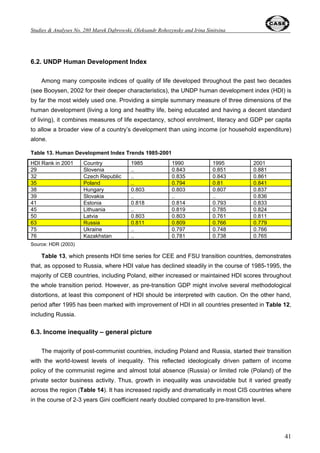
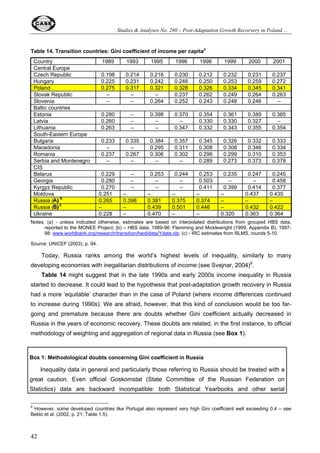
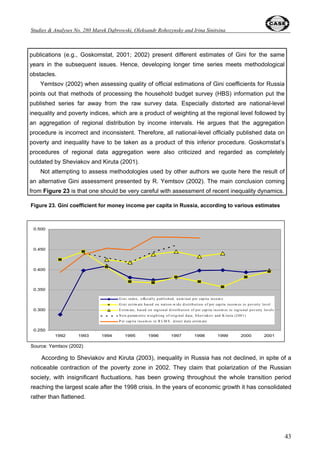
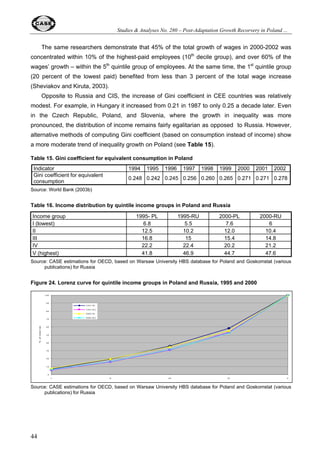
S t u d i e s & A n a l y s e s 
C e n t r u m A n a l i z
C e n t e r f o r S o c i a l 
a n d E c o n o m i c R e s e a r c h 
2 8 0
Oleksandr Rohozynsky, and Irina Sinitsina 
Post-Adaptation Growth Recovery in Poland and Russia 
– Similarities and Differences 
W a r s a w , J u n e 2 0 0 4
Materials published here have a working paper character. They can be subject to further publication. The 
views and opinions expressed here reflect the author(s) point of view and not necessarily those of the CASE. 
This paper was committed by the World Bank and Global Development Network as the 
background case study for the World Bank conference on ‘Scaling Up Poverty Reduction’ in 
Shanghai, China, May 25-27, 2004 and presented during this conference in its earlier, shorter 
version. See: 
http://info.worldbank.org/etools/docs/library/39235/Poland%20and%20Russia%20Comparative%2 
0Case%20Study.doc 
Keywords: transition, transition strategy, growth, poverty, income inequality, Poland, Russia, Central 
and Eastern Europe, CIS. 
© CASE – Center for Social and Economic Research, Warsaw 2004 
Graphic Design: Agnieszka Natalia Bury 
ISSN 1506-1701, ISBN: 83-7178-343-4 
© CASE – Center for Social and Economic Research, Warsaw 2004 
Graphic Design: Agnieszka Natalia Bury 
ISSN 1506-1701, ISBN: 83-7178-340-X 
Publisher: 
CASE – Center for Social and Economic Research 
12 Sienkiewicza, 00-944 Warsaw, Poland 
tel.: (48 22) 622 66 27, 828 61 33, fax: (48 22) 828 60 69 
e-mail: case@case.com.pl 
http://www.case.com.pl/
Contents 
Abstract.............................................................................................................................. 5 
1. Introduction ................................................................................................................... 6 
2. Output decline – unavoidable but painful adjustment............................................... 8 
3. Post-Adaptation Recovery: General Characteristics............................................... 11 
4. Structural features of growth patterns in Poland and Russia ................................ 15 
4.1. Employment structure and labor market developments ................................. 15 
4.2. The Role of SME and FDI.................................................................................... 20 
4.3. The role of energy sector ................................................................................... 22 
4.4. Export and import dynamics and structure, the role of European 
integration................................................................................................................. 26 
4.5. Fiscal policy pattern............................................................................................ 30 
5. Composite indices of structural and institutional reforms ..................................... 33 
5.1. EBRD assessment of privatization and structural reforms............................. 33 
5.2. Modified EBRD index.......................................................................................... 34 
5.3. Freedom House indices...................................................................................... 35 
5.4. Transparency International Corruption Perceptions Index............................. 37 
5.5. The Heritage Foundation Index of Economic Freedom................................... 37 
5.6. The Fraser Institute’s Economic Freedom of the World (EFW) Index............ 38 
6. Social dimension of growth patterns ........................................................................ 39 
6.1. Household consumption .................................................................................... 40 
6.2. UNDP Human Development Index ..................................................................... 41 
6.3. Income inequality – general picture .................................................................. 41 
6.4. Factors potentially influencing income inequality........................................... 45 
6.5. Poverty scale and dynamics .............................................................................. 50 
6.6. Major poverty sources and vulnerable groups ................................................ 52 
7. Lessons Learned......................................................................................................... 55 
References....................................................................................................................... 58
Studies  Analyses No. 280 – Post-Adaptation Growth Recorvery in Poland ...
Professor of Economics, Chairman of the Council of the CASE – Center for Social and Economic 
Research in Warsaw, Chairman of the Supervisory Board of the CASE-Ukraine in Kiev, Member of 
the Board of Trustees of the Institute for the Economy in Transition in Moscow, former First Deputy 
Minister of Finance (1989-1990), Member of Parliament (1991-1993) and Member of the Monetary 
Policy Council of the National Bank of Poland (1998-2004). In the last decade he has been 
involved in policy advising and policy research in Belarus, Bosnia and Herzegovina, Bulgaria, 
Georgia, Iraq, Kazakhstan, Kyrgyzstan, Macedonia, Moldova, Mongolia, Romania, Russia, Serbia, 
Ukraine and Uzbekistan and in a number of international research projects related to monetary and 
fiscal policies, currency crises, EU and EMU enlargement, and political economy of transition. 
Consultant of the World Bank and UNDP. 
Oleksandr Rohozynsky 
Executive Director of CASE Ukraine. He holds masters degrees in Applied Mathematics, 
Economics, Policy Analysis, and Business Administration, and is working towards his Ph.D. in 
Policy Analysis at the RAND Graduate School, Santa Monica, CA, USA. He is economist and 
researcher with over 6 years of experience working in Ukraine and the US, including: leading and 
managing projects for Ukrainian think-tank; working with various international organizations, 
including World Bank, Soros International Economic Advisory Group, HIID/CASE; and providing 
support and advise to decision-makers in Ministry of Economy, Ministry of Finance and Prime- 
Minister of Ukraine. 
Irina Sinitsina 
Irina Sinitsina, (Ph.D., Moscow State University, 1975) is a leading researcher at the Institute of 
International Economic and Political Studies, Russian Academy of Sciences (Moscow, Russia) and 
CASE's Senior Researcher, Member of the Board of Directors of CASE - Transcaucasus in Tbilisi, 
Georgia. She specializes in the analysis of social policy, including social security systems, social 
services, labor market, income and employment policies in Russia, Poland, Georgia, Ukraine and 
other FSU and Central /Eastern European countries. Since 1992, she has advised Russian 
ministries, governmental agencies, and the Central Bank of the Russian Federation on various 
social and employment policy issues. She is an author or co-author of over 40 monographs, 
chapters and articles published in academic magazines on the issues of social policy, social 
security, income and employment policies in transition economies. 
4
Studies  Analyses No. 280
Oleksandr Rohozynsky and Irina Sinitsina 
5 
Abstract 
The purpose of this paper is to analyze the sources, economic and social characteristics, of 
growth recovery, which followed the first period of output decline in two transition countries – 
Poland and Russia. They represent two different groups of transition countries (new EU member 
states vs. CIS) in terms of adopted transition strategy and accomplished results. Generally, fast 
reformers succeeded and slow reformers experienced a lot of troubles. Although eventually all 
former communist countries entered the path of economic growth, those which moved slowly lost 
sometimes the whole decade. Social costs of slow reforms were also dramatic: income 
degradation and rising inequalities, high level of poverty and corruption, various social and 
institutional distortions and pathologies, violation of human rights and civil and economic liberties, 
attempts of authoritarian restoration, etc. 
The period of ‘adaptation’ output decline was much more severe and longer in Russia than in 
Poland, and recovery came later. Unlike in the leading transition countries, the role of new private 
firms and FDI in Russia has been very limited what can be explained by administrative barriers, 
widespread corruption, lack of transparency, instability and contradictions in economic legislation, 
reflecting poor business climate. In the absence of FDI and with limited role of SME Russian 
economy is dominated by large domestic corporations, many of them having an ‘oligarchic’ 
characteristic. This additionally complicates the political economy of market reforms and weakens 
constituency of favor of open democratic society and liberal economic policies. 
The high oil prices helped in economic recovery and fiscal adjustment in Russia in early 2000s. 
However, Russian economy has become increasingly oil-dependent. While major obstacles to 
future Russia’s growth can origin from its structural monoculture dominated by the oil and energy 
sector, and poor business climate, the excessive welfare state can be considered as the main 
development burden in the case of Poland. 
In both analyzed countries poverty and inequality increased substantially during 1990s, to 
much bigger extent in Russia compared to Poland. While part of the income polarization was 
inevitably connected with departure from communist egalitarianism and part of poverty 
phenomenon reflected transition adaptation costs, other factors such as continuous structural 
distortions, incomplete liberalization, high inflation, insufficient competition, barriers to 
entrepreneurship, institutional weaknesses of the state captured by oligarchs, corruption, etc., 
played a significant role here.
Studies  Analyses No. 280 – Post-Adaptation Growth Recorvery in Poland ... 
1. Introduction 
6 
The purpose of this paper is to analyze the sources, economic and social characteristics, and 
perspectives of growth recovery, which followed the first period of output decline in transition 
economies. As the first stage of transition was inevitably associated with a deep output correction 
resulting mostly from distortions inherited from the command economy, which we call the 
‘adaptation’ output decline, the recovery which followed will be called by us as the ‘post-adaptation’ 
recovery. 
Our analysis covers two important transition countries (Poland and Russia) representing 
different transition histories, strategies and trajectories and respective periods, which can be 
identified as representing post adaptation recovery (1992-1999 in Poland and 1999-2003 in 
Russia). While the analyzed growth episode is already over in the case of Poland, it is not over in 
Russia yet which may give an interesting food for thought as to what kind of growth challenges 
Russia can meet in the near future (under assumption that both growth episodes are comparable 
enough). 
Poland was the pioneer of post-communist political and economic transition starting this 
process already in 1989. In Russia it became possible two years later when the Soviet Union 
collapsed. In the first stage of its transition Poland represented a classical case of fast reform 
strategy called sometimes in more journalist-type analyzes as ‘shock-therapy’1. Russia tried to 
follow the same pattern but failed for domestic political reasons, representing eventually a much 
slower and less consequent reform path. From the early 1990s Poland and other Central European 
and Baltic countries (CEB hereafter) enjoyed a geopolitical chance to participate in the European 
integration with the EU membership finalized on May 1, 2004. Only very recently, Russia started to 
discuss seriously the perspective of its deeper cooperation and possibly partial integration with the 
EU, and the EU started to consider Russia as its future strategic partner. 
For research purposes, Poland can be a good representative of the group of CEB countries 
considered by many comparative researches and rankings as examples of transition success (see 
e.g. World Bank, 2002; Dabrowski and Gortat, 2002; subsequent EBRD Transition Reports). On 
the other hand, Russia is the biggest CIS country and shares many structural, institutional and 
political problems of this group. This gives us a good comparative ground for analyzing some 
‘stylized’ characteristics of economic developments of both sub-regions (i.e. CEB and CIS) and 
drawing conclusions related to the differences in transition strategies. 
Although the main focus of this paper is placed on the post-adaptation output recovery period 
we start our analysis from the short characteristics of the previous period, i.e. adaptation output 
1 As the notion of ‘shock therapy’ has a substantial emotional and sometimes pejorative content we will not use it in this 
paper preferring instead to talk about ‘fast’ or ‘slow’ (gradual) reforms.
Studies  Analyses No. 280
Oleksandr Rohozynsky and Irina Sinitsina 
decline because the observed differences in both countries (in terms of size, length and specific 
causes of this decline) determined various starting points of the growth stage. This is the topic of 
Section 2 of this study. In Section 3 we present a general characteristic of post-adaptation recovery 
period in Poland and Russia. Section 4 deals with some specific features distinguishing Poland’s 
and Russia’s growth patterns in the analyzed periods. It relates to changes in employment 
structure and labor market developments, the role of newly created small and medium-size 
enterprises, foreign direct investment, the role of energy sector (particularly in Russia), sectoral 
and geographical structure of trade, and fiscal policy pattern. In Section 5 we analyze progress in 
the sphere of structural and institutional reforms in both countries. Section 6 contains the analysis 
of social dimension of growth in both countries, i.e. the influence of growth pattern and structural 
and institutional characteristics of both economies on income level and its differentiation. Finally, 
Section 7 presents policy lessons for other countries. 
Taking into account a very broad topic of this paper and limited time and resources to prepare 
it the authors had to rely, whenever it was possible, on the already existing analyzes, statistics and 
international comparisons and ratings of the IMF, World Bank, EBRD, OECD and several 
international think tanks/NGOs like the Freedom House, Transparency International, Heritage 
Foundation, etc. Several earlier studies of CASE and its network partners (like the Institute for the 
Economy of Transition in Moscow) were of great help in preparing this particular analysis. Authors 
are very grateful to OECD for its kind agreement to use results of the earlier CASE research on 
income distribution in Poland (being the part of OECD-sponsored project) for purpose of this study. 
We also would like to acknowledge a valuable consultation of Katarzyna Pietka who helped us to 
select and interpret statistical data on income distribution, inequality, poverty and social 
expenditures in Poland. Asad Alam and Radwan Shaban from the World Bank and Lyn Squire 
from the Global Development Network Secretariat gave us valuable remarks and suggestions to 
earlier (pre-conference) versions of this paper. Professor Bradford DeLong from the University 
California, Berkeley commented this paper during the Shanghai Poverty Conference. However, 
authors are solely responsible for the content and quality of this paper as well as for provided 
interpretations and conclusions. 
As there is no a well-grounded and universally accepted transition growth theory we have 
focused on partial hypotheses developed in the already existing cross-country analyzes (see e.g. 
De Melo, Denizer, and Gelb, 1996; Aslund, Boone, and Johnson, 1996; Fischer, Sahay and Vegh, 
1996; Havrylyshyn et al, 2000; WEO, 2000; Gros and Suhrcke, 2001; Fischer and Sahay, 2001; 
Campos and Coricelli, 2002; World Bank, 2002; EBRD, various issues). Methodology of most of 
these empirical exercises refers to the endogenous growth theory. We also use the same 
approach, although in a less formalized way – using the technique of narrative analysis and simple 
statistical comparison. 
7
Studies  Analyses No. 280 – Post-Adaptation Growth Recorvery in Poland ... 
2. Output decline – unavoidable but painful adjustment 
8 
A deep output decline was a common phenomenon for all the transition economies. This 
decline occurred regardless of the transition strategy used (Aslund, Boone and Johnson, 1996). 
However, the size of this decline varied depending on which transition strategy country adopted, 
conditions at the beginning of the transition, or external shocks (see WEO, 2000; World Bank, 
2002). 
Apart from short-term costs of macroeconomic stabilization (see Balcerowicz and Gelb, 1994; 
Dabrowski, 1996) the size of ‘adaptation’ output decline was determined mostly by the scale of 
structural and institutional distortions inherited from the command economy. Adjustment triggered 
by liberalization of domestic and external markets caused a significant shift in the relative demand. 
On the external side, the previous export markets organized on the basis of central planning 
mechanism collapsed, particularly CMEA (1990-1991), and the Soviet inter-republican market 
(1992-1993). New import opportunities decreased demand for some domestic products while new 
export opportunities gave a chance to increase production of other goods. However, because the 
elasticity of supply response was usually limited, a shift in relative external demand had to be 
connected with a temporary decrease of output. 
Among domestic relative-demand factors one should mention: demilitarization (see Gaidar 
1997; 2003a; 2003b; Yasin, 2003), decreasing investment rate and change in the structure of 
investment demand, rationalization of inter-regional links (especially in Russia), elimination of 
forced substitution (see Winiecki, 1990, pp.781-783), more consumer freedom coming from 
elimination of the rationing system and from privatization of part of collective consumption (e.g., 
housing). 
The second group of microeconomic factors was connected with a dramatic change in the cost 
level and structure coming from price liberalization, and elimination of multiple exchange rates, 
various explicit and implicit subsidies, and special price arrangements inside the CMEA and the 
former Soviet Union (related mostly to heavily underpriced energy resources).
Studies  Analyses No. 280
Oleksandr Rohozynsky and Irina Sinitsina 
134.8 
73.5 
9 
Figure 1. Real GDP growth in selected transition economies (1989 = 100) 
96 
88.4 
91.2 
P o lan d 
E st o n ia 
Russia 
Arm en ia 
82.2 84.3 
87.6 
92.1 
98.6 
104.5 
78 
71.2 
62.2 59.6 57.5 58 55.2 58.2 
140 
130 
120 
110 
100 
90 
80 
70 
60 
50 
40 
30 
1990 1991 1992 1993 1994 1995 1996 1997 1998 1999 2000 2001 2002 2003 
1989 = 100 
Note: data for 2003 are based on WEO (2003) and authors’ forecast. 
Source: TransMonee (2002); WEO (2003) 
111.6 
116.9 
121.7 
126.6 129.1 130.9 
63 
66.5 
69.4 
Finally, the third group of factors was related to microeconomic behavior and involved such 
issues as collapse of the mobilization role of central plan and administrative incentives connected 
with a totalitarian regime, expectations and incentives created by the privatization process2, 
expectations of massive bailouts of state enterprises by the government based on past reform 
experience under communism (creating credibility problems for post-communist reformers), and 
lack of skills to work under market conditions (see Dabrowski, 1996; Gaidar, 2003a; 2003b). 
Apart from the initial conditions determined by communist heritage and external shock the size 
of ‘adaptation’ output decline was also influenced by transition strategy. Policies did matter, 
particularly speed of reforms and their consistency (see World Bank, 1996; 2002; IMF, 2000; 
Havrylyshyn et al., 2000; De Melo et al., 2001). Wyplosz (1999) presented evidence that the 
countries, which proceeded with reforms in the fast manner, for example Poland, suffered smaller 
decline before stabilization than countries implementing gradual reforms, such as Russia. 
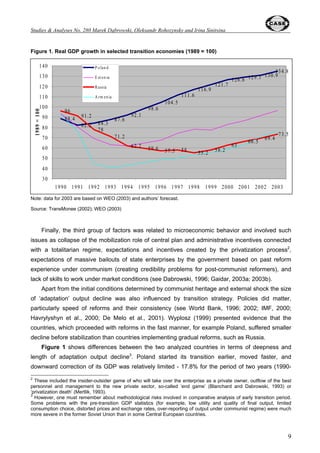
Figure 1 shows differences between the two analyzed countries in terms of deepness and 
length of adaptation output decline3. Poland started its transition earlier, moved faster, and 
downward correction of its GDP was relatively limited - 17.8% for the period of two years (1990- 
2 These included the insider-outsider game of who will take over the enterprise as a private owner, outflow of the best 
personnel and management to the new private sector, so-called ‘end game’ (Blanchard and Dabrowski, 1993) or 
‘privatization death’ (Mertlik, 1993). 
3 However, one must remember about methodological risks involved in comparative analysis of early transition period. 
Some problems with the pre-transition GDP statistics (for example, low utility and quality of final output, limited 
consumption choice, distorted prices and exchange rates, over-reporting of output under communist regime) were much 
more severe in the former Soviet Union than in some Central European countries.
Studies  Analyses No. 280 – Post-Adaptation Growth Recorvery in Poland ... 
1991) only. Starting from 1992 (precisely from Q4 1991), Poland’s economy took off. In Russia, 
output decline amounted to almost 45% of a pre-transition level and lasted for 8 years. Positive 
GDP dynamics accompanied by certain macroeconomic stabilization started only in 1997 but in 
1998 Russian economy was again thrown back by the financial crisis. Finally, a sustainable 
recovery started in Q3 1999. 
Figure 2. Military expenditures in Poland and Russia, 1988-2001 
18 
16 
14 
12 
10 
8 
6 
4 
2 
0 
Poland 
Russia 
1988 1989 1990 1991 1992 1993 1994 1995 1996 1997 1998 1999 2000 2001 
% of GD 
Source: World Development Indicators 2003 
Ye ars 
Table 1. Russia: output of military industry, 1991-2001, constant prices, 1991=100. 
Item 1991 1995 1996 1997 1998 1999 2000 2001 
Military output 100 25.1 18.8 13.9 16.6 23.1 29.1 29.5 
Civilian output 100 39.9 28.9 28.5 28.3 36.3 44.5 50.1 
Total output 100 31.4 23.1 20.1 21.7 29.1 36.2 38.4 
Employment 100 54.4 46.9 41 36 33.3 34.1 33.5 
Source: SIPRI (2003) 
10 
How the above differences can be explained? Certainly, initial conditions did matter strongly. 
Russia had longer and more severe experience with communism and command economy than 
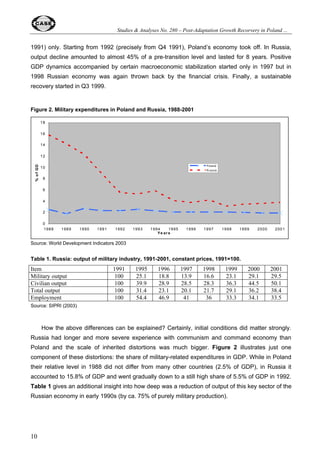
Poland and the scale of inherited distortions was much bigger. Figure 2 illustrates just one 
component of these distortions: the share of military-related expenditures in GDP. While in Poland 
their relative level in 1988 did not differ from many other countries (2.5% of GDP), in Russia it 
accounted to 15.8% of GDP and went gradually down to a still high share of 5.5% of GDP in 1992. 
Table 1 gives an additional insight into how deep was a reduction of output of this key sector of the 
Russian economy in early 1990s (by ca. 75% of purely military production).
Studies  Analyses No. 280
Oleksandr Rohozynsky and Irina Sinitsina 
However, initial conditions cannot explain the whole size of GDP correction in Russia and its 
enormous length. Figure 1 contains also data for two other former Soviet republics – Estonia and 
Armenia. One can assume that the size of inherited distortions was not smaller in these two 
countries than in the case of Russia, keeping in mind that both were fully dependent on 
underpriced oil and gas from Russia. Hence, after collapse of the USSR they had to adjust to much 
higher world oil and gas prices while Russia could gain from eliminating price distortions. 
Estonia recorded five-year GDP decline (three years after obtaining independence and starting 
market reforms) of cumulative scale of 38.1%. In Armenia cumulative GDP decline was the highest 
among the four analyzed countries (by almost 60% as a result of the war with Azerbaijan) but 
lasted only four years and was followed by a strong and long lasting (already ten years) recovery. 
The conclusion which can be drawn from the above brief and a bit simplified analysis is that 
Russia’s negative growth trend through most of 1990s was determined by the slow pace and non-optimal 
sequencing of economic reforms (in addition to highly unfavorable initial conditions). Slow 
pace and inconsistency of macroeconomic stabilization and liberalization hampered structural and 
institutional changes, which were necessary to stop output decline and start its recovery. Populist 
policies only slowed down adaptation process and made it longer and more severe (see Figure 1). 
Comparisons with other countries show that progress in macroeconomic stabilization 
(especially lowering inflation) became a key factor of subsequent output recovery (see e.g. Fischer, 
Sahay, and Vegh, 1996; Havrylyshyn et al., 2000; Fischer and Sahay, 2001). Countries that tamed 
inflation quickly experienced a speedier and stronger recovery in output (see e.g. IMF, 2000). 
Moreover, in many CEE countries the early success of economic stabilization helped to strengthen 
the constituency in favor of further reforms, both political and economic ones. In Russia, though, 
the economic growth was delayed and the country has found itself in a slow-reform equilibrium for 
several years. 
11 
3. Post-Adaptation Recovery: General Characteristics 
As we mentioned in Section 2 Poland’s output decline was relatively short (two years only) and 
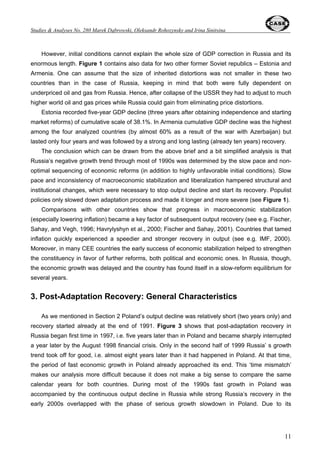
recovery started already at the end of 1991. Figure 3 shows that post-adaptation recovery in 
Russia began first time in 1997, i.e. five years later than in Poland and became sharply interrupted 
a year later by the August 1998 financial crisis. Only in the second half of 1999 Russia’ s growth 
trend took off for good, i.e. almost eight years later than it had happened in Poland. At that time, 
the period of fast economic growth in Poland already approached its end. This ‘time mismatch’ 
makes our analysis more difficult because it does not make a big sense to compare the same 
calendar years for both countries. During most of the 1990s fast growth in Poland was 
accompanied by the continuous output decline in Russia while strong Russia’s recovery in the 
early 2000s overlapped with the phase of serious growth slowdown in Poland. Due to its
Studies  Analyses No. 280 – Post-Adaptation Growth Recorvery in Poland ... 
particularly long and severe period of output decline, Russia (and some other CIS economies such 
as Ukraine, Moldova or Kazakhstan) lagged one ‘phase’ behind Poland, other Central European, 
Baltic and even some CIS countries such as Armenia or Kyrgyzstan. Hence, we decided to extract 
a ‘recovery’ phase from each country growth statistics, eliminating in this way the above mentioned 
‘time mismatch’. 
Figure 3. Annual growth rate of real GDP in Poland and Russia, in percent 
- 6 ,2 
2 ,1 
3 ,3 
4 ,5 
6 ,8 
6 
- 4 ,8 
- 1 3 ,2 
- 6 ,8 
- 9 
- 4 ,2 
1 0 
5 
0 
-5 
-1 0 
-1 5 
Poland 
Russia 
1991 1992 1993 1994 1995 1996 1997 1998 1999 2000 2001 2002 
Sources: WEO (2003), p. 181, Table 7; CASE database 
6 ,8 
4 ,8 
9 
5 ,4 5 
4 ,1 4 
- 1 
1 ,8 
- 4 ,9 
Figure 4. Annual rate of real GDP growth in subsequent year of recovery period 


+XQJDU 
/DWYLD 
3RODQG 
6ORYDNLD 
(VWRQLD 
5XVVLD 


    HDU      
Sources: WEO (2003), p. 181, Table 7; CASE database 
12 
1 1 ,3 
4 ,3 


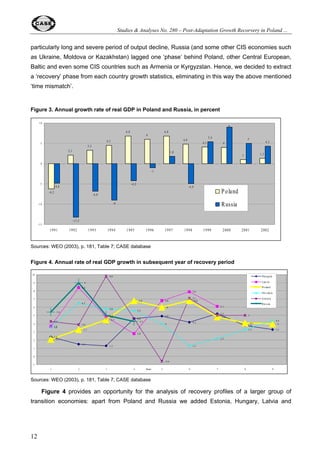
Figure 4 provides an opportunity for the analysis of recovery profiles of a larger group of 
transition economies: apart from Poland and Russia we added Estonia, Hungary, Latvia and
Studies  Analyses No. 280
Oleksandr Rohozynsky and Irina Sinitsina 
Slovakia4 and calibrated the chart in the way which allows comparing growth trends beginning from 
the moment when the ‘adaptation’ output decline became overcome. It means that year 1 in Figure 
4 means the first year of output recovery, i.e. 1992 for Poland, 1994 for Hungary and Slovakia, 
1995 for Estonia, 1996 for Latvia, and 1999 for Russia. 
In spite of countries’ specifics some general observations could be drawn from Figure 4. First, 
‘taking off’ trend was quite rapid in most analyzed countries, accomplishing high growth rates 
already in the second or third year of the recovery phase5. It seems to confirm the hypothesis that 
the first stage of take off based mostly on reallocation of existing resources and capacities 
(exploiting the so-called simple reserves) and not on new investments which, on the contrary, were 
strongly depressed during the phase of ‘adaptation’ output decline. The investment volume started 
to increase rapidly only after economy already took off. For example, in Poland real gross fixed 
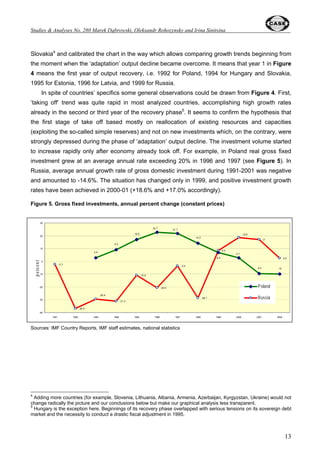
investment grew at an average annual rate exceeding 20% in 1996 and 1997 (see Figure 5). In 
Russia, average annual growth rate of gross domestic investment during 1991-2001 was negative 
and amounted to -14.6%. The situation has changed only in 1999, and positive investment growth 
rates have been achieved in 2000-01 (+18.6% and +17.0% accordingly). 
 
13 
Figure 5. Gross fixed investments, annual percent change (constant prices) 


p ercen t 


Poland 
Russia 
            
Sources: IMF Country Reports, IMF staff estimates, national statistics 


4 Adding more countries (for example, Slovenia, Lithuania, Albania, Armenia, Azerbaijan, Kyrgyzstan, Ukraine) would not 
change radically the picture and our conclusions below but make our graphical analysis less transparent. 
5 Hungary is the exception here. Beginnings of its recovery phase overlapped with serious tensions on its sovereign debt 
market and the necessity to conduct a drastic fiscal adjustment in 1995.
Studies  Analyses No. 280 – Post-Adaptation Growth Recorvery in Poland ... 
14 
Thus, the first stage of recovery in transition economy seemed to be based on a catching-up 
effect using mostly the existing resources released by the ‘adaptation’ output decline and facilitated 
by the systemic changes accomplished to date. It cannot be excluded that countries with recorded 
deeper output decline (like Russia) had more simple reserves and, therefore, more rooms for a 
catching up growth. However, it is clear that sustainability of economic growth depends critically on 
further reform steps (see below). 
The second conclusion, which can be drawn from Figure 4 relates to a generally decreasing 
growth trend after the first take-off stage has been over. It additionally supports the catching-up 
interpretation of the first stage of post-adaptation recovery. In some cases (the example of 
Slovakia after 1998) the new reform effort has been needed to give a growth trend a new impulse. 
The phenomenon of declining growth trend could be well observed in the case of Poland. After 
peaking up in 1994-19976 the growth rate started to go down systematically and reached a very 
low level (close to 1%) in the period of Q4 2000 – Q1 2003. Apart from exogenous factors such as 
the influence of Russian financial crisis (which brought the shock in Q4 1998 and the first half of 
1999) and general slowdown of the world and European economy after 2000, a number of 
domestic factors played an important role. Among the latter one can mention: the slow pace of 
privatization and restructuring of several important sectors (coal, steel and other heavy industries, 
energy sector, railways, telecommunication, etc.), increasing labor market rigidities, high level of 
fiscal redistribution (in the range of 45-50% of GDP), excessive social commitments and resulting 
high taxes, reversal of deregulation trend of the early 1990s, and adjustment costs connected with 
the adoption of EU acquis communautaire. 
In addition, due to serious macroeconomic imbalances accompanying years of very high 
growth rates (chronic two-digit inflation and rapidly increasing current account deficit) a serious 
tightening of both monetary and fiscal policies became necessary. While fiscal tightening occurred 
to be short-living (only in 1998-1999, followed by a substantial fiscal relaxation in the subsequent 
years) monetary tightening of 1999-2000 managed to bring inflation to a very low one-digit level 
(end-year inflation rate of 3.6% in 2001 and 0.8% in 2002 comparing to 9.8% in 1999) and 
substantially reduce current account deficit - from 8.1% of GDP in 1998 to 3.1% of GDP in 2001 
(World Bank, 2003, p. 197, Table A18). However, the real sector had to bear costs of the 
stabilization/disinflation policy, and suboptimal policy mix (relatively loose fiscal vs. tight monetary 
policy) increased negative output/ employment consequences. Hopefully, Polish economy will 
benefit in future from the recent stabilization policy and a new round of microeconomic 
restructuring, which took place in the beginning of the 2000s but it will be already another growth 
phase, which will require a separate analysis. 
6 At that time some Polish politicians and foreign observers started to talk about ‘Polish miracle’. The same could be 
occasionally heard in Russia in 2001-2003. However, authors of this paper are very careful with using this kind of 
emotional (and ex post usually evidently overly optimistic) characteristics. They reflect public demand for success story 
and politicians’ wishful thinking rather than any well-grounded empirical observation (and particularly any well-grounded 
forecast of future growth trend and its sustainability).
Studies  Analyses No. 280
Oleksandr Rohozynsky and Irina Sinitsina 
According to our simplified trend comparison presented in Figure 4, in 2003 Russia would be 
in the similar phase of its growth recovery as Poland in 1996, i.e., at its highest growth momentum. 
Does also Russia face the perspective of gradually decreasing growth rate in the coming years? 
Possibly yes if the new growth impulses will not be added to those observed in the beginning of 
2000s. At this point we can risk a hypothesis that high growth rates in Russia starting from 2000 
may be explained by: (1) depth of the previous output decline and use of simple reserves (e.g., 
utilization of idle capacities); (2) positive effects of economic reforms conducted in 1990s 
(particularly privatization), and (3) high oil prices on international markets (see Dabrowski, 2003). 
We will come back to this question at the end of this paper after conducting a comparative 
structural and institutional analyzes of both economies. 
15 
4. Structural features of growth patterns in Poland and Russia 
In spite of potential similarities in growth trends in Poland in 1990s and Russia in early 2000s 
one should take a deeper look at the structural characteristics of both economies. Only such an 
analysis can bring us closer to the answer to the question whether we analyze the same 
phenomenon in both countries or different phenomena with some superficial similarities? In this 
section we try to address five concrete issues: employment structure and labor market 
developments, the role of small and medium size enterprises (SME) and foreign direct investments 
(FDI), the role of oil and energy production/ consumption, structure of foreign trade, and fiscal 
policy pattern. 
4.1. Employment structure and labor market developments 
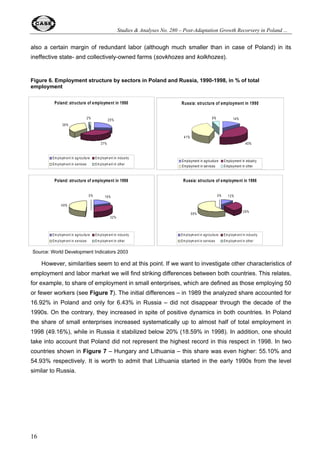
Figure 6 provides us with a general picture of changes in employment structure of two 
countries in consideration recorded between 1990 and 19987. Generally, it looks like both countries 
represent the similar structural changes: moving a substantial part of labor force from industry to a 
broadly defined service sector (more dramatic in Russia compared to Poland) and, in parallel, 
decreasing share of employment in agriculture (more substantial in Poland than in Russia), again 
in favor of service sector. Both tendencies and relative differences in both countries could hardly 
come as a surprise. Former communist countries were heavily over-industrialized (especially 
former USSR and Russia in particular) while market services were underdeveloped. Poland, which 
managed to avoid communist collectivization of its agriculture, suffered (and continues to suffer) 
over-employment in this sector typical for less developed countries. On the other hand, Russia had 
7 We do not have a fully comparable data for any later year. However, according to national statistics the proportions 
observed in 1998 did not undergo any serious changes during the next five years.
Studies  Analyses No. 280 – Post-Adaptation Growth Recorvery in Poland ... 
also a certain margin of redundant labor (although much smaller than in case of Poland) in its 
ineffective state- and collectively-owned farms (sovkhozes and kolkhozes). 
Figure 6. Employment structure by sectors in Poland and Russia, 1990-1998, in % of total 
employment 
Poland: structure of employment in 1990 
25% 
37% 
36% 
2% 
Em ploym en t in a g riculture Em p loym ent in indus try 
Em ploym en t in s ervices Em ploym en t in o ther 
Poland: structure of employment in 1998 
19% 
32% 
49% 
0% 
Em ploym en t in a g riculture Em p loym ent in indus try 
Em ploym en t in s ervices Em ploym en t in o ther 
Source: World Development Indicators 2003 
16 
Russia: structure of employment in 1990 
14% 
40% 
41% 
5% 
Employment in agriculture Employment in industry 
Employment in services Employment in other 
Russia: structure of employment in 1998 
12% 
29% 
59% 
0% 
Em ploym en t in a g riculture Em p loym ent in indus try 
Em ploym en t in s ervices Em ploym en t in o ther 
However, similarities seem to end at this point. If we want to investigate other characteristics of 
employment and labor market we will find striking differences between both countries. This relates, 
for example, to share of employment in small enterprises, which are defined as those employing 50 
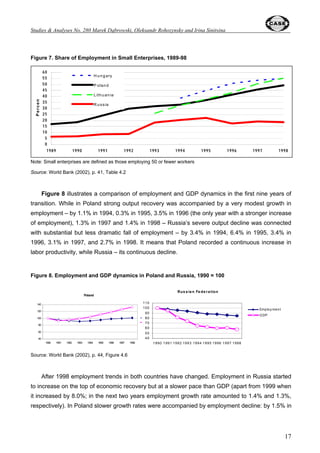
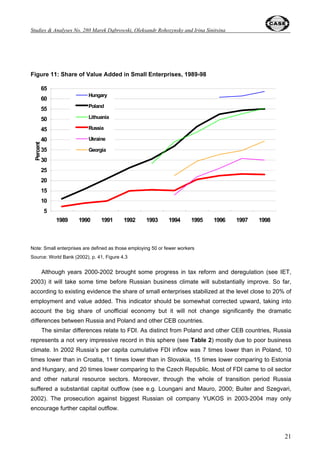
or fewer workers (see Figure 7). The initial differences – in 1989 the analyzed share accounted for 
16.92% in Poland and only for 6.43% in Russia – did not disappear through the decade of the 
1990s. On the contrary, they increased in spite of positive dynamics in both countries. In Poland 
the share of small enterprises increased systematically up to almost half of total employment in 
1998 (49.16%), while in Russia it stabilized below 20% (18.59% in 1998). In addition, one should 
take into account that Poland did not represent the highest record in this respect in 1998. In two 
countries shown in Figure 7 – Hungary and Lithuania – this share was even higher: 55.10% and 
54.93% respectively. It is worth to admit that Lithuania started in the early 1990s from the level 
similar to Russia.
Studies  Analyses No. 280
Oleksandr Rohozynsky and Irina Sinitsina 
Hungary 
Poland 
L ithuan ia 
Russia 
1989 1990 1991 1992 1993 1994 1995 1996 1997 1998 
17 
Figure 7. Share of Employment in Small Enterprises, 1989-98 
60 
55 
50 
45 
40 
35 
30 
25 
20 
15 
10 
5 
0 
Percen 
Note: Small enterprises are defined as those employing 50 or fewer workers 
Source: World Bank (2002), p. 41, Table 4.2 
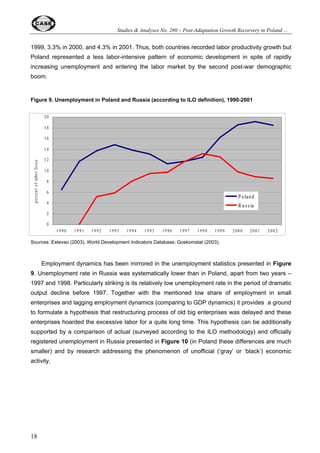
Figure 8 illustrates a comparison of employment and GDP dynamics in the first nine years of 
transition. While in Poland strong output recovery was accompanied by a very modest growth in 
employment – by 1.1% in 1994, 0.3% in 1995, 3.5% in 1996 (the only year with a stronger increase 
of employment), 1.3% in 1997 and 1.4% in 1998 – Russia’s severe output decline was connected 
with substantial but less dramatic fall of employment – by 3.4% in 1994, 6.4% in 1995, 3.4% in 
1996, 3.1% in 1997, and 2.7% in 1998. It means that Poland recorded a continuous increase in 
labor productivity, while Russia – its continuous decline. 
Figure 8. Employment and GDP dynamics in Poland and Russia, 1990 = 100 
Poland 
140 
120 
100 
80 
60 
40 
1990 1991 1992 1993 1994 1995 1996 1997 1998 
Source: World Bank (2002), p. 44, Figure 4.6 
110 
100 
90 
80 
Employment 
GDP 
Rus s ian Federation 
70 
60 
50 
40 
1990 1991 1992 1993 1994 1995 1996 1997 1998 
Employment 
GDP 
After 1998 employment trends in both countries have changed. Employment in Russia started 
to increase on the top of economic recovery but at a slower pace than GDP (apart from 1999 when 
it increased by 8.0%; in the next two years employment growth rate amounted to 1.4% and 1.3%, 
respectively). In Poland slower growth rates were accompanied by employment decline: by 1.5% in
Studies  Analyses No. 280 – Post-Adaptation Growth Recorvery in Poland ... 
1999, 3.3% in 2000, and 4.3% in 2001. Thus, both countries recorded labor productivity growth but 
Poland represented a less labor-intensive pattern of economic development in spite of rapidly 
increasing unemployment and entering the labor market by the second post-war demographic 
boom. 
Figure 9. Unemployment in Poland and Russia (according to ILO definition), 1990-2001 
2 0 
1 8 
1 6 
1 4 
1 2 
1 0 
8 
6 
4 
2 
0 
P olan d 
Rus s ia 
1 9 9 0 1 9 9 1 1 9 9 2 1 9 9 3 1 9 9 4 1 9 9 5 1 9 9 6 1 9 9 7 1 9 9 8 1 9 9 9 2 0 0 0 2 0 0 1 2 0 0 2 
p ercen t o f labo r fo rce 
Sources:
; Goskomstat (2003). 
18 
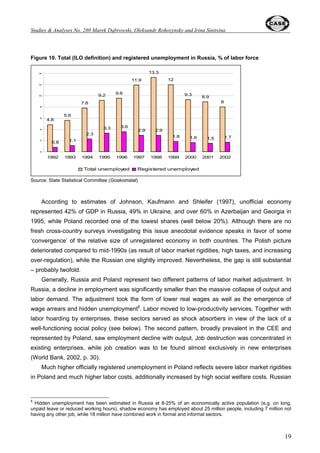
Employment dynamics has been mirrored in the unemployment statistics presented in Figure 
9. Unemployment rate in Russia was systematically lower than in Poland, apart from two years – 
1997 and 1998. Particularly striking is its relatively low unemployment rate in the period of dramatic 
output decline before 1997. Together with the mentioned low share of employment in small 
enterprises and lagging employment dynamics (comparing to GDP dynamics) it provides a ground 
to formulate a hypothesis that restructuring process of old big enterprises was delayed and these 
enterprises hoarded the excessive labor for a quite long time. This hypothesis can be additionally 
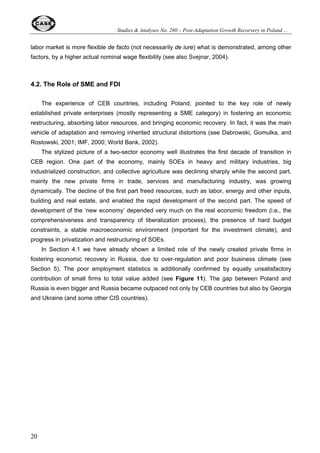
supported by a comparison of actual (surveyed according to the ILO methodology) and officially 
registered unemployment in Russia presented in Figure 10 (in Poland these differences are much 
smaller) and by research addressing the phenomenon of unofficial (‘gray’ or ‘black’) economic 
activity.
Studies  Analyses No. 280
Oleksandr Rohozynsky and Irina Sinitsina 
19 
Figure 10. Total (ILO definition) and registered unemployment in Russia, % of labor force
Source: State Statistical Committee (Goskomstat) 


According to estimates of Johnson, Kaufmann and Shleifer (1997), unofficial economy 
represented 42% of GDP in Russia, 49% in Ukraine, and over 60% in Azerbaijan and Georgia in 
1995, while Poland recorded one of the lowest shares (well below 20%). Although there are no 
fresh cross-country surveys investigating this issue anecdotal evidence speaks in favor of some 
‘convergence’ of the relative size of unregistered economy in both countries. The Polish picture 
deteriorated compared to mid-1990s (as result of labor market rigidities, high taxes, and increasing 
over-regulation), while the Russian one slightly improved. Nevertheless, the gap is still substantial 
– probably twofold. 
Generally, Russia and Poland represent two different patterns of labor market adjustment. In 
Russia, a decline in employment was significantly smaller than the massive collapse of output and 
labor demand. The adjustment took the form of lower real wages as well as the emergence of 
wage arrears and hidden unemployment8. Labor moved to low-productivity services. Together with 
labor hoarding by enterprises, these sectors served as shock absorbers in view of the lack of a 
well-functioning social policy (see below). The second pattern, broadly prevalent in the CEE and 
represented by Poland, saw employment decline with output. Job destruction was concentrated in 
existing enterprises, while job creation was to be found almost exclusively in new enterprises 
(World Bank, 2002, p. 30). 
Much higher officially registered unemployment in Poland reflects severe labor market rigidities 
in Poland and much higher labor costs, additionally increased by high social welfare costs. Russian 
8 Hidden unemployment has been estimated in Russia at 8-25% of an economically active population (e.g. on long, 
unpaid leave or reduced working hours), shadow economy has employed about 25 million people, including 7 million not 
having any other job, while 18 million have combined work in formal and informal sectors.
Studies  Analyses No. 280 – Post-Adaptation Growth Recorvery in Poland ... 
labor market is more flexible de facto (not necessarily de iure) what is demonstrated, among other 
factors, by a higher actual nominal wage flexibility (see also Svejnar, 2004). 
4.2. The Role of SME and FDI 
20 
The experience of CEB countries, including Poland, pointed to the key role of newly 
established private enterprises (mostly representing a SME category) in fostering an economic 
restructuring, absorbing labor resources, and bringing economic recovery. In fact, it was the main 
vehicle of adaptation and removing inherited structural distortions (see Dabrowski, Gomulka, and 
Rostowski, 2001; IMF, 2000; World Bank, 2002). 
The stylized picture of a two-sector economy well illustrates the first decade of transition in 
CEB region. One part of the economy, mainly SOEs in heavy and military industries, big 
industrialized construction, and collective agriculture was declining sharply while the second part, 
mainly the new private firms in trade, services and manufacturing industry, was growing 
dynamically. The decline of the first part freed resources, such as labor, energy and other inputs, 
building and real estate, and enabled the rapid development of the second part. The speed of 
development of the ‘new economy’ depended very much on the real economic freedom (i.e., the 
comprehensiveness and transparency of liberalization process), the presence of hard budget 
constraints, a stable macroeconomic environment (important for the investment climate), and 
progress in privatization and restructuring of SOEs. 
In Section 4.1 we have already shown a limited role of the newly created private firms in 
fostering economic recovery in Russia, due to over-regulation and poor business climate (see 
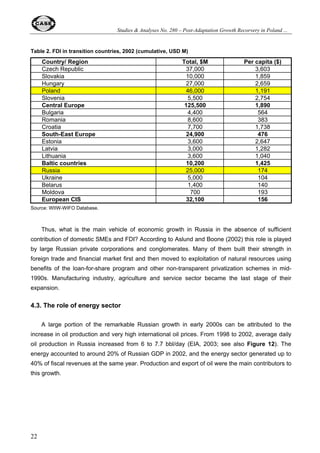
Section 5). The poor employment statistics is additionally confirmed by equally unsatisfactory 
contribution of small firms to total value added (see Figure 11). The gap between Poland and 
Russia is even bigger and Russia became outpaced not only by CEB countries but also by Georgia 
and Ukraine (and some other CIS countries).
Studies  Analyses No. 280
Oleksandr Rohozynsky and Irina Sinitsina 
21 
Figure 11: Share of Value Added in Small Enterprises, 1989-98 
65 
60 
55 
50 
45 
40 
35 
30 
25 
20 
15 
10 
5 
1989 1990 1991 1992 1993 1994 1995 1996 1997 1998 
Percent 
Hungary 
Poland 
Lithuania 
Russia 
Ukraine 
Georgia 
Note: Small enterprises are defined as those employing 50 or fewer workers 
Source: World Bank (2002), p. 41, Figure 4.3 
Although years 2000-2002 brought some progress in tax reform and deregulation (see IET, 
2003) it will take some time before Russian business climate will substantially improve. So far, 
according to existing evidence the share of small enterprises stabilized at the level close to 20% of 
employment and value added. This indicator should be somewhat corrected upward, taking into 
account the big share of unofficial economy but it will not change significantly the dramatic 
differences between Russia and Poland and other CEB countries. 
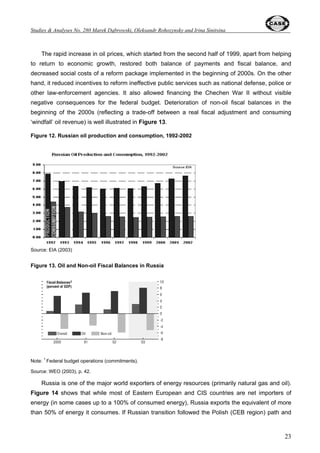
The similar differences relate to FDI. As distinct from Poland and other CEB countries, Russia 
represents a not very impressive record in this sphere (see Table 2) mostly due to poor business 
climate. In 2002 Russia’s per capita cumulative FDI inflow was 7 times lower than in Poland, 10 
times lower than in Croatia, 11 times lower than in Slovakia, 15 times lower comparing to Estonia 
and Hungary, and 20 times lower comparing to the Czech Republic. Most of FDI came to oil sector 
and other natural resource sectors. Moreover, through the whole of transition period Russia 
suffered a substantial capital outflow (see e.g. Loungani and Mauro, 2000; Buiter and Szegvari, 
2002). The prosecution against biggest Russian oil company YUKOS in 2003-2004 may only 
encourage further capital outflow.
Studies  Analyses No. 280 – Post-Adaptation Growth Recorvery in Poland ... 
Table 2. FDI in transition countries, 2002 (cumulative, USD M) 
22 
Country/ Region Total, $M Per capita ($) 
Czech Republic 37,000 3,603 
Slovakia 10,000 1,859 
Hungary 27,000 2,659 
Poland 46,000 1,191 
Slovenia 5,500 2,754 
Central Europe 125,500 1,890 
Bulgaria 4,400 564 
Romania 8,600 383 
Croatia 7,700 1,738 
South-East Europe 24,900 476 
Estonia 3,600 2,647 
Latvia 3,000 1,282 
Lithuania 3,600 1,040 
Baltic countries 10,200 1,425 
Russia 25,000 174 
Ukraine 5,000 104 
Belarus 1,400 140 
Moldova 700 193 
European CIS 32,100 156 
Source: WIIW-WIFO Database. 
Thus, what is the main vehicle of economic growth in Russia in the absence of sufficient 
contribution of domestic SMEs and FDI? According to Aslund and Boone (2002) this role is played 
by large Russian private corporations and conglomerates. Many of them built their strength in 
foreign trade and financial market first and then moved to exploitation of natural resources using 
benefits of the loan-for-share program and other non-transparent privatization schemes in mid- 
1990s. Manufacturing industry, agriculture and service sector became the last stage of their 
expansion. 
4.3. The role of energy sector 
A large portion of the remarkable Russian growth in early 2000s can be attributed to the 
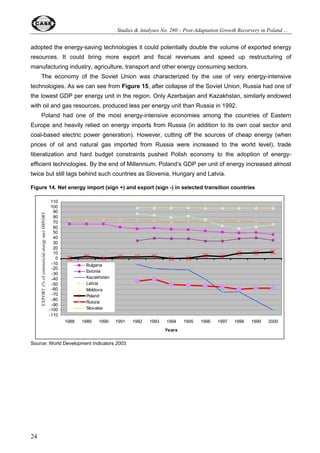
increase in oil production and very high international oil prices. From 1998 to 2002, average daily 
oil production in Russia increased from 6 to 7.7 bbl/day (EIA, 2003; see also Figure 12). The 
energy accounted to around 20% of Russian GDP in 2002, and the energy sector generated up to 
40% of fiscal revenues at the same year. Production and export of oil were the main contributors to 
this growth.
Studies  Analyses No. 280
Oleksandr Rohozynsky and Irina Sinitsina 
The rapid increase in oil prices, which started from the second half of 1999, apart from helping 
to return to economic growth, restored both balance of payments and fiscal balance, and 
decreased social costs of a reform package implemented in the beginning of 2000s. On the other 
hand, it reduced incentives to reform ineffective public services such as national defense, police or 
other law-enforcement agencies. It also allowed financing the Chechen War II without visible 
negative consequences for the federal budget. Deterioration of non-oil fiscal balances in the 
beginning of the 2000s (reflecting a trade-off between a real fiscal adjustment and consuming 
‘windfall’ oil revenue) is well illustrated in Figure 13. 
23 
Figure 12. Russian oil production and consumption, 1992-2002 
Source: EIA (2003) 
Figure 13. Oil and Non-oil Fiscal Balances in Russia 
Note: 1 Federal budget operations (commitments). 
Source: WEO (2003), p. 42. 
Russia is one of the major world exporters of energy resources (primarily natural gas and oil). 
Figure 14 shows that while most of Eastern European and CIS countries are net importers of 
energy (in some cases up to a 100% of consumed energy), Russia exports the equivalent of more 
than 50% of energy it consumes. If Russian transition followed the Polish (CEB region) path and
Studies  Analyses No. 280 – Post-Adaptation Growth Recorvery in Poland ... 
adopted the energy-saving technologies it could potentially double the volume of exported energy 
resources. It could bring more export and fiscal revenues and speed up restructuring of 
manufacturing industry, agriculture, transport and other energy consuming sectors. 
24 
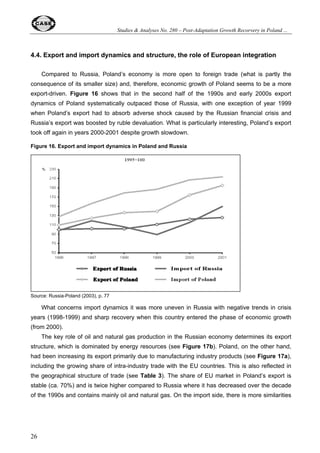
The economy of the Soviet Union was characterized by the use of very energy-intensive 
technologies. As we can see from Figure 15, after collapse of the Soviet Union, Russia had one of 
the lowest GDP per energy unit in the region. Only Azerbaijan and Kazakhstan, similarly endowed 
with oil and gas resources, produced less per energy unit than Russia in 1992. 
Poland had one of the most energy-intensive economies among the countries of Eastern 
Europe and heavily relied on energy imports from Russia (in addition to its own coal sector and 
coal-based electric power generation). However, cutting off the sources of cheap energy (when 
prices of oil and natural gas imported from Russia were increased to the world level), trade 
liberalization and hard budget constraints pushed Polish economy to the adoption of energy-efficient 
technologies. By the end of Millennium, Poland’s GDP per unit of energy increased almost 
twice but still lags behind such countries as Slovenia, Hungary and Latvia. 
Figure 14. Net energy import (sign +) and export (sign -) in selected transition countries 
110 
100 
90 
80 
70 
60 
50 
40 
30 
20 
10 
0 
-10 
-20 
-30 
-40 
-50 
-60 
-70 
-80 
-90 
-100 
-110 
1988 1989 1990 1991 1992 1993 1994 1995 1996 1997 1998 1999 2000 
Source: World Development Indicators 2003 
Years 
EXPORT (% of commercial energy use) IMPORT 
Bulgaria 
Estonia 
Kazakhstan 
Latvia 
Moldova 
Poland 
Russia 
Slovakia
Studies  Analyses No. 280
Oleksandr Rohozynsky and Irina Sinitsina 
25 
Figure 15. GDP per unit of energy use (PPP $ per kg of oil equivalent) 
5.5 
5 
4.5 
4 
3.5 
3 
2.5 
2 
1.5 
1 
H unga ry 
K a z a khsta n 
L a tv ia 
Moldova 
P ola nd 
Russia 
Slove n ia 
1988 1989 1990 1991 1992 1993 1994 1995 1996 1997 1998 1999 2000 
Source: World Development Indicators 2003 
At the same time, domestic energy prices in Russia remained significantly lower than in the 
rest of the world. It led to conservation of the energy inefficient technologies. As a result, 
production per unit of energy remained almost unchanged during the period 1992 – 2000. This is in 
contrast even with other CIS countries such as Kazakhstan or Moldova where certain progress in 
energy efficiency has been recorded. 
In fact, more than four-fold devaluation of the ruble in 1998-1999 (as result of the August 1998 
financial crisis) and only limited adjustment of the ruble energy prices inside Russia led to a 
reversal of a limited progress achieved in this sphere before 1998. It increased domestic price 
distortions and artificially improved external competitiveness of the Russian manufacturing 
industry, in addition to real depreciation of the ruble (see Development Center, 2001; IET, 2003). It 
has seriously complicated Russia’s negotiations on the WTO accession, particularly with the EU 
(see EU, 2003).
Studies  Analyses No. 280 – Post-Adaptation Growth Recorvery in Poland ... 
4.4. Export and import dynamics and structure, the role of European integration 
26 
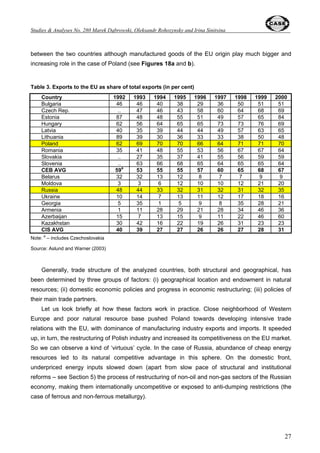
Compared to Russia, Poland’s economy is more open to foreign trade (what is partly the 
consequence of its smaller size) and, therefore, economic growth of Poland seems to be a more 
export-driven. Figure 16 shows that in the second half of the 1990s and early 2000s export 
dynamics of Poland systematically outpaced those of Russia, with one exception of year 1999 
when Poland’s export had to absorb adverse shock caused by the Russian financial crisis and 
Russia’s export was boosted by ruble devaluation. What is particularly interesting, Poland’s export 
took off again in years 2000-2001 despite growth slowdown. 
Figure 16. Export and import dynamics in Poland and Russia 
Source: Russia-Poland (2003), p. 77 
What concerns import dynamics it was more uneven in Russia with negative trends in crisis 
years (1998-1999) and sharp recovery when this country entered the phase of economic growth 
(from 2000). 
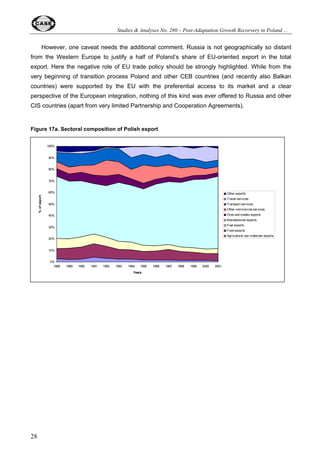
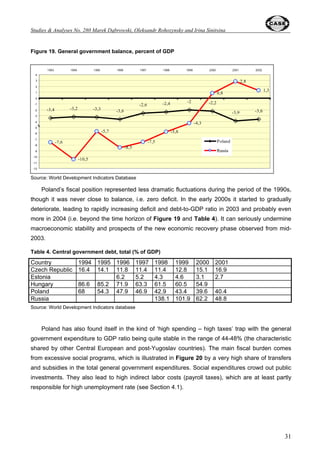
The key role of oil and natural gas production in the Russian economy determines its export 
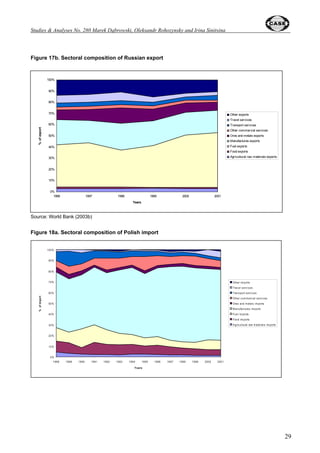
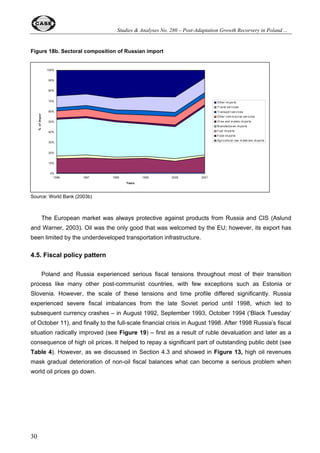
structure, which is dominated by energy resources (see Figure 17b). Poland, on the other hand, 
had been increasing its export primarily due to manufacturing industry products (see Figure 17a), 
including the growing share of intra-industry trade with the EU countries. This is also reflected in 
the geographical structure of trade (see Table 3). The share of EU market in Poland’s export is 
stable (ca. 70%) and is twice higher compared to Russia where it has decreased over the decade 
of the 1990s and contains mainly oil and natural gas. On the import side, there is more similarities
Studies  Analyses No. 280
Oleksandr Rohozynsky and Irina Sinitsina 
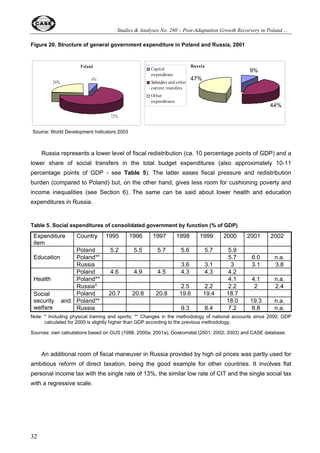
between the two countries although manufactured goods of the EU origin play much bigger and 
increasing role in the case of Poland (see Figures 18a and b). 
27 
Table 3. Exports to the EU as share of total exports (in per cent) 
Country 1992 1993 1994 1995 1996 1997 1998 1999 2000 
Bulgaria 46 46 40 38 29 36 50 51 51 
Czech Rep. .. 47 46 43 58 60 64 68 69 
Estonia 87 48 48 55 51 49 57 65 84 
Hungary 62 56 64 65 65 73 73 76 69 
Latvia 40 35 39 44 44 49 57 63 65 
Lithuania 89 39 30 36 33 33 38 50 48 
Poland 62 69 70 70 66 64 71 71 70 
Romania 35 41 48 55 53 56 67 67 64 
Slovakia .. 27 35 37 41 55 56 59 59 
Slovenia .. 63 66 68 65 64 65 65 64 
CEB AVG 59a 53 55 55 57 60 65 68 67 
Belarus 32 32 13 12 8 7 7 9 9 
Moldova 3 3 6 12 10 10 12 21 20 
Russia 48 44 33 32 31 32 31 32 35 
Ukraine 10 14 7 13 11 12 17 18 16 
Georgia 5 35 1 5 9 8 35 28 21 
Armenia 1 11 28 29 21 28 34 46 36 
Azerbaijan 15 7 13 15 9 11 22 46 60 
Kazakhstan 30 42 16 22 19 26 31 23 23 
CIS AVG 40 39 27 27 26 26 27 28 31 
Note: a – includes Czechoslovakia 
Source: Aslund and Warner (2003) 
Generally, trade structure of the analyzed countries, both structural and geographical, has 
been determined by three groups of factors: (i) geographical location and endowment in natural 
resources; (ii) domestic economic policies and progress in economic restructuring; (iii) policies of 
their main trade partners. 
Let us look briefly at how these factors work in practice. Close neighborhood of Western 
Europe and poor natural resource base pushed Poland towards developing intensive trade 
relations with the EU, with dominance of manufacturing industry exports and imports. It speeded 
up, in turn, the restructuring of Polish industry and increased its competitiveness on the EU market. 
So we can observe a kind of ‘virtuous’ cycle. In the case of Russia, abundance of cheap energy 
resources led to its natural competitive advantage in this sphere. On the domestic front, 
underpriced energy inputs slowed down (apart from slow pace of structural and institutional 
reforms – see Section 5) the process of restructuring of non-oil and non-gas sectors of the Russian 
economy, making them internationally uncompetitive or exposed to anti-dumping restrictions (the 
case of ferrous and non-ferrous metallurgy).
Studies  Analyses No. 280 – Post-Adaptation Growth Recorvery in Poland ... 
28 
However, one caveat needs the additional comment. Russia is not geographically so distant 
from the Western Europe to justify a half of Poland’s share of EU-oriented export in the total 
export. Here the negative role of EU trade policy should be strongly highlighted. While from the 
very beginning of transition process Poland and other CEB countries (and recently also Balkan 
countries) were supported by the EU with the preferential access to its market and a clear 
perspective of the European integration, nothing of this kind was ever offered to Russia and other 
CIS countries (apart from very limited Partnership and Cooperation Agreements). 
Figure 17a. Sectoral composition of Polish export 
100% 
90% 
80% 
70% 
60% 
50% 
40% 
30% 
20% 
10% 
0% 
1988 1989 1990 1991 1992 1993 1994 1995 1996 1997 1998 1999 2000 2001 
Years 
% of export 
Other exports 
Travel services 
Transport services 
Other commercial services 
Ores and metals exports 
Manufactures exports 
Fuel exports 
Food exports 
Agricultural raw materials exports
Studies  Analyses No. 280
Oleksandr Rohozynsky and Irina Sinitsina 
29 
Figure 17b. Sectoral composition of Russian export 
100% 
90% 
80% 
70% 
60% 
50% 
40% 
30% 
20% 
10% 
0% 
1996 1997 1998 1999 2000 2001 
% of export 
Source: World Bank (2003b) 
Years 
Figure 18a. Sectoral composition of Polish import 
Other exports 
Travel services 
Transport services 
Other commercial services 
Ores and metals exports 
Manufactures exports 
Fuel exports 
Food exports 
Agricultural raw materials exports 
100% 
90% 
80% 
70% 
60% 
50% 
40% 
30% 
20% 
10% 
0% 
1988 1989 1990 1991 1992 1993 1994 1995 1996 1997 1998 1999 2000 2001 
Years 
% of import 
Other imports 
Trav e l s erv ic es 
Trans port s erv ic es 
Other c ommerc ial s erv ic es 
Ores and m etals imports 
Manufac tures imports 
Fuel imports 
Food imports 
A gric ul tura l raw m ateria ls imports
Studies  Analyses No. 280 – Post-Adaptation Growth Recorvery in Poland ... 
Figure 18b. Sectoral composition of Russian import 
100% 
90% 
80% 
70% 
60% 
50% 
40% 
30% 
20% 
10% 
0% 
1996 1997 1998 1999 2000 2001 
% of impor 
Source: World Bank (2003b) 
30 
Years 
Other im ports 
Travel services 
Transport services 
Other com m ercial services 
Ores and m etals im ports 
M anufactures im ports 
Fuel im ports 
Food im por ts 
Agr icultur al raw m ater ials im ports 
The European market was always protective against products from Russia and CIS (Aslund 
and Warner, 2003). Oil was the only good that was welcomed by the EU; however, its export has 
been limited by the underdeveloped transportation infrastructure. 
4.5. Fiscal policy pattern 
Poland and Russia experienced serious fiscal tensions throughout most of their transition 
process like many other post-communist countries, with few exceptions such as Estonia or 
Slovenia. However, the scale of these tensions and time profile differed significantly. Russia 
experienced severe fiscal imbalances from the late Soviet period until 1998, which led to 
subsequent currency crashes – in August 1992, September 1993, October 1994 (‘Black Tuesday’ 
of October 11), and finally to the full-scale financial crisis in August 1998. After 1998 Russia’s fiscal 
situation radically improved (see Figure 19) – first as a result of ruble devaluation and later as a 
consequence of high oil prices. It helped to repay a significant part of outstanding public debt (see 
Table 4). However, as we discussed in Section 4.3 and showed in Figure 13, high oil revenues 
mask gradual deterioration of non-oil fiscal balances what can become a serious problem when 
world oil prices go down.
Studies  Analyses No. 280
Oleksandr Rohozynsky and Irina Sinitsina 
31 
Figure 19. General government balance, percent of GDP 
          
-3,4 -3,2 -3,3 -3,6 
-7,6 
-10,5 
-5,7 
-8,5 


Source: World Development Indicators Database 
-2,6 -2,4 -2 -2,2 
2,8 
-3,9 -3,6 
-7,5 
-5,8 
-4,3 
0,8 
1,3 
Poland 
Russia 
Poland’s fiscal position represented less dramatic fluctuations during the period of the 1990s, 
though it was never close to balance, i.e. zero deficit. In the early 2000s it started to gradually 
deteriorate, leading to rapidly increasing deficit and debt-to-GDP ratio in 2003 and probably even 
more in 2004 (i.e. beyond the time horizon of Figure 19 and Table 4). It can seriously undermine 
macroeconomic stability and prospects of the new economic recovery phase observed from mid- 
2003. 
Table 4. Central government debt, total (% of GDP) 
Country 1994 1995 1996 1997 1998 1999 2000 2001 
Czech Republic 16.4 14.1 11.8 11.4 11.4 12.8 15.1 16.9 
Estonia 6.2 5.2 4.3 4.6 3.1 2.7 
Hungary 86.6 85.2 71.9 63.3 61.5 60.5 54.9 
Poland 68 54.3 47.9 46.9 42.9 43.4 39.6 40.4 
Russia 138.1 101.9 62.2 48.8 
Source: World Development Indicators database 
Poland has also found itself in the kind of ‘high spending – high taxes’ trap with the general 
government expenditure to GDP ratio being quite stable in the range of 44-48% (the characteristic 
shared by other Central European and post-Yugoslav countries). The main fiscal burden comes 
from excessive social programs, which is illustrated in Figure 20 by a very high share of transfers 
and subsidies in the total general government expenditures. Social expenditures crowd out public 
investments. They also lead to high indirect labor costs (payroll taxes), which are at least partly 
responsible for high unemployment rate (see Section 4.1).
Studies  Analyses No. 280 – Post-Adaptation Growth Recorvery in Poland ... 
Figure 20. Structure of general government expenditure in Poland and Russia, 2001 
Poland 
4% 
72% 
24% 
Source: World Development Indicators 2003 
32 
Russia 
9% 
44% 
47% 
Capital 
expenditure 
Subsidies and other 
current transfers 
Other 
expenditures 
Russia represents a lower level of fiscal redistribution (ca. 10 percentage points of GDP) and a 
lower share of social transfers in the total budget expenditures (also approximately 10-11 
percentage points of GDP - see Table 5). The latter eases fiscal pressure and redistribution 
burden (compared to Poland) but, on the other hand, gives less room for cushioning poverty and 
income inequalities (see Section 6). The same can be said about lower health and education 
expenditures in Russia. 
Table 5. Social expenditures of consolidated government by function (% of GDP) 
Expenditure 
item 
Country 1995 1996 1997 1998 1999 2000 2001 2002 
Poland 5.2 5.5 5.7 5.6 5.7 5.9 
Education Poland** 5.7 6.0 n.a. 
Russia 3.6 3.1 3 3.1 3.8 
Poland 4.6 4.9 4.5 4.3 4.3 4.2 
Health Poland** 4.1 4.1 n.a. 
Russia* 2.5 2.2 2.2 2 2.4 
Poland 20.7 20.8 20.8 19.6 19.4 18.7 
Poland** 18.0 19.3 n.a. 
Social 
security and 
welfare Russia 9.3 8.4 7.2 8.8 n.a. 
Note: * Including physical training and sports; ** Changes in the methodology of national accounts since 2000; GDP 
calculated for 2000 is slightly higher than GDP according to the previous methodology. 
Sources: own calculations based on GUS (1998; 2000a; 2001a); Goskomstat (2001; 2002; 2003) and CASE database. 
An additional room of fiscal maneuver in Russia provided by high oil prices was partly used for 
ambitious reform of direct taxation, being the good example for other countries. It involves flat 
personal income tax with the single rate of 13%, the similar low rate of CIT and the single social tax 
with a regressive scale.
Studies  Analyses No. 280
Oleksandr Rohozynsky and Irina Sinitsina 
33 
5. Composite indices of structural and institutional reforms 
This chapter includes the analysis of various composite indicators computed by the 
international organizations and think tanks such as EBRD, Freedom House, Transparency 
International, Heritage Foundation and Fraser Institute. These indicators and ratings refer to 
various important areas of structural and institutional reforms, civil and economic freedoms, 
business and investment climate, etc. Authors of this paper are generally aware of methodological 
problems and dilemmas involved in any attempt to quantify qualitative, sometimes narrative, 
characteristics and the necessity to treat the obtained results with a certain dose of caution. 
Nevertheless, this is the only available technical opportunity to conduct cross-country comparisons 
related to more sophisticated components of economic and institutional system. 
5.1. EBRD assessment of privatization and structural reforms 
Since the first half of the 1990s the EBRD is conducting regularly (in its annual ‘Transition 
Reports’) the assessment of various aspects of structural and institutional reforms in transition 
countries. The continuity, generally unchanging methodology and deep factual knowledge of 
reform developments in transition economies are the strong side of the EBRD rankings. Its 
weakness is connected with a relatively narrow scale of granted scores (1-4 or 1-3) what does not 
provide sufficient differentiation of individual countries’ ratings and all institutional nuances, 
particularly in the recent years when most of them completed the basic agenda of market reform. 
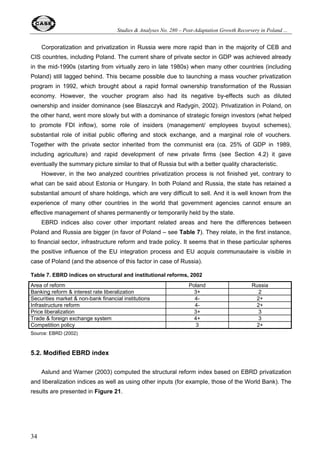
Table 6 shows that the share of private sector in GDP in mid-2001 was quite similar in Poland 
(75%) and Russia (70%). Also scores for large (3+) and small (4+ and 4) privatization were almost 
the same. It is the sphere of governance and corporate restructuring where we see bigger 
differences: Poland has 3+ score and Russia 2+ only. The latter reflects specifics of privatization 
processes in both countries and Russia’s problems with legal reforms. 
Table 6. Privatization results in selected CEE and CIS countries 
Country Private sector share in Privatization 
GDP, %, mid-2001 large small 
Governance  enterprise 
restructuring 
Armenia 70 3+ 4- 2+ 
Poland 75 3+ 4+ 3+ 
Russia 70 3+ 4 2+ 
Hungary 80 4 4+ 3+ 
Czech 
Republic 
80 4 4+ 3+ 
Estonia 80 4 4+ 3+ 
Source: EBRD (2002)
Studies  Analyses No. 280 – Post-Adaptation Growth Recorvery in Poland ... 
34 
Corporatization and privatization in Russia were more rapid than in the majority of CEB and 
CIS countries, including Poland. The current share of private sector in GDP was achieved already 
in the mid-1990s (starting from virtually zero in late 1980s) when many other countries (including 
Poland) still lagged behind. This became possible due to launching a mass voucher privatization 
program in 1992, which brought about a rapid formal ownership transformation of the Russian 
economy. However, the voucher program also had its negative by-effects such as diluted 
ownership and insider dominance (see Blaszczyk and Radygin, 2002). Privatization in Poland, on 
the other hand, went more slowly but with a dominance of strategic foreign investors (what helped 
to promote FDI inflow), some role of insiders (management/ employees buyout schemes), 
substantial role of initial public offering and stock exchange, and a marginal role of vouchers. 
Together with the private sector inherited from the communist era (ca. 25% of GDP in 1989, 
including agriculture) and rapid development of new private firms (see Section 4.2) it gave 
eventually the summary picture similar to that of Russia but with a better quality characteristic. 
However, in the two analyzed countries privatization process is not finished yet, contrary to 
what can be said about Estonia or Hungary. In both Poland and Russia, the state has retained a 
substantial amount of share holdings, which are very difficult to sell. And it is well known from the 
experience of many other countries in the world that government agencies cannot ensure an 
effective management of shares permanently or temporarily held by the state. 
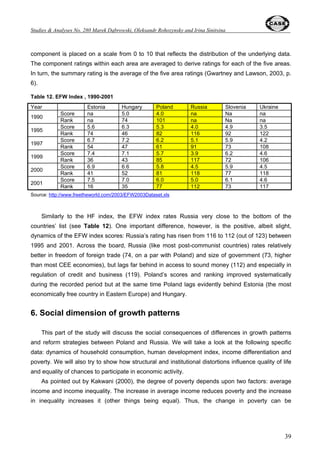
EBRD indices also cover other important related areas and here the differences between 
Poland and Russia are bigger (in favor of Poland – see Table 7). They relate, in the first instance, 
to financial sector, infrastructure reform and trade policy. It seems that in these particular spheres 
the positive influence of the EU integration process and EU acquis communautaire is visible in 
case of Poland (and the absence of this factor in case of Russia). 
Table 7. EBRD indices on structural and institutional reforms, 2002 
Area of reform Poland Russia 
Banking reform  interest rate liberalization 3+ 2 
Securities market  non-bank financial institutions 4- 2+ 
Infrastructure reform 4- 2+ 
Price liberalization 3+ 3 
Trade  foreign exchange system 4+ 3 
Competition policy 3 2+ 
Source: EBRD (2002) 
5.2. Modified EBRD index 
Aslund and Warner (2003) computed the structural reform index based on EBRD privatization 
and liberalization indices as well as using other inputs (for example, those of the World Bank). The 
results are presented in Figure 21.
Studies  Analyses No. 280
Oleksandr Rohozynsky and Irina Sinitsina 
35 
Figure 21. Structural Reform Index (normal economy=1) 


+XQJDU 
]HFK 5HSXEOLF 
(VWRQLD 
6ORYDNLD 
/LWKXDQLD 
3RODQG 
%XOJDULD 
/DWYLD 
5RPDQLD 
(8 FDQGLGDWHV 
*HRUJLD 
.UJ]VWDQ 
0ROGRYD 
$UPHQLD 
.D]DNKVWDQ 
8NUDLQH 
$]HUEDLMDQ 
5XVVLD 
7DMLNLVWDQ 
8]EHNLVWDQ 
%HODUXV 
7XUNPHQLVWDQ 
,6 
Note: The composite structural reform index consists of 73 percent liberalization and 27 percent privatization. 
Source: Aslund and Warner (2003) based on EBRD structural indices 
 
The two analyzed countries do not occupy leader positions in their regional groups (Poland in 
the EU candidates group and Russia in the CIS group). There are five countries recording better 
scores than Poland: Hungary, Czech Republic, Estonia, Slovakia and Lithuania. However, 
Poland’s position is visibly better than Russia’s one. 
5.3. Freedom House indices 
Since 1972, the Freedom House has published an annual assessment of the state of freedom 
worldwide on the basis of political rights and civil liberties rating on a one-to-seven scale. These 
countries, which rating averages 1-2.5 are generally considered as ‘Free’, 3-5.5 – ‘Partly Free’, and 
5.5-7 – ‘Not Free’. 
Russia, while formally remaining in the ‘Partly Free’ category, has steadily decreased its rating, 
closely approaching the ‘Not Free’ status (see Table 8). This is in sharp contrast with the stable 
high rating of Poland and other CEB countries accomplished already in the beginning of 1990s. 
More importantly, the progress in democratization and human rights standards has been strongly 
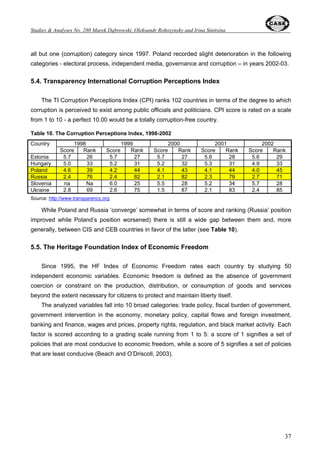
correlated with progress in economic reforms with causality going in both sides but being more 
important in relation to political reforms as factor determining the economic progress (see also 
Dabrowski and Gortat, 2002). Empirical research conducted in the Russian regions also confirm 
that guarantees of basic human rights and civil liberties have the fundamental importance for 
business and investment climate (see Mau and Yanovskiy, 2002).
Studies  Analyses No. 280 – Post-Adaptation Growth Recorvery in Poland ... 
Table 8. ‘Freedom in the World’ Ratings, 1991-2002 
36 
Poland Russia 
Years 
Score Category Score Category 
1991-92 2.2 F 3.3 PF 
1992-93 2.2 F 3.4 PF 
1993-94 2.2 F 3.4 PF 
1994-95 2.2 F 3.4 PF 
1995-96 1.2 F 3.4 PF 
1996-97 1.2 F 3.4 PF 
1997-98 1.2 F 3.4 PF 
1998-99 1.2 F 4.4 PF 
1999-00 1.2 F 4.5 PF 
2000-01 1.2 F 5.5 PF 
2001-02 1.2 F 5.5 PF 
Source: FH (2003a) 
Similarly to worldwide indicators, Freedom House since 1997, in its ‘Nations in Transit’ study, 
provides subcategory ratings and averaged scores that are signposts of progress or regress in 
political and economic reforms in 27 CEE and FSU countries. These scores are based on the 
following categories and subcategories: democratization (electoral process, civil society, 
independent media and governance), rule of law (constitutional, legislative, and judicial 
framework), and (until 2002) economic liberalization (privatization, macroeconomic and 
microeconomic policy). 
Table 9 indicates an ever-widening gap between Russia and Poland both in democratization 
and the rule-of-law categories (although Russia represented a modest improvement in RoL in 2003 
and Poland recorded some deterioration of both democratization and RoL scores in 2002-2003). In 
the six transition categories, which the Freedom House tracks, Russia has experienced regress in 
Table 9. ‘Nations in Transit’ Scores, 1997-2003 
Country/ Indicator 1997 1998 1999-2000 2001 2002 2003 
Poland 
Democratization 1.50 1.45 1.44 1.44 1.50 1.63 
Of which: electoral process 1.50 1.25 1.25 1.25 1.25 1.50 
- civil society 1.25 1.25 1.25 1.25 1.25 1.25 
- independent media 1.50 1.50 1.50 1.50 1.50 1.75 
- governance 1.75 1.75 1.75 1.75 2.00 2.00 
Rule of Law na na 1.88 1.88 1.88 2.00 
Of which - - corruption na na 2.25 2.25 2.25 2.50 
– constitutional, legislative and judicial framework 1.50 1.50 1.50 1.50 1.50 1.50 
Russia 
Democratization 3.80 4.10 4.25 4.63 4.81 4.88 
of which: electoral process 3.50 3.50 4.00 4.25 4.50 4.75 
- civil society 3.75 4.00 3.75 4.00 4.00 4.25 
- independent media 3.75 4.25 4.75 5.25 5.50 5.50 
- governance 4.00 4.50 4.50 5.00 5.25 5.00 
Rule of Law na na 5.25 5.38 5.38 5.13 
of which - - corruption na na 6.25 6.25 6.00 5.75 
– constitutional, legislative and judicial framework 4.00 4.25 4.25 4.50 4.75 4.50 
Sources: FH (2002; 2003b)
Studies  Analyses No. 280
Oleksandr Rohozynsky and Irina Sinitsina 
all but one (corruption) category since 1997. Poland recorded slight deterioration in the following 
categories - electoral process, independent media, governance and corruption – in years 2002-03. 
37 
5.4. Transparency International Corruption Perceptions Index 
The TI Corruption Perceptions Index (CPI) ranks 102 countries in terms of the degree to which 
corruption is perceived to exist among public officials and politicians. CPI score is rated on a scale 
from 1 to 10 - a perfect 10.00 would be a totally corruption-free country. 
Table 10. The Corruption Perceptions Index, 1998-2002 
Country 1998 1999 2000 2001 2002 
Score Rank Score Rank Score Rank Score Rank Score Rank 
Estonia 5.7 26 5.7 27 5.7 27 5.6 28 5.6 29 
Hungary 5.0 33 5.2 31 5.2 32 5.3 31 4.9 33 
Poland 4.6 39 4.2 44 4.1 43 4.1 44 4.0 45 
Russia 2.4 76 2.4 82 2.1 82 2.3 79 2.7 71 
Slovenia na Na 6.0 25 5.5 28 5.2 34 5.7 28 
Ukraine 2.8 69 2.6 75 1.5 87 2.1 83 2.4 85 
Source: http://www.transparency.org 
While Poland and Russia ‘converge’ somewhat in terms of score and ranking (Russia’ position 
improved while Poland’s position worsened) there is still a wide gap between them and, more 
generally, between CIS and CEB countries in favor of the latter (see Table 10). 
5.5. The Heritage Foundation Index of Economic Freedom 
Since 1995, the HF Index of Economic Freedom rates each country by studying 50 
independent economic variables. Economic freedom is defined as the absence of government 
coercion or constraint on the production, distribution, or consumption of goods and services 
beyond the extent necessary for citizens to protect and maintain liberty itself. 
The analyzed variables fall into 10 broad categories: trade policy, fiscal burden of government, 
government intervention in the economy, monetary policy, capital flows and foreign investment, 
banking and finance, wages and prices, property rights, regulation, and black market activity. Each 
factor is scored according to a grading scale running from 1 to 5: a score of 1 signifies a set of 
policies that are most conducive to economic freedom, while a score of 5 signifies a set of policies 
that are least conducive (Beach and O’Driscoll, 2003).
Studies  Analyses No. 280 – Post-Adaptation Growth Recorvery in Poland ... 
Table 11. The HF Index of Economic Freedom, 1995-2003 
Year Estonia Hungary Poland Russia Slovenia Ukraine 
38 
Score 2.40 3.00 3.30 3.40 na 3.70 
1995 
Rank 18 41 59 69 na 85 
Score 2.50 3.00 3.10 3.50 3.50 3.80 
1996 
Rank 28 61 71 93 93 118 
Score 2.50 3.00 3.10 3.55 3.30 3.75 
1997 
Rank 32 68 73 106 89 122 
Score 2.30 3.00 2.90 3.35 3.00 3.80 
1998 
Rank 24 71 61 95 71 123 
Score 2.35 2.95 2.80 3.50 2.90 3.60 
1999 
Rank 30 69 52 110 62 126 
Score 2.20 2.55 2.80 3.70 3.00 3.60 
2000 
Rank 22 41 53 122 74 116 
Score 2.05 2.55 2.75 3.70 2.90 3.85 
2001 
Rank 14 42 54 127 63 133 
Score 1.80 2.40 2.70 3.70 3.10 3.85 
2002 
Rank 4 32 45 131 79 137 
Score 1.80 2.65 2.90 3.70 2.85 3.65 
2003 
Rank 6 44 66 135 62 131 
Source: O’Driscoll, Feulner, and O’Grady (2003) 
As Table 11 indicates, Russia is the only country (among the chosen set of transition 
economies) which demonstrated a consistent deterioration in the degree of economic freedom in 
the course of the past eight years and remains among the least free countries in the region. 
Despite several achievements in the economic sphere (e.g. taxation reform), the trend toward 
increased political and administrative coercion is characterized by a growing bureaucracy, 
cutbacks in regional autonomy, interference in regional elections, crackdowns on the independent 
media, the granting of increased power to the country’s security agencies, and a reluctance to 
introduce military and judicial reforms (O’Driscoll, Feulner, and O’Grady, 2003). Across the board, 
Russia scores poorly in almost all of the factors, with one exception of government intervention 
(2.5). Moreover, similarly to the Freedom House indices, HF figures indicate a widening gap 
between Russia and CEB countries. 
Poland’s scores in this ranking, although much worse than in most other new EU members, did 
improve moderately during the last eight years (apart from 2003) and are visibly better than those 
of Russia. 
5.6. The Fraser Institute’s Economic Freedom of the World (EFW) Index 
Somewhat similar to the HF index, the EFW index measures the degree of economic freedom 
across 123 countries in five major areas: size of government (expenditures, taxes, and 
enterprises); legal structure and security of property rights; access to sound money; freedom to 
exchange with foreigners; and regulation of credit, labor, and business. Counting the various sub-components, 
the EFW index utilizes 38 distinct pieces of data. Each component and sub-
Studies  Analyses No. 280
Oleksandr Rohozynsky and Irina Sinitsina 
component is placed on a scale from 0 to 10 that reflects the distribution of the underlying data. 
The component ratings within each area are averaged to derive ratings for each of the five areas. 
In turn, the summary rating is the average of the five area ratings (Gwartney and Lawson, 2003, p. 
6). 
39 
Table 12. EFW Index , 1990-2001 
Year Estonia Hungary Poland Russia Slovenia Ukraine 
Score na 5.0 4.0 na Na na 
1990 
Rank na 74 101 na Na na 
Score 5.6 6.3 5.3 4.0 4.9 3.5 
1995 
Rank 74 46 82 116 92 122 
Score 6.7 7.2 6.2 5.1 5.9 4.2 
1997 
Rank 54 47 61 91 73 108 
Score 7.4 7.1 5.7 3.9 6.2 4.6 
1999 
Rank 36 43 85 117 72 106 
Score 6.9 6.6 5.8 4.5 5.9 4.5 
2000 
Rank 41 52 81 118 77 118 
Score 7.5 7.0 6.0 5.0 6.1 4.6 
2001 
Rank 16 35 77 112 73 117 
Source: http://www.freetheworld.com/2003/EFW2003Dataset.xls 
Similarly to the HF index, the EFW index rates Russia very close to the bottom of the 
countries’ list (see Table 12). One important difference, however, is the positive, albeit slight, 
dynamics of the EFW index scores: Russia’s rating has risen from 116 to 112 (out of 123) between 
1995 and 2001. Across the board, Russia (like most post-communist countries) rates relatively 
better in freedom of foreign trade (74, on a par with Poland) and size of government (73, higher 
than most CEE economies), but lags far behind in access to sound money (112) and especially in 
regulation of credit and business (119). Poland’s scores and ranking improved systematically 
during the recorded period but at the same time Poland lags evidently behind Estonia (the most 
economically free country in Eastern Europe) and Hungary. 
6. Social dimension of growth patterns 
This part of the study will discuss the social consequences of differences in growth patterns 
and reform strategies between Poland and Russia. We will take a look at the following specific 
data: dynamics of household consumption, human development index, income differentiation and 
poverty. We will also try to show how structural and institutional distortions influence quality of life 
and equality of chances to participate in economic activity. 
As pointed out by Kakwani (2000), the degree of poverty depends upon two factors: average 
income and income inequality. The increase in average income reduces poverty and the increase 
in inequality increases it (other things being equal). Thus, the change in poverty can be
Studies  Analyses No. 280 – Post-Adaptation Growth Recorvery in Poland ... 
decomposed into two components: one is the growth component relating to change in mean 
income, and the other is the inequality component relating to change in inequality. 
6.1. Household consumption 
40 
As real wage and real income dynamics involve several methodological weaknesses, the 
dynamics of household consumption seem to be a better proxy of actual income trends and 
provide a less distorted picture of the early years of transition. Ability to capture at least part of the 
unregistered economy seems to be a strong advantage of this particular indicator. On the weak 
side, calculating household per capita consumption in current US dollar terms involves an effect of 
the real appreciation/depreciation of a domestic currency. As real appreciation of both zloty and 
ruble prevailed in the long run, this meant that the real consumption dynamics denominated in 
domestic currencies and fixed prices would present less favorable picture (but differences between 
both countries would be probably similar). 
Figure 22. Household consumption per capita in Poland and Russia 
2500 
2400 
2300 
2200 
2100 
2000 
1900 
1800 
1700 
1600 
1500 
1400 
1300 
1200 
1100 
1000 
P oland 
Russ ia 
1990 1991 1992 1993 1994 1995Ye ar1996 1997 1998 1999 2000 2001 
cons tant USD pe r capita 
Source: World Development Indicators 2003 
We can see from Figure 22 that both Poland and Russia started their transition with 
approximately the same level of household consumption per capita. However, transformation in 
Poland was accompanied by a systematic increase in per capita consumption while in Russia the 
level of per capita consumption started to decrease in 1989, and continued this trend for a decade 
(following GDP decline). The trend was reversed only when Russian GDP started to grow.

CASE Network Studies and Analyses 280 - Post-Adaptation Growth Recovery in Poland and Russia - Similarities and Differences

  • 1.
    S t ud i a i A n a l i z y S t u d i e s & A n a l y s e s C e n t r u m A n a l i z
  • 2.
    C e nt e r f o r S o c i a l a n d E c o n o m i c R e s e a r c h 2 8 0
  • 3.
    Oleksandr Rohozynsky, andIrina Sinitsina Post-Adaptation Growth Recovery in Poland and Russia – Similarities and Differences W a r s a w , J u n e 2 0 0 4
  • 4.
    Materials published herehave a working paper character. They can be subject to further publication. The views and opinions expressed here reflect the author(s) point of view and not necessarily those of the CASE. This paper was committed by the World Bank and Global Development Network as the background case study for the World Bank conference on ‘Scaling Up Poverty Reduction’ in Shanghai, China, May 25-27, 2004 and presented during this conference in its earlier, shorter version. See: http://info.worldbank.org/etools/docs/library/39235/Poland%20and%20Russia%20Comparative%2 0Case%20Study.doc Keywords: transition, transition strategy, growth, poverty, income inequality, Poland, Russia, Central and Eastern Europe, CIS. © CASE – Center for Social and Economic Research, Warsaw 2004 Graphic Design: Agnieszka Natalia Bury ISSN 1506-1701, ISBN: 83-7178-343-4 © CASE – Center for Social and Economic Research, Warsaw 2004 Graphic Design: Agnieszka Natalia Bury ISSN 1506-1701, ISBN: 83-7178-340-X Publisher: CASE – Center for Social and Economic Research 12 Sienkiewicza, 00-944 Warsaw, Poland tel.: (48 22) 622 66 27, 828 61 33, fax: (48 22) 828 60 69 e-mail: case@case.com.pl http://www.case.com.pl/
  • 5.
    Contents Abstract.............................................................................................................................. 5 1. Introduction ................................................................................................................... 6 2. Output decline – unavoidable but painful adjustment............................................... 8 3. Post-Adaptation Recovery: General Characteristics............................................... 11 4. Structural features of growth patterns in Poland and Russia ................................ 15 4.1. Employment structure and labor market developments ................................. 15 4.2. The Role of SME and FDI.................................................................................... 20 4.3. The role of energy sector ................................................................................... 22 4.4. Export and import dynamics and structure, the role of European integration................................................................................................................. 26 4.5. Fiscal policy pattern............................................................................................ 30 5. Composite indices of structural and institutional reforms ..................................... 33 5.1. EBRD assessment of privatization and structural reforms............................. 33 5.2. Modified EBRD index.......................................................................................... 34 5.3. Freedom House indices...................................................................................... 35 5.4. Transparency International Corruption Perceptions Index............................. 37 5.5. The Heritage Foundation Index of Economic Freedom................................... 37 5.6. The Fraser Institute’s Economic Freedom of the World (EFW) Index............ 38 6. Social dimension of growth patterns ........................................................................ 39 6.1. Household consumption .................................................................................... 40 6.2. UNDP Human Development Index ..................................................................... 41 6.3. Income inequality – general picture .................................................................. 41 6.4. Factors potentially influencing income inequality........................................... 45 6.5. Poverty scale and dynamics .............................................................................. 50 6.6. Major poverty sources and vulnerable groups ................................................ 52 7. Lessons Learned......................................................................................................... 55 References....................................................................................................................... 58
  • 6.
    Studies AnalysesNo. 280 – Post-Adaptation Growth Recorvery in Poland ...
  • 7.
    Professor of Economics,Chairman of the Council of the CASE – Center for Social and Economic Research in Warsaw, Chairman of the Supervisory Board of the CASE-Ukraine in Kiev, Member of the Board of Trustees of the Institute for the Economy in Transition in Moscow, former First Deputy Minister of Finance (1989-1990), Member of Parliament (1991-1993) and Member of the Monetary Policy Council of the National Bank of Poland (1998-2004). In the last decade he has been involved in policy advising and policy research in Belarus, Bosnia and Herzegovina, Bulgaria, Georgia, Iraq, Kazakhstan, Kyrgyzstan, Macedonia, Moldova, Mongolia, Romania, Russia, Serbia, Ukraine and Uzbekistan and in a number of international research projects related to monetary and fiscal policies, currency crises, EU and EMU enlargement, and political economy of transition. Consultant of the World Bank and UNDP. Oleksandr Rohozynsky Executive Director of CASE Ukraine. He holds masters degrees in Applied Mathematics, Economics, Policy Analysis, and Business Administration, and is working towards his Ph.D. in Policy Analysis at the RAND Graduate School, Santa Monica, CA, USA. He is economist and researcher with over 6 years of experience working in Ukraine and the US, including: leading and managing projects for Ukrainian think-tank; working with various international organizations, including World Bank, Soros International Economic Advisory Group, HIID/CASE; and providing support and advise to decision-makers in Ministry of Economy, Ministry of Finance and Prime- Minister of Ukraine. Irina Sinitsina Irina Sinitsina, (Ph.D., Moscow State University, 1975) is a leading researcher at the Institute of International Economic and Political Studies, Russian Academy of Sciences (Moscow, Russia) and CASE's Senior Researcher, Member of the Board of Directors of CASE - Transcaucasus in Tbilisi, Georgia. She specializes in the analysis of social policy, including social security systems, social services, labor market, income and employment policies in Russia, Poland, Georgia, Ukraine and other FSU and Central /Eastern European countries. Since 1992, she has advised Russian ministries, governmental agencies, and the Central Bank of the Russian Federation on various social and employment policy issues. She is an author or co-author of over 40 monographs, chapters and articles published in academic magazines on the issues of social policy, social security, income and employment policies in transition economies. 4
  • 8.
  • 9.
    Oleksandr Rohozynsky andIrina Sinitsina 5 Abstract The purpose of this paper is to analyze the sources, economic and social characteristics, of growth recovery, which followed the first period of output decline in two transition countries – Poland and Russia. They represent two different groups of transition countries (new EU member states vs. CIS) in terms of adopted transition strategy and accomplished results. Generally, fast reformers succeeded and slow reformers experienced a lot of troubles. Although eventually all former communist countries entered the path of economic growth, those which moved slowly lost sometimes the whole decade. Social costs of slow reforms were also dramatic: income degradation and rising inequalities, high level of poverty and corruption, various social and institutional distortions and pathologies, violation of human rights and civil and economic liberties, attempts of authoritarian restoration, etc. The period of ‘adaptation’ output decline was much more severe and longer in Russia than in Poland, and recovery came later. Unlike in the leading transition countries, the role of new private firms and FDI in Russia has been very limited what can be explained by administrative barriers, widespread corruption, lack of transparency, instability and contradictions in economic legislation, reflecting poor business climate. In the absence of FDI and with limited role of SME Russian economy is dominated by large domestic corporations, many of them having an ‘oligarchic’ characteristic. This additionally complicates the political economy of market reforms and weakens constituency of favor of open democratic society and liberal economic policies. The high oil prices helped in economic recovery and fiscal adjustment in Russia in early 2000s. However, Russian economy has become increasingly oil-dependent. While major obstacles to future Russia’s growth can origin from its structural monoculture dominated by the oil and energy sector, and poor business climate, the excessive welfare state can be considered as the main development burden in the case of Poland. In both analyzed countries poverty and inequality increased substantially during 1990s, to much bigger extent in Russia compared to Poland. While part of the income polarization was inevitably connected with departure from communist egalitarianism and part of poverty phenomenon reflected transition adaptation costs, other factors such as continuous structural distortions, incomplete liberalization, high inflation, insufficient competition, barriers to entrepreneurship, institutional weaknesses of the state captured by oligarchs, corruption, etc., played a significant role here.
  • 10.
    Studies AnalysesNo. 280 – Post-Adaptation Growth Recorvery in Poland ... 1. Introduction 6 The purpose of this paper is to analyze the sources, economic and social characteristics, and perspectives of growth recovery, which followed the first period of output decline in transition economies. As the first stage of transition was inevitably associated with a deep output correction resulting mostly from distortions inherited from the command economy, which we call the ‘adaptation’ output decline, the recovery which followed will be called by us as the ‘post-adaptation’ recovery. Our analysis covers two important transition countries (Poland and Russia) representing different transition histories, strategies and trajectories and respective periods, which can be identified as representing post adaptation recovery (1992-1999 in Poland and 1999-2003 in Russia). While the analyzed growth episode is already over in the case of Poland, it is not over in Russia yet which may give an interesting food for thought as to what kind of growth challenges Russia can meet in the near future (under assumption that both growth episodes are comparable enough). Poland was the pioneer of post-communist political and economic transition starting this process already in 1989. In Russia it became possible two years later when the Soviet Union collapsed. In the first stage of its transition Poland represented a classical case of fast reform strategy called sometimes in more journalist-type analyzes as ‘shock-therapy’1. Russia tried to follow the same pattern but failed for domestic political reasons, representing eventually a much slower and less consequent reform path. From the early 1990s Poland and other Central European and Baltic countries (CEB hereafter) enjoyed a geopolitical chance to participate in the European integration with the EU membership finalized on May 1, 2004. Only very recently, Russia started to discuss seriously the perspective of its deeper cooperation and possibly partial integration with the EU, and the EU started to consider Russia as its future strategic partner. For research purposes, Poland can be a good representative of the group of CEB countries considered by many comparative researches and rankings as examples of transition success (see e.g. World Bank, 2002; Dabrowski and Gortat, 2002; subsequent EBRD Transition Reports). On the other hand, Russia is the biggest CIS country and shares many structural, institutional and political problems of this group. This gives us a good comparative ground for analyzing some ‘stylized’ characteristics of economic developments of both sub-regions (i.e. CEB and CIS) and drawing conclusions related to the differences in transition strategies. Although the main focus of this paper is placed on the post-adaptation output recovery period we start our analysis from the short characteristics of the previous period, i.e. adaptation output 1 As the notion of ‘shock therapy’ has a substantial emotional and sometimes pejorative content we will not use it in this paper preferring instead to talk about ‘fast’ or ‘slow’ (gradual) reforms.
  • 11.
  • 12.
    Oleksandr Rohozynsky andIrina Sinitsina decline because the observed differences in both countries (in terms of size, length and specific causes of this decline) determined various starting points of the growth stage. This is the topic of Section 2 of this study. In Section 3 we present a general characteristic of post-adaptation recovery period in Poland and Russia. Section 4 deals with some specific features distinguishing Poland’s and Russia’s growth patterns in the analyzed periods. It relates to changes in employment structure and labor market developments, the role of newly created small and medium-size enterprises, foreign direct investment, the role of energy sector (particularly in Russia), sectoral and geographical structure of trade, and fiscal policy pattern. In Section 5 we analyze progress in the sphere of structural and institutional reforms in both countries. Section 6 contains the analysis of social dimension of growth in both countries, i.e. the influence of growth pattern and structural and institutional characteristics of both economies on income level and its differentiation. Finally, Section 7 presents policy lessons for other countries. Taking into account a very broad topic of this paper and limited time and resources to prepare it the authors had to rely, whenever it was possible, on the already existing analyzes, statistics and international comparisons and ratings of the IMF, World Bank, EBRD, OECD and several international think tanks/NGOs like the Freedom House, Transparency International, Heritage Foundation, etc. Several earlier studies of CASE and its network partners (like the Institute for the Economy of Transition in Moscow) were of great help in preparing this particular analysis. Authors are very grateful to OECD for its kind agreement to use results of the earlier CASE research on income distribution in Poland (being the part of OECD-sponsored project) for purpose of this study. We also would like to acknowledge a valuable consultation of Katarzyna Pietka who helped us to select and interpret statistical data on income distribution, inequality, poverty and social expenditures in Poland. Asad Alam and Radwan Shaban from the World Bank and Lyn Squire from the Global Development Network Secretariat gave us valuable remarks and suggestions to earlier (pre-conference) versions of this paper. Professor Bradford DeLong from the University California, Berkeley commented this paper during the Shanghai Poverty Conference. However, authors are solely responsible for the content and quality of this paper as well as for provided interpretations and conclusions. As there is no a well-grounded and universally accepted transition growth theory we have focused on partial hypotheses developed in the already existing cross-country analyzes (see e.g. De Melo, Denizer, and Gelb, 1996; Aslund, Boone, and Johnson, 1996; Fischer, Sahay and Vegh, 1996; Havrylyshyn et al, 2000; WEO, 2000; Gros and Suhrcke, 2001; Fischer and Sahay, 2001; Campos and Coricelli, 2002; World Bank, 2002; EBRD, various issues). Methodology of most of these empirical exercises refers to the endogenous growth theory. We also use the same approach, although in a less formalized way – using the technique of narrative analysis and simple statistical comparison. 7
  • 13.
    Studies AnalysesNo. 280 – Post-Adaptation Growth Recorvery in Poland ... 2. Output decline – unavoidable but painful adjustment 8 A deep output decline was a common phenomenon for all the transition economies. This decline occurred regardless of the transition strategy used (Aslund, Boone and Johnson, 1996). However, the size of this decline varied depending on which transition strategy country adopted, conditions at the beginning of the transition, or external shocks (see WEO, 2000; World Bank, 2002). Apart from short-term costs of macroeconomic stabilization (see Balcerowicz and Gelb, 1994; Dabrowski, 1996) the size of ‘adaptation’ output decline was determined mostly by the scale of structural and institutional distortions inherited from the command economy. Adjustment triggered by liberalization of domestic and external markets caused a significant shift in the relative demand. On the external side, the previous export markets organized on the basis of central planning mechanism collapsed, particularly CMEA (1990-1991), and the Soviet inter-republican market (1992-1993). New import opportunities decreased demand for some domestic products while new export opportunities gave a chance to increase production of other goods. However, because the elasticity of supply response was usually limited, a shift in relative external demand had to be connected with a temporary decrease of output. Among domestic relative-demand factors one should mention: demilitarization (see Gaidar 1997; 2003a; 2003b; Yasin, 2003), decreasing investment rate and change in the structure of investment demand, rationalization of inter-regional links (especially in Russia), elimination of forced substitution (see Winiecki, 1990, pp.781-783), more consumer freedom coming from elimination of the rationing system and from privatization of part of collective consumption (e.g., housing). The second group of microeconomic factors was connected with a dramatic change in the cost level and structure coming from price liberalization, and elimination of multiple exchange rates, various explicit and implicit subsidies, and special price arrangements inside the CMEA and the former Soviet Union (related mostly to heavily underpriced energy resources).
  • 14.
  • 15.
    Oleksandr Rohozynsky andIrina Sinitsina 134.8 73.5 9 Figure 1. Real GDP growth in selected transition economies (1989 = 100) 96 88.4 91.2 P o lan d E st o n ia Russia Arm en ia 82.2 84.3 87.6 92.1 98.6 104.5 78 71.2 62.2 59.6 57.5 58 55.2 58.2 140 130 120 110 100 90 80 70 60 50 40 30 1990 1991 1992 1993 1994 1995 1996 1997 1998 1999 2000 2001 2002 2003 1989 = 100 Note: data for 2003 are based on WEO (2003) and authors’ forecast. Source: TransMonee (2002); WEO (2003) 111.6 116.9 121.7 126.6 129.1 130.9 63 66.5 69.4 Finally, the third group of factors was related to microeconomic behavior and involved such issues as collapse of the mobilization role of central plan and administrative incentives connected with a totalitarian regime, expectations and incentives created by the privatization process2, expectations of massive bailouts of state enterprises by the government based on past reform experience under communism (creating credibility problems for post-communist reformers), and lack of skills to work under market conditions (see Dabrowski, 1996; Gaidar, 2003a; 2003b). Apart from the initial conditions determined by communist heritage and external shock the size of ‘adaptation’ output decline was also influenced by transition strategy. Policies did matter, particularly speed of reforms and their consistency (see World Bank, 1996; 2002; IMF, 2000; Havrylyshyn et al., 2000; De Melo et al., 2001). Wyplosz (1999) presented evidence that the countries, which proceeded with reforms in the fast manner, for example Poland, suffered smaller decline before stabilization than countries implementing gradual reforms, such as Russia. Figure 1 shows differences between the two analyzed countries in terms of deepness and length of adaptation output decline3. Poland started its transition earlier, moved faster, and downward correction of its GDP was relatively limited - 17.8% for the period of two years (1990- 2 These included the insider-outsider game of who will take over the enterprise as a private owner, outflow of the best personnel and management to the new private sector, so-called ‘end game’ (Blanchard and Dabrowski, 1993) or ‘privatization death’ (Mertlik, 1993). 3 However, one must remember about methodological risks involved in comparative analysis of early transition period. Some problems with the pre-transition GDP statistics (for example, low utility and quality of final output, limited consumption choice, distorted prices and exchange rates, over-reporting of output under communist regime) were much more severe in the former Soviet Union than in some Central European countries.
  • 16.
    Studies AnalysesNo. 280 – Post-Adaptation Growth Recorvery in Poland ... 1991) only. Starting from 1992 (precisely from Q4 1991), Poland’s economy took off. In Russia, output decline amounted to almost 45% of a pre-transition level and lasted for 8 years. Positive GDP dynamics accompanied by certain macroeconomic stabilization started only in 1997 but in 1998 Russian economy was again thrown back by the financial crisis. Finally, a sustainable recovery started in Q3 1999. Figure 2. Military expenditures in Poland and Russia, 1988-2001 18 16 14 12 10 8 6 4 2 0 Poland Russia 1988 1989 1990 1991 1992 1993 1994 1995 1996 1997 1998 1999 2000 2001 % of GD Source: World Development Indicators 2003 Ye ars Table 1. Russia: output of military industry, 1991-2001, constant prices, 1991=100. Item 1991 1995 1996 1997 1998 1999 2000 2001 Military output 100 25.1 18.8 13.9 16.6 23.1 29.1 29.5 Civilian output 100 39.9 28.9 28.5 28.3 36.3 44.5 50.1 Total output 100 31.4 23.1 20.1 21.7 29.1 36.2 38.4 Employment 100 54.4 46.9 41 36 33.3 34.1 33.5 Source: SIPRI (2003) 10 How the above differences can be explained? Certainly, initial conditions did matter strongly. Russia had longer and more severe experience with communism and command economy than Poland and the scale of inherited distortions was much bigger. Figure 2 illustrates just one component of these distortions: the share of military-related expenditures in GDP. While in Poland their relative level in 1988 did not differ from many other countries (2.5% of GDP), in Russia it accounted to 15.8% of GDP and went gradually down to a still high share of 5.5% of GDP in 1992. Table 1 gives an additional insight into how deep was a reduction of output of this key sector of the Russian economy in early 1990s (by ca. 75% of purely military production).
  • 17.
  • 18.
    Oleksandr Rohozynsky andIrina Sinitsina However, initial conditions cannot explain the whole size of GDP correction in Russia and its enormous length. Figure 1 contains also data for two other former Soviet republics – Estonia and Armenia. One can assume that the size of inherited distortions was not smaller in these two countries than in the case of Russia, keeping in mind that both were fully dependent on underpriced oil and gas from Russia. Hence, after collapse of the USSR they had to adjust to much higher world oil and gas prices while Russia could gain from eliminating price distortions. Estonia recorded five-year GDP decline (three years after obtaining independence and starting market reforms) of cumulative scale of 38.1%. In Armenia cumulative GDP decline was the highest among the four analyzed countries (by almost 60% as a result of the war with Azerbaijan) but lasted only four years and was followed by a strong and long lasting (already ten years) recovery. The conclusion which can be drawn from the above brief and a bit simplified analysis is that Russia’s negative growth trend through most of 1990s was determined by the slow pace and non-optimal sequencing of economic reforms (in addition to highly unfavorable initial conditions). Slow pace and inconsistency of macroeconomic stabilization and liberalization hampered structural and institutional changes, which were necessary to stop output decline and start its recovery. Populist policies only slowed down adaptation process and made it longer and more severe (see Figure 1). Comparisons with other countries show that progress in macroeconomic stabilization (especially lowering inflation) became a key factor of subsequent output recovery (see e.g. Fischer, Sahay, and Vegh, 1996; Havrylyshyn et al., 2000; Fischer and Sahay, 2001). Countries that tamed inflation quickly experienced a speedier and stronger recovery in output (see e.g. IMF, 2000). Moreover, in many CEE countries the early success of economic stabilization helped to strengthen the constituency in favor of further reforms, both political and economic ones. In Russia, though, the economic growth was delayed and the country has found itself in a slow-reform equilibrium for several years. 11 3. Post-Adaptation Recovery: General Characteristics As we mentioned in Section 2 Poland’s output decline was relatively short (two years only) and recovery started already at the end of 1991. Figure 3 shows that post-adaptation recovery in Russia began first time in 1997, i.e. five years later than in Poland and became sharply interrupted a year later by the August 1998 financial crisis. Only in the second half of 1999 Russia’ s growth trend took off for good, i.e. almost eight years later than it had happened in Poland. At that time, the period of fast economic growth in Poland already approached its end. This ‘time mismatch’ makes our analysis more difficult because it does not make a big sense to compare the same calendar years for both countries. During most of the 1990s fast growth in Poland was accompanied by the continuous output decline in Russia while strong Russia’s recovery in the early 2000s overlapped with the phase of serious growth slowdown in Poland. Due to its
  • 19.
    Studies AnalysesNo. 280 – Post-Adaptation Growth Recorvery in Poland ... particularly long and severe period of output decline, Russia (and some other CIS economies such as Ukraine, Moldova or Kazakhstan) lagged one ‘phase’ behind Poland, other Central European, Baltic and even some CIS countries such as Armenia or Kyrgyzstan. Hence, we decided to extract a ‘recovery’ phase from each country growth statistics, eliminating in this way the above mentioned ‘time mismatch’. Figure 3. Annual growth rate of real GDP in Poland and Russia, in percent - 6 ,2 2 ,1 3 ,3 4 ,5 6 ,8 6 - 4 ,8 - 1 3 ,2 - 6 ,8 - 9 - 4 ,2 1 0 5 0 -5 -1 0 -1 5 Poland Russia 1991 1992 1993 1994 1995 1996 1997 1998 1999 2000 2001 2002 Sources: WEO (2003), p. 181, Table 7; CASE database 6 ,8 4 ,8 9 5 ,4 5 4 ,1 4 - 1 1 ,8 - 4 ,9 Figure 4. Annual rate of real GDP growth in subsequent year of recovery period +XQJDU /DWYLD 3RODQG 6ORYDNLD (VWRQLD 5XVVLD HDU Sources: WEO (2003), p. 181, Table 7; CASE database 12 1 1 ,3 4 ,3 Figure 4 provides an opportunity for the analysis of recovery profiles of a larger group of transition economies: apart from Poland and Russia we added Estonia, Hungary, Latvia and
  • 20.
  • 21.
    Oleksandr Rohozynsky andIrina Sinitsina Slovakia4 and calibrated the chart in the way which allows comparing growth trends beginning from the moment when the ‘adaptation’ output decline became overcome. It means that year 1 in Figure 4 means the first year of output recovery, i.e. 1992 for Poland, 1994 for Hungary and Slovakia, 1995 for Estonia, 1996 for Latvia, and 1999 for Russia. In spite of countries’ specifics some general observations could be drawn from Figure 4. First, ‘taking off’ trend was quite rapid in most analyzed countries, accomplishing high growth rates already in the second or third year of the recovery phase5. It seems to confirm the hypothesis that the first stage of take off based mostly on reallocation of existing resources and capacities (exploiting the so-called simple reserves) and not on new investments which, on the contrary, were strongly depressed during the phase of ‘adaptation’ output decline. The investment volume started to increase rapidly only after economy already took off. For example, in Poland real gross fixed investment grew at an average annual rate exceeding 20% in 1996 and 1997 (see Figure 5). In Russia, average annual growth rate of gross domestic investment during 1991-2001 was negative and amounted to -14.6%. The situation has changed only in 1999, and positive investment growth rates have been achieved in 2000-01 (+18.6% and +17.0% accordingly). 13 Figure 5. Gross fixed investments, annual percent change (constant prices) p ercen t Poland Russia Sources: IMF Country Reports, IMF staff estimates, national statistics 4 Adding more countries (for example, Slovenia, Lithuania, Albania, Armenia, Azerbaijan, Kyrgyzstan, Ukraine) would not change radically the picture and our conclusions below but make our graphical analysis less transparent. 5 Hungary is the exception here. Beginnings of its recovery phase overlapped with serious tensions on its sovereign debt market and the necessity to conduct a drastic fiscal adjustment in 1995.
  • 22.
    Studies AnalysesNo. 280 – Post-Adaptation Growth Recorvery in Poland ... 14 Thus, the first stage of recovery in transition economy seemed to be based on a catching-up effect using mostly the existing resources released by the ‘adaptation’ output decline and facilitated by the systemic changes accomplished to date. It cannot be excluded that countries with recorded deeper output decline (like Russia) had more simple reserves and, therefore, more rooms for a catching up growth. However, it is clear that sustainability of economic growth depends critically on further reform steps (see below). The second conclusion, which can be drawn from Figure 4 relates to a generally decreasing growth trend after the first take-off stage has been over. It additionally supports the catching-up interpretation of the first stage of post-adaptation recovery. In some cases (the example of Slovakia after 1998) the new reform effort has been needed to give a growth trend a new impulse. The phenomenon of declining growth trend could be well observed in the case of Poland. After peaking up in 1994-19976 the growth rate started to go down systematically and reached a very low level (close to 1%) in the period of Q4 2000 – Q1 2003. Apart from exogenous factors such as the influence of Russian financial crisis (which brought the shock in Q4 1998 and the first half of 1999) and general slowdown of the world and European economy after 2000, a number of domestic factors played an important role. Among the latter one can mention: the slow pace of privatization and restructuring of several important sectors (coal, steel and other heavy industries, energy sector, railways, telecommunication, etc.), increasing labor market rigidities, high level of fiscal redistribution (in the range of 45-50% of GDP), excessive social commitments and resulting high taxes, reversal of deregulation trend of the early 1990s, and adjustment costs connected with the adoption of EU acquis communautaire. In addition, due to serious macroeconomic imbalances accompanying years of very high growth rates (chronic two-digit inflation and rapidly increasing current account deficit) a serious tightening of both monetary and fiscal policies became necessary. While fiscal tightening occurred to be short-living (only in 1998-1999, followed by a substantial fiscal relaxation in the subsequent years) monetary tightening of 1999-2000 managed to bring inflation to a very low one-digit level (end-year inflation rate of 3.6% in 2001 and 0.8% in 2002 comparing to 9.8% in 1999) and substantially reduce current account deficit - from 8.1% of GDP in 1998 to 3.1% of GDP in 2001 (World Bank, 2003, p. 197, Table A18). However, the real sector had to bear costs of the stabilization/disinflation policy, and suboptimal policy mix (relatively loose fiscal vs. tight monetary policy) increased negative output/ employment consequences. Hopefully, Polish economy will benefit in future from the recent stabilization policy and a new round of microeconomic restructuring, which took place in the beginning of the 2000s but it will be already another growth phase, which will require a separate analysis. 6 At that time some Polish politicians and foreign observers started to talk about ‘Polish miracle’. The same could be occasionally heard in Russia in 2001-2003. However, authors of this paper are very careful with using this kind of emotional (and ex post usually evidently overly optimistic) characteristics. They reflect public demand for success story and politicians’ wishful thinking rather than any well-grounded empirical observation (and particularly any well-grounded forecast of future growth trend and its sustainability).
  • 23.
  • 24.
    Oleksandr Rohozynsky andIrina Sinitsina According to our simplified trend comparison presented in Figure 4, in 2003 Russia would be in the similar phase of its growth recovery as Poland in 1996, i.e., at its highest growth momentum. Does also Russia face the perspective of gradually decreasing growth rate in the coming years? Possibly yes if the new growth impulses will not be added to those observed in the beginning of 2000s. At this point we can risk a hypothesis that high growth rates in Russia starting from 2000 may be explained by: (1) depth of the previous output decline and use of simple reserves (e.g., utilization of idle capacities); (2) positive effects of economic reforms conducted in 1990s (particularly privatization), and (3) high oil prices on international markets (see Dabrowski, 2003). We will come back to this question at the end of this paper after conducting a comparative structural and institutional analyzes of both economies. 15 4. Structural features of growth patterns in Poland and Russia In spite of potential similarities in growth trends in Poland in 1990s and Russia in early 2000s one should take a deeper look at the structural characteristics of both economies. Only such an analysis can bring us closer to the answer to the question whether we analyze the same phenomenon in both countries or different phenomena with some superficial similarities? In this section we try to address five concrete issues: employment structure and labor market developments, the role of small and medium size enterprises (SME) and foreign direct investments (FDI), the role of oil and energy production/ consumption, structure of foreign trade, and fiscal policy pattern. 4.1. Employment structure and labor market developments Figure 6 provides us with a general picture of changes in employment structure of two countries in consideration recorded between 1990 and 19987. Generally, it looks like both countries represent the similar structural changes: moving a substantial part of labor force from industry to a broadly defined service sector (more dramatic in Russia compared to Poland) and, in parallel, decreasing share of employment in agriculture (more substantial in Poland than in Russia), again in favor of service sector. Both tendencies and relative differences in both countries could hardly come as a surprise. Former communist countries were heavily over-industrialized (especially former USSR and Russia in particular) while market services were underdeveloped. Poland, which managed to avoid communist collectivization of its agriculture, suffered (and continues to suffer) over-employment in this sector typical for less developed countries. On the other hand, Russia had 7 We do not have a fully comparable data for any later year. However, according to national statistics the proportions observed in 1998 did not undergo any serious changes during the next five years.
  • 25.
    Studies AnalysesNo. 280 – Post-Adaptation Growth Recorvery in Poland ... also a certain margin of redundant labor (although much smaller than in case of Poland) in its ineffective state- and collectively-owned farms (sovkhozes and kolkhozes). Figure 6. Employment structure by sectors in Poland and Russia, 1990-1998, in % of total employment Poland: structure of employment in 1990 25% 37% 36% 2% Em ploym en t in a g riculture Em p loym ent in indus try Em ploym en t in s ervices Em ploym en t in o ther Poland: structure of employment in 1998 19% 32% 49% 0% Em ploym en t in a g riculture Em p loym ent in indus try Em ploym en t in s ervices Em ploym en t in o ther Source: World Development Indicators 2003 16 Russia: structure of employment in 1990 14% 40% 41% 5% Employment in agriculture Employment in industry Employment in services Employment in other Russia: structure of employment in 1998 12% 29% 59% 0% Em ploym en t in a g riculture Em p loym ent in indus try Em ploym en t in s ervices Em ploym en t in o ther However, similarities seem to end at this point. If we want to investigate other characteristics of employment and labor market we will find striking differences between both countries. This relates, for example, to share of employment in small enterprises, which are defined as those employing 50 or fewer workers (see Figure 7). The initial differences – in 1989 the analyzed share accounted for 16.92% in Poland and only for 6.43% in Russia – did not disappear through the decade of the 1990s. On the contrary, they increased in spite of positive dynamics in both countries. In Poland the share of small enterprises increased systematically up to almost half of total employment in 1998 (49.16%), while in Russia it stabilized below 20% (18.59% in 1998). In addition, one should take into account that Poland did not represent the highest record in this respect in 1998. In two countries shown in Figure 7 – Hungary and Lithuania – this share was even higher: 55.10% and 54.93% respectively. It is worth to admit that Lithuania started in the early 1990s from the level similar to Russia.
  • 26.
  • 27.
    Oleksandr Rohozynsky andIrina Sinitsina Hungary Poland L ithuan ia Russia 1989 1990 1991 1992 1993 1994 1995 1996 1997 1998 17 Figure 7. Share of Employment in Small Enterprises, 1989-98 60 55 50 45 40 35 30 25 20 15 10 5 0 Percen Note: Small enterprises are defined as those employing 50 or fewer workers Source: World Bank (2002), p. 41, Table 4.2 Figure 8 illustrates a comparison of employment and GDP dynamics in the first nine years of transition. While in Poland strong output recovery was accompanied by a very modest growth in employment – by 1.1% in 1994, 0.3% in 1995, 3.5% in 1996 (the only year with a stronger increase of employment), 1.3% in 1997 and 1.4% in 1998 – Russia’s severe output decline was connected with substantial but less dramatic fall of employment – by 3.4% in 1994, 6.4% in 1995, 3.4% in 1996, 3.1% in 1997, and 2.7% in 1998. It means that Poland recorded a continuous increase in labor productivity, while Russia – its continuous decline. Figure 8. Employment and GDP dynamics in Poland and Russia, 1990 = 100 Poland 140 120 100 80 60 40 1990 1991 1992 1993 1994 1995 1996 1997 1998 Source: World Bank (2002), p. 44, Figure 4.6 110 100 90 80 Employment GDP Rus s ian Federation 70 60 50 40 1990 1991 1992 1993 1994 1995 1996 1997 1998 Employment GDP After 1998 employment trends in both countries have changed. Employment in Russia started to increase on the top of economic recovery but at a slower pace than GDP (apart from 1999 when it increased by 8.0%; in the next two years employment growth rate amounted to 1.4% and 1.3%, respectively). In Poland slower growth rates were accompanied by employment decline: by 1.5% in
  • 28.
    Studies AnalysesNo. 280 – Post-Adaptation Growth Recorvery in Poland ... 1999, 3.3% in 2000, and 4.3% in 2001. Thus, both countries recorded labor productivity growth but Poland represented a less labor-intensive pattern of economic development in spite of rapidly increasing unemployment and entering the labor market by the second post-war demographic boom. Figure 9. Unemployment in Poland and Russia (according to ILO definition), 1990-2001 2 0 1 8 1 6 1 4 1 2 1 0 8 6 4 2 0 P olan d Rus s ia 1 9 9 0 1 9 9 1 1 9 9 2 1 9 9 3 1 9 9 4 1 9 9 5 1 9 9 6 1 9 9 7 1 9 9 8 1 9 9 9 2 0 0 0 2 0 0 1 2 0 0 2 p ercen t o f labo r fo rce Sources:
  • 29.
    ; Goskomstat (2003). 18 Employment dynamics has been mirrored in the unemployment statistics presented in Figure 9. Unemployment rate in Russia was systematically lower than in Poland, apart from two years – 1997 and 1998. Particularly striking is its relatively low unemployment rate in the period of dramatic output decline before 1997. Together with the mentioned low share of employment in small enterprises and lagging employment dynamics (comparing to GDP dynamics) it provides a ground to formulate a hypothesis that restructuring process of old big enterprises was delayed and these enterprises hoarded the excessive labor for a quite long time. This hypothesis can be additionally supported by a comparison of actual (surveyed according to the ILO methodology) and officially registered unemployment in Russia presented in Figure 10 (in Poland these differences are much smaller) and by research addressing the phenomenon of unofficial (‘gray’ or ‘black’) economic activity.
  • 30.
  • 31.
    Oleksandr Rohozynsky andIrina Sinitsina 19 Figure 10. Total (ILO definition) and registered unemployment in Russia, % of labor force
  • 32.
    Source: State StatisticalCommittee (Goskomstat) According to estimates of Johnson, Kaufmann and Shleifer (1997), unofficial economy represented 42% of GDP in Russia, 49% in Ukraine, and over 60% in Azerbaijan and Georgia in 1995, while Poland recorded one of the lowest shares (well below 20%). Although there are no fresh cross-country surveys investigating this issue anecdotal evidence speaks in favor of some ‘convergence’ of the relative size of unregistered economy in both countries. The Polish picture deteriorated compared to mid-1990s (as result of labor market rigidities, high taxes, and increasing over-regulation), while the Russian one slightly improved. Nevertheless, the gap is still substantial – probably twofold. Generally, Russia and Poland represent two different patterns of labor market adjustment. In Russia, a decline in employment was significantly smaller than the massive collapse of output and labor demand. The adjustment took the form of lower real wages as well as the emergence of wage arrears and hidden unemployment8. Labor moved to low-productivity services. Together with labor hoarding by enterprises, these sectors served as shock absorbers in view of the lack of a well-functioning social policy (see below). The second pattern, broadly prevalent in the CEE and represented by Poland, saw employment decline with output. Job destruction was concentrated in existing enterprises, while job creation was to be found almost exclusively in new enterprises (World Bank, 2002, p. 30). Much higher officially registered unemployment in Poland reflects severe labor market rigidities in Poland and much higher labor costs, additionally increased by high social welfare costs. Russian 8 Hidden unemployment has been estimated in Russia at 8-25% of an economically active population (e.g. on long, unpaid leave or reduced working hours), shadow economy has employed about 25 million people, including 7 million not having any other job, while 18 million have combined work in formal and informal sectors.
  • 33.
    Studies AnalysesNo. 280 – Post-Adaptation Growth Recorvery in Poland ... labor market is more flexible de facto (not necessarily de iure) what is demonstrated, among other factors, by a higher actual nominal wage flexibility (see also Svejnar, 2004). 4.2. The Role of SME and FDI 20 The experience of CEB countries, including Poland, pointed to the key role of newly established private enterprises (mostly representing a SME category) in fostering an economic restructuring, absorbing labor resources, and bringing economic recovery. In fact, it was the main vehicle of adaptation and removing inherited structural distortions (see Dabrowski, Gomulka, and Rostowski, 2001; IMF, 2000; World Bank, 2002). The stylized picture of a two-sector economy well illustrates the first decade of transition in CEB region. One part of the economy, mainly SOEs in heavy and military industries, big industrialized construction, and collective agriculture was declining sharply while the second part, mainly the new private firms in trade, services and manufacturing industry, was growing dynamically. The decline of the first part freed resources, such as labor, energy and other inputs, building and real estate, and enabled the rapid development of the second part. The speed of development of the ‘new economy’ depended very much on the real economic freedom (i.e., the comprehensiveness and transparency of liberalization process), the presence of hard budget constraints, a stable macroeconomic environment (important for the investment climate), and progress in privatization and restructuring of SOEs. In Section 4.1 we have already shown a limited role of the newly created private firms in fostering economic recovery in Russia, due to over-regulation and poor business climate (see Section 5). The poor employment statistics is additionally confirmed by equally unsatisfactory contribution of small firms to total value added (see Figure 11). The gap between Poland and Russia is even bigger and Russia became outpaced not only by CEB countries but also by Georgia and Ukraine (and some other CIS countries).
  • 34.
  • 35.
    Oleksandr Rohozynsky andIrina Sinitsina 21 Figure 11: Share of Value Added in Small Enterprises, 1989-98 65 60 55 50 45 40 35 30 25 20 15 10 5 1989 1990 1991 1992 1993 1994 1995 1996 1997 1998 Percent Hungary Poland Lithuania Russia Ukraine Georgia Note: Small enterprises are defined as those employing 50 or fewer workers Source: World Bank (2002), p. 41, Figure 4.3 Although years 2000-2002 brought some progress in tax reform and deregulation (see IET, 2003) it will take some time before Russian business climate will substantially improve. So far, according to existing evidence the share of small enterprises stabilized at the level close to 20% of employment and value added. This indicator should be somewhat corrected upward, taking into account the big share of unofficial economy but it will not change significantly the dramatic differences between Russia and Poland and other CEB countries. The similar differences relate to FDI. As distinct from Poland and other CEB countries, Russia represents a not very impressive record in this sphere (see Table 2) mostly due to poor business climate. In 2002 Russia’s per capita cumulative FDI inflow was 7 times lower than in Poland, 10 times lower than in Croatia, 11 times lower than in Slovakia, 15 times lower comparing to Estonia and Hungary, and 20 times lower comparing to the Czech Republic. Most of FDI came to oil sector and other natural resource sectors. Moreover, through the whole of transition period Russia suffered a substantial capital outflow (see e.g. Loungani and Mauro, 2000; Buiter and Szegvari, 2002). The prosecution against biggest Russian oil company YUKOS in 2003-2004 may only encourage further capital outflow.
  • 36.
    Studies AnalysesNo. 280 – Post-Adaptation Growth Recorvery in Poland ... Table 2. FDI in transition countries, 2002 (cumulative, USD M) 22 Country/ Region Total, $M Per capita ($) Czech Republic 37,000 3,603 Slovakia 10,000 1,859 Hungary 27,000 2,659 Poland 46,000 1,191 Slovenia 5,500 2,754 Central Europe 125,500 1,890 Bulgaria 4,400 564 Romania 8,600 383 Croatia 7,700 1,738 South-East Europe 24,900 476 Estonia 3,600 2,647 Latvia 3,000 1,282 Lithuania 3,600 1,040 Baltic countries 10,200 1,425 Russia 25,000 174 Ukraine 5,000 104 Belarus 1,400 140 Moldova 700 193 European CIS 32,100 156 Source: WIIW-WIFO Database. Thus, what is the main vehicle of economic growth in Russia in the absence of sufficient contribution of domestic SMEs and FDI? According to Aslund and Boone (2002) this role is played by large Russian private corporations and conglomerates. Many of them built their strength in foreign trade and financial market first and then moved to exploitation of natural resources using benefits of the loan-for-share program and other non-transparent privatization schemes in mid- 1990s. Manufacturing industry, agriculture and service sector became the last stage of their expansion. 4.3. The role of energy sector A large portion of the remarkable Russian growth in early 2000s can be attributed to the increase in oil production and very high international oil prices. From 1998 to 2002, average daily oil production in Russia increased from 6 to 7.7 bbl/day (EIA, 2003; see also Figure 12). The energy accounted to around 20% of Russian GDP in 2002, and the energy sector generated up to 40% of fiscal revenues at the same year. Production and export of oil were the main contributors to this growth.
  • 37.
  • 38.
    Oleksandr Rohozynsky andIrina Sinitsina The rapid increase in oil prices, which started from the second half of 1999, apart from helping to return to economic growth, restored both balance of payments and fiscal balance, and decreased social costs of a reform package implemented in the beginning of 2000s. On the other hand, it reduced incentives to reform ineffective public services such as national defense, police or other law-enforcement agencies. It also allowed financing the Chechen War II without visible negative consequences for the federal budget. Deterioration of non-oil fiscal balances in the beginning of the 2000s (reflecting a trade-off between a real fiscal adjustment and consuming ‘windfall’ oil revenue) is well illustrated in Figure 13. 23 Figure 12. Russian oil production and consumption, 1992-2002 Source: EIA (2003) Figure 13. Oil and Non-oil Fiscal Balances in Russia Note: 1 Federal budget operations (commitments). Source: WEO (2003), p. 42. Russia is one of the major world exporters of energy resources (primarily natural gas and oil). Figure 14 shows that while most of Eastern European and CIS countries are net importers of energy (in some cases up to a 100% of consumed energy), Russia exports the equivalent of more than 50% of energy it consumes. If Russian transition followed the Polish (CEB region) path and
  • 39.
    Studies AnalysesNo. 280 – Post-Adaptation Growth Recorvery in Poland ... adopted the energy-saving technologies it could potentially double the volume of exported energy resources. It could bring more export and fiscal revenues and speed up restructuring of manufacturing industry, agriculture, transport and other energy consuming sectors. 24 The economy of the Soviet Union was characterized by the use of very energy-intensive technologies. As we can see from Figure 15, after collapse of the Soviet Union, Russia had one of the lowest GDP per energy unit in the region. Only Azerbaijan and Kazakhstan, similarly endowed with oil and gas resources, produced less per energy unit than Russia in 1992. Poland had one of the most energy-intensive economies among the countries of Eastern Europe and heavily relied on energy imports from Russia (in addition to its own coal sector and coal-based electric power generation). However, cutting off the sources of cheap energy (when prices of oil and natural gas imported from Russia were increased to the world level), trade liberalization and hard budget constraints pushed Polish economy to the adoption of energy-efficient technologies. By the end of Millennium, Poland’s GDP per unit of energy increased almost twice but still lags behind such countries as Slovenia, Hungary and Latvia. Figure 14. Net energy import (sign +) and export (sign -) in selected transition countries 110 100 90 80 70 60 50 40 30 20 10 0 -10 -20 -30 -40 -50 -60 -70 -80 -90 -100 -110 1988 1989 1990 1991 1992 1993 1994 1995 1996 1997 1998 1999 2000 Source: World Development Indicators 2003 Years EXPORT (% of commercial energy use) IMPORT Bulgaria Estonia Kazakhstan Latvia Moldova Poland Russia Slovakia
  • 40.
  • 41.
    Oleksandr Rohozynsky andIrina Sinitsina 25 Figure 15. GDP per unit of energy use (PPP $ per kg of oil equivalent) 5.5 5 4.5 4 3.5 3 2.5 2 1.5 1 H unga ry K a z a khsta n L a tv ia Moldova P ola nd Russia Slove n ia 1988 1989 1990 1991 1992 1993 1994 1995 1996 1997 1998 1999 2000 Source: World Development Indicators 2003 At the same time, domestic energy prices in Russia remained significantly lower than in the rest of the world. It led to conservation of the energy inefficient technologies. As a result, production per unit of energy remained almost unchanged during the period 1992 – 2000. This is in contrast even with other CIS countries such as Kazakhstan or Moldova where certain progress in energy efficiency has been recorded. In fact, more than four-fold devaluation of the ruble in 1998-1999 (as result of the August 1998 financial crisis) and only limited adjustment of the ruble energy prices inside Russia led to a reversal of a limited progress achieved in this sphere before 1998. It increased domestic price distortions and artificially improved external competitiveness of the Russian manufacturing industry, in addition to real depreciation of the ruble (see Development Center, 2001; IET, 2003). It has seriously complicated Russia’s negotiations on the WTO accession, particularly with the EU (see EU, 2003).
  • 42.
    Studies AnalysesNo. 280 – Post-Adaptation Growth Recorvery in Poland ... 4.4. Export and import dynamics and structure, the role of European integration 26 Compared to Russia, Poland’s economy is more open to foreign trade (what is partly the consequence of its smaller size) and, therefore, economic growth of Poland seems to be a more export-driven. Figure 16 shows that in the second half of the 1990s and early 2000s export dynamics of Poland systematically outpaced those of Russia, with one exception of year 1999 when Poland’s export had to absorb adverse shock caused by the Russian financial crisis and Russia’s export was boosted by ruble devaluation. What is particularly interesting, Poland’s export took off again in years 2000-2001 despite growth slowdown. Figure 16. Export and import dynamics in Poland and Russia Source: Russia-Poland (2003), p. 77 What concerns import dynamics it was more uneven in Russia with negative trends in crisis years (1998-1999) and sharp recovery when this country entered the phase of economic growth (from 2000). The key role of oil and natural gas production in the Russian economy determines its export structure, which is dominated by energy resources (see Figure 17b). Poland, on the other hand, had been increasing its export primarily due to manufacturing industry products (see Figure 17a), including the growing share of intra-industry trade with the EU countries. This is also reflected in the geographical structure of trade (see Table 3). The share of EU market in Poland’s export is stable (ca. 70%) and is twice higher compared to Russia where it has decreased over the decade of the 1990s and contains mainly oil and natural gas. On the import side, there is more similarities
  • 43.
  • 44.
    Oleksandr Rohozynsky andIrina Sinitsina between the two countries although manufactured goods of the EU origin play much bigger and increasing role in the case of Poland (see Figures 18a and b). 27 Table 3. Exports to the EU as share of total exports (in per cent) Country 1992 1993 1994 1995 1996 1997 1998 1999 2000 Bulgaria 46 46 40 38 29 36 50 51 51 Czech Rep. .. 47 46 43 58 60 64 68 69 Estonia 87 48 48 55 51 49 57 65 84 Hungary 62 56 64 65 65 73 73 76 69 Latvia 40 35 39 44 44 49 57 63 65 Lithuania 89 39 30 36 33 33 38 50 48 Poland 62 69 70 70 66 64 71 71 70 Romania 35 41 48 55 53 56 67 67 64 Slovakia .. 27 35 37 41 55 56 59 59 Slovenia .. 63 66 68 65 64 65 65 64 CEB AVG 59a 53 55 55 57 60 65 68 67 Belarus 32 32 13 12 8 7 7 9 9 Moldova 3 3 6 12 10 10 12 21 20 Russia 48 44 33 32 31 32 31 32 35 Ukraine 10 14 7 13 11 12 17 18 16 Georgia 5 35 1 5 9 8 35 28 21 Armenia 1 11 28 29 21 28 34 46 36 Azerbaijan 15 7 13 15 9 11 22 46 60 Kazakhstan 30 42 16 22 19 26 31 23 23 CIS AVG 40 39 27 27 26 26 27 28 31 Note: a – includes Czechoslovakia Source: Aslund and Warner (2003) Generally, trade structure of the analyzed countries, both structural and geographical, has been determined by three groups of factors: (i) geographical location and endowment in natural resources; (ii) domestic economic policies and progress in economic restructuring; (iii) policies of their main trade partners. Let us look briefly at how these factors work in practice. Close neighborhood of Western Europe and poor natural resource base pushed Poland towards developing intensive trade relations with the EU, with dominance of manufacturing industry exports and imports. It speeded up, in turn, the restructuring of Polish industry and increased its competitiveness on the EU market. So we can observe a kind of ‘virtuous’ cycle. In the case of Russia, abundance of cheap energy resources led to its natural competitive advantage in this sphere. On the domestic front, underpriced energy inputs slowed down (apart from slow pace of structural and institutional reforms – see Section 5) the process of restructuring of non-oil and non-gas sectors of the Russian economy, making them internationally uncompetitive or exposed to anti-dumping restrictions (the case of ferrous and non-ferrous metallurgy).
  • 45.
    Studies AnalysesNo. 280 – Post-Adaptation Growth Recorvery in Poland ... 28 However, one caveat needs the additional comment. Russia is not geographically so distant from the Western Europe to justify a half of Poland’s share of EU-oriented export in the total export. Here the negative role of EU trade policy should be strongly highlighted. While from the very beginning of transition process Poland and other CEB countries (and recently also Balkan countries) were supported by the EU with the preferential access to its market and a clear perspective of the European integration, nothing of this kind was ever offered to Russia and other CIS countries (apart from very limited Partnership and Cooperation Agreements). Figure 17a. Sectoral composition of Polish export 100% 90% 80% 70% 60% 50% 40% 30% 20% 10% 0% 1988 1989 1990 1991 1992 1993 1994 1995 1996 1997 1998 1999 2000 2001 Years % of export Other exports Travel services Transport services Other commercial services Ores and metals exports Manufactures exports Fuel exports Food exports Agricultural raw materials exports
  • 46.
  • 47.
    Oleksandr Rohozynsky andIrina Sinitsina 29 Figure 17b. Sectoral composition of Russian export 100% 90% 80% 70% 60% 50% 40% 30% 20% 10% 0% 1996 1997 1998 1999 2000 2001 % of export Source: World Bank (2003b) Years Figure 18a. Sectoral composition of Polish import Other exports Travel services Transport services Other commercial services Ores and metals exports Manufactures exports Fuel exports Food exports Agricultural raw materials exports 100% 90% 80% 70% 60% 50% 40% 30% 20% 10% 0% 1988 1989 1990 1991 1992 1993 1994 1995 1996 1997 1998 1999 2000 2001 Years % of import Other imports Trav e l s erv ic es Trans port s erv ic es Other c ommerc ial s erv ic es Ores and m etals imports Manufac tures imports Fuel imports Food imports A gric ul tura l raw m ateria ls imports
  • 48.
    Studies AnalysesNo. 280 – Post-Adaptation Growth Recorvery in Poland ... Figure 18b. Sectoral composition of Russian import 100% 90% 80% 70% 60% 50% 40% 30% 20% 10% 0% 1996 1997 1998 1999 2000 2001 % of impor Source: World Bank (2003b) 30 Years Other im ports Travel services Transport services Other com m ercial services Ores and m etals im ports M anufactures im ports Fuel im ports Food im por ts Agr icultur al raw m ater ials im ports The European market was always protective against products from Russia and CIS (Aslund and Warner, 2003). Oil was the only good that was welcomed by the EU; however, its export has been limited by the underdeveloped transportation infrastructure. 4.5. Fiscal policy pattern Poland and Russia experienced serious fiscal tensions throughout most of their transition process like many other post-communist countries, with few exceptions such as Estonia or Slovenia. However, the scale of these tensions and time profile differed significantly. Russia experienced severe fiscal imbalances from the late Soviet period until 1998, which led to subsequent currency crashes – in August 1992, September 1993, October 1994 (‘Black Tuesday’ of October 11), and finally to the full-scale financial crisis in August 1998. After 1998 Russia’s fiscal situation radically improved (see Figure 19) – first as a result of ruble devaluation and later as a consequence of high oil prices. It helped to repay a significant part of outstanding public debt (see Table 4). However, as we discussed in Section 4.3 and showed in Figure 13, high oil revenues mask gradual deterioration of non-oil fiscal balances what can become a serious problem when world oil prices go down.
  • 49.
  • 50.
    Oleksandr Rohozynsky andIrina Sinitsina 31 Figure 19. General government balance, percent of GDP -3,4 -3,2 -3,3 -3,6 -7,6 -10,5 -5,7 -8,5 Source: World Development Indicators Database -2,6 -2,4 -2 -2,2 2,8 -3,9 -3,6 -7,5 -5,8 -4,3 0,8 1,3 Poland Russia Poland’s fiscal position represented less dramatic fluctuations during the period of the 1990s, though it was never close to balance, i.e. zero deficit. In the early 2000s it started to gradually deteriorate, leading to rapidly increasing deficit and debt-to-GDP ratio in 2003 and probably even more in 2004 (i.e. beyond the time horizon of Figure 19 and Table 4). It can seriously undermine macroeconomic stability and prospects of the new economic recovery phase observed from mid- 2003. Table 4. Central government debt, total (% of GDP) Country 1994 1995 1996 1997 1998 1999 2000 2001 Czech Republic 16.4 14.1 11.8 11.4 11.4 12.8 15.1 16.9 Estonia 6.2 5.2 4.3 4.6 3.1 2.7 Hungary 86.6 85.2 71.9 63.3 61.5 60.5 54.9 Poland 68 54.3 47.9 46.9 42.9 43.4 39.6 40.4 Russia 138.1 101.9 62.2 48.8 Source: World Development Indicators database Poland has also found itself in the kind of ‘high spending – high taxes’ trap with the general government expenditure to GDP ratio being quite stable in the range of 44-48% (the characteristic shared by other Central European and post-Yugoslav countries). The main fiscal burden comes from excessive social programs, which is illustrated in Figure 20 by a very high share of transfers and subsidies in the total general government expenditures. Social expenditures crowd out public investments. They also lead to high indirect labor costs (payroll taxes), which are at least partly responsible for high unemployment rate (see Section 4.1).
  • 51.
    Studies AnalysesNo. 280 – Post-Adaptation Growth Recorvery in Poland ... Figure 20. Structure of general government expenditure in Poland and Russia, 2001 Poland 4% 72% 24% Source: World Development Indicators 2003 32 Russia 9% 44% 47% Capital expenditure Subsidies and other current transfers Other expenditures Russia represents a lower level of fiscal redistribution (ca. 10 percentage points of GDP) and a lower share of social transfers in the total budget expenditures (also approximately 10-11 percentage points of GDP - see Table 5). The latter eases fiscal pressure and redistribution burden (compared to Poland) but, on the other hand, gives less room for cushioning poverty and income inequalities (see Section 6). The same can be said about lower health and education expenditures in Russia. Table 5. Social expenditures of consolidated government by function (% of GDP) Expenditure item Country 1995 1996 1997 1998 1999 2000 2001 2002 Poland 5.2 5.5 5.7 5.6 5.7 5.9 Education Poland** 5.7 6.0 n.a. Russia 3.6 3.1 3 3.1 3.8 Poland 4.6 4.9 4.5 4.3 4.3 4.2 Health Poland** 4.1 4.1 n.a. Russia* 2.5 2.2 2.2 2 2.4 Poland 20.7 20.8 20.8 19.6 19.4 18.7 Poland** 18.0 19.3 n.a. Social security and welfare Russia 9.3 8.4 7.2 8.8 n.a. Note: * Including physical training and sports; ** Changes in the methodology of national accounts since 2000; GDP calculated for 2000 is slightly higher than GDP according to the previous methodology. Sources: own calculations based on GUS (1998; 2000a; 2001a); Goskomstat (2001; 2002; 2003) and CASE database. An additional room of fiscal maneuver in Russia provided by high oil prices was partly used for ambitious reform of direct taxation, being the good example for other countries. It involves flat personal income tax with the single rate of 13%, the similar low rate of CIT and the single social tax with a regressive scale.
  • 52.
  • 53.
    Oleksandr Rohozynsky andIrina Sinitsina 33 5. Composite indices of structural and institutional reforms This chapter includes the analysis of various composite indicators computed by the international organizations and think tanks such as EBRD, Freedom House, Transparency International, Heritage Foundation and Fraser Institute. These indicators and ratings refer to various important areas of structural and institutional reforms, civil and economic freedoms, business and investment climate, etc. Authors of this paper are generally aware of methodological problems and dilemmas involved in any attempt to quantify qualitative, sometimes narrative, characteristics and the necessity to treat the obtained results with a certain dose of caution. Nevertheless, this is the only available technical opportunity to conduct cross-country comparisons related to more sophisticated components of economic and institutional system. 5.1. EBRD assessment of privatization and structural reforms Since the first half of the 1990s the EBRD is conducting regularly (in its annual ‘Transition Reports’) the assessment of various aspects of structural and institutional reforms in transition countries. The continuity, generally unchanging methodology and deep factual knowledge of reform developments in transition economies are the strong side of the EBRD rankings. Its weakness is connected with a relatively narrow scale of granted scores (1-4 or 1-3) what does not provide sufficient differentiation of individual countries’ ratings and all institutional nuances, particularly in the recent years when most of them completed the basic agenda of market reform. Table 6 shows that the share of private sector in GDP in mid-2001 was quite similar in Poland (75%) and Russia (70%). Also scores for large (3+) and small (4+ and 4) privatization were almost the same. It is the sphere of governance and corporate restructuring where we see bigger differences: Poland has 3+ score and Russia 2+ only. The latter reflects specifics of privatization processes in both countries and Russia’s problems with legal reforms. Table 6. Privatization results in selected CEE and CIS countries Country Private sector share in Privatization GDP, %, mid-2001 large small Governance enterprise restructuring Armenia 70 3+ 4- 2+ Poland 75 3+ 4+ 3+ Russia 70 3+ 4 2+ Hungary 80 4 4+ 3+ Czech Republic 80 4 4+ 3+ Estonia 80 4 4+ 3+ Source: EBRD (2002)
  • 54.
    Studies AnalysesNo. 280 – Post-Adaptation Growth Recorvery in Poland ... 34 Corporatization and privatization in Russia were more rapid than in the majority of CEB and CIS countries, including Poland. The current share of private sector in GDP was achieved already in the mid-1990s (starting from virtually zero in late 1980s) when many other countries (including Poland) still lagged behind. This became possible due to launching a mass voucher privatization program in 1992, which brought about a rapid formal ownership transformation of the Russian economy. However, the voucher program also had its negative by-effects such as diluted ownership and insider dominance (see Blaszczyk and Radygin, 2002). Privatization in Poland, on the other hand, went more slowly but with a dominance of strategic foreign investors (what helped to promote FDI inflow), some role of insiders (management/ employees buyout schemes), substantial role of initial public offering and stock exchange, and a marginal role of vouchers. Together with the private sector inherited from the communist era (ca. 25% of GDP in 1989, including agriculture) and rapid development of new private firms (see Section 4.2) it gave eventually the summary picture similar to that of Russia but with a better quality characteristic. However, in the two analyzed countries privatization process is not finished yet, contrary to what can be said about Estonia or Hungary. In both Poland and Russia, the state has retained a substantial amount of share holdings, which are very difficult to sell. And it is well known from the experience of many other countries in the world that government agencies cannot ensure an effective management of shares permanently or temporarily held by the state. EBRD indices also cover other important related areas and here the differences between Poland and Russia are bigger (in favor of Poland – see Table 7). They relate, in the first instance, to financial sector, infrastructure reform and trade policy. It seems that in these particular spheres the positive influence of the EU integration process and EU acquis communautaire is visible in case of Poland (and the absence of this factor in case of Russia). Table 7. EBRD indices on structural and institutional reforms, 2002 Area of reform Poland Russia Banking reform interest rate liberalization 3+ 2 Securities market non-bank financial institutions 4- 2+ Infrastructure reform 4- 2+ Price liberalization 3+ 3 Trade foreign exchange system 4+ 3 Competition policy 3 2+ Source: EBRD (2002) 5.2. Modified EBRD index Aslund and Warner (2003) computed the structural reform index based on EBRD privatization and liberalization indices as well as using other inputs (for example, those of the World Bank). The results are presented in Figure 21.
  • 55.
  • 56.
    Oleksandr Rohozynsky andIrina Sinitsina 35 Figure 21. Structural Reform Index (normal economy=1) +XQJDU ]HFK 5HSXEOLF (VWRQLD 6ORYDNLD /LWKXDQLD 3RODQG %XOJDULD /DWYLD 5RPDQLD (8 FDQGLGDWHV *HRUJLD .UJ]VWDQ 0ROGRYD $UPHQLD .D]DNKVWDQ 8NUDLQH $]HUEDLMDQ 5XVVLD 7DMLNLVWDQ 8]EHNLVWDQ %HODUXV 7XUNPHQLVWDQ ,6 Note: The composite structural reform index consists of 73 percent liberalization and 27 percent privatization. Source: Aslund and Warner (2003) based on EBRD structural indices The two analyzed countries do not occupy leader positions in their regional groups (Poland in the EU candidates group and Russia in the CIS group). There are five countries recording better scores than Poland: Hungary, Czech Republic, Estonia, Slovakia and Lithuania. However, Poland’s position is visibly better than Russia’s one. 5.3. Freedom House indices Since 1972, the Freedom House has published an annual assessment of the state of freedom worldwide on the basis of political rights and civil liberties rating on a one-to-seven scale. These countries, which rating averages 1-2.5 are generally considered as ‘Free’, 3-5.5 – ‘Partly Free’, and 5.5-7 – ‘Not Free’. Russia, while formally remaining in the ‘Partly Free’ category, has steadily decreased its rating, closely approaching the ‘Not Free’ status (see Table 8). This is in sharp contrast with the stable high rating of Poland and other CEB countries accomplished already in the beginning of 1990s. More importantly, the progress in democratization and human rights standards has been strongly correlated with progress in economic reforms with causality going in both sides but being more important in relation to political reforms as factor determining the economic progress (see also Dabrowski and Gortat, 2002). Empirical research conducted in the Russian regions also confirm that guarantees of basic human rights and civil liberties have the fundamental importance for business and investment climate (see Mau and Yanovskiy, 2002).
  • 57.
    Studies AnalysesNo. 280 – Post-Adaptation Growth Recorvery in Poland ... Table 8. ‘Freedom in the World’ Ratings, 1991-2002 36 Poland Russia Years Score Category Score Category 1991-92 2.2 F 3.3 PF 1992-93 2.2 F 3.4 PF 1993-94 2.2 F 3.4 PF 1994-95 2.2 F 3.4 PF 1995-96 1.2 F 3.4 PF 1996-97 1.2 F 3.4 PF 1997-98 1.2 F 3.4 PF 1998-99 1.2 F 4.4 PF 1999-00 1.2 F 4.5 PF 2000-01 1.2 F 5.5 PF 2001-02 1.2 F 5.5 PF Source: FH (2003a) Similarly to worldwide indicators, Freedom House since 1997, in its ‘Nations in Transit’ study, provides subcategory ratings and averaged scores that are signposts of progress or regress in political and economic reforms in 27 CEE and FSU countries. These scores are based on the following categories and subcategories: democratization (electoral process, civil society, independent media and governance), rule of law (constitutional, legislative, and judicial framework), and (until 2002) economic liberalization (privatization, macroeconomic and microeconomic policy). Table 9 indicates an ever-widening gap between Russia and Poland both in democratization and the rule-of-law categories (although Russia represented a modest improvement in RoL in 2003 and Poland recorded some deterioration of both democratization and RoL scores in 2002-2003). In the six transition categories, which the Freedom House tracks, Russia has experienced regress in Table 9. ‘Nations in Transit’ Scores, 1997-2003 Country/ Indicator 1997 1998 1999-2000 2001 2002 2003 Poland Democratization 1.50 1.45 1.44 1.44 1.50 1.63 Of which: electoral process 1.50 1.25 1.25 1.25 1.25 1.50 - civil society 1.25 1.25 1.25 1.25 1.25 1.25 - independent media 1.50 1.50 1.50 1.50 1.50 1.75 - governance 1.75 1.75 1.75 1.75 2.00 2.00 Rule of Law na na 1.88 1.88 1.88 2.00 Of which - - corruption na na 2.25 2.25 2.25 2.50 – constitutional, legislative and judicial framework 1.50 1.50 1.50 1.50 1.50 1.50 Russia Democratization 3.80 4.10 4.25 4.63 4.81 4.88 of which: electoral process 3.50 3.50 4.00 4.25 4.50 4.75 - civil society 3.75 4.00 3.75 4.00 4.00 4.25 - independent media 3.75 4.25 4.75 5.25 5.50 5.50 - governance 4.00 4.50 4.50 5.00 5.25 5.00 Rule of Law na na 5.25 5.38 5.38 5.13 of which - - corruption na na 6.25 6.25 6.00 5.75 – constitutional, legislative and judicial framework 4.00 4.25 4.25 4.50 4.75 4.50 Sources: FH (2002; 2003b)
  • 58.
  • 59.
    Oleksandr Rohozynsky andIrina Sinitsina all but one (corruption) category since 1997. Poland recorded slight deterioration in the following categories - electoral process, independent media, governance and corruption – in years 2002-03. 37 5.4. Transparency International Corruption Perceptions Index The TI Corruption Perceptions Index (CPI) ranks 102 countries in terms of the degree to which corruption is perceived to exist among public officials and politicians. CPI score is rated on a scale from 1 to 10 - a perfect 10.00 would be a totally corruption-free country. Table 10. The Corruption Perceptions Index, 1998-2002 Country 1998 1999 2000 2001 2002 Score Rank Score Rank Score Rank Score Rank Score Rank Estonia 5.7 26 5.7 27 5.7 27 5.6 28 5.6 29 Hungary 5.0 33 5.2 31 5.2 32 5.3 31 4.9 33 Poland 4.6 39 4.2 44 4.1 43 4.1 44 4.0 45 Russia 2.4 76 2.4 82 2.1 82 2.3 79 2.7 71 Slovenia na Na 6.0 25 5.5 28 5.2 34 5.7 28 Ukraine 2.8 69 2.6 75 1.5 87 2.1 83 2.4 85 Source: http://www.transparency.org While Poland and Russia ‘converge’ somewhat in terms of score and ranking (Russia’ position improved while Poland’s position worsened) there is still a wide gap between them and, more generally, between CIS and CEB countries in favor of the latter (see Table 10). 5.5. The Heritage Foundation Index of Economic Freedom Since 1995, the HF Index of Economic Freedom rates each country by studying 50 independent economic variables. Economic freedom is defined as the absence of government coercion or constraint on the production, distribution, or consumption of goods and services beyond the extent necessary for citizens to protect and maintain liberty itself. The analyzed variables fall into 10 broad categories: trade policy, fiscal burden of government, government intervention in the economy, monetary policy, capital flows and foreign investment, banking and finance, wages and prices, property rights, regulation, and black market activity. Each factor is scored according to a grading scale running from 1 to 5: a score of 1 signifies a set of policies that are most conducive to economic freedom, while a score of 5 signifies a set of policies that are least conducive (Beach and O’Driscoll, 2003).
  • 60.
    Studies AnalysesNo. 280 – Post-Adaptation Growth Recorvery in Poland ... Table 11. The HF Index of Economic Freedom, 1995-2003 Year Estonia Hungary Poland Russia Slovenia Ukraine 38 Score 2.40 3.00 3.30 3.40 na 3.70 1995 Rank 18 41 59 69 na 85 Score 2.50 3.00 3.10 3.50 3.50 3.80 1996 Rank 28 61 71 93 93 118 Score 2.50 3.00 3.10 3.55 3.30 3.75 1997 Rank 32 68 73 106 89 122 Score 2.30 3.00 2.90 3.35 3.00 3.80 1998 Rank 24 71 61 95 71 123 Score 2.35 2.95 2.80 3.50 2.90 3.60 1999 Rank 30 69 52 110 62 126 Score 2.20 2.55 2.80 3.70 3.00 3.60 2000 Rank 22 41 53 122 74 116 Score 2.05 2.55 2.75 3.70 2.90 3.85 2001 Rank 14 42 54 127 63 133 Score 1.80 2.40 2.70 3.70 3.10 3.85 2002 Rank 4 32 45 131 79 137 Score 1.80 2.65 2.90 3.70 2.85 3.65 2003 Rank 6 44 66 135 62 131 Source: O’Driscoll, Feulner, and O’Grady (2003) As Table 11 indicates, Russia is the only country (among the chosen set of transition economies) which demonstrated a consistent deterioration in the degree of economic freedom in the course of the past eight years and remains among the least free countries in the region. Despite several achievements in the economic sphere (e.g. taxation reform), the trend toward increased political and administrative coercion is characterized by a growing bureaucracy, cutbacks in regional autonomy, interference in regional elections, crackdowns on the independent media, the granting of increased power to the country’s security agencies, and a reluctance to introduce military and judicial reforms (O’Driscoll, Feulner, and O’Grady, 2003). Across the board, Russia scores poorly in almost all of the factors, with one exception of government intervention (2.5). Moreover, similarly to the Freedom House indices, HF figures indicate a widening gap between Russia and CEB countries. Poland’s scores in this ranking, although much worse than in most other new EU members, did improve moderately during the last eight years (apart from 2003) and are visibly better than those of Russia. 5.6. The Fraser Institute’s Economic Freedom of the World (EFW) Index Somewhat similar to the HF index, the EFW index measures the degree of economic freedom across 123 countries in five major areas: size of government (expenditures, taxes, and enterprises); legal structure and security of property rights; access to sound money; freedom to exchange with foreigners; and regulation of credit, labor, and business. Counting the various sub-components, the EFW index utilizes 38 distinct pieces of data. Each component and sub-
  • 61.
  • 62.
    Oleksandr Rohozynsky andIrina Sinitsina component is placed on a scale from 0 to 10 that reflects the distribution of the underlying data. The component ratings within each area are averaged to derive ratings for each of the five areas. In turn, the summary rating is the average of the five area ratings (Gwartney and Lawson, 2003, p. 6). 39 Table 12. EFW Index , 1990-2001 Year Estonia Hungary Poland Russia Slovenia Ukraine Score na 5.0 4.0 na Na na 1990 Rank na 74 101 na Na na Score 5.6 6.3 5.3 4.0 4.9 3.5 1995 Rank 74 46 82 116 92 122 Score 6.7 7.2 6.2 5.1 5.9 4.2 1997 Rank 54 47 61 91 73 108 Score 7.4 7.1 5.7 3.9 6.2 4.6 1999 Rank 36 43 85 117 72 106 Score 6.9 6.6 5.8 4.5 5.9 4.5 2000 Rank 41 52 81 118 77 118 Score 7.5 7.0 6.0 5.0 6.1 4.6 2001 Rank 16 35 77 112 73 117 Source: http://www.freetheworld.com/2003/EFW2003Dataset.xls Similarly to the HF index, the EFW index rates Russia very close to the bottom of the countries’ list (see Table 12). One important difference, however, is the positive, albeit slight, dynamics of the EFW index scores: Russia’s rating has risen from 116 to 112 (out of 123) between 1995 and 2001. Across the board, Russia (like most post-communist countries) rates relatively better in freedom of foreign trade (74, on a par with Poland) and size of government (73, higher than most CEE economies), but lags far behind in access to sound money (112) and especially in regulation of credit and business (119). Poland’s scores and ranking improved systematically during the recorded period but at the same time Poland lags evidently behind Estonia (the most economically free country in Eastern Europe) and Hungary. 6. Social dimension of growth patterns This part of the study will discuss the social consequences of differences in growth patterns and reform strategies between Poland and Russia. We will take a look at the following specific data: dynamics of household consumption, human development index, income differentiation and poverty. We will also try to show how structural and institutional distortions influence quality of life and equality of chances to participate in economic activity. As pointed out by Kakwani (2000), the degree of poverty depends upon two factors: average income and income inequality. The increase in average income reduces poverty and the increase in inequality increases it (other things being equal). Thus, the change in poverty can be
  • 63.
    Studies AnalysesNo. 280 – Post-Adaptation Growth Recorvery in Poland ... decomposed into two components: one is the growth component relating to change in mean income, and the other is the inequality component relating to change in inequality. 6.1. Household consumption 40 As real wage and real income dynamics involve several methodological weaknesses, the dynamics of household consumption seem to be a better proxy of actual income trends and provide a less distorted picture of the early years of transition. Ability to capture at least part of the unregistered economy seems to be a strong advantage of this particular indicator. On the weak side, calculating household per capita consumption in current US dollar terms involves an effect of the real appreciation/depreciation of a domestic currency. As real appreciation of both zloty and ruble prevailed in the long run, this meant that the real consumption dynamics denominated in domestic currencies and fixed prices would present less favorable picture (but differences between both countries would be probably similar). Figure 22. Household consumption per capita in Poland and Russia 2500 2400 2300 2200 2100 2000 1900 1800 1700 1600 1500 1400 1300 1200 1100 1000 P oland Russ ia 1990 1991 1992 1993 1994 1995Ye ar1996 1997 1998 1999 2000 2001 cons tant USD pe r capita Source: World Development Indicators 2003 We can see from Figure 22 that both Poland and Russia started their transition with approximately the same level of household consumption per capita. However, transformation in Poland was accompanied by a systematic increase in per capita consumption while in Russia the level of per capita consumption started to decrease in 1989, and continued this trend for a decade (following GDP decline). The trend was reversed only when Russian GDP started to grow.