CMOS DESIGN METHOD
VARIOUS DESIGN METHODS:-
• Cell based design
• Full Custom based Design
• Platform based Design
CELL BASED DESIGN:-
1 Cell-based design uses a standard cell library as the basic building blocks of
a chip. The cells are placed in appropriate positions, then their
interconnections are routed
2 Cell-based design can deliver smaller, faster, and lower-power chips than
FPGAs but has high NRE costs to produce the custom mask set. Therefore,
it is only economical for high volume parts or when the performance
commands a lucrative sales price.
3 As compared to full custom design, cell-based design offers much higher
productivity because it uses predesigned cells with layouts
CELL BASED DESIGN:-
Foundries and library vendors supply cells with a wide range of functionality.
These include the following:
Small-scale integration (SSI) logic (NAND, NOR, XOR, AOI, OAI, inverters,
buffers, registers)
Memories (RAM, ROM, CAM, register files)
System level modules such as processors, protocol processors, serial interfaces, and
bus interfaces
1
2
3
CELL BASED DESIGN:-
1
2
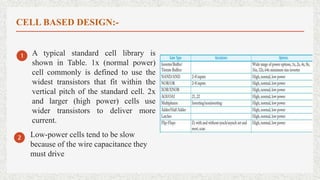
A typical standard cell library is
shown in Table. 1x (normal power)
cell commonly is defined to use the
widest transistors that fit within the
vertical pitch of the standard cell. 2x
and larger (high power) cells use
wider transistors to deliver more
current.
Low-power cells tend to be slow
because of the wire capacitance they
must drive
CELL BASED DESIGN:-
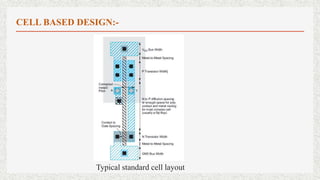
Typical standard cell layout
FULL CUSTOM DESIGN:-
The oldest and most traditional technique is termed custom mask layout, in which
a designer sits in front of a graphics display running an interactive editor and
pieces designs together at the geometry level one rectangle at a time. This work
is sometimes called polygon pushing.
1
Software generators as a method of generating physical layout. This kind of idea
has been around for a long time and was often referred to as silicon compilation.
Generators are the most common method used today for library generation
2
Custom-designed microprocessors routinely exceed 2 GHz in nanometer
processes, while synthesized ASICs typically operate closer to 200–350 Mhz.
3
PLATFORM BASED DESIGN - SOC:-
A platform can be used to implement a design by using common structures such as
busses and common high-level languages (such as C) to program the processors.
To a large extent, the RISC processor and memories can be interchanged and the
number and type of peripherals can be changed while maintaining good design
and verification times because the modules have been predesigned and the test and
verification.
1
2
Platform-based systems typically consist of a basic RISC processor, which can be
extended with multipliers, floating point units, or specialized DSP units.
3
processor selection is important when starting out on a product design that may
eventually be integrated.
SUMMARY:-
THANK YOU

CMOS DESIGN METHOD.pptx

  • 1.
  • 2.
    VARIOUS DESIGN METHODS:- •Cell based design • Full Custom based Design • Platform based Design
  • 3.
    CELL BASED DESIGN:- 1Cell-based design uses a standard cell library as the basic building blocks of a chip. The cells are placed in appropriate positions, then their interconnections are routed 2 Cell-based design can deliver smaller, faster, and lower-power chips than FPGAs but has high NRE costs to produce the custom mask set. Therefore, it is only economical for high volume parts or when the performance commands a lucrative sales price. 3 As compared to full custom design, cell-based design offers much higher productivity because it uses predesigned cells with layouts
  • 4.
    CELL BASED DESIGN:- Foundriesand library vendors supply cells with a wide range of functionality. These include the following: Small-scale integration (SSI) logic (NAND, NOR, XOR, AOI, OAI, inverters, buffers, registers) Memories (RAM, ROM, CAM, register files) System level modules such as processors, protocol processors, serial interfaces, and bus interfaces 1 2 3
  • 5.
    CELL BASED DESIGN:- 1 2 Atypical standard cell library is shown in Table. 1x (normal power) cell commonly is defined to use the widest transistors that fit within the vertical pitch of the standard cell. 2x and larger (high power) cells use wider transistors to deliver more current. Low-power cells tend to be slow because of the wire capacitance they must drive
  • 6.
    CELL BASED DESIGN:- Typicalstandard cell layout
  • 7.
    FULL CUSTOM DESIGN:- Theoldest and most traditional technique is termed custom mask layout, in which a designer sits in front of a graphics display running an interactive editor and pieces designs together at the geometry level one rectangle at a time. This work is sometimes called polygon pushing. 1 Software generators as a method of generating physical layout. This kind of idea has been around for a long time and was often referred to as silicon compilation. Generators are the most common method used today for library generation 2 Custom-designed microprocessors routinely exceed 2 GHz in nanometer processes, while synthesized ASICs typically operate closer to 200–350 Mhz. 3
  • 8.
    PLATFORM BASED DESIGN- SOC:- A platform can be used to implement a design by using common structures such as busses and common high-level languages (such as C) to program the processors. To a large extent, the RISC processor and memories can be interchanged and the number and type of peripherals can be changed while maintaining good design and verification times because the modules have been predesigned and the test and verification. 1 2 Platform-based systems typically consist of a basic RISC processor, which can be extended with multipliers, floating point units, or specialized DSP units. 3 processor selection is important when starting out on a product design that may eventually be integrated.
  • 9.
  • 10.