16:11 27)
LIET
NOTE: If you'd like to vew an image of
the Information below (or borrow the
Image for your own site), click here.
CLUTCH FRICTIONMATERIALS
Explainedd
Few auto parts are as mysterious as the modern clutch. From confusing and misleading
industry jargon, to common misconceptions about clutch function, there's a lot of bad
information out there.
Here's a rundown of the six common clutch friction materlals with data and detalils that will make
you a clutchexpert
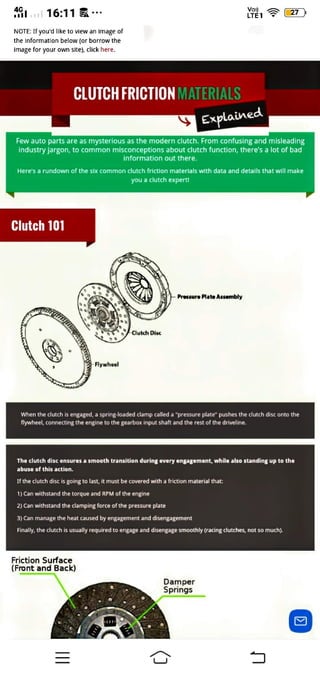
Clutch 101
ressure Plate Assembly
Clutch Disc
Flywheel
When the clutch is engaged, a spring-loaded clamp caled a "pressure plate" pushes the clutch disc onto the
flywheel, connecting the engine to the gearbox input shaft and the rest of the driveline.
The clutch disc ensures a smooth transition during every engagement, while also standing up to the
abuse of this action.
If the clutch disc is going to last, it must be covered with a friction material that:
1) Can withstand the torque and RPM of the engine
2) Can withstand the clamping force of the pressure plate
3) Can manage the heat caused by engagement and disengagement
Finally, the clutch is usually required to engage and disengage smoothly (racing clutches, not so much)
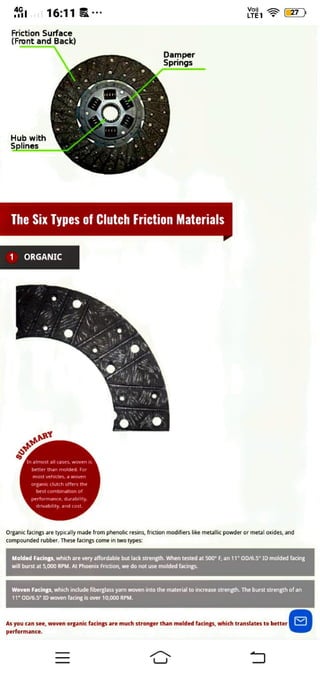
Friction Surface
(Front and Back)
Damper
Springs
16:11 LIET
Friction Surface
(Front and Back)
Damper
Springs
Hub with
Splines
The Six Types of Clutch Friction Materials
1 ORGANIC
MMARr
S
almost all cases, woven
better than molded. For
most vehicles, a wover
orers the
best combinauo o
pertormance, durability
drivability, and cost.
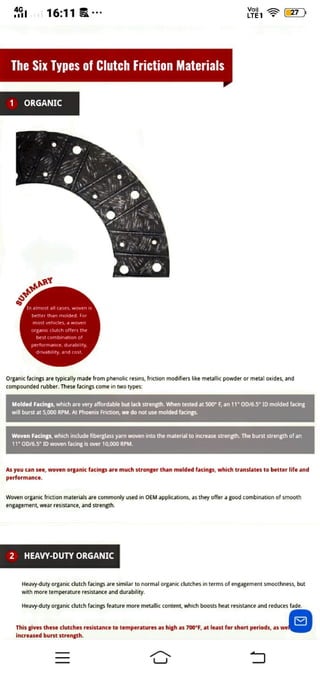
Organic facings are typically made from phenolic resins, friction modifiers like metallic powder or metal oxides, and
compounded rubber. These facings come in two types:
Molded Facings, whichare very affordable but lack strength. When tested at 500" F an 11" OD/6.5"ID molded facing
will burst at 5,000 RPM. At Phoenix Friction, we do not use molded facings.
Woven Facings, which include fiberglass yarn woven into the material to increase strength. The burst strength of an
11 OD/6.5" ID woven facing is over 10,000 RPM.
As you can see, woven organic facings are much stronger than molded facings, which translates to better
pertormance
16:11 C7
LTET
The Six Types of Clutch Friction Materials
1 ORGANIC
sUMMARr
almost all cases, woven is
better than molded. For
most vehicles, a woven
organic clutch offers the
best combination of
performance, durability.
drivability, and cost
organic facings are typicaly made from phenolic resins, friction modifiers like metallic powder or metal oxides, and
compounded rubber. These facings come in two types:
Molded Facings, which are very affordable but lack strength. When tested at 500" F, an 11" OD/6.5" 1D molded facing
will burst at 5,000 RPM. At Phoenix Friction, we do not use molded facings.
Woven Facings, which include fiberglass yarn woven into the material to increase strength. The burst strength of an
11" OD/6.5" 1D woven facing is over 10,000 RPM.
As you can see, woven organic facings are much stronger than molded facings, which transiates to better life and
pertormance.
Woven organic friction materials are commonly used in OEM applications, as they offer a good combination of smooth
engagement, wear resistance, and strength.
2 HEAVY-DUTY ORGANIC
Heavy-duty organic clutch facings are similar to normal organic clutches in terms of engagement smoothness, but
with more temperature resistance and durability.
Heavy-duty organic clutch facings feature more metallic content, which boosts heat resistance and reduces fade
This gives these clutches resistance to temperatures as high as 700"F, at least for short periods, as we
increased burst strength.
A116:11 YOP, 7)
LTET
2 HEAVY-DUTY ORGANIC
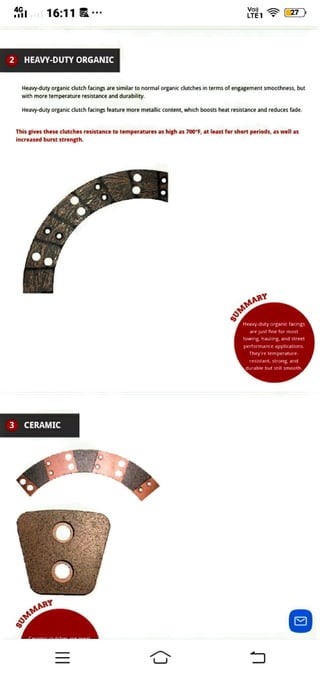
Heavy-duty organic clutch facings are similar to normal organic clutches in terms of engagement smoothness, but
with more temperature resistance and durability.
Heavy-duty organic clutch facings feature more metallic content, which boosts heat resistance and reduces fade.
This gives these clutches resistance to temperatures as high as 700°F, at least for short periods, as well as
increased burst strength.
sUMMARP
Heay-duty organic facingS
are just nne tor most
towing, hauling and street
performance applications.
hey re temperature
resistant, strong, and
durable but stll smooh
3 CERAMIC
sUMMAR
16:11 7 )
LTET
3 CERAMIC
sUMMAR
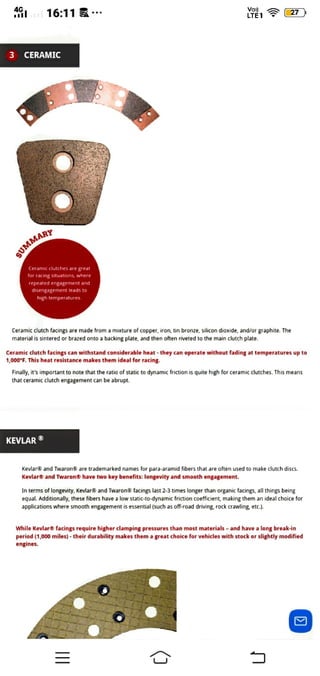
Ceramic clutches are great
or racing Situations, where
repeated engagement and
disengagement leads to
high temperatures.
Ceramic clutch facings are made from a mixture of copper, iron, tin bronze, silicon dioxide, and/or graphite. The
material is sintered or brazed onto a backing plate, and then often riveted to the main clutch plate.
Ceramic clutch facings can withstand considerable heat they can operate without fading at temperatures up to
1,000°F. This heat resistance makes them ideal for racing.
Finally, it'simportant to note that the ratio of static to dynamic friction is quite high for ceramic clutches. This means
that ceramic clutch engagement can be abrupt.
KEVLAR
Kevlar® and Twaron® are trademarked names for para-aramid fibers that are often used to make clutch discs.
Kevlar® and Twaron® have two key benefits: longevity and smooth engagement.
In terms of longevity, Kevlar® and Twaron8 facings last 2-3 times longer than organic facings, all things being
equal. Additionally, these fibers have a low static-to-dynamic friction coefficient, making them an ideal choice for
applications where smooth engagement is essential (such as off-road driving. rock crawling etc.).
While Kevlar® facings require higher clamping pressures than most materials - and have a long break-in
period (1,000 miles)-theirdurability makes them a great choice for vehicles with stock or slightly modified
engines.
=
16:11 27
LIET
KEVLAR
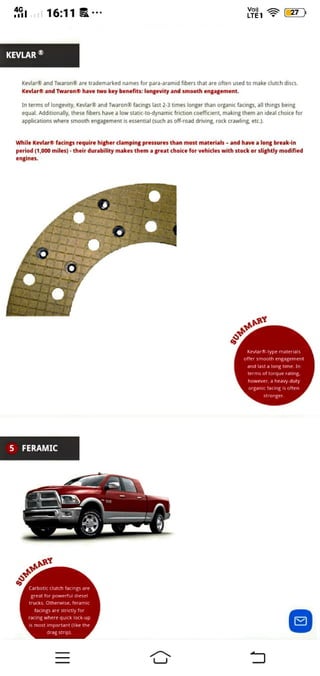
Keviar® and Twaron® are trademarked names tor para-aramid fibers that are often used to make clutch discs
Kevlar® and Twaron® have two key benefits: longevity and smooth engagement.
In terms of longevity, Kevlar® and Twaron@ facings last 2-3 times longer than organic facings, all things being
equal. Additionally, these fibers have a low static-to-dynamic friction coefficient, making them an ideal choice for
applications where smooth engagement is essential (such as off-road driving, rock crawling etc).
While Kevlar® facings require higher clamping pressures than most materials - and have a long break-in
period (1,000 miles)- their durability makes thema great choice for vehicles with stock or slightly modified
engines.
SUMMARP
Kevlar-typematerials
offer smooth engagement
ano 1ast a long time, In
terms of
torque ratng
however, a heavy-dut
organic facing is often
stronger.
5 FERAMIC
gUMMAR
Carbotic clutch facings are
great for powerful diesel
trucks. Otherwise, feramic
facings are strictiy Tor
racing where quick lock-up
is most important (like the
drag strip).
16:11 IE 27)
5 FERAMIC
sUMMARp
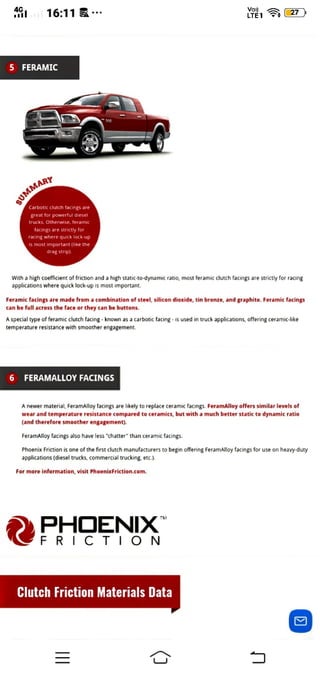
Carbotic clutch facings are
great for powerful diese
trucks. Otherwise, feramic
facings are strictly for
racing where quick lock-up
is most important (like the
dragstrip)
With a high coeficient of friction and a high static-to-dynamic ratio, most feramic clutch facings are strictly for racing
aPpications where quiCK 1OCK-up 15 most important.
Feramic facings are made from a combination of steel, silicon dioxide, tin bronze, and graphite. Feramic facings
can be full across the face or they can be buttons.
special type of feramic clutch facing- known as a carbotic facing -is used in truck applications, offering ceramic-like
temperature resistance with smoother engagement.
6 FERAMALLOYFACINGSs
A newer material, FeramAlloy facings are likely to replace ceramic facings. FeramAlloy offers similar levels of
wear and temperature resistance compared to ceramics, but with a much better static to dynamic ratio
(and therefore smoother engagement).
FeramAlloy facings also have less "chatter" than ceramic facings.
Phoenix Friction is one of the first clutch manufacturers to begin offering FeramAlloy facings for use on heavy-duty
applications (diesel trucks, commercial trucking, etc.).
For more information, visit PhoenixFriction.com.
PHOENIX
FRICTION
Clutch Friction Materials Data
A116:12 C7
LIET
Clutch Friction Materials Data
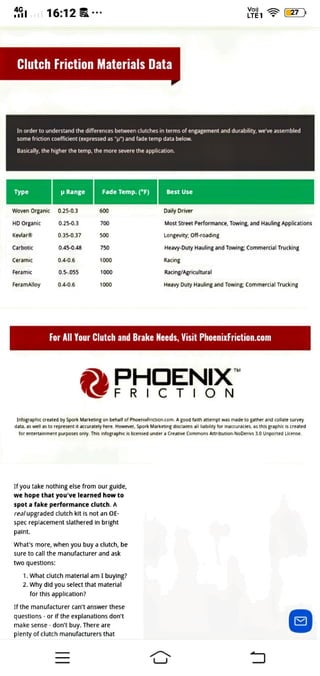
In order to understand the differences between clutches in terms of engagement and durability, we've assembled
some friction coefficient (expressed as "y') and fade temp data below.
Basically, the higher the temp, the more severe the application.
Type P Range Fade Temp. ((H) Best Use
Woven Organic 0.25-0.3 00 Daily Driver
HO Organic 0.25-0.3 00 Most Street Performance, Towing, and Hauling Applications
Kevlar 0.35-0.37 Longevity, Off-roading
500
Carbotic 0.45-0.48 750 Heavy-Duty Hauling and Towing: Commercial Trucking
ceramic 0.4-0.6 1000 Racing
Feramic 0.5-.055 1000 Racing/Agricultural
FeramAlloy 0.4-0.6 1000 Heavy Duty Hauling and Towing Commercial Trucking
For All Your Clutch and Brake Needs, Visit PhoenixFriction.com
PHOENIX
RIC TION
Infographic created by Spork Marketing on behalf of PhoenixFriction.com. A good faith attempt was made to gather and collate survey
data, as well as to represent it accurately here. However, Spork Marketing disclaims all liability for inaccuracies, as this graphic is created
for entertainment purposes only. This infographic is licensed under a Creative Commons Attribution-NoDerivs 3.0 Unported License,.
If you take nothing else from our guide,
we hope that you've learned how to
spot a fake performance clutch. A
real upgraded clutch kit is not an OE-
spec replacement slathered In bright
paint.
What's more, when you buy a clutch, be
sure to call the manufacturer and ask
two questions:
1. What clutch materlal am 1
Duyng
2. Why did you select that material
for this application?
If the manufacturer can't answer these
questlons-or if the explanations don't
make sense - don't buy. There are
plenty of clutch manufacturers that

clutch friction material.pdf

  • 1.
    16:11 27) LIET NOTE: Ifyou'd like to vew an image of the Information below (or borrow the Image for your own site), click here. CLUTCH FRICTIONMATERIALS Explainedd Few auto parts are as mysterious as the modern clutch. From confusing and misleading industry jargon, to common misconceptions about clutch function, there's a lot of bad information out there. Here's a rundown of the six common clutch friction materlals with data and detalils that will make you a clutchexpert Clutch 101 ressure Plate Assembly Clutch Disc Flywheel When the clutch is engaged, a spring-loaded clamp caled a "pressure plate" pushes the clutch disc onto the flywheel, connecting the engine to the gearbox input shaft and the rest of the driveline. The clutch disc ensures a smooth transition during every engagement, while also standing up to the abuse of this action. If the clutch disc is going to last, it must be covered with a friction material that: 1) Can withstand the torque and RPM of the engine 2) Can withstand the clamping force of the pressure plate 3) Can manage the heat caused by engagement and disengagement Finally, the clutch is usually required to engage and disengage smoothly (racing clutches, not so much) Friction Surface (Front and Back) Damper Springs
  • 2.
    16:11 LIET Friction Surface (Frontand Back) Damper Springs Hub with Splines The Six Types of Clutch Friction Materials 1 ORGANIC MMARr S almost all cases, woven better than molded. For most vehicles, a wover orers the best combinauo o pertormance, durability drivability, and cost. Organic facings are typically made from phenolic resins, friction modifiers like metallic powder or metal oxides, and compounded rubber. These facings come in two types: Molded Facings, whichare very affordable but lack strength. When tested at 500" F an 11" OD/6.5"ID molded facing will burst at 5,000 RPM. At Phoenix Friction, we do not use molded facings. Woven Facings, which include fiberglass yarn woven into the material to increase strength. The burst strength of an 11 OD/6.5" ID woven facing is over 10,000 RPM. As you can see, woven organic facings are much stronger than molded facings, which translates to better pertormance
  • 3.
    16:11 C7 LTET The SixTypes of Clutch Friction Materials 1 ORGANIC sUMMARr almost all cases, woven is better than molded. For most vehicles, a woven organic clutch offers the best combination of performance, durability. drivability, and cost organic facings are typicaly made from phenolic resins, friction modifiers like metallic powder or metal oxides, and compounded rubber. These facings come in two types: Molded Facings, which are very affordable but lack strength. When tested at 500" F, an 11" OD/6.5" 1D molded facing will burst at 5,000 RPM. At Phoenix Friction, we do not use molded facings. Woven Facings, which include fiberglass yarn woven into the material to increase strength. The burst strength of an 11" OD/6.5" 1D woven facing is over 10,000 RPM. As you can see, woven organic facings are much stronger than molded facings, which transiates to better life and pertormance. Woven organic friction materials are commonly used in OEM applications, as they offer a good combination of smooth engagement, wear resistance, and strength. 2 HEAVY-DUTY ORGANIC Heavy-duty organic clutch facings are similar to normal organic clutches in terms of engagement smoothness, but with more temperature resistance and durability. Heavy-duty organic clutch facings feature more metallic content, which boosts heat resistance and reduces fade This gives these clutches resistance to temperatures as high as 700"F, at least for short periods, as we increased burst strength.
  • 4.
    A116:11 YOP, 7) LTET 2HEAVY-DUTY ORGANIC Heavy-duty organic clutch facings are similar to normal organic clutches in terms of engagement smoothness, but with more temperature resistance and durability. Heavy-duty organic clutch facings feature more metallic content, which boosts heat resistance and reduces fade. This gives these clutches resistance to temperatures as high as 700°F, at least for short periods, as well as increased burst strength. sUMMARP Heay-duty organic facingS are just nne tor most towing, hauling and street performance applications. hey re temperature resistant, strong, and durable but stll smooh 3 CERAMIC sUMMAR
  • 5.
    16:11 7 ) LTET 3CERAMIC sUMMAR Ceramic clutches are great or racing Situations, where repeated engagement and disengagement leads to high temperatures. Ceramic clutch facings are made from a mixture of copper, iron, tin bronze, silicon dioxide, and/or graphite. The material is sintered or brazed onto a backing plate, and then often riveted to the main clutch plate. Ceramic clutch facings can withstand considerable heat they can operate without fading at temperatures up to 1,000°F. This heat resistance makes them ideal for racing. Finally, it'simportant to note that the ratio of static to dynamic friction is quite high for ceramic clutches. This means that ceramic clutch engagement can be abrupt. KEVLAR Kevlar® and Twaron® are trademarked names for para-aramid fibers that are often used to make clutch discs. Kevlar® and Twaron® have two key benefits: longevity and smooth engagement. In terms of longevity, Kevlar® and Twaron8 facings last 2-3 times longer than organic facings, all things being equal. Additionally, these fibers have a low static-to-dynamic friction coefficient, making them an ideal choice for applications where smooth engagement is essential (such as off-road driving. rock crawling etc.). While Kevlar® facings require higher clamping pressures than most materials - and have a long break-in period (1,000 miles)-theirdurability makes them a great choice for vehicles with stock or slightly modified engines. =
  • 6.
    16:11 27 LIET KEVLAR Keviar® andTwaron® are trademarked names tor para-aramid fibers that are often used to make clutch discs Kevlar® and Twaron® have two key benefits: longevity and smooth engagement. In terms of longevity, Kevlar® and Twaron@ facings last 2-3 times longer than organic facings, all things being equal. Additionally, these fibers have a low static-to-dynamic friction coefficient, making them an ideal choice for applications where smooth engagement is essential (such as off-road driving, rock crawling etc). While Kevlar® facings require higher clamping pressures than most materials - and have a long break-in period (1,000 miles)- their durability makes thema great choice for vehicles with stock or slightly modified engines. SUMMARP Kevlar-typematerials offer smooth engagement ano 1ast a long time, In terms of torque ratng however, a heavy-dut organic facing is often stronger. 5 FERAMIC gUMMAR Carbotic clutch facings are great for powerful diesel trucks. Otherwise, feramic facings are strictiy Tor racing where quick lock-up is most important (like the drag strip).
  • 7.
    16:11 IE 27) 5FERAMIC sUMMARp Carbotic clutch facings are great for powerful diese trucks. Otherwise, feramic facings are strictly for racing where quick lock-up is most important (like the dragstrip) With a high coeficient of friction and a high static-to-dynamic ratio, most feramic clutch facings are strictly for racing aPpications where quiCK 1OCK-up 15 most important. Feramic facings are made from a combination of steel, silicon dioxide, tin bronze, and graphite. Feramic facings can be full across the face or they can be buttons. special type of feramic clutch facing- known as a carbotic facing -is used in truck applications, offering ceramic-like temperature resistance with smoother engagement. 6 FERAMALLOYFACINGSs A newer material, FeramAlloy facings are likely to replace ceramic facings. FeramAlloy offers similar levels of wear and temperature resistance compared to ceramics, but with a much better static to dynamic ratio (and therefore smoother engagement). FeramAlloy facings also have less "chatter" than ceramic facings. Phoenix Friction is one of the first clutch manufacturers to begin offering FeramAlloy facings for use on heavy-duty applications (diesel trucks, commercial trucking, etc.). For more information, visit PhoenixFriction.com. PHOENIX FRICTION Clutch Friction Materials Data
  • 8.
    A116:12 C7 LIET Clutch FrictionMaterials Data In order to understand the differences between clutches in terms of engagement and durability, we've assembled some friction coefficient (expressed as "y') and fade temp data below. Basically, the higher the temp, the more severe the application. Type P Range Fade Temp. ((H) Best Use Woven Organic 0.25-0.3 00 Daily Driver HO Organic 0.25-0.3 00 Most Street Performance, Towing, and Hauling Applications Kevlar 0.35-0.37 Longevity, Off-roading 500 Carbotic 0.45-0.48 750 Heavy-Duty Hauling and Towing: Commercial Trucking ceramic 0.4-0.6 1000 Racing Feramic 0.5-.055 1000 Racing/Agricultural FeramAlloy 0.4-0.6 1000 Heavy Duty Hauling and Towing Commercial Trucking For All Your Clutch and Brake Needs, Visit PhoenixFriction.com PHOENIX RIC TION Infographic created by Spork Marketing on behalf of PhoenixFriction.com. A good faith attempt was made to gather and collate survey data, as well as to represent it accurately here. However, Spork Marketing disclaims all liability for inaccuracies, as this graphic is created for entertainment purposes only. This infographic is licensed under a Creative Commons Attribution-NoDerivs 3.0 Unported License,. If you take nothing else from our guide, we hope that you've learned how to spot a fake performance clutch. A real upgraded clutch kit is not an OE- spec replacement slathered In bright paint. What's more, when you buy a clutch, be sure to call the manufacturer and ask two questions: 1. What clutch materlal am 1 Duyng 2. Why did you select that material for this application? If the manufacturer can't answer these questlons-or if the explanations don't make sense - don't buy. There are plenty of clutch manufacturers that