A quick start guide to
business solutions
in the cloud
Presented by:
Annie Bustos
Director of Marketing
Prashant Kumar
SVP, Solutions & Strategy
Humanizing the cloud – Who is driving?
Goal : Simply providing business freedom
Why worry about
infrastructure
• We buy phones without worrying
about cell towers
• We buy homes without worrying
about electricity, hydro
Make changes easy and
quick
• Prepare for the one constant –
CHANGE
• Expect and plan for business
agility
Start small – Go Big
• ROI with each incremental
change
• Prototyping and testing ideas
Minimize Customization
• Choose eco systems that work
with each other
• Commit to the business goals
without any handicap
How to Design Cloud Solution Strategy
successful
Cloud Engineering Approaches
Enterprise as a provider of
cloud services.
When the enterprise is a
provider (e.g., building a
private cloud) hardware,
software and processes used
to implement a cloud service
are a primary focus.
Enterprise as a consumer of
cloud services.
When the enterprise is a
consumer, the focus is on the
IT-related capabilities delivered
as a service.
Reverse Cloud Engineering
IT
Views of Cloud
Business Users
View of Cloud
Development resources
Service access (portal, API)
Scalability capabilities
Service definition
Resource tracking
Automation
Standardization
Virtualization
Infrastructure
Phase 1: Business Case Support for Cloud
Assemble your team
Develop Business Case and Cloud Strategy
Phase 2: Design Cloud Strategy
Select Cloud Deployment Models
Select Cloud Service Models
Determine Who Will Develop, Test and Deploy Cloud Service
Phase 3: Cloud Governance & Security
Develop Cloud Governance Policies and Service Agreement
Assess and Resolve Security and Privacy Issues
Phase 4: POC & Production
Integrate with Existing Enterprise Systems
Develop a Proof-of-Concept before Moving to Production
Manage the Cloud environment
How to Get Started
How do I get started?
 Call us for a FREE one day evaluation
 Quick evaluation of priorities & pain points
 Possible options for business
 Plan to tackle and address challenges
 Help you build a cloud strategy and roadmap
http://info.tblocks.com/get-your-cloud-solution-roadmap
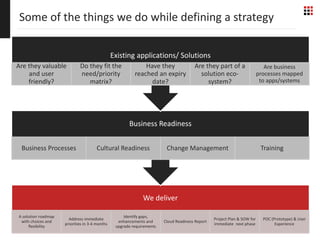
Some of the things we do while defining a strategy
We deliver
A solution roadmap
with choices and
flexibility
Address immediate
priorities in 3-4 months
Identify gaps,
enhancements and
upgrade requirements
Cloud Readiness Report
Project Plan & SOW for
immediate next phase
POC (Prototype) & User
Experience
Business Readiness
Business Processes Cultural Readiness Change Management Training
Existing applications/ Solutions
Are they valuable
and user
friendly?
Do they fit the
need/priority
matrix?
Have they
reached an expiry
date?
Are they part of a
solution eco-
system?
Are business
processes mapped
to apps/systems
Building customer-first solutions
True to your vision.
Thank you for attending!
Get your free assessment and solution roadmap today!
http://info.tblocks.com/get-your-cloud-solution-roadmap
Now taking questions.
Annie Bustos, Director of Marketing
annie@tblocks.com
twitter.com/techblocks
linkedin.com/company/techblocks
facebook.com/TechBlockshttp://tblocks.com

A Quick Start Guide to Business Solutions in the Cloud

  • 1.
    A quick startguide to business solutions in the cloud Presented by: Annie Bustos Director of Marketing Prashant Kumar SVP, Solutions & Strategy
  • 2.
    Humanizing the cloud– Who is driving?
  • 3.
    Goal : Simplyproviding business freedom Why worry about infrastructure • We buy phones without worrying about cell towers • We buy homes without worrying about electricity, hydro Make changes easy and quick • Prepare for the one constant – CHANGE • Expect and plan for business agility Start small – Go Big • ROI with each incremental change • Prototyping and testing ideas Minimize Customization • Choose eco systems that work with each other • Commit to the business goals without any handicap
  • 4.
    How to DesignCloud Solution Strategy successful
  • 5.
    Cloud Engineering Approaches Enterpriseas a provider of cloud services. When the enterprise is a provider (e.g., building a private cloud) hardware, software and processes used to implement a cloud service are a primary focus. Enterprise as a consumer of cloud services. When the enterprise is a consumer, the focus is on the IT-related capabilities delivered as a service.
  • 6.
    Reverse Cloud Engineering IT Viewsof Cloud Business Users View of Cloud Development resources Service access (portal, API) Scalability capabilities Service definition Resource tracking Automation Standardization Virtualization Infrastructure
  • 7.
    Phase 1: BusinessCase Support for Cloud Assemble your team Develop Business Case and Cloud Strategy
  • 8.
    Phase 2: DesignCloud Strategy Select Cloud Deployment Models Select Cloud Service Models Determine Who Will Develop, Test and Deploy Cloud Service
  • 9.
    Phase 3: CloudGovernance & Security Develop Cloud Governance Policies and Service Agreement Assess and Resolve Security and Privacy Issues
  • 10.
    Phase 4: POC& Production Integrate with Existing Enterprise Systems Develop a Proof-of-Concept before Moving to Production Manage the Cloud environment
  • 11.
    How to GetStarted
  • 12.
    How do Iget started?  Call us for a FREE one day evaluation  Quick evaluation of priorities & pain points  Possible options for business  Plan to tackle and address challenges  Help you build a cloud strategy and roadmap http://info.tblocks.com/get-your-cloud-solution-roadmap
  • 13.
    Some of thethings we do while defining a strategy We deliver A solution roadmap with choices and flexibility Address immediate priorities in 3-4 months Identify gaps, enhancements and upgrade requirements Cloud Readiness Report Project Plan & SOW for immediate next phase POC (Prototype) & User Experience Business Readiness Business Processes Cultural Readiness Change Management Training Existing applications/ Solutions Are they valuable and user friendly? Do they fit the need/priority matrix? Have they reached an expiry date? Are they part of a solution eco- system? Are business processes mapped to apps/systems
  • 14.
  • 15.
    Thank you forattending! Get your free assessment and solution roadmap today! http://info.tblocks.com/get-your-cloud-solution-roadmap Now taking questions. Annie Bustos, Director of Marketing annie@tblocks.com twitter.com/techblocks linkedin.com/company/techblocks facebook.com/TechBlockshttp://tblocks.com

Editor's Notes

  • #6 Enterprise as a provider of cloud services. When the enterprise is a provider (e.g., building a private cloud) hardware, software and processes used to implement a cloud service are a primary focus. Most cloud decisions are not (and should not be) about completely shutting down data centers and moving everything to the cloud. Nor should a cloud strategy be equated with a data center strategy. Neither should it be done in a vacuum — there should be data center space for things not in the cloud and, if things are moved out of the data center, there are implications. But they are not the same thing. In general, data center outsourcing, data center modernization and data center strategies are not synonymous with the cloud. Enterprise as a consumer of cloud services. When the enterprise is a consumer, the focus is on the IT-related capabilities delivered as a service. The main goal is determining if, when, where, how and why cloud services should be used. The hardware and software used to implement the service are handled by the service provider and are not a concern of the consumer. A cloud strategy begins by identifying business goals and mapping potential benefits of the cloud to them, while mitigating the potential drawbacks. Cloud should be thought of as a means to an end. The end must be specified first. To get cloud right you have to start here, and that requires a completely different set of skills This is a skill your virtualization administrator does not have
  • #7 To get cloud right, you have to step away from the guts of the solution and start with the value proposition.  From the point of view of the consumers of this service — your internal developers and business users.  To them, cloud is a service, not an infrastructure stack. They value the speed in which resources can be allocated to them, the simplicity of getting their work done and the lack of friction involved. And honestly, your virtualization administrator probably doesn't see how he benefits from cloud. In fact, he's probably threatened by it.  How can I deliver the same value and experience of the public cloud from within our own data center? Those who have had the most success with this approach have also started with a complete Infrastructure as a Service or Platform as a Service solution, rather than trying to build one up from a virtualization foundation
  • #8 Team : Executive stakeholder with a vision Understands the business and has their trust Someone on the technology team open to transformation Business Case What are the pain areas (Agility, Time to market, Flexibility, competitive) Stakeholder satisfaction Market Positioning
  • #9 Cloud Strategy Hybrid, Private, Public SaaS, PaaS, IaaS Existing Landscape and Transition Planning Impact and Change Management Planning Pricing, Licensing
  • #10 Governance: Who What When Compliance & Security Requirements Data, Business, Privacy Risk Regional Jurisdictions Balancing check & balances with user experience (UX)
  • #11 Integration and Validation (POC) Maturity of Cloud Validate Solutions (Performance, Experience, Requirements Matrix) Not everything can/should be in cloud : test integration strategy Adopt Agile as a culture (Not just methodology)