Clean Energy
Global Incentives Map
Renewable Energy
Solar Energy
Wind Energy
Marine Energy
Hydro
Waste-to-Energy
Other Cleantech
Clean Energy » Renewables » Wind Energy
Wind Characteristics
As the wind power is proportional to the cubic wind speed, it is crucial to have detailed knowledge of the site-specific wind characteristics. Even
small errors in estimation of wind speed can have large effects on the energy yield, but also lead to poor choices for turbine and site. An average
wind speed is not sufficient. Site-specific wind characteristics pertinent to wind turbines include:
mean wind speed: Only interesting as a headline figure, but does not tell how often high wind speeds occur.
wind speed distribution : diurnal, seasonal, annual patterns
turbulence: short-term fluctuations
long-term fluctuations
distribution of wind direction
wind shear (profile)
We are providing information on those dimensions and tools for basic yield calculations. However, due to the sensitivities, no calculation can
replace on-site wind measuring campaigns.
Wind Speed Patterns
Wind speed patterns can be depicted as
a wind speed spectrum. A high value
indicates a significant change in wind
speed over the corresponding time
period. Although this graph is obviously
site-specific, there are distinctive
similarities. A typical graph is shown on
the right.
The peaks in the wind speed spectrum
account for annual, seasonal and daily
patterns as well as short-term
turbulences. A striking phenomenon is
the spectral gap between time periods of
10 minutes to 2 hours.
These patterns are important not only for
yield estimations, but also for forecasting
of wind power output.
Wind Speed Distribution: The Macrometeorological Range
Large-scale movements of air masses account for 3 peaks on the macrometeorological side of the spectrum.
Diurnal Pattern caused by different temperatures at day and night. This effect is more distinct at coastal sites than off-shore.1.
Depressions and Anti-cyclones usually occur with periods of about 4 days. Tthis phenomenon is more distinct in oceanic than continental
regions.
2.
Annual Pattern varies with the degree of latitude and vanishes in close proximity to the equator.3.
The distribution of hourly average wind speeds (i.e. excluding turbulence) can be described by a so-called Weibull distribution:
What is wind energy?
Wind Characteristics
Technologies
Systems
Market & Industry
Environmental Issues
Wind Site Planning
Visual Impact
Shadow Flicker
Home Services Projects Clean Energy Solar Power Climate Change Finance Blog search
Wind Characteristics, Wind Speed and Energy http://www.greenrhinoenergy.com/renewable/wind/wind_characteristics.php
1 of 4 18-Jul-15 5:10 PM
with a shape factor k and a scaling factor
A. The dimensionless shape factor
reflects the influence of the topography on
wind speeds and ranges between 1.2
(mountains) to 4.0 (monsoon regions).
The scaling factor A is roughly 125% of
the average annual wind speed.
Alternatively, the following relationship
between average wind speed, shape
factor and scaling factor can be used:
where Γ(x) is the gamma-function. In
practice, the wind distribution is measured
first, and then the parameters are
adapted and used for further calculations.
Micro-meteorological Range: Turbulence
One of the main characteristics of wind its high temporal variations. Wind speeds can double or triple within seconds, meaning power increased 8
or 27 times! Turbulence intensity increases with obstacles such as buildings, tress or steep mountain tops. Sites with high average wind speeds
tend to suffer less from turbulence.
Why is turbulence bad for wind turbines?
Reduced production of energy
Increased wear and tear shorten lifetime of the
turbine
Increased dynamic loads on the blades
What are sure signs of high turbulence?
Inhomogenouse landscapes
Steep cliffs or mountain tops
Regions with many obstacles - buildings and other
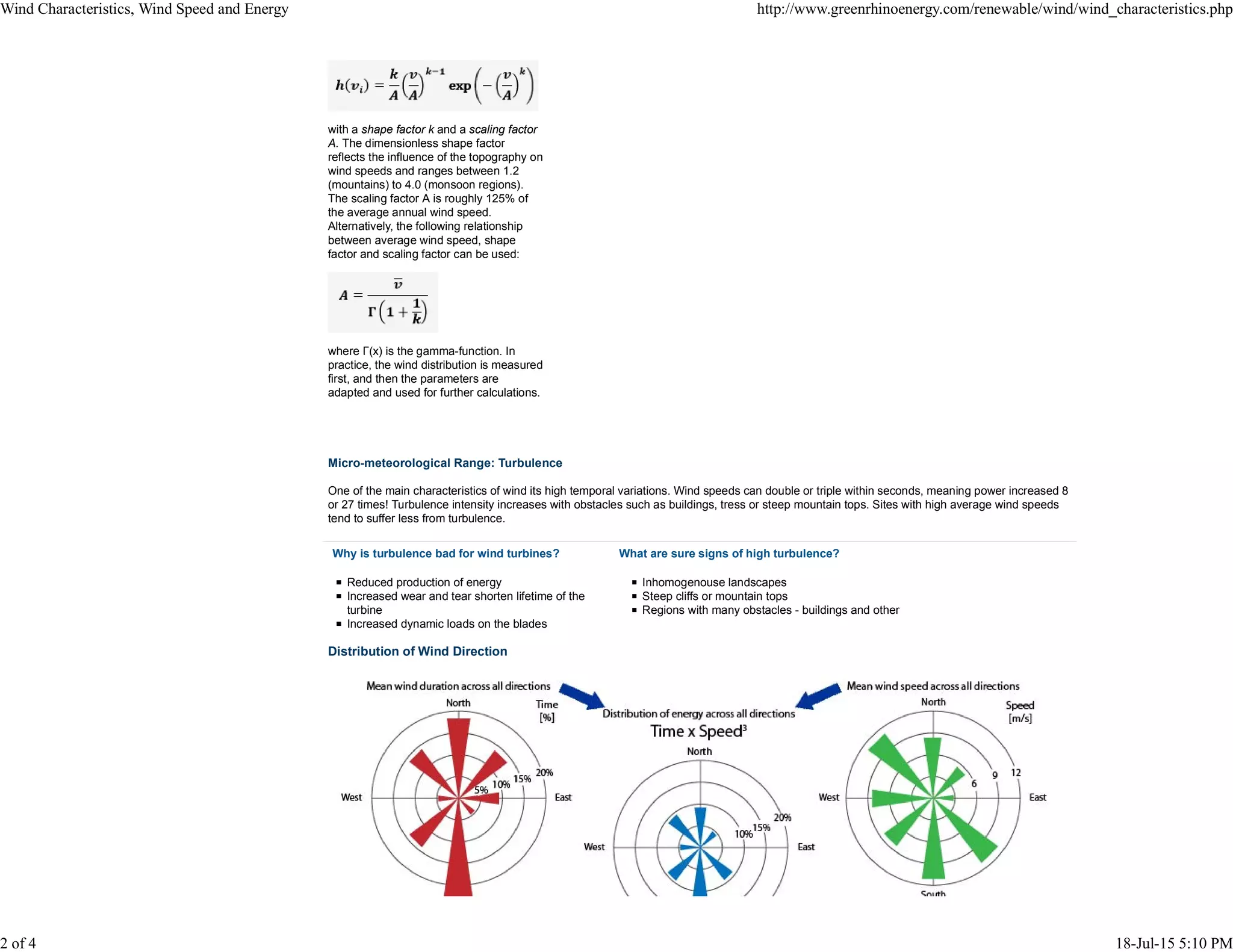
Distribution of Wind Direction
Wind Characteristics, Wind Speed and Energy http://www.greenrhinoenergy.com/renewable/wind/wind_characteristics.php
2 of 4 18-Jul-15 5:10 PM
Although not of interest for the site selection, the distribution of the wind direction is important for the layout of a wind farm. This is done in three
steps:
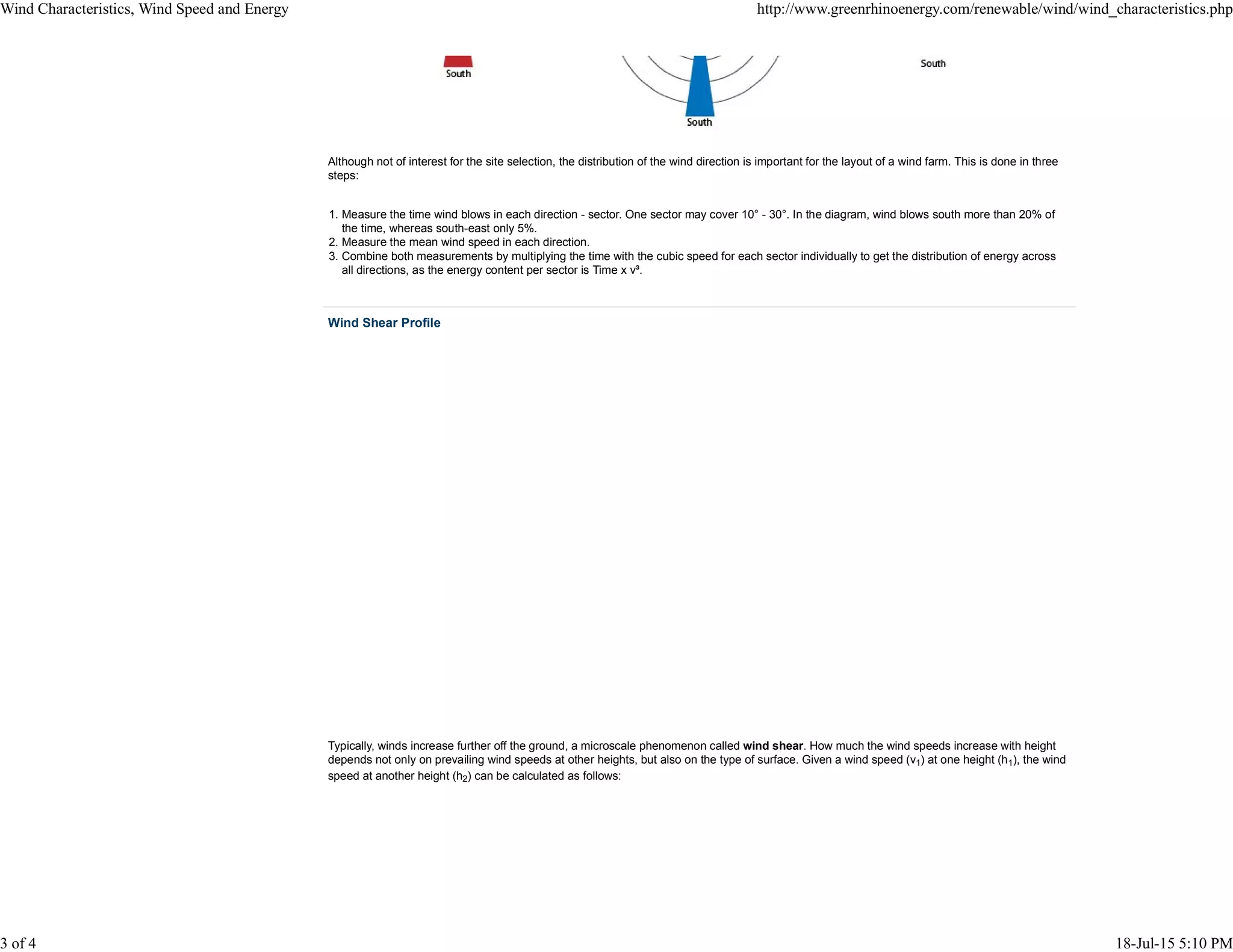
Measure the time wind blows in each direction - sector. One sector may cover 10° - 30°. In the diagram, wind blows south more than 20% of
the time, whereas south-east only 5%.
1.
Measure the mean wind speed in each direction.2.
Combine both measurements by multiplying the time with the cubic speed for each sector individually to get the distribution of energy across
all directions, as the energy content per sector is Time x v³.
3.
Wind Shear Profile
Typically, winds increase further off the ground, a microscale phenomenon called wind shear. How much the wind speeds increase with height
depends not only on prevailing wind speeds at other heights, but also on the type of surface. Given a wind speed (v1) at one height (h1), the wind
speed at another height (h2) can be calculated as follows:
Wind Characteristics, Wind Speed and Energy http://www.greenrhinoenergy.com/renewable/wind/wind_characteristics.php
3 of 4 18-Jul-15 5:10 PM
where z0 is an index that describes the roughness of the surface. Values for the
roughness index range from 0.01 for flat landscapes to 2.0 in town centres. Two
important insights follow from this:
In rough areas, especially built-up areas, the height of the turbine hub is much more
important than off-shore, as wind speed change slower along the distance from the
surface.
For large turbines, the difference between the wind speed experienced by blade tips
at top and bottom vary much more in rough areas - forces that cause additional
wear and tear.
Long-term Fluctuations
The annual energy yield from wind can also vary from year to year, caused by many factors including variations in solar intensity and other
large-scale effects. Empirical evidence shows that these annual variations are much more distinct than for solar irradiance and can vary as much
as 30%.
Join us << previous | next >>
About | Terms of Use | Sitemap | Contact Us ©2013 Green Rhino Energy Ltd.
Wind Characteristics, Wind Speed and Energy http://www.greenrhinoenergy.com/renewable/wind/wind_characteristics.php
4 of 4 18-Jul-15 5:10 PM

Wind characteristics, wind speed and energy

  • 1.
    Clean Energy Global IncentivesMap Renewable Energy Solar Energy Wind Energy Marine Energy Hydro Waste-to-Energy Other Cleantech Clean Energy » Renewables » Wind Energy Wind Characteristics As the wind power is proportional to the cubic wind speed, it is crucial to have detailed knowledge of the site-specific wind characteristics. Even small errors in estimation of wind speed can have large effects on the energy yield, but also lead to poor choices for turbine and site. An average wind speed is not sufficient. Site-specific wind characteristics pertinent to wind turbines include: mean wind speed: Only interesting as a headline figure, but does not tell how often high wind speeds occur. wind speed distribution : diurnal, seasonal, annual patterns turbulence: short-term fluctuations long-term fluctuations distribution of wind direction wind shear (profile) We are providing information on those dimensions and tools for basic yield calculations. However, due to the sensitivities, no calculation can replace on-site wind measuring campaigns. Wind Speed Patterns Wind speed patterns can be depicted as a wind speed spectrum. A high value indicates a significant change in wind speed over the corresponding time period. Although this graph is obviously site-specific, there are distinctive similarities. A typical graph is shown on the right. The peaks in the wind speed spectrum account for annual, seasonal and daily patterns as well as short-term turbulences. A striking phenomenon is the spectral gap between time periods of 10 minutes to 2 hours. These patterns are important not only for yield estimations, but also for forecasting of wind power output. Wind Speed Distribution: The Macrometeorological Range Large-scale movements of air masses account for 3 peaks on the macrometeorological side of the spectrum. Diurnal Pattern caused by different temperatures at day and night. This effect is more distinct at coastal sites than off-shore.1. Depressions and Anti-cyclones usually occur with periods of about 4 days. Tthis phenomenon is more distinct in oceanic than continental regions. 2. Annual Pattern varies with the degree of latitude and vanishes in close proximity to the equator.3. The distribution of hourly average wind speeds (i.e. excluding turbulence) can be described by a so-called Weibull distribution: What is wind energy? Wind Characteristics Technologies Systems Market & Industry Environmental Issues Wind Site Planning Visual Impact Shadow Flicker Home Services Projects Clean Energy Solar Power Climate Change Finance Blog search Wind Characteristics, Wind Speed and Energy http://www.greenrhinoenergy.com/renewable/wind/wind_characteristics.php 1 of 4 18-Jul-15 5:10 PM
  • 2.
    with a shapefactor k and a scaling factor A. The dimensionless shape factor reflects the influence of the topography on wind speeds and ranges between 1.2 (mountains) to 4.0 (monsoon regions). The scaling factor A is roughly 125% of the average annual wind speed. Alternatively, the following relationship between average wind speed, shape factor and scaling factor can be used: where Γ(x) is the gamma-function. In practice, the wind distribution is measured first, and then the parameters are adapted and used for further calculations. Micro-meteorological Range: Turbulence One of the main characteristics of wind its high temporal variations. Wind speeds can double or triple within seconds, meaning power increased 8 or 27 times! Turbulence intensity increases with obstacles such as buildings, tress or steep mountain tops. Sites with high average wind speeds tend to suffer less from turbulence. Why is turbulence bad for wind turbines? Reduced production of energy Increased wear and tear shorten lifetime of the turbine Increased dynamic loads on the blades What are sure signs of high turbulence? Inhomogenouse landscapes Steep cliffs or mountain tops Regions with many obstacles - buildings and other Distribution of Wind Direction Wind Characteristics, Wind Speed and Energy http://www.greenrhinoenergy.com/renewable/wind/wind_characteristics.php 2 of 4 18-Jul-15 5:10 PM
  • 3.
    Although not ofinterest for the site selection, the distribution of the wind direction is important for the layout of a wind farm. This is done in three steps: Measure the time wind blows in each direction - sector. One sector may cover 10° - 30°. In the diagram, wind blows south more than 20% of the time, whereas south-east only 5%. 1. Measure the mean wind speed in each direction.2. Combine both measurements by multiplying the time with the cubic speed for each sector individually to get the distribution of energy across all directions, as the energy content per sector is Time x v³. 3. Wind Shear Profile Typically, winds increase further off the ground, a microscale phenomenon called wind shear. How much the wind speeds increase with height depends not only on prevailing wind speeds at other heights, but also on the type of surface. Given a wind speed (v1) at one height (h1), the wind speed at another height (h2) can be calculated as follows: Wind Characteristics, Wind Speed and Energy http://www.greenrhinoenergy.com/renewable/wind/wind_characteristics.php 3 of 4 18-Jul-15 5:10 PM
  • 4.
    where z0 isan index that describes the roughness of the surface. Values for the roughness index range from 0.01 for flat landscapes to 2.0 in town centres. Two important insights follow from this: In rough areas, especially built-up areas, the height of the turbine hub is much more important than off-shore, as wind speed change slower along the distance from the surface. For large turbines, the difference between the wind speed experienced by blade tips at top and bottom vary much more in rough areas - forces that cause additional wear and tear. Long-term Fluctuations The annual energy yield from wind can also vary from year to year, caused by many factors including variations in solar intensity and other large-scale effects. Empirical evidence shows that these annual variations are much more distinct than for solar irradiance and can vary as much as 30%. Join us << previous | next >> About | Terms of Use | Sitemap | Contact Us ©2013 Green Rhino Energy Ltd. Wind Characteristics, Wind Speed and Energy http://www.greenrhinoenergy.com/renewable/wind/wind_characteristics.php 4 of 4 18-Jul-15 5:10 PM