Cloud FoundryFrom A Developer’s Perspective Multi-Language, Multi-Framework PaaS1
Dealing with applicationsFrom a Developer’s Perspective2
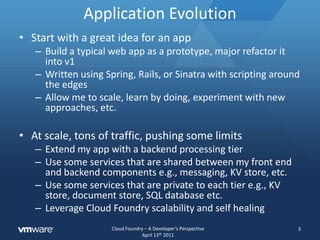
Application EvolutionStart with a great idea for an appBuild a typical web app as a prototype, major refactor it into v1Written using Spring, Rails, or Sinatra with scripting around the edgesAllow me to scale, learn by doing, experiment with new approaches, etc.At scale, tons of traffic, pushing some limitsExtend my app with a backend processing tierUse some services that are shared between my front end and backend components e.g., messaging, KV store, etc.Use some services that are private to each tier e.g., KV store, document store, SQL database etc.Leverage Cloud Foundry scalability and self healing3
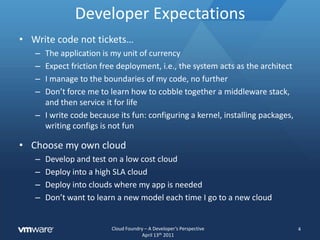
Developer ExpectationsWrite code not tickets…The application is my unit of currencyExpect friction free deployment, i.e., the system acts as the architectI manage to the boundaries of my code, no furtherDon’t force me to learn how to cobble together a middleware stack, and then service it for lifeI write code because its fun: configuring a kernel, installing packages, writing configs is not funChoose my own cloudDevelop and test on a low cost cloudDeploy into a high SLA cloudDeploy into clouds where my app is neededDon’t want to learn a new model each time I go to a new cloud4
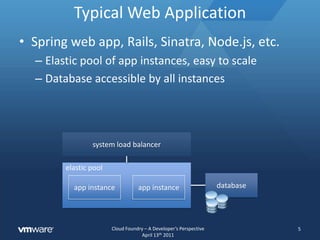
Typical Web Application5Spring web app, Rails, Sinatra, Node.js, etc.Elastic pool of app instances, easy to scaleDatabase accessible by all instancesdatabasesystem load balancerelastic poolapp instanceapp instance
Deploying Web App the Old Way6[mysqld]user = foobarport = 3306basedir = /usrbind-address = 172.58.77.101key_buffer = 16Mthread_stack = 128Kthread_cache_size = 8…[nginx]http.includemime.types;default_type: application/octet-stream;log_format: main ‘$remote_addr - $remote_user []…’keepalive_timeout 65;[tomcat]<Connector redirectPort=“8443” emptySessionPath…/><bean id=“sessionFactory” class=“org.springframework…/>[frontend]dependencies:mysqlclient
rubyfiles:core/app/fe/**/*
core/common/**/*[blah]- blah blah blahmvc web app
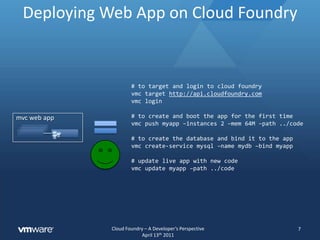
Deploying Web App on Cloud Foundry7# to target and login to cloud foundryvmctarget http://api.cloudfoundry.comvmc login# to create and boot the app for the first timevmc push myapp –instances 2 –mem 64M –path ../code# to create the database and bind it to the appvmc create-service mysql –name mydb –bind myapp# update live app with new codevmc update myapp –path ../codemvc web app
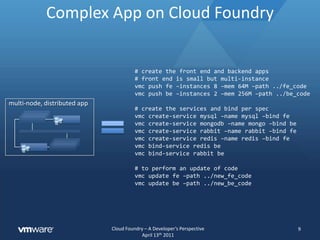
At Scale – Multi-Node Distributed App8system load balancerredismysqlmongodbelastic poolrabbitMQelastic poolfront_endfront_endback_end
Complex App on Cloud Foundry9# create the front end and backend apps# front end is small but multi-instancevmc push fe –instances 8 –mem 64M –path ../fe_codevmc push be –instances 2 –mem 256M –path ../be_code# create the services and bind per specvmc create-service mysql –name mysql –bind fevmc create-service mongodb –name mongo –bind bevmc create-service rabbit –name rabbit –bind fevmccreate-service redis –name redis –bind fevmc bind-service redis bevmc bind-service rabbit be# to perform an update of codevmc update fe –path ../new_fe_codevmc update be –path ../new_be_codemulti-node, distributed app
SummaryCloud Foundrylets me start smallLearn new approaches, frameworks, and servicesDevelop on my cloud or yoursCloudFoundrylets me grow my appMulti node distributed systemsBuilt-in scaling at the node levelCloudFoundrylets me deploy & run with no frictionThere is no learning curve. 0 to cloud in 3 clicksCloud Foundry is my infrastructure architectCloud Foundry lets me choose my own cloud10
developer visible architectureFrom a Developer’s Perspective11
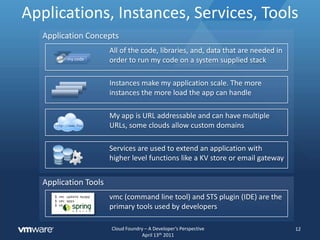
Applications, Instances, Services, Tools12Application ConceptsInstances make my application scale. The more instances the more load the app can handleAll of the code, libraries, and, data that are needed in order to run my code on a system supplied stackMy app is URL addressable and can have multiple URLs, some clouds allow custom domainshttp://www.fooServices are used to extend an application with higher level functions like a KV store or email gatewayApplication Toolsvmc (command line tool) and STS plugin (IDE) are the primary tools used by developers$ vmc update myapp$ vmc apps$ vmmy code
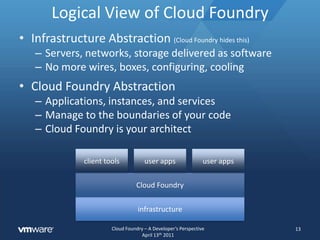
Logical View of Cloud Foundry13Infrastructure Abstraction (Cloud Foundry hides this)Servers, networks, storage delivered as softwareNo more wires, boxes, configuring, coolingCloud FoundryAbstractionApplications, instances, and servicesManage to the boundaries of your codeCloud Foundry is your architectuser appsuser appsclient toolsCloud Foundryinfrastructure
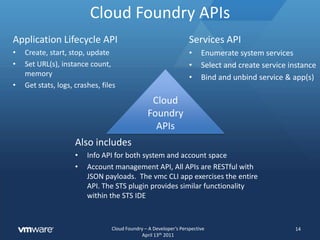
Cloud Foundry APIs14Application Lifecycle APICreate, start, stop, updateSet URL(s), instance count, memoryGet stats, logs, crashes, filesServices APIEnumerate system servicesSelect and create service instanceBind and unbind service & app(s)Cloud FoundryAPIsAlso includesInfo API for both system and account spaceAccount management API, All APIs are RESTful with JSON payloads.  The vmc CLI app exercises the entire API. The STS plugin provides similar functionality within the STS IDE
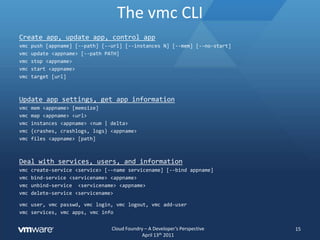
The vmc CLI15Create app, update app, control appvmc push [appname] [--path] [--url] [--instances N] [--mem] [--no-start]vmc update <appname> [--path PATH]vmc stop <appname>vmc start <appname>vmc target [url]Update app settings, get app informationvmcmem <appname> [memsize]vmc map <appname> <url>vmc instances <appname> <num | delta>vmc {crashes, crashlogs, logs} <appname>vmc files <appname> [path]Deal with services, users, and informationvmc create-service <service> [--name servicename] [--bind appname]vmc bind-service <servicename> <appname>vmc unbind-service  <servicename> <appname>vmc delete-service <servicename>vmc user, vmcpasswd, vmc login, vmc logout, vmc add-uservmc services, vmc apps, vmc info
What’s under the hoodFrom a Developer’s Perspective16
Cloud Foundry Internal View17
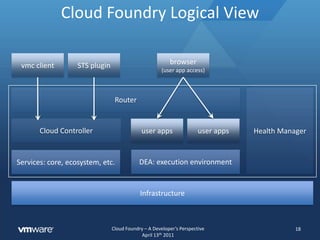
Cloud Foundry Logical View18vmc clientSTS pluginbrowser(user app access)RouterHealth Manageruser appsCloud Controlleruser appsDEA: execution environmentServices: core, ecosystem, etc.Infrastructure
Cloud Foundry: RouterThe router receives all traffic from the outside world and maintains the mapping from external URL to internal application instanceThe router performs this job for all Cloud Foundry APIentry points (typically from vmc or STS) as well as for all application specific trafficThe router acts as a load balancer, distributing requests evenly across all instances of a given app19
Cloud Foundry: Cloud ControllerIt is responsible for all state changes in the systemEnsuring all dependencies are availableBinding the application to servicesAnything that effects users, apps, or services is controlled by the Cloud ControllersExamples : vmc push, vmc instances, vmc create-service, etc. are driven by the Cloud ControllerOnce staged, the Cloud Controller is responsible for connecting the application to a DEA execution unit20
Cloud Foundry: Health ManagerThe Health Manager works closely with the Cloud Controller and DEAs to ensure that applications stay alive and healthyWhen an app instance crashes, it is the Health Manager that notes this and arranges for a replacement instanceIf the Health Manager detects rapid and repeated crashes, it declares the app to be in a “flapping” state and does not try to revive the app instances that are sick21
Cloud Foundry: DEAThe system maintains a pool of standby DEAs and these act as the VM-level container for an applicationDEAs support both single and multi-tenant operation (1 app per DEA VM, or n apps per DEA VM)DEAs provide a secure/constrained OS environment running the application’s app-server and the application code22

Cloud Foundry a Developer's Perspective

  • 1.
    Cloud FoundryFrom ADeveloper’s Perspective Multi-Language, Multi-Framework PaaS1
  • 2.
    Dealing with applicationsFroma Developer’s Perspective2
  • 3.
    Application EvolutionStart witha great idea for an appBuild a typical web app as a prototype, major refactor it into v1Written using Spring, Rails, or Sinatra with scripting around the edgesAllow me to scale, learn by doing, experiment with new approaches, etc.At scale, tons of traffic, pushing some limitsExtend my app with a backend processing tierUse some services that are shared between my front end and backend components e.g., messaging, KV store, etc.Use some services that are private to each tier e.g., KV store, document store, SQL database etc.Leverage Cloud Foundry scalability and self healing3
  • 4.
    Developer ExpectationsWrite codenot tickets…The application is my unit of currencyExpect friction free deployment, i.e., the system acts as the architectI manage to the boundaries of my code, no furtherDon’t force me to learn how to cobble together a middleware stack, and then service it for lifeI write code because its fun: configuring a kernel, installing packages, writing configs is not funChoose my own cloudDevelop and test on a low cost cloudDeploy into a high SLA cloudDeploy into clouds where my app is neededDon’t want to learn a new model each time I go to a new cloud4
  • 5.
    Typical Web Application5Springweb app, Rails, Sinatra, Node.js, etc.Elastic pool of app instances, easy to scaleDatabase accessible by all instancesdatabasesystem load balancerelastic poolapp instanceapp instance
  • 6.
    Deploying Web Appthe Old Way6[mysqld]user = foobarport = 3306basedir = /usrbind-address = 172.58.77.101key_buffer = 16Mthread_stack = 128Kthread_cache_size = 8…[nginx]http.includemime.types;default_type: application/octet-stream;log_format: main ‘$remote_addr - $remote_user []…’keepalive_timeout 65;[tomcat]<Connector redirectPort=“8443” emptySessionPath…/><bean id=“sessionFactory” class=“org.springframework…/>[frontend]dependencies:mysqlclient
  • 7.
  • 8.
  • 9.
    Deploying Web Appon Cloud Foundry7# to target and login to cloud foundryvmctarget http://api.cloudfoundry.comvmc login# to create and boot the app for the first timevmc push myapp –instances 2 –mem 64M –path ../code# to create the database and bind it to the appvmc create-service mysql –name mydb –bind myapp# update live app with new codevmc update myapp –path ../codemvc web app
  • 10.
    At Scale –Multi-Node Distributed App8system load balancerredismysqlmongodbelastic poolrabbitMQelastic poolfront_endfront_endback_end
  • 11.
    Complex App onCloud Foundry9# create the front end and backend apps# front end is small but multi-instancevmc push fe –instances 8 –mem 64M –path ../fe_codevmc push be –instances 2 –mem 256M –path ../be_code# create the services and bind per specvmc create-service mysql –name mysql –bind fevmc create-service mongodb –name mongo –bind bevmc create-service rabbit –name rabbit –bind fevmccreate-service redis –name redis –bind fevmc bind-service redis bevmc bind-service rabbit be# to perform an update of codevmc update fe –path ../new_fe_codevmc update be –path ../new_be_codemulti-node, distributed app
  • 12.
    SummaryCloud Foundrylets mestart smallLearn new approaches, frameworks, and servicesDevelop on my cloud or yoursCloudFoundrylets me grow my appMulti node distributed systemsBuilt-in scaling at the node levelCloudFoundrylets me deploy & run with no frictionThere is no learning curve. 0 to cloud in 3 clicksCloud Foundry is my infrastructure architectCloud Foundry lets me choose my own cloud10
  • 13.
    developer visible architectureFroma Developer’s Perspective11
  • 14.
    Applications, Instances, Services,Tools12Application ConceptsInstances make my application scale. The more instances the more load the app can handleAll of the code, libraries, and, data that are needed in order to run my code on a system supplied stackMy app is URL addressable and can have multiple URLs, some clouds allow custom domainshttp://www.fooServices are used to extend an application with higher level functions like a KV store or email gatewayApplication Toolsvmc (command line tool) and STS plugin (IDE) are the primary tools used by developers$ vmc update myapp$ vmc apps$ vmmy code
  • 15.
    Logical View ofCloud Foundry13Infrastructure Abstraction (Cloud Foundry hides this)Servers, networks, storage delivered as softwareNo more wires, boxes, configuring, coolingCloud FoundryAbstractionApplications, instances, and servicesManage to the boundaries of your codeCloud Foundry is your architectuser appsuser appsclient toolsCloud Foundryinfrastructure
  • 16.
    Cloud Foundry APIs14ApplicationLifecycle APICreate, start, stop, updateSet URL(s), instance count, memoryGet stats, logs, crashes, filesServices APIEnumerate system servicesSelect and create service instanceBind and unbind service & app(s)Cloud FoundryAPIsAlso includesInfo API for both system and account spaceAccount management API, All APIs are RESTful with JSON payloads. The vmc CLI app exercises the entire API. The STS plugin provides similar functionality within the STS IDE
  • 17.
    The vmc CLI15Createapp, update app, control appvmc push [appname] [--path] [--url] [--instances N] [--mem] [--no-start]vmc update <appname> [--path PATH]vmc stop <appname>vmc start <appname>vmc target [url]Update app settings, get app informationvmcmem <appname> [memsize]vmc map <appname> <url>vmc instances <appname> <num | delta>vmc {crashes, crashlogs, logs} <appname>vmc files <appname> [path]Deal with services, users, and informationvmc create-service <service> [--name servicename] [--bind appname]vmc bind-service <servicename> <appname>vmc unbind-service <servicename> <appname>vmc delete-service <servicename>vmc user, vmcpasswd, vmc login, vmc logout, vmc add-uservmc services, vmc apps, vmc info
  • 18.
    What’s under thehoodFrom a Developer’s Perspective16
  • 19.
  • 20.
    Cloud Foundry LogicalView18vmc clientSTS pluginbrowser(user app access)RouterHealth Manageruser appsCloud Controlleruser appsDEA: execution environmentServices: core, ecosystem, etc.Infrastructure
  • 21.
    Cloud Foundry: RouterTherouter receives all traffic from the outside world and maintains the mapping from external URL to internal application instanceThe router performs this job for all Cloud Foundry APIentry points (typically from vmc or STS) as well as for all application specific trafficThe router acts as a load balancer, distributing requests evenly across all instances of a given app19
  • 22.
    Cloud Foundry: CloudControllerIt is responsible for all state changes in the systemEnsuring all dependencies are availableBinding the application to servicesAnything that effects users, apps, or services is controlled by the Cloud ControllersExamples : vmc push, vmc instances, vmc create-service, etc. are driven by the Cloud ControllerOnce staged, the Cloud Controller is responsible for connecting the application to a DEA execution unit20
  • 23.
    Cloud Foundry: HealthManagerThe Health Manager works closely with the Cloud Controller and DEAs to ensure that applications stay alive and healthyWhen an app instance crashes, it is the Health Manager that notes this and arranges for a replacement instanceIf the Health Manager detects rapid and repeated crashes, it declares the app to be in a “flapping” state and does not try to revive the app instances that are sick21
  • 24.
    Cloud Foundry: DEAThesystem maintains a pool of standby DEAs and these act as the VM-level container for an applicationDEAs support both single and multi-tenant operation (1 app per DEA VM, or n apps per DEA VM)DEAs provide a secure/constrained OS environment running the application’s app-server and the application code22