Cloud Foundry the definitive guide develop deploy and scale First Edition Winn
Cloud Foundry the definitive guide develop deploy and scale First Edition Winn
Cloud Foundry the definitive guide develop deploy and scale First Edition Winn
Cloud Foundry the definitive guide develop deploy and scale First Edition Winn
Cloud Foundry the definitive guide develop deploy and scale First Edition Winn
1.
Cloud Foundry thedefinitive guide develop
deploy and scale First Edition Winn pdf download
https://ebookname.com/product/cloud-foundry-the-definitive-guide-
develop-deploy-and-scale-first-edition-winn/
Get Instant Ebook Downloads – Browse at https://ebookname.com
2.
Instant digital products(PDF, ePub, MOBI) available
Download now and explore formats that suit you...
The Cloud Computing Journey Design and deploy resilient
and secure multi cloud systems with practical guidance
1st Edition Divit Gupta
https://ebookname.com/product/the-cloud-computing-journey-design-
and-deploy-resilient-and-secure-multi-cloud-systems-with-
practical-guidance-1st-edition-divit-gupta/
The Definitive Guide to SQLite Definitive Guide 1st
Edition Mike Owens
https://ebookname.com/product/the-definitive-guide-to-sqlite-
definitive-guide-1st-edition-mike-owens/
The Definitive Guide to SOA Oracle Service Bus Second
Edition The Definitive Guide Jeff Davies
https://ebookname.com/product/the-definitive-guide-to-soa-oracle-
service-bus-second-edition-the-definitive-guide-jeff-davies/
Child Second Language Acquisition A bi directional
study of English and Italian tense aspect morphology
Studies in Bilingualism 35th Edition Sonia Rocca
https://ebookname.com/product/child-second-language-acquisition-
a-bi-directional-study-of-english-and-italian-tense-aspect-
morphology-studies-in-bilingualism-35th-edition-sonia-rocca/
3.
Confessions of aMunicipal Bond Salesman Jim Lebenthal
https://ebookname.com/product/confessions-of-a-municipal-bond-
salesman-jim-lebenthal/
Annual Fishes Life History Strategy Diversity and
Evolution 1st Edition Nibia Berois (Editor)
https://ebookname.com/product/annual-fishes-life-history-
strategy-diversity-and-evolution-1st-edition-nibia-berois-editor/
Round up 6 Student s Book 6 Round Up Grammar Practice
3rd Revised edition Edition V. Evans
https://ebookname.com/product/round-up-6-student-s-book-6-round-
up-grammar-practice-3rd-revised-edition-edition-v-evans/
Shakespeare s Heroines or Characteristics of Women Anna
Murphy Jameson
https://ebookname.com/product/shakespeare-s-heroines-or-
characteristics-of-women-anna-murphy-jameson/
Small Animal Ophthalmology Self Assessment Colour
Review 1st Edition Don Arthur Samuelson
https://ebookname.com/product/small-animal-ophthalmology-self-
assessment-colour-review-1st-edition-don-arthur-samuelson/
4.
Advances in Immunology81 1st Edition Frederick W. Alt
https://ebookname.com/product/advances-in-immunology-81-1st-
edition-frederick-w-alt/
5.
Duncan C. E.Winn
DEVELOP, DEPLOY, AND SCALE
CloudFoundry
The Definitive Guide
7.
Duncan C. E.Winn
Cloud Foundry:
The Definitive Guide
Develop, Deploy, and Scale
Boston Farnham Sebastopol Tokyo
Beijing Boston Farnham Sebastopol Tokyo
Beijing
Foreword
When we thinkof transformative innovation, it’s easy for our minds to grasp the tan‐
gible and overt technologies—the television, the personal computer, the smartphone.
These inventions are visible, material commodities that serve a physical purpose in
our lives. These technologies start small and then eventually gain widespread adop‐
tion, at which point they change the way we interact and engage with the technology
—and often with the world around us. When we talk about strides in technology to
most people, these are the gadgets they envision: separate objects that can be picked
up, plugged in, and turned off.
But for those of us who are quietly enabling digital transformation across multiple
industries, we know what innovation can look like. It can be invisible and intangible
—the velocity behind a high dive into the pool. The operators and developers of the
world no longer reside in the technology aisle. You are leading the change at every
kind of company across every industry. It’s one thing to demonstrate how a printing
press increases the pace of printing papers exponentially. It’s another thing entirely to
explain how a platform that is not visible has the ability to transform a company’s
ability to compete in a quickly changing marketplace. This book is a resource for you
as you lead the digital revolution within your organization.
This is undoubtedly a technical book devoted to the underlying concepts of Cloud
Foundry and how it works, but it is emblematic of something larger at play. The
author, Duncan Winn, has spent a career helping customers achieve more with tech‐
nology. Most recently, at Pivotal, he helped customers implement, deploy, and get
apps up and running on Cloud Foundry. He saw such incredible results that he took
it upon himself to begin the project of cataloging, explaining, and evangelizing the
technology. Duncan saw the monumental benefit of Cloud Foundry to everyone,
from the business itself right down to the developer. He saw how cloud-native appli‐
cation, architecture, and development are driving and accelerating digital innovation,
and that Cloud Foundry was the invisible platform that could take this process from
days to minutes.
Foreword | xv
22.
Cloud Foundry isdedicated to improving the ability of developers to code and deploy
new applications. The collaborative nature of this open source project facilitates
cooperative, interactive creation, driving innovation. A platform that expedites the
deployment of applications does so with the understanding that an iterative approach
to development enables a user-first mentality. Cloud Foundry’s support of continu‐
ous delivery empowers developers to iterate applications based on user feedback,
eliminating the need for late-night adjustments during limited change windows. It
minimizes risk around release failure because incremental change is easier to perform
and less drastic. In short, Cloud Foundry makes a developer’s job faster and easier.
Cloud Foundry is the standard for application platforms with the noble vision of uni‐
fying the market for enterprise software. Cloud Foundry: The Definitive Guide is an
integral rulebook for building the software of the future and maintaining the
momentum of digital transformation across industries. The power of open source is
self-evident in the potency of Cloud Foundry, with a commitment to sharing and
continuous innovation.
It is my hope that you use this book as your digital transformation encyclopedia.
Read it, revisit it, learn from it, and challenge it. Cloud Foundry is for you.
— Abby Kearns
Executive Director of
Cloud Foundry Foundation
xvi | Foreword
23.
Preface
Cloud Foundry isa platform that helps you develop and deploy applications and
tasks with velocity. Velocity, as a vector quantity, is different from raw speed because
it is direction aware. In our case, direction is based on user feedback. Application
velocity allows you to adopt an iterative approach to development through repeatedly
gaining fast feedback from end users. Ultimately, this approach allows you to align
your products, user requirements, and expectations. This book covers Cloud Foun‐
dry’s technical concepts, providing a breakdown of the various platform components
and how they interrelate. It also will walk you through a typical setup of BOSH (a
release-engineering tool chain) and Cloud Foundry, and unpack the broader consid‐
erations of adopting Cloud Foundry for enterprise workloads.
Like all distributed systems, Cloud Foundry involves various levels of complexity.
Complexity is fine if it is well defined. Cloud Foundry does an excellent job defining
its internal complexity by providing explicit boundaries between each of its compo‐
nents. For the most part, this removes the need for the platform operator to deal with
Cloud Foundry’s internal complexity. However, there are still many other factors to
consider when running Cloud Foundry; for example, choosing your underlying
infrastructure, defining your networking architecture, and establishing your resil‐
iency requirements. These concerns are environmental, relating to the ecosystem in
which Cloud Foundry resides. Getting these concerns right is essential for reliably
handling business critical workloads. Cloud Foundry: The Definitive Guide aims to
tackle these environmental considerations and decision points that are required for
configuring and running Cloud Foundry at scale.
In addition to unpacking the various considerations required for running the tech‐
nology, this book also explores the concepts surrounding Cloud Foundry. My goal is
to provide the necessary content for understanding the following:
• Cloud Foundry’s underlying concepts
Preface | xvii
24.
• How CloudFoundry works, including the flow of communication between the
distributed components
• How to begin deploying BOSH and Cloud Foundry, including the key configura‐
tion decision points
An understanding of how Cloud Foundry works is vital if you are running business-
critical applications, services, and workloads on the platform. Understanding the role
of each component along with the flow of communication is vital for troubleshooting
platform issues.
Who Should Read This Book
My hope is that you are reading this book because you already believe Cloud Foundry
will enable you to deliver software with higher velocity. If you are unfamiliar with the
high-level concepts of Cloud Foundry and what it enables you to achieve, I suggest
(shameless plug, I know) that you begin by reading Cloud Foundry: The Cloud-Native
Platform. The purpose of that book is to provide an understanding of why you should
care about using a platform to achieve application velocity.
This book is primarily aimed at Cloud Foundry operators who are responsible for
installing, configuring, and operating Cloud Foundry. Cloud Foundry significantly
simplifies the operational concerns of running applications and services. For exam‐
ple, imagine not having to provision infrastructure for every new project, and sys‐
tematically repaving all your deployed machines via rolling upgrades with zero
downtime. Empowering developers to deliver software with significantly less com‐
plexity and overhead is powerful. However, configuring and running Cloud Foundry
itself can involve some complexity.
The team responsible for operating Cloud Foundry is often known as the platform
operations team. This team’s responsibility includes deploying and operating Cloud
Foundry so that application developers can take advantage of its capabilities.
Typical expertise required for the platform operations team is very broad. A list of
required roles and skills is discussed at length in “Team Structure: Platform Opera‐
tions for the Enterprise” on page 44. The list is diverse because Cloud Foundry lever‐
ages different technology layers across your infrastructure. Many platform operators
have expertise with a subset of these disciplines. The challenge of adopting technol‐
ogy that touches so many varied layers is understanding each layer and how it should
be configured to interact with the others. An additional objective of this book is
therefore to enable platform operators to quickly expand their areas of expertise, and
to gain understanding of the salient points of any unfamiliar territory.
The approaches in this text come from real experience with numerous companies
from many different industries. The companies I have worked with all have
xviii | Preface
25.
embarked on ajourney toward establishing Cloud Foundry at scale. If you are look‐
ing for a way of introducing Cloud Foundry into your development and deployment
pipeline, this book is for you.
Cloud Foundry also makes developers’ lives easier, abstracting away the middleware,
OS, and infrastructure concerns so that they can focus on just their application and
desired backing services. Using Cloud Foundry is straightforward and sufficiently
covered in the Cloud Foundry documentation. Therefore, developer usage of Cloud
Foundry is not a focus of this book. With that said, many developers I have worked
with find Cloud Foundry’s technology interesting and often desire a deeper under‐
standing of the operational aspects detailed in this book.
This is a technically focused book intended for platform operators. Therefore, you
should have some of the following basic system administrative skills:
• Know how to open a terminal window in your OS of choice
• Know how to install software tools such as command-line interfaces (CLIs)
• Know how to use secure shell (SSH) and work with virtual machines (VMs)
• Know how to work with source code from GitHub by both downloading and
installing it (Mac users—Homebrew should be your go-to tool of choice here)
When I talk about specific Cloud Foundry tools such as BOSH, I will link you to an
appropriate download location (often a GitHub repository). You can then follow the
instructions in the linked repositories. For Mac users, you can also install most Cloud
Foundry tools via Homebrew.
Why I Wrote This Book
As a platform architect for Pivotal, I have worked with numerous companies from
various industries to help them install and configure Cloud Foundry. Like most plat‐
form operators, I began with knowledge of a subset of the technology; everything else
I learned on the job. In my early days with Cloud Foundry, there are two key things
that would have helped me:
• An understanding of the critical configuration considerations for both the plat‐
form and the underlying distributed infrastructure
• A reference architecture detailing the rationale and trade-offs for all implementa‐
tion decisions
To address the first point, Cloud Foundry has forged a fantastic collaborative com‐
munity from numerous companies and industries. I have been fortunate to work
alongside an incredibly talented team with a diverse skill set, both within Pivotal and
from other companies within the Cloud Foundry community. The reason I wrote this
Preface | xix
26.
book is todocument the best practices and considerations I have learned through
working with Cloud Foundry.
Regarding the second point, as a consultant working across numerous industries, I
see the same issues and questions coming up with every new engagement. It is there‐
fore my hope that this book will explain the basic reference architecture for Cloud
Foundry deployments, including detailing the rationale and trade-offs for all imple‐
mentation decisions.
A Word on Cloud-Native Platforms
Cloud Foundry is a cloud-native platform. Such platforms are designed to do more
for you so that you can focus on what is important: delivering applications that
directly affect your business. Specifically, cloud-native platforms are designed to do
more (including reliably and predictably running and scaling applications) on top of
potentially unreliable cloud-based infrastructure. If you are unfamiliar with the high-
level concepts of Cloud Foundry and what it enables you to achieve, you should begin
by reading Cloud Foundry: The Cloud-Native Platform.
Online Resources
There are some great online references that you should familiarize yourself with as
you embark on your Cloud Foundry journey:
• The Cloud Foundry Foundation
• Bosh.io
• The cf-deployment GitHub repository
• Cloud Foundry’s continuous integration tool Concourse
Conventions Used in This Book
The following typographical conventions are used in this book:
Italics
Indicates new terms, URLs, email addresses, filenames, and file extensions.
Constant width
Used for program listings, as well as within paragraphs to refer to program ele‐
ments such as variable or function names, databases, data types, environment
variables, statements, and keywords.
Constant width bold
Shows commands or other text that should be typed verbatim by the user.
xx | Preface
27.
Constant width italics
Showstext that should be replaced with user-supplied values or by values deter‐
mined by context.
This icon signifies a tip, suggestion, or general note.
This icon indicates a warning or caution.
This icon indicates a item to take note of.
Sidebar
Sidebars are used to provide some additional context to the main text.
Command prompts always start with $, for example:
$ cf push
O’Reilly Safari
Safari (formerly Safari Books Online) is a membership-based
training and reference platform for enterprise, government,
educators, and individuals.
Members have access to thousands of books, training videos, Learning Paths, interac‐
tive tutorials, and curated playlists from over 250 publishers, including O’Reilly
Media, Harvard Business Review, Prentice Hall Professional, Addison-Wesley Pro‐
fessional, Microsoft Press, Sams, Que, Peachpit Press, Adobe, Focal Press, Cisco
Press, John Wiley & Sons, Syngress, Morgan Kaufmann, IBM Redbooks, Packt,
Adobe Press, FT Press, Apress, Manning, New Riders, McGraw-Hill, Jones & Bartlett,
and Course Technology, among others.
Preface | xxi
28.
For more information,please visit http://oreilly.com/safari.
How to Contact Us
Please address comments and questions concerning this book to the publisher:
O’Reilly Media, Inc.
1005 Gravenstein Highway North
Sebastopol, CA 95472
800-998-9938 (in the United States or Canada)
707-829-0515 (international or local)
707-829-0104 (fax)
To comment or ask technical questions about this book, send email to bookques‐
tions@oreilly.com.
For more information about our books, courses, conferences, and news, see our web‐
site at http://www.oreilly.com.
Find us on Facebook: http://facebook.com/oreilly
Follow us on Twitter: http://twitter.com/oreillymedia
Watch us on YouTube: http://www.youtube.com/oreillymedia
Acknowledgments
One of the things I love about Cloud Foundry is its community. It is genuinely col‐
laborative, and many people within the community have invested both time and
expertise helping to shape the content and accuracy of this book. A brief section is
not enough to encapsulate the extent to which my friends, family, and colleagues
have helped me, but I will most certainly mention their names. Due to the breadth of
support and the time it took to write this book, I have a sinking feeling that I’ve
missed someone really important, in which case I apologize.
Various product managers and subject matter experts were incredibly generous with
their time, both upfront to go deep on specific topics, and later on reviewing the rele‐
vant sections at length. In chapter order, I would like to thank: David Sabeti and Evan
Farrar on Chapter 5; Eric Malm and Brandon Shroyer on Diego; Shannon Coen on
Routing; Will Pragnell, Glyn Normington, and Julian Friedman on Containers; Ben
Hale on Buildpacks; Dmitriy Kalinin on BOSH; Dan Higham on Debugging; Allen
Duet and Mark Alston on Logging; Sree Tummidi and Filip Hanik on UAA; Haydon
Ryan and Sean Keery on HA and DR; and Dieu Cao on the final Summary.
Numerous colleagues provided incredibly valuable input and tech reviews, including
Matthew Stine, James Bayer, Onsi Fakhouri, Robert Mee, Graham Winn, Amit
xxii | Preface
29.
Gupta, Ramiro Salas,Ford Donald, Merlin Glynn, Shaozhen Ding, John Calabrese,
Caleb Washburn, Ian Zink, Keith Strini, Shawn Neal, Rohit Kelapure, Dave Wallraff,
David Malone, Christopher Umbel, Rick Farmer, Stu Radnidge, Stuart Charlton, and
Jim Park, Alex Ley, Daniel Jones, and Dr Nick Williams—along with many folks at
Stark and Wayne.
Most of the material in this book was derived from experiences in the trenches, and
there are many people who have toughed it out in those trenches alongside me. Sev‐
eral of the people already mentioned belong in this category, but in addition, I would
like to thank Raghvender Arni, Mark Ruesink, Dino Cicciarelli, Joe Fitzgerald, and
Matt Russell for their superb guidance and for establishing excellent teams in which I
had the good fortune to work.
Thanks also to my good friend Vinodini Murugesan for her excellent editing. Special
thanks to my mother, who always invested in my education, and to my father, who
provided tireless coaching and feedback throughout my career; you both inspired me
to do what I love to the best of my ability. And, finally, and most importantly, thanks
to my wonderful wife, Tanya Winn, for her endless understanding and support in all
my endeavors.
Preface | xxiii
[218] Cf. f.36 and Ḥ.S. ii. 271.
[219] sīnkīlīsī ham mūndā īdī.
[220] khāna-wādalār, viz. the Chaghatāī, the Tīmūrid in two Mīrān-
shāhī branches, ‘Alī’s and Bābur’s and the Bāī-qarā in Harāt.
[221] aūghlāqchī i.e. player at kūk-būrā. Concerning the game, see
Shaw’s Vocabulary; Schuyler i, 268; Kostenko iii, 82; Von Schwarz s.n.
baiga.
[222] Ẕū’l-ḥijja 910 ah.-May 1505 ad. Cf. f. 154. This statement helps
to define what Bābur reckoned his expeditions into Hindūstān.
[223] Aīkū (Ayāgū)-tīmūr Tarkhān Arghūn d. circa 793 ah.-1391 ad. He
was a friend of Tīmūr. See Z̤ .N. i, 525 etc.
[224] āndāq ikhlāq u at̤ awārī yūq īdī kīm dīsā būlghāī. The Shāh-nāma
cap. xviii, describes him as a spoiled child and man of pleasure, caring
only for eating, drinking and hunting. The Shaibānī-nāma narrates his
various affairs.
[225] i.e., cutlass, a parallel sobriquet to qīlīch, sword. If it be correct
to translate by “cutlass,” the nickname may have prompted Bābur’s
brief following comment, mardāna īkān dūr, i.e. Qulī Muḥ. must have
been brave because known as the Cutlass. A common variant in MSS.
from Būghdā is Bāghdād; Bāghdād was first written in the Ḥai. MS.
but is corrected by the scribe to būghdā.
[226] So pointed in the Ḥai. MS. I surmise it a clan-name.
[227] i.e. to offer him the succession. The mountain road taken from
Aūrā-tīpā would be by Āb-burdan, Sara-tāq and the Kām Rūd defile.
[228] īrīldī. The departure can hardly have been open because
Aḥmad’s begs favoured Maḥmūd; Malik-i-Muḥammad’s party would be
likely to slip away in small companies.
[229] This well-known Green, Grey or Blue palace or halting-place
was within the citadel of Samarkand. Cf. f. 37. It served as a prison
from which return was not expected.
[230] Cf. f. 27. He married a full-sister of Bāī-sunghar.
[231] Gulistān Part I. Story 27. For “steaming up,” see Tennyson’s
Lotus-eaters Choric song, canto 8 (H.B.).
32.
[232] Elph. MS.f. 16b; First W.-i-B. I.O. 215 f. 19; Second W.-i-B. I.O.
217 f. 15b; Memoirs p. 27.
[233] He was a Dūghlāt, uncle by marriage of Ḥaidar Mīrzā and now
holding Khost for Maḥmūd. See T.R. s.n. for his claim on Aīsān-
daulat’s gratitude.
[234] tāsh qūrghān dā chīqār dā. Here (as e.g. f. 110b l. 9) the
Second W.-i-B. translates tāsh as though it meant stone instead of
outer. Cf. f. 47 for an adjectival use of tāsh, stone, with the
preposition (tāsh) din. The places contrasted here are the citadel (ark)
and the walled-town (qūrghān). The chīqār (exit) is the fortified Gate-
house of the mud circumvallation. Cf. f. 46 for another example of
chīqār.
[235] Elph. Ḥai. Kehr’s MSS., ānīng bīla bār kīshi bār beglārnī
tūtūrūldī. This idiom recurs on f. 76b l. 8. A palimpsest entry in the
Elph. MS. produces the statement that when Ḥasan fled, his begs
returned to Andijān.
[236] Ḥai. MS. awī mūnkūzī, underlined by sāgh-i-gāū, cows’ thatched
house. [T. mūnkūz, lit. horn, means also cattle.] Elph. MS., awī
mūnkūsh, underlined by dar jā’ī khwāb alfakhta, sleeping place. [T.
mūnkūsh, retired.]
[237] The first qāchār of this pun has been explained as gurez-gāh,
sharm-gāh, hinder parts, fuite and vertèbre inférieur. The Ḥ.S. (ii, 273
l. 3 fr. ft.) says the wound was in a vital (maqattal) part.
[238] From Niz̤ āmī’s Khusrau u Shirīn, Lahore lith. ed. p. 137 l. 8. It is
quoted also in the A.N. Bib. Ind. ed. ii, 207 (H.B. ii, 321). (H.B.).
[239] See Hughes Dictionary of Islām s.nn. Eating and Food.
[240] Cf. f. 6b and note. If ‘Umar Shaikh were Maḥmūd’s full-brother,
his name might well appear here.
[241] i.e. “Not a farthing, not a half-penny.”
[242] Here the Mems. enters a statement, not found in the Turkī text,
that Maḥmūd’s dress was elegant and fashionable.
[243] n:h:l:m. My husband has cleared up a mistake (Mems. p. 28
and Méms. i, 54) of supposing this to be the name of an animal. It is
explained in the A.N. (i, 255. H.B. i, 496) as a Badakhshī equivalent of
tasqāwal; tasqāwal var. tāshqāwal, is explained by the Farhang-i-
az̤ farī, a Turkī-Persian Dict. seen in the Mullā Fīroz Library of Bombay,
33.
to mean rāhband kunanda, the stopping of the road. Cf. J.R.A.S.
1900 p. 137.
[244] i.e. “a collection of poems in the alphabetical order of the
various end rhymes.” (Steingass.)
[245] At this battle Daulat-shāh was present. Cf. Browne’s D.S. for
Astarābād p. 523 and for Andikhūd p. 532. For this and all other
references to D.S. and Ḥ.S. I am indebted to my husband.
[246] The following dates will help out Bābur’s brief narrative.
Maḥmūd æt. 7, was given Astarābād in 864 ah. (1459-60 ad.); it was
lost to Ḥusain at Jauz-wilāyat and Maḥmūd went into Khurāsān in 865
ah.; he was restored by his father in 866 ah.; on his father’s death
(873 ah.-1469 ad.) he fled to Harāt, thence to Samarkand and from
there was taken to Ḥiṣār æt. 16. Cf. D’Herbélot s.n. Abū-sa‘ad; Ḥ.S. i,
209; Browne’s D.S. p. 522.
[247] Presumably the “Hindūstān the Less” of Clavijo (Markham p. 3
and p. 113), approx. Qaṃbar-‘alī’s districts. Clavijo includes Tīrmīẕ
under the name.
[248] Perhaps a Ṣufī term,—longing for the absent friend. For
particulars about this man see Ḥ.S. ii, 235 and Browne’s D.S. p. 533.
[249] Here in the Ḥai. MS. is one of several blank spaces, waiting for
information presumably not known to Bābur when writing. The space
will have been in the archetype of the Ḥai. MS. and it makes for the
opinion that the Ḥai. MS. is a direct copy of Bābur’s own. This space is
not left in the Elph. MS. but that MS. is known from its scribe’s note (f.
198) down to f. 198 (Ḥai. MS. f. 243b) to have been copied from
“other writings” and only subsequent to its f. 198 from Bābur’s own.
Cf. JRAS 1906 p. 88 and 1907 p. 143.
[250] The T.R. (p. 330) supplies this name.
[251] Cf. f. 35b. This was a betrothal only, the marriage being made in
903 ah. Cf. Ḥ.S. ii, 260 and Gul-badan’s H.N. f. 24b.
[252] Kehr’s MS. supplies Aī (Moon) as her name but it has no
authority. The Elph. MS. has what may be lā nām, no name, on its
margin and over tūrūtūnchī (4th.) its usual sign of what is
problematical.
[253] See Ḥ.S. ii, 250. Here Pīr-i-Muḥammad Aīlchī-būghā was
drowned. Cf. f. 29.
34.
[254] Chaghānīān ismarked in Erskine’s (Mems.) map as somewhere
about the head of (Fr. map 1904) the Ilyak Water, a tributary of the
Kāfir-nighān.
[255] i.e. when Bābur was writing in Hindūstān.
[256] For his family see f. 55b note to Yār-‘alī Balāl.
[257] bā wujūd turklūk muhkam paidā kunanda īdī.
[258] Roebuck’s Oriental Proverbs (p. 232) explains the five of this
phrase where seven might be expected, by saying that of this Seven
days’ world (qy. days of Creation) one is for birth, another for death,
and that thus five only are left for man’s brief life.
[259] The cognomen Aīlchī-būghā, taken with the bearer’s recorded
strength of fist, may mean Strong man of Aīlchī (the capital of
Khutan). One of Tīmūr’s commanders bore the name. Cf. f. 21b for
būghū as athlete.
[260] Hazārāspī seems to be Mīr Pīr Darwesh Hazārāspī. With his
brother, Mīr ‘Alī, he had charge of Balkh. See Rauzatu’ṣ-ṣafā B.M. Add.
23506, f. 242b; Browne’s D.S. p. 432. It may be right to understand a
hand-to-hand fight between Hazārāspī and Aīlchī-būghā. The affair
was in 857 ah. (1453 ad.).
[261] yārāq sīz, perhaps trusting to fisticuffs, perhaps without mail.
Bābur’s summary has confused the facts. Muḥ. Aīlchī-būghā was sent
by Sl. Maḥmūd Mīrzā from Ḥiṣār with 1,000 men and did not issue out
of Qūndūz. (Ḥ.S. ii, 251.) His death occurred not before 895 ah.
[262] See T.R. s.nn. Mīr Ayūb and Ayūb.
[263] This passage is made more clear by f. 120b and f. 125b.
[264] He is mentioned in ‘Alī-sher Nawā’ī’s Majālis-i-nafā’is; see B.M.
Add. 7875, f. 278 and Rieu’s Turkish Catalogue.
[265] ? full of splits or full handsome.
[266] This may have occurred after Abū-sa‘īd Mīrzā’s death whose son
Abā-bikr was. Cf. f. 28. If so, over-brevity has obscured the statement.
[267] mīnglīgh aīldīn dūr, perhaps of those whose hereditary
Command was a Thousand, the head of a Mīng (Pers. Hazāra), i.e. of
the tenth of a tūmān.
35.
[268] qūrghān-nīng tāshīdāyāngī tām qūpārīb sālā dūr. I understand,
that what was taken was a new circumvallation in whole or in part.
Such double walls are on record. Cf. Appendix A.
[269] bahādurlūq aūlūsh, an actual portion of food.
[270] i.e. either unmailed or actually naked.
[271] The old English noun strike expresses the purpose of the sar-
kob. It is “an instrument for scraping off what rises above the top”
(Webster, whose example is grain in a measure). The sar-kob is an
erection of earth or wood, as high as the attacked walls, and it
enabled besiegers to strike off heads appearing above the ramparts.
[272] i.e. the dislocation due to ‘Umar Shaikh’s death.
[273] Cf. f. 13. The Ḥ.S. (ii, 274) places his son, Mīr Mughūl, in
charge, but otherwise agrees with the B.N.
[274] Cf. Clavijo, Markham p. 132. Sir Charles Grandison bent the
knee on occasions but illustrated MSS. e.g. the B.M. Tawārīkh-i-guzīda
Naṣrat-nāma show that Bābur would kneel down on both knees. Cf. f.
123b for the fatigue of the genuflection.
[275] I have translated kūrūshūb thus because it appears to me that
here and in other places, stress is laid by Bābur upon the mutual gaze
as an episode of a ceremonious interview. The verb kūrūshmak is
often rendered by the Persian translators as daryāftan and by the L.
and E. Memoirs as to embrace. I have not found in the B.N. warrant
for translating it as to embrace; qūchūshmāq is Bābur’s word for this
(f. 103). Daryāftan, taken as to grasp or see with the mind, to
understand, well expresses mutual gaze and its sequel of mutual
understanding. Sometimes of course, kūrūsh, the interview does not
imply kūrūsh, the silent looking in the eyes with mutual
understanding; it simply means se voyer e.g. f. 17. The point is thus
dwelt upon because the frequent mention of an embrace gives a
different impression of manners from that made by “interview” or
words expressing mutual gaze.
[276] dābān. This word Réclus (vi, 171) quoting from Fedschenko,
explains as a difficult rocky defile; art, again, as a dangerous gap at a
high elevation; bel, as an easy low pass; and kūtal, as a broad
opening between low hills. The explanation of kūtal does not hold
good for Bābur’s application of the word (f. 81b) to the Sara-tāq.
36.
[277] Cf. f.4b and note. From Bābur’s special mention of it, it would
seem not to be the usual road.
[278] The spelling of this name is uncertain. Variants are many.
Concerning the tribe see T.R. p. 165 n.
[279] Niz̤ āmu’d-dīn ‘Alī Barlās: see Gul-badan’s H.N. s.n. He served
Bābur till the latter’s death.
[280] i.e. Ẕū’n-nūn or perhaps the garrison.
[281] i.e. down to Shaibānī’s destruction of Chaghatāī rule in Tāshkīnt
in 1503 ad.
[282] Elph. MS. f. 23; W.-i-B. I.O. 215 f. 26 and 217 f. 21; Mems. p.
35.
Bābur’s own affairs form a small part of this year’s record; the rest is
drawn from the Ḥ.S. which in its turn, uses Bābur’s f. 34 and f. 37b.
Each author words the shared material in his own style; one adding
magniloquence, the other retracting to plain statement, indeed
summarizing at times to obscurity. Each passes his own judgment on
events, e.g. here Khwānd-amīr’s is more favourable to Ḥusain Bāī-
qarā’s conduct of the Ḥiṣār campaign than Bābur’s. Cf. Ḥ.S. ii, 256-60
and 274.
[283] This feint would take him from the Oxus.
[284] Tīrmīẕ to Ḥiṣār, 96m. (Réclus vi, 255).
[285] Ḥ.S. Wazr-āb valley. The usual route is up the Kām Rūd and
over the Mūra pass to Sara-tāq. Cf. f. 81b.
[286] i.e. the Ḥiṣārī mentioned a few lines lower and on f. 99b.
Nothing on f. 99b explains his cognomen.
[287] The road is difficult. Cf. f. 81b.
[288] Khwānd-amīr also singles out one man for praise, Sl. Maḥmūd
Mīr-i-ākhwur; the two names probably represent one person. The
sobriquet may refer to skill with a matchlock, to top-spinning (firnagī-
bāz) or to some lost joke. (Ḥ.S. ii, 257.)
[289] This pregnant phrase has been found difficult. It may express
that Bābur assigned the sult̤ āns places in their due precedence; that
he seated them in a row; and that they sat cross-legged, as men of
rank, and were not made, as inferiors, to kneel and sit back on their
heels. Out of this last meaning, I infer comes the one given by
37.
dictionaries, “to sitat ease,” since the cross-legged posture is less
irksome than the genuflection, not to speak of the ease of mind
produced by honour received. Cf. f. 18b and note on Aḥmad’s posture;
Redhouse s.nn. bāghīsh and bāghdāsh; and B.M. Tawārīkh-i-guzīda
naṣrat-nāma, in the illustrations of which the chief personage, only,
sits cross-legged.
[290] siyāsat. My translation is conjectural only.
[291] sar-kob. The old English noun strike, “an instrument for
scraping off what appears above the top,” expresses the purpose of
the wall-high erections of wood or earth (L. agger) raised to reach
what shewed above ramparts. Cf. Webster.
[292] Presumably lower down the Qūndūz Water.
[293] aūz pādshāhī u mīrzālārīdīn artīb.
[294] sic. Ḥai. MS.; Elph. MS. “near Tāliqān”; some W.-i-B. MSS.
“Great Garden.” Gul-badan mentions a Tāliqān Garden. Perhaps the
Mīrzā went so far east because, Ẕū’n-nūn being with him, he had
Qandahār in mind. Cf. f. 42b.
[295] i.e. Sayyid Muḥammad ‘Alī. See f. 15 n. to Sherīm. Khwāja
Changāl lies 14 m. below Tāliqān on the Tāliqān Water. (Erskine.)
[296] f. 27b, second.
[297] The first was circa 895 ah.-1490 ad. Cf. f. 27b.
[298] Bābur’s wording suggests that their common homage was the
cause of Badī‘u’z-zamān’s displeasure but see f. 41.
[299] The Mīrzā had grown up with Ḥiṣārīs. Cf. Ḥ.S. ii, 270.
[300] As the husband of one of the six Badakhshī Begīms, he was
closely connected with local ruling houses. See T.R. p. 107.
[301] i.e. Muḥammad ‘Ubaidu’l-lāh the elder of Aḥrārī’s two sons. d.
911 ah. See Rashaḥāt-i-‘ain-alḥayāt (I.O. 633) f. 269-75; and
Khizīnatu’l-aṣfīya lith. ed. i, 597.
[302] Bū yūq tūr, i.e. This is not to be.
[303] d. 908 ah. He was not, it would seem, of the Aḥrārī family. His
own had provided Pontiffs (Shaikhu’l-islām) for Samarkand through
400 years. Cf. Shaibānī-nāma, Vambéry, p. 106; also, for his character,
p. 96.
38.
[304] i.e. heclaimed sanctuary.
[305] Cf. f. 45b and Pétis de la Croix’s Histoire de Chīngīz Khān pp.
171 and 227. What Tīmūr’s work on the Gūk Sarāī was is a question
for archæologists.
[306] i.e. over the Aītmak Pass. Cf. f. 49.
[307] Ḥai. MS. ārālighīgha. Elph. MS. ārāl, island.
[308] See f. 179b for Binā’ī. Muḥammad Ṣāliḥ Mīrzā Khwārizmī is the
author of the Shaibānī-nāma.
[309] Elph. MS. f. 27; W.-i-B. I.O. 215 f. 30b and 217 f. 25; Mems. p.
42.
[310] i.e. Circassian. Muḥammad Ṣāliḥ (Sh.N. Vambéry p. 276 l. 58)
speaks of other Aūzbegs using Chirkas swords.
[311] aīrtā yāzīghā. My translation is conjectural. Aīrtā implies i.a.
foresight. Yāzīghā allows a pun at the expense of the sult̤ āns; since it
can be read both as to the open country and as for their (next, aīrtā)
misdeeds. My impression is that they took the opportunity of being
outside Samarkand with their men, to leave Bāī-sunghar and make for
Shaibānī, then in Turkistān. Muḥammad Ṣāliḥ also marking the
tottering Gate of Sl. ‘Alī Mīrzā, left him now, also for Shaibānī.
(Vambéry cap. xv.)
[312] aūmāq, to amuse a child in order to keep it from crying.
[313] i.e. with Khwāja Yahya presumably. See f. 38.
[314] This man is mentioned also in the Tawārikh-i-guzīda
Naṣratnāma B.M. Or. 3222 f. 124b.
[315] Ḥ.S., on the last day of Ramẓān (June 28th. 1497 ad.).
[316] Muḥammad Sīghal appears to have been a marked man. I
quote from the T.G.N.N. (see supra), f. 123b foot, the information that
he was the grandson of Ya‘qūb Beg. Zenker explains Sīghalī as the
name of a Chaghatāī family. An Ayūb-i-Ya‘qūb Begchīk Mughūl may be
an uncle. See f. 43 for another grandson.
[317] baẓ’ī kīrkān-kīnt-kīsākkā bāsh-sīz-qīlghān Mughūllārnī tūtūb. I
take the word kīsāk in this highly idiomatic sentence to be a
diminutive of kīs, old person, on the analogy of mīr, mīrāk, mard,
mardak. [The Ḥ.S. uses Kīsāk (ii, 261) as a proper noun.] The
alliteration in kāf and the mighty adjective here are noticeable.
39.
[318] Qāsim fearedto go amongst the Mughūls lest he should meet
retaliatory death. Cf. f. 99b.
[319] This appears from the context to be Yām (Jām) -bāī and not the
Djouma (Jām) of the Fr. map of 1904, lying farther south. The Avenue
named seems likely to be Tīmūr’s of f. 45b and to be on the direct
road for Khujand. See Schuyler i, 232.
[320] būghān buyīnī. W.-i-B. 215, yān, thigh, and 217 gardan, throat.
I am in doubt as to the meaning of būghān; perhaps the two words
stand for joint at the nape of the neck. Khwāja-i-kalān was one of
seven brothers, six died in Bābur’s service, he himself served till
Bābur’s death.
[321] Cf. f. 48.
[322] Khorochkine (Radlov’s Réceuil d’Itinéraires p. 241) mentions
Pul-i-mougak, a great stone bridge thrown across a deep ravine, east
of Samarkand. For Kūl-i-maghāk, deep pool, or pool of the fosse, see
f. 48b.
[323] From Khwānd-amīr’s differing account of this affair, it may be
surmised that those sending the message were not treacherous; but
the message itself was deceiving inasmuch as it did not lead Bābur to
expect opposition. Cf. f. 43 and note.
[324] Of this nick-name several interpretations are allowed by the
dictionaries.
[325] See Schuyler i, 268 for an account of this beautiful Highland
village.
[326] Here Bābur takes up the thread, dropped on f. 36, of the affairs
of the Khurāsānī mīrzās. He draws on other sources than the Ḥ.S.;
perhaps on his own memory, perhaps on information given by
Khurāsānīs with him in Hindūstān e.g. Ḥusain’s grandson. See f. 167b.
Cf. Ḥ.S. ii, 261.
[327] bāghīshlāb tūr. Cf. f. 34 note to bāghīsh dā.
[328] Bū sozlār aūnūlūng. Some W.-i-B. MSS., Farāmosh bakunīd for
nakunīd, thus making the Mīrzā not acute but rude, and destroying
the point of the story i.e. that the Mīrzā pretended so to have
forgotten as to have an empty mind. Khwānd-amīr states that ‘Alī-sher
prevailed at first; his tears therefore may have been of joy at the
success of his pacifying mission.
40.
[329] i.e. B.Z.’sfather, Ḥusain, against Mū‘min’s father, B.Z. and
Ḥusain’s son, Muz̤ affar Ḥusain against B.Z.’s son Mū‘min;—a veritable
conundrum.
[330] Garzawān lies west of Balkh. Concerning Pul-i-chirāgh Col.
Grodekoff’s Ride to Harāt (Marvin p. 103 ff.) gives pertinent
information. It has also a map showing the Pul-i-chirāgh meadow. The
place stands at the mouth of a triply-bridged defile, but the name
appears to mean Gate of the Lamp (cf. Gate of Tīmūr), and not Bridge
of the Lamp, because the Ḥ.S. and also modern maps write bīl (bel),
pass, where the Turkī text writes pul, bridge, narrows, pass.
The lamp of the name is one at the shrine of a saint, just at the
mouth of the defile. It was alight when Col. Grodekoff passed in 1879
and to it, he says, the name is due now—as it presumably was 400
years ago and earlier.
[331] Khwānd-amīr heard from the Mīrzā on the spot, when later in
his service, that he was let down the precipice by help of turban-
sashes tied together.
[332] yīkīt yīlāng u yāyāq yālīng; a jingle made by due phonetic
change of vowels; a play too on yālāng, which first means stripped
i.e. robbed and next unmailed, perhaps sometimes bare-bodied in
fight.
[333] qūsh-khāna. As the place was outside the walls, it may be a
good hawking ground and not a falconry.
[334] The Ḥ.S. mentions (ii, 222) a Sl. Aḥmad of Chār-shaṃba, a
town mentioned e.g. by Grodekoff p. 123. It also spoils Bābur’s
coincidence by fixing Tuesday, Shab‘ān 29th. for the battle. Perhaps
the commencement of the Muḥammadan day at sunset, allows of
both statements.
[335] Elph. MS. f. 30b; W.-i-B. I.O. 215 f. 34 and 217 f. 26b; Mems. p.
46.
The abruptness of this opening is due to the interposition of Sl.
Ḥusain M.’s affairs between Bābur’s statement on f. 41 that he
returned from Aūrgūt and this first of 903 ah. that on return he
encamped in Qulba.
[336] See f. 48b.
[337] i.e. Chūpān-ātā; see f. 45 and note.
41.
[338] Aūghlāqchī, theGrey Wolfer of f. 22.
[339] A sobriquet, the suppliant or perhaps something having
connection with musk. Ḥ.S. ii, 278, son of Ḥ.D.
[340] i.e. grandson (of Muḥammad Sīghal). Cf. f. 39.
[341] This seeming sobriquet may show the man’s trade. Kāl is a sort
of biscuit; qāshūq may mean a spoon.
[342] The Ḥ.S. does not ascribe treachery to those inviting Bābur into
Samarkand but attributes the murder of his men to others who fell on
them when the plan of his admission became known. The choice here
of “town-rabble” for retaliatory death supports the account of Ḥ.S. ii.
[343] “It was the end of September or beginning of October”
(Erskine).
[344] awī u kīpa yīrlār. Awī is likely to represent kibitkas. For kīpa yīr,
see Zenker p. 782.
[345] Interesting reference may be made, amongst the many books
on Samarkand, to Sharafu’d-dīn ‘Alī Yazdī’s Z̤ afar-nāma Bib. Ind. ed. i,
300, 781, 799, 800 and ii, 6, 194, 596 etc.; to Ruy Gonzalves di
Clavijo’s Embassy to Tīmūr (Markham) cap. vi and vii; to Ujfalvy’s
Turkistan ii, 79 and Madame Ujfalvy’s De Paris à Samarcande p. 161,
—these two containing a plan of the town; to Schuyler’s Turkistan; to
Kostenko’s Turkistan Gazetteer i, 345; to Réclus, vi, 270 and plan; and
to a beautiful work of the St. Petersburg Archæological Society, Les
Mosquées de Samarcande, of which the B.M. has a copy.
[346] This statement is confused in the Elp. and Ḥai. MSS. The second
appears to give, by abjad, lat. 40° 6" and long. 99'. Mr. Erskine (p. 48)
gives lat. 39’ 57" and long. 99’ 16”, noting that this is according to
Ūlūgh Beg’s Tables and that the long. is calculated from Ferro. The
Ency. Br. of 1910-11 gives lat. 39’ 39" and long. 66’ 45”.
[347] The enigmatical cognomen, Protected Town, is of early date; it
is used i.a. by Ibn Batūta in the 14th. century. Bābur’s tense refers it
to the past. The town had frequently changed hands in historic times
before he wrote. The name may be due to immunity from damage to
the buildings in the town. Even Chīngīz Khān’s capture (1222 ad.) left
the place well-preserved and its lands cultivated, but it inflicted great
loss of men. Cf. Schuyler i, 236 and his authorities, especially
Bretschneider.
42.
[348] Here isa good example of Bābur’s caution in narrative. He does
not affirm that Samarkand became Musalmān, or (infra) that Quṣam
ibn ‘Abbās went, or that Alexander founded but in each case uses the
presumptive past tense, resp. būlghān dūr, bārghān dūr, bīnā qīlghān
dūr, thus showing that he repeats what may be inferred or presumed
and not what he himself asserts.
[349] i.e. of Muḥammad. See Z̤ .N. ii, 193.
[350] i.e. Fat Village. His text misleading him, Mr. Erskine makes here
the useful irrelevant note that Persians and Arabs call the place
Samar-qand and Turks, Samar-kand, the former using qaf (q), the
latter kaf (k). Both the Elph. and the Ḥai. MSS. write Samarqand.
For use of the name Fat Village, see Clavijo (Markham p. 170),
Simesquinte, and Bretschneider’s Mediæval Geography pp. 61, 64, 66
and 163.
[351] qadam. Kostenko (i, 344) gives 9 m. as the circumference of the
old walls and 1-2/3m. as that of the citadel. See Mde. Ujfalvy p. 175
for a picture of the walls.
[352] Ma‘lūm aīmās kīm mūncha paidā būlmīsh būlghāī; an idiomatic
phrase.
[353] d. 333 ah. (944 ad.). See D’Herbélot art. Mātridī p. 572.
[354] See D’Herbélot art. Aschair p. 124.
[355] Abū ‘Abdu’l-lāh bin Ismā‘īlu’l-jausī b. 194 ah. d. 256 ah. (810-870
ad.). See D’Herbélot art. Bokhārī p. 191, art. Giorag p. 373, and art.
Ṣāḥiḥu’l-bokhārī p. 722. He passed a short period, only, of his life in
Khartank, a suburb of Samarkand.
[356] Cf. f. 3b and n. 1.
[357] This though 2475 ft. above the sea is only some 300 ft. above
Samarkand. It is the Chūpān-ātā (Father of Shepherds) of maps and
on it Tīmūr built a shrine to the local patron of shepherds. The Zar-
afshān, or rather, its Qarā-sū arm, flows from the east of the Little Hill
and turns round it to flow west. Bābur uses the name Kohik Water
loosely; e.g. for the whole Zar-afshān when he speaks (infra) of
cutting off the Dar-i-gham canal but for its southern arm only, the
Qarā-sū in several places, and once, for the Dar-i-gham canal. See f.
49b and Kostenko i. 192.
43.
[358] rūd. TheZar-afshān has a very rapid current. See Kostenko i,
196, and for the canal, i, 174. The name Dar-i-gham is used also for a
musical note having charm to witch away grief; and also for a town
noted for its wines.
[359] What this represents can only be guessed; perhaps 150 to 200
miles. Abū’l-fidā (Reinaud ii, 213) quotes Ibn Haukal as saying that
from Bukhārā up to “Bottam” (this seems to be where the Zar-afshān
emerges into the open land) is eight days’ journey through an
unbroken tangle of verdure and gardens.
[360] See Schuyler i, 286 on the apportionment of water to
Samarkand and Bukhārā.
[361] It is still grown in the Samarkand region, and in Mr. Erskine’s
time a grape of the same name was cultivated in Aurangābād of the
Deccan.
[362] i.e. Shāhrukhī, Tīmūr’s grandson, through Shāhrukh. It may be
noted here that Bābur never gives Tīmūr any other title than Beg and
that he styles all Tīmūrids, Mīrzā (Mīr-born).
[363] Mr. Erskine here points out the contradiction between the
statements (i) of Ibn Haukal, writing, in 367 ah. (977 ad.), of
Samarkand as having a citadel (ark), an outer-fort (qūrghān) and
Gates in both circumvallations; and (2) of Sharafu’d-dīn Yazdī (Z̤ .N.)
who mentions that when, in Tīmūr’s day, the Getes besieged
Samarkand, it had neither walls nor gates. See Ouseley’s Ibn Haukal
p. 253; Z̤ .N. Bib. Ind. ed. i, 109 and Pétis de la Croix’s Z̤ .N. (Histoire
de Tīmūr Beg) i, 91.
[364] Here still lies the Ascension Stone, the Gūk-tāsh, a block of
greyish white marble. Concerning the date of the erection of the
building and meaning of its name, see e.g. Pétis de la Croix’s Histoire
de Chīngīz Khān p. 171; Mems. p. 40 note; and Schuyler s.n.
[365] This seems to be the Bībī Khānīm Mosque. The author of Les
Mosquées de Samarcande states that Tīmūr built Bībī Khānīm and the
Gūr-i-amīr (Amīr’s tomb); decorated Shāh-i-zinda and set up the
Chūpān-ātā shrine. Cf. f. 46 and note to Jahāngīr Mīrzā, as to the Gūr-
i-amīr.
[366] Cap. II. Quoting from Sale’s Qur’ān (i, 24) the verse is, “And
Ibrāhīm and Ismā‘īl raised the foundations of the house, saying, ‘Lord!
accept it from us, for Thou art he who hearest and knowest; Lord!
make us also resigned to Thee, and show us Thy holy ceremonies,
44.
and be turnedto us, for Thou art easy to be reconciled, and
merciful.’”
[367] or, buland, Garden of the Height or High Garden. The Turkī
texts have what can be read as buldī but the Z̤ .N. both when
describing it (ii, 194) and elsewhere (e.g. ii, 596) writes buland. Buldī
may be a clerical error for bulandī, the height, a name agreeing with
the position of the garden.
[368] In the Heart-expanding Garden, the Spanish Ambassadors had
their first interview with Tīmūr. See Clavijo (Markham p. 130). Also the
Z̤ .N. ii, 6 for an account of its construction.
[369] Judging from the location of the gardens and of Bābur’s camps,
this appears to be the Avenue mentioned on f. 39b and f. 40.
[370] See infra f. 48 and note.
[371] The Plane-tree Garden. This seems to be Clavijo’s Bayginar, laid
out shortly before he saw it (Markham p. 136).
[372] The citadel of Samarkand stands high; from it the ground
slopes west and south; on these sides therefore gardens outside the
walls would lie markedly below the outer-fort (tāsh-qūrghān). Here as
elsewhere the second W.-i-B. reads stone for outer (Cf. index s.n.
tāsh). For the making of the North garden see Z̤ .N. i, 799.
[373] Tīmūr’s eldest son, d. 805 ah. (1402 ad.), before his father,
therefore. Bābur’s wording suggests that in his day, the Gūr-i-amīr
was known as the Madrāsa. See as to the buildings Z̤ .N. i, 713 and ii,
492, 595, 597, 705; Clavijo (Markham p. 164 and p. 166); and Les
Mosquées de Samarcande.
[374] Hindūstān would make a better climax here than Samarkand
does.
[375] These appear to be pictures or ornamentations of carved wood.
Redhouse describes islīmī as a special kind of ornamentation in curved
lines, similar to Chinese methods.
[376] i.e. the Black Stone (ka’ba) at Makkah to which Musalmāns turn
in prayer.
[377] As ancient observatories were themselves the instruments of
astronomical observation, Bābur’s wording is correct. Aūlūgh Beg’s
great quadrant was 180 ft. high; Abū-muḥammad Khujandī’s sextant
had a radius of 58 ft. Jā’ī Singh made similar great instruments in
45.
Jā’īpūr, Dihlī hasothers. Cf. Greaves Misc. Works i, 50; Mems. p. 51
note; Āiyīn-i-akbarī (Jarrett) ii, 5 and note; Murray’s Hand-book to
Bengal p. 331; Indian Gazetteer xiii, 400.
[378] b. 597 ah. d. 672 ah. (1201-1274 ad.). See D’Herbélot’s art.
Naṣīr-i-dīn p. 662; Abū’l-fidā (Reinaud, Introduction i, cxxxviii) and
Beale’s Biographical Dict. s.n.
[379] a grandson of Chīngīz Khān, d. 663 ah. (1265 ad.). The
cognomen Aīl-khānī (Īl-khānī) may mean Khān of the Tribe.
[380] Ḥarūnu’r-rashīd’s second son; d. 218 ah. (833 ad.).
[381] Mr. Erskine notes that this remark would seem to fix the date at
which Bābur wrote it as 934 ah. (1527 ad.), that being the 1584th.
year of the era of Vikramāditya, and therefore at three years before
Bābur’s death. (The Vikramāditya era began 57 BC.)
[382] Cf. index s.n. tāsh.
[383] This remark may refer to the 34 miles between the town and
the quarries of its building stone. See f. 49 and note to Aītmāk Pass.
[384] Steingass, any support for the back in sitting, a low wall in front
of a house. See Vullers p. 148 and Burhān-i-qāt̤ i‘; p. 119. Perhaps a
dado.
[385] beg u begāt, bāgh u bāghcha.
[386] Four Gardens, a quadrilateral garden, laid out in four plots. The
use of the name has now been extended for any well-arranged, large
garden, especially one belonging to a ruler (Erskine).
[387] As two of the trees mentioned here are large, it may be right to
translate nārwān, not by pomegranate, but as the hard-wood elm,
Madame Ujfalvy’s ‘karagatche’ (p. 168 and p. 222). The name qarā-
yīghāch (karagatch), dark tree, is given to trees other than this elm
on account of their deep shadow.
[388] Now a common plan indeed! See Schuyler i, 173.
[389] juwāz-i-kaghazlār (nīng) sū’ī, i.e. the water of the paper-
(pulping)-mortars. Owing to the omission from some MSS. of the
word sū, water, juwāz has been mistaken for a kind of paper. See
Mems. p. 52 and Méms. i, 102; A.Q.R. July 1910, p. 2, art. Paper-mills
of Samarkand (H.B.); and Madame Ujfalvy p. 188. Kostenko, it is to be
46.
noted, does notinclude paper in his list (i, 346) of modern
manufactures of Samarkand.
[390] Mine of mud or clay. My husband has given me support for
reading gil, and not gul, rose;—(1) In two good MSS. of the W.-i-B.
the word is pointed with kasra, i.e. as for gil, clay; and (2) when
describing a feast held in the garden by Tīmūr, the Z̤ .N. says the mud-
mine became a rose-mine, shuda Kān-i-gil Kān-i-gul. [Mr. Erskine
refers here to Pétis de la Croix’s Histoire de Tīmūr Beg (i.e. Z̤ .N.) i, 96
and ii, 133 and 421.]
[391] qūrūgh. Vullers, classing the word as Arabic, Zenker, classing it
as Eastern Turkī, and Erskine (p. 42 n.) explain this as land reserved
for the summer encampment of princes. Shaw (Voc. p. 155), deriving
it from qūrūmāq, to frighten, explains it as a fenced field of growing
grain.
[392] Cf. f. 40. There it is located at one yīghāch and here at 3 kurohs
from the town.
[393] t̤ aur. Cf. Zenker s.n. I understand it to lie, as Khān Yūrtī did, in a
curve of the river.
[394] 162 m. by rail.
[395] Cf. f. 3.
[396] tīrīsīnī sūīūb. The verb sūīmāk, to despoil, seems to exclude the
common plan of stoning the fruit. Cf. f. 3b, dānasīnī alīp, taking out
the stones.
[397] Mīn Samarkandtā aūl (or auwal) aīchkāndā Bukhārā chāghīrlār
nī aīchār aīdīm. These words have been understood to refer to Bābur’s
initial drinking of wine but this reading is negatived by his statement
(f. 189) that he first drank wine in Harāt in 912 ah. I understand his
meaning to be that the wine he drank in Samarkand was Bukhārā
wine. The time cannot have been earlier than 917 ah. The two words
aūl aīchkāndā, I read as parallel to aūl (bāghrī qarā) (f. 280) ‘that
drinking,’ ‘that bird,’ i.e. of those other countries, not of Hindūstān
where he wrote.
It may be noted that Bābur’s word for wine, chāghīr, may not always
represent wine of the grape but may include wine of the apple and
pear (cider and perry), and other fruits. Cider, its name seeming to be
a descendant of chāghīr, was introduced into England by Crusaders,
its manufacture having been learned from Turks in Palestine.
47.
[398] 48 m.3 fur. by way of the Aītmāk Pass (mod. Takhta Qarachi),
and, Réclus (vi, 256) Buz-gala-khāna, Goat-house.
[399] The name Aītmāk, to build, appears to be due to the stone
quarries on the range. The pass-head is 34 m. from Samarkand and
3000 ft. above it. See Kostenko ii, 115 and Schuyler ii, 61 for details
of the route.
[400] The description of this hall is difficult to translate. Clavijo
(Markham 124) throws light on the small recesses. Cf. Z̤ .N. i, 781 and
300 and Schuyler ii, 68.
[401] The Tāq-i-kisrī, below Bāghdād, is 105 ft. high, 84 ft. span and
150 ft. in depth (Erskine).
[402] Cf. f. 46. Bābur does not mention that Tīmūr’s father was buried
at Kesh. Clavijo (Markham p. 123) says it was Tīmūr’s first intention to
be buried near his father, in Kesh.
[403] Abū’l-fidā (Reinaud II, ii, 21) says that Nasaf is the Arabic and
Nakhshab the local name for Qarshī. Ibn Haukal (Ouseley p. 260)
writes Nakhshab.
[404] This word has been translated burial-place and cimetière but
Qarshī means castle, or royal-residence. The Z̤ .N. (i, 111) says that
Qarshī is an equivalent for Ar. qaṣr, palace, and was so called, from
one built there by Qublāī Khān (d. 1294 ad.). Perhaps Bābur’s word is
connected with Gūrkhān, the title of sovereigns in Khutan, and means
great or royal-house, i.e. palace.
[405] 94 m. 6-1/2 fur. via Jām (Kostenko i, 115.)
[406] See Appendix B.
[407] some 34 m. (Kostenko i, 196). Schuyler mentions that he heard
in Qarā-kūl a tradition that the district, in bye-gone days, was
fertilized from the Sīr.
[408] Cf. f. 45.
[409] By abjad the words ‘Abbās kasht yield 853. The date of the
murder was Ramẓān 9, 853 ah. (Oct. 27th. 1449 ad.).
[410] This couplet is quoted in the Rauẓatu’ṣ-ṣafā (lith. ed. vi, f. 234
foot) and in the Ḥ.S. ii, 44. It is said, in the R.Ṣ. to be by Niz̤ āmī and
to refer to the killing by Shīrūya of his father, Khusrau Parwīz in 7 ah.
(628 ad.). The Ḥ.S. says that ‘Abdu’l-lat̤ īf constantly repeated the
48.
couplet, after hehad murdered his father. [See also Daulat Shāh
(Browne p. 356 and p. 366.) H.B.]
[411] By abjad, Bābā Ḥusain kasht yields 854. The death was on Rabi‘
I, 26, 854 ah. (May 9th. 1450 ad.). See R.Ṣ. vi, 235 for an account of
this death.
[412] This overstates the time; dates shew 1 yr. 1 mth. and a few
days.
[413] i.e. The Khān of the Mughūls, Bābur’s uncle.
[414] Elph. MS. aūrmaghāīlār, might not turn; Ḥai. and Kehr’s MSS.
(sar bā bād) bīrmāghāīlār, might not give. Both metaphors seem
drawn from the protective habit of man and beast of turning the back
to a storm-wind.
[415] i.e. betwixt two waters, the Miyān-i-dū-āb of India. Here, it is
the most fertile triangle of land in Turkistān (Réclus, vi, 199), enclosed
by the eastern mountains, the Nārīn and the Qarā-sū; Rabāt̤ ik-
aūrchīnī, its alternative name, means Small Station sub-district. From
the uses of aūrchīn I infer that it describes a district in which there is
no considerable head-quarters fort.
[416] i.e. his own, Qūtlūq-nigār Khānīm and hers, Aīsān-daulat Begīm,
with perhaps other widows of his father, probably Shāh Sult̤ ān Begīm.
[417] Cf. f. 16 for almost verbatim statements.
[418] Blacksmith’s Dale. Ahangarān appears corrupted in modern
maps to Angren. See Ḥ.S. ii, 293 for Khwānd-amīr’s wording of this
episode.
[419] Cf. f. 1b and Kostenko i, 101.
[420] i.e. Khān Uncle (Mother’s brother).
[421] n.w. of the Sang ferry over the Sīr.
[422] perhaps, messenger of good tidings.
[423] This man’s family connections are interesting. He was ‘Alī-shukr
Beg Bahārlū’s grandson, nephew therefore of Pāshā Begīm; through
his son, Saif-‘alī Beg, he was the grandfather of Bairām Khān-i-khānān
and thus the g.g.f. of ‘Abdu’r-raḥīm Mīrzā, the translator of the Second
Wāqi‘āt-i-bāburī. See Firishta lith. ed. p. 250.
49.
[424] Bābur’s (step-)grandmother,co-widow with Aīsān-daulat of
Yūnas Khān and mother of Aḥmad and Maḥmud Chaghatāī.
[425] Here the narrative picks up the thread of Khusrau Shāh’s affairs,
dropped on f. 44.
[426] mīng tūmān fulūs, i.e. a thousand sets-of-ten-thousand small
copper coins. Mr. Erskine (Mems. p. 61) here has a note on coins. As
here the tūmān does not seem to be a coin but a number, I do not
reproduce it, valuable as it is per se.
[427] ārīqlār; this the annotator of the Elph. MS. has changed to
āshlīq, provisions, corn.
[428] Samān-chī may mean Keeper of the Goods. Tīngrī-bīrdī,
Theodore, is the purely Turkī form of the Khudāī-bīrdī, already met
with several times in the B.N.
[429] Bast (Bost) is on the left bank of the Halmand.
[430] Cf. f. 56b.
[431] known as Kābulī. He was a son of Abū-sa‘īd and thus an uncle
of Bābur. He ruled Kābul and Ghaznī from a date previous to his
father’s death in 873 ah. (perhaps from the time ‘Umar Shaikh was not
sent there, in 870 ah. See f. 6b) to his death in 907 ah. Bābur was his
virtual successor in Kābul, in 910 ah.
[432] Elph. MS. f. 42; W.-i-B. I.O. 215 f. 47b and 217 f. 38; Mems. p.
63. Bābur here resumes his own story, interrupted on f. 56.
[433] aīsh achīlmādī, a phrase recurring on f. 59b foot. It appears to
imply, of trust in Providence, what the English “The way was not
opened,” does. Cf. f. 60b for another example of trust, there clinching
discussion whether to go or not to go to Marghīnān.
[434] i.e. Aḥrārī. He had been dead some 10 years. The despoilment
of his family is mentioned on f. 23b.
[435] fatratlār, here those due to the deaths of Aḥmad and Maḥmūd
with their sequel of unstable government in Samarkand.
[436] Aūghlāqchī, the player of the kid-game, the gray-wolfer. Yār-
yīlāq will have gone with the rest of Samarkand into ‘Alī’s hands in
Rajab 903 ah. (March 1498). Contingent terms between him and
Bābur will have been made; Yūsuf may have recognized some show
of right under them, for allowing Bābur to occupy Yār-yīlāq.
50.
[437] i.e. after933 ah. Cf. f. 46b and note concerning the
Bikramāditya era. See index s.n. Aḥmad-i-yūsuf and Ḥ.S. ii, 293.
[438] This plural, unless ironical, cannot be read as honouring ‘Alī;
Bābur uses the honorific plural most rarely and specially, e.g. for
saintly persons, for The Khān and for elder women-kinsfolk.
[439] bīr yārīm yīl. Dates shew this to mean six months. It appears a
parallel expression to Pers. hasht-yak, one-eighth.
[440] Ḥ.S. ii, 293, in place of these two quotations, has a misra‘,—Na
rāy ṣafar kardan u na rūy iqāmat, (Nor resolve to march, nor face to
stay).
[441] i.e. in Samarkand.
[442] Point to point, some 145 m. but much further by the road.
Tang-āb seems likely to be one of the head-waters of Khwāja
Bikargān-water. Thence the route would be by unfrequented hill-
tracks, each man leading his second horse.
[443] tūn yārīmī naqāra waqtīdā. Tūn yārīmī seems to mean half-dark,
twilight. Here it cannot mean mid-night since this would imply a halt
of twelve hours and Bābur says no halt was made. The drum next
following mid-day is the one beaten at sunset.
[444] The voluntary prayer, offered when the sun has well risen, fits
the context.
[445] I understand that the obeisance was made in the Gate-house,
between the inner and outer doors.
[446] This seeming sobriquet may be due to eloquence or to good
looks.
[447] qarā tīyāq. Cf. f. 63 where black bludgeons are used by a red
rabble.
[448] He was head-man of his clan and again with Shaibānī in 909 ah.
(Sh. N. Vambéry, p. 272). Erskine (p. 67) notes that the Manghīts are
the modern Nogais.
[449] i.e. in order to allow for the here very swift current. The Ḥ.S.
varying a good deal in details from the B.N. gives the useful
information that Aūzūn Ḥasan’s men knew nothing of the coming of
the Tāshkīnt Mughūls.
[450] Cf. f. 4b and App. A. as to the position of Akhsī.
51.
[451] bārīnī qīrdīlār.After this statement the five exceptions are
unexpected; Bābur’s wording is somewhat confused here.
[452] i.e. in Hindūstān.
[453] Taṃbal would be the competitor for the second place.
[454] 47 m. 4-1/2 fur.
[455] Bābur had been about two lunar years absent from Andijān but
his loss of rule was of under 16 months.
[456] A scribe’s note entered here on the margin of the Ḥai. MS. is to
the effect that certain words are not in the noble archetype (nashka
sharīf); this supports other circumstances which make for the opinion
that this Codex is a direct copy of Bābur’s own MS. See Index s.n. Ḥai.
MS. and JRAS 1906, p. 87.
[457] Musalmān here seems to indicate mental contrast with Pagan
practices or neglect of Musalmān observances amongst Mughūls.
[458] i.e. of his advisors and himself.
[459] Cf. f. 34.
[460] circa 933 ah. All the revolts chronicled by Bābur as made against
himself were under Mughūl leadership. Long Ḥasan, Taṃbal and ‘Alī-
dost were all Mughūls. The worst was that of 914 ah. (1518 ad.) in
which Qulī Chūnāq disgraced himself (T.R. p. 357).
[461] Chūnāq may indicate the loss of one ear.
[462] Būqāq, amongst other meanings, has that of one who lies in
ambush.
[463] This remark has interest because it shews that (as Bābur
planned to write more than is now with the B.N. MSS.) the first gap in
the book (914 ah. to 925 ah.) is accidental. His own last illness is the
probable cause of this gap. Cf. JRAS 1905, p. 744. Two other
passages referring to unchronicled matters are one about the Bāgh-i-
ṣafā (f. 224), and one about Sl. ‘Alī T̤ aghāī (f. 242).
[464] I surmise Aīlāīsh to be a local name of the Qarā-daryā affluent
of the Sīr.
[465] aīkī aūch naubat chāpqūlāb bāsh chīqārghalī qūīmās. I cannot
feel so sure as Mr. E. and M. de C. were that the man’s head held fast,
especially as for it to fall would make the better story.
52.
[466] Tūqā appearsto have been the son of a T̤ aghāī, perhaps of
Sherīm; his name may imply blood-relationship.
[467] For the verb awīmāq, to trepan, see f. 67 note 5.
[468] The Fr. map of 1904 shews a hill suiting Bābur’s location of this
Hill of Pleasure.
[469] A place near Kābul bears the same name; in both the name is
explained by a legend that there Earth opened a refuge for forty
menaced daughters.
[470] Elph. MS. f. 47b; W.-i-B. I.O. 215 f. 53 and 217 f. 43; Mems. p.
70.
[471] From Andijān to Aūsh is a little over 33 miles. Taṃbal’s road
was east of Bābur’s and placed him between Andijān and Aūzkīnt
where was the force protecting his family.
[472] mod. Mazy, on the main Aūsh-Kāshghar road.
[473] āb-duzd; de C. i, 144, prise d’eau.
[474] This simile seems the fruit of experience in Hindūstān. See f.
333, concerning Chānderi.
[475] These two Mughūls rebelled in 914 ah. with Sl. Qulī Chūnāq
(T.R. s.n.).
[476] awīdī. The head of Captain Dow, fractured at Chunār by a stone
flung at it, was trepanned (Saiyār-i-muta‘akhirīn, p. 577 and Irvine l
.c. p. 283). Yār-‘alī was alive in 910 ah. He seems to be the father of
the great Bairām Khān-i-khānān of Akbar’s reign.
[477] chasht-gāh; midway between sunrise and noon.
[478] t̤ aurī; because providing prisoners for exchange.
[479] shakh tūtūlūr īdī, perhaps a palisade.
[480] i.e. from Ḥiṣār where he had placed him in 903 ah.
[481] qūba yūzlūq (f. 6b and note 4). The Turkmān features would be
a maternal inheritance.
[482] He is “Saifī Maulānā ‘Arūzī” of Rieu’s Pers. Cat. p. 525. Cf. Ḥ.S.
ii, 341. His book, ‘Arūz-i-saifī has been translated by Blochmann and
by Ranking.
53.
[483] namāz aūtārīdī. I understand some irony from this (de
Meynard’s Dict. s.n. aūtmāq).
[484] The mat̤ la‘ of poems serve as an index of first lines.
[485] Cf. f. 30.
[486] Cf. f. 37b.
[487] i.e. scout and in times of peace, huntsman. On the margin of
the Elph. Codex here stands a note, mutilated in rebinding;—Sl.
Aḥmad pidr-i-Qūch Beg ast * * * pidr-i-Sher-afgan u Sher-afgan * * *
u Sl. Ḥusain Khān * * * Qūch Beg ast. Hamesha * * * dar khāna
Shaham Khān * * *.
[488] pītīldī; W.-i-B. navishta shud, words indicating the use by Bābur
of a written record.
[489] Cf. f. 6b and note and f. 17 and note.
[490] tūlūk; i.e. other food than grain. Fruit, fresh or preserved, being
a principal constituent of food in Central Asia, tūlūk will include
several, but chiefly melons. “Les melons constituent presque seuls
vers le fin d'été, la nourriture des classes pauvres (Th. Radloff. l.c. p.
343).
[491] Cf. f. 6b and note.
[492] tūlkī var. tūlkū, the yellow fox. Following this word the Ḥai. MS.
has u dar kamīn dūr instead of u rangīn dūr.
[493] bī ḥadd; with which I.O. 215 agrees but I.O. 217 adds farbih,
fat, which is right in fact (f. 2b) but less pertinent here than an
unlimited quantity.
[494] Here a pun on ‘ajab may be read.
[495] Cf. f. 15, note to T̤ aghāī.
[496] Apparently not the usual Kīndīr-līk pass but one n.w. of Kāsān.
[497] A ride of at least 40 miles, followed by one of 20 to Kāsān.
[498] Cf. f. 72 and f. 72b. Tīlba would seem to have left Taṃbal.
[499] Taṃbalnīng qarāsī.
[500] i.e. the Other (Mid-afternoon) Prayer.
54.
[501] ātīnīng būīnīnīqātīb. Qātmāq has also the here-appropriate
meaning of to stiffen.
[502] aīlīk qūshmāq, i.e. Bābur’s men with the Kāsān garrison. But the
two W.-i-B. write merely dast burd and dast kardan.
[503] The meaning of Ghazna here is uncertain. The Second W.-i-B.
renders it by ar. qaryat but up to this point Bābur has not used qaryat
for village. Ghazna-namangān cannot be modern Namangān. It was 2
m. from Archīān where Taṃbal was, and Bābur went to Bīshkhārān to
be between Taṃbal and Machamī, coming from the south. Archīān
and Ghazna-namangān seem both to have been n. or n.w. of
Bīshkārān (see maps).
It may be mentioned that at Archīān, in 909 ah. the two Chaghatāī
Khāns and Bābur were defeated by Shaibānī.
[504] bīzlār. The double plural is rare with Bābur; he writes bīz, we,
when action is taken in common; he rarely uses mīn, I, with autocratic
force; his phrasing is largely impersonal, e.g. with rare exceptions, he
writes the impersonal passive verb.
[505] bāshlīghlār. Teufel was of opinion that this word is not used as a
noun in the B.N. In this he is mistaken; it is so used frequently, as
here, in apposition. See ZDMG, xxxvii, art. Bābur und Abū‘l-faẓl.
[506] Cf. f. 54 foot.
[507] Cf. f. 20. She may have come from Samarkand and ‘Alī’s
household or from Kesh and the Tarkhān households.
[508] Cf. f. 26 l. 2 for the same phrase.
[509] He is the author of the Shaibānī-nāma.
[510] dāng and fils (infra) are small copper coins.
[511] Cf. f. 25 l. 1 and note 1.
[512] Probably the poet again; he had left Harāt and was in
Samarkand (Sh. N. Vambéry, p. 34 l. 14).
[513] From what follows, this Mughūl advance seems a sequel to a
Tarkhān invitation.
[514] By omitting the word Mīr the Turkī text has caused confusion
between this father and son (Index s.nn.).
55.
[515] bīz khūdkharāb bū mu‘āmla aīdūk. These words have been
understood earlier, as referring to the abnormal state of Bābur’s mind
described under Sec. r. They better suit the affairs of Samarkand
because Bābur is able to resolve on action and also because he here
writes bīz, we, and not mīn, I, as in Sec. r.
[516] For būlghār, rendezvous, see also f. 78 l. 2 fr. ft.
[517] 25 m. only; the halts were due probably to belated arrivals.
[518] Some of his ties would be those of old acquaintance in Ḥiṣār
with ‘Alī’s father’s begs, now with him in Samarkand.
[519] Point to point, some 90 m. but further by road.
[520] Bū waqi‘ būlghāch, manifestly ironical.
[521] Sangzār to Aūrā-tīpā, by way of the hills, some 50 miles.
[522] The Sh. N. Vambéry, p. 60, confirms this.
[523] Cf. f. 74b.
[524] Macham and Awīghūr, presumably.
[525] gūzlār tūz tūtī, i.e. he was blinded for some treachery to his
hosts.
[526] Muḥ. Ṣāliḥ’s well-informed account of this episode has much
interest, filling out and, as by Shaibānī’s Boswell, balancing Bābur’s.
Bābur is obscure about what country was to be given to ‘Alī. Pāyanda-
ḥasan paraphrases his brief words;—Shaibānī was to be as a father to
‘Alī and when he had taken ‘Alī’s father’s wilāyāt, he was to give a
country to ‘Alī. It has been thought that the gift to ‘Alī was to follow
Shaibānī’s recovery of his own ancestral camping-ground (yūrt) but
this is negatived, I think, by the word, wilāyāt, cultivated land.
[527] Elp. MS. f. 57b; W.-i-B. I.O. 215 f. 63b and I.O. 217 f. 52; Mems.
p. 82.
Two contemporary works here supplement the B.N.; (1) the
(Tawārikh-i-guzīda) Naṣrat-nāma, dated 908 ah. (B.M. Turkī Or. 3222)
of which Berezin’s Shaibāni-nāma is an abridgment; (2) Muḥ. Ṣāliḥ
Mīrzā’s Shaibānī-nāma (Vambéry trs. cap. xix et seq.). The Ḥ.S.
(Bomb. ed. p. 302, and Tehran ed. p. 384) is also useful.
[528] i.e. on his right. The Ḥ.S. ii, 302 represents that ‘Alī was well-
received. After Shaibāq had had Zuhra’s overtures, he sent an envoy
56.
to ‘Alī andYaḥya; the first was not won over but the second fell in
with his mother’s scheme. This difference of view explains why ‘Alī
slipped away while Yaḥya was engaged in the Friday Mosque. It
seems likely that mother and son alike expected their Aūzbeg blood to
stand them in good stead with Shaibāq.
[529] He tried vainly to get the town defended. “Would to God Bābur
Mīrzā were here!” he is reported as saying, by Muḥ. Ṣāliḥ.
[530] Perhaps it is for the play of words on ‘Alī and ‘Alī’s life (jān) that
this man makes his sole appearance here.
[531] i.e. rich man or merchant, but Bī (infra) is an equivalent of Beg.
[532] Muḥ. Ṣāliḥ, invoking curses on such a mother, mentions that
Zuhra was given to a person of her own sort.
[533] The Sh. N. and Naṣrat-nāma attempt to lift the blame of ‘Alī’s
death from Shaibāq; the second saying that he fell into the Kohik-
water when drunk.
[534] Harāt might be his destination but the Ḥ.S. names Makka. Some
dismissals towards Khurāsān may imply pilgrimage to Meshhed.
[535] Used also by Bābur’s daughter, Gul-badan (l.c. f. 31).
[536] Cut off by alien lands and weary travel.
[537] The Pers. annotator of the Elph. Codex has changed Alāī to
wīlāyat, and dābān (pass) to yān, side. For the difficult route see
Schuyler, i, 275, Kostenko, i, 129 and Rickmers, JRGS. 1907, art. Fan
Valley.
[538] Amongst Turks and Mughūls, gifts were made by nines.
[539] Ḥiṣār was his earlier home.
[540] Many of these will have been climbed in order to get over
places impassable at the river’s level.
[541] Schuyler quotes a legend of the lake. He and Kostenko make it
larger.
[542] The second occasion was when he crossed from Sūkh for Kābul
in 910 ah. (fol. 120).
[543] This name appears to indicate a Command of 10,000
(Bretschneider’s Mediæval Researches, i, 112).
57.
[544] It seemslikely that the cloth was soiled. Cf. f. 25 and Hughes
Dict. of Islām s.n. Eating.
[545] As, of the quoted speech, one word only, of three, is Turkī,
others may have been dreamed. Shaikh Maṣlaḥat’s tomb is in Khujand
where Bābur had found refuge in 903 ah.; it had been
circumambulated by Tīmūr in 790 ah. (1390 ad.) and is still honoured.
This account of a dream compares well for naturalness with that in
the seemingly-spurious passage, entered with the Ḥai. MS. on f. 118.
For examination of the passage see JRAS, Jan. 1911, and App. D.
[546] He was made a Tarkhān by diploma of Shaibānī (Ḥ.S. ii, 306, l.
2).
58.
[547] Here theḤai. MS. begins to use the word Shaibāq in place of its
previously uniform Shaibānī. As has been noted (f. 5b n. 2), the Elph.
MS. writes Shaibāq. It may be therefore that a scribe has changed the
earlier part of the Ḥai. MS. and that Bābur wrote Shaibāq. From this
point my text will follow the double authority of the Elph. and Ḥai.
MSS.
[548] In 875 ah. (1470 ad.). Ḥusain was then 32 years old. Bābur
might have compared his taking of Samarkand with Tīmūr’s capture of
Qarshī, also with 240 followers (Z̤ .N. i, 127). Firishta (lith. ed. p. 196)
ascribes his omission to do so to reluctance to rank himself with his
great ancestor.
[549] This arrival shews that Shaibānī expected to stay in Samarkand.
He had been occupying Turkistān under The Chaghatāī Khān.
[550] ‘Alī-sher died Jan. 3rd. 1501. It is not clear to what disturbances
Bābur refers. He himself was at ease till after April 20th. 1502 and his
defeat at Sar-i-pul. Possibly the reference is to the quarrels between
Binā’ī and ‘Alī-sher. Cf. Sām Mīrzā’s Anthology, trs. S. de Saçy, Notices
et Extraits iv, 287 et seq.
[551] I surmise a double play-of-words in this verse. One is on two
rhyming words, ghala and mallah and is illustrated by rendering them
as oat and coat. The other is on pointed and unpointed letters, i.e.
ghala and ‘ala. We cannot find however a Persian word ‘ala, meaning
garment.
[552] Bābur’s refrain is ghūsīdūr, his rhymes būl, (buyur)ūl and tūl.
Binā’ī makes būlghūsīdūr his refrain but his rhymes are not true viz.
yīr, (sa)mar and lār.
[553] Shawwāl 906 ah. began April 20th. 1501.
[554] From the Bū-stān, Graf ed. p. 55, l. 246.
[555] Sīkīz Yīldūz. See Chardin’s Voyages, v, 136 and Table; also
Stanley Lane Poole’s Bābur, p. 56.
[556] In 1791 ad. Muḥ. Effendi shot 482 yards from a Turkish bow,
before the R. Tox. S.; not a good shot, he declared. Longer ones are
on record. See Payne-Gallwey’s Cross-bow and AQR. 1911, H.
Beveridge’s Oriental Cross-bows.
[557] In the margin of the Elph. Codex, here, stands a Persian verse
which appears more likely to be Humāyūn’s than Bābur’s. It is as
59.
follows:
Were the Mughūlrace angels, they would be bad;
Written in gold, the name Mughūl would be bad;
Pluck not an ear from the Mughūl’s corn-land,
What is sown with Mughūl seed will be bad.
This verse is written into the text of the First W.-i-B. (I.O. 215 f. 72)
and is introduced by a scribe’s statement that it is by ān Ḥaẓrat, much
as notes known to be Humāyūn’s are elsewhere attested in the Elph.
Codex. It is not in the Ḥai. and Kehr’s MSS. nor with, at least many,
good copies of the Second W.-i-B.
[558] This subterranean water-course, issuing in a flowing well
(Erskine) gave its name to a bastion (Ḥ.S. ii, 300).
[559] nāwak, a diminutive of nāo, a tube. It is described, in a MS. of
Bābur’s time, by Muḥ. Budhā’ī, and, in a second of later date, by
Amīnu’d-dīn (AQR 1911, H.B.’s Oriental Cross-bows).
[560] Kostenko, i, 344, would make the rounds 9 m.
[561] bīr yūz ātliqnīng ātinī nāwak aūqī bīla yakhshī atīm. This has
been read by Erskine as though būz āt, pale horse, and not yūz ātlīq,
Centurion, were written. De. C. translates by Centurion and a
marginal note of the Elph. Codex explains yūz ātlīq by ṣad aspagī.
[562] The Sh. N. gives the reverse side of the picture, the plenty
enjoyed by the besiegers.
[563] He may have been attached to the tomb of Khwāja ‘Abdu’l-lāh
Anṣārī in Harāt.
[564] The brusque entry here and elsewhere of e.g. Taṃbal’s affairs,
allows the inference that Bābur was quoting from perhaps a news-
writer’s, contemporary records. For a different view of Taṃbal, the Sh.
N. cap. xxxiii should be read.
[565] Five-villages, on the main Khujand-Tāshkīnt road.
[566] turk, as on f. 28 of Khusrau Shāh.
[567] Elph. MS. f. 68b; W.-i-B. I.O. 215 f. 78 and 217 f. 61b; Mems. p.
97.
The Kehr-Ilminsky text shews, in this year, a good example of its
Persification and of Dr. Ilminsky’s dealings with his difficult archetype
by the help of the Memoirs.
60.
[568] tāshlāb. TheSh. N. places these desertions as after four months
of siege.
[569] It strikes one as strange to find Long Ḥasan described, as here,
in terms of his younger brother. The singularity may be due to the fact
that Ḥusain was with Bābur and may have invited Ḥasan. It may be
noted here that Ḥusain seems likely to be that father-in-law of ‘Umar
Shaikh mentioned on f. 12b and 13b.
[570] This laudatory comment I find nowhere but in the Ḥai. Codex.
[571] There is some uncertainty about the names of those who left.
[572] The Sh. N. is interesting here as giving an eye-witness’ account
of the surrender of the town and of the part played in the surrender
by Khān-zāda’s marriage (cap. xxxix).
[573] The first seems likely to be a relation of Niz̤ āmu’d-dīn ‘Alī
Khalīfa; the second was Mole-marked, a foster-sister. The party
numbered some 100 persons of whom Abū’l-makāram was one (Ḥ.S.
ii, 310).
[574] Bābur’s brevity is misleading; his sister was not captured but
married with her own and her mother’s consent before attempt to
leave the town was made. Cf. Gul-badan’s H.N. f. 3b and Sh. N.
Vambéry, p. 145.
[575] The route taken avoided the main road for Dīzak; it can be
traced by the physical features, mentioned by Bābur, on the Fr. map of
1904. The Sh. N. says the night was extraordinarily dark. Departure in
blinding darkness and by unusual ways shews distrust of Shaibāq’s
safe-conduct suggesting that Yaḥyā’s fate was in the minds of the
fugitives.
[576] The texts differ as to whether the last two lines are prose or
verse. All four are in Turkī, but I surmise a clerical error in the refrain
of the third, where būlūb is written for būldī.
[577] The second was in 908 ah. (f. 18b); the third in 914 ah. (f. 216
b); the fourth is not described in the B.N.; it followed Bābur’s defeat
at Ghaj-diwān in 918 ah. (Erskine’s History of India, i, 325). He had a
fifth, but of a different kind, when he survived poison in 933 ah. (f.
305).
[578] Ḥai. MS. qāqāsrāq; Elph. MS. yānasrāq.
61.
[579] ātūn, onewho instructs in reading, writing and embroidery. Cf.
Gulbadan’s H.N. f. 26. The distance walked may have been 70 or 80
m.
[580] She was the wife of the then Governor of Aūrā-tīpā, Muḥ.
Ḥusain Dūghlāt.
[581] It may be noted here that in speaking of these elder women
Bābur uses the honorific plural, a form of rare occurrence except for
such women, for saintly persons and exceptionally for The supreme
Khān. For his father he has never used it.
[582] This name has several variants. The village lies, in a valley-
bottom, on the Aq-sū and on a road. See Kostenko, i, 119.
[583] She had been divorced from Shaibānī in order to allow him to
make legal marriage with her niece, Khān-zāda.
[584] Amongst the variants of this name, I select the modern one.
Macha is the upper valley of the Zar-afshān.
[585] Tīmūr took Dihlī in 801 ah. (Dec. 1398), i.e. 103 solar and 106
lunar years earlier. The ancient dame would then have been under 5
years old. It is not surprising therefore that in repeating her story
Bābur should use a tense betokening hear-say matter (bārib īkān
dūr).
[586] The anecdote here following, has been analysed in JRAS 1908,
p. 87, in order to show warrant for the opinion that parts of the Kehr-
Ilminsky text are retranslations from the Persian W.-i-B.
[587] Amongst those thus leaving seem to have been Qaṃbar-‘alī (f.
99b).
[588] Cf. f. 107 foot.
[589] The Sh. N. speaks of the cold in that winter (Vambéry, p. 160).
It was unusual for the Sīr to freeze in this part of its course (Sh. N. p.
172) where it is extremely rapid (Kostenko, i, 213).
[590] Cf. f. 4b.
[591] Point to point, some 50 miles.
[592] Āhangarān-julgasī, a name narrowed on maps to Angren
(valley).
62.
[593] Faut shūdNuyān. The numerical value of these words is 907.
Bābur when writing, looks back 26 years to the death of this friend.
[594] Āb-burdan village is on the Zar-afshān; the pass is 11,200 ft.
above the sea. Bābur’s boundaries still hold good and the spring still
flows. See Ujfalvy l.c. i. 14; Kostenko, i, 119 and 193; Rickmers, JRGS
1907, p. 358.
[595] From the Bū-stān (Graf’s ed. Vienna 1858, p. 561). The last
couplet is also in the Gulistān (Platts’ ed. p. 72). The Bombay lith. ed.
of the Bū-stān explains (p. 39) that the “We” of the third couplet
means Jamshīd and his predecessors who have rested by his fountain.
[596] nīma. The First W.-i-B. (I.O. 215 f. 81 l. 8) writes tawārīkh,
annals.
[597] This may be the Khwāja Hijrī of the A.N. (index s.n.); and
Badāyūnī’s Ḥasan Hijrī, Bib. Ind. iii, 385; and Ethé’s Pers. Cat. No.
793; and Bod. Cat. No. 189.
[598] The Ḥai. MS. points in the last line as though punning on Khān
and Jān, but appears to be wrong.
[599] For an account of the waste of crops, the Sh. N. should be seen
(p. 162 and 180).
[600] I think this refers to last year’s move (f. 94 foot).
[601] In other words, the T. preposition, meaning E. in, at, etc. may
be written with t or d, as ta(tā) or as da(dā). Also the one meaning E.
towards, may be gha, qa, or ka (with long or short vowel).
[602] dīm, a word found difficult. It may be a derivative of root de,
tell, and a noun with the meaning of English tale (number). The First
W.-i-B. renders it by san, and by san, Abū’l-ghāzī expresses what
Bābur’s dīm expresses, the numbering of troops. It occurs thrice in
the B.N. (here, on f. 183b and on f. 264b). In the Elphinstone Codex it
has been written-over into Ivīm, once resembles vīm more than dīm
and once is omitted. The L. and E. Memoirs (p. 303) inserts what
seems a gloss, saying that a whip or bow is used in the count,
presumably held by the teller to ‘keep his place’ in the march past.
The Siyāsat-nāma (Schefer, trs. p. 22) names the whip as used in
numbering an army.
[603] The acclamation of the standards is depicted in B.M. W.-i-B. Or.
3714 f. 128b. One cloth is shewn tied to the off fore-leg of a live cow,
63.
above the knee,Bābur’s word being aūrtā aīlīk (middle-hand).
[604] The libation was of fermented mares'-milk.
[605] lit. their one way.
[606] Cf. T.R. p. 308.
[607] Elph. MS. f. 74; W.-i-B. I.O. 215 f. 83 and 217 f. 66; Mems. p.
104.
[608] It may be noted that Bābur calls his mother’s brothers, not
t̤ aghāī but dādā father. I have not met with an instance of his saying
‘My t̤ aghāī’ as he says ‘My dādā.’ Cf. index s.n. taghāī.
[609] kūrūnūsh qīlīb, reflective from kūrmak, to see.
[610] A rider’s metaphor.
[611] As touching the misnomer, ‘Mughūl dynasty’ for the Tīmūrid
rulers in Hindūstān, it may be noted that here, as Bābur is speaking to
a Chaghatāī Mughūl, his ‘Turk’ is left to apply to himself.
[612] Gulistān, cap. viii, Maxim 12 (Platts’ ed. p. 147).
[613] This backward count is to 890 ah. when Aḥmad fled from
cultivated lands (T.R. p. 113).
[614] It becomes clear that Aḥmad had already been asked to come
to Tāshkīnt.
[615] Cf. f. 96b for his first departure without help.
[616] Yagha (Yaghma) is not on the Fr. map of 1904, but suitably
located is Turbat (Tomb) to which roads converge.
[617] Elph. MS. tūshkūcha; Ḥai. MS. yūkūnchā. The importance
Aḥmad attached to ceremony can be inferred by the details given (f.
103) of his meeting with Maḥmūd.
[618] kūrūshkāīlār. Cf. Redhouse who gives no support for reading the
verb kūrmak as meaning to embrace.
[619] būrk, a tall felt cap (Redhouse). In the adjective applied to the
cap there are several variants. The Ḥai. MS. writes muftūl, solid or
twisted. The Elph. MS. has muftūn-lūq which has been understood by
Mr. Erskine to mean, gold-embroidered.
64.
Welcome to ourwebsite – the ideal destination for book lovers and
knowledge seekers. With a mission to inspire endlessly, we offer a
vast collection of books, ranging from classic literary works to
specialized publications, self-development books, and children's
literature. Each book is a new journey of discovery, expanding
knowledge and enriching the soul of the reade
Our website is not just a platform for buying books, but a bridge
connecting readers to the timeless values of culture and wisdom. With
an elegant, user-friendly interface and an intelligent search system,
we are committed to providing a quick and convenient shopping
experience. Additionally, our special promotions and home delivery
services ensure that you save time and fully enjoy the joy of reading.
Let us accompany you on the journey of exploring knowledge and
personal growth!
ebookname.com



![978-1-491-93243-8
[LSI]
Cloud Foundry: The Definitive Guide
by Duncan C. E. Winn
Copyright © 2017 Duncan Winn. All rights reserved.
Printed in the United States of America.
Published by O’Reilly Media, Inc. , 1005 Gravenstein Highway North, Sebastopol, CA 95472.
O’Reilly books may be purchased for educational, business, or sales promotional use. Online editions are
also available for most titles (http://oreilly.com/safari). For more information, contact our corporate/insti‐
tutional sales department: 800-998-9938 or corporate@oreilly.com.
Editors: Brian Anderson and Virginia Wilson Indexer: Judy McConville
Production Editor: Melanie Yarbrough Interior Designer: David Futato
Copyeditor: Octal Publishing, Inc. Cover Designer: Karen Montgomery
Proofreader: Christina Edwards Illustrator: Rebecca Demarest
May 2017: First Edition
Revision History for the First Edition
2017-05-22: First Release
The O’Reilly logo is a registered trademark of O’Reilly Media, Inc. Cloud Foundry: The Definitive Guide,
the cover image, and related trade dress are trademarks of O’Reilly Media, Inc.
While the publisher and the author have used good faith efforts to ensure that the information and
instructions contained in this work are accurate, the publisher and the author disclaim all responsibility
for errors or omissions, including without limitation responsibility for damages resulting from the use of
or reliance on this work. Use of the information and instructions contained in this work is at your own
risk. If any code samples or other technology this work contains or describes is subject to open source
licenses or the intellectual property rights of others, it is your responsibility to ensure that your use
thereof complies with such licenses and/or rights.](https://image.slidesharecdn.com/12628-250418014240-fb13fd7c/75/Cloud-Foundry-the-definitive-guide-develop-deploy-and-scale-First-Edition-Winn-8-2048.jpg)



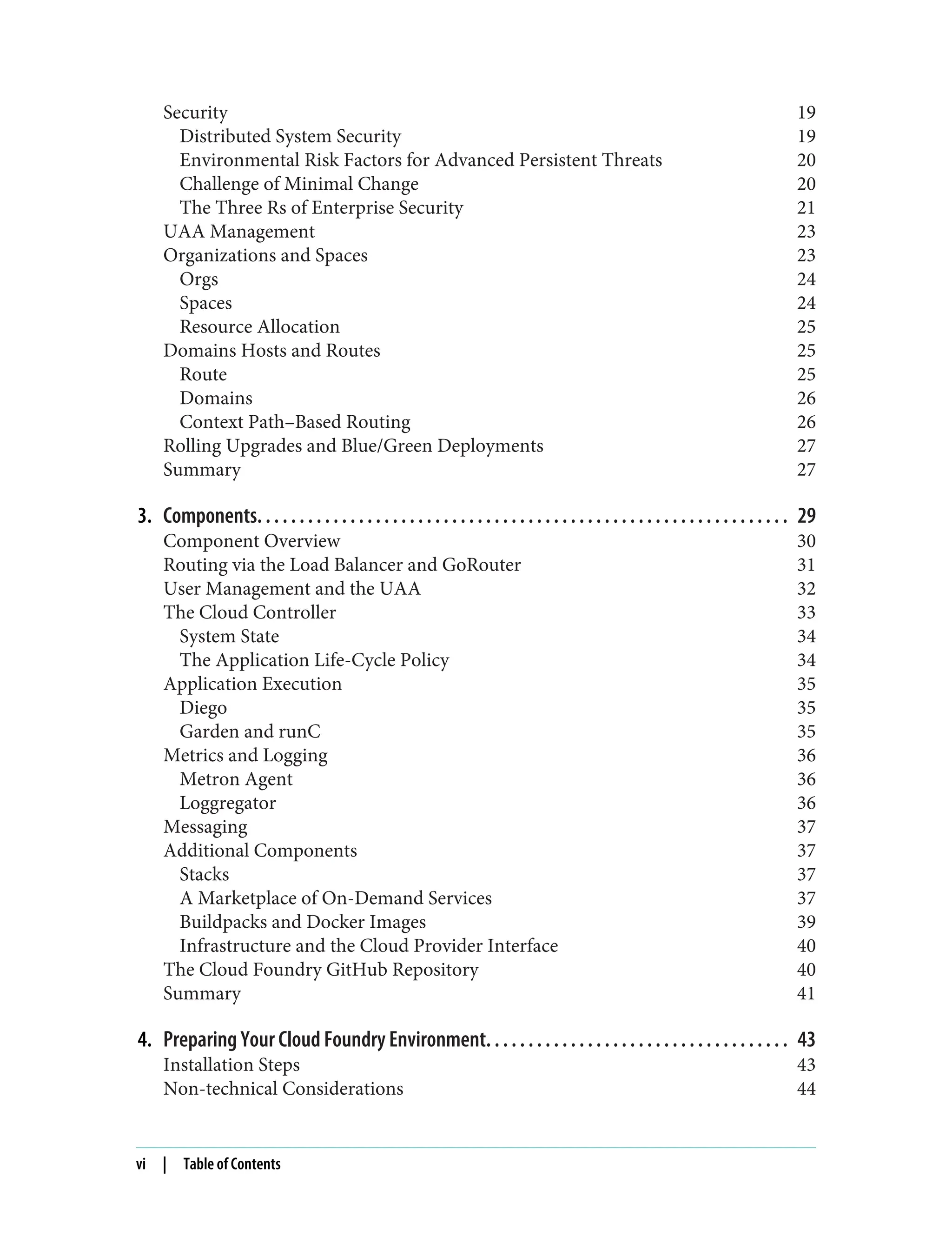

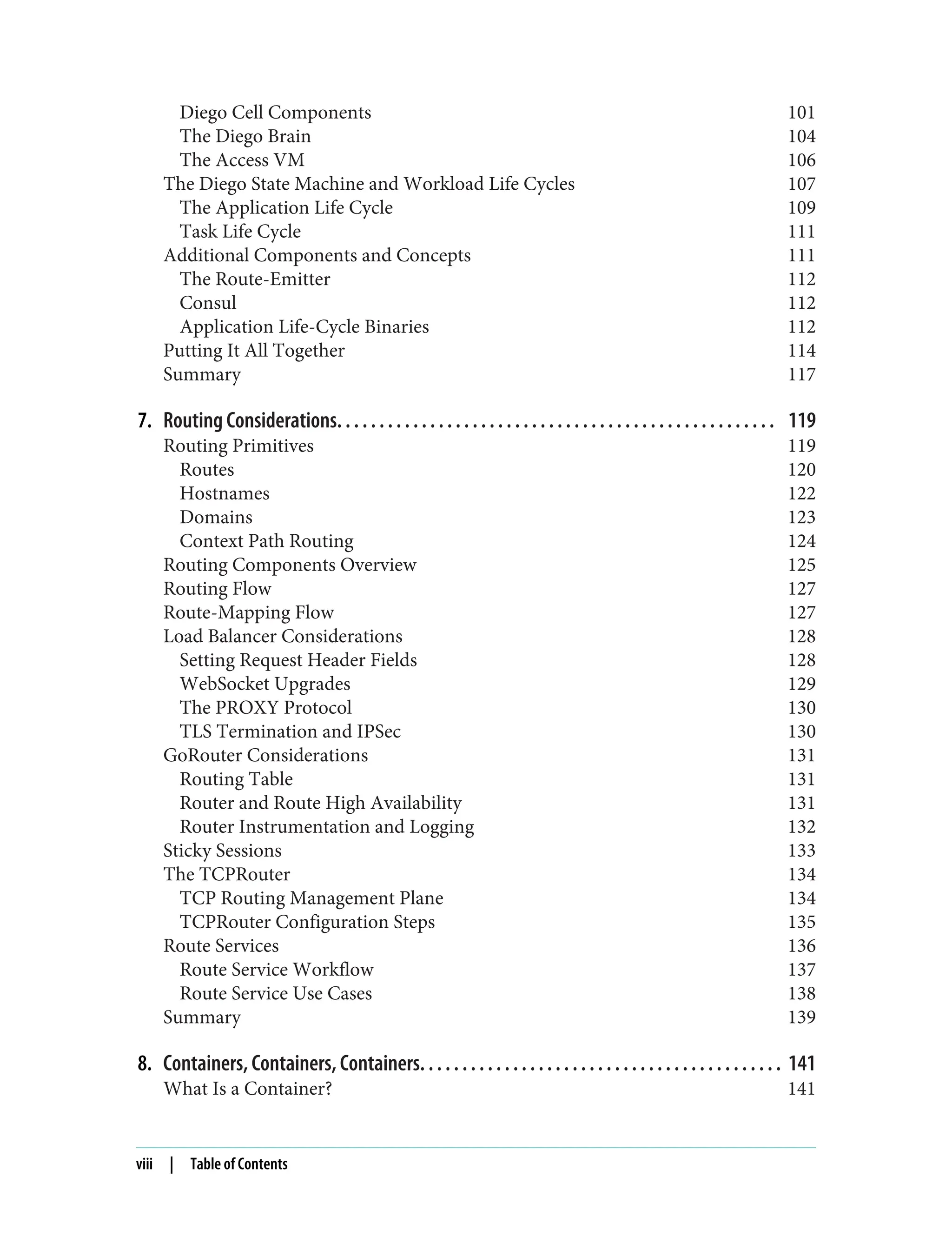
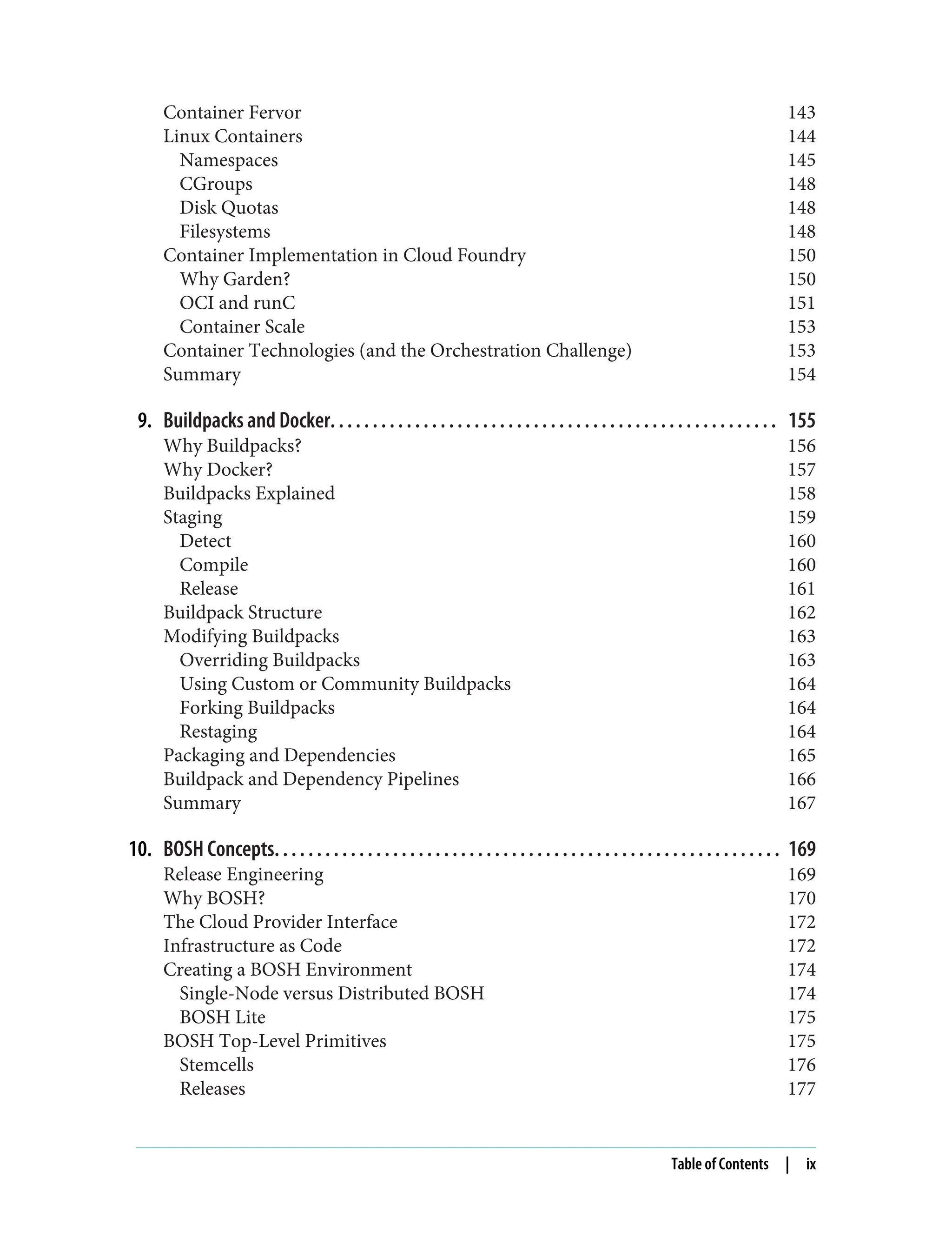
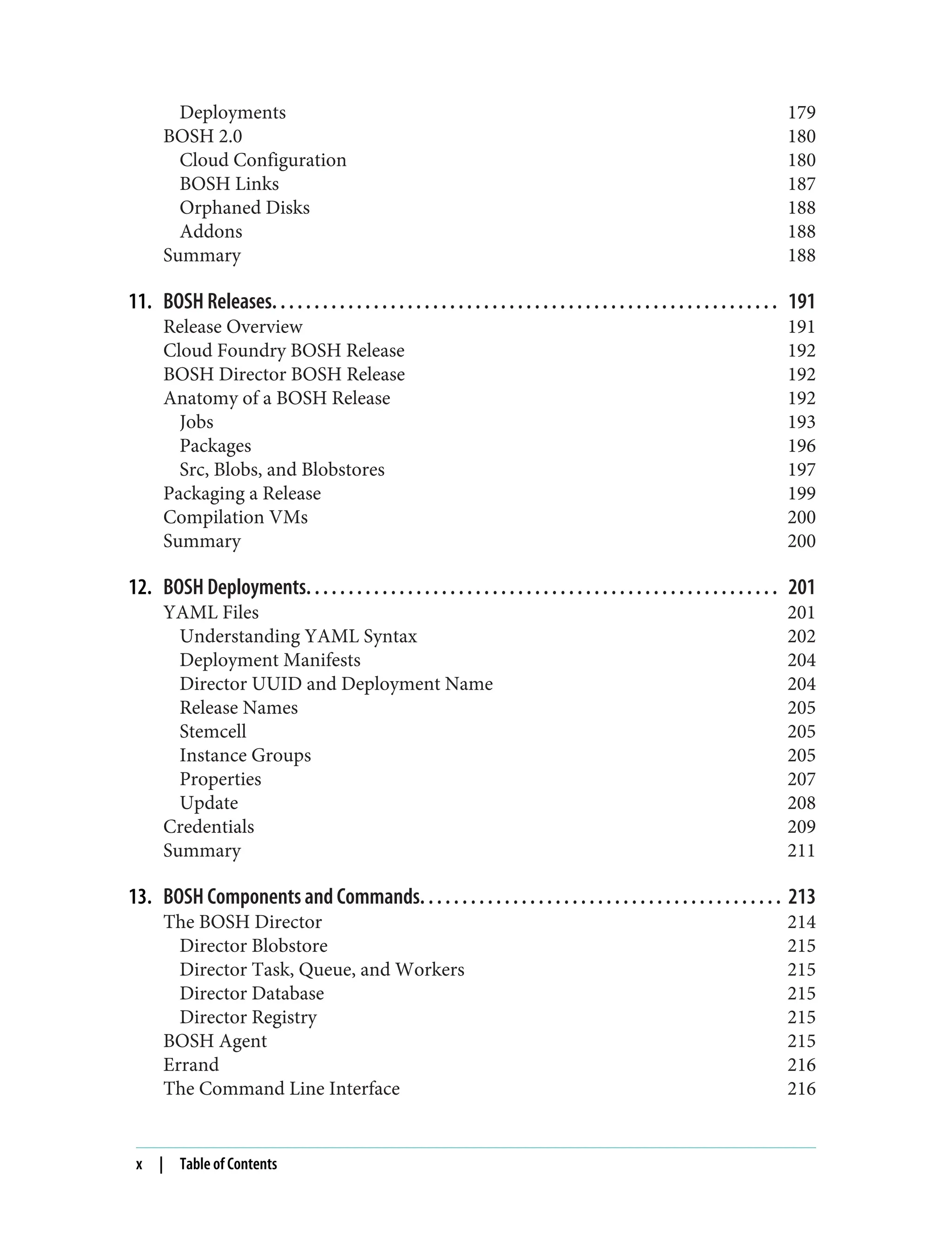



![[218] Cf. f. 36 and Ḥ.S. ii. 271.
[219] sīnkīlīsī ham mūndā īdī.
[220] khāna-wādalār, viz. the Chaghatāī, the Tīmūrid in two Mīrān-
shāhī branches, ‘Alī’s and Bābur’s and the Bāī-qarā in Harāt.
[221] aūghlāqchī i.e. player at kūk-būrā. Concerning the game, see
Shaw’s Vocabulary; Schuyler i, 268; Kostenko iii, 82; Von Schwarz s.n.
baiga.
[222] Ẕū’l-ḥijja 910 ah.-May 1505 ad. Cf. f. 154. This statement helps
to define what Bābur reckoned his expeditions into Hindūstān.
[223] Aīkū (Ayāgū)-tīmūr Tarkhān Arghūn d. circa 793 ah.-1391 ad. He
was a friend of Tīmūr. See Z̤ .N. i, 525 etc.
[224] āndāq ikhlāq u at̤ awārī yūq īdī kīm dīsā būlghāī. The Shāh-nāma
cap. xviii, describes him as a spoiled child and man of pleasure, caring
only for eating, drinking and hunting. The Shaibānī-nāma narrates his
various affairs.
[225] i.e., cutlass, a parallel sobriquet to qīlīch, sword. If it be correct
to translate by “cutlass,” the nickname may have prompted Bābur’s
brief following comment, mardāna īkān dūr, i.e. Qulī Muḥ. must have
been brave because known as the Cutlass. A common variant in MSS.
from Būghdā is Bāghdād; Bāghdād was first written in the Ḥai. MS.
but is corrected by the scribe to būghdā.
[226] So pointed in the Ḥai. MS. I surmise it a clan-name.
[227] i.e. to offer him the succession. The mountain road taken from
Aūrā-tīpā would be by Āb-burdan, Sara-tāq and the Kām Rūd defile.
[228] īrīldī. The departure can hardly have been open because
Aḥmad’s begs favoured Maḥmūd; Malik-i-Muḥammad’s party would be
likely to slip away in small companies.
[229] This well-known Green, Grey or Blue palace or halting-place
was within the citadel of Samarkand. Cf. f. 37. It served as a prison
from which return was not expected.
[230] Cf. f. 27. He married a full-sister of Bāī-sunghar.
[231] Gulistān Part I. Story 27. For “steaming up,” see Tennyson’s
Lotus-eaters Choric song, canto 8 (H.B.).](https://image.slidesharecdn.com/12628-250418014240-fb13fd7c/75/Cloud-Foundry-the-definitive-guide-develop-deploy-and-scale-First-Edition-Winn-31-2048.jpg)
![[232] Elph. MS. f. 16b; First W.-i-B. I.O. 215 f. 19; Second W.-i-B. I.O.
217 f. 15b; Memoirs p. 27.
[233] He was a Dūghlāt, uncle by marriage of Ḥaidar Mīrzā and now
holding Khost for Maḥmūd. See T.R. s.n. for his claim on Aīsān-
daulat’s gratitude.
[234] tāsh qūrghān dā chīqār dā. Here (as e.g. f. 110b l. 9) the
Second W.-i-B. translates tāsh as though it meant stone instead of
outer. Cf. f. 47 for an adjectival use of tāsh, stone, with the
preposition (tāsh) din. The places contrasted here are the citadel (ark)
and the walled-town (qūrghān). The chīqār (exit) is the fortified Gate-
house of the mud circumvallation. Cf. f. 46 for another example of
chīqār.
[235] Elph. Ḥai. Kehr’s MSS., ānīng bīla bār kīshi bār beglārnī
tūtūrūldī. This idiom recurs on f. 76b l. 8. A palimpsest entry in the
Elph. MS. produces the statement that when Ḥasan fled, his begs
returned to Andijān.
[236] Ḥai. MS. awī mūnkūzī, underlined by sāgh-i-gāū, cows’ thatched
house. [T. mūnkūz, lit. horn, means also cattle.] Elph. MS., awī
mūnkūsh, underlined by dar jā’ī khwāb alfakhta, sleeping place. [T.
mūnkūsh, retired.]
[237] The first qāchār of this pun has been explained as gurez-gāh,
sharm-gāh, hinder parts, fuite and vertèbre inférieur. The Ḥ.S. (ii, 273
l. 3 fr. ft.) says the wound was in a vital (maqattal) part.
[238] From Niz̤ āmī’s Khusrau u Shirīn, Lahore lith. ed. p. 137 l. 8. It is
quoted also in the A.N. Bib. Ind. ed. ii, 207 (H.B. ii, 321). (H.B.).
[239] See Hughes Dictionary of Islām s.nn. Eating and Food.
[240] Cf. f. 6b and note. If ‘Umar Shaikh were Maḥmūd’s full-brother,
his name might well appear here.
[241] i.e. “Not a farthing, not a half-penny.”
[242] Here the Mems. enters a statement, not found in the Turkī text,
that Maḥmūd’s dress was elegant and fashionable.
[243] n:h:l:m. My husband has cleared up a mistake (Mems. p. 28
and Méms. i, 54) of supposing this to be the name of an animal. It is
explained in the A.N. (i, 255. H.B. i, 496) as a Badakhshī equivalent of
tasqāwal; tasqāwal var. tāshqāwal, is explained by the Farhang-i-
az̤ farī, a Turkī-Persian Dict. seen in the Mullā Fīroz Library of Bombay,](https://image.slidesharecdn.com/12628-250418014240-fb13fd7c/75/Cloud-Foundry-the-definitive-guide-develop-deploy-and-scale-First-Edition-Winn-32-2048.jpg)
![to mean rāh band kunanda, the stopping of the road. Cf. J.R.A.S.
1900 p. 137.
[244] i.e. “a collection of poems in the alphabetical order of the
various end rhymes.” (Steingass.)
[245] At this battle Daulat-shāh was present. Cf. Browne’s D.S. for
Astarābād p. 523 and for Andikhūd p. 532. For this and all other
references to D.S. and Ḥ.S. I am indebted to my husband.
[246] The following dates will help out Bābur’s brief narrative.
Maḥmūd æt. 7, was given Astarābād in 864 ah. (1459-60 ad.); it was
lost to Ḥusain at Jauz-wilāyat and Maḥmūd went into Khurāsān in 865
ah.; he was restored by his father in 866 ah.; on his father’s death
(873 ah.-1469 ad.) he fled to Harāt, thence to Samarkand and from
there was taken to Ḥiṣār æt. 16. Cf. D’Herbélot s.n. Abū-sa‘ad; Ḥ.S. i,
209; Browne’s D.S. p. 522.
[247] Presumably the “Hindūstān the Less” of Clavijo (Markham p. 3
and p. 113), approx. Qaṃbar-‘alī’s districts. Clavijo includes Tīrmīẕ
under the name.
[248] Perhaps a Ṣufī term,—longing for the absent friend. For
particulars about this man see Ḥ.S. ii, 235 and Browne’s D.S. p. 533.
[249] Here in the Ḥai. MS. is one of several blank spaces, waiting for
information presumably not known to Bābur when writing. The space
will have been in the archetype of the Ḥai. MS. and it makes for the
opinion that the Ḥai. MS. is a direct copy of Bābur’s own. This space is
not left in the Elph. MS. but that MS. is known from its scribe’s note (f.
198) down to f. 198 (Ḥai. MS. f. 243b) to have been copied from
“other writings” and only subsequent to its f. 198 from Bābur’s own.
Cf. JRAS 1906 p. 88 and 1907 p. 143.
[250] The T.R. (p. 330) supplies this name.
[251] Cf. f. 35b. This was a betrothal only, the marriage being made in
903 ah. Cf. Ḥ.S. ii, 260 and Gul-badan’s H.N. f. 24b.
[252] Kehr’s MS. supplies Aī (Moon) as her name but it has no
authority. The Elph. MS. has what may be lā nām, no name, on its
margin and over tūrūtūnchī (4th.) its usual sign of what is
problematical.
[253] See Ḥ.S. ii, 250. Here Pīr-i-Muḥammad Aīlchī-būghā was
drowned. Cf. f. 29.](https://image.slidesharecdn.com/12628-250418014240-fb13fd7c/75/Cloud-Foundry-the-definitive-guide-develop-deploy-and-scale-First-Edition-Winn-33-2048.jpg)
![[254] Chaghānīān is marked in Erskine’s (Mems.) map as somewhere
about the head of (Fr. map 1904) the Ilyak Water, a tributary of the
Kāfir-nighān.
[255] i.e. when Bābur was writing in Hindūstān.
[256] For his family see f. 55b note to Yār-‘alī Balāl.
[257] bā wujūd turklūk muhkam paidā kunanda īdī.
[258] Roebuck’s Oriental Proverbs (p. 232) explains the five of this
phrase where seven might be expected, by saying that of this Seven
days’ world (qy. days of Creation) one is for birth, another for death,
and that thus five only are left for man’s brief life.
[259] The cognomen Aīlchī-būghā, taken with the bearer’s recorded
strength of fist, may mean Strong man of Aīlchī (the capital of
Khutan). One of Tīmūr’s commanders bore the name. Cf. f. 21b for
būghū as athlete.
[260] Hazārāspī seems to be Mīr Pīr Darwesh Hazārāspī. With his
brother, Mīr ‘Alī, he had charge of Balkh. See Rauzatu’ṣ-ṣafā B.M. Add.
23506, f. 242b; Browne’s D.S. p. 432. It may be right to understand a
hand-to-hand fight between Hazārāspī and Aīlchī-būghā. The affair
was in 857 ah. (1453 ad.).
[261] yārāq sīz, perhaps trusting to fisticuffs, perhaps without mail.
Bābur’s summary has confused the facts. Muḥ. Aīlchī-būghā was sent
by Sl. Maḥmūd Mīrzā from Ḥiṣār with 1,000 men and did not issue out
of Qūndūz. (Ḥ.S. ii, 251.) His death occurred not before 895 ah.
[262] See T.R. s.nn. Mīr Ayūb and Ayūb.
[263] This passage is made more clear by f. 120b and f. 125b.
[264] He is mentioned in ‘Alī-sher Nawā’ī’s Majālis-i-nafā’is; see B.M.
Add. 7875, f. 278 and Rieu’s Turkish Catalogue.
[265] ? full of splits or full handsome.
[266] This may have occurred after Abū-sa‘īd Mīrzā’s death whose son
Abā-bikr was. Cf. f. 28. If so, over-brevity has obscured the statement.
[267] mīnglīgh aīldīn dūr, perhaps of those whose hereditary
Command was a Thousand, the head of a Mīng (Pers. Hazāra), i.e. of
the tenth of a tūmān.](https://image.slidesharecdn.com/12628-250418014240-fb13fd7c/75/Cloud-Foundry-the-definitive-guide-develop-deploy-and-scale-First-Edition-Winn-34-2048.jpg)
![[268] qūrghān-nīng tāshīdā yāngī tām qūpārīb sālā dūr. I understand,
that what was taken was a new circumvallation in whole or in part.
Such double walls are on record. Cf. Appendix A.
[269] bahādurlūq aūlūsh, an actual portion of food.
[270] i.e. either unmailed or actually naked.
[271] The old English noun strike expresses the purpose of the sar-
kob. It is “an instrument for scraping off what rises above the top”
(Webster, whose example is grain in a measure). The sar-kob is an
erection of earth or wood, as high as the attacked walls, and it
enabled besiegers to strike off heads appearing above the ramparts.
[272] i.e. the dislocation due to ‘Umar Shaikh’s death.
[273] Cf. f. 13. The Ḥ.S. (ii, 274) places his son, Mīr Mughūl, in
charge, but otherwise agrees with the B.N.
[274] Cf. Clavijo, Markham p. 132. Sir Charles Grandison bent the
knee on occasions but illustrated MSS. e.g. the B.M. Tawārīkh-i-guzīda
Naṣrat-nāma show that Bābur would kneel down on both knees. Cf. f.
123b for the fatigue of the genuflection.
[275] I have translated kūrūshūb thus because it appears to me that
here and in other places, stress is laid by Bābur upon the mutual gaze
as an episode of a ceremonious interview. The verb kūrūshmak is
often rendered by the Persian translators as daryāftan and by the L.
and E. Memoirs as to embrace. I have not found in the B.N. warrant
for translating it as to embrace; qūchūshmāq is Bābur’s word for this
(f. 103). Daryāftan, taken as to grasp or see with the mind, to
understand, well expresses mutual gaze and its sequel of mutual
understanding. Sometimes of course, kūrūsh, the interview does not
imply kūrūsh, the silent looking in the eyes with mutual
understanding; it simply means se voyer e.g. f. 17. The point is thus
dwelt upon because the frequent mention of an embrace gives a
different impression of manners from that made by “interview” or
words expressing mutual gaze.
[276] dābān. This word Réclus (vi, 171) quoting from Fedschenko,
explains as a difficult rocky defile; art, again, as a dangerous gap at a
high elevation; bel, as an easy low pass; and kūtal, as a broad
opening between low hills. The explanation of kūtal does not hold
good for Bābur’s application of the word (f. 81b) to the Sara-tāq.](https://image.slidesharecdn.com/12628-250418014240-fb13fd7c/75/Cloud-Foundry-the-definitive-guide-develop-deploy-and-scale-First-Edition-Winn-35-2048.jpg)
![[277] Cf. f. 4b and note. From Bābur’s special mention of it, it would
seem not to be the usual road.
[278] The spelling of this name is uncertain. Variants are many.
Concerning the tribe see T.R. p. 165 n.
[279] Niz̤ āmu’d-dīn ‘Alī Barlās: see Gul-badan’s H.N. s.n. He served
Bābur till the latter’s death.
[280] i.e. Ẕū’n-nūn or perhaps the garrison.
[281] i.e. down to Shaibānī’s destruction of Chaghatāī rule in Tāshkīnt
in 1503 ad.
[282] Elph. MS. f. 23; W.-i-B. I.O. 215 f. 26 and 217 f. 21; Mems. p.
35.
Bābur’s own affairs form a small part of this year’s record; the rest is
drawn from the Ḥ.S. which in its turn, uses Bābur’s f. 34 and f. 37b.
Each author words the shared material in his own style; one adding
magniloquence, the other retracting to plain statement, indeed
summarizing at times to obscurity. Each passes his own judgment on
events, e.g. here Khwānd-amīr’s is more favourable to Ḥusain Bāī-
qarā’s conduct of the Ḥiṣār campaign than Bābur’s. Cf. Ḥ.S. ii, 256-60
and 274.
[283] This feint would take him from the Oxus.
[284] Tīrmīẕ to Ḥiṣār, 96m. (Réclus vi, 255).
[285] Ḥ.S. Wazr-āb valley. The usual route is up the Kām Rūd and
over the Mūra pass to Sara-tāq. Cf. f. 81b.
[286] i.e. the Ḥiṣārī mentioned a few lines lower and on f. 99b.
Nothing on f. 99b explains his cognomen.
[287] The road is difficult. Cf. f. 81b.
[288] Khwānd-amīr also singles out one man for praise, Sl. Maḥmūd
Mīr-i-ākhwur; the two names probably represent one person. The
sobriquet may refer to skill with a matchlock, to top-spinning (firnagī-
bāz) or to some lost joke. (Ḥ.S. ii, 257.)
[289] This pregnant phrase has been found difficult. It may express
that Bābur assigned the sult̤ āns places in their due precedence; that
he seated them in a row; and that they sat cross-legged, as men of
rank, and were not made, as inferiors, to kneel and sit back on their
heels. Out of this last meaning, I infer comes the one given by](https://image.slidesharecdn.com/12628-250418014240-fb13fd7c/75/Cloud-Foundry-the-definitive-guide-develop-deploy-and-scale-First-Edition-Winn-36-2048.jpg)
![dictionaries, “to sit at ease,” since the cross-legged posture is less
irksome than the genuflection, not to speak of the ease of mind
produced by honour received. Cf. f. 18b and note on Aḥmad’s posture;
Redhouse s.nn. bāghīsh and bāghdāsh; and B.M. Tawārīkh-i-guzīda
naṣrat-nāma, in the illustrations of which the chief personage, only,
sits cross-legged.
[290] siyāsat. My translation is conjectural only.
[291] sar-kob. The old English noun strike, “an instrument for
scraping off what appears above the top,” expresses the purpose of
the wall-high erections of wood or earth (L. agger) raised to reach
what shewed above ramparts. Cf. Webster.
[292] Presumably lower down the Qūndūz Water.
[293] aūz pādshāhī u mīrzālārīdīn artīb.
[294] sic. Ḥai. MS.; Elph. MS. “near Tāliqān”; some W.-i-B. MSS.
“Great Garden.” Gul-badan mentions a Tāliqān Garden. Perhaps the
Mīrzā went so far east because, Ẕū’n-nūn being with him, he had
Qandahār in mind. Cf. f. 42b.
[295] i.e. Sayyid Muḥammad ‘Alī. See f. 15 n. to Sherīm. Khwāja
Changāl lies 14 m. below Tāliqān on the Tāliqān Water. (Erskine.)
[296] f. 27b, second.
[297] The first was circa 895 ah.-1490 ad. Cf. f. 27b.
[298] Bābur’s wording suggests that their common homage was the
cause of Badī‘u’z-zamān’s displeasure but see f. 41.
[299] The Mīrzā had grown up with Ḥiṣārīs. Cf. Ḥ.S. ii, 270.
[300] As the husband of one of the six Badakhshī Begīms, he was
closely connected with local ruling houses. See T.R. p. 107.
[301] i.e. Muḥammad ‘Ubaidu’l-lāh the elder of Aḥrārī’s two sons. d.
911 ah. See Rashaḥāt-i-‘ain-alḥayāt (I.O. 633) f. 269-75; and
Khizīnatu’l-aṣfīya lith. ed. i, 597.
[302] Bū yūq tūr, i.e. This is not to be.
[303] d. 908 ah. He was not, it would seem, of the Aḥrārī family. His
own had provided Pontiffs (Shaikhu’l-islām) for Samarkand through
400 years. Cf. Shaibānī-nāma, Vambéry, p. 106; also, for his character,
p. 96.](https://image.slidesharecdn.com/12628-250418014240-fb13fd7c/75/Cloud-Foundry-the-definitive-guide-develop-deploy-and-scale-First-Edition-Winn-37-2048.jpg)
![[304] i.e. he claimed sanctuary.
[305] Cf. f. 45b and Pétis de la Croix’s Histoire de Chīngīz Khān pp.
171 and 227. What Tīmūr’s work on the Gūk Sarāī was is a question
for archæologists.
[306] i.e. over the Aītmak Pass. Cf. f. 49.
[307] Ḥai. MS. ārālighīgha. Elph. MS. ārāl, island.
[308] See f. 179b for Binā’ī. Muḥammad Ṣāliḥ Mīrzā Khwārizmī is the
author of the Shaibānī-nāma.
[309] Elph. MS. f. 27; W.-i-B. I.O. 215 f. 30b and 217 f. 25; Mems. p.
42.
[310] i.e. Circassian. Muḥammad Ṣāliḥ (Sh.N. Vambéry p. 276 l. 58)
speaks of other Aūzbegs using Chirkas swords.
[311] aīrtā yāzīghā. My translation is conjectural. Aīrtā implies i.a.
foresight. Yāzīghā allows a pun at the expense of the sult̤ āns; since it
can be read both as to the open country and as for their (next, aīrtā)
misdeeds. My impression is that they took the opportunity of being
outside Samarkand with their men, to leave Bāī-sunghar and make for
Shaibānī, then in Turkistān. Muḥammad Ṣāliḥ also marking the
tottering Gate of Sl. ‘Alī Mīrzā, left him now, also for Shaibānī.
(Vambéry cap. xv.)
[312] aūmāq, to amuse a child in order to keep it from crying.
[313] i.e. with Khwāja Yahya presumably. See f. 38.
[314] This man is mentioned also in the Tawārikh-i-guzīda
Naṣratnāma B.M. Or. 3222 f. 124b.
[315] Ḥ.S., on the last day of Ramẓān (June 28th. 1497 ad.).
[316] Muḥammad Sīghal appears to have been a marked man. I
quote from the T.G.N.N. (see supra), f. 123b foot, the information that
he was the grandson of Ya‘qūb Beg. Zenker explains Sīghalī as the
name of a Chaghatāī family. An Ayūb-i-Ya‘qūb Begchīk Mughūl may be
an uncle. See f. 43 for another grandson.
[317] baẓ’ī kīrkān-kīnt-kīsākkā bāsh-sīz-qīlghān Mughūllārnī tūtūb. I
take the word kīsāk in this highly idiomatic sentence to be a
diminutive of kīs, old person, on the analogy of mīr, mīrāk, mard,
mardak. [The Ḥ.S. uses Kīsāk (ii, 261) as a proper noun.] The
alliteration in kāf and the mighty adjective here are noticeable.](https://image.slidesharecdn.com/12628-250418014240-fb13fd7c/75/Cloud-Foundry-the-definitive-guide-develop-deploy-and-scale-First-Edition-Winn-38-2048.jpg)
![[318] Qāsim feared to go amongst the Mughūls lest he should meet
retaliatory death. Cf. f. 99b.
[319] This appears from the context to be Yām (Jām) -bāī and not the
Djouma (Jām) of the Fr. map of 1904, lying farther south. The Avenue
named seems likely to be Tīmūr’s of f. 45b and to be on the direct
road for Khujand. See Schuyler i, 232.
[320] būghān buyīnī. W.-i-B. 215, yān, thigh, and 217 gardan, throat.
I am in doubt as to the meaning of būghān; perhaps the two words
stand for joint at the nape of the neck. Khwāja-i-kalān was one of
seven brothers, six died in Bābur’s service, he himself served till
Bābur’s death.
[321] Cf. f. 48.
[322] Khorochkine (Radlov’s Réceuil d’Itinéraires p. 241) mentions
Pul-i-mougak, a great stone bridge thrown across a deep ravine, east
of Samarkand. For Kūl-i-maghāk, deep pool, or pool of the fosse, see
f. 48b.
[323] From Khwānd-amīr’s differing account of this affair, it may be
surmised that those sending the message were not treacherous; but
the message itself was deceiving inasmuch as it did not lead Bābur to
expect opposition. Cf. f. 43 and note.
[324] Of this nick-name several interpretations are allowed by the
dictionaries.
[325] See Schuyler i, 268 for an account of this beautiful Highland
village.
[326] Here Bābur takes up the thread, dropped on f. 36, of the affairs
of the Khurāsānī mīrzās. He draws on other sources than the Ḥ.S.;
perhaps on his own memory, perhaps on information given by
Khurāsānīs with him in Hindūstān e.g. Ḥusain’s grandson. See f. 167b.
Cf. Ḥ.S. ii, 261.
[327] bāghīshlāb tūr. Cf. f. 34 note to bāghīsh dā.
[328] Bū sozlār aūnūlūng. Some W.-i-B. MSS., Farāmosh bakunīd for
nakunīd, thus making the Mīrzā not acute but rude, and destroying
the point of the story i.e. that the Mīrzā pretended so to have
forgotten as to have an empty mind. Khwānd-amīr states that ‘Alī-sher
prevailed at first; his tears therefore may have been of joy at the
success of his pacifying mission.](https://image.slidesharecdn.com/12628-250418014240-fb13fd7c/75/Cloud-Foundry-the-definitive-guide-develop-deploy-and-scale-First-Edition-Winn-39-2048.jpg)
![[329] i.e. B.Z.’s father, Ḥusain, against Mū‘min’s father, B.Z. and
Ḥusain’s son, Muz̤ affar Ḥusain against B.Z.’s son Mū‘min;—a veritable
conundrum.
[330] Garzawān lies west of Balkh. Concerning Pul-i-chirāgh Col.
Grodekoff’s Ride to Harāt (Marvin p. 103 ff.) gives pertinent
information. It has also a map showing the Pul-i-chirāgh meadow. The
place stands at the mouth of a triply-bridged defile, but the name
appears to mean Gate of the Lamp (cf. Gate of Tīmūr), and not Bridge
of the Lamp, because the Ḥ.S. and also modern maps write bīl (bel),
pass, where the Turkī text writes pul, bridge, narrows, pass.
The lamp of the name is one at the shrine of a saint, just at the
mouth of the defile. It was alight when Col. Grodekoff passed in 1879
and to it, he says, the name is due now—as it presumably was 400
years ago and earlier.
[331] Khwānd-amīr heard from the Mīrzā on the spot, when later in
his service, that he was let down the precipice by help of turban-
sashes tied together.
[332] yīkīt yīlāng u yāyāq yālīng; a jingle made by due phonetic
change of vowels; a play too on yālāng, which first means stripped
i.e. robbed and next unmailed, perhaps sometimes bare-bodied in
fight.
[333] qūsh-khāna. As the place was outside the walls, it may be a
good hawking ground and not a falconry.
[334] The Ḥ.S. mentions (ii, 222) a Sl. Aḥmad of Chār-shaṃba, a
town mentioned e.g. by Grodekoff p. 123. It also spoils Bābur’s
coincidence by fixing Tuesday, Shab‘ān 29th. for the battle. Perhaps
the commencement of the Muḥammadan day at sunset, allows of
both statements.
[335] Elph. MS. f. 30b; W.-i-B. I.O. 215 f. 34 and 217 f. 26b; Mems. p.
46.
The abruptness of this opening is due to the interposition of Sl.
Ḥusain M.’s affairs between Bābur’s statement on f. 41 that he
returned from Aūrgūt and this first of 903 ah. that on return he
encamped in Qulba.
[336] See f. 48b.
[337] i.e. Chūpān-ātā; see f. 45 and note.](https://image.slidesharecdn.com/12628-250418014240-fb13fd7c/75/Cloud-Foundry-the-definitive-guide-develop-deploy-and-scale-First-Edition-Winn-40-2048.jpg)
![[338] Aūghlāqchī, the Grey Wolfer of f. 22.
[339] A sobriquet, the suppliant or perhaps something having
connection with musk. Ḥ.S. ii, 278, son of Ḥ.D.
[340] i.e. grandson (of Muḥammad Sīghal). Cf. f. 39.
[341] This seeming sobriquet may show the man’s trade. Kāl is a sort
of biscuit; qāshūq may mean a spoon.
[342] The Ḥ.S. does not ascribe treachery to those inviting Bābur into
Samarkand but attributes the murder of his men to others who fell on
them when the plan of his admission became known. The choice here
of “town-rabble” for retaliatory death supports the account of Ḥ.S. ii.
[343] “It was the end of September or beginning of October”
(Erskine).
[344] awī u kīpa yīrlār. Awī is likely to represent kibitkas. For kīpa yīr,
see Zenker p. 782.
[345] Interesting reference may be made, amongst the many books
on Samarkand, to Sharafu’d-dīn ‘Alī Yazdī’s Z̤ afar-nāma Bib. Ind. ed. i,
300, 781, 799, 800 and ii, 6, 194, 596 etc.; to Ruy Gonzalves di
Clavijo’s Embassy to Tīmūr (Markham) cap. vi and vii; to Ujfalvy’s
Turkistan ii, 79 and Madame Ujfalvy’s De Paris à Samarcande p. 161,
—these two containing a plan of the town; to Schuyler’s Turkistan; to
Kostenko’s Turkistan Gazetteer i, 345; to Réclus, vi, 270 and plan; and
to a beautiful work of the St. Petersburg Archæological Society, Les
Mosquées de Samarcande, of which the B.M. has a copy.
[346] This statement is confused in the Elp. and Ḥai. MSS. The second
appears to give, by abjad, lat. 40° 6" and long. 99'. Mr. Erskine (p. 48)
gives lat. 39’ 57" and long. 99’ 16”, noting that this is according to
Ūlūgh Beg’s Tables and that the long. is calculated from Ferro. The
Ency. Br. of 1910-11 gives lat. 39’ 39" and long. 66’ 45”.
[347] The enigmatical cognomen, Protected Town, is of early date; it
is used i.a. by Ibn Batūta in the 14th. century. Bābur’s tense refers it
to the past. The town had frequently changed hands in historic times
before he wrote. The name may be due to immunity from damage to
the buildings in the town. Even Chīngīz Khān’s capture (1222 ad.) left
the place well-preserved and its lands cultivated, but it inflicted great
loss of men. Cf. Schuyler i, 236 and his authorities, especially
Bretschneider.](https://image.slidesharecdn.com/12628-250418014240-fb13fd7c/75/Cloud-Foundry-the-definitive-guide-develop-deploy-and-scale-First-Edition-Winn-41-2048.jpg)
![[348] Here is a good example of Bābur’s caution in narrative. He does
not affirm that Samarkand became Musalmān, or (infra) that Quṣam
ibn ‘Abbās went, or that Alexander founded but in each case uses the
presumptive past tense, resp. būlghān dūr, bārghān dūr, bīnā qīlghān
dūr, thus showing that he repeats what may be inferred or presumed
and not what he himself asserts.
[349] i.e. of Muḥammad. See Z̤ .N. ii, 193.
[350] i.e. Fat Village. His text misleading him, Mr. Erskine makes here
the useful irrelevant note that Persians and Arabs call the place
Samar-qand and Turks, Samar-kand, the former using qaf (q), the
latter kaf (k). Both the Elph. and the Ḥai. MSS. write Samarqand.
For use of the name Fat Village, see Clavijo (Markham p. 170),
Simesquinte, and Bretschneider’s Mediæval Geography pp. 61, 64, 66
and 163.
[351] qadam. Kostenko (i, 344) gives 9 m. as the circumference of the
old walls and 1-2/3m. as that of the citadel. See Mde. Ujfalvy p. 175
for a picture of the walls.
[352] Ma‘lūm aīmās kīm mūncha paidā būlmīsh būlghāī; an idiomatic
phrase.
[353] d. 333 ah. (944 ad.). See D’Herbélot art. Mātridī p. 572.
[354] See D’Herbélot art. Aschair p. 124.
[355] Abū ‘Abdu’l-lāh bin Ismā‘īlu’l-jausī b. 194 ah. d. 256 ah. (810-870
ad.). See D’Herbélot art. Bokhārī p. 191, art. Giorag p. 373, and art.
Ṣāḥiḥu’l-bokhārī p. 722. He passed a short period, only, of his life in
Khartank, a suburb of Samarkand.
[356] Cf. f. 3b and n. 1.
[357] This though 2475 ft. above the sea is only some 300 ft. above
Samarkand. It is the Chūpān-ātā (Father of Shepherds) of maps and
on it Tīmūr built a shrine to the local patron of shepherds. The Zar-
afshān, or rather, its Qarā-sū arm, flows from the east of the Little Hill
and turns round it to flow west. Bābur uses the name Kohik Water
loosely; e.g. for the whole Zar-afshān when he speaks (infra) of
cutting off the Dar-i-gham canal but for its southern arm only, the
Qarā-sū in several places, and once, for the Dar-i-gham canal. See f.
49b and Kostenko i. 192.](https://image.slidesharecdn.com/12628-250418014240-fb13fd7c/75/Cloud-Foundry-the-definitive-guide-develop-deploy-and-scale-First-Edition-Winn-42-2048.jpg)
![[358] rūd. The Zar-afshān has a very rapid current. See Kostenko i,
196, and for the canal, i, 174. The name Dar-i-gham is used also for a
musical note having charm to witch away grief; and also for a town
noted for its wines.
[359] What this represents can only be guessed; perhaps 150 to 200
miles. Abū’l-fidā (Reinaud ii, 213) quotes Ibn Haukal as saying that
from Bukhārā up to “Bottam” (this seems to be where the Zar-afshān
emerges into the open land) is eight days’ journey through an
unbroken tangle of verdure and gardens.
[360] See Schuyler i, 286 on the apportionment of water to
Samarkand and Bukhārā.
[361] It is still grown in the Samarkand region, and in Mr. Erskine’s
time a grape of the same name was cultivated in Aurangābād of the
Deccan.
[362] i.e. Shāhrukhī, Tīmūr’s grandson, through Shāhrukh. It may be
noted here that Bābur never gives Tīmūr any other title than Beg and
that he styles all Tīmūrids, Mīrzā (Mīr-born).
[363] Mr. Erskine here points out the contradiction between the
statements (i) of Ibn Haukal, writing, in 367 ah. (977 ad.), of
Samarkand as having a citadel (ark), an outer-fort (qūrghān) and
Gates in both circumvallations; and (2) of Sharafu’d-dīn Yazdī (Z̤ .N.)
who mentions that when, in Tīmūr’s day, the Getes besieged
Samarkand, it had neither walls nor gates. See Ouseley’s Ibn Haukal
p. 253; Z̤ .N. Bib. Ind. ed. i, 109 and Pétis de la Croix’s Z̤ .N. (Histoire
de Tīmūr Beg) i, 91.
[364] Here still lies the Ascension Stone, the Gūk-tāsh, a block of
greyish white marble. Concerning the date of the erection of the
building and meaning of its name, see e.g. Pétis de la Croix’s Histoire
de Chīngīz Khān p. 171; Mems. p. 40 note; and Schuyler s.n.
[365] This seems to be the Bībī Khānīm Mosque. The author of Les
Mosquées de Samarcande states that Tīmūr built Bībī Khānīm and the
Gūr-i-amīr (Amīr’s tomb); decorated Shāh-i-zinda and set up the
Chūpān-ātā shrine. Cf. f. 46 and note to Jahāngīr Mīrzā, as to the Gūr-
i-amīr.
[366] Cap. II. Quoting from Sale’s Qur’ān (i, 24) the verse is, “And
Ibrāhīm and Ismā‘īl raised the foundations of the house, saying, ‘Lord!
accept it from us, for Thou art he who hearest and knowest; Lord!
make us also resigned to Thee, and show us Thy holy ceremonies,](https://image.slidesharecdn.com/12628-250418014240-fb13fd7c/75/Cloud-Foundry-the-definitive-guide-develop-deploy-and-scale-First-Edition-Winn-43-2048.jpg)
![and be turned to us, for Thou art easy to be reconciled, and
merciful.’”
[367] or, buland, Garden of the Height or High Garden. The Turkī
texts have what can be read as buldī but the Z̤ .N. both when
describing it (ii, 194) and elsewhere (e.g. ii, 596) writes buland. Buldī
may be a clerical error for bulandī, the height, a name agreeing with
the position of the garden.
[368] In the Heart-expanding Garden, the Spanish Ambassadors had
their first interview with Tīmūr. See Clavijo (Markham p. 130). Also the
Z̤ .N. ii, 6 for an account of its construction.
[369] Judging from the location of the gardens and of Bābur’s camps,
this appears to be the Avenue mentioned on f. 39b and f. 40.
[370] See infra f. 48 and note.
[371] The Plane-tree Garden. This seems to be Clavijo’s Bayginar, laid
out shortly before he saw it (Markham p. 136).
[372] The citadel of Samarkand stands high; from it the ground
slopes west and south; on these sides therefore gardens outside the
walls would lie markedly below the outer-fort (tāsh-qūrghān). Here as
elsewhere the second W.-i-B. reads stone for outer (Cf. index s.n.
tāsh). For the making of the North garden see Z̤ .N. i, 799.
[373] Tīmūr’s eldest son, d. 805 ah. (1402 ad.), before his father,
therefore. Bābur’s wording suggests that in his day, the Gūr-i-amīr
was known as the Madrāsa. See as to the buildings Z̤ .N. i, 713 and ii,
492, 595, 597, 705; Clavijo (Markham p. 164 and p. 166); and Les
Mosquées de Samarcande.
[374] Hindūstān would make a better climax here than Samarkand
does.
[375] These appear to be pictures or ornamentations of carved wood.
Redhouse describes islīmī as a special kind of ornamentation in curved
lines, similar to Chinese methods.
[376] i.e. the Black Stone (ka’ba) at Makkah to which Musalmāns turn
in prayer.
[377] As ancient observatories were themselves the instruments of
astronomical observation, Bābur’s wording is correct. Aūlūgh Beg’s
great quadrant was 180 ft. high; Abū-muḥammad Khujandī’s sextant
had a radius of 58 ft. Jā’ī Singh made similar great instruments in](https://image.slidesharecdn.com/12628-250418014240-fb13fd7c/75/Cloud-Foundry-the-definitive-guide-develop-deploy-and-scale-First-Edition-Winn-44-2048.jpg)
![Jā’īpūr, Dihlī has others. Cf. Greaves Misc. Works i, 50; Mems. p. 51
note; Āiyīn-i-akbarī (Jarrett) ii, 5 and note; Murray’s Hand-book to
Bengal p. 331; Indian Gazetteer xiii, 400.
[378] b. 597 ah. d. 672 ah. (1201-1274 ad.). See D’Herbélot’s art.
Naṣīr-i-dīn p. 662; Abū’l-fidā (Reinaud, Introduction i, cxxxviii) and
Beale’s Biographical Dict. s.n.
[379] a grandson of Chīngīz Khān, d. 663 ah. (1265 ad.). The
cognomen Aīl-khānī (Īl-khānī) may mean Khān of the Tribe.
[380] Ḥarūnu’r-rashīd’s second son; d. 218 ah. (833 ad.).
[381] Mr. Erskine notes that this remark would seem to fix the date at
which Bābur wrote it as 934 ah. (1527 ad.), that being the 1584th.
year of the era of Vikramāditya, and therefore at three years before
Bābur’s death. (The Vikramāditya era began 57 BC.)
[382] Cf. index s.n. tāsh.
[383] This remark may refer to the 34 miles between the town and
the quarries of its building stone. See f. 49 and note to Aītmāk Pass.
[384] Steingass, any support for the back in sitting, a low wall in front
of a house. See Vullers p. 148 and Burhān-i-qāt̤ i‘; p. 119. Perhaps a
dado.
[385] beg u begāt, bāgh u bāghcha.
[386] Four Gardens, a quadrilateral garden, laid out in four plots. The
use of the name has now been extended for any well-arranged, large
garden, especially one belonging to a ruler (Erskine).
[387] As two of the trees mentioned here are large, it may be right to
translate nārwān, not by pomegranate, but as the hard-wood elm,
Madame Ujfalvy’s ‘karagatche’ (p. 168 and p. 222). The name qarā-
yīghāch (karagatch), dark tree, is given to trees other than this elm
on account of their deep shadow.
[388] Now a common plan indeed! See Schuyler i, 173.
[389] juwāz-i-kaghazlār (nīng) sū’ī, i.e. the water of the paper-
(pulping)-mortars. Owing to the omission from some MSS. of the
word sū, water, juwāz has been mistaken for a kind of paper. See
Mems. p. 52 and Méms. i, 102; A.Q.R. July 1910, p. 2, art. Paper-mills
of Samarkand (H.B.); and Madame Ujfalvy p. 188. Kostenko, it is to be](https://image.slidesharecdn.com/12628-250418014240-fb13fd7c/75/Cloud-Foundry-the-definitive-guide-develop-deploy-and-scale-First-Edition-Winn-45-2048.jpg)
![noted, does not include paper in his list (i, 346) of modern
manufactures of Samarkand.
[390] Mine of mud or clay. My husband has given me support for
reading gil, and not gul, rose;—(1) In two good MSS. of the W.-i-B.
the word is pointed with kasra, i.e. as for gil, clay; and (2) when
describing a feast held in the garden by Tīmūr, the Z̤ .N. says the mud-
mine became a rose-mine, shuda Kān-i-gil Kān-i-gul. [Mr. Erskine
refers here to Pétis de la Croix’s Histoire de Tīmūr Beg (i.e. Z̤ .N.) i, 96
and ii, 133 and 421.]
[391] qūrūgh. Vullers, classing the word as Arabic, Zenker, classing it
as Eastern Turkī, and Erskine (p. 42 n.) explain this as land reserved
for the summer encampment of princes. Shaw (Voc. p. 155), deriving
it from qūrūmāq, to frighten, explains it as a fenced field of growing
grain.
[392] Cf. f. 40. There it is located at one yīghāch and here at 3 kurohs
from the town.
[393] t̤ aur. Cf. Zenker s.n. I understand it to lie, as Khān Yūrtī did, in a
curve of the river.
[394] 162 m. by rail.
[395] Cf. f. 3.
[396] tīrīsīnī sūīūb. The verb sūīmāk, to despoil, seems to exclude the
common plan of stoning the fruit. Cf. f. 3b, dānasīnī alīp, taking out
the stones.
[397] Mīn Samarkandtā aūl (or auwal) aīchkāndā Bukhārā chāghīrlār
nī aīchār aīdīm. These words have been understood to refer to Bābur’s
initial drinking of wine but this reading is negatived by his statement
(f. 189) that he first drank wine in Harāt in 912 ah. I understand his
meaning to be that the wine he drank in Samarkand was Bukhārā
wine. The time cannot have been earlier than 917 ah. The two words
aūl aīchkāndā, I read as parallel to aūl (bāghrī qarā) (f. 280) ‘that
drinking,’ ‘that bird,’ i.e. of those other countries, not of Hindūstān
where he wrote.
It may be noted that Bābur’s word for wine, chāghīr, may not always
represent wine of the grape but may include wine of the apple and
pear (cider and perry), and other fruits. Cider, its name seeming to be
a descendant of chāghīr, was introduced into England by Crusaders,
its manufacture having been learned from Turks in Palestine.](https://image.slidesharecdn.com/12628-250418014240-fb13fd7c/75/Cloud-Foundry-the-definitive-guide-develop-deploy-and-scale-First-Edition-Winn-46-2048.jpg)
![[398] 48 m. 3 fur. by way of the Aītmāk Pass (mod. Takhta Qarachi),
and, Réclus (vi, 256) Buz-gala-khāna, Goat-house.
[399] The name Aītmāk, to build, appears to be due to the stone
quarries on the range. The pass-head is 34 m. from Samarkand and
3000 ft. above it. See Kostenko ii, 115 and Schuyler ii, 61 for details
of the route.
[400] The description of this hall is difficult to translate. Clavijo
(Markham 124) throws light on the small recesses. Cf. Z̤ .N. i, 781 and
300 and Schuyler ii, 68.
[401] The Tāq-i-kisrī, below Bāghdād, is 105 ft. high, 84 ft. span and
150 ft. in depth (Erskine).
[402] Cf. f. 46. Bābur does not mention that Tīmūr’s father was buried
at Kesh. Clavijo (Markham p. 123) says it was Tīmūr’s first intention to
be buried near his father, in Kesh.
[403] Abū’l-fidā (Reinaud II, ii, 21) says that Nasaf is the Arabic and
Nakhshab the local name for Qarshī. Ibn Haukal (Ouseley p. 260)
writes Nakhshab.
[404] This word has been translated burial-place and cimetière but
Qarshī means castle, or royal-residence. The Z̤ .N. (i, 111) says that
Qarshī is an equivalent for Ar. qaṣr, palace, and was so called, from
one built there by Qublāī Khān (d. 1294 ad.). Perhaps Bābur’s word is
connected with Gūrkhān, the title of sovereigns in Khutan, and means
great or royal-house, i.e. palace.
[405] 94 m. 6-1/2 fur. via Jām (Kostenko i, 115.)
[406] See Appendix B.
[407] some 34 m. (Kostenko i, 196). Schuyler mentions that he heard
in Qarā-kūl a tradition that the district, in bye-gone days, was
fertilized from the Sīr.
[408] Cf. f. 45.
[409] By abjad the words ‘Abbās kasht yield 853. The date of the
murder was Ramẓān 9, 853 ah. (Oct. 27th. 1449 ad.).
[410] This couplet is quoted in the Rauẓatu’ṣ-ṣafā (lith. ed. vi, f. 234
foot) and in the Ḥ.S. ii, 44. It is said, in the R.Ṣ. to be by Niz̤ āmī and
to refer to the killing by Shīrūya of his father, Khusrau Parwīz in 7 ah.
(628 ad.). The Ḥ.S. says that ‘Abdu’l-lat̤ īf constantly repeated the](https://image.slidesharecdn.com/12628-250418014240-fb13fd7c/75/Cloud-Foundry-the-definitive-guide-develop-deploy-and-scale-First-Edition-Winn-47-2048.jpg)
![couplet, after he had murdered his father. [See also Daulat Shāh
(Browne p. 356 and p. 366.) H.B.]
[411] By abjad, Bābā Ḥusain kasht yields 854. The death was on Rabi‘
I, 26, 854 ah. (May 9th. 1450 ad.). See R.Ṣ. vi, 235 for an account of
this death.
[412] This overstates the time; dates shew 1 yr. 1 mth. and a few
days.
[413] i.e. The Khān of the Mughūls, Bābur’s uncle.
[414] Elph. MS. aūrmaghāīlār, might not turn; Ḥai. and Kehr’s MSS.
(sar bā bād) bīrmāghāīlār, might not give. Both metaphors seem
drawn from the protective habit of man and beast of turning the back
to a storm-wind.
[415] i.e. betwixt two waters, the Miyān-i-dū-āb of India. Here, it is
the most fertile triangle of land in Turkistān (Réclus, vi, 199), enclosed
by the eastern mountains, the Nārīn and the Qarā-sū; Rabāt̤ ik-
aūrchīnī, its alternative name, means Small Station sub-district. From
the uses of aūrchīn I infer that it describes a district in which there is
no considerable head-quarters fort.
[416] i.e. his own, Qūtlūq-nigār Khānīm and hers, Aīsān-daulat Begīm,
with perhaps other widows of his father, probably Shāh Sult̤ ān Begīm.
[417] Cf. f. 16 for almost verbatim statements.
[418] Blacksmith’s Dale. Ahangarān appears corrupted in modern
maps to Angren. See Ḥ.S. ii, 293 for Khwānd-amīr’s wording of this
episode.
[419] Cf. f. 1b and Kostenko i, 101.
[420] i.e. Khān Uncle (Mother’s brother).
[421] n.w. of the Sang ferry over the Sīr.
[422] perhaps, messenger of good tidings.
[423] This man’s family connections are interesting. He was ‘Alī-shukr
Beg Bahārlū’s grandson, nephew therefore of Pāshā Begīm; through
his son, Saif-‘alī Beg, he was the grandfather of Bairām Khān-i-khānān
and thus the g.g.f. of ‘Abdu’r-raḥīm Mīrzā, the translator of the Second
Wāqi‘āt-i-bāburī. See Firishta lith. ed. p. 250.](https://image.slidesharecdn.com/12628-250418014240-fb13fd7c/75/Cloud-Foundry-the-definitive-guide-develop-deploy-and-scale-First-Edition-Winn-48-2048.jpg)
![[424] Bābur’s (step-)grandmother, co-widow with Aīsān-daulat of
Yūnas Khān and mother of Aḥmad and Maḥmud Chaghatāī.
[425] Here the narrative picks up the thread of Khusrau Shāh’s affairs,
dropped on f. 44.
[426] mīng tūmān fulūs, i.e. a thousand sets-of-ten-thousand small
copper coins. Mr. Erskine (Mems. p. 61) here has a note on coins. As
here the tūmān does not seem to be a coin but a number, I do not
reproduce it, valuable as it is per se.
[427] ārīqlār; this the annotator of the Elph. MS. has changed to
āshlīq, provisions, corn.
[428] Samān-chī may mean Keeper of the Goods. Tīngrī-bīrdī,
Theodore, is the purely Turkī form of the Khudāī-bīrdī, already met
with several times in the B.N.
[429] Bast (Bost) is on the left bank of the Halmand.
[430] Cf. f. 56b.
[431] known as Kābulī. He was a son of Abū-sa‘īd and thus an uncle
of Bābur. He ruled Kābul and Ghaznī from a date previous to his
father’s death in 873 ah. (perhaps from the time ‘Umar Shaikh was not
sent there, in 870 ah. See f. 6b) to his death in 907 ah. Bābur was his
virtual successor in Kābul, in 910 ah.
[432] Elph. MS. f. 42; W.-i-B. I.O. 215 f. 47b and 217 f. 38; Mems. p.
63. Bābur here resumes his own story, interrupted on f. 56.
[433] aīsh achīlmādī, a phrase recurring on f. 59b foot. It appears to
imply, of trust in Providence, what the English “The way was not
opened,” does. Cf. f. 60b for another example of trust, there clinching
discussion whether to go or not to go to Marghīnān.
[434] i.e. Aḥrārī. He had been dead some 10 years. The despoilment
of his family is mentioned on f. 23b.
[435] fatratlār, here those due to the deaths of Aḥmad and Maḥmūd
with their sequel of unstable government in Samarkand.
[436] Aūghlāqchī, the player of the kid-game, the gray-wolfer. Yār-
yīlāq will have gone with the rest of Samarkand into ‘Alī’s hands in
Rajab 903 ah. (March 1498). Contingent terms between him and
Bābur will have been made; Yūsuf may have recognized some show
of right under them, for allowing Bābur to occupy Yār-yīlāq.](https://image.slidesharecdn.com/12628-250418014240-fb13fd7c/75/Cloud-Foundry-the-definitive-guide-develop-deploy-and-scale-First-Edition-Winn-49-2048.jpg)
![[437] i.e. after 933 ah. Cf. f. 46b and note concerning the
Bikramāditya era. See index s.n. Aḥmad-i-yūsuf and Ḥ.S. ii, 293.
[438] This plural, unless ironical, cannot be read as honouring ‘Alī;
Bābur uses the honorific plural most rarely and specially, e.g. for
saintly persons, for The Khān and for elder women-kinsfolk.
[439] bīr yārīm yīl. Dates shew this to mean six months. It appears a
parallel expression to Pers. hasht-yak, one-eighth.
[440] Ḥ.S. ii, 293, in place of these two quotations, has a misra‘,—Na
rāy ṣafar kardan u na rūy iqāmat, (Nor resolve to march, nor face to
stay).
[441] i.e. in Samarkand.
[442] Point to point, some 145 m. but much further by the road.
Tang-āb seems likely to be one of the head-waters of Khwāja
Bikargān-water. Thence the route would be by unfrequented hill-
tracks, each man leading his second horse.
[443] tūn yārīmī naqāra waqtīdā. Tūn yārīmī seems to mean half-dark,
twilight. Here it cannot mean mid-night since this would imply a halt
of twelve hours and Bābur says no halt was made. The drum next
following mid-day is the one beaten at sunset.
[444] The voluntary prayer, offered when the sun has well risen, fits
the context.
[445] I understand that the obeisance was made in the Gate-house,
between the inner and outer doors.
[446] This seeming sobriquet may be due to eloquence or to good
looks.
[447] qarā tīyāq. Cf. f. 63 where black bludgeons are used by a red
rabble.
[448] He was head-man of his clan and again with Shaibānī in 909 ah.
(Sh. N. Vambéry, p. 272). Erskine (p. 67) notes that the Manghīts are
the modern Nogais.
[449] i.e. in order to allow for the here very swift current. The Ḥ.S.
varying a good deal in details from the B.N. gives the useful
information that Aūzūn Ḥasan’s men knew nothing of the coming of
the Tāshkīnt Mughūls.
[450] Cf. f. 4b and App. A. as to the position of Akhsī.](https://image.slidesharecdn.com/12628-250418014240-fb13fd7c/75/Cloud-Foundry-the-definitive-guide-develop-deploy-and-scale-First-Edition-Winn-50-2048.jpg)
![[451] bārīnī qīrdīlār. After this statement the five exceptions are
unexpected; Bābur’s wording is somewhat confused here.
[452] i.e. in Hindūstān.
[453] Taṃbal would be the competitor for the second place.
[454] 47 m. 4-1/2 fur.
[455] Bābur had been about two lunar years absent from Andijān but
his loss of rule was of under 16 months.
[456] A scribe’s note entered here on the margin of the Ḥai. MS. is to
the effect that certain words are not in the noble archetype (nashka
sharīf); this supports other circumstances which make for the opinion
that this Codex is a direct copy of Bābur’s own MS. See Index s.n. Ḥai.
MS. and JRAS 1906, p. 87.
[457] Musalmān here seems to indicate mental contrast with Pagan
practices or neglect of Musalmān observances amongst Mughūls.
[458] i.e. of his advisors and himself.
[459] Cf. f. 34.
[460] circa 933 ah. All the revolts chronicled by Bābur as made against
himself were under Mughūl leadership. Long Ḥasan, Taṃbal and ‘Alī-
dost were all Mughūls. The worst was that of 914 ah. (1518 ad.) in
which Qulī Chūnāq disgraced himself (T.R. p. 357).
[461] Chūnāq may indicate the loss of one ear.
[462] Būqāq, amongst other meanings, has that of one who lies in
ambush.
[463] This remark has interest because it shews that (as Bābur
planned to write more than is now with the B.N. MSS.) the first gap in
the book (914 ah. to 925 ah.) is accidental. His own last illness is the
probable cause of this gap. Cf. JRAS 1905, p. 744. Two other
passages referring to unchronicled matters are one about the Bāgh-i-
ṣafā (f. 224), and one about Sl. ‘Alī T̤ aghāī (f. 242).
[464] I surmise Aīlāīsh to be a local name of the Qarā-daryā affluent
of the Sīr.
[465] aīkī aūch naubat chāpqūlāb bāsh chīqārghalī qūīmās. I cannot
feel so sure as Mr. E. and M. de C. were that the man’s head held fast,
especially as for it to fall would make the better story.](https://image.slidesharecdn.com/12628-250418014240-fb13fd7c/75/Cloud-Foundry-the-definitive-guide-develop-deploy-and-scale-First-Edition-Winn-51-2048.jpg)
![[466] Tūqā appears to have been the son of a T̤ aghāī, perhaps of
Sherīm; his name may imply blood-relationship.
[467] For the verb awīmāq, to trepan, see f. 67 note 5.
[468] The Fr. map of 1904 shews a hill suiting Bābur’s location of this
Hill of Pleasure.
[469] A place near Kābul bears the same name; in both the name is
explained by a legend that there Earth opened a refuge for forty
menaced daughters.
[470] Elph. MS. f. 47b; W.-i-B. I.O. 215 f. 53 and 217 f. 43; Mems. p.
70.
[471] From Andijān to Aūsh is a little over 33 miles. Taṃbal’s road
was east of Bābur’s and placed him between Andijān and Aūzkīnt
where was the force protecting his family.
[472] mod. Mazy, on the main Aūsh-Kāshghar road.
[473] āb-duzd; de C. i, 144, prise d’eau.
[474] This simile seems the fruit of experience in Hindūstān. See f.
333, concerning Chānderi.
[475] These two Mughūls rebelled in 914 ah. with Sl. Qulī Chūnāq
(T.R. s.n.).
[476] awīdī. The head of Captain Dow, fractured at Chunār by a stone
flung at it, was trepanned (Saiyār-i-muta‘akhirīn, p. 577 and Irvine l
.c. p. 283). Yār-‘alī was alive in 910 ah. He seems to be the father of
the great Bairām Khān-i-khānān of Akbar’s reign.
[477] chasht-gāh; midway between sunrise and noon.
[478] t̤ aurī; because providing prisoners for exchange.
[479] shakh tūtūlūr īdī, perhaps a palisade.
[480] i.e. from Ḥiṣār where he had placed him in 903 ah.
[481] qūba yūzlūq (f. 6b and note 4). The Turkmān features would be
a maternal inheritance.
[482] He is “Saifī Maulānā ‘Arūzī” of Rieu’s Pers. Cat. p. 525. Cf. Ḥ.S.
ii, 341. His book, ‘Arūz-i-saifī has been translated by Blochmann and
by Ranking.](https://image.slidesharecdn.com/12628-250418014240-fb13fd7c/75/Cloud-Foundry-the-definitive-guide-develop-deploy-and-scale-First-Edition-Winn-52-2048.jpg)
![[483] namāz aūtār īdī. I understand some irony from this (de
Meynard’s Dict. s.n. aūtmāq).
[484] The mat̤ la‘ of poems serve as an index of first lines.
[485] Cf. f. 30.
[486] Cf. f. 37b.
[487] i.e. scout and in times of peace, huntsman. On the margin of
the Elph. Codex here stands a note, mutilated in rebinding;—Sl.
Aḥmad pidr-i-Qūch Beg ast * * * pidr-i-Sher-afgan u Sher-afgan * * *
u Sl. Ḥusain Khān * * * Qūch Beg ast. Hamesha * * * dar khāna
Shaham Khān * * *.
[488] pītīldī; W.-i-B. navishta shud, words indicating the use by Bābur
of a written record.
[489] Cf. f. 6b and note and f. 17 and note.
[490] tūlūk; i.e. other food than grain. Fruit, fresh or preserved, being
a principal constituent of food in Central Asia, tūlūk will include
several, but chiefly melons. “Les melons constituent presque seuls
vers le fin d'été, la nourriture des classes pauvres (Th. Radloff. l.c. p.
343).
[491] Cf. f. 6b and note.
[492] tūlkī var. tūlkū, the yellow fox. Following this word the Ḥai. MS.
has u dar kamīn dūr instead of u rangīn dūr.
[493] bī ḥadd; with which I.O. 215 agrees but I.O. 217 adds farbih,
fat, which is right in fact (f. 2b) but less pertinent here than an
unlimited quantity.
[494] Here a pun on ‘ajab may be read.
[495] Cf. f. 15, note to T̤ aghāī.
[496] Apparently not the usual Kīndīr-līk pass but one n.w. of Kāsān.
[497] A ride of at least 40 miles, followed by one of 20 to Kāsān.
[498] Cf. f. 72 and f. 72b. Tīlba would seem to have left Taṃbal.
[499] Taṃbalnīng qarāsī.
[500] i.e. the Other (Mid-afternoon) Prayer.](https://image.slidesharecdn.com/12628-250418014240-fb13fd7c/75/Cloud-Foundry-the-definitive-guide-develop-deploy-and-scale-First-Edition-Winn-53-2048.jpg)
![[501] ātīnīng būīnīnī qātīb. Qātmāq has also the here-appropriate
meaning of to stiffen.
[502] aīlīk qūshmāq, i.e. Bābur’s men with the Kāsān garrison. But the
two W.-i-B. write merely dast burd and dast kardan.
[503] The meaning of Ghazna here is uncertain. The Second W.-i-B.
renders it by ar. qaryat but up to this point Bābur has not used qaryat
for village. Ghazna-namangān cannot be modern Namangān. It was 2
m. from Archīān where Taṃbal was, and Bābur went to Bīshkhārān to
be between Taṃbal and Machamī, coming from the south. Archīān
and Ghazna-namangān seem both to have been n. or n.w. of
Bīshkārān (see maps).
It may be mentioned that at Archīān, in 909 ah. the two Chaghatāī
Khāns and Bābur were defeated by Shaibānī.
[504] bīzlār. The double plural is rare with Bābur; he writes bīz, we,
when action is taken in common; he rarely uses mīn, I, with autocratic
force; his phrasing is largely impersonal, e.g. with rare exceptions, he
writes the impersonal passive verb.
[505] bāshlīghlār. Teufel was of opinion that this word is not used as a
noun in the B.N. In this he is mistaken; it is so used frequently, as
here, in apposition. See ZDMG, xxxvii, art. Bābur und Abū‘l-faẓl.
[506] Cf. f. 54 foot.
[507] Cf. f. 20. She may have come from Samarkand and ‘Alī’s
household or from Kesh and the Tarkhān households.
[508] Cf. f. 26 l. 2 for the same phrase.
[509] He is the author of the Shaibānī-nāma.
[510] dāng and fils (infra) are small copper coins.
[511] Cf. f. 25 l. 1 and note 1.
[512] Probably the poet again; he had left Harāt and was in
Samarkand (Sh. N. Vambéry, p. 34 l. 14).
[513] From what follows, this Mughūl advance seems a sequel to a
Tarkhān invitation.
[514] By omitting the word Mīr the Turkī text has caused confusion
between this father and son (Index s.nn.).](https://image.slidesharecdn.com/12628-250418014240-fb13fd7c/75/Cloud-Foundry-the-definitive-guide-develop-deploy-and-scale-First-Edition-Winn-54-2048.jpg)
![[515] bīz khūd kharāb bū mu‘āmla aīdūk. These words have been
understood earlier, as referring to the abnormal state of Bābur’s mind
described under Sec. r. They better suit the affairs of Samarkand
because Bābur is able to resolve on action and also because he here
writes bīz, we, and not mīn, I, as in Sec. r.
[516] For būlghār, rendezvous, see also f. 78 l. 2 fr. ft.
[517] 25 m. only; the halts were due probably to belated arrivals.
[518] Some of his ties would be those of old acquaintance in Ḥiṣār
with ‘Alī’s father’s begs, now with him in Samarkand.
[519] Point to point, some 90 m. but further by road.
[520] Bū waqi‘ būlghāch, manifestly ironical.
[521] Sangzār to Aūrā-tīpā, by way of the hills, some 50 miles.
[522] The Sh. N. Vambéry, p. 60, confirms this.
[523] Cf. f. 74b.
[524] Macham and Awīghūr, presumably.
[525] gūzlār tūz tūtī, i.e. he was blinded for some treachery to his
hosts.
[526] Muḥ. Ṣāliḥ’s well-informed account of this episode has much
interest, filling out and, as by Shaibānī’s Boswell, balancing Bābur’s.
Bābur is obscure about what country was to be given to ‘Alī. Pāyanda-
ḥasan paraphrases his brief words;—Shaibānī was to be as a father to
‘Alī and when he had taken ‘Alī’s father’s wilāyāt, he was to give a
country to ‘Alī. It has been thought that the gift to ‘Alī was to follow
Shaibānī’s recovery of his own ancestral camping-ground (yūrt) but
this is negatived, I think, by the word, wilāyāt, cultivated land.
[527] Elp. MS. f. 57b; W.-i-B. I.O. 215 f. 63b and I.O. 217 f. 52; Mems.
p. 82.
Two contemporary works here supplement the B.N.; (1) the
(Tawārikh-i-guzīda) Naṣrat-nāma, dated 908 ah. (B.M. Turkī Or. 3222)
of which Berezin’s Shaibāni-nāma is an abridgment; (2) Muḥ. Ṣāliḥ
Mīrzā’s Shaibānī-nāma (Vambéry trs. cap. xix et seq.). The Ḥ.S.
(Bomb. ed. p. 302, and Tehran ed. p. 384) is also useful.
[528] i.e. on his right. The Ḥ.S. ii, 302 represents that ‘Alī was well-
received. After Shaibāq had had Zuhra’s overtures, he sent an envoy](https://image.slidesharecdn.com/12628-250418014240-fb13fd7c/75/Cloud-Foundry-the-definitive-guide-develop-deploy-and-scale-First-Edition-Winn-55-2048.jpg)
![to ‘Alī and Yaḥya; the first was not won over but the second fell in
with his mother’s scheme. This difference of view explains why ‘Alī
slipped away while Yaḥya was engaged in the Friday Mosque. It
seems likely that mother and son alike expected their Aūzbeg blood to
stand them in good stead with Shaibāq.
[529] He tried vainly to get the town defended. “Would to God Bābur
Mīrzā were here!” he is reported as saying, by Muḥ. Ṣāliḥ.
[530] Perhaps it is for the play of words on ‘Alī and ‘Alī’s life (jān) that
this man makes his sole appearance here.
[531] i.e. rich man or merchant, but Bī (infra) is an equivalent of Beg.
[532] Muḥ. Ṣāliḥ, invoking curses on such a mother, mentions that
Zuhra was given to a person of her own sort.
[533] The Sh. N. and Naṣrat-nāma attempt to lift the blame of ‘Alī’s
death from Shaibāq; the second saying that he fell into the Kohik-
water when drunk.
[534] Harāt might be his destination but the Ḥ.S. names Makka. Some
dismissals towards Khurāsān may imply pilgrimage to Meshhed.
[535] Used also by Bābur’s daughter, Gul-badan (l.c. f. 31).
[536] Cut off by alien lands and weary travel.
[537] The Pers. annotator of the Elph. Codex has changed Alāī to
wīlāyat, and dābān (pass) to yān, side. For the difficult route see
Schuyler, i, 275, Kostenko, i, 129 and Rickmers, JRGS. 1907, art. Fan
Valley.
[538] Amongst Turks and Mughūls, gifts were made by nines.
[539] Ḥiṣār was his earlier home.
[540] Many of these will have been climbed in order to get over
places impassable at the river’s level.
[541] Schuyler quotes a legend of the lake. He and Kostenko make it
larger.
[542] The second occasion was when he crossed from Sūkh for Kābul
in 910 ah. (fol. 120).
[543] This name appears to indicate a Command of 10,000
(Bretschneider’s Mediæval Researches, i, 112).](https://image.slidesharecdn.com/12628-250418014240-fb13fd7c/75/Cloud-Foundry-the-definitive-guide-develop-deploy-and-scale-First-Edition-Winn-56-2048.jpg)
![[544] It seems likely that the cloth was soiled. Cf. f. 25 and Hughes
Dict. of Islām s.n. Eating.
[545] As, of the quoted speech, one word only, of three, is Turkī,
others may have been dreamed. Shaikh Maṣlaḥat’s tomb is in Khujand
where Bābur had found refuge in 903 ah.; it had been
circumambulated by Tīmūr in 790 ah. (1390 ad.) and is still honoured.
This account of a dream compares well for naturalness with that in
the seemingly-spurious passage, entered with the Ḥai. MS. on f. 118.
For examination of the passage see JRAS, Jan. 1911, and App. D.
[546] He was made a Tarkhān by diploma of Shaibānī (Ḥ.S. ii, 306, l.
2).](https://image.slidesharecdn.com/12628-250418014240-fb13fd7c/75/Cloud-Foundry-the-definitive-guide-develop-deploy-and-scale-First-Edition-Winn-57-2048.jpg)
![[547] Here the Ḥai. MS. begins to use the word Shaibāq in place of its
previously uniform Shaibānī. As has been noted (f. 5b n. 2), the Elph.
MS. writes Shaibāq. It may be therefore that a scribe has changed the
earlier part of the Ḥai. MS. and that Bābur wrote Shaibāq. From this
point my text will follow the double authority of the Elph. and Ḥai.
MSS.
[548] In 875 ah. (1470 ad.). Ḥusain was then 32 years old. Bābur
might have compared his taking of Samarkand with Tīmūr’s capture of
Qarshī, also with 240 followers (Z̤ .N. i, 127). Firishta (lith. ed. p. 196)
ascribes his omission to do so to reluctance to rank himself with his
great ancestor.
[549] This arrival shews that Shaibānī expected to stay in Samarkand.
He had been occupying Turkistān under The Chaghatāī Khān.
[550] ‘Alī-sher died Jan. 3rd. 1501. It is not clear to what disturbances
Bābur refers. He himself was at ease till after April 20th. 1502 and his
defeat at Sar-i-pul. Possibly the reference is to the quarrels between
Binā’ī and ‘Alī-sher. Cf. Sām Mīrzā’s Anthology, trs. S. de Saçy, Notices
et Extraits iv, 287 et seq.
[551] I surmise a double play-of-words in this verse. One is on two
rhyming words, ghala and mallah and is illustrated by rendering them
as oat and coat. The other is on pointed and unpointed letters, i.e.
ghala and ‘ala. We cannot find however a Persian word ‘ala, meaning
garment.
[552] Bābur’s refrain is ghūsīdūr, his rhymes būl, (buyur)ūl and tūl.
Binā’ī makes būlghūsīdūr his refrain but his rhymes are not true viz.
yīr, (sa)mar and lār.
[553] Shawwāl 906 ah. began April 20th. 1501.
[554] From the Bū-stān, Graf ed. p. 55, l. 246.
[555] Sīkīz Yīldūz. See Chardin’s Voyages, v, 136 and Table; also
Stanley Lane Poole’s Bābur, p. 56.
[556] In 1791 ad. Muḥ. Effendi shot 482 yards from a Turkish bow,
before the R. Tox. S.; not a good shot, he declared. Longer ones are
on record. See Payne-Gallwey’s Cross-bow and AQR. 1911, H.
Beveridge’s Oriental Cross-bows.
[557] In the margin of the Elph. Codex, here, stands a Persian verse
which appears more likely to be Humāyūn’s than Bābur’s. It is as](https://image.slidesharecdn.com/12628-250418014240-fb13fd7c/75/Cloud-Foundry-the-definitive-guide-develop-deploy-and-scale-First-Edition-Winn-58-2048.jpg)
![follows:
Were the Mughūl race angels, they would be bad;
Written in gold, the name Mughūl would be bad;
Pluck not an ear from the Mughūl’s corn-land,
What is sown with Mughūl seed will be bad.
This verse is written into the text of the First W.-i-B. (I.O. 215 f. 72)
and is introduced by a scribe’s statement that it is by ān Ḥaẓrat, much
as notes known to be Humāyūn’s are elsewhere attested in the Elph.
Codex. It is not in the Ḥai. and Kehr’s MSS. nor with, at least many,
good copies of the Second W.-i-B.
[558] This subterranean water-course, issuing in a flowing well
(Erskine) gave its name to a bastion (Ḥ.S. ii, 300).
[559] nāwak, a diminutive of nāo, a tube. It is described, in a MS. of
Bābur’s time, by Muḥ. Budhā’ī, and, in a second of later date, by
Amīnu’d-dīn (AQR 1911, H.B.’s Oriental Cross-bows).
[560] Kostenko, i, 344, would make the rounds 9 m.
[561] bīr yūz ātliqnīng ātinī nāwak aūqī bīla yakhshī atīm. This has
been read by Erskine as though būz āt, pale horse, and not yūz ātlīq,
Centurion, were written. De. C. translates by Centurion and a
marginal note of the Elph. Codex explains yūz ātlīq by ṣad aspagī.
[562] The Sh. N. gives the reverse side of the picture, the plenty
enjoyed by the besiegers.
[563] He may have been attached to the tomb of Khwāja ‘Abdu’l-lāh
Anṣārī in Harāt.
[564] The brusque entry here and elsewhere of e.g. Taṃbal’s affairs,
allows the inference that Bābur was quoting from perhaps a news-
writer’s, contemporary records. For a different view of Taṃbal, the Sh.
N. cap. xxxiii should be read.
[565] Five-villages, on the main Khujand-Tāshkīnt road.
[566] turk, as on f. 28 of Khusrau Shāh.
[567] Elph. MS. f. 68b; W.-i-B. I.O. 215 f. 78 and 217 f. 61b; Mems. p.
97.
The Kehr-Ilminsky text shews, in this year, a good example of its
Persification and of Dr. Ilminsky’s dealings with his difficult archetype
by the help of the Memoirs.](https://image.slidesharecdn.com/12628-250418014240-fb13fd7c/75/Cloud-Foundry-the-definitive-guide-develop-deploy-and-scale-First-Edition-Winn-59-2048.jpg)
![[568] tāshlāb. The Sh. N. places these desertions as after four months
of siege.
[569] It strikes one as strange to find Long Ḥasan described, as here,
in terms of his younger brother. The singularity may be due to the fact
that Ḥusain was with Bābur and may have invited Ḥasan. It may be
noted here that Ḥusain seems likely to be that father-in-law of ‘Umar
Shaikh mentioned on f. 12b and 13b.
[570] This laudatory comment I find nowhere but in the Ḥai. Codex.
[571] There is some uncertainty about the names of those who left.
[572] The Sh. N. is interesting here as giving an eye-witness’ account
of the surrender of the town and of the part played in the surrender
by Khān-zāda’s marriage (cap. xxxix).
[573] The first seems likely to be a relation of Niz̤ āmu’d-dīn ‘Alī
Khalīfa; the second was Mole-marked, a foster-sister. The party
numbered some 100 persons of whom Abū’l-makāram was one (Ḥ.S.
ii, 310).
[574] Bābur’s brevity is misleading; his sister was not captured but
married with her own and her mother’s consent before attempt to
leave the town was made. Cf. Gul-badan’s H.N. f. 3b and Sh. N.
Vambéry, p. 145.
[575] The route taken avoided the main road for Dīzak; it can be
traced by the physical features, mentioned by Bābur, on the Fr. map of
1904. The Sh. N. says the night was extraordinarily dark. Departure in
blinding darkness and by unusual ways shews distrust of Shaibāq’s
safe-conduct suggesting that Yaḥyā’s fate was in the minds of the
fugitives.
[576] The texts differ as to whether the last two lines are prose or
verse. All four are in Turkī, but I surmise a clerical error in the refrain
of the third, where būlūb is written for būldī.
[577] The second was in 908 ah. (f. 18b); the third in 914 ah. (f. 216
b); the fourth is not described in the B.N.; it followed Bābur’s defeat
at Ghaj-diwān in 918 ah. (Erskine’s History of India, i, 325). He had a
fifth, but of a different kind, when he survived poison in 933 ah. (f.
305).
[578] Ḥai. MS. qāqāsrāq; Elph. MS. yānasrāq.](https://image.slidesharecdn.com/12628-250418014240-fb13fd7c/75/Cloud-Foundry-the-definitive-guide-develop-deploy-and-scale-First-Edition-Winn-60-2048.jpg)
![[579] ātūn, one who instructs in reading, writing and embroidery. Cf.
Gulbadan’s H.N. f. 26. The distance walked may have been 70 or 80
m.
[580] She was the wife of the then Governor of Aūrā-tīpā, Muḥ.
Ḥusain Dūghlāt.
[581] It may be noted here that in speaking of these elder women
Bābur uses the honorific plural, a form of rare occurrence except for
such women, for saintly persons and exceptionally for The supreme
Khān. For his father he has never used it.
[582] This name has several variants. The village lies, in a valley-
bottom, on the Aq-sū and on a road. See Kostenko, i, 119.
[583] She had been divorced from Shaibānī in order to allow him to
make legal marriage with her niece, Khān-zāda.
[584] Amongst the variants of this name, I select the modern one.
Macha is the upper valley of the Zar-afshān.
[585] Tīmūr took Dihlī in 801 ah. (Dec. 1398), i.e. 103 solar and 106
lunar years earlier. The ancient dame would then have been under 5
years old. It is not surprising therefore that in repeating her story
Bābur should use a tense betokening hear-say matter (bārib īkān
dūr).
[586] The anecdote here following, has been analysed in JRAS 1908,
p. 87, in order to show warrant for the opinion that parts of the Kehr-
Ilminsky text are retranslations from the Persian W.-i-B.
[587] Amongst those thus leaving seem to have been Qaṃbar-‘alī (f.
99b).
[588] Cf. f. 107 foot.
[589] The Sh. N. speaks of the cold in that winter (Vambéry, p. 160).
It was unusual for the Sīr to freeze in this part of its course (Sh. N. p.
172) where it is extremely rapid (Kostenko, i, 213).
[590] Cf. f. 4b.
[591] Point to point, some 50 miles.
[592] Āhangarān-julgasī, a name narrowed on maps to Angren
(valley).](https://image.slidesharecdn.com/12628-250418014240-fb13fd7c/75/Cloud-Foundry-the-definitive-guide-develop-deploy-and-scale-First-Edition-Winn-61-2048.jpg)
![[593] Faut shūd Nuyān. The numerical value of these words is 907.
Bābur when writing, looks back 26 years to the death of this friend.
[594] Āb-burdan village is on the Zar-afshān; the pass is 11,200 ft.
above the sea. Bābur’s boundaries still hold good and the spring still
flows. See Ujfalvy l.c. i. 14; Kostenko, i, 119 and 193; Rickmers, JRGS
1907, p. 358.
[595] From the Bū-stān (Graf’s ed. Vienna 1858, p. 561). The last
couplet is also in the Gulistān (Platts’ ed. p. 72). The Bombay lith. ed.
of the Bū-stān explains (p. 39) that the “We” of the third couplet
means Jamshīd and his predecessors who have rested by his fountain.
[596] nīma. The First W.-i-B. (I.O. 215 f. 81 l. 8) writes tawārīkh,
annals.
[597] This may be the Khwāja Hijrī of the A.N. (index s.n.); and
Badāyūnī’s Ḥasan Hijrī, Bib. Ind. iii, 385; and Ethé’s Pers. Cat. No.
793; and Bod. Cat. No. 189.
[598] The Ḥai. MS. points in the last line as though punning on Khān
and Jān, but appears to be wrong.
[599] For an account of the waste of crops, the Sh. N. should be seen
(p. 162 and 180).
[600] I think this refers to last year’s move (f. 94 foot).
[601] In other words, the T. preposition, meaning E. in, at, etc. may
be written with t or d, as ta(tā) or as da(dā). Also the one meaning E.
towards, may be gha, qa, or ka (with long or short vowel).
[602] dīm, a word found difficult. It may be a derivative of root de,
tell, and a noun with the meaning of English tale (number). The First
W.-i-B. renders it by san, and by san, Abū’l-ghāzī expresses what
Bābur’s dīm expresses, the numbering of troops. It occurs thrice in
the B.N. (here, on f. 183b and on f. 264b). In the Elphinstone Codex it
has been written-over into Ivīm, once resembles vīm more than dīm
and once is omitted. The L. and E. Memoirs (p. 303) inserts what
seems a gloss, saying that a whip or bow is used in the count,
presumably held by the teller to ‘keep his place’ in the march past.
The Siyāsat-nāma (Schefer, trs. p. 22) names the whip as used in
numbering an army.
[603] The acclamation of the standards is depicted in B.M. W.-i-B. Or.
3714 f. 128b. One cloth is shewn tied to the off fore-leg of a live cow,](https://image.slidesharecdn.com/12628-250418014240-fb13fd7c/75/Cloud-Foundry-the-definitive-guide-develop-deploy-and-scale-First-Edition-Winn-62-2048.jpg)
![above the knee, Bābur’s word being aūrtā aīlīk (middle-hand).
[604] The libation was of fermented mares'-milk.
[605] lit. their one way.
[606] Cf. T.R. p. 308.
[607] Elph. MS. f. 74; W.-i-B. I.O. 215 f. 83 and 217 f. 66; Mems. p.
104.
[608] It may be noted that Bābur calls his mother’s brothers, not
t̤ aghāī but dādā father. I have not met with an instance of his saying
‘My t̤ aghāī’ as he says ‘My dādā.’ Cf. index s.n. taghāī.
[609] kūrūnūsh qīlīb, reflective from kūrmak, to see.
[610] A rider’s metaphor.
[611] As touching the misnomer, ‘Mughūl dynasty’ for the Tīmūrid
rulers in Hindūstān, it may be noted that here, as Bābur is speaking to
a Chaghatāī Mughūl, his ‘Turk’ is left to apply to himself.
[612] Gulistān, cap. viii, Maxim 12 (Platts’ ed. p. 147).
[613] This backward count is to 890 ah. when Aḥmad fled from
cultivated lands (T.R. p. 113).
[614] It becomes clear that Aḥmad had already been asked to come
to Tāshkīnt.
[615] Cf. f. 96b for his first departure without help.
[616] Yagha (Yaghma) is not on the Fr. map of 1904, but suitably
located is Turbat (Tomb) to which roads converge.
[617] Elph. MS. tūshkūcha; Ḥai. MS. yūkūnchā. The importance
Aḥmad attached to ceremony can be inferred by the details given (f.
103) of his meeting with Maḥmūd.
[618] kūrūshkāīlār. Cf. Redhouse who gives no support for reading the
verb kūrmak as meaning to embrace.
[619] būrk, a tall felt cap (Redhouse). In the adjective applied to the
cap there are several variants. The Ḥai. MS. writes muftūl, solid or
twisted. The Elph. MS. has muftūn-lūq which has been understood by
Mr. Erskine to mean, gold-embroidered.](https://image.slidesharecdn.com/12628-250418014240-fb13fd7c/75/Cloud-Foundry-the-definitive-guide-develop-deploy-and-scale-First-Edition-Winn-63-2048.jpg)