Unit 1
Chapter 1: Introduction
1
Unit 1_Introduction
Contents
■ Cloud computing: an old idea whose time has
come
■ Cloud Computing Delivery models and services.
■ Ethical issues in cloud computing.
■ Cloud vulnerabilities.
Unit 1_Introduction 2
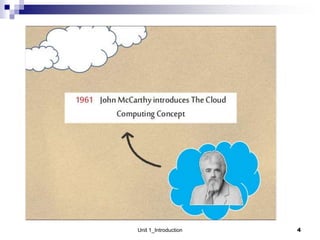
History of Cloud computing
■ Before cloud computing
1. Client-server computing
1. Distributed computing
Unit 1_Introduction 3
Unit 1_Introduction 4
1.1 Cloud computing
■ Uses Internet technologies to offer scalable and elastic
services.
■ Elastic computing refers to the ability of dynamically
acquiring computing resources and supporting a variable
workload.
■ The resources used for these services can be metered.
■ Maintenance and security are ensured by service
providers.
5
Unit 1_Introduction
Types of clouds
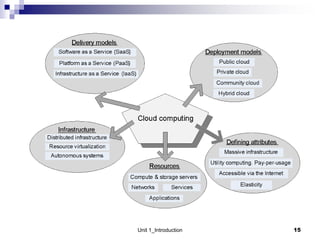
■ Public Cloud - the infrastructure is made available to
the general public or a large industry group and is
owned by the organization selling cloud services.
■ Private Cloud – the infrastructure is operated solely for
an organization.
Unit 1_Introduction 6
■ Community Cloud - the infrastructure is shared by
several organizations and supports a community that
has shared concerns. It may be managed by
organizations or a third party and may exists on
premises or off premises.
■ Hybrid Cloud - composition of two or more clouds
(public, private, or community) as unique entities but
bound by standardized technology that enables data and
application portability.
Unit 1_Introduction 7
The “good” about cloud computing
■ Resources, such as CPU cycles, storage, network
bandwidth, are shared.
■ When multiple applications share a system, their peak
demands for resources are not synchronized thus,
multiplexing leads to a higher resource utilization.
8
Unit 1_Introduction
■ Resources can be aggregated to support data-intensive
applications.
■ Data sharing facilitates collaborative activities. Many
applications require multiple types of analysis of shared
data sets and multiple decisions carried out by groups
scattered around the globe.
Unit 1_Introduction 9
More “good” about cloud computing
■ Eliminates the initial investment costs and the
maintenance and operation costs for a private computing
infrastructure.
■ Cost reduction: concentration of resources creates the
opportunity to pay as you go for computing.
■ Elasticity: the ability to accommodate workloads with
very large peak-to-average ratios.
■ User convenience: virtualization allows users to operate
in familiar environments rather than in idiosyncratic
ones.
Unit 1_Introduction 10
Why cloud computing could be successful
when other paradigms have failed?
■ It is in a better position to exploit recent advances in software,
networking, storage, and processor technologies promoted by
the same companies who provide cloud services.
■ It is focused on enterprise computing; its adoption by
industrial organizations, financial institutions, government,
and so on could have a huge impact on the economy.
11
Unit 1_Introduction
■ A cloud consists of a homogeneous set of hardware and
software resources in a single administrative domain.
■ Security, resource management, fault-tolerance, and
QOS are less challenging than in a heterogeneous
environment with resources in multiple ADs.
Unit 1_Introduction 12
Challenges for cloud computing
■ Availability of service: what happens when the service
provider cannot deliver?
solution is ………………SLAs OR Over provisioning
■ .
■ Vendor lock-in: once a customer is hooked to one
provider it is hard to move to another. Standardization
efforts at NIST attempt to address this problem.
■ Data confidentiality and auditability, a serious problem.
■ Data transfer bottleneck; many applications are data-
intensive.
13
Unit 1_Introduction
More challenges
■ Performance unpredictability, one of the consequences
of resource sharing.
◻ How to use resource virtualization and performance
isolation for QoS guarantees?
◻ How to support elasticity, the ability to scale up and
down quickly?
■ Resource management; are self-organization and self-
management the solution?
■ Security and confidentiality; major concern.
■ Addressing these challenges provides good research
opportunities!!
Unit 1_Introduction 14
Unit 1_Introduction 15
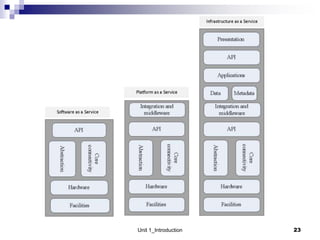
Cloud delivery models
■ Software as a Service (SaaS)
■ Platform as a Service (PaaS)
■ Infrastructure as a Service (IaaS)
Unit 1_Introduction 16
Software-as-a-Service (SaaS)
■ Applications are supplied by the service provider.
■ The user does not manage or control the underlying
cloud infrastructure or individual application capabilities.
■ Not suitable for real-time applications or for those where
data is not allowed to be hosted externally.
■ Examples: Gmail, Google search engine.
Unit 1_Introduction 17
■ Services offered include:
◻ Enterprise services such as: workflow management,
group-ware and collaborative, supply chain,
communications, digital signature, customer
relationship management (CRM), desktop software,
financial management, geo-spatial, and search.
◻ Web 2.0 applications such as: metadata
management, social networking, blogs, wiki services,
and portal services.
Unit 1_Introduction 18
Platform-as-a-Service (PaaS)
■ Allows a cloud user to deploy consumer-created or
acquired applications using programming languages and
tools supported by the service provider.
■ The user:
◻ Has control over the deployed applications and,
possibly, application hosting environment
configurations.
◻ Does not manage or control the underlying cloud
infrastructure including network, servers, operating
systems, or storage.
Unit 1_Introduction 19
■ Not particularly useful when:
◻ The application must be portable.
◻ Proprietary programming languages are used.
◻ The hardware and software must be customized to
improve the performance of the application.
Unit 1_Introduction 20
Infrastructure-as-a-Service (IaaS)
■ The user is able to deploy and run arbitrary software,
which can include OS and applications.
■ The user does not manage or control the underlying
cloud infrastructure but has control over OS, storage,
deployed applications, and possibly limited control of
some networking components, e.g., host firewalls.
Unit 1_Introduction 21
■ Services offered by this delivery model include:
• server hosting,
• Web servers,
• storage,
• computing hardware,
• OS,
• virtual instances,
• load balancing,
• Internet access, and
• bandwidth provisioning.
Unit 1_Introduction 22
Unit 1_Introduction 23
Cloud activities
■ Service management and provisioning including:
◻ Virtualization.
◻ Service provisioning.
◻ Call center.
◻ Operations management.
◻ Systems management.
◻ QoS management.
◻ Billing and accounting, asset management.
◻ SLA management.
◻ Technical support and backups.
Unit 1_Introduction 24
Cloud activities (cont’d)
■ Security management including:
◻ ID and authentication.
◻ Certification and accreditation.
◻ Intrusion prevention.
◻ Intrusion detection.
◻ Virus protection.
◻ Cryptography.
◻ Physical security, incident response.
◻ Access control, audit and trails, and firewalls.
Unit 1_Introduction 25
Cloud activities (cont’d)
■ Customer services such as:
■ Customer assistance and on-line help.
■ Subscriptions.
■ Business intelligence.
■ Reporting.
■ Customer preferences.
■ Personalization.
■ Integration services including:
■ Data management.
■ Development.
Unit 1_Introduction 26
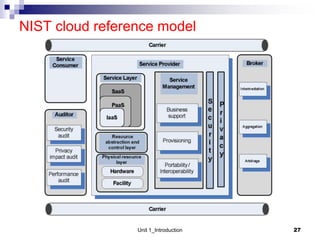
NIST cloud reference model
Unit 1_Introduction 27
Ethical issues
■ Paradigm shift with implications on computing ethics:
■ The control is relinquished to third party services.
■ The data is stored on multiple sites administered
by several organizations.
■ Multiple services interoperate across the network.
■ Implications
■ Unauthorized access.
■ Data corruption.
■ Infrastructure failure, and service unavailability.
Unit 1_Introduction 28
De-perimeterisation
■ Systems can span the boundaries of multiple organizations
and cross the security borders.
■ The complex structure of cloud services can make it
difficult to determine who is responsible in case something
undesirable happens.
■ Identity fraud and theft are made possible by the
unauthorized access to personal data in circulation and by
new forms of dissemination through social networks and
they could also pose a danger to cloud computing.
Unit 1_Introduction 29
Privacy issues
■ Cloud service providers have already collected
petabytes of sensitive personal information stored in
data centers around the world.
■ The acceptance of cloud computing therefore will be
determined by privacy issues addressed by these
companies and the countries where the data centers are
located.
■ Privacy is affected by cultural differences; some cultures
favor privacy, others emphasize community.
■ This leads to an ambivalent attitude towards privacy in
the Internet which is a global system.
Unit 1_Introduction 30
Cloud vulnerabilities
■ Clouds are affected by malicious attacks and failures of
the infrastructure, e.g., power failures.
■ Such events can affect the Internet domain name
servers and prevent access to a cloud or can directly
affect the clouds:
Unit 1_Introduction 31
1. in 2004 an attack at Akamai caused a domain name
outage and a major blackout that affected Google,
Yahoo, and other sites.
1. in 2009, Google was the target of a denial of service
attack which took down Google News and Gmail for
several days;
1. in 2012 lightning caused a prolonged down time at
Amazon.
Unit 1_Introduction 32

Cloud Computing Introduction. Engineering seventh Semester

  • 1.
    Unit 1 Chapter 1:Introduction 1 Unit 1_Introduction
  • 2.
    Contents ■ Cloud computing:an old idea whose time has come ■ Cloud Computing Delivery models and services. ■ Ethical issues in cloud computing. ■ Cloud vulnerabilities. Unit 1_Introduction 2
  • 3.
    History of Cloudcomputing ■ Before cloud computing 1. Client-server computing 1. Distributed computing Unit 1_Introduction 3
  • 4.
  • 5.
    1.1 Cloud computing ■Uses Internet technologies to offer scalable and elastic services. ■ Elastic computing refers to the ability of dynamically acquiring computing resources and supporting a variable workload. ■ The resources used for these services can be metered. ■ Maintenance and security are ensured by service providers. 5 Unit 1_Introduction
  • 6.
    Types of clouds ■Public Cloud - the infrastructure is made available to the general public or a large industry group and is owned by the organization selling cloud services. ■ Private Cloud – the infrastructure is operated solely for an organization. Unit 1_Introduction 6
  • 7.
    ■ Community Cloud- the infrastructure is shared by several organizations and supports a community that has shared concerns. It may be managed by organizations or a third party and may exists on premises or off premises. ■ Hybrid Cloud - composition of two or more clouds (public, private, or community) as unique entities but bound by standardized technology that enables data and application portability. Unit 1_Introduction 7
  • 8.
    The “good” aboutcloud computing ■ Resources, such as CPU cycles, storage, network bandwidth, are shared. ■ When multiple applications share a system, their peak demands for resources are not synchronized thus, multiplexing leads to a higher resource utilization. 8 Unit 1_Introduction
  • 9.
    ■ Resources canbe aggregated to support data-intensive applications. ■ Data sharing facilitates collaborative activities. Many applications require multiple types of analysis of shared data sets and multiple decisions carried out by groups scattered around the globe. Unit 1_Introduction 9
  • 10.
    More “good” aboutcloud computing ■ Eliminates the initial investment costs and the maintenance and operation costs for a private computing infrastructure. ■ Cost reduction: concentration of resources creates the opportunity to pay as you go for computing. ■ Elasticity: the ability to accommodate workloads with very large peak-to-average ratios. ■ User convenience: virtualization allows users to operate in familiar environments rather than in idiosyncratic ones. Unit 1_Introduction 10
  • 11.
    Why cloud computingcould be successful when other paradigms have failed? ■ It is in a better position to exploit recent advances in software, networking, storage, and processor technologies promoted by the same companies who provide cloud services. ■ It is focused on enterprise computing; its adoption by industrial organizations, financial institutions, government, and so on could have a huge impact on the economy. 11 Unit 1_Introduction
  • 12.
    ■ A cloudconsists of a homogeneous set of hardware and software resources in a single administrative domain. ■ Security, resource management, fault-tolerance, and QOS are less challenging than in a heterogeneous environment with resources in multiple ADs. Unit 1_Introduction 12
  • 13.
    Challenges for cloudcomputing ■ Availability of service: what happens when the service provider cannot deliver? solution is ………………SLAs OR Over provisioning ■ . ■ Vendor lock-in: once a customer is hooked to one provider it is hard to move to another. Standardization efforts at NIST attempt to address this problem. ■ Data confidentiality and auditability, a serious problem. ■ Data transfer bottleneck; many applications are data- intensive. 13 Unit 1_Introduction
  • 14.
    More challenges ■ Performanceunpredictability, one of the consequences of resource sharing. ◻ How to use resource virtualization and performance isolation for QoS guarantees? ◻ How to support elasticity, the ability to scale up and down quickly? ■ Resource management; are self-organization and self- management the solution? ■ Security and confidentiality; major concern. ■ Addressing these challenges provides good research opportunities!! Unit 1_Introduction 14
  • 15.
  • 16.
    Cloud delivery models ■Software as a Service (SaaS) ■ Platform as a Service (PaaS) ■ Infrastructure as a Service (IaaS) Unit 1_Introduction 16
  • 17.
    Software-as-a-Service (SaaS) ■ Applicationsare supplied by the service provider. ■ The user does not manage or control the underlying cloud infrastructure or individual application capabilities. ■ Not suitable for real-time applications or for those where data is not allowed to be hosted externally. ■ Examples: Gmail, Google search engine. Unit 1_Introduction 17
  • 18.
    ■ Services offeredinclude: ◻ Enterprise services such as: workflow management, group-ware and collaborative, supply chain, communications, digital signature, customer relationship management (CRM), desktop software, financial management, geo-spatial, and search. ◻ Web 2.0 applications such as: metadata management, social networking, blogs, wiki services, and portal services. Unit 1_Introduction 18
  • 19.
    Platform-as-a-Service (PaaS) ■ Allowsa cloud user to deploy consumer-created or acquired applications using programming languages and tools supported by the service provider. ■ The user: ◻ Has control over the deployed applications and, possibly, application hosting environment configurations. ◻ Does not manage or control the underlying cloud infrastructure including network, servers, operating systems, or storage. Unit 1_Introduction 19
  • 20.
    ■ Not particularlyuseful when: ◻ The application must be portable. ◻ Proprietary programming languages are used. ◻ The hardware and software must be customized to improve the performance of the application. Unit 1_Introduction 20
  • 21.
    Infrastructure-as-a-Service (IaaS) ■ Theuser is able to deploy and run arbitrary software, which can include OS and applications. ■ The user does not manage or control the underlying cloud infrastructure but has control over OS, storage, deployed applications, and possibly limited control of some networking components, e.g., host firewalls. Unit 1_Introduction 21
  • 22.
    ■ Services offeredby this delivery model include: • server hosting, • Web servers, • storage, • computing hardware, • OS, • virtual instances, • load balancing, • Internet access, and • bandwidth provisioning. Unit 1_Introduction 22
  • 23.
  • 24.
    Cloud activities ■ Servicemanagement and provisioning including: ◻ Virtualization. ◻ Service provisioning. ◻ Call center. ◻ Operations management. ◻ Systems management. ◻ QoS management. ◻ Billing and accounting, asset management. ◻ SLA management. ◻ Technical support and backups. Unit 1_Introduction 24
  • 25.
    Cloud activities (cont’d) ■Security management including: ◻ ID and authentication. ◻ Certification and accreditation. ◻ Intrusion prevention. ◻ Intrusion detection. ◻ Virus protection. ◻ Cryptography. ◻ Physical security, incident response. ◻ Access control, audit and trails, and firewalls. Unit 1_Introduction 25
  • 26.
    Cloud activities (cont’d) ■Customer services such as: ■ Customer assistance and on-line help. ■ Subscriptions. ■ Business intelligence. ■ Reporting. ■ Customer preferences. ■ Personalization. ■ Integration services including: ■ Data management. ■ Development. Unit 1_Introduction 26
  • 27.
    NIST cloud referencemodel Unit 1_Introduction 27
  • 28.
    Ethical issues ■ Paradigmshift with implications on computing ethics: ■ The control is relinquished to third party services. ■ The data is stored on multiple sites administered by several organizations. ■ Multiple services interoperate across the network. ■ Implications ■ Unauthorized access. ■ Data corruption. ■ Infrastructure failure, and service unavailability. Unit 1_Introduction 28
  • 29.
    De-perimeterisation ■ Systems canspan the boundaries of multiple organizations and cross the security borders. ■ The complex structure of cloud services can make it difficult to determine who is responsible in case something undesirable happens. ■ Identity fraud and theft are made possible by the unauthorized access to personal data in circulation and by new forms of dissemination through social networks and they could also pose a danger to cloud computing. Unit 1_Introduction 29
  • 30.
    Privacy issues ■ Cloudservice providers have already collected petabytes of sensitive personal information stored in data centers around the world. ■ The acceptance of cloud computing therefore will be determined by privacy issues addressed by these companies and the countries where the data centers are located. ■ Privacy is affected by cultural differences; some cultures favor privacy, others emphasize community. ■ This leads to an ambivalent attitude towards privacy in the Internet which is a global system. Unit 1_Introduction 30
  • 31.
    Cloud vulnerabilities ■ Cloudsare affected by malicious attacks and failures of the infrastructure, e.g., power failures. ■ Such events can affect the Internet domain name servers and prevent access to a cloud or can directly affect the clouds: Unit 1_Introduction 31
  • 32.
    1. in 2004an attack at Akamai caused a domain name outage and a major blackout that affected Google, Yahoo, and other sites. 1. in 2009, Google was the target of a denial of service attack which took down Google News and Gmail for several days; 1. in 2012 lightning caused a prolonged down time at Amazon. Unit 1_Introduction 32