Why it is called so ?
Metaphorically the word cloud is
used because of the analogy
between the property of rain
clouds and the way the cloud
computing is designed
Benefits !
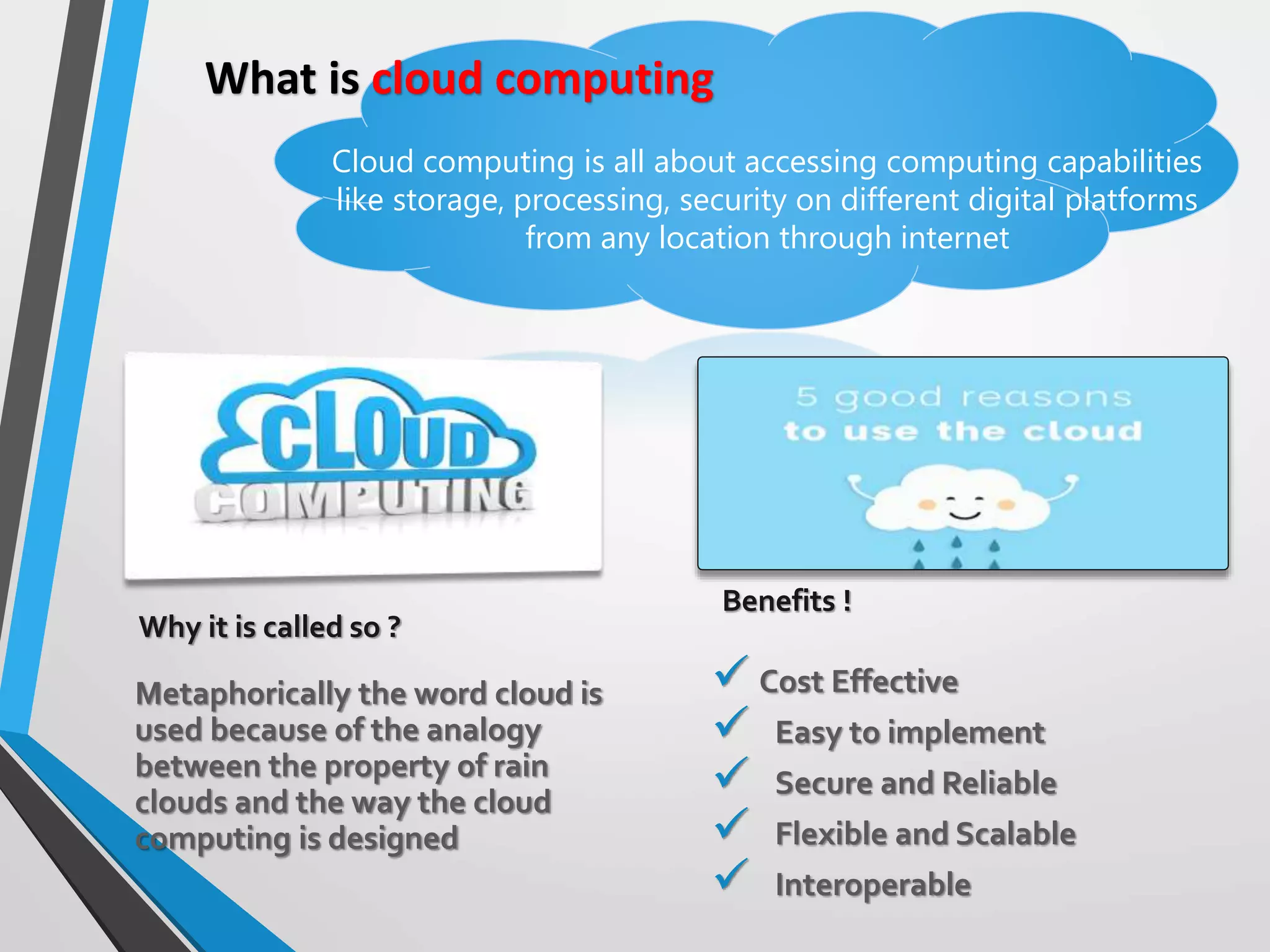
 Cost Effective
 Easy to implement
 Secure and Reliable
 Flexible and Scalable
 Interoperable
Cloud computing is all about accessing computing capabilities
like storage, processing, security on different digital platforms
from any location through internet
What is cloud computing
How Cloud Computing Works
• If you have experienced using e-mail, you have already experienced using the
cloud. Basically, what you are loading on your machine, as an e-mail user, is
simply – an application.You log in into a Web Service, and all the programs
necessary to actually run the application, are located on a remote machine
owned by another company.The real storage and the software does not exist on
your computer, but exist instead – on the cloud.
• It is estimated that there is over 1 Exabyte of data stored in the cloud at the
moment, or 1,073,741,824 gigabytes of data.The Gartner prediction is that
at the year-end 2016, more than 50% of Global 1000 companies will have
stored customer-sensitive data in the public cloud.
• By adopting the cloud, companies are relying on an automated decision
making system to reduce the number of the staff they need to perform
complex calculations, analysis, and to actually maintain the system.
What is Cloud Made of?
• Cloud can be divided broadly into two layer –front end
and back end
• On front end we have a client , an application, user
interface
• On the back end of the system, there are:
Computers that run the applications
Servers (with a central server(s))
Data storage systems
Types of Cloud Computing
• Based on a deployment
model
• Public
• Private
• Hybrid
• Hommunity cloud
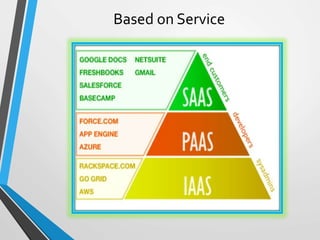
Based on a service :
IaaS (Infrastructure-as-
a-Service)
PaaS (Platform-as-a-
Service)
SaaS (Software-as-a-
Service)
Based on Deployment Model
• Public Cloud:
• The whole computing
infrastructure is located on the
premises of a cloud computing
company that offers the cloud
service.
• The location remains, thus,
separate from the customer and
he has no physical control over the
infrastructure.
• As public clouds use shared
resources, they do excel mostly in
performance, but are also most
vulnerable to various attacks.
• Private Cloud:
• Provides the same benefits of
PublicCloud, but uses
dedicated, private hardware.
Private cloud means using a
cloud infrastructure (network)
solely by one
customer/organization
• It is not shared with others, yet
it is remotely located
• The companies have an option
of choosing an on premise
private cloud as well, which is
more expensive, but they do
have a physical control over
the infrastructure.
Continued…
• Hybrid Cloud:
• Means, using both private and
public clouds, depending on
their purpose.
• For example, public cloud can
be used to interact with
customers, while keeping
their data secured through a
private cloud.
Community Cloud:
• Implies an infrastructure
that is shared between
organizations, usually with
the shared data and data
management concerns.
• For example, a
community cloud can
belong to a government of
a single country.
Based on Service
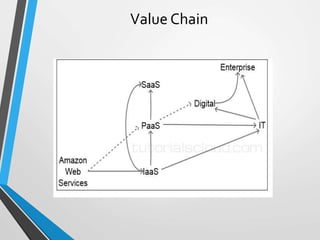
Value Chain
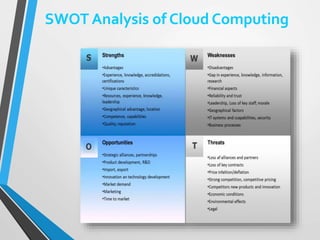
SWOT Analysis of Cloud Computing
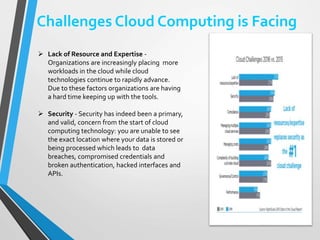
Challenges Cloud Computing is Facing
 Lack of Resource and Expertise -
Organizations are increasingly placing more
workloads in the cloud while cloud
technologies continue to rapidly advance.
Due to these factors organizations are having
a hard time keeping up with the tools.
 Security - Security has indeed been a primary,
and valid, concern from the start of cloud
computing technology: you are unable to see
the exact location where your data is stored or
being processed which leads to data
breaches, compromised credentials and
broken authentication, hacked interfaces and
APIs.
Challenges Cloud Computing is Facing
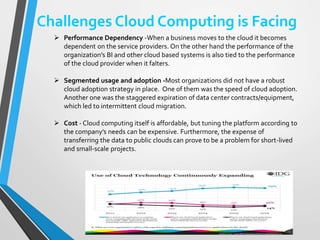
 Performance Dependency -When a business moves to the cloud it becomes
dependent on the service providers. On the other hand the performance of the
organization’s BI and other cloud based systems is also tied to the performance
of the cloud provider when it falters.
 Segmented usage and adoption -Most organizations did not have a robust
cloud adoption strategy in place. One of them was the speed of cloud adoption.
Another one was the staggered expiration of data center contracts/equipment,
which led to intermittent cloud migration.
 Cost - Cloud computing itself is affordable, but tuning the platform according to
the company’s needs can be expensive. Furthermore, the expense of
transferring the data to public clouds can prove to be a problem for short-lived
and small-scale projects.
Is there a Future?
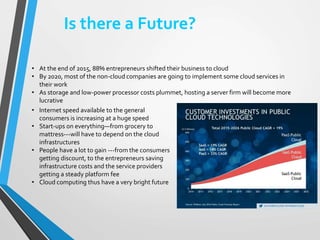
• Internet speed available to the general
consumers is increasing at a huge speed
• Start-ups on everything—from grocery to
mattress---will have to depend on the cloud
infrastructures
• People have a lot to gain ---from the consumers
getting discount, to the entrepreneurs saving
infrastructure costs and the service providers
getting a steady platform fee
• Cloud computing thus have a very bright future
• At the end of 2015, 88% entrepreneurs shifted their business to cloud
• By 2020, most of the non-cloud companies are going to implement some cloud services in
their work
• As storage and low-power processor costs plummet, hosting a server firm will become more
lucrative
What is the Future?
• Artificial Intelligence: Where processing power is
abundant, AI learns quickly.Thus most recent AI s are
cloud based
• Internet of Everything: As each and every device
starts interacting with each other, this horde of data
will be needed to be stored and processed and cloud
computing provides the cheapest and fastest
alternative
• Blockchain:Though bitcoin prices have fallen
drastically, block chain technology has the ability
from keeping health records to tracing diamonds
from mines to customers ---all on cloud computing
support
• Autonomous vehicles:The backbone of the driverless
cars---its software updates and machine learning are
all situated in the cloud
Conclusion
Thank You

Cloud computing- Benefits,Future and Challenges

  • 1.
    Why it iscalled so ? Metaphorically the word cloud is used because of the analogy between the property of rain clouds and the way the cloud computing is designed Benefits !  Cost Effective  Easy to implement  Secure and Reliable  Flexible and Scalable  Interoperable Cloud computing is all about accessing computing capabilities like storage, processing, security on different digital platforms from any location through internet What is cloud computing
  • 3.
    How Cloud ComputingWorks • If you have experienced using e-mail, you have already experienced using the cloud. Basically, what you are loading on your machine, as an e-mail user, is simply – an application.You log in into a Web Service, and all the programs necessary to actually run the application, are located on a remote machine owned by another company.The real storage and the software does not exist on your computer, but exist instead – on the cloud. • It is estimated that there is over 1 Exabyte of data stored in the cloud at the moment, or 1,073,741,824 gigabytes of data.The Gartner prediction is that at the year-end 2016, more than 50% of Global 1000 companies will have stored customer-sensitive data in the public cloud. • By adopting the cloud, companies are relying on an automated decision making system to reduce the number of the staff they need to perform complex calculations, analysis, and to actually maintain the system.
  • 4.
    What is CloudMade of? • Cloud can be divided broadly into two layer –front end and back end • On front end we have a client , an application, user interface • On the back end of the system, there are: Computers that run the applications Servers (with a central server(s)) Data storage systems
  • 5.
    Types of CloudComputing • Based on a deployment model • Public • Private • Hybrid • Hommunity cloud Based on a service : IaaS (Infrastructure-as- a-Service) PaaS (Platform-as-a- Service) SaaS (Software-as-a- Service)
  • 6.
    Based on DeploymentModel • Public Cloud: • The whole computing infrastructure is located on the premises of a cloud computing company that offers the cloud service. • The location remains, thus, separate from the customer and he has no physical control over the infrastructure. • As public clouds use shared resources, they do excel mostly in performance, but are also most vulnerable to various attacks. • Private Cloud: • Provides the same benefits of PublicCloud, but uses dedicated, private hardware. Private cloud means using a cloud infrastructure (network) solely by one customer/organization • It is not shared with others, yet it is remotely located • The companies have an option of choosing an on premise private cloud as well, which is more expensive, but they do have a physical control over the infrastructure.
  • 7.
    Continued… • Hybrid Cloud: •Means, using both private and public clouds, depending on their purpose. • For example, public cloud can be used to interact with customers, while keeping their data secured through a private cloud. Community Cloud: • Implies an infrastructure that is shared between organizations, usually with the shared data and data management concerns. • For example, a community cloud can belong to a government of a single country.
  • 8.
  • 9.
  • 10.
    SWOT Analysis ofCloud Computing
  • 11.
    Challenges Cloud Computingis Facing  Lack of Resource and Expertise - Organizations are increasingly placing more workloads in the cloud while cloud technologies continue to rapidly advance. Due to these factors organizations are having a hard time keeping up with the tools.  Security - Security has indeed been a primary, and valid, concern from the start of cloud computing technology: you are unable to see the exact location where your data is stored or being processed which leads to data breaches, compromised credentials and broken authentication, hacked interfaces and APIs.
  • 12.
    Challenges Cloud Computingis Facing  Performance Dependency -When a business moves to the cloud it becomes dependent on the service providers. On the other hand the performance of the organization’s BI and other cloud based systems is also tied to the performance of the cloud provider when it falters.  Segmented usage and adoption -Most organizations did not have a robust cloud adoption strategy in place. One of them was the speed of cloud adoption. Another one was the staggered expiration of data center contracts/equipment, which led to intermittent cloud migration.  Cost - Cloud computing itself is affordable, but tuning the platform according to the company’s needs can be expensive. Furthermore, the expense of transferring the data to public clouds can prove to be a problem for short-lived and small-scale projects.
  • 13.
    Is there aFuture? • Internet speed available to the general consumers is increasing at a huge speed • Start-ups on everything—from grocery to mattress---will have to depend on the cloud infrastructures • People have a lot to gain ---from the consumers getting discount, to the entrepreneurs saving infrastructure costs and the service providers getting a steady platform fee • Cloud computing thus have a very bright future • At the end of 2015, 88% entrepreneurs shifted their business to cloud • By 2020, most of the non-cloud companies are going to implement some cloud services in their work • As storage and low-power processor costs plummet, hosting a server firm will become more lucrative
  • 14.
    What is theFuture? • Artificial Intelligence: Where processing power is abundant, AI learns quickly.Thus most recent AI s are cloud based • Internet of Everything: As each and every device starts interacting with each other, this horde of data will be needed to be stored and processed and cloud computing provides the cheapest and fastest alternative • Blockchain:Though bitcoin prices have fallen drastically, block chain technology has the ability from keeping health records to tracing diamonds from mines to customers ---all on cloud computing support • Autonomous vehicles:The backbone of the driverless cars---its software updates and machine learning are all situated in the cloud
  • 15.
  • 16.