Cloud
Computing
PREPARED BY :
Avinash Kumar Saklani
SUBMITTED TO :
KritikaChauhan
CONTENTS
 INTRODUCTION
 BENEFITS OF CLOUD COMPUTING
 DISADVANTAGES
 BASIC CONCEPTS
 DEPLOYMENT MODELS
 TYPES OF CLOUD
 TYPES OF CLOUD SERVICES
 SERVICES MODELS
 PLATFORMS FOR CLOUD COMPUTING
 CONCLUSION
INTRODUCTION
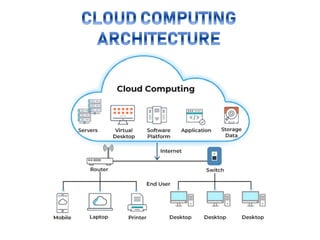
Cloud Computing is defined as storing and accessing
of data and computing services over the internet. It
doesn’t store any data on your personal computer.
Cloud Computing is the on-demand availability of
computer services like servers,data storage,
networking, databases, etc.
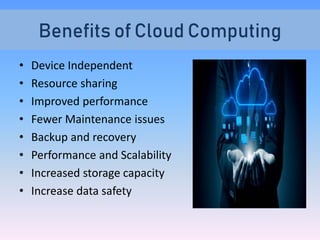
Benefits of Cloud Computing
• Device Independent
• Resource sharing
• Improved performance
• Fewer Maintenance issues
• Backup and recovery
• Performance and Scalability
• Increased storage capacity
• Increase data safety
DISADVANTAGES
• Requires a constant Internet connection
• Features might be limited
Can be slow
• Stored data can be lost
• Stored data might not be secure
• Does not work well with
low-speed connections
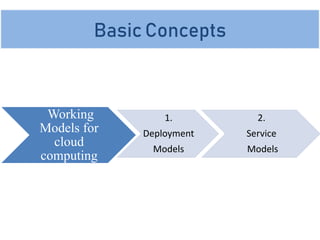
Basic Concepts
Working
Models for
cloud
computing
1.
Deployment
Models
2.
Service
Models
DEPLOYMENT MODELS
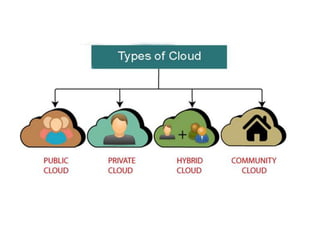
• Public Cloud : It provides a shared platform that accessible to
the general public through an Internet connection.
• Private cloud : It provides computing services to a private
internal network (within the organization) and selected
users instead of the general public.
• Hybrid cloud : It is a combination of public & private clouds
Hybrid cloud = public cloud + private cloud
• Community cloud : It is a cloud infrastructure that allows
systems and services to be accessible by a group of several
organizations to share the information.
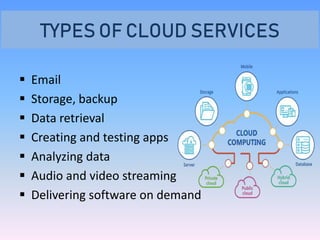
TYPES OF CLOUD SERVICES
 Email
 Storage, backup
 Data retrieval
 Creating and testing apps
 Analyzing data
 Audio and video streaming
 Delivering software on demand
SERVICE MODELS
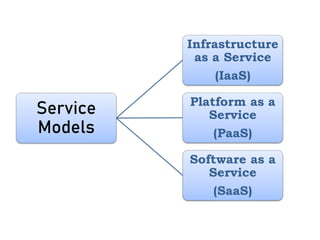
Service
Models
Infrastructure
as a Service
(IaaS)
Platform as a
Service
(PaaS)
Software as a
Service
(SaaS)
CONCLUSION
In Conclusion,
Cloud computing is recently new technological development
that has the potential to have a great impact on the world . It
has many benefits that it provides to it users and businesses.
But there are other challenges the cloud computing must
overcome. People are very skeptical about whether their data is
secure and private.
There are no standards or regulations
worldwide provided data through cloud computing. But once,
there are standards and regulation worldwide, cloud
computing will revolutionize the future.
Cloud Computing

Cloud Computing

  • 1.
    Cloud Computing PREPARED BY : AvinashKumar Saklani SUBMITTED TO : KritikaChauhan
  • 2.
    CONTENTS  INTRODUCTION  BENEFITSOF CLOUD COMPUTING  DISADVANTAGES  BASIC CONCEPTS  DEPLOYMENT MODELS  TYPES OF CLOUD  TYPES OF CLOUD SERVICES  SERVICES MODELS  PLATFORMS FOR CLOUD COMPUTING  CONCLUSION
  • 3.
    INTRODUCTION Cloud Computing isdefined as storing and accessing of data and computing services over the internet. It doesn’t store any data on your personal computer. Cloud Computing is the on-demand availability of computer services like servers,data storage, networking, databases, etc.
  • 5.
    Benefits of CloudComputing • Device Independent • Resource sharing • Improved performance • Fewer Maintenance issues • Backup and recovery • Performance and Scalability • Increased storage capacity • Increase data safety
  • 6.
    DISADVANTAGES • Requires aconstant Internet connection • Features might be limited Can be slow • Stored data can be lost • Stored data might not be secure • Does not work well with low-speed connections
  • 7.
  • 8.
  • 10.
    • Public Cloud: It provides a shared platform that accessible to the general public through an Internet connection. • Private cloud : It provides computing services to a private internal network (within the organization) and selected users instead of the general public. • Hybrid cloud : It is a combination of public & private clouds Hybrid cloud = public cloud + private cloud • Community cloud : It is a cloud infrastructure that allows systems and services to be accessible by a group of several organizations to share the information.
  • 11.
    TYPES OF CLOUDSERVICES  Email  Storage, backup  Data retrieval  Creating and testing apps  Analyzing data  Audio and video streaming  Delivering software on demand
  • 12.
  • 13.
    Service Models Infrastructure as a Service (IaaS) Platformas a Service (PaaS) Software as a Service (SaaS)
  • 15.
    CONCLUSION In Conclusion, Cloud computingis recently new technological development that has the potential to have a great impact on the world . It has many benefits that it provides to it users and businesses. But there are other challenges the cloud computing must overcome. People are very skeptical about whether their data is secure and private. There are no standards or regulations worldwide provided data through cloud computing. But once, there are standards and regulation worldwide, cloud computing will revolutionize the future.