Cloud Computing
AKSHAY BOSAMIYA
4TH SEMESTER, COMPUTER ENGINEERING
ROLL NO.: CE09, BATCH: C1
EMAIL ID: ARBOSAMIYA@GMAIL.COM
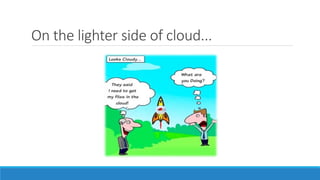
On the lighter side of cloud...
Importance of cloud computing
•Cloud computing has the potential to radically change the nature of Information and
Communication Technology(ICT) provision in the public service and significantly reduce costs. It
is key element of the strategic future of ICT in this sector.
•We believe we are moving out of the ICE Age, the Iron Age, The industrial Age, the Information
Age, to the participation Age. You are participating on the Internet, not just viewing stuff. We
build the infrastructure that goes in the data centre that facilitates the participation age.
-Scott McNealy, former CEO, Sun Microsystems
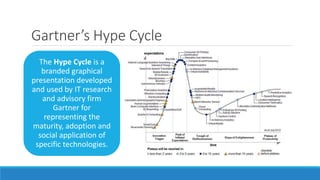
Gartner’s Hype Cycle
The Hype Cycle is a
branded graphical
presentation developed
and used by IT research
and advisory firm
Gartner for
representing the
maturity, adoption and
social application of
specific technologies.
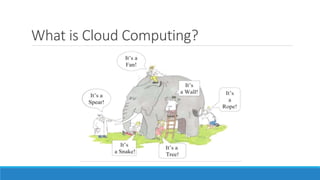
What is Cloud Computing?
What is Cloud computing?
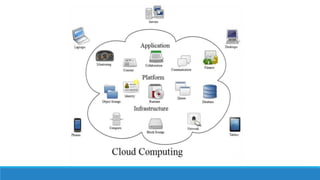
•Cloud computing is a recently evolved computing terminology or metaphor based on utility and
consumption of computing resources. Cloud computing involves deploying groups of remote
servers and software networks that allow centralized data storage and online access to
computer services or resources
-Wikipedia the free encyclopaedia
•Cloud computing is a comprehensive solution that delivers IT as a service. It is an Internet-based
computing solution where shared resources are provided like electricity distributed on the
electrical grid. Computers in the cloud are configured to work together and the various
applications use the collective computing power as if they are running on a single system.
-IBM Developers
What is Cloud computing?
According to Forrester, Cloud Computing is:
“A form of standardized IT-based capability – such as Internet-based services,
software, or IT infrastructure- offered by a service provider that is accessible via
Internet protocols from any computer, always available and scales automatically
to adjust to demand, is either pay-per-use or advertising-based. Has Web- or
programmatic-based control interfaces, and enables full customer self-service. ”
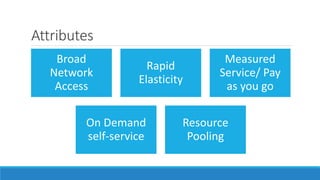
Attributes
Attributes
Broad
Network
Access
Rapid
Elasticity
Measured
Service/ Pay
as you go
On Demand
self-service
Resource
Pooling
Service Models
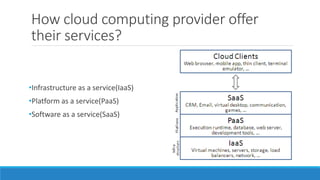
How cloud computing provider offer
their services?
•Infrastructure as a service(IaaS)
•Platform as a service(PaaS)
•Software as a service(SaaS)
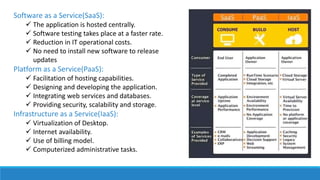
Software as a Service(SaaS):
 The application is hosted centrally.
 Software testing takes place at a faster rate.
 Reduction in IT operational costs.
 No need to install new software to release
updates
Platform as a Service(PaaS):
 Facilitation of hosting capabilities.
 Designing and developing the application.
 Integrating web services and databases.
 Providing security, scalability and storage.
Infrastructure as a Service(IaaS):
 Virtualization of Desktop.
 Internet availability.
 Use of billing model.
 Computerized administrative tasks.
Deployment Models
Deployment Models
• Private cloud
• Public cloud
• Hybrid cloud
• Others
• Community cloud
• Distributed cloud
• Inter cloud
• Multi cloud
Public cloud
•Mega-scale Infrastructure and Services
•Sold publically
•Pay-per-use
•Multitenant application and services
•Access virtually unlimited resources
Private cloud
•Finite Infrastructure and Services
•Enterprise owned or leased
•Charge-back to LOBs or Users
•Cloud Computing model in a company’s own datacentre or
providers
•Access limited resources that must be managed by LOBs or
Central IT
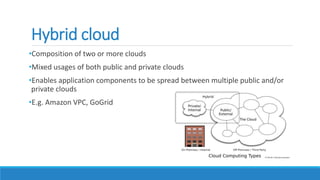
Hybrid cloud
•Composition of two or more clouds
•Mixed usages of both public and private clouds
•Enables application components to be spread between multiple public and/or
private clouds
•E.g. Amazon VPC, GoGrid
Key Characteristics
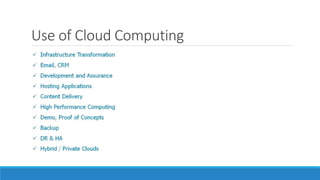
Use of Cloud Computing
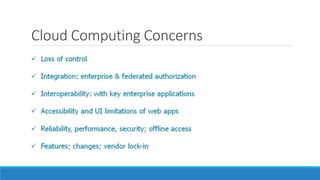
Cloud Computing Concerns
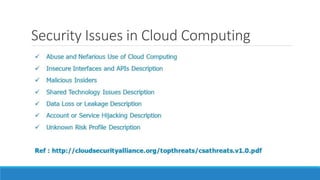
Security Issues in Cloud Computing
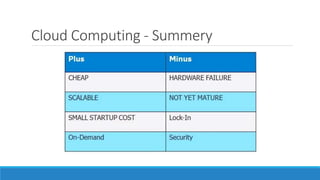
Cloud Computing - Summery
Thank You!

Cloud computing

  • 1.
    Cloud Computing AKSHAY BOSAMIYA 4THSEMESTER, COMPUTER ENGINEERING ROLL NO.: CE09, BATCH: C1 EMAIL ID: ARBOSAMIYA@GMAIL.COM
  • 2.
    On the lighterside of cloud...
  • 3.
    Importance of cloudcomputing •Cloud computing has the potential to radically change the nature of Information and Communication Technology(ICT) provision in the public service and significantly reduce costs. It is key element of the strategic future of ICT in this sector. •We believe we are moving out of the ICE Age, the Iron Age, The industrial Age, the Information Age, to the participation Age. You are participating on the Internet, not just viewing stuff. We build the infrastructure that goes in the data centre that facilitates the participation age. -Scott McNealy, former CEO, Sun Microsystems
  • 4.
    Gartner’s Hype Cycle TheHype Cycle is a branded graphical presentation developed and used by IT research and advisory firm Gartner for representing the maturity, adoption and social application of specific technologies.
  • 5.
    What is CloudComputing?
  • 6.
    What is Cloudcomputing? •Cloud computing is a recently evolved computing terminology or metaphor based on utility and consumption of computing resources. Cloud computing involves deploying groups of remote servers and software networks that allow centralized data storage and online access to computer services or resources -Wikipedia the free encyclopaedia •Cloud computing is a comprehensive solution that delivers IT as a service. It is an Internet-based computing solution where shared resources are provided like electricity distributed on the electrical grid. Computers in the cloud are configured to work together and the various applications use the collective computing power as if they are running on a single system. -IBM Developers
  • 7.
    What is Cloudcomputing? According to Forrester, Cloud Computing is: “A form of standardized IT-based capability – such as Internet-based services, software, or IT infrastructure- offered by a service provider that is accessible via Internet protocols from any computer, always available and scales automatically to adjust to demand, is either pay-per-use or advertising-based. Has Web- or programmatic-based control interfaces, and enables full customer self-service. ”
  • 8.
  • 9.
  • 10.
  • 11.
    How cloud computingprovider offer their services? •Infrastructure as a service(IaaS) •Platform as a service(PaaS) •Software as a service(SaaS)
  • 12.
    Software as aService(SaaS):  The application is hosted centrally.  Software testing takes place at a faster rate.  Reduction in IT operational costs.  No need to install new software to release updates Platform as a Service(PaaS):  Facilitation of hosting capabilities.  Designing and developing the application.  Integrating web services and databases.  Providing security, scalability and storage. Infrastructure as a Service(IaaS):  Virtualization of Desktop.  Internet availability.  Use of billing model.  Computerized administrative tasks.
  • 14.
  • 15.
    Deployment Models • Privatecloud • Public cloud • Hybrid cloud • Others • Community cloud • Distributed cloud • Inter cloud • Multi cloud
  • 16.
    Public cloud •Mega-scale Infrastructureand Services •Sold publically •Pay-per-use •Multitenant application and services •Access virtually unlimited resources
  • 17.
    Private cloud •Finite Infrastructureand Services •Enterprise owned or leased •Charge-back to LOBs or Users •Cloud Computing model in a company’s own datacentre or providers •Access limited resources that must be managed by LOBs or Central IT
  • 18.
    Hybrid cloud •Composition oftwo or more clouds •Mixed usages of both public and private clouds •Enables application components to be spread between multiple public and/or private clouds •E.g. Amazon VPC, GoGrid
  • 19.
  • 20.
    Use of CloudComputing
  • 21.
  • 22.
  • 23.
    Security Issues inCloud Computing
  • 24.
  • 25.