Cloud Computing: Da Teoria para a Prática Cezar Taurion Gerente de Novas Tecnologias/Technical Evangelist [email_address]
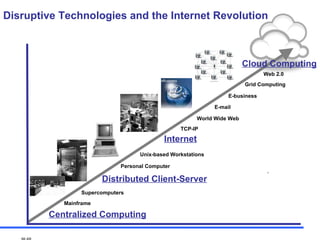
Disruptive Technologies and the Internet Revolution , E-mail World Wide Web TCP-IP E-business Grid Computing Internet Centralized Computing Mainframe Supercomputers Distributed Client-Server Personal Computer Unix-based Workstations Web 2.0 Cloud Computing
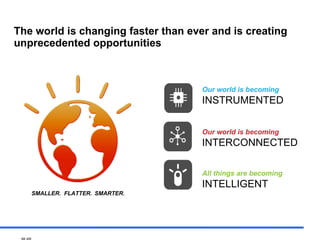
The world is changing faster than ever and is creating unprecedented opportunities SMALLER.  FLATTER.  SMARTER. Our world is becoming   INSTRUMENTED Our world is becoming INTERCONNECTED All things are becoming   INTELLIGENT
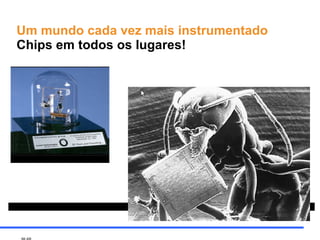
Um mundo cada vez mais instrumentado Chips em todos os lugares!
Computadores em lugares antes inimagináveis…


Volume of Digital Data Every day, 15 petabytes of new information are being generated. This is 8x more than the information in all U.S. libraries.
Variety of Information Today, 80% of new data growth is unstructured content, generated largely by email, with increasing contribution by documents, images, and video and audio  38% of email archiving decisions receive input from a C-level executive and 23% from legal/compliance professional
 
Changing the Cost Structure of IT will become a Business Imperative “ The message for IT is clear; businesses expect greater agility from IT. The current approaches are clearly not satisfying customer needs. A new approach is going to become an imperative for businesses to grow and thrive in a challenging economy.”  Gartner, Inc. Gartner Press Release,  “Gartner says Changing the Cost Structure of IT  Will Become a Business Imperative for Most CIOs”,  October 14, 2008
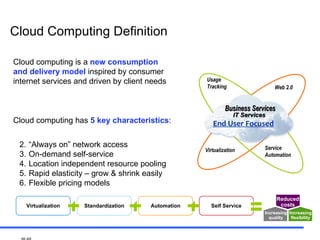
Cloud Computing Definition  Cloud computing is a  new consumption and delivery model  inspired by consumer internet services and driven by client needs Cloud computing has  5 key characteristics : “ Always on” network access  On-demand self-service  Location independent resource pooling Rapid elasticity – grow & shrink easily Flexible pricing models …  to free your budget for new investments and speed  deployment of new capabilities. Business Services IT Services Virtualization Service Automation Usage Tracking Web 2.0 End User Focused Virtualization Standardization Automation Self Service Increasing flexibility Reduced costs Increasing quality
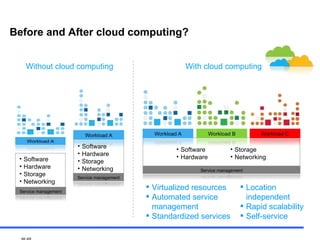
Before and After cloud computing? With cloud computing Without cloud computing Virtualized resources Automated service management Standardized services Location independent Rapid scalability Self-service Software Hardware Storage Networking Software Hardware Storage Networking Software Hardware Storage Networking
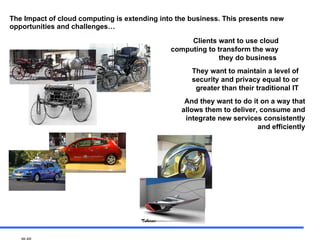
The Impact of cloud computing is extending into the business. This presents new opportunities and challenges… Clients want to use cloud computing to transform the way they do business  They want to maintain a level of security and privacy equal to or greater than their traditional IT And they want to do it on a way that allows them to deliver, consume and integrate new services consistently and efficiently
Obrigado! Mais informações: www.ibm.com /cloud-computing www.ibm.com/developerworks/cloud www.computingonclouds.wordpress.com www.ibm.com/developerworks/blogs/page/ctaurion   [email_address] @twitter, Facebook, Linkedin, BranchOut

IBM - Seminário Computação em Nuvem

  • 1.
    Cloud Computing: DaTeoria para a Prática Cezar Taurion Gerente de Novas Tecnologias/Technical Evangelist [email_address]
  • 2.
    Disruptive Technologies andthe Internet Revolution , E-mail World Wide Web TCP-IP E-business Grid Computing Internet Centralized Computing Mainframe Supercomputers Distributed Client-Server Personal Computer Unix-based Workstations Web 2.0 Cloud Computing
  • 3.
    The world ischanging faster than ever and is creating unprecedented opportunities SMALLER. FLATTER. SMARTER. Our world is becoming INSTRUMENTED Our world is becoming INTERCONNECTED All things are becoming INTELLIGENT
  • 4.
    Um mundo cadavez mais instrumentado Chips em todos os lugares!
  • 5.
    Computadores em lugaresantes inimagináveis…
  • 6.
  • 7.
  • 8.
  • 9.
    Volume of DigitalData Every day, 15 petabytes of new information are being generated. This is 8x more than the information in all U.S. libraries.
  • 10.
    Variety of InformationToday, 80% of new data growth is unstructured content, generated largely by email, with increasing contribution by documents, images, and video and audio 38% of email archiving decisions receive input from a C-level executive and 23% from legal/compliance professional
  • 11.
  • 12.
    Changing the CostStructure of IT will become a Business Imperative “ The message for IT is clear; businesses expect greater agility from IT. The current approaches are clearly not satisfying customer needs. A new approach is going to become an imperative for businesses to grow and thrive in a challenging economy.” Gartner, Inc. Gartner Press Release, “Gartner says Changing the Cost Structure of IT Will Become a Business Imperative for Most CIOs”, October 14, 2008
  • 13.
    Cloud Computing Definition Cloud computing is a new consumption and delivery model inspired by consumer internet services and driven by client needs Cloud computing has 5 key characteristics : “ Always on” network access On-demand self-service Location independent resource pooling Rapid elasticity – grow & shrink easily Flexible pricing models … to free your budget for new investments and speed deployment of new capabilities. Business Services IT Services Virtualization Service Automation Usage Tracking Web 2.0 End User Focused Virtualization Standardization Automation Self Service Increasing flexibility Reduced costs Increasing quality
  • 14.
    Before and Aftercloud computing? With cloud computing Without cloud computing Virtualized resources Automated service management Standardized services Location independent Rapid scalability Self-service Software Hardware Storage Networking Software Hardware Storage Networking Software Hardware Storage Networking
  • 15.
    The Impact ofcloud computing is extending into the business. This presents new opportunities and challenges… Clients want to use cloud computing to transform the way they do business They want to maintain a level of security and privacy equal to or greater than their traditional IT And they want to do it on a way that allows them to deliver, consume and integrate new services consistently and efficiently
  • 16.
    Obrigado! Mais informações:www.ibm.com /cloud-computing www.ibm.com/developerworks/cloud www.computingonclouds.wordpress.com www.ibm.com/developerworks/blogs/page/ctaurion [email_address] @twitter, Facebook, Linkedin, BranchOut

Editor's Notes

  • #3 Centralized Computing: 1960s - Optimized for sharing, industrial strength, systems management, . . . Managed by central IT organization Back office applications involving transactions, shared data bases, . . . Mainframes, supercomputers, minicomputers, . . . Client-Server: 1980s - Optimized for low costs, simplicity, flexibility, . . . . Distributed management across multiple departments and organizations Large numbers of PC based applications PC-based clients and servers, Unix, Linux, . . . . Cloud: 2000s - Optimized for massive scalability, distribution of services, . . . . Managed by central IT organization, hybrid acquisition models Supports huge numbers of mobile devices and sensors Internet-based architecture BEING DRIVEN BY THE GLOBAL ACCEPTANCE OF THE INTERNET
  • #7 Centerpoint Energy The Intelligent Grid can reduce energy costs by up to 25 percent per household using on demand information to improve reliability, services, efficiencies, even regulatory transparency
  • #9 *According to International Telecommunication Union.
  • #10 Volume of Digital Data: The data explosion, of course, but also shifts in the nature of data. Once virtually all the information available to be "processed" was authored by someone. Now that kind of data is being overwhelmed by machine-generated data – spewing out of sensors, RFID, meters, microphones, surveillance systems, GPS systems and all manner of animate and inanimate objects. By 2010, the amount of digital information will grow to 988 Exabytes (equivalent to a stack of books from the sun to Pluto and back) Every day, 15 Petabytes of new information are being generated. This 8 times more than the information in all U.S. libraries The number of emails sent every day is estimated to be over 200 billion By 2010, the codified information base of the world is expected to double every 11 hours
  • #11 Variety of Information (diversity and heterogeneity): With this expansion of the sources of information comes large variance in the complexion of the available data -- very noisy, lots of errors -- and no time to cleanse it in a world of real-time decision making. 80% of new data growth is unstructured content, generated largely by email, with increasing contribution by documents, images, and video and audio 38% of email archiving decisions receive input from a C-level executive and 23% from legal/compliance professional The average car will have 100 million lines of code by 2010; the Airbus A380 alone contains over 1 billion lines of code