CLOUD COMPUTING

Decisions! Delivered !!
SARAVANAN . M
SALES MANAGER
20TH NOV 2013

Index :
1. Cloud Computing Intro
2. Characteristics
3. Service Model / Deployment Model
4. Service Model – SaaS / PaaS / IaaS
5. Deployment Model – Private / Public
6. Cloud Providers
7. Advantages of Cloud Computing
8. Disadvantages of Cloud Computing
9. Commercial Clouds
10. Conclusion & Thanks.
CLOUD COMPUTING :
 Cloud computing is simply an IT service sold and delivered over the Internet

 These are not new technologies but a new name applied to a collection of

older technologies that are packed, soled and delivered in a new way.
 Cloud computing is a computing model, not a new technology. In this model,

the “customer” plug into the “cloud” to access IT resources which are priced
and provided “on-demand”.
CHARACTERISTICS :

 There are five essential characteristics of cloud computing :
 On-demand Self service
 Resource pooling

 Rapid elasticity
 Measured service
 Broad network access.
SERVICE MODEL & DEPLOYMENT MODEL:

 The 3 service models of Cloud

 Similarly there 3 deployment models

Computing are ,

also ,

 SAAS (Software As A Service)



Public cloud

 PAAS (Platform As A Service)



Private cloud

 IAAS (Infrastructure As A Service).



Hybrid cloud.
SERVICE MODELS: (SAAS / PAAS / IAAS)
 SAAS :Applications delivered as a service to end users over the internet .
 (eg: Gmail , Google apps, AOL messaging).

 PAAS :Application development & deployment platform delivered as a service

.
 (with: OS, Server hardware, load balancing or computing capacity. Providers are – Microsoft Azure, oracle, Google

maps, sales force`s force.com).

 IAAS : Server-storage, network hardware& associated software delivered as a

service.


(raw virtual servers, on demand that customers configure and manage. The Vendors are :IBM, Amazon.com (elastic
compute cloud[EC2} and simple storage)
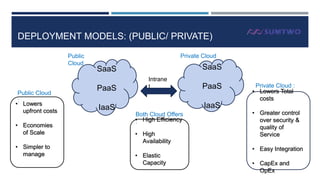
DEPLOYMENT MODELS: (PUBLIC/ PRIVATE)
Public
Cloud

Public Cloud
:
• Lowers
upfront costs
• Economies
of Scale
• Simpler to
manage

Private Cloud

SaaS

SaaS
PaaS

Intrane
t

PaaS

IaaS

IaaS
Both Cloud Offers
• High Efficiency
:

• High
Availability
• Elastic
Capacity

Private Cloud :
• Lowers Total
costs
• Greater control
over security &
quality of
Service
• Easy Integration
• CapEx and
OpEx
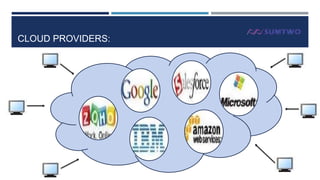
CLOUD PROVIDERS:
ADVANTAGES OF CLOUD COMPUTING:
 Increased Speed

# 24 hrs provisioning,
# Online self service,
# Credit card Acquisition.
 Increased Scalability

# Increase capacity ~ 24 hrs,
# “Turn on & Turn off “ monthly,
# Capacity on demand.

 Reduce Cost

# pay only for what you need,

# Month – month Service,
# No Annual Maintenance Fee.
DISADVANTAGES OF CLOUD COMPUTING:
 Requires a constant Internet connection
 Does not work with low speed connections.
 Cloud Computing is impossible if you cannot connect to the internet.
 When you are offline, Cloud Computing doest not work.
 Stored data can be lost / might not be secure. There is No physical or local

backup.
 Limited features.
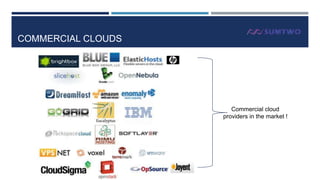
COMMERCIAL CLOUDS

Commercial cloud
providers in the market !
THANK YOU !
DECISIONS !! DELIVERED !!!

Cloud computing

  • 1.
    CLOUD COMPUTING Decisions! Delivered!! SARAVANAN . M SALES MANAGER 20TH NOV 2013 Index : 1. Cloud Computing Intro 2. Characteristics 3. Service Model / Deployment Model 4. Service Model – SaaS / PaaS / IaaS 5. Deployment Model – Private / Public 6. Cloud Providers 7. Advantages of Cloud Computing 8. Disadvantages of Cloud Computing 9. Commercial Clouds 10. Conclusion & Thanks.
  • 2.
    CLOUD COMPUTING : Cloud computing is simply an IT service sold and delivered over the Internet  These are not new technologies but a new name applied to a collection of older technologies that are packed, soled and delivered in a new way.  Cloud computing is a computing model, not a new technology. In this model, the “customer” plug into the “cloud” to access IT resources which are priced and provided “on-demand”.
  • 3.
    CHARACTERISTICS :  Thereare five essential characteristics of cloud computing :  On-demand Self service  Resource pooling  Rapid elasticity  Measured service  Broad network access.
  • 4.
    SERVICE MODEL &DEPLOYMENT MODEL:  The 3 service models of Cloud  Similarly there 3 deployment models Computing are , also ,  SAAS (Software As A Service)  Public cloud  PAAS (Platform As A Service)  Private cloud  IAAS (Infrastructure As A Service).  Hybrid cloud.
  • 5.
    SERVICE MODELS: (SAAS/ PAAS / IAAS)  SAAS :Applications delivered as a service to end users over the internet .  (eg: Gmail , Google apps, AOL messaging).  PAAS :Application development & deployment platform delivered as a service .  (with: OS, Server hardware, load balancing or computing capacity. Providers are – Microsoft Azure, oracle, Google maps, sales force`s force.com).  IAAS : Server-storage, network hardware& associated software delivered as a service.  (raw virtual servers, on demand that customers configure and manage. The Vendors are :IBM, Amazon.com (elastic compute cloud[EC2} and simple storage)
  • 6.
    DEPLOYMENT MODELS: (PUBLIC/PRIVATE) Public Cloud Public Cloud : • Lowers upfront costs • Economies of Scale • Simpler to manage Private Cloud SaaS SaaS PaaS Intrane t PaaS IaaS IaaS Both Cloud Offers • High Efficiency : • High Availability • Elastic Capacity Private Cloud : • Lowers Total costs • Greater control over security & quality of Service • Easy Integration • CapEx and OpEx
  • 7.
  • 8.
    ADVANTAGES OF CLOUDCOMPUTING:  Increased Speed # 24 hrs provisioning, # Online self service, # Credit card Acquisition.  Increased Scalability # Increase capacity ~ 24 hrs, # “Turn on & Turn off “ monthly, # Capacity on demand.  Reduce Cost # pay only for what you need, # Month – month Service, # No Annual Maintenance Fee.
  • 9.
    DISADVANTAGES OF CLOUDCOMPUTING:  Requires a constant Internet connection  Does not work with low speed connections.  Cloud Computing is impossible if you cannot connect to the internet.  When you are offline, Cloud Computing doest not work.  Stored data can be lost / might not be secure. There is No physical or local backup.  Limited features.
  • 10.
  • 11.
    THANK YOU ! DECISIONS!! DELIVERED !!!