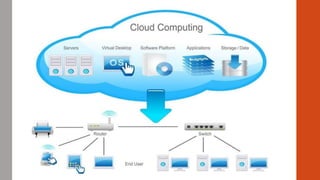
Cloud Computing
Nuzra Jalaladeen
Century Media Technology
What is Cloud
The Virtual workspace along with full network built on borrowed
storage and virtual devices in a separate location, connected via your
own device
Little Bit Of History
1960.-Present
Century
Media
Technology
Migrating To Cloud
Cloud
Service
models
Cloud
Deployment
models
Why Cloud at
CMT
1.Large Volume of data.
2.System downtime.
3.Backup Crashes.
4.Security issues
Bring
Your
Own
Device
Exiting Infrastructure
A Costly Complicated Infrastructure
Migration to Cloud
Amazon Web Services
Century
Media
Technology
Migrating To Cloud
Proposed AWS Infrastructure
Technical Aspects
Century
Media
Technology
• Central Server
• Manage Traffic
• Middle Ware
• Provides Full Network
Infrastructure
Opportunities
Century
Media
Technology
Costly Effective Long run
Elastic
Remote Access
Highly secure
Disaster recovery
Challenges
Century
Media
Technology
• Costly but not high compared to on-premises infrastructure
• Configuration needs highly qualified professionals.
Thank You

Cloud Computing

Editor's Notes

  • #4  It starts with the premise that the data services and architecture should be on servers. We call it cloud computing—they should be in a “cloud” somewhere.” Using Data From Afar. Both agree that “cloud computing” was born as a marketing term. At the time, telecom networks were already referred to as the cloud; in engineering drawings, a cloud represented the network. ftp.sftp,,stand alone networks with centralized servers, connected to the web, central servers located in one branch office later turned in to rented space in server farms here infrastructure is built maintained with security around the clock.
  • #5 Cloud computing is an on-demand service where the availability of computer system resources, data storage and computing power, without direct active management by the user. The term is generally used to describe data centers available to many users over the Internet.
  • #6 Cloud computing is an on-demand service where the availability of computer system resources, data storage and computing power, without direct active management by the user. The term is generally used to describe data centers available to many users over the Internet.
  • #7 Cloud Deployment Models Private Cloud Deployment Model - This model is entirely operated by the organization for its own purpose. The management may be assigned to the third part or retained with the organization itself either on-site or off-site.  Public Cloud Deployment Model - This deployment model is offered to public at large or a big group of industries. Public cloud is owned by any provider organization that is engaged in selling cloud solutions.  Hybrid Cloud Model - The hybrid cloud model is created by combining two or more clouds that retain their individual entities in spite of being clubbed together to enable portability of applications including load balancing and cloud bursting. Hybrid cloud is characterized by permutations of private cloud, public cloud and community cloud.
  • #9 We are here to get an insight on cloud computing and weigh the pros and cons on the migration. As we know we are facing any issues with our existing infrastructure. Large Volume of data. System downtime. Backup Crashes. Security issues.
  • #10 Our business is totally relying on communication and transmission. Broadcast and marketing with alert
  • #11 All the peripherals are not in the diagram it is costly to purchase all these and set up . Also I times of changes due to upgrading or expanding we need to incur more costs.
  • #12 Explain on what is we are going to do in terms of our network.
  • #13 Amazon web service established in 2002, is a platform that offers flexible, reliable, scalable, easy-to-use and cost-effective cloud computing solutions. AWS is a comprehensive, easy to use computing platform offered Amazon. The platform is developed with a combination of infrastructure as a service (IaaS), platform as a service (PaaS) and packaged software as a service (SaaS) offerings.
  • #15 How Is Cloud Computing Technology Managed? A central server manages the cloud system. It’s purpose is to manage traffic and client demands to ensure everything runs smoothly. It pursues a set of rules called protocols and uses a special kind of software known as middle ware. Middle ware permits networked computers to communicate with each other.
  • #16 Cloud will give many opportunities' to the company : Long run costly effective Elastic Remote In times of crisis Disaster recovery
  • #17 What Are Some Risks Of Cloud Computing Technology? Large companies often require hundreds of digital storage devices. Cloud computing systems need at least twice the number of storage devices to keep client information stored. That’s because these devices occasionally break down. A cloud system makes copies of clients’ information, to store it on other devices. This method of making copies of data as a backup is called redundancy.