Cloud ComputingMar 2016
Workshop:
Skills and Knowledge of a Modern Librarian
By:
Roshan Goolaup,
Head of Performance & Business Reporting,
Emtel Ltd
Rules of the Game
• Session Objectives:
• Enable participants to achieve
introductory overview of the concept
of Cloud Computing and related
benefits in real-life.
• Methodology:
• Cloud Journey Duration,
• No Death by PowerPoint ~ 20 Slides,
• Videos / Interactions,
• Graphics,
• Questions
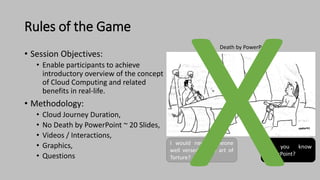
I would need someone
well versed in the art of
Torture?
Do you know
PowerPoint?
Death by PowerPoint
Agenda
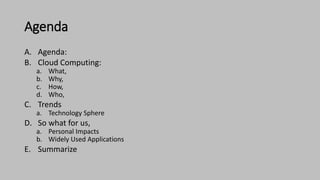
A. Agenda:
B. Cloud Computing:
a. What,
b. Why,
c. How,
d. Who,
C. Trends
a. Technology Sphere
D. So what for us,
a. Personal Impacts
b. Widely Used Applications
E. Summarize
What is Cloud Computing ?
Definitions
NIST [National Institute of Standards and Technology]:
• Cloud computing is a model
• for enabling ubiquitous, convenient, on-demand network access
• to a shared pool of configurable computing resources (e.g., networks, servers,
storage, applications, and services)
• that can be rapidly provisioned and released with minimal management effort or
service provider interaction.
1. On-demand self-service
2. Broad network access
3. Resource pooling
4. Rapid elasticity
5. Measured service
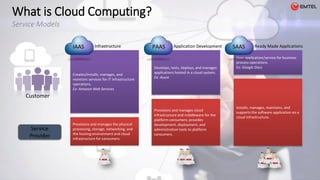
• This cloud model is based on
• 3 Service Models [IaaS | Paas | SaaS]
• 4 Deployment Models [Public | Private | Hybrid | Community]
Cloud
Computing
Cloud
Abstraction
“System’s Approach”
Processing of Information
Computing
Origins of Cloud
Historic Perspective
What is Cloud Computing?
Service Models
Creates/installs, manages, and
monitors services for IT infrastructure
operations.
Ex: Amazon Web Services
Develops, tests, deploys, and manages
applications hosted in a cloud system.
Ex: Azure
Uses application/service for business
process operations.
Ex: Google Docs
Installs, manages, maintains, and
supports the software application on a
cloud infrastructure.
Provisions and manages cloud
infrastructure and middleware for the
platform consumers; provides
development, deployment, and
administration tools to platform
consumers.
Provisions and manages the physical
processing, storage, networking, and
the hosting environment and cloud
infrastructure for consumers.
IAAS PAAS SAAS
Customer
Infrastructure Application Development Ready Made Applications
Service
Provider
What is Cloud Computing?
Deployment Models
Network Applications
Infrastructure
Community Cloud: Used for a single
organization; can be internally or
externally hosted
Hybrid Cloud: Composition of two or
more clouds [private, community or
public] that remain unique entities but
are bound together, offering the
benefits of multiple deployment models
Private Cloud: Shared by several
organizations; typically externally hosted
but may be hosted by one of the
organization
Public Cloud: Provisioned for open use
by a particular organization who hosts
the service
A model for enabling
ubiquitous network access
to a shared pool of
configurable computing
resources.
Types of Cloud Deployment Overlap between Models
Why ?
Why Cloud Computing?
International Trends
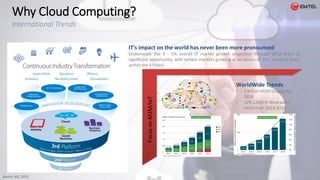
IT's impact on the world has never been more pronounced
Underneath the 3 - 5% overall IT market growth projection through 2018 there is
significant opportunity, with certain markets growing at an excess of 20%, many of them
within the 4 Pillars.
FocusonM2M/IoT
WorldWide Trends
• 2 Billion M2M Devices by
2018
• 52% CAGR in Wearables
trend from 2013-2018
Source: IDC; 2015
Why Cloud Computing?
Barriers v/s Advantages
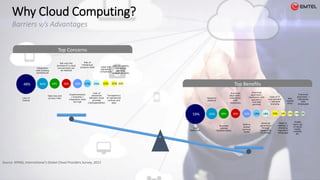
Top Concerns
Top Benefits
Source: KPMG; International’s Global Cloud Providers Survey, 2012
9%10%12%13%15%18%19%23%26%30%31%59%
Cost
Reduction
Speed to
adoption
Business
process
transformation
Improved
alignment /
interaction
with
customers
Shift to
shared
services
model
Improved
alignment /
interaction with
suppliers /
business
partners
Revenue
generation
through
faster time
to market
Ease of IT
procurement
/ software
licensing
Need to
address a
changing
regulatory
landscape
New
market
entry
Enable
more use
of social
media,
mobility
etc.
Improved
alignment /
interaction
with
employees
21%22%22%25%27%28%28%39%41%48%
Loss of
Control
Integration
with existing
architecture
Data loss and
privacy risks
Not sure the
promise of a cloud
environment can
be realized
Implementation
/ transition /
integration costs
too high
Risk of
intellectual
property theft
Lack of
standards
between cloud
provides
(interoperability)
Legal and
regulatory
compliance
Transparency
of operational
controls and
data
Lack of visibility
into future
demand,
associated costs
Why Cloud Computing?
Focus on Advantages
Why Cloud Computing?
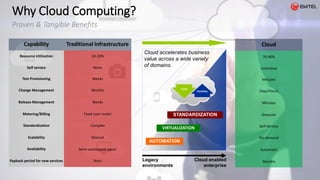
Proven & Tangible Benefits
Capability Traditional Infrastructure
Resource Utilization 10-20%
Self service None
Test Provisioning Weeks
Change Management Months
Release Management Weeks
Metering/Billing Fixed cost model
Standardization Complex
Scalability Manual
Availability Semi-automated repair
Payback period for new services Years Legacy
environments
Cloud enabled
enterprise
Cloud accelerates business
value across a wide variety
of domains.
VIRTUALIZATION
AUTOMATION
STANDARDIZATION
Cost
Flexibility
Cloud
70-90%
Unlimited
Minutes
Days/Hours
Minutes
Granular
Self-Service
On-demand
Automatic
Months
How ?
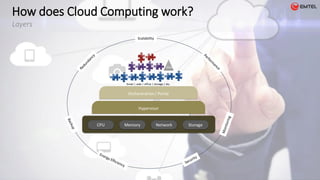
How does Cloud Computing work?
Layers
ISVs
Scalability
How does Cloud Computing work?
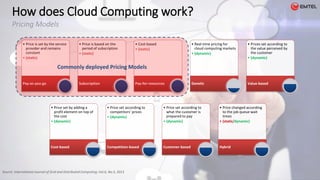
Pricing Models
• Price is set by the service
provider and remains
constant
• (static)
Pay-as-you-go
• Price is based on the
period of subscription
• (static)
Subscription
• Cost-based
• (static)
Pay-for-resources
• Real-time pricing for
cloud computing markets
• (dynamic)
Genetic
• Prices set according to
the value perceived by
the customer
• (dynamic)
Value-based
• Price set by adding a
profit element on top of
the cost
• (dynamic)
Cost-based
• Price set according to
competitors’ prices
• (dynamic)
Competition-based
• Price set according to
what the customer is
prepared to pay
• (dynamic)
Customer-based
• Price changed according
to the job queue wait
times
• (static/dynamic)
Hybrid
Source: International Journal of Grid and Distributed Computing; Vol.6, No.5, 2013
Commonly deployed Pricing Models
How does Cloud Computing work?
For Instance: Widely used Amazon Cloud Drive
Who ?
Who is involved in Cloud Computing?
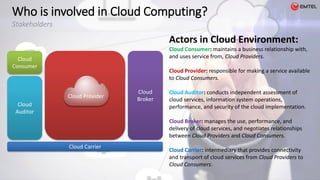
Stakeholders
Cloud
Broker
Cloud Carrier
Cloud Provider
Cloud
Consumer
Cloud
Auditor
Actors in Cloud Environment:
Cloud Consumer: maintains a business relationship with,
and uses service from, Cloud Providers.
Cloud Provider: responsible for making a service available
to Cloud Consumers.
Cloud Auditor: conducts independent assessment of
cloud services, information system operations,
performance, and security of the cloud implementation.
Cloud Broker: manages the use, performance, and
delivery of cloud services, and negotiates relationships
between Cloud Providers and Cloud Consumers.
Cloud Carrier: intermediary that provides connectivity
and transport of cloud services from Cloud Providers to
Cloud Consumers.
Who is involved in Cloud Computing?
International Service Providers
Amazon Web Services [AWS]:
• Diverse customer base
• Broadest range of use cases, including enterprise and
mission-critical applications.
• >10 times more cloud IaaS compute capacity in use than
the aggregate total of the other 14 providers in this
Magic Quadrant.
MicroSoft Azure:
• Leverages on
• Microsoft's brand,
• Existing customer relationships,
• History of running global-class consumer Internet properties,
• Deep investments in engineering,
• Aggressive roadmap
• To rapidly to attain the status of strategic cloud IaaS
provider
RackSpace:
• Rackspace offers
• Multitenant OpenStack-based public cloud
• 3 flavors of hosted private cloud
Who is involved in Cloud Computing?
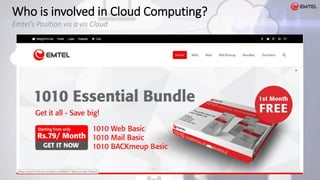
Emtel’s Position vis a vis Cloud
Trends
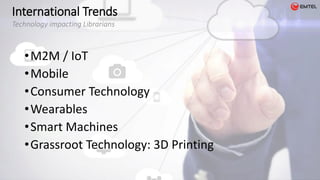
•M2M / IoT
•Mobile
•Consumer Technology
•Wearables
•Smart Machines
•Grassroot Technology: 3D Printing
International Trends
Technology impacting Librarians
So What ?
• Data Accessibility
• Anywhere
• Anyhow
• Anytime
• Costs
• License [Google Docs @ $ 0 v/s MS Office $ 200]
• Unlimited Hardware
• No Hassle
• Support & Maintenance
• Future Proof
Impact of Cloud
Personal & Existing Librarian Area
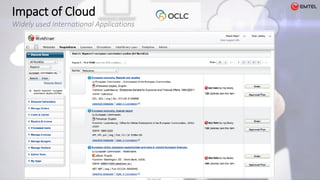
Impact of Cloud
Widely used International Applications
Recap
• No need to fear cloud – it’s a utility like Grid Power &
Water Services
• Worldwide Forces: M2M / IoT, Big Data, Cloud, Social
• Multiple Benefits: Costs, Efficiency, Scalability ….
• Many Big Players:
• International: Amazon, Microsoft
• Local Players: Emtel, Bhumishq
Summary of Learning Points
Catchup
THANK YOU
Any Questions ?

Cloud computing v3 mar 2016

  • 1.
    Cloud ComputingMar 2016 Workshop: Skillsand Knowledge of a Modern Librarian By: Roshan Goolaup, Head of Performance & Business Reporting, Emtel Ltd
  • 2.
    Rules of theGame • Session Objectives: • Enable participants to achieve introductory overview of the concept of Cloud Computing and related benefits in real-life. • Methodology: • Cloud Journey Duration, • No Death by PowerPoint ~ 20 Slides, • Videos / Interactions, • Graphics, • Questions I would need someone well versed in the art of Torture? Do you know PowerPoint? Death by PowerPoint
  • 3.
    Agenda A. Agenda: B. CloudComputing: a. What, b. Why, c. How, d. Who, C. Trends a. Technology Sphere D. So what for us, a. Personal Impacts b. Widely Used Applications E. Summarize
  • 4.
    What is CloudComputing ? Definitions NIST [National Institute of Standards and Technology]: • Cloud computing is a model • for enabling ubiquitous, convenient, on-demand network access • to a shared pool of configurable computing resources (e.g., networks, servers, storage, applications, and services) • that can be rapidly provisioned and released with minimal management effort or service provider interaction. 1. On-demand self-service 2. Broad network access 3. Resource pooling 4. Rapid elasticity 5. Measured service • This cloud model is based on • 3 Service Models [IaaS | Paas | SaaS] • 4 Deployment Models [Public | Private | Hybrid | Community] Cloud Computing Cloud Abstraction “System’s Approach” Processing of Information Computing
  • 5.
  • 6.
    What is CloudComputing? Service Models Creates/installs, manages, and monitors services for IT infrastructure operations. Ex: Amazon Web Services Develops, tests, deploys, and manages applications hosted in a cloud system. Ex: Azure Uses application/service for business process operations. Ex: Google Docs Installs, manages, maintains, and supports the software application on a cloud infrastructure. Provisions and manages cloud infrastructure and middleware for the platform consumers; provides development, deployment, and administration tools to platform consumers. Provisions and manages the physical processing, storage, networking, and the hosting environment and cloud infrastructure for consumers. IAAS PAAS SAAS Customer Infrastructure Application Development Ready Made Applications Service Provider
  • 7.
    What is CloudComputing? Deployment Models Network Applications Infrastructure Community Cloud: Used for a single organization; can be internally or externally hosted Hybrid Cloud: Composition of two or more clouds [private, community or public] that remain unique entities but are bound together, offering the benefits of multiple deployment models Private Cloud: Shared by several organizations; typically externally hosted but may be hosted by one of the organization Public Cloud: Provisioned for open use by a particular organization who hosts the service A model for enabling ubiquitous network access to a shared pool of configurable computing resources. Types of Cloud Deployment Overlap between Models
  • 8.
  • 9.
    Why Cloud Computing? InternationalTrends IT's impact on the world has never been more pronounced Underneath the 3 - 5% overall IT market growth projection through 2018 there is significant opportunity, with certain markets growing at an excess of 20%, many of them within the 4 Pillars. FocusonM2M/IoT WorldWide Trends • 2 Billion M2M Devices by 2018 • 52% CAGR in Wearables trend from 2013-2018 Source: IDC; 2015
  • 10.
    Why Cloud Computing? Barriersv/s Advantages Top Concerns Top Benefits Source: KPMG; International’s Global Cloud Providers Survey, 2012 9%10%12%13%15%18%19%23%26%30%31%59% Cost Reduction Speed to adoption Business process transformation Improved alignment / interaction with customers Shift to shared services model Improved alignment / interaction with suppliers / business partners Revenue generation through faster time to market Ease of IT procurement / software licensing Need to address a changing regulatory landscape New market entry Enable more use of social media, mobility etc. Improved alignment / interaction with employees 21%22%22%25%27%28%28%39%41%48% Loss of Control Integration with existing architecture Data loss and privacy risks Not sure the promise of a cloud environment can be realized Implementation / transition / integration costs too high Risk of intellectual property theft Lack of standards between cloud provides (interoperability) Legal and regulatory compliance Transparency of operational controls and data Lack of visibility into future demand, associated costs
  • 11.
  • 12.
    Why Cloud Computing? Proven& Tangible Benefits Capability Traditional Infrastructure Resource Utilization 10-20% Self service None Test Provisioning Weeks Change Management Months Release Management Weeks Metering/Billing Fixed cost model Standardization Complex Scalability Manual Availability Semi-automated repair Payback period for new services Years Legacy environments Cloud enabled enterprise Cloud accelerates business value across a wide variety of domains. VIRTUALIZATION AUTOMATION STANDARDIZATION Cost Flexibility Cloud 70-90% Unlimited Minutes Days/Hours Minutes Granular Self-Service On-demand Automatic Months
  • 13.
  • 14.
    How does CloudComputing work? Layers ISVs Scalability
  • 15.
    How does CloudComputing work? Pricing Models • Price is set by the service provider and remains constant • (static) Pay-as-you-go • Price is based on the period of subscription • (static) Subscription • Cost-based • (static) Pay-for-resources • Real-time pricing for cloud computing markets • (dynamic) Genetic • Prices set according to the value perceived by the customer • (dynamic) Value-based • Price set by adding a profit element on top of the cost • (dynamic) Cost-based • Price set according to competitors’ prices • (dynamic) Competition-based • Price set according to what the customer is prepared to pay • (dynamic) Customer-based • Price changed according to the job queue wait times • (static/dynamic) Hybrid Source: International Journal of Grid and Distributed Computing; Vol.6, No.5, 2013 Commonly deployed Pricing Models
  • 16.
    How does CloudComputing work? For Instance: Widely used Amazon Cloud Drive
  • 17.
  • 18.
    Who is involvedin Cloud Computing? Stakeholders Cloud Broker Cloud Carrier Cloud Provider Cloud Consumer Cloud Auditor Actors in Cloud Environment: Cloud Consumer: maintains a business relationship with, and uses service from, Cloud Providers. Cloud Provider: responsible for making a service available to Cloud Consumers. Cloud Auditor: conducts independent assessment of cloud services, information system operations, performance, and security of the cloud implementation. Cloud Broker: manages the use, performance, and delivery of cloud services, and negotiates relationships between Cloud Providers and Cloud Consumers. Cloud Carrier: intermediary that provides connectivity and transport of cloud services from Cloud Providers to Cloud Consumers.
  • 19.
    Who is involvedin Cloud Computing? International Service Providers Amazon Web Services [AWS]: • Diverse customer base • Broadest range of use cases, including enterprise and mission-critical applications. • >10 times more cloud IaaS compute capacity in use than the aggregate total of the other 14 providers in this Magic Quadrant. MicroSoft Azure: • Leverages on • Microsoft's brand, • Existing customer relationships, • History of running global-class consumer Internet properties, • Deep investments in engineering, • Aggressive roadmap • To rapidly to attain the status of strategic cloud IaaS provider RackSpace: • Rackspace offers • Multitenant OpenStack-based public cloud • 3 flavors of hosted private cloud
  • 20.
    Who is involvedin Cloud Computing? Emtel’s Position vis a vis Cloud
  • 21.
  • 22.
    •M2M / IoT •Mobile •ConsumerTechnology •Wearables •Smart Machines •Grassroot Technology: 3D Printing International Trends Technology impacting Librarians
  • 23.
  • 24.
    • Data Accessibility •Anywhere • Anyhow • Anytime • Costs • License [Google Docs @ $ 0 v/s MS Office $ 200] • Unlimited Hardware • No Hassle • Support & Maintenance • Future Proof Impact of Cloud Personal & Existing Librarian Area
  • 25.
    Impact of Cloud Widelyused International Applications
  • 26.
  • 27.
    • No needto fear cloud – it’s a utility like Grid Power & Water Services • Worldwide Forces: M2M / IoT, Big Data, Cloud, Social • Multiple Benefits: Costs, Efficiency, Scalability …. • Many Big Players: • International: Amazon, Microsoft • Local Players: Emtel, Bhumishq Summary of Learning Points Catchup
  • 28.