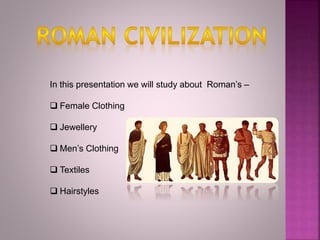
In this presentation we will study about Roman’s –
 Female Clothing
 Jewellery
 Men’s Clothing
 Textiles
 Hairstyles
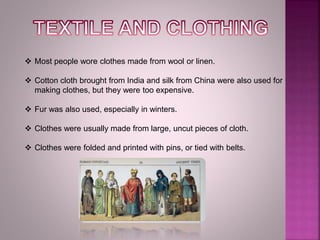
 Most people wore clothes made from wool or linen.
 Cotton cloth brought from India and silk from China were also used for
making clothes, but they were too expensive.
 Fur was also used, especially in winters.
 Clothes were usually made from large, uncut pieces of cloth.
 Clothes were folded and printed with pins, or tied with belts.
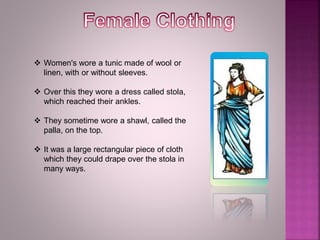
 Women's wore a tunic made of wool or
linen, with or without sleeves.
 Over this they wore a dress called stola,
which reached their ankles.
 They sometime wore a shawl, called the
palla, on the top.
 It was a large rectangular piece of cloth
which they could drape over the stola in
many ways.
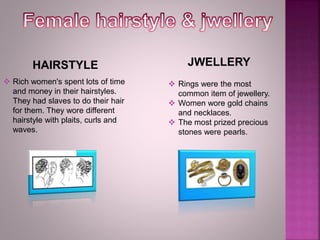
HAIRSTYLE
 Rich women's spent lots of time
and money in their hairstyles.
They had slaves to do their hair
for them. They wore different
hairstyle with plaits, curls and
waves.
JWELLERY
 Rings were the most
common item of jewellery.
 Women wore gold chains
and necklaces.
 The most prized precious
stones were pearls.
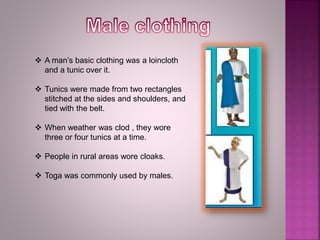
 A man’s basic clothing was a loincloth
and a tunic over it.
 Tunics were made from two rectangles
stitched at the sides and shoulders, and
tied with the belt.
 When weather was clod , they wore
three or four tunics at a time.
 People in rural areas wore cloaks.
 Toga was commonly used by males.
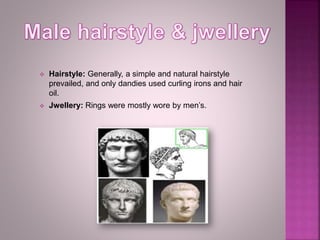
 Hairstyle: Generally, a simple and natural hairstyle
prevailed, and only dandies used curling irons and hair
oil.
 Jwellery: Rings were mostly wore by men’s.
Roman civilization

Roman civilization

  • 1.
    In this presentationwe will study about Roman’s –  Female Clothing  Jewellery  Men’s Clothing  Textiles  Hairstyles
  • 2.
     Most peoplewore clothes made from wool or linen.  Cotton cloth brought from India and silk from China were also used for making clothes, but they were too expensive.  Fur was also used, especially in winters.  Clothes were usually made from large, uncut pieces of cloth.  Clothes were folded and printed with pins, or tied with belts.
  • 3.
     Women's worea tunic made of wool or linen, with or without sleeves.  Over this they wore a dress called stola, which reached their ankles.  They sometime wore a shawl, called the palla, on the top.  It was a large rectangular piece of cloth which they could drape over the stola in many ways.
  • 4.
    HAIRSTYLE  Rich women'sspent lots of time and money in their hairstyles. They had slaves to do their hair for them. They wore different hairstyle with plaits, curls and waves. JWELLERY  Rings were the most common item of jewellery.  Women wore gold chains and necklaces.  The most prized precious stones were pearls.
  • 5.
     A man’sbasic clothing was a loincloth and a tunic over it.  Tunics were made from two rectangles stitched at the sides and shoulders, and tied with the belt.  When weather was clod , they wore three or four tunics at a time.  People in rural areas wore cloaks.  Toga was commonly used by males.
  • 6.
     Hairstyle: Generally,a simple and natural hairstyle prevailed, and only dandies used curling irons and hair oil.  Jwellery: Rings were mostly wore by men’s.