CLOTH SIMULATION
(Jaypee institute of information technology sec.62 noida U.P.)
Mentor :
Mrs.Suma Dawn
by:
Riti Kumari
10503881
CLOTH SIMULATION
• Cloth simulation means modeling the behavior
of cloth using various techniques of simulation.
Cloth simulation has always been an area of
great research for graphics community.Cloth
simulation has applications in games where it is
used to model the garments of the character in
the game. This makes the game look much
more realistic. It is also used in the films for
animating cloths.
CLOTH SIMULATION
• Cloth simulation has been an important topic in
computer animation since the early 1980’s
• It has been extensively researched, and has
reached a point where it is *basically* a solved
problem
• Today, we will look at a very basic method of
cloth simulation. It is relatively easy to
implement and can achieve good results. It will
also serve as an introduction to some more
advanced cloth simulation topics.
ALGORITHM
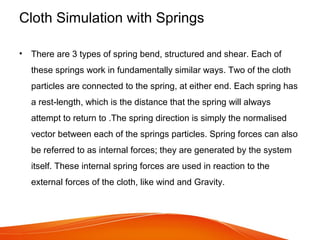
To implement any physics simulation, we need to do these steps (in order):
i) Sum up all forces acting on a vertex to get the resultant force.
ii) Find acceleration by dividing the resultant force by the object mass: a = f / m
(Newton’s Second Law for a constant mass)
iii) Perform numerical integration on the acceleration to get velocity/position
iv) Update the vertex with the new velocity/position, and repeat from (i).
Cloth Simulation with Springs
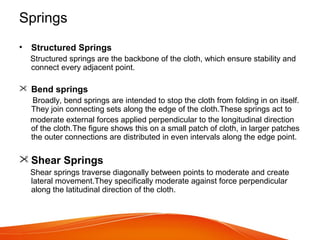
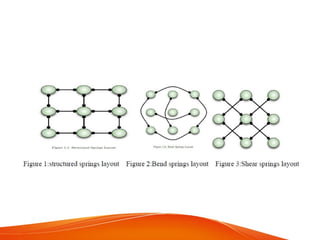
• There are 3 types of spring bend, structured and shear. Each of
these springs work in fundamentally similar ways. Two of the cloth
particles are connected to the spring, at either end. Each spring has
a rest-length, which is the distance that the spring will always
attempt to return to .The spring direction is simply the normalised
vector between each of the springs particles. Spring forces can also
be referred to as internal forces; they are generated by the system
itself. These internal spring forces are used in reaction to the
external forces of the cloth, like wind and Gravity.
Springs
• Structured Springs
Structured springs are the backbone of the cloth, which ensure stability and
connect every adjacent point.
 Bend springs
Broadly, bend springs are intended to stop the cloth from folding in on itself.
They join connecting sets along the edge of the cloth.These springs act to
moderate external forces applied perpendicular to the longitudinal direction
of the cloth.The figure shows this on a small patch of cloth, in larger patches
the outer connections are distributed in even intervals along the edge point.
 Shear Springs
Shear springs traverse diagonally between points to moderate and create
lateral movement.They specifically moderate against force perpendicular
along the latitudinal direction of the cloth.
Physics Simulation
• General Physics Simulation:
• 1. Compute forces
• 2. Compute normal
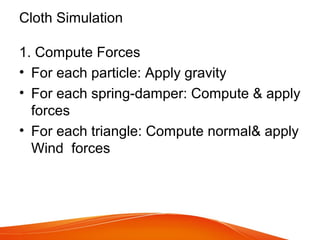
Cloth Simulation
1. Compute Forces
• For each particle: Apply gravity
• For each spring-damper: Compute & apply
forces
• For each triangle: Compute normal& apply
Wind forces
Spring-Dampers
• The basic spring-damper connects two
particles and has three constants defining
its behavior
• Spring constant: ks
• Damping factor: kd
• Rest length: l0
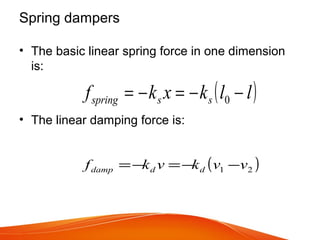
• The basic linear spring force in one dimension
is:
• The linear damping force is:
( )llkxkf ssspring −−=−= 0
Spring dampers
( )21 vvkvkf dddamp −−=−=
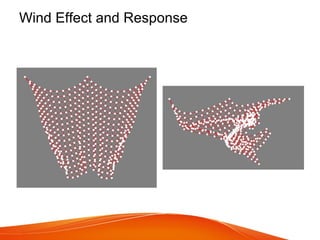
Wind Forces
• Wind forces are proportional to scalar
product between wind direction and the normal of
each face of the cloth.
Dot product=v1.x*v2.x+v1.y*v2.y+v1.z*v2.z
dans=dot(wind,tnorm);
cans.x=dans*tnorm.x;
cans.y=dans*tnorm.y;
cans.z=dans*tnorm.z;
spring[i][j].wind_effect.x=cans.x;
spring[i][j].wind_effect.y=cans.y;
spring[i][j].wind_effect.z=cans.z;
dans=dot product answer
cans=cross product answer
tnorm=normal
Continuum Mechanics
• Real cloth simulation rarely uses springs
• Instead, forces are generated based on the deformation
of a triangular element
• This way, one can properly account for internal forces
within the piece of cloth based on the theory of
continuum mechanics
• The basic process is still very similar. Instead of looping
through springs computing forces, one loops through the
triangles and computes the forces
• Continuum models account for various properties such
as elastic deformation, plastic deformation, bending
forces, anisotropy, and more
Wind Effect and Response

Cloth simulation ppt

  • 1.
    CLOTH SIMULATION (Jaypee instituteof information technology sec.62 noida U.P.) Mentor : Mrs.Suma Dawn by: Riti Kumari 10503881
  • 2.
    CLOTH SIMULATION • Clothsimulation means modeling the behavior of cloth using various techniques of simulation. Cloth simulation has always been an area of great research for graphics community.Cloth simulation has applications in games where it is used to model the garments of the character in the game. This makes the game look much more realistic. It is also used in the films for animating cloths.
  • 3.
    CLOTH SIMULATION • Clothsimulation has been an important topic in computer animation since the early 1980’s • It has been extensively researched, and has reached a point where it is *basically* a solved problem • Today, we will look at a very basic method of cloth simulation. It is relatively easy to implement and can achieve good results. It will also serve as an introduction to some more advanced cloth simulation topics.
  • 4.
    ALGORITHM To implement anyphysics simulation, we need to do these steps (in order): i) Sum up all forces acting on a vertex to get the resultant force. ii) Find acceleration by dividing the resultant force by the object mass: a = f / m (Newton’s Second Law for a constant mass) iii) Perform numerical integration on the acceleration to get velocity/position iv) Update the vertex with the new velocity/position, and repeat from (i).
  • 5.
    Cloth Simulation withSprings • There are 3 types of spring bend, structured and shear. Each of these springs work in fundamentally similar ways. Two of the cloth particles are connected to the spring, at either end. Each spring has a rest-length, which is the distance that the spring will always attempt to return to .The spring direction is simply the normalised vector between each of the springs particles. Spring forces can also be referred to as internal forces; they are generated by the system itself. These internal spring forces are used in reaction to the external forces of the cloth, like wind and Gravity.
  • 6.
    Springs • Structured Springs Structuredsprings are the backbone of the cloth, which ensure stability and connect every adjacent point.  Bend springs Broadly, bend springs are intended to stop the cloth from folding in on itself. They join connecting sets along the edge of the cloth.These springs act to moderate external forces applied perpendicular to the longitudinal direction of the cloth.The figure shows this on a small patch of cloth, in larger patches the outer connections are distributed in even intervals along the edge point.  Shear Springs Shear springs traverse diagonally between points to moderate and create lateral movement.They specifically moderate against force perpendicular along the latitudinal direction of the cloth.
  • 8.
    Physics Simulation • GeneralPhysics Simulation: • 1. Compute forces • 2. Compute normal
  • 9.
    Cloth Simulation 1. ComputeForces • For each particle: Apply gravity • For each spring-damper: Compute & apply forces • For each triangle: Compute normal& apply Wind forces
  • 10.
    Spring-Dampers • The basicspring-damper connects two particles and has three constants defining its behavior • Spring constant: ks • Damping factor: kd • Rest length: l0
  • 11.
    • The basiclinear spring force in one dimension is: • The linear damping force is: ( )llkxkf ssspring −−=−= 0 Spring dampers ( )21 vvkvkf dddamp −−=−=
  • 12.
    Wind Forces • Windforces are proportional to scalar product between wind direction and the normal of each face of the cloth. Dot product=v1.x*v2.x+v1.y*v2.y+v1.z*v2.z dans=dot(wind,tnorm); cans.x=dans*tnorm.x; cans.y=dans*tnorm.y; cans.z=dans*tnorm.z; spring[i][j].wind_effect.x=cans.x; spring[i][j].wind_effect.y=cans.y; spring[i][j].wind_effect.z=cans.z; dans=dot product answer cans=cross product answer tnorm=normal
  • 13.
    Continuum Mechanics • Realcloth simulation rarely uses springs • Instead, forces are generated based on the deformation of a triangular element • This way, one can properly account for internal forces within the piece of cloth based on the theory of continuum mechanics • The basic process is still very similar. Instead of looping through springs computing forces, one loops through the triangles and computes the forces • Continuum models account for various properties such as elastic deformation, plastic deformation, bending forces, anisotropy, and more
  • 14.