Ghosh Lab University of Arizona  Department of Chemistry Cloning 101: A Primer
Outline Cloning overview pDRAW32  Design Gene Insert Primers Further considerations (optimization of the process) Transformation
Cloning Overview Four main steps in cloning: Insert synthesis Restriction enzyme digest Ligation Transformation + Functional construct Plasmid (vector) Insert (your gene)
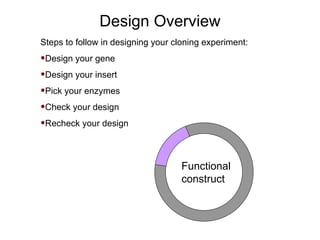
Design Overview Steps to follow in designing your cloning experiment: Design your gene Design your insert Pick your enzymes  Check your design Recheck your design Functional construct
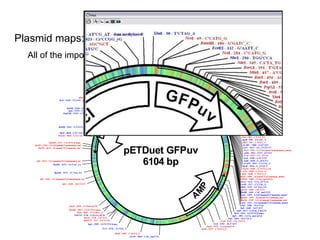
All of the important information in one place! pDRAW32 Plasmid maps: pDRAW32
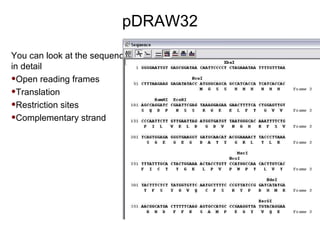
pDRAW32 You can look at the sequence in detail Open reading frames Translation Restriction sites Complementary strand
Design of the Gene Example, the gene we want: G  C  D  R  A  S  P  Y  C  G We got this from phage display: ggctgcgacagggcgagcccgtactgcggt G  C  D  R  A  S  P  Y  C  G Phage sequence Final sequence for the gene of interest: ggctgcgacagggcgagcccgtactgcggt taa G  C  D  R  A  S  P  Y  C  G  * Add a stop codon If you are cloning out of a known plasmid, just use the sequence that you have
Design of the Gene If you are designing the gene from scratch, keep in mind  codon usage Not all codons are created equal Un-optimized codons could lead to lower expression levels The codon usage reflects levels of tRNA available in E. Coli Pay attention to the stop codons too (XL1-Blues read through TAG {amber stop codon} 20% of the time)
http://www. bioinformatics .org/sms2/rev_trans.html http://www.entelechon.com/index.php?id=tools/backtranslation&lang=eng or preferably… What if we don’t have the DNA sequence? Design from scratch! (don’t forget about  codon usage )
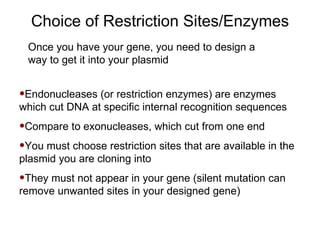
Endonucleases (or restriction enzymes) are enzymes which cut DNA at specific internal recognition sequences Compare to exonucleases, which cut from one end You must choose restriction sites that are available in the plasmid you are cloning into They must not appear in your gene (silent mutation can remove unwanted sites in your designed gene) Choice of Restriction Sites/Enzymes Once you have your gene, you need to design a way to get it into your plasmid
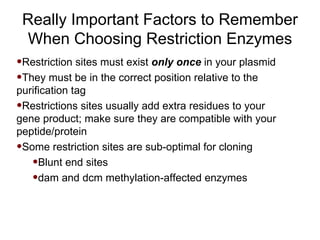
Restriction sites must exist  only once  in your plasmid They must be in the correct position relative to the purification tag Restrictions sites usually add extra residues to your gene product; make sure they are compatible with your peptide/protein Some restriction sites are sub-optimal for cloning Blunt end sites dam and dcm methylation-affected enzymes Really Important Factors to Remember When Choosing Restriction Enzymes
AGCCA G GATCC GGGCTGCAAGCGGTTAA G   AATTC GTCGAC GTCGAC G   AATTC TTAACCGCTTCCAGCCC G GATCC TGGCT GATCC GGGCTGCAAGCGGTTAA G AATTC TTAACCGCTTCCAGCCC G + “ sticky ends” AGCCA GAT ATC GGGCTGCAAGCGGTTAA CAG CTG GTCGAC GTCGAC CAG CTG TTAACCGCTTCCAGCCC GAT ATC TGGCT ATC GGGCTGCAAGCGGTTAA CAG CTG TTAACCGCTTCCAGCCC GAT AGCCA GAT ATC TGGCT + CTG GTCGAC GTCGAC CAG “ Sticky ends”: 5’ or 3’ over-hangs that allow the DNA to anneal even though it is not covalently bound Help with the next step: ligation Most common restriction enzymes Blunt-end restriction enzymes No sticky ends Blunt vs Sticky Ends Digestion Digestion GATCC TGGCT AGCCA G AATTC GTCGAC GTCGAC G
dam Methylation Dam methylase Dam methylase puts a methyl group on the nitrogen of 6 th  position of adenosine at the site:  G A TC  All of the E. Coli that we use generate DNA with dam methylation  Some enzymes  only  cut dam methylated DNA: eg DpnI Some enzymes  do not  cut dam methylated DNA: eg XbaI http://www.neb.com/nebecomm/tech_reference/restriction_enzymes/dam_dcm_methylases_of_ecoli.asp
dcm Methylation http://www.neb.com/nebecomm/tech_reference/restriction_enzymes/dam_dcm_methylases_of_ecoli.asp Dcm methylase Dcm methylase puts a methyl group on the carbon of 5 th  position of cytidine at the site:  C C AGG and C C TGG  The enzyme we use most that can be affected by dcm methylation is SfiI XL1-Blues and BL21s are both Dcm +
Once you have your restriction enzymes chosen, it is time to design the final complete gene The multiple cloning site (or whatever plasmid you are cloning into) should already have the 5’ portion of the gene intact (i.e. RBS, spacer, Met) Sequences must be  in frame NcoI BtgI 51  CTTTAATAAG GAGATATACC ATGGGCAGCA GCCATCACCA TCATCACCAC M  G  S  S  H  H  H  H  H  H  SacI  AscI  SbfI  SalI  NotI BamHI   EcoRI EcoICRI BssHII  PstI   AccI  HindIII 101 AGCCA GGATC   C GAATTCGAG CTCGGCGCGC  CTGCAG GTCG ACAAGCTTGC S  Q  D  P  N  S  S  S  A  R  L  Q  V  D  K  L  A Design of the Insert
Design of the Insert 71  ATGGGCAGCAGCCATCACCATCATCACCAC M  G  S  S  H  H  H  H  H  H SacI  AscI SbfI  SalI  BamHI  EcoRI EcoICRI  PstI   AccI  HindIII 101 AGCCA GGATCC GAATTCGAGCTCGGCGCGC CTGCAG GTCGACAAGCTTGC S  Q  D  P  N  S  S  S  A  R  L  Q  V  D  K  L  A The gene we want: ggctgcgacagggcgagcccgtactgcggttaa   G  C  D  R  A  S  P  Y  C  G   * BamHI   PstI   AGCCA GGATCC GAATTCGAGCTCGGCGCGC CTGCAG GTCGACAAGCTTGC S  Q  D  P  N  S  S  S  A  R  L  Q  V  D  K  L  A G  C  D  R  A  S  P  Y  C  G   * ggctgcgacagggcgagcccgtactgcggttaa AGCCA GGATCC G ggctgcgacagggcgagcccgtactgcggttaa CTGCAG GTCGACAA Be aware of the amber stop codon: TAG Multiple cloning site
Design of the Insert Always check and re-check your sequence! ATGGGCAGCA GCCATCACCA TCATCACCAC AGCCA GGATCC G ggctgcgacagggcgagcccgtactgcggttaa CTGCAG GTCGACAA atgggcagcagccatcaccatcatcaccacagcca ggatcc g ggctgcgacagggcgagc   M  G  S  S  H  H  H  H  H  H  S  Q  D  P   G  C  D  R  A  S   ccgtactgcggttaa ctgcag gtcgacaa   P  Y  C  G  -   L  Q   V  D   Everything looks good: in frame the whole way! Translate the  whole  gene
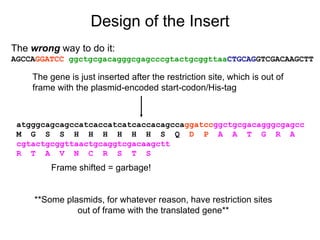
The  wrong  way to do it: AGCCA GGATCC  ggctgcgacagggcgagcccgtactgcggttaa CTGCAG GTCGACAAGCTT atgggcagcagccatcaccatcatcaccacagcca ggatcc ggctgcgacagggcgagcc M  G  S  S  H  H  H  H  H  H  S  Q   D  P   A  A  T  G  R  A   cgtactgcggttaactgcaggtcgacaagctt R  T  A  V  N  C  R  S  T  S   Frame shifted = garbage! Design of the Insert The gene is just inserted after the restriction site, which is out of frame with the plasmid-encoded start-codon/His-tag **Some plasmids, for whatever reason, have restriction sites out of frame with the translated gene**
Finishing Touches atgggcagcagccatcaccatcatcaccacagcca ggatcc g ggctgcgacagggcgagc   M  G  S  S  H  H  H  H  H  H  S  Q  D  P   G  C  D  R  A  S   ccgtactgcggttaa ctgcag gtcgacaa   P  Y  C  G  -   L  Q   V  D   Restriction enzymes need 5’ and 3’ base pairs to cut properly NEB has a reference guide for specific enzymes (see link below) A good rule of thumb is 6 base pairs after the recognition site Inserting a GC “clamp” at the end and beginning of the sequence is also a good idea http://www.neb.com/nebecomm/tech_reference/restriction_enzymes/cleavage_linearized_vector.asp gccagcca ggatcc g ggctgcgacagggcgagcccgtactgcggttaa ctgcag gtcgacgc S  Q   D  P   G  C  D  R  A  S  P  Y  C  G  -   L  Q   V  D  Final gene, polished and ready to go:
Once the insert is designed correctly, the next step is designing primers to order from IDT, based on insert synthesis strategy Design of the Primers Three main strategies towards insert synthesis: PCR amplification Klenow extension of overlapping primers Complimentary full-length primers + Insert Vector
The most common method of insert synthesis Necessitates a pre-existing construct Extra restriction sites and/or amino acid residues can be added on each side of the gene Internal mutations are more difficult PCR Amplification of Insert from an Existing Gene Insert
PCR amplification from overlapping primers No pre-existing construct is needed PCR products messy, possibly making subsequent rxns difficult Good for inserts >150 bp PCR Synthesis of Insert F1: 10x F2: 1x R1: 1x R2: 10x 5’ 3’ 5’ 3’ 5’ 3’ 5’ 3’ Full-length insert should still be the major product Insert
Klenow Extension of Overlapping Primers Two primers that are complimentary in their 3’ region are designed (overlap    15bp) Extended to full length by the Klenow fragment of DNA Polymerase I Useful if insert is 50 to 150 bp Insert 5’ 3’ 5’ 3’ Klenow fragment: retains 3’ to 5’ polymerase activity, but does not have exonuclease activity 5’ 3’ 5’ 3’ Klenow
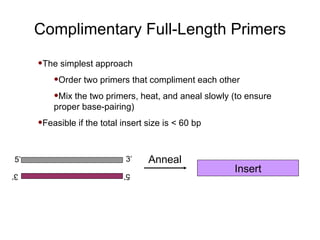
The simplest approach Order two primers that compliment each other Mix the two primers, heat, and aneal slowly (to ensure proper base-pairing) Feasible if the total insert size is < 60 bp Complimentary Full-Length Primers Insert 5’ 3’ 5’ 3’ Anneal
Designing Primers to Order Once the insert synthesis technique is decided, primer design is fairly straight-forward Forward primers: Assess necessary overlap and copy the sequence from your designed gene, along with extra 5’ sequence Reverse primers: First, design exactly as if it were a forward primer:  Copy necessary overlap and extra 3’ sequence from your designed gene Once all this is in place, use pDRAW32 sequence manipulator to calculate the reverse compliment Order the pDRAW32 calculated sequence directly
Cloning Out an Existing Gene In the example mentioned previously, we would normally use full length overlapping primers, but let’s look at the more common case of having a preexisting gene: gccagcca ggatcc g ggctgcgacagggcgagcccgtactgcggttaa ctgcag gtcgacgc S  Q   D  P   G  C  D  R  A  S  P  Y  C  G  -   L  Q   V  D  tgcggcccagccggccatgggctgcgacagggcgagcccgtactgcggtggaggcggtgctgcagcgc A  A  Q  P  A  M  G  C  D  R  A  S  P  Y  C  G   G  G  G  A  A  A Preexisting gene: Goal gene: + Overlap Extra sequence from gene design gccagccaggatccgggctgcgacagg ccgtactgcggttaactgcaggtcgacgc Forward Primer: Design of Reverse Primer:
gccagccaggatccgggctgcgacagggcgagcccgtactgcggttaactgcaggtcgacgc S  Q  D  P  G  C  D  R  A  S  P  Y  C  G  -  L  Q  V  D  Ordering Primers Forward primer to order: gccagccaggatccg ggctgcgacagg Reverse primer to order: GCGTCGACCTGCAGTTAACCGCAGTACGG Design of Reverse Primer:  ccgtactgcggt taactgcaggtcgacgc & http://www.idtdna.com/Home/Home. aspx Now we can order the primers:
Vectors and Bacteria Strains An important thing to think about before you start cloning: What vectors/E Coli should I use? pET-Duet pRSF-Duet pCANTAB-5E pMAL pQE-30 Vector BL-21: Protease deficient, stable to toxic proteins, and contains the T7 RNA polymerase gene T7 lac promoter (An E. Coli strain with phage T7 RNA polymerase is necessary)  Plac promoter Ptac promoter XL1-Blue: mostly good for DNA isolation/phage display M15(pREP4): tighter regulation of the lac suppressor  T5 promoter E Coli strains we use Promoter
mRNA lac Expression Regulation lac site Promoter RBS ATG- your gene lac repressor lac site Promoter RBS ATG- your gene RNA polymerase X IPTG (or lactose, etc) IPTG lac site Promoter RBS ATG- your gene Transcription
Anti-biotic resistance (working concentration) Ampicillin (100  g/mL) Kanamycin (35  g/mL) Tetracycline HCl (10  g/mL) Chloramphenicol (170  g/mL in ethanol) Purification Tags and Selection (Anti-biotic Resistance) Purification Tag His-tag (nickel agarose resin) Maltose Binding Protein (amylose resin) Glutathione S-Transferase (glutathione resin)
Digestion of Insert and Vector Digest with the same restriction endonucleases Optional (recommended) step: Treat the plasmid DNA with Antarctic phosphatase Decreases the background by stopping self-ligation of singly cut plasmid and background re-ligation
Ligation of the Insert into the Vector + Ligation covalently attaches the vector and the insert via a phosphodiester bond (5’phosphate and 3’ hydroxyl of the next base)
Antarctic Phosphatase and Ligation  http://www.neb.com/nebecomm/products/productM0202.asp Antarctic Phosphatase cleaves this phosphate, disallowing self-ligation The insert still has the 5’ phosphate though
Transformation The functional construct is now ready to be transformed into new E. Coli and grown up The new DNA isolated from the E. Coli must then be sequenced to make sure that everything worked Once the sequence is confirmed, we are ready to go!

Cloning

  • 1.
    Ghosh Lab Universityof Arizona Department of Chemistry Cloning 101: A Primer
  • 2.
    Outline Cloning overviewpDRAW32 Design Gene Insert Primers Further considerations (optimization of the process) Transformation
  • 3.
    Cloning Overview Fourmain steps in cloning: Insert synthesis Restriction enzyme digest Ligation Transformation + Functional construct Plasmid (vector) Insert (your gene)
  • 4.
    Design Overview Stepsto follow in designing your cloning experiment: Design your gene Design your insert Pick your enzymes Check your design Recheck your design Functional construct
  • 5.
    All of theimportant information in one place! pDRAW32 Plasmid maps: pDRAW32
  • 6.
    pDRAW32 You canlook at the sequence in detail Open reading frames Translation Restriction sites Complementary strand
  • 7.
    Design of theGene Example, the gene we want: G C D R A S P Y C G We got this from phage display: ggctgcgacagggcgagcccgtactgcggt G C D R A S P Y C G Phage sequence Final sequence for the gene of interest: ggctgcgacagggcgagcccgtactgcggt taa G C D R A S P Y C G * Add a stop codon If you are cloning out of a known plasmid, just use the sequence that you have
  • 8.
    Design of theGene If you are designing the gene from scratch, keep in mind codon usage Not all codons are created equal Un-optimized codons could lead to lower expression levels The codon usage reflects levels of tRNA available in E. Coli Pay attention to the stop codons too (XL1-Blues read through TAG {amber stop codon} 20% of the time)
  • 9.
    http://www. bioinformatics .org/sms2/rev_trans.htmlhttp://www.entelechon.com/index.php?id=tools/backtranslation&lang=eng or preferably… What if we don’t have the DNA sequence? Design from scratch! (don’t forget about codon usage )
  • 10.
    Endonucleases (or restrictionenzymes) are enzymes which cut DNA at specific internal recognition sequences Compare to exonucleases, which cut from one end You must choose restriction sites that are available in the plasmid you are cloning into They must not appear in your gene (silent mutation can remove unwanted sites in your designed gene) Choice of Restriction Sites/Enzymes Once you have your gene, you need to design a way to get it into your plasmid
  • 11.
    Restriction sites mustexist only once in your plasmid They must be in the correct position relative to the purification tag Restrictions sites usually add extra residues to your gene product; make sure they are compatible with your peptide/protein Some restriction sites are sub-optimal for cloning Blunt end sites dam and dcm methylation-affected enzymes Really Important Factors to Remember When Choosing Restriction Enzymes
  • 12.
    AGCCA G GATCCGGGCTGCAAGCGGTTAA G AATTC GTCGAC GTCGAC G AATTC TTAACCGCTTCCAGCCC G GATCC TGGCT GATCC GGGCTGCAAGCGGTTAA G AATTC TTAACCGCTTCCAGCCC G + “ sticky ends” AGCCA GAT ATC GGGCTGCAAGCGGTTAA CAG CTG GTCGAC GTCGAC CAG CTG TTAACCGCTTCCAGCCC GAT ATC TGGCT ATC GGGCTGCAAGCGGTTAA CAG CTG TTAACCGCTTCCAGCCC GAT AGCCA GAT ATC TGGCT + CTG GTCGAC GTCGAC CAG “ Sticky ends”: 5’ or 3’ over-hangs that allow the DNA to anneal even though it is not covalently bound Help with the next step: ligation Most common restriction enzymes Blunt-end restriction enzymes No sticky ends Blunt vs Sticky Ends Digestion Digestion GATCC TGGCT AGCCA G AATTC GTCGAC GTCGAC G
  • 13.
    dam Methylation Dammethylase Dam methylase puts a methyl group on the nitrogen of 6 th position of adenosine at the site: G A TC All of the E. Coli that we use generate DNA with dam methylation Some enzymes only cut dam methylated DNA: eg DpnI Some enzymes do not cut dam methylated DNA: eg XbaI http://www.neb.com/nebecomm/tech_reference/restriction_enzymes/dam_dcm_methylases_of_ecoli.asp
  • 14.
    dcm Methylation http://www.neb.com/nebecomm/tech_reference/restriction_enzymes/dam_dcm_methylases_of_ecoli.aspDcm methylase Dcm methylase puts a methyl group on the carbon of 5 th position of cytidine at the site: C C AGG and C C TGG The enzyme we use most that can be affected by dcm methylation is SfiI XL1-Blues and BL21s are both Dcm +
  • 15.
    Once you haveyour restriction enzymes chosen, it is time to design the final complete gene The multiple cloning site (or whatever plasmid you are cloning into) should already have the 5’ portion of the gene intact (i.e. RBS, spacer, Met) Sequences must be in frame NcoI BtgI 51 CTTTAATAAG GAGATATACC ATGGGCAGCA GCCATCACCA TCATCACCAC M G S S H H H H H H SacI AscI SbfI SalI NotI BamHI EcoRI EcoICRI BssHII PstI AccI HindIII 101 AGCCA GGATC C GAATTCGAG CTCGGCGCGC CTGCAG GTCG ACAAGCTTGC S Q D P N S S S A R L Q V D K L A Design of the Insert
  • 16.
    Design of theInsert 71 ATGGGCAGCAGCCATCACCATCATCACCAC M G S S H H H H H H SacI AscI SbfI SalI BamHI EcoRI EcoICRI PstI AccI HindIII 101 AGCCA GGATCC GAATTCGAGCTCGGCGCGC CTGCAG GTCGACAAGCTTGC S Q D P N S S S A R L Q V D K L A The gene we want: ggctgcgacagggcgagcccgtactgcggttaa G C D R A S P Y C G * BamHI PstI AGCCA GGATCC GAATTCGAGCTCGGCGCGC CTGCAG GTCGACAAGCTTGC S Q D P N S S S A R L Q V D K L A G C D R A S P Y C G * ggctgcgacagggcgagcccgtactgcggttaa AGCCA GGATCC G ggctgcgacagggcgagcccgtactgcggttaa CTGCAG GTCGACAA Be aware of the amber stop codon: TAG Multiple cloning site
  • 17.
    Design of theInsert Always check and re-check your sequence! ATGGGCAGCA GCCATCACCA TCATCACCAC AGCCA GGATCC G ggctgcgacagggcgagcccgtactgcggttaa CTGCAG GTCGACAA atgggcagcagccatcaccatcatcaccacagcca ggatcc g ggctgcgacagggcgagc M G S S H H H H H H S Q D P G C D R A S ccgtactgcggttaa ctgcag gtcgacaa P Y C G - L Q V D Everything looks good: in frame the whole way! Translate the whole gene
  • 18.
    The wrong way to do it: AGCCA GGATCC ggctgcgacagggcgagcccgtactgcggttaa CTGCAG GTCGACAAGCTT atgggcagcagccatcaccatcatcaccacagcca ggatcc ggctgcgacagggcgagcc M G S S H H H H H H S Q D P A A T G R A cgtactgcggttaactgcaggtcgacaagctt R T A V N C R S T S Frame shifted = garbage! Design of the Insert The gene is just inserted after the restriction site, which is out of frame with the plasmid-encoded start-codon/His-tag **Some plasmids, for whatever reason, have restriction sites out of frame with the translated gene**
  • 19.
    Finishing Touches atgggcagcagccatcaccatcatcaccacagccaggatcc g ggctgcgacagggcgagc M G S S H H H H H H S Q D P G C D R A S ccgtactgcggttaa ctgcag gtcgacaa P Y C G - L Q V D Restriction enzymes need 5’ and 3’ base pairs to cut properly NEB has a reference guide for specific enzymes (see link below) A good rule of thumb is 6 base pairs after the recognition site Inserting a GC “clamp” at the end and beginning of the sequence is also a good idea http://www.neb.com/nebecomm/tech_reference/restriction_enzymes/cleavage_linearized_vector.asp gccagcca ggatcc g ggctgcgacagggcgagcccgtactgcggttaa ctgcag gtcgacgc S Q D P G C D R A S P Y C G - L Q V D Final gene, polished and ready to go:
  • 20.
    Once the insertis designed correctly, the next step is designing primers to order from IDT, based on insert synthesis strategy Design of the Primers Three main strategies towards insert synthesis: PCR amplification Klenow extension of overlapping primers Complimentary full-length primers + Insert Vector
  • 21.
    The most commonmethod of insert synthesis Necessitates a pre-existing construct Extra restriction sites and/or amino acid residues can be added on each side of the gene Internal mutations are more difficult PCR Amplification of Insert from an Existing Gene Insert
  • 22.
    PCR amplification fromoverlapping primers No pre-existing construct is needed PCR products messy, possibly making subsequent rxns difficult Good for inserts >150 bp PCR Synthesis of Insert F1: 10x F2: 1x R1: 1x R2: 10x 5’ 3’ 5’ 3’ 5’ 3’ 5’ 3’ Full-length insert should still be the major product Insert
  • 23.
    Klenow Extension ofOverlapping Primers Two primers that are complimentary in their 3’ region are designed (overlap  15bp) Extended to full length by the Klenow fragment of DNA Polymerase I Useful if insert is 50 to 150 bp Insert 5’ 3’ 5’ 3’ Klenow fragment: retains 3’ to 5’ polymerase activity, but does not have exonuclease activity 5’ 3’ 5’ 3’ Klenow
  • 24.
    The simplest approachOrder two primers that compliment each other Mix the two primers, heat, and aneal slowly (to ensure proper base-pairing) Feasible if the total insert size is < 60 bp Complimentary Full-Length Primers Insert 5’ 3’ 5’ 3’ Anneal
  • 25.
    Designing Primers toOrder Once the insert synthesis technique is decided, primer design is fairly straight-forward Forward primers: Assess necessary overlap and copy the sequence from your designed gene, along with extra 5’ sequence Reverse primers: First, design exactly as if it were a forward primer: Copy necessary overlap and extra 3’ sequence from your designed gene Once all this is in place, use pDRAW32 sequence manipulator to calculate the reverse compliment Order the pDRAW32 calculated sequence directly
  • 26.
    Cloning Out anExisting Gene In the example mentioned previously, we would normally use full length overlapping primers, but let’s look at the more common case of having a preexisting gene: gccagcca ggatcc g ggctgcgacagggcgagcccgtactgcggttaa ctgcag gtcgacgc S Q D P G C D R A S P Y C G - L Q V D tgcggcccagccggccatgggctgcgacagggcgagcccgtactgcggtggaggcggtgctgcagcgc A A Q P A M G C D R A S P Y C G G G G A A A Preexisting gene: Goal gene: + Overlap Extra sequence from gene design gccagccaggatccgggctgcgacagg ccgtactgcggttaactgcaggtcgacgc Forward Primer: Design of Reverse Primer:
  • 27.
    gccagccaggatccgggctgcgacagggcgagcccgtactgcggttaactgcaggtcgacgc S Q D P G C D R A S P Y C G - L Q V D Ordering Primers Forward primer to order: gccagccaggatccg ggctgcgacagg Reverse primer to order: GCGTCGACCTGCAGTTAACCGCAGTACGG Design of Reverse Primer: ccgtactgcggt taactgcaggtcgacgc & http://www.idtdna.com/Home/Home. aspx Now we can order the primers:
  • 28.
    Vectors and BacteriaStrains An important thing to think about before you start cloning: What vectors/E Coli should I use? pET-Duet pRSF-Duet pCANTAB-5E pMAL pQE-30 Vector BL-21: Protease deficient, stable to toxic proteins, and contains the T7 RNA polymerase gene T7 lac promoter (An E. Coli strain with phage T7 RNA polymerase is necessary) Plac promoter Ptac promoter XL1-Blue: mostly good for DNA isolation/phage display M15(pREP4): tighter regulation of the lac suppressor T5 promoter E Coli strains we use Promoter
  • 29.
    mRNA lac ExpressionRegulation lac site Promoter RBS ATG- your gene lac repressor lac site Promoter RBS ATG- your gene RNA polymerase X IPTG (or lactose, etc) IPTG lac site Promoter RBS ATG- your gene Transcription
  • 30.
    Anti-biotic resistance (workingconcentration) Ampicillin (100  g/mL) Kanamycin (35  g/mL) Tetracycline HCl (10  g/mL) Chloramphenicol (170  g/mL in ethanol) Purification Tags and Selection (Anti-biotic Resistance) Purification Tag His-tag (nickel agarose resin) Maltose Binding Protein (amylose resin) Glutathione S-Transferase (glutathione resin)
  • 31.
    Digestion of Insertand Vector Digest with the same restriction endonucleases Optional (recommended) step: Treat the plasmid DNA with Antarctic phosphatase Decreases the background by stopping self-ligation of singly cut plasmid and background re-ligation
  • 32.
    Ligation of theInsert into the Vector + Ligation covalently attaches the vector and the insert via a phosphodiester bond (5’phosphate and 3’ hydroxyl of the next base)
  • 33.
    Antarctic Phosphatase andLigation http://www.neb.com/nebecomm/products/productM0202.asp Antarctic Phosphatase cleaves this phosphate, disallowing self-ligation The insert still has the 5’ phosphate though
  • 34.
    Transformation The functionalconstruct is now ready to be transformed into new E. Coli and grown up The new DNA isolated from the E. Coli must then be sequenced to make sure that everything worked Once the sequence is confirmed, we are ready to go!