V Sowmya Int. Journal of Engineering Research and Applications www.ijera.com
ISSN: 2248-9622, Vol. 6, Issue 2, (Part - 3) February 2016, pp.26-29
www.ijera.com 26|P a g e
Adaptive Privacy Policy Prediction of User Uploaded Images on
Content sharing Sites
V Sowmya*, N Sripriya**
*ME, Computer Science and Engineering, Prathyusha Engineering College, Chennai, 602 025, India.
**Computer Science and Engineering, Prathyusha Engineering College, Chennai, 602 025, India.
Abstract
User Image sharing social site maintaining privacy has become a major problem, as demonstrated by a recent
wave of publicized incidents where users inadvertently shared personal information. In light of these incidents,
the need of tools to help users control access to their shared content is apparent. Toward addressing this need an
Adaptive Privacy Policy Prediction (A3P) system to help users compose privacy settings for their images. The
solution relies on an image classification framework for image categories which may be associated with similar
policies and on a policy prediction algorithm to automatically generate a policy for each newly uploaded image,
also according to user’s social features. Image Sharing takes place both among previously established groups of
known people or social circles and also increasingly with people outside the users social circles, for purposes of
social discovery-to help them identify new peers and learn about peers interests and social surroundings,
Sharing images within online content sharing sites, therefore, may quickly lead to unwanted disclosure. The
aggregated information can result in unexpected exposure of one’s social environment and lead to abuse of
one’s personal information.
Keywords: Adaptive Privacy Policy Prediction (A3P), A3P- Core, A3P- Social, Polar Fourier Transform
(PFT).
I. INTRODUCTION
An A3P system that helps users automates the
privacy policy settings for their uploaded images.
The A3P system provides a comprehensive
framework to infer privacy preferences based on the
information available for a given user. We also
effectively tackled the issue of cold start, leveraging
social context information. A3P-core: (I) Image
classification and (ii) Adaptive policy prediction.
User images are first classified based on content and
metadata. Privacy policies of each category of
images are analyzed for the policy prediction.
Content-based classification algorithm compares
image signatures defined based on quantified and
sanitized version of Haar wavelet transformation.
Metadata-based classification groups images into
subcategories under aforementioned baseline
categories. A3P-social multi-criteria inference
mechanism that generates representative policies by
leveraging key information related to the user’s social
context. Images searching for content based and
image based the result found for each image privacy
policy set of user privacy in sharing site. Content-
based classification is based on an efficient and yet
accurate image similarity approach. Classification
algorithm compares image signatures defined based
on quantified and sanitized version of Haar wavelet
transformation. The Image encodes frequency and
spatial information related to image color, size, and
texture. The small number of coefficients is selected
to form the signature of the image.
FIG: SYSTEM ARCHITECHTURE
II. RELATED WORK
[2]Content-based retrieval is ultimately
dependent on the features used for the annotation of
data and its efficiency is dependent on the invariance
and robust properties. The Polar Fourier Transform
(PFT) is similar to the Discrete Fourier Transform in
two dimensions but uses transform parameters radius
and angle rather than the Cartesian co-ordinates. To
improve implications for content based retrieval of
natural images where there will be a significantly
higher number of textures.
RESEARCH ARTICLE OPEN ACCESS
V Sowmya Int. Journal of Engineering Research and Applications www.ijera.com
ISSN: 2248-9622, Vol. 6, Issue 2, (Part - 3) February 2016, pp.26-29
www.ijera.com 27|P a g e
[6]Local radial symmetry is to identify regions
of interest within a scene. A facial feature detector
and as a generic region of interest detector the new
transform is seen to offer equal or superior
performance to contemporary techniques. The
method has been demonstrated on a series of face
images and other scenes, and compared against a
number of contemporary techniques from the
literature. Equal or superior performance on the
images tested while offering significant savings in
both the computation required and the complexity of
the implementation.
[5]The refining process is formulated as an
optimization framework based on the consistency
between “visual similarity” and “semantic similarity”
in social images. An image retagging scheme that
aims at improving the quality of the tags associated
with social images in terms of content relevance.
III. SYSTEM OVERVIEW
The A3P system consists of two main
components: A3P-core and A3P-social. The overall
data flow is the following. When a user uploads an
image, the image will be first sent to the A3P-core.
The A3P-core classifies the image and determines
whether there is a need to invoke the A3P-social. In
most cases, the A3P-core predicts policies for the
users directly based on their historical behavior. If
one of the following two cases is verified true, A3P-
core will invoke A3Psocial: (i) The user does not
have enough data for the type of the uploaded image
to conduct policy prediction; (ii) The A3P-core
detects the recent major changes among the user’s
community about their privacy practices along with
user’s increase of social networking activities
(addition of new friends, new posts on one’s profile
etc). In above cases, it would be beneficial to report
to the user the latest privacy practice of social
communities that have similar background as the
user. The A3P-social groups users into social
communities with similar social context and privacy
preferences, and continuously monitors the social
groups. When the A3P-social is invoked, it
automatically identifies the social group for the user
and sends back the information about the group to the
A3P-core for policy prediction. At the end, the
predicted policy will be displayed to the user. If the
user is fully satisfied by the predicted policy, he or
she can just accept it. Otherwise, the user can choose
to revise the policy. The actual policy will be stored
in the policy repository of the system for the policy
prediction of future uploads.
IV. IDENTIFYING SOCIAL
GROUPS
The policy recommendation process based on the
social groups that a user U uploaded a new image and
the A3P-core invoked the A3P-social for policy
recommendation. The A3P-social will find the social
group which is most similar to user U and then
choose the representative user in the social group
along with his images to be sent to the A3P-Core
policy prediction module to generate the
recommended policy for user U.
Given that the number of users in social network
may be huge and that users may join a large number
of social groups, it would be very time consuming to
compare the new user’s social context attributes
against the frequent pattern of each social group. In
order to speed up the group identification process and
ensure reasonable response time, we leverage the
inverted file structure to organize the social group
information. The inverted file maps keywords (values
of social context attribute) occurring in the frequent
patterns to the social groups that contain the
keywords. Specifically, in first sort the keywords
(except the social connection) in the frequent patterns
in an alphabetical order. Each keyword is associated
with a link list which stores social group ID and
pointers to the detailed information of the social
group.
V. A3P CORE
There are two major components in A3P-core: (i)
Image classification and (ii) Adaptive policy
prediction. For each user, his/her images are first
classified based on content and metadata. Then,
privacy policies of each category of images are
analyzed for the policy prediction. Adopting a two-
stage approach is more suitable for policy
recommendation than applying the common one-
stage data mining approaches to mine both image
features and policies together.
Recall that when a user uploads a new image, the
user is waiting for a recommended policy. The two-
stage approach allows the system to employ the first
stage to classify the new image and find the candidate
sets of images for the subsequent policy
recommendation. As for the one-stage mining
approach, it would not be able to locate the right class
of the new image because its classification criteria
need both image features and policies whereas the
policies of the new image are not available yet.
Moreover, combining both image features and
policies into a single classifier would lead to a system
which is very dependent to the specific syntax of the
policy. If a change in the supported policies were to
be introduced, the whole learning model would need
to change.
A. Content-Based Classification:
Content-based classification is based on an
efficient and yet accurate image similarity approach.
Classification algorithm compares image signatures
defined based on quantified and sanitized version of
Haar wavelet transformation. The Image encodes
V Sowmya Int. Journal of Engineering Research and Applications www.ijera.com
ISSN: 2248-9622, Vol. 6, Issue 2, (Part - 3) February 2016, pp.26-29
www.ijera.com 28|P a g e
frequency and spatial information related to image
color, size, and texture. The small number of
coefficients is selected to form the signature of the
image.
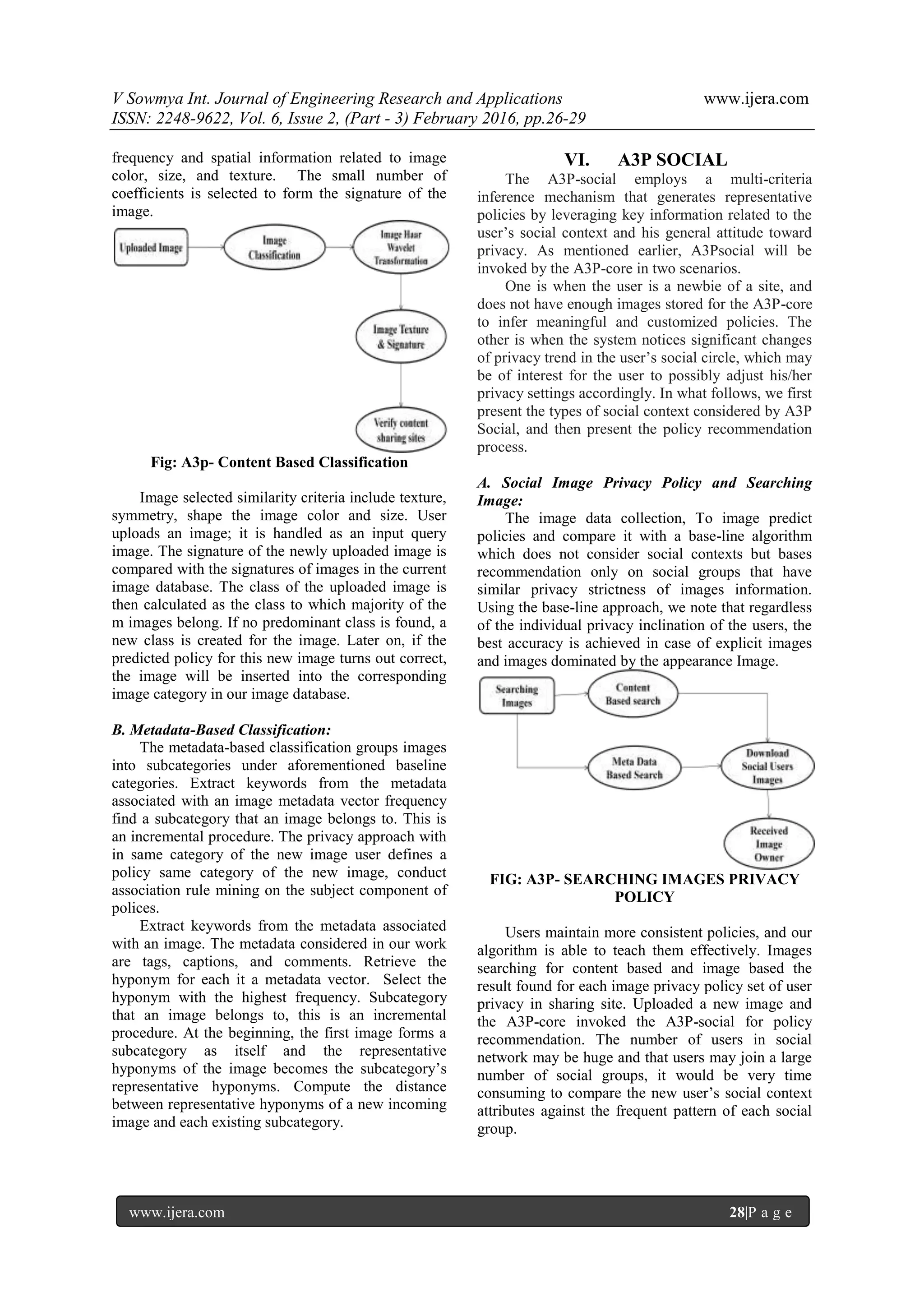
Fig: A3p- Content Based Classification
Image selected similarity criteria include texture,
symmetry, shape the image color and size. User
uploads an image; it is handled as an input query
image. The signature of the newly uploaded image is
compared with the signatures of images in the current
image database. The class of the uploaded image is
then calculated as the class to which majority of the
m images belong. If no predominant class is found, a
new class is created for the image. Later on, if the
predicted policy for this new image turns out correct,
the image will be inserted into the corresponding
image category in our image database.
B. Metadata-Based Classification:
The metadata-based classification groups images
into subcategories under aforementioned baseline
categories. Extract keywords from the metadata
associated with an image metadata vector frequency
find a subcategory that an image belongs to. This is
an incremental procedure. The privacy approach with
in same category of the new image user defines a
policy same category of the new image, conduct
association rule mining on the subject component of
polices.
Extract keywords from the metadata associated
with an image. The metadata considered in our work
are tags, captions, and comments. Retrieve the
hyponym for each it a metadata vector. Select the
hyponym with the highest frequency. Subcategory
that an image belongs to, this is an incremental
procedure. At the beginning, the first image forms a
subcategory as itself and the representative
hyponyms of the image becomes the subcategory’s
representative hyponyms. Compute the distance
between representative hyponyms of a new incoming
image and each existing subcategory.
VI. A3P SOCIAL
The A3P-social employs a multi-criteria
inference mechanism that generates representative
policies by leveraging key information related to the
user’s social context and his general attitude toward
privacy. As mentioned earlier, A3Psocial will be
invoked by the A3P-core in two scenarios.
One is when the user is a newbie of a site, and
does not have enough images stored for the A3P-core
to infer meaningful and customized policies. The
other is when the system notices significant changes
of privacy trend in the user’s social circle, which may
be of interest for the user to possibly adjust his/her
privacy settings accordingly. In what follows, we first
present the types of social context considered by A3P
Social, and then present the policy recommendation
process.
A. Social Image Privacy Policy and Searching
Image:
The image data collection, To image predict
policies and compare it with a base-line algorithm
which does not consider social contexts but bases
recommendation only on social groups that have
similar privacy strictness of images information.
Using the base-line approach, we note that regardless
of the individual privacy inclination of the users, the
best accuracy is achieved in case of explicit images
and images dominated by the appearance Image.
FIG: A3P- SEARCHING IMAGES PRIVACY
POLICY
Users maintain more consistent policies, and our
algorithm is able to teach them effectively. Images
searching for content based and image based the
result found for each image privacy policy set of user
privacy in sharing site. Uploaded a new image and
the A3P-core invoked the A3P-social for policy
recommendation. The number of users in social
network may be huge and that users may join a large
number of social groups, it would be very time
consuming to compare the new user’s social context
attributes against the frequent pattern of each social
group.
V Sowmya Int. Journal of Engineering Research and Applications www.ijera.com
ISSN: 2248-9622, Vol. 6, Issue 2, (Part - 3) February 2016, pp.26-29
www.ijera.com 29|P a g e
VII. CONCLUSION
Our solution relies on an image classification
framework for image categories which may be
associated with similar policies and on a policy
prediction algorithm to automatically generate a
policy for each newly uploaded image, also
according to users’ social features. The generated
policies will follow the evolution of user’s privacy
attitude.
REFERENCES
[1] R. Datta, D. Joshi, J. Li, and J. Wang,
“Image retrieval: Ideas, influences, and
trends of the new age” IEEE Transaction on
Cloud Computing, Vol. 2, NO. 4,
OCTOBER-DECEMBER 2014.
[2] P.R. Hill, C.N. Canagarajah and D.R. Bull,
“Rotationally Invariant Texture Based
Features” IEEE Computer Society 1089-
7801/15/$31.00 c 2015 IEEE.
[3] Kaitai Liang, Joseph K. Liu, Rongxing Lu,
Duncan S. Wong, “Privacy Concerns for
Photo Sharing in Online Social Networks”
IEEE Computer Society 1089-
7801/15/$31.00 c 2015 IEEE.
[4] P. Klemperer, Y. Liang, M. Mazurek, M.
Sleeper, “Tag, you can see it!: Using tags for
access control in photo sharing” IEEE
Transaction on Engineering Management,
Vol. 62, NO. 3, AUGUST 2015.
[5] D. Liu, X.-S. Hua, M. Wang, and H.-J.
Zhang, “Retagging social images based on
visual and semantic consistency” IEEE
Transaction on Image Processing, VOL. 24,
NO. 11, NOVEMBER 2014.
[6] G. Loy and A. Zelinsky, “Fast radial
symmetry for detecting points of interest”
IEEE Transaction on Pattern Analysis and
Machine Intelligence, Vol. 25, NO.8,
AUGUST 2014.
[7] Linke Guo, Chi Zhang, and Yuguang Fang,
“A Trust-Based Privacy-Preserving Friend
Recommendation Scheme for Online Social
Networks” IEEE Transaction on Dependable
and Secure Computing, Vol. 12, NO. 4,
JULY/AUGUST 2015.
[8] Xueming Qian, Xian-Sheng Hua, Yuan Yan
Tang, and Tao Mei “Social Image Tagging
With Diverse Semantics” IEEE Transaction
on Cybernetics, Vol. 44, NO. 12,
DECEMBER 2014.
[9] S. Zerr, S. Siersdorfer, J. Hare, and E.
Demidova, “Privacy-aware image
classification and search” IEEE Transaction
on Pattern Analysis and Machine
Intelligence, Vol. 25, NO. 8, AUGUST
2014.
[10] J. Zhuang and S. C. H. Hoi, “Non-
parametric kernel ranking approach for
social image retrieval” IEEE Transaction on
Knowledge and Data Engineering, Vol. 26,
NO. 1, JANUARY 2014.
AUTHORS
First Author – Sowmya V, ME-II , Computer
Science and Engineering, Prathyusha Engineering
College, Chennai, 602 025, India. E-Mail ID:
sowmyarajaraman@rediffmail.com
Second Author – Sripriya N, Assistant Professor-I,
Computer Science and Engineering, Prathyusha
Engineering College, Chennai, 602 025, India.
Email ID: narasimhan.sripriya@gmail.com

Adaptive Privacy Policy Prediction of User Uploaded Images on Content sharing Sites

  • 1.
    V Sowmya Int.Journal of Engineering Research and Applications www.ijera.com ISSN: 2248-9622, Vol. 6, Issue 2, (Part - 3) February 2016, pp.26-29 www.ijera.com 26|P a g e Adaptive Privacy Policy Prediction of User Uploaded Images on Content sharing Sites V Sowmya*, N Sripriya** *ME, Computer Science and Engineering, Prathyusha Engineering College, Chennai, 602 025, India. **Computer Science and Engineering, Prathyusha Engineering College, Chennai, 602 025, India. Abstract User Image sharing social site maintaining privacy has become a major problem, as demonstrated by a recent wave of publicized incidents where users inadvertently shared personal information. In light of these incidents, the need of tools to help users control access to their shared content is apparent. Toward addressing this need an Adaptive Privacy Policy Prediction (A3P) system to help users compose privacy settings for their images. The solution relies on an image classification framework for image categories which may be associated with similar policies and on a policy prediction algorithm to automatically generate a policy for each newly uploaded image, also according to user’s social features. Image Sharing takes place both among previously established groups of known people or social circles and also increasingly with people outside the users social circles, for purposes of social discovery-to help them identify new peers and learn about peers interests and social surroundings, Sharing images within online content sharing sites, therefore, may quickly lead to unwanted disclosure. The aggregated information can result in unexpected exposure of one’s social environment and lead to abuse of one’s personal information. Keywords: Adaptive Privacy Policy Prediction (A3P), A3P- Core, A3P- Social, Polar Fourier Transform (PFT). I. INTRODUCTION An A3P system that helps users automates the privacy policy settings for their uploaded images. The A3P system provides a comprehensive framework to infer privacy preferences based on the information available for a given user. We also effectively tackled the issue of cold start, leveraging social context information. A3P-core: (I) Image classification and (ii) Adaptive policy prediction. User images are first classified based on content and metadata. Privacy policies of each category of images are analyzed for the policy prediction. Content-based classification algorithm compares image signatures defined based on quantified and sanitized version of Haar wavelet transformation. Metadata-based classification groups images into subcategories under aforementioned baseline categories. A3P-social multi-criteria inference mechanism that generates representative policies by leveraging key information related to the user’s social context. Images searching for content based and image based the result found for each image privacy policy set of user privacy in sharing site. Content- based classification is based on an efficient and yet accurate image similarity approach. Classification algorithm compares image signatures defined based on quantified and sanitized version of Haar wavelet transformation. The Image encodes frequency and spatial information related to image color, size, and texture. The small number of coefficients is selected to form the signature of the image. FIG: SYSTEM ARCHITECHTURE II. RELATED WORK [2]Content-based retrieval is ultimately dependent on the features used for the annotation of data and its efficiency is dependent on the invariance and robust properties. The Polar Fourier Transform (PFT) is similar to the Discrete Fourier Transform in two dimensions but uses transform parameters radius and angle rather than the Cartesian co-ordinates. To improve implications for content based retrieval of natural images where there will be a significantly higher number of textures. RESEARCH ARTICLE OPEN ACCESS
  • 2.
    V Sowmya Int.Journal of Engineering Research and Applications www.ijera.com ISSN: 2248-9622, Vol. 6, Issue 2, (Part - 3) February 2016, pp.26-29 www.ijera.com 27|P a g e [6]Local radial symmetry is to identify regions of interest within a scene. A facial feature detector and as a generic region of interest detector the new transform is seen to offer equal or superior performance to contemporary techniques. The method has been demonstrated on a series of face images and other scenes, and compared against a number of contemporary techniques from the literature. Equal or superior performance on the images tested while offering significant savings in both the computation required and the complexity of the implementation. [5]The refining process is formulated as an optimization framework based on the consistency between “visual similarity” and “semantic similarity” in social images. An image retagging scheme that aims at improving the quality of the tags associated with social images in terms of content relevance. III. SYSTEM OVERVIEW The A3P system consists of two main components: A3P-core and A3P-social. The overall data flow is the following. When a user uploads an image, the image will be first sent to the A3P-core. The A3P-core classifies the image and determines whether there is a need to invoke the A3P-social. In most cases, the A3P-core predicts policies for the users directly based on their historical behavior. If one of the following two cases is verified true, A3P- core will invoke A3Psocial: (i) The user does not have enough data for the type of the uploaded image to conduct policy prediction; (ii) The A3P-core detects the recent major changes among the user’s community about their privacy practices along with user’s increase of social networking activities (addition of new friends, new posts on one’s profile etc). In above cases, it would be beneficial to report to the user the latest privacy practice of social communities that have similar background as the user. The A3P-social groups users into social communities with similar social context and privacy preferences, and continuously monitors the social groups. When the A3P-social is invoked, it automatically identifies the social group for the user and sends back the information about the group to the A3P-core for policy prediction. At the end, the predicted policy will be displayed to the user. If the user is fully satisfied by the predicted policy, he or she can just accept it. Otherwise, the user can choose to revise the policy. The actual policy will be stored in the policy repository of the system for the policy prediction of future uploads. IV. IDENTIFYING SOCIAL GROUPS The policy recommendation process based on the social groups that a user U uploaded a new image and the A3P-core invoked the A3P-social for policy recommendation. The A3P-social will find the social group which is most similar to user U and then choose the representative user in the social group along with his images to be sent to the A3P-Core policy prediction module to generate the recommended policy for user U. Given that the number of users in social network may be huge and that users may join a large number of social groups, it would be very time consuming to compare the new user’s social context attributes against the frequent pattern of each social group. In order to speed up the group identification process and ensure reasonable response time, we leverage the inverted file structure to organize the social group information. The inverted file maps keywords (values of social context attribute) occurring in the frequent patterns to the social groups that contain the keywords. Specifically, in first sort the keywords (except the social connection) in the frequent patterns in an alphabetical order. Each keyword is associated with a link list which stores social group ID and pointers to the detailed information of the social group. V. A3P CORE There are two major components in A3P-core: (i) Image classification and (ii) Adaptive policy prediction. For each user, his/her images are first classified based on content and metadata. Then, privacy policies of each category of images are analyzed for the policy prediction. Adopting a two- stage approach is more suitable for policy recommendation than applying the common one- stage data mining approaches to mine both image features and policies together. Recall that when a user uploads a new image, the user is waiting for a recommended policy. The two- stage approach allows the system to employ the first stage to classify the new image and find the candidate sets of images for the subsequent policy recommendation. As for the one-stage mining approach, it would not be able to locate the right class of the new image because its classification criteria need both image features and policies whereas the policies of the new image are not available yet. Moreover, combining both image features and policies into a single classifier would lead to a system which is very dependent to the specific syntax of the policy. If a change in the supported policies were to be introduced, the whole learning model would need to change. A. Content-Based Classification: Content-based classification is based on an efficient and yet accurate image similarity approach. Classification algorithm compares image signatures defined based on quantified and sanitized version of Haar wavelet transformation. The Image encodes
  • 3.
    V Sowmya Int.Journal of Engineering Research and Applications www.ijera.com ISSN: 2248-9622, Vol. 6, Issue 2, (Part - 3) February 2016, pp.26-29 www.ijera.com 28|P a g e frequency and spatial information related to image color, size, and texture. The small number of coefficients is selected to form the signature of the image. Fig: A3p- Content Based Classification Image selected similarity criteria include texture, symmetry, shape the image color and size. User uploads an image; it is handled as an input query image. The signature of the newly uploaded image is compared with the signatures of images in the current image database. The class of the uploaded image is then calculated as the class to which majority of the m images belong. If no predominant class is found, a new class is created for the image. Later on, if the predicted policy for this new image turns out correct, the image will be inserted into the corresponding image category in our image database. B. Metadata-Based Classification: The metadata-based classification groups images into subcategories under aforementioned baseline categories. Extract keywords from the metadata associated with an image metadata vector frequency find a subcategory that an image belongs to. This is an incremental procedure. The privacy approach with in same category of the new image user defines a policy same category of the new image, conduct association rule mining on the subject component of polices. Extract keywords from the metadata associated with an image. The metadata considered in our work are tags, captions, and comments. Retrieve the hyponym for each it a metadata vector. Select the hyponym with the highest frequency. Subcategory that an image belongs to, this is an incremental procedure. At the beginning, the first image forms a subcategory as itself and the representative hyponyms of the image becomes the subcategory’s representative hyponyms. Compute the distance between representative hyponyms of a new incoming image and each existing subcategory. VI. A3P SOCIAL The A3P-social employs a multi-criteria inference mechanism that generates representative policies by leveraging key information related to the user’s social context and his general attitude toward privacy. As mentioned earlier, A3Psocial will be invoked by the A3P-core in two scenarios. One is when the user is a newbie of a site, and does not have enough images stored for the A3P-core to infer meaningful and customized policies. The other is when the system notices significant changes of privacy trend in the user’s social circle, which may be of interest for the user to possibly adjust his/her privacy settings accordingly. In what follows, we first present the types of social context considered by A3P Social, and then present the policy recommendation process. A. Social Image Privacy Policy and Searching Image: The image data collection, To image predict policies and compare it with a base-line algorithm which does not consider social contexts but bases recommendation only on social groups that have similar privacy strictness of images information. Using the base-line approach, we note that regardless of the individual privacy inclination of the users, the best accuracy is achieved in case of explicit images and images dominated by the appearance Image. FIG: A3P- SEARCHING IMAGES PRIVACY POLICY Users maintain more consistent policies, and our algorithm is able to teach them effectively. Images searching for content based and image based the result found for each image privacy policy set of user privacy in sharing site. Uploaded a new image and the A3P-core invoked the A3P-social for policy recommendation. The number of users in social network may be huge and that users may join a large number of social groups, it would be very time consuming to compare the new user’s social context attributes against the frequent pattern of each social group.
  • 4.
    V Sowmya Int.Journal of Engineering Research and Applications www.ijera.com ISSN: 2248-9622, Vol. 6, Issue 2, (Part - 3) February 2016, pp.26-29 www.ijera.com 29|P a g e VII. CONCLUSION Our solution relies on an image classification framework for image categories which may be associated with similar policies and on a policy prediction algorithm to automatically generate a policy for each newly uploaded image, also according to users’ social features. The generated policies will follow the evolution of user’s privacy attitude. REFERENCES [1] R. Datta, D. Joshi, J. Li, and J. Wang, “Image retrieval: Ideas, influences, and trends of the new age” IEEE Transaction on Cloud Computing, Vol. 2, NO. 4, OCTOBER-DECEMBER 2014. [2] P.R. Hill, C.N. Canagarajah and D.R. Bull, “Rotationally Invariant Texture Based Features” IEEE Computer Society 1089- 7801/15/$31.00 c 2015 IEEE. [3] Kaitai Liang, Joseph K. Liu, Rongxing Lu, Duncan S. Wong, “Privacy Concerns for Photo Sharing in Online Social Networks” IEEE Computer Society 1089- 7801/15/$31.00 c 2015 IEEE. [4] P. Klemperer, Y. Liang, M. Mazurek, M. Sleeper, “Tag, you can see it!: Using tags for access control in photo sharing” IEEE Transaction on Engineering Management, Vol. 62, NO. 3, AUGUST 2015. [5] D. Liu, X.-S. Hua, M. Wang, and H.-J. Zhang, “Retagging social images based on visual and semantic consistency” IEEE Transaction on Image Processing, VOL. 24, NO. 11, NOVEMBER 2014. [6] G. Loy and A. Zelinsky, “Fast radial symmetry for detecting points of interest” IEEE Transaction on Pattern Analysis and Machine Intelligence, Vol. 25, NO.8, AUGUST 2014. [7] Linke Guo, Chi Zhang, and Yuguang Fang, “A Trust-Based Privacy-Preserving Friend Recommendation Scheme for Online Social Networks” IEEE Transaction on Dependable and Secure Computing, Vol. 12, NO. 4, JULY/AUGUST 2015. [8] Xueming Qian, Xian-Sheng Hua, Yuan Yan Tang, and Tao Mei “Social Image Tagging With Diverse Semantics” IEEE Transaction on Cybernetics, Vol. 44, NO. 12, DECEMBER 2014. [9] S. Zerr, S. Siersdorfer, J. Hare, and E. Demidova, “Privacy-aware image classification and search” IEEE Transaction on Pattern Analysis and Machine Intelligence, Vol. 25, NO. 8, AUGUST 2014. [10] J. Zhuang and S. C. H. Hoi, “Non- parametric kernel ranking approach for social image retrieval” IEEE Transaction on Knowledge and Data Engineering, Vol. 26, NO. 1, JANUARY 2014. AUTHORS First Author – Sowmya V, ME-II , Computer Science and Engineering, Prathyusha Engineering College, Chennai, 602 025, India. E-Mail ID: sowmyarajaraman@rediffmail.com Second Author – Sripriya N, Assistant Professor-I, Computer Science and Engineering, Prathyusha Engineering College, Chennai, 602 025, India. Email ID: narasimhan.sripriya@gmail.com