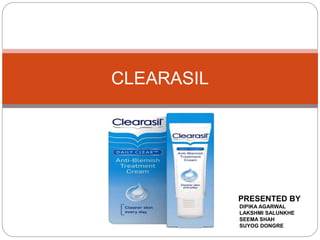
CLEARASIL
PRESENTED BY
DIPIKA AGARWAL
LAKSHMI SALUNKHE
SEEMA SHAH
SUYOG DONGRE
In 2006,
Skincare brand Clearasil
Parent company Boots
Healthcare International (BHI)
Currently,
Purchased by Reckitt Benckiser, Inc.
(British multinational consumer
goods company headquartered
in Slough, England. It is a producer of
health, hygiene and home products)
#4 Young Skin Care (YSC) brand in the U.S.
The management team is improving its performance, trying to achieve by
overtaking Clean & Clear in the next five years
#3
I N T R O D U C T I O N
P R O D U C T P O RT F O L I O , TA R G E T C O N S U M E R S & P O S I T I O N I N G
E V O L U T I O N
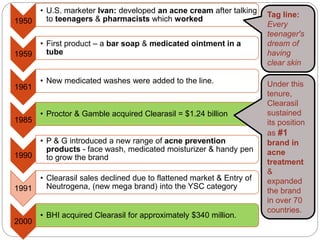
1950
• U.S. marketer Ivan: developed an acne cream after talking
to teenagers & pharmacists which worked
1959
• First product – a bar soap & medicated ointment in a
tube
1961
• New medicated washes were added to the line.
1985
• Proctor & Gamble acquired Clearasil = $1.24 billion
1990
• P & G introduced a new range of acne prevention
products - face wash, medicated moisturizer & handy pen
to grow the brand
1991
• Clearasil sales declined due to flattened market & Entry of
Neutrogena, (new mega brand) into the YSC category
2000
• BHI acquired Clearasil for approximately $340 million.
Tag line:
Every
teenager's
dream of
having
clear skin
Under this
tenure,
Clearasil
sustained
its position
as #1
brand in
acne
treatment
&
expanded
the brand
in over 70
countries.
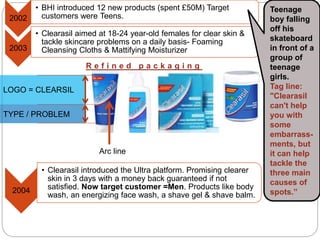
2002
• BHI introduced 12 new products (spent £50M) Target
customers were Teens.
2003
• Clearasil aimed at 18-24 year-old females for clear skin &
tackle skincare problems on a daily basis- Foaming
Cleansing Cloths & Mattifying Moisturizer
Teenage
boy falling
off his
skateboard
in front of a
group of
teenage
girls.
Tag line:
"Clearasil
can't help
you with
some
embarrass-
ments, but
it can help
tackle the
three main
causes of
spots.”
R e f i n e d p a c k a g i n g
Arc line
LOGO = CLEARSIL
TYPE / PROBLEM
2004
• Clearasil introduced the Ultra platform. Promising clearer
skin in 3 days with a money back guaranteed if not
satisfied. Now target customer =Men. Products like body
wash, an energizing face wash, a shave gel & shave balm.
2005
• Poor sales performance. To overcome, they introduced new products =
Clearasil Daily Oil Control (OC) with green tea and peppermint.
2006
• Clearasil Daily Blackhead Control (BHC) with natural sea salt, were
launched.
C o l o u r s c h e m e s
Oil Control (2005)
Blackhead control (2006)
= blue & purple= green
to attract more
females
BHI was purchased by Reckitt Benckiser & now Clearasil is a part of the RB
portfolio.
2007
• RB updated Clearasil’s look, feel & name. New products launched -
Clearasil Deep Cleansing Scrub, and Ultra Acne System Solutions & Ultra
Acne Clearing Gel Wash.
L o o k , F e e l & N a m e
more prominent blue
Daily Facial Scrub Deep Cleansing Scrub
Tag line: “Clearer Skin, All Day, Every
Day,” were intended to connect with
consumers seeking a product to maintain
healthy looking skin & prevent breakouts.
2008
• Due to poor sales performance - Clearasil Blackhead Control & Oil Control
were discontinued.
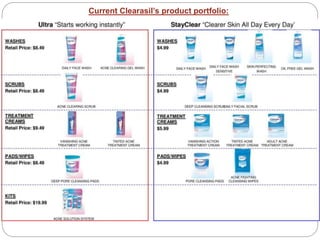
Current Clearasil’s product portfolio:
MARKETING COMMUNICATION
• In 1957, Clearasil made advertising as: second brand to sponsor the popular
teenage dance and music TV show American Bandstand with the “Jet-a-way
Sweepstakes,”
• In 2004 the executives at BHI realized that more than half of teens spent a
considerable amount of time online, so they launched an online snowboard
simulation game that used geo-targeting and content management tools that
allowed players to see a specific version of the game based on their location.
• In 2005 - 2007, the core brand message “Clearasil gives clear skin for the important
moments in life” focused more on everyday scenarios.
• “May Cause Confidence” Campaign continued in 2008 with two spots supporting the
launch of new Stay Clear products.
The marketing support behind the this campaign consists of TV, brand website and
market entry sampling.
KEY CONSUMER NEEDS BY AGE
 Treatment vs. Prevention
• Market segmentation:- 50% of market = BOTH treat and prevent skin conditions
 Consumers Psychographic Segments
• 2 psychographic segments –
 Higher anxiety consumers = they want to get rid of it as fast as they can
 Lower anxiety consumers = believe daily skin maintenance
 SATISFIED CUSTOMERS  UNSATISFIED CUSTOMERS
POSITIONING / STRATEGY
The YSC market is expected to become more competitive with expansive new
business models, new segment entries and various brands :
 Proactiv :-
Target Customer = 16-35 year old males and 14-40 year old females.
 Neutrogena :-
Target Customer = only females.
 Clean & Clear :-
Target Customer = younger females aged 12-24.
 Clearasil :-
Emphasis has changed over the years. It started out with
Target Customer =
• Teen-aged 11-17
• Young adults aged 18-24
• Its sales equally from male & female consumers
THE YOUNG SKIN CARE MARKET
Washes
42%
Scrubs
23%
Treatments
15%
Pads
/Wipes
10%
Kits
10%
Clearsil
8%
Neutrogena
22%
Proactiv
22%
Clean &
clear
16%
Biore
4%
Acne free
4%
Noxzema
3%
Oxy
3%
Stridex
2%
Others
16%
The total U.S. YSC
market in 2008 is
estimated at $1.13
billion (estimate based
on Nielsen scanning
and panel data) in retail
sales
Clearasil

Clearasil

  • 1.
    CLEARASIL PRESENTED BY DIPIKA AGARWAL LAKSHMISALUNKHE SEEMA SHAH SUYOG DONGRE
  • 2.
    In 2006, Skincare brandClearasil Parent company Boots Healthcare International (BHI) Currently, Purchased by Reckitt Benckiser, Inc. (British multinational consumer goods company headquartered in Slough, England. It is a producer of health, hygiene and home products) #4 Young Skin Care (YSC) brand in the U.S. The management team is improving its performance, trying to achieve by overtaking Clean & Clear in the next five years #3 I N T R O D U C T I O N
  • 3.
    P R OD U C T P O RT F O L I O , TA R G E T C O N S U M E R S & P O S I T I O N I N G E V O L U T I O N
  • 4.
    1950 • U.S. marketerIvan: developed an acne cream after talking to teenagers & pharmacists which worked 1959 • First product – a bar soap & medicated ointment in a tube 1961 • New medicated washes were added to the line. 1985 • Proctor & Gamble acquired Clearasil = $1.24 billion 1990 • P & G introduced a new range of acne prevention products - face wash, medicated moisturizer & handy pen to grow the brand 1991 • Clearasil sales declined due to flattened market & Entry of Neutrogena, (new mega brand) into the YSC category 2000 • BHI acquired Clearasil for approximately $340 million. Tag line: Every teenager's dream of having clear skin Under this tenure, Clearasil sustained its position as #1 brand in acne treatment & expanded the brand in over 70 countries.
  • 5.
    2002 • BHI introduced12 new products (spent £50M) Target customers were Teens. 2003 • Clearasil aimed at 18-24 year-old females for clear skin & tackle skincare problems on a daily basis- Foaming Cleansing Cloths & Mattifying Moisturizer Teenage boy falling off his skateboard in front of a group of teenage girls. Tag line: "Clearasil can't help you with some embarrass- ments, but it can help tackle the three main causes of spots.” R e f i n e d p a c k a g i n g Arc line LOGO = CLEARSIL TYPE / PROBLEM 2004 • Clearasil introduced the Ultra platform. Promising clearer skin in 3 days with a money back guaranteed if not satisfied. Now target customer =Men. Products like body wash, an energizing face wash, a shave gel & shave balm.
  • 6.
    2005 • Poor salesperformance. To overcome, they introduced new products = Clearasil Daily Oil Control (OC) with green tea and peppermint. 2006 • Clearasil Daily Blackhead Control (BHC) with natural sea salt, were launched. C o l o u r s c h e m e s Oil Control (2005) Blackhead control (2006) = blue & purple= green to attract more females BHI was purchased by Reckitt Benckiser & now Clearasil is a part of the RB portfolio.
  • 7.
    2007 • RB updatedClearasil’s look, feel & name. New products launched - Clearasil Deep Cleansing Scrub, and Ultra Acne System Solutions & Ultra Acne Clearing Gel Wash. L o o k , F e e l & N a m e more prominent blue Daily Facial Scrub Deep Cleansing Scrub Tag line: “Clearer Skin, All Day, Every Day,” were intended to connect with consumers seeking a product to maintain healthy looking skin & prevent breakouts. 2008 • Due to poor sales performance - Clearasil Blackhead Control & Oil Control were discontinued.
  • 8.
  • 9.
    MARKETING COMMUNICATION • In1957, Clearasil made advertising as: second brand to sponsor the popular teenage dance and music TV show American Bandstand with the “Jet-a-way Sweepstakes,” • In 2004 the executives at BHI realized that more than half of teens spent a considerable amount of time online, so they launched an online snowboard simulation game that used geo-targeting and content management tools that allowed players to see a specific version of the game based on their location. • In 2005 - 2007, the core brand message “Clearasil gives clear skin for the important moments in life” focused more on everyday scenarios.
  • 10.
    • “May CauseConfidence” Campaign continued in 2008 with two spots supporting the launch of new Stay Clear products. The marketing support behind the this campaign consists of TV, brand website and market entry sampling.
  • 11.
    KEY CONSUMER NEEDSBY AGE  Treatment vs. Prevention • Market segmentation:- 50% of market = BOTH treat and prevent skin conditions  Consumers Psychographic Segments • 2 psychographic segments –  Higher anxiety consumers = they want to get rid of it as fast as they can  Lower anxiety consumers = believe daily skin maintenance  SATISFIED CUSTOMERS  UNSATISFIED CUSTOMERS
  • 12.
  • 13.
    The YSC marketis expected to become more competitive with expansive new business models, new segment entries and various brands :  Proactiv :- Target Customer = 16-35 year old males and 14-40 year old females.  Neutrogena :- Target Customer = only females.  Clean & Clear :- Target Customer = younger females aged 12-24.  Clearasil :- Emphasis has changed over the years. It started out with Target Customer = • Teen-aged 11-17 • Young adults aged 18-24 • Its sales equally from male & female consumers
  • 14.
    THE YOUNG SKINCARE MARKET Washes 42% Scrubs 23% Treatments 15% Pads /Wipes 10% Kits 10% Clearsil 8% Neutrogena 22% Proactiv 22% Clean & clear 16% Biore 4% Acne free 4% Noxzema 3% Oxy 3% Stridex 2% Others 16% The total U.S. YSC market in 2008 is estimated at $1.13 billion (estimate based on Nielsen scanning and panel data) in retail sales