• Energy Drives the Economy


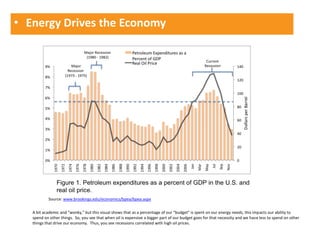
           Source: www.brookings.edu/economics/bpea/bpea.aspx


   A bit academic and “wonky,” but this visual shows that as a percentage of our “budget” is spent on our energy needs, this impacts our ability to
   spend on other things. So, you see that when oil is expensive a bigger part of our budget goes for that necessity and we have less to spend on other
   things that drive our economy. Thus, you see recessions correlated with high oil prices.
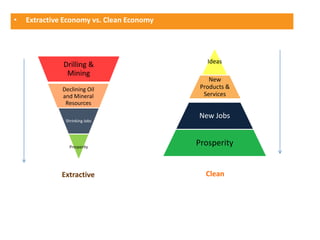
•   Extractive Economy vs. Clean Economy


                                              Ideas
              Drilling &
               Mining
                                               New
              Declining Oil                 Products &
              and Mineral                    Services
               Resources

                                           New Jobs
               Shrinking Jobs


                Prosperity
                                           Prosperity


              Extractive                     Clean
• Extractive Economy vs. Clean Economy


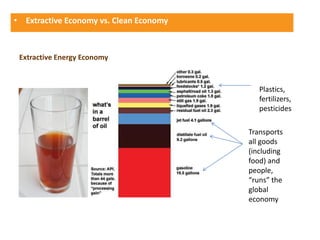
 Extractive Energy Economy


                                            Plastics,
                                            fertilizers,
                                            pesticides

                                         Transports
                                         all goods
                                         (including
                                         food) and
                                         people,
                                         “runs” the
                                         global
                                         economy
•   Extractive  Taking from a declining source
•   Extractive: Not if, but when….


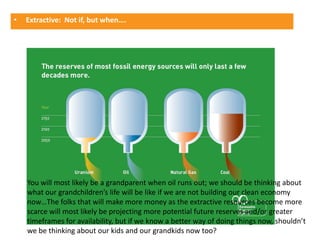
    You will most likely be a grandparent when oil runs out; we should be thinking about
    what our grandchildren’s life will be like if we are not building our clean economy
    now…The folks that will make more money as the extractive resources become more
    scarce will most likely be projecting more potential future reserves and/or greater
    timeframes for availability, but if we know a better way of doing things now, shouldn’t
    we be thinking about our kids and our grandkids now too?
• Clean  Taking from a replenishing source
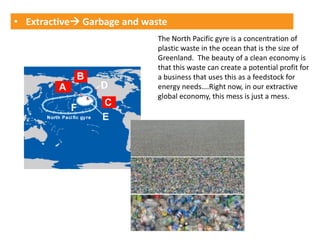
• Extractive Garbage and waste
                             The North Pacific gyre is a concentration of
                             plastic waste in the ocean that is the size of
                             Greenland. The beauty of a clean economy is
                             that this waste can create a potential profit for
                             a business that uses this as a feedstock for
                             energy needs….Right now, in our extractive
                             global economy, this mess is just a mess.
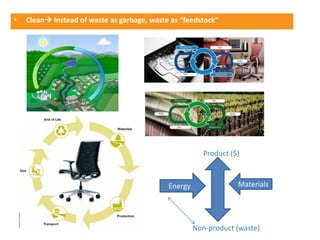
•   Clean Instead of waste as garbage, waste as “feedstock”


                                                         Product ($)


                                             Energy                Materials


                                                      Non-product (waste)
•   Notes for previous slide


                The visual in the bottom right-hand of the slide is the “core” principle in
                sustainability. Maximizing energy efficiency and minimizing waste
                creates increased product and thus increased profits. As an added
                “bonus,” waste itself can be converted into energy with the right
                systems and technology. The overall beauty of a cyclical approach to
                business production models is that they mirror the cyclical way that the
                earth “functions,” making us a responsible part of our planet.
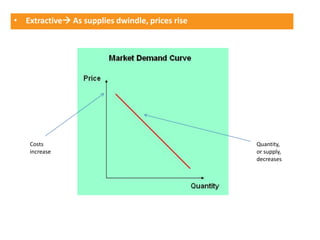
• Extractive As supplies dwindle, prices rise


    Costs                                        Quantity,
    increase                                     or supply,
                                                 decreases
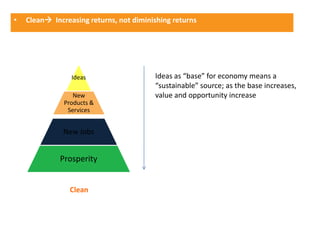
•   Clean Increasing returns, not diminishing returns


                 Ideas                   Ideas as “base” for economy means a
                                         “sustainable” source; as the base increases,
                  New                    value and opportunity increase
               Products &
                Services


              New Jobs


             Prosperity


                Clean
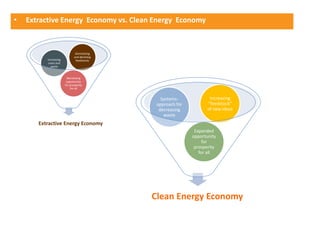
•   Extractive Energy Economy vs. Clean Energy Economy


                               Diminishing
                              and declining
          Increasing           feedstocks
           costs and
             waste


                        Decreasing
                        opportunity
                       for prosperity
                           for all


                                                 Systems-             Increasing
                                               approach for          “feedstock”
                                                decreasing           of new ideas
                                                  waste
       Extractive Energy Economy
                                                               Expanded
                                                              opportunity
                                                                  for
                                                               prosperity
                                                                 for all


                                              Clean Energy Economy
•   The Extractive Economy: Huge Potential Threat
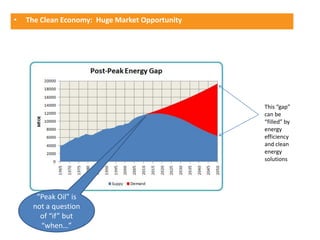
•   The Clean Economy: Huge Market Opportunity


                                                 This “gap”
                                                 can be
                                                 “filled” by
                                                 energy
                                                 efficiency
                                                 and clean
                                                 energy
                                                 solutions


      “Peak Oil” is
     not a question
       of “if” but
       “when…”
•   Notes for previous slide


                       We have a better way to do things…if you had the choice to
                       ride across country in a horse and buggy or to ride across
                       country in a horse-less carriage (what we called cars back
                       when autos were the competition) which would you pick?
                       “Alternative” energy is a recognition that clean, renewable
                       sources of energy are the competition for extractive energy,
                       but it is a choice that an informed person will likely make
                       when given the options. This movement towards clean
                       energy is so important when we realize that as oil and other
                       extractive energy feedstocks decline, there will not be enough
                       available to meet growing demand. This gap between
                       available resources and need can be made up by providing
                       other sources of non-extracted energy and energy efficiency
                       measures (getting more “bang for our buck” from the energy
                       we are using).
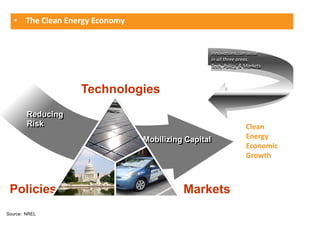
• The Clean Energy Economy


                                                     Innovations can occur
                                                     in all three areas:
                                                     Tech, Policy, & Markets


                   Technologies
        Reducing
        Risk                                                         Clean
                                Mobilizing Capital                   Energy
                                                                     Economic
                                                                     Growth


 Policies                                 Markets
Source: NREL
•   Notes for previous slide


                   Technology: Innovation usually occurs in the lab, more efficient
                   solar cells, better designs for wind power (jet stream), etc.
                   Policies: Innovation example: Property Assessed Clean Energy
                   (PACE) where up front costs are paid for by the city, and paid back
                   through property taxes (like property assessments that goes
                   towards the public good of streetlights and sidewalks)
                   Markets: Innovation example: Power Purchase Agreement (PPA)
                   where a company (manufacturing factory, for example) would
                   agree to purchase power from the solar company that installs the
                   building’s solar system at a set rate for a set number of years, and
                   the solar company finances the up-front costs of the system itself.
                   WE DO NOT HAVE TO WAIT FOR “TECHNOLOGY” DEVELOPMENTS
                   TO ADDRESS THE “HIGH COST” ISSUE….Would you pay for your
                   $250K house in cash up front? There is a better way to do
                   things…
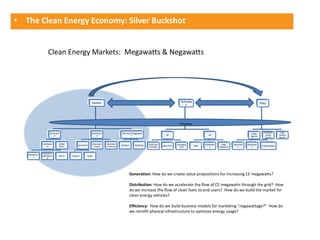
• The Clean Energy Economy: Silver Buckshot


                      Clean Energy Markets: Megawatts & Negawatts


                                                             Markets                                                                          Technolog
                                                                                                                                                                                                                   Policy
                                                                                                                                                  y


                                                                                                                                             Finance

                        Generatio                            Distributio                Efficiency/”Negawatts                                                                                                         Entrepren       Low-
                                                                                                                                                                                                         RE/EE
                           n                                      n                                ”                              RE                               EE                                                   eurial       Carbon
                                                                                                                                                                                                        Specific
                                                                                                                                                                                                                       Specific      Specific

                Distribute      Utility                      Alternativ    Alternativ                             EERE Tech                Emerging             IT/Softwar    Bldg.      Generatio   Distributio
                                                Smart Grid                              Services      Materials                Nano Tech                  AMI                                                       Transportation
                     d          Scale                         e Fuels      e Vehicles                              Portfolio                 Tech                    e       Materials      n             n

                Commerci
   Residentia
                al/Industri     Micro     Physical       Cyber
        l
                     al


                                                                                                   Generation: How do we create value propositions for increasing CE megawatts?

                                                                                                   Distribution: How do we accelerate the flow of CE megawatts through the grid? How
                                                                                                   do we increase the flow of clean fuels to end users? How do we build the market for
                                                                                                   clean energy vehicles?

                                                                                                   Efficiency: How do we build business models for marketing “negawattage?” How do
                                                                                                   we retrofit physical infrastructure to optimize energy usage?
•      Notes for previous slide


    oClean Energy is complex and there is no “silver bullet” it is “silver buckshot.”

    oMost big energy companies have a minute fraction of their business that they invest in clean energy sources, but many have speculated that
    these companies are simply waiting to see what clean energy will be the “silver bullet” and that then they will acquire it. The problem is that in
    the meantime, these same companies from the extractive industry don’t really have much “skin in the game” yet and it could be argued that they
    therefore still are protecting their extractive resource strategy as this is where their profits come from. When added to a very real perspective
    that there will never really be a silver bullet solution, it becomes increasingly difficult to expect that extractive energy interests are going to
    change their business model.

    oWe are asking horse-and-buggy manufacturers to “play nice” with Henry Ford. The great opportunity in this complex landscape is that each of
    these types of businesses can create demand for jobs….and if we can figure out how to re-train, or “retrofit” the extractive energy professionals
    and technicians, we can have a win-win…while the CEO at BP might not be able to do what he does in this new economy, many hard-working
    employees could potentially have a “new relationship” with energy (aside, we are already talking with folks from oil & gas who are interested in
    Ecotech programs…individuals are smart, “people” sometimes aren’t….)

    oWe know that the many people already employed in this new, clean energy economy are within much smaller companies than transnational
    extractive corporations. This is another win-win in terms of the great opportunity in this space, which such diversity…and we also have large
    corporations like GE and others that are actually growing their divisions for CE within their organizations.

    oOn a broad scale though, it is still a “David vs. Goliath” picture when comparing PNLs…(profit and loss statements)…as an aside, because of the
    $5B that just U.S. extractive energy companies get in “subsidies” every year, when one looks at BP’s books, for example, their reporting of their
    profits is not actually representative of their fiscal value…

    CE Markets= finance in the form of investments, etc…
    CE Technology = finance in the form of R&D grants, etc…
    CE Policy= finance in the form of political contributions, etc….
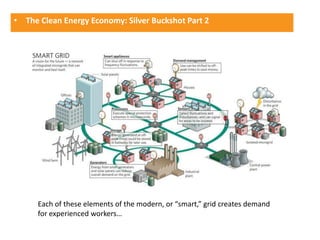
• The Clean Energy Economy: Silver Buckshot Part 2


      Each of these elements of the modern, or “smart,” grid creates demand
      for experienced workers…
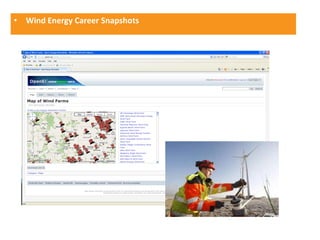
• Wind Energy Career Snapshots
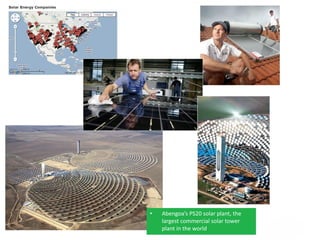
•   Abengoa’s PS20 solar plant, the
    largest commercial solar tower
    plant in the world.
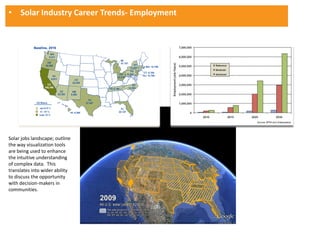
• Solar Industry Career Trends- Employment


Solar jobs landscape; outline
the way visualization tools
are being used to enhance
the intuitive understanding
of complex data. This
translates into wider ability
to discuss the opportunity
with decision-makers in
communities.
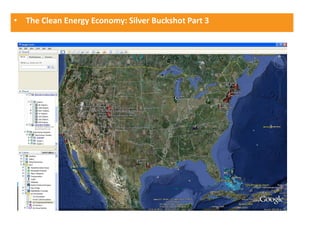
• The Clean Energy Economy: Silver Buckshot Part 3

Clean Economy 101_Notes

  • 1.
    • Energy Drivesthe Economy Source: www.brookings.edu/economics/bpea/bpea.aspx A bit academic and “wonky,” but this visual shows that as a percentage of our “budget” is spent on our energy needs, this impacts our ability to spend on other things. So, you see that when oil is expensive a bigger part of our budget goes for that necessity and we have less to spend on other things that drive our economy. Thus, you see recessions correlated with high oil prices.
  • 2.
    Extractive Economy vs. Clean Economy Ideas Drilling & Mining New Declining Oil Products & and Mineral Services Resources New Jobs Shrinking Jobs Prosperity Prosperity Extractive Clean
  • 3.
    • Extractive Economyvs. Clean Economy Extractive Energy Economy Plastics, fertilizers, pesticides Transports all goods (including food) and people, “runs” the global economy
  • 4.
    Extractive  Taking from a declining source
  • 5.
    Extractive: Not if, but when…. You will most likely be a grandparent when oil runs out; we should be thinking about what our grandchildren’s life will be like if we are not building our clean economy now…The folks that will make more money as the extractive resources become more scarce will most likely be projecting more potential future reserves and/or greater timeframes for availability, but if we know a better way of doing things now, shouldn’t we be thinking about our kids and our grandkids now too?
  • 6.
    • Clean Taking from a replenishing source
  • 7.
    • Extractive Garbageand waste The North Pacific gyre is a concentration of plastic waste in the ocean that is the size of Greenland. The beauty of a clean economy is that this waste can create a potential profit for a business that uses this as a feedstock for energy needs….Right now, in our extractive global economy, this mess is just a mess.
  • 8.
    Clean Instead of waste as garbage, waste as “feedstock” Product ($) Energy Materials Non-product (waste)
  • 9.
    Notes for previous slide The visual in the bottom right-hand of the slide is the “core” principle in sustainability. Maximizing energy efficiency and minimizing waste creates increased product and thus increased profits. As an added “bonus,” waste itself can be converted into energy with the right systems and technology. The overall beauty of a cyclical approach to business production models is that they mirror the cyclical way that the earth “functions,” making us a responsible part of our planet.
  • 10.
    • Extractive Assupplies dwindle, prices rise Costs Quantity, increase or supply, decreases
  • 11.
    Clean Increasing returns, not diminishing returns Ideas Ideas as “base” for economy means a “sustainable” source; as the base increases, New value and opportunity increase Products & Services New Jobs Prosperity Clean
  • 12.
    Extractive Energy Economy vs. Clean Energy Economy Diminishing and declining Increasing feedstocks costs and waste Decreasing opportunity for prosperity for all Systems- Increasing approach for “feedstock” decreasing of new ideas waste Extractive Energy Economy Expanded opportunity for prosperity for all Clean Energy Economy
  • 13.
    The Extractive Economy: Huge Potential Threat
  • 14.
    The Clean Economy: Huge Market Opportunity This “gap” can be “filled” by energy efficiency and clean energy solutions “Peak Oil” is not a question of “if” but “when…”
  • 15.
    Notes for previous slide We have a better way to do things…if you had the choice to ride across country in a horse and buggy or to ride across country in a horse-less carriage (what we called cars back when autos were the competition) which would you pick? “Alternative” energy is a recognition that clean, renewable sources of energy are the competition for extractive energy, but it is a choice that an informed person will likely make when given the options. This movement towards clean energy is so important when we realize that as oil and other extractive energy feedstocks decline, there will not be enough available to meet growing demand. This gap between available resources and need can be made up by providing other sources of non-extracted energy and energy efficiency measures (getting more “bang for our buck” from the energy we are using).
  • 16.
    • The CleanEnergy Economy Innovations can occur in all three areas: Tech, Policy, & Markets Technologies Reducing Risk Clean Mobilizing Capital Energy Economic Growth Policies Markets Source: NREL
  • 17.
    Notes for previous slide Technology: Innovation usually occurs in the lab, more efficient solar cells, better designs for wind power (jet stream), etc. Policies: Innovation example: Property Assessed Clean Energy (PACE) where up front costs are paid for by the city, and paid back through property taxes (like property assessments that goes towards the public good of streetlights and sidewalks) Markets: Innovation example: Power Purchase Agreement (PPA) where a company (manufacturing factory, for example) would agree to purchase power from the solar company that installs the building’s solar system at a set rate for a set number of years, and the solar company finances the up-front costs of the system itself. WE DO NOT HAVE TO WAIT FOR “TECHNOLOGY” DEVELOPMENTS TO ADDRESS THE “HIGH COST” ISSUE….Would you pay for your $250K house in cash up front? There is a better way to do things…
  • 18.
    • The CleanEnergy Economy: Silver Buckshot Clean Energy Markets: Megawatts & Negawatts Markets Technolog Policy y Finance Generatio Distributio Efficiency/”Negawatts Entrepren Low- RE/EE n n ” RE EE eurial Carbon Specific Specific Specific Distribute Utility Alternativ Alternativ EERE Tech Emerging IT/Softwar Bldg. Generatio Distributio Smart Grid Services Materials Nano Tech AMI Transportation d Scale e Fuels e Vehicles Portfolio Tech e Materials n n Commerci Residentia al/Industri Micro Physical Cyber l al Generation: How do we create value propositions for increasing CE megawatts? Distribution: How do we accelerate the flow of CE megawatts through the grid? How do we increase the flow of clean fuels to end users? How do we build the market for clean energy vehicles? Efficiency: How do we build business models for marketing “negawattage?” How do we retrofit physical infrastructure to optimize energy usage?
  • 19.
    Notes for previous slide oClean Energy is complex and there is no “silver bullet” it is “silver buckshot.” oMost big energy companies have a minute fraction of their business that they invest in clean energy sources, but many have speculated that these companies are simply waiting to see what clean energy will be the “silver bullet” and that then they will acquire it. The problem is that in the meantime, these same companies from the extractive industry don’t really have much “skin in the game” yet and it could be argued that they therefore still are protecting their extractive resource strategy as this is where their profits come from. When added to a very real perspective that there will never really be a silver bullet solution, it becomes increasingly difficult to expect that extractive energy interests are going to change their business model. oWe are asking horse-and-buggy manufacturers to “play nice” with Henry Ford. The great opportunity in this complex landscape is that each of these types of businesses can create demand for jobs….and if we can figure out how to re-train, or “retrofit” the extractive energy professionals and technicians, we can have a win-win…while the CEO at BP might not be able to do what he does in this new economy, many hard-working employees could potentially have a “new relationship” with energy (aside, we are already talking with folks from oil & gas who are interested in Ecotech programs…individuals are smart, “people” sometimes aren’t….) oWe know that the many people already employed in this new, clean energy economy are within much smaller companies than transnational extractive corporations. This is another win-win in terms of the great opportunity in this space, which such diversity…and we also have large corporations like GE and others that are actually growing their divisions for CE within their organizations. oOn a broad scale though, it is still a “David vs. Goliath” picture when comparing PNLs…(profit and loss statements)…as an aside, because of the $5B that just U.S. extractive energy companies get in “subsidies” every year, when one looks at BP’s books, for example, their reporting of their profits is not actually representative of their fiscal value… CE Markets= finance in the form of investments, etc… CE Technology = finance in the form of R&D grants, etc… CE Policy= finance in the form of political contributions, etc….
  • 20.
    • The CleanEnergy Economy: Silver Buckshot Part 2 Each of these elements of the modern, or “smart,” grid creates demand for experienced workers…
  • 21.
    • Wind EnergyCareer Snapshots
  • 22.
    Abengoa’s PS20 solar plant, the largest commercial solar tower plant in the world.
  • 23.
    • Solar IndustryCareer Trends- Employment Solar jobs landscape; outline the way visualization tools are being used to enhance the intuitive understanding of complex data. This translates into wider ability to discuss the opportunity with decision-makers in communities.
  • 24.
    • The CleanEnergy Economy: Silver Buckshot Part 3