ORTHOPAEDIC DEPARTMENT
SÖDERSJUKHUSET, STOCKHOLM, SWEDEN
HENRIK ILLERSTRÖM, M.D.
CLAVICLE FRACTURES
Clavicle Fractures
Clavicle Fractures Classification
• Allman: Medial – Midshaft – Lateral/distal
• Nordqvist & Petersson
• Craig
• Edingburgh
• Neer
Clavicle Fractures
• 3% of all fractures
• Midshaft fractures 80%
• Distal (or lateral) fractures 15%
• Medial fractures <5%
Medial Clavicle Fractures
• Risk for neurovascular damage
• Often epiphyseal separation (open until 30 y)
• Stability of fracture by the costo-clavicular lig.
• Preferably no surgery if undisplaced and no risk
for underlying structures
Lateral Clavicle Fractures
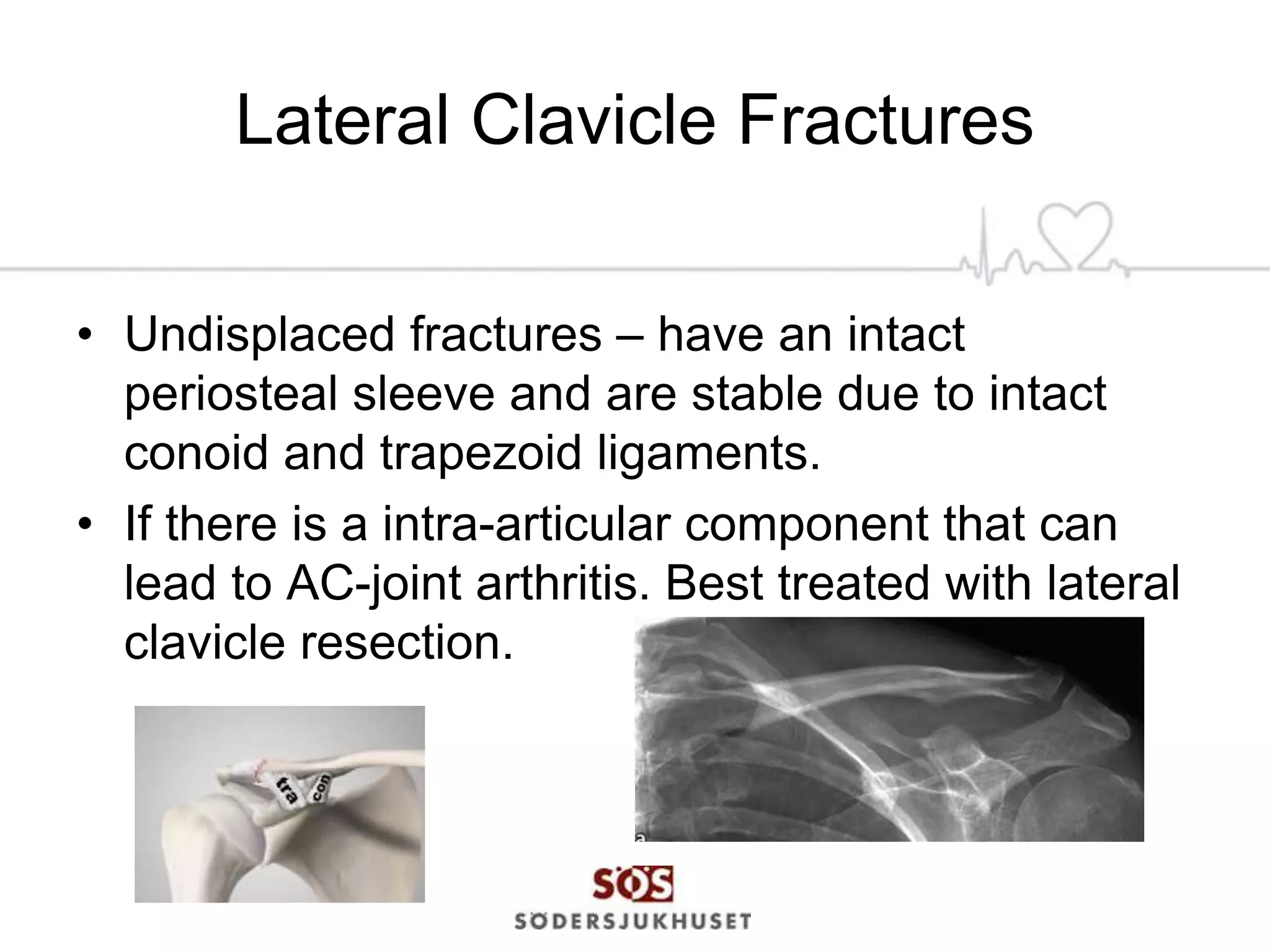
• Undisplaced fractures – have an intact
periosteal sleeve and are stable due to intact
conoid and trapezoid ligaments.
• If there is a intra-articular component that can
lead to AC-joint arthritis. Best treated with lateral
clavicle resection.
Lateral Clavicle Fractures
• Displaced fractures usually needs surgery
• Conservative treatment => 33% non-union
• Operative treatment => 6% non-union (Review -
Oh et al 2011)
• Increased incidence among elderly – tolerate
non-union reasonably well
Lateral Clavicle Fractures
• Hook-plate – removal after union >3months
Lateral Clavicle Fractures
• Contured locking plates, >2-3 screws in lateral
fragment
Lateral Clavicle Fractures
• Coraco-clavicular screw
• Sutures and or ligament grafts
• Needles and pins…
And now to the controversial part…
Mid Shaft Clavicular Fractures
2 weeks
Mid Shaft Clavicular Fractures
• Undisplaced – non-operatively
• Conservative treatment – sling or figure of 8
bandage. No evidence for either. (Andersen et al
1987, Cochrane-Lenza et al 2009)
• Displaced – surgery or not…
Displaced Mid Shaft Clavicular
Fractures surgery or not?
• Cochrane review (Lenza et al 2013) of 8 RCTs
show low evidence. No difference between
surgery or conseravtive treatment. No QoL
• McKee 2012, meta-analysis of 6 RCTs show
lower rate of non-union and symtomatic
malunion and earlier functional return compared
to conseravtive treatment. Little evidence for
significantly improved long-term functional
outcome for surgery vs conservative treatment
More
• RCT Virtanen ET al 2012 no difference at one
year follow-up Constant and DASH scores. Poor
scores associated with non-union
• RCT Robinson et al 2013 showed significantly
less reported dissatisfaction after surgery but no
difference in Constant/DASH scores. High NNT,
>6 to prevent 1 non-union
Displaced Mid Shaft Clavicular
Fractures – surgical methods
• Plates
– Stable,Comminution
– Prominence
– Wound complications
• Pins
– Less invasive
– Less prominence
– Less control/stability
Displaced Mid Shaft Clavicular
Fractures – Conclusion
• Individualize for each patient
• Early return – Surgery
• Large displacement >2cm, Z-fragment – Surgery
• Communition – Plate
• No surgery – high risk for non-union (up to 23%)
• Surgery – high risk of complications (up to 48%)
– mostly hardware related (McKee 2012)
Thank you!

Clavicle Fractures - A review

  • 1.
    ORTHOPAEDIC DEPARTMENT SÖDERSJUKHUSET, STOCKHOLM,SWEDEN HENRIK ILLERSTRÖM, M.D. CLAVICLE FRACTURES
  • 2.
  • 3.
    Clavicle Fractures Classification •Allman: Medial – Midshaft – Lateral/distal • Nordqvist & Petersson • Craig • Edingburgh • Neer
  • 4.
    Clavicle Fractures • 3%of all fractures • Midshaft fractures 80% • Distal (or lateral) fractures 15% • Medial fractures <5%
  • 5.
    Medial Clavicle Fractures •Risk for neurovascular damage • Often epiphyseal separation (open until 30 y) • Stability of fracture by the costo-clavicular lig. • Preferably no surgery if undisplaced and no risk for underlying structures
  • 6.
    Lateral Clavicle Fractures •Undisplaced fractures – have an intact periosteal sleeve and are stable due to intact conoid and trapezoid ligaments. • If there is a intra-articular component that can lead to AC-joint arthritis. Best treated with lateral clavicle resection.
  • 7.
    Lateral Clavicle Fractures •Displaced fractures usually needs surgery • Conservative treatment => 33% non-union • Operative treatment => 6% non-union (Review - Oh et al 2011) • Increased incidence among elderly – tolerate non-union reasonably well
  • 8.
    Lateral Clavicle Fractures •Hook-plate – removal after union >3months
  • 9.
    Lateral Clavicle Fractures •Contured locking plates, >2-3 screws in lateral fragment
  • 10.
    Lateral Clavicle Fractures •Coraco-clavicular screw • Sutures and or ligament grafts • Needles and pins…
  • 11.
    And now tothe controversial part…
  • 12.
  • 13.
    Mid Shaft ClavicularFractures 2 weeks
  • 14.
    Mid Shaft ClavicularFractures • Undisplaced – non-operatively • Conservative treatment – sling or figure of 8 bandage. No evidence for either. (Andersen et al 1987, Cochrane-Lenza et al 2009) • Displaced – surgery or not…
  • 15.
    Displaced Mid ShaftClavicular Fractures surgery or not? • Cochrane review (Lenza et al 2013) of 8 RCTs show low evidence. No difference between surgery or conseravtive treatment. No QoL • McKee 2012, meta-analysis of 6 RCTs show lower rate of non-union and symtomatic malunion and earlier functional return compared to conseravtive treatment. Little evidence for significantly improved long-term functional outcome for surgery vs conservative treatment
  • 16.
    More • RCT VirtanenET al 2012 no difference at one year follow-up Constant and DASH scores. Poor scores associated with non-union • RCT Robinson et al 2013 showed significantly less reported dissatisfaction after surgery but no difference in Constant/DASH scores. High NNT, >6 to prevent 1 non-union
  • 17.
    Displaced Mid ShaftClavicular Fractures – surgical methods • Plates – Stable,Comminution – Prominence – Wound complications • Pins – Less invasive – Less prominence – Less control/stability
  • 18.
    Displaced Mid ShaftClavicular Fractures – Conclusion • Individualize for each patient • Early return – Surgery • Large displacement >2cm, Z-fragment – Surgery • Communition – Plate • No surgery – high risk for non-union (up to 23%) • Surgery – high risk of complications (up to 48%) – mostly hardware related (McKee 2012)
  • 19.