DevianceAndConformity
GROUP#1
22011516-002
22011516-004
22011516-036
22011516-046
22011516-056
22011516-066
22011516-068
22011516-084
22011516-106
Roll#22011516-084
SOCIAL
DEVIANCE
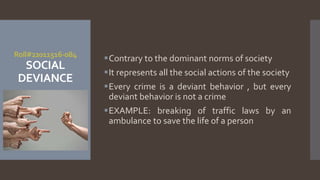
Contrary to the dominant norms of society
It represents all the social actions of the society
Every crime is a deviant behavior , but every
deviant behavior is not a crime
EXAMPLE: breaking of traffic laws by an
ambulance to save the life of a person
TYPESOF
CRIMES  Crimes Against Persons: it is also known as Personal crime
like robbery, rape ,murder and aggravated assault
 They are unevenly distributed in the united states where
young, urban, poor and racial minorities commits these
crimes
 Crimes Against Property: involve theft of property without
bodily harm, such as burglary , auto theft and arson like
personal crimes, young ,urban ,poor and racial minorities
generally commits these crimes more than others
Roll#22011516-068
TYPESOF
CRIMES
 Crimes Against Morality: they are called victimless
crimes because there is no complainant ,or victim
 Examples: illegal drug, illegal gambling and
prostitution
 White Collar Crime: Crimes that are committed by
people of high social status who commits their crimes
in the context of their occupation
 Examples: securities fraud ,embezzlement, money
laundering and corporate fraud
Roll#22011516-004
TYPESOF
CRIMES
 Organized Crime: It is a crime committed by
structured groups involving the distribution of
illegal goods and services to others
 Examples: drugs , weapons, illicit goods and
armed robbery
FUNCTIONS
OF DEVIANCE
 It clarifies norms and increases conformity
 Strengthens social bonds among people
reacting to the deviant
 It can help lead to positive social change
 It bring people together
 Encourage social change
 Clarify moral boundaries
Roll#22011516-106
Robert. K
MeronsTheory
of Deviance
OR
SocialStrain
Theory
 Developed by Robert K. Merton in 1938
 Society puts pressure on individuals to achieve socially accepted goals
even though they lack the means to do so
 The role of culture, versus social structure
 It is an analysis of the relationship between culture ,structure and
anomie
 According to the theory, people were expected to pursue this goal
through legitimate means such as education and work
 The dominant cultural message was if you are ambitious , talented and
work hard then income and wealth is the reward
 Merton developed the concept of anomie to describe this imbalance
between cultural goals and institutionalized means
 He argued that such an imbalanced society produces anomie-there is a
strain or tension between the goals and means which produce
unsatisfied aspirations
Roll#22011516-036
ADAPTATIOS
TOSTRAIN
 Merton argued that when individuals are faced with a gap
between their goals and their current status, strain occurs
 People have five ways to adopt:
 Conformity: pursing cultural goals through society
approved goals
 Innovation: unapproved or unconventional means to
obtain culturally approved goals
Example: Dealing drugs or stealing to achieve financial
security
 Ritualism: Using the same socially approved means to
achieved less elusive goals
Roll#22011516-066
ADAPTATIOS
TOSTRAIN
 Retreatism: To reject the both cultural goals and the
means to obtain it, then find a way to escape it
 Rebellion: To reject the cultural goals and means, then
work to replace them
Examples:
 conformist (teacher , doctor)
 Innovators (dealing drugs or stealing to meet financial
needs ,a thief)
 Ritualists ( a student without career plan)
 Rebellion ( terrorist, mass shooters)
 Retreatists ( a homeless person)
Roll#22011516-046
CONFORMITY
 Tendency to align your altitudes , beliefs and
behaviors with those around you
 It is a powerful force that can take the form of
overt social pressure or subtler unconscious
influence
 Conformity involves changing your behaviors in
order to fit in or go along with the people go
around
 It is the process in which people change their
beliefs, attitudes , actions or perceptions to
more closely match those held by groups to
which they belong or by groups whose
approval they desire
Roll#22011516-056
WHY DOWE
CONFORM?
 Researchers have found that people conform
for a different reasons
 In many cases looking to the rest of the group
for clues for how we should behave can actually
be helpful
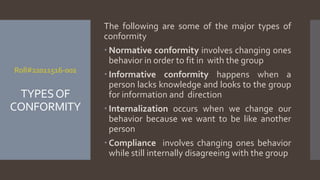
Roll#22011516-002
TYPESOF
CONFORMITY
The following are some of the major types of
conformity
 Normative conformity involves changing ones
behavior in order to fit in with the group
 Informative conformity happens when a
person lacks knowledge and looks to the group
for information and direction
 Internalization occurs when we change our
behavior because we want to be like another
person
 Compliance involves changing ones behavior
while still internally disagreeing with the group
THANKYOU

Deviance And Conformity.pptx

  • 1.
  • 2.
    Roll#22011516-084 SOCIAL DEVIANCE Contrary to thedominant norms of society It represents all the social actions of the society Every crime is a deviant behavior , but every deviant behavior is not a crime EXAMPLE: breaking of traffic laws by an ambulance to save the life of a person
  • 3.
    TYPESOF CRIMES  CrimesAgainst Persons: it is also known as Personal crime like robbery, rape ,murder and aggravated assault  They are unevenly distributed in the united states where young, urban, poor and racial minorities commits these crimes  Crimes Against Property: involve theft of property without bodily harm, such as burglary , auto theft and arson like personal crimes, young ,urban ,poor and racial minorities generally commits these crimes more than others
  • 4.
    Roll#22011516-068 TYPESOF CRIMES  Crimes AgainstMorality: they are called victimless crimes because there is no complainant ,or victim  Examples: illegal drug, illegal gambling and prostitution  White Collar Crime: Crimes that are committed by people of high social status who commits their crimes in the context of their occupation  Examples: securities fraud ,embezzlement, money laundering and corporate fraud
  • 5.
    Roll#22011516-004 TYPESOF CRIMES  Organized Crime:It is a crime committed by structured groups involving the distribution of illegal goods and services to others  Examples: drugs , weapons, illicit goods and armed robbery
  • 6.
    FUNCTIONS OF DEVIANCE  Itclarifies norms and increases conformity  Strengthens social bonds among people reacting to the deviant  It can help lead to positive social change  It bring people together  Encourage social change  Clarify moral boundaries
  • 7.
    Roll#22011516-106 Robert. K MeronsTheory of Deviance OR SocialStrain Theory Developed by Robert K. Merton in 1938  Society puts pressure on individuals to achieve socially accepted goals even though they lack the means to do so  The role of culture, versus social structure  It is an analysis of the relationship between culture ,structure and anomie  According to the theory, people were expected to pursue this goal through legitimate means such as education and work  The dominant cultural message was if you are ambitious , talented and work hard then income and wealth is the reward  Merton developed the concept of anomie to describe this imbalance between cultural goals and institutionalized means  He argued that such an imbalanced society produces anomie-there is a strain or tension between the goals and means which produce unsatisfied aspirations
  • 8.
    Roll#22011516-036 ADAPTATIOS TOSTRAIN  Merton arguedthat when individuals are faced with a gap between their goals and their current status, strain occurs  People have five ways to adopt:  Conformity: pursing cultural goals through society approved goals  Innovation: unapproved or unconventional means to obtain culturally approved goals Example: Dealing drugs or stealing to achieve financial security  Ritualism: Using the same socially approved means to achieved less elusive goals
  • 9.
    Roll#22011516-066 ADAPTATIOS TOSTRAIN  Retreatism: Toreject the both cultural goals and the means to obtain it, then find a way to escape it  Rebellion: To reject the cultural goals and means, then work to replace them Examples:  conformist (teacher , doctor)  Innovators (dealing drugs or stealing to meet financial needs ,a thief)  Ritualists ( a student without career plan)  Rebellion ( terrorist, mass shooters)  Retreatists ( a homeless person)
  • 10.
    Roll#22011516-046 CONFORMITY  Tendency toalign your altitudes , beliefs and behaviors with those around you  It is a powerful force that can take the form of overt social pressure or subtler unconscious influence  Conformity involves changing your behaviors in order to fit in or go along with the people go around  It is the process in which people change their beliefs, attitudes , actions or perceptions to more closely match those held by groups to which they belong or by groups whose approval they desire
  • 11.
    Roll#22011516-056 WHY DOWE CONFORM?  Researchershave found that people conform for a different reasons  In many cases looking to the rest of the group for clues for how we should behave can actually be helpful
  • 12.
    Roll#22011516-002 TYPESOF CONFORMITY The following aresome of the major types of conformity  Normative conformity involves changing ones behavior in order to fit in with the group  Informative conformity happens when a person lacks knowledge and looks to the group for information and direction  Internalization occurs when we change our behavior because we want to be like another person  Compliance involves changing ones behavior while still internally disagreeing with the group
  • 13.