Nat Thorne
D.I.S.T.I.N.C.T
 Don’t
 Ignore
 Setting
 Technical Codes
 Iconography
 Narrative
 Characterisation
 Themes
Setting
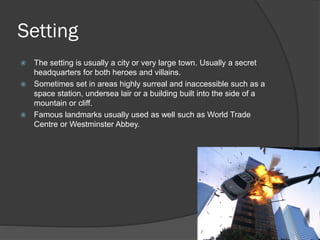
 The setting is usually a city or very large town. Usually a secret
headquarters for both heroes and villains.
 Sometimes set in areas highly surreal and inaccessible such as a
space station, undersea lair or a building built into the side of a
mountain or cliff.
 Famous landmarks usually used as well such as World Trade
Centre or Westminster Abbey.
Technical Codes
 To show the action surrounding people, usually a series of medium
shots and long shots are used. If the action surrounds one person
then usually a medium shot is focused on them and anything in
their radius. If the action surrounds a group of people or
vehicles, then long shots are used so that the action can be seen
around it.
 A lot of shots are hand held and shaken when explosions or
crashes occur in action films which connotes danger surrounding
the character.
 Shaking also connotes the collapse of a building if the action occurs
inside a building.
 When looking at the outside of a headquarters, especially a tall
HQ, then a wide shot is used and the camera tracks the building but
moves further away from it or moves further towards it.
Iconography
 A lot of the scenes take place during the day time. The
lighting is quite bright because the weather never really
tends to be bad in the action scenes of films.
 The destruction of buildings or vehicles identifies the action
genre further, along with guns and heavy war machinery
such as tanks or armed helicopters.
 The villain’s actions usually help us identify the action genre
as well because they usually develop some weapon that can
threaten the world in one way or another such as a nuclear
strike or WMD situated on a satellite in space.
Narrative Structure
 Todorov’s theory is applied to most action films in the narrative structure.
 The equilibrium is that there is the protagonist going about his job, whether
it be a normal everyday job or an actual ‘action man’ job.
 The disruption is usually the villain developing a plot to destroy or take over
some society or civilisation.
 The recognition of the disruption occurs when the plan of the villain starts to
take place and changes in normal day to day life occur.
 The attempt to repair the disruption is usually the protagonist who goes out
to find out the source of the disruption and finds a way to stop it from going
any further.
 The climax is usually a face off between the protagonist and the
antagonist, the antagonist is usually defeated and their plans are foiled.
 The new equilibrium is that a change has occurred in a society and it is just
accepted and life goes on or that the initial equilibrium returns and
everything is back to normal.
Character Types
 The protagonist, usually a ‘hench’, fearless He-man who goes all out to put
a stop to the antagonists actions.
 The antagonist is usually an evil and highly intelligent mastermind who has
a plot to affect a vast amount of people in some way. They don’t usually
match the stature of the protagonist but are intellectually superior.
 There is usually a ‘sidekick’ to both the protagonist and the antagonist. The
protagonist’s sidekick is usually treated more equally and is respected by
the protagonist, whereas the sidekick of the antagonist is usually a buffoon
who does everything the antagonist wishes without any say to the
occurrences of the plot.
 There is always a love interest to the protagonist who needs help in one
way or another by the protagonist because she is caused trouble by the
antagonist.
Themes
 World Domination
 War
 Terrorist Attacks
 Mass crimes or heists
 Disaster
 Greek or Roman Historical
 Government Plots
 Spies

Action Genre Conventions

  • 1.
  • 2.
    D.I.S.T.I.N.C.T  Don’t  Ignore Setting  Technical Codes  Iconography  Narrative  Characterisation  Themes
  • 3.
    Setting  The settingis usually a city or very large town. Usually a secret headquarters for both heroes and villains.  Sometimes set in areas highly surreal and inaccessible such as a space station, undersea lair or a building built into the side of a mountain or cliff.  Famous landmarks usually used as well such as World Trade Centre or Westminster Abbey.
  • 4.
    Technical Codes  Toshow the action surrounding people, usually a series of medium shots and long shots are used. If the action surrounds one person then usually a medium shot is focused on them and anything in their radius. If the action surrounds a group of people or vehicles, then long shots are used so that the action can be seen around it.  A lot of shots are hand held and shaken when explosions or crashes occur in action films which connotes danger surrounding the character.  Shaking also connotes the collapse of a building if the action occurs inside a building.  When looking at the outside of a headquarters, especially a tall HQ, then a wide shot is used and the camera tracks the building but moves further away from it or moves further towards it.
  • 5.
    Iconography  A lotof the scenes take place during the day time. The lighting is quite bright because the weather never really tends to be bad in the action scenes of films.  The destruction of buildings or vehicles identifies the action genre further, along with guns and heavy war machinery such as tanks or armed helicopters.  The villain’s actions usually help us identify the action genre as well because they usually develop some weapon that can threaten the world in one way or another such as a nuclear strike or WMD situated on a satellite in space.
  • 6.
    Narrative Structure  Todorov’stheory is applied to most action films in the narrative structure.  The equilibrium is that there is the protagonist going about his job, whether it be a normal everyday job or an actual ‘action man’ job.  The disruption is usually the villain developing a plot to destroy or take over some society or civilisation.  The recognition of the disruption occurs when the plan of the villain starts to take place and changes in normal day to day life occur.  The attempt to repair the disruption is usually the protagonist who goes out to find out the source of the disruption and finds a way to stop it from going any further.  The climax is usually a face off between the protagonist and the antagonist, the antagonist is usually defeated and their plans are foiled.  The new equilibrium is that a change has occurred in a society and it is just accepted and life goes on or that the initial equilibrium returns and everything is back to normal.
  • 7.
    Character Types  Theprotagonist, usually a ‘hench’, fearless He-man who goes all out to put a stop to the antagonists actions.  The antagonist is usually an evil and highly intelligent mastermind who has a plot to affect a vast amount of people in some way. They don’t usually match the stature of the protagonist but are intellectually superior.  There is usually a ‘sidekick’ to both the protagonist and the antagonist. The protagonist’s sidekick is usually treated more equally and is respected by the protagonist, whereas the sidekick of the antagonist is usually a buffoon who does everything the antagonist wishes without any say to the occurrences of the plot.  There is always a love interest to the protagonist who needs help in one way or another by the protagonist because she is caused trouble by the antagonist.
  • 8.
    Themes  World Domination War  Terrorist Attacks  Mass crimes or heists  Disaster  Greek or Roman Historical  Government Plots  Spies