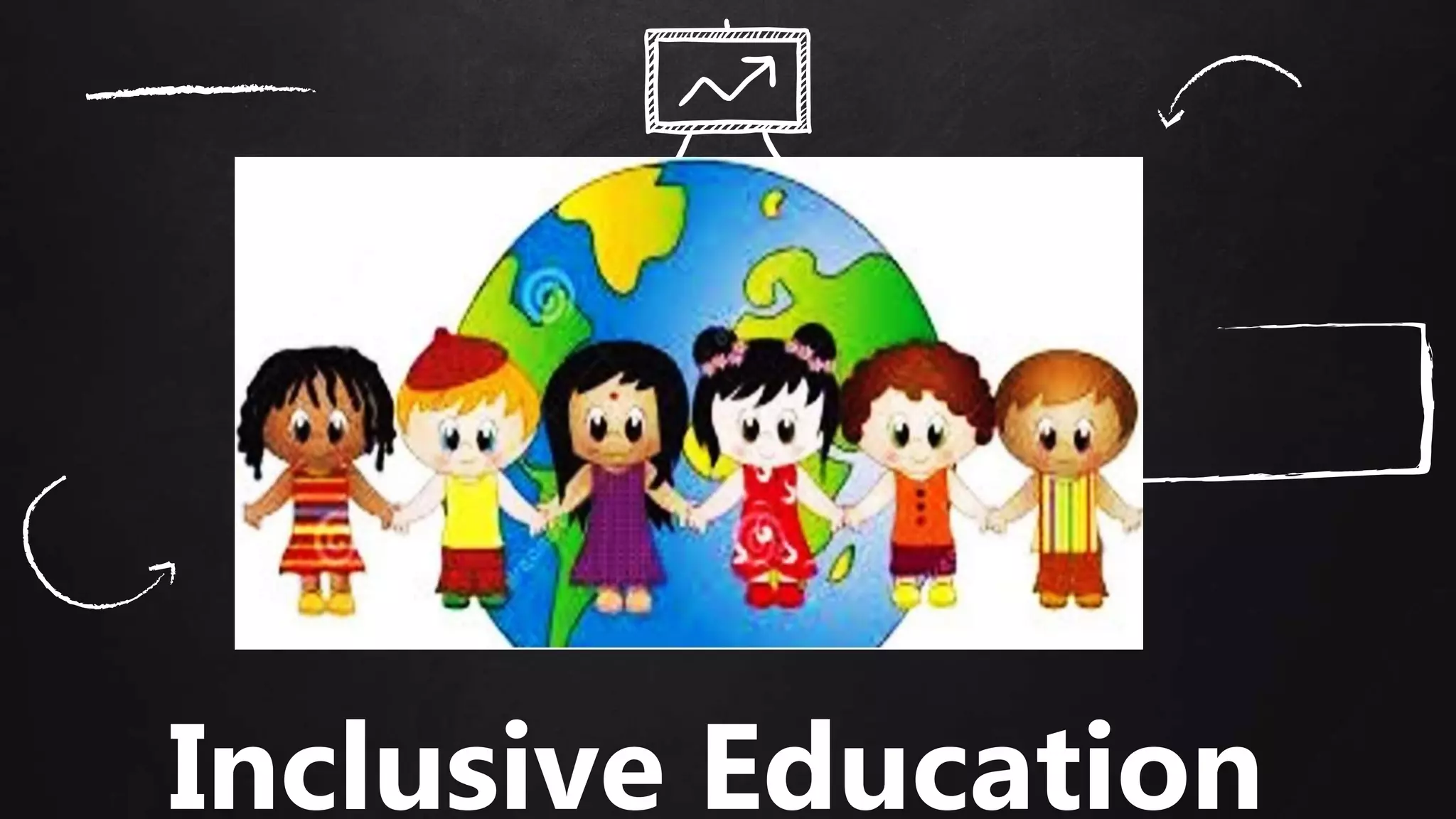
Inclusive Education
Rationale
BACKGROUND
Every child has the right to education
In the Philippines, about 15 million of the
estimated 100 million Filipinos have some form
of disability, wherein 50% are children (WHO,
2011)
In line with the thrust on access to quality
education, DepEd through the Student Inclusion
Division of the Bureau of Learning Delivery (BLD)
institutionalize the Special Education Program at
the elementary and secondary levels.
Vision: “A society in which ALL persons
regardless of their disabilities achieve
education to realize their full potential.”
POLICY STATEMENT: The right to education must be ensured for children, youth and adult learners with
special education needs (LSENs). Effective and efficient education services for LSENs will enable them to
develop their potentials to become well-rounded, happy and smart individuals who can contribute
meaningfully to the society.
2
Rationale
BACKGROUND
Insert videos of LSENs working
Ex. Restaurant, LGU, engineering company
3
Terminology and Definition of Disability
4
Body Functions: are the psychological
functions of the body systems, including the
psychological functions. “Body” refers to the
human organism as a whole, thus includes the
brain.
Body Structures: are the structural or
anatomical parts of the body.
Impairment: is a loss or abnormality in body
structure or physiological function (including
mental functions).
Activity: is the execution of a task of action by
an individual.
Activity limitations: are difficulties an
individual may have in executing activities.
Participation: is a person’s involvement in a
life situation. It represents societal perspective
of functioning.
Participation restrictions: are problems an
individual may experience in involvement in a
life situation.
Contextual factors: are the factors that
together constitute the complete context of an
individual’s life.
Environmental factors: include the physical
world and its features, the human made
physical factors, other people relationships,
roles, attitudes and values, social systems and
services, and policies, rules and laws.
Personal factors: age, gender, social
status, life experiences.
General Objectives
Identify the common characteristics of learners with various
difficulties.
Apply appropriate accommodation based on the needs of the
learners with difficulties.
Demonstrate instructional strategies in teaching learners with
these identified difficulties.
5
1.
LEARNERS with DIFFICULTY in
PERFORMING ADAPTIVE SKILLS
SESSION ON TEACHING
6
“
Every child has a different
learning style and pace. Each
child is unique, not only capable
of learning but also capable of
succeeding.
Robert John Meehan
7
relax
8
Raymond Macasaet
Gold Medalist, Swimming
9
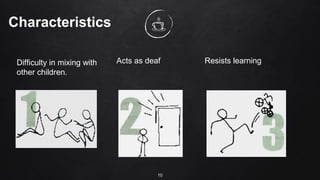
Characteristics
Difficulty in mixing with
other children.
Acts as deaf Resists learning
10
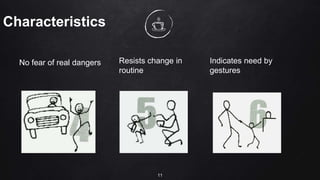
Characteristics
No fear of real dangers Resists change in
routine
Indicates need by
gestures
11
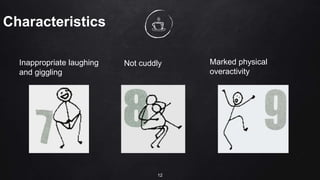
Characteristics
Inappropriate laughing
and giggling
Not cuddly Marked physical
overactivity
12
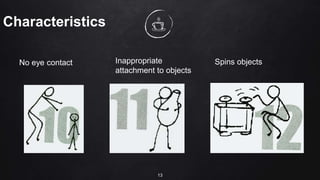
Characteristics
No eye contact Inappropriate
attachment to objects
Spins objects
13
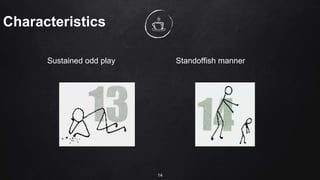
Characteristics
Sustained odd play Standoffish manner
14
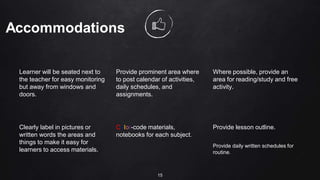
Learner will be seated next to
the teacher for easy monitoring
but away from windows and
doors.
Provide prominent area where
to post calendar of activities,
daily schedules, and
assignments.
Where possible, provide an
area for reading/study and free
activity.
Clearly label in pictures or
written words the areas and
things to make it easy for
learners to access materials.
Color-code materials,
notebooks for each subject.
Provide lesson outline.
Provide daily written schedules for
routine.
15
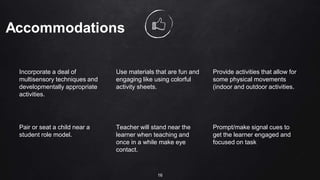
Incorporate a deal of
multisensory techniques and
developmentally appropriate
activities.
Use materials that are fun and
engaging like using colorful
activity sheets.
Provide activities that allow for
some physical movements
(indoor and outdoor activities.
Pair or seat a child near a
student role model.
Teacher will stand near the
learner when teaching and
once in a while make eye
contact.
Prompt/make signal cues to
get the learner engaged and
focused on task
16
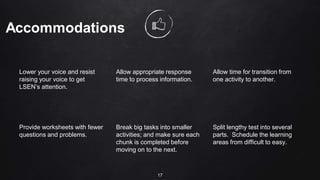
Lower your voice and resist
raising your voice to get
LSEN’s attention.
Allow appropriate response
time to process information.
Allow time for transition from
one activity to another.
Provide worksheets with fewer
questions and problems.
Break big tasks into smaller
activities; and make sure each
chunk is completed before
moving on to the next.
Split lengthy test into several
parts. Schedule the learning
areas from difficult to easy.
17
2.
LEARNERS with DIFFICULTY in
BASIC LEARNING and APPLYING
KNOWLEDGE
SESSION ON TEACHING
18
Guess Who I Am?
 He is an American actor and
producer. He was nominated
for three Academy Awards and
has won three Golden Globe
Awards. He started his career at
age 19 in the film Endless Love.
 But he has severe dyslexia
and calls himself
“functionally illiterate”
19
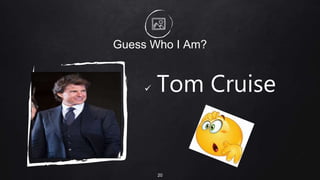
Guess Who I Am?
 Tom Cruise
20
Guess Who I Am?
 A German-born theoretical
physicist who developed the
theory of relativity, one of the
two pillars of modern physics
(alongside quantum
mechanics).
 He has a learning disability
and did not speak until age 3.
 He had a very difficult time
doing math in school. It was
also very hard for him to
21
Guess Who I Am?
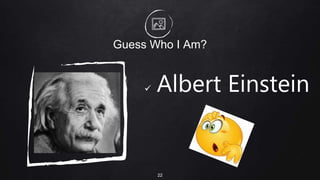
 Albert Einstein
22
Guess Who I Am?
 English actor best known for
his role as Harry Potter in the
film series of the same name.
 It is difficult for him to tie his
shoe lace. Handwriting also
continues to be a challenge
23
Guess Who I Am?
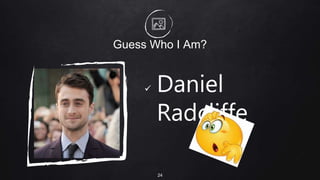
 Daniel
Radcliffe
24
Guess Who I Am?
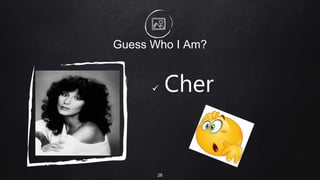
 Sometimes called the Goddess
of Pop, she has been described
as embodying female
autonomy in a male-dominated
industry.
 “I couldn’t read quickly
enough to get all my
homework done and for me,
math was like trying to
understand Sanskrit. The only
way I learned was by
25
Guess Who I Am?
 Cher
26
Guess Who I Am?
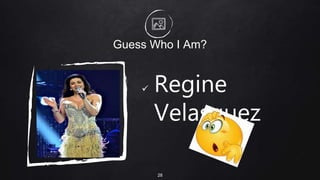
 Filipino singer, actress and
record producer. In the 1980s
she gained recognition by
winning the 1984 singing
contest, “Ang Bagong
Kampeon”
 “I’ve had it since birth. I
remember when I was
younger malabo yung mata
ko. Kasi bali-baligtad yung ‘v’
at ‘b’ ko. I can’t spell right. Di
27
Guess Who I Am?
 Regine
Velasquez
28
Difficulty in Basic Learning and Applying Knowledge
Difficulty in basic learning and applying knowledge represents
a difficulty in one or more of the basic learning processes
involved in understanding or using language, both spoken and
written that may manifest itself in an imperfect ability to listen,
speak, read, think, write, spell, or do mathematical calculations
(Leong, 1999; Snowling, 2005). Specific terms for these
difficulties may include difficulty in reading, in writing, in
counting and calculating; and in spelling.
29
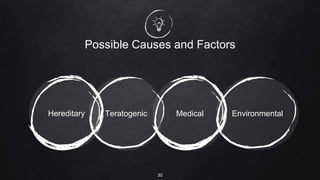
Possible Causes and Factors
Teratogenic Medical Environmental
30
Hereditary
Place your screenshot here
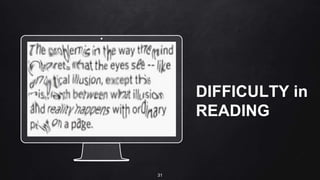
DIFFICULTY in
READING
31
relax
32
33
Difficulty in
Reading
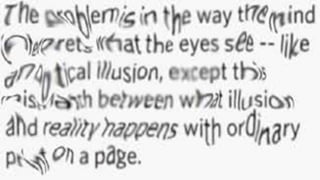
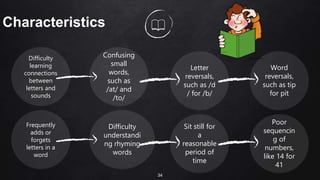
Dyslexia is a chronic neurological disorder and common learning
difficulty that can cause problems with reading, writing and spelling. It's a "specific
learning difficulty", which means it causes problems with certain abilities used for
learning, such as reading and writing. Unlike a learning disability, intelligence isn't
affected.
Often, dyslexic’s complain about seeing the word moving or waving. Sometimes
they just to see the word-it is missing for them. Some dyslexic’s have trouble
making sense of the symbols in our language because the letter may look one way
one time and another way the next time they come across them.
Difficulty
learning
connections
between
letters and
sounds
Confusing
small
words,
such as
/at/ and
/to/
Letter
reversals,
such as /d
/ for /b/
34
Characteristics
Word
reversals,
such as tip
for pit
Frequently
adds or
forgets
letters in a
word
Difficulty
understandi
ng rhyming
words
Sit still for
a
reasonable
period of
time
Poor
sequencin
g of
numbers,
like 14 for
41
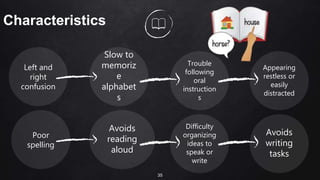
Left and
right
confusion
Slow to
memoriz
e
alphabet
s
Trouble
following
oral
instruction
s
35
Characteristics
Appearing
restless or
easily
distracted
Poor
spelling
Avoids
reading
aloud
Difficulty
organizing
ideas to
speak or
write
Avoids
writing
tasks
36
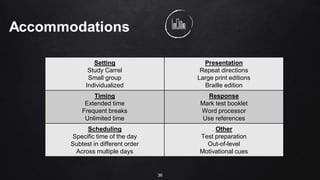
Setting
Study Carrel
Small group
Individualized
Presentation
Repeat directions
Large print editions
Braille edition
Timing
Extended time
Frequent breaks
Unlimited time
Response
Mark test booklet
Word processor
Use references
Scheduling
Specific time of the day
Subtest in different order
Across multiple days
Other
Test preparation
Out-of-level
Motivational cues
37
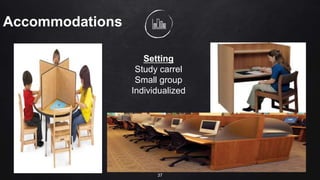
Accommodations
Setting
Study carrel
Small group
Individualized
38
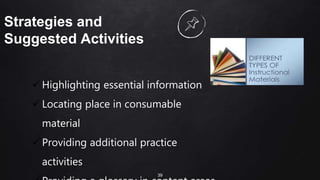
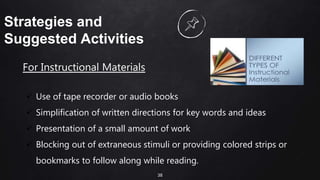
Strategies and
Suggested Activities
For Instructional Materials
 Use of tape recorder or audio books
 Simplification of written directions for key words and ideas
 Presentation of a small amount of work
 Blocking out of extraneous stimuli or providing colored strips or
bookmarks to follow along while reading.
39
Strategies and
Suggested Activities
 Highlighting essential information
 Locating place in consumable
material
 Providing additional practice
activities
40
Strategies and
Suggested Activities
For Performance
 Changing response mode
 Providing an outline of the lecture
 Using graphic organizers
 Using assignment books or calendars
 Providing readily-available handouts
41
Strategies and
Suggested Activities
For Interactive Instruction
 Using explicit teaching procedures
 Stick to consistent daily routines
 Repeating directions, then check to see if
learners understand
 Providing copy of lecture notes
 Providing learners with a graphic organizer
Place your screenshot here
DIFFICULTY in
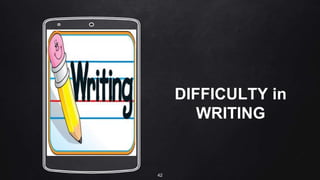
WRITING
42
43
Difficulty in
Writing
Dysgraphia is a transcription disability, meaning
that it is a writing disorder associated with impaired
handwriting, orthographic coding (orthography, the
storing process of written words and processing the
letters in those words), and finger sequencing (the
movement of muscles required to write).
44
Difficulty in
Writing
Dysgraphia is a transcription disability, meaning
that it is a writing disorder associated with impaired
handwriting, orthographic coding (orthography, the
storing process of written words and processing the
letters in those words), and finger sequencing (the
movement of muscles required to write).
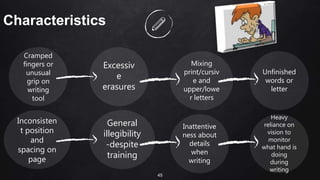
Cramped
fingers or
unusual
grip on
writing
tool
Excessiv
e
erasures
Mixing
print/cursiv
e and
upper/lowe
r letters
45
Characteristics
Unfinished
words or
letter
Inconsisten
t position
and
spacing on
page
General
illegibility
-despite
training
Inattentive
ness about
details
when
writing
Heavy
reliance on
vision to
monitor
what hand is
doing
during
writing
46
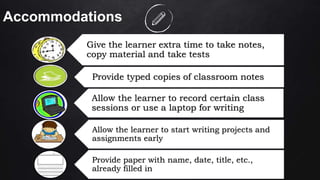
Accommodations
Give the learner extra time to take notes,
copy material and take tests
Provide typed copies of classroom notes
Allow the learner to record certain class
sessions or use a laptop for writing
Allow the learner to start writing projects and
assignments early
Provide paper with name, date, title, etc.,
already filled in
47
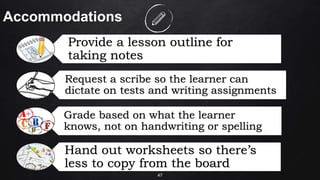
Accommodations
Provide a lesson outline for
taking notes
Request a scribe so the learner can
dictate on tests and writing assignments
Grade based on what the learner
knows, not on handwriting or spelling
Hand out worksheets so there’s
less to copy from the board
48
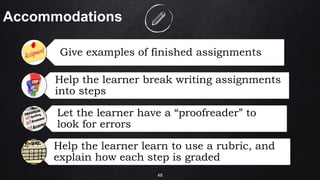
Accommodations
Give examples of finished assignments
Help the learner break writing assignments
into steps
Let the learner have a “proofreader” to
look for errors
Help the learner learn to use a rubric, and
explain how each step is graded
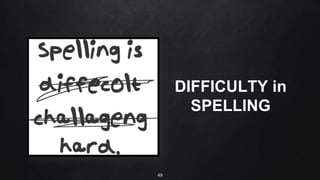
Place your screenshot here DIFFICULTY in
SPELLING
49
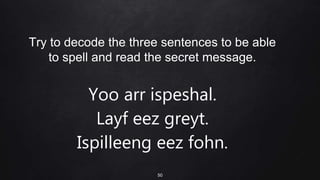
Try to decode the three sentences to be able
to spell and read the secret message.
50
Yoo arr ispeshal.
Layf eez greyt.
Ispilleeng eez fohn.
51
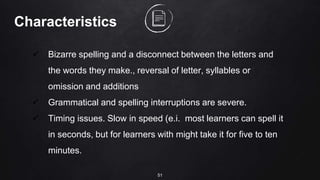
Characteristics
 Bizarre spelling and a disconnect between the letters and
the words they make., reversal of letter, syllables or
omission and additions
 Grammatical and spelling interruptions are severe.
 Timing issues. Slow in speed (e.i. most learners can spell it
in seconds, but for learners with might take it for five to ten
minutes.
52
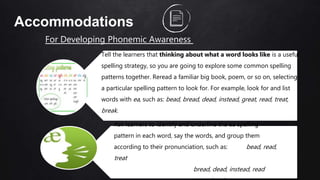
Accommodations
For Developing Phonemic Awareness
Tell the learners that thinking about what a word looks like is a useful
spelling strategy, so you are going to explore some common spelling
patterns together. Reread a familiar big book, poem, or so on, selecting
a particular spelling pattern to look for. For example, look for and list
words with ea, such as: bead, bread, dead, instead, great, read, treat,
break.
Ask learners to identify and underline the ea spelling
pattern in each word, say the words, and group them
according to their pronunciation, such as: bead, read,
treat
bread, dead, instead, read
Place your screenshot here
DIFFICULTY in
COUNTING &
CALCULATING
53
54
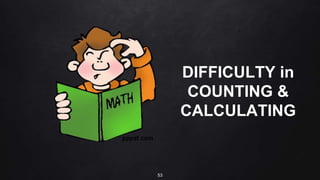
Difficulty in Counting
and Calculating
Dyscalculia is a specific learning disability
In math. Kids may have difficulty understanding
number-related concepts or using symbols or
functions
needed for success in mathematics.
55
Difficulty in Counting
and Calculating
Dyscalculia is a specific learning disability
In math. Kids may have difficulty understanding
number-related concepts or using symbols or
functions
needed for success in mathematics.
Skips
over
numbers
Has
trouble
recognizi
ng
number
symbols
May still
use fingers
to count
instead of
using more
advanced
strategies
56
Characteristics
Struggle to
understand
math-
related
words, such
as less than,
greater than
Has
difficulties
understandi
ng place
values
General
illegibility
-despite
training
Has
difficulty
measuring
things like
ingredients
in a recipe
Has trouble
finding
different
approaches
to the same
math
problem
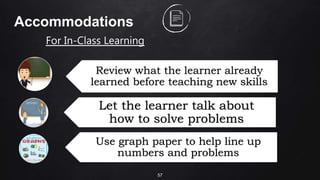
57
Accommodations
Review what the learner already
learned before teaching new skills
Let the learner talk about
how to solve problems
Use graph paper to help line up
numbers and problems
For In-Class Learning
58
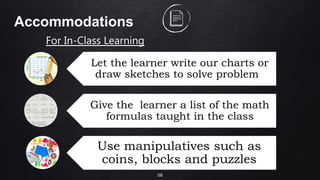
Accommodations
For In-Class Learning
Let the learner write our charts or
draw sketches to solve problems
Give the learner a list of the math
formulas taught in the class
Use manipulatives such as
coins, blocks and puzzles
59
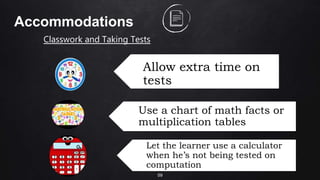
Accommodations
Classwork and Taking Tests
Allow extra time on
tests
Use a chart of math facts or
multiplication tables
Let the learner use a calculator
when he’s not being tested on
computation
3.
LEARNERS with DIFFICULTY in
COMMUNICATING
SESSION ON TEACHING
60
61
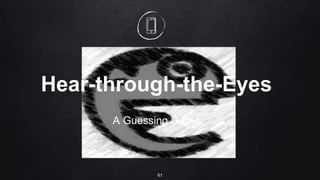
Hear-through-the-Eyes
A Guessing Game
62
Sorsogon City
63
legazpi City
64
caramoan
65
Sto. domingo
66
Cagsawa ruins
67
Naga regent hotel
68
Kawa-kawa
69
Misibis bay
70
COMMUNICATION
Communication is such a fundamental part of the human
experience. It entails interactive exchange of information, ideas,
feelings needs and desires.
Communication Difficulty/Disorder is a problem
in the ability to receive, send, process, and comprehend concepts
or verbal , nonverbal and graphic symbol systems. A
communication difficulty/disorder may be evident in the processes
of hearing, language and/or speech.
71
72
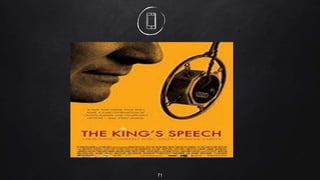
After watching the clip, give the conflict of
the story/movie?
What was the solution of the dilemma of the
king?
73
COMMUNICATION
Communication is such a fundamental part of the human
experience. It entails interactive exchange of information, ideas,
feelings needs and desires.
Communication Difficulty/Disorder is a problem in the ability to
receive, send, process, and comprehend concepts or verbal ,
nonverbal and graphic symbol systems. A communication
difficulty/disorder may be evident in the processes of hearing,
language and/or speech.
74
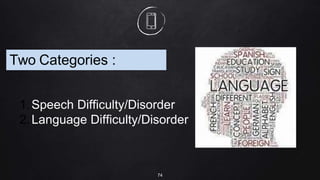
Two Categories :
1.Speech Difficulty/Disorder
2.Language Difficulty/Disorder
75
Speech Sound Error Characteristics
1. Distortions
‫ﻬ‬ learner distorts a spud usually caused by deficient oral motor skills
e.g. “thoup” for “soup”
2. Substitutions
‫ﻬ‬ learner substitutes a sound for another sound.
e.g. “wabbit” for “rabbit”
3. Omissions
‫ﻬ‬ learner drops (emits) a sound from a word.
e.g. “at” for “hat” or “bu” for “bug”
4. Additions
‫ﻬ‬ adds a sound that shouldn’t be there
e.g. “doga” for “dog”
76
77
78
2.
LEARNERS with DIFFICULTY in
BASIC LEARNING and APPLYING
KNOWLEDGE
SESSION ON TEACHING
79
80
Maps
our office
81
89,526,124
Whoa! That’s a big number, aren’t you proud?
82
89,526,124$
That’s a lot of money
100%
Total success!
185,244 users
And a lot of users
83
You can copy&paste graphs from Google Sheets
84
Android project
Show and explain your web,
app or software projects using
these gadget templates.
Place your screenshot here
85
Place your screenshot
here
iPhone project
Show and explain your web,
app or software projects using
these gadget templates.
86
Place your screenshot here
Tablet project
Show and explain your web,
app or software projects using
these gadget templates.
87
thanks!
Any questions?
You can find me at
@username
user@mailme
88
Credits
Special thanks to all the people who made and released
these awesome resources for free:
✘ Presentation template by SlidesCarnival
✘ Photographs by Unsplash
89
Presentation design
This presentation uses the following typographies:
✘ Titles: Walter Turncoat
✘ Body copy: Sniglet
You can download the fonts on these pages:
https://www.fontsquirrel.com/fonts/walter-turncoat
https://www.fontsquirrel.com/fonts/sniglet
You don’t need to keep this slide in your presentation. It’s only here to serve you as a design guide if you need to create
new slides or download the fonts to edit the presentation in PowerPoint®
90
SlidesCarnival icons are editable shapes.
This means that you can:
● Resize them without losing quality.
● Change fill color and opacity.
Isn’t that nice? :)
Examples:
91
Now you can use any emoji as an icon!
And of course it resizes without losing quality and you can change the color.
How? Follow Google instructions
https://twitter.com/googledocs/status/730087240156643328
✋👆👉👍👤👦👧👨👩👪💃🏃💑❤😂
😉😋😒😭👶😸🐟🍒🍔💣📌📖🔨🎃🎈
🎨🏈🏰🌏🔌🔑 and many more...
😉
92
Extra graphics
93

LAC-Session-Inclusive-Education-Autosaved-pptx.pptx

  • 1.
  • 2.
    Rationale BACKGROUND Every child hasthe right to education In the Philippines, about 15 million of the estimated 100 million Filipinos have some form of disability, wherein 50% are children (WHO, 2011) In line with the thrust on access to quality education, DepEd through the Student Inclusion Division of the Bureau of Learning Delivery (BLD) institutionalize the Special Education Program at the elementary and secondary levels. Vision: “A society in which ALL persons regardless of their disabilities achieve education to realize their full potential.” POLICY STATEMENT: The right to education must be ensured for children, youth and adult learners with special education needs (LSENs). Effective and efficient education services for LSENs will enable them to develop their potentials to become well-rounded, happy and smart individuals who can contribute meaningfully to the society. 2
  • 3.
    Rationale BACKGROUND Insert videos ofLSENs working Ex. Restaurant, LGU, engineering company 3
  • 4.
    Terminology and Definitionof Disability 4 Body Functions: are the psychological functions of the body systems, including the psychological functions. “Body” refers to the human organism as a whole, thus includes the brain. Body Structures: are the structural or anatomical parts of the body. Impairment: is a loss or abnormality in body structure or physiological function (including mental functions). Activity: is the execution of a task of action by an individual. Activity limitations: are difficulties an individual may have in executing activities. Participation: is a person’s involvement in a life situation. It represents societal perspective of functioning. Participation restrictions: are problems an individual may experience in involvement in a life situation. Contextual factors: are the factors that together constitute the complete context of an individual’s life. Environmental factors: include the physical world and its features, the human made physical factors, other people relationships, roles, attitudes and values, social systems and services, and policies, rules and laws. Personal factors: age, gender, social status, life experiences.
  • 5.
    General Objectives Identify thecommon characteristics of learners with various difficulties. Apply appropriate accommodation based on the needs of the learners with difficulties. Demonstrate instructional strategies in teaching learners with these identified difficulties. 5
  • 6.
    1. LEARNERS with DIFFICULTYin PERFORMING ADAPTIVE SKILLS SESSION ON TEACHING 6
  • 7.
    “ Every child hasa different learning style and pace. Each child is unique, not only capable of learning but also capable of succeeding. Robert John Meehan 7
  • 8.
  • 9.
  • 10.
    Characteristics Difficulty in mixingwith other children. Acts as deaf Resists learning 10
  • 11.
    Characteristics No fear ofreal dangers Resists change in routine Indicates need by gestures 11
  • 12.
    Characteristics Inappropriate laughing and giggling Notcuddly Marked physical overactivity 12
  • 13.
    Characteristics No eye contactInappropriate attachment to objects Spins objects 13
  • 14.
  • 15.
    Learner will beseated next to the teacher for easy monitoring but away from windows and doors. Provide prominent area where to post calendar of activities, daily schedules, and assignments. Where possible, provide an area for reading/study and free activity. Clearly label in pictures or written words the areas and things to make it easy for learners to access materials. Color-code materials, notebooks for each subject. Provide lesson outline. Provide daily written schedules for routine. 15
  • 16.
    Incorporate a dealof multisensory techniques and developmentally appropriate activities. Use materials that are fun and engaging like using colorful activity sheets. Provide activities that allow for some physical movements (indoor and outdoor activities. Pair or seat a child near a student role model. Teacher will stand near the learner when teaching and once in a while make eye contact. Prompt/make signal cues to get the learner engaged and focused on task 16
  • 17.
    Lower your voiceand resist raising your voice to get LSEN’s attention. Allow appropriate response time to process information. Allow time for transition from one activity to another. Provide worksheets with fewer questions and problems. Break big tasks into smaller activities; and make sure each chunk is completed before moving on to the next. Split lengthy test into several parts. Schedule the learning areas from difficult to easy. 17
  • 18.
    2. LEARNERS with DIFFICULTYin BASIC LEARNING and APPLYING KNOWLEDGE SESSION ON TEACHING 18
  • 19.
    Guess Who IAm?  He is an American actor and producer. He was nominated for three Academy Awards and has won three Golden Globe Awards. He started his career at age 19 in the film Endless Love.  But he has severe dyslexia and calls himself “functionally illiterate” 19
  • 20.
    Guess Who IAm?  Tom Cruise 20
  • 21.
    Guess Who IAm?  A German-born theoretical physicist who developed the theory of relativity, one of the two pillars of modern physics (alongside quantum mechanics).  He has a learning disability and did not speak until age 3.  He had a very difficult time doing math in school. It was also very hard for him to 21
  • 22.
    Guess Who IAm?  Albert Einstein 22
  • 23.
    Guess Who IAm?  English actor best known for his role as Harry Potter in the film series of the same name.  It is difficult for him to tie his shoe lace. Handwriting also continues to be a challenge 23
  • 24.
    Guess Who IAm?  Daniel Radcliffe 24
  • 25.
    Guess Who IAm?  Sometimes called the Goddess of Pop, she has been described as embodying female autonomy in a male-dominated industry.  “I couldn’t read quickly enough to get all my homework done and for me, math was like trying to understand Sanskrit. The only way I learned was by 25
  • 26.
    Guess Who IAm?  Cher 26
  • 27.
    Guess Who IAm?  Filipino singer, actress and record producer. In the 1980s she gained recognition by winning the 1984 singing contest, “Ang Bagong Kampeon”  “I’ve had it since birth. I remember when I was younger malabo yung mata ko. Kasi bali-baligtad yung ‘v’ at ‘b’ ko. I can’t spell right. Di 27
  • 28.
    Guess Who IAm?  Regine Velasquez 28
  • 29.
    Difficulty in BasicLearning and Applying Knowledge Difficulty in basic learning and applying knowledge represents a difficulty in one or more of the basic learning processes involved in understanding or using language, both spoken and written that may manifest itself in an imperfect ability to listen, speak, read, think, write, spell, or do mathematical calculations (Leong, 1999; Snowling, 2005). Specific terms for these difficulties may include difficulty in reading, in writing, in counting and calculating; and in spelling. 29
  • 30.
    Possible Causes andFactors Teratogenic Medical Environmental 30 Hereditary
  • 31.
    Place your screenshothere DIFFICULTY in READING 31
  • 32.
  • 33.
    33 Difficulty in Reading Dyslexia isa chronic neurological disorder and common learning difficulty that can cause problems with reading, writing and spelling. It's a "specific learning difficulty", which means it causes problems with certain abilities used for learning, such as reading and writing. Unlike a learning disability, intelligence isn't affected. Often, dyslexic’s complain about seeing the word moving or waving. Sometimes they just to see the word-it is missing for them. Some dyslexic’s have trouble making sense of the symbols in our language because the letter may look one way one time and another way the next time they come across them.
  • 34.
    Difficulty learning connections between letters and sounds Confusing small words, such as /at/and /to/ Letter reversals, such as /d / for /b/ 34 Characteristics Word reversals, such as tip for pit Frequently adds or forgets letters in a word Difficulty understandi ng rhyming words Sit still for a reasonable period of time Poor sequencin g of numbers, like 14 for 41
  • 35.
    Left and right confusion Slow to memoriz e alphabet s Trouble following oral instruction s 35 Characteristics Appearing restlessor easily distracted Poor spelling Avoids reading aloud Difficulty organizing ideas to speak or write Avoids writing tasks
  • 36.
    36 Setting Study Carrel Small group Individualized Presentation Repeatdirections Large print editions Braille edition Timing Extended time Frequent breaks Unlimited time Response Mark test booklet Word processor Use references Scheduling Specific time of the day Subtest in different order Across multiple days Other Test preparation Out-of-level Motivational cues
  • 37.
  • 38.
    38 Strategies and Suggested Activities ForInstructional Materials  Use of tape recorder or audio books  Simplification of written directions for key words and ideas  Presentation of a small amount of work  Blocking out of extraneous stimuli or providing colored strips or bookmarks to follow along while reading.
  • 39.
    39 Strategies and Suggested Activities Highlighting essential information  Locating place in consumable material  Providing additional practice activities
  • 40.
    40 Strategies and Suggested Activities ForPerformance  Changing response mode  Providing an outline of the lecture  Using graphic organizers  Using assignment books or calendars  Providing readily-available handouts
  • 41.
    41 Strategies and Suggested Activities ForInteractive Instruction  Using explicit teaching procedures  Stick to consistent daily routines  Repeating directions, then check to see if learners understand  Providing copy of lecture notes  Providing learners with a graphic organizer
  • 42.
    Place your screenshothere DIFFICULTY in WRITING 42
  • 43.
    43 Difficulty in Writing Dysgraphia isa transcription disability, meaning that it is a writing disorder associated with impaired handwriting, orthographic coding (orthography, the storing process of written words and processing the letters in those words), and finger sequencing (the movement of muscles required to write).
  • 44.
    44 Difficulty in Writing Dysgraphia isa transcription disability, meaning that it is a writing disorder associated with impaired handwriting, orthographic coding (orthography, the storing process of written words and processing the letters in those words), and finger sequencing (the movement of muscles required to write).
  • 45.
    Cramped fingers or unusual grip on writing tool Excessiv e erasures Mixing print/cursiv eand upper/lowe r letters 45 Characteristics Unfinished words or letter Inconsisten t position and spacing on page General illegibility -despite training Inattentive ness about details when writing Heavy reliance on vision to monitor what hand is doing during writing
  • 46.
    46 Accommodations Give the learnerextra time to take notes, copy material and take tests Provide typed copies of classroom notes Allow the learner to record certain class sessions or use a laptop for writing Allow the learner to start writing projects and assignments early Provide paper with name, date, title, etc., already filled in
  • 47.
    47 Accommodations Provide a lessonoutline for taking notes Request a scribe so the learner can dictate on tests and writing assignments Grade based on what the learner knows, not on handwriting or spelling Hand out worksheets so there’s less to copy from the board
  • 48.
    48 Accommodations Give examples offinished assignments Help the learner break writing assignments into steps Let the learner have a “proofreader” to look for errors Help the learner learn to use a rubric, and explain how each step is graded
  • 49.
    Place your screenshothere DIFFICULTY in SPELLING 49
  • 50.
    Try to decodethe three sentences to be able to spell and read the secret message. 50 Yoo arr ispeshal. Layf eez greyt. Ispilleeng eez fohn.
  • 51.
    51 Characteristics  Bizarre spellingand a disconnect between the letters and the words they make., reversal of letter, syllables or omission and additions  Grammatical and spelling interruptions are severe.  Timing issues. Slow in speed (e.i. most learners can spell it in seconds, but for learners with might take it for five to ten minutes.
  • 52.
    52 Accommodations For Developing PhonemicAwareness Tell the learners that thinking about what a word looks like is a useful spelling strategy, so you are going to explore some common spelling patterns together. Reread a familiar big book, poem, or so on, selecting a particular spelling pattern to look for. For example, look for and list words with ea, such as: bead, bread, dead, instead, great, read, treat, break. Ask learners to identify and underline the ea spelling pattern in each word, say the words, and group them according to their pronunciation, such as: bead, read, treat bread, dead, instead, read
  • 53.
    Place your screenshothere DIFFICULTY in COUNTING & CALCULATING 53
  • 54.
    54 Difficulty in Counting andCalculating Dyscalculia is a specific learning disability In math. Kids may have difficulty understanding number-related concepts or using symbols or functions needed for success in mathematics.
  • 55.
    55 Difficulty in Counting andCalculating Dyscalculia is a specific learning disability In math. Kids may have difficulty understanding number-related concepts or using symbols or functions needed for success in mathematics.
  • 56.
    Skips over numbers Has trouble recognizi ng number symbols May still use fingers tocount instead of using more advanced strategies 56 Characteristics Struggle to understand math- related words, such as less than, greater than Has difficulties understandi ng place values General illegibility -despite training Has difficulty measuring things like ingredients in a recipe Has trouble finding different approaches to the same math problem
  • 57.
    57 Accommodations Review what thelearner already learned before teaching new skills Let the learner talk about how to solve problems Use graph paper to help line up numbers and problems For In-Class Learning
  • 58.
    58 Accommodations For In-Class Learning Letthe learner write our charts or draw sketches to solve problems Give the learner a list of the math formulas taught in the class Use manipulatives such as coins, blocks and puzzles
  • 59.
    59 Accommodations Classwork and TakingTests Allow extra time on tests Use a chart of math facts or multiplication tables Let the learner use a calculator when he’s not being tested on computation
  • 60.
    3. LEARNERS with DIFFICULTYin COMMUNICATING SESSION ON TEACHING 60
  • 61.
  • 62.
  • 63.
  • 64.
  • 65.
  • 66.
  • 67.
  • 68.
  • 69.
  • 70.
    70 COMMUNICATION Communication is sucha fundamental part of the human experience. It entails interactive exchange of information, ideas, feelings needs and desires. Communication Difficulty/Disorder is a problem in the ability to receive, send, process, and comprehend concepts or verbal , nonverbal and graphic symbol systems. A communication difficulty/disorder may be evident in the processes of hearing, language and/or speech.
  • 71.
  • 72.
    72 After watching theclip, give the conflict of the story/movie? What was the solution of the dilemma of the king?
  • 73.
    73 COMMUNICATION Communication is sucha fundamental part of the human experience. It entails interactive exchange of information, ideas, feelings needs and desires. Communication Difficulty/Disorder is a problem in the ability to receive, send, process, and comprehend concepts or verbal , nonverbal and graphic symbol systems. A communication difficulty/disorder may be evident in the processes of hearing, language and/or speech.
  • 74.
    74 Two Categories : 1.SpeechDifficulty/Disorder 2.Language Difficulty/Disorder
  • 75.
    75 Speech Sound ErrorCharacteristics 1. Distortions ‫ﻬ‬ learner distorts a spud usually caused by deficient oral motor skills e.g. “thoup” for “soup” 2. Substitutions ‫ﻬ‬ learner substitutes a sound for another sound. e.g. “wabbit” for “rabbit” 3. Omissions ‫ﻬ‬ learner drops (emits) a sound from a word. e.g. “at” for “hat” or “bu” for “bug” 4. Additions ‫ﻬ‬ adds a sound that shouldn’t be there e.g. “doga” for “dog”
  • 76.
  • 77.
  • 78.
  • 79.
    2. LEARNERS with DIFFICULTYin BASIC LEARNING and APPLYING KNOWLEDGE SESSION ON TEACHING 79
  • 80.
  • 81.
  • 82.
    89,526,124 Whoa! That’s abig number, aren’t you proud? 82
  • 83.
    89,526,124$ That’s a lotof money 100% Total success! 185,244 users And a lot of users 83
  • 84.
    You can copy&pastegraphs from Google Sheets 84
  • 85.
    Android project Show andexplain your web, app or software projects using these gadget templates. Place your screenshot here 85
  • 86.
    Place your screenshot here iPhoneproject Show and explain your web, app or software projects using these gadget templates. 86
  • 87.
    Place your screenshothere Tablet project Show and explain your web, app or software projects using these gadget templates. 87
  • 88.
    thanks! Any questions? You canfind me at @username user@mailme 88
  • 89.
    Credits Special thanks toall the people who made and released these awesome resources for free: ✘ Presentation template by SlidesCarnival ✘ Photographs by Unsplash 89
  • 90.
    Presentation design This presentationuses the following typographies: ✘ Titles: Walter Turncoat ✘ Body copy: Sniglet You can download the fonts on these pages: https://www.fontsquirrel.com/fonts/walter-turncoat https://www.fontsquirrel.com/fonts/sniglet You don’t need to keep this slide in your presentation. It’s only here to serve you as a design guide if you need to create new slides or download the fonts to edit the presentation in PowerPoint® 90
  • 91.
    SlidesCarnival icons areeditable shapes. This means that you can: ● Resize them without losing quality. ● Change fill color and opacity. Isn’t that nice? :) Examples: 91
  • 92.
    Now you canuse any emoji as an icon! And of course it resizes without losing quality and you can change the color. How? Follow Google instructions https://twitter.com/googledocs/status/730087240156643328 ✋👆👉👍👤👦👧👨👩👪💃🏃💑❤😂 😉😋😒😭👶😸🐟🍒🍔💣📌📖🔨🎃🎈 🎨🏈🏰🌏🔌🔑 and many more... 😉 92
  • 93.