UNDERSTANDING DISASTER
MANAGEMENT
[ Source : Collected from Different Sources]
CONTENTS
What is disaster, disaster management, vulnerability,
international disaster assistance and sources and types,
environmental refugee.
Response based vs prevention based disaster
management
Impact of disaster on national development
Disaster Trends
DISASTER
DISASTER, DISASTER MANAGEMENT, VULNERABILITY
 Al-Madhari et al., (1997)
 “disaster is such an event that are localized in time and space if one or
more of the following consequences occur: (1) 10 or more fatalities; (2)
damage exceeds $1 million (US); or (3) 50 or more people evacuated”.
WHAT IS A DISASTER?
A disaster can be defined as any occurrence, either natural or man-
made:
- That damages assets and infrastructure, causes loss of lives &
ecological disruptions and deterioration of health and health services;
- Creates human needs that the victims can not alleviate themselves; and
- Warrants an extraordinary response from outside the affected
community or area.
[ Source : DISASTER RISK MANAGEMENT TRAINING PROGRAMME]
HAZARD AND DISASTER
Hazard
 Natural phenomenon that can potentially trigger a
disaster
Example: Earthquake, Floods, Tsunami
 These events need not necessarily result in a disaster
Disaster
 Serious disruption involving widespread human,
material, economic or environmental losses and impact
 Hazards may be inevitable, but disasters can be
prevented
PPT 1.6
NATURAL AND MAN-MADE DISASTERS
NATURAL MAN-MADE OR TECHNOLOGICAL
1. Biological
(Disease Epidemics, Insect/Animal Plagues or
Infestations)
1. Industrial Accidents
(Chemical Spills, Radio-active Spills)
2. Geophysical
(Earthquakes, Tsunamis, Landslides, Volcanic
Eruptions)
2. Transport Accidents/ Failures
3. Climatological
(Drought, Wildfires)
3. Complex Emergencies/ Conflicts, Warlike
Encounters, Famine
4. Hydrological
(Floods)
5. Meteorological
(Storms, Cyclones/ Hurricanes/ Typhoons,
Tornadoes, Snow Storms) [ Source : DISASTER RISK MANAGEMENT TRAINING PROGRAMME]
DISASTER : CASES
2023 May – Tropical Cyclone Mocha
 Tropical Cyclone (TC) Mocha made landfall in southeastern Bangladesh
and in neighboring Myanmar on 14 May with maximum sustained
winds up to 250 km per hour (155 miles per hour).
 Bangladesh’s National Disaster Response Coordination Centre (NDRCC)
reported that 414,170 people evacuated to 7,040 shelters in 14 coastal
districts.
 As of 15 May, the UN reported that nearly 430,000 people had been
affected, more than 2,000 homes were destroyed, and more than
10,600 houses were damaged across Chattogram Division.
 Overall, damage occurred in four districts, 26 upazilas, and 99 unions.
DISASTER : CASES ….
2023 May – Rana Plaza disaster
 On 24 April 2013, 1,134 people were killed and at least another 2,000
injured in the collapse of a factory building in Dhaka, Bangladesh
 Abuses ‘still rife’: 10 years on from Bangladesh’s Rana Plaza disaster |
Rana Plaza | The Guardian
DISASTER MANAGEMENT
DISASTER MANAGEMENT
 Silver (2001) ,
 disaster management is about “an applied science that seeks by
systematic observation and analysis of disasters, to improve measures
relating to prevention, mitigation, preparedness, emergency response and
recovery”.
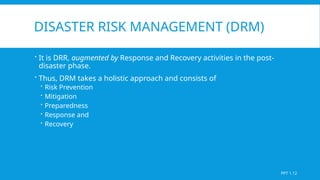
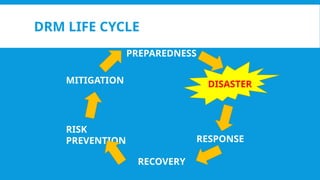
DISASTER RISK MANAGEMENT (DRM)
 It is DRR, augmented by Response and Recovery activities in the post-
disaster phase.
 Thus, DRM takes a holistic approach and consists of
 Risk Prevention
 Mitigation
 Preparedness
 Response and
 Recovery
PPT 1.12
DRM LIFE CYCLE
PREPAREDNESS
RESPONSE
RECOVERY
RISK
PREVENTION
MITIGATION DISASTER
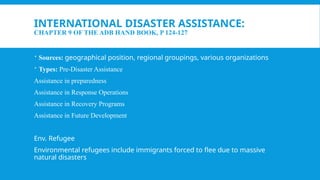
INTERNATIONAL DISASTER ASSISTANCE:
CHAPTER 9 OF THE ADB HAND BOOK, P 124-127
 Sources: geographical position, regional groupings, various organizations
 Types: Pre-Disaster Assistance
Assistance in preparedness
Assistance in Response Operations
Assistance in Recovery Programs
Assistance in Future Development
Env. Refugee
Environmental refugees include immigrants forced to flee due to massive
natural disasters
DISASTER MANAGEMENT STRATEGIES IN 3 PHASES OF
DISASTER
Pre-disaster
Phase
[or pre-impact
phase]
Post-disaster phase
immediately after the
disaster
(0-48 hours)
[also called the
impact phase]
Post-disaster
phase
(48+ hours)
[or Post Impact
phase]
Risk prevention
Response Recovery
Mitigation
Preparedness
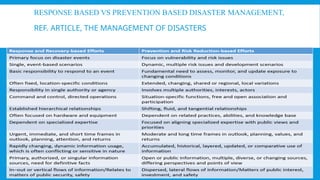
RESPONSE BASED VS PREVENTION BASED DISASTER MANAGEMENT,
REF. ARTICLE, THE MANAGEMENT OF DISASTERS
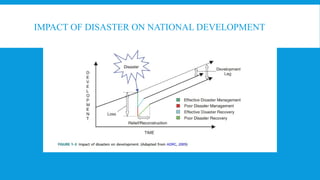
IMPACT OF DISASTER ON NATIONAL DEVELOPMENT
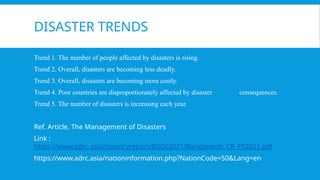
DISASTER TRENDS
Trend 1. The number of people affected by disasters is rising.
Trend 2. Overall, disasters are becoming less deadly.
Trend 3. Overall, disasters are becoming more costly.
Trend 4. Poor countries are disproportionately affected by disaster consequences.
Trend 5. The number of disasters is increasing each year.
Ref. Article, The Management of Disasters
Link :
https://www.adrc.asia/countryreport/BGD/2021/Bangladesh_CR_FY2021.pdf
https://www.adrc.asia/nationinformation.php?NationCode=50&Lang=en

Chapt-1-Understanding-Disaster-Management.pptx

  • 1.
    UNDERSTANDING DISASTER MANAGEMENT [ Source: Collected from Different Sources]
  • 2.
    CONTENTS What is disaster,disaster management, vulnerability, international disaster assistance and sources and types, environmental refugee. Response based vs prevention based disaster management Impact of disaster on national development Disaster Trends
  • 3.
  • 4.
    DISASTER, DISASTER MANAGEMENT,VULNERABILITY  Al-Madhari et al., (1997)  “disaster is such an event that are localized in time and space if one or more of the following consequences occur: (1) 10 or more fatalities; (2) damage exceeds $1 million (US); or (3) 50 or more people evacuated”.
  • 5.
    WHAT IS ADISASTER? A disaster can be defined as any occurrence, either natural or man- made: - That damages assets and infrastructure, causes loss of lives & ecological disruptions and deterioration of health and health services; - Creates human needs that the victims can not alleviate themselves; and - Warrants an extraordinary response from outside the affected community or area. [ Source : DISASTER RISK MANAGEMENT TRAINING PROGRAMME]
  • 6.
    HAZARD AND DISASTER Hazard Natural phenomenon that can potentially trigger a disaster Example: Earthquake, Floods, Tsunami  These events need not necessarily result in a disaster Disaster  Serious disruption involving widespread human, material, economic or environmental losses and impact  Hazards may be inevitable, but disasters can be prevented PPT 1.6
  • 7.
    NATURAL AND MAN-MADEDISASTERS NATURAL MAN-MADE OR TECHNOLOGICAL 1. Biological (Disease Epidemics, Insect/Animal Plagues or Infestations) 1. Industrial Accidents (Chemical Spills, Radio-active Spills) 2. Geophysical (Earthquakes, Tsunamis, Landslides, Volcanic Eruptions) 2. Transport Accidents/ Failures 3. Climatological (Drought, Wildfires) 3. Complex Emergencies/ Conflicts, Warlike Encounters, Famine 4. Hydrological (Floods) 5. Meteorological (Storms, Cyclones/ Hurricanes/ Typhoons, Tornadoes, Snow Storms) [ Source : DISASTER RISK MANAGEMENT TRAINING PROGRAMME]
  • 8.
    DISASTER : CASES 2023May – Tropical Cyclone Mocha  Tropical Cyclone (TC) Mocha made landfall in southeastern Bangladesh and in neighboring Myanmar on 14 May with maximum sustained winds up to 250 km per hour (155 miles per hour).  Bangladesh’s National Disaster Response Coordination Centre (NDRCC) reported that 414,170 people evacuated to 7,040 shelters in 14 coastal districts.  As of 15 May, the UN reported that nearly 430,000 people had been affected, more than 2,000 homes were destroyed, and more than 10,600 houses were damaged across Chattogram Division.  Overall, damage occurred in four districts, 26 upazilas, and 99 unions.
  • 9.
    DISASTER : CASES…. 2023 May – Rana Plaza disaster  On 24 April 2013, 1,134 people were killed and at least another 2,000 injured in the collapse of a factory building in Dhaka, Bangladesh  Abuses ‘still rife’: 10 years on from Bangladesh’s Rana Plaza disaster | Rana Plaza | The Guardian
  • 10.
  • 11.
    DISASTER MANAGEMENT  Silver(2001) ,  disaster management is about “an applied science that seeks by systematic observation and analysis of disasters, to improve measures relating to prevention, mitigation, preparedness, emergency response and recovery”.
  • 12.
    DISASTER RISK MANAGEMENT(DRM)  It is DRR, augmented by Response and Recovery activities in the post- disaster phase.  Thus, DRM takes a holistic approach and consists of  Risk Prevention  Mitigation  Preparedness  Response and  Recovery PPT 1.12
  • 13.
  • 14.
    INTERNATIONAL DISASTER ASSISTANCE: CHAPTER9 OF THE ADB HAND BOOK, P 124-127  Sources: geographical position, regional groupings, various organizations  Types: Pre-Disaster Assistance Assistance in preparedness Assistance in Response Operations Assistance in Recovery Programs Assistance in Future Development Env. Refugee Environmental refugees include immigrants forced to flee due to massive natural disasters
  • 15.
    DISASTER MANAGEMENT STRATEGIESIN 3 PHASES OF DISASTER Pre-disaster Phase [or pre-impact phase] Post-disaster phase immediately after the disaster (0-48 hours) [also called the impact phase] Post-disaster phase (48+ hours) [or Post Impact phase] Risk prevention Response Recovery Mitigation Preparedness
  • 16.
    RESPONSE BASED VSPREVENTION BASED DISASTER MANAGEMENT, REF. ARTICLE, THE MANAGEMENT OF DISASTERS
  • 17.
    IMPACT OF DISASTERON NATIONAL DEVELOPMENT
  • 18.
    DISASTER TRENDS Trend 1.The number of people affected by disasters is rising. Trend 2. Overall, disasters are becoming less deadly. Trend 3. Overall, disasters are becoming more costly. Trend 4. Poor countries are disproportionately affected by disaster consequences. Trend 5. The number of disasters is increasing each year. Ref. Article, The Management of Disasters Link : https://www.adrc.asia/countryreport/BGD/2021/Bangladesh_CR_FY2021.pdf https://www.adrc.asia/nationinformation.php?NationCode=50&Lang=en