Classism
Class
 a large group of people who occupy a
similar economic position in the wider
society based on income, wealth, property
ownership, education, skills, or authority in
the economic sphere.
http://www.usccb.org/cchd/povertyusa/tour.htm
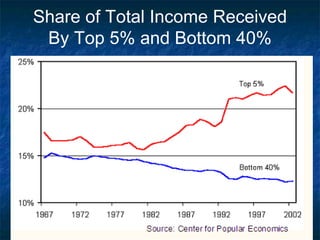
Share of Total Income Received
By Top 5% and Bottom 40%
Class Identity
 A label for one category of class
experience, such as ruling class, owning
class, middle class, working class, poor
Classism
 The systematic assignment of
characteristics of worth and ability based
on social class.
 differential treatment
 systematic oppression of subordinated
groups
Internalized Classism
 the acceptance and justification of
classism by working class and poor
people.
Class Privilege
 tangible or intangible unearned
advantages of "higher" class status
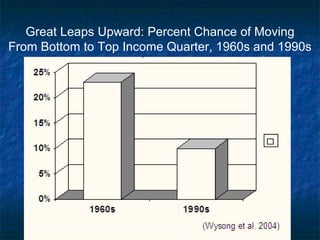
Great Leaps Upward: Percent Chance of Moving
From Bottom to Top Income Quarter, 1960s and 1990s
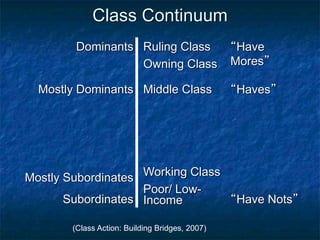
Class Continuum
Dominants Ruling Class
Owning Class
“Have
Mores”
Mostly Dominants Middle Class “Haves”
Mostly Subordinates
Subordinates
Working Class
Poor/ Low-
Income “Have Nots”
(Class Action: Building Bridges, 2007)
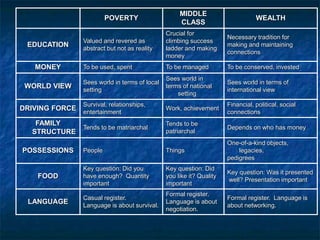
POVERTY
MIDDLE
CLASS
WEALTH
EDUCATION
Valued and revered as
abstract but not as reality
Crucial for
climbing success
ladder and making
money
Necessary tradition for
making and maintaining
connections
MONEY To be used, spent To be managed To be conserved, invested
WORLD VIEW
Sees world in terms of local
setting
Sees world in
terms of national
setting
Sees world in terms of
international view
DRIVING FORCE
Survival, relationships,
entertainment
Work, achievement
Financial, political, social
connections
FAMILY
STRUCTURE
Tends to be matriarchal
Tends to be
patriarchal
Depends on who has money
POSSESSIONS People Things
One-of-a-kind objects,
legacies,
pedigrees
FOOD
Key question: Did you
have enough? Quantity
important
Key question: Did
you like it? Quality
important
Key question: Was it presented
well? Presentation important
LANGUAGE
Casual register.
Language is about survival.
Formal register.
Language is about
negotiation.
Formal register. Language is
about networking.
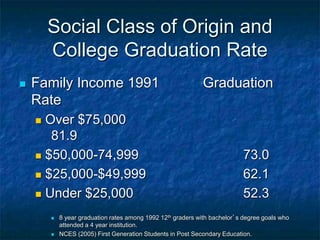
 Family Income 1991 Graduation
Rate
 Over $75,000
81.9
 $50,000-74,999 73.0
 $25,000-$49,999 62.1
 Under $25,000 52.3
 8 year graduation rates among 1992 12th graders with bachelor’s degree goals who
attended a 4 year institution.
 NCES (2005) First Generation Students in Post Secondary Education.
Social Class of Origin and
College Graduation Rate
Class Ally
 A person from the more privileged classes
whose attitudes and behaviors are anti-
classist, who is committed to increasing
his or her own understanding of the issues
related to classism, and is actively working
towards eliminating classism on many
levels.
Social Class Assumptions
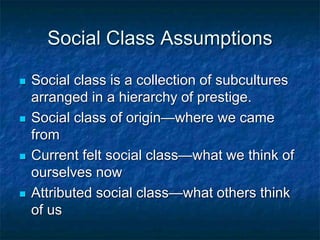
 Social class is a collection of subcultures
arranged in a hierarchy of prestige.
 Social class of origin—where we came
from
 Current felt social class—what we think of
ourselves now
 Attributed social class—what others think
of us
Social Class Assumptions
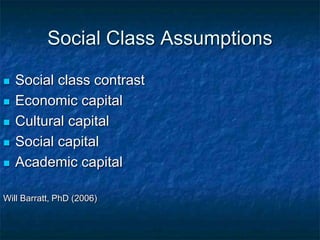
 Social class contrast
 Economic capital
 Cultural capital
 Social capital
 Academic capital
Will Barratt, PhD (2006)
For more information on
Classism:
 www.inequality.org
 www.classism.org
 Understanding Class Cultures: An Activist
Perspective. By Betsy Leondar-Wright,
September 2003.
 Nickeled and Dimed: On Not Getting By in
America. By Barbara Ehrenreight
 www.morethanmoney.org
 www.classmatters.org

Classism

  • 1.
  • 2.
    Class  a largegroup of people who occupy a similar economic position in the wider society based on income, wealth, property ownership, education, skills, or authority in the economic sphere. http://www.usccb.org/cchd/povertyusa/tour.htm
  • 3.
    Share of TotalIncome Received By Top 5% and Bottom 40%
  • 4.
    Class Identity  Alabel for one category of class experience, such as ruling class, owning class, middle class, working class, poor
  • 5.
    Classism  The systematicassignment of characteristics of worth and ability based on social class.  differential treatment  systematic oppression of subordinated groups
  • 6.
    Internalized Classism  theacceptance and justification of classism by working class and poor people.
  • 7.
    Class Privilege  tangibleor intangible unearned advantages of "higher" class status
  • 8.
    Great Leaps Upward:Percent Chance of Moving From Bottom to Top Income Quarter, 1960s and 1990s
  • 9.
    Class Continuum Dominants RulingClass Owning Class “Have Mores” Mostly Dominants Middle Class “Haves” Mostly Subordinates Subordinates Working Class Poor/ Low- Income “Have Nots” (Class Action: Building Bridges, 2007)
  • 10.
    POVERTY MIDDLE CLASS WEALTH EDUCATION Valued and reveredas abstract but not as reality Crucial for climbing success ladder and making money Necessary tradition for making and maintaining connections MONEY To be used, spent To be managed To be conserved, invested WORLD VIEW Sees world in terms of local setting Sees world in terms of national setting Sees world in terms of international view DRIVING FORCE Survival, relationships, entertainment Work, achievement Financial, political, social connections FAMILY STRUCTURE Tends to be matriarchal Tends to be patriarchal Depends on who has money POSSESSIONS People Things One-of-a-kind objects, legacies, pedigrees FOOD Key question: Did you have enough? Quantity important Key question: Did you like it? Quality important Key question: Was it presented well? Presentation important LANGUAGE Casual register. Language is about survival. Formal register. Language is about negotiation. Formal register. Language is about networking.
  • 12.
     Family Income1991 Graduation Rate  Over $75,000 81.9  $50,000-74,999 73.0  $25,000-$49,999 62.1  Under $25,000 52.3  8 year graduation rates among 1992 12th graders with bachelor’s degree goals who attended a 4 year institution.  NCES (2005) First Generation Students in Post Secondary Education. Social Class of Origin and College Graduation Rate
  • 13.
    Class Ally  Aperson from the more privileged classes whose attitudes and behaviors are anti- classist, who is committed to increasing his or her own understanding of the issues related to classism, and is actively working towards eliminating classism on many levels.
  • 14.
    Social Class Assumptions Social class is a collection of subcultures arranged in a hierarchy of prestige.  Social class of origin—where we came from  Current felt social class—what we think of ourselves now  Attributed social class—what others think of us
  • 15.
    Social Class Assumptions Social class contrast  Economic capital  Cultural capital  Social capital  Academic capital Will Barratt, PhD (2006)
  • 16.
    For more informationon Classism:  www.inequality.org  www.classism.org  Understanding Class Cultures: An Activist Perspective. By Betsy Leondar-Wright, September 2003.  Nickeled and Dimed: On Not Getting By in America. By Barbara Ehrenreight  www.morethanmoney.org  www.classmatters.org