WORKING WITH REFUGEES:
AN INTERNATIONAL COMMUNITY IN THE
HEART OF DALLAS/FORT WORTH

Diane Mitschke, PhD
Associate Professor
School of Social Work
What is a refugee?
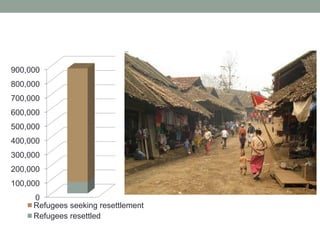
900,000
800,000
700,000
600,000
500,000
400,000
300,000
200,000
100,000
0
Refugees seeking resettlement
Refugees resettled
How many refugees are here?
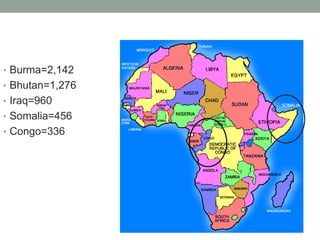
• Burma=2,142

• Bhutan=1,276
• Iraq=960
• Somalia=456
• Congo=336
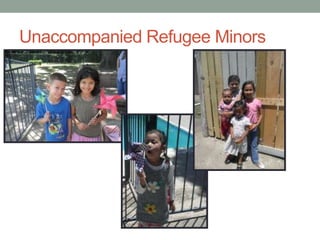
Unaccompanied Refugee Minors
Resettlement process
• To provide refugees with

a safe and stable living
environment, ongoing
support from family or
friends, and the means
to become self-sufficient

• Assistance period

begins upon arrival and
ends 4-8 months later
• Resettlement agencies
provide help with:
• Employment
• Language classes
• Applications for federal and

state assistance
• School enrollment
• Housing and basic
furnishings
Then what?
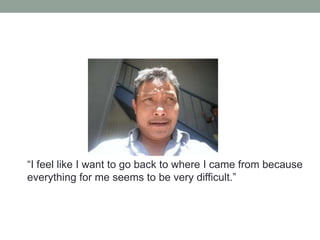
“I feel like I want to go back to where I came from because
everything for me seems to be very difficult.”
“I thought we would have a better life, and not to be struggles [sic] as
[when] we live[d] in Thailand or Burma. Yet, we don’t have to scare of
[sic] getting killed but we have to struggle in finding job and find money for
paying our bills.”
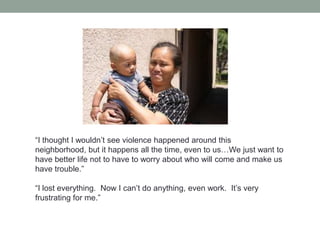
“I thought I wouldn’t see violence happened around this
neighborhood, but it happens all the time, even to us…We just want to
have better life not to have to worry about who will come and make us
have trouble.”

“I lost everything. Now I can’t do anything, even work. It’s very
frustrating for me.”
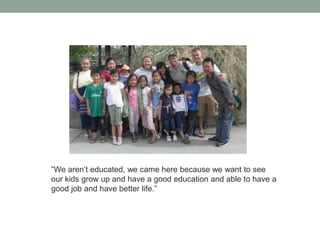
“We aren’t educated, we came here because we want to see
our kids grow up and have a good education and able to have a
good job and have better life.”
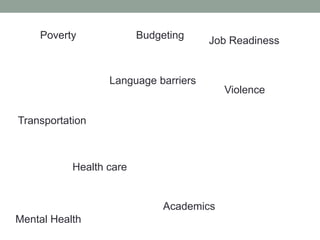
Poverty

Budgeting

Job Readiness

Language barriers

Transportation

Health care

Academics
Mental Health

Violence
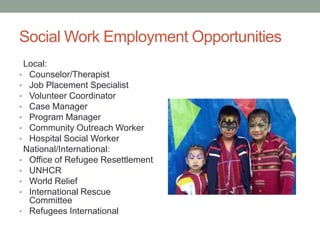
Social Work Employment Opportunities
Local:
• Counselor/Therapist
• Job Placement Specialist
• Volunteer Coordinator
• Case Manager
• Program Manager
• Community Outreach Worker
• Hospital Social Worker
National/International:
• Office of Refugee Resettlement
• UNHCR
• World Relief
• International Rescue
Committee
• Refugees International
Metroplex-Area Resettlement
• Dallas
• Catholic Charities of Dallas
• Refugee Services of Texas
• International Rescue Committee
• Fort Worth
• Catholic Charities of Fort Worth
• World Relief
• Refugee Services of Texas
Other agencies
• Mosaic Family Services
• Center for Survivors of Torture
• Dallas ISD—Refugee Support Services
• Area Hospitals and Clinics
Resources
• Office of Refugee Resettlement
• UNHCR Resettlement Handbook-US Chapter
• Welcome to the United States Guidebook
• TIN—Translation and Interpretation Network
• Language Line

• UNHCR: United Nations High Commissioner for Refugees
• International Rescue Committee
• World Relief
• Refugees International
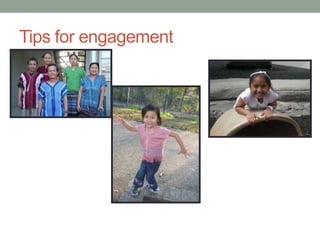
Tips for engagement
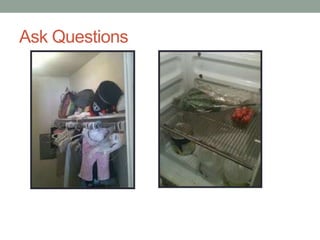
Ask Questions
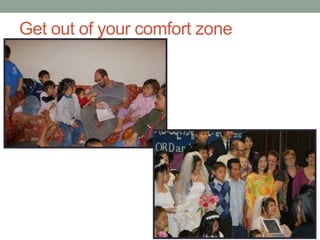
Get out of your comfort zone
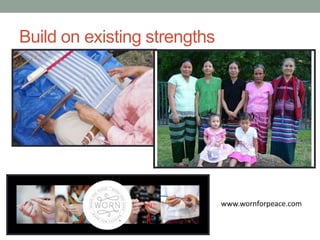
Build on existing strengths
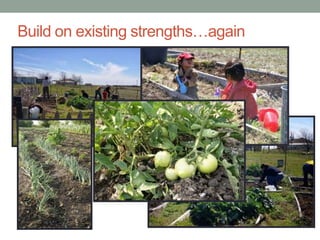
Build on existing strengths…again
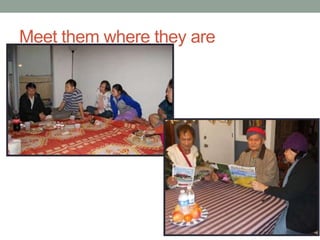
Meet them where they are
Be patient
Acknowledge power differences
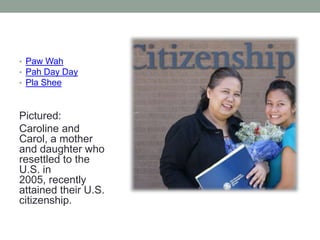
• Paw Wah
• Pah Day Day
• Pla Shee

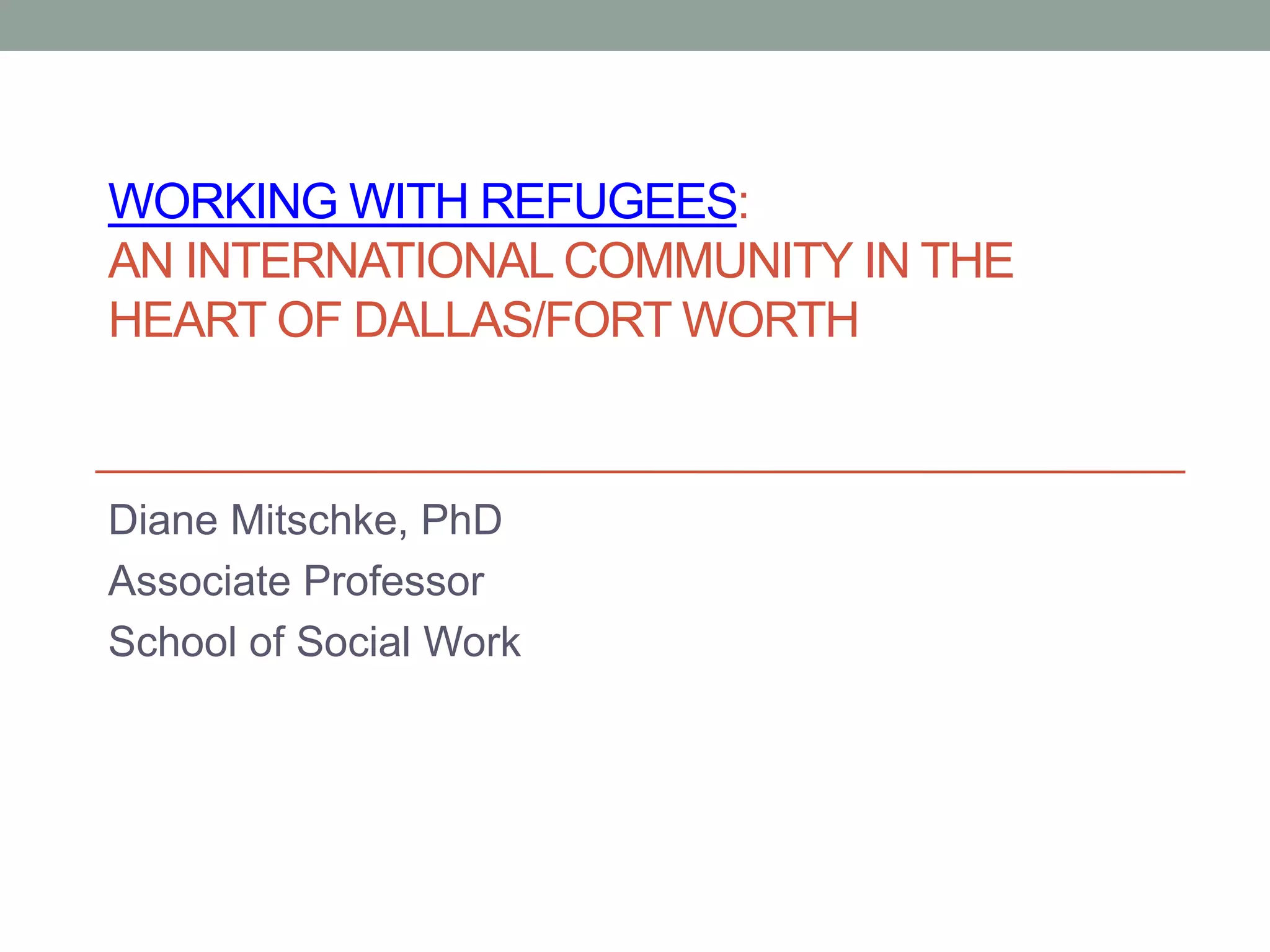
Pictured:
Caroline and
Carol, a mother
and daughter who
resettled to the
U.S. in
2005, recently
attained their U.S.
citizenship.
Diane Mitschke
dianemitschke@uta.edu
Sunday afternoons at Agape Clinic
4105 Junius St. in East Dallas
www.blogspot.oneworldoutreach.com
The Pledge

Refugee presentation for UTA SISW

Editor's Notes

  • #3 I’ve found my passion and my purpose in working with refugees in our community. Much of my experience has been with refugees from Burma, and specifically with the Karen people. Over the past seven years, I’ve shared meals with women who watched their children die at the hands of the Burmese army, laughed with children squealing with glee at their first visit to the zoo, the circus, six flags, and the Texas State Fair. I’ve cried with grandmothers who’ve lost their sense of place, purpose, and person, too scarred and too tired to start again. I’ve counseled young mothers and fathers who struggle to feed their children while working 12 hour shifts on an assembly line—back breaking jobs that pay too little and are gone in an instant. I’ve shared my family, my home, my weekends and my weekdays with the Karen, who are, without exception, resilient beyond belief. Working with refugees has inspired my research and my humanity. This work has stretched me, has changed me, has transformed me.
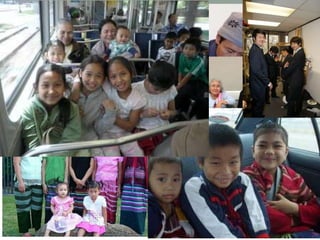
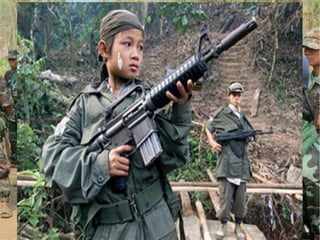
  • #4 So, what exactly is a refugee? A refugee is someone who has been forced to flee his or her country because of persecution, war, or violence. A refugee has a well-founded fear of persecution for reasons of race, religion, nationality, political opinion or membership in a particular social group. Most likely, they cannot return home or are afraid to do so. War and ethnic, tribal and religious violence are leading causes of refugees fleeing their countries. In Burma, the Burmese army has tortured and killed the Karen and other ethnic tribes living in and around the hills and jungles along the Thai-Burma border. Many of the Karen, including women and children, have taken up arms to join rebel armies to defend themselves against the Burmese army. As their villages are overtaken and crops burned, many run through the jungle and eventually reach the Thai border, where they may enter and live in a refugee camp.
  • #5 The United Nations High Commission on Refugees manages the resettlement of refugees all over the world. Obviously, living conditions in the camps vary tremendously. In general, however, resources such as food, medicines, and clothing are scarce. Education is limited, if available at all, and refugees in the camps are not permitted to leave the camp or gain employment. Resettlement needs outpace resettlement places by a factor of 10 to 1. There are currently 800,000 persons currently seeking resettlement. Many of the Karen refugees entering the US today lived in the Thai refugee camps for 15 to 20 years before they were resettled to the US. Most Karen children have never lived in their homeland of Burma.The US, Canada, and Australia provide 90% of global resettlement places, and 16 European countries provide 8%
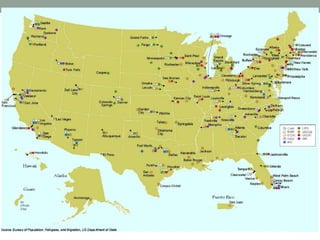
  • #6 The US Office of Refugee Resettlement oversees the refugee resettlement process in the US.There were 58,238 new refugees who entered the US in 2012. Cities across the country are designated as resettlement areas based on job availability and other economic factors.
  • #7 While refugees come from many countries, they typically enter the US in waves dependent on the socio-political context5,923 Texas in 2012
  • #8 Upon arrival in the U.S., these refugee children are placed into the Unaccompanied Refugee Minors (URM) program and receive refugee foster care services and benefits.
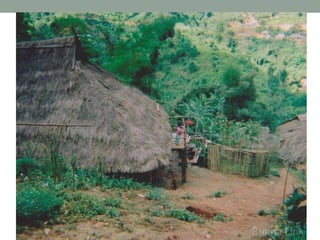
  • #10 Let’s take a moment to flip the script. Imagine with me, that for whatever reason, you are plopped on a rural Burma hillside tomorrow. You’re greeted by a guide, who miraculously speaks English, and explains that she’ll be available to answer your questions for the next 3 months. After that time, you’ll be on your own.
  • #11 You follow her, dumbfounded, to a nearby plot of land. She explains that you’ll need to build yourself a home, and points to a thatch hut nearby as an example.
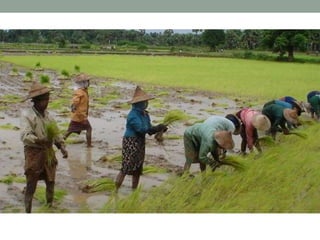
  • #12 She then encourages you use the meager allowance she’s provided you to purchase seeds to plant in your land plot. Which seeds to buy? How should you plant them? When should you harvest them?
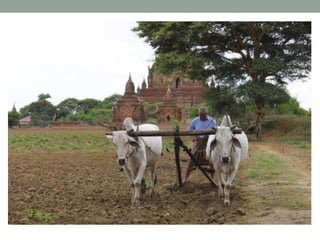
  • #13 Do you need an oxen team? What are oxen?Perhaps growing crops is not your forte, your guide suggests.
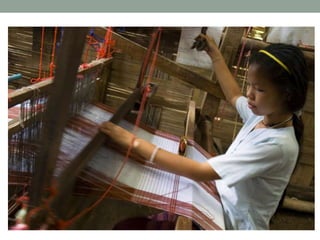
  • #14 In that case, you can weave clothing and handbags to sell at the local markets.What? You didn’t bring a loom? Well, I guess you can build your loom. You’d better get to work, though. Weaving one shirt using this traditional method takes about 12 hours, you know?Wait…you don’t know how to weave?
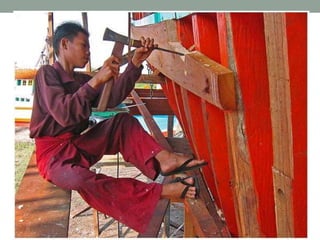
  • #15 In that case, perhaps you can earn your living hand carving wood furniture and selling it to the upper class Burmese and Thai tourists that frequent the local markets.Tell me you brought your hand tools with you? You did, right?If you can imagine how it might feel to be placed in a land completely unfamiliar, faced with tasks and responsibilities you’ve never encountered, and being unable to communicate with anyone around you, you may be able to imagine what it is like for refugees who arrive in our community.How long would it take you to become self-sufficient if you were in Burma? Would it take you more than 90 days?
  • #16 In a recent study conducted with Bhutanese refugees in Fort Worth, we found that refugees’ mental health symptoms actually worsen over time. Feelings of anxiety and depression increase as the stressors of resettlement become a reality.