BIOCHEMISTRY & CLINICAL PATHOLOGY
D.Pharm 1st year
TOPIC- CLASSIFICATION OF PROTEINS
Presented by-
SHWETA MISHRA
HYGIA GROUP OF INSTITUTION
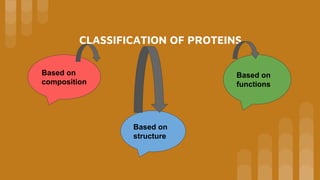
CLASSIFICATION OF PROTEINS
Based on
composition
Based on
structure
Based on
functions
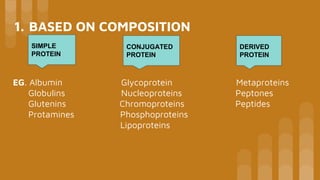
1. BASED ON COMPOSITION
EG. Albumin Glycoprotein Metaproteins
Globulins Nucleoproteins Peptones
Glutenins Chromoproteins Peptides
Protamines Phosphoproteins
Lipoproteins
SIMPLE
PROTEIN
CONJUGATED
PROTEIN
DERIVED
PROTEIN
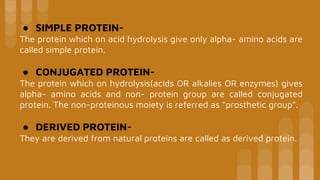
● SIMPLE PROTEIN-
The protein which on acid hydrolysis give only alpha- amino acids are
called simple protein.
● CONJUGATED PROTEIN-
The protein which on hydrolysis(acids OR alkalies OR enzymes) gives
alpha- amino acids and non- protein group are called conjugated
protein. The non-proteinous moiety is referred as “prosthetic group”.
● DERIVED PROTEIN-
They are derived from natural proteins are called as derived protein.
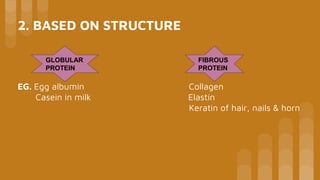
2. BASED ON STRUCTURE
EG. Egg albumin Collagen
Casein in milk Elastin
Keratin of hair, nails & horn
GLOBULAR
PROTEIN
FIBROUS
PROTEIN
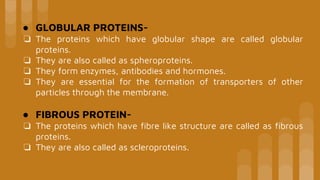
● GLOBULAR PROTEINS-
❏ The proteins which have globular shape are called globular
proteins.
❏ They are also called as spheroproteins.
❏ They form enzymes, antibodies and hormones.
❏ They are essential for the formation of transporters of other
particles through the membrane.
● FIBROUS PROTEIN-
❏ The proteins which have fibre like structure are called as fibrous
proteins.
❏ They are also called as scleroproteins.
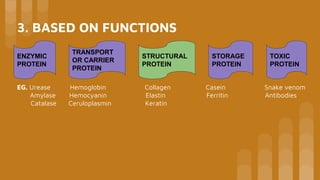
3. BASED ON FUNCTIONS
EG. Urease Hemoglobin Collagen Casein Snake venom
Amylase Hemocyanin Elastin Ferritin Antibodies
Catalase Ceruloplasmin Keratin
ENZYMIC
PROTEIN
TRANSPORT
OR CARRIER
PROTEIN
STRUCTURAL
PROTEIN
STORAGE
PROTEIN
TOXIC
PROTEIN
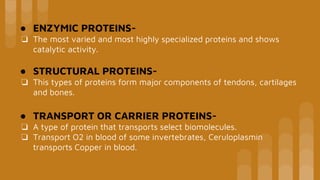
● ENZYMIC PROTEINS-
❏ The most varied and most highly specialized proteins and shows
catalytic activity.
● STRUCTURAL PROTEINS-
❏ This types of proteins form major components of tendons, cartilages
and bones.
● TRANSPORT OR CARRIER PROTEINS-
❏ A type of protein that transports select biomolecules.
❏ Transport O2 in blood of some invertebrates, Ceruloplasmin
transports Copper in blood.
● STORAGE PROTEINS-
❏ Ferritin is an example of a storage protein that stores iron.
● TOXIC PROTEINS-
❏ Also called defensive proteins.
❏ They provide protection against disease. Antibodies fight against
bacteria & viruses.
THANK YOU

Classification of proteins

  • 1.
    BIOCHEMISTRY & CLINICALPATHOLOGY D.Pharm 1st year TOPIC- CLASSIFICATION OF PROTEINS Presented by- SHWETA MISHRA HYGIA GROUP OF INSTITUTION
  • 2.
    CLASSIFICATION OF PROTEINS Basedon composition Based on structure Based on functions
  • 3.
    1. BASED ONCOMPOSITION EG. Albumin Glycoprotein Metaproteins Globulins Nucleoproteins Peptones Glutenins Chromoproteins Peptides Protamines Phosphoproteins Lipoproteins SIMPLE PROTEIN CONJUGATED PROTEIN DERIVED PROTEIN
  • 4.
    ● SIMPLE PROTEIN- Theprotein which on acid hydrolysis give only alpha- amino acids are called simple protein. ● CONJUGATED PROTEIN- The protein which on hydrolysis(acids OR alkalies OR enzymes) gives alpha- amino acids and non- protein group are called conjugated protein. The non-proteinous moiety is referred as “prosthetic group”. ● DERIVED PROTEIN- They are derived from natural proteins are called as derived protein.
  • 5.
    2. BASED ONSTRUCTURE EG. Egg albumin Collagen Casein in milk Elastin Keratin of hair, nails & horn GLOBULAR PROTEIN FIBROUS PROTEIN
  • 6.
    ● GLOBULAR PROTEINS- ❏The proteins which have globular shape are called globular proteins. ❏ They are also called as spheroproteins. ❏ They form enzymes, antibodies and hormones. ❏ They are essential for the formation of transporters of other particles through the membrane. ● FIBROUS PROTEIN- ❏ The proteins which have fibre like structure are called as fibrous proteins. ❏ They are also called as scleroproteins.
  • 7.
    3. BASED ONFUNCTIONS EG. Urease Hemoglobin Collagen Casein Snake venom Amylase Hemocyanin Elastin Ferritin Antibodies Catalase Ceruloplasmin Keratin ENZYMIC PROTEIN TRANSPORT OR CARRIER PROTEIN STRUCTURAL PROTEIN STORAGE PROTEIN TOXIC PROTEIN
  • 8.
    ● ENZYMIC PROTEINS- ❏The most varied and most highly specialized proteins and shows catalytic activity. ● STRUCTURAL PROTEINS- ❏ This types of proteins form major components of tendons, cartilages and bones. ● TRANSPORT OR CARRIER PROTEINS- ❏ A type of protein that transports select biomolecules. ❏ Transport O2 in blood of some invertebrates, Ceruloplasmin transports Copper in blood.
  • 9.
    ● STORAGE PROTEINS- ❏Ferritin is an example of a storage protein that stores iron. ● TOXIC PROTEINS- ❏ Also called defensive proteins. ❏ They provide protection against disease. Antibodies fight against bacteria & viruses.
  • 10.