PROTEINS
Classified on the Basis of Compostion
Presented by: Areeba Zafar
Submitted to : Ms. Sumera
PROTEINS
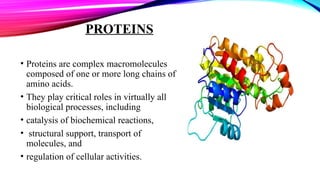
• Proteins are complex macromolecules
composed of one or more long chains of
amino acids.
• They play critical roles in virtually all
biological processes, including
• catalysis of biochemical reactions,
• structural support, transport of
molecules, and
• regulation of cellular activities.
CLASSIFICATION
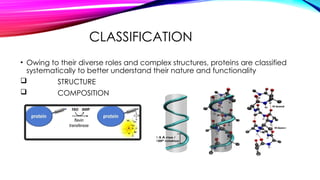
• Owing to their diverse roles and complex structures, proteins are classified
systematically to better understand their nature and functionality
 STRUCTURE
 COMPOSITION
COMPOSTION
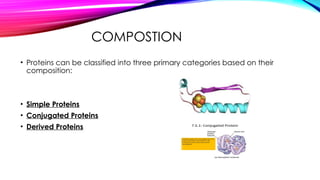
• Proteins can be classified into three primary categories based on their
composition:
• Simple Proteins
• Conjugated Proteins
• Derived Proteins
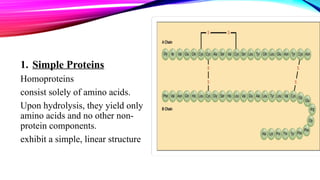
1. Simple Proteins
Homoproteins
consist solely of amino acids.
Upon hydrolysis, they yield only
amino acids and no other non-
protein components.​
exhibit a simple, linear structure
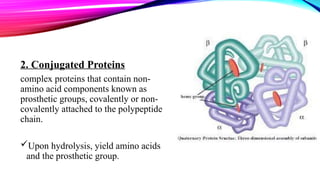
2. Conjugated Proteins
complex proteins that contain non-
amino acid components known as
prosthetic groups, covalently or non-
covalently attached to the polypeptide
chain.​
Upon hydrolysis, yield amino acids
and the prosthetic group.
TYPES OF CONJUGATED
PROTEINS
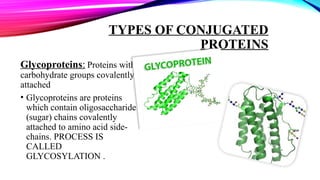
Glycoproteins: Proteins with
carbohydrate groups covalently
attached
• Glycoproteins are proteins
which contain oligosaccharide
(sugar) chains covalently
attached to amino acid side-
chains. PROCESS IS
CALLED
GLYCOSYLATION .
2. Phosphoproteins: Proteins that have
phosphate groups attached.
Phosphoproteins are proteins that have a
phosphate group attached
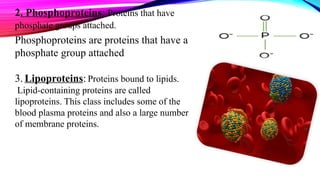
3. Lipoproteins: Proteins bound to lipids.
Lipid-containing proteins are called
lipoproteins. This class includes some of the
blood plasma proteins and also a large number
of membrane proteins.
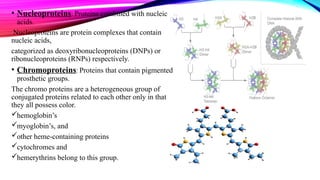
• Nucleoproteins: Proteins combined with nucleic
acids.
Nucleoproteins are protein complexes that contain
nucleic acids,
categorized as deoxyribonucleoproteins (DNPs) or
ribonucleoproteins (RNPs) respectively.
• Chromoproteins: Proteins that contain pigmented
prosthetic groups.
The chromo proteins are a heterogeneous group of
conjugated proteins related to each other only in that
they all possess color.
hemoglobin’s
myoglobin’s, and
other heme-containing proteins
cytochromes and
hemerythrins belong to this group.
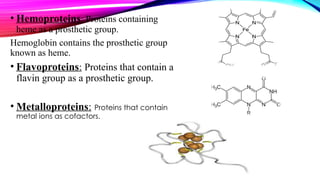
• Hemoproteins: Proteins containing
heme as a prosthetic group.
Hemoglobin contains the prosthetic group
known as heme.
• Flavoproteins: Proteins that contain a
flavin group as a prosthetic group.
• Metalloproteins: Proteins that contain
metal ions as cofactors.
3. Derived Proteins : Derived proteins are
products resulting from the hydrolysis of simple
or conjugated proteins.​
• Formed by the breakdown of native proteins
through physical or chemical processes.
• Include smaller peptides and fragments with
altered properties compared to the original
proteins.
Thankyou …

Proteins.composition structure and types

  • 1.
    PROTEINS Classified on theBasis of Compostion Presented by: Areeba Zafar Submitted to : Ms. Sumera
  • 2.
    PROTEINS • Proteins arecomplex macromolecules composed of one or more long chains of amino acids. • They play critical roles in virtually all biological processes, including • catalysis of biochemical reactions, • structural support, transport of molecules, and • regulation of cellular activities.
  • 3.
    CLASSIFICATION • Owing totheir diverse roles and complex structures, proteins are classified systematically to better understand their nature and functionality  STRUCTURE  COMPOSITION
  • 4.
    COMPOSTION • Proteins canbe classified into three primary categories based on their composition: • Simple Proteins • Conjugated Proteins • Derived Proteins
  • 5.
    1. Simple Proteins Homoproteins consistsolely of amino acids. Upon hydrolysis, they yield only amino acids and no other non- protein components.​ exhibit a simple, linear structure
  • 6.
    2. Conjugated Proteins complexproteins that contain non- amino acid components known as prosthetic groups, covalently or non- covalently attached to the polypeptide chain.​ Upon hydrolysis, yield amino acids and the prosthetic group.
  • 7.
    TYPES OF CONJUGATED PROTEINS Glycoproteins:Proteins with carbohydrate groups covalently attached • Glycoproteins are proteins which contain oligosaccharide (sugar) chains covalently attached to amino acid side- chains. PROCESS IS CALLED GLYCOSYLATION .
  • 8.
    2. Phosphoproteins: Proteinsthat have phosphate groups attached. Phosphoproteins are proteins that have a phosphate group attached 3. Lipoproteins: Proteins bound to lipids. Lipid-containing proteins are called lipoproteins. This class includes some of the blood plasma proteins and also a large number of membrane proteins.
  • 9.
    • Nucleoproteins: Proteinscombined with nucleic acids. Nucleoproteins are protein complexes that contain nucleic acids, categorized as deoxyribonucleoproteins (DNPs) or ribonucleoproteins (RNPs) respectively. • Chromoproteins: Proteins that contain pigmented prosthetic groups. The chromo proteins are a heterogeneous group of conjugated proteins related to each other only in that they all possess color. hemoglobin’s myoglobin’s, and other heme-containing proteins cytochromes and hemerythrins belong to this group.
  • 10.
    • Hemoproteins: Proteinscontaining heme as a prosthetic group. Hemoglobin contains the prosthetic group known as heme. • Flavoproteins: Proteins that contain a flavin group as a prosthetic group. • Metalloproteins: Proteins that contain metal ions as cofactors.
  • 11.
    3. Derived Proteins: Derived proteins are products resulting from the hydrolysis of simple or conjugated proteins.​ • Formed by the breakdown of native proteins through physical or chemical processes. • Include smaller peptides and fragments with altered properties compared to the original proteins.
  • 12.