BIOCHEMISTRY AND CLINICAL
PATHOLOGY
D.Pharm 1st year
TOPIC- PROTEINS
Part-2
Presented by-
SHWETA MISHRA
HYGIA GROUP OF INSTITUTION
CONTENTS
❏ Role or function of Proteins
❏ Biological value of Proteins
ROLE OR FUNCTION OF PROTEINS
❏ Protein is primarily used in the body to build, maintain and repair
body tissues.
❏ Protein is the major source of energy.
❏ Protein produces enzymes that increases the rate of chemical
reactions reactions in the body.
❏ Protein helps to store other substance in the organism. Eg. Iron
is stored in the liver in a complex with the protein Ferritin.
❏ They provide structural frame-work for cells and tissues.
❏ They act as enzymes and hormones.
❏ Protein exert osmotic pressure which helps in maintaining
electrolyte and water balance.
❏ Proteins can be catabolised to release energy.
❏ Receptor proteins binds with specific substances like vitamins and
minerals and mediate their cellular action.
❏ They help in muscle contraction(myosin, actin).
❏ They help in maintaining osmotic pressure.
❏ They help in the process of coagulation(Thrombin, Fibrinogen).
❏ They help in acid-base balance of the body.
❏ During starvation proteins(amino acids) serve as the major
suppliers of energy.
❏ Cell secretion such as mucus(glycoproteins) help in protection
and provide a slippery texture.
❏ G-protein is one of the regulatory proteins by which the
hormonal signals are transmitted to the nucleus in the cell.
❏ Proteins also control DNA replication, protein synthesis, chain
initiation, chain termination etc.
BIOLOGICAL VALUE OF PROTEINS
❏ Karl Thomas has first used the term biological value.
❏ Biological value of protein is used as a measure of protein
quality.
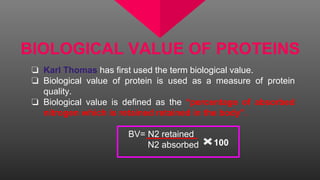
❏ Biological value is defined as the “percentage of absorbed
nitrogen which is retained retained in the body”.
BV= N2 retained
N2 absorbed 100
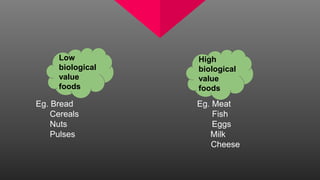
Eg. Bread Eg. Meat
Cereals Fish
Nuts Eggs
Pulses Milk
Cheese
Low
biological
value
foods
High
biological
value
foods
THANK YOU

Proteins part 2

  • 1.
    BIOCHEMISTRY AND CLINICAL PATHOLOGY D.Pharm1st year TOPIC- PROTEINS Part-2 Presented by- SHWETA MISHRA HYGIA GROUP OF INSTITUTION
  • 2.
    CONTENTS ❏ Role orfunction of Proteins ❏ Biological value of Proteins
  • 3.
    ROLE OR FUNCTIONOF PROTEINS ❏ Protein is primarily used in the body to build, maintain and repair body tissues. ❏ Protein is the major source of energy. ❏ Protein produces enzymes that increases the rate of chemical reactions reactions in the body. ❏ Protein helps to store other substance in the organism. Eg. Iron is stored in the liver in a complex with the protein Ferritin. ❏ They provide structural frame-work for cells and tissues. ❏ They act as enzymes and hormones.
  • 4.
    ❏ Protein exertosmotic pressure which helps in maintaining electrolyte and water balance. ❏ Proteins can be catabolised to release energy. ❏ Receptor proteins binds with specific substances like vitamins and minerals and mediate their cellular action. ❏ They help in muscle contraction(myosin, actin). ❏ They help in maintaining osmotic pressure. ❏ They help in the process of coagulation(Thrombin, Fibrinogen). ❏ They help in acid-base balance of the body. ❏ During starvation proteins(amino acids) serve as the major suppliers of energy.
  • 5.
    ❏ Cell secretionsuch as mucus(glycoproteins) help in protection and provide a slippery texture. ❏ G-protein is one of the regulatory proteins by which the hormonal signals are transmitted to the nucleus in the cell. ❏ Proteins also control DNA replication, protein synthesis, chain initiation, chain termination etc.
  • 6.
    BIOLOGICAL VALUE OFPROTEINS ❏ Karl Thomas has first used the term biological value. ❏ Biological value of protein is used as a measure of protein quality. ❏ Biological value is defined as the “percentage of absorbed nitrogen which is retained retained in the body”. BV= N2 retained N2 absorbed 100
  • 7.
    Eg. Bread Eg.Meat Cereals Fish Nuts Eggs Pulses Milk Cheese Low biological value foods High biological value foods
  • 8.