Unit 6: Classification and Diversity
Fig. 26-1
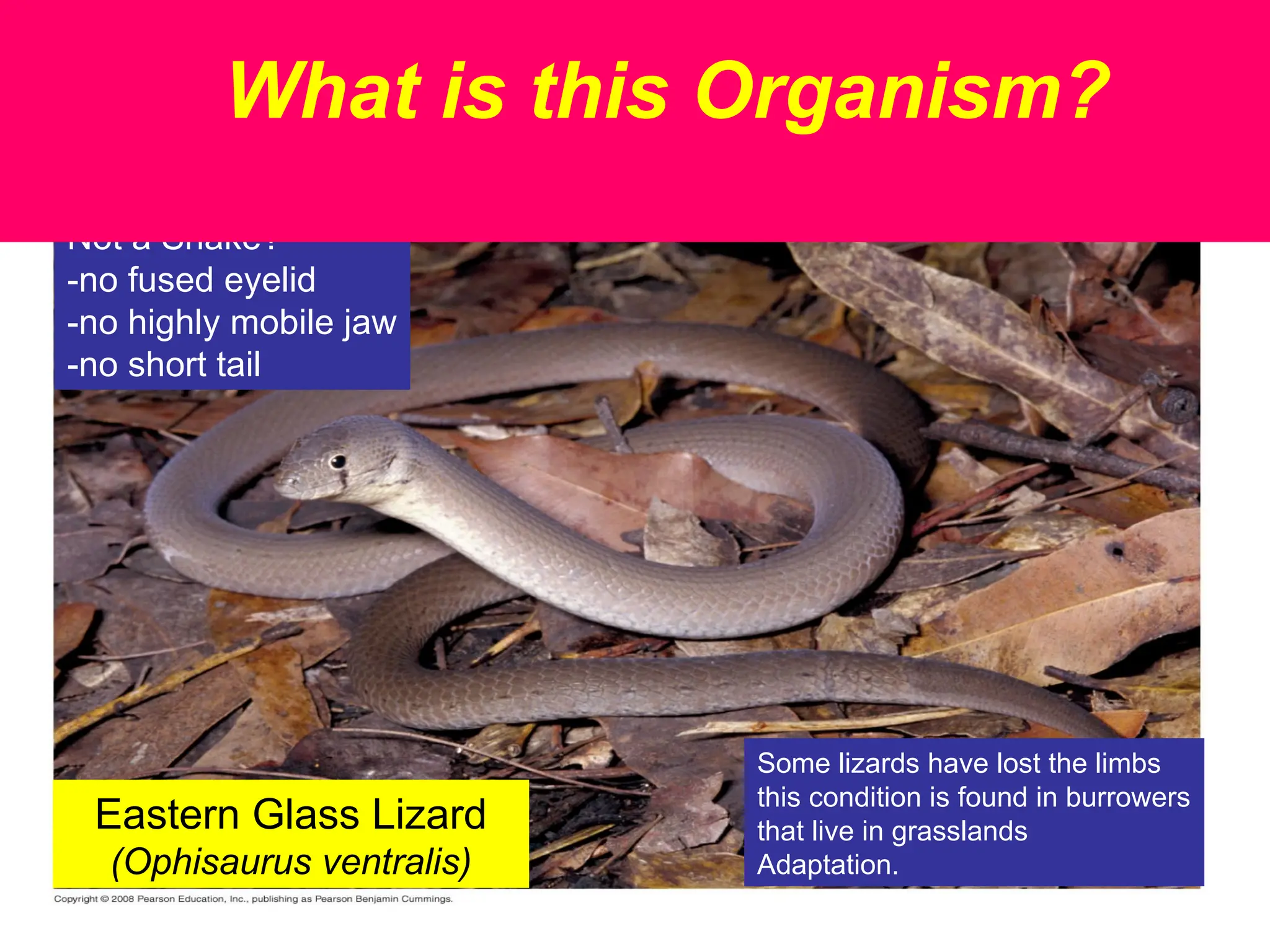
Not a Snake?
-no fused eyelid
-no highly mobile jaw
-no short tail
Some lizards have lost the limbs
this condition is found in burrowers
that live in grasslands
Adaptation.
What is this Organism?
Eastern Glass Lizard
(Ophisaurus ventralis)
Unit 6: Classification and Diversity
Linnaeus developed the scientific naming system still
used today.
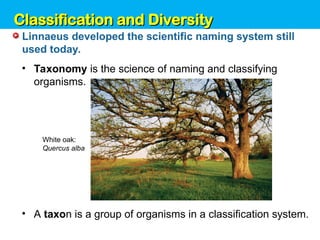
• Taxonomy is the science of naming and classifying
organisms.
• A taxon is a group of organisms in a classification system.
White oak:
Quercus alba
Classification and Diversity
Unit 6: Classification and Diversity
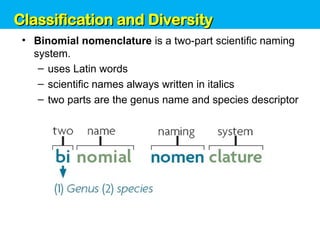
• Binomial nomenclature is a two-part scientific naming
system.
– uses Latin words
– scientific names always written in italics
– two parts are the genus name and species descriptor
Classification and Diversity
Unit 6: Classification and Diversity
• A genus includes one or more physically similar species.
– Species in the same genus are thought to be closely
related.
– Genus name is always capitalized.
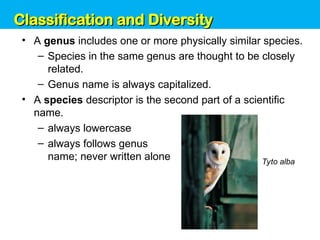
• A species descriptor is the second part of a scientific
name.
– always lowercase
– always follows genus
name; never written alone Tyto alba
Classification and Diversity
Unit 6: Classification and Diversity
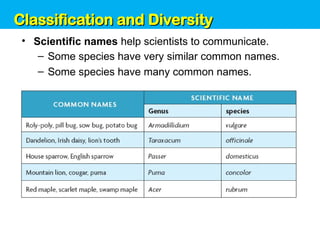
• Scientific names help scientists to communicate.
– Some species have very similar common names.
– Some species have many common names.
Classification and Diversity
Unit 6: Classification and Diversity
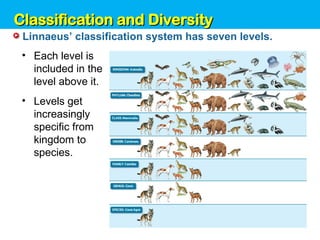
Linnaeus’ classification system has seven levels.
• Each level is
included in the
level above it.
• Levels get
increasingly
specific from
kingdom to
species.
Classification and Diversity
Unit 6: Classification and Diversity
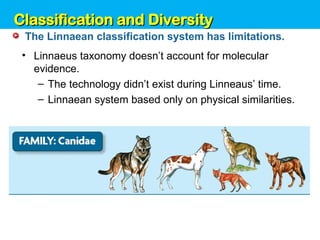
The Linnaean classification system has limitations.
• Linnaeus taxonomy doesn’t account for molecular
evidence.
– The technology didn’t exist during Linneaus’ time.
– Linnaean system based only on physical similarities.
Classification and Diversity
Unit 6: Classification and Diversity
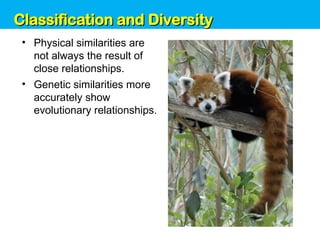
• Physical similarities are
not always the result of
close relationships.
• Genetic similarities more
accurately show
evolutionary relationships.
Classification and Diversity
Unit 6: Classification and Diversity
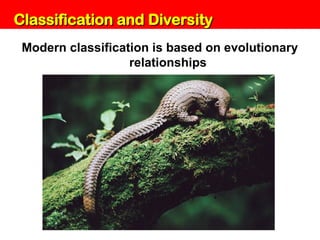
Modern classification is based on evolutionary
relationships
Classification and Diversity
Unit 6: Classification and Diversity
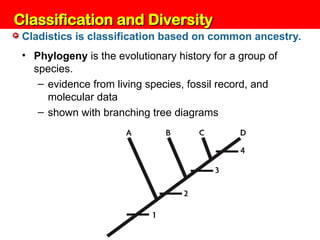
Cladistics is classification based on common ancestry.
• Phylogeny is the evolutionary history for a group of
species.
– evidence from living species, fossil record, and
molecular data
– shown with branching tree diagrams
Classification and Diversity
Unit 6: Classification and Diversity
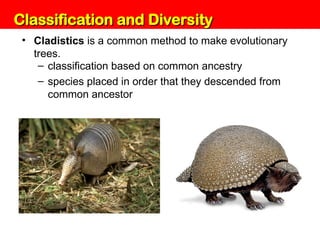
• Cladistics is a common method to make evolutionary
trees.
– classification based on common ancestry
– species placed in order that they descended from
common ancestor
Classification and Diversity
Unit 6: Classification and Diversity
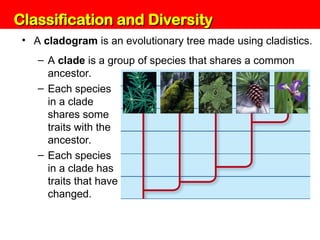
• A cladogram is an evolutionary tree made using cladistics.
– A clade is a group of species that shares a common
ancestor.
– Each species
in a clade
shares some
traits with the
ancestor.
– Each species
in a clade has
traits that have
changed.
Classification and Diversity
Unit 6: Classification and Diversity
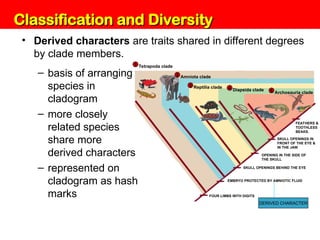
• Derived characters are traits shared in different degrees
by clade members.
– basis of arranging
species in
cladogram
– more closely
related species
share more
derived characters
– represented on
cladogram as hash
marks FOUR LIMBS WITH DIGITS
Tetrapoda clade
1
Amniota clade
2
Reptilia clade
3
Diapsida clade
4
Archosauria clade
5
EMBRYO PROTECTED BY AMNIOTIC FLUID
OPENING IN THE SIDE OF
THE SKULL
SKULL OPENINGS IN
FRONT OF THE EYE &
IN THE JAW
FEATHERS &
TOOTHLESS
BEAKS.
SKULL OPENINGS BEHIND THE EYE
DERIVED CHARACTER
Classification and Diversity
Unit 6: Classification and Diversity
FOUR LIMBS WITH DIGITS
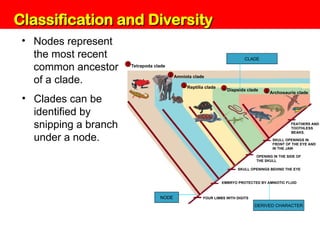
• Nodes represent
the most recent
common ancestor
of a clade.
• Clades can be
identified by
snipping a branch
under a node.
Tetrapoda clade
1
Amniota clade
2
Reptilia clade
3
Diapsida clade
4
Archosauria clade
5
EMBRYO PROTECTED BY AMNIOTIC FLUID
OPENING IN THE SIDE OF
THE SKULL
SKULL OPENINGS IN
FRONT OF THE EYE AND
IN THE JAW
FEATHERS AND
TOOTHLESS
BEAKS.
SKULL OPENINGS BEHIND THE EYE
NODE
DERIVED CHARACTER
CLADE
Classification and Diversity
Unit 6: Classification and Diversity
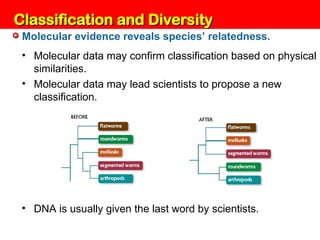
• Molecular data may confirm classification based on physical
similarities.
• Molecular data may lead scientists to propose a new
classification.
Molecular evidence reveals species’ relatedness.
• DNA is usually given the last word by scientists.
Classification and Diversity
Unit 6: Classification and Diversity
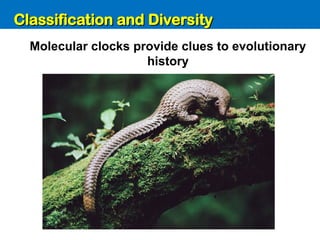
Molecular clocks provide clues to evolutionary
history
Classification and Diversity
Unit 6: Classification and Diversity
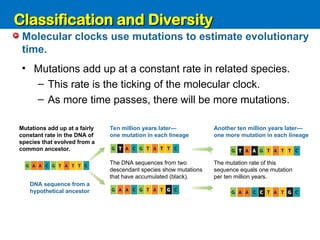
Molecular clocks use mutations to estimate evolutionary
time.
• Mutations add up at a constant rate in related species.
– This rate is the ticking of the molecular clock.
– As more time passes, there will be more mutations.
DNA sequence from a
hypothetical ancestor
The DNA sequences from two
descendant species show mutations
that have accumulated (black).
The mutation rate of this
sequence equals one mutation
per ten million years.
Mutations add up at a fairly
constant rate in the DNA of
species that evolved from a
common ancestor.
Ten million years later—
one mutation in each lineage
Another ten million years later—
one more mutation in each lineage
Classification and Diversity
Unit 6: Classification and Diversity
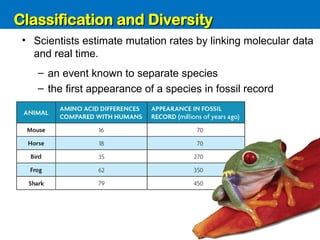
• Scientists estimate mutation rates by linking molecular data
and real time.
– an event known to separate species
– the first appearance of a species in fossil record
Classification and Diversity
Unit 6: Classification and Diversity
• Different molecules have different mutation rates.
– higher rate, better for studying closely related species
– lower rate, better for studying distantly related species
Mitochondrial DNA and ribosomal RNA provide two types
of molecular clocks.
Classification and Diversity
Unit 6: Classification and Diversity
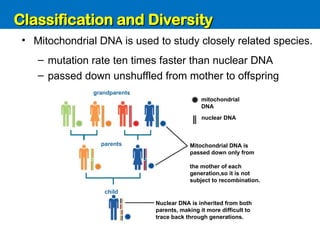
• Mitochondrial DNA is used to study closely related species.
grandparents
parents
child
Nuclear DNA is inherited from both
parents, making it more difficult to
trace back through generations.
Mitochondrial DNA is
passed down only from
the mother of each
generation,so it is not
subject to recombination.
mitochondrial
DNA
nuclear DNA
– mutation rate ten times faster than nuclear DNA
– passed down unshuffled from mother to offspring
Classification and Diversity
Unit 6: Classification and Diversity
• Ribosomal RNA is used to study distantly related species.
– many conservative regions
– lower mutation rate than most DNA
Classification and Diversity
Unit 6: Classification and Diversity
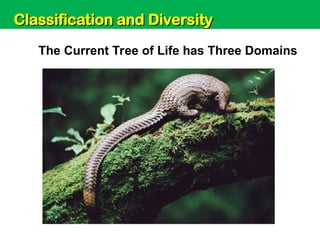
The Current Tree of Life has Three Domains
Classification and Diversity
Unit 6: Classification and Diversity
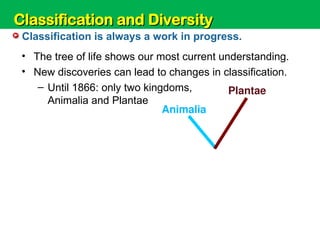
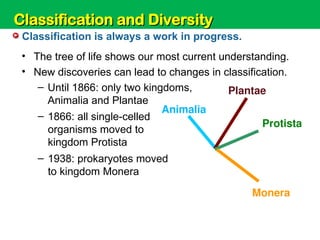
Classification is always a work in progress.
• The tree of life shows our most current understanding.
• New discoveries can lead to changes in classification.
– Until 1866: only two kingdoms,
Animalia and Plantae
Animalia
Plantae
Classification and Diversity
Unit 6: Classification and Diversity
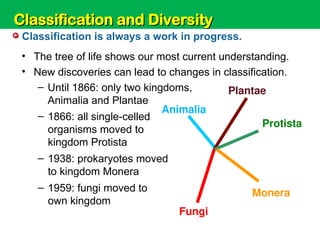
Classification is always a work in progress.
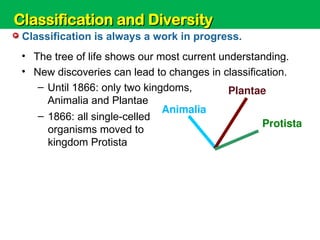
• The tree of life shows our most current understanding.
• New discoveries can lead to changes in classification.
– Until 1866: only two kingdoms,
Animalia and Plantae
– 1866: all single-celled
organisms moved to
kingdom Protista
Animalia
Protista
Plantae
Classification and Diversity
Unit 6: Classification and Diversity
Classification is always a work in progress.
• The tree of life shows our most current understanding.
• New discoveries can lead to changes in classification.
– Until 1866: only two kingdoms,
Animalia and Plantae
– 1938: prokaryotes moved
to kingdom Monera
– 1866: all single-celled
organisms moved to
kingdom Protista
Animalia
Protista
Plantae
Monera
Classification and Diversity
Unit 6: Classification and Diversity
• The tree of life shows our most current understanding.
• New discoveries can lead to changes in classification.
– Until 1866: only two kingdoms,
Animalia and Plantae
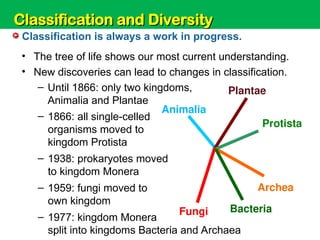
Classification is always a work in progress.
– 1938: prokaryotes moved
to kingdom Monera
– 1866: all single-celled
organisms moved to
kingdom Protista
Monera
– 1959: fungi moved to
own kingdom
Fungi
Protista
Plantae
Animalia
Classification and Diversity
Unit 6: Classification and Diversity
• The tree of life shows our most current understanding.
• New discoveries can lead to changes in classification.
– Until 1866: only two kingdoms,
Animalia and Plantae
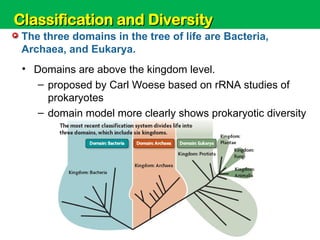
Classification is always a work in progress.
– 1938: prokaryotes moved
to kingdom Monera
– 1866: all single-celled
organisms moved to
kingdom Protista
– 1959: fungi moved to
own kingdom
– 1977: kingdom Monera
split into kingdoms Bacteria and Archaea
Animalia
Protista
Fungi
Plantae
Archea
Bacteria
Classification and Diversity
Unit 6: Classification and Diversity
The three domains in the tree of life are Bacteria,
Archaea, and Eukarya.
• Domains are above the kingdom level.
– proposed by Carl Woese based on rRNA studies of
prokaryotes
– domain model more clearly shows prokaryotic diversity
Classification and Diversity
Unit 6: Classification and Diversity
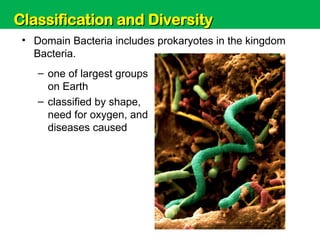
• Domain Bacteria includes prokaryotes in the kingdom
Bacteria.
– one of largest groups
on Earth
– classified by shape,
need for oxygen, and
diseases caused
Classification and Diversity
Unit 6: Classification and Diversity
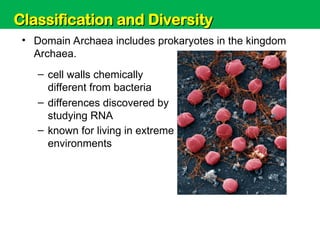
– known for living in extreme
environments
• Domain Archaea includes prokaryotes in the kingdom
Archaea.
– cell walls chemically
different from bacteria
– differences discovered by
studying RNA
Classification and Diversity
Unit 6: Classification and Diversity
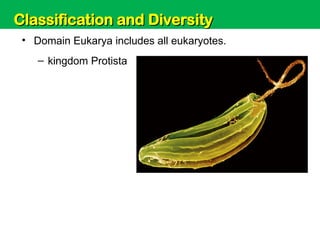
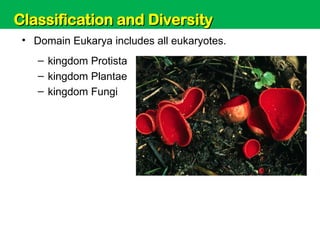
• Domain Eukarya includes all eukaryotes.
– kingdom Protista
Classification and Diversity
Unit 6: Classification and Diversity
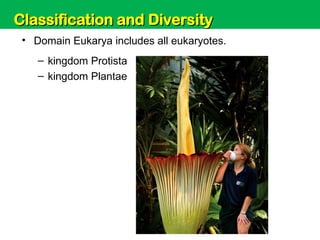
• Domain Eukarya includes all eukaryotes.
– kingdom Protista
– kingdom Plantae
Classification and Diversity
Unit 6: Classification and Diversity
• Domain Eukarya includes all eukaryotes.
– kingdom Protista
– kingdom Plantae
– kingdom Fungi
Classification and Diversity
Unit 6: Classification and Diversity
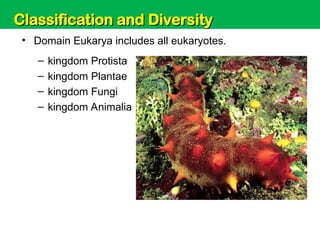
• Domain Eukarya includes all eukaryotes.
– kingdom Protista
– kingdom Plantae
– kingdom Fungi
– kingdom Animalia
Classification and Diversity
Unit 6: Classification and Diversity
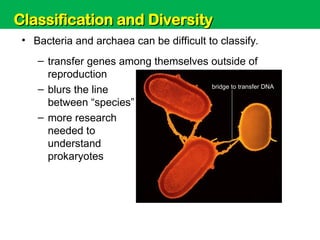
• Bacteria and archaea can be difficult to classify.
– transfer genes among themselves outside of
reproduction
– blurs the line
between “species”
– more research
needed to
understand
prokaryotes
bridge to transfer DNA
Classification and Diversity
Unit 6: Classification and Diversity
May, R.M. (2011). Why worry about how many species and
their loss? PLoS Biol 9: e1001130.
De Carvalho, M.R., Bockmann, F.A., Amorim, D.S., de
Vivo, M., de Toldeo- Piza (2005). Revisiting the
taxonomic impediment. Science 307: 353.
Godfray, H.C. (2002). Challenges for taxonomy. Nature
417: 17-19.
Nature (2002). Genomics and taxonomy for all. Nature 417:
573. 101.
Kapoor, V.C. (1998). Principles and practices of animal
taxonomy. Science Publishers.
References
References

Classification of Organisms Part 2.ppt final

  • 1.
    Unit 6: Classificationand Diversity Fig. 26-1 Not a Snake? -no fused eyelid -no highly mobile jaw -no short tail Some lizards have lost the limbs this condition is found in burrowers that live in grasslands Adaptation. What is this Organism? Eastern Glass Lizard (Ophisaurus ventralis)
  • 2.
    Unit 6: Classificationand Diversity Linnaeus developed the scientific naming system still used today. • Taxonomy is the science of naming and classifying organisms. • A taxon is a group of organisms in a classification system. White oak: Quercus alba Classification and Diversity Classification and Diversity
  • 3.
    Unit 6: Classificationand Diversity • Binomial nomenclature is a two-part scientific naming system. – uses Latin words – scientific names always written in italics – two parts are the genus name and species descriptor Classification and Diversity Classification and Diversity
  • 4.
    Unit 6: Classificationand Diversity • A genus includes one or more physically similar species. – Species in the same genus are thought to be closely related. – Genus name is always capitalized. • A species descriptor is the second part of a scientific name. – always lowercase – always follows genus name; never written alone Tyto alba Classification and Diversity Classification and Diversity
  • 5.
    Unit 6: Classificationand Diversity • Scientific names help scientists to communicate. – Some species have very similar common names. – Some species have many common names. Classification and Diversity Classification and Diversity
  • 6.
    Unit 6: Classificationand Diversity Linnaeus’ classification system has seven levels. • Each level is included in the level above it. • Levels get increasingly specific from kingdom to species. Classification and Diversity Classification and Diversity
  • 7.
    Unit 6: Classificationand Diversity The Linnaean classification system has limitations. • Linnaeus taxonomy doesn’t account for molecular evidence. – The technology didn’t exist during Linneaus’ time. – Linnaean system based only on physical similarities. Classification and Diversity Classification and Diversity
  • 8.
    Unit 6: Classificationand Diversity • Physical similarities are not always the result of close relationships. • Genetic similarities more accurately show evolutionary relationships. Classification and Diversity Classification and Diversity
  • 9.
    Unit 6: Classificationand Diversity Modern classification is based on evolutionary relationships Classification and Diversity Classification and Diversity
  • 10.
    Unit 6: Classificationand Diversity Cladistics is classification based on common ancestry. • Phylogeny is the evolutionary history for a group of species. – evidence from living species, fossil record, and molecular data – shown with branching tree diagrams Classification and Diversity Classification and Diversity
  • 11.
    Unit 6: Classificationand Diversity • Cladistics is a common method to make evolutionary trees. – classification based on common ancestry – species placed in order that they descended from common ancestor Classification and Diversity Classification and Diversity
  • 12.
    Unit 6: Classificationand Diversity • A cladogram is an evolutionary tree made using cladistics. – A clade is a group of species that shares a common ancestor. – Each species in a clade shares some traits with the ancestor. – Each species in a clade has traits that have changed. Classification and Diversity Classification and Diversity
  • 13.
    Unit 6: Classificationand Diversity • Derived characters are traits shared in different degrees by clade members. – basis of arranging species in cladogram – more closely related species share more derived characters – represented on cladogram as hash marks FOUR LIMBS WITH DIGITS Tetrapoda clade 1 Amniota clade 2 Reptilia clade 3 Diapsida clade 4 Archosauria clade 5 EMBRYO PROTECTED BY AMNIOTIC FLUID OPENING IN THE SIDE OF THE SKULL SKULL OPENINGS IN FRONT OF THE EYE & IN THE JAW FEATHERS & TOOTHLESS BEAKS. SKULL OPENINGS BEHIND THE EYE DERIVED CHARACTER Classification and Diversity Classification and Diversity
  • 14.
    Unit 6: Classificationand Diversity FOUR LIMBS WITH DIGITS • Nodes represent the most recent common ancestor of a clade. • Clades can be identified by snipping a branch under a node. Tetrapoda clade 1 Amniota clade 2 Reptilia clade 3 Diapsida clade 4 Archosauria clade 5 EMBRYO PROTECTED BY AMNIOTIC FLUID OPENING IN THE SIDE OF THE SKULL SKULL OPENINGS IN FRONT OF THE EYE AND IN THE JAW FEATHERS AND TOOTHLESS BEAKS. SKULL OPENINGS BEHIND THE EYE NODE DERIVED CHARACTER CLADE Classification and Diversity Classification and Diversity
  • 15.
    Unit 6: Classificationand Diversity • Molecular data may confirm classification based on physical similarities. • Molecular data may lead scientists to propose a new classification. Molecular evidence reveals species’ relatedness. • DNA is usually given the last word by scientists. Classification and Diversity Classification and Diversity
  • 16.
    Unit 6: Classificationand Diversity Molecular clocks provide clues to evolutionary history Classification and Diversity Classification and Diversity
  • 17.
    Unit 6: Classificationand Diversity Molecular clocks use mutations to estimate evolutionary time. • Mutations add up at a constant rate in related species. – This rate is the ticking of the molecular clock. – As more time passes, there will be more mutations. DNA sequence from a hypothetical ancestor The DNA sequences from two descendant species show mutations that have accumulated (black). The mutation rate of this sequence equals one mutation per ten million years. Mutations add up at a fairly constant rate in the DNA of species that evolved from a common ancestor. Ten million years later— one mutation in each lineage Another ten million years later— one more mutation in each lineage Classification and Diversity Classification and Diversity
  • 18.
    Unit 6: Classificationand Diversity • Scientists estimate mutation rates by linking molecular data and real time. – an event known to separate species – the first appearance of a species in fossil record Classification and Diversity Classification and Diversity
  • 19.
    Unit 6: Classificationand Diversity • Different molecules have different mutation rates. – higher rate, better for studying closely related species – lower rate, better for studying distantly related species Mitochondrial DNA and ribosomal RNA provide two types of molecular clocks. Classification and Diversity Classification and Diversity
  • 20.
    Unit 6: Classificationand Diversity • Mitochondrial DNA is used to study closely related species. grandparents parents child Nuclear DNA is inherited from both parents, making it more difficult to trace back through generations. Mitochondrial DNA is passed down only from the mother of each generation,so it is not subject to recombination. mitochondrial DNA nuclear DNA – mutation rate ten times faster than nuclear DNA – passed down unshuffled from mother to offspring Classification and Diversity Classification and Diversity
  • 21.
    Unit 6: Classificationand Diversity • Ribosomal RNA is used to study distantly related species. – many conservative regions – lower mutation rate than most DNA Classification and Diversity Classification and Diversity
  • 22.
    Unit 6: Classificationand Diversity The Current Tree of Life has Three Domains Classification and Diversity Classification and Diversity
  • 23.
    Unit 6: Classificationand Diversity Classification is always a work in progress. • The tree of life shows our most current understanding. • New discoveries can lead to changes in classification. – Until 1866: only two kingdoms, Animalia and Plantae Animalia Plantae Classification and Diversity Classification and Diversity
  • 24.
    Unit 6: Classificationand Diversity Classification is always a work in progress. • The tree of life shows our most current understanding. • New discoveries can lead to changes in classification. – Until 1866: only two kingdoms, Animalia and Plantae – 1866: all single-celled organisms moved to kingdom Protista Animalia Protista Plantae Classification and Diversity Classification and Diversity
  • 25.
    Unit 6: Classificationand Diversity Classification is always a work in progress. • The tree of life shows our most current understanding. • New discoveries can lead to changes in classification. – Until 1866: only two kingdoms, Animalia and Plantae – 1938: prokaryotes moved to kingdom Monera – 1866: all single-celled organisms moved to kingdom Protista Animalia Protista Plantae Monera Classification and Diversity Classification and Diversity
  • 26.
    Unit 6: Classificationand Diversity • The tree of life shows our most current understanding. • New discoveries can lead to changes in classification. – Until 1866: only two kingdoms, Animalia and Plantae Classification is always a work in progress. – 1938: prokaryotes moved to kingdom Monera – 1866: all single-celled organisms moved to kingdom Protista Monera – 1959: fungi moved to own kingdom Fungi Protista Plantae Animalia Classification and Diversity Classification and Diversity
  • 27.
    Unit 6: Classificationand Diversity • The tree of life shows our most current understanding. • New discoveries can lead to changes in classification. – Until 1866: only two kingdoms, Animalia and Plantae Classification is always a work in progress. – 1938: prokaryotes moved to kingdom Monera – 1866: all single-celled organisms moved to kingdom Protista – 1959: fungi moved to own kingdom – 1977: kingdom Monera split into kingdoms Bacteria and Archaea Animalia Protista Fungi Plantae Archea Bacteria Classification and Diversity Classification and Diversity
  • 28.
    Unit 6: Classificationand Diversity The three domains in the tree of life are Bacteria, Archaea, and Eukarya. • Domains are above the kingdom level. – proposed by Carl Woese based on rRNA studies of prokaryotes – domain model more clearly shows prokaryotic diversity Classification and Diversity Classification and Diversity
  • 29.
    Unit 6: Classificationand Diversity • Domain Bacteria includes prokaryotes in the kingdom Bacteria. – one of largest groups on Earth – classified by shape, need for oxygen, and diseases caused Classification and Diversity Classification and Diversity
  • 30.
    Unit 6: Classificationand Diversity – known for living in extreme environments • Domain Archaea includes prokaryotes in the kingdom Archaea. – cell walls chemically different from bacteria – differences discovered by studying RNA Classification and Diversity Classification and Diversity
  • 31.
    Unit 6: Classificationand Diversity • Domain Eukarya includes all eukaryotes. – kingdom Protista Classification and Diversity Classification and Diversity
  • 32.
    Unit 6: Classificationand Diversity • Domain Eukarya includes all eukaryotes. – kingdom Protista – kingdom Plantae Classification and Diversity Classification and Diversity
  • 33.
    Unit 6: Classificationand Diversity • Domain Eukarya includes all eukaryotes. – kingdom Protista – kingdom Plantae – kingdom Fungi Classification and Diversity Classification and Diversity
  • 34.
    Unit 6: Classificationand Diversity • Domain Eukarya includes all eukaryotes. – kingdom Protista – kingdom Plantae – kingdom Fungi – kingdom Animalia Classification and Diversity Classification and Diversity
  • 35.
    Unit 6: Classificationand Diversity • Bacteria and archaea can be difficult to classify. – transfer genes among themselves outside of reproduction – blurs the line between “species” – more research needed to understand prokaryotes bridge to transfer DNA Classification and Diversity Classification and Diversity
  • 36.
    Unit 6: Classificationand Diversity May, R.M. (2011). Why worry about how many species and their loss? PLoS Biol 9: e1001130. De Carvalho, M.R., Bockmann, F.A., Amorim, D.S., de Vivo, M., de Toldeo- Piza (2005). Revisiting the taxonomic impediment. Science 307: 353. Godfray, H.C. (2002). Challenges for taxonomy. Nature 417: 17-19. Nature (2002). Genomics and taxonomy for all. Nature 417: 573. 101. Kapoor, V.C. (1998). Principles and practices of animal taxonomy. Science Publishers. References References

Editor's Notes

  • #1 Figure 26.1 What is this organism?