Classification of NC & CNC Technology
BY:
M. KAMALA KANNAN (211231101603)
3RD YEAR, ROBOTICS AND AUTOMATION
NC Technology:
 Numerical control (NC) technology is the automated control
of machining tools by means of a computer.
 It is a broad term that encompasses a wide range of
systems, from simple point-to-point machines to complex
multi-axis CNC machines.
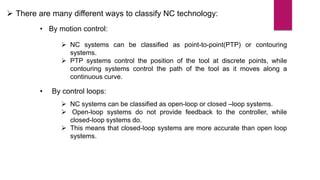
 There are many different ways to classify NC technology:
• By motion control:
 NC systems can be classified as point-to-point(PTP) or contouring
systems.
 PTP systems control the position of the tool at discrete points, while
contouring systems control the path of the tool as it moves along a
continuous curve.
• By control loops:
 NC systems can be classified as open-loop or closed –loop systems.
 Open-loop systems do not provide feedback to the controller, while
closed-loop systems do.
 This means that closed-loop systems are more accurate than open loop
systems.
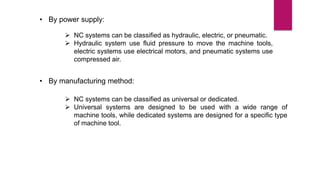
• By power supply:
 NC systems can be classified as hydraulic, electric, or pneumatic.
 Hydraulic system use fluid pressure to move the machine tools,
electric systems use electrical motors, and pneumatic systems use
compressed air.
• By manufacturing method:
 NC systems can be classified as universal or dedicated.
 Universal systems are designed to be used with a wide range of
machine tools, while dedicated systems are designed for a specific type
of machine tool.
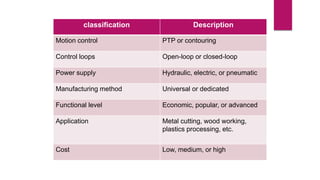
classification Description
Motion control PTP or contouring
Control loops Open-loop or closed-loop
Power supply Hydraulic, electric, or pneumatic
Manufacturing method Universal or dedicated
Functional level Economic, popular, or advanced
Application Metal cutting, wood working,
plastics processing, etc.
Cost Low, medium, or high
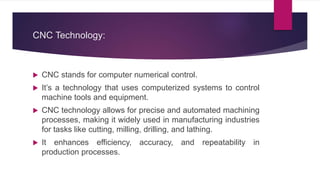
CNC Technology:
 CNC stands for computer numerical control.
 It’s a technology that uses computerized systems to control
machine tools and equipment.
 CNC technology allows for precise and automated machining
processes, making it widely used in manufacturing industries
for tasks like cutting, milling, drilling, and lathing.
 It enhances efficiency, accuracy, and repeatability in
production processes.
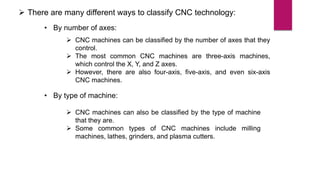
 There are many different ways to classify CNC technology:
• By number of axes:
 CNC machines can be classified by the number of axes that they
control.
 The most common CNC machines are three-axis machines,
which control the X, Y, and Z axes.
 However, there are also four-axis, five-axis, and even six-axis
CNC machines.
• By type of machine:
 CNC machines can also be classified by the type of machine
that they are.
 Some common types of CNC machines include milling
machines, lathes, grinders, and plasma cutters.
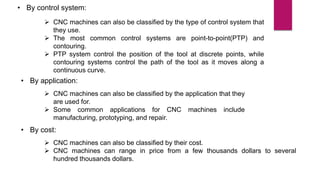
• By control system:
 CNC machines can also be classified by the type of control system that
they use.
 The most common control systems are point-to-point(PTP) and
contouring.
 PTP system control the position of the tool at discrete points, while
contouring systems control the path of the tool as it moves along a
continuous curve.
• By application:
 CNC machines can also be classified by the application that they
are used for.
 Some common applications for CNC machines include
manufacturing, prototyping, and repair.
• By cost:
 CNC machines can also be classified by their cost.
 CNC machines can range in price from a few thousands dollars to several
hundred thousands dollars.
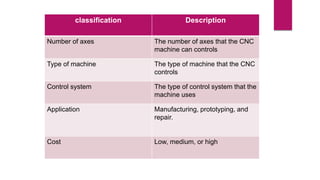
classification Description
Number of axes The number of axes that the CNC
machine can controls
Type of machine The type of machine that the CNC
controls
Control system The type of control system that the
machine uses
Application Manufacturing, prototyping, and
repair.
Cost Low, medium, or high
Classification of NC & CNC Technology.pptx

Classification of NC & CNC Technology.pptx

  • 1.
    Classification of NC& CNC Technology BY: M. KAMALA KANNAN (211231101603) 3RD YEAR, ROBOTICS AND AUTOMATION
  • 2.
    NC Technology:  Numericalcontrol (NC) technology is the automated control of machining tools by means of a computer.  It is a broad term that encompasses a wide range of systems, from simple point-to-point machines to complex multi-axis CNC machines.
  • 3.
     There aremany different ways to classify NC technology: • By motion control:  NC systems can be classified as point-to-point(PTP) or contouring systems.  PTP systems control the position of the tool at discrete points, while contouring systems control the path of the tool as it moves along a continuous curve. • By control loops:  NC systems can be classified as open-loop or closed –loop systems.  Open-loop systems do not provide feedback to the controller, while closed-loop systems do.  This means that closed-loop systems are more accurate than open loop systems.
  • 4.
    • By powersupply:  NC systems can be classified as hydraulic, electric, or pneumatic.  Hydraulic system use fluid pressure to move the machine tools, electric systems use electrical motors, and pneumatic systems use compressed air. • By manufacturing method:  NC systems can be classified as universal or dedicated.  Universal systems are designed to be used with a wide range of machine tools, while dedicated systems are designed for a specific type of machine tool.
  • 5.
    classification Description Motion controlPTP or contouring Control loops Open-loop or closed-loop Power supply Hydraulic, electric, or pneumatic Manufacturing method Universal or dedicated Functional level Economic, popular, or advanced Application Metal cutting, wood working, plastics processing, etc. Cost Low, medium, or high
  • 6.
    CNC Technology:  CNCstands for computer numerical control.  It’s a technology that uses computerized systems to control machine tools and equipment.  CNC technology allows for precise and automated machining processes, making it widely used in manufacturing industries for tasks like cutting, milling, drilling, and lathing.  It enhances efficiency, accuracy, and repeatability in production processes.
  • 7.
     There aremany different ways to classify CNC technology: • By number of axes:  CNC machines can be classified by the number of axes that they control.  The most common CNC machines are three-axis machines, which control the X, Y, and Z axes.  However, there are also four-axis, five-axis, and even six-axis CNC machines. • By type of machine:  CNC machines can also be classified by the type of machine that they are.  Some common types of CNC machines include milling machines, lathes, grinders, and plasma cutters.
  • 8.
    • By controlsystem:  CNC machines can also be classified by the type of control system that they use.  The most common control systems are point-to-point(PTP) and contouring.  PTP system control the position of the tool at discrete points, while contouring systems control the path of the tool as it moves along a continuous curve. • By application:  CNC machines can also be classified by the application that they are used for.  Some common applications for CNC machines include manufacturing, prototyping, and repair. • By cost:  CNC machines can also be classified by their cost.  CNC machines can range in price from a few thousands dollars to several hundred thousands dollars.
  • 9.
    classification Description Number ofaxes The number of axes that the CNC machine can controls Type of machine The type of machine that the CNC controls Control system The type of control system that the machine uses Application Manufacturing, prototyping, and repair. Cost Low, medium, or high