Classical Music
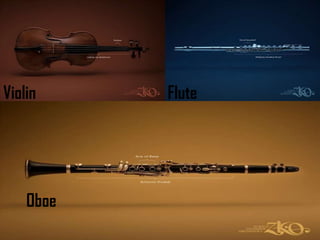
Violin     Flute


    Oboe
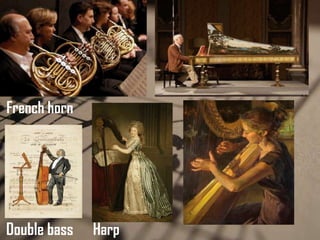
French horn


Double bass   Harp
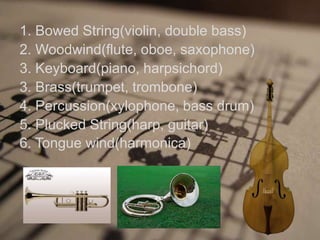
1. Bowed String(violin, double bass)
2. Woodwind(flute, oboe, saxophone)
3. Keyboard(piano, harpsichord)
3. Brass(trumpet, trombone)
4. Percussion(xylophone, bass drum)
5. Plucked String(harp, guitar)
6. Tongue wind(harmonica)
History of classical music
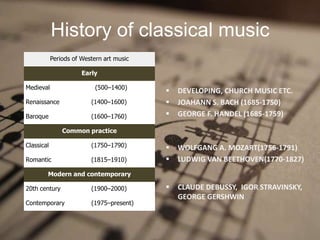
            Periods of Western art music

                       Early

Medieval                    (500–1400)
                                              DEVELOPING, CHURCH MUSIC ETC.
Renaissance               (1400–1600)         JOAHANN S. BACH (1685-1750)
Baroque                   (1600–1760)         GEORGE F. HANDEL (1685-1759)

                Common practice

Classical                 (1750–1790)         WOLFGANG A. MOZART(1756-1791)
Romantic                  (1815–1910)         LUDWIG VAN BEETHOVEN(1770-1827)
        Modern and contemporary

20th century              (1900–2000)         CLAUDE DEBUSSY, IGOR STRAVINSKY,
                                               GEORGE GERSHWIN
Contemporary              (1975–present)
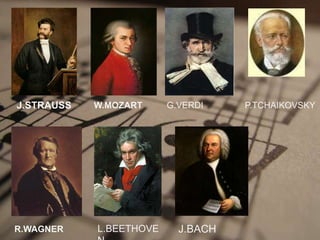
J.STRAUSS   W.MOZART     G.VERDI    P.TCHAIKOVSKY


R.WAGNER    L.BEETHOVE     J.BACH
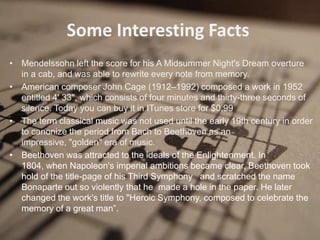
Some Interesting Facts
• Mendelssohn left the score for his A Midsummer Night's Dream overture
  in a cab, and was able to rewrite every note from memory.
• American composer John Cage (1912–1992) composed a work in 1952
  entitled 4' 33", which consists of four minutes and thirty-three seconds of
  silence. Today you can buy it in ITunes store for $0,99
• The term classical music was not used until the early 19th century in order
  to canonize the period from Bach to Beethoven as an
  impressive, "golden" era of music.
• Beethoven was attracted to the ideals of the Enlightenment. In
  1804, when Napoleon's imperial ambitions became clear, Beethoven took
  hold of the title-page of his Third Symphony and scratched the name
  Bonaparte out so violently that he made a hole in the paper. He later
  changed the work's title to "Heroic Symphony, composed to celebrate the
  memory of a great man”.

Classical music

  • 1.
  • 2.
    Violin Flute Oboe
  • 3.
  • 4.
    1. Bowed String(violin,double bass) 2. Woodwind(flute, oboe, saxophone) 3. Keyboard(piano, harpsichord) 3. Brass(trumpet, trombone) 4. Percussion(xylophone, bass drum) 5. Plucked String(harp, guitar) 6. Tongue wind(harmonica)
  • 5.
    History of classicalmusic Periods of Western art music Early Medieval (500–1400)  DEVELOPING, CHURCH MUSIC ETC. Renaissance (1400–1600)  JOAHANN S. BACH (1685-1750) Baroque (1600–1760)  GEORGE F. HANDEL (1685-1759) Common practice Classical (1750–1790)  WOLFGANG A. MOZART(1756-1791) Romantic (1815–1910)  LUDWIG VAN BEETHOVEN(1770-1827) Modern and contemporary 20th century (1900–2000)  CLAUDE DEBUSSY, IGOR STRAVINSKY, GEORGE GERSHWIN Contemporary (1975–present)
  • 6.
    J.STRAUSS W.MOZART G.VERDI P.TCHAIKOVSKY R.WAGNER L.BEETHOVE J.BACH
  • 7.
    Some Interesting Facts •Mendelssohn left the score for his A Midsummer Night's Dream overture in a cab, and was able to rewrite every note from memory. • American composer John Cage (1912–1992) composed a work in 1952 entitled 4' 33", which consists of four minutes and thirty-three seconds of silence. Today you can buy it in ITunes store for $0,99 • The term classical music was not used until the early 19th century in order to canonize the period from Bach to Beethoven as an impressive, "golden" era of music. • Beethoven was attracted to the ideals of the Enlightenment. In 1804, when Napoleon's imperial ambitions became clear, Beethoven took hold of the title-page of his Third Symphony and scratched the name Bonaparte out so violently that he made a hole in the paper. He later changed the work's title to "Heroic Symphony, composed to celebrate the memory of a great man”.