What is Music ?
 an artistic form of auditory communication
incorporating instrumental or vocal tones in a
structured and continuous manner.
 the sounds produced by singers or musical
instruments.
One True Definition of Music !
“music is universal and yet it is also relative and
subjective.”
 Music is the singing of the birds ….
 the whistling of a boy as he’s walking ….
 the beautiful sounds a pianist produces as he touches the
keys of a piano.
Origin of Music (History)
 Six periods of music
 Each period has a particular style of music
that greatly contributed to what music is
today
1
• Medieval, Middle Ages (500-1400)
2
• Renaissance (1400-1600)
3
• Baroque (1600-1760)
4
• Classical (1730-1820)
5
• Romantic (1815-1910)
6
• 20th Century (1900-2000)
Origin of Music (History)
Structure
 Music Timeline Introduction
 Music Forms and Styles
 Musical Instruments
Medieval Ages
Music Timeline (500-1400)
Pic Credit - Replica of the helmet found at Sutton Hoo, in the burial of an Anglo-Saxon leader, probably a king, about 620
in the Early MiddleAges[1]
Medieval Music Timeline
 musical notation began as well as the birth of
polyphony
Early music notation
Monophonic and Polyphonic
 Remarkable continuity : categorized into
monophonic and polyphonic styles
 monophonic means one note at a time while
polyphonic two or more different notes at
the same time.
Plainchant (Plain Song)
 a form of medieval church music that
involves chanting
 Emerged around 100 A.D
 Only type of music allowed in Christian
churches early on
 it was believed that music should make a
listener receptive to spiritual thoughts and
reflections
The Introit, scripted in “neumes” in the 14th—15th century
Gregorian Chant
The Beginning of Polyphony
 a characteristic of Western music based on
plainchant
 improvising with parallel melodies, with emphasis
on fourth (ex. C to F) and fifth (ex. C to G)
intervals
the start of polyphony wherein several musical
lines were combined
 As singers continued experimenting with melodies, polyphony
became more elaborate and complex
The Lute
 is shaped like a pear
 a short neck, a sound hole carved with a rose
pattern
 strings that varied in numbers
 early lute is the peg box which was angled back
Renaissance
Music Timeline (1400-1600)
 Renaissance or "rebirth," a period of significant changes in
history, including music
Humanism in Music
 A new philosophy called “humanism” developed
in Italy
 It emphasized that life should be viewed as a
preparation for death
 Dutch composers and musicians
were arranged to teach and
perform in Italian courts
 the invention of printing helped
spread these new ideas
Instrumental Music
 By the second half of the 1500s instrumental
music began to take shape
 The lute was widely used at that time
 eventually mixed instruments were used
Mix instruments are played
Renaissance Musical Instruments
 The Shawm
 The Dulcian
 The Trumpet
The shawm
 has a conical bore, only wider
 It has 7 to 8 finger holes
 at the end of the bore is a large bell
 was mostly used in outdoor
ceremonial events
Dulcian
 The dulcian is a predecessor of the shawm
 A precursor of the bassoon
 Dulcians are easier to transport than the
shawm due to its smaller size
 Dulcians produce sound that is less piercing
than the shawm
Trumpet
 The most commonly used is the B flat trumpet
 There is also the C, D, E flat and piccolo trumpet
Baroque
Music Timeline (1600-1760)
 "baroque" comes from the Italian word "barocco" which
means bizarre (very strange)
Baroque
 a time when composers experimented with form,
styles and instruments.
 the development of opera and instrumental
music
 The violin was also considered an important
musical instrument during this time
Venice and the Opera
 In 1573, a group of musicians and intellectuals came together to
discuss various subjects
 This group of individuals are known as the “Florentine Camerata”,
 The composer Claduio Monteverdi was an important
contributor, specifically his opera ”Orfeo”; the first opera to
gain public welcome
 In Europe, the earliest four stringed violin was used in the
first part of the century
 fairly easy to start learning
 mostly suitable for children 6 years and older
Violin
Viola
 The first violas are believed to have
been made in the 15th century
 During the 18th century, it was used to
play the part of the cello.
 an important member of a string
ensemble.
 It is tuned a fifth lower than the violin
 It’s functions as the tenor instrument in a string ensemble.
 the viola has become an integral part of every string
ensemble
Double Bass
 In 1516 there was an illustration closely
resembling that of a double bass.
 It is like a huge cello and is played the same
way
 By rubbing the bow across the strings
 Striking the strings
 The double bass isn't as popular as other string instruments
but is essential in most kinds of ensemble especially jazz
bands.
The Harp
 It is surprisingly easy to start
 Not a lot of people play the harp
 Even finding a teacher may be
difficult.
 One of the most beautiful sounding instruments
How to Play: The musician blows air into a thin, tapered
double reed and cover or uncover the holes.
Oboe
Classical
Music Timeline (1730-1820)
 is characterized by simpler melodies such as the sonatas.
 The primary instrument is Piano
Style Galant
 a simple yet more direct style of music.
 Middle class also appreciate
 less complicated and easy to understand
Sentimental Style
 This style was adapted by composers
 reflected feelings and situations experienced
in daily life
 New music styles of Classical period
 It had simpler harmony and clearer tonality
Piano
 Bartolomeo Cristofori created
around 1709 in Florence.
 Changes in his early invention
became the basic of the modern
piano.
 very popular in the mid-18th century
Romantic
Music Timeline (1815-1910)
 is characterized by using music to tell a story or express an
idea
 the use of various instruments including wind instruments
Beethoven and Romanticism
 Wrote choral, chamber music
and opera.
 studied under Haydn,
 was also influenced by the works
of Mozart
 began to lose his hearing at age 28,
losing it completely by age 50.
 One of his most popular works is the Ninth Symphony
 He influenced a new crop of young composers guided by the
ideals of Romanticism.
What is Romanticism?
that
from
included
music to
different art
painting to
 a concept
mediums;
literature.
 During the 19th century, Vienna and Paris
were the centers of musical activity
Wanderer Above the Sea of Fog, by
Caspar David Friedrich
is an example of Romantic painting.
 believed in allowing their imagination and passion
 different from the Classical belief of logical order and clarity
What is Romanticism?
The Flute
The Saxophone
The Tuba
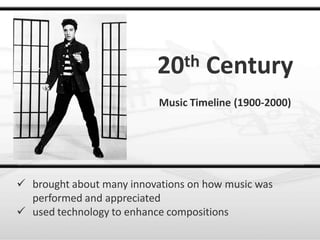
20th Century
Music Timeline (1900-2000)
 brought about many innovations on how music was
performed and appreciated
 used technology to enhance compositions
20th Century Music
 is defined by the sudden emergence of
advanced technology
 no longer limited to concerts, opera-houses,
clubs, and domestic music-making
Rock and roll
 often written as rock & roll or rock 'n' roll
 evolved in the United States during the late
1940s and early 1950s
 combination of African American blues,
country, jazz and gospel music.
 Either the piano or saxophone was often the lead instrument
 generally replaced by guitar in the middle to late 1950s
 now more commonly called simply "rock music" or "rock".
Hip Hop Music
 also called rap music
 consisting of a stylized rhythmic music
 commonly accompanies rapping, a rhythmic
and rhyming speech that is chanted
four key stylistic elements:
 rapping, scratching, breaking and graffiti writing
Music has changed the world ?
 When some people get sad, they often
start listening to music, which then calms
them down
 If it wasn't for music, then this world
would've been insane
Music Education : http://musiced.about.com/
Medieval : http://en.wikipedia.org/wiki/Medieval_music
Renaissance : http://en.wikipedia.org/wiki/Renaissance_music
Baroque : http://en.wikipedia.org/wiki/Baroque_music
Classical : http://en.wikipedia.org/wiki/Classical_period_(music)
Romantic : http://en.wikipedia.org/wiki/Romantic_music
20th Century : http://en.wikipedia.org/wiki/20th-century_classical_music
music-120829142425-phpapp02.pptx

music-120829142425-phpapp02.pptx

  • 2.
    What is Music?  an artistic form of auditory communication incorporating instrumental or vocal tones in a structured and continuous manner.  the sounds produced by singers or musical instruments.
  • 3.
    One True Definitionof Music ! “music is universal and yet it is also relative and subjective.”
  • 4.
     Music isthe singing of the birds ….
  • 5.
     the whistlingof a boy as he’s walking ….
  • 6.
     the beautifulsounds a pianist produces as he touches the keys of a piano.
  • 7.
    Origin of Music(History)  Six periods of music  Each period has a particular style of music that greatly contributed to what music is today
  • 8.
    1 • Medieval, MiddleAges (500-1400) 2 • Renaissance (1400-1600) 3 • Baroque (1600-1760) 4 • Classical (1730-1820) 5 • Romantic (1815-1910) 6 • 20th Century (1900-2000) Origin of Music (History)
  • 9.
    Structure  Music TimelineIntroduction  Music Forms and Styles  Musical Instruments
  • 10.
    Medieval Ages Music Timeline(500-1400) Pic Credit - Replica of the helmet found at Sutton Hoo, in the burial of an Anglo-Saxon leader, probably a king, about 620 in the Early MiddleAges[1]
  • 11.
    Medieval Music Timeline musical notation began as well as the birth of polyphony Early music notation
  • 12.
    Monophonic and Polyphonic Remarkable continuity : categorized into monophonic and polyphonic styles  monophonic means one note at a time while polyphonic two or more different notes at the same time.
  • 13.
    Plainchant (Plain Song) a form of medieval church music that involves chanting  Emerged around 100 A.D  Only type of music allowed in Christian churches early on  it was believed that music should make a listener receptive to spiritual thoughts and reflections
  • 14.
    The Introit, scriptedin “neumes” in the 14th—15th century
  • 15.
  • 16.
    The Beginning ofPolyphony  a characteristic of Western music based on plainchant  improvising with parallel melodies, with emphasis on fourth (ex. C to F) and fifth (ex. C to G) intervals
  • 17.
    the start ofpolyphony wherein several musical lines were combined
  • 18.
     As singerscontinued experimenting with melodies, polyphony became more elaborate and complex
  • 19.
    The Lute  isshaped like a pear  a short neck, a sound hole carved with a rose pattern  strings that varied in numbers  early lute is the peg box which was angled back
  • 20.
    Renaissance Music Timeline (1400-1600) Renaissance or "rebirth," a period of significant changes in history, including music
  • 21.
    Humanism in Music A new philosophy called “humanism” developed in Italy  It emphasized that life should be viewed as a preparation for death
  • 22.
     Dutch composersand musicians were arranged to teach and perform in Italian courts  the invention of printing helped spread these new ideas
  • 23.
    Instrumental Music  Bythe second half of the 1500s instrumental music began to take shape  The lute was widely used at that time  eventually mixed instruments were used
  • 24.
  • 25.
    Renaissance Musical Instruments The Shawm  The Dulcian  The Trumpet
  • 26.
    The shawm  hasa conical bore, only wider  It has 7 to 8 finger holes  at the end of the bore is a large bell  was mostly used in outdoor ceremonial events
  • 27.
    Dulcian  The dulcianis a predecessor of the shawm  A precursor of the bassoon  Dulcians are easier to transport than the shawm due to its smaller size  Dulcians produce sound that is less piercing than the shawm
  • 28.
    Trumpet  The mostcommonly used is the B flat trumpet  There is also the C, D, E flat and piccolo trumpet
  • 29.
    Baroque Music Timeline (1600-1760) "baroque" comes from the Italian word "barocco" which means bizarre (very strange)
  • 30.
    Baroque  a timewhen composers experimented with form, styles and instruments.  the development of opera and instrumental music  The violin was also considered an important musical instrument during this time
  • 31.
    Venice and theOpera  In 1573, a group of musicians and intellectuals came together to discuss various subjects  This group of individuals are known as the “Florentine Camerata”,
  • 32.
     The composerCladuio Monteverdi was an important contributor, specifically his opera ”Orfeo”; the first opera to gain public welcome
  • 33.
     In Europe,the earliest four stringed violin was used in the first part of the century  fairly easy to start learning  mostly suitable for children 6 years and older Violin
  • 34.
    Viola  The firstviolas are believed to have been made in the 15th century  During the 18th century, it was used to play the part of the cello.  an important member of a string ensemble.  It is tuned a fifth lower than the violin  It’s functions as the tenor instrument in a string ensemble.  the viola has become an integral part of every string ensemble
  • 35.
    Double Bass  In1516 there was an illustration closely resembling that of a double bass.  It is like a huge cello and is played the same way  By rubbing the bow across the strings  Striking the strings  The double bass isn't as popular as other string instruments but is essential in most kinds of ensemble especially jazz bands.
  • 36.
    The Harp  Itis surprisingly easy to start  Not a lot of people play the harp  Even finding a teacher may be difficult.  One of the most beautiful sounding instruments
  • 37.
    How to Play:The musician blows air into a thin, tapered double reed and cover or uncover the holes. Oboe
  • 38.
    Classical Music Timeline (1730-1820) is characterized by simpler melodies such as the sonatas.  The primary instrument is Piano
  • 39.
    Style Galant  asimple yet more direct style of music.  Middle class also appreciate  less complicated and easy to understand
  • 40.
    Sentimental Style  Thisstyle was adapted by composers  reflected feelings and situations experienced in daily life  New music styles of Classical period  It had simpler harmony and clearer tonality
  • 41.
    Piano  Bartolomeo Cristoforicreated around 1709 in Florence.  Changes in his early invention became the basic of the modern piano.  very popular in the mid-18th century
  • 42.
    Romantic Music Timeline (1815-1910) is characterized by using music to tell a story or express an idea  the use of various instruments including wind instruments
  • 43.
    Beethoven and Romanticism Wrote choral, chamber music and opera.  studied under Haydn,  was also influenced by the works of Mozart  began to lose his hearing at age 28, losing it completely by age 50.  One of his most popular works is the Ninth Symphony  He influenced a new crop of young composers guided by the ideals of Romanticism.
  • 44.
    What is Romanticism? that from included musicto different art painting to  a concept mediums; literature.  During the 19th century, Vienna and Paris were the centers of musical activity
  • 45.
    Wanderer Above theSea of Fog, by Caspar David Friedrich is an example of Romantic painting.  believed in allowing their imagination and passion  different from the Classical belief of logical order and clarity What is Romanticism?
  • 46.
  • 47.
  • 48.
  • 49.
    20th Century Music Timeline(1900-2000)  brought about many innovations on how music was performed and appreciated  used technology to enhance compositions
  • 50.
    20th Century Music is defined by the sudden emergence of advanced technology  no longer limited to concerts, opera-houses, clubs, and domestic music-making
  • 51.
    Rock and roll often written as rock & roll or rock 'n' roll  evolved in the United States during the late 1940s and early 1950s  combination of African American blues, country, jazz and gospel music.
  • 52.
     Either thepiano or saxophone was often the lead instrument  generally replaced by guitar in the middle to late 1950s  now more commonly called simply "rock music" or "rock".
  • 53.
    Hip Hop Music also called rap music  consisting of a stylized rhythmic music  commonly accompanies rapping, a rhythmic and rhyming speech that is chanted
  • 54.
    four key stylisticelements:  rapping, scratching, breaking and graffiti writing
  • 55.
    Music has changedthe world ?  When some people get sad, they often start listening to music, which then calms them down  If it wasn't for music, then this world would've been insane
  • 56.
    Music Education :http://musiced.about.com/ Medieval : http://en.wikipedia.org/wiki/Medieval_music Renaissance : http://en.wikipedia.org/wiki/Renaissance_music Baroque : http://en.wikipedia.org/wiki/Baroque_music Classical : http://en.wikipedia.org/wiki/Classical_period_(music) Romantic : http://en.wikipedia.org/wiki/Romantic_music 20th Century : http://en.wikipedia.org/wiki/20th-century_classical_music