
You’ll probably all
             recognize…

 Ride of the Valkries
    http://www.youtube.com/watch?v=V92OBNsQgxU&lis
     t=LP8n51vlXWW6I&index=1&feature=plcp
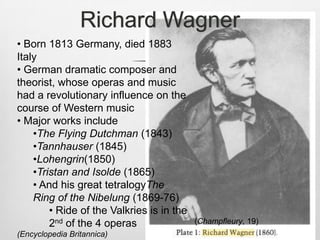
Richard Wagner
• Born 1813 Germany, died 1883
Italy
• German dramatic composer and
theorist, whose operas and music
had a revolutionary influence on the
course of Western music
• Major works include
    •The Flying Dutchman (1843)
    •Tannhauser (1845)
    •Lohengrin(1850)
    •Tristan and Isolde (1865)
    • And his great tetralogyThe
    Ring of the Nibelung (1869-76)
        • Ride of the Valkries is in the
        2nd of the 4 operas                (Champfleury, 19)
(Encyclopedia Britannica)
“It lies in the nature of music
   to be, not the aim, but the
     means of expression.”
        - Richard Wagner
Characterization of Wagner’s Music
 Absence of melodies

 Strange orchestrations

 Bizarre combinations of instruments with clashing timbres

 Remarkable melodies suddenly interrupted as if by a malicious
  gnome

 Comparable to the religious feeling experienced while silently
  crossing a dense forest

 Not imitative music like Hadyn’sFour Seasons that imitated the
  passing of winter to spring. Wagner created orchestral
  experiences that included characters and drama, all through
  music and dance
                                        Champfleury
More than just a musician…

 Wagner was a thinker and writer

 He announced himself a reformer of music, but he
  really was a reformer of the opera because he
  worked cross genre to create a compound art form


                              (Gryanowski)
Realism in the Arts

 In the line of successful 19th century German composers
  (Felix Mendelssohn, Schumann, Johannes Brahms)
  Richard Wagner created a revolutionary new form of
  musical drama grounded in complicated psychological,
  religious, and philosophical symbolism
 He worked to create a more unified presentation of poetry,
  music, dance, and scenery in historical & mythical operas
 Along the lines of a unified presentation, Wagner’s
  compositions are considered consistent with the period of
  Realism because of his attempt to genuinely convey
  events and life experiences by abstract emotion-rich form
  rather than through strictly formal imitation
                                       (Encyclopedia Britannica)
Among the great composers for the theater,
    Richard Wagner was the only one who
 created plot, characters, text, and symbolism
  as well as the music. He raised the melodic
  and harmonic style of German music to its
   highest emotional intensity, changing the
     course of Western music by either the
   extension of his methods or the reaction
                 against them.
                             (Encyclopedia Britannica)
Some critics HATED Wagner


 Some musical and theatrical critics thought he was
  too different compared to previous composers

 The word realism and label music of the future were
  used as clubs to beat him down

 Audiences, however, loved the experience of
  Wagner operas


                            (Champfleury)
More music

 Siegfried Funeral March from Gotterdammerung
    http://www.youtube.com/watch?v=L8wHteSOwW4
       You’ll notice minor keys, powerful emotions that are not
        necessarily pleasant

 Tannhauser Overture
    http://www.youtube.com/watch?v=SRmCEGHt-
     Qk&feature=related
Politics

 Wagner was exiled from Germany for 12 years because of
  political events
 He was a Socialist, banned from Germany until 1861
 While in Paris and Zurich, he wrote much music, and prose.
 King Ludwig II of Bavaria paid Wagner’s debts and essentially
  rescued and popularized his work again after exile, funding his
  latter work
 His involvement with left-wing politics, Socialism, and Anti-
  Semitist overtones, cast him in a poor light civically due to
  implications of Nazism

                                           (Berry)
Legacy & Reputation

 Wagner described himself as the “embodiment of German
  spirit”
 He fashioned himself as the German composer, establishing a
  unique profile for himself even before his brand of national
  opera was established
 Though heavily criticized, he inspired a new kind of opera that
  stretched beyond Germany and Europe
 His influence trickled over to many disciplines including
  literature, visual arts, theater, film, and philosophy
 English-American poet W.H. Auden calls Wagner, “Perhaps the
  greatest genius that ever lived.”

                                       (Vazsonyi)
Works Cited

   Berry, Mark. Richard Wagner and the Politics of Music-Drama The Historical Journal , Vol.
    47, No. 3 (Sep., 2004), pp. 663-683

   Champfleury and Palomba Paves-Yashinsky. "Richard Wagner" and "After the Battle”
    19th-Century Music , Vol. 13, No. 1 (Summer, 1989), pp. 18-27

   Gryzanowski, E. Richard Wagner's Theories of Music Oper und Drama by Richard Wagner
    Review by: The North American Review , Vol. 124, No. 254 (Jan., 1877), pp. 53-81

   Millington, Barry (Ed.) (1992) The Wagner Compendium: A Guide to Wagner's Life and
    Music. Thames and Hudson Ltd., London.

   "Richard Wagner." Encyclopædia Britannica. Encyclopædia Britannica Online.
    Encyclopædia Britannica Inc., 2012. Web. 07 Oct. 2012.
    <http://www.britannica.com/EBchecked/topic/633925/Richard-Wagner>.

   Vazsonyi, Nicholas. Marketing German Identity: Richard Wagner's "Enterprise”German
    Studies Review , Vol. 28, No. 2 (May, 2005), pp. 327-346

Richard Wagner Hailey Hirst

  • 2.
    You’ll probably all recognize…  Ride of the Valkries  http://www.youtube.com/watch?v=V92OBNsQgxU&lis t=LP8n51vlXWW6I&index=1&feature=plcp
  • 3.
    Richard Wagner • Born1813 Germany, died 1883 Italy • German dramatic composer and theorist, whose operas and music had a revolutionary influence on the course of Western music • Major works include •The Flying Dutchman (1843) •Tannhauser (1845) •Lohengrin(1850) •Tristan and Isolde (1865) • And his great tetralogyThe Ring of the Nibelung (1869-76) • Ride of the Valkries is in the 2nd of the 4 operas (Champfleury, 19) (Encyclopedia Britannica)
  • 4.
    “It lies inthe nature of music to be, not the aim, but the means of expression.” - Richard Wagner
  • 5.
    Characterization of Wagner’sMusic  Absence of melodies  Strange orchestrations  Bizarre combinations of instruments with clashing timbres  Remarkable melodies suddenly interrupted as if by a malicious gnome  Comparable to the religious feeling experienced while silently crossing a dense forest  Not imitative music like Hadyn’sFour Seasons that imitated the passing of winter to spring. Wagner created orchestral experiences that included characters and drama, all through music and dance Champfleury
  • 6.
    More than justa musician…  Wagner was a thinker and writer  He announced himself a reformer of music, but he really was a reformer of the opera because he worked cross genre to create a compound art form (Gryanowski)
  • 7.
    Realism in theArts  In the line of successful 19th century German composers (Felix Mendelssohn, Schumann, Johannes Brahms) Richard Wagner created a revolutionary new form of musical drama grounded in complicated psychological, religious, and philosophical symbolism  He worked to create a more unified presentation of poetry, music, dance, and scenery in historical & mythical operas  Along the lines of a unified presentation, Wagner’s compositions are considered consistent with the period of Realism because of his attempt to genuinely convey events and life experiences by abstract emotion-rich form rather than through strictly formal imitation (Encyclopedia Britannica)
  • 8.
    Among the greatcomposers for the theater, Richard Wagner was the only one who created plot, characters, text, and symbolism as well as the music. He raised the melodic and harmonic style of German music to its highest emotional intensity, changing the course of Western music by either the extension of his methods or the reaction against them. (Encyclopedia Britannica)
  • 9.
    Some critics HATEDWagner  Some musical and theatrical critics thought he was too different compared to previous composers  The word realism and label music of the future were used as clubs to beat him down  Audiences, however, loved the experience of Wagner operas (Champfleury)
  • 10.
    More music  SiegfriedFuneral March from Gotterdammerung  http://www.youtube.com/watch?v=L8wHteSOwW4  You’ll notice minor keys, powerful emotions that are not necessarily pleasant  Tannhauser Overture  http://www.youtube.com/watch?v=SRmCEGHt- Qk&feature=related
  • 11.
    Politics  Wagner wasexiled from Germany for 12 years because of political events  He was a Socialist, banned from Germany until 1861  While in Paris and Zurich, he wrote much music, and prose.  King Ludwig II of Bavaria paid Wagner’s debts and essentially rescued and popularized his work again after exile, funding his latter work  His involvement with left-wing politics, Socialism, and Anti- Semitist overtones, cast him in a poor light civically due to implications of Nazism (Berry)
  • 12.
    Legacy & Reputation Wagner described himself as the “embodiment of German spirit”  He fashioned himself as the German composer, establishing a unique profile for himself even before his brand of national opera was established  Though heavily criticized, he inspired a new kind of opera that stretched beyond Germany and Europe  His influence trickled over to many disciplines including literature, visual arts, theater, film, and philosophy  English-American poet W.H. Auden calls Wagner, “Perhaps the greatest genius that ever lived.” (Vazsonyi)
  • 13.
    Works Cited  Berry, Mark. Richard Wagner and the Politics of Music-Drama The Historical Journal , Vol. 47, No. 3 (Sep., 2004), pp. 663-683  Champfleury and Palomba Paves-Yashinsky. "Richard Wagner" and "After the Battle” 19th-Century Music , Vol. 13, No. 1 (Summer, 1989), pp. 18-27  Gryzanowski, E. Richard Wagner's Theories of Music Oper und Drama by Richard Wagner Review by: The North American Review , Vol. 124, No. 254 (Jan., 1877), pp. 53-81  Millington, Barry (Ed.) (1992) The Wagner Compendium: A Guide to Wagner's Life and Music. Thames and Hudson Ltd., London.  "Richard Wagner." Encyclopædia Britannica. Encyclopædia Britannica Online. Encyclopædia Britannica Inc., 2012. Web. 07 Oct. 2012. <http://www.britannica.com/EBchecked/topic/633925/Richard-Wagner>.  Vazsonyi, Nicholas. Marketing German Identity: Richard Wagner's "Enterprise”German Studies Review , Vol. 28, No. 2 (May, 2005), pp. 327-346