MOTION AND MEASUREMENT
OF DISTANCES NOTES.
DEFINITIONS:
•MOTION: When the body’s position changes with respect to its
surroundings and time, the body is said to be in motion.
•REST: When the body’s position doesn’t change with respect to its
surroundings and time, the body is said to be at rest.
•INERTIA: The object tends to remain
unchanged either in rest or in motion.
•INERTIA OF REST: The inherent property of a body by
virtue of which it cannot change its position of rest, is called Inertia of rest.
•Eg: It is due to inertia of rest that passengers in a vehicle get a
backward jerk when the vehicle starts suddenly
• INERTIA OF MOTION: The resistance of any physical object to any change in its
velocity. This includes changes to the object's speed or direction of motion. This is
called Inertia of Motion. Eg: We fall forward in a car or bus if the driver applies
brakes due to the inertia of motion.
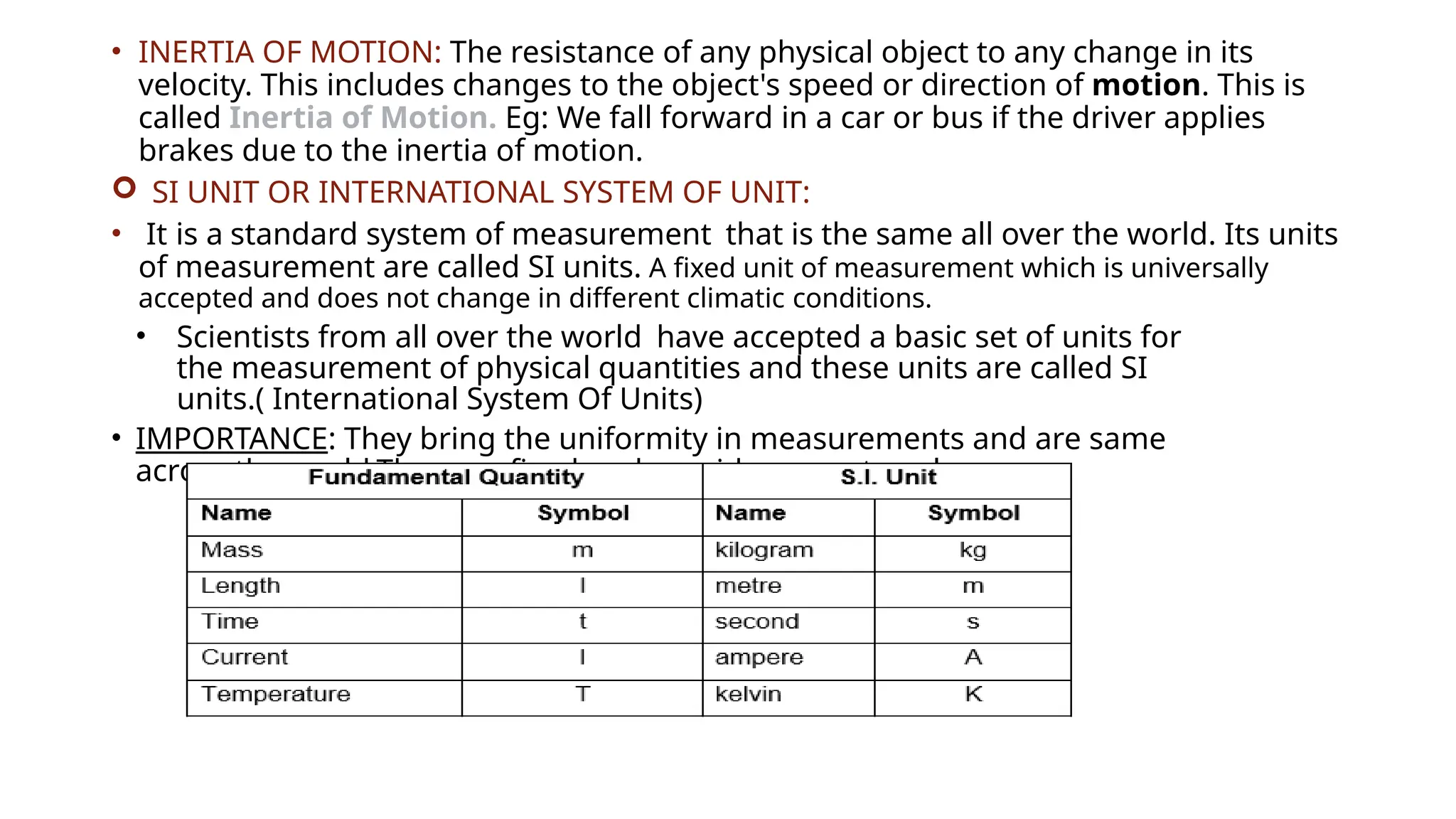
 SI UNIT OR INTERNATIONAL SYSTEM OF UNIT:
• It is a standard system of measurement that is the same all over the world. Its units
of measurement are called SI units. A fixed unit of measurement which is universally
accepted and does not change in different climatic conditions.
• Scientists from all over the world have accepted a basic set of units for
the measurement of physical quantities and these units are called SI
units.( International System Of Units)
• IMPORTANCE: They bring the uniformity in measurements and are same
across the world.They are fixed and provide accurate value.
• CONVERSION OF UNITS:
 (To be written in Blank page)
•
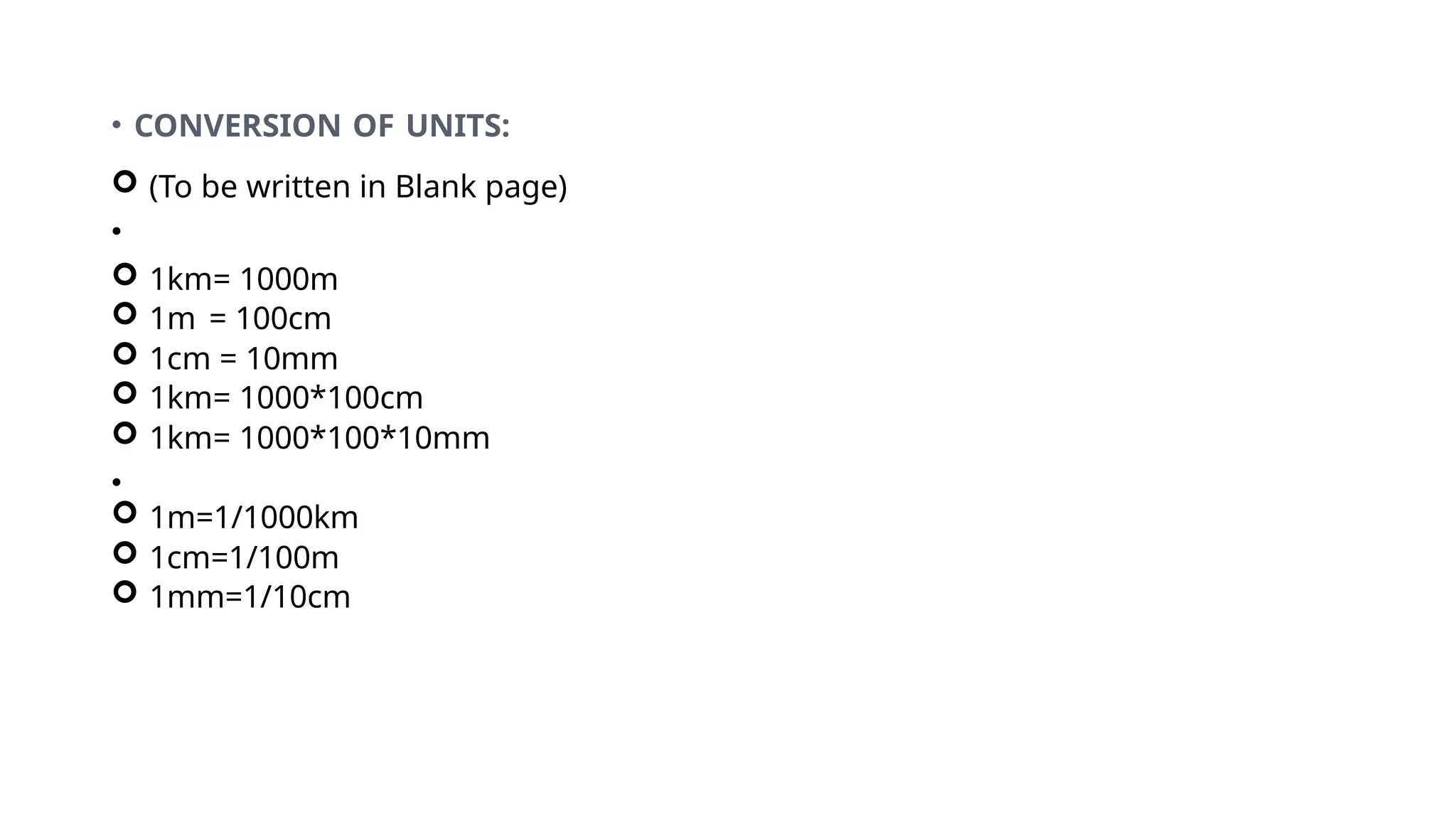
 1km= 1000m
 1m = 100cm
 1cm = 10mm
 1km= 1000*100cm
 1km= 1000*100*10mm
•
 1m=1/1000km
 1cm=1/100m
 1mm=1/10cm
QUESTIONS AND ANSWERS:
1. What do you understand about transportation? What
brought about a revolution in the means of
transportation?
•Ans.The process of travelling and moving people or goods
from one place to another is called transportation. People
need to go to places for different reasons. They also need
many things which reach them via transportation. No trade is
possible without transportation.
2.What do you understand by measurement? Explain
• Ans. Measurement is the comparison of an unknown quantity with a fixed
quantity of the same kind. The fixed quantity is known as the unit of
measurement.
• Every measurement involves two things:
● The unit of measurement.
● The number of units the object measures.
• For example, when we say that the length of a cloth piece is 3 metres, we actually
compare the length of the cloth piece (unknown quantity) with a fixed known
quantity(metre).
• Thus, we can say that the unknown quantity is 3 times the unknown quantity is 3
times the known quantity and is written as 3m. Here, measurement has two parts,
a number (3) and a fixed quantity (metre). Metre is the unit of measurement in
this case.
3.Describe various precautions that need to be taken while taking measurements.
• Ans.
The meter scale should have edges with no missing
markings. It should be kept straight along the edges of
the object to be measured.
Scales with worn-out ends should be avoided.
Reading should always be taken keeping the eye
straight and not from the side.
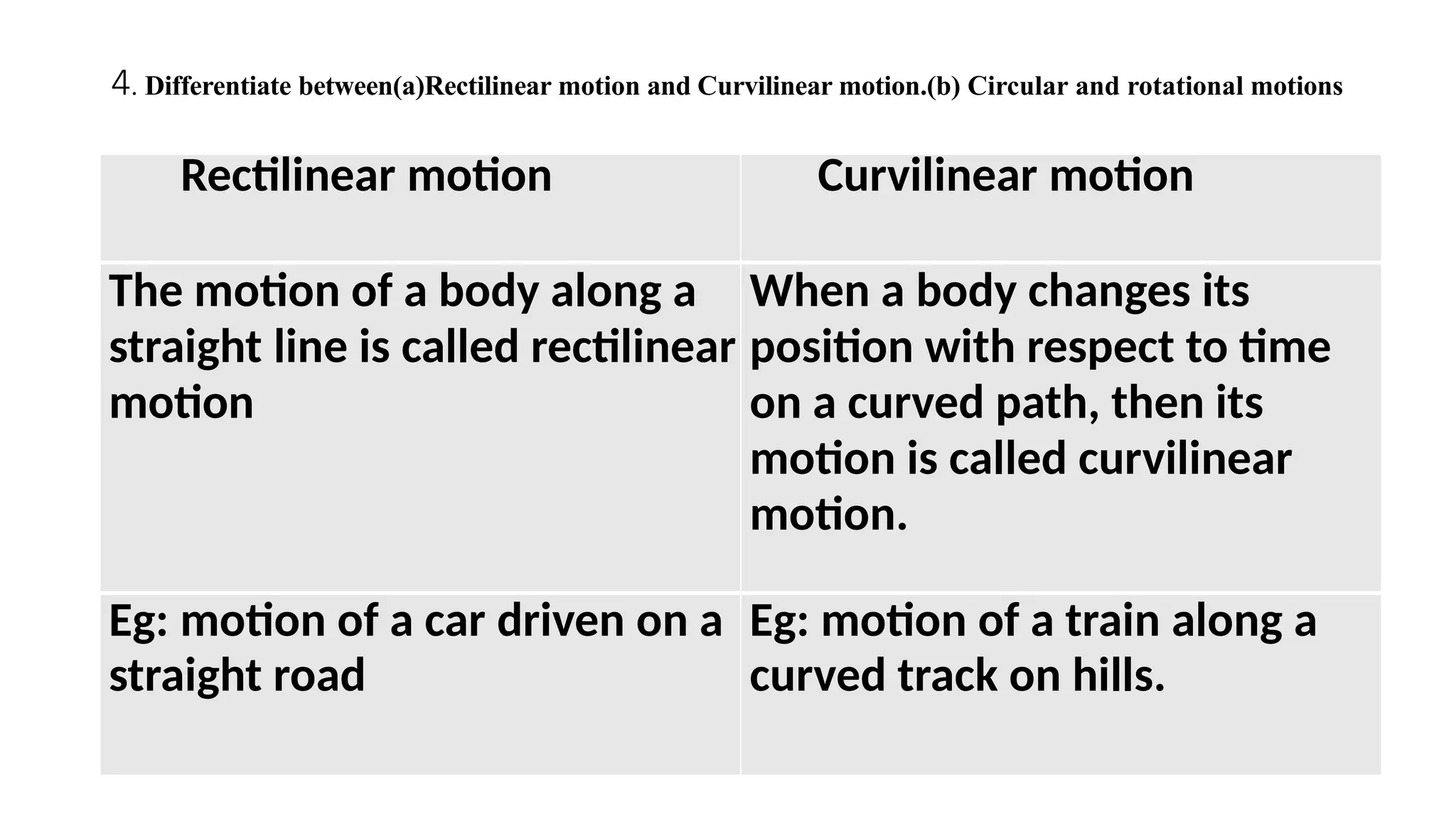
4. Differentiate between(a)Rectilinear motion and Curvilinear motion.(b) Circular and rotational motions
Rectilinear motion Curvilinear motion
The motion of a body along a
straight line is called rectilinear
motion
When a body changes its
position with respect to time
on a curved path, then its
motion is called curvilinear
motion.
Eg: motion of a car driven on a
straight road
Eg: motion of a train along a
curved track on hills.
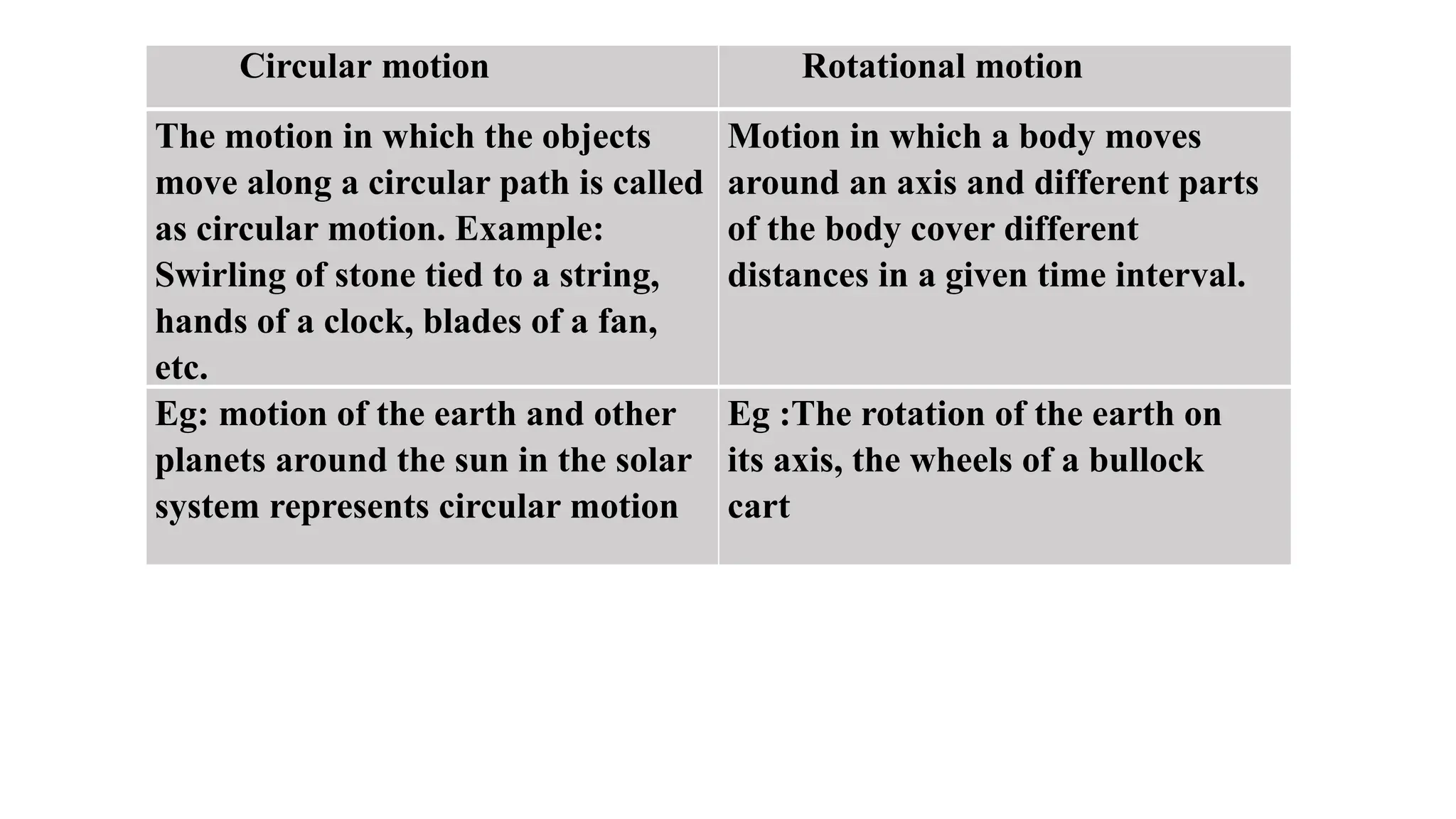
Circular motion Rotational motion
The motion in which the objects
move along a circular path is called
as circular motion. Example:
Swirling of stone tied to a string,
hands of a clock, blades of a fan,
etc.
Motion in which a body moves
around an axis and different parts
of the body cover different
distances in a given time interval.
Eg: motion of the earth and other
planets around the sun in the solar
system represents circular motion
Eg :The rotation of the earth on
its axis, the wheels of a bullock
cart
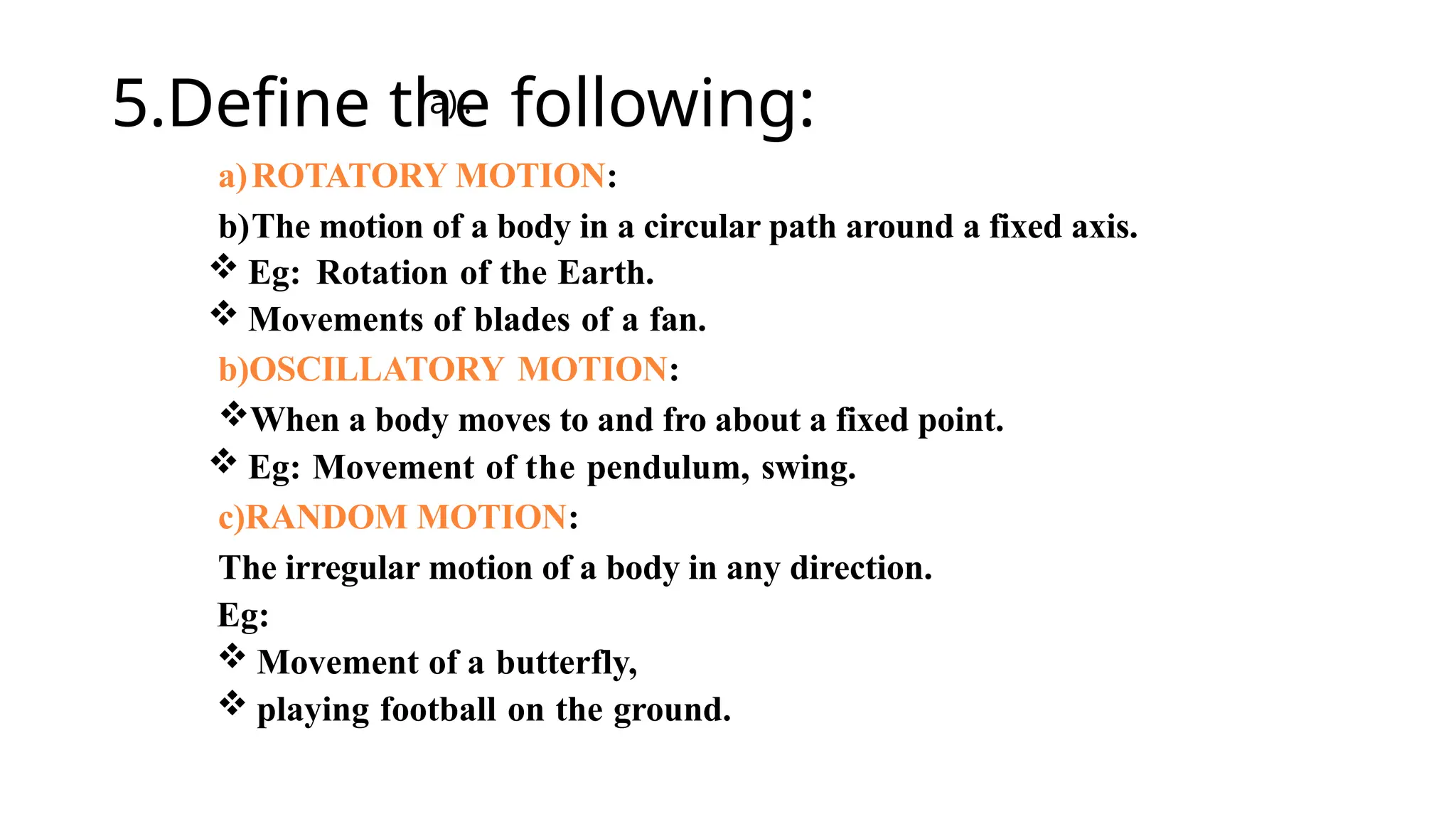
5.Define the following:
a)ROTATORY MOTION:
b)The motion of a body in a circular path around a fixed axis.
 Eg: Rotation of the Earth.
 Movements of blades of a fan.
b)OSCILLATORY MOTION:
When a body moves to and fro about a fixed point.
 Eg: Movement of the pendulum, swing.
c)RANDOM MOTION:
The irregular motion of a body in any direction.
Eg:
 Movement of a butterfly,
 playing football on the ground.
a) .
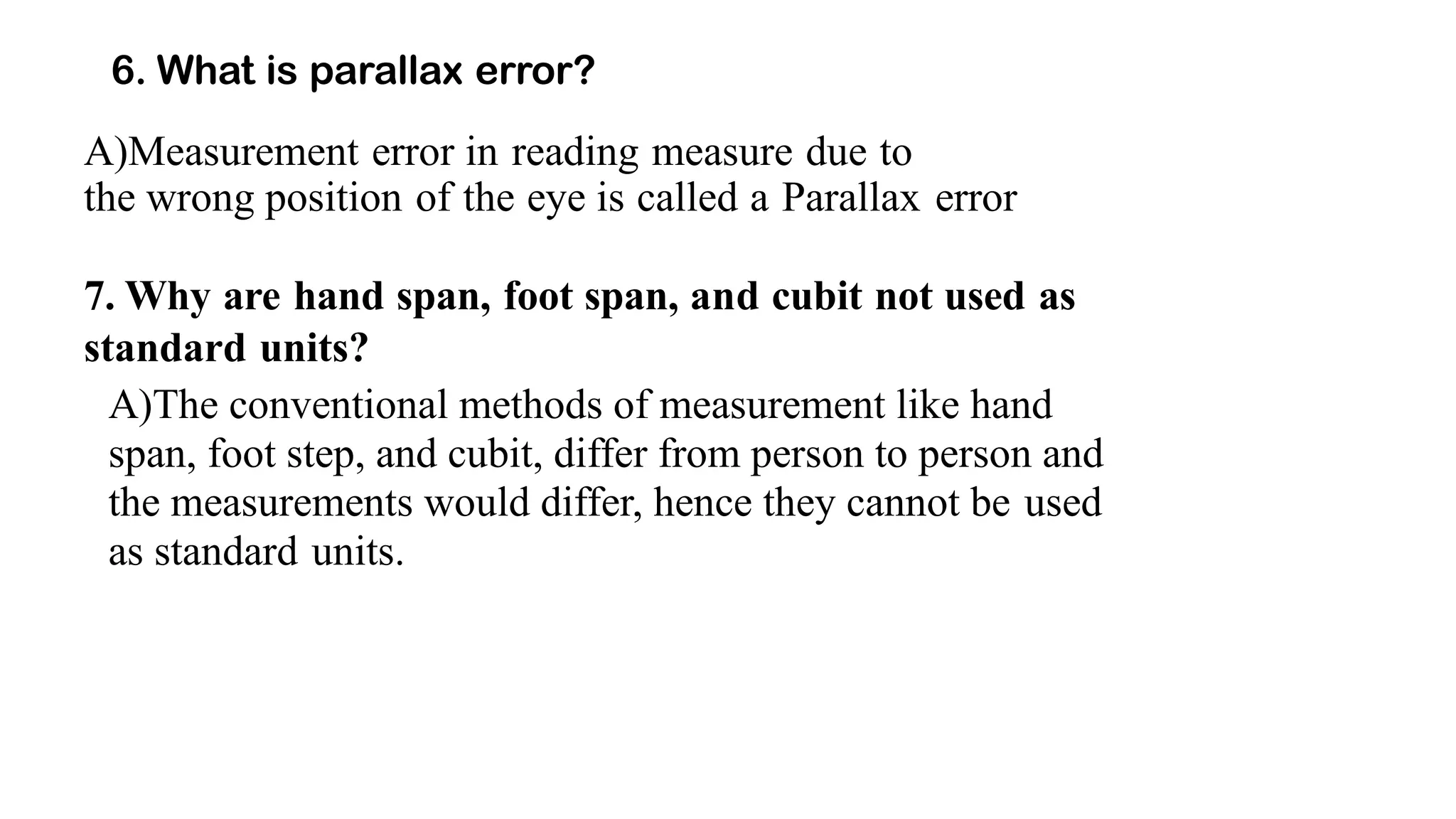
6. What is parallax error?
A)Measurement error in reading measure due to
the wrong position of the eye is called a Parallax error
7. Why are hand span, foot span, and cubit not used as
standard units?
A)The conventional methods of measurement like hand
span, foot step, and cubit, differ from person to person and
the measurements would differ, hence they cannot be used
as standard units.
8.Distinguish between uniform and non-uniform motion.
• A)
 A body is said to be in uniform motion if it covers equal distances
in equal intervals of time.
Eg: If a car travels 100km in 1hour and another 100km in the next hour.
 A body is said to be in non-uniform motion if it covers equal distances
in unequal intervals of time or unequal distances in equal intervals of
time.
Eg: Motion of a car on a crowded road.
9. WRITE A SHORT NOTE ON TRANSLATORY MOTION
A)
• The two types of translatory motion are
 a) RECTILINEAR MOTION: When the body moves along a straight
line its motion is said to be rectilinear motion.
 Eg: Stone dropped from certain height, motion of a train along a
straight track.
 b) CURVILINEAR MOTION: When the body moves along a curved
line its motion is said to be curvilinear motion.
 Eg: A ball thrown in air in an angle, A car taking a
• turn
10.Give two examples to explain that a body can show more than one type of motion at
same time.
• A)
Eg 1: Rotation of the Earth on its axis shows both rotational
and periodic motion.
• Eg 2: A car moving on a straight road shows rectilinear motion,
whereas its wheels show rotatory motion.
NUMERICALS
1.The distance between Radha’s home and her school is 3260m. Express this
distance in km.
1km= 1000m
2. While measuring the length of a needle, the reading of
measure at one end is 3.0cm and at the other end is 33.4cm.
What is the length of the needle?
A)Reading of the scale at one end = 3.0cm reading of the scale
at the other end= 33.4cm so, the length of the needle=(33.4-
3.0)cm= 30.4cm.
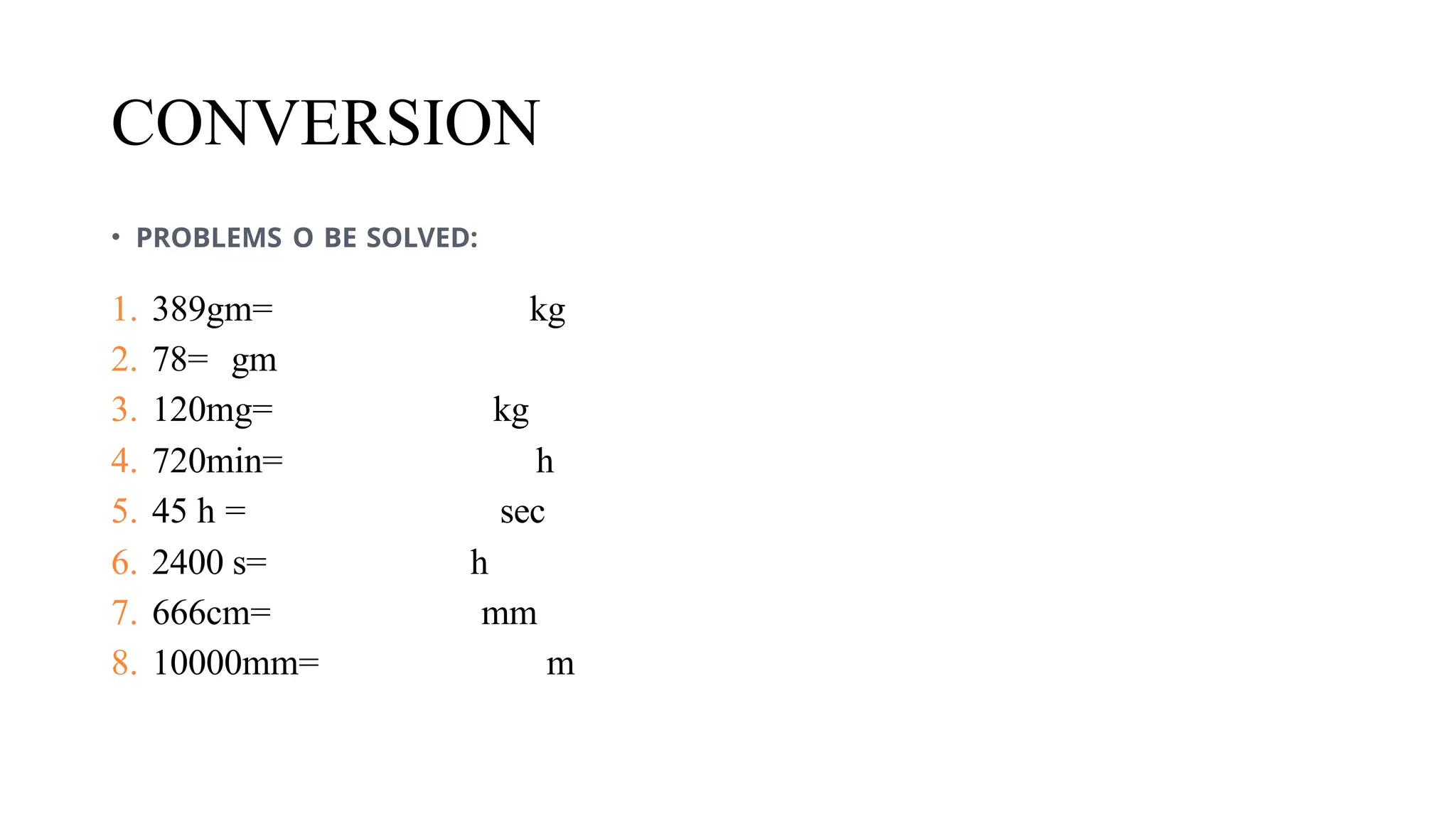
CONVERSION
• PROBLEMS O BE SOLVED:
1. 389gm= kg
2. 78= gm
3. 120mg= kg
4. 720min= h
5. 45 h = sec
6. 2400 s= h
7. 666cm= mm
8. 10000mm= m

MOTION AND MEASUREMENT of objects notes (6).pptx

  • 1.
    MOTION AND MEASUREMENT OFDISTANCES NOTES.
  • 2.
    DEFINITIONS: •MOTION: When thebody’s position changes with respect to its surroundings and time, the body is said to be in motion. •REST: When the body’s position doesn’t change with respect to its surroundings and time, the body is said to be at rest. •INERTIA: The object tends to remain unchanged either in rest or in motion. •INERTIA OF REST: The inherent property of a body by virtue of which it cannot change its position of rest, is called Inertia of rest. •Eg: It is due to inertia of rest that passengers in a vehicle get a backward jerk when the vehicle starts suddenly
  • 3.
    • INERTIA OFMOTION: The resistance of any physical object to any change in its velocity. This includes changes to the object's speed or direction of motion. This is called Inertia of Motion. Eg: We fall forward in a car or bus if the driver applies brakes due to the inertia of motion.  SI UNIT OR INTERNATIONAL SYSTEM OF UNIT: • It is a standard system of measurement that is the same all over the world. Its units of measurement are called SI units. A fixed unit of measurement which is universally accepted and does not change in different climatic conditions. • Scientists from all over the world have accepted a basic set of units for the measurement of physical quantities and these units are called SI units.( International System Of Units) • IMPORTANCE: They bring the uniformity in measurements and are same across the world.They are fixed and provide accurate value.
  • 4.
    • CONVERSION OFUNITS:  (To be written in Blank page) •  1km= 1000m  1m = 100cm  1cm = 10mm  1km= 1000*100cm  1km= 1000*100*10mm •  1m=1/1000km  1cm=1/100m  1mm=1/10cm
  • 6.
    QUESTIONS AND ANSWERS: 1.What do you understand about transportation? What brought about a revolution in the means of transportation? •Ans.The process of travelling and moving people or goods from one place to another is called transportation. People need to go to places for different reasons. They also need many things which reach them via transportation. No trade is possible without transportation.
  • 7.
    2.What do youunderstand by measurement? Explain • Ans. Measurement is the comparison of an unknown quantity with a fixed quantity of the same kind. The fixed quantity is known as the unit of measurement. • Every measurement involves two things: ● The unit of measurement. ● The number of units the object measures. • For example, when we say that the length of a cloth piece is 3 metres, we actually compare the length of the cloth piece (unknown quantity) with a fixed known quantity(metre). • Thus, we can say that the unknown quantity is 3 times the unknown quantity is 3 times the known quantity and is written as 3m. Here, measurement has two parts, a number (3) and a fixed quantity (metre). Metre is the unit of measurement in this case.
  • 8.
    3.Describe various precautionsthat need to be taken while taking measurements. • Ans. The meter scale should have edges with no missing markings. It should be kept straight along the edges of the object to be measured. Scales with worn-out ends should be avoided. Reading should always be taken keeping the eye straight and not from the side.
  • 9.
    4. Differentiate between(a)Rectilinearmotion and Curvilinear motion.(b) Circular and rotational motions Rectilinear motion Curvilinear motion The motion of a body along a straight line is called rectilinear motion When a body changes its position with respect to time on a curved path, then its motion is called curvilinear motion. Eg: motion of a car driven on a straight road Eg: motion of a train along a curved track on hills.
  • 10.
    Circular motion Rotationalmotion The motion in which the objects move along a circular path is called as circular motion. Example: Swirling of stone tied to a string, hands of a clock, blades of a fan, etc. Motion in which a body moves around an axis and different parts of the body cover different distances in a given time interval. Eg: motion of the earth and other planets around the sun in the solar system represents circular motion Eg :The rotation of the earth on its axis, the wheels of a bullock cart
  • 11.
    5.Define the following: a)ROTATORYMOTION: b)The motion of a body in a circular path around a fixed axis.  Eg: Rotation of the Earth.  Movements of blades of a fan. b)OSCILLATORY MOTION: When a body moves to and fro about a fixed point.  Eg: Movement of the pendulum, swing. c)RANDOM MOTION: The irregular motion of a body in any direction. Eg:  Movement of a butterfly,  playing football on the ground. a) .
  • 12.
    6. What isparallax error? A)Measurement error in reading measure due to the wrong position of the eye is called a Parallax error 7. Why are hand span, foot span, and cubit not used as standard units? A)The conventional methods of measurement like hand span, foot step, and cubit, differ from person to person and the measurements would differ, hence they cannot be used as standard units.
  • 13.
    8.Distinguish between uniformand non-uniform motion. • A)  A body is said to be in uniform motion if it covers equal distances in equal intervals of time. Eg: If a car travels 100km in 1hour and another 100km in the next hour.  A body is said to be in non-uniform motion if it covers equal distances in unequal intervals of time or unequal distances in equal intervals of time. Eg: Motion of a car on a crowded road.
  • 14.
    9. WRITE ASHORT NOTE ON TRANSLATORY MOTION A) • The two types of translatory motion are  a) RECTILINEAR MOTION: When the body moves along a straight line its motion is said to be rectilinear motion.  Eg: Stone dropped from certain height, motion of a train along a straight track.  b) CURVILINEAR MOTION: When the body moves along a curved line its motion is said to be curvilinear motion.  Eg: A ball thrown in air in an angle, A car taking a • turn
  • 15.
    10.Give two examplesto explain that a body can show more than one type of motion at same time. • A) Eg 1: Rotation of the Earth on its axis shows both rotational and periodic motion. • Eg 2: A car moving on a straight road shows rectilinear motion, whereas its wheels show rotatory motion.
  • 16.
    NUMERICALS 1.The distance betweenRadha’s home and her school is 3260m. Express this distance in km. 1km= 1000m 2. While measuring the length of a needle, the reading of measure at one end is 3.0cm and at the other end is 33.4cm. What is the length of the needle? A)Reading of the scale at one end = 3.0cm reading of the scale at the other end= 33.4cm so, the length of the needle=(33.4- 3.0)cm= 30.4cm.
  • 17.
    CONVERSION • PROBLEMS OBE SOLVED: 1. 389gm= kg 2. 78= gm 3. 120mg= kg 4. 720min= h 5. 45 h = sec 6. 2400 s= h 7. 666cm= mm 8. 10000mm= m