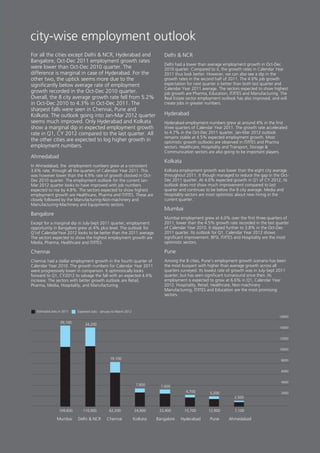
Ma Foi Randstad
2012
       Employment Trends Survey
in this report...

Indian Economy – Improved outlook with pockets of concern
?
? methodology
Data and
? of employment generation in different sectors
Estimates

           ? Financial Services and Insurance
           Banking,
           Education, Training and Consultancy
           ?
           Energy
           ?
           Healthcare
           ?
           Hospitality
           ?
           Information Technology & Information Technology Enabled Services
           ?
           Manufacturing - Machinery and Equipment
           ?
           Manufacturing - Non-Machinery Products
           ?
           Media and Entertainment
           ?
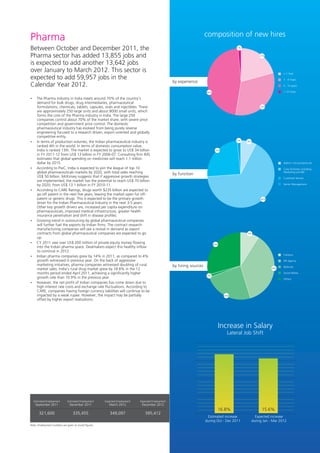
           Pharma
           ?
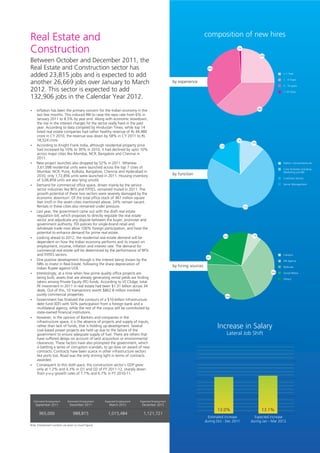
           Real Estate and Construction
           ?
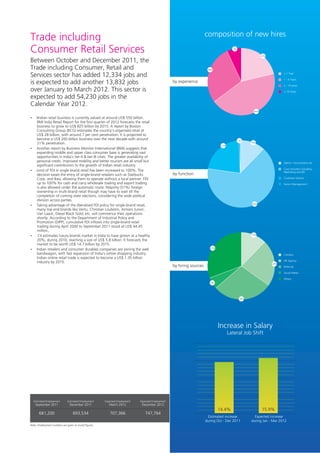
           Trade including Consumer, Retail and Services
           ?
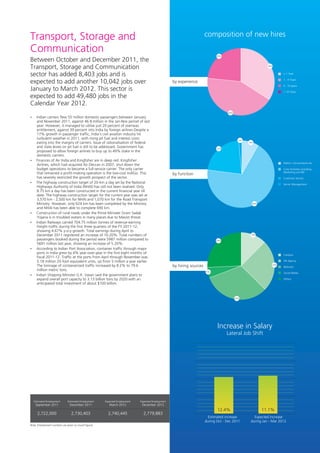
           Transport, Storage and Communication
           ?


Concluding Remarks
?
Appendix
?

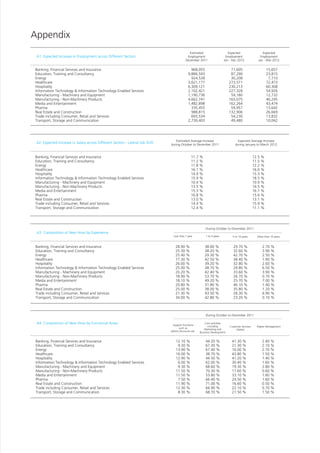
           A1: Expected Increase in Employment across Different Sectors
           A2: Expected Increase in Salary across Different Sectors - Lateral Job Shift
           A3: Composition of New Hires by Experience
           A4: Composition of New Hires by Functional Areas
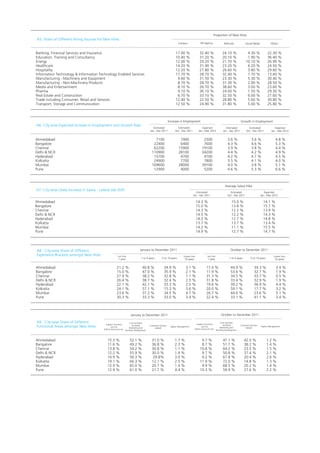
           A5: Share of Different Hiring Sources for New Hires
           A6: City-wise Growth in Employment
           A7: City-wise Likely Increase in Salary - Lateral Job Shift
           A8 : City-wise Share of Different Experience Brackets amongst New Hires
           A9: City-wise Share of Different Functional Areas amongst New Hires


The Ma Foi Randstad Employment Trends Survey (MEtS), conducted by Ma Foi Randstad - India’s No. 1 Integrated HR services company, is a
study on the Indian employment trends and opportunities. Starting from November 2004 till 2008, MEtS was conducted once a year.
Considering several shifts in employment dynamics even within a year’s time, MEtS was converted into a quarterly survey from 2010 to
capture the changes in employment scenario in India from one quarter to another.

The primary objective of this employment survey is to understand the employment trends in the organized sector on a quarterly basis. The
present survey captures the employment situation in the organized sector during the fourth quarter of Calendar Year 2011 (from October to
December 2011) and the likely scenario in the first quarter of the Calendar Year 2012 (January to March 2012). The study results are based
on a survey in December 2011 of 639 sample companies spread across 13 different sectors. The feedback was gathered from the top HR
personnel or top management of the companies, who could share valuable insights on employment related issues. The major focus of the
survey is to estimate the changes in employment scenario across sectors and space. The other issues highlighted in the survey are changes in
salary in case of lateral hiring, recruitments for different experience categories and hiring for different functional roles.

The report is presented in four sections. The first section (Section A) discusses the recent trends and an overall view of the Indian Economy. It
is followed by Section B which provides insights about the data and methodological aspects of the study. Section C presents a picture of the
changing pattern of employment in different sectors of the economy. A snapshot of the changing scenario in 8 selected cities is also given in
this section. The final section (Section D) concludes the study highlighting key issues.
Indian Economy
improved outlook
with pockets of concern

According to Prime Minister Manmohan Singh, the Indian           On the back of the improving inflation scenario, RBI has also
economy is expected to grow at around 7% in the financial        indicated a halt in the repo rate increase. It last raised the
year 2011-12, lower than the December projection of 7.5%.        repo rate by 25 basis points in October 2011 to 8.50%.
According to Mr. Montek Singh Ahluwalia, Deputy                  Over the previous 9 months it had raised the rate by 200
Chairman, Planning Commission, even though the 12th plan         basis points, starting from 6.25% at beginning of the year.
target annual growth rate of 9% is still feasible, it is now     If the declining trend of inflation continues, RBI is expected
more difficult to achieve than six months ago.                   to start reducing the interest rate beginning Q1 of FY 2012-
                                                                 13. Credit Suisse expects a 125 basis points decline in repo
The Gross Domestic Product (GDP) of India grew by 7.7% in        rate over the FY 2012-13.
Q1, 2011-12 period, as compared to 8.8% growth rate for
Q1, 2010-11. The year on year growth rate fell further to        In contrast to the declining trend in food inflation, the fuel
6.9% in Q2. The sectors that did well in Q2 of 2011-12 over      prices are still holding out. In the week ending December
corresponding period of the previous year are electricity, gas   24, fuel inflation marginally accelerated to 14.6% as
and water supply (9.8%), trade, hotels, transport and            compared to 14.4% a week earlier. On the demand side,
communication (9.9%) and financial sector (including real        the growth story of the United States, Europe and other
estate) (10.5%). Construction sector grew at 4.3%,               major economies are expected to remain weak, dampening
followed by agriculture at 3.2% and manufacturing at             their oil consumption. U.S. dollar is also likely to continue its
measly 2.7%.                                                     strong trend, helping to keep the price in check. However,
                                                                 there is rising tension between US/Europe and Iran in recent
The major drag for the economy was the decline in mining         times. United States and Europe have been campaigning to
sector GDP by 2.9% in Q2, along with the significant fall in     choke off Iran's oil export, and isolating its central bank.
the growth of manufacturing sector. The IIP data for Q2,         Although US and Europe have been talking with alternative
2011-12 showed a decline by 2.7% for the mining industry         suppliers, especially the other Gulf producers, doubts have
output, which was much lower than the 6.3% growth                been raised regarding their capacity to completely replace
registered in Q2, 2010-11. Manufacturing output grew only        Iran's supply on a sustained basis. This uncertainty has led to
at 3.1%, which was again lesser than half the Q2, 2010-11        an increase in the oil prices, mainly due to supply concerns,
growth rate of 7.4%. Electricity production did better           in spite of absence of any spurt in demand.
comparatively, growing at a much higher 10.5% in Q2              The adverse effect of rising fuel prices on Indian economy
2011-12 vis-a-vis a low 2.1% in the corresponding quarter        can be further exacerbated by the fall in the value of the
of previous year. One significant related development on the     Rupee. Indian Rupee was the worst performer in 2011
policy front was the adoption of the New Manufacturing           among Asian currencies, losing close to 20.6% against the
Policy on October 25, 2011. The New Policy envisages an          U.S. dollar since August 2011. This was due to foreign
increase in the share of manufacturing in GDP, from 16% to       investors pulling out of Asia's third-largest economy on
25% and creation of 100 million additional jobs in the           worries over its large fiscal deficit, stubborn high inflation
manufacturing sector by 2022. The Policy also proposes to        and slowing growth. According to Mr. Pranab Mukherjee,
set up seven National Investment and Manufacturing Zones         Finance Minister, the pressure on Rupee will continue until
with single-window clearance and flexible labour laws.           there is a suitable solution to the sovereign debt problem in
                                                                 Europe. According to research firm Macquarie, there is a
Even though the overall year on year inflation remained high     risk of Rupee depreciating further to 55-56 level against the
at 9.11% for November 2011, the food inflation has               US dollar in the near term, although a pull back is expected
significantly dropped over the last two months. For the week     in the second half of this year. A weak rupee will exert an
ending December 24, food inflation came down to negative         upward pressure on overall inflation by pushing up the cost
3.4%, as prices of vegetables, onion, potato and wheat           of imported items, and thereby partially offsetting a
recorded a decline. This was the first time in six years that    moderation in food prices.
food inflation had shown a decline on an annual basis. It
remained on the negative zone for the subsequent three
weeks also. RBI expects inflation to moderate further to
around 7% level by March 2012.
The fall in inflation and interest rates may also be limited                    238 billion to US$ 310 billion. This resulted in an increase in
due to the rising fiscal deficit, which is a result of growth                   the trade deficit from US$ 93 billion to US$ 117 billion. A
slowdown affecting tax revenues and derailment of PSU
divestment as a result of depressed market conditions. The
Central Government has been forced to increase its
borrowing for the FY 2011-12 by 22%, raising questions
about its ability to restrict deficit within the target figure of
4.6% of GDP. Most analysts expect India's 2011/12 federal
fiscal gap to be an almost 1 percentage point higher than
the original target.

Another important factor can be the de-leveraging risk
emanating from crisis in the Euro zone. In the event of
worsening of the European crisis, the European banks may
refuse to rollover or extend credit to Indian corporate
houses. In such a scenario, Indian banks will be required to
take the loans on their books. According to the Bank of
International Settlements (BIS), European banks' claims
against India stood at US$159 billion at the end of June
2011. This accounts for almost 55% of the total
international claims (US$289 billion) on India. According to
financial market experts, the process has already started to
some extent and has the potential to adversely affect the
domestic liquidity situation in the coming months.

Cumulative value of exports for the period April-November
in FY 2011 -12 was US$ 193 billion against US$ 145 billion
for the same period in previous year, registering a growth of
33.2%. Imports over this period grew by 30.2% from US$


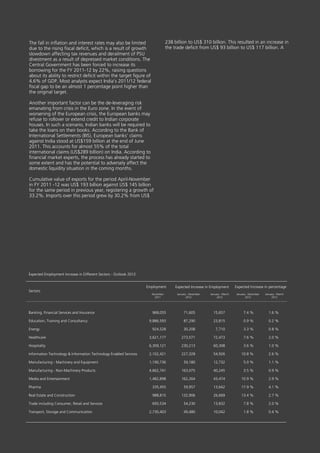
Expected Employment Increase in Different Sectors - Outlook 2012


                                                                   Employment        Expected Increase in Employment         Expected Increase in percentage
Sectors
                                                                     December         January - December   January - March   January - December   January - March
                                                                       2011                  2012               2012                2012               2012


Banking, Financial Services and Insurance                             968,055              71,605            15,657               7.4 %             1.6 %

Education, Training and Consultancy                                 9,886,593              87,290            23,815               0.9 %             0.2 %

Energy                                                                924,528              30,208              7,710              3.3 %             0.8 %

Healthcare                                                          3,621,177            273,571             72,473               7.6 %             2.0 %

Hospitality                                                         6,309,121            230,213             60,308               3.6 %             1.0 %

Information Technology & Information Technology Enabled Services    2,102,421            227,328             54,926             10.8 %              2.6 %

Manufacturing - Machinery and Equipment                             1,190,736              59,180            12,732               5.0 %             1.1 %

Manufacturing - Non-Machinery Products                              4,662,741            163,075             40,245               3.5 %             0.9 %

Media and Entertainment                                             1,482,898            162,264             43,474             10.9 %              2.9 %

Pharma                                                                335,455              59,957            13,642             17.9 %              4.1 %

Real Estate and Construction                                          988,815            132,906             26,669             13.4 %              2.7 %

Trade including Consumer, Retail and Services                         693,534              54,230            13,832               7.8 %             2.0 %

Transport, Storage and Communication                                2,730,403              49,480            10,042               1.8 %             0.4 %
The Indian economy is expected to grow at around 7% in
estimates of                                                             the financial year 2011-12, lower than the December
                                                                         projection of 7.8% to 8.0%. With some respite in food

employment                                                               inflation, there is wide spread belief that the interest rate
                                                                         hikes have hit the ceiling and will begin a descent from April
                                                                         2012 onwards. This may provide a respite to the badly
generation in                                                            battered sectors of manufacturing, real estate, construction,
                                                                         automobile, etc.

different sectors                                                        In terms of jobs created in Calendar Year 2011, Healthcare,
                                                                         Hospitality and IT took the top three places. In terms of y-o-
                                                                         y growth rate, the pride of place was taken by the Pharma
                                                                         sector. These four sectors are expected to repeat their chart
                                                                         topper performance in Calendar Year 2012 too. Two other
                                                                         sectors that will significantly add to the employment
                                                                         opportunities are Media & Entertainment and
                                                                         Manufacturing of Non-machinery products. Real Estate and
                                                                         Construction, which was expected to log a 16.8% growth
                                                                         rate in Calendar Year 2011, only managed to grow at
                                                                         15.1%. The growth rate is expected to further decline in
                                                                         Calendar Year 2012 at 13.4%. However, this sector is likely
                                                                         to create more than a lakh new job opportunities in the
                                                                         current year.

                                                                         A summary of the employment generation scenario across
                                                                         13 different sectors are presented below. It gives the
                                                                         estimated numbers of job created in Calendar Year 2011 in
                                                                         these sectors, as well as the likely additions in CY 2012. A
                                                                         comparison of Q4, CY 2011 against Q1, CY2012 numbers
                                                                         is also given in the following table. A detailed sectoral level
                                                                         analysis, highlighting some of the important developments
                                                                         which had a material impact on the job prospects in these
                                                                         sectors, is presented subsequently.


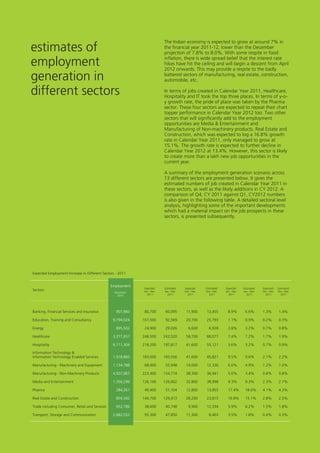
Expected Employment Increase in Different Sectors - 2011


                                                Employment
                                                             Expected    Estimated   Expected    Estimated   Expected    Estimated   Expected    Estimated
Sectors                                                      Jan - Dec   Jan - Dec   Oct - Dec   Oct - Dec   Jan - Dec   Jan - Dec   Oct - Dec   Oct - Dec
                                                 December
                                                   2010        2011         2011       2011         2011       2011         2011       2011         2011


Banking, Financial Services and Insurance         907,960     80,700      60,095      11,900     13,455       8.9%        6.6%       1.3%        1.4%

Education, Training and Consultancy              9,794,024   107,500      92,569      20,700     25,793       1.1%        0.9%       0.2%        0.3%

Energy                                            895,502     24,900      29,026       6,600       6,928      2.8%        3.2%       0.7%        0.8%

Healthcare                                       3,377,657   248,500     243,520      58,700     68,077       7.4%        7.2%       1.7%        1.9%

Hospitality                                      6,111,304   218,200     197,817      41,600     55,121       3.6%        3.2%       0.7%        0.9%

Information Technology &
Information Technology Enabled Services          1,918,865   183,000     183,556      41,600     45,821       9.5%        9.6%       2.1%        2.2%

Manufacturing - Machinery and Equipment          1,134,788    68,400      55,948      14,000     12,336       6.0%        4.9%       1.2%        1.0%

Manufacturing - Non-Machinery Products           4,507,967   223,400     154,774      38,300     36,941       5.0%        3.4%       0.8%        0.8%

Media and Entertainment                          1,356,296   126,100     126,602      32,800     38,998       9.3%        9.3%       2.3%        2.7%

Pharma                                            284,351     49,400      51,104      12,800     13,855       17.4%       18.0%      4.1%        4.3%

Real Estate and Construction                      859,342    144,700     129,473      26,200     23,815       16.8%       15.1%      2.8%        2.5%

Trade including Consumer, Retail and Services     652,786     38,600      40,748       9,900     12,334       5.9%        6.2%       1.5%        1.8%

Transport, Storage and Communication             2,682,553    93,300      47,850      11,300       8,403      3.5%        1.8%       0.4%        0.3%
Banking, Financial                                                                                                    composition of new hires

Services and Insurance                                                                                                                      3%


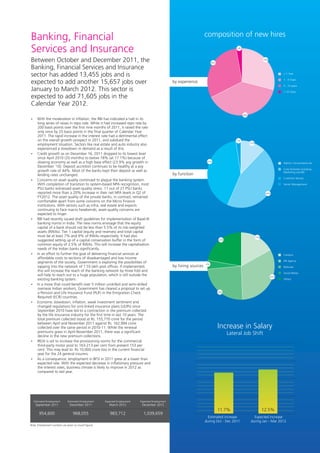
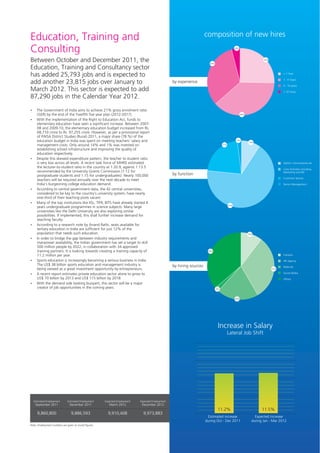
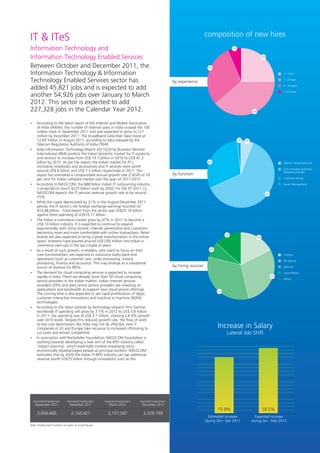
Between October and December 2011, the                                                                                     30%
                                                                                                                                                                   29%


Banking, Financial Services and Insurance
sector has added 13,455 jobs and is                                                                                                                                            < 1 Year


expected to add another 15,657 jobs over                                                          by experience
                                                                                                                                                                               1 - 4 Years

                                                                                                                                                                               5 - 10 years
January to March 2012. This sector is                                                                                                                                          > 10 Years

expected to add 71,605 jobs in the
Calendar Year 2012.
                                                                                                                                                 39%

? moderation in inflation, the RBI has indicated a halt in its
With the
long series of raises in repo rate. While it had increased repo rate by
200 basis points over the first nine months of 2011, it raised the rate
only once by 25 basis points in the final quarter of Calendar Year
2011. The rapid increase in the interest rate had a detrimental effect
on the overall growth prospect in 2011, and subdued the                                                                                    2%
                                                                                                                                                       12%
employment situation. Sectors like real estate and auto industry also
experienced a slowdown in demand as a result of this.
?growth as on December 16, 2011 dropped to its lowest level
Credit
since April 2010 (20 months) to below 18% (at 17.1%) because of
slowing economy as well as a high base effect (23.9% yoy growth in                                                     41%
                                                                                                                                                                               Admin / Accountants etc
December ‘10). Deposit accretion continues to be healthy at a yoy
                                                                                                                                                                               Core Activities including
growth rate of 44%. Most of the banks kept their deposit as well as                                                                                                            Marketing and BD
lending rates unchanged.                                                                          by function
                                                                                                                                                                               Customer Service
Concerns on asset quality continued to plague the banking system.
?
With completion of transition to system-based NPA recognition, most                                                                                                            Senior Management
PSU banks witnessed asset-quality stress. 11 out of 21 PSU banks
reported more than a 20% increase in their net NPA levels in Q2 of                                                                                                  44%
FY2012. The asset quality of the private banks, in contrast, remained
comfortable apart from some concerns on the Micro Finance
Institutions. With sectors such as infra, real estate and exports
continuing to face macro headwinds, asset-quality concerns are
expected to linger.
? recently issued draft guidelines for implementation of Basel-III
RBI had
banking norms in India. The new norms envisage that the equity
capital of a bank should not be less than 5.5% of its risk-weighted
assets (RWAs). Tier 1 capital (equity and reserves) and total capital
must be at least 7% and 9% of RWAs respectively. It had also                                                                                                 17%
suggested setting up of a capital conservation buffer in the form of                                                             22%

common equity of 2.5% of RWAs. This will increase the capitalisation
needs of the Indian banks significantly.
In an effort to further the goal of delivering financial services at
?                                                                                                                                                                              Campus
affordable costs to sections of disadvantaged and low income
                                                                                                                                                                               HR Agency
segments of the society, Government is exploring the possibilities of                                                 4%
tapping into the network of 1.55 lakh post offices. If implemented,                               by hiring sources                                                            Referrals
this will increase the reach of the banking network by three fold and
                                                                                                                                                                               Social Media
will help to reach out to a huge population, which is still outside the                                                                                                  32%
existing banking system.                                                                                                                                                       Others

In a move that could benefit over 5 million unskilled and semi-skilled
?
overseas Indian workers, Government has cleared a proposal to set up
a Pension and Life Insurance Fund (PLIF) in the Emigration Check                                                                 24%

Required (ECR) countries.
Economic slowdown, inflation, weak investment sentiment and
?
changed regulations for unit-linked insurance plans (ULIPs) since
September 2010 have led to a contraction in the premium collected
by the life insurance industry for the first time in last 10 years. The
total premium collected stood at Rs. 155,770 crore for the period
between April and November 2011 against Rs. 162,994 crore
collected over the same period in 2010-11. While the renewal                                                                     Increase in Salary
premiums grew in April-November 2011, there was a significant                                                                          Lateral Job Shift
decline in the new premium collections.
? set to increase the provisioning norms for the commercial
IRDA is
third-party motor pool to 163-213 per cent from present 153 per
cent. This may lead to Rs 10,000 crore loss in the current financial
year for the 24 general insurers.
As a consequence, employment in BFSI in 2011 grew at a lower than
?
expected rate. With the expected decrease in inflationary pressure and
the interest rates, business climate is likely to improve in 2012 as
compared to last year.


  Estimated Employment        Estimated Employment    Expected Employment   Expected Employment
    September 2011              December 2011            March 2012          December 2012
                                                                                                                                 11.7%                             12.5%
       954,600                    968,055                983,712              1,039,659
                                                                                                                        Estimated increase               Expected increase
                                                                                                                      during Oct - Dec 2011            during Jan - Mar 2012
Note: Employment numbers are given as round figures
Education, Training and                                                                                               composition of new hires

Consulting                                                                                                                                     4%


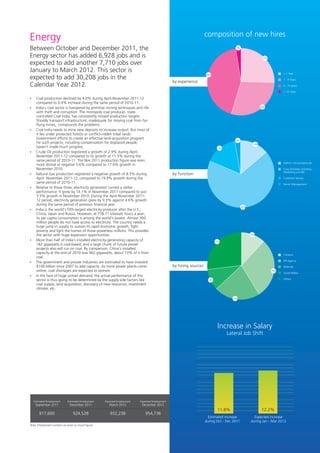
Between October and December 2011, the                                                                                  33%
                                                                                                                                                                    25%


Education, Training and Consultancy sector
has added 25,793 jobs and is expected to                                                                                                                                        < 1 Year


add another 23,815 jobs over January to                                                           by experience
                                                                                                                                                                                1 - 4 Years

                                                                                                                                                                                5 - 10 years
March 2012. This sector is expected to add                                                                                                                                      > 10 Years

87,290 jobs in the Calendar Year 2012.

The Government of India aims to achieve 21% gross enrolment ratio
?
     (GER) by the end of the Twelfth five year plan (2012-2017).                                                                                     38%

? implementation of the Right to Education Act, funds to
With the
elementary education have seen a significant increase. Between 2007-
08 and 2009-10, the elementary education budget increased from Rs.
68,710 crore to Rs. 97,255 crore. However, as per a provisional report
of PAISA District Studies (Rural) 2011, a major share (78 %) of the
education budget in India was spent on meeting teachers’ salary and                                                                             2%
                                                                                                                                                            9%
management costs. Only around 14% and 1% was invested on                                                                           21%

establishing school infrastructure and improving the quality of
education respectively.
? this skewed expenditure pattern, the teacher to student ratio
Despite
is very low across all levels. A recent task force of MHRD estimated                                                                                                            Admin / Accountants etc
the lecturer-to-student ratio in the country at 1:20.9, against 1:13.5                                                                                                          Core Activities including
recommended by the University Grants Commission (1:12 for                                                                                                                       Marketing and BD
postgraduate students and 1:15 for undergraduates). Nearly 100,000                                by function
                                                                                                                                                                                Customer Service
teachers will be required annually over the next decade to meet
India’s burgeoning college education demand.                                                                                                                                    Senior Management
According to central government data, the 42 central universities,
?
considered to be key to the country’s university system, have nearly
one-third of their teaching posts vacant.
? the top institutions like IISc, TIFR, BITS have already started 4
Many of
                                                                                                                                         67%
years undergraduate programmes in science subjects. Many large
universities like the Delhi University are also exploring similar
possibilities. If implemented, this shall further increase demand for
teaching faculty.
According to a research note by Anand Rathi, seats available for
?
tertiary education in India are sufficient for just 12% of the
population that needs such education.                                                                                                                      10%

? to bridge the gap between industry requirements and
In order
manpower availability, the Indian government has set a target to skill
500 million people by 2022, in collaboration with 34 approved
training partners. It is looking towards creating a training capacity of                                               36%

11.2 million per year.                                                                                                                                                          Campus

?education is increasingly becoming a serious business in India.
Sports                                                                                                                                                                          HR Agency
The US$ 38 billion sports education and management industry is                                    by hiring sources                                                             Referrals
being viewed as a great investment opportunity by entrepreneurs.                                                                                                          31%

? report estimates private education sector alone to grow to
A recent                                                                                                                                                                        Social Media

US$ 70 billion by 2013 and US$ 115 billion by 2018.                                                                                                                             Others
? demand side looking buoyant, this sector will be a major
With the
creator of job opportunities in the coming years.                                                                             2%


                                                                                                                                               20%


                                                                                                                               Increase in Salary
                                                                                                                                         Lateral Job Shift


  Estimated Employment        Estimated Employment    Expected Employment   Expected Employment
   September 2011              December 2011             March 2012          December 2012
                                                                                                                               11.2%                               11.5%
     9,860,800                   9,886,593              9,910,408             9,973,883
                                                                                                                        Estimated increase                     Expected increase
                                                                                                                      during Oct - Dec 2011                  during Jan - Mar 2012
Note: Employment numbers are given as round figures
composition of new hires
Energy
Between October and December 2011, the                                                                                                   3%


Energy sector has added 6,928 jobs and is                                                                                                                    25%

expected to add another 7,710 jobs over
January to March 2012. This sector is                                                                                                                                    < 1 Year
expected to add 30,208 jobs in the
                                                                                                                      43%

                                                                                                                                                                         1 - 4 Years
                                                                                                  by experience
Calendar Year 2012.                                                                                                                                                      5 - 10 years

                                                                                                                                                                         > 10 Years

Coal production declined by 4.0% during April-November 2011-12
?
    compared to 0.4% increase during the same period of 2010-11.
?coal sector is hampered by primitive mining techniques and rife
India's                                                                                                                                                     29%

with theft and corruption. The monopoly coal producer, state-
controlled Coal India, has consistently missed production targets.
Shoddy transport infrastructure, inadequate for moving coal from far-
flung mines, compounds the problems.
Coal India needs to mine new deposits to increase output. But most of
?
it lies under protected forests or conflict-ridden tribal lands.
Government efforts to create an effective land-acquisition program                                                                       3%
for such projects, including compensation for displaced people,                                                                                       14%
haven't made much progress.                                                                                                    16%
?Oil production registered a growth of 2.9% during April-
Crude
November 2011-12 compared to its growth at 11.5% during the
same period of 2010-11. The Nov 2011 production figure was even
                                                                                                                                                                         Admin / Accountants etc
more dismal at negative 5.6% compared to 17.0% growth in
November 2010.                                                                                                                                                           Core Activities including
                                                                                                                                                                         Marketing and BD
? Gas production registered a negative growth of 8.5% during
Natural                                                                                           by function
April- November 2011-12, compared to 19.9% growth during the                                                                                                             Customer Service
same period of 2010-11.                                                                                                                                                  Senior Management
? to these three, electricity generation turned a stellar
Relative
performance. It grew by 14.1% in November 2011 compared to just
3.5% growth in November 2010. During the April-November 2011-
12 period, electricity generation grew by 9.3% against 4.6% growth
during the same period of previous financial year.
                                                                                                                                              67%
? the world's fifth-largest electricity producer after the U.S.,
India is
China, Japan and Russia. However, at 778.71 kilowatt hours a year,
its per capita consumption is among the world's lowest. Almost 300
million people do not have access to electricity. The country needs a
huge jump in supply to sustain its rapid economic growth, fight
poverty and light the homes of those powerless millions. This provides
the sector with huge expansion opportunities.                                                                                                       12%

More than half of India's installed electricity-generating capacity of
?                                                                                                                             27%
182 gigawatts is coal-based, and a large chunk of future power
projects also will run on coal. By comparison, China's installed
capacity at the end of 2010 was 962 gigawatts, about 73% of it from                                                                                                      Campus
coal.
                                                                                                                                                                         HR Agency
The government and private industries are estimated to have invested
?
$100 billion since 2007 to add capacity. As more power plants come                                by hiring sources                                                      Referrals
online, coal shortages are expected to worsen.                                                                                                                     29%
                                                                                                                                                                         Social Media
In the face of huge unmet demand, the actual performance of this
?
sector is thus going to be determined by the supply side factors like                                                   10%                                              Others

coal supply, land acquisition, discovery of new resources, investment
climate, etc.

                                                                                                                                       22%


                                                                                                                               Increase in Salary
                                                                                                                                     Lateral Job Shift


  Estimated Employment        Estimated Employment    Expected Employment   Expected Employment
    September 2011              December 2011            March 2012          December 2012
                                                                                                                               11.8%                        12.2%
       917,600                    924,528                932,238               954,736
                                                                                                                        Estimated increase            Expected increase
                                                                                                                      during Oct - Dec 2011         during Jan - Mar 2012
Note: Employment numbers are given as round figures
composition of new hires
Healthcare
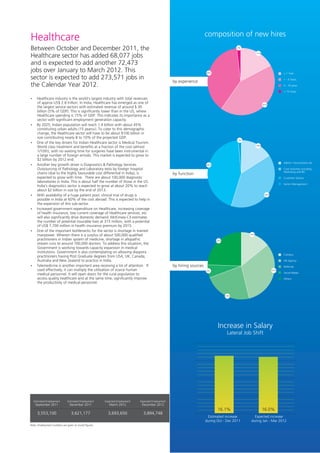
Between October and December 2011, the                                                                                                   2%


Healthcare sector has added 68,077 jobs
                                                                                                                                                    17%


and is expected to add another 72,473
jobs over January to March 2012. This                                                                                 39%                                              < 1 Year
sector is expected to add 273,571 jobs in                                                                                                                              1 - 4 Years
                                                                                                  by experience
the Calendar Year 2012.                                                                                                                                                5 - 10 years

                                                                                                                                                                       > 10 Years

Healthcare industry is the world's largest industry with total revenues
?
of approx US$ 2.8 trillion. In India, Healthcare has emerged as one of                                                                                    42%
the largest service sectors with estimated revenue of around $ 30
billion (5% of GDP). This is significantly lower than in the US, where
Healthcare spending is 15% of GDP. This indicates its importance as a
sector with significant employment generation capacity.
? Indian population will reach 1.4 billion with about 45%
By 2025,
constituting urban adults (15 years+). To cater to this demographic
change, the Healthcare sector will have to be about $100 billion in
size contributing nearly 8 to 10% of the projected GDP.
                                                                                                                                         2%
? the key drivers for Indian Healthcare sector is Medical Tourism.
One of
                                                                                                                                                    16%
World class treatment and benefits at a fraction of the cost (almost
1/10th), with no waiting time for surgeries have been instrumental in
a large number of foreign arrivals. This market is expected to grow to
$2 billion by 2012 end.
                                                                                                                                                                       Admin / Accountants etc
? key growth driver is Diagnostics & Pathology Services.
Another                                                                                                               44%

Outsourcing of Pathology and Laboratory tests by foreign hospital                                                                                                      Core Activities including
                                                                                                                                                                       Marketing and BD
chains (due to the highly favourable cost differential in India), is                              by function
expected to grow with time. There are about 100,000 diagnostic                                                                                                         Customer Service
laboratories in India. This is about half the number of those in the US.
                                                                                                                                                                       Senior Management
India’s diagnostics sector is expected to grow at about 20% to reach
about $2 billion in size by the end of 2013.
With availability of a huge patient pool, clinical trial of drugs is
?                                                                                                                                                          39%

possible in India at 60% of the cost abroad. This is expected to help in
the expansion of this sub-sector.
Increased government expenditure on Healthcare, increasing coverage
?
of health insurance, low current coverage of Healthcare services, etc.
will also significantly drive domestic demand. McKinsey-CII estimates
the number of potential insurable lives at 315 million, with a potential
of US$ 7,700 million in health insurance premium by 2015.
? the important bottlenecks for the sector is shortage in trained
One of
manpower. Wherein there is a surplus of about 500,000 qualified                                                                               14%

practitioners in Indian system of medicine, shortage in allopathic                                                          25%
stream runs to around 700,000 doctors. To address this situation, the
Government is working towards capacity expansion in medical
institutions. Government is also contemplating on allowing diaspora
                                                                                                                                                                       Campus
practitioners having Post Graduate degrees from USA, UK, Canada,
Australia and New Zealand to practice in India.                                                                                                                        HR Agency
Telemedicine is another important area receiving a lot of attention. If
?                                                                                                 by hiring sources                                                    Referrals
used effectively, it can multiply the utilization of scarce human                                                     6%                                         32%
                                                                                                                                                                       Social Media
medical personnel. It will open doors for the rural population to
access quality healthcare and at the same time, significantly improve                                                                                                  Others
the productivity of medical personnel.


                                                                                                                                  23%


                                                                                                                             Increase in Salary
                                                                                                                                   Lateral Job Shift


  Estimated Employment        Estimated Employment    Expected Employment   Expected Employment
   September 2011              December 2011             March 2012          December 2012
                                                                                                                             16.1%                        16.0%
     3,553,100                   3,621,177              3,693,650             3,894,748
                                                                                                                        Estimated increase      Expected increase
                                                                                                                      during Oct - Dec 2011   during Jan - Mar 2012
Note: Employment numbers are given as round figures
Hospitality                                                                                                           composition of new hires
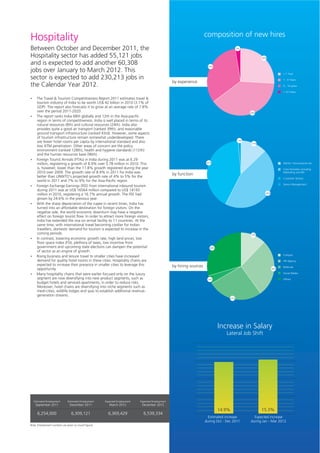
Between October and December 2011, the                                                                                                     3%


Hospitality sector has added 55,121 jobs                                                                                                               26%

and is expected to add another 60,308                                                                                   33%

jobs over January to March 2012. This                                                                                                                                < 1 Year
sector is expected to add 230,213 jobs in                                                                                                                            1 - 4 Years
                                                                                                  by experience
the Calendar Year 2012.                                                                                                                                              5 - 10 years

                                                                                                                                                                     > 10 Years

The Travel & Tourism Competitiveness Report 2011 estimates travel &
?
tourism industry of India to be worth US$ 42 billion in 2010 (3.1% of
GDP). The report also forecasts it to grow at an average rate of 7.8%
over the period 2011-2020.                                                                                                                       39%
The report ranks India 68th globally and 12th in the Asia-pacific
?
region in terms of competitiveness. India is well placed in terms of its
natural resources (8th) and cultural resources (24th). India also
provides quite a good air transport (ranked 39th), and reasonable
ground transport infrastructure (ranked 43rd). However, some aspects
of tourism infrastructure remain somewhat underdeveloped. There
                                                                                                                                            1%
are fewer hotel rooms per capita by international standard and also                                                                              13%
low ATM penetration. Other areas of concern are the policy
environment (ranked 128th), health and hygiene standards (112th)
and the human resources base (96th).
? Tourist Arrivals (FTAs) in India during 2011 was at 6.29
Foreign
million, registering a growth of 8.9% over 5.78 million in 2010. This                                                  41%                                           Admin / Accountants etc
is, however, lower than the 11.8% growth registered during the year                                                                                                  Core Activities including
2010 over 2009. The growth rate of 8.9% in 2011 for India was                                                                                                        Marketing and BD
                                                                                                  by function
better than UNWTO’s projected growth rate of 4% to 5% for the                                                                                                        Customer Service
world in 2011 and 7% to 9% for the Asia-Pacific region.
                                                                                                                                                                     Senior Management
? Exchange Earnings (FEE) from international inbound tourism
Foreign
during 2011 was at US$ 16564 million compared to US$ 14193
                                                                                                                                                         45%
million in 2010, registering a 16.7% annual growth. The FEE had
grown by 24.6% in the previous year.
? sharp depreciation of the rupee in recent times, India has
With the
turned into an affordable destination for foreign visitors. On the
negative side, the world economic downturn may have a negative
effect on foreign tourist flow. In order to attract more foreign visitors,
India has extended the visa on arrival facility to 11 countries. At the
same time, with international travel becoming costlier for Indian
travellers, domestic demand for tourism is expected to increase in the
coming periods.                                                                                                                                  12%
In contrast, lowering economic growth rate, high land prices, low
?
floor space index (FSI), plethora of taxes, low incentive from
government and upcoming state elections can dampen the potential                                                         30%
of sector as an engine of growth.
                                                                                                                                                                     Campus
Rising business and leisure travel to smaller cities have increased
?
demand for quality hotel rooms in these cities. Hospitality chains are                                                                                               HR Agency
expected to increase their presence in smaller cities to leverage this                            by hiring sources                                                  Referrals
opportunity.                                                                                                                                                   28%

Many hospitality chains that were earlier focused only on the luxury
?                                                                                                                                                                    Social Media
segment are now diversifying into new product segments, such as                                                         4%                                           Others
budget hotels and serviced apartments, in order to reduce risks.
Moreover, hotel chains are diversifying into niche segments such as
medi-cities, wildlife lodges and spas to establish additional revenue-
generation streams.
                                                                                                                                     27%


                                                                                                                               Increase in Salary
                                                                                                                                   Lateral Job Shift


  Estimated Employment        Estimated Employment    Expected Employment   Expected Employment
    September 2011              December 2011            March 2012          December 2012
                                                                                                                               14.9%                   15.3%
     6,254,000                   6,309,121              6,369,429             6,539,334
                                                                                                                        Estimated increase         Expected increase
                                                                                                                      during Oct - Dec 2011      during Jan - Mar 2012
Note: Employment numbers are given as round figures
composition of new hires
IT & ITeS
Information Technology and                                                                                                               7%


Information Technology Enabled Services                                                                                                                          25%


Between October and December 2011, the                                                                                 30%

Information Technology & Information                                                                                                                                           < 1 Year

Technology Enabled Services sector has                                                            by experience
                                                                                                                                                                               1 - 4 Years


added 45,821 jobs and is expected to add                                                                                                                                       5 - 10 years

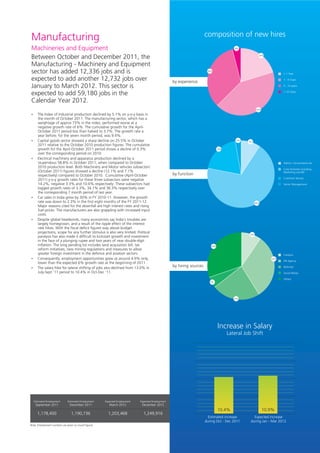
                                                                                                                                                                               > 10 Years
another 54,926 jobs over January to March
2012. This sector is expected to add
227,328 jobs in the Calendar Year 2012.                                                                                                                 39%


According to the latest report of the Internet and Mobile Association
?
of India (IAMAI), the number of internet users in India crossed the 100
million mark in September 2011 and was expected to grow to 121
million by December 2011. The broadband subscriber base stood at
12.69 million in August 2011, according to data released by the                                                                               2%   6%
Telecom Regulatory Authority of India (TRAI).
India Information Technology Report 2011(Q3) by Business Monitor
?
International (BMI) predicts the Indian domestic market for IT products
and services to increase from US$ 19.7 billion in 2010 to US$ 41.2
billion by 2015. As per the report, the Indian market for PCs                                                          30%
                                                                                                                                                                               Admin / Accountants etc
(including notebooks and accessories) and IT services were worth
                                                                                                                                                                               Core Activities including
around US$ 8 billion and US$ 7.5 billion respectively in 2011. The                                                                                                             Marketing and BD
report has estimated a compounded annual growth rate (CAGR) of 18                                 by function
per cent for Indian software market over the span of 2011-2015.                                                                                                                Customer Service

According to NASSCOM, the $88 billion Indian IT outsourcing industry
?                                                                                                                                                                              Senior Management
is projected to touch $225 billion mark by 2020. For the FY 2011-12,
NASSCOM expects the IT services revenue growth rate to be around                                                                                                   62%
15%.
While the rupee depreciated by 21% in the August-December 2011
?
period, the IT sector’s net foreign exchange earnings touched US
$14.48 billion. Total export from the sector was US$25.19 billion
against forex spending of US$10.71 billion.
The Indian e-commerce market grew by 47% in 2011 to become a
?
US$ 10 billion industry. It is expected to continue to expand
exponentially with rising income, internet penetration and customers
becoming more and more comfortable with online transactions. Retail
                                                                                                                                   14%
brands are also expected to bring a great transformation in the online                                                                                     18%
space. Investors have poured around US$ 200 million into Indian e-
commerce start-ups in the last couple of years.
As a result of such growth, e-retailers, who want to focus on their
?                                                                                                                       8%

core functionalities, are expected to outsource bulky back-end                                                                                                                 Campus
operations (such as customer care, order processing, invoice                                                                                                                   HR Agency
processing, finance and accounts). This may emerge as a substantial
source of revenue for BPOs.                                                                       by hiring sources                                                            Referrals

The demand for cloud computing services is expected to increase
?                                                                                                                                                                              Social Media
rapidly in India. There are already more than 50 cloud computing                                                                                                         29%
                                                                                                                                                                               Others
service providers in the Indian market. Indian internet services
providers (ISPs) and data centre service providers are investing on
applications and bandwidth to support new cloud service offerings.                                                           32%
The coming time is also expected to see rapid proliferation of Apps,
customer interactive innovations and machine to machine (M2M)
technologies.
According to the latest outlook by technology research firm Gartner,
?
worldwide IT spending will grow by 3.7% in 2012 to US$ 3.8 trillion.
In 2011, the spending was at US$ 3.7 trillion, clocking a 6.9% growth
over 2010 levels. Despite this reduced growth rate, the flow of work
to low cost destinations like India may not be affected, even if
companies in US and Europe take recourse to increased offshoring to                                                          Increase in Salary
cut costs and remain competitive.                                                                                                   Lateral Job Shift
In association with Rockefeller Foundation, NASSCOM Foundation is
?
working towards developing a new arm of the BPO industry called
‘impact sourcing’, which essentially involves employing socio-
economically disadvantaged people as principal workers. NASSCOM
estimates that by 2020 the Indian IT-BPO industry can tap additional
revenue worth US$75 billion through innovations such as this.


  Estimated Employment        Estimated Employment    Expected Employment   Expected Employment
   September 2011              December 2011             March 2012          December 2012
                                                                                                                             15.9%                               18.5%
     2,056,600                   2,102,421              2,157,347             2,329,749
                                                                                                                        Estimated increase                Expected increase
                                                                                                                      during Oct - Dec 2011             during Jan - Mar 2012
Note: Employment numbers are given as round figures
Manufacturing                                                                                                         composition of new hires
Machineries and Equipment                                                                                                               4%


Between October and December 2011, the                                                                                                                 20%


Manufacturing - Machinery and Equipment
sector has added 12,336 jobs and is                                                                                    34%
                                                                                                                                                                     < 1 Year

expected to add another 12,732 jobs over                                                          by experience
                                                                                                                                                                     1 - 4 Years

January to March 2012. This sector is                                                                                                                                5 - 10 years


expected to add 59,180 jobs in the                                                                                                                                   > 10 Years


Calendar Year 2012.
                                                                                                                                                      42%

The Index of Industrial production declined by 5.1% on y-o-y basis in
?
the month of October 2011. The manufacturing sector, which has a
weightage of approx 75% in the index, performed worse at a
negative growth rate of 6%. The cumulative growth for the April-
October 2011 period less than halved to 3.7%. The growth rate a
year before, for the seven month period, was 9.4%.
? goods sector showed a sharp decline on 25.5% in October
Capital                                                                                                                                  3%
                                                                                                                                               9%
2011 relative to the October 2010 production figures. The cumulative
growth for the April-October 2011 period shows a decline of 0.3%                                                               19%

over the corresponding period on 2010.
? machinery and apparatus production declined by a
Electrical
stupendous 58.8% in October 2011, when compared to October                                                                                                           Admin / Accountants etc
2010 production level. Both Machinery and Motor vehicles subsectors’
                                                                                                                                                                     Core Activities including
(October 2011) figures showed a decline (12.1% and 7.1%                                                                                                              Marketing and BD
respectively) compared to October 2010. Cumulative (April-October                                 by function
                                                                                                                                                                     Customer Service
2011) y-o-y growth rates for these three subsectors were negative
14.2%, negative 3.3% and 10.6% respectively. These subsectors had                                                                                                    Senior Management
logged growth rates of 3.3%, 34.1% and 36.3% respectively over
the corresponding 7 month period of last year.
? in India grew by 30% in FY 2010-11. However, the growth
Car sales
rate was down to 2.3% in the first eight months of the FY 2011-12.                                                                                   69%
Major reasons cited for the downfall are high interest rates and rising
fuel prices. The manufacturers are also grappling with increased input
costs.
? global headwinds, many economists say India's troubles are
Despite
largely homegrown, and a result of the ripple effect of the interest
rate hikes. With the fiscal deficit figures way above budget
projections, scope for any further stimulus is also very limited. Political
                                                                                                                                               10%
paralysis has also made it difficult to kickstart growth and investment
in the face of a plunging rupee and two years of near double-digit
inflation. The long pending list includes land acquisition bill, tax                                                     30%
reform initiatives, new mining regulations and measures to allow
greater foreign investment in the defence and aviation sectors.                                                                                                      Campus
Consequently, employment opportunities grew at around 4.9% only,
?                                                                                                                                                              32%
                                                                                                                                                                     HR Agency
lower than the expected 6% growth rate at the beginning of 2011.
The salary hike for lateral shifting of jobs also declined from 13.0% in
?
                                                                                                  by hiring sources                                                  Referrals

July-Sept ‘11 period to 10.4% in Oct-Dec ’11.                                                                                                                        Social Media

                                                                                                                                                                     Others
                                                                                                                         5%


                                                                                                                                        23%


                                                                                                                               Increase in Salary
                                                                                                                                     Lateral Job Shift


  Estimated Employment        Estimated Employment    Expected Employment   Expected Employment
    September 2011              December 2011            March 2012          December 2012
                                                                                                                               10.4%                        10.9%
     1,178,400                   1,190,736              1,203,468             1,249,916
                                                                                                                        Estimated increase        Expected increase
                                                                                                                      during Oct - Dec 2011     during Jan - Mar 2012
Note: Employment numbers are given as round figures
Manufacturing                                                                                                         composition of new hires
Non-machinery Manufacturing                                                                                                                      1%


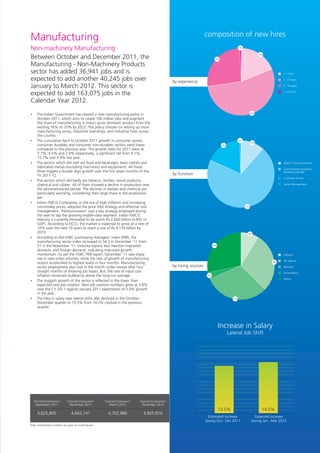
Between October and December 2011, the
                                                                                                                                                                  19%

                                                                                                                             27%

Manufacturing - Non-Machinery Products
sector has added 36,941 jobs and is                                                                                                                                            < 1 Year

expected to add another 40,245 jobs over                                                          by experience
                                                                                                                                                                               1 - 4 Years

January to March 2012. This sector is                                                                                                                                          5 - 10 years


expected to add 163,075 jobs in the                                                                                                                                            > 10 Years


Calendar Year 2012.
                                                                                                                                                            54%
The Indian Government has cleared a new manufacturing policy in
?
October 2011, which aims to create 100 million jobs and augment
the share of manufacturing in India's gross domestic product from the
existing 16% to 25% by 2022. The policy stresses on setting up more
manufacturing zones, industrial townships, and industrial hubs across
the country.
The cumulative April to October 2011 growth in consumer goods,
?                                                                                                                                                1%
                                                                                                                                                            12%
consumer durables and consumer non-durables sectors were lower                                                                     18%
compared to the previous year. The growth rates for 2011 were at
3.7%, 4.5% and 2.9% respectively, a significant fall from 9.1%,
15.7% and 3.9% last year.
The sectors which did well are food and beverages, basic metals and
?                                                                                                                                                                              Admin / Accountants etc
fabricated metals (excluding machinery and equipment). All these                                                                                                               Core Activities including
three logged a double digit growth over the first seven months of the                                                                                                          Marketing and BD
FY 2011-12.                                                                                       by function
                                                                                                                                                                               Customer Service
The sectors which did badly are tobacco, textiles, wood products,
?
chemical and rubber. All of them showed a decline in production over                                                                                                           Senior Management
the aforementioned period. The declines in textiles and chemical are
particularly worrying, considering their large share in the production
pie.
?FMCG Companies, in the era of high inflation and increasing
Indian
commodity prices, adopted the price hike strategy and effective cost                                                                                  70%

management. `Premiumization` was a key strategy employed during
the year to tap the growing middle-class segment. Indian FMCG
Industry is currently estimated to be worth Rs 2,600 billion (4.8% of
GDP). According to FICCI, the market is expected to grow at a rate of
10% over the next 10 years to reach a size of Rs 4,130 billion by
2015.                                                                                                                                                   9%
According to the HSBC purchasing managers' index (PMI), the
?
manufacturing sector index increased to 54.2 in December ’11 from
51 in the November ‘11. Industry reports also mention improved                                                              29%

domestic and foreign demand, indicating improved growth
momentum. As per the HSBC PMI report, December ’11 saw sharp                                                                                                                   Campus
rise in new order volumes, while the rate of growth of manufacturing
                                                                                                                                                                               HR Agency
output accelerated to highest levels in four months. Manufacturing                                                                                                      29%

sector employment also rose in the month under review after four                                  by hiring sources                                                            Referrals
straight months of showing job losses. But, the rate of input cost                                                                                                             Social Media
inflation remained stubbornly above the long-run average.                                                              3%
                                                                                                                                                                               Others
The sluggish growth of the sector is reflected in the lower than
?
expected new job creation. New job creation numbers grew at 3.8%
over the CY 2011 against January 2011 expectation of 5.0% growth
in the year.
? in salary over lateral shifts also declined in the October-
The hike                                                                                                                                   31%
December quarter to 13.5% from 14.2% clocked in the previous
quarter.


                                                                                                                                  Increase in Salary
                                                                                                                                         Lateral Job Shift


  Estimated Employment        Estimated Employment    Expected Employment   Expected Employment
   September 2011              December 2011             March 2012          December 2012
                                                                                                                                  13.5%                             14.5%
     4,625,800                   4,662,741              4,702,986             4,825,816
                                                                                                                        Estimated increase                    Expected increase
                                                                                                                      during Oct - Dec 2011                 during Jan - Mar 2012
Note: Employment numbers are given as round figures
Media and Entertainment                                                                                               composition of new hires
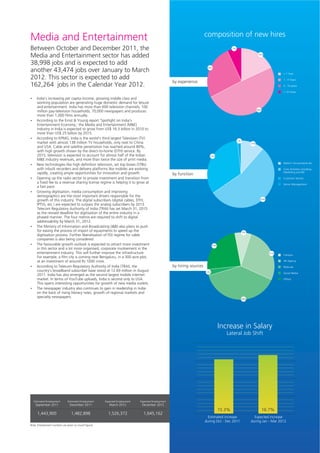
Between October and December 2011, the                                                                                                    7%


Media and Entertainment sector has added                                                                                                                         18%


38,998 jobs and is expected to add
another 43,474 jobs over January to March
                                                                                                                       26%

                                                                                                                                                                               < 1 Year
2012. This sector is expected to add                                                                                                                                           1 - 4 Years
                                                                                                  by experience
162,264 jobs in the Calendar Year 2012.                                                                                                                                        5 - 10 years

                                                                                                                                                                               > 10 Years

?increasing per capita income, growing middle class and
India's
working population are generating huge domestic demand for leisure
and entertainment. India has more than 600 television channels, 100
                                                                                                                                                                49%
million pay-television households, 70,000 newspapers and produces
more than 1,000 films annually.
According to the Ernst & Young report ‘Spotlight on India's
?
Entertainment Economy,' the Media and Entertainment (M&E)
industry in India is expected to grow from US$ 16.3 billion in 2010 to
more than US$ 25 billion by 2015.
According to KPMG, India is the world's third largest Television (TV)
?
                                                                                                                                               2%
market with almost 138 million TV households, only next to China                                                                                          12%
and USA. Cable and satellite penetration has reached around 80%,
with high growth shown by the direct-to-home (DTH) service. By
2015, television is expected to account for almost half of the Indian                                                       33%
M&E industry revenues, and more than twice the size of print media.
                                                                                                                                                                               Admin / Accountants etc
New technologies like high definition television, set top boxes (STBs)
?
with inbuilt recorders and delivery platforms like mobiles are evolving                                                                                                        Core Activities including
rapidly, creating ample opportunities for innovation and growth.                                                                                                               Marketing and BD
                                                                                                  by function
? up the radio sector to private investment and transition from
Opening                                                                                                                                                                        Customer Service
a fixed fee to a revenue sharing license regime is helping it to grow at                                                                                                       Senior Management
a fast pace.
? digitisation, media consumption and improving
Growing
demographics are the most important drivers responsible for the
growth of this industry. The digital subscribers (digital cables, DTH,                                                                                            54%

IPTVs, etc.) are expected to surpass the analog subscribers by 2013.
Telecom Regulatory Authority of India (TRAI) has set March 31, 2015
as the revised deadline for digitisation of the entire industry in a
phased manner. The four metros are required to shift to digital
addressability by March 31, 2012.
The Ministry of Information and Broadcasting (I&B) also plans to push
?
for easing the process of import of equipments to speed up the                                                                                      8%
digitisation process. Further liberalisation of FDI regime for cable
companies is also being considered.
The favourable growth outlook is expected to attract more investment
?                                                                                                                           24%
in this sector and a lot more organised, corporate involvement in the
entertainment industry. This will further improve the infrastructure.                                                                                                    27%
                                                                                                                                                                               Campus
For example, a film city is coming near Bengaluru, in a 300 acre plot,
at an investment of around Rs 1000 crore.                                                                                                                                      HR Agency

According to Telecom Regulatory Authority of India (TRAI), the
?                                                                                                 by hiring sources                                                            Referrals
country's broadband subscriber base stood at 12.69 million in August                                                   3%
                                                                                                                                                                               Social Media
2011. India has also emerged as the second largest mobile internet
market. In terms of YouTube uploads, India is second only to USA.                                                                                                              Others
This opens interesting opportunities for growth of new media outlets.
The newspaper industry also continues to gain in readership in India
?
on the back of rising literacy rates, growth of regional markets and
specialty newspapers.                                                                                                                               39%


                                                                                                                                  Increase in Salary
                                                                                                                                     Lateral Job Shift


  Estimated Employment        Estimated Employment    Expected Employment   Expected Employment
    September 2011              December 2011            March 2012          December 2012
                                                                                                                                  15.3%                               16.7%
     1,443,900                   1,482,898              1,526,372             1,645,162
                                                                                                                        Estimated increase                  Expected increase
                                                                                                                      during Oct - Dec 2011               during Jan - Mar 2012
Note: Employment numbers are given as round figures
composition of new hires
Pharma
Between October and December 2011, the                                                                                                    1%


Pharma sector has added 13,855 jobs and                                                                                                                  21%


is expected to add another 13,642 jobs
over January to March 2012. This sector is                                                                                                                             < 1 Year
expected to add 59,957 jobs in the                                                                                                                                     1 - 4 Years
                                                                                                  by experience
Calendar Year 2012.                                                                                                                                                    5 - 10 years

                                                                                                                       46%                                             > 10 Years

The Pharma industry in India meets around 70% of the country’s
?
demand for bulk drugs, drug intermediaries, pharmaceutical
formulations, chemicals, tablets, capsules, orals and injectibles. There                                                                                 32%

are approximately 250 large units and about 8000 small units, which
forms the core of the Pharma industry in India. The large 250
companies control about 70% of the market share, with severe price
competition and government price control. The domestic
pharmaceutical industry has evolved from being purely reverse
engineering focused to a research driven, export oriented and globally
competitive entity.
                                                                                                                                          2%
? of production volumes, the Indian pharmaceutical industry is
In terms                                                                                                                                       8%

ranked 4th in the world. In terms of domestic consumption value,
India is ranked 13th. The market is expected to grow to US$ 34 billion                                                        25%

in FY 2011-12 from US$ 13 billion in FY 2006-07. Consulting firm IMS
estimates that global spending on medicines will reach 1.1 trillion
dollar by 2015.                                                                                                                                                        Admin / Accountants etc
According to PwC, India is expected to join the league of top 10
?                                                                                                                                                                      Core Activities including
global pharmaceuticals markets by 2020, with total sales reaching                                 by function
                                                                                                                                                                       Marketing and BD
US$ 50 billion. McKinsey suggests that if aggressive growth strategies                                                                                                 Customer Service
are implemented, the market has the potential to reach US$ 70 billion
by 2020, from US$ 13.1 billion in FY 2010-11.                                                                                                                          Senior Management

According to CARE Ratings, drugs worth $235 billion are expected to
?
go off patent in the next five years, leaving the market open for off-
patent or generic drugs. This is expected to be the primary growth                                                                                       66%
driver for the Indian Pharmaceutical Industry in the next 3-5 years.
Other key growth drivers are, increased per capita expenditure on
pharmaceuticals, improved medical infrastructure, greater health
insurance penetration and shift in disease profiles.
? trend in outsourcing by global pharmaceutical companies
Growing
will further fuel the exports by Indian firms. The contract research
manufacturing companies will see a revival in demand as export
contracts from global pharmaceutical companies are expected to go                                                                              9%

up.
? saw over US$ 200 million of private equity money flowing
CY 2011                                                                                                                      29%
into the Indian pharma space. Dealmakers expect this healthy inflow
to continue in 2012.
                                                                                                                                                                       Campus
?pharma companies grew by 14% in 2011, as compared to 4%
Indian
growth witnessed in previous year. On the back of aggressive                                                                                                           HR Agency
marketing initiatives, pharma companies witnessed doubling of rural                               by hiring sources                                                    Referrals
market sales. India's rural drug market grew by 18.8% in the 12                                                                                                 36%

months period ended April 2011, achieving a significantly higher                                                                                                       Social Media
                                                                                                                       2%
growth rate than 10.9% in the previous year.                                                                                                                           Others
However, the net profit of Indian companies has come down due to
?
high interest rate costs and exchange rate fluctuations. According to
CARE, companies having foreign currency liabilities will continue to be
impacted by a weak rupee. However, the impact may be partially                                                                      24%
offset by higher export realizations.


                                                                                                                               Increase in Salary
                                                                                                                                     Lateral Job Shift


  Estimated Employment        Estimated Employment    Expected Employment   Expected Employment
   September 2011              December 2011             March 2012          December 2012
                                                                                                                               16.8%                      15.6%
       321,600                    335,455                349,097               395,412
                                                                                                                        Estimated increase            Expected increase
                                                                                                                      during Oct - Dec 2011         during Jan - Mar 2012
Note: Employment numbers are given as round figures
Real Estate and                                                                                                       composition of new hires

Construction                                                                                                                               1%


                                                                                                                                                             25%

Between October and December 2011, the
Real Estate and Construction sector has                                                                                36%


added 23,815 jobs and is expected to add                                                                                                                                 < 1 Year


another 26,669 jobs over January to March
                                                                                                                                                                         1 - 4 Years
                                                                                                  by experience
                                                                                                                                                                         5 - 10 years
2012. This sector is expected to add                                                                                                                                     > 10 Years

132,906 jobs in the Calendar Year 2012.
                                                                                                                                                            38%
? has been the primary concern for the Indian economy in the
Inflation
last few months. This induced RBI to raise the repo rate from 6% in
January 2011 to 8.5% by year end. Along with economic slowdown,
the rise in the interest charges hit the sector really hard in the past
year. According to data compiled by Hindustan Times, while top 14
listed real estate companies had rather healthy revenue of Rs 44,480
crore in CY 2010, the revenue was down by 58% in CY 2011 to Rs
18,524 crore.                                                                                                                              1%
                                                                                                                                                      12%
According to Knight Frank India, although residential property price
?                                                                                                                              17%
had increased by 10% to 30% in 2010, it had declined by upto 10%
across major cities like Mumbai, NCR, Bangalore and Chennai in
2011.
New project launches also dropped by 52% in 2011. Whereas
?                                                                                                                                                                        Admin / Accountants etc
3,61,098 residential units were launched across the top 7 cities of                                                                                                      Core Activities including
Mumbai, NCR, Pune, Kolkata, Bangalore, Chennai and Hyderabad in                                                                                                          Marketing and BD
2010, only 1,72,856 units were launched in 2011. Housing inventory                                by function
                                                                                                                                                                         Customer Service
of 3,06,859 units are also lying unsold.
? for commercial office space, driven mainly by the service
Demand                                                                                                                                                                   Senior Management
sector industries like BFSI and IT/ITES, remained muted in 2011. The
growth potential of these two sectors were severely damaged by the
economic downturn. Of the total office stock of 367 million square
feet (msf) in the seven cities mentioned above, 24% remain vacant.
Rentals in these cities also remained under pressure.                                                                                           71%

Last year, the government came out with the draft real estate
?
regulation bill, which proposes to directly regulate the real estate
sector and adjudicate any dispute between the buyer, promoter and
government authority. FDI policies for single-brand retail and
wholesale trade now allow 100% foreign participation, and have the
potential to enhance demand for prime real estate.
                                                                                                                                 22%                   7%
? ahead to 2012, the residential real estate demand will be
Looking
dependent on how the Indian economy performs and its impact on
employment, income, inflation and interest rate. The demand for
commercial real estate will be determined by the performance of BFSI
and IT/ITES sectors.                                                                                                                                                     Campus
                                                                                                                       6%
One positive development though is the interest being shown by the
?                                                                                                                                                                        HR Agency
NRIs to invest in Real Estate, following the sharp depreciation of
                                                                                                  by hiring sources                                                      Referrals
Indian Rupee against US$.
Interestingly, at a time when few prime quality office projects are
?                                                                                                                                                                  33%   Social Media
being built, assets that are already generating rental yields are finding                                                                                                Others
takers among Private Equity (PE) funds. According to VCCEdge, total
PE investment in 2011 in real estate had been $1.31 billion across 34
deals. Out of this, 10 transactions worth $862.8 million involved
purely commercial properties.                                                                                                        33%
Government has finalized the contours of a $10-billion infrastructure
?
debt fund (IDF) with 50% participation from a foreign bank and a
multilateral agency, while the rest of the corpus will be contributed by
state-owned financial institutions.
However, in the opinion of Bankers and companies in the
?
infrastructure space, it is the absence of projects and supply of inputs,
rather than lack of funds, that is holding up development. Several
coal-based power projects are held up due to the failure of the
                                                                                                                             Increase in Salary
government to ensure adequate supply of fuel. There are others that                                                                  Lateral Job Shift
have suffered delays on account of land acquisition or environmental
clearances. These factors have also prompted the government, which
is battling a series of corruption scandals, to go slow on award of new
contracts. Contracts have been scarce in other infrastructure sectors
like ports too. Road was the only shining light in terms of contracts
awarded.
Consequent to this sloth pace, the construction sector’s GDP grew
?
only at 1.2% and 4.3% in Q1 and Q2 of FY 2011-12, sharply down
from y-o-y growth rates of 7.7% and 6.7% in FY 2010-11.


  Estimated Employment        Estimated Employment    Expected Employment   Expected Employment
    September 2011              December 2011            March 2012          December 2012
                                                                                                                             13.0%                            13.1%
       965,000                    988,815               1,015,484             1,121,721
                                                                                                                        Estimated increase              Expected increase
                                                                                                                      during Oct - Dec 2011           during Jan - Mar 2012
Note: Employment numbers are given as round figures
composition of new hires
Trade including
Consumer Retail Services                                                                                                                7%


                                                                                                                                                          21%

Between October and December 2011, the
Trade including Consumer, Retail and                                                                                   28%

Services sector has added 12,334 jobs and                                                                                                                             < 1 Year

                                                                                                                                                                      1 - 4 Years
is expected to add another 13,832 jobs                                                            by experience
                                                                                                                                                                      5 - 10 years
over January to March 2012. This sector is                                                                                                                            > 10 Years

expected to add 54,230 jobs in the
Calendar Year 2012.
                                                                                                                                                    44%


? retail business is currently valued at around US$ 550 billion.
IIndian
BMI India Retail Report for the first quarter of 2012 forecasts the retail
business to grow to US$ 825 billion by 2015. A report by Boston
Consulting Group (BCG) estimates the country's organised retail at
US$ 28 billion, with around 7 per cent penetration. It is projected to
become a US$ 260 billion business over the next decade with around                                                                           1%
21% penetration.                                                                                                                                   12%
                                                                                                                                22%
? report by Business Monitor International (BMI) suggests that
Another
expanding middle and upper class consumer base is generating vast
opportunities in India's tier-II & tier-III cities. The greater availability of
personal credit, improved mobility and better tourism are all small but                                                                                               Admin / Accountants etc
significant contributors to the growth of Indian retail industry.
                                                                                                                                                                      Core Activities including
? FDI in single brand retail has been increased to 100%. The
Limit of                                                                                                                                                              Marketing and BD
decision eases the entry of single-brand retailers such as Starbucks                              by function
Corp. and Ikea, allowing them to operate without a local partner. FDI                                                                                                 Customer Service
up to 100% for cash and carry wholesale trading and export trading                                                                                                    Senior Management
is also allowed under the automatic route. Majority (51%) foreign
ownership in multi-brand retail though may have to wait till the
completion of coming state elections, considering the wide political
division across parties.
                                                                                                                                                   65%
? advantage of the liberalised FDI policy for single-brand retail,
Taking
many top end brands like Vertu, Christian Loubotin, Armani Junior,
Van Laack, Diesel Black Gold, etc. will commence their operations
shortly. According to the Department of Industrial Policy and
Promotion (DIPP), cumulative FDI inflows into single-brand retail
trading during April 2000 to September 2011 stood at US$ 44.45
million,.
?CII estimates luxury brands market in India to have grown at a healthy                                                                            12%

20%, during 2010, reaching a size of US$ 5.8 billion. It forecasts the
market to be worth US$ 14.7 billion by 2015.
                                                                                                                         31%
?retailers and consumer durables companies are joining the web
Indian
bandwagon, with fast expansion of India's online shopping industry.                                                                                                   Campus
Indian online retail trade is expected to become a US$ 1.35 billion
                                                                                                                                                                      HR Agency
industry by 2015.                                                                                                                                               23%
                                                                                                  by hiring sources                                                   Referrals

                                                                                                                                                                      Social Media

                                                                                                                                                                      Others
                                                                                                                         6%


                                                                                                                                             29%


                                                                                                                               Increase in Salary
                                                                                                                                      Lateral Job Shift


  Estimated Employment        Estimated Employment    Expected Employment   Expected Employment
   September 2011              December 2011             March 2012          December 2012
                                                                                                                               14.4%                      15.9%
       681,200                    693,534                707,366               747,764
                                                                                                                        Estimated increase           Expected increase
                                                                                                                      during Oct - Dec 2011        during Jan - Mar 2012
Note: Employment numbers are given as round figures
Transport, Storage and                                                                                                composition of new hires

Communication                                                                                                                23%

Between October and December 2011, the
Transport, Storage and Communication                                                                                                                       34%


sector has added 8,403 jobs and is                                                                                                                                  < 1 Year


expected to add another 10,042 jobs over                                                          by experience
                                                                                                                                                                    1 - 4 Years

                                                                                                                                                                    5 - 10 years
January to March 2012. This sector is                                                                                                                               > 10 Years
expected to add 49,480 jobs in the
Calendar Year 2012.
                                                                                                                                   43%

?carriers flew 55 million domestic passengers between January
Indian
and November 2011, against 46.8 million in the Jan-Nov period of last
year. However, it managed to utilise just 20 percent of overseas
entitlement, against 39 percent into India by foreign airlines.Despite a
17% growth in passenger traffic, India's civil aviation industry hit
turbulent weather in 2011, with rising jet fuel and interest costs                                                                         2%
eating into the margins of carriers. Issue of rationalisation of federal                                                                        8%

and state levies on jet fuel is still to be addressed. Government has                                                        22%
proposed to allow foreign airlines to buy up to 49% stake in the
domestic carriers.
? of Air India and Kingfisher are in deep red. Kingfisher
Finances
                                                                                                                                                                    Admin / Accountants etc
Airlines, which had acquired Air Deccan in 2007, shut down the
budget operations to become a full-service carrier. The only carrier                                                                                                Core Activities including
that remained a profit-making operation is the low-cost IndiGo. This                                                                                                Marketing and BD
                                                                                                  by function
has severely restricted the growth prospect of the sector.                                                                                                          Customer Service
The highway construction target of 20-km a day set by the National
?                                                                                                                                                                   Senior Management
Highways Authority of India (NHAI) has still not been realised. Only
8.75 km a day has been constructed in the current financial year till
date. The highway construction target for the current year was set at
3,570 km - 2,500 km for NHAI and 1,070 km for the Road Transport
Ministry. However, only 624 km has been completed by the Ministry                                                                                69%

and NHAI has been able to complete 690 km.
Construction of rural roads under the Prime Minister Gram Sadak
?
Yojana is in troubled waters in many places due to Maoist threat.
?Railways carried 704.75 million tonnes of revenue-earning
Indian
freight traffic during the first three quarters of the FY 2011-12,
showing 4.67% y-o-y growth. Total earnings during April to
December 2011 registered an increase of 10.20%. Total numbers of                                                                                13%

passengers booked during the period were 5987 million compared to                                                           26%
5691 million last year, showing an increase of 5.20%.
According to Indian Port Association, container traffic through major
?
ports in India grew by 4% year-over-year in the first eight months of                                                                                               Campus
fiscal 2011-12. Traffic at the ports from April through November was
5.18 million 20-foot equivalent units, up from 5 million a year earlier.                                                                                            HR Agency
The tonnage of containerized traffic increased by 8.2% to 79.6                                    by hiring sources                                          25%
                                                                                                                                                                    Referrals
million metric tons.                                                                                                  5%
                                                                                                                                                                    Social Media
?Shipping Minister G.K. Vasan said the government plans to
Indian
expand overall port capacity to 3.13 billion tons by 2020 with an                                                                                                   Others
anticipated total investment of about $100 billion.


                                                                                                                                         32%


                                                                                                                             Increase in Salary
                                                                                                                                   Lateral Job Shift


  Estimated Employment        Estimated Employment    Expected Employment   Expected Employment
    September 2011              December 2011            March 2012          December 2012
                                                                                                                             12.4%                     11.1%
     2,722,000                   2,730,403              2,740,445             2,779,883
                                                                                                                        Estimated increase         Expected increase
                                                                                                                      during Oct - Dec 2011      during Jan - Mar 2012
Note: Employment numbers are given as round figures
city-wise employment outlook
For all the cities except Delhi & NCR, Hyderabad and                             Delhi & NCR
Bangalore, Oct-Dec 2011 employment growth rates
                                                                                 Delhi had a lower than average employment growth in Oct-Dec
were lower than Oct-Dec 2010 quarter. The                                        2010 quarter. Compared to it, the growth rates in Calendar Year
difference is marginal in case of Hyderabad. For the                             2011 thus look better. However, we can also see a dip in the
other two, the uptick seems more due to the                                      growth rates in the second half of 2011. The 4.9% job growth
significantly below average rate of employment                                   expectation for next quarter is better than both last quarter and
                                                                                 Calendar Year 2011 average. The sectors expected to show highest
growth recorded in the Oct-Dec 2010 quarter.                                     job growth are Pharma, Education, IT/ITES and Manufacturing. The
Overall, the 8 city average growth rate fell from 5.2%                           Real Estate sector employment outlook has also improved, and will
in Oct-Dec 2010 to 4.3% in Oct-Dec 2011. The                                     create jobs in greater numbers.
sharpest falls were seen in Chennai, Pune and
Kolkata. The outlook going into Jan-Mar 2012 quarter                             Hyderabad
seems much improved. Only Hyderabad and Kolkata                                  Hyderabad employment numbers grew at around 4% in the first
show a marginal dip in expected employment growth                                three quarters of Calendar Year 2011. The growth rate accelerated
rate in Q1, CY 2012 compared to the last quarter. All                            to 4.7% in the Oct-Dec 2011 quarter. Jan-Mar 2012 outlook
                                                                                 remains stable at 4.5% expected employment growth. Most
the other cities are expected to log higher growth in                            optimistic growth outlooks are observed in IT/ITES and Pharma
employment numbers.                                                              sectors. Healthcare, Hospitality and Transport, Storage &
                                                                                 Communication sectors are also going to be important players.
Ahmedabad
                                                                                 Kolkata
In Ahmedabad, the employment numbers grew at a consistent
3.6% rate, through all the quarters of Calendar Year 2011. This                  Kolkata employment growth was lower than the eight city average
was however lower than the 4.9% rate of growth clocked in Oct-                   throughout 2011. It though managed to reduce the gap in the Oct-
Dec 2010 quarter. The employment outlook for the current Jan-                    Dec 2011 quarter. At 4.0% expected growth in Q1 of CY 2012, its
Mar 2012 quarter looks to have improved with job numbers                         outlook does not show much improvement compared to last
expected to rise by 4.8%. The sectors expected to show highest                   quarter and continues to be below the 8 city average. Media and
employment growth are Healthcare, Pharma and IT/ITES. These are                  Hospitality sectors are most optimistic about new hiring in the
closely followed by the Manufacturing-Non-machinery and                          current quarter.
Manufacturing-Machinery and Equipments sectors.
                                                                                 Mumbai
Bangalore
                                                                                 Mumbai employment grew at 4.0% over the first three quarters of
Except for a marginal dip in July-Sept 2011 quarter, employment                  2011, lower than the 4.5% growth rate recorded in the last quarter
opportunity in Bangalore grew at 4% plus level. The outlook for                  of Calendar Year 2010. It dipped further to 3.8% in the Oct-Dec
Q1of CalendarYear 2012 looks to be better than the 2011 average.                 2011 quarter. Its outlook for Q1, Calendar Year 2012 shows
The sectors expected to show the highest employment growth are                   significant improvement. BFSI, IT/ITES and Hospitality are the most
Media, Pharma, Healthcare and IT/ITES.                                           optimistic sectors.

Chennai                                                                          Pune
Chennai had a stellar employment growth in the fourth quarter of                 Among the 8 cities, Pune’s employment growth scenario has been
Calendar Year 2010. The growth numbers for Calendar Year 2011                    the most buoyant with higher than average growth across all
were progressively lower in comparison. It optimistically looks                  quarters surveyed. Its lowest rate of growth was in July-Sept 2011
forward to Q1, CY2012 to salvage the fall with an expected 4.4%                  quarter, but has seen significant turnaround since then. Its
increase. The sectors with better growth outlook are Retail,                     employment is expected to grow at 6.6% in Q1, Calendar Year
Pharma, Media, Hospitality, and Manufacturing.                                   2012. Hospitality, Retail, Healthcare, Non-machinery
                                                                                 Manufacturing, IT/ITES and Education are the most promising
                                                                                 sectors.


   Estimated Jobs in 2011   Expected Jobs - January to March 2012
                                                                                                                                               16000
                   39,100
                                 34,200
                                                                                                                                               14000


                                                                                                                                               12000


                                                                                                                                               10000

                                                  19,100                                                                                        8000


                                                                                                                                                6000


                                                                                                                                                4000
                                                                     7,800      7,600
                                                                                            4,700        5,200                                  2000
                                                                                                                      2,500


                  109,600      110,900           62,200             24,900     22,400      15,700        12,900        7,100

                Mumbai      Delhi & NCR        Chennai              Kolkata   Bangalore   Hyderabad      Pune      Ahmedabad
summary and conclusion
The current Ma Foi Randstad Employment Survey (MEtS) covers employment generation and other related issues such as
sectoral distribution of job growth, salary hikes for lateral job shifts, composition of new hires in terms of experience,
functional area and hiring sources for the October-December Quarter of Calendar Year 2011 and captures the industry
expectations on how the employment scenario will develop over the January-March 2012 Quarter of CY 2012. A summary
review of job generation record of the 13 sectors in the previous year is also presented, and compared against expected
scenario in 2012.

In the full calendar year 2011, around 1.4 million jobs were generated in the 13 sectors covered by MEtS. This is more than
10% lower than the 1.6 million job generation expected at the beginning of 2011. The last quarter data, however, manages
to look better than expectations. 0.36 million jobs were generated in October-December Quarter of Calendar Year 2011
against an expectation of 0.33 million. The better than expected employment growth figure is supported by the recently
released November IIP numbers. Industrial production in November 2011 not only reversed the negative growth of October
2011, but also managed to beat the growth rate of the previous four months. This improvement in industrial climate has
helped in generating more jobs than was expected at the beginning of the Oct-Dec 2011 quarter.

Healthcare, Hospitality and IT/ITES were the major job creators in the last quarter. Media and Entertainment also did
particularly well. Real Estate & Construction and Transport, Storage & Communication sectors were the underperformers.
Going forward, in 2012, companies in the Pharma, IT/ITES, Media & Entertainment and Real Estate & Construction sectors are
most optimistic about new hiring – with up to 10% plus job growth rates. In terms of number of jobs expected to be created,
Healthcare, Hospitality and IT/ITES are looking forward to add more than 2 lakh jobs, whereas Manufacturing (non-machinery
products), Media & Entertainment and Real Estate & Construction sectors are expecting 1 lakh plus additions.

The international economic gloom is far from over, except some titbit of positive news from US. Many of the domestic
economic worries like inflation, rupee depreciation, budget deficit are still not back to the comfort zone. However, the
market sentiments are positive with hope for better performance during 2012, now that worse is over. The latest MEtS survey
seems to capture this mood, with almost all the sectors showing a better growth outlook for the coming months, relative to
their performance during the October-December Quarter of Calendar Year 2011.
Appendix
                                                                                              Estimated                      Expected                   Expected
 A1: Expected Increase in Employment across Different Sectors                                Employment                    Employment                  Employment
                                                                                            December 2011                 Jan - Dec 2012             Jan - Mar 2012

Banking, Financial Services and Insurance                                                       968,055                        71,605                      15,657
Education, Training and Consultancy                                                           9,886,593                        87,290                      23,815
Energy                                                                                          924,528                        30,208                       7,710
Healthcare                                                                                    3,621,177                       273,571                      72,473
Hospitality                                                                                   6,309,121                       230,213                      60,308
Information Technology & Information Technology Enabled Services                              2,102,421                       227,328                      54,926
Manufacturing - Machinery and Equipment                                                       1,190,736                        59,180                      12,732
Manufacturing - Non-Machinery Products                                                        4,662,741                       163,075                      40,245
Media and Entertainment                                                                       1,482,898                       162,264                      43,474
Pharma                                                                                          335,455                        59,957                      13,642
Real Estate and Construction                                                                    988,815                       132,906                      26,669
Trade including Consumer, Retail and Services                                                   693,534                        54,230                      13,832
Transport, Storage and Communication                                                          2,730,403                        49,480                      10,042


                                                                                    Estimated Average Increase                     Expected Average Increase
 A2: Expected Increase in Salary across Different Sectors - Lateral Job Shift   during October to December 2011                   during January to March 2012


Banking, Financial Services and Insurance                                                       11.7 %                                            12.5 %
Education, Training and Consultancy                                                             11.2 %                                            11.5 %
Energy                                                                                          11.8 %                                            12.2 %
Healthcare                                                                                      16.1 %                                            16.0 %
Hospitality                                                                                     14.9 %                                            15.3 %
Information Technology & Information Technology Enabled Services                                15.9 %                                            18.5 %
Manufacturing - Machinery and Equipment                                                         10.4 %                                            10.9 %
Manufacturing - Non-Machinery Products                                                          13.5 %                                            14.5 %
Media and Entertainment                                                                         15.3 %                                            16.7 %
Pharma                                                                                          16.8 %                                            15.6 %
Real Estate and Construction                                                                    13.0 %                                            13.1 %
Trade including Consumer, Retail and Services                                                   14.4 %                                            15.9 %
Transport, Storage and Communication                                                            12.4 %                                            11.1 %


                                                                                                           During October to December 2011
 A3: Composition of New Hires by Experience
                                                                                  Less than 1 year         1 to 4 years         5 to 10 years       More than 10 years


Banking, Financial Services and Insurance                                          28.90 %                38.60 %               29.70 %                2.70 %
Education, Training and Consultancy                                                25.30 %                38.20 %               32.60 %                3.90 %
Energy                                                                             25.40 %                29.30 %               42.70 %                2.50 %
Healthcare                                                                         17.30 %                42.50 %               38.40 %                1.90 %
Hospitality                                                                        26.00 %                39.20 %               32.80 %                2.60 %
Information Technology & Information Technology Enabled Services                   25.00 %                38.70 %               29.80 %                6.50 %
Manufacturing - Machinery and Equipment                                            20.20 %                42.40 %               33.60 %                3.90 %
Manufacturing - Non-Machinery Products                                             18.90 %                53.70 %               26.70 %                0.70 %
Media and Entertainment                                                            18.10 %                49.20 %               25.70 %                7.00 %
Pharma                                                                             20.80 %                31.80 %               46.10 %                1.40 %
Real Estate and Construction                                                       25.00 %                38.00 %               35.80 %                1.20 %
Trade including Consumer, Retail and Services                                      21.30 %                43.50 %               28.30 %                6.90 %
Transport, Storage and Communication                                               34.00 %                42.80 %               23.20 %                0.10 %


                                                                                                           During October to December 2011

 A4: Composition of New Hires by Functional Areas                                Support functions
                                                                                                           Core activities
                                                                                                             including        Customer Services     Higher Management
                                                                                      such as             Marketing and            related
                                                                                Admin./Accounts etc.   Business Development


Banking, Financial Services and Insurance                                           12.10 %                44.20 %             41.30 %                 2.40 %
Education, Training and Consultancy                                                  9.30 %                67.30 %             21.30 %                 2.10 %
Energy                                                                              13.90 %                67.40 %             16.00 %                 2.70 %
Healthcare                                                                          16.00 %                38.70 %             43.80 %                 1.50 %
Hospitality                                                                         12.90 %                44.50 %             41.20 %                 1.40 %
Information Technology & Information Technology Enabled Services                     6.00 %                62.00 %             30.40 %                 1.60 %
Manufacturing - Machinery and Equipment                                              9.30 %                68.60 %             19.30 %                 2.80 %
Manufacturing - Non-Machinery Products                                              11.50 %                70.30 %             17.60 %                 0.60 %
Media and Entertainment                                                             11.50 %                53.80 %             33.10 %                 1.60 %
Pharma                                                                               7.50 %                66.40 %             24.50 %                 1.60 %
Real Estate and Construction                                                        11.90 %                71.00 %             16.60 %                 0.50 %
Trade including Consumer, Retail and Services                                       12.30 %                64.90 %             22.10 %                 0.70 %
Transport, Storage and Communication                                                 8.30 %                68.70 %             21.50 %                 1.50 %
Proportion of New Hires
A5: Share of Different Hiring Sources for New Hires
                                                                                                                     Campus               HR Agency              Referrals            Social Media           Others


Banking, Financial Services and Insurance                                                                         17.00 %                32.40 %                24.10 %                4.30 %              22.30 %
Education, Training and Consultancy                                                                               10.40 %                31.20 %                20.10 %                1.90 %              36.40 %
Energy                                                                                                            12.00 %                29.20 %                21.70 %               10.10 %              26.90 %
Healthcare                                                                                                        14.20 %                31.90 %                23.20 %                6.20 %              24.50 %
Hospitality                                                                                                       12.20 %                27.80 %                26.60 %                3.80 %              29.60 %
Information Technology & Information Technology Enabled Services                                                  17.70 %                28.70 %                32.40 %                7.70 %              13.60 %
Manufacturing - Machinery and Equipment                                                                            9.60 %                31.50 %                23.30 %                5.30 %              30.40 %
Manufacturing - Non-Machinery Products                                                                             8.70 %                28.70 %                31.30 %                2.90 %              28.50 %
Media and Entertainment                                                                                            8.10 %                26.70 %                38.60 %                3.00 %              23.60 %
Pharma                                                                                                             9.10 %                36.10 %                24.00 %                1.50 %              29.30 %
Real Estate and Construction                                                                                       6.70 %                33.10 %                32.50 %                6.00 %              21.60 %
Trade including Consumer, Retail and Services                                                                     12.40 %                22.50 %                28.80 %                5.60 %              30.80 %
Transport, Storage and Communication                                                                              12.50 %                24.90 %                31.80 %                5.00 %              25.80 %


                                                                                                             Increase in Employment                                              Growth in Employment
A6: City-wise Expected Increase in Employment and Growth Rate
                                                                                            Estimated               Estimated               Expected               Estimated             Estimated               Expected
                                                                                         Jan - Dec 2011           Oct - Dec 2011         Jan - Mar 2012         Jan - Dec 2011         Oct - Dec 2011         Jan - Mar 2012


Ahmedabad                                                                                    7100                     1900                   2500                    3.6 %                  3.6 %                4.8 %
Bangalore                                                                                   22400                     6400                   7600                    4.3 %                  4.6 %                5.3 %
Chennai                                                                                     62200                    15900                  19100                    3.9 %                  3.8 %                4.4 %
Delhi & NCR                                                                                110900                    28100                  34200                    4.4 %                  4.2 %                4.9 %
Hyderabad                                                                                   15700                     4700                   4700                    4.2 %                  4.7 %                4.5 %
Kolkatta                                                                                    24900                     7700                   7800                    3.5 %                  4.1 %                4.0 %
Mumbai                                                                                     109600                    28000                  39100                    4.0 %                  3.8 %                5.1 %
Pune                                                                                        12900                     4000                   5200                    4.6 %                  5.3 %                6.6 %


                                                                                                                                                                  Average Salary Hike
A7: City-wise Likely Increase in Salary - Lateral Job Shift
                                                                                                                                      Estimated                        Estimated                        Expected
                                                                                                                                   Jan - Dec 2011                    Oct - Dec 2011                  Jan - Mar 2012

Ahmedabad                                                                                                                               14.3 %                          15.0 %                         14.1 %
Bangalore                                                                                                                               15.0 %                          13.8 %                         15.7 %
Chennai                                                                                                                                 14.3 %                          12.2 %                         13.9 %
Delhi & NCR                                                                                                                             14.5 %                          12.2 %                         14.3 %
Hyderabad                                                                                                                               14.2 %                          12.7 %                         14.8 %
Kolkatta                                                                                                                                13.7 %                          13.7 %                         13.4 %
Mumbai                                                                                                                                  14.2 %                          11.1 %                         15.5 %
Pune                                                                                                                                    14.9 %                          12.7 %                         14.7 %


A8 : City-wise Share of Different                                               January to December 2011                                                               October to December 2011
Experience Brackets amongst New Hires                     Less than                                                      Greater than            Less than                                                      Greater than
                                                           1 year                1 to 4 years        5 to 10 years        10 years                1 year              1 to 4 years         5 to 10 years         10 years


Ahmedabad                                                21.2 %                   40.8 %               34.9 %              3.1 %                17.4 %                  44.9 %                 34.3 %             3.4 %
Bangalore                                                15.0 %                   47.0 %               35.9 %              2.1 %                11.9 %                  53.6 %                 32.7 %             1.9 %
Chennai                                                  27.9 %                   38.2 %               32.8 %              1.1 %                31.3 %                  34.5 %                 33.7 %             0.5 %
Delhi & NCR                                              26.4 %                   38.7 %               32.4 %              2.5 %                31.8 %                  33.4 %                 32.9 %             1.9 %
Hyderabad                                                22.1 %                   42.1 %               33.3 %              2.5 %                19.6 %                  39.2 %                 36.9 %             4.4 %
Kolkatta                                                 24.1 %                   57.1 %               15.3 %              3.6 %                20.0 %                  59.1 %                 17.7 %             3.2 %
Mumbai                                                   23.6 %                   37.2 %               34.5 %              4.7 %                26.7 %                  44.6 %                 23.6 %             5.1 %
Pune                                                     30.3 %                   33.3 %               33.0 %              3.4 %                22.4 %                  33.1 %                 41.1 %             3.4 %


                                                                       January to December 2011                                                               October to December 2011

A9: City-wise Share of Different                                      Core activities
                                                                                                                                      Support functions
                                                                                                                                                              Core activities
                                              Support functions                                                                                                 including
Functional Areas amongst New Hires                 such as
                                                                        including
                                                                     Marketing and
                                                                                         Customer Services
                                                                                              related
                                                                                                              Higher Management            such as           Marketing and
                                                                                                                                                                                 Customer Services
                                                                                                                                                                                      related
                                                                                                                                                                                                     Higher Management
                                             Admin./Accounts etc. Business Development                                               Admin./Accounts etc. Business Development


Ahmedabad                                       15.3 %                52.1 %               31.0 %                 1.7 %                    9.7 %                47.1 %               42.0 %                1.2 %
Bangalore                                       11.6 %                49.2 %               36.8 %                 2.3 %                    8.7 %                51.7 %               38.2 %                1.4 %
Chennai                                         13.8 %                54.2 %               30.8 %                 1.1 %                   10.8 %                64.2 %               23.5 %                1.5 %
Delhi & NCR                                     12.2 %                55.9 %               30.0 %                 1.9 %                    9.7 %                50.8 %               37.4 %                2.1 %
Hyderabad                                       10.9 %                56.3 %                29.8%                 3.0 %                    9.2 %                67.8 %               20.4 %                2.6 %
Kolkatta                                        19.1 %                66.3 %               12.1 %                 2.5 %                   11.9 %                72.0 %               14.8 %                1.3 %
Mumbai                                          12.9 %                65.0 %               20.7 %                 1.4 %                    9.9 %                68.5 %               20.2 %                1.4 %
Pune                                            12.9 %                61.0 %               21.7 %                 4.4 %                   10.3 %                59.9 %               27.6 %                2.2 %
HR Statistical Research                                           about Ma Foi Randstad
We offer comprehensive research consulting that helps our         Ma Foi Randstad is an international HR service provider servicing world class
                                                                  companies across the globe. Started in 1992, the company has grown into a
clients in informed decision making. Our team of dedicated        full spectrum HR services provider for clients worldwide. It has helped
research professionals use proven research methods to gather      generate career opportunities for thousands individuals in 36 countries and
data, interpret it and prepare a comprehensive and valuable       has worked for over 250 Fortune 500 organizations.
report for the client.                                            Ma Foi Randstad offers the broadest HR services portfolio ranging from
                                                                  Search, Selection, Staffing, Inhouse Services, Consulting, Outsourcing,
Some of our research services include:                            Training and Assessment. The organization has a vast network of offices
                                                                  across the country to be within reach of candidates and flexi workers.
Benchmarking HR practices involves recruitment strategies,
?                                                                 Ma Foi Randstad continues to focus on developing customized and
innovations in retention policies and performance                 innovative HR services, leveraging on its unique strengths of geographical
management systems.                                               presence and end-to-end capability across all HR service functions.
India entry strategy helps global clients set shop in India. We
?
support clients by providing them research support for
location, people and operations.                                  about Randstad
Factor costing is a comparative study of locations
?
(cities) in terms of factor costs - infrastructure,               Randstad specializes in solutions in the field of flexible work and human
availability of people, technology and public                     resources services. Our services range from regular temporary staffing and
facilities among others.                                          permanent placement to inhouse, professionals, search & selection, and HR
                                                                  Solutions. The Randstad Group is one of the leading HR services providers in
? pool analysis helps in the
Resource                                                          the world with top three positions in Argentina, Belgium & Luxembourg,
assessment.                                                       Canada, Chile, France, Germany, Greece, India, Mexico, the Netherlands,
                                                                  Poland, Portugal, Spain, Switzerland, the UK, and the United States as well
                                                                  as major positions in Australia and Japan. End 2011 Randstad had
If you are looking for statistical research                       approximately 28,700 corporate employees and around 4,700 branches and
assistance, please write to us at                                 inhouse locations in 40 countries around the world. Randstad generated a
sales.enquiry@mafoirandstad.com                                   revenue of € 16.2 billion in 2011. Randstad was founded in 1960 and is
or call us at +91 44 61016101                                     headquartered in Diemen, the Netherlands. Randstad Holding nv is listed on
                                                                  the NYSE Euronext Amsterdam, where options for stocks in Randstad are
                                                                  also traded. For more information see www.randstad.com.


                                                                  about Indicus Analytics
                                                                  Indicus Analytics is an economics research and data analysis firm based in New Delhi.
                                                                  Indicus examines many aspects of the Indian economy both at the national and sub-
                                                                  national level It conducts monitoring and evaluation studies, indexation and ratings, as
                                                                  well as policy research.

                                                                  The endeavour of this research is to use it to broaden the public policy debate to promote
                                                                  liberalism and the mechanisms of the market for the stimulation of growth in India. The
                                                                  extension of the competitive market mechanism of resource allocation to the economy as
                                                                  a whole requires rigorous and robust understanding of institutions that will facilitate the
                                                                  extension. Indicus research thus focuses on the institutional capabilities as well as the
                                                                  regulatory processes of these institutions.

                                                                  Our research services have been used by academia, government, research organizations,
                                                                  civil society, media, international institutions and industry. Academic institutions such as
                                                                  Harvard, Cambridge, Stanford Universities; national and international government
                                                                  organizations such as RBI, Finance Commission, DFID, USAID, various ministries;
                                                                  international organizations such as World Bank, UNICEF, UNDP; media groups such as
                                                                  India Today, Outlook, Indian Express; industry such as IKEA, Microsoft, VISA; consulting
                                                                  firms such as McKinsey, BCG, E&Y; NGOs and civil society organizations such as National
                                                                  Foundation of India, Liberty Institute have been some of our key sponsors.

                                                                  Indicus started in December 2000 and has since become India's premier economics
                                                                  research firm. National and international corporate bodies, industry associations,
                                                                  governments, academia and media houses have used our research to better understand
                                                                  the Indian economy and markets. Key decision-makers such as the President of India Dr.
                                                                  A.P.J Abdul Kalam, the Prime Minister Dr. Manmohan Singh and the Finance Minister Mr.
                                                                  P. Chidambaram have referred to Indicus' work.

                                                                  Constant interaction with national and international experts and our ongoing non-funded
                                                                  research activities are the key factors that enable us to maintain a high quality of output.
                                                                  Our persistent endeavor to keep abreast of new developments in research methodology
                                                                  gives us the ability to bring out fresh insights from otherwise intractable information.
                                                                  Most important factor behind our success has been our ability to triangulate between (i)
                                                                  the objectives and motivations of the sponsor, (ii) information availability and robust
                                                                  methodologies, and (iii) structure of the Indian economy. Apart from quantitative
                                                                  economic research of secondary data, Indicus conducts large scale surveys, qualitative
                                                                  analysis, indexation, forecasting, evaluation and monitoring, publishes white papers and
                                                                  policy briefs.
for more details please write to sales.enquiry@mafoirandstad.com
or call us at +91 44 61016101

Corporate Office: Ma Foi Management Consultants Ltd. 49, Cathedral Road, Chennai 600 086. India

www.mafoirandstad.com

c

  • 1.
    Ma Foi Randstad 2012 Employment Trends Survey
  • 2.
    in this report... IndianEconomy – Improved outlook with pockets of concern ? ? methodology Data and ? of employment generation in different sectors Estimates ? Financial Services and Insurance Banking, Education, Training and Consultancy ? Energy ? Healthcare ? Hospitality ? Information Technology & Information Technology Enabled Services ? Manufacturing - Machinery and Equipment ? Manufacturing - Non-Machinery Products ? Media and Entertainment ? Pharma ? Real Estate and Construction ? Trade including Consumer, Retail and Services ? Transport, Storage and Communication ? Concluding Remarks ? Appendix ? A1: Expected Increase in Employment across Different Sectors A2: Expected Increase in Salary across Different Sectors - Lateral Job Shift A3: Composition of New Hires by Experience A4: Composition of New Hires by Functional Areas A5: Share of Different Hiring Sources for New Hires A6: City-wise Growth in Employment A7: City-wise Likely Increase in Salary - Lateral Job Shift A8 : City-wise Share of Different Experience Brackets amongst New Hires A9: City-wise Share of Different Functional Areas amongst New Hires The Ma Foi Randstad Employment Trends Survey (MEtS), conducted by Ma Foi Randstad - India’s No. 1 Integrated HR services company, is a study on the Indian employment trends and opportunities. Starting from November 2004 till 2008, MEtS was conducted once a year. Considering several shifts in employment dynamics even within a year’s time, MEtS was converted into a quarterly survey from 2010 to capture the changes in employment scenario in India from one quarter to another. The primary objective of this employment survey is to understand the employment trends in the organized sector on a quarterly basis. The present survey captures the employment situation in the organized sector during the fourth quarter of Calendar Year 2011 (from October to December 2011) and the likely scenario in the first quarter of the Calendar Year 2012 (January to March 2012). The study results are based on a survey in December 2011 of 639 sample companies spread across 13 different sectors. The feedback was gathered from the top HR personnel or top management of the companies, who could share valuable insights on employment related issues. The major focus of the survey is to estimate the changes in employment scenario across sectors and space. The other issues highlighted in the survey are changes in salary in case of lateral hiring, recruitments for different experience categories and hiring for different functional roles. The report is presented in four sections. The first section (Section A) discusses the recent trends and an overall view of the Indian Economy. It is followed by Section B which provides insights about the data and methodological aspects of the study. Section C presents a picture of the changing pattern of employment in different sectors of the economy. A snapshot of the changing scenario in 8 selected cities is also given in this section. The final section (Section D) concludes the study highlighting key issues.
  • 3.
    Indian Economy improved outlook withpockets of concern According to Prime Minister Manmohan Singh, the Indian On the back of the improving inflation scenario, RBI has also economy is expected to grow at around 7% in the financial indicated a halt in the repo rate increase. It last raised the year 2011-12, lower than the December projection of 7.5%. repo rate by 25 basis points in October 2011 to 8.50%. According to Mr. Montek Singh Ahluwalia, Deputy Over the previous 9 months it had raised the rate by 200 Chairman, Planning Commission, even though the 12th plan basis points, starting from 6.25% at beginning of the year. target annual growth rate of 9% is still feasible, it is now If the declining trend of inflation continues, RBI is expected more difficult to achieve than six months ago. to start reducing the interest rate beginning Q1 of FY 2012- 13. Credit Suisse expects a 125 basis points decline in repo The Gross Domestic Product (GDP) of India grew by 7.7% in rate over the FY 2012-13. Q1, 2011-12 period, as compared to 8.8% growth rate for Q1, 2010-11. The year on year growth rate fell further to In contrast to the declining trend in food inflation, the fuel 6.9% in Q2. The sectors that did well in Q2 of 2011-12 over prices are still holding out. In the week ending December corresponding period of the previous year are electricity, gas 24, fuel inflation marginally accelerated to 14.6% as and water supply (9.8%), trade, hotels, transport and compared to 14.4% a week earlier. On the demand side, communication (9.9%) and financial sector (including real the growth story of the United States, Europe and other estate) (10.5%). Construction sector grew at 4.3%, major economies are expected to remain weak, dampening followed by agriculture at 3.2% and manufacturing at their oil consumption. U.S. dollar is also likely to continue its measly 2.7%. strong trend, helping to keep the price in check. However, there is rising tension between US/Europe and Iran in recent The major drag for the economy was the decline in mining times. United States and Europe have been campaigning to sector GDP by 2.9% in Q2, along with the significant fall in choke off Iran's oil export, and isolating its central bank. the growth of manufacturing sector. The IIP data for Q2, Although US and Europe have been talking with alternative 2011-12 showed a decline by 2.7% for the mining industry suppliers, especially the other Gulf producers, doubts have output, which was much lower than the 6.3% growth been raised regarding their capacity to completely replace registered in Q2, 2010-11. Manufacturing output grew only Iran's supply on a sustained basis. This uncertainty has led to at 3.1%, which was again lesser than half the Q2, 2010-11 an increase in the oil prices, mainly due to supply concerns, growth rate of 7.4%. Electricity production did better in spite of absence of any spurt in demand. comparatively, growing at a much higher 10.5% in Q2 The adverse effect of rising fuel prices on Indian economy 2011-12 vis-a-vis a low 2.1% in the corresponding quarter can be further exacerbated by the fall in the value of the of previous year. One significant related development on the Rupee. Indian Rupee was the worst performer in 2011 policy front was the adoption of the New Manufacturing among Asian currencies, losing close to 20.6% against the Policy on October 25, 2011. The New Policy envisages an U.S. dollar since August 2011. This was due to foreign increase in the share of manufacturing in GDP, from 16% to investors pulling out of Asia's third-largest economy on 25% and creation of 100 million additional jobs in the worries over its large fiscal deficit, stubborn high inflation manufacturing sector by 2022. The Policy also proposes to and slowing growth. According to Mr. Pranab Mukherjee, set up seven National Investment and Manufacturing Zones Finance Minister, the pressure on Rupee will continue until with single-window clearance and flexible labour laws. there is a suitable solution to the sovereign debt problem in Europe. According to research firm Macquarie, there is a Even though the overall year on year inflation remained high risk of Rupee depreciating further to 55-56 level against the at 9.11% for November 2011, the food inflation has US dollar in the near term, although a pull back is expected significantly dropped over the last two months. For the week in the second half of this year. A weak rupee will exert an ending December 24, food inflation came down to negative upward pressure on overall inflation by pushing up the cost 3.4%, as prices of vegetables, onion, potato and wheat of imported items, and thereby partially offsetting a recorded a decline. This was the first time in six years that moderation in food prices. food inflation had shown a decline on an annual basis. It remained on the negative zone for the subsequent three weeks also. RBI expects inflation to moderate further to around 7% level by March 2012.
  • 4.
    The fall ininflation and interest rates may also be limited 238 billion to US$ 310 billion. This resulted in an increase in due to the rising fiscal deficit, which is a result of growth the trade deficit from US$ 93 billion to US$ 117 billion. A slowdown affecting tax revenues and derailment of PSU divestment as a result of depressed market conditions. The Central Government has been forced to increase its borrowing for the FY 2011-12 by 22%, raising questions about its ability to restrict deficit within the target figure of 4.6% of GDP. Most analysts expect India's 2011/12 federal fiscal gap to be an almost 1 percentage point higher than the original target. Another important factor can be the de-leveraging risk emanating from crisis in the Euro zone. In the event of worsening of the European crisis, the European banks may refuse to rollover or extend credit to Indian corporate houses. In such a scenario, Indian banks will be required to take the loans on their books. According to the Bank of International Settlements (BIS), European banks' claims against India stood at US$159 billion at the end of June 2011. This accounts for almost 55% of the total international claims (US$289 billion) on India. According to financial market experts, the process has already started to some extent and has the potential to adversely affect the domestic liquidity situation in the coming months. Cumulative value of exports for the period April-November in FY 2011 -12 was US$ 193 billion against US$ 145 billion for the same period in previous year, registering a growth of 33.2%. Imports over this period grew by 30.2% from US$ Expected Employment Increase in Different Sectors - Outlook 2012 Employment Expected Increase in Employment Expected Increase in percentage Sectors December January - December January - March January - December January - March 2011 2012 2012 2012 2012 Banking, Financial Services and Insurance 968,055 71,605 15,657 7.4 % 1.6 % Education, Training and Consultancy 9,886,593 87,290 23,815 0.9 % 0.2 % Energy 924,528 30,208 7,710 3.3 % 0.8 % Healthcare 3,621,177 273,571 72,473 7.6 % 2.0 % Hospitality 6,309,121 230,213 60,308 3.6 % 1.0 % Information Technology & Information Technology Enabled Services 2,102,421 227,328 54,926 10.8 % 2.6 % Manufacturing - Machinery and Equipment 1,190,736 59,180 12,732 5.0 % 1.1 % Manufacturing - Non-Machinery Products 4,662,741 163,075 40,245 3.5 % 0.9 % Media and Entertainment 1,482,898 162,264 43,474 10.9 % 2.9 % Pharma 335,455 59,957 13,642 17.9 % 4.1 % Real Estate and Construction 988,815 132,906 26,669 13.4 % 2.7 % Trade including Consumer, Retail and Services 693,534 54,230 13,832 7.8 % 2.0 % Transport, Storage and Communication 2,730,403 49,480 10,042 1.8 % 0.4 %
  • 5.
    The Indian economyis expected to grow at around 7% in estimates of the financial year 2011-12, lower than the December projection of 7.8% to 8.0%. With some respite in food employment inflation, there is wide spread belief that the interest rate hikes have hit the ceiling and will begin a descent from April 2012 onwards. This may provide a respite to the badly generation in battered sectors of manufacturing, real estate, construction, automobile, etc. different sectors In terms of jobs created in Calendar Year 2011, Healthcare, Hospitality and IT took the top three places. In terms of y-o- y growth rate, the pride of place was taken by the Pharma sector. These four sectors are expected to repeat their chart topper performance in Calendar Year 2012 too. Two other sectors that will significantly add to the employment opportunities are Media & Entertainment and Manufacturing of Non-machinery products. Real Estate and Construction, which was expected to log a 16.8% growth rate in Calendar Year 2011, only managed to grow at 15.1%. The growth rate is expected to further decline in Calendar Year 2012 at 13.4%. However, this sector is likely to create more than a lakh new job opportunities in the current year. A summary of the employment generation scenario across 13 different sectors are presented below. It gives the estimated numbers of job created in Calendar Year 2011 in these sectors, as well as the likely additions in CY 2012. A comparison of Q4, CY 2011 against Q1, CY2012 numbers is also given in the following table. A detailed sectoral level analysis, highlighting some of the important developments which had a material impact on the job prospects in these sectors, is presented subsequently. Expected Employment Increase in Different Sectors - 2011 Employment Expected Estimated Expected Estimated Expected Estimated Expected Estimated Sectors Jan - Dec Jan - Dec Oct - Dec Oct - Dec Jan - Dec Jan - Dec Oct - Dec Oct - Dec December 2010 2011 2011 2011 2011 2011 2011 2011 2011 Banking, Financial Services and Insurance 907,960 80,700 60,095 11,900 13,455 8.9% 6.6% 1.3% 1.4% Education, Training and Consultancy 9,794,024 107,500 92,569 20,700 25,793 1.1% 0.9% 0.2% 0.3% Energy 895,502 24,900 29,026 6,600 6,928 2.8% 3.2% 0.7% 0.8% Healthcare 3,377,657 248,500 243,520 58,700 68,077 7.4% 7.2% 1.7% 1.9% Hospitality 6,111,304 218,200 197,817 41,600 55,121 3.6% 3.2% 0.7% 0.9% Information Technology & Information Technology Enabled Services 1,918,865 183,000 183,556 41,600 45,821 9.5% 9.6% 2.1% 2.2% Manufacturing - Machinery and Equipment 1,134,788 68,400 55,948 14,000 12,336 6.0% 4.9% 1.2% 1.0% Manufacturing - Non-Machinery Products 4,507,967 223,400 154,774 38,300 36,941 5.0% 3.4% 0.8% 0.8% Media and Entertainment 1,356,296 126,100 126,602 32,800 38,998 9.3% 9.3% 2.3% 2.7% Pharma 284,351 49,400 51,104 12,800 13,855 17.4% 18.0% 4.1% 4.3% Real Estate and Construction 859,342 144,700 129,473 26,200 23,815 16.8% 15.1% 2.8% 2.5% Trade including Consumer, Retail and Services 652,786 38,600 40,748 9,900 12,334 5.9% 6.2% 1.5% 1.8% Transport, Storage and Communication 2,682,553 93,300 47,850 11,300 8,403 3.5% 1.8% 0.4% 0.3%
  • 6.
    Banking, Financial composition of new hires Services and Insurance 3% Between October and December 2011, the 30% 29% Banking, Financial Services and Insurance sector has added 13,455 jobs and is < 1 Year expected to add another 15,657 jobs over by experience 1 - 4 Years 5 - 10 years January to March 2012. This sector is > 10 Years expected to add 71,605 jobs in the Calendar Year 2012. 39% ? moderation in inflation, the RBI has indicated a halt in its With the long series of raises in repo rate. While it had increased repo rate by 200 basis points over the first nine months of 2011, it raised the rate only once by 25 basis points in the final quarter of Calendar Year 2011. The rapid increase in the interest rate had a detrimental effect on the overall growth prospect in 2011, and subdued the 2% 12% employment situation. Sectors like real estate and auto industry also experienced a slowdown in demand as a result of this. ?growth as on December 16, 2011 dropped to its lowest level Credit since April 2010 (20 months) to below 18% (at 17.1%) because of slowing economy as well as a high base effect (23.9% yoy growth in 41% Admin / Accountants etc December ‘10). Deposit accretion continues to be healthy at a yoy Core Activities including growth rate of 44%. Most of the banks kept their deposit as well as Marketing and BD lending rates unchanged. by function Customer Service Concerns on asset quality continued to plague the banking system. ? With completion of transition to system-based NPA recognition, most Senior Management PSU banks witnessed asset-quality stress. 11 out of 21 PSU banks reported more than a 20% increase in their net NPA levels in Q2 of 44% FY2012. The asset quality of the private banks, in contrast, remained comfortable apart from some concerns on the Micro Finance Institutions. With sectors such as infra, real estate and exports continuing to face macro headwinds, asset-quality concerns are expected to linger. ? recently issued draft guidelines for implementation of Basel-III RBI had banking norms in India. The new norms envisage that the equity capital of a bank should not be less than 5.5% of its risk-weighted assets (RWAs). Tier 1 capital (equity and reserves) and total capital must be at least 7% and 9% of RWAs respectively. It had also 17% suggested setting up of a capital conservation buffer in the form of 22% common equity of 2.5% of RWAs. This will increase the capitalisation needs of the Indian banks significantly. In an effort to further the goal of delivering financial services at ? Campus affordable costs to sections of disadvantaged and low income HR Agency segments of the society, Government is exploring the possibilities of 4% tapping into the network of 1.55 lakh post offices. If implemented, by hiring sources Referrals this will increase the reach of the banking network by three fold and Social Media will help to reach out to a huge population, which is still outside the 32% existing banking system. Others In a move that could benefit over 5 million unskilled and semi-skilled ? overseas Indian workers, Government has cleared a proposal to set up a Pension and Life Insurance Fund (PLIF) in the Emigration Check 24% Required (ECR) countries. Economic slowdown, inflation, weak investment sentiment and ? changed regulations for unit-linked insurance plans (ULIPs) since September 2010 have led to a contraction in the premium collected by the life insurance industry for the first time in last 10 years. The total premium collected stood at Rs. 155,770 crore for the period between April and November 2011 against Rs. 162,994 crore collected over the same period in 2010-11. While the renewal Increase in Salary premiums grew in April-November 2011, there was a significant Lateral Job Shift decline in the new premium collections. ? set to increase the provisioning norms for the commercial IRDA is third-party motor pool to 163-213 per cent from present 153 per cent. This may lead to Rs 10,000 crore loss in the current financial year for the 24 general insurers. As a consequence, employment in BFSI in 2011 grew at a lower than ? expected rate. With the expected decrease in inflationary pressure and the interest rates, business climate is likely to improve in 2012 as compared to last year. Estimated Employment Estimated Employment Expected Employment Expected Employment September 2011 December 2011 March 2012 December 2012 11.7% 12.5% 954,600 968,055 983,712 1,039,659 Estimated increase Expected increase during Oct - Dec 2011 during Jan - Mar 2012 Note: Employment numbers are given as round figures
  • 7.
    Education, Training and composition of new hires Consulting 4% Between October and December 2011, the 33% 25% Education, Training and Consultancy sector has added 25,793 jobs and is expected to < 1 Year add another 23,815 jobs over January to by experience 1 - 4 Years 5 - 10 years March 2012. This sector is expected to add > 10 Years 87,290 jobs in the Calendar Year 2012. The Government of India aims to achieve 21% gross enrolment ratio ? (GER) by the end of the Twelfth five year plan (2012-2017). 38% ? implementation of the Right to Education Act, funds to With the elementary education have seen a significant increase. Between 2007- 08 and 2009-10, the elementary education budget increased from Rs. 68,710 crore to Rs. 97,255 crore. However, as per a provisional report of PAISA District Studies (Rural) 2011, a major share (78 %) of the education budget in India was spent on meeting teachers’ salary and 2% 9% management costs. Only around 14% and 1% was invested on 21% establishing school infrastructure and improving the quality of education respectively. ? this skewed expenditure pattern, the teacher to student ratio Despite is very low across all levels. A recent task force of MHRD estimated Admin / Accountants etc the lecturer-to-student ratio in the country at 1:20.9, against 1:13.5 Core Activities including recommended by the University Grants Commission (1:12 for Marketing and BD postgraduate students and 1:15 for undergraduates). Nearly 100,000 by function Customer Service teachers will be required annually over the next decade to meet India’s burgeoning college education demand. Senior Management According to central government data, the 42 central universities, ? considered to be key to the country’s university system, have nearly one-third of their teaching posts vacant. ? the top institutions like IISc, TIFR, BITS have already started 4 Many of 67% years undergraduate programmes in science subjects. Many large universities like the Delhi University are also exploring similar possibilities. If implemented, this shall further increase demand for teaching faculty. According to a research note by Anand Rathi, seats available for ? tertiary education in India are sufficient for just 12% of the population that needs such education. 10% ? to bridge the gap between industry requirements and In order manpower availability, the Indian government has set a target to skill 500 million people by 2022, in collaboration with 34 approved training partners. It is looking towards creating a training capacity of 36% 11.2 million per year. Campus ?education is increasingly becoming a serious business in India. Sports HR Agency The US$ 38 billion sports education and management industry is by hiring sources Referrals being viewed as a great investment opportunity by entrepreneurs. 31% ? report estimates private education sector alone to grow to A recent Social Media US$ 70 billion by 2013 and US$ 115 billion by 2018. Others ? demand side looking buoyant, this sector will be a major With the creator of job opportunities in the coming years. 2% 20% Increase in Salary Lateral Job Shift Estimated Employment Estimated Employment Expected Employment Expected Employment September 2011 December 2011 March 2012 December 2012 11.2% 11.5% 9,860,800 9,886,593 9,910,408 9,973,883 Estimated increase Expected increase during Oct - Dec 2011 during Jan - Mar 2012 Note: Employment numbers are given as round figures
  • 8.
    composition of newhires Energy Between October and December 2011, the 3% Energy sector has added 6,928 jobs and is 25% expected to add another 7,710 jobs over January to March 2012. This sector is < 1 Year expected to add 30,208 jobs in the 43% 1 - 4 Years by experience Calendar Year 2012. 5 - 10 years > 10 Years Coal production declined by 4.0% during April-November 2011-12 ? compared to 0.4% increase during the same period of 2010-11. ?coal sector is hampered by primitive mining techniques and rife India's 29% with theft and corruption. The monopoly coal producer, state- controlled Coal India, has consistently missed production targets. Shoddy transport infrastructure, inadequate for moving coal from far- flung mines, compounds the problems. Coal India needs to mine new deposits to increase output. But most of ? it lies under protected forests or conflict-ridden tribal lands. Government efforts to create an effective land-acquisition program 3% for such projects, including compensation for displaced people, 14% haven't made much progress. 16% ?Oil production registered a growth of 2.9% during April- Crude November 2011-12 compared to its growth at 11.5% during the same period of 2010-11. The Nov 2011 production figure was even Admin / Accountants etc more dismal at negative 5.6% compared to 17.0% growth in November 2010. Core Activities including Marketing and BD ? Gas production registered a negative growth of 8.5% during Natural by function April- November 2011-12, compared to 19.9% growth during the Customer Service same period of 2010-11. Senior Management ? to these three, electricity generation turned a stellar Relative performance. It grew by 14.1% in November 2011 compared to just 3.5% growth in November 2010. During the April-November 2011- 12 period, electricity generation grew by 9.3% against 4.6% growth during the same period of previous financial year. 67% ? the world's fifth-largest electricity producer after the U.S., India is China, Japan and Russia. However, at 778.71 kilowatt hours a year, its per capita consumption is among the world's lowest. Almost 300 million people do not have access to electricity. The country needs a huge jump in supply to sustain its rapid economic growth, fight poverty and light the homes of those powerless millions. This provides the sector with huge expansion opportunities. 12% More than half of India's installed electricity-generating capacity of ? 27% 182 gigawatts is coal-based, and a large chunk of future power projects also will run on coal. By comparison, China's installed capacity at the end of 2010 was 962 gigawatts, about 73% of it from Campus coal. HR Agency The government and private industries are estimated to have invested ? $100 billion since 2007 to add capacity. As more power plants come by hiring sources Referrals online, coal shortages are expected to worsen. 29% Social Media In the face of huge unmet demand, the actual performance of this ? sector is thus going to be determined by the supply side factors like 10% Others coal supply, land acquisition, discovery of new resources, investment climate, etc. 22% Increase in Salary Lateral Job Shift Estimated Employment Estimated Employment Expected Employment Expected Employment September 2011 December 2011 March 2012 December 2012 11.8% 12.2% 917,600 924,528 932,238 954,736 Estimated increase Expected increase during Oct - Dec 2011 during Jan - Mar 2012 Note: Employment numbers are given as round figures
  • 9.
    composition of newhires Healthcare Between October and December 2011, the 2% Healthcare sector has added 68,077 jobs 17% and is expected to add another 72,473 jobs over January to March 2012. This 39% < 1 Year sector is expected to add 273,571 jobs in 1 - 4 Years by experience the Calendar Year 2012. 5 - 10 years > 10 Years Healthcare industry is the world's largest industry with total revenues ? of approx US$ 2.8 trillion. In India, Healthcare has emerged as one of 42% the largest service sectors with estimated revenue of around $ 30 billion (5% of GDP). This is significantly lower than in the US, where Healthcare spending is 15% of GDP. This indicates its importance as a sector with significant employment generation capacity. ? Indian population will reach 1.4 billion with about 45% By 2025, constituting urban adults (15 years+). To cater to this demographic change, the Healthcare sector will have to be about $100 billion in size contributing nearly 8 to 10% of the projected GDP. 2% ? the key drivers for Indian Healthcare sector is Medical Tourism. One of 16% World class treatment and benefits at a fraction of the cost (almost 1/10th), with no waiting time for surgeries have been instrumental in a large number of foreign arrivals. This market is expected to grow to $2 billion by 2012 end. Admin / Accountants etc ? key growth driver is Diagnostics & Pathology Services. Another 44% Outsourcing of Pathology and Laboratory tests by foreign hospital Core Activities including Marketing and BD chains (due to the highly favourable cost differential in India), is by function expected to grow with time. There are about 100,000 diagnostic Customer Service laboratories in India. This is about half the number of those in the US. Senior Management India’s diagnostics sector is expected to grow at about 20% to reach about $2 billion in size by the end of 2013. With availability of a huge patient pool, clinical trial of drugs is ? 39% possible in India at 60% of the cost abroad. This is expected to help in the expansion of this sub-sector. Increased government expenditure on Healthcare, increasing coverage ? of health insurance, low current coverage of Healthcare services, etc. will also significantly drive domestic demand. McKinsey-CII estimates the number of potential insurable lives at 315 million, with a potential of US$ 7,700 million in health insurance premium by 2015. ? the important bottlenecks for the sector is shortage in trained One of manpower. Wherein there is a surplus of about 500,000 qualified 14% practitioners in Indian system of medicine, shortage in allopathic 25% stream runs to around 700,000 doctors. To address this situation, the Government is working towards capacity expansion in medical institutions. Government is also contemplating on allowing diaspora Campus practitioners having Post Graduate degrees from USA, UK, Canada, Australia and New Zealand to practice in India. HR Agency Telemedicine is another important area receiving a lot of attention. If ? by hiring sources Referrals used effectively, it can multiply the utilization of scarce human 6% 32% Social Media medical personnel. It will open doors for the rural population to access quality healthcare and at the same time, significantly improve Others the productivity of medical personnel. 23% Increase in Salary Lateral Job Shift Estimated Employment Estimated Employment Expected Employment Expected Employment September 2011 December 2011 March 2012 December 2012 16.1% 16.0% 3,553,100 3,621,177 3,693,650 3,894,748 Estimated increase Expected increase during Oct - Dec 2011 during Jan - Mar 2012 Note: Employment numbers are given as round figures
  • 10.
    Hospitality composition of new hires Between October and December 2011, the 3% Hospitality sector has added 55,121 jobs 26% and is expected to add another 60,308 33% jobs over January to March 2012. This < 1 Year sector is expected to add 230,213 jobs in 1 - 4 Years by experience the Calendar Year 2012. 5 - 10 years > 10 Years The Travel & Tourism Competitiveness Report 2011 estimates travel & ? tourism industry of India to be worth US$ 42 billion in 2010 (3.1% of GDP). The report also forecasts it to grow at an average rate of 7.8% over the period 2011-2020. 39% The report ranks India 68th globally and 12th in the Asia-pacific ? region in terms of competitiveness. India is well placed in terms of its natural resources (8th) and cultural resources (24th). India also provides quite a good air transport (ranked 39th), and reasonable ground transport infrastructure (ranked 43rd). However, some aspects of tourism infrastructure remain somewhat underdeveloped. There 1% are fewer hotel rooms per capita by international standard and also 13% low ATM penetration. Other areas of concern are the policy environment (ranked 128th), health and hygiene standards (112th) and the human resources base (96th). ? Tourist Arrivals (FTAs) in India during 2011 was at 6.29 Foreign million, registering a growth of 8.9% over 5.78 million in 2010. This 41% Admin / Accountants etc is, however, lower than the 11.8% growth registered during the year Core Activities including 2010 over 2009. The growth rate of 8.9% in 2011 for India was Marketing and BD by function better than UNWTO’s projected growth rate of 4% to 5% for the Customer Service world in 2011 and 7% to 9% for the Asia-Pacific region. Senior Management ? Exchange Earnings (FEE) from international inbound tourism Foreign during 2011 was at US$ 16564 million compared to US$ 14193 45% million in 2010, registering a 16.7% annual growth. The FEE had grown by 24.6% in the previous year. ? sharp depreciation of the rupee in recent times, India has With the turned into an affordable destination for foreign visitors. On the negative side, the world economic downturn may have a negative effect on foreign tourist flow. In order to attract more foreign visitors, India has extended the visa on arrival facility to 11 countries. At the same time, with international travel becoming costlier for Indian travellers, domestic demand for tourism is expected to increase in the coming periods. 12% In contrast, lowering economic growth rate, high land prices, low ? floor space index (FSI), plethora of taxes, low incentive from government and upcoming state elections can dampen the potential 30% of sector as an engine of growth. Campus Rising business and leisure travel to smaller cities have increased ? demand for quality hotel rooms in these cities. Hospitality chains are HR Agency expected to increase their presence in smaller cities to leverage this by hiring sources Referrals opportunity. 28% Many hospitality chains that were earlier focused only on the luxury ? Social Media segment are now diversifying into new product segments, such as 4% Others budget hotels and serviced apartments, in order to reduce risks. Moreover, hotel chains are diversifying into niche segments such as medi-cities, wildlife lodges and spas to establish additional revenue- generation streams. 27% Increase in Salary Lateral Job Shift Estimated Employment Estimated Employment Expected Employment Expected Employment September 2011 December 2011 March 2012 December 2012 14.9% 15.3% 6,254,000 6,309,121 6,369,429 6,539,334 Estimated increase Expected increase during Oct - Dec 2011 during Jan - Mar 2012 Note: Employment numbers are given as round figures
  • 11.
    composition of newhires IT & ITeS Information Technology and 7% Information Technology Enabled Services 25% Between October and December 2011, the 30% Information Technology & Information < 1 Year Technology Enabled Services sector has by experience 1 - 4 Years added 45,821 jobs and is expected to add 5 - 10 years > 10 Years another 54,926 jobs over January to March 2012. This sector is expected to add 227,328 jobs in the Calendar Year 2012. 39% According to the latest report of the Internet and Mobile Association ? of India (IAMAI), the number of internet users in India crossed the 100 million mark in September 2011 and was expected to grow to 121 million by December 2011. The broadband subscriber base stood at 12.69 million in August 2011, according to data released by the 2% 6% Telecom Regulatory Authority of India (TRAI). India Information Technology Report 2011(Q3) by Business Monitor ? International (BMI) predicts the Indian domestic market for IT products and services to increase from US$ 19.7 billion in 2010 to US$ 41.2 billion by 2015. As per the report, the Indian market for PCs 30% Admin / Accountants etc (including notebooks and accessories) and IT services were worth Core Activities including around US$ 8 billion and US$ 7.5 billion respectively in 2011. The Marketing and BD report has estimated a compounded annual growth rate (CAGR) of 18 by function per cent for Indian software market over the span of 2011-2015. Customer Service According to NASSCOM, the $88 billion Indian IT outsourcing industry ? Senior Management is projected to touch $225 billion mark by 2020. For the FY 2011-12, NASSCOM expects the IT services revenue growth rate to be around 62% 15%. While the rupee depreciated by 21% in the August-December 2011 ? period, the IT sector’s net foreign exchange earnings touched US $14.48 billion. Total export from the sector was US$25.19 billion against forex spending of US$10.71 billion. The Indian e-commerce market grew by 47% in 2011 to become a ? US$ 10 billion industry. It is expected to continue to expand exponentially with rising income, internet penetration and customers becoming more and more comfortable with online transactions. Retail 14% brands are also expected to bring a great transformation in the online 18% space. Investors have poured around US$ 200 million into Indian e- commerce start-ups in the last couple of years. As a result of such growth, e-retailers, who want to focus on their ? 8% core functionalities, are expected to outsource bulky back-end Campus operations (such as customer care, order processing, invoice HR Agency processing, finance and accounts). This may emerge as a substantial source of revenue for BPOs. by hiring sources Referrals The demand for cloud computing services is expected to increase ? Social Media rapidly in India. There are already more than 50 cloud computing 29% Others service providers in the Indian market. Indian internet services providers (ISPs) and data centre service providers are investing on applications and bandwidth to support new cloud service offerings. 32% The coming time is also expected to see rapid proliferation of Apps, customer interactive innovations and machine to machine (M2M) technologies. According to the latest outlook by technology research firm Gartner, ? worldwide IT spending will grow by 3.7% in 2012 to US$ 3.8 trillion. In 2011, the spending was at US$ 3.7 trillion, clocking a 6.9% growth over 2010 levels. Despite this reduced growth rate, the flow of work to low cost destinations like India may not be affected, even if companies in US and Europe take recourse to increased offshoring to Increase in Salary cut costs and remain competitive. Lateral Job Shift In association with Rockefeller Foundation, NASSCOM Foundation is ? working towards developing a new arm of the BPO industry called ‘impact sourcing’, which essentially involves employing socio- economically disadvantaged people as principal workers. NASSCOM estimates that by 2020 the Indian IT-BPO industry can tap additional revenue worth US$75 billion through innovations such as this. Estimated Employment Estimated Employment Expected Employment Expected Employment September 2011 December 2011 March 2012 December 2012 15.9% 18.5% 2,056,600 2,102,421 2,157,347 2,329,749 Estimated increase Expected increase during Oct - Dec 2011 during Jan - Mar 2012 Note: Employment numbers are given as round figures
  • 12.
    Manufacturing composition of new hires Machineries and Equipment 4% Between October and December 2011, the 20% Manufacturing - Machinery and Equipment sector has added 12,336 jobs and is 34% < 1 Year expected to add another 12,732 jobs over by experience 1 - 4 Years January to March 2012. This sector is 5 - 10 years expected to add 59,180 jobs in the > 10 Years Calendar Year 2012. 42% The Index of Industrial production declined by 5.1% on y-o-y basis in ? the month of October 2011. The manufacturing sector, which has a weightage of approx 75% in the index, performed worse at a negative growth rate of 6%. The cumulative growth for the April- October 2011 period less than halved to 3.7%. The growth rate a year before, for the seven month period, was 9.4%. ? goods sector showed a sharp decline on 25.5% in October Capital 3% 9% 2011 relative to the October 2010 production figures. The cumulative growth for the April-October 2011 period shows a decline of 0.3% 19% over the corresponding period on 2010. ? machinery and apparatus production declined by a Electrical stupendous 58.8% in October 2011, when compared to October Admin / Accountants etc 2010 production level. Both Machinery and Motor vehicles subsectors’ Core Activities including (October 2011) figures showed a decline (12.1% and 7.1% Marketing and BD respectively) compared to October 2010. Cumulative (April-October by function Customer Service 2011) y-o-y growth rates for these three subsectors were negative 14.2%, negative 3.3% and 10.6% respectively. These subsectors had Senior Management logged growth rates of 3.3%, 34.1% and 36.3% respectively over the corresponding 7 month period of last year. ? in India grew by 30% in FY 2010-11. However, the growth Car sales rate was down to 2.3% in the first eight months of the FY 2011-12. 69% Major reasons cited for the downfall are high interest rates and rising fuel prices. The manufacturers are also grappling with increased input costs. ? global headwinds, many economists say India's troubles are Despite largely homegrown, and a result of the ripple effect of the interest rate hikes. With the fiscal deficit figures way above budget projections, scope for any further stimulus is also very limited. Political 10% paralysis has also made it difficult to kickstart growth and investment in the face of a plunging rupee and two years of near double-digit inflation. The long pending list includes land acquisition bill, tax 30% reform initiatives, new mining regulations and measures to allow greater foreign investment in the defence and aviation sectors. Campus Consequently, employment opportunities grew at around 4.9% only, ? 32% HR Agency lower than the expected 6% growth rate at the beginning of 2011. The salary hike for lateral shifting of jobs also declined from 13.0% in ? by hiring sources Referrals July-Sept ‘11 period to 10.4% in Oct-Dec ’11. Social Media Others 5% 23% Increase in Salary Lateral Job Shift Estimated Employment Estimated Employment Expected Employment Expected Employment September 2011 December 2011 March 2012 December 2012 10.4% 10.9% 1,178,400 1,190,736 1,203,468 1,249,916 Estimated increase Expected increase during Oct - Dec 2011 during Jan - Mar 2012 Note: Employment numbers are given as round figures
  • 13.
    Manufacturing composition of new hires Non-machinery Manufacturing 1% Between October and December 2011, the 19% 27% Manufacturing - Non-Machinery Products sector has added 36,941 jobs and is < 1 Year expected to add another 40,245 jobs over by experience 1 - 4 Years January to March 2012. This sector is 5 - 10 years expected to add 163,075 jobs in the > 10 Years Calendar Year 2012. 54% The Indian Government has cleared a new manufacturing policy in ? October 2011, which aims to create 100 million jobs and augment the share of manufacturing in India's gross domestic product from the existing 16% to 25% by 2022. The policy stresses on setting up more manufacturing zones, industrial townships, and industrial hubs across the country. The cumulative April to October 2011 growth in consumer goods, ? 1% 12% consumer durables and consumer non-durables sectors were lower 18% compared to the previous year. The growth rates for 2011 were at 3.7%, 4.5% and 2.9% respectively, a significant fall from 9.1%, 15.7% and 3.9% last year. The sectors which did well are food and beverages, basic metals and ? Admin / Accountants etc fabricated metals (excluding machinery and equipment). All these Core Activities including three logged a double digit growth over the first seven months of the Marketing and BD FY 2011-12. by function Customer Service The sectors which did badly are tobacco, textiles, wood products, ? chemical and rubber. All of them showed a decline in production over Senior Management the aforementioned period. The declines in textiles and chemical are particularly worrying, considering their large share in the production pie. ?FMCG Companies, in the era of high inflation and increasing Indian commodity prices, adopted the price hike strategy and effective cost 70% management. `Premiumization` was a key strategy employed during the year to tap the growing middle-class segment. Indian FMCG Industry is currently estimated to be worth Rs 2,600 billion (4.8% of GDP). According to FICCI, the market is expected to grow at a rate of 10% over the next 10 years to reach a size of Rs 4,130 billion by 2015. 9% According to the HSBC purchasing managers' index (PMI), the ? manufacturing sector index increased to 54.2 in December ’11 from 51 in the November ‘11. Industry reports also mention improved 29% domestic and foreign demand, indicating improved growth momentum. As per the HSBC PMI report, December ’11 saw sharp Campus rise in new order volumes, while the rate of growth of manufacturing HR Agency output accelerated to highest levels in four months. Manufacturing 29% sector employment also rose in the month under review after four by hiring sources Referrals straight months of showing job losses. But, the rate of input cost Social Media inflation remained stubbornly above the long-run average. 3% Others The sluggish growth of the sector is reflected in the lower than ? expected new job creation. New job creation numbers grew at 3.8% over the CY 2011 against January 2011 expectation of 5.0% growth in the year. ? in salary over lateral shifts also declined in the October- The hike 31% December quarter to 13.5% from 14.2% clocked in the previous quarter. Increase in Salary Lateral Job Shift Estimated Employment Estimated Employment Expected Employment Expected Employment September 2011 December 2011 March 2012 December 2012 13.5% 14.5% 4,625,800 4,662,741 4,702,986 4,825,816 Estimated increase Expected increase during Oct - Dec 2011 during Jan - Mar 2012 Note: Employment numbers are given as round figures
  • 14.
    Media and Entertainment composition of new hires Between October and December 2011, the 7% Media and Entertainment sector has added 18% 38,998 jobs and is expected to add another 43,474 jobs over January to March 26% < 1 Year 2012. This sector is expected to add 1 - 4 Years by experience 162,264 jobs in the Calendar Year 2012. 5 - 10 years > 10 Years ?increasing per capita income, growing middle class and India's working population are generating huge domestic demand for leisure and entertainment. India has more than 600 television channels, 100 49% million pay-television households, 70,000 newspapers and produces more than 1,000 films annually. According to the Ernst & Young report ‘Spotlight on India's ? Entertainment Economy,' the Media and Entertainment (M&E) industry in India is expected to grow from US$ 16.3 billion in 2010 to more than US$ 25 billion by 2015. According to KPMG, India is the world's third largest Television (TV) ? 2% market with almost 138 million TV households, only next to China 12% and USA. Cable and satellite penetration has reached around 80%, with high growth shown by the direct-to-home (DTH) service. By 2015, television is expected to account for almost half of the Indian 33% M&E industry revenues, and more than twice the size of print media. Admin / Accountants etc New technologies like high definition television, set top boxes (STBs) ? with inbuilt recorders and delivery platforms like mobiles are evolving Core Activities including rapidly, creating ample opportunities for innovation and growth. Marketing and BD by function ? up the radio sector to private investment and transition from Opening Customer Service a fixed fee to a revenue sharing license regime is helping it to grow at Senior Management a fast pace. ? digitisation, media consumption and improving Growing demographics are the most important drivers responsible for the growth of this industry. The digital subscribers (digital cables, DTH, 54% IPTVs, etc.) are expected to surpass the analog subscribers by 2013. Telecom Regulatory Authority of India (TRAI) has set March 31, 2015 as the revised deadline for digitisation of the entire industry in a phased manner. The four metros are required to shift to digital addressability by March 31, 2012. The Ministry of Information and Broadcasting (I&B) also plans to push ? for easing the process of import of equipments to speed up the 8% digitisation process. Further liberalisation of FDI regime for cable companies is also being considered. The favourable growth outlook is expected to attract more investment ? 24% in this sector and a lot more organised, corporate involvement in the entertainment industry. This will further improve the infrastructure. 27% Campus For example, a film city is coming near Bengaluru, in a 300 acre plot, at an investment of around Rs 1000 crore. HR Agency According to Telecom Regulatory Authority of India (TRAI), the ? by hiring sources Referrals country's broadband subscriber base stood at 12.69 million in August 3% Social Media 2011. India has also emerged as the second largest mobile internet market. In terms of YouTube uploads, India is second only to USA. Others This opens interesting opportunities for growth of new media outlets. The newspaper industry also continues to gain in readership in India ? on the back of rising literacy rates, growth of regional markets and specialty newspapers. 39% Increase in Salary Lateral Job Shift Estimated Employment Estimated Employment Expected Employment Expected Employment September 2011 December 2011 March 2012 December 2012 15.3% 16.7% 1,443,900 1,482,898 1,526,372 1,645,162 Estimated increase Expected increase during Oct - Dec 2011 during Jan - Mar 2012 Note: Employment numbers are given as round figures
  • 15.
    composition of newhires Pharma Between October and December 2011, the 1% Pharma sector has added 13,855 jobs and 21% is expected to add another 13,642 jobs over January to March 2012. This sector is < 1 Year expected to add 59,957 jobs in the 1 - 4 Years by experience Calendar Year 2012. 5 - 10 years 46% > 10 Years The Pharma industry in India meets around 70% of the country’s ? demand for bulk drugs, drug intermediaries, pharmaceutical formulations, chemicals, tablets, capsules, orals and injectibles. There 32% are approximately 250 large units and about 8000 small units, which forms the core of the Pharma industry in India. The large 250 companies control about 70% of the market share, with severe price competition and government price control. The domestic pharmaceutical industry has evolved from being purely reverse engineering focused to a research driven, export oriented and globally competitive entity. 2% ? of production volumes, the Indian pharmaceutical industry is In terms 8% ranked 4th in the world. In terms of domestic consumption value, India is ranked 13th. The market is expected to grow to US$ 34 billion 25% in FY 2011-12 from US$ 13 billion in FY 2006-07. Consulting firm IMS estimates that global spending on medicines will reach 1.1 trillion dollar by 2015. Admin / Accountants etc According to PwC, India is expected to join the league of top 10 ? Core Activities including global pharmaceuticals markets by 2020, with total sales reaching by function Marketing and BD US$ 50 billion. McKinsey suggests that if aggressive growth strategies Customer Service are implemented, the market has the potential to reach US$ 70 billion by 2020, from US$ 13.1 billion in FY 2010-11. Senior Management According to CARE Ratings, drugs worth $235 billion are expected to ? go off patent in the next five years, leaving the market open for off- patent or generic drugs. This is expected to be the primary growth 66% driver for the Indian Pharmaceutical Industry in the next 3-5 years. Other key growth drivers are, increased per capita expenditure on pharmaceuticals, improved medical infrastructure, greater health insurance penetration and shift in disease profiles. ? trend in outsourcing by global pharmaceutical companies Growing will further fuel the exports by Indian firms. The contract research manufacturing companies will see a revival in demand as export contracts from global pharmaceutical companies are expected to go 9% up. ? saw over US$ 200 million of private equity money flowing CY 2011 29% into the Indian pharma space. Dealmakers expect this healthy inflow to continue in 2012. Campus ?pharma companies grew by 14% in 2011, as compared to 4% Indian growth witnessed in previous year. On the back of aggressive HR Agency marketing initiatives, pharma companies witnessed doubling of rural by hiring sources Referrals market sales. India's rural drug market grew by 18.8% in the 12 36% months period ended April 2011, achieving a significantly higher Social Media 2% growth rate than 10.9% in the previous year. Others However, the net profit of Indian companies has come down due to ? high interest rate costs and exchange rate fluctuations. According to CARE, companies having foreign currency liabilities will continue to be impacted by a weak rupee. However, the impact may be partially 24% offset by higher export realizations. Increase in Salary Lateral Job Shift Estimated Employment Estimated Employment Expected Employment Expected Employment September 2011 December 2011 March 2012 December 2012 16.8% 15.6% 321,600 335,455 349,097 395,412 Estimated increase Expected increase during Oct - Dec 2011 during Jan - Mar 2012 Note: Employment numbers are given as round figures
  • 16.
    Real Estate and composition of new hires Construction 1% 25% Between October and December 2011, the Real Estate and Construction sector has 36% added 23,815 jobs and is expected to add < 1 Year another 26,669 jobs over January to March 1 - 4 Years by experience 5 - 10 years 2012. This sector is expected to add > 10 Years 132,906 jobs in the Calendar Year 2012. 38% ? has been the primary concern for the Indian economy in the Inflation last few months. This induced RBI to raise the repo rate from 6% in January 2011 to 8.5% by year end. Along with economic slowdown, the rise in the interest charges hit the sector really hard in the past year. According to data compiled by Hindustan Times, while top 14 listed real estate companies had rather healthy revenue of Rs 44,480 crore in CY 2010, the revenue was down by 58% in CY 2011 to Rs 18,524 crore. 1% 12% According to Knight Frank India, although residential property price ? 17% had increased by 10% to 30% in 2010, it had declined by upto 10% across major cities like Mumbai, NCR, Bangalore and Chennai in 2011. New project launches also dropped by 52% in 2011. Whereas ? Admin / Accountants etc 3,61,098 residential units were launched across the top 7 cities of Core Activities including Mumbai, NCR, Pune, Kolkata, Bangalore, Chennai and Hyderabad in Marketing and BD 2010, only 1,72,856 units were launched in 2011. Housing inventory by function Customer Service of 3,06,859 units are also lying unsold. ? for commercial office space, driven mainly by the service Demand Senior Management sector industries like BFSI and IT/ITES, remained muted in 2011. The growth potential of these two sectors were severely damaged by the economic downturn. Of the total office stock of 367 million square feet (msf) in the seven cities mentioned above, 24% remain vacant. Rentals in these cities also remained under pressure. 71% Last year, the government came out with the draft real estate ? regulation bill, which proposes to directly regulate the real estate sector and adjudicate any dispute between the buyer, promoter and government authority. FDI policies for single-brand retail and wholesale trade now allow 100% foreign participation, and have the potential to enhance demand for prime real estate. 22% 7% ? ahead to 2012, the residential real estate demand will be Looking dependent on how the Indian economy performs and its impact on employment, income, inflation and interest rate. The demand for commercial real estate will be determined by the performance of BFSI and IT/ITES sectors. Campus 6% One positive development though is the interest being shown by the ? HR Agency NRIs to invest in Real Estate, following the sharp depreciation of by hiring sources Referrals Indian Rupee against US$. Interestingly, at a time when few prime quality office projects are ? 33% Social Media being built, assets that are already generating rental yields are finding Others takers among Private Equity (PE) funds. According to VCCEdge, total PE investment in 2011 in real estate had been $1.31 billion across 34 deals. Out of this, 10 transactions worth $862.8 million involved purely commercial properties. 33% Government has finalized the contours of a $10-billion infrastructure ? debt fund (IDF) with 50% participation from a foreign bank and a multilateral agency, while the rest of the corpus will be contributed by state-owned financial institutions. However, in the opinion of Bankers and companies in the ? infrastructure space, it is the absence of projects and supply of inputs, rather than lack of funds, that is holding up development. Several coal-based power projects are held up due to the failure of the Increase in Salary government to ensure adequate supply of fuel. There are others that Lateral Job Shift have suffered delays on account of land acquisition or environmental clearances. These factors have also prompted the government, which is battling a series of corruption scandals, to go slow on award of new contracts. Contracts have been scarce in other infrastructure sectors like ports too. Road was the only shining light in terms of contracts awarded. Consequent to this sloth pace, the construction sector’s GDP grew ? only at 1.2% and 4.3% in Q1 and Q2 of FY 2011-12, sharply down from y-o-y growth rates of 7.7% and 6.7% in FY 2010-11. Estimated Employment Estimated Employment Expected Employment Expected Employment September 2011 December 2011 March 2012 December 2012 13.0% 13.1% 965,000 988,815 1,015,484 1,121,721 Estimated increase Expected increase during Oct - Dec 2011 during Jan - Mar 2012 Note: Employment numbers are given as round figures
  • 17.
    composition of newhires Trade including Consumer Retail Services 7% 21% Between October and December 2011, the Trade including Consumer, Retail and 28% Services sector has added 12,334 jobs and < 1 Year 1 - 4 Years is expected to add another 13,832 jobs by experience 5 - 10 years over January to March 2012. This sector is > 10 Years expected to add 54,230 jobs in the Calendar Year 2012. 44% ? retail business is currently valued at around US$ 550 billion. IIndian BMI India Retail Report for the first quarter of 2012 forecasts the retail business to grow to US$ 825 billion by 2015. A report by Boston Consulting Group (BCG) estimates the country's organised retail at US$ 28 billion, with around 7 per cent penetration. It is projected to become a US$ 260 billion business over the next decade with around 1% 21% penetration. 12% 22% ? report by Business Monitor International (BMI) suggests that Another expanding middle and upper class consumer base is generating vast opportunities in India's tier-II & tier-III cities. The greater availability of personal credit, improved mobility and better tourism are all small but Admin / Accountants etc significant contributors to the growth of Indian retail industry. Core Activities including ? FDI in single brand retail has been increased to 100%. The Limit of Marketing and BD decision eases the entry of single-brand retailers such as Starbucks by function Corp. and Ikea, allowing them to operate without a local partner. FDI Customer Service up to 100% for cash and carry wholesale trading and export trading Senior Management is also allowed under the automatic route. Majority (51%) foreign ownership in multi-brand retail though may have to wait till the completion of coming state elections, considering the wide political division across parties. 65% ? advantage of the liberalised FDI policy for single-brand retail, Taking many top end brands like Vertu, Christian Loubotin, Armani Junior, Van Laack, Diesel Black Gold, etc. will commence their operations shortly. According to the Department of Industrial Policy and Promotion (DIPP), cumulative FDI inflows into single-brand retail trading during April 2000 to September 2011 stood at US$ 44.45 million,. ?CII estimates luxury brands market in India to have grown at a healthy 12% 20%, during 2010, reaching a size of US$ 5.8 billion. It forecasts the market to be worth US$ 14.7 billion by 2015. 31% ?retailers and consumer durables companies are joining the web Indian bandwagon, with fast expansion of India's online shopping industry. Campus Indian online retail trade is expected to become a US$ 1.35 billion HR Agency industry by 2015. 23% by hiring sources Referrals Social Media Others 6% 29% Increase in Salary Lateral Job Shift Estimated Employment Estimated Employment Expected Employment Expected Employment September 2011 December 2011 March 2012 December 2012 14.4% 15.9% 681,200 693,534 707,366 747,764 Estimated increase Expected increase during Oct - Dec 2011 during Jan - Mar 2012 Note: Employment numbers are given as round figures
  • 18.
    Transport, Storage and composition of new hires Communication 23% Between October and December 2011, the Transport, Storage and Communication 34% sector has added 8,403 jobs and is < 1 Year expected to add another 10,042 jobs over by experience 1 - 4 Years 5 - 10 years January to March 2012. This sector is > 10 Years expected to add 49,480 jobs in the Calendar Year 2012. 43% ?carriers flew 55 million domestic passengers between January Indian and November 2011, against 46.8 million in the Jan-Nov period of last year. However, it managed to utilise just 20 percent of overseas entitlement, against 39 percent into India by foreign airlines.Despite a 17% growth in passenger traffic, India's civil aviation industry hit turbulent weather in 2011, with rising jet fuel and interest costs 2% eating into the margins of carriers. Issue of rationalisation of federal 8% and state levies on jet fuel is still to be addressed. Government has 22% proposed to allow foreign airlines to buy up to 49% stake in the domestic carriers. ? of Air India and Kingfisher are in deep red. Kingfisher Finances Admin / Accountants etc Airlines, which had acquired Air Deccan in 2007, shut down the budget operations to become a full-service carrier. The only carrier Core Activities including that remained a profit-making operation is the low-cost IndiGo. This Marketing and BD by function has severely restricted the growth prospect of the sector. Customer Service The highway construction target of 20-km a day set by the National ? Senior Management Highways Authority of India (NHAI) has still not been realised. Only 8.75 km a day has been constructed in the current financial year till date. The highway construction target for the current year was set at 3,570 km - 2,500 km for NHAI and 1,070 km for the Road Transport Ministry. However, only 624 km has been completed by the Ministry 69% and NHAI has been able to complete 690 km. Construction of rural roads under the Prime Minister Gram Sadak ? Yojana is in troubled waters in many places due to Maoist threat. ?Railways carried 704.75 million tonnes of revenue-earning Indian freight traffic during the first three quarters of the FY 2011-12, showing 4.67% y-o-y growth. Total earnings during April to December 2011 registered an increase of 10.20%. Total numbers of 13% passengers booked during the period were 5987 million compared to 26% 5691 million last year, showing an increase of 5.20%. According to Indian Port Association, container traffic through major ? ports in India grew by 4% year-over-year in the first eight months of Campus fiscal 2011-12. Traffic at the ports from April through November was 5.18 million 20-foot equivalent units, up from 5 million a year earlier. HR Agency The tonnage of containerized traffic increased by 8.2% to 79.6 by hiring sources 25% Referrals million metric tons. 5% Social Media ?Shipping Minister G.K. Vasan said the government plans to Indian expand overall port capacity to 3.13 billion tons by 2020 with an Others anticipated total investment of about $100 billion. 32% Increase in Salary Lateral Job Shift Estimated Employment Estimated Employment Expected Employment Expected Employment September 2011 December 2011 March 2012 December 2012 12.4% 11.1% 2,722,000 2,730,403 2,740,445 2,779,883 Estimated increase Expected increase during Oct - Dec 2011 during Jan - Mar 2012 Note: Employment numbers are given as round figures
  • 19.
    city-wise employment outlook Forall the cities except Delhi & NCR, Hyderabad and Delhi & NCR Bangalore, Oct-Dec 2011 employment growth rates Delhi had a lower than average employment growth in Oct-Dec were lower than Oct-Dec 2010 quarter. The 2010 quarter. Compared to it, the growth rates in Calendar Year difference is marginal in case of Hyderabad. For the 2011 thus look better. However, we can also see a dip in the other two, the uptick seems more due to the growth rates in the second half of 2011. The 4.9% job growth significantly below average rate of employment expectation for next quarter is better than both last quarter and Calendar Year 2011 average. The sectors expected to show highest growth recorded in the Oct-Dec 2010 quarter. job growth are Pharma, Education, IT/ITES and Manufacturing. The Overall, the 8 city average growth rate fell from 5.2% Real Estate sector employment outlook has also improved, and will in Oct-Dec 2010 to 4.3% in Oct-Dec 2011. The create jobs in greater numbers. sharpest falls were seen in Chennai, Pune and Kolkata. The outlook going into Jan-Mar 2012 quarter Hyderabad seems much improved. Only Hyderabad and Kolkata Hyderabad employment numbers grew at around 4% in the first show a marginal dip in expected employment growth three quarters of Calendar Year 2011. The growth rate accelerated rate in Q1, CY 2012 compared to the last quarter. All to 4.7% in the Oct-Dec 2011 quarter. Jan-Mar 2012 outlook remains stable at 4.5% expected employment growth. Most the other cities are expected to log higher growth in optimistic growth outlooks are observed in IT/ITES and Pharma employment numbers. sectors. Healthcare, Hospitality and Transport, Storage & Communication sectors are also going to be important players. Ahmedabad Kolkata In Ahmedabad, the employment numbers grew at a consistent 3.6% rate, through all the quarters of Calendar Year 2011. This Kolkata employment growth was lower than the eight city average was however lower than the 4.9% rate of growth clocked in Oct- throughout 2011. It though managed to reduce the gap in the Oct- Dec 2010 quarter. The employment outlook for the current Jan- Dec 2011 quarter. At 4.0% expected growth in Q1 of CY 2012, its Mar 2012 quarter looks to have improved with job numbers outlook does not show much improvement compared to last expected to rise by 4.8%. The sectors expected to show highest quarter and continues to be below the 8 city average. Media and employment growth are Healthcare, Pharma and IT/ITES. These are Hospitality sectors are most optimistic about new hiring in the closely followed by the Manufacturing-Non-machinery and current quarter. Manufacturing-Machinery and Equipments sectors. Mumbai Bangalore Mumbai employment grew at 4.0% over the first three quarters of Except for a marginal dip in July-Sept 2011 quarter, employment 2011, lower than the 4.5% growth rate recorded in the last quarter opportunity in Bangalore grew at 4% plus level. The outlook for of Calendar Year 2010. It dipped further to 3.8% in the Oct-Dec Q1of CalendarYear 2012 looks to be better than the 2011 average. 2011 quarter. Its outlook for Q1, Calendar Year 2012 shows The sectors expected to show the highest employment growth are significant improvement. BFSI, IT/ITES and Hospitality are the most Media, Pharma, Healthcare and IT/ITES. optimistic sectors. Chennai Pune Chennai had a stellar employment growth in the fourth quarter of Among the 8 cities, Pune’s employment growth scenario has been Calendar Year 2010. The growth numbers for Calendar Year 2011 the most buoyant with higher than average growth across all were progressively lower in comparison. It optimistically looks quarters surveyed. Its lowest rate of growth was in July-Sept 2011 forward to Q1, CY2012 to salvage the fall with an expected 4.4% quarter, but has seen significant turnaround since then. Its increase. The sectors with better growth outlook are Retail, employment is expected to grow at 6.6% in Q1, Calendar Year Pharma, Media, Hospitality, and Manufacturing. 2012. Hospitality, Retail, Healthcare, Non-machinery Manufacturing, IT/ITES and Education are the most promising sectors. Estimated Jobs in 2011 Expected Jobs - January to March 2012 16000 39,100 34,200 14000 12000 10000 19,100 8000 6000 4000 7,800 7,600 4,700 5,200 2000 2,500 109,600 110,900 62,200 24,900 22,400 15,700 12,900 7,100 Mumbai Delhi & NCR Chennai Kolkata Bangalore Hyderabad Pune Ahmedabad
  • 20.
    summary and conclusion Thecurrent Ma Foi Randstad Employment Survey (MEtS) covers employment generation and other related issues such as sectoral distribution of job growth, salary hikes for lateral job shifts, composition of new hires in terms of experience, functional area and hiring sources for the October-December Quarter of Calendar Year 2011 and captures the industry expectations on how the employment scenario will develop over the January-March 2012 Quarter of CY 2012. A summary review of job generation record of the 13 sectors in the previous year is also presented, and compared against expected scenario in 2012. In the full calendar year 2011, around 1.4 million jobs were generated in the 13 sectors covered by MEtS. This is more than 10% lower than the 1.6 million job generation expected at the beginning of 2011. The last quarter data, however, manages to look better than expectations. 0.36 million jobs were generated in October-December Quarter of Calendar Year 2011 against an expectation of 0.33 million. The better than expected employment growth figure is supported by the recently released November IIP numbers. Industrial production in November 2011 not only reversed the negative growth of October 2011, but also managed to beat the growth rate of the previous four months. This improvement in industrial climate has helped in generating more jobs than was expected at the beginning of the Oct-Dec 2011 quarter. Healthcare, Hospitality and IT/ITES were the major job creators in the last quarter. Media and Entertainment also did particularly well. Real Estate & Construction and Transport, Storage & Communication sectors were the underperformers. Going forward, in 2012, companies in the Pharma, IT/ITES, Media & Entertainment and Real Estate & Construction sectors are most optimistic about new hiring – with up to 10% plus job growth rates. In terms of number of jobs expected to be created, Healthcare, Hospitality and IT/ITES are looking forward to add more than 2 lakh jobs, whereas Manufacturing (non-machinery products), Media & Entertainment and Real Estate & Construction sectors are expecting 1 lakh plus additions. The international economic gloom is far from over, except some titbit of positive news from US. Many of the domestic economic worries like inflation, rupee depreciation, budget deficit are still not back to the comfort zone. However, the market sentiments are positive with hope for better performance during 2012, now that worse is over. The latest MEtS survey seems to capture this mood, with almost all the sectors showing a better growth outlook for the coming months, relative to their performance during the October-December Quarter of Calendar Year 2011.
  • 21.
    Appendix Estimated Expected Expected A1: Expected Increase in Employment across Different Sectors Employment Employment Employment December 2011 Jan - Dec 2012 Jan - Mar 2012 Banking, Financial Services and Insurance 968,055 71,605 15,657 Education, Training and Consultancy 9,886,593 87,290 23,815 Energy 924,528 30,208 7,710 Healthcare 3,621,177 273,571 72,473 Hospitality 6,309,121 230,213 60,308 Information Technology & Information Technology Enabled Services 2,102,421 227,328 54,926 Manufacturing - Machinery and Equipment 1,190,736 59,180 12,732 Manufacturing - Non-Machinery Products 4,662,741 163,075 40,245 Media and Entertainment 1,482,898 162,264 43,474 Pharma 335,455 59,957 13,642 Real Estate and Construction 988,815 132,906 26,669 Trade including Consumer, Retail and Services 693,534 54,230 13,832 Transport, Storage and Communication 2,730,403 49,480 10,042 Estimated Average Increase Expected Average Increase A2: Expected Increase in Salary across Different Sectors - Lateral Job Shift during October to December 2011 during January to March 2012 Banking, Financial Services and Insurance 11.7 % 12.5 % Education, Training and Consultancy 11.2 % 11.5 % Energy 11.8 % 12.2 % Healthcare 16.1 % 16.0 % Hospitality 14.9 % 15.3 % Information Technology & Information Technology Enabled Services 15.9 % 18.5 % Manufacturing - Machinery and Equipment 10.4 % 10.9 % Manufacturing - Non-Machinery Products 13.5 % 14.5 % Media and Entertainment 15.3 % 16.7 % Pharma 16.8 % 15.6 % Real Estate and Construction 13.0 % 13.1 % Trade including Consumer, Retail and Services 14.4 % 15.9 % Transport, Storage and Communication 12.4 % 11.1 % During October to December 2011 A3: Composition of New Hires by Experience Less than 1 year 1 to 4 years 5 to 10 years More than 10 years Banking, Financial Services and Insurance 28.90 % 38.60 % 29.70 % 2.70 % Education, Training and Consultancy 25.30 % 38.20 % 32.60 % 3.90 % Energy 25.40 % 29.30 % 42.70 % 2.50 % Healthcare 17.30 % 42.50 % 38.40 % 1.90 % Hospitality 26.00 % 39.20 % 32.80 % 2.60 % Information Technology & Information Technology Enabled Services 25.00 % 38.70 % 29.80 % 6.50 % Manufacturing - Machinery and Equipment 20.20 % 42.40 % 33.60 % 3.90 % Manufacturing - Non-Machinery Products 18.90 % 53.70 % 26.70 % 0.70 % Media and Entertainment 18.10 % 49.20 % 25.70 % 7.00 % Pharma 20.80 % 31.80 % 46.10 % 1.40 % Real Estate and Construction 25.00 % 38.00 % 35.80 % 1.20 % Trade including Consumer, Retail and Services 21.30 % 43.50 % 28.30 % 6.90 % Transport, Storage and Communication 34.00 % 42.80 % 23.20 % 0.10 % During October to December 2011 A4: Composition of New Hires by Functional Areas Support functions Core activities including Customer Services Higher Management such as Marketing and related Admin./Accounts etc. Business Development Banking, Financial Services and Insurance 12.10 % 44.20 % 41.30 % 2.40 % Education, Training and Consultancy 9.30 % 67.30 % 21.30 % 2.10 % Energy 13.90 % 67.40 % 16.00 % 2.70 % Healthcare 16.00 % 38.70 % 43.80 % 1.50 % Hospitality 12.90 % 44.50 % 41.20 % 1.40 % Information Technology & Information Technology Enabled Services 6.00 % 62.00 % 30.40 % 1.60 % Manufacturing - Machinery and Equipment 9.30 % 68.60 % 19.30 % 2.80 % Manufacturing - Non-Machinery Products 11.50 % 70.30 % 17.60 % 0.60 % Media and Entertainment 11.50 % 53.80 % 33.10 % 1.60 % Pharma 7.50 % 66.40 % 24.50 % 1.60 % Real Estate and Construction 11.90 % 71.00 % 16.60 % 0.50 % Trade including Consumer, Retail and Services 12.30 % 64.90 % 22.10 % 0.70 % Transport, Storage and Communication 8.30 % 68.70 % 21.50 % 1.50 %
  • 22.
    Proportion of NewHires A5: Share of Different Hiring Sources for New Hires Campus HR Agency Referrals Social Media Others Banking, Financial Services and Insurance 17.00 % 32.40 % 24.10 % 4.30 % 22.30 % Education, Training and Consultancy 10.40 % 31.20 % 20.10 % 1.90 % 36.40 % Energy 12.00 % 29.20 % 21.70 % 10.10 % 26.90 % Healthcare 14.20 % 31.90 % 23.20 % 6.20 % 24.50 % Hospitality 12.20 % 27.80 % 26.60 % 3.80 % 29.60 % Information Technology & Information Technology Enabled Services 17.70 % 28.70 % 32.40 % 7.70 % 13.60 % Manufacturing - Machinery and Equipment 9.60 % 31.50 % 23.30 % 5.30 % 30.40 % Manufacturing - Non-Machinery Products 8.70 % 28.70 % 31.30 % 2.90 % 28.50 % Media and Entertainment 8.10 % 26.70 % 38.60 % 3.00 % 23.60 % Pharma 9.10 % 36.10 % 24.00 % 1.50 % 29.30 % Real Estate and Construction 6.70 % 33.10 % 32.50 % 6.00 % 21.60 % Trade including Consumer, Retail and Services 12.40 % 22.50 % 28.80 % 5.60 % 30.80 % Transport, Storage and Communication 12.50 % 24.90 % 31.80 % 5.00 % 25.80 % Increase in Employment Growth in Employment A6: City-wise Expected Increase in Employment and Growth Rate Estimated Estimated Expected Estimated Estimated Expected Jan - Dec 2011 Oct - Dec 2011 Jan - Mar 2012 Jan - Dec 2011 Oct - Dec 2011 Jan - Mar 2012 Ahmedabad 7100 1900 2500 3.6 % 3.6 % 4.8 % Bangalore 22400 6400 7600 4.3 % 4.6 % 5.3 % Chennai 62200 15900 19100 3.9 % 3.8 % 4.4 % Delhi & NCR 110900 28100 34200 4.4 % 4.2 % 4.9 % Hyderabad 15700 4700 4700 4.2 % 4.7 % 4.5 % Kolkatta 24900 7700 7800 3.5 % 4.1 % 4.0 % Mumbai 109600 28000 39100 4.0 % 3.8 % 5.1 % Pune 12900 4000 5200 4.6 % 5.3 % 6.6 % Average Salary Hike A7: City-wise Likely Increase in Salary - Lateral Job Shift Estimated Estimated Expected Jan - Dec 2011 Oct - Dec 2011 Jan - Mar 2012 Ahmedabad 14.3 % 15.0 % 14.1 % Bangalore 15.0 % 13.8 % 15.7 % Chennai 14.3 % 12.2 % 13.9 % Delhi & NCR 14.5 % 12.2 % 14.3 % Hyderabad 14.2 % 12.7 % 14.8 % Kolkatta 13.7 % 13.7 % 13.4 % Mumbai 14.2 % 11.1 % 15.5 % Pune 14.9 % 12.7 % 14.7 % A8 : City-wise Share of Different January to December 2011 October to December 2011 Experience Brackets amongst New Hires Less than Greater than Less than Greater than 1 year 1 to 4 years 5 to 10 years 10 years 1 year 1 to 4 years 5 to 10 years 10 years Ahmedabad 21.2 % 40.8 % 34.9 % 3.1 % 17.4 % 44.9 % 34.3 % 3.4 % Bangalore 15.0 % 47.0 % 35.9 % 2.1 % 11.9 % 53.6 % 32.7 % 1.9 % Chennai 27.9 % 38.2 % 32.8 % 1.1 % 31.3 % 34.5 % 33.7 % 0.5 % Delhi & NCR 26.4 % 38.7 % 32.4 % 2.5 % 31.8 % 33.4 % 32.9 % 1.9 % Hyderabad 22.1 % 42.1 % 33.3 % 2.5 % 19.6 % 39.2 % 36.9 % 4.4 % Kolkatta 24.1 % 57.1 % 15.3 % 3.6 % 20.0 % 59.1 % 17.7 % 3.2 % Mumbai 23.6 % 37.2 % 34.5 % 4.7 % 26.7 % 44.6 % 23.6 % 5.1 % Pune 30.3 % 33.3 % 33.0 % 3.4 % 22.4 % 33.1 % 41.1 % 3.4 % January to December 2011 October to December 2011 A9: City-wise Share of Different Core activities Support functions Core activities Support functions including Functional Areas amongst New Hires such as including Marketing and Customer Services related Higher Management such as Marketing and Customer Services related Higher Management Admin./Accounts etc. Business Development Admin./Accounts etc. Business Development Ahmedabad 15.3 % 52.1 % 31.0 % 1.7 % 9.7 % 47.1 % 42.0 % 1.2 % Bangalore 11.6 % 49.2 % 36.8 % 2.3 % 8.7 % 51.7 % 38.2 % 1.4 % Chennai 13.8 % 54.2 % 30.8 % 1.1 % 10.8 % 64.2 % 23.5 % 1.5 % Delhi & NCR 12.2 % 55.9 % 30.0 % 1.9 % 9.7 % 50.8 % 37.4 % 2.1 % Hyderabad 10.9 % 56.3 % 29.8% 3.0 % 9.2 % 67.8 % 20.4 % 2.6 % Kolkatta 19.1 % 66.3 % 12.1 % 2.5 % 11.9 % 72.0 % 14.8 % 1.3 % Mumbai 12.9 % 65.0 % 20.7 % 1.4 % 9.9 % 68.5 % 20.2 % 1.4 % Pune 12.9 % 61.0 % 21.7 % 4.4 % 10.3 % 59.9 % 27.6 % 2.2 %
  • 23.
    HR Statistical Research about Ma Foi Randstad We offer comprehensive research consulting that helps our Ma Foi Randstad is an international HR service provider servicing world class companies across the globe. Started in 1992, the company has grown into a clients in informed decision making. Our team of dedicated full spectrum HR services provider for clients worldwide. It has helped research professionals use proven research methods to gather generate career opportunities for thousands individuals in 36 countries and data, interpret it and prepare a comprehensive and valuable has worked for over 250 Fortune 500 organizations. report for the client. Ma Foi Randstad offers the broadest HR services portfolio ranging from Search, Selection, Staffing, Inhouse Services, Consulting, Outsourcing, Some of our research services include: Training and Assessment. The organization has a vast network of offices across the country to be within reach of candidates and flexi workers. Benchmarking HR practices involves recruitment strategies, ? Ma Foi Randstad continues to focus on developing customized and innovations in retention policies and performance innovative HR services, leveraging on its unique strengths of geographical management systems. presence and end-to-end capability across all HR service functions. India entry strategy helps global clients set shop in India. We ? support clients by providing them research support for location, people and operations. about Randstad Factor costing is a comparative study of locations ? (cities) in terms of factor costs - infrastructure, Randstad specializes in solutions in the field of flexible work and human availability of people, technology and public resources services. Our services range from regular temporary staffing and facilities among others. permanent placement to inhouse, professionals, search & selection, and HR Solutions. The Randstad Group is one of the leading HR services providers in ? pool analysis helps in the Resource the world with top three positions in Argentina, Belgium & Luxembourg, assessment. Canada, Chile, France, Germany, Greece, India, Mexico, the Netherlands, Poland, Portugal, Spain, Switzerland, the UK, and the United States as well as major positions in Australia and Japan. End 2011 Randstad had If you are looking for statistical research approximately 28,700 corporate employees and around 4,700 branches and assistance, please write to us at inhouse locations in 40 countries around the world. Randstad generated a sales.enquiry@mafoirandstad.com revenue of € 16.2 billion in 2011. Randstad was founded in 1960 and is or call us at +91 44 61016101 headquartered in Diemen, the Netherlands. Randstad Holding nv is listed on the NYSE Euronext Amsterdam, where options for stocks in Randstad are also traded. For more information see www.randstad.com. about Indicus Analytics Indicus Analytics is an economics research and data analysis firm based in New Delhi. Indicus examines many aspects of the Indian economy both at the national and sub- national level It conducts monitoring and evaluation studies, indexation and ratings, as well as policy research. The endeavour of this research is to use it to broaden the public policy debate to promote liberalism and the mechanisms of the market for the stimulation of growth in India. The extension of the competitive market mechanism of resource allocation to the economy as a whole requires rigorous and robust understanding of institutions that will facilitate the extension. Indicus research thus focuses on the institutional capabilities as well as the regulatory processes of these institutions. Our research services have been used by academia, government, research organizations, civil society, media, international institutions and industry. Academic institutions such as Harvard, Cambridge, Stanford Universities; national and international government organizations such as RBI, Finance Commission, DFID, USAID, various ministries; international organizations such as World Bank, UNICEF, UNDP; media groups such as India Today, Outlook, Indian Express; industry such as IKEA, Microsoft, VISA; consulting firms such as McKinsey, BCG, E&Y; NGOs and civil society organizations such as National Foundation of India, Liberty Institute have been some of our key sponsors. Indicus started in December 2000 and has since become India's premier economics research firm. National and international corporate bodies, industry associations, governments, academia and media houses have used our research to better understand the Indian economy and markets. Key decision-makers such as the President of India Dr. A.P.J Abdul Kalam, the Prime Minister Dr. Manmohan Singh and the Finance Minister Mr. P. Chidambaram have referred to Indicus' work. Constant interaction with national and international experts and our ongoing non-funded research activities are the key factors that enable us to maintain a high quality of output. Our persistent endeavor to keep abreast of new developments in research methodology gives us the ability to bring out fresh insights from otherwise intractable information. Most important factor behind our success has been our ability to triangulate between (i) the objectives and motivations of the sponsor, (ii) information availability and robust methodologies, and (iii) structure of the Indian economy. Apart from quantitative economic research of secondary data, Indicus conducts large scale surveys, qualitative analysis, indexation, forecasting, evaluation and monitoring, publishes white papers and policy briefs.
  • 24.
    for more detailsplease write to sales.enquiry@mafoirandstad.com or call us at +91 44 61016101 Corporate Office: Ma Foi Management Consultants Ltd. 49, Cathedral Road, Chennai 600 086. India www.mafoirandstad.com